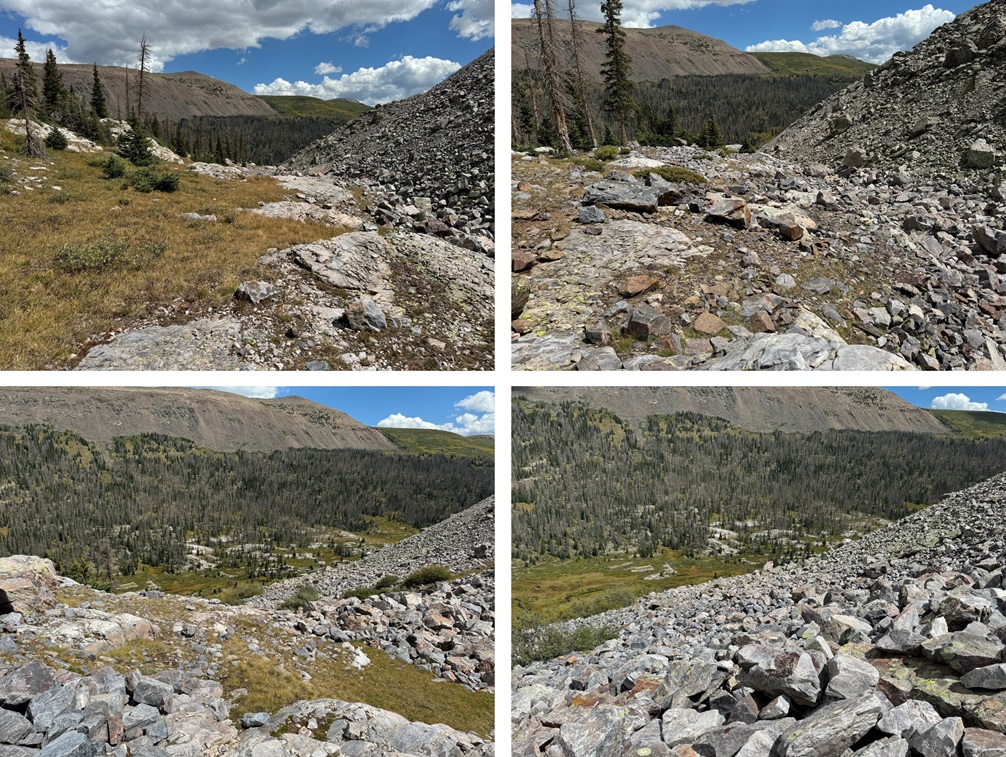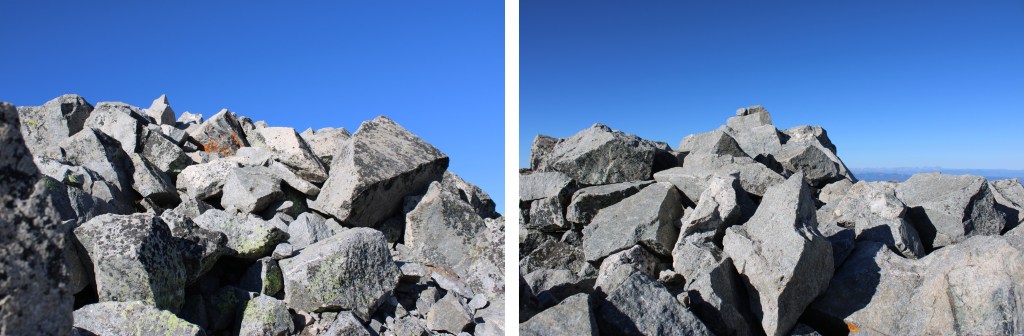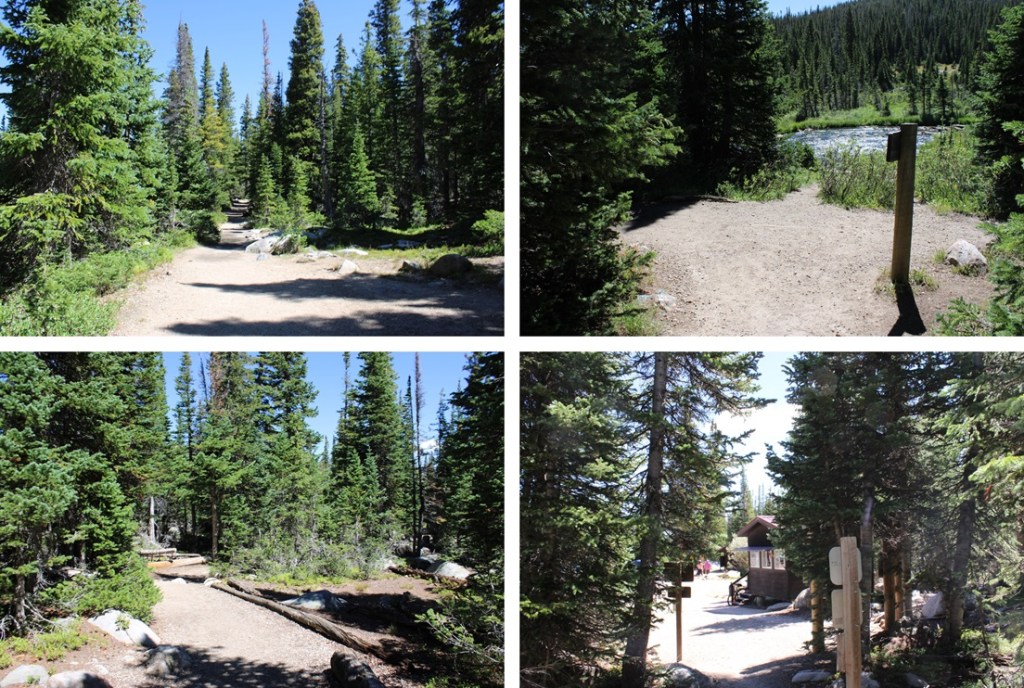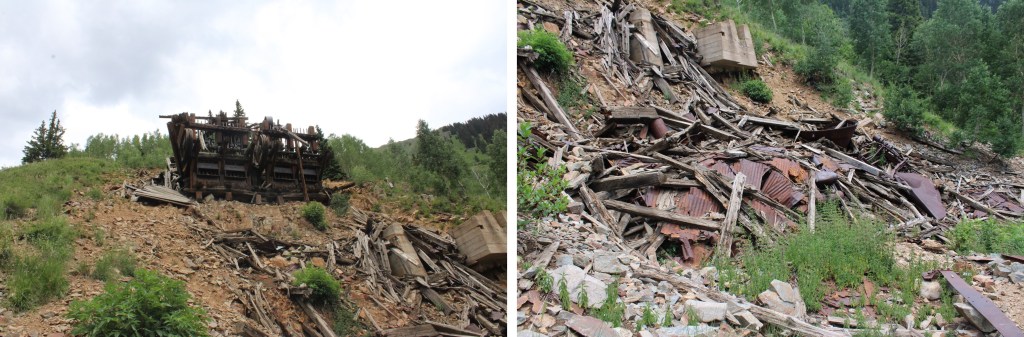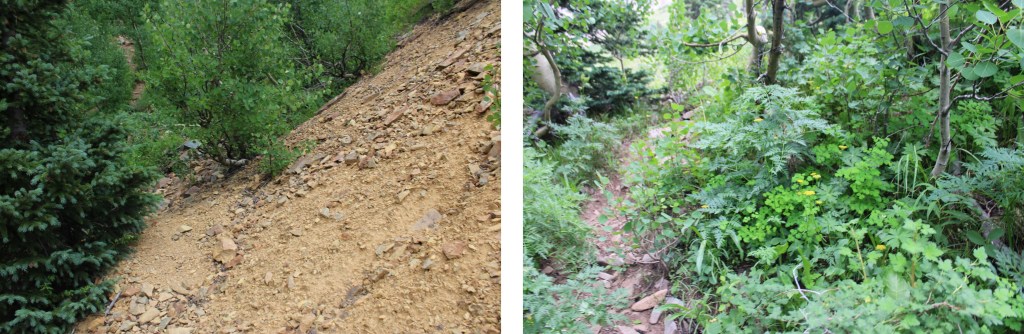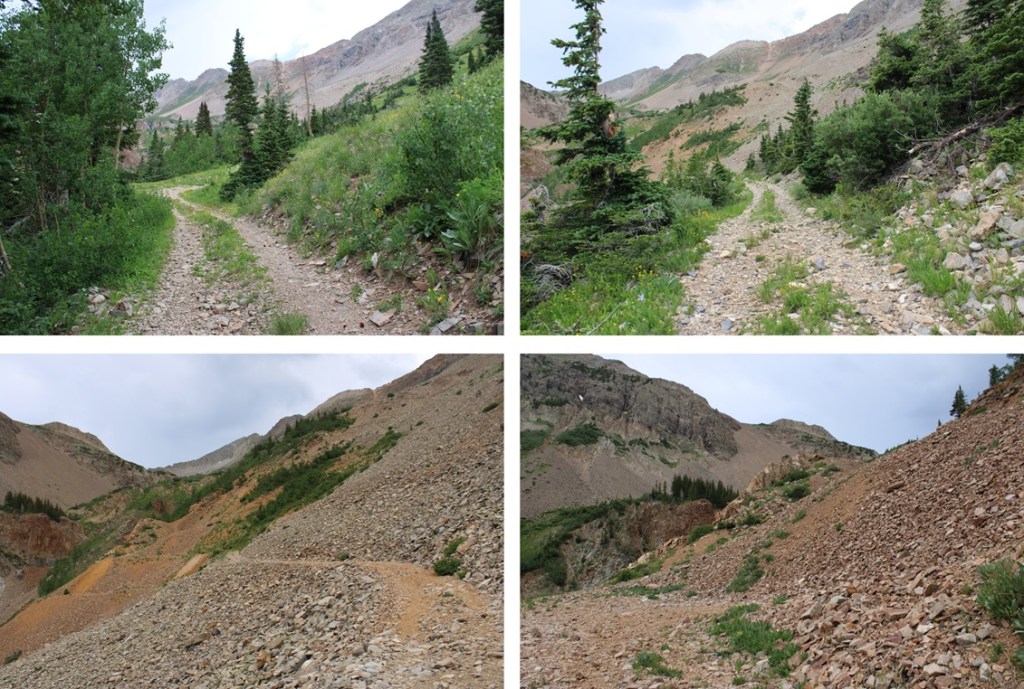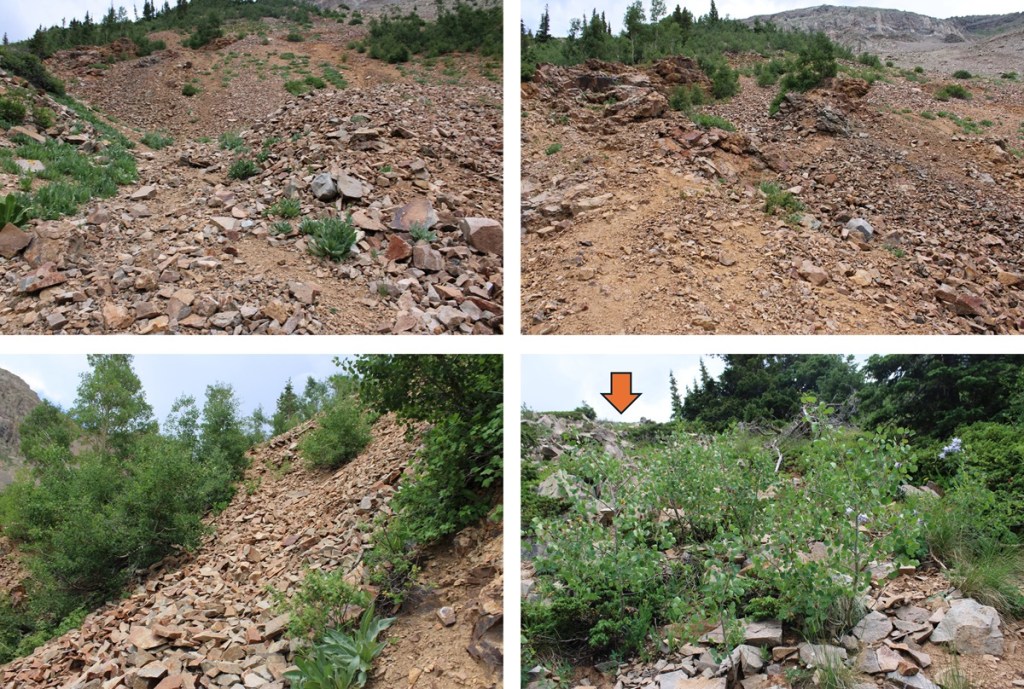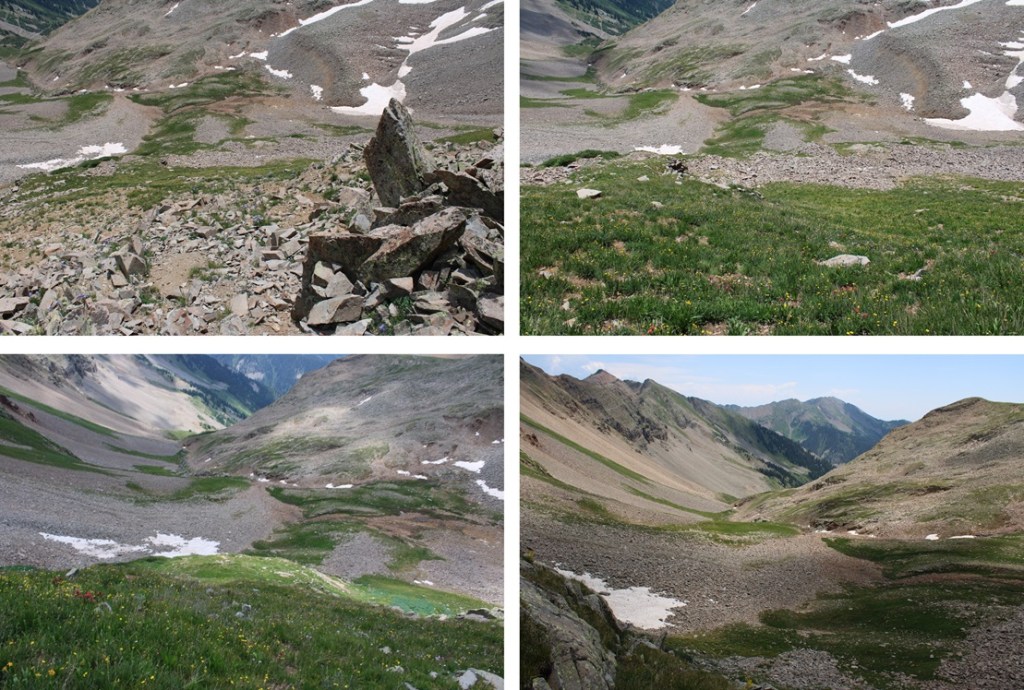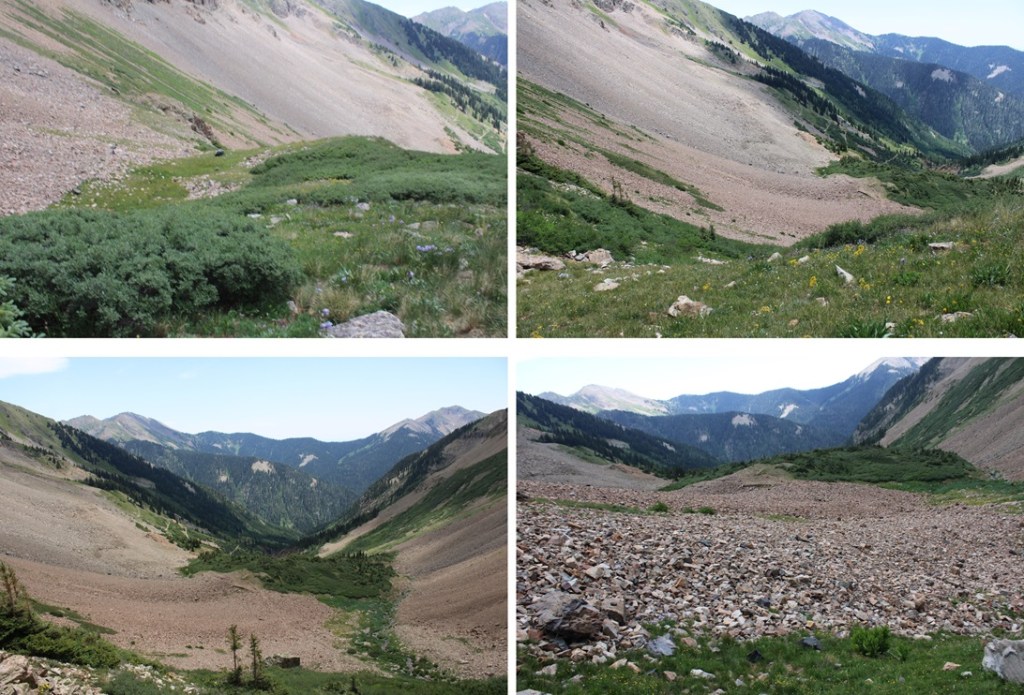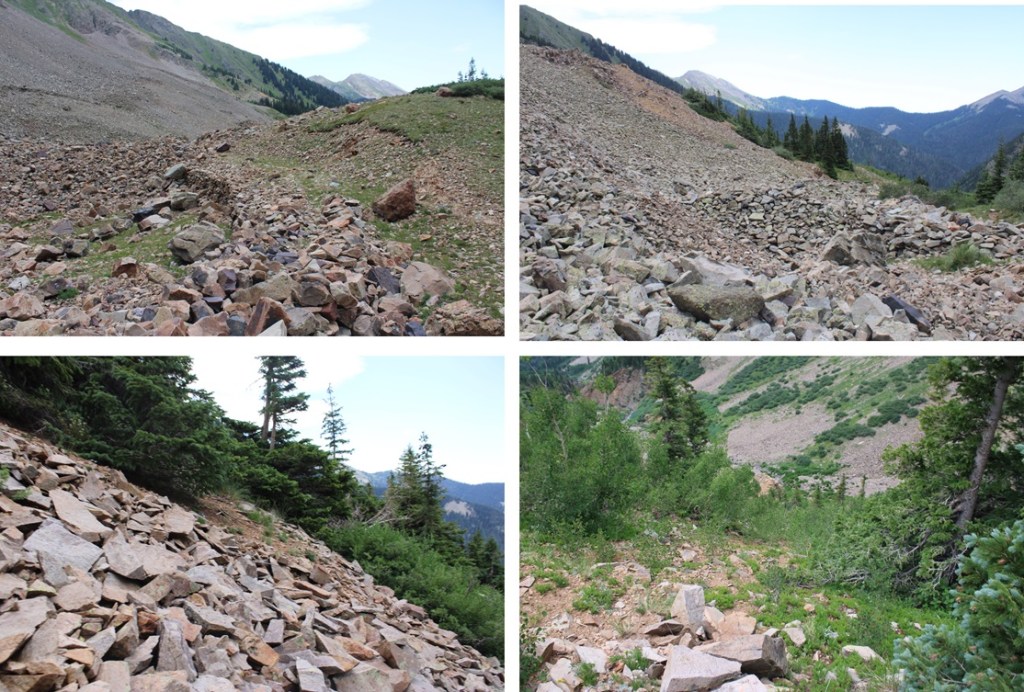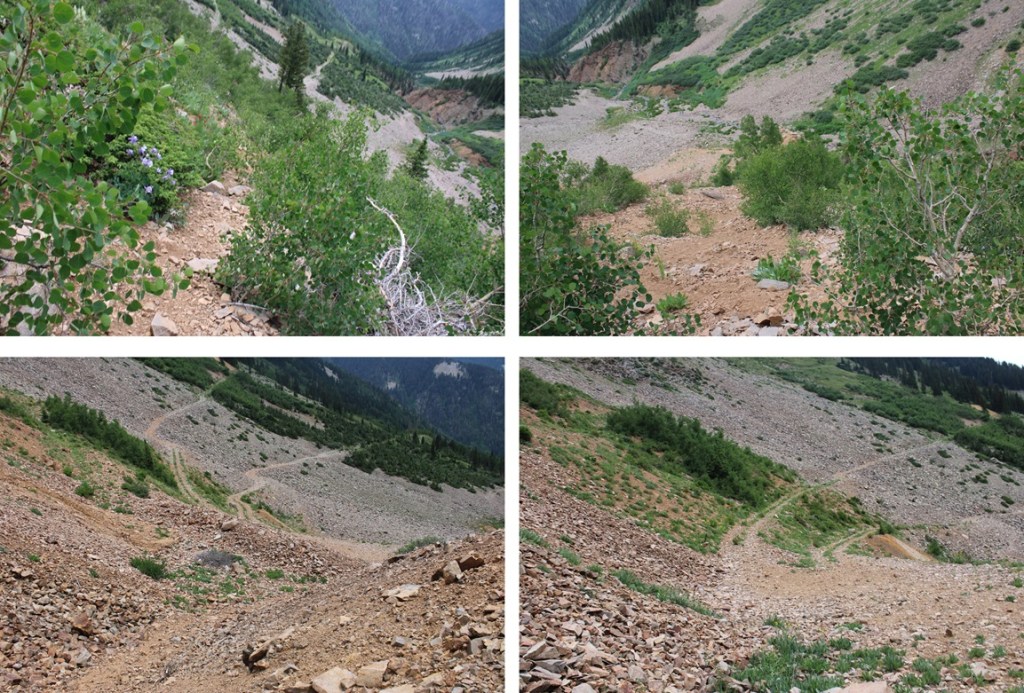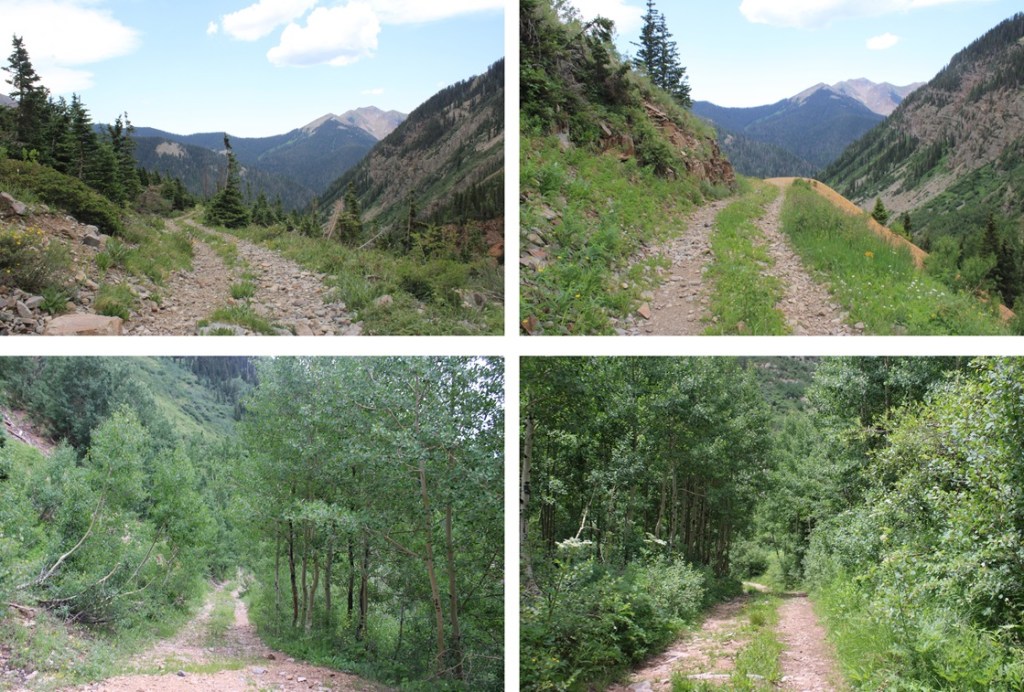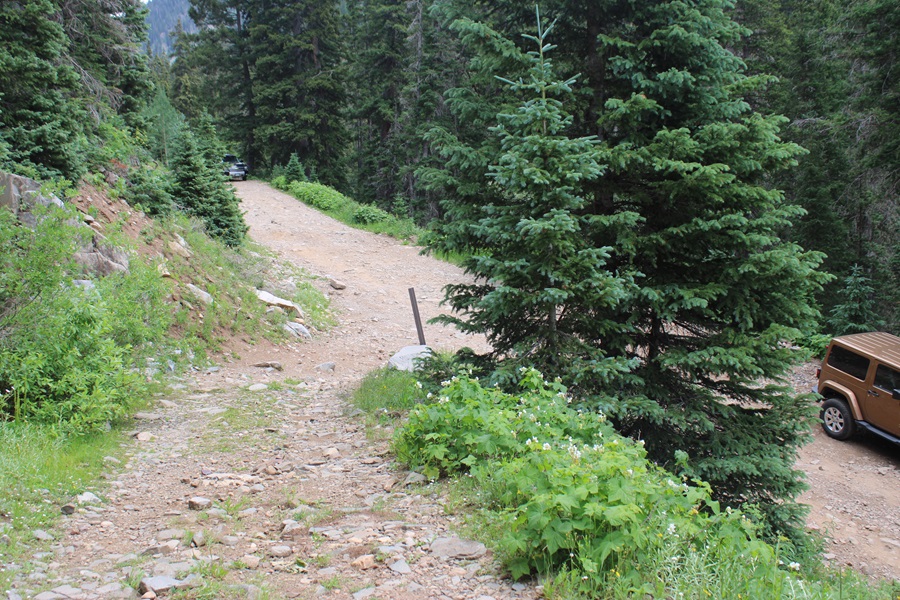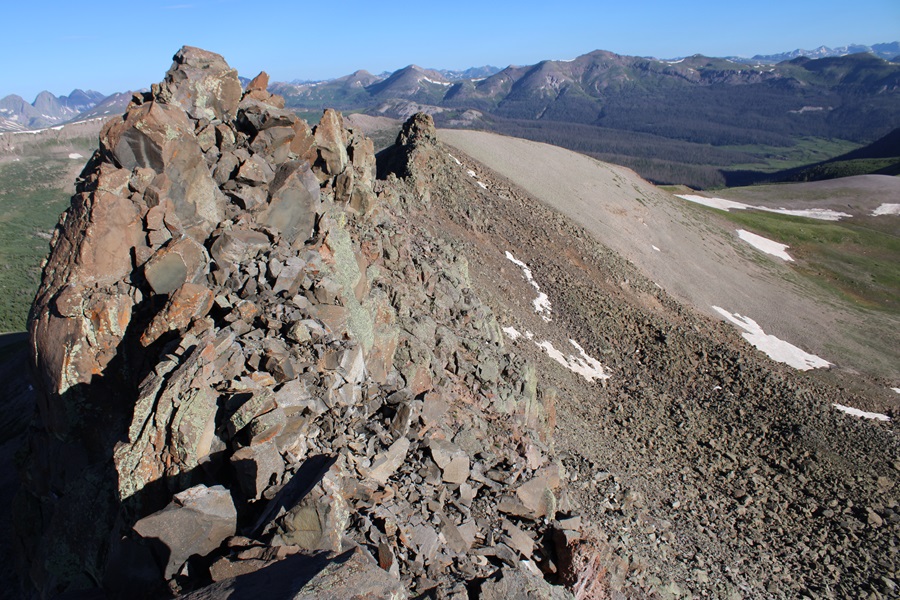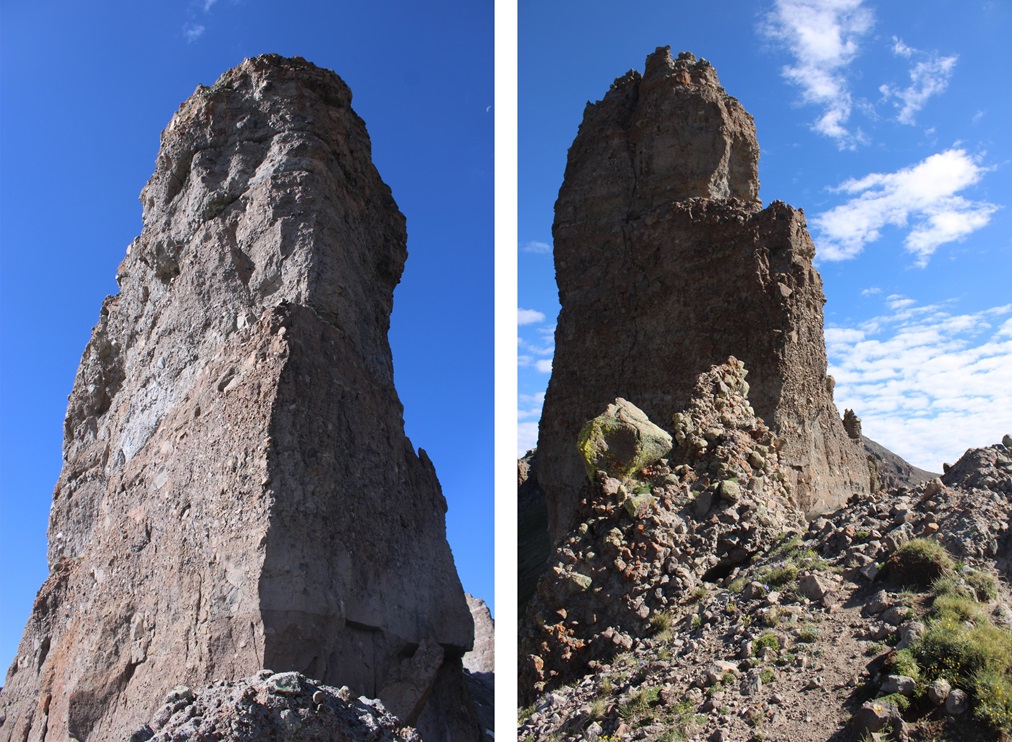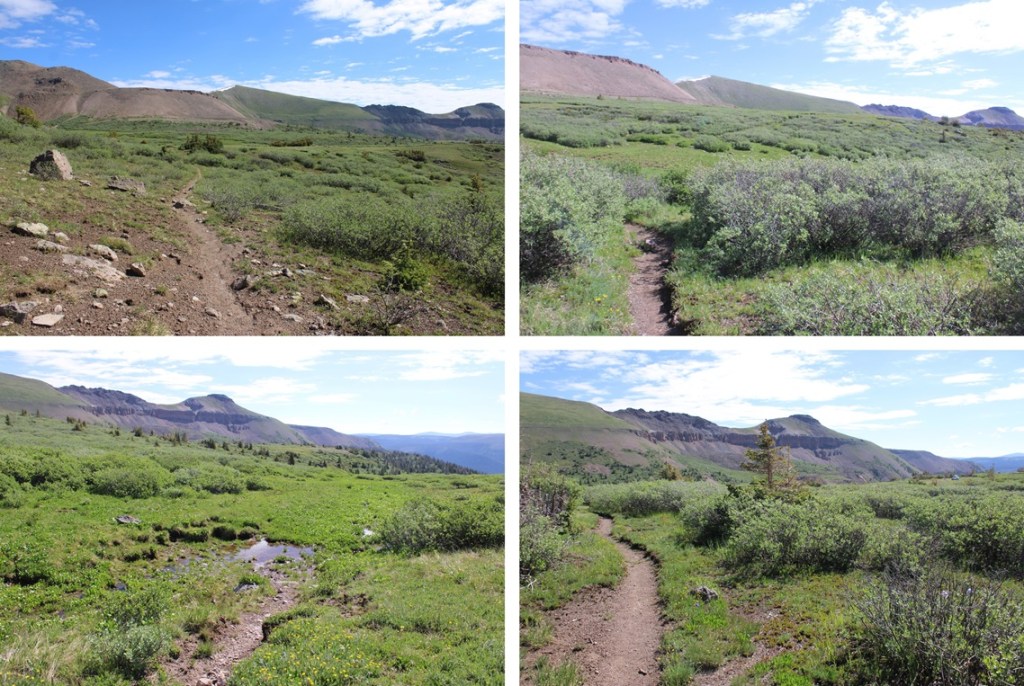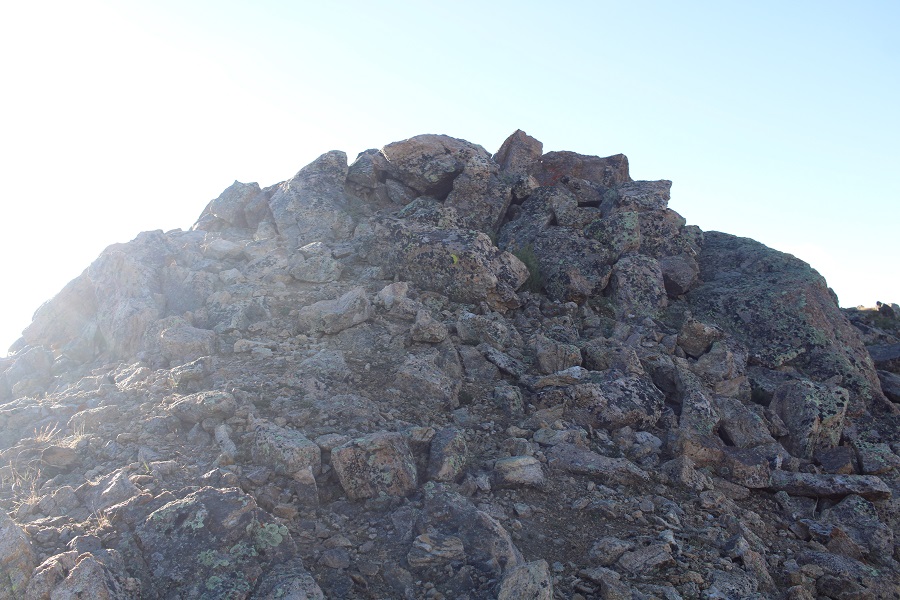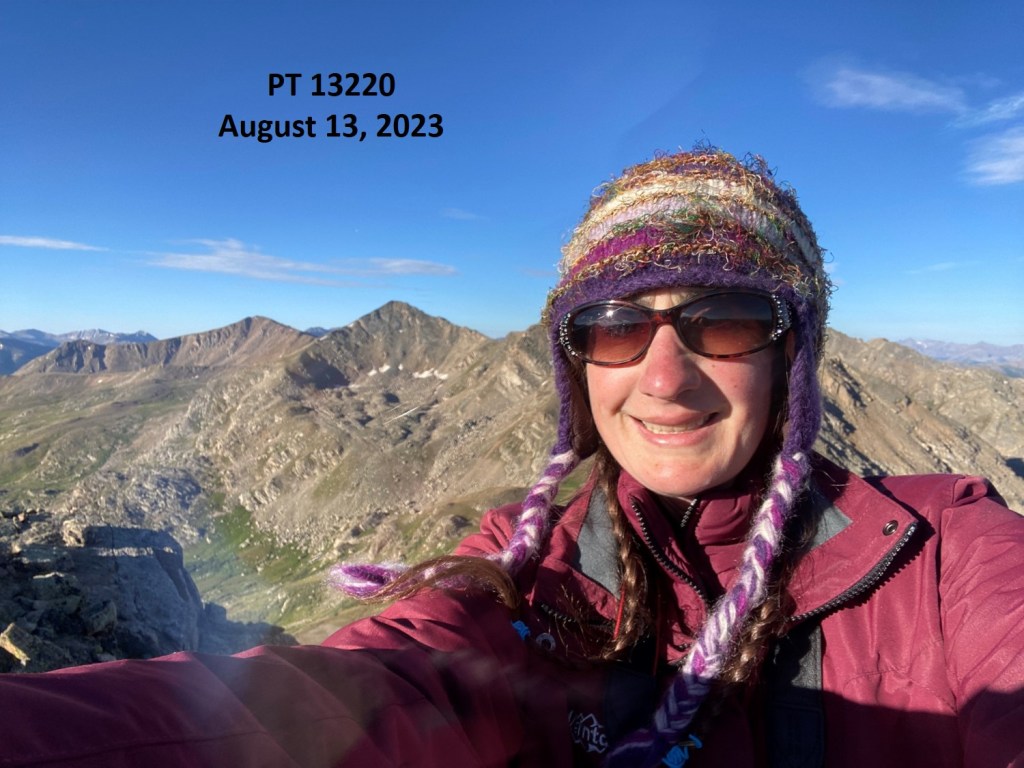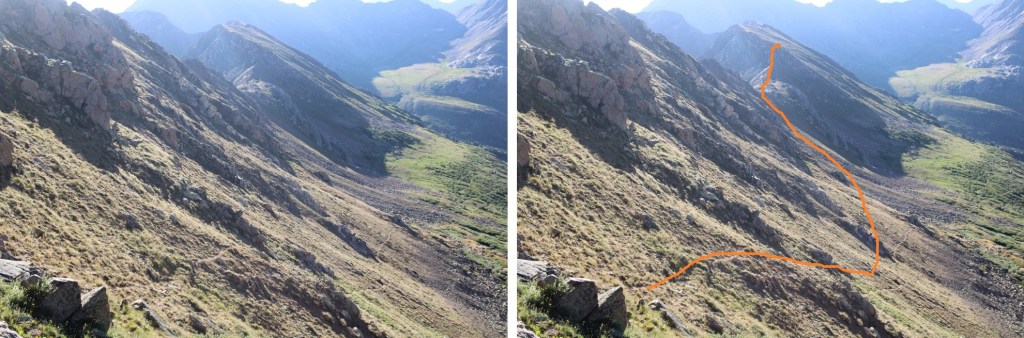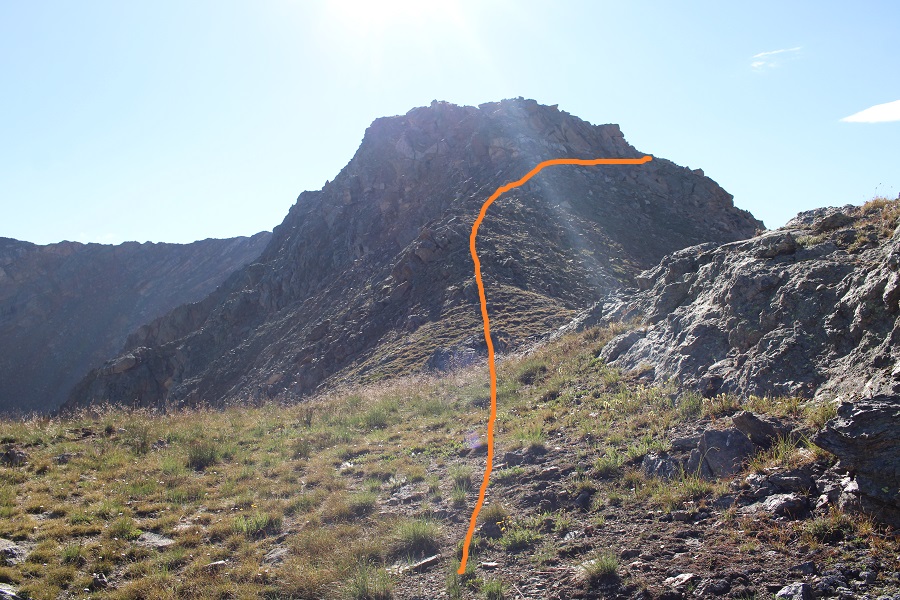
PT 13204

RT Length:  Varies depending on route (see below)

Elevation Gain:  Varies depending on route (see below)

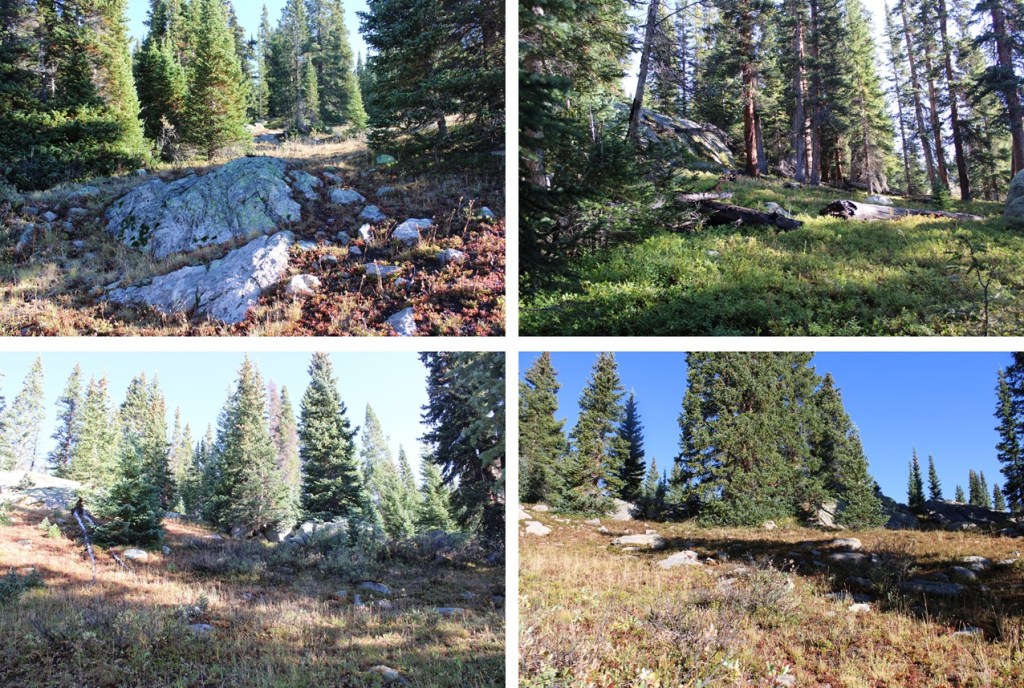
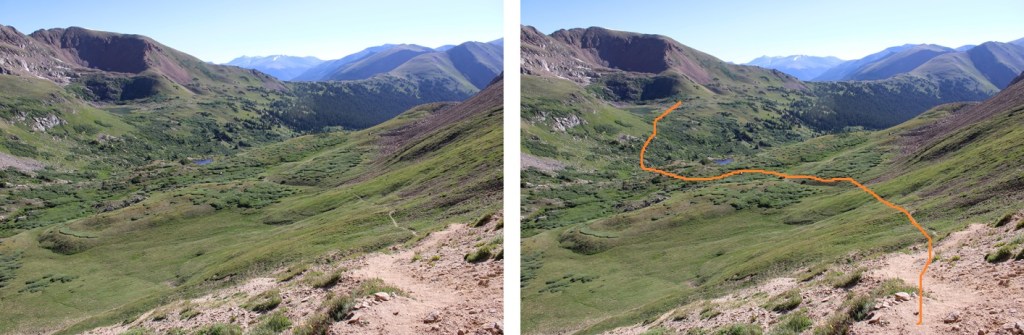
This is a three-trip-report peak for me, so my numbers are all splattered together.  I had an idea this peak would take me several attempts to get, so I came prepared and brought my backpacking gear.  I’m going to give you the three reports as they happened.  I found a way to make this a class 4, 3, or 2 peak.  You can choose your route.  Either way, the approach to the place I camped in the upper basin is the same. 

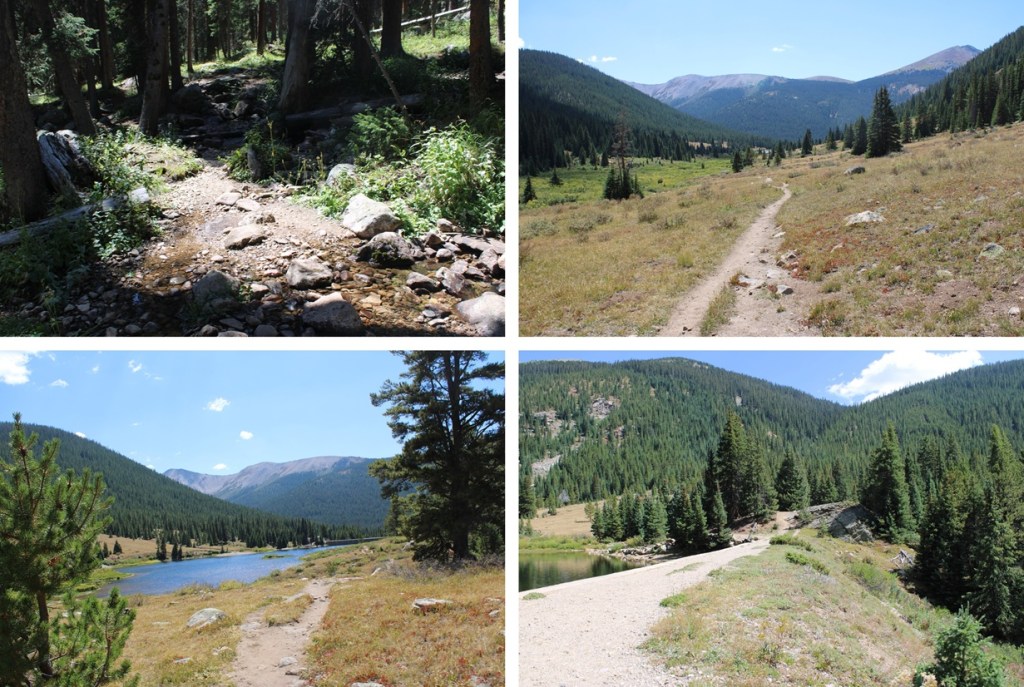
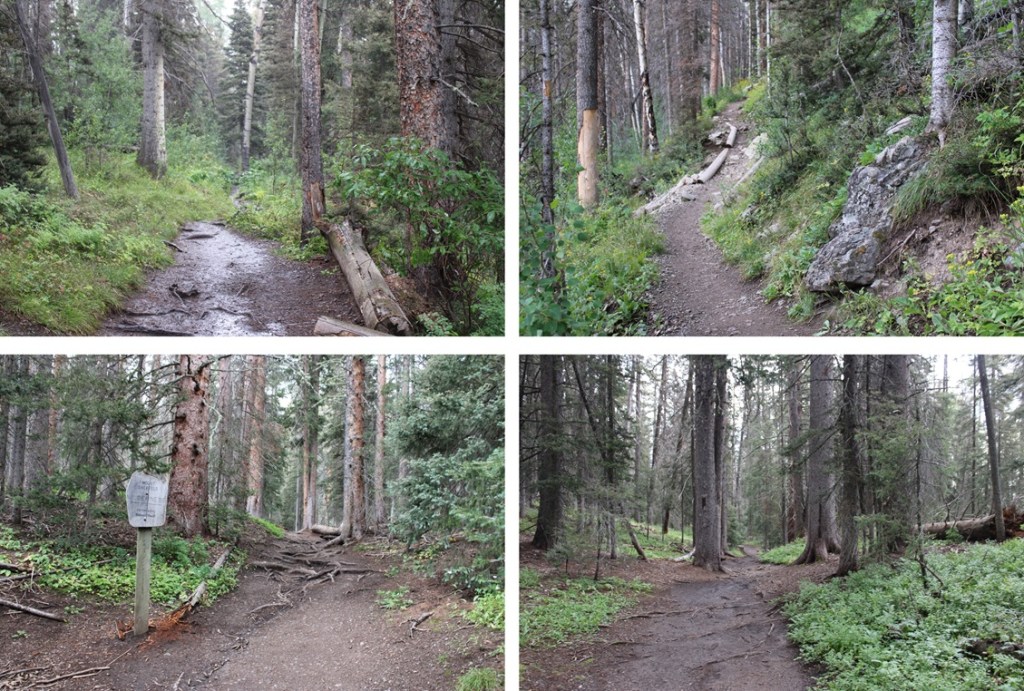
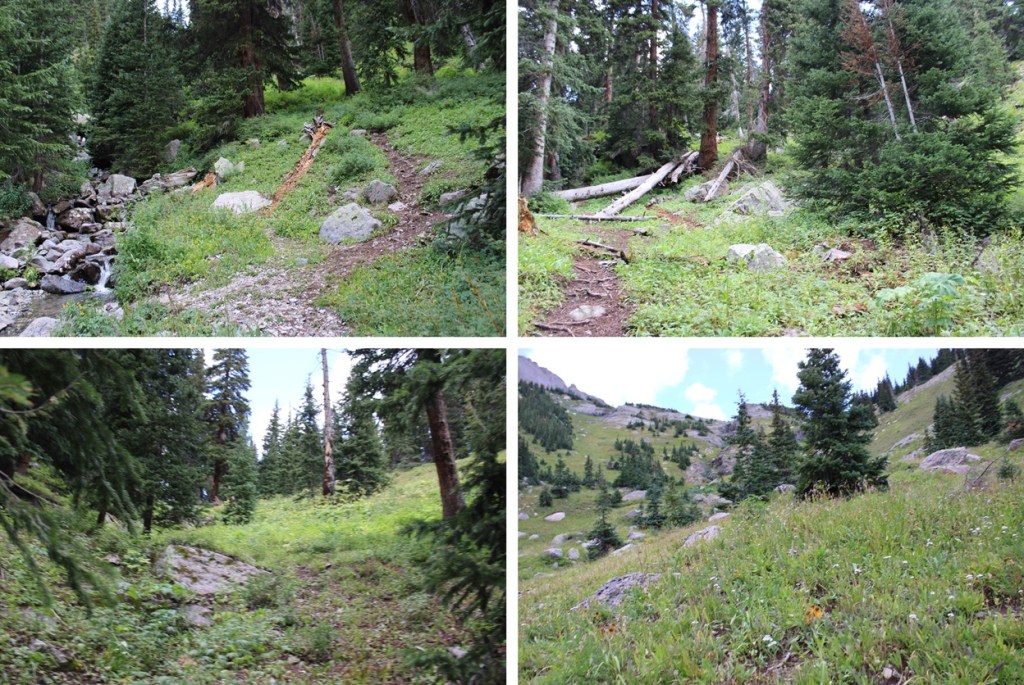
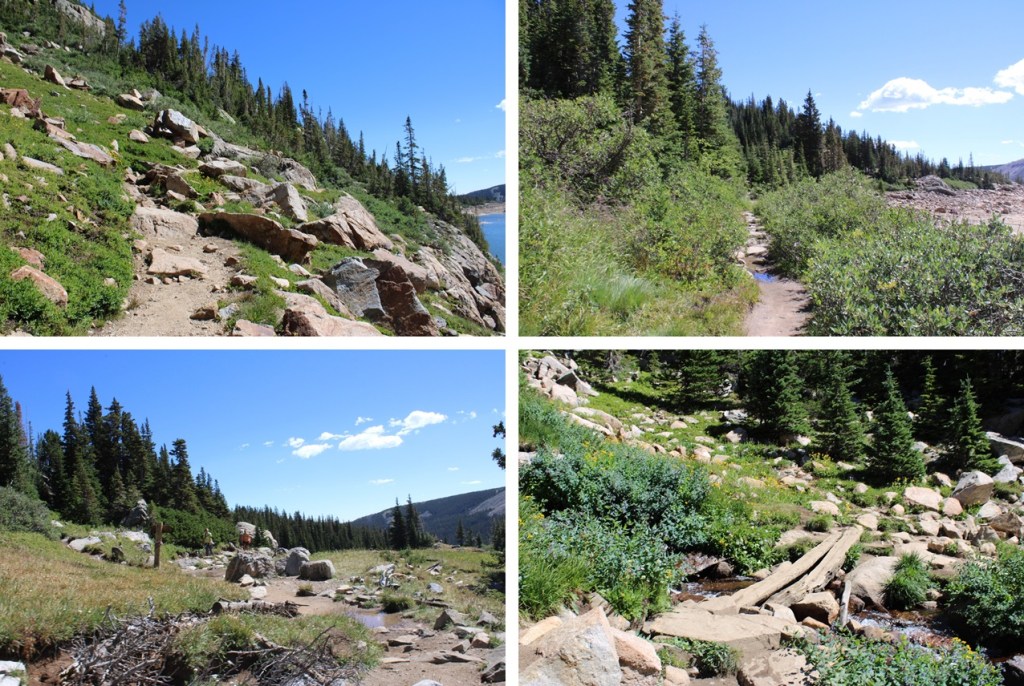
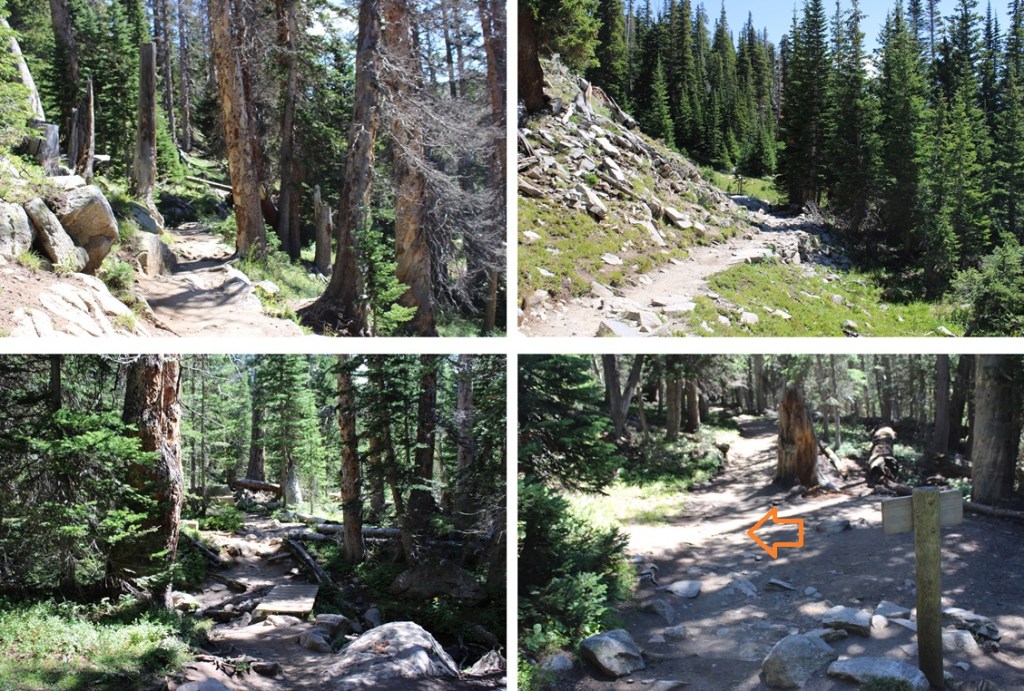
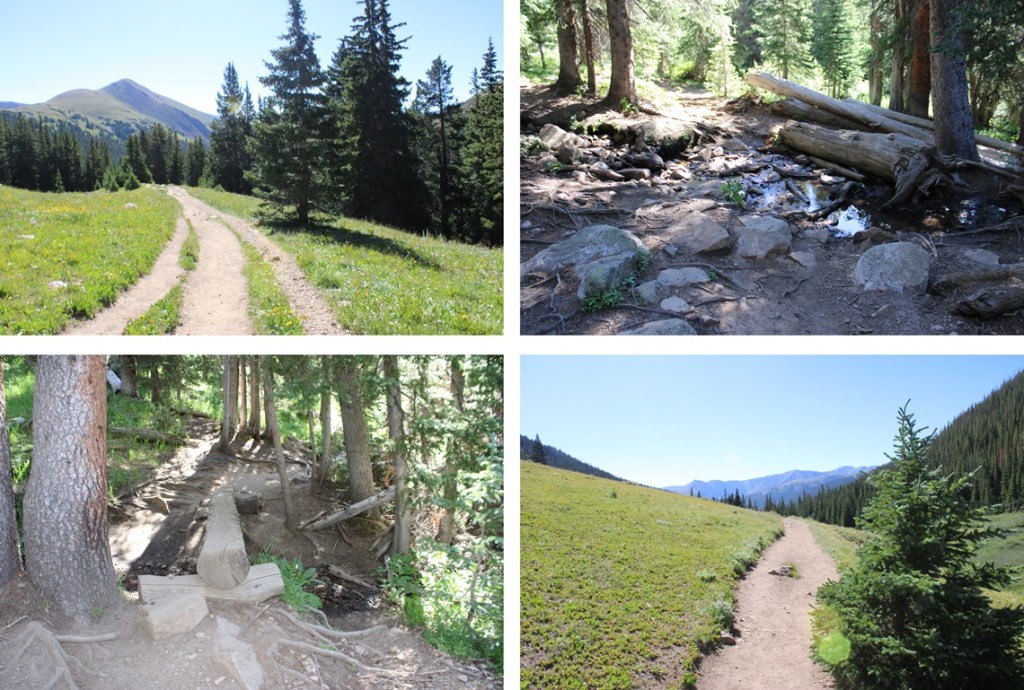
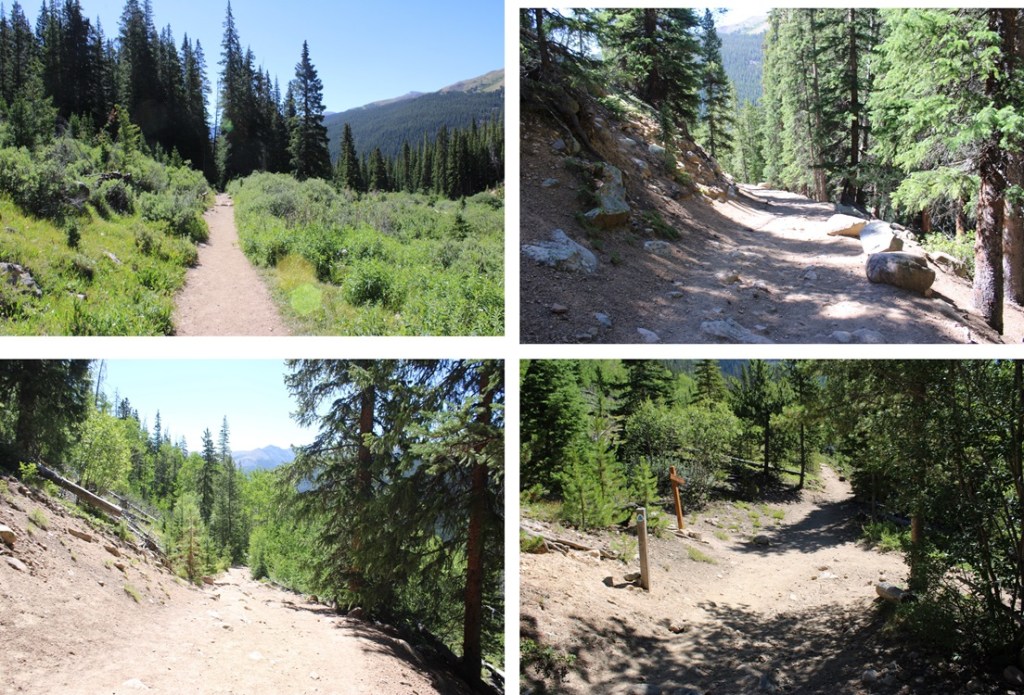
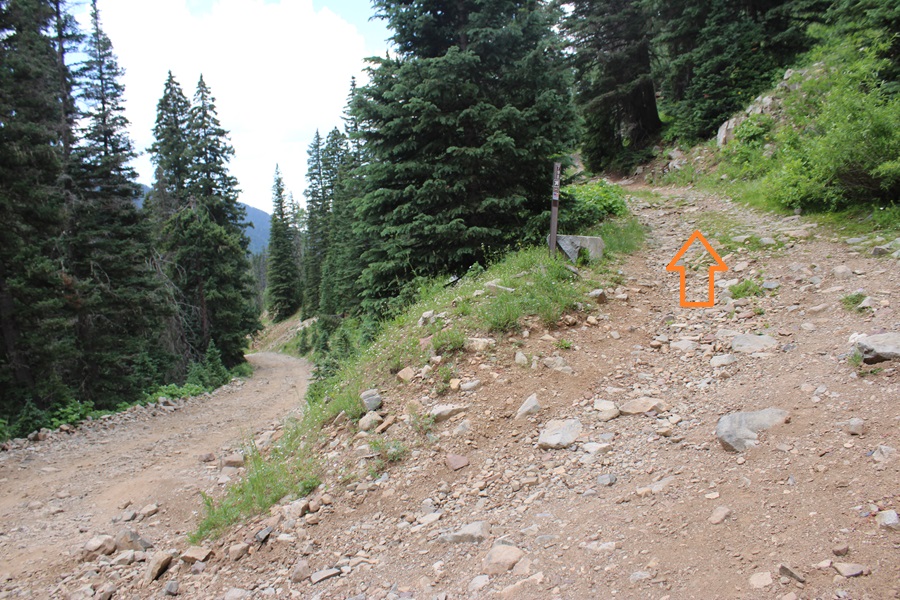
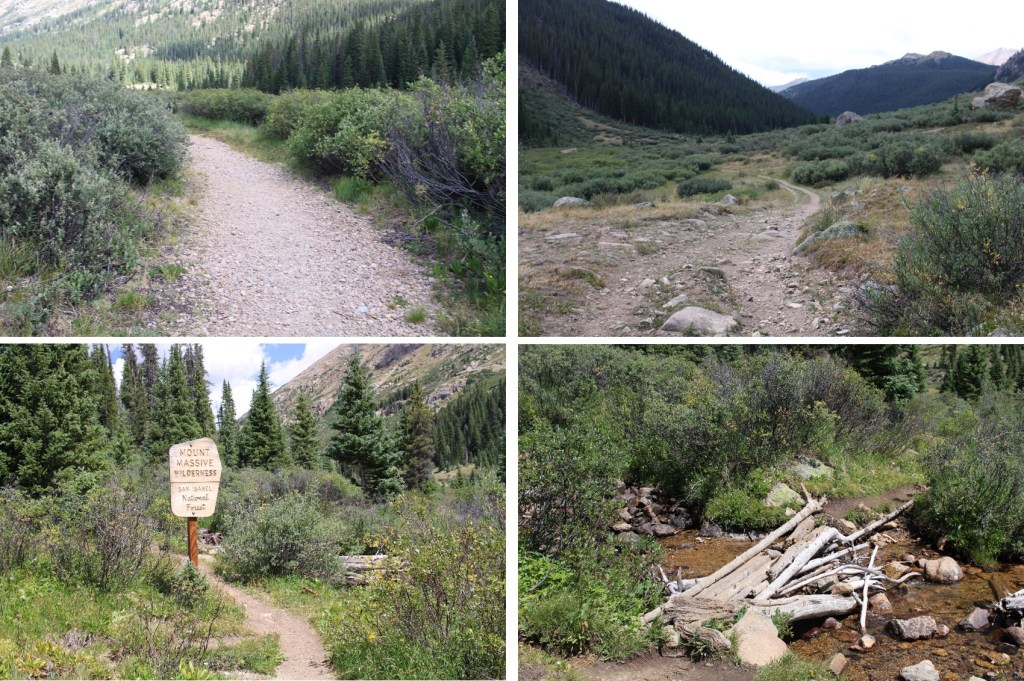
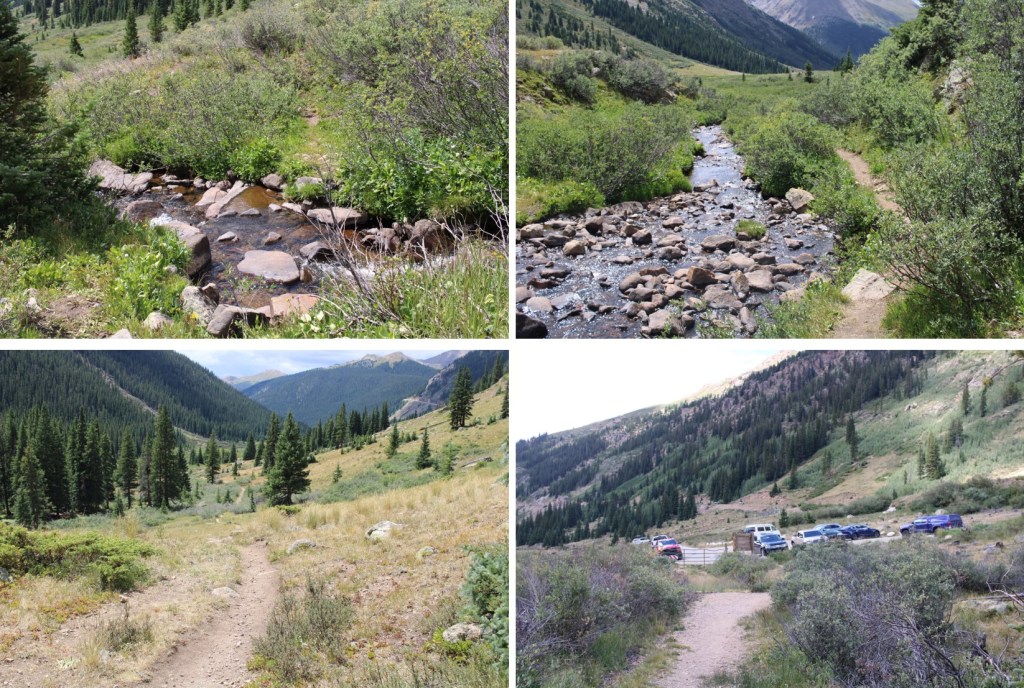
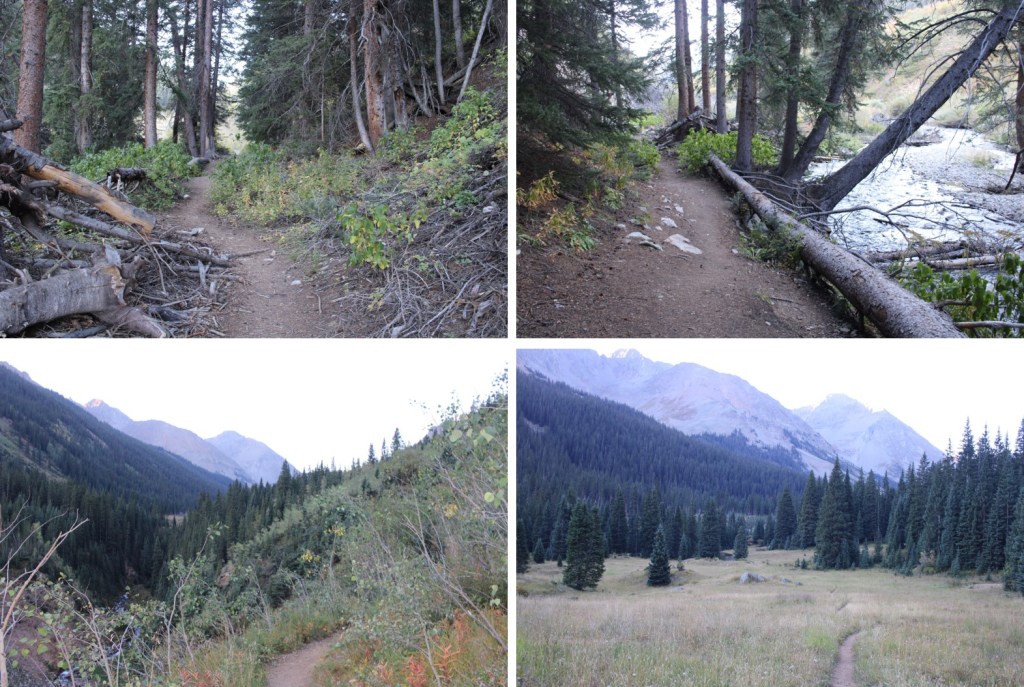
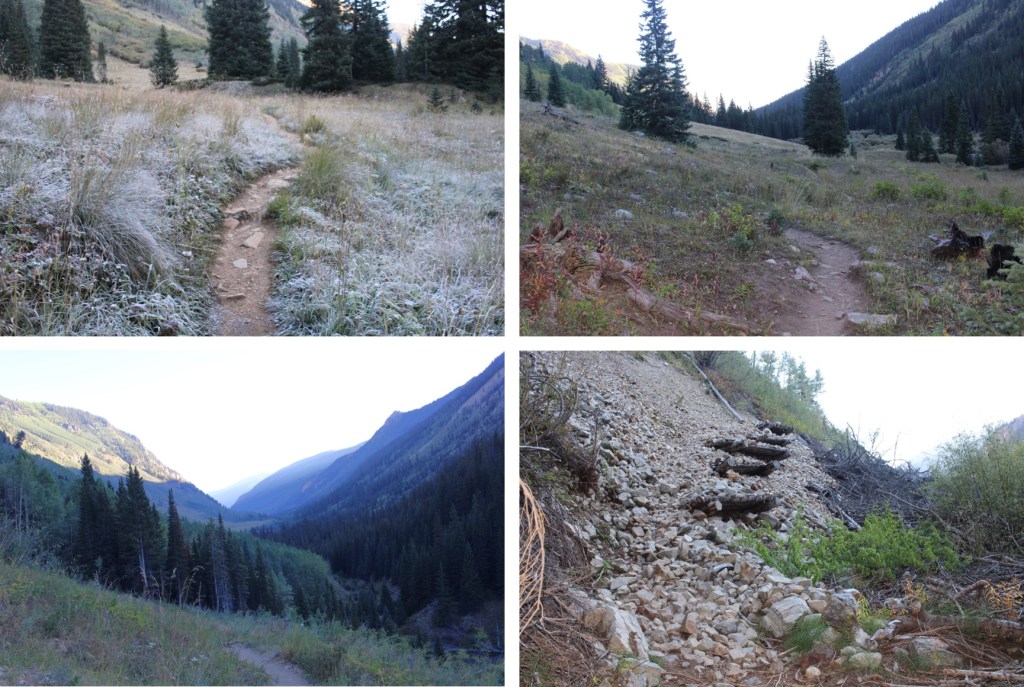
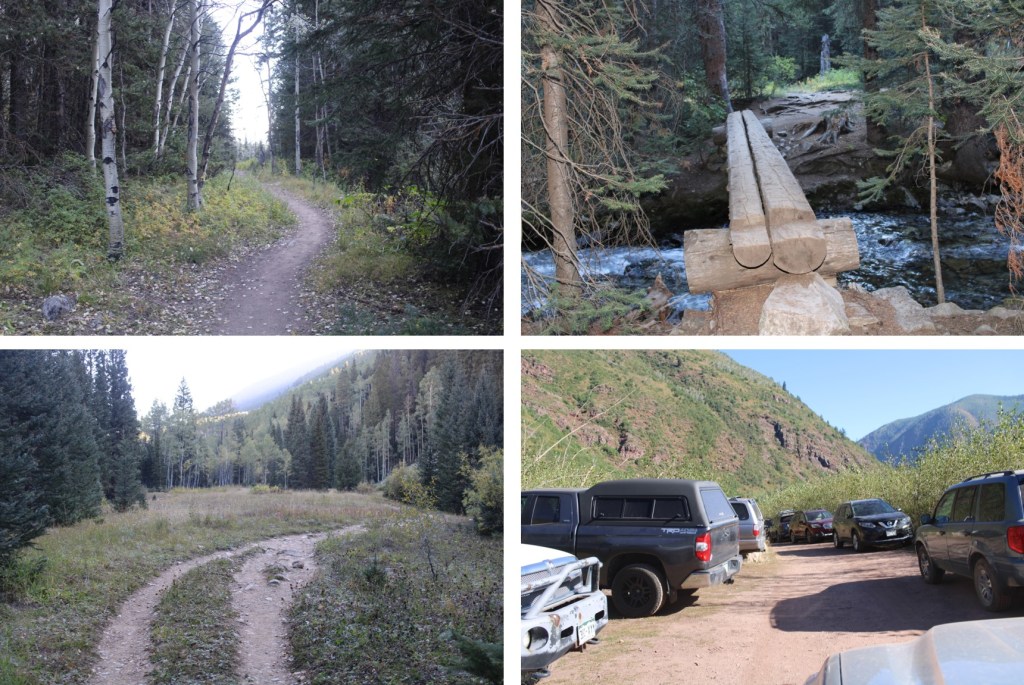
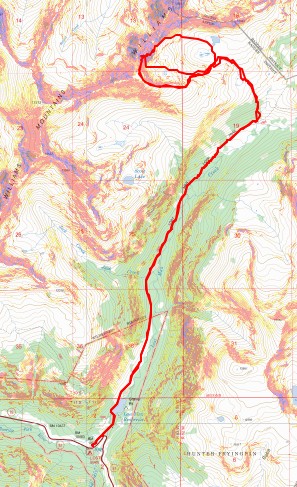
I started at the Lower Lost Man Campground and followed the trail (1996) north past Lost Man Reservoir and up towards South Fork Pass.  This is a class 1 trail I followed for about 4.25 miles.

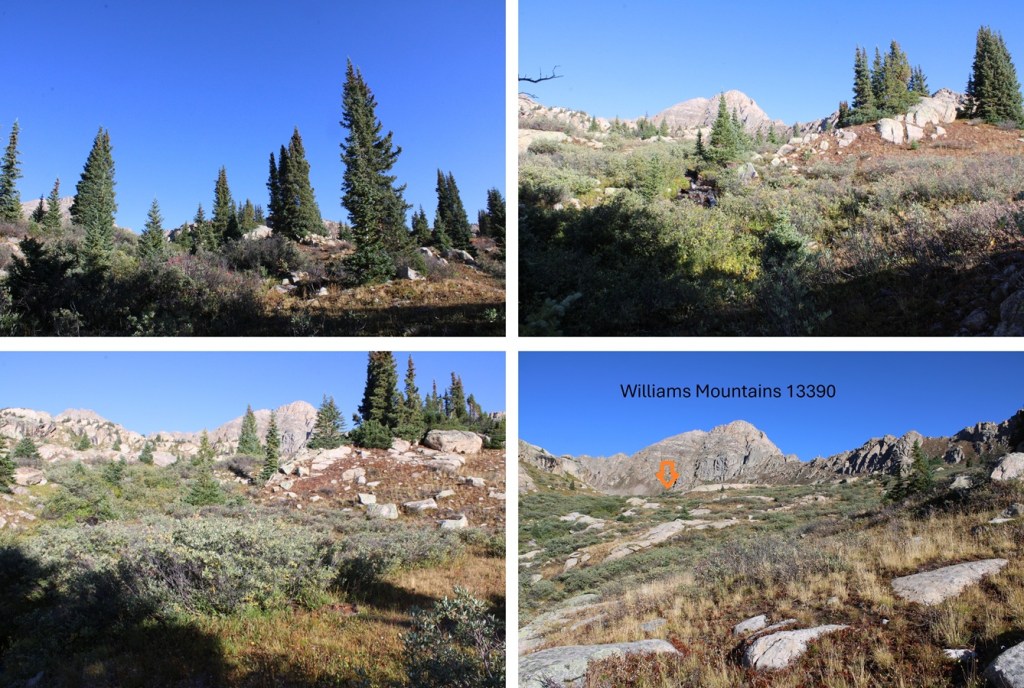
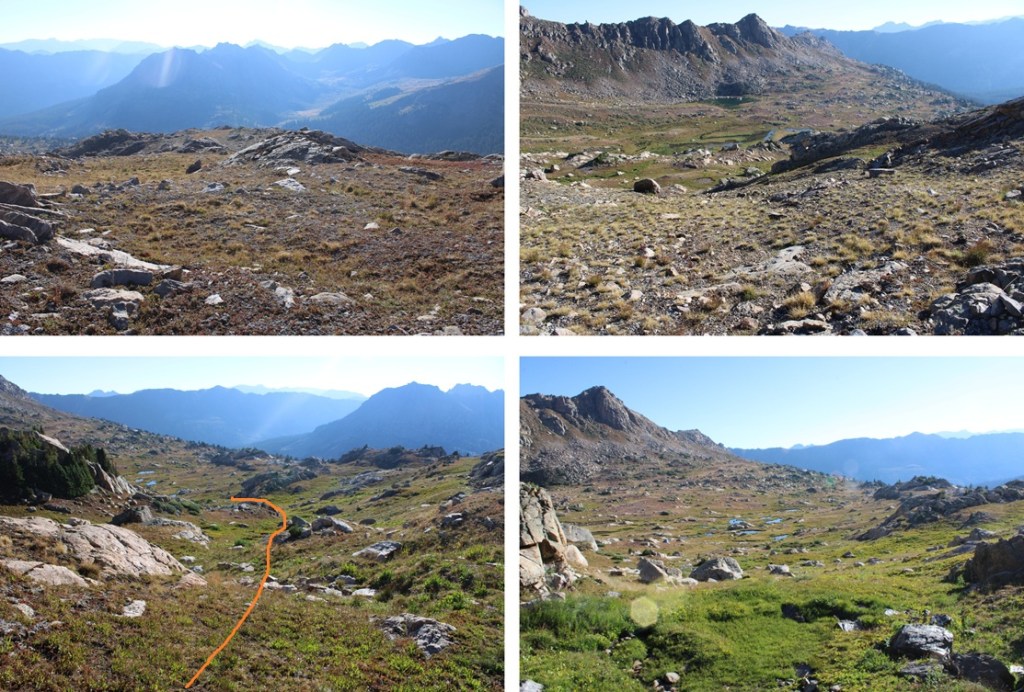
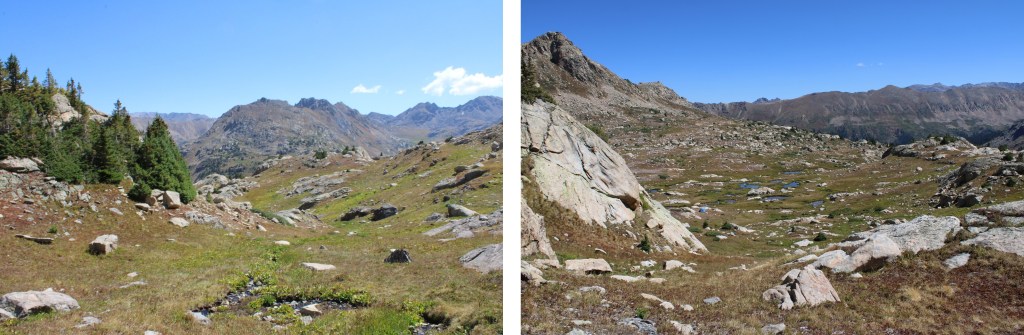
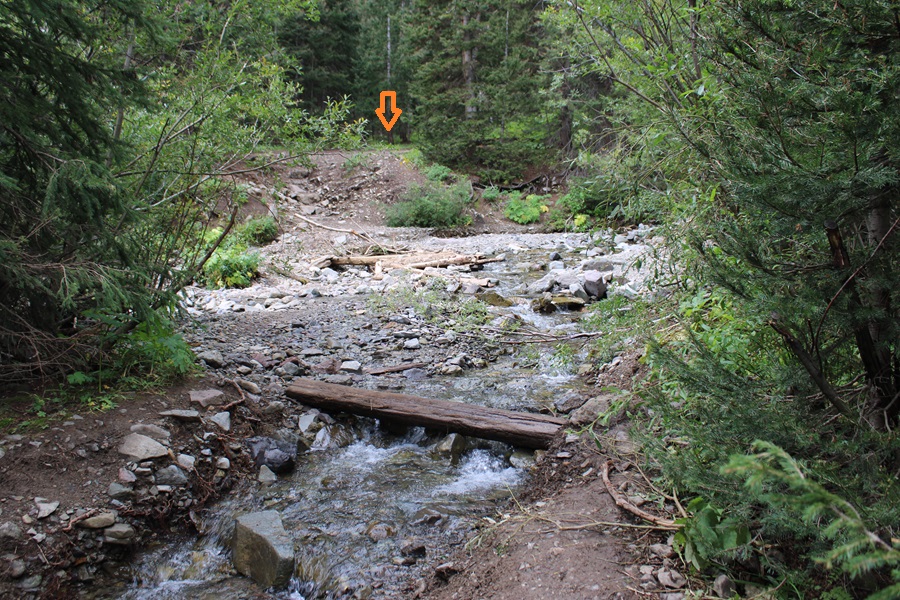
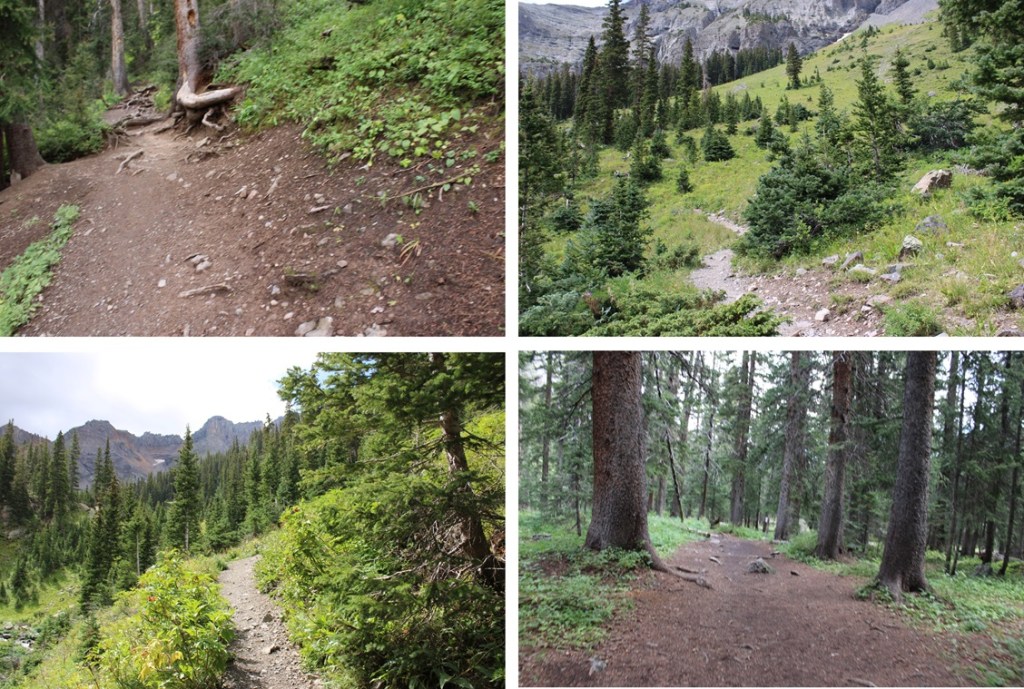
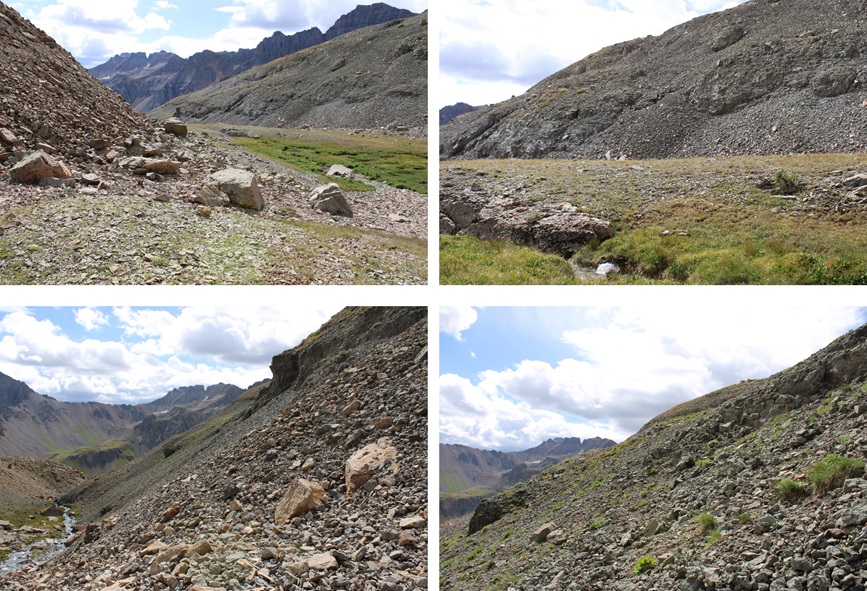
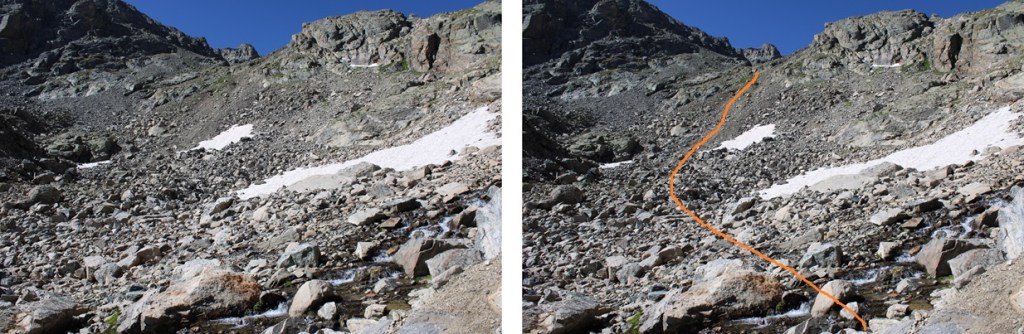
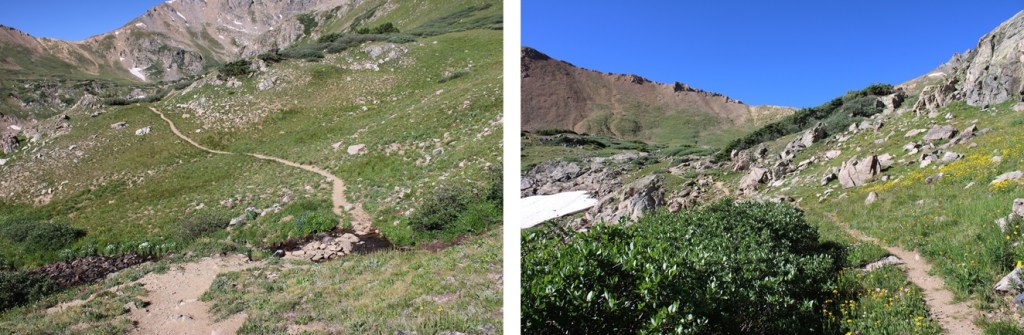
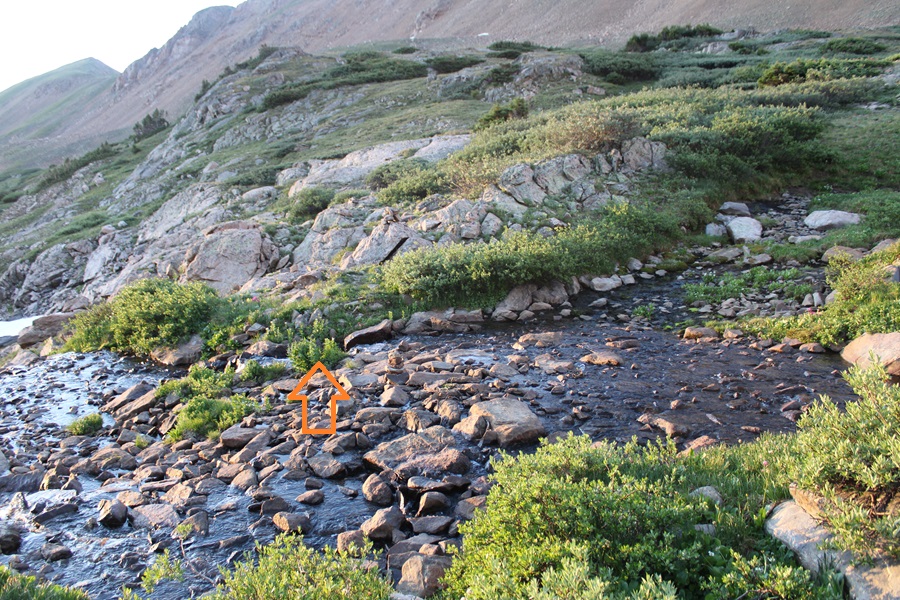
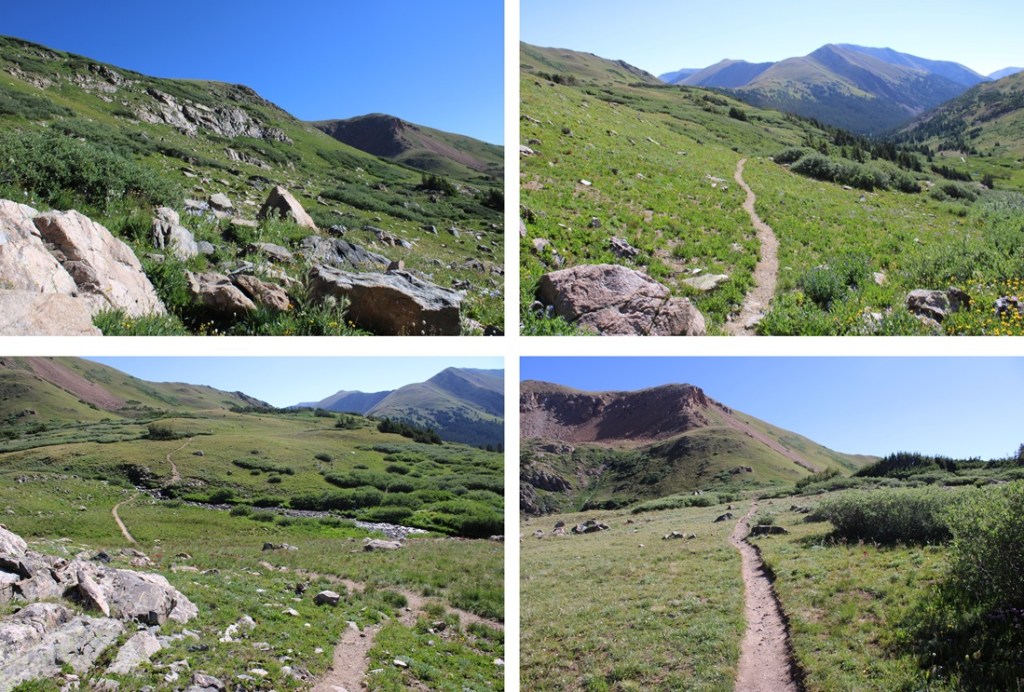
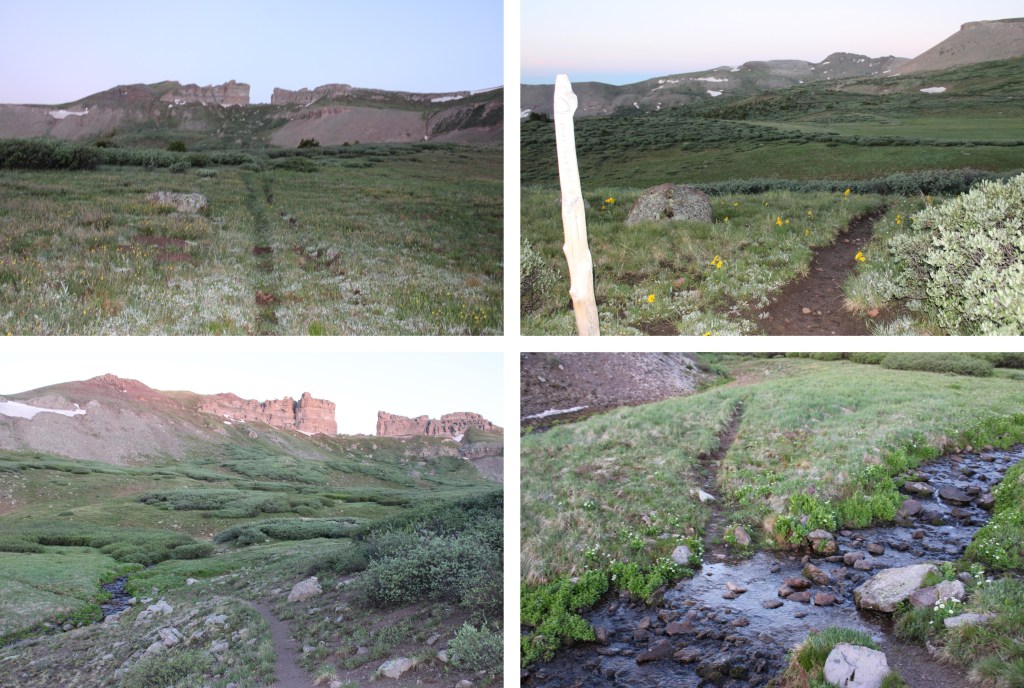
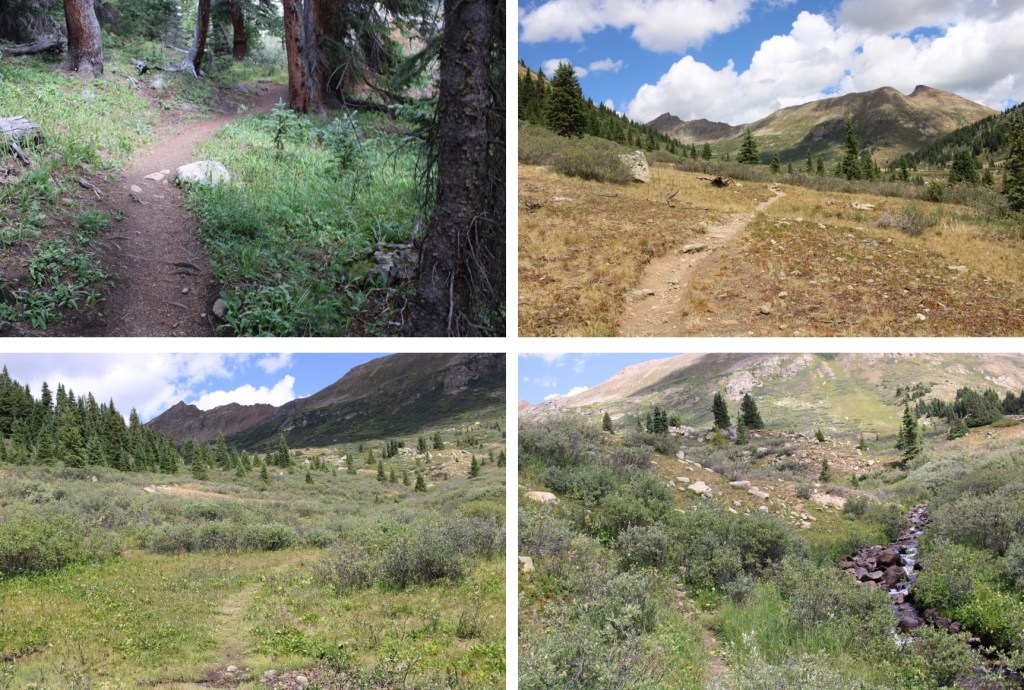
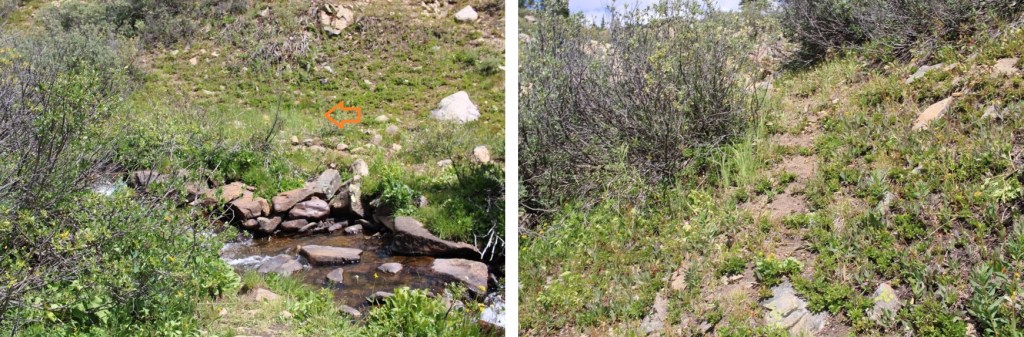
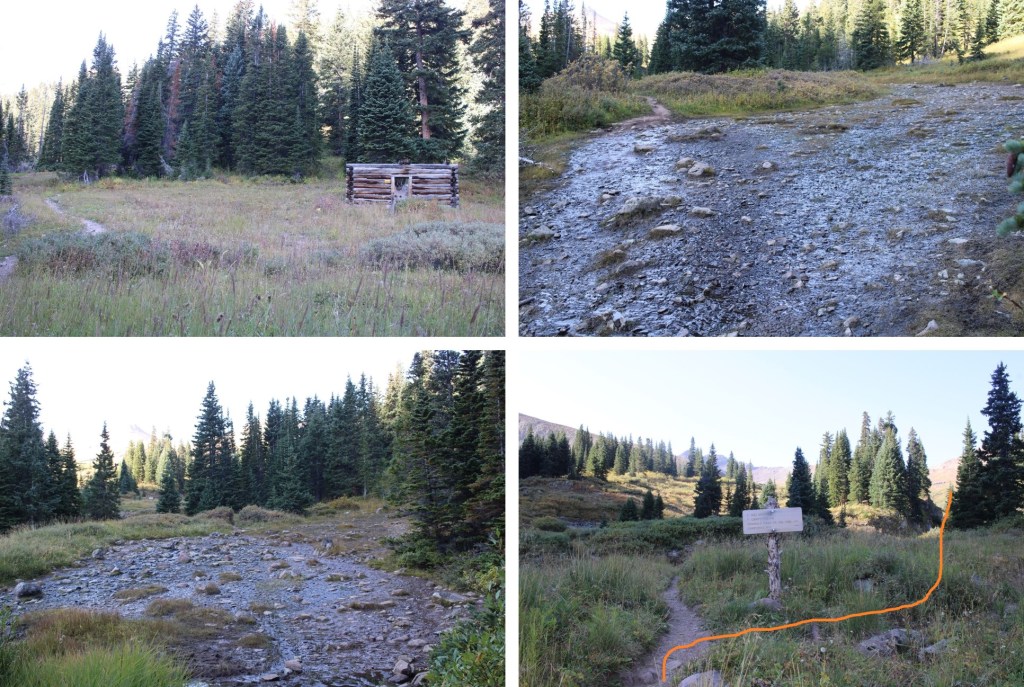
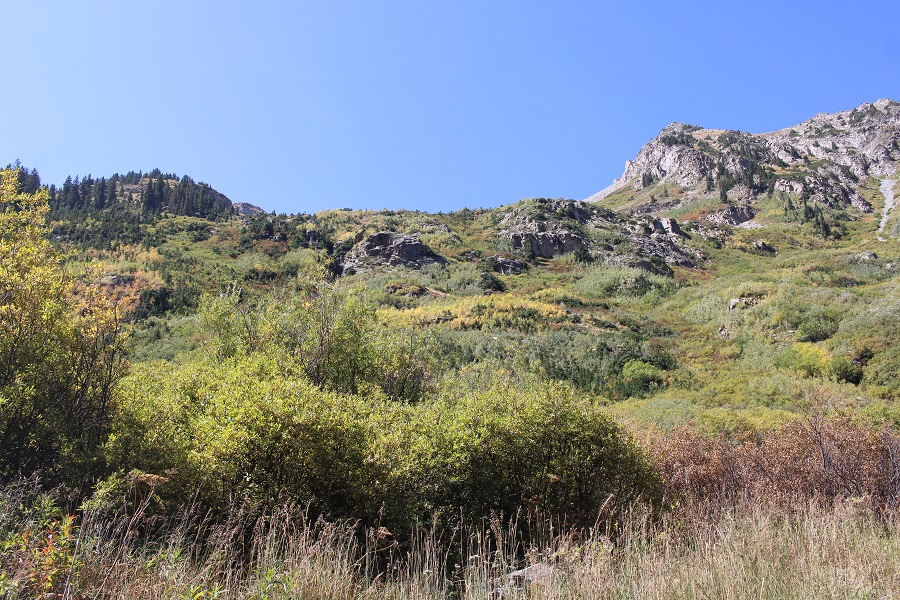
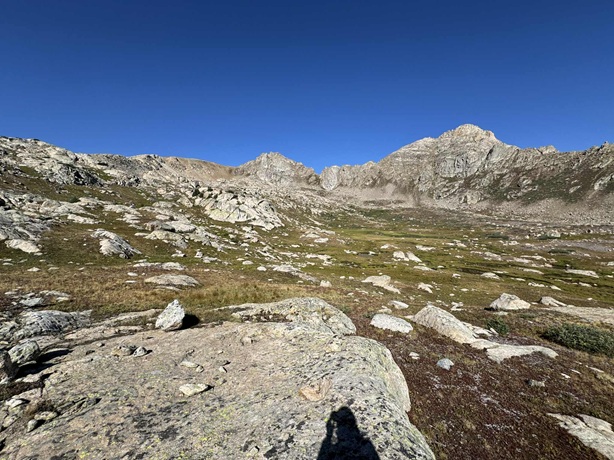
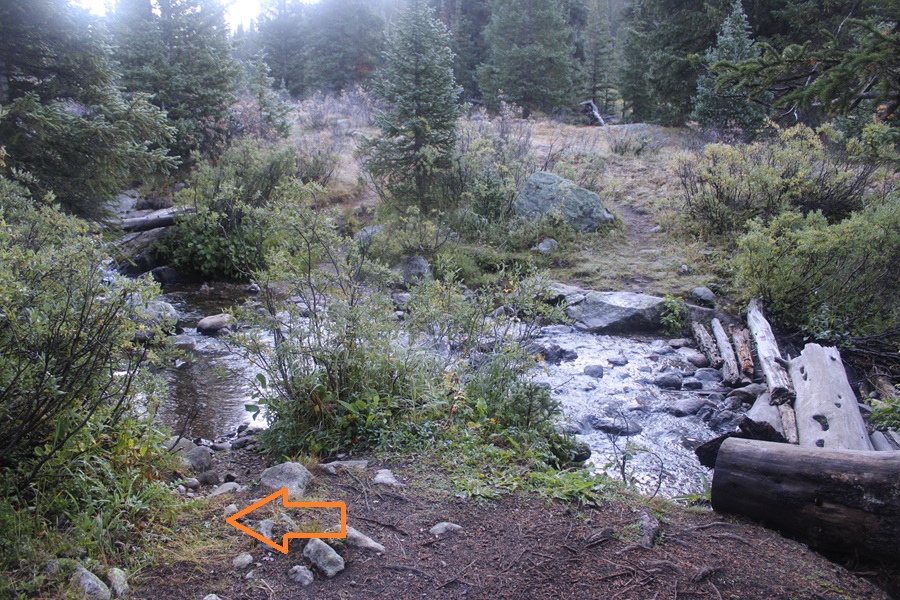
After about 4.25 miles, at 11430’, and just before the third creek crossing I turned left and followed the creek for about 20 yards before crossing the creek and then following the creek up to an upper basin, heading northeast.  This creek isn’t named, and neither is the basin, but following it will put you just east of 13024.  This is class 2.  It’s less than a mile to make it into the basin once you leave the trail.
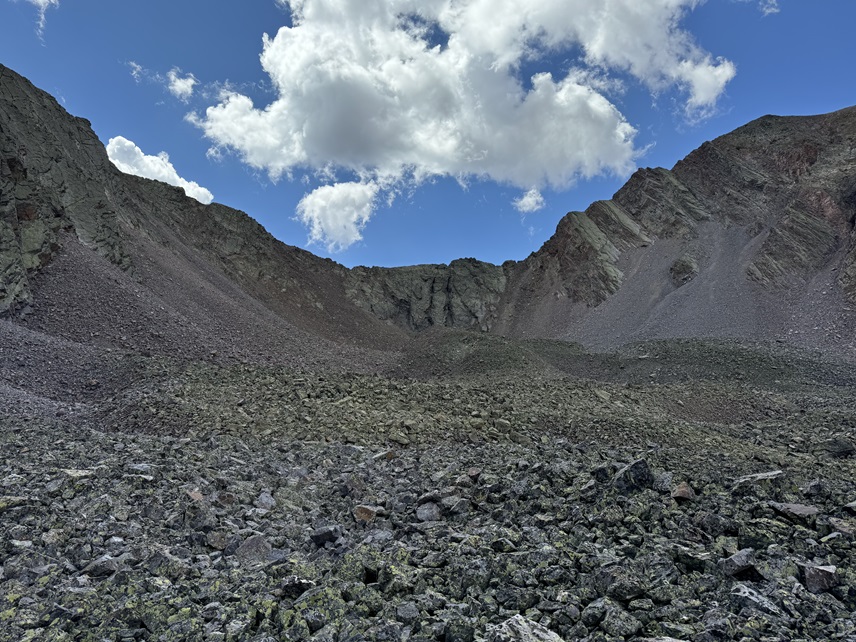
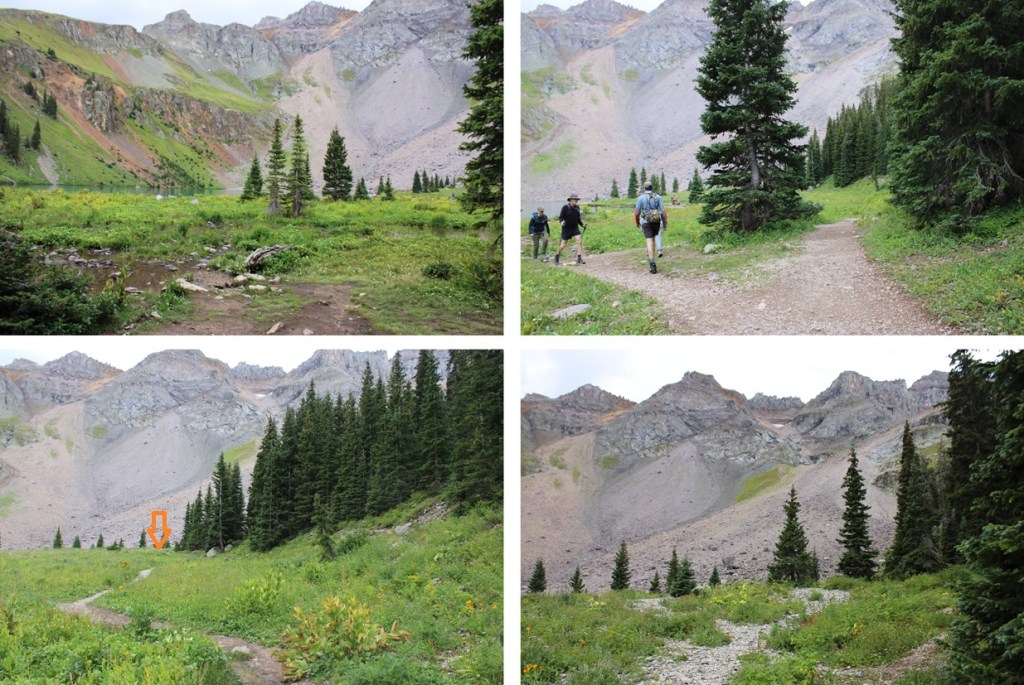
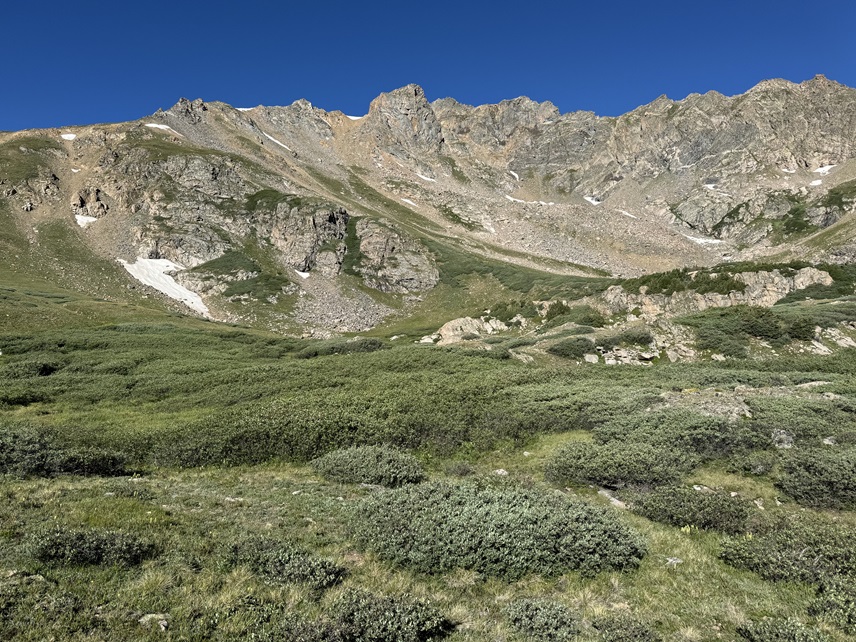
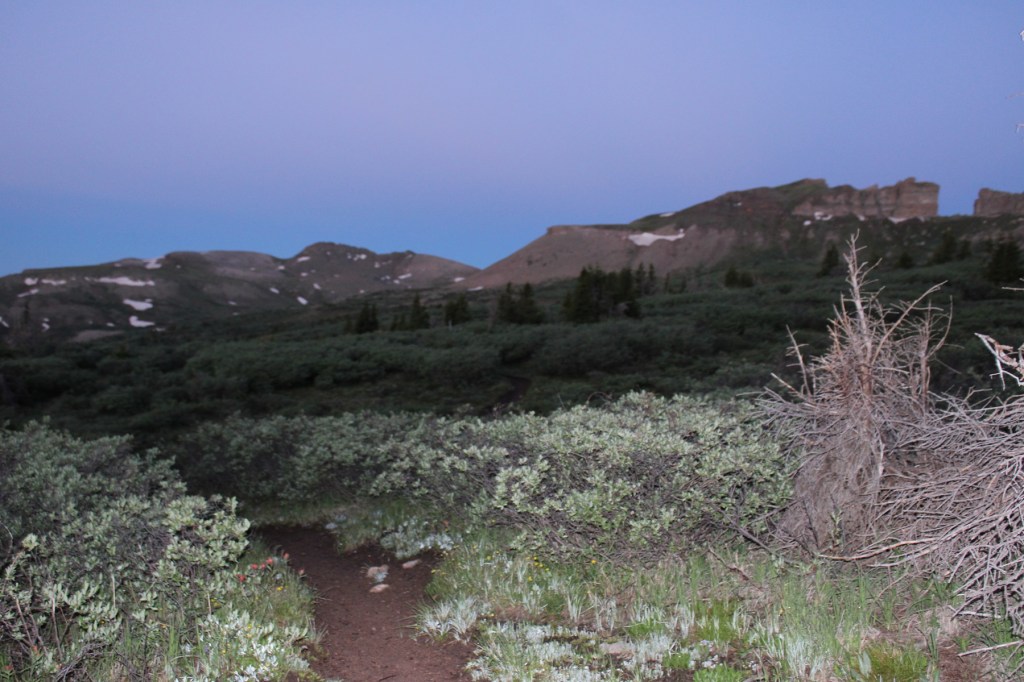
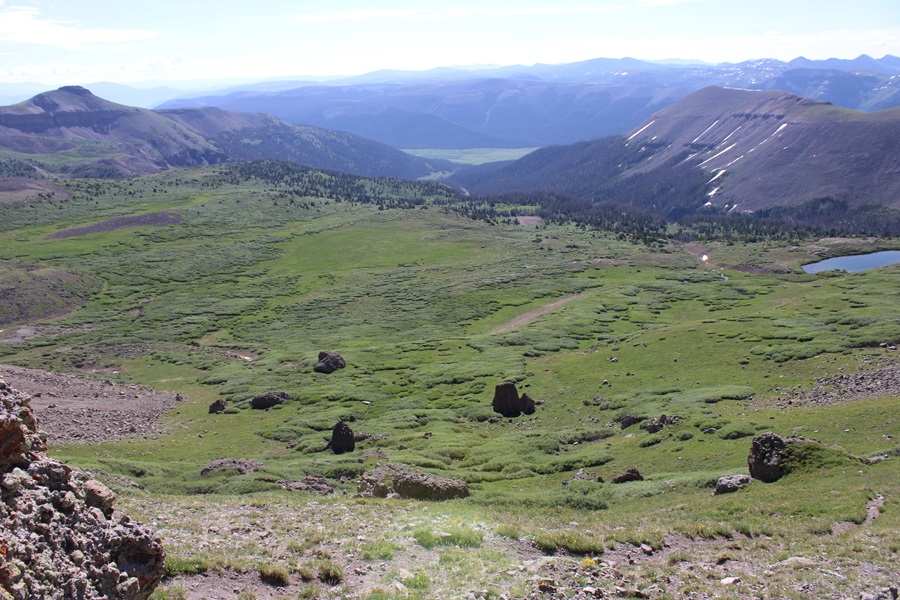
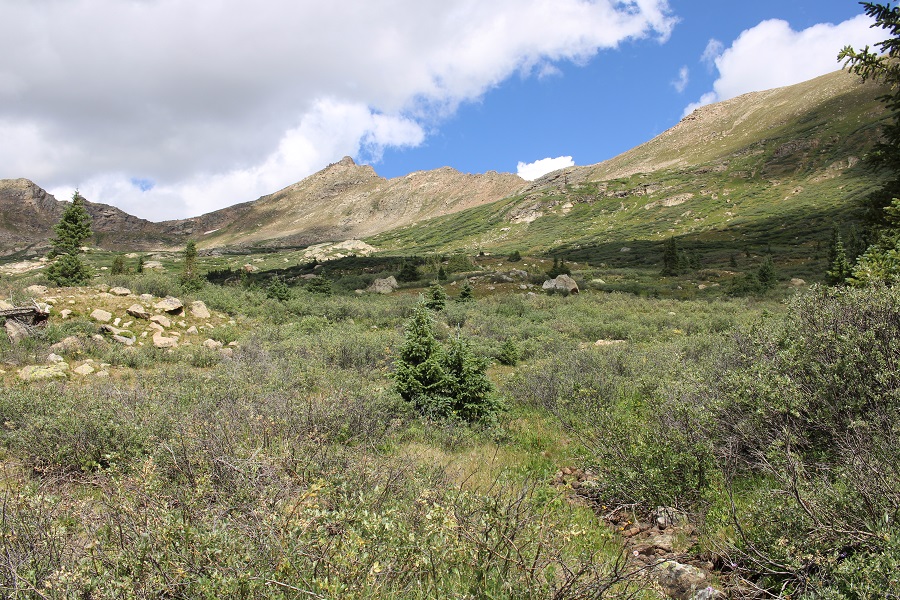
This put me into an upper basin.  From this point there are several options to climb 13024. 
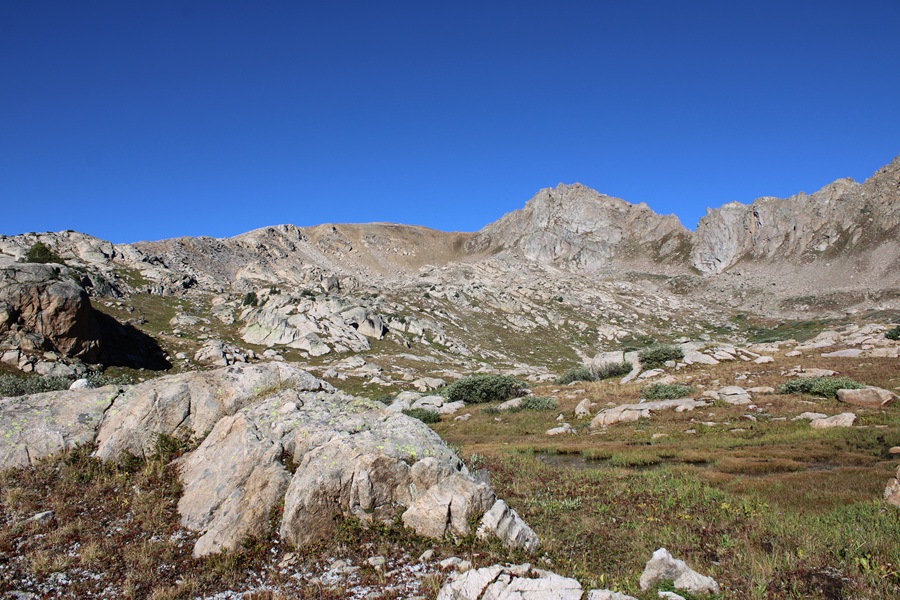
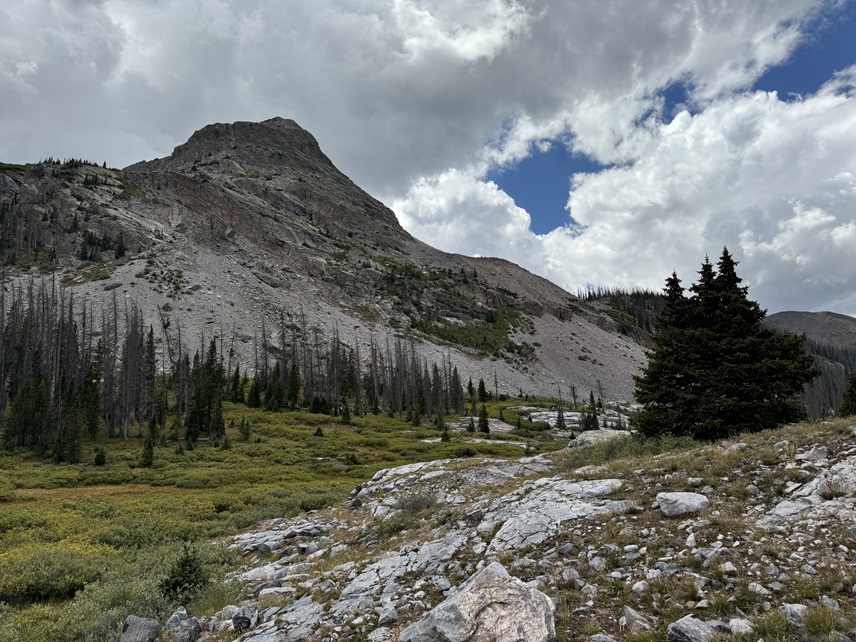
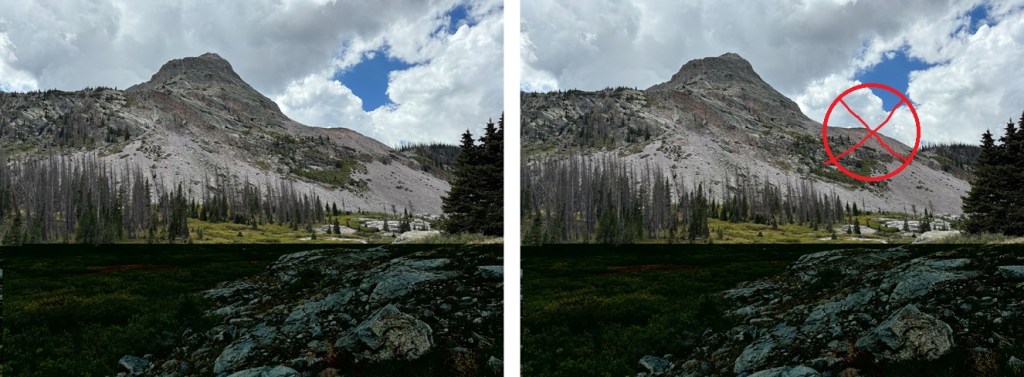
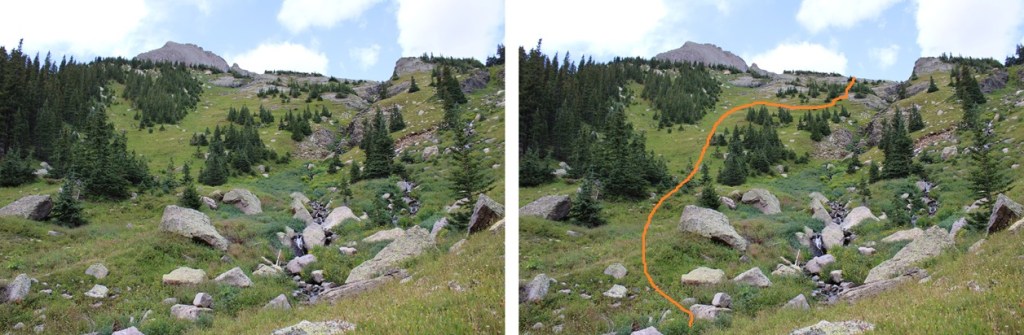
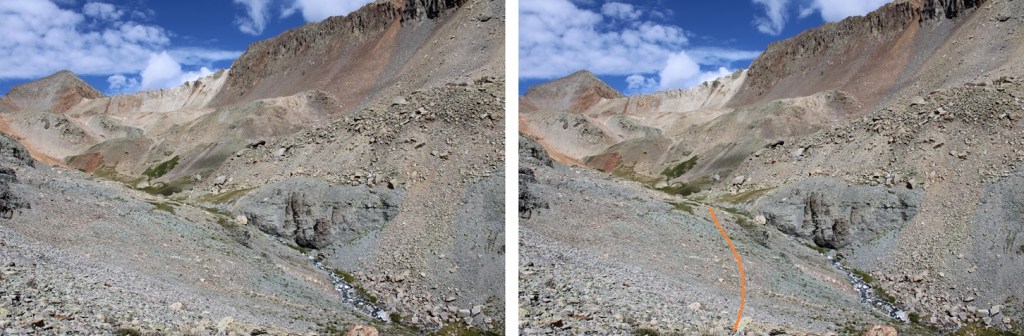
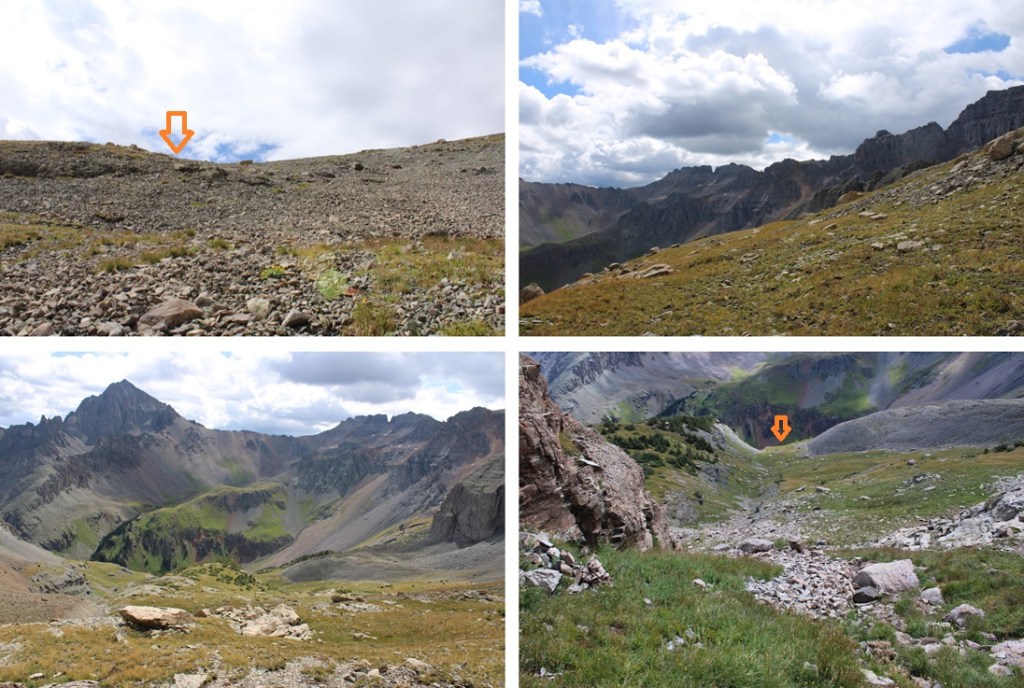
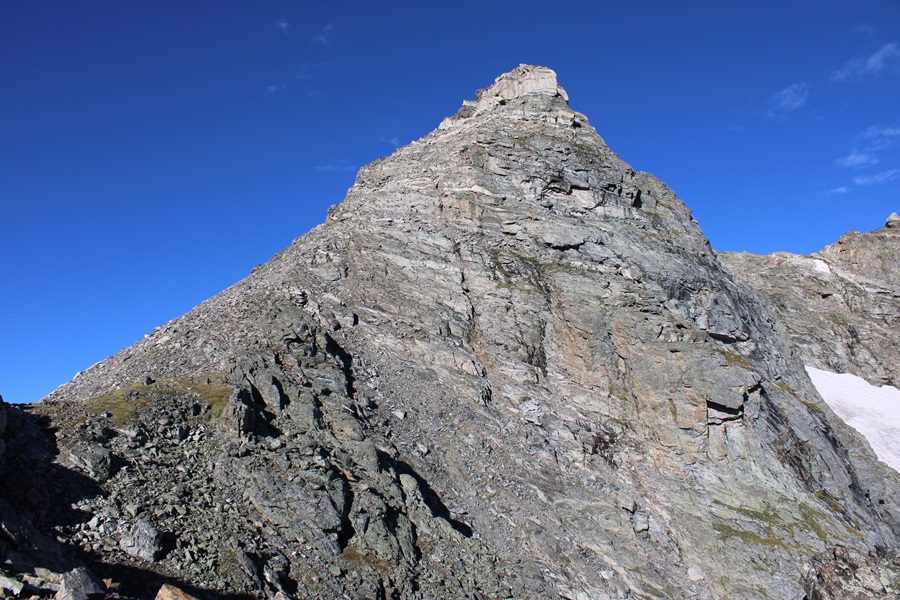
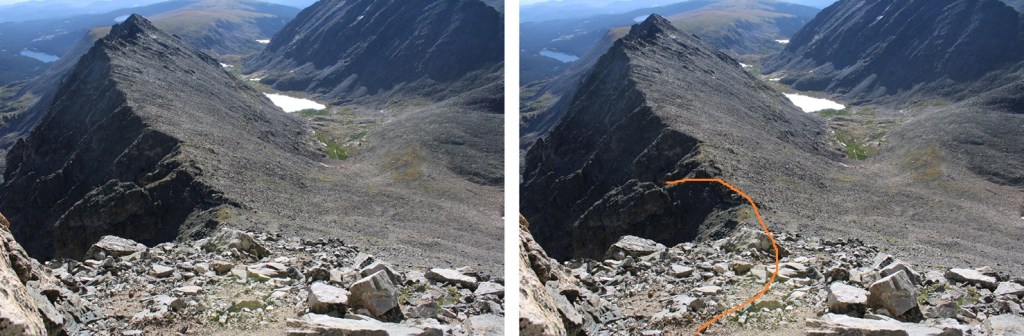
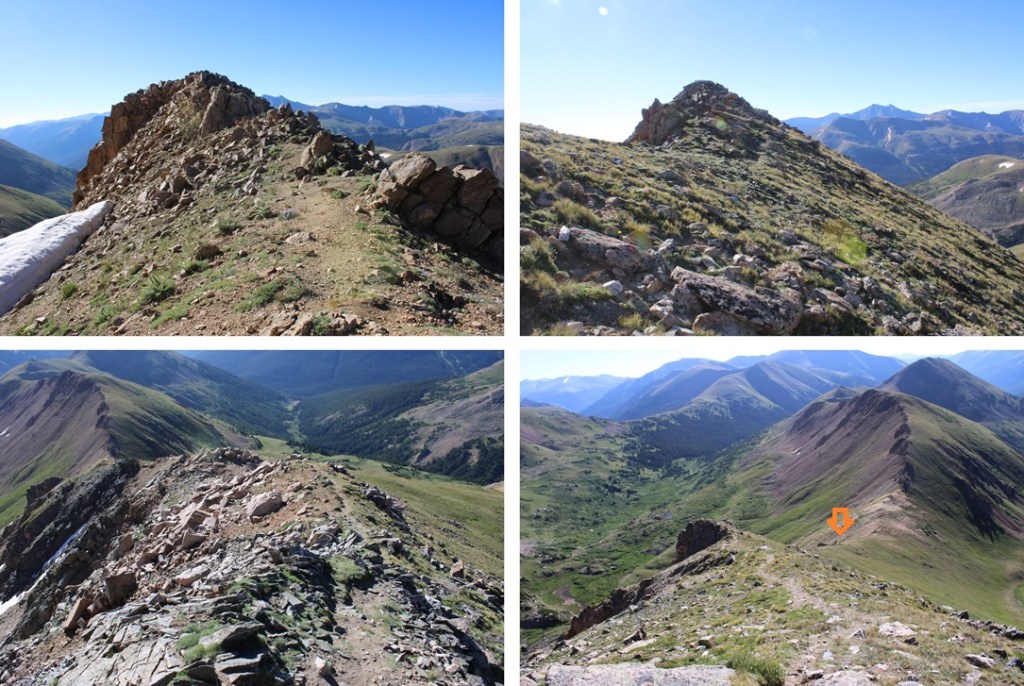
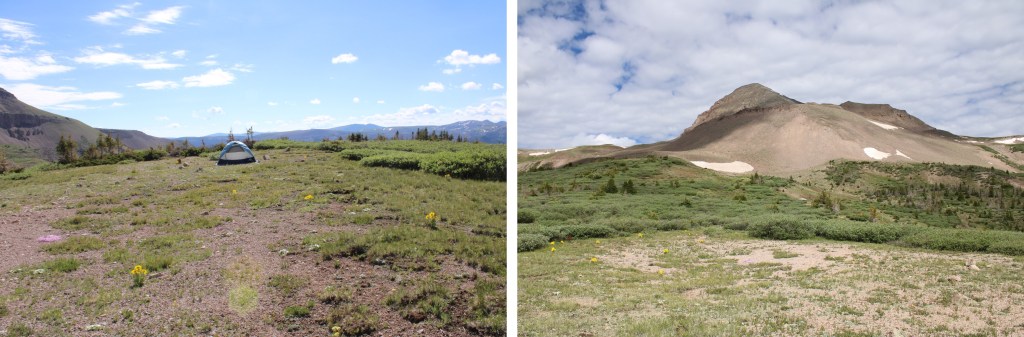
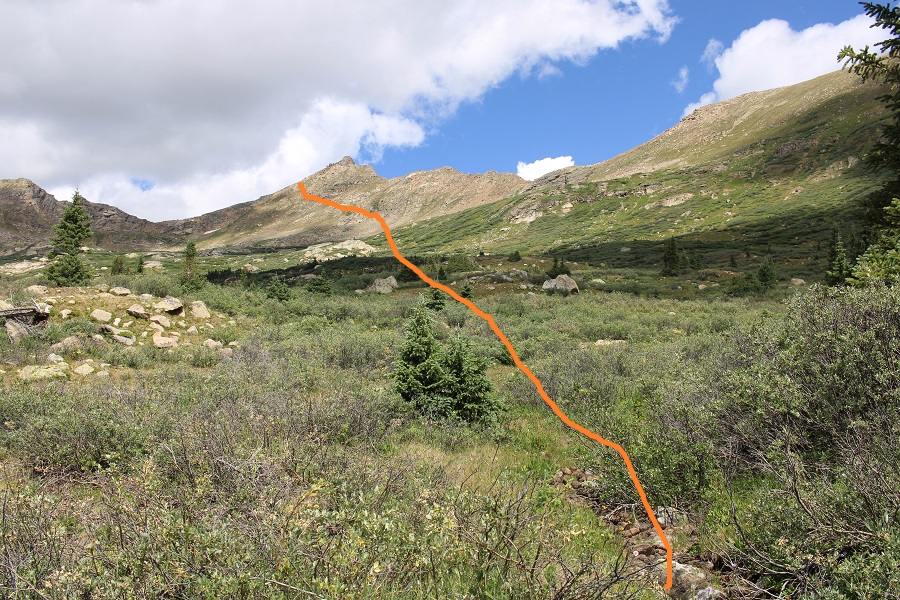
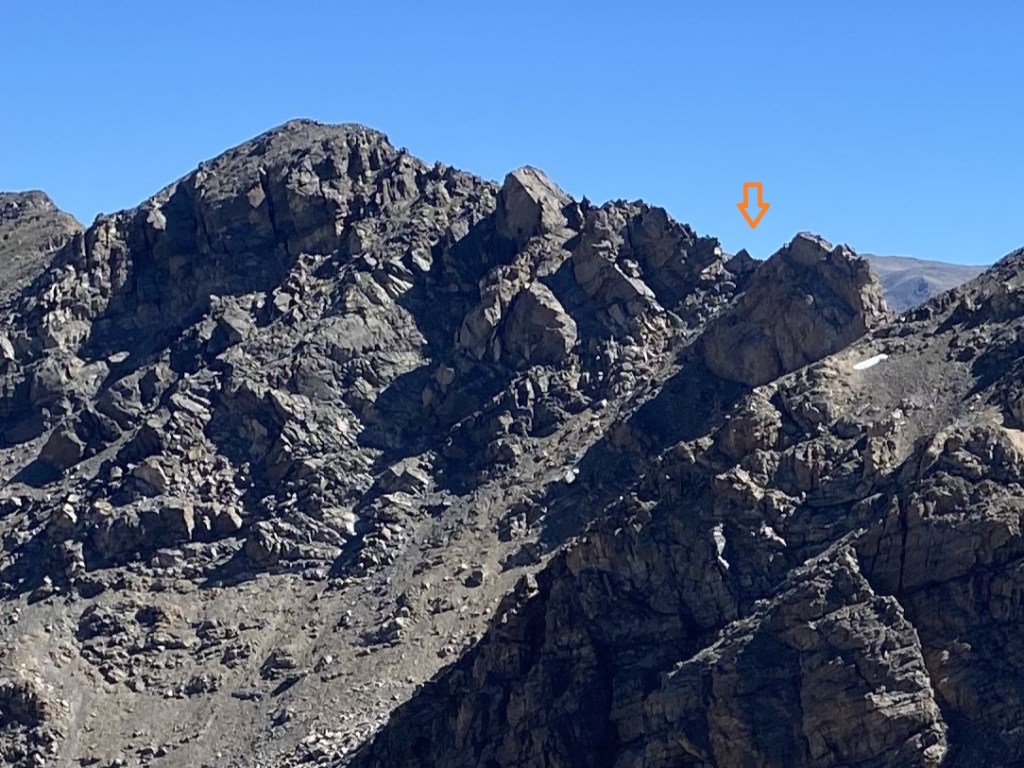
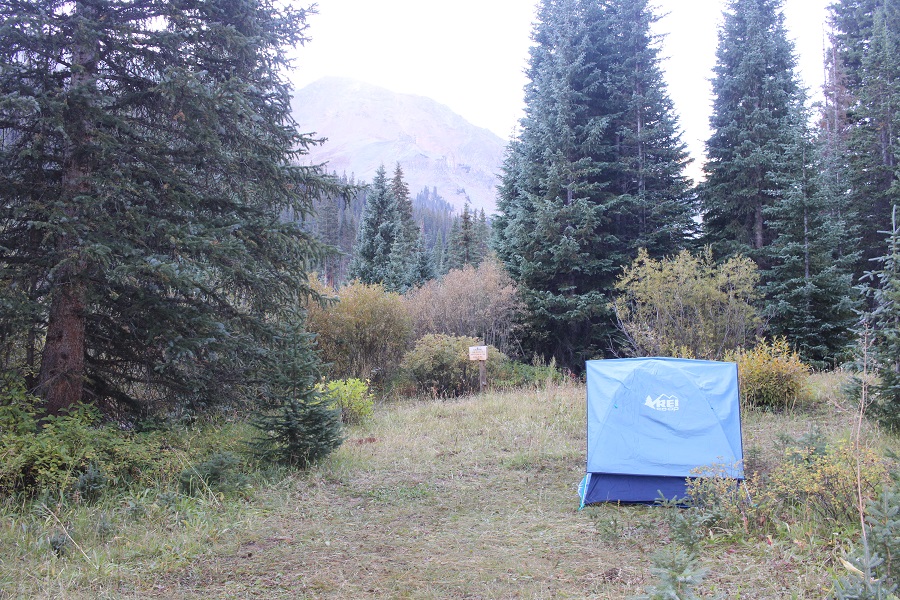
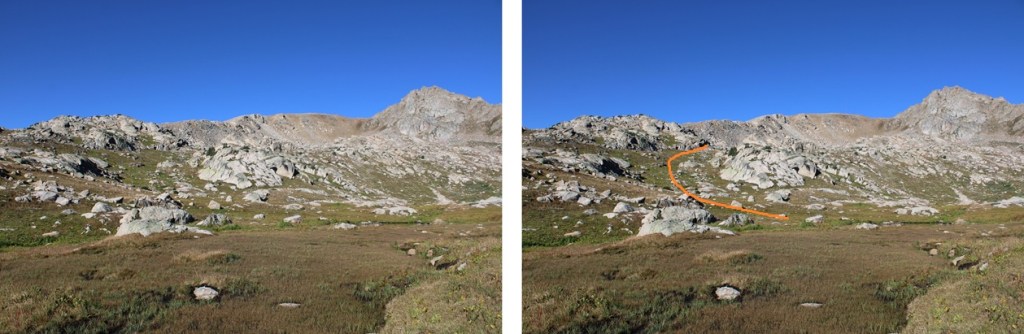
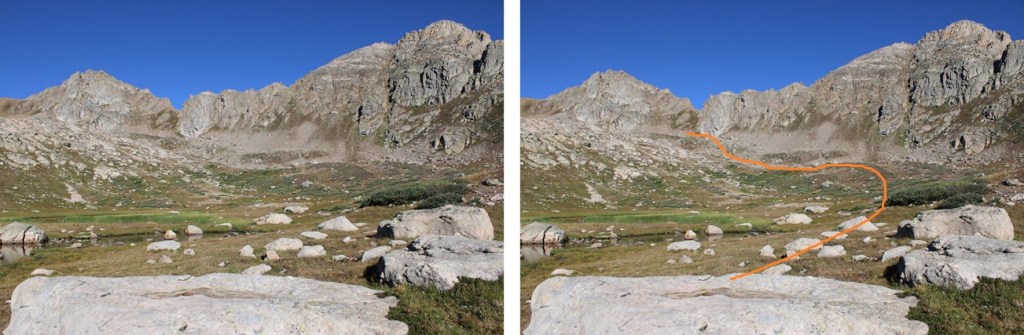
I found a camping spot and set up for the night. This area is boggy/marshy, and it’s difficult to find a spot 150’ from water, but I found one underneath a large rock outcropping.  As you can see by the picture below, I found three different routes up/down PT 13024.  The orange route is class 4, the blue route class 2, the pink route class 3 (I didn’t really know this beforehand).  My first attempt the next morning was going to be to the left hand side, as I didn’t yet know if the ridge would go, and had heard it was the easier side (it wasn’t).  I’d been in the area before, and the ridge looked like it went, so in the morning I was going to take the ridge to the summit from the left. 

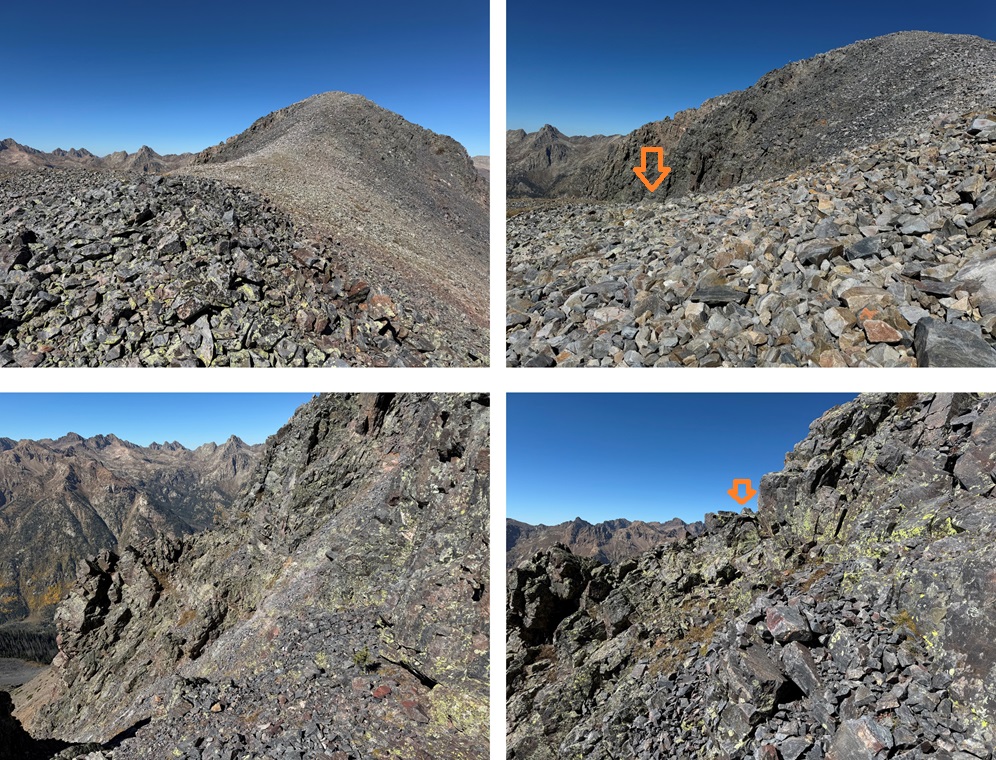
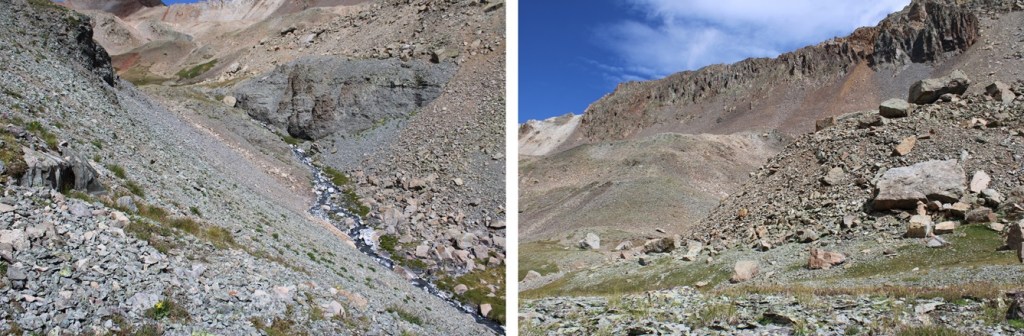
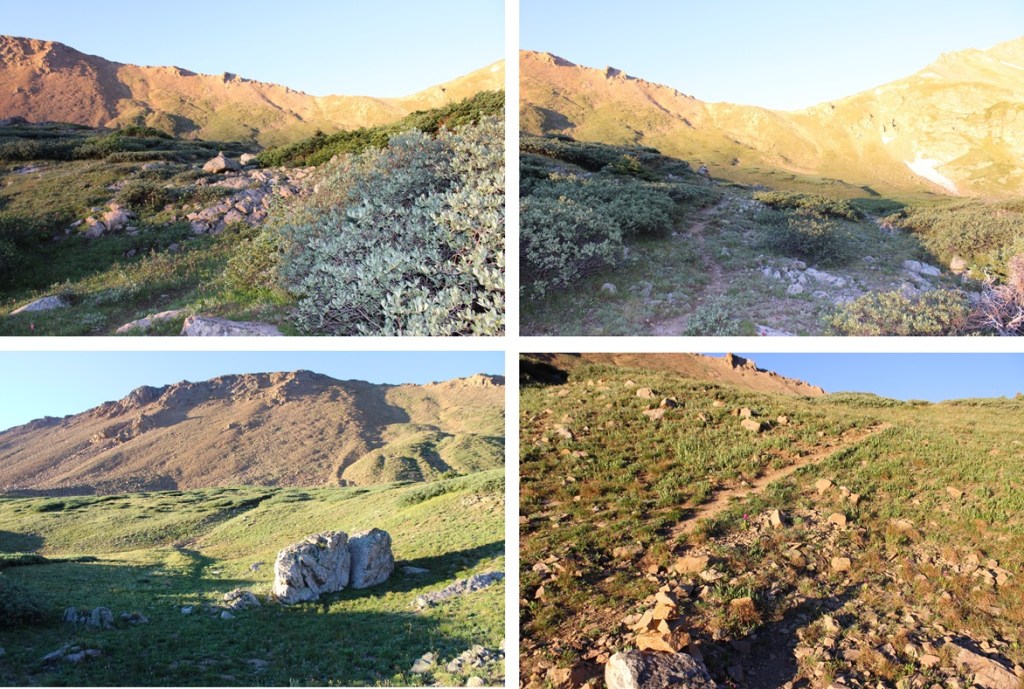
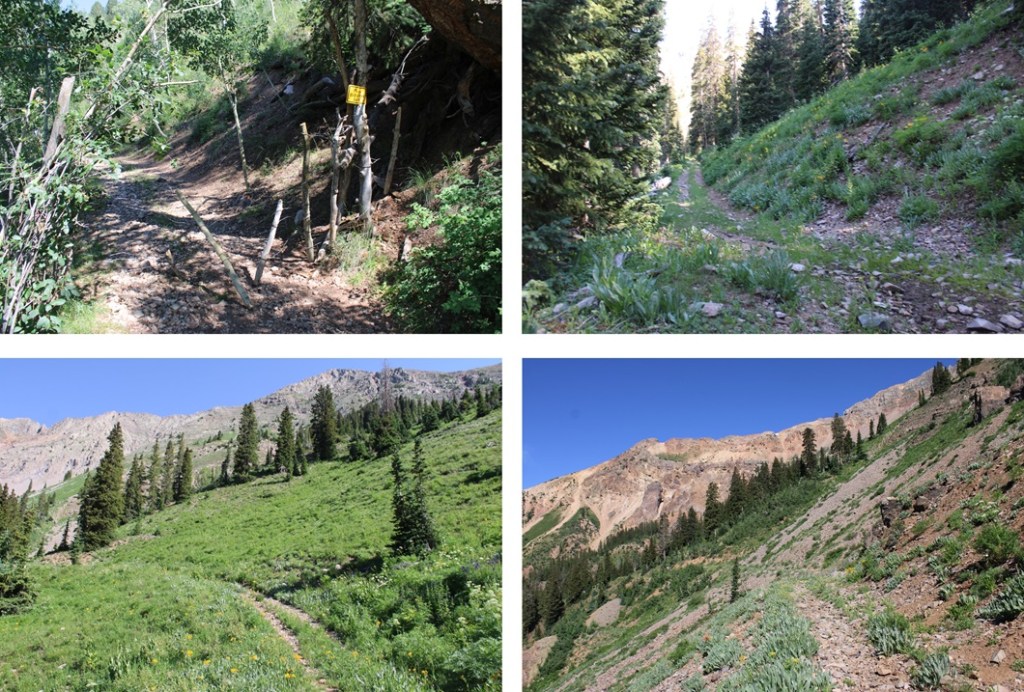
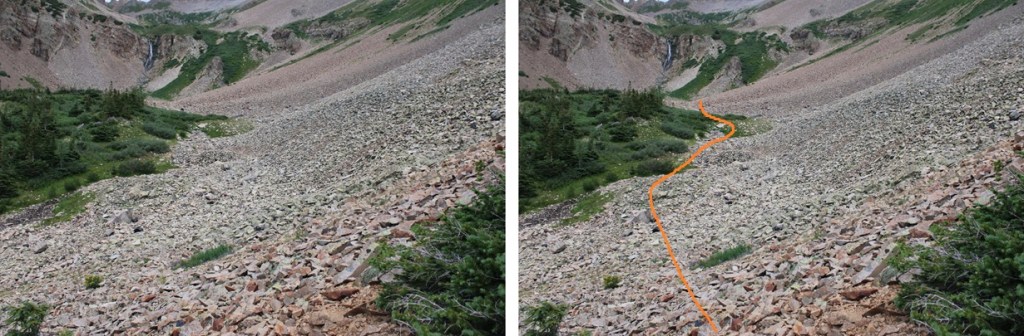
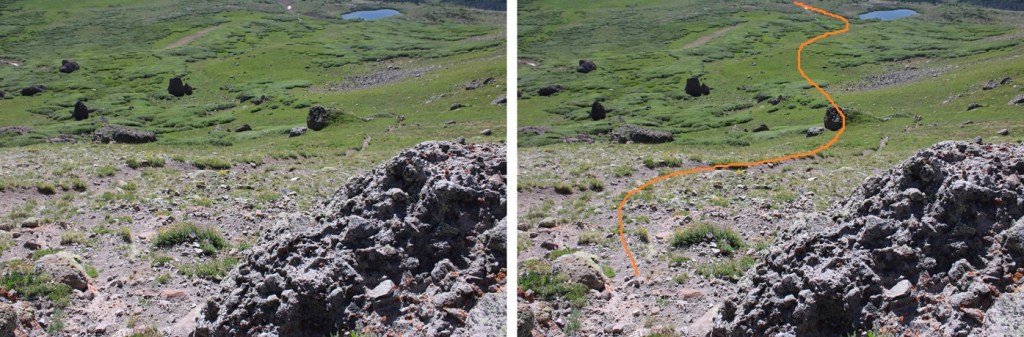
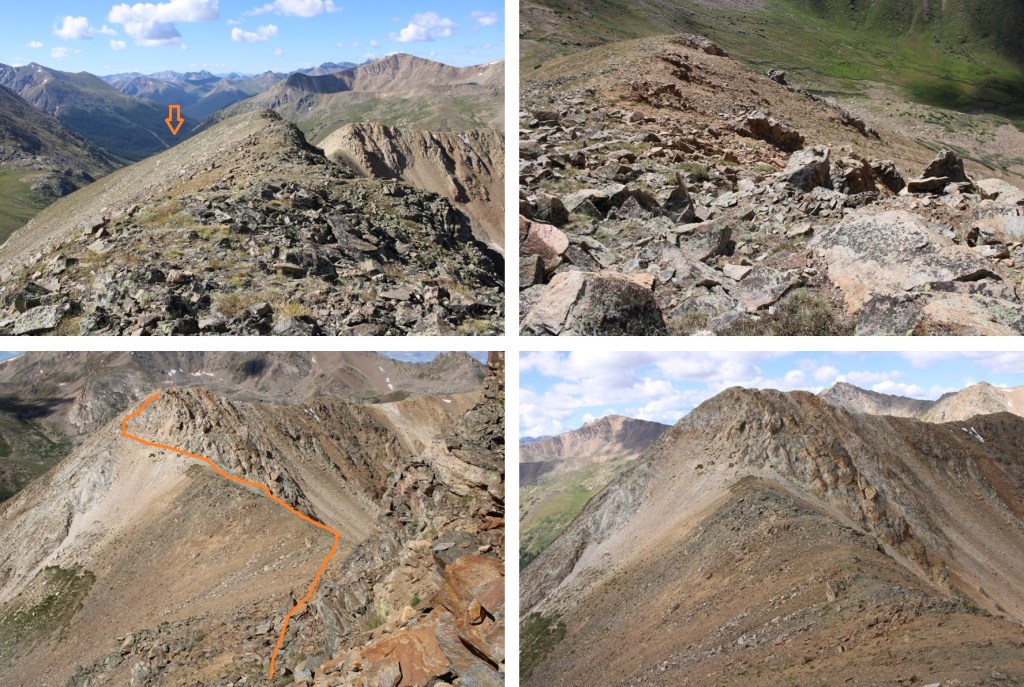
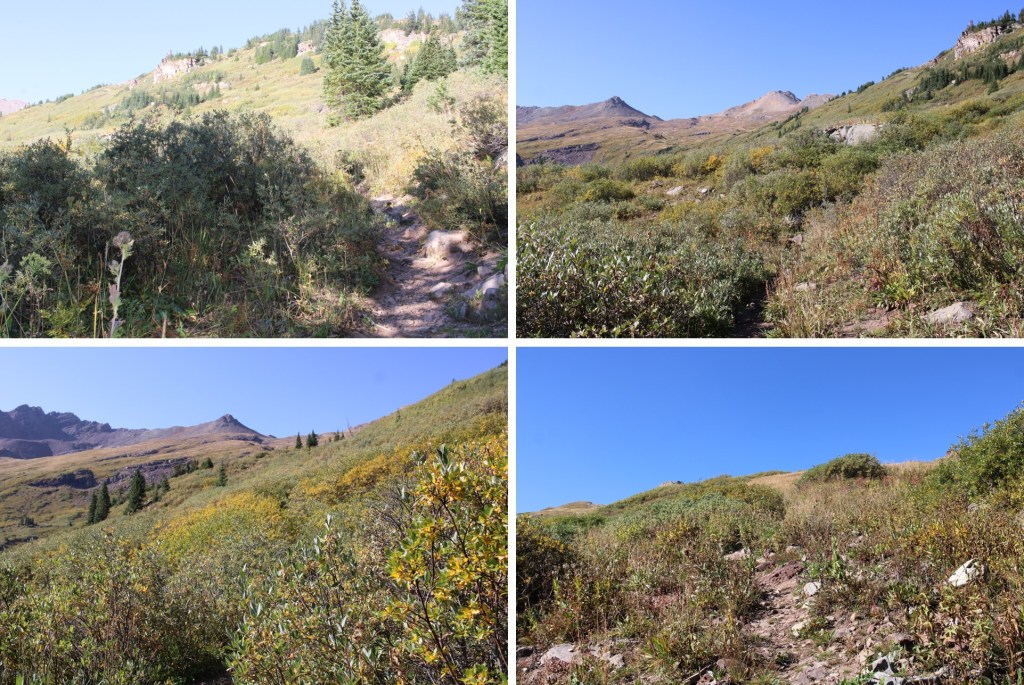
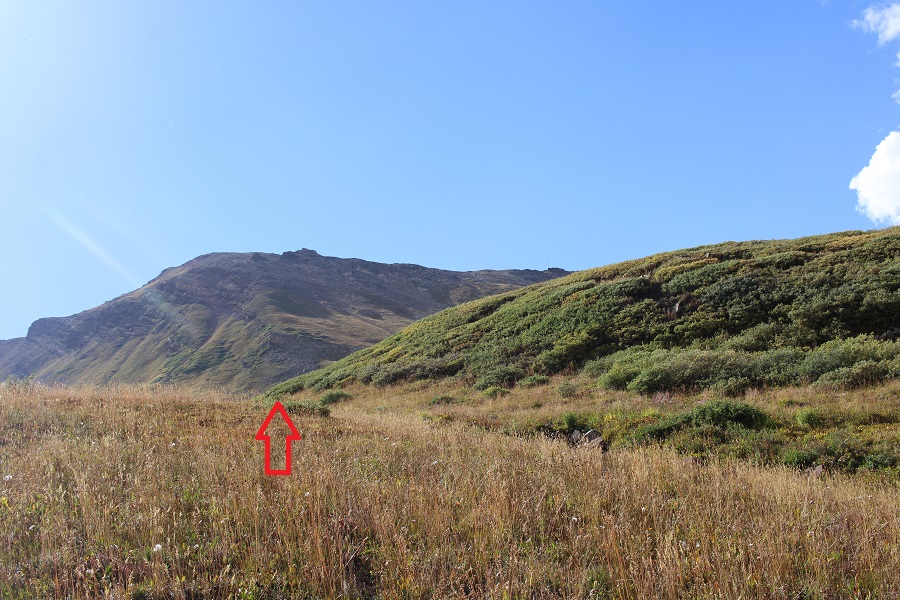
I set up my tent and had the late afternoon to just chill and relax (a goal of mine while climbing this year).  While I was there a couple of hunters hiked in, scouting the area (hunting season was to start in a couple of days).  I saw them pointing in the distance and getting out their binoculars and looking, then pointing again.  I gave them their space, but half an hour later they started hiking towards me and my tent.  They whistled and said “Just so you know, there’s a bear behind you about 200 feet, behind the rock you’re set up next to.”  I was thrilled with this information, but a bit upset it took them HALF AN HOUR to let me know a bear was behind me.  I got up, got my trekking pole, and spent the next 2 hours looking for the bear.  I never saw it.  I was mentally ok and prepared for the night (bear cannister and all), but still a little upset I never actually got to see the bear.  I did hear cow elk calling to their babies in the night, but no more sighting of that bear.  In the morning I was off at 6:30am to attempt the ridge (orange route).  I started by following the grassy area southwest towards the ridge.
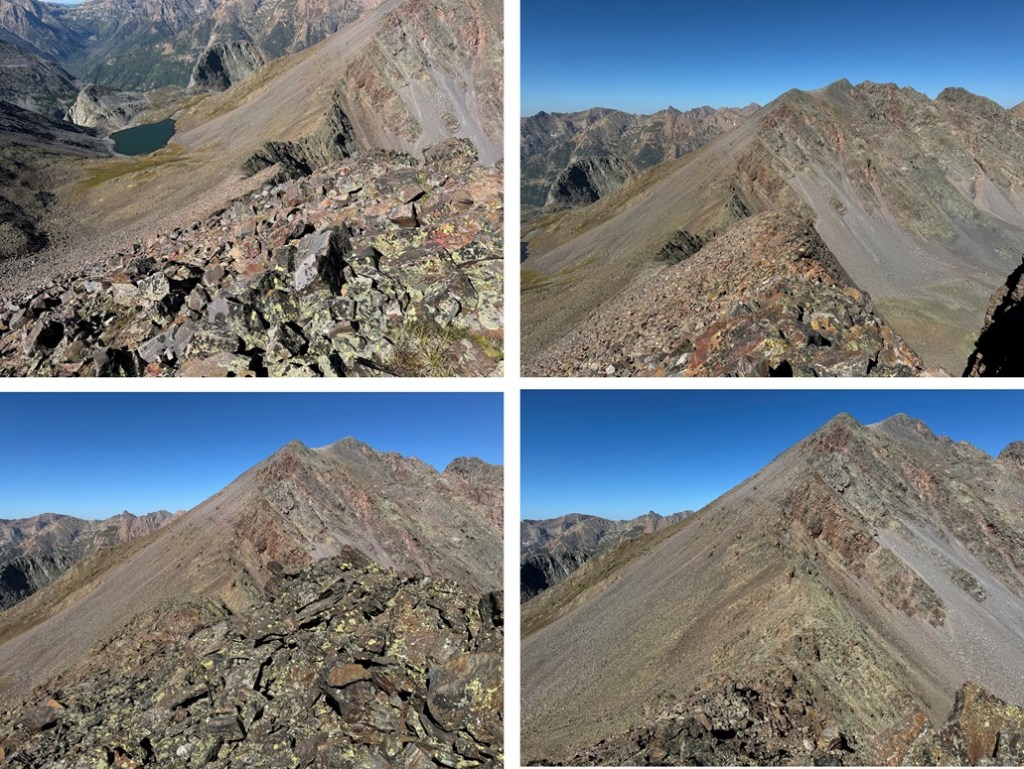
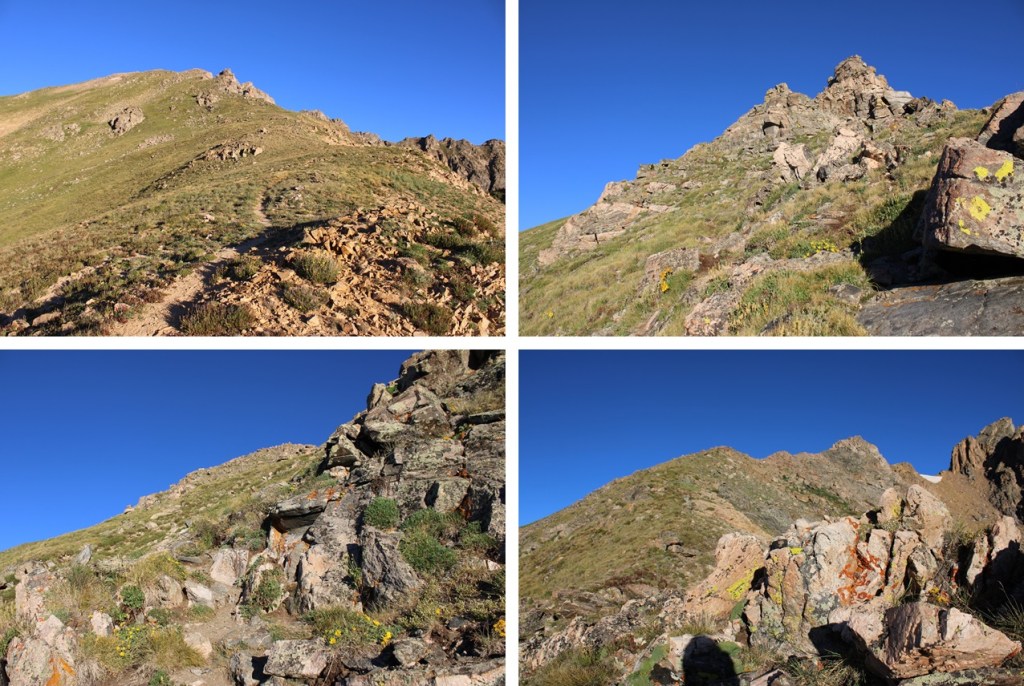
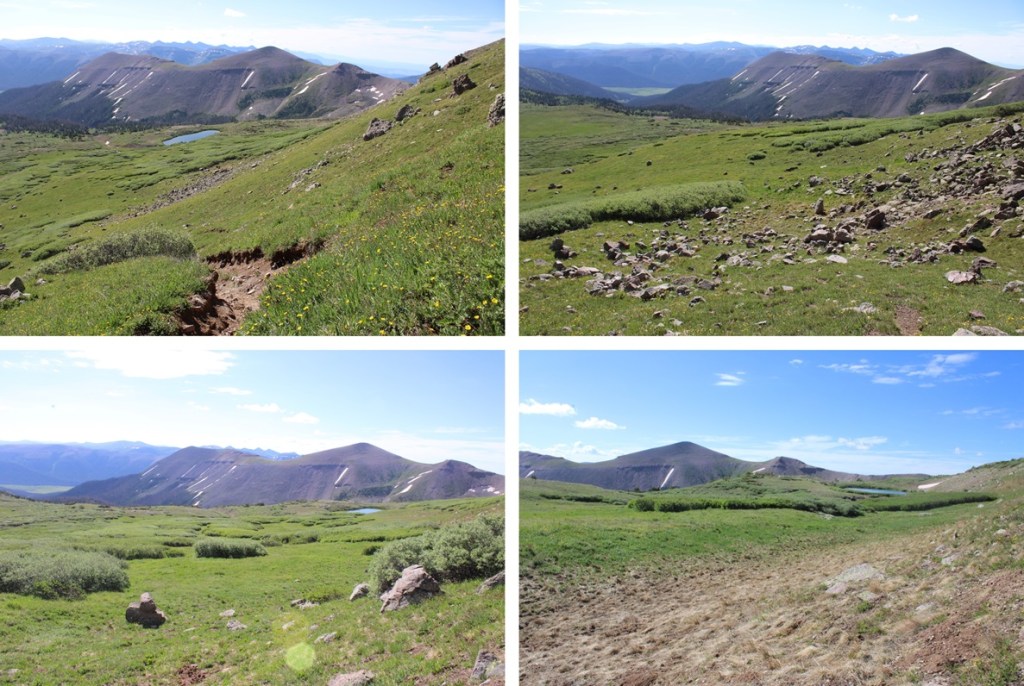
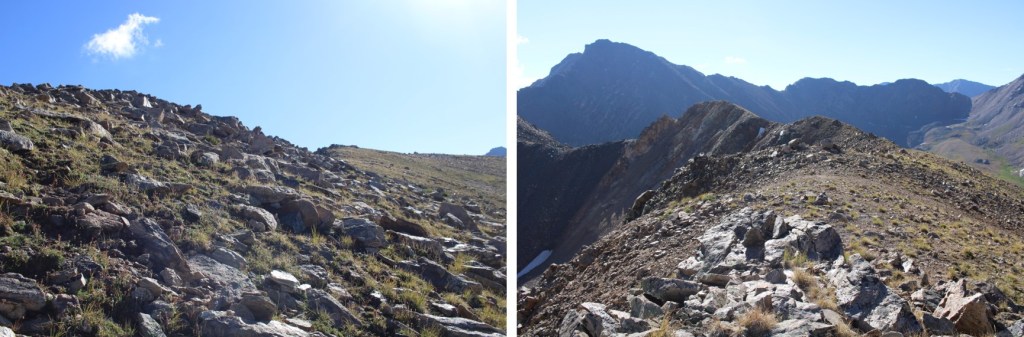
I then found a small gully and gained the ridge on tundra.  This was all easy class 2.
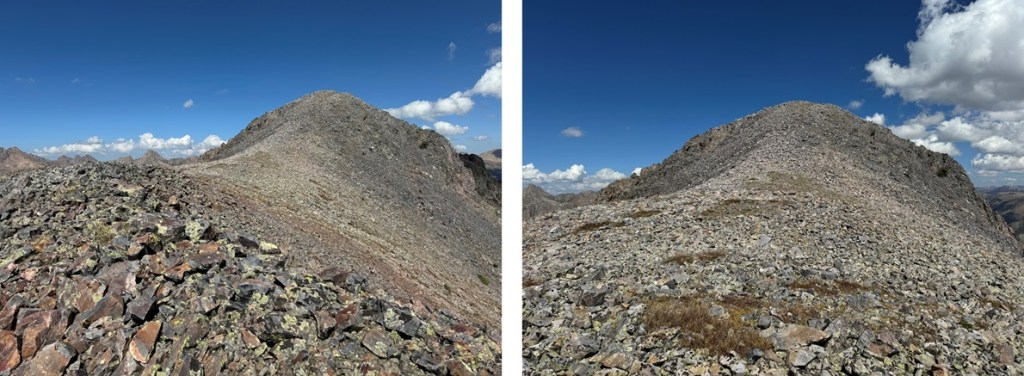
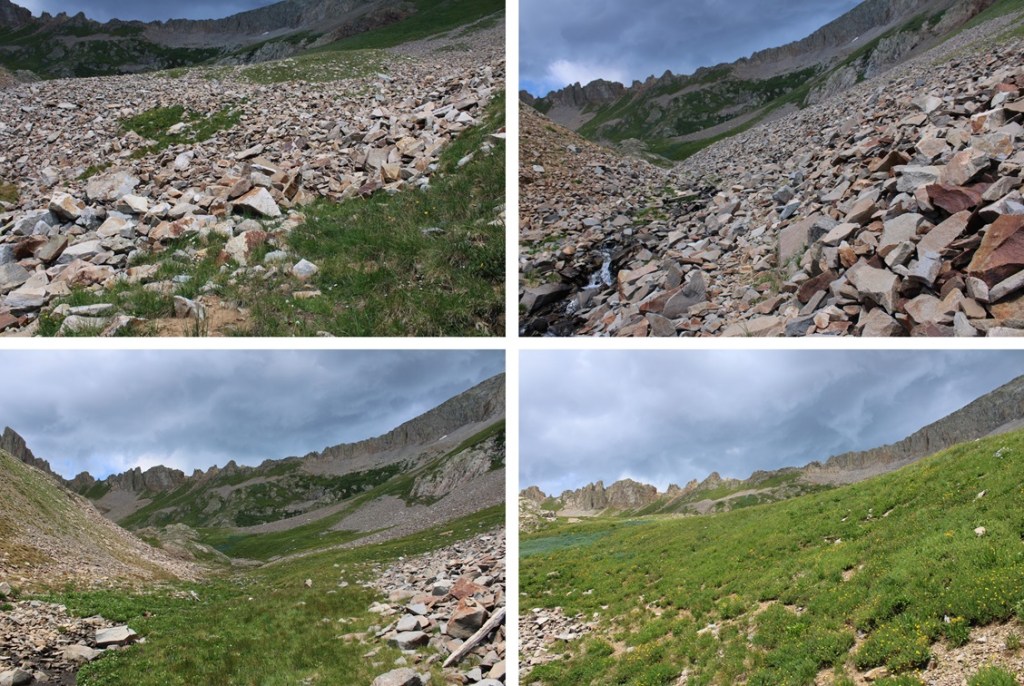
Once on the ridge it was an easy class 2 hike as I followed the ridge west/northwest.

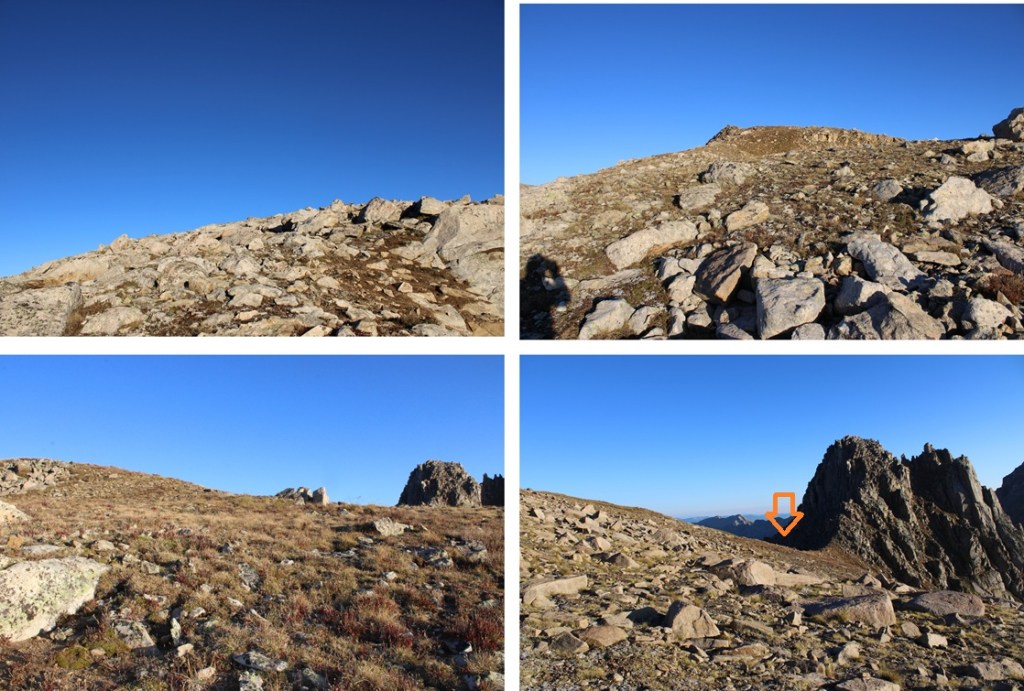
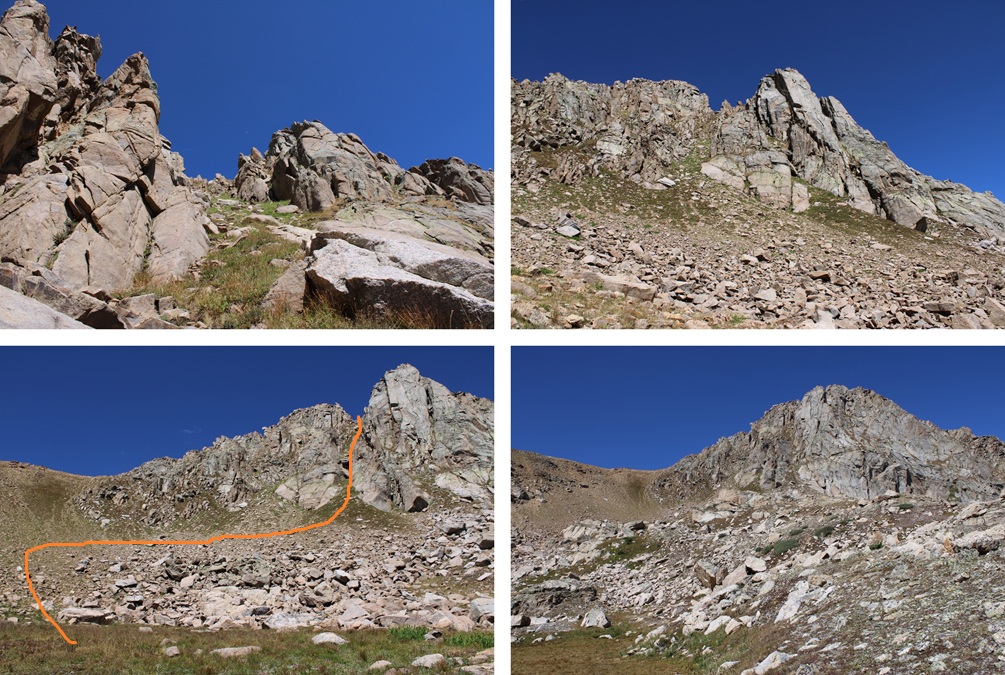
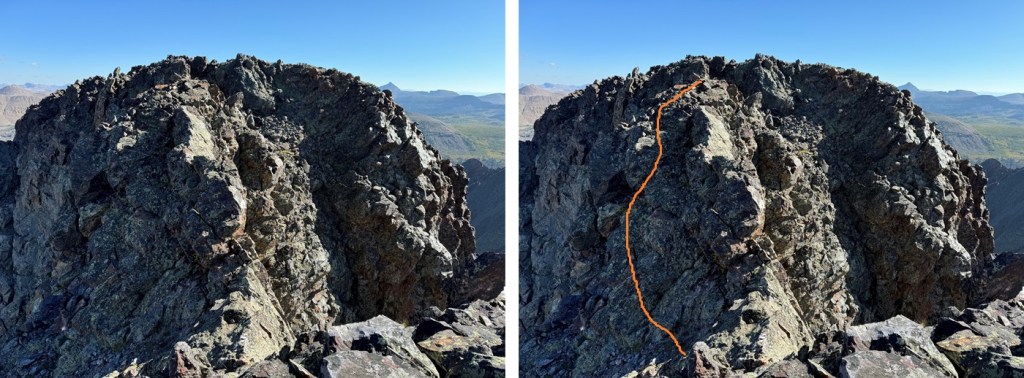
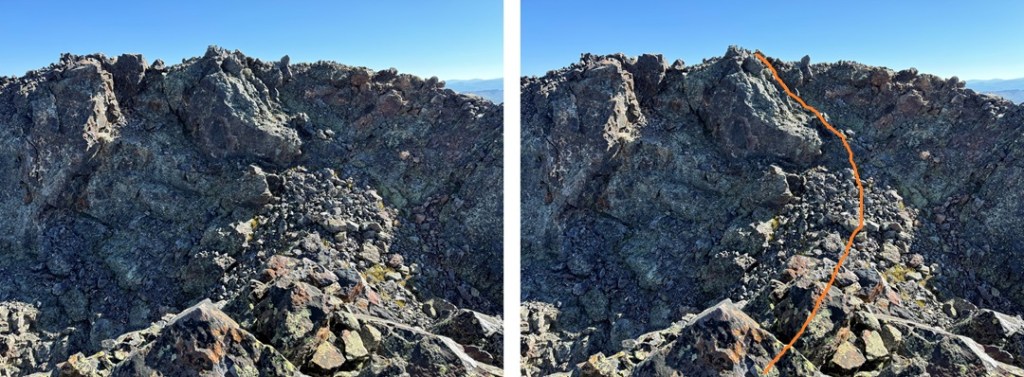
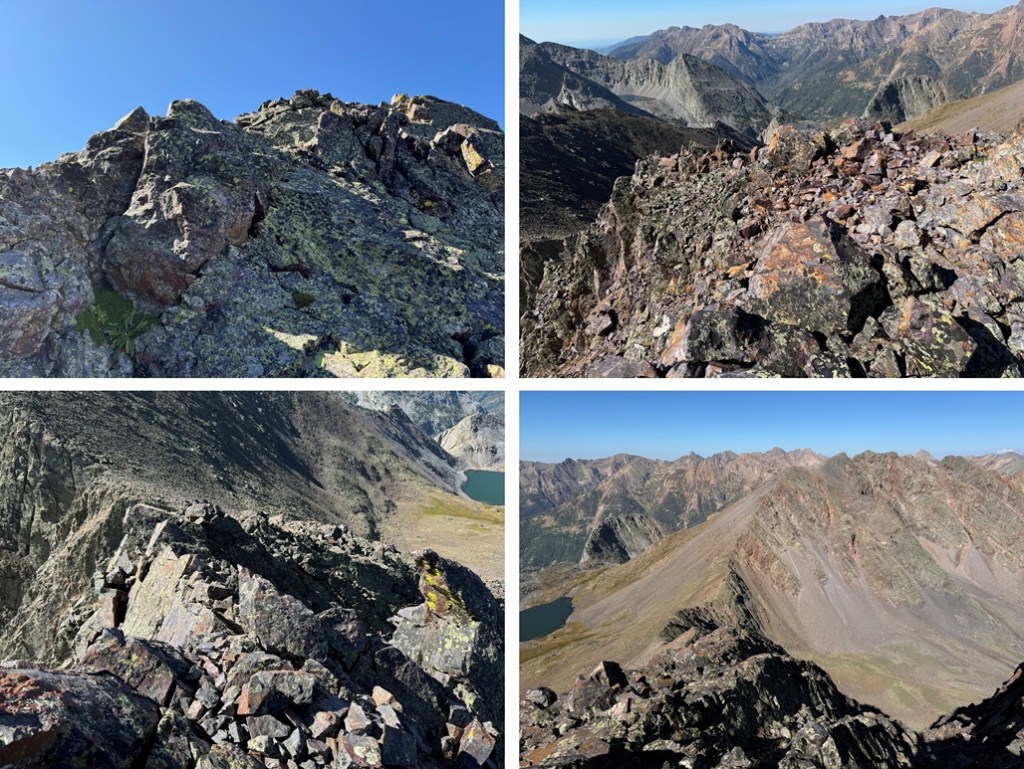
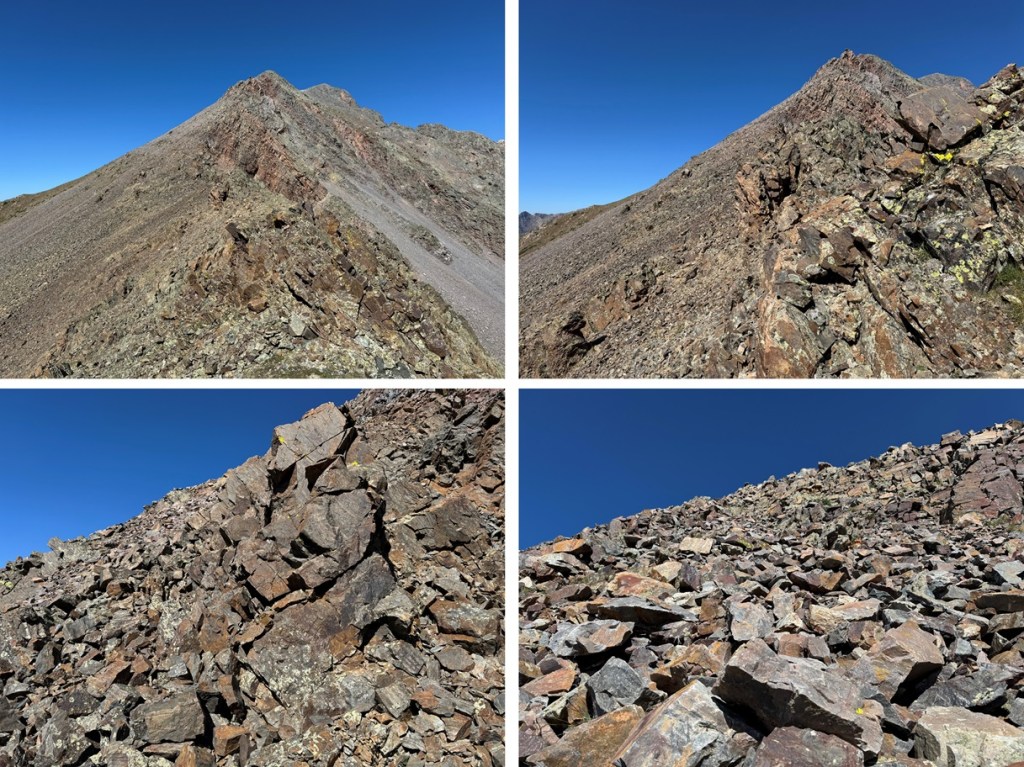
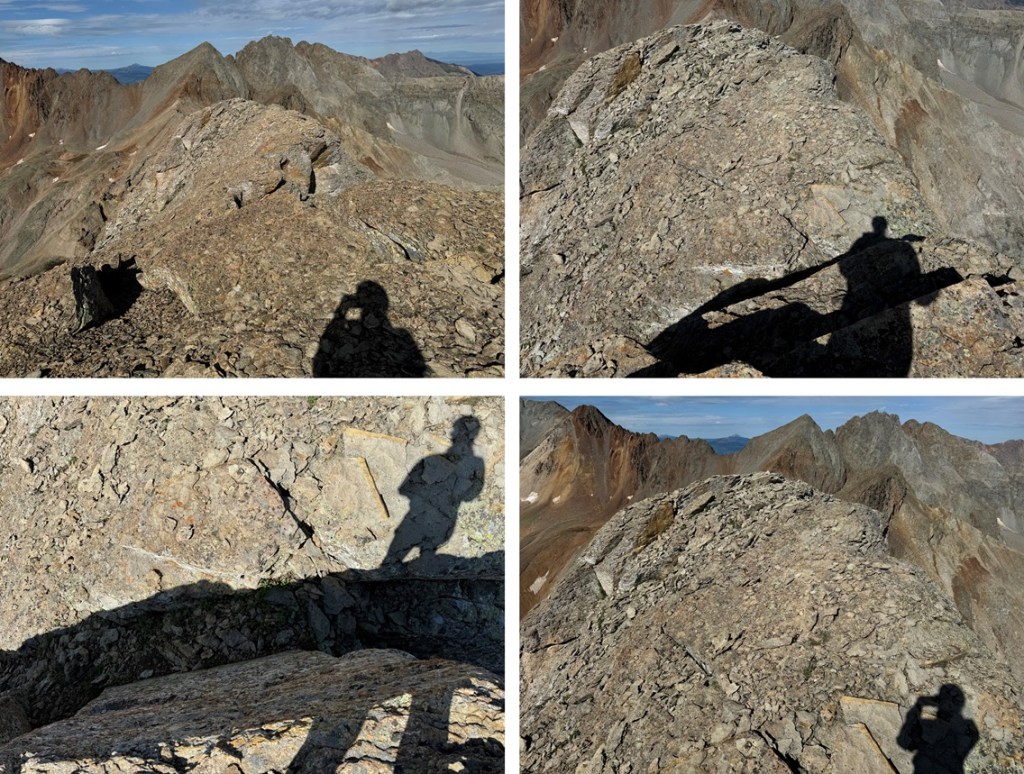
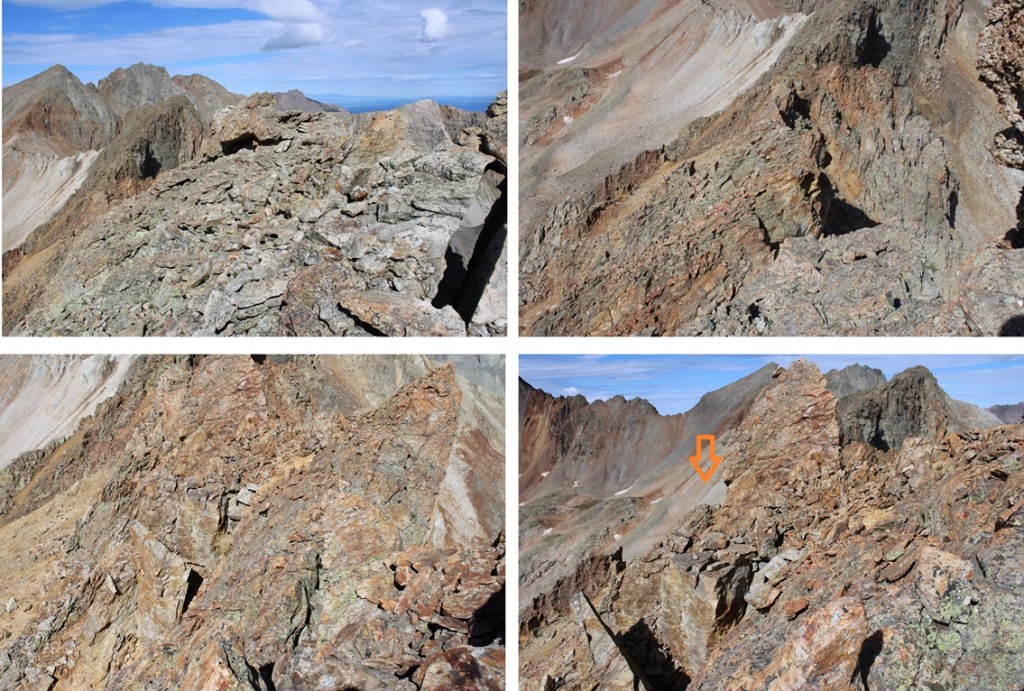
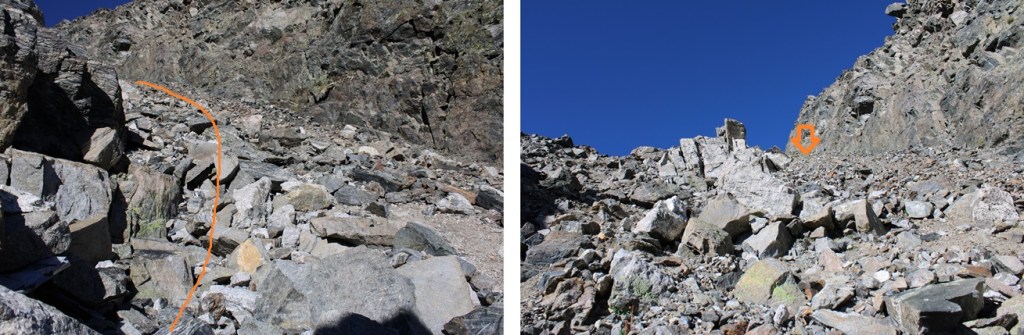
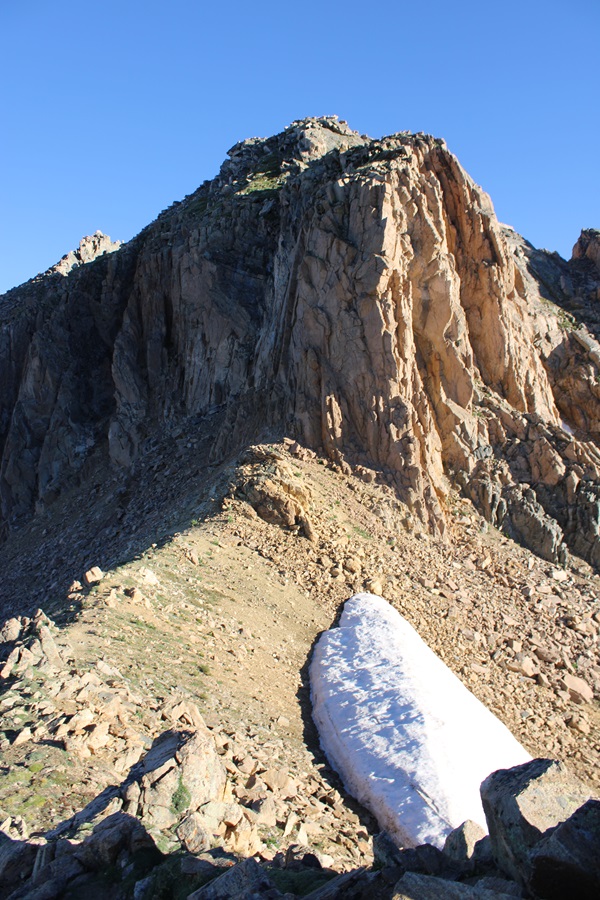
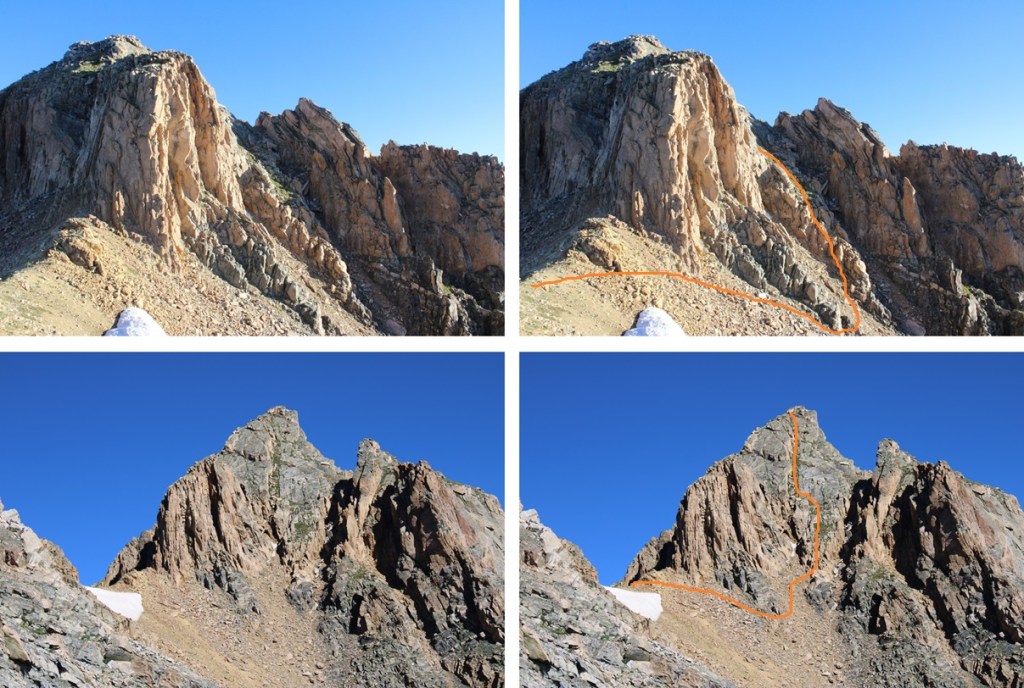
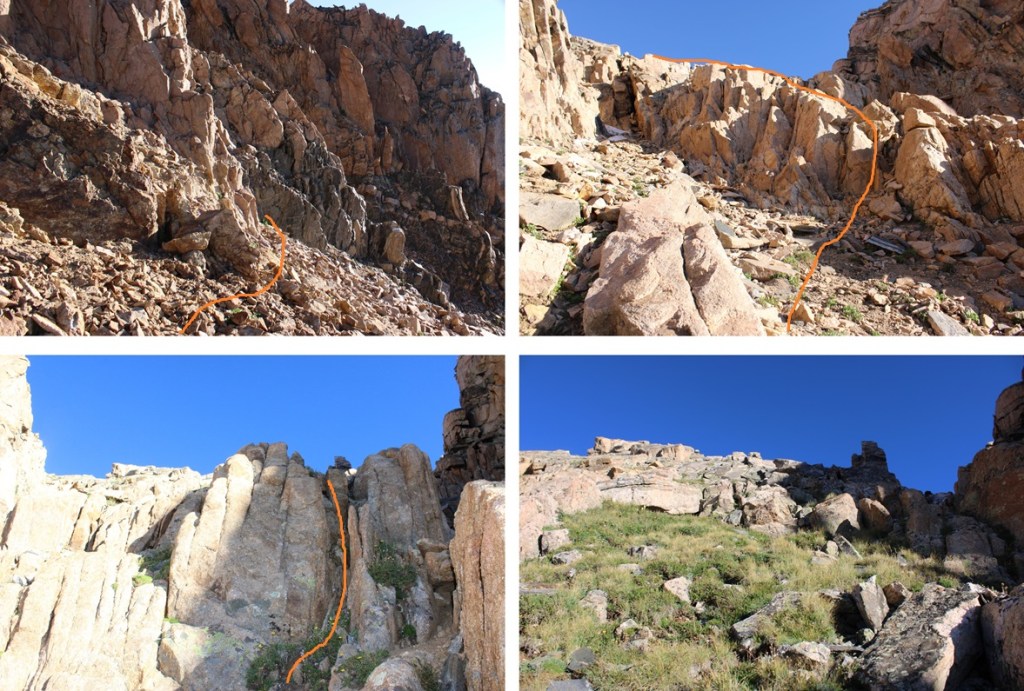
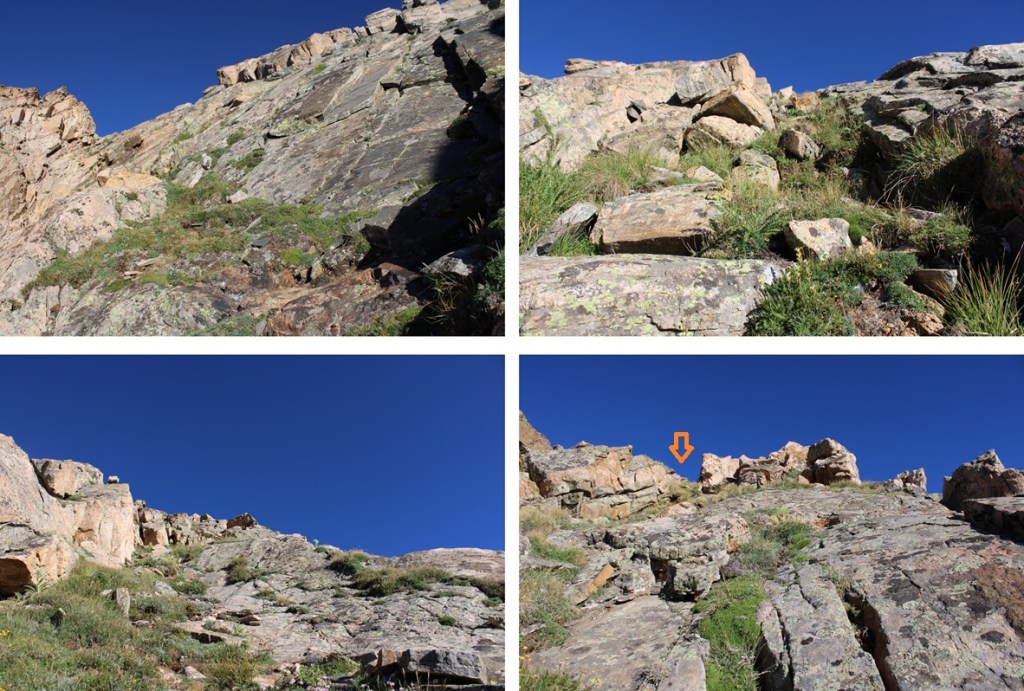
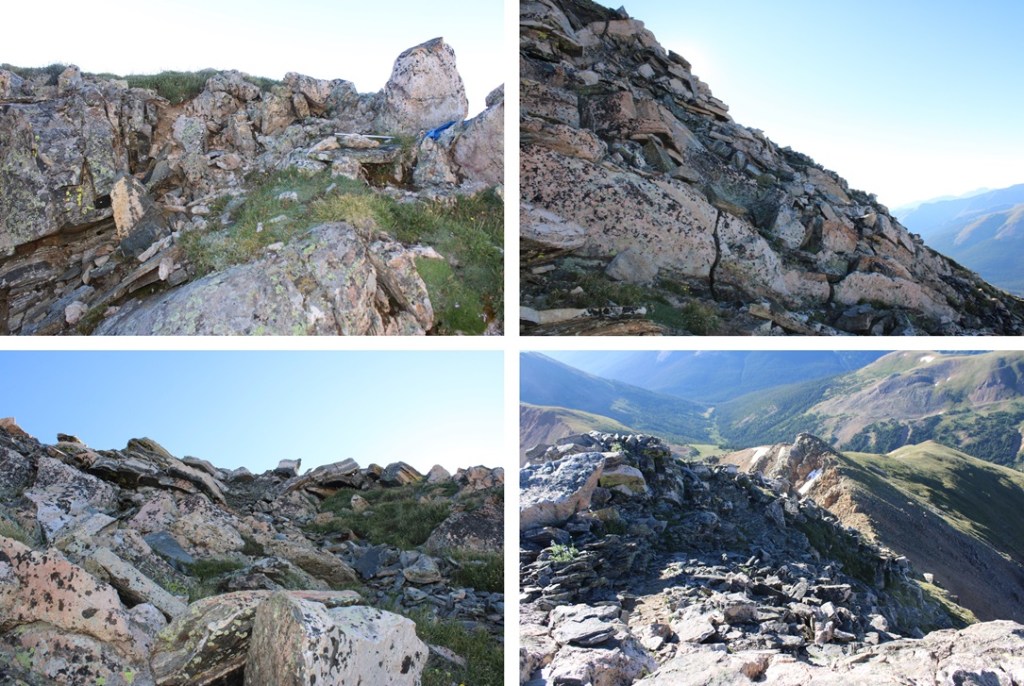
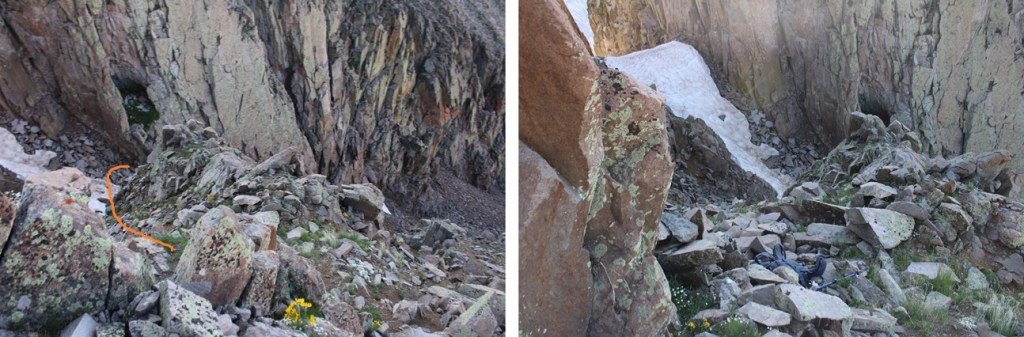
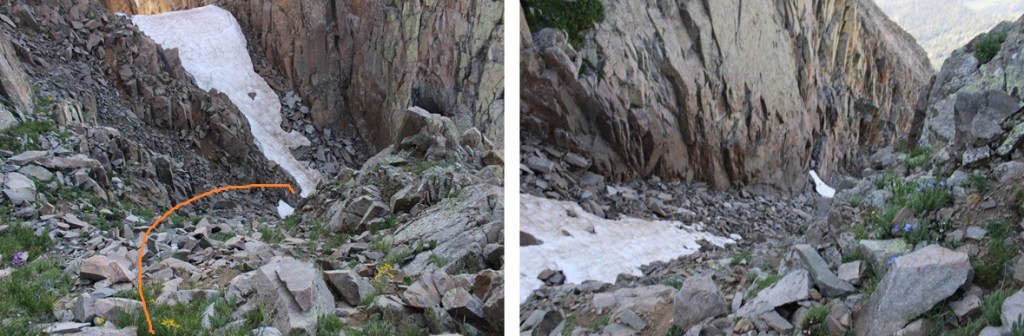
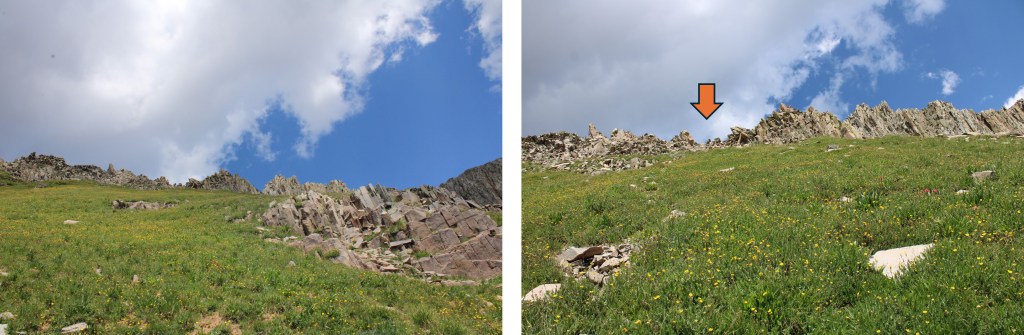
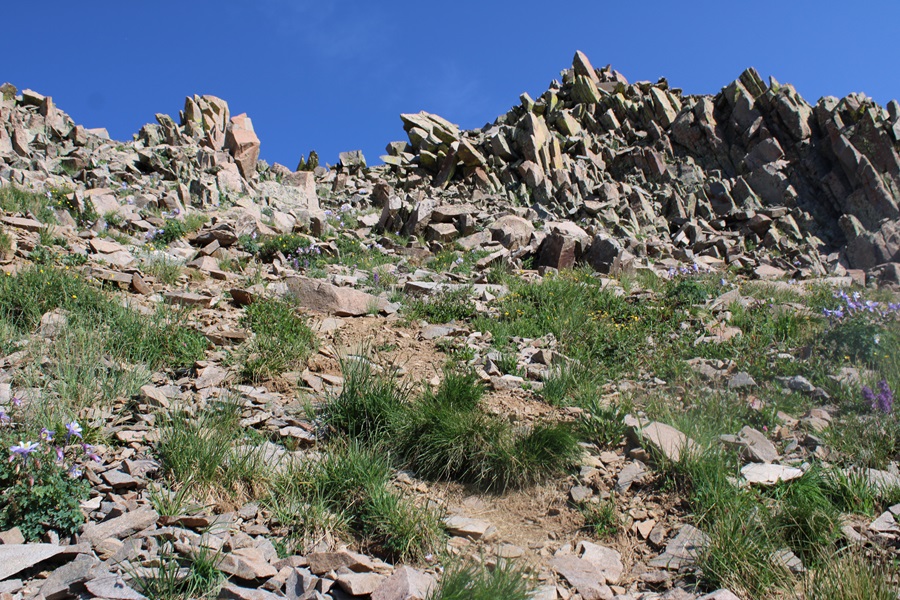
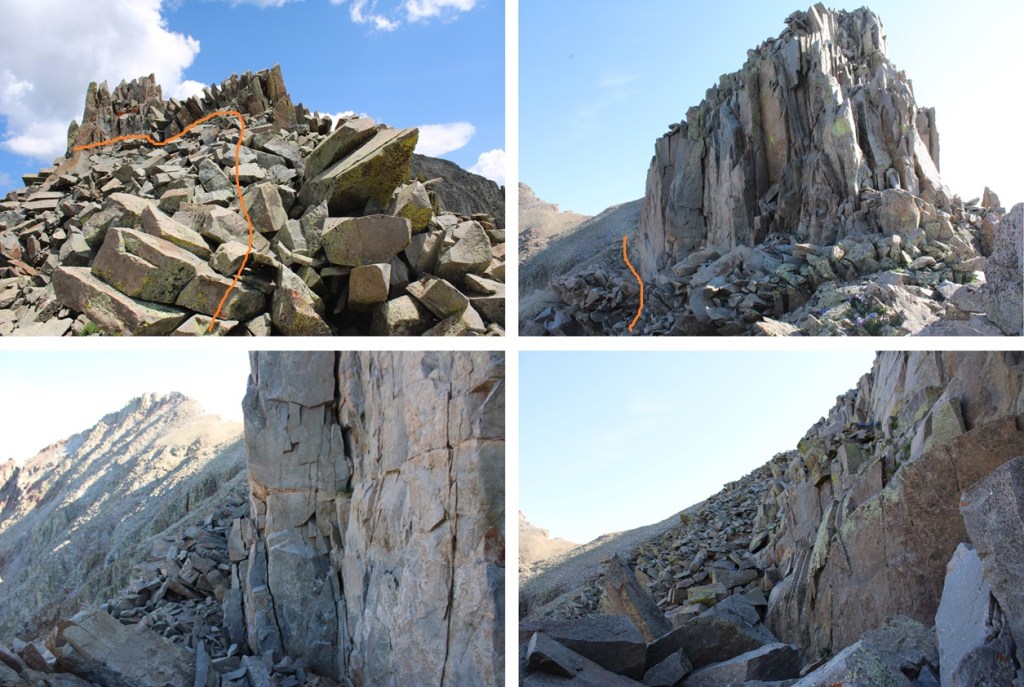
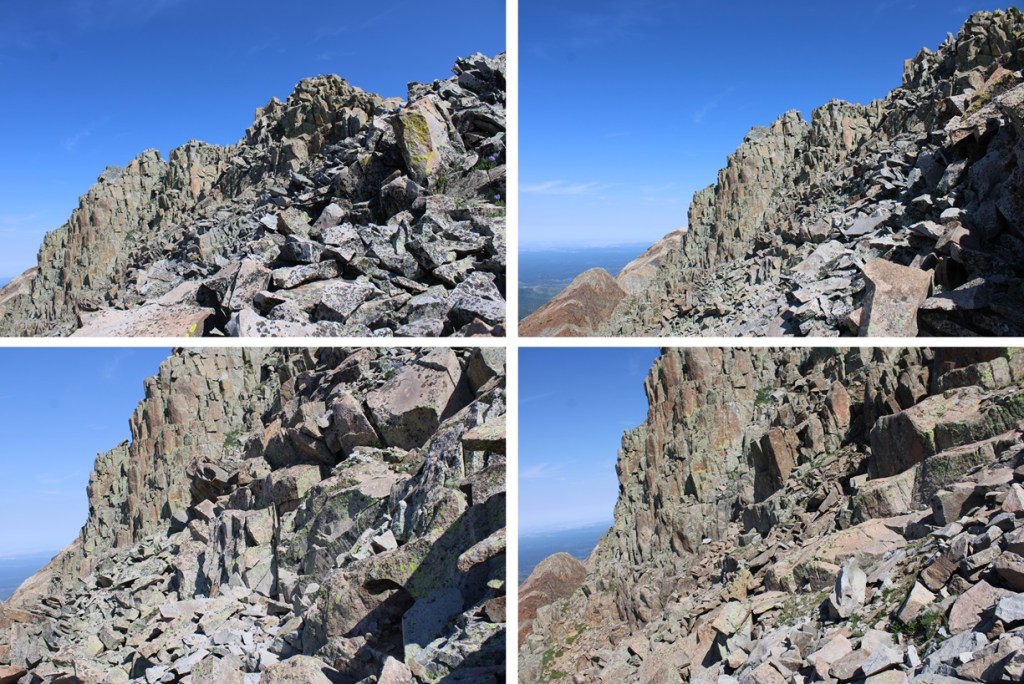
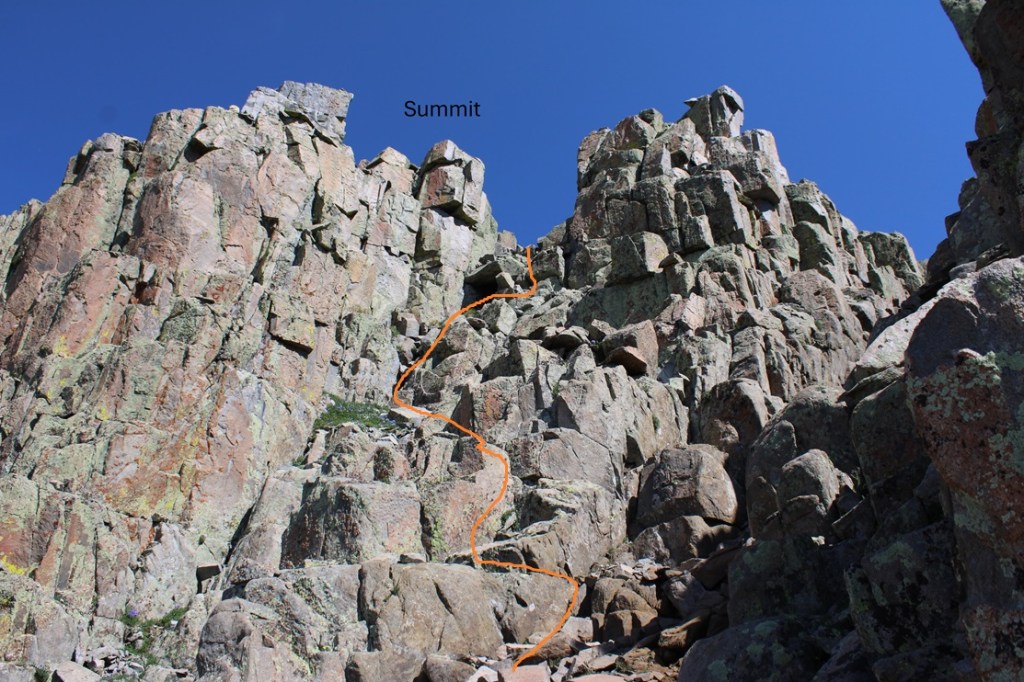
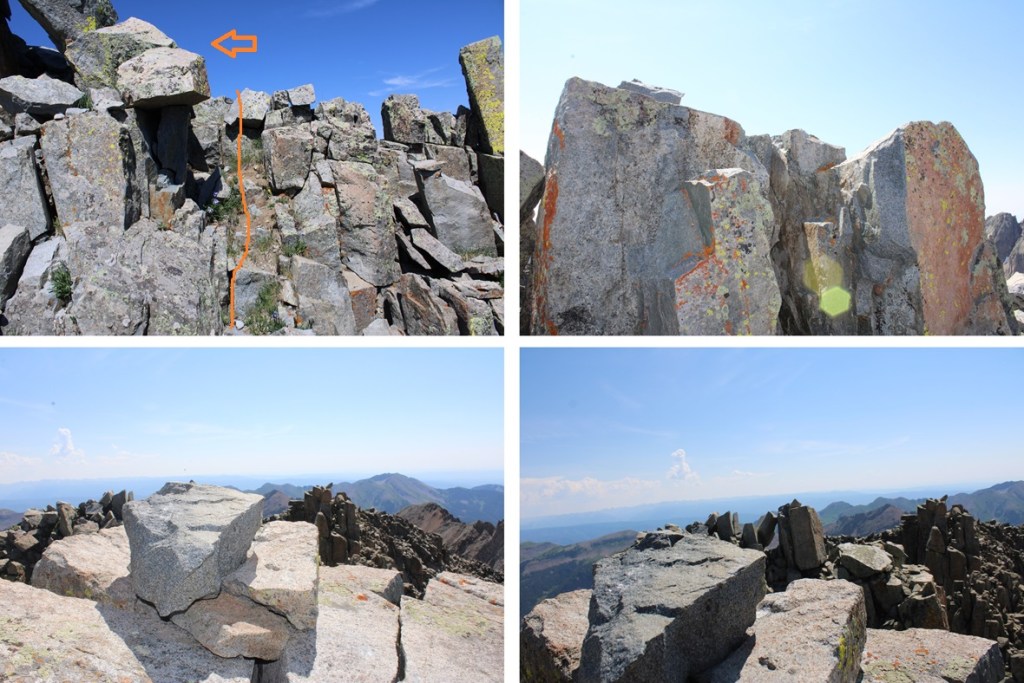
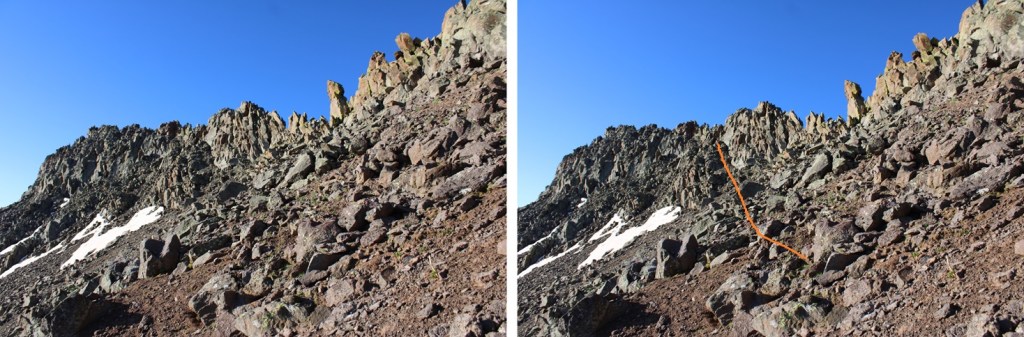
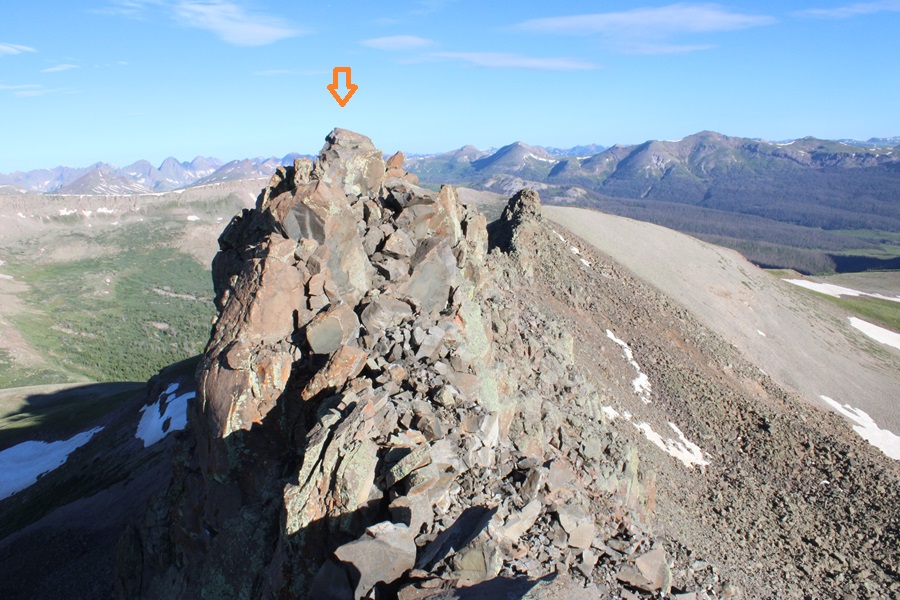
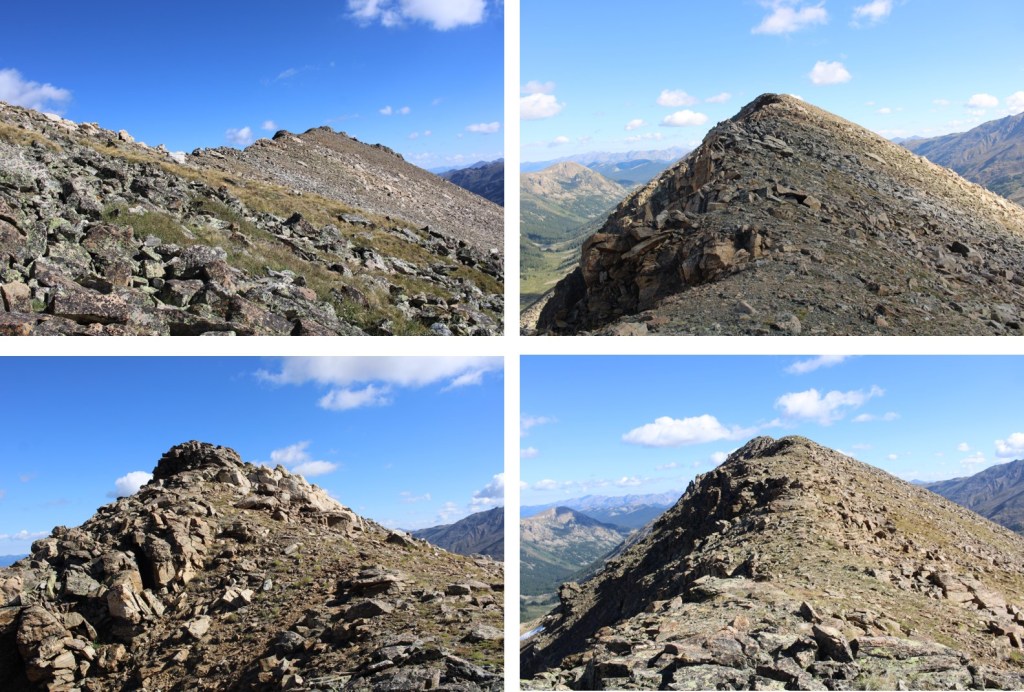
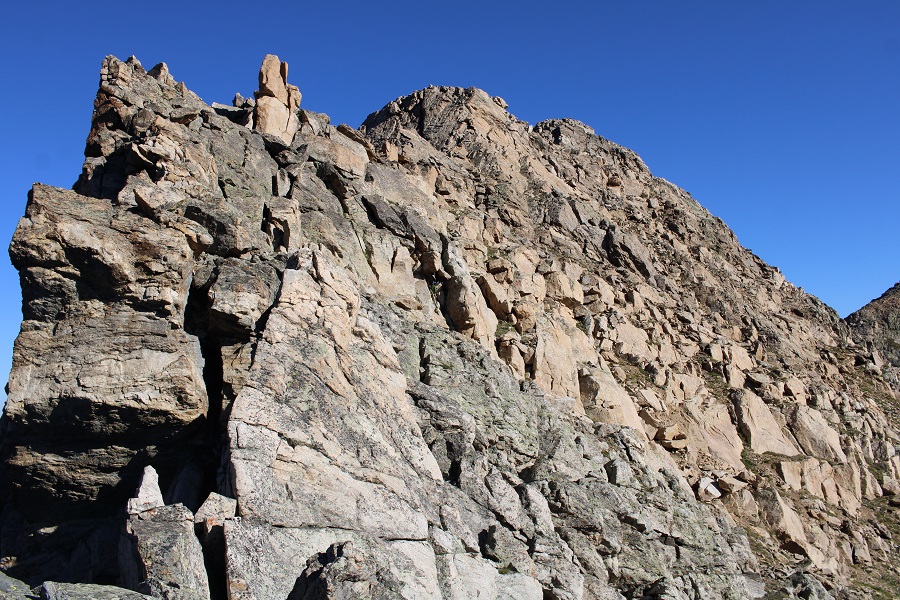
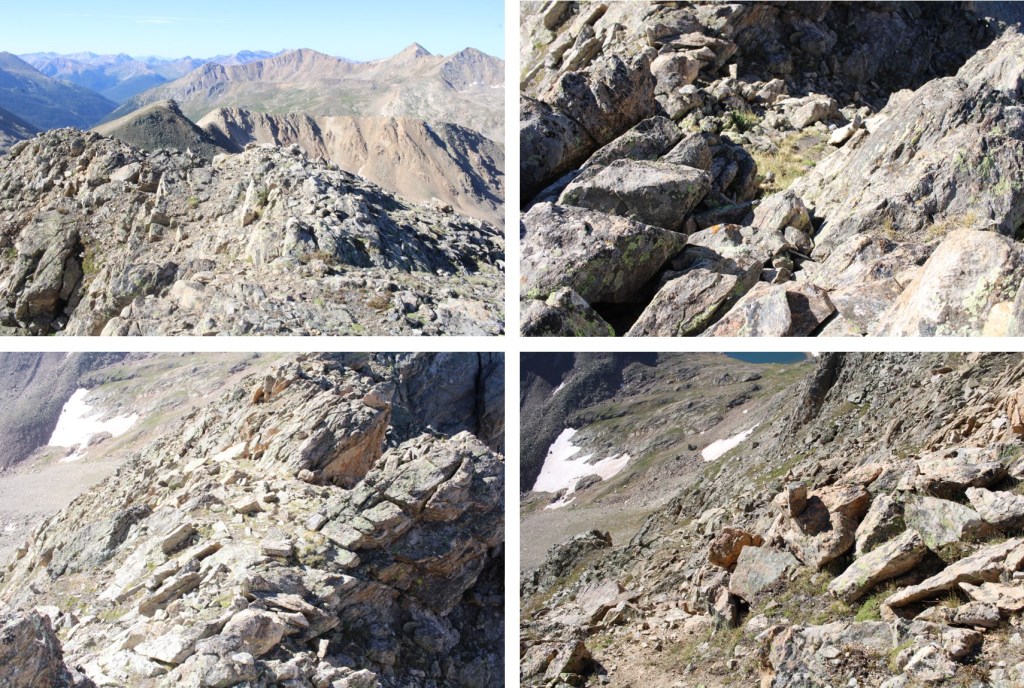
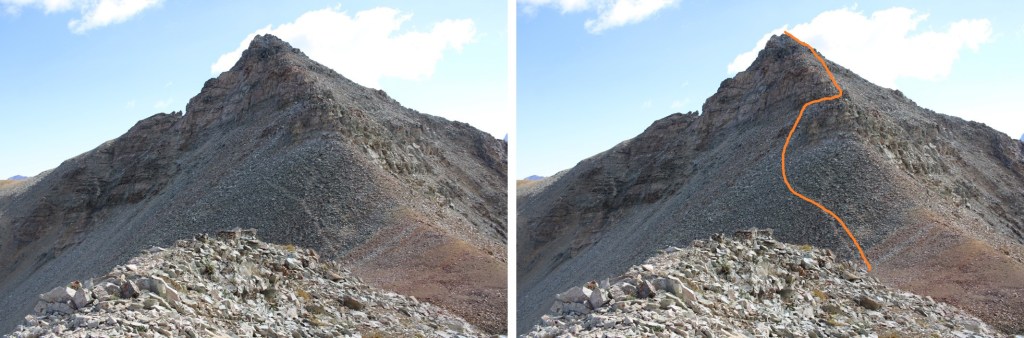
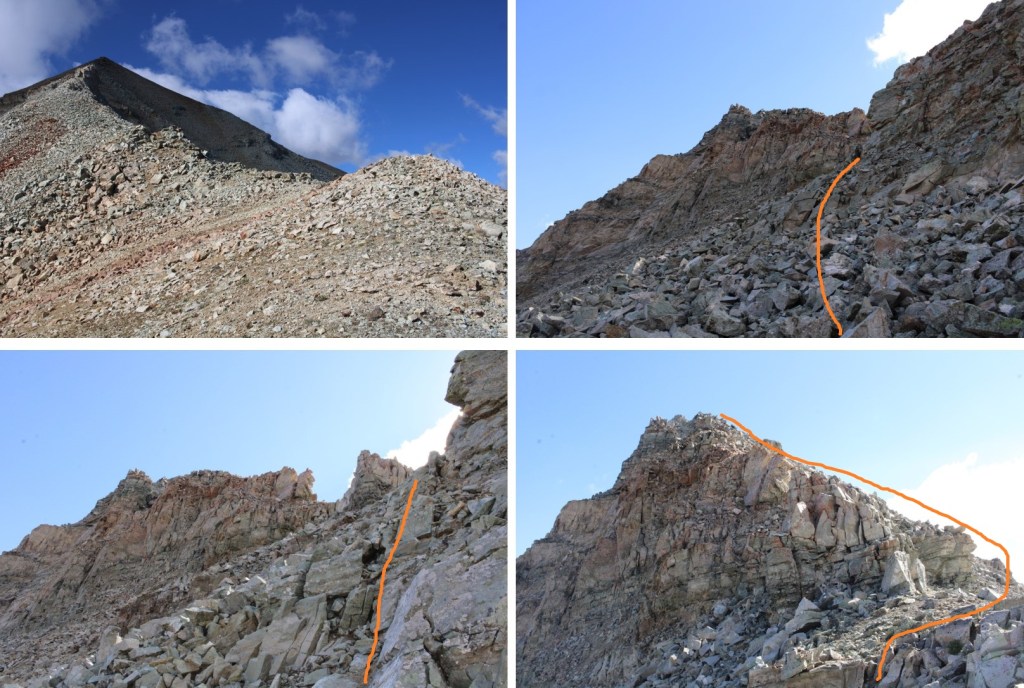
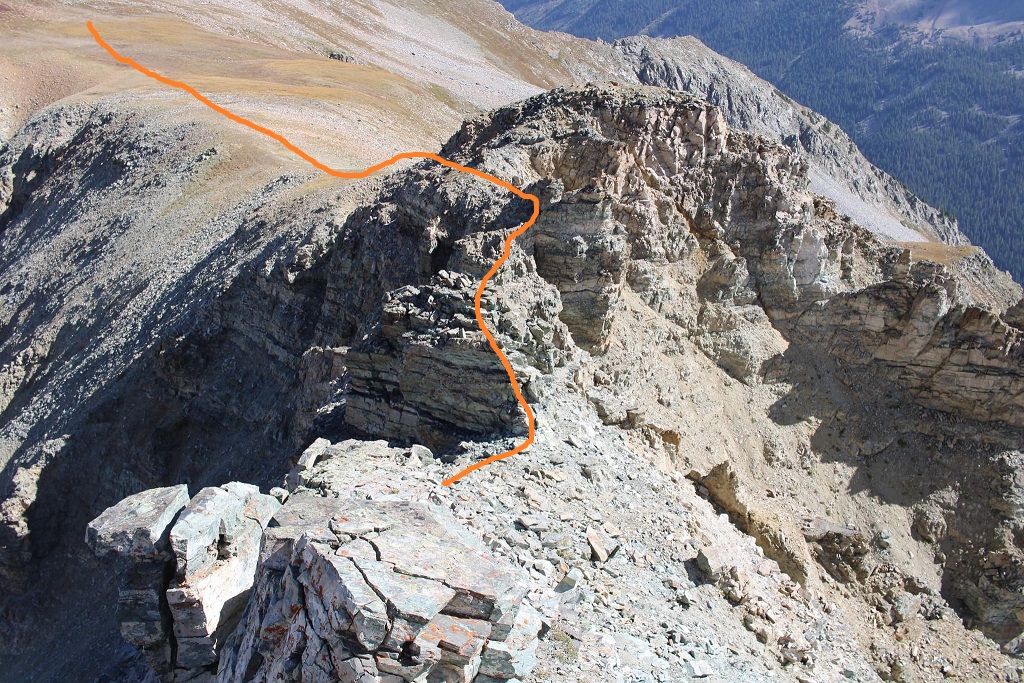
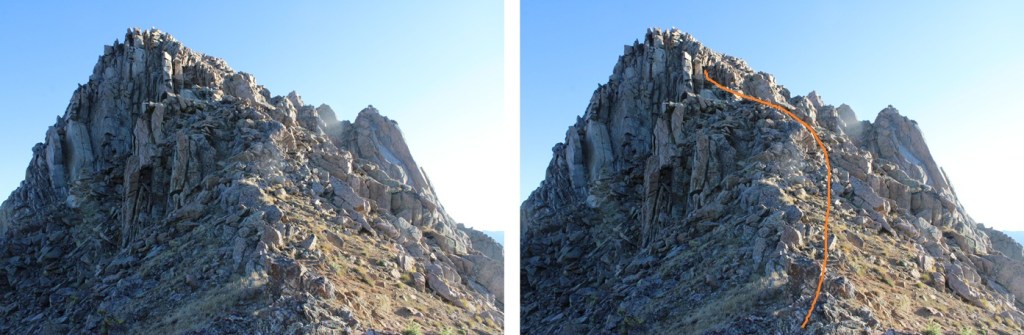
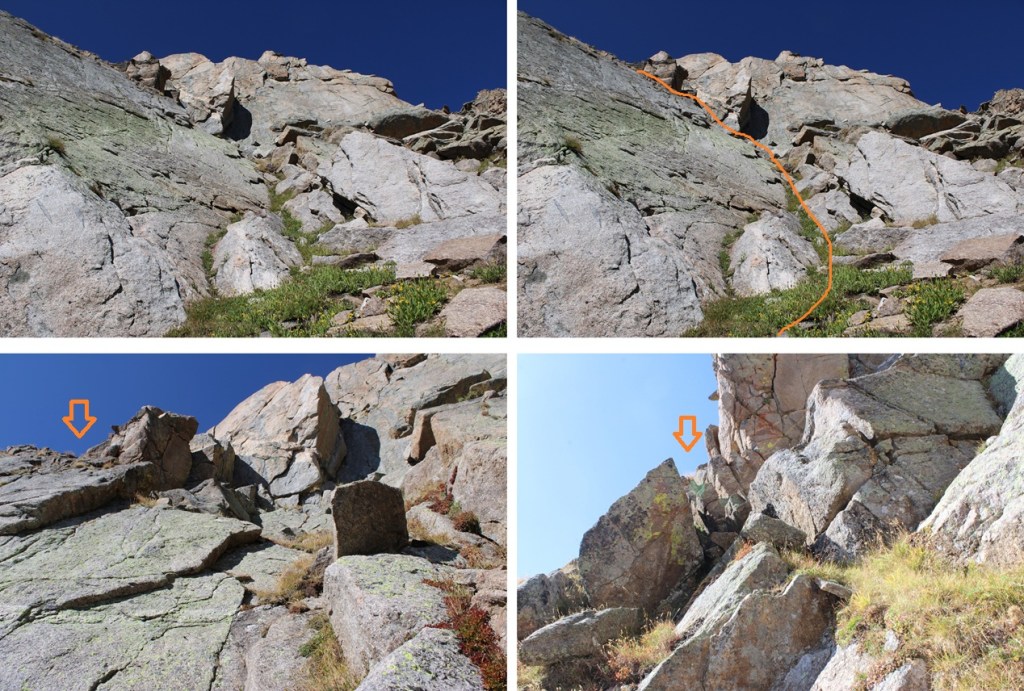
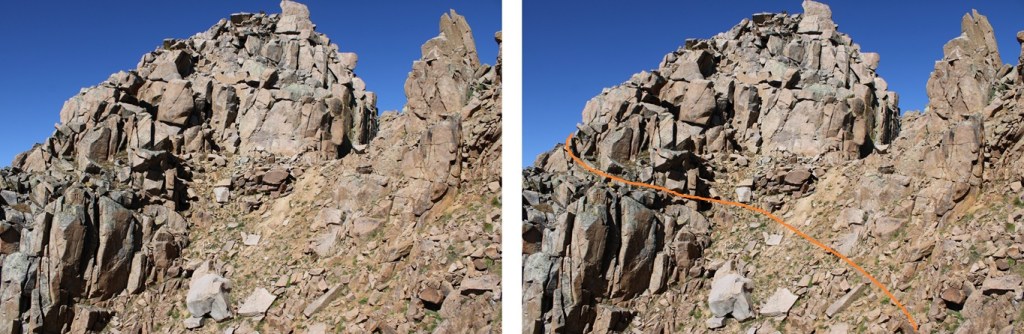
At the top of the ridge I could see 13024 to the right.  I followed the ridge on class 2 terrain to the base of the rocky area.  From here it’s only 1/10th of a mile and less than 200’ of elevation gain to the summit.  It’s mostly class 2 or easy 3, but there was one class 4 move I didn’t feel comfortable attempting without ropes.  Where the orange line ends is where I stopped, about 100’ from the summit.
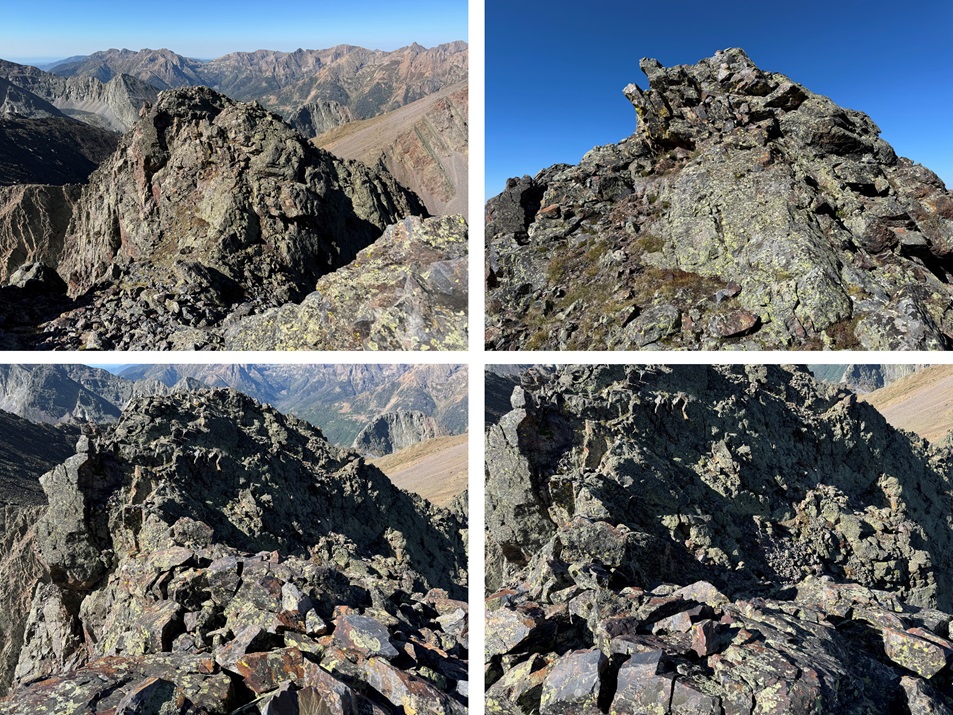
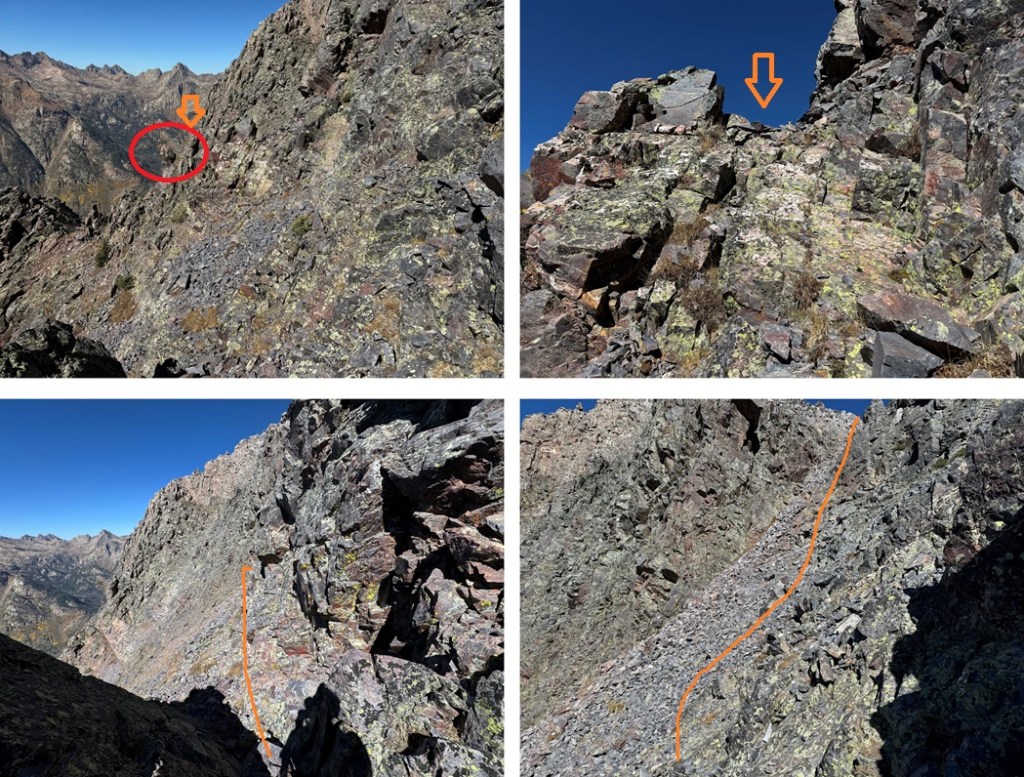
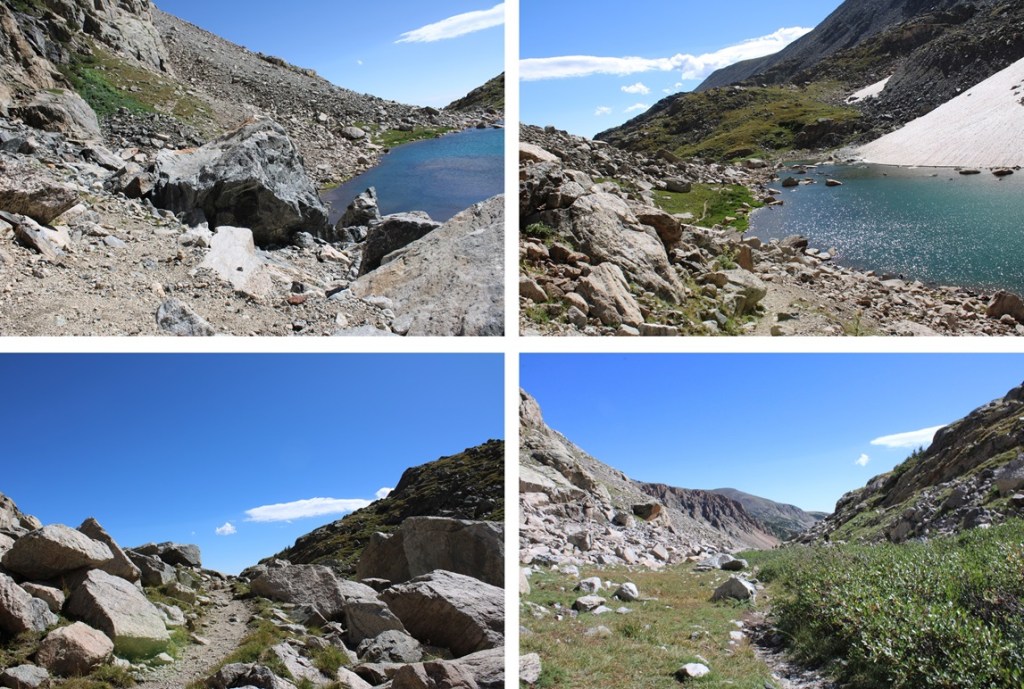
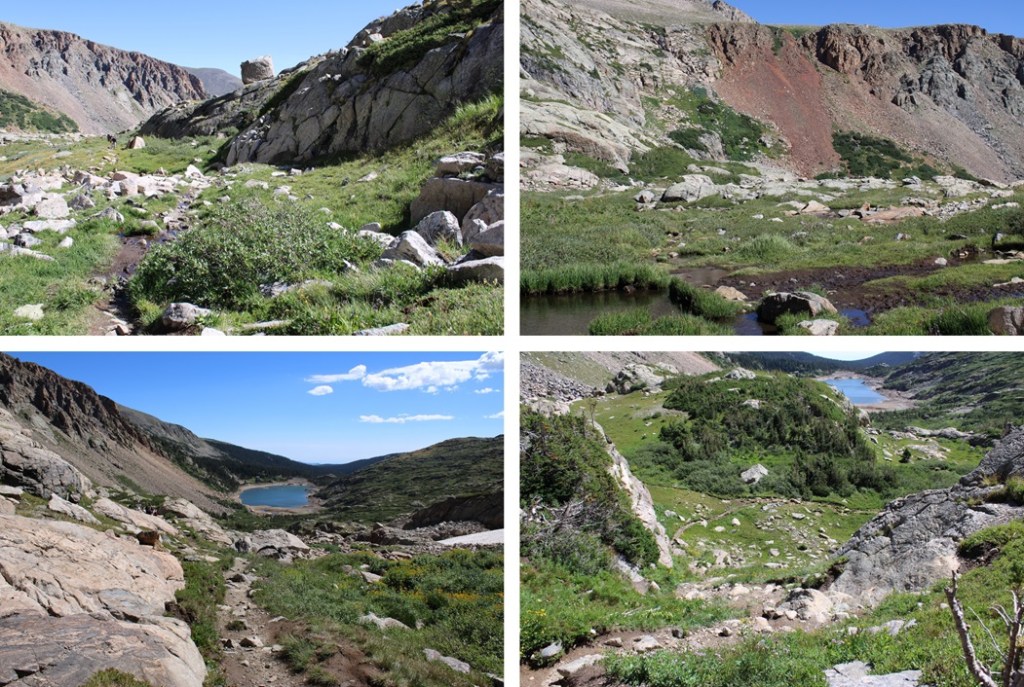
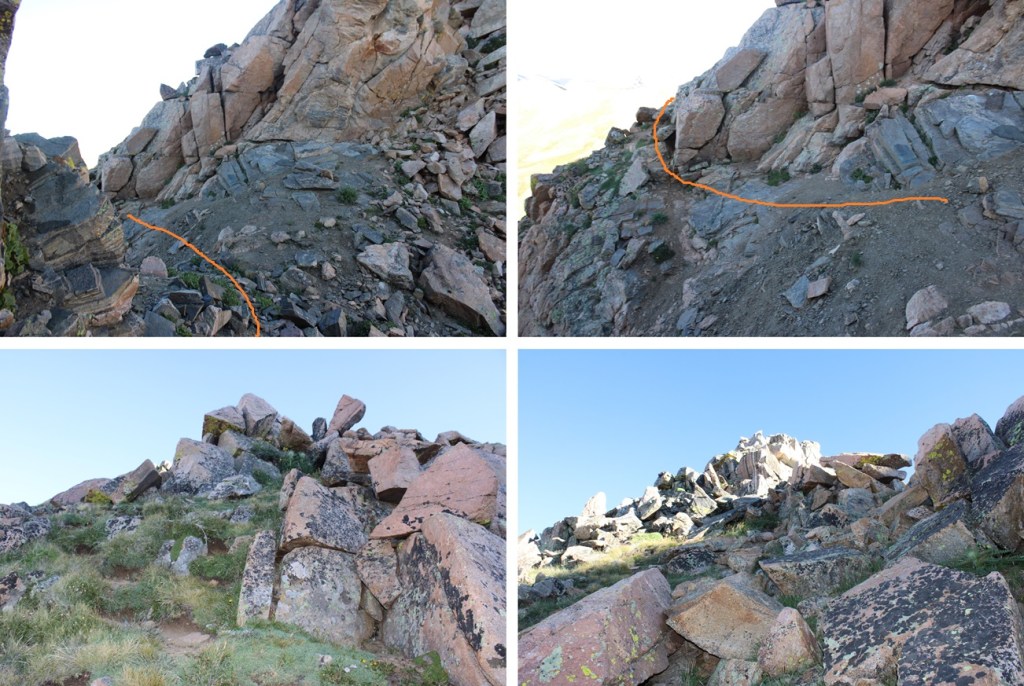
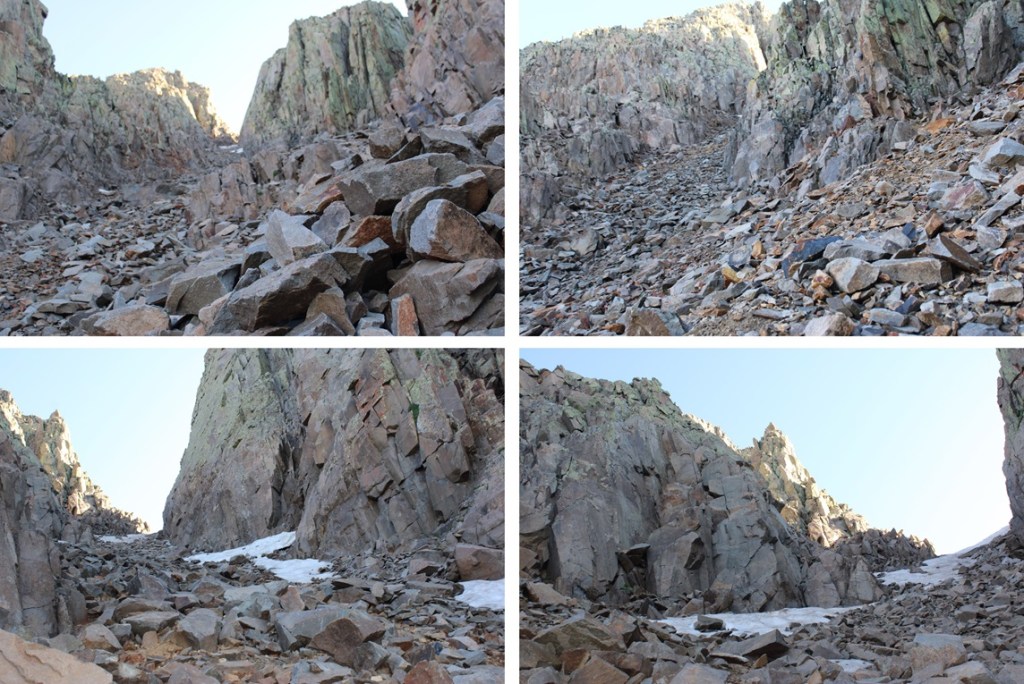
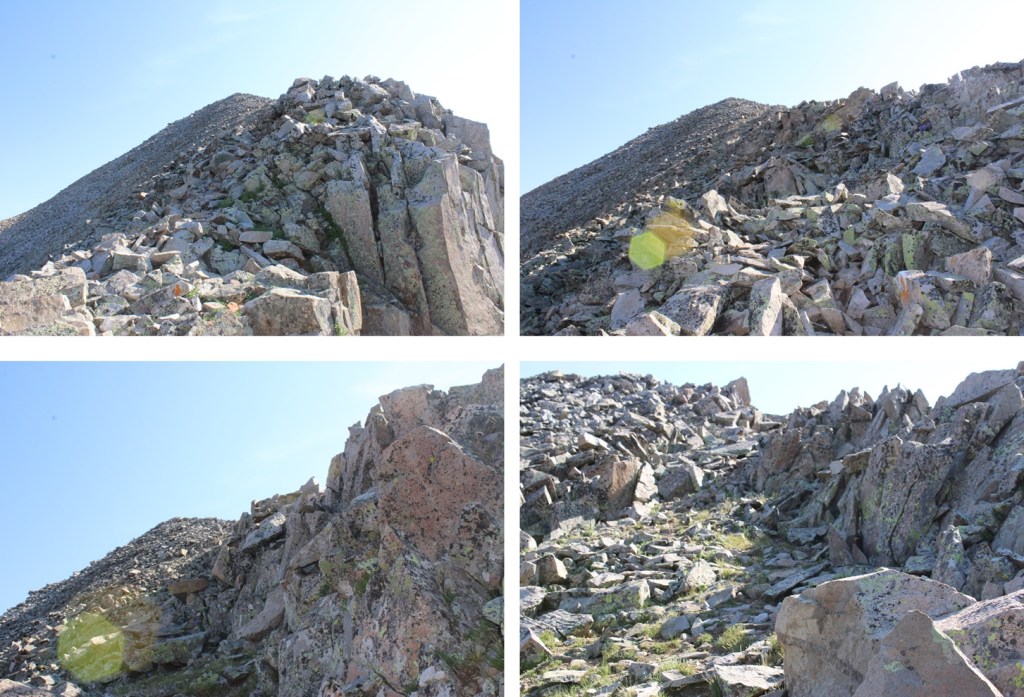
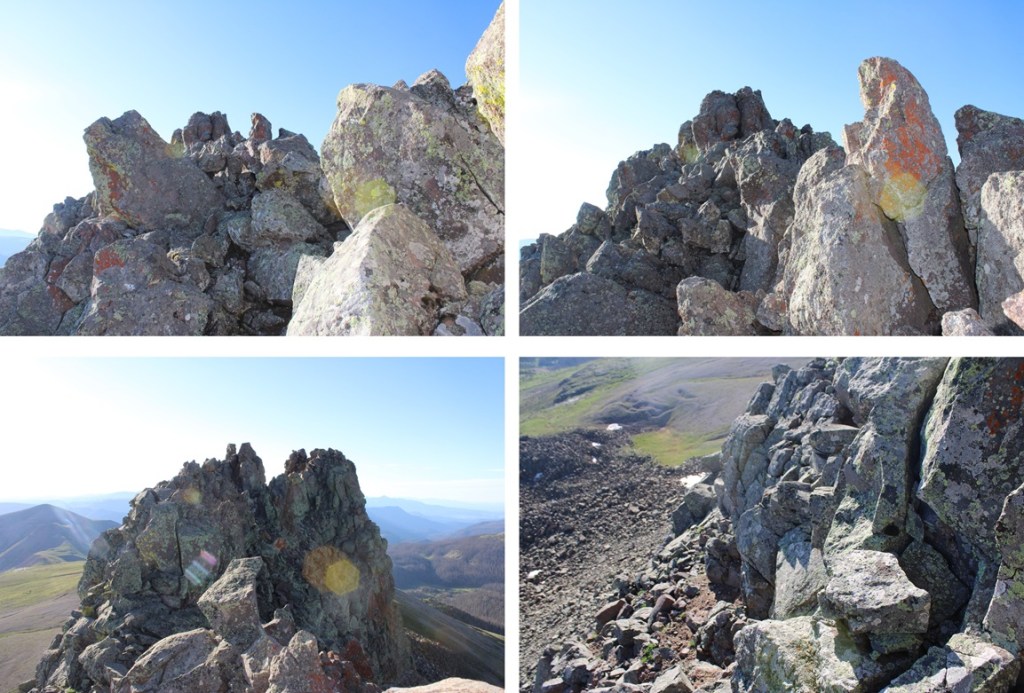
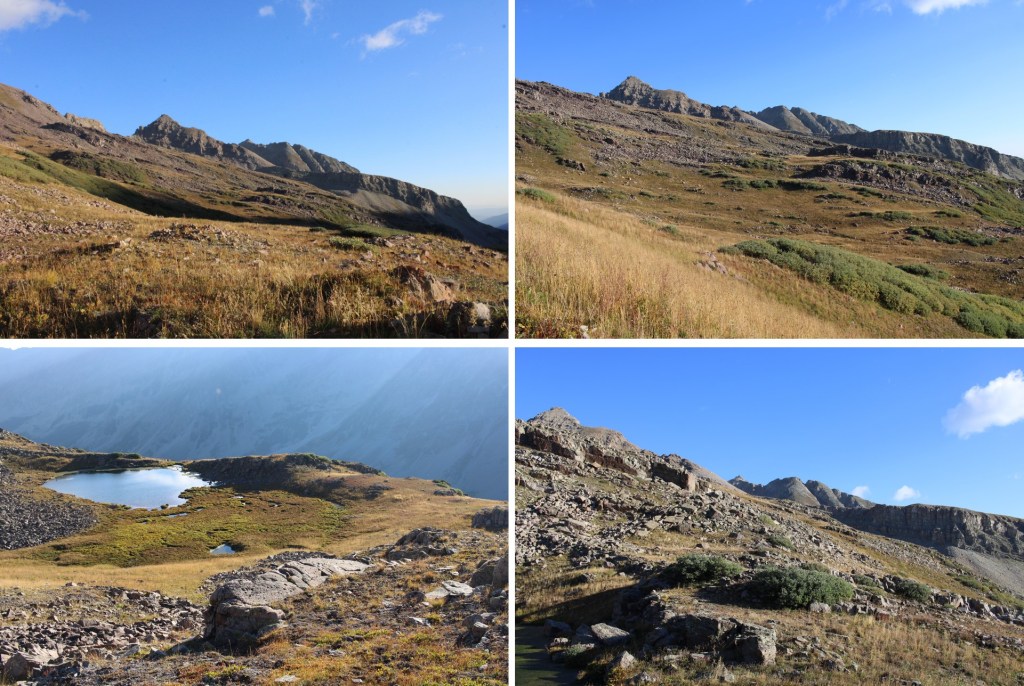
Here are some pictures of the route to that point.
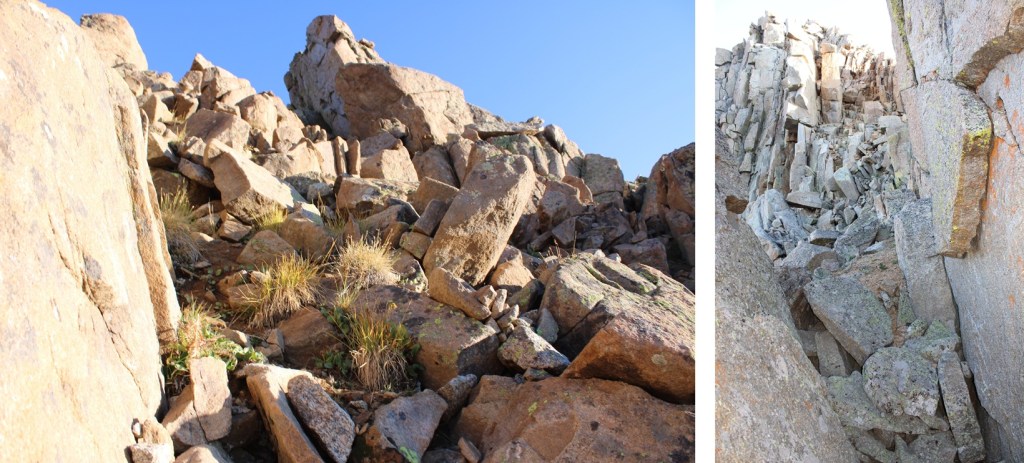
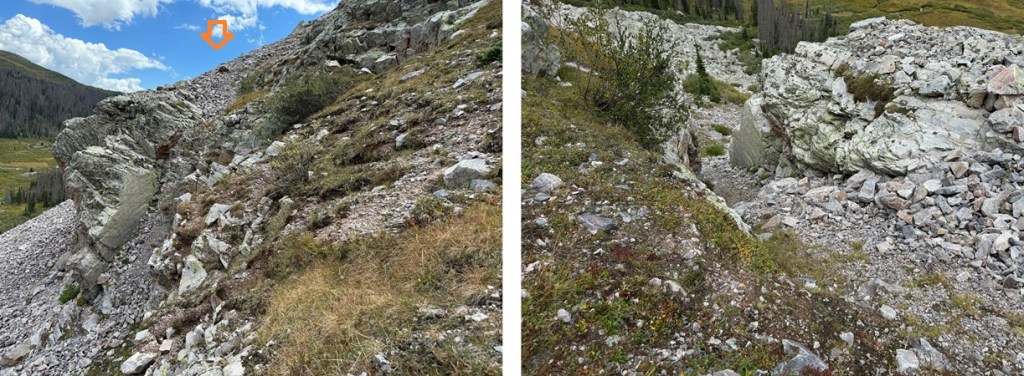
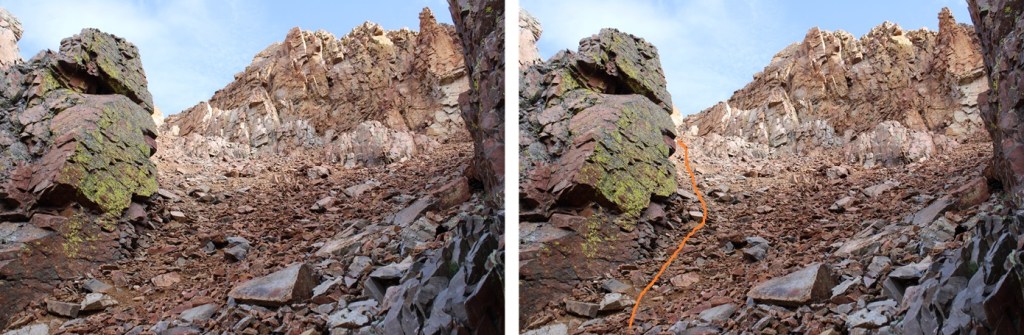
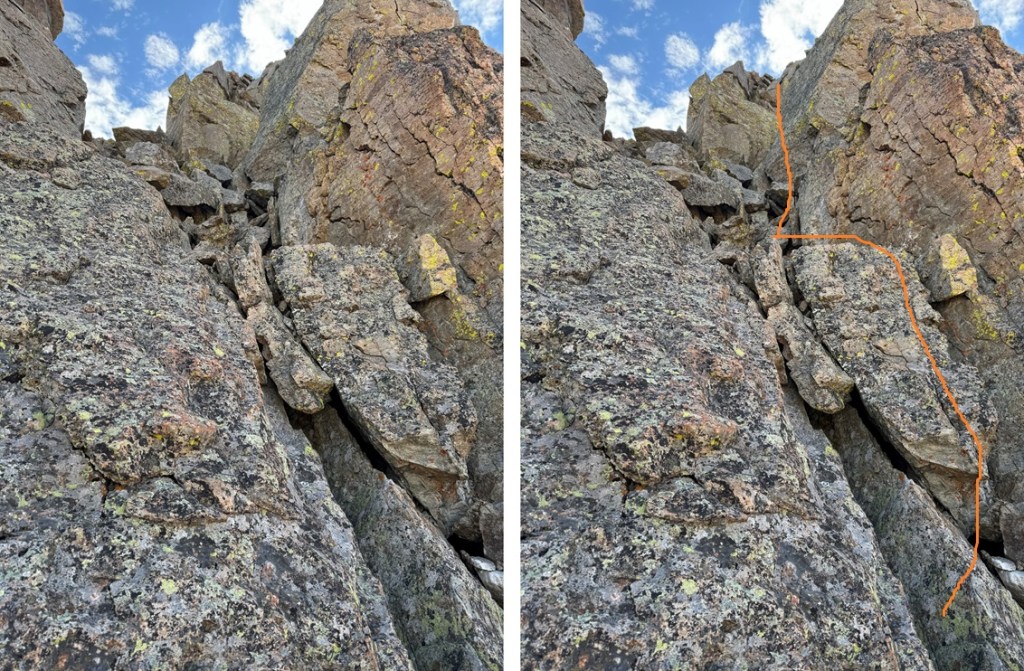
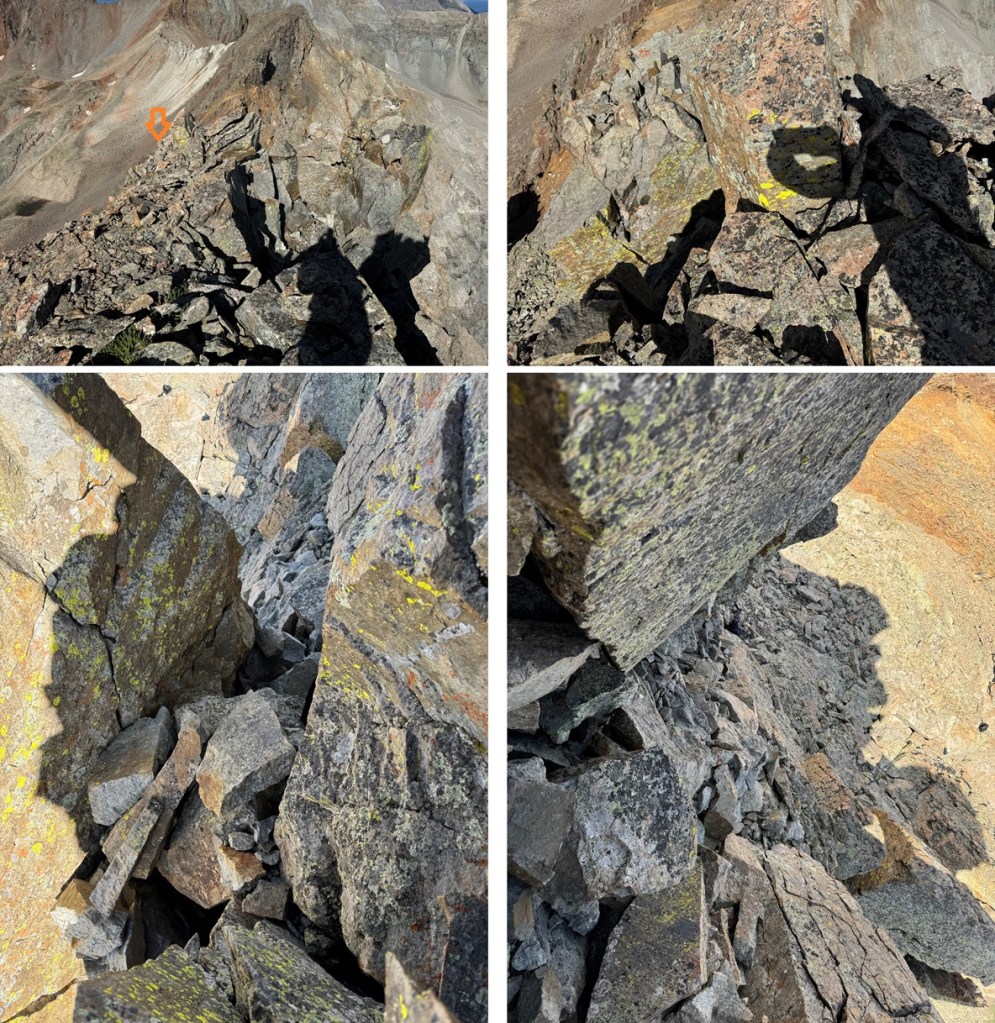
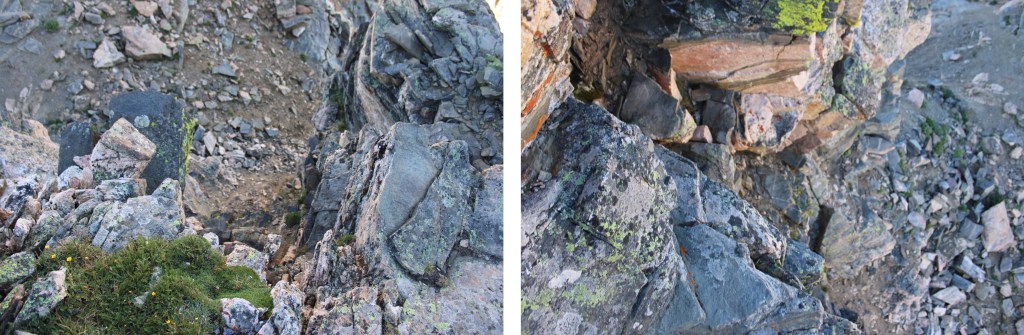
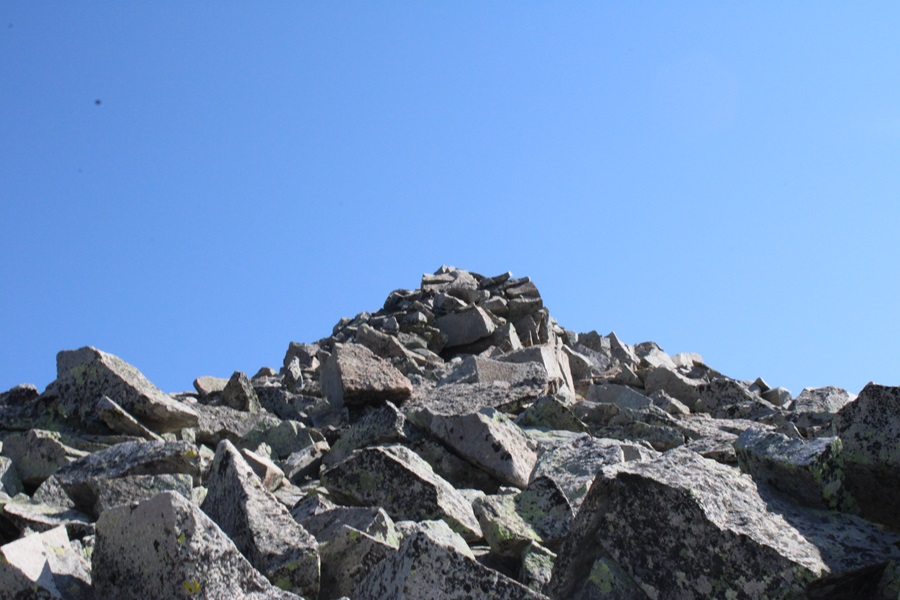
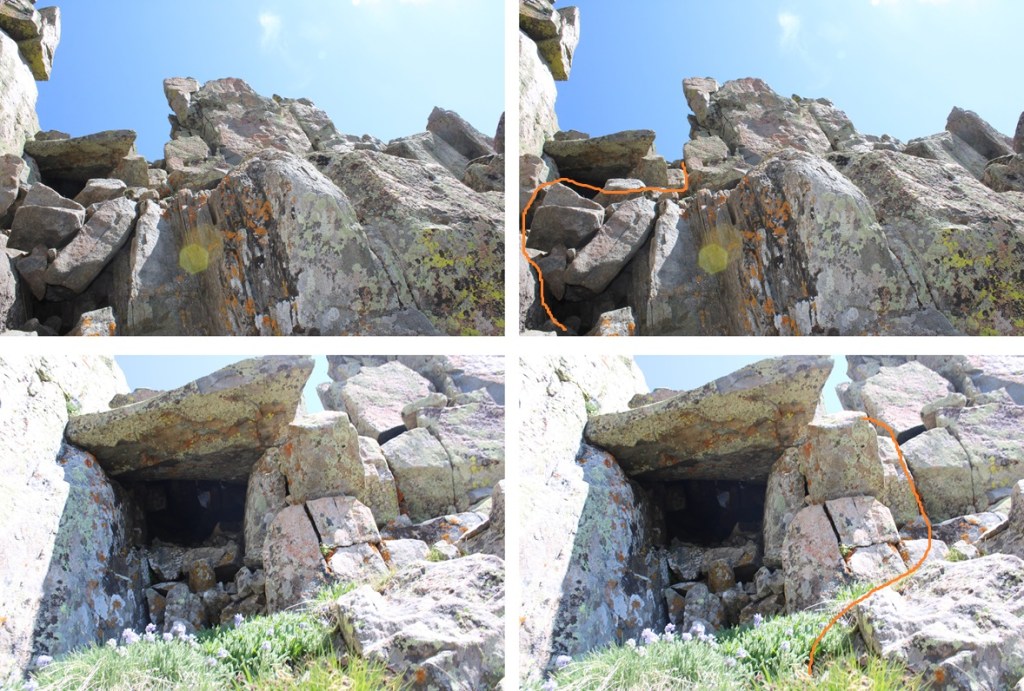
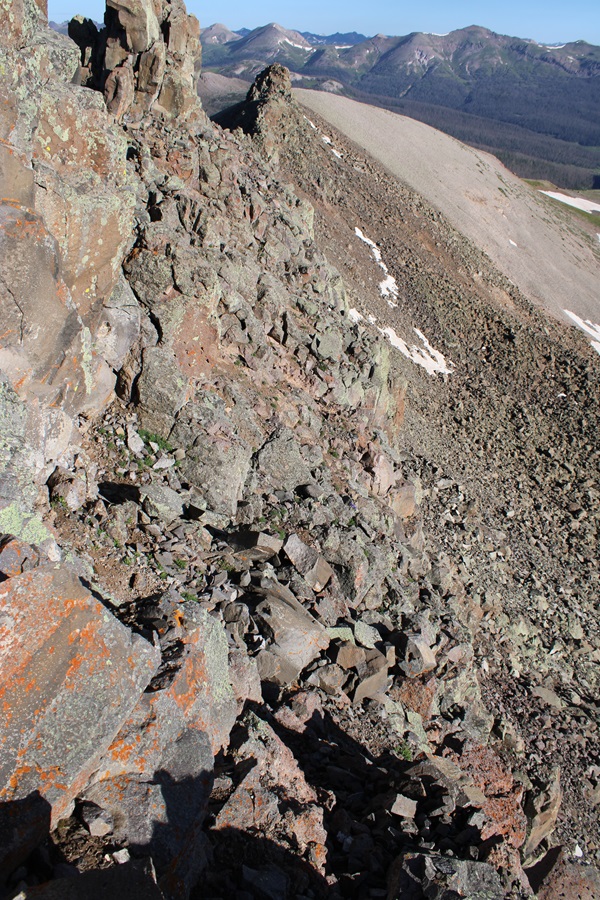
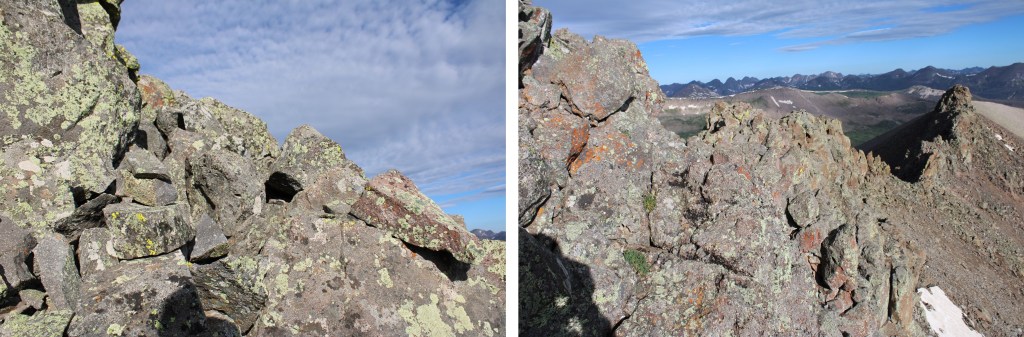
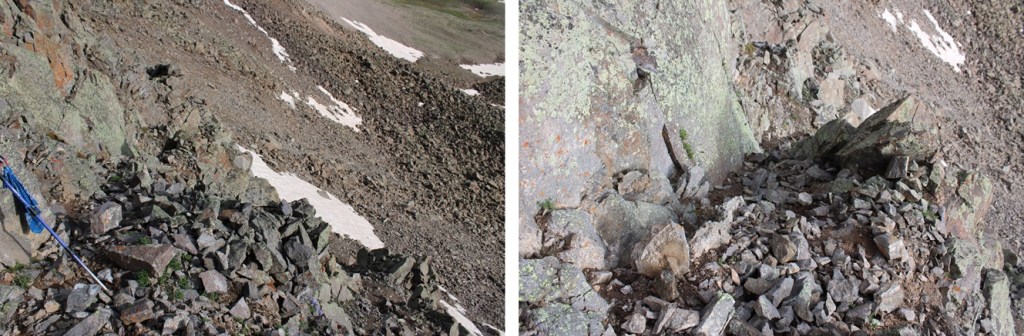
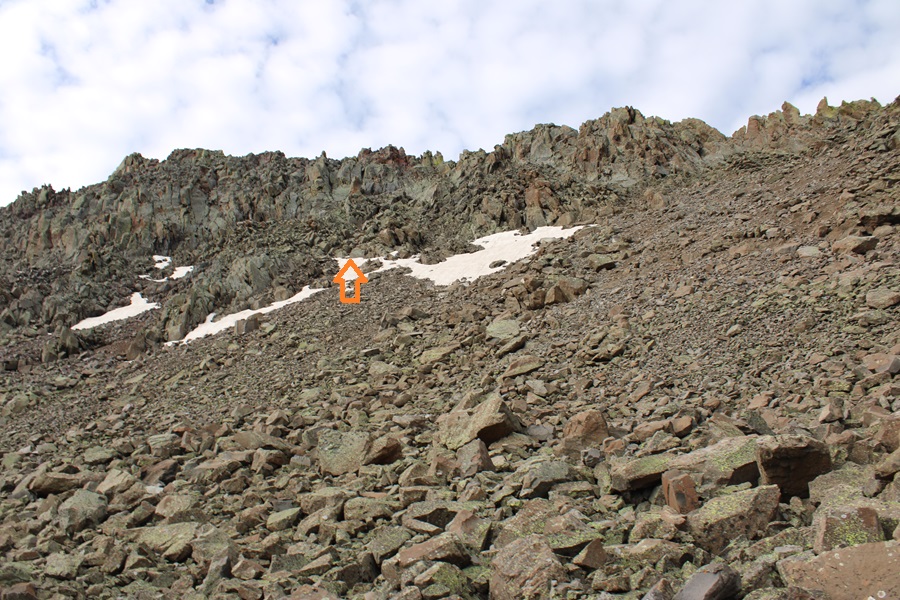
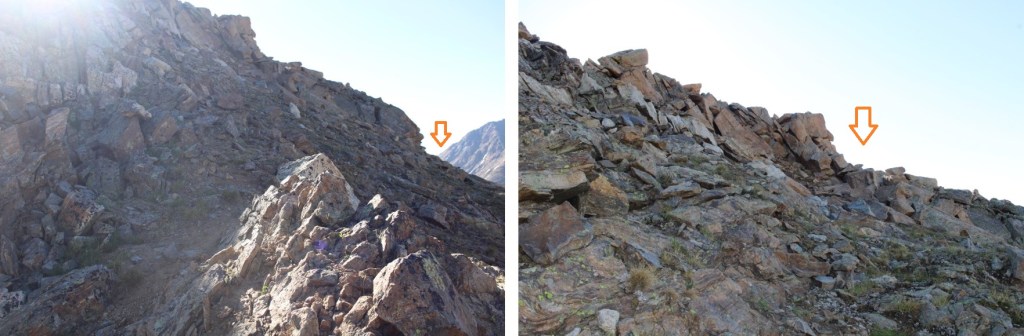
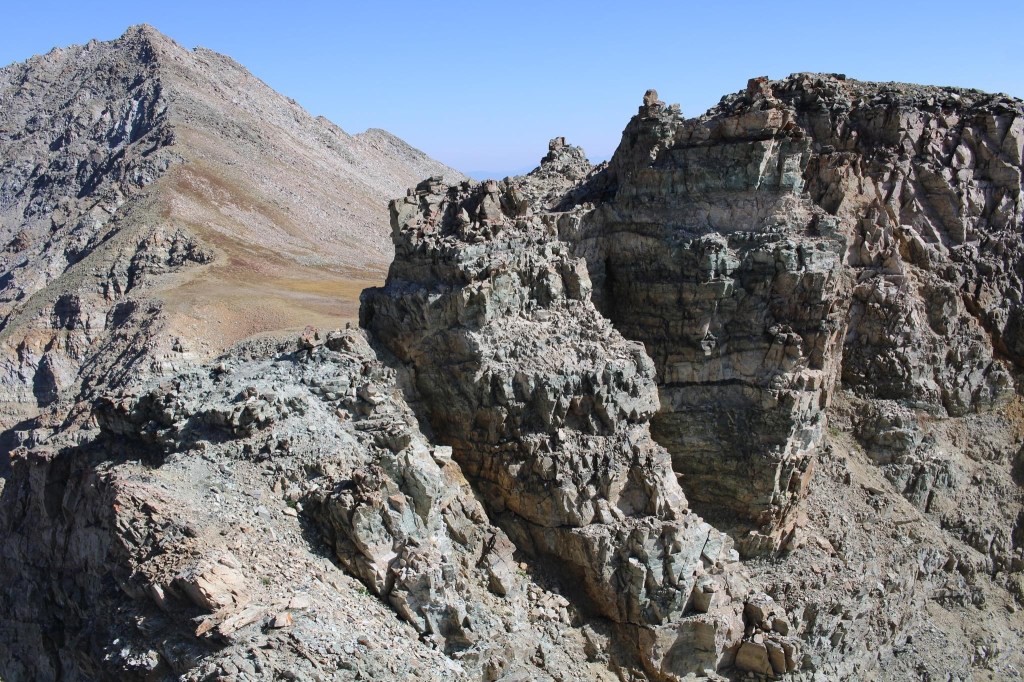
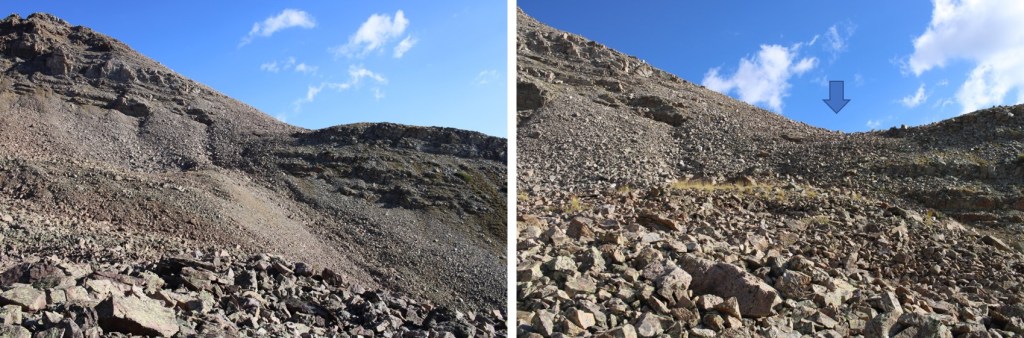
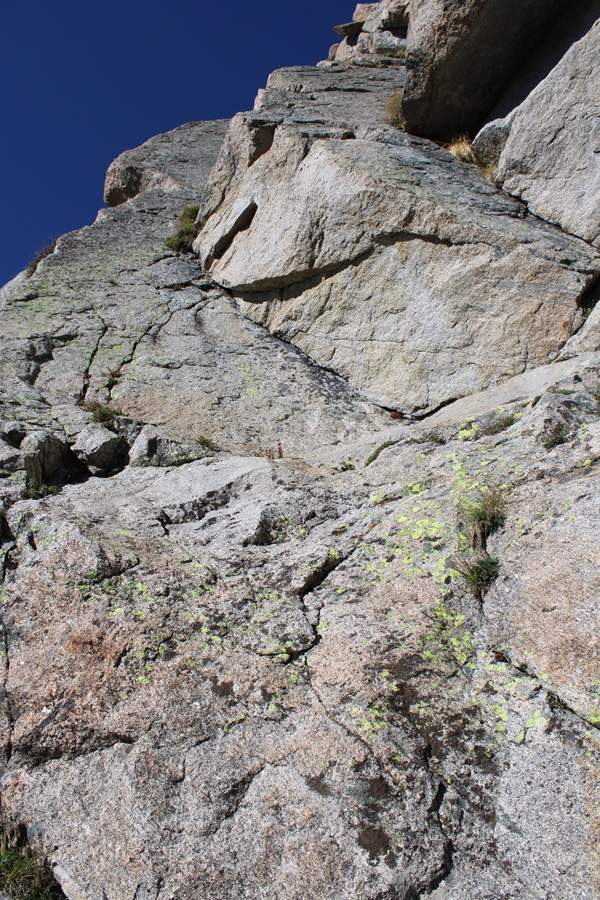
This was the move that I didn’t feel comfortable attempting without ropes.  It was very similar to the final crux on Jagged after the rockfall, but when I was there I had rope to help me.  The rocks above this problem overhang several feet over what look like easy steps from below, and it’s steep on all sides and all the rocks are loose, making depending on them for support/balance poor judgement.  The picture doesn’t do this area justice, and it wasn’t until I was under the rocks I realized the difficulty.  If I saw this picture, I’d go for it, but when I was there I knew it was too dangerous for me to do solo.  I could see where I needed to place my hands/feet, but I wasn’t tall enough to make the moves.  Rock climbing shoes might have helped, and a rope definitely would have, but I had neither.  I spent about 15 minutes trying to find a way up/around this, and in the end turned around.  I’d just been on an amazing podcast (seriously, you should listen to it just to know the podcaster: it’s called “Going in Blind” and will change the way you think of your own life experiences).  We talked about failed attempts, turnarounds, risk tolerance, etc. and this move was above my risk tolerance for soloing.  How terrible would it have been if I’d just talked about my many, many failed attempts and turnarounds and attempted this and failed because I was overconfident?  I’d look like  a fool.  If I’d been with a friend they could have cheerleader lifted me and I could have pulled them from above but solo I didn’t feel comfortable attempting this move.  I felt there was a 75% chance I could make it up, which just wasn’t good enough, especially when going solo.  However, if you can get over this class 4 move it’s an easy class 3 climb to the summit. 
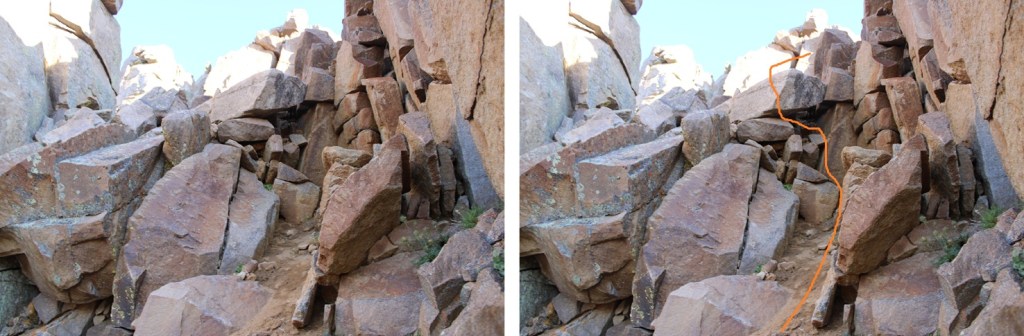
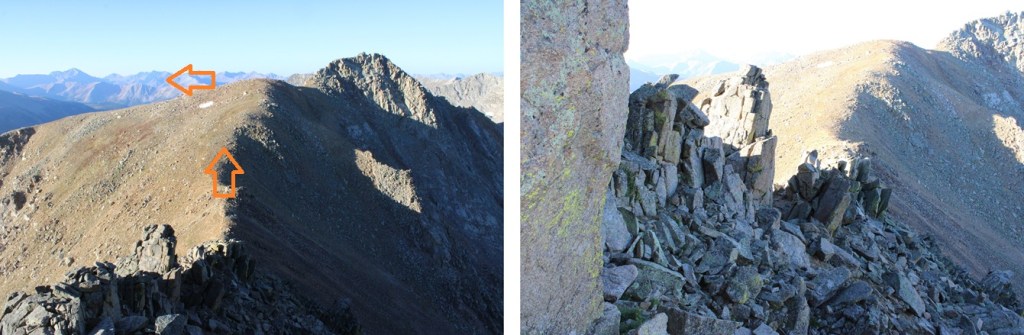
As I said, I turned around and headed back down to the basin, retracing my steps on easy class 2 terrain.
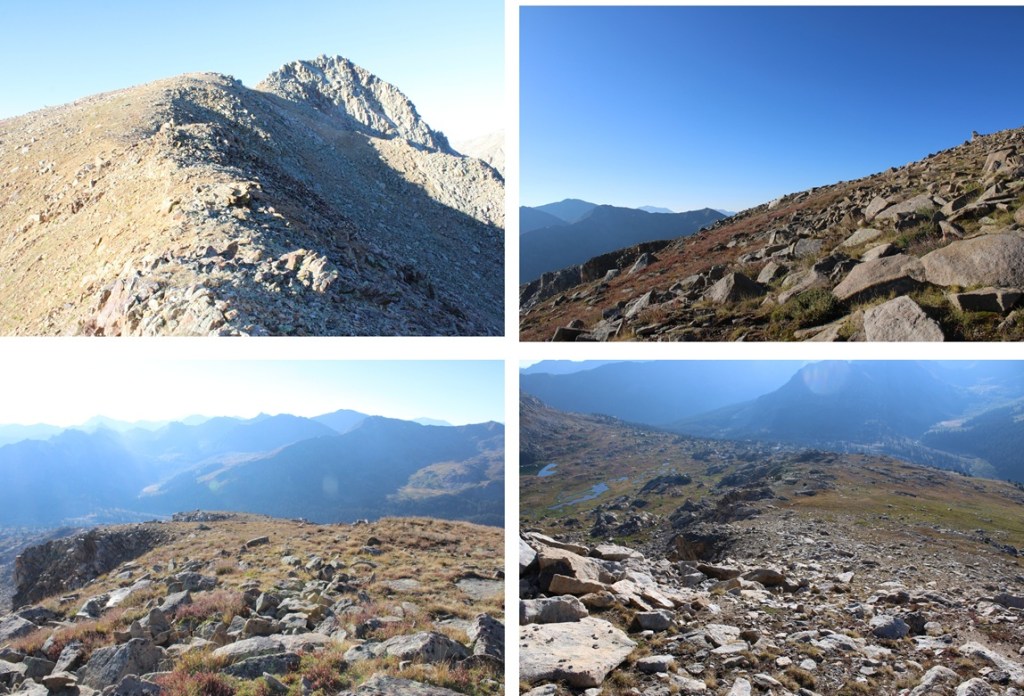
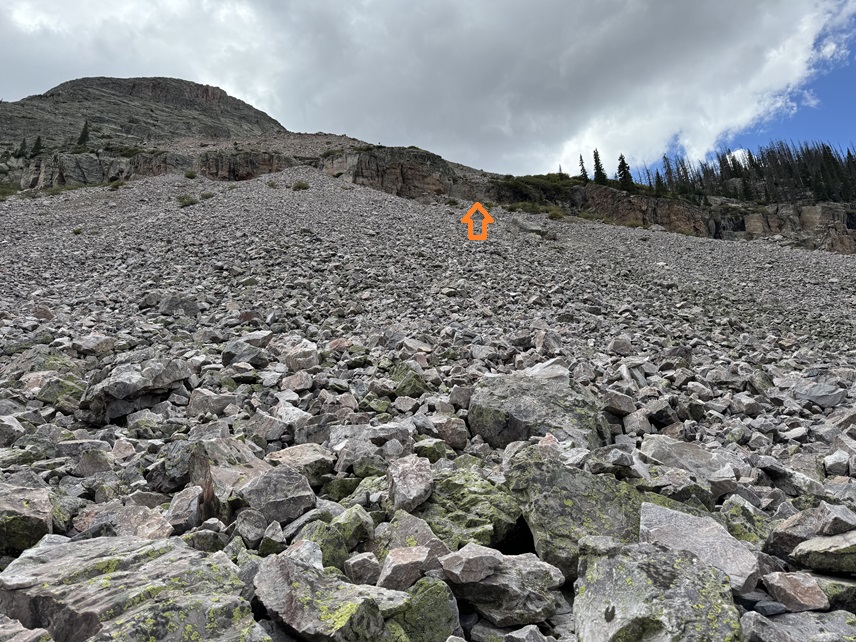
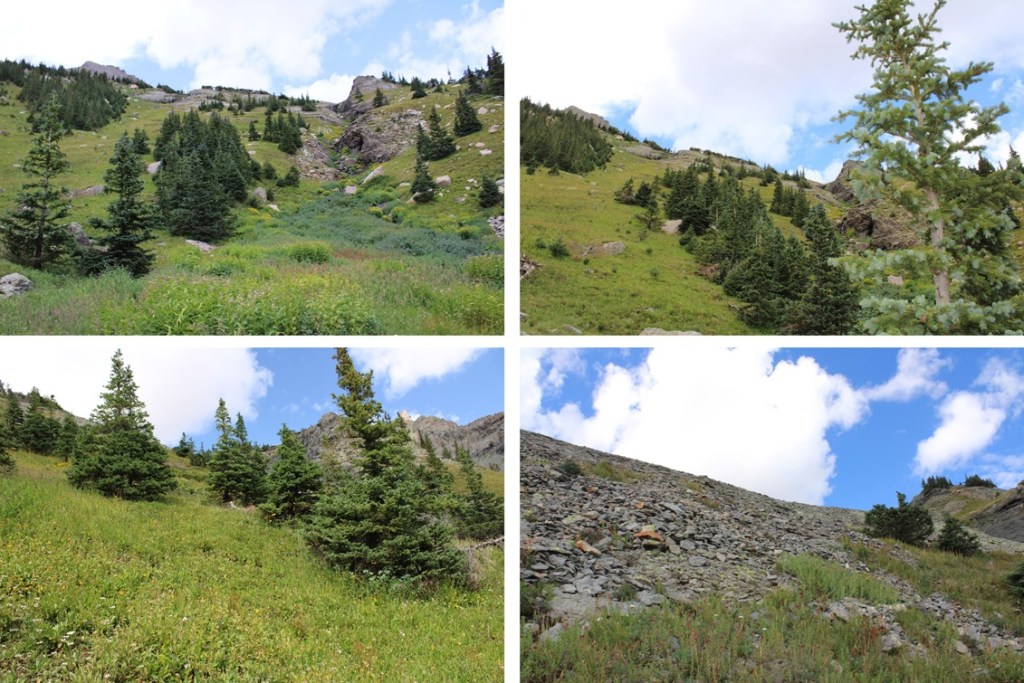
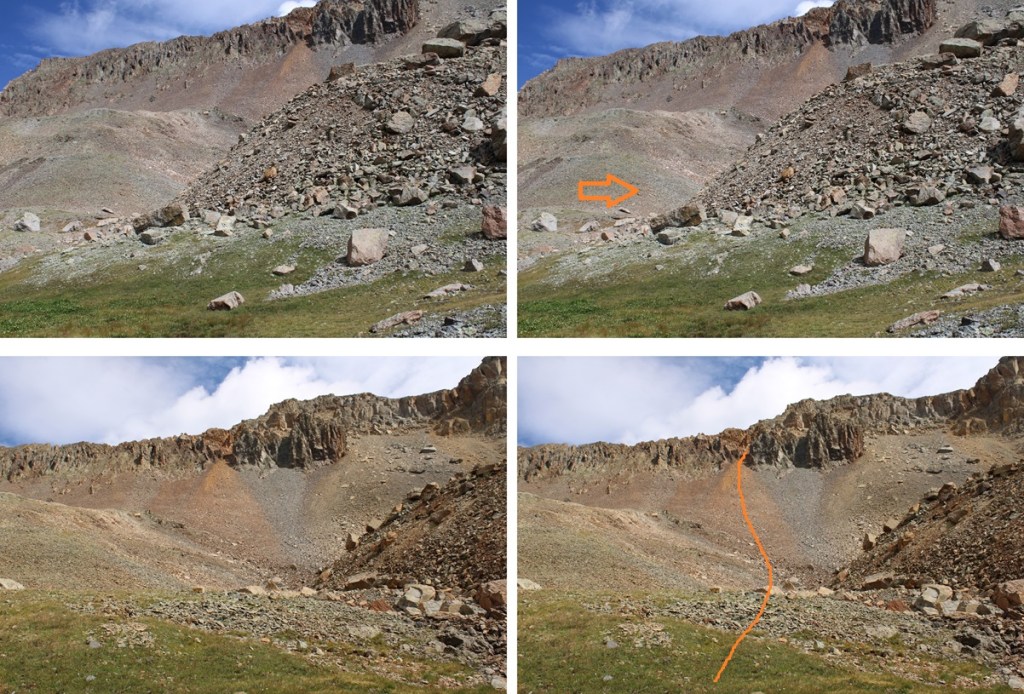
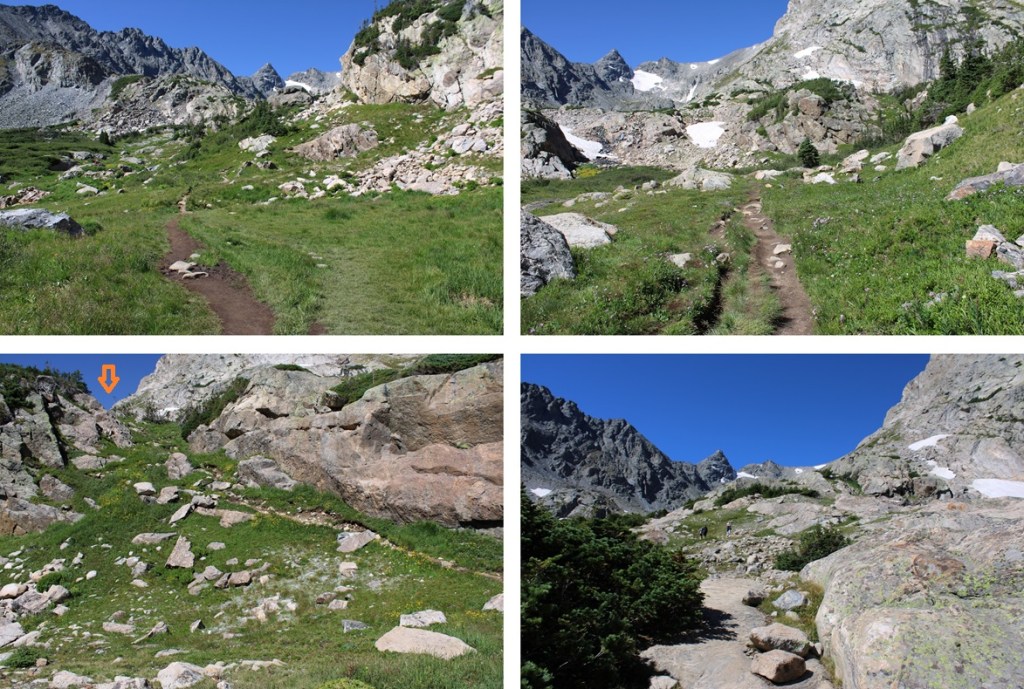
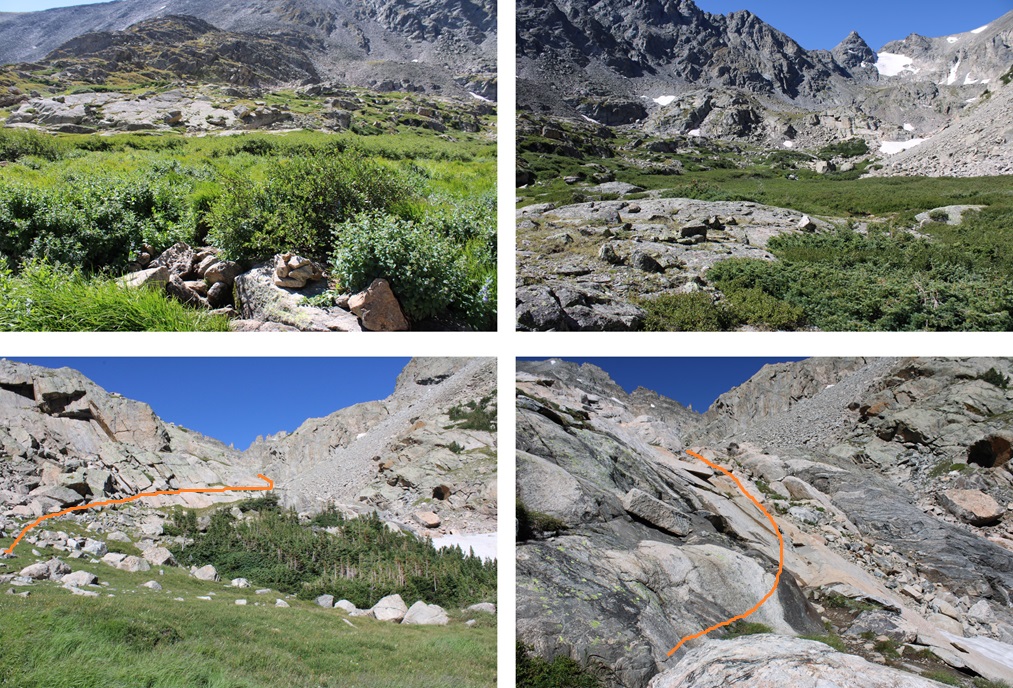
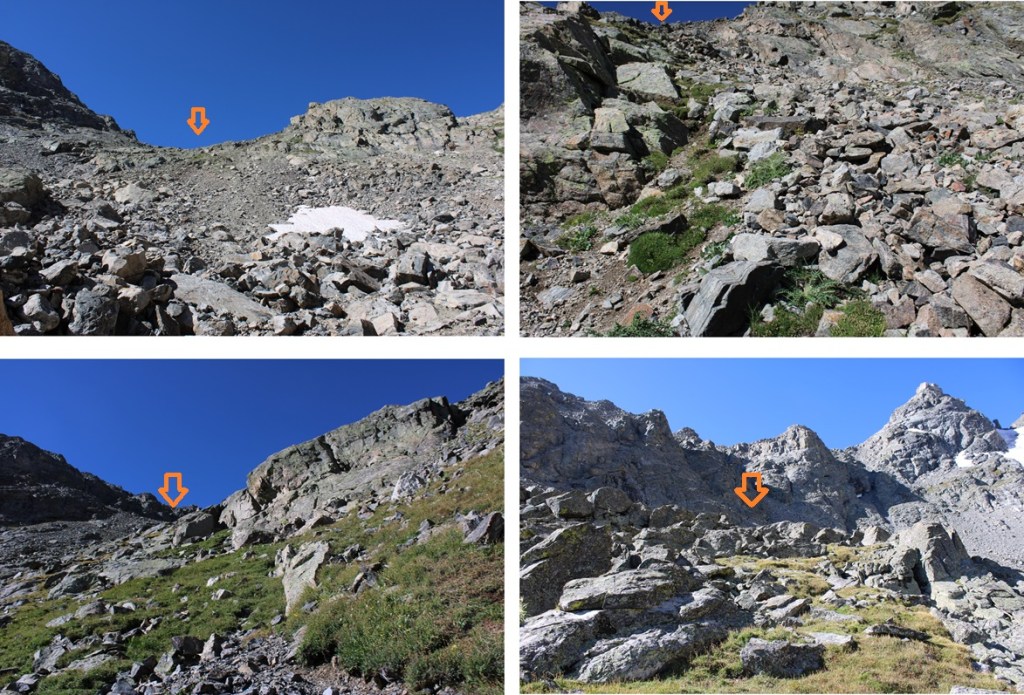
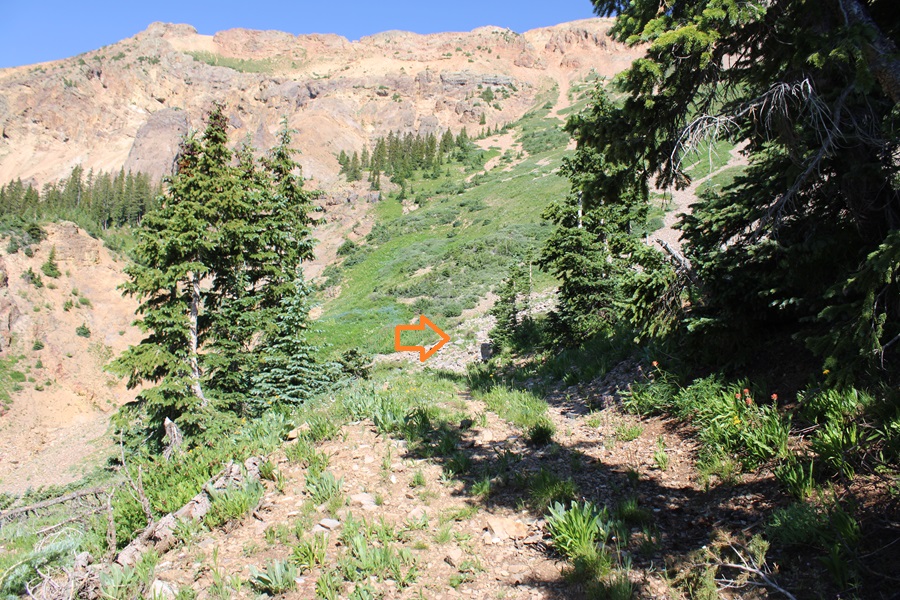
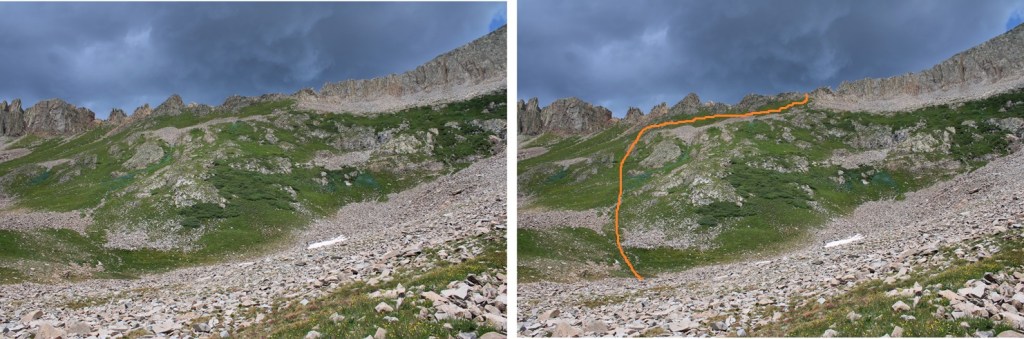
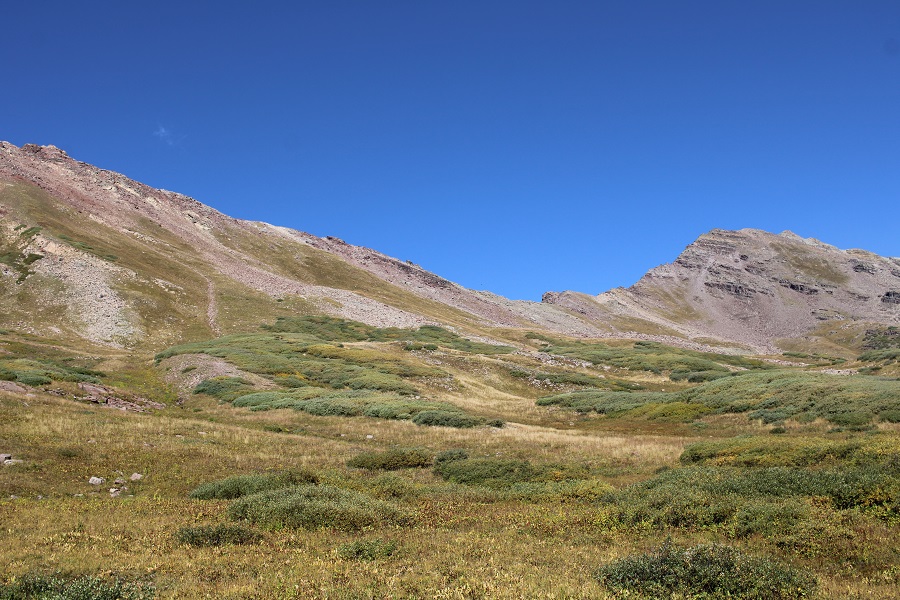
Back in the basin at my campsite it was only 9am.  I had a quick snack and started out again, this time taking the pink route up to 13204.  I started out by heading northwest up the basin towards the base of a large rock outcropping.  This is choose your own adventure, and all of it is class 2, just make your way towards the large rock outcropping.
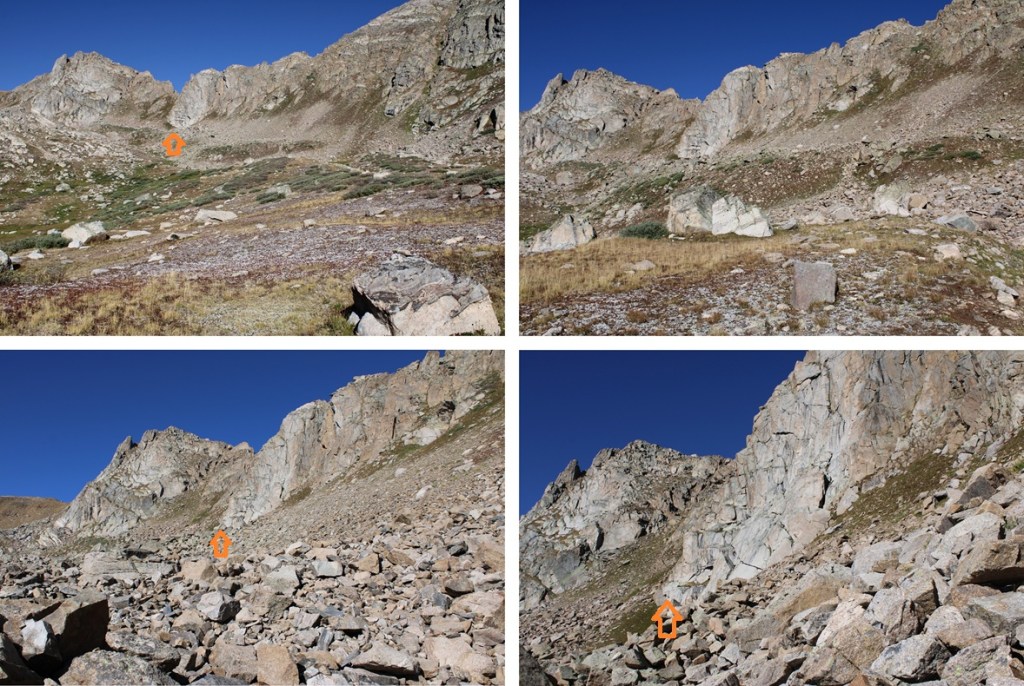
From the base of this large rock outcropping I looked for a grassy ramp in the distance to the south/southwest.  It’s small, and the access point for the rest of the climb. 
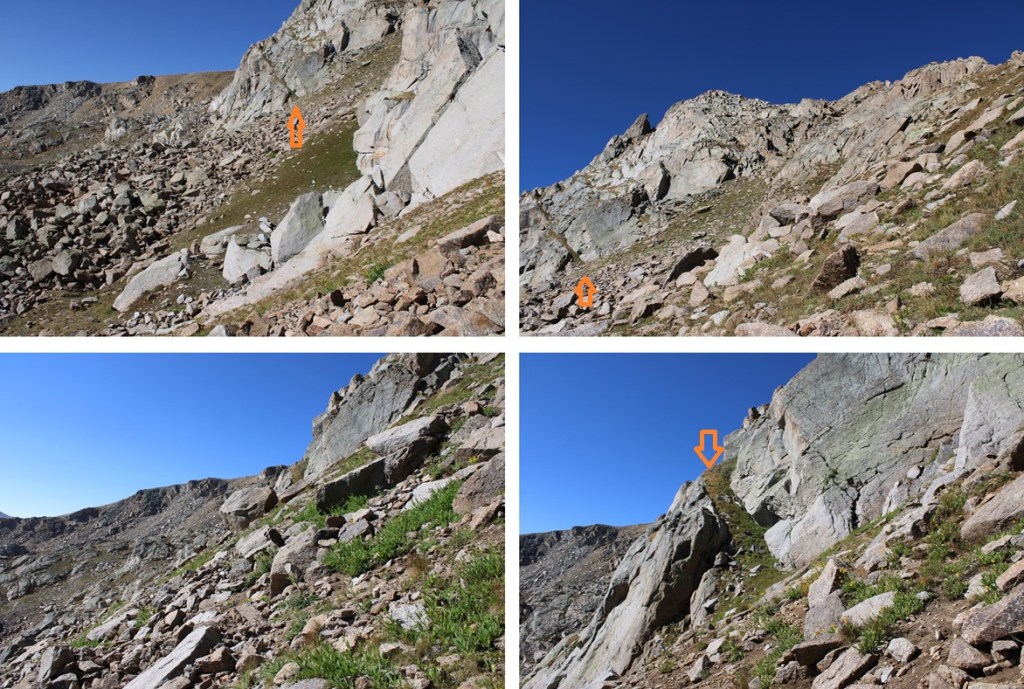
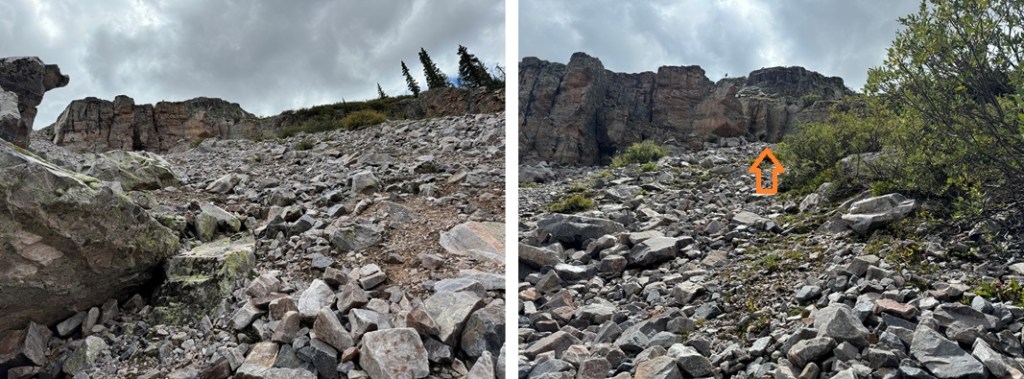
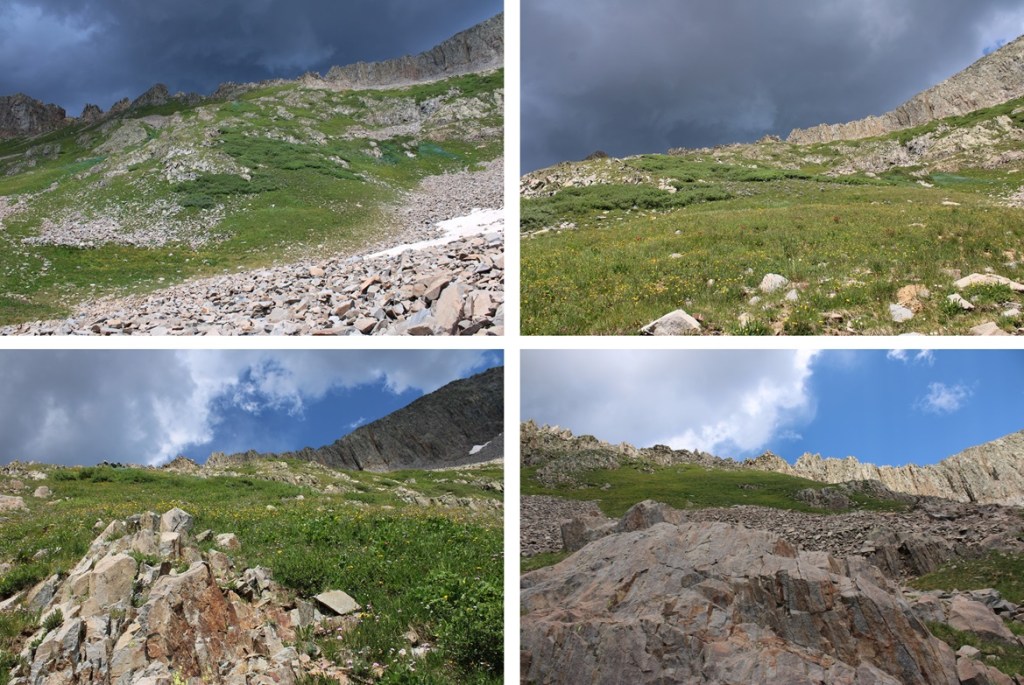
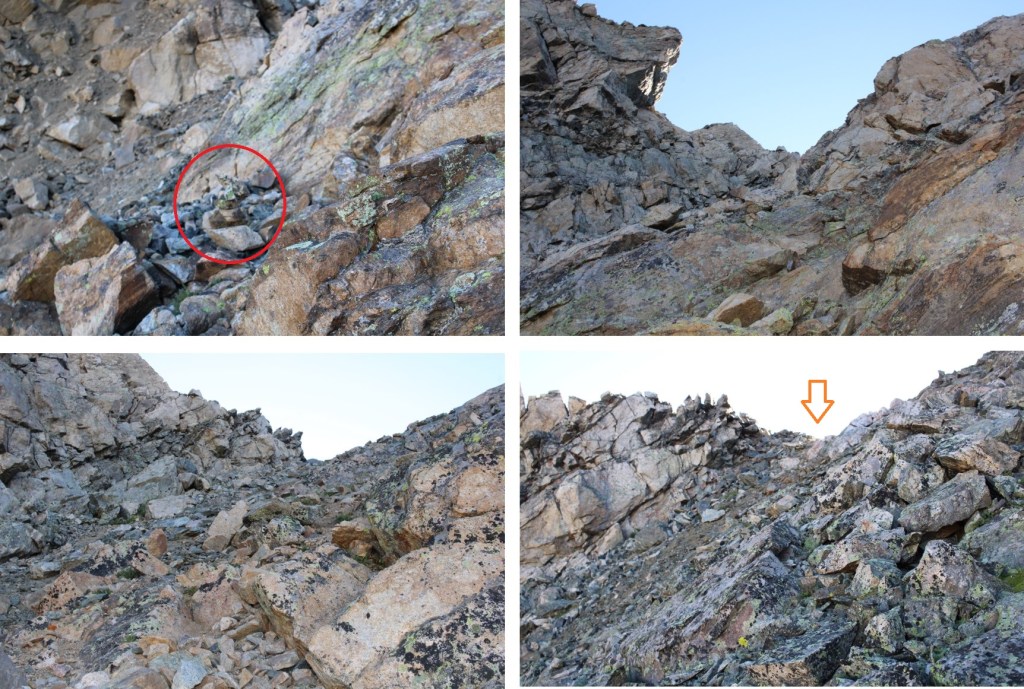
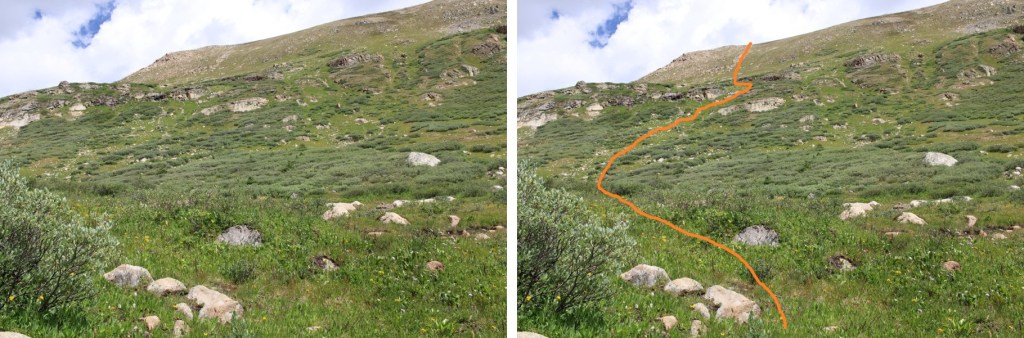
I hiked up the grassy ramp and came to some willows.  My beta said from here to climb up the rock slab.  This was obviously class 4+ and I once again didn’t feel comfortable climbing up this rock face. 
So I did some scouting around.  BEFORE you see this rock face and before you make it to the willows (which are obvious) there is a nicer class 3 grassy slope.  Take that up and follow it to the left and it will keep you on route but keeps it class 3.  There’s some  exposure, but I felt much safer on this route, and put up some cairns to indicate where you ascend.
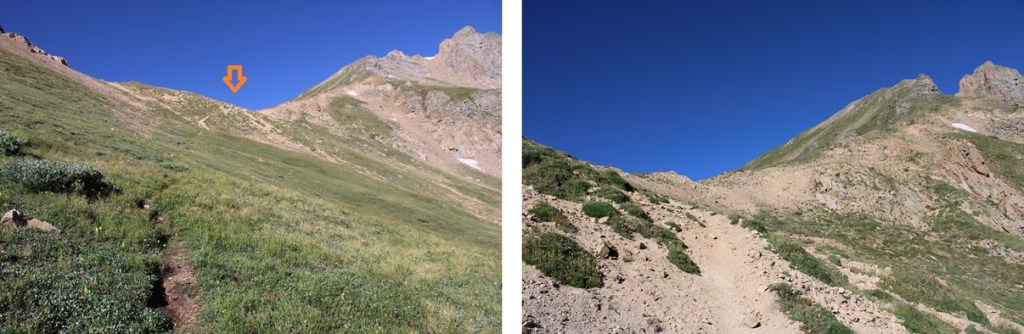
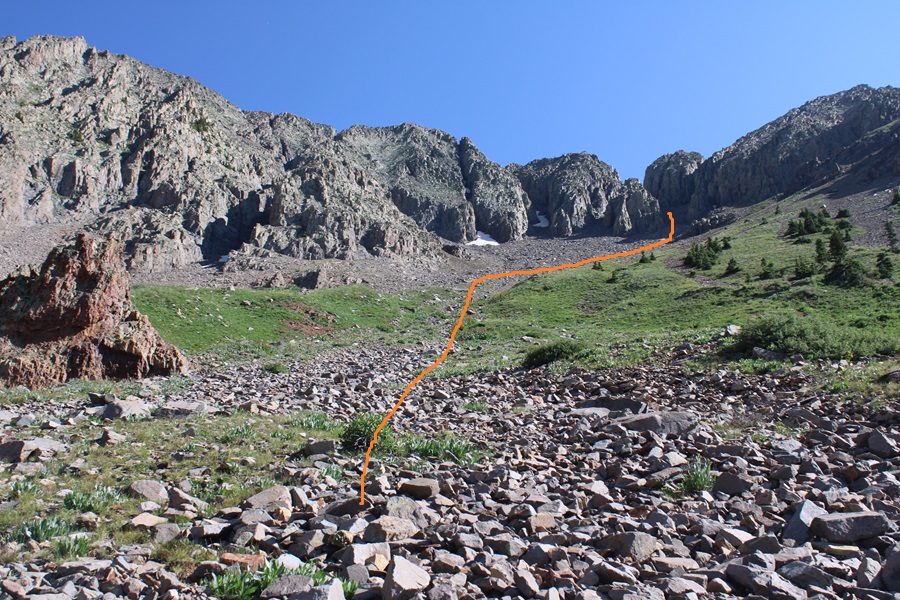
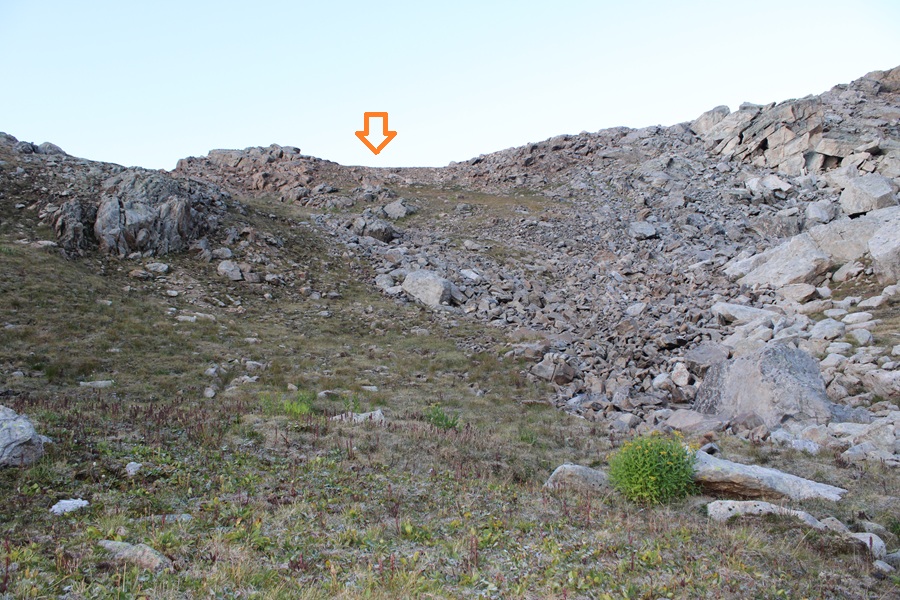
From here on out it’s class 3 choose your own adventure up the grassy slopes.  There is exposure here and be extra careful if the foliage is wet (which it was during my trip).  I was aiming for a notch in the mountain, heading west.
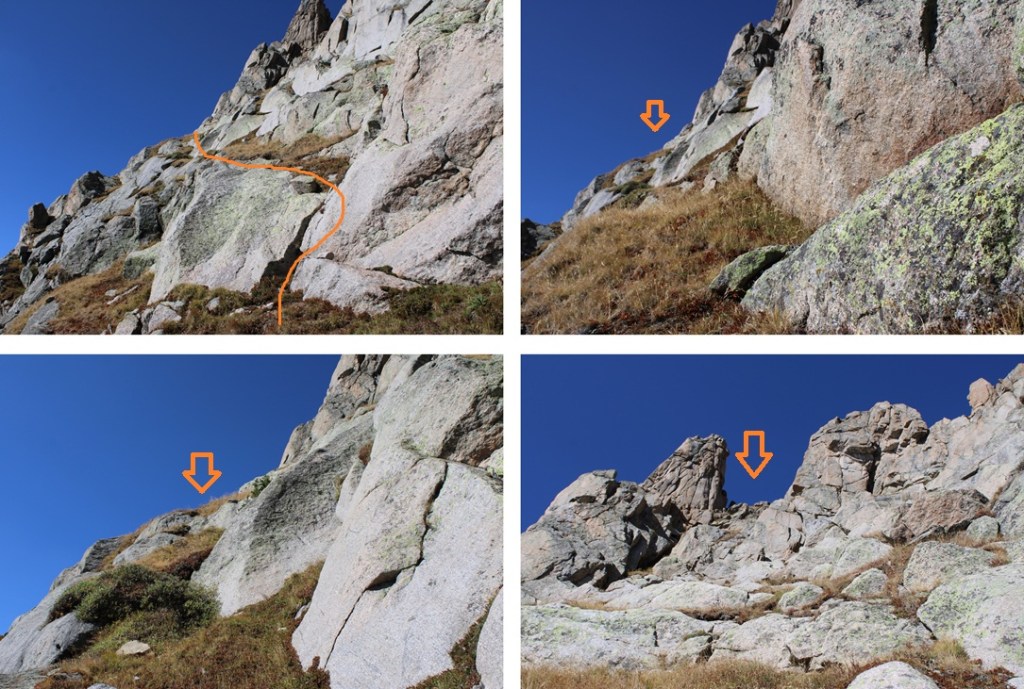
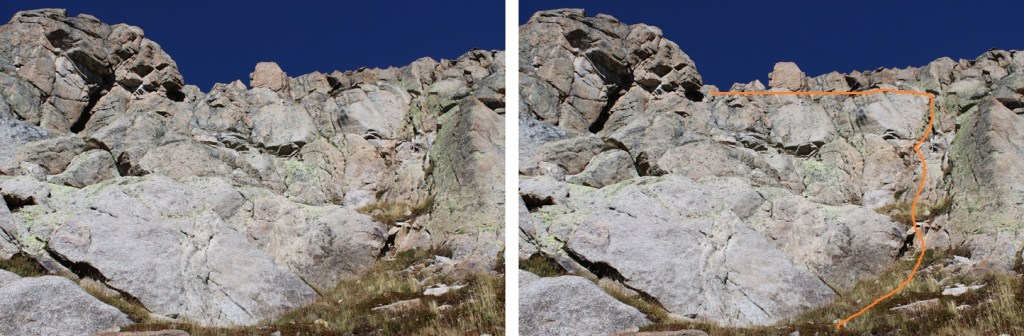
Here’s looking from below the notch, and the route I took, class 3
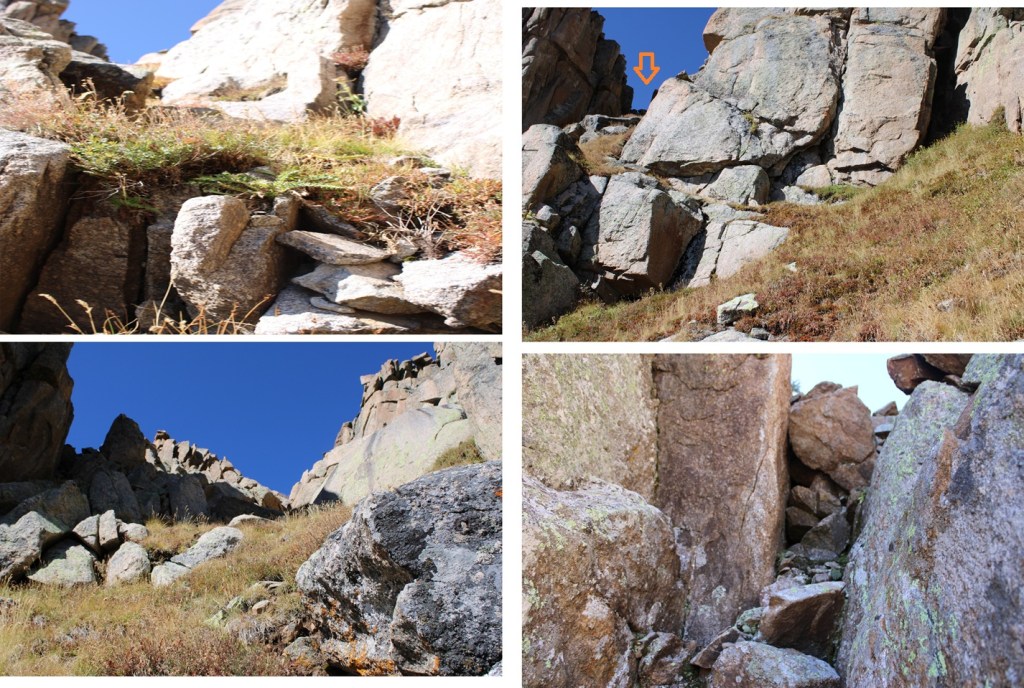
Once over the notch I needed to descend about 20 feet into a gully, then re-ascend to the other side. 
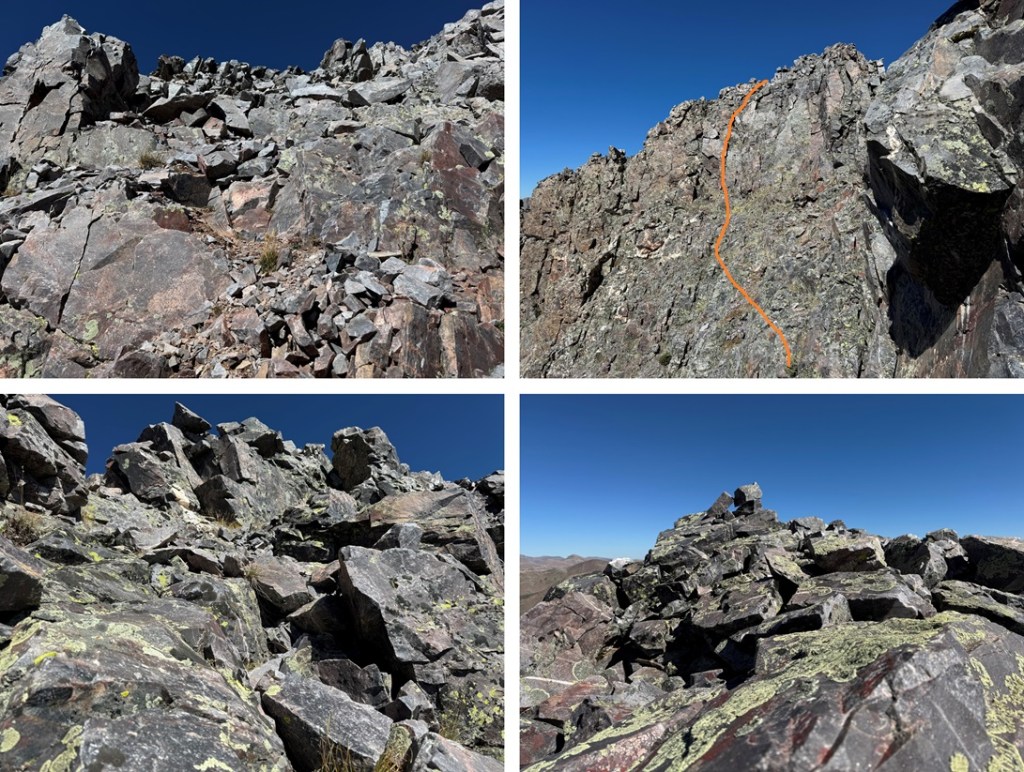
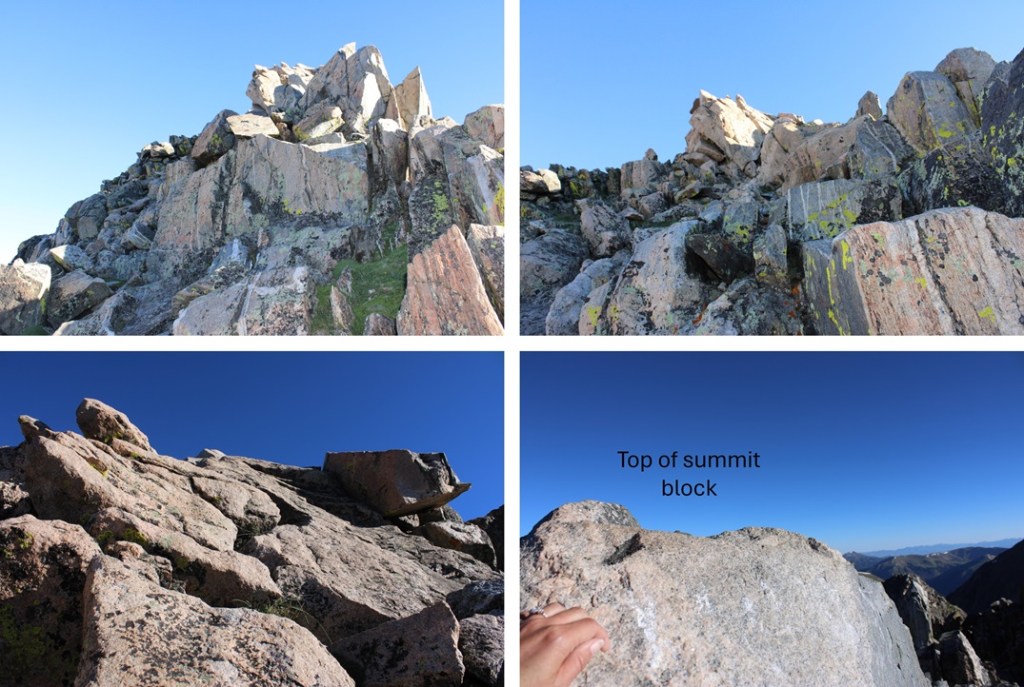
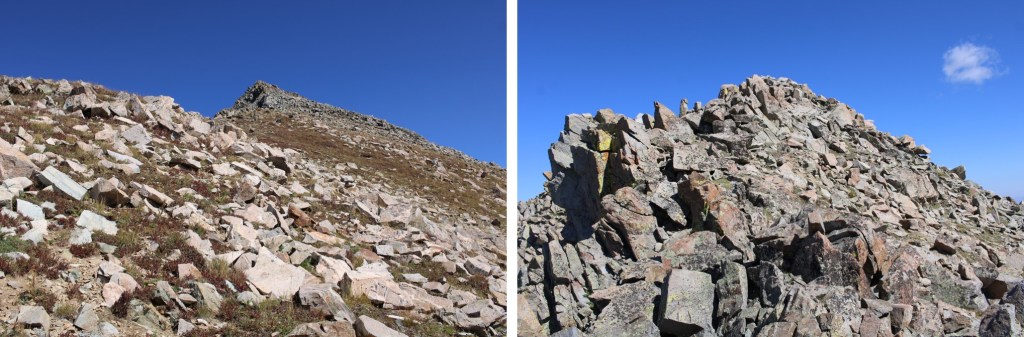
Now I found cairns leading me north and then west to the summit.  From this point on it was difficult class 2, easy class 3 to the summit.  It was choose your own adventure, and the routes were obvious.

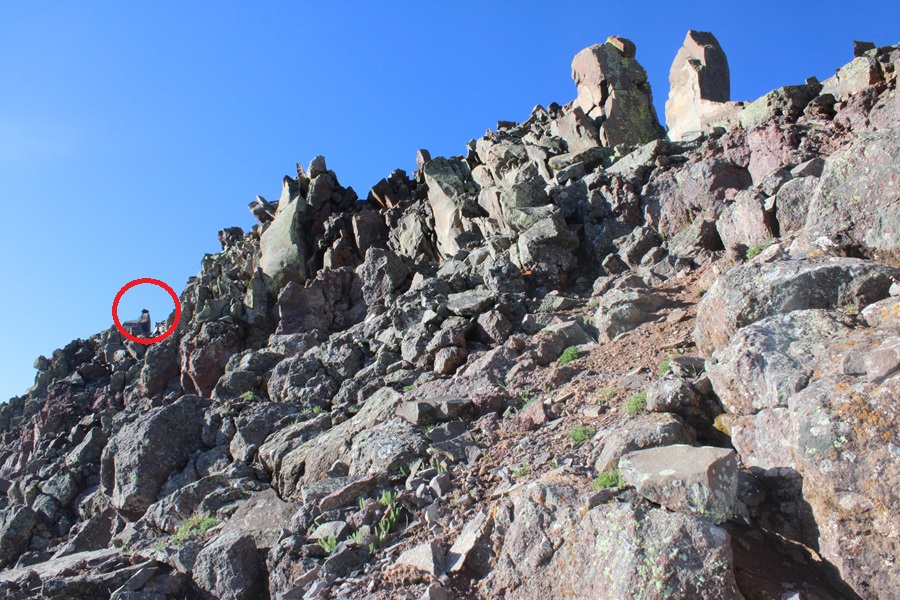
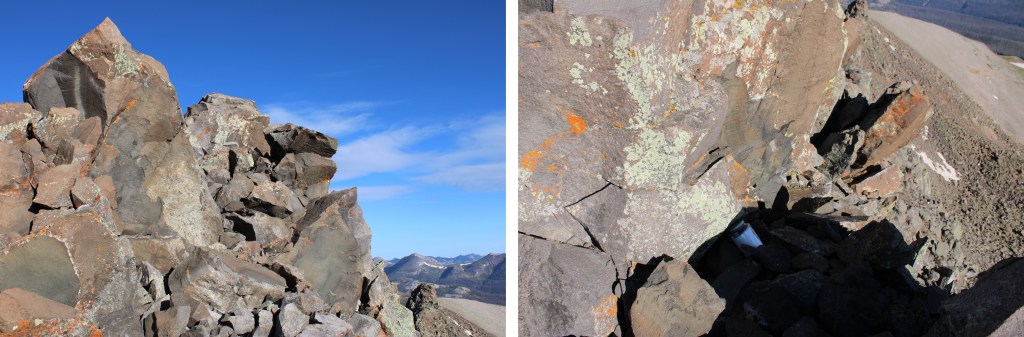
The true summit is to the left, with a small rock on top of a large boulder.
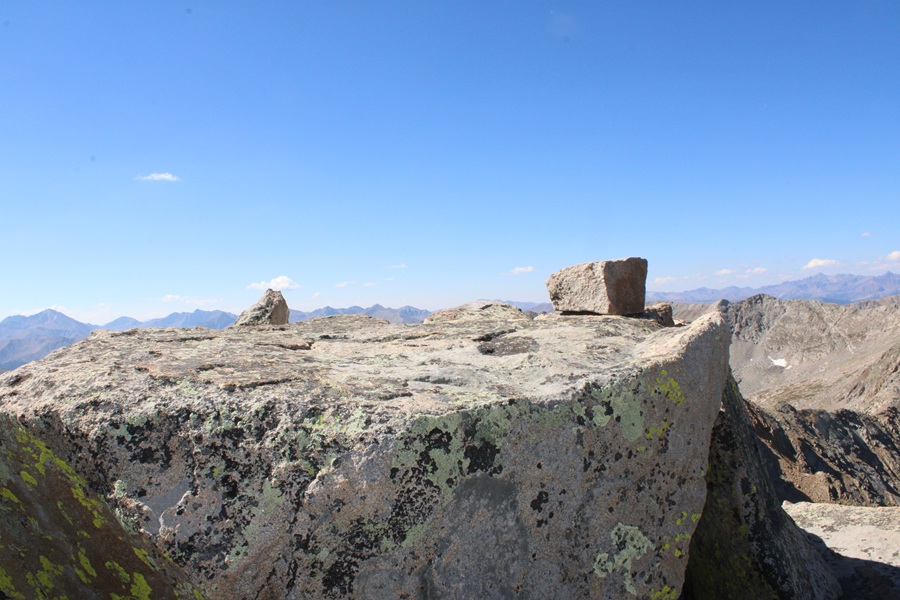
I summited 13204 at 10:50am

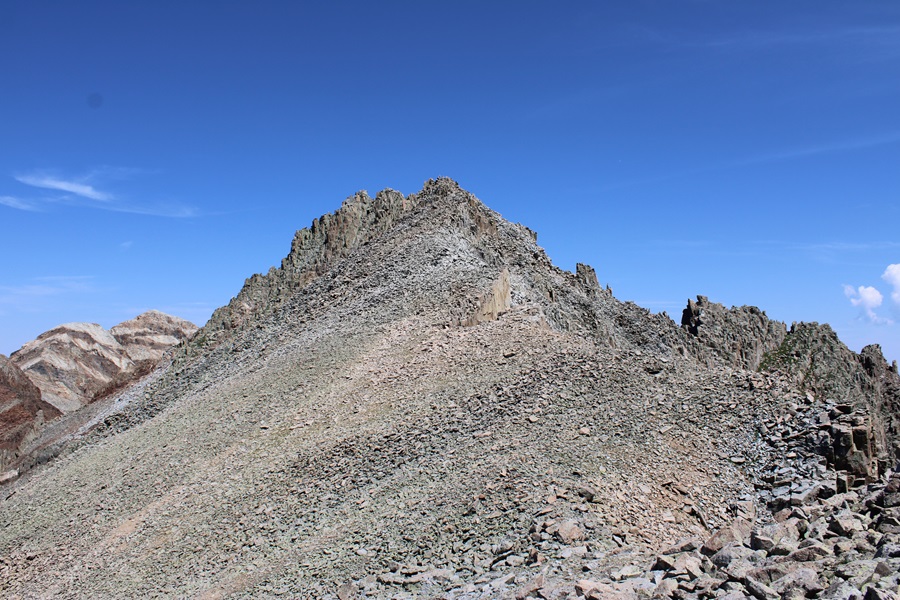
13204:

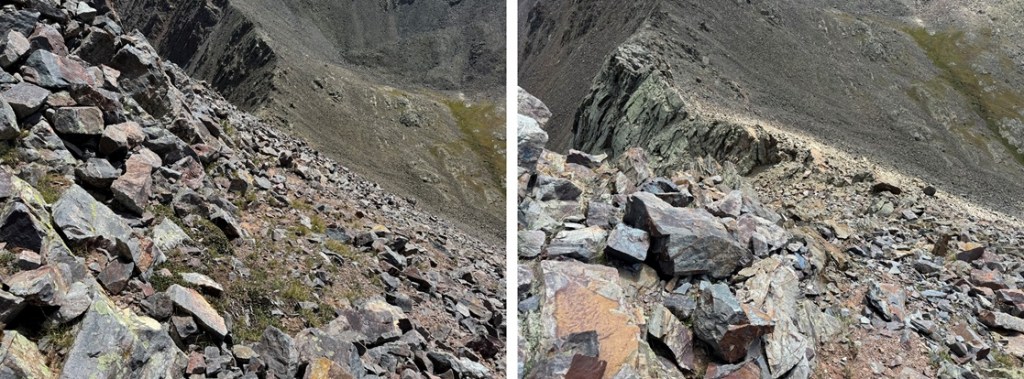
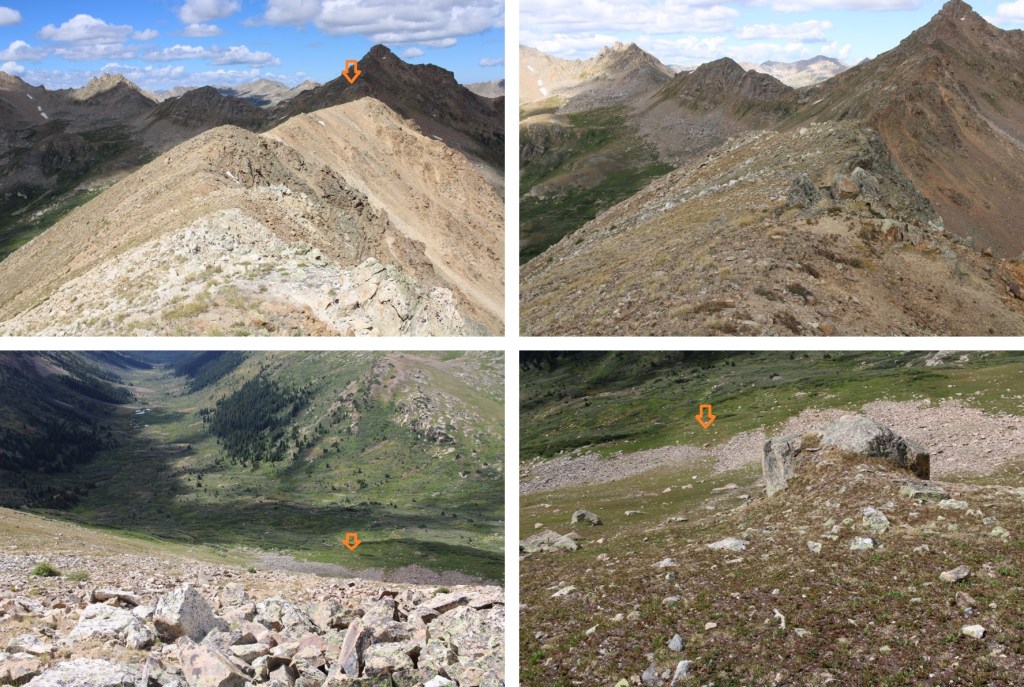
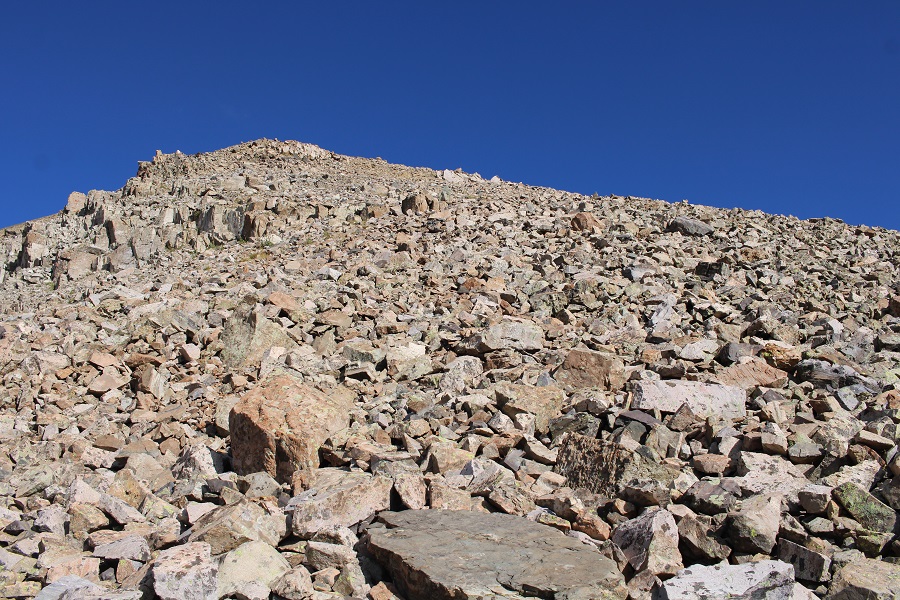
Now you might think I’d head back the way I’d summited, but I was curious as to if I could have made it down that class 4 route I’d attempted earlier, so I headed back the way I’d summited, then headed down southwest to try to link up my climb from earlier in the day.  It was all class 2 until I got to the class 4 part, and I was glad I’d turned around. 
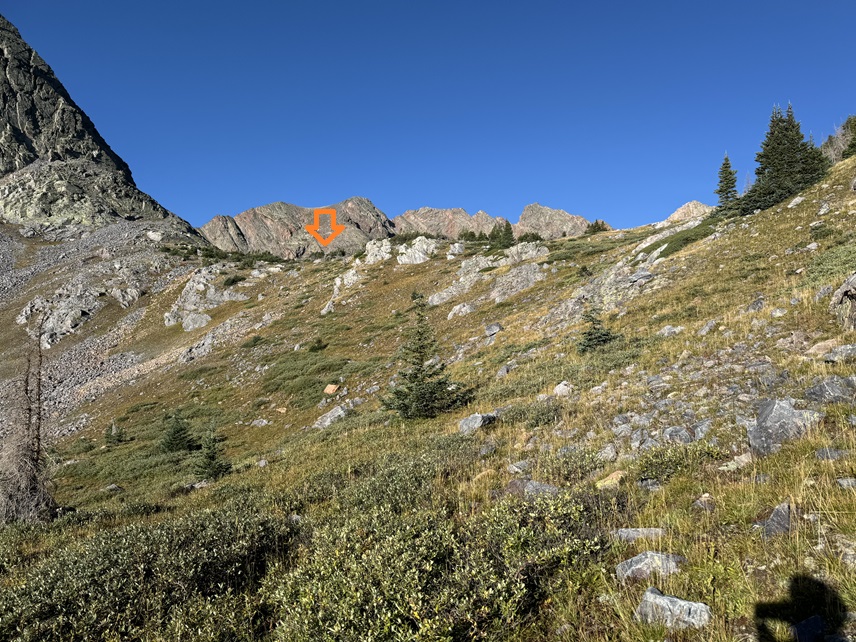
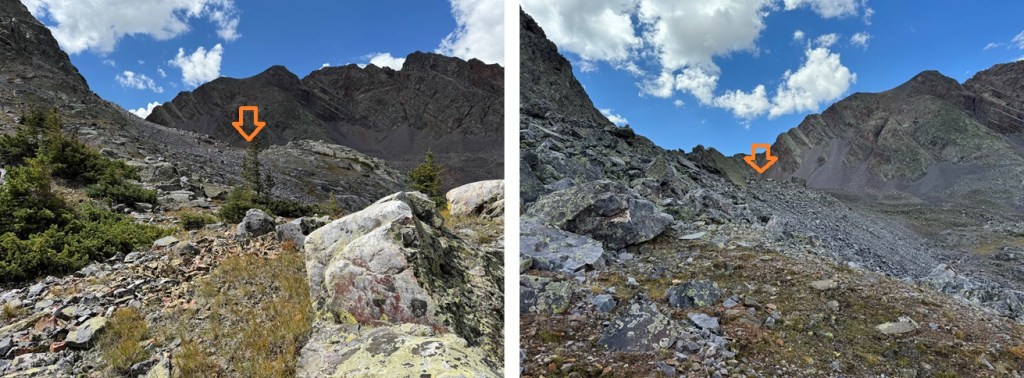
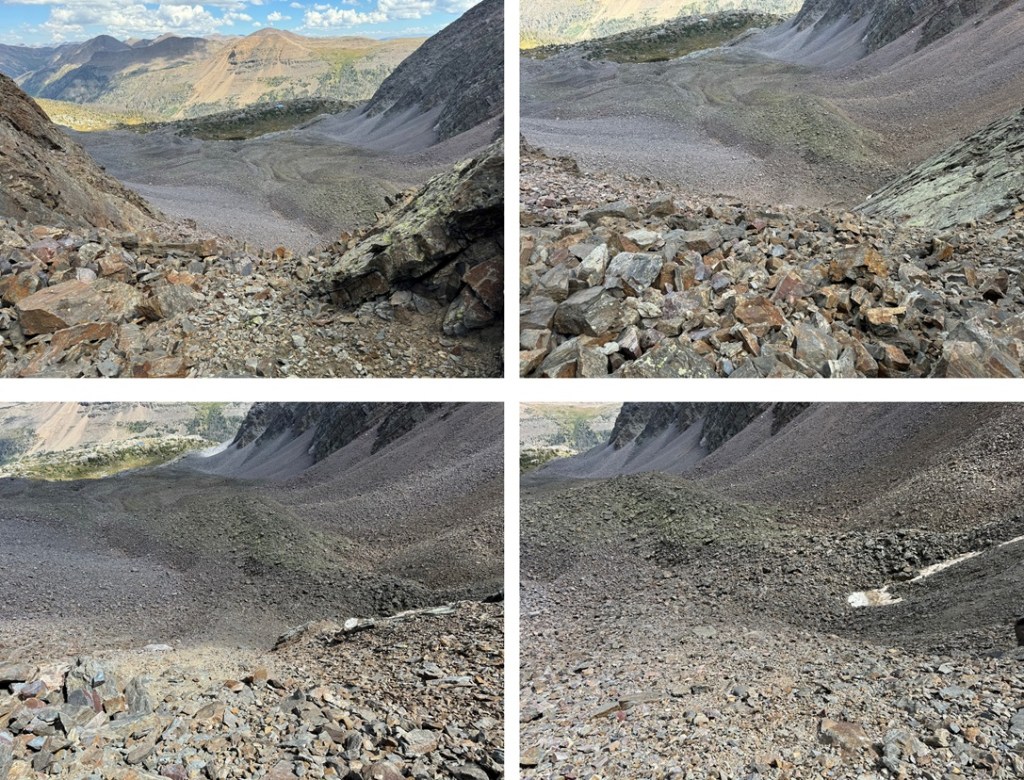
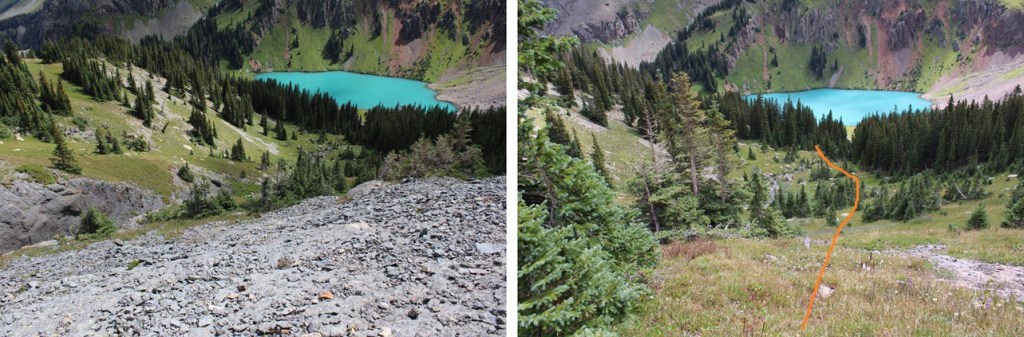
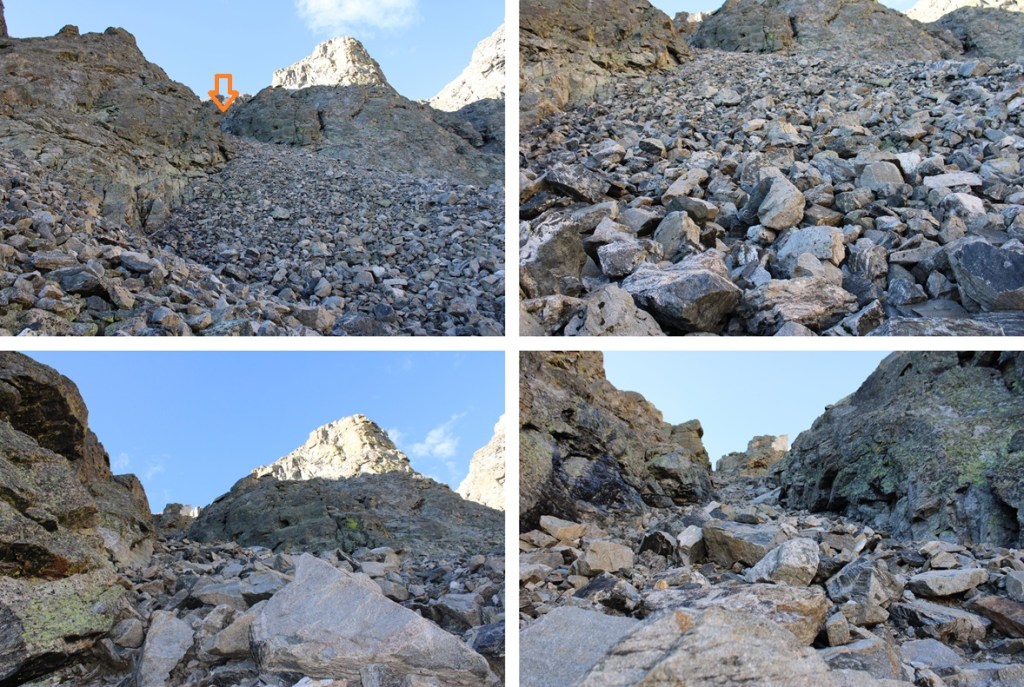
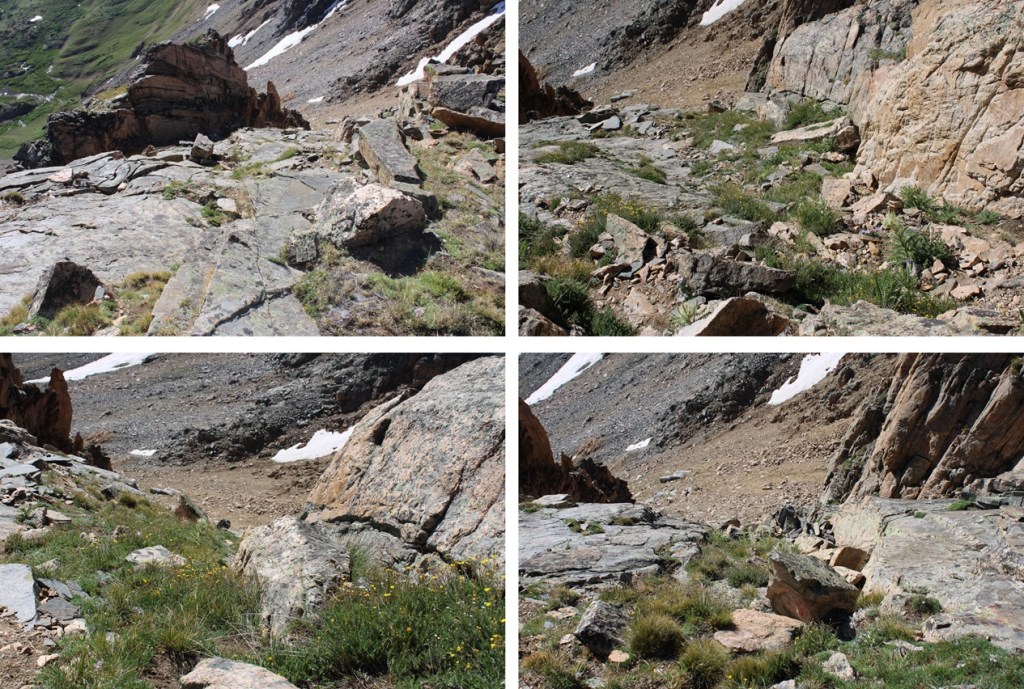
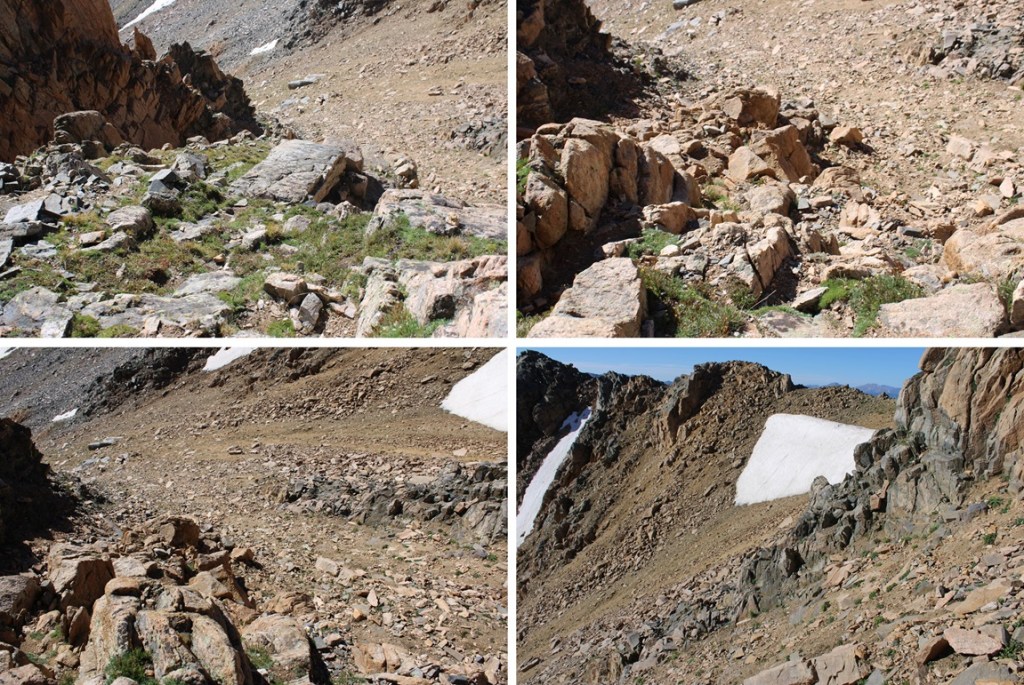
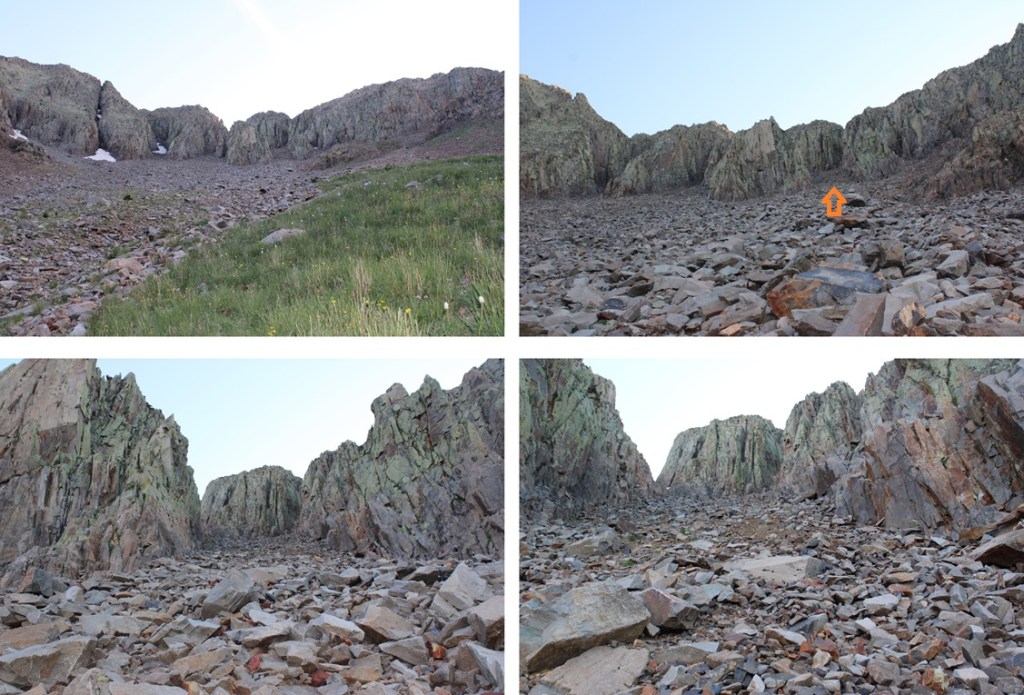
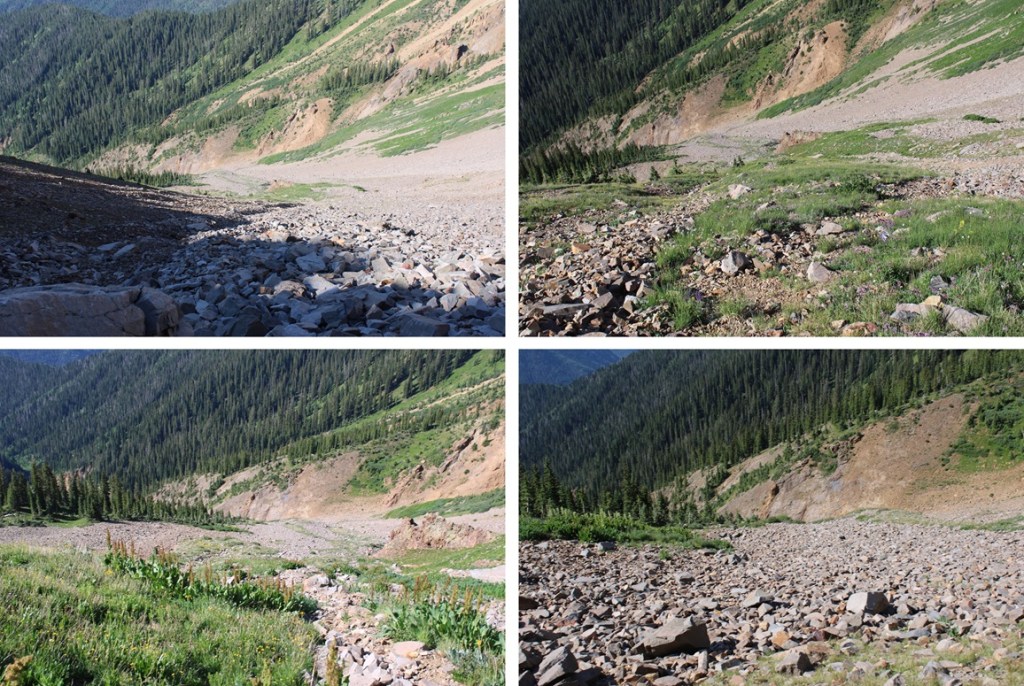
Seeing it wasn’t any better from this angle I reascended and found a gully to head down. I could see all the way down to the valley, it looked class 2, so I decided to go for it. I started at 13100’ and descended the entire way down on class 2 terrain just below where I’d dropped down and re-ascended again on the ascent.  The place just before the notch on the return.  That gully goes at class 2.  I could see the access point from the summit.
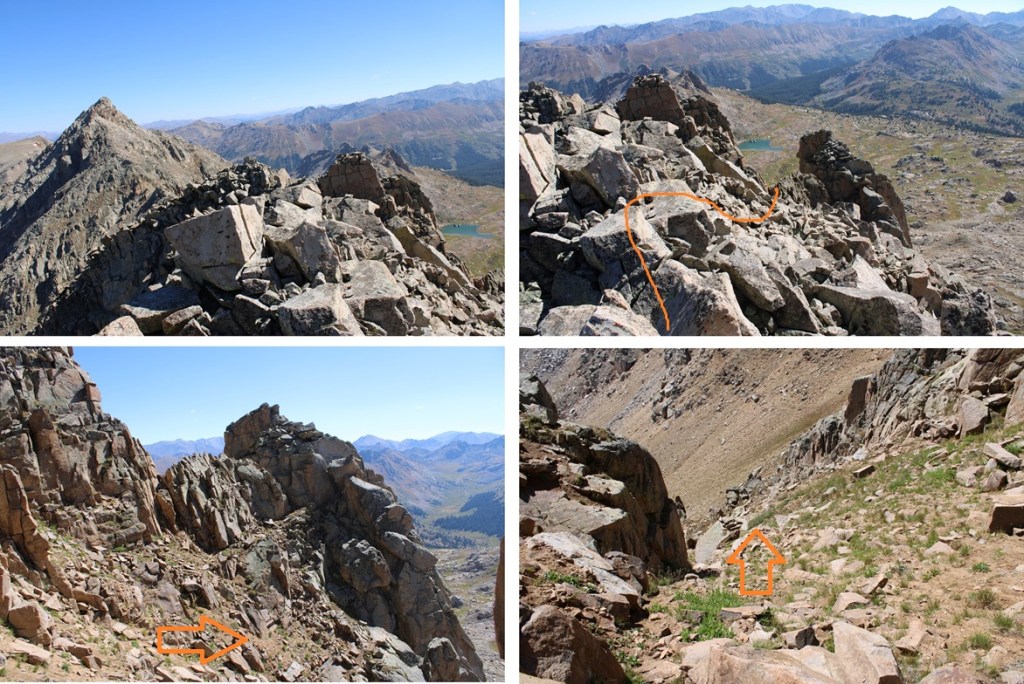
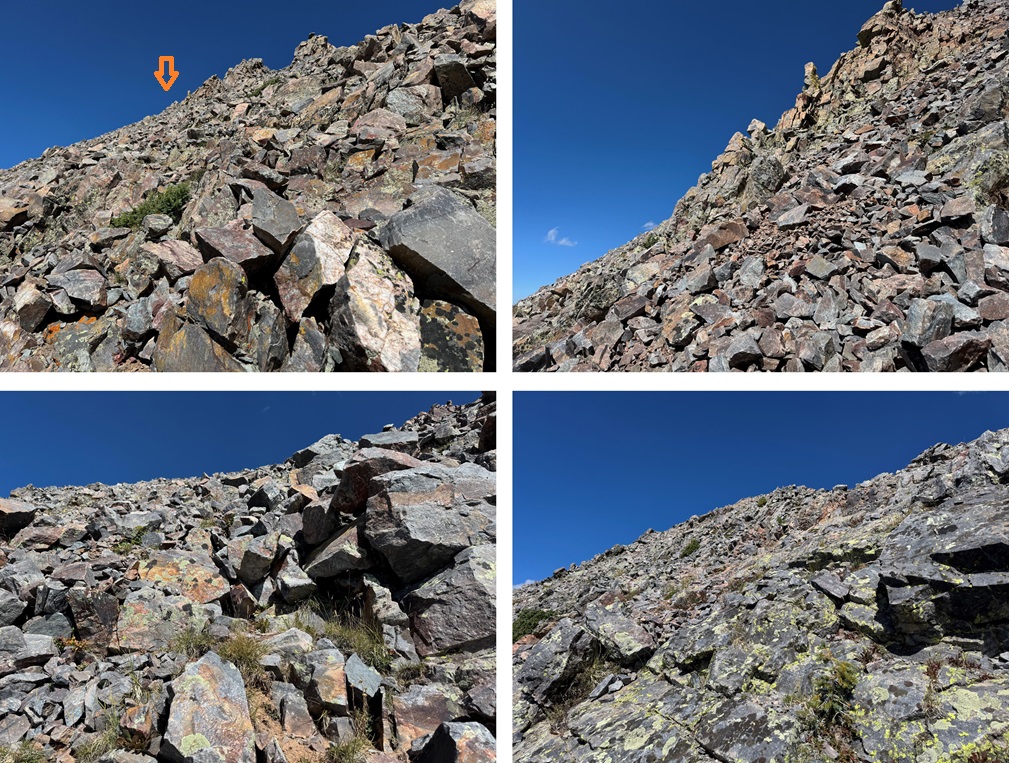
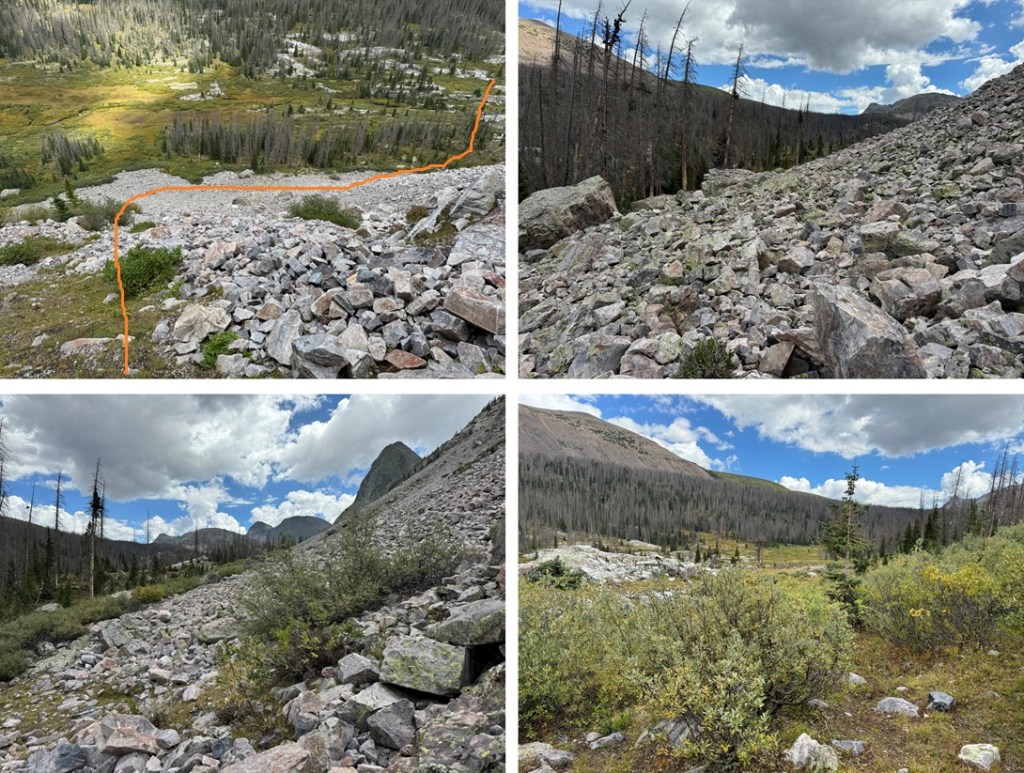
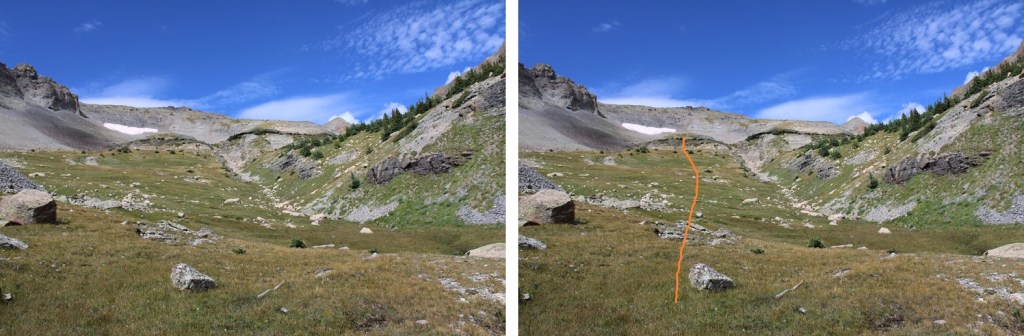
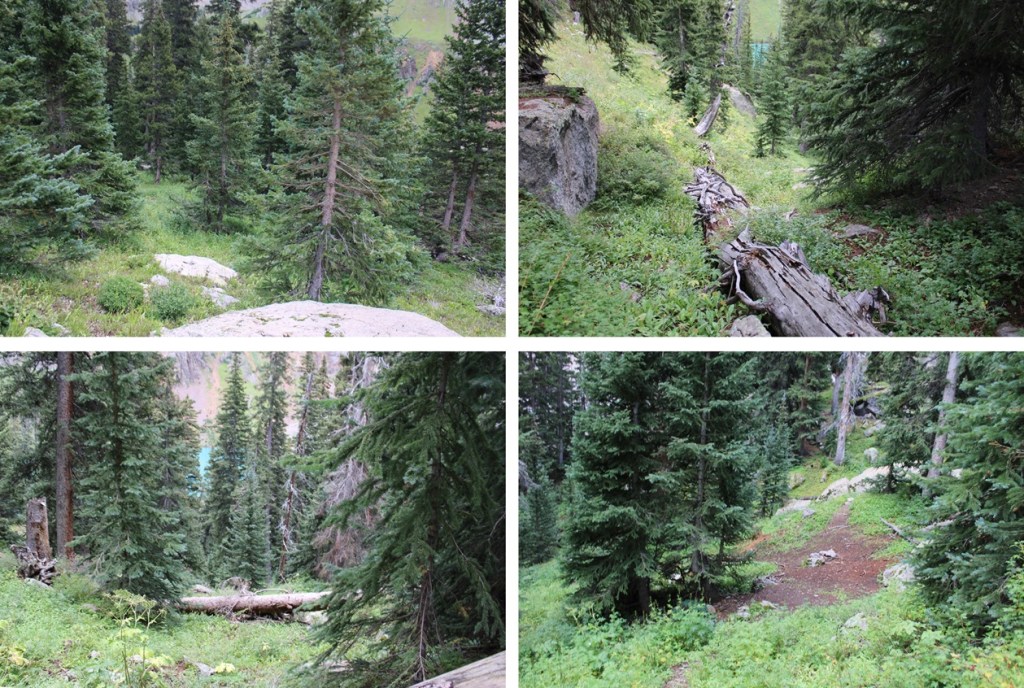
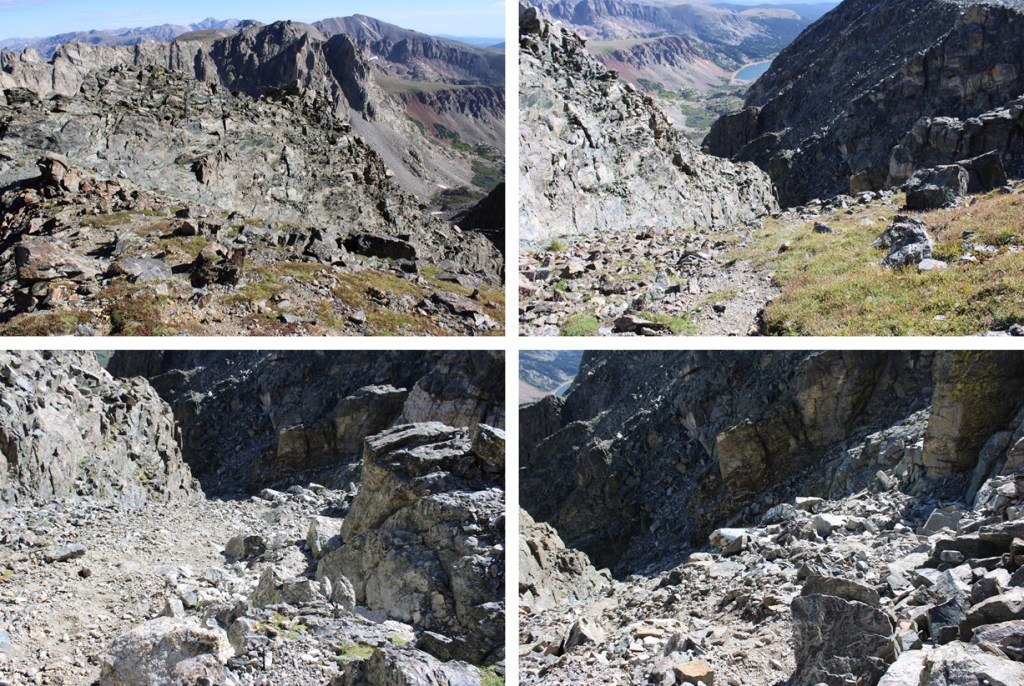
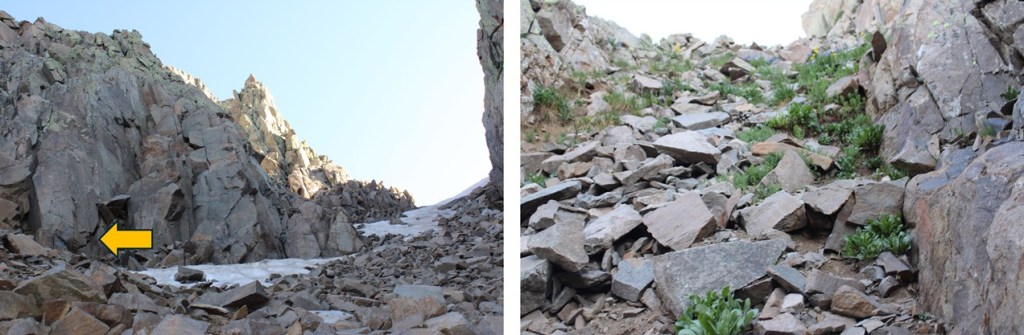
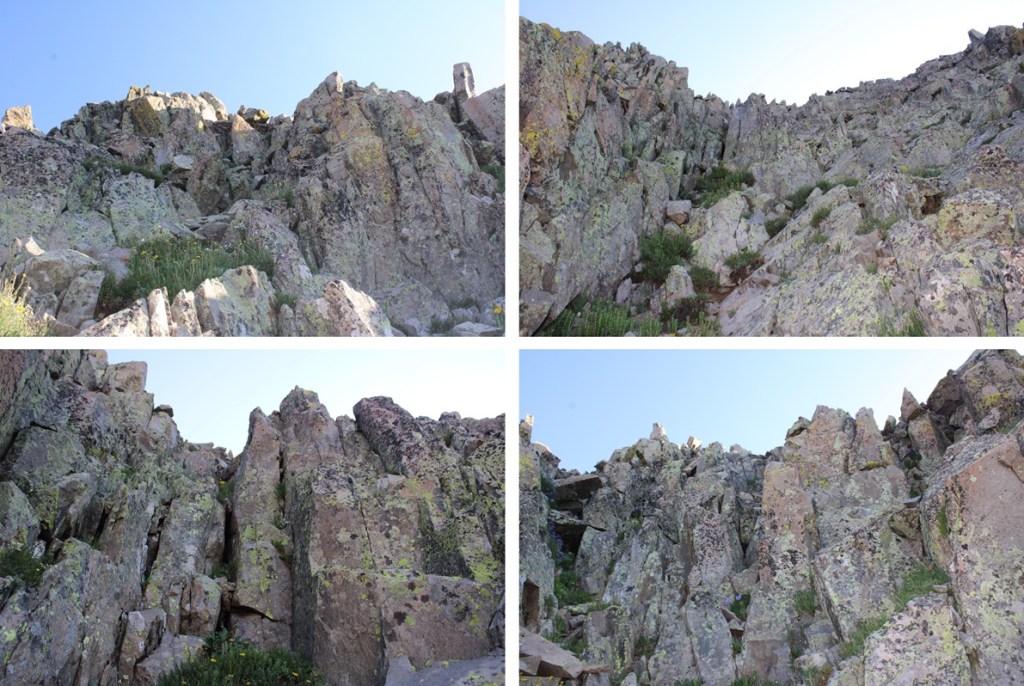
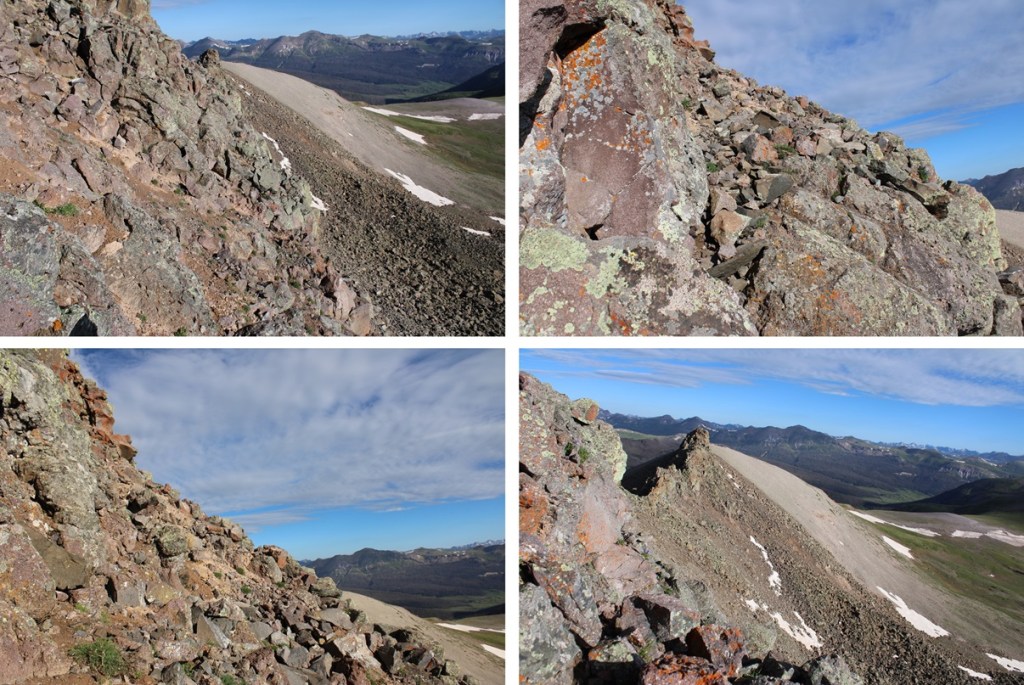
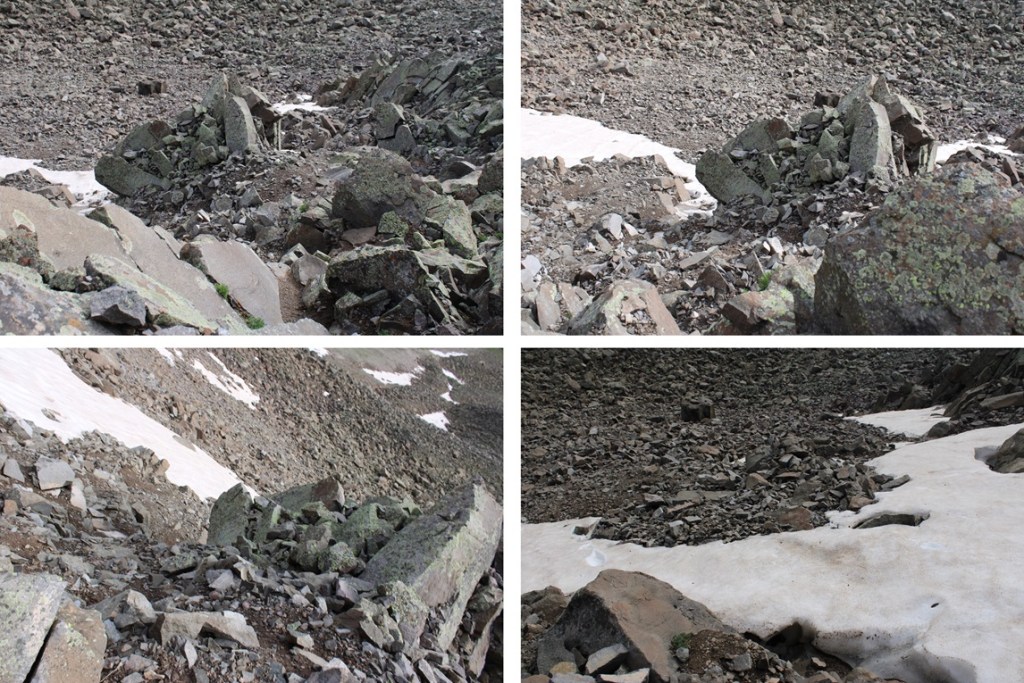
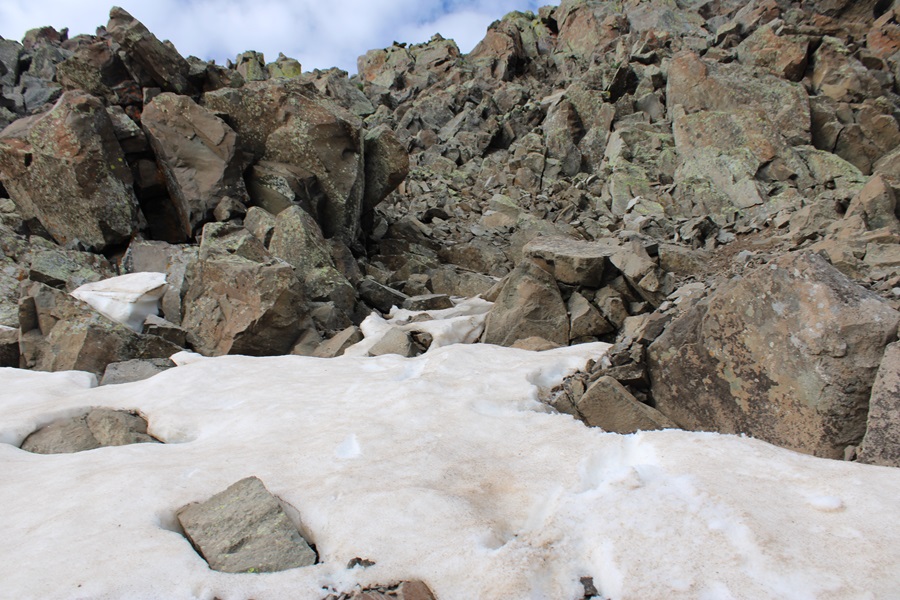
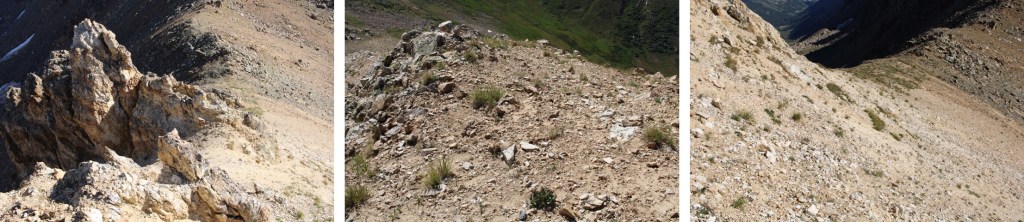
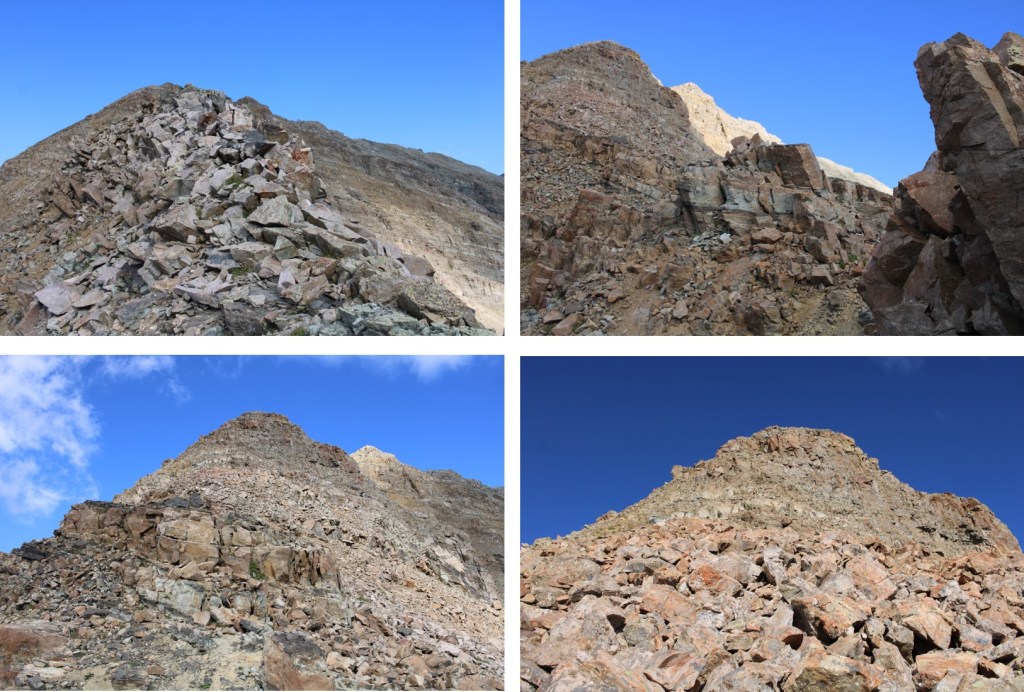
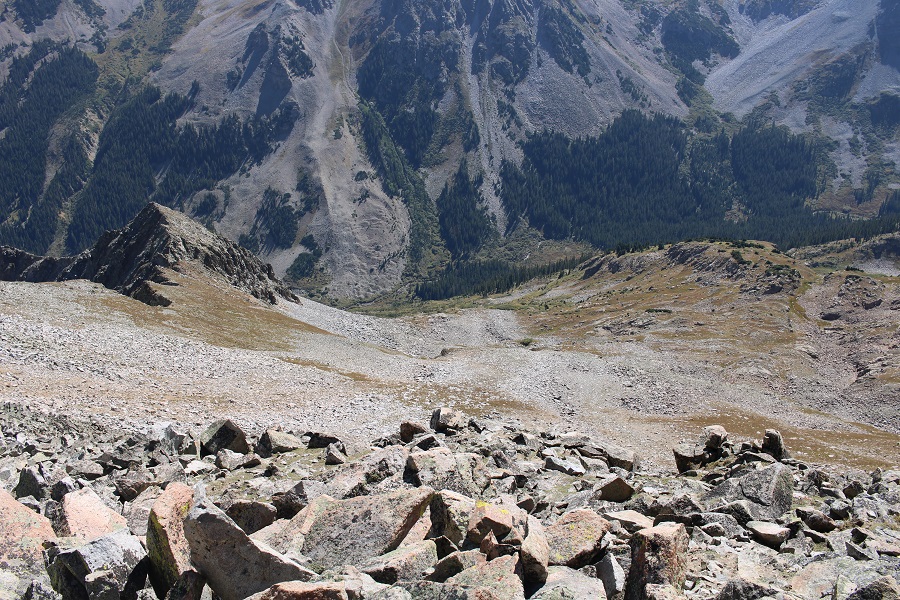
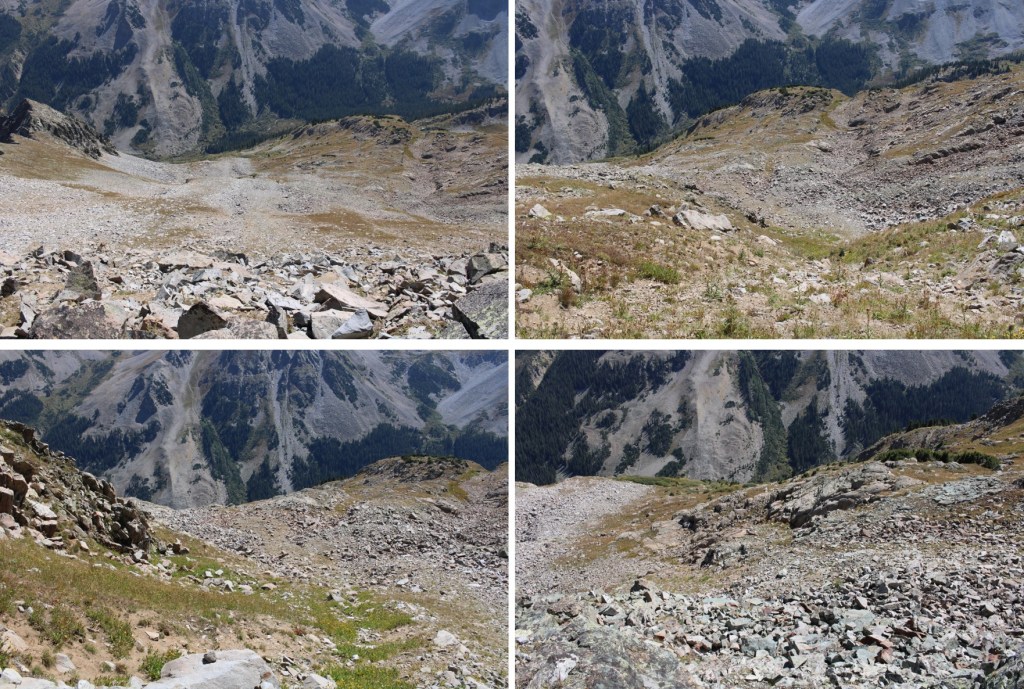
Here are some pictures looking down the gully.  It splits at least twice, but each option is class 2, so pick the route you like the best.  If I were to do this peak again, I’d take the gully.  Tons of game trails, not a lot of scree, lots of elevation gain but no exposure.  Just keep this as an option as a bail out point, or another way to summit this peak if you’re dividing the peaks and not doing the traverse. 

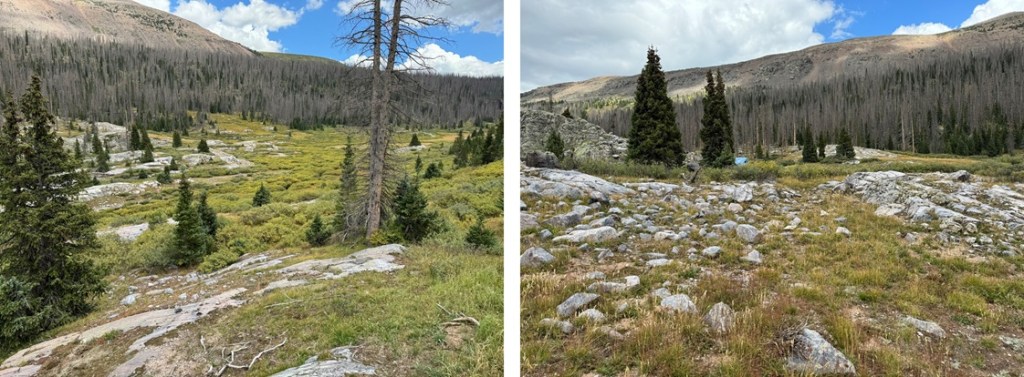
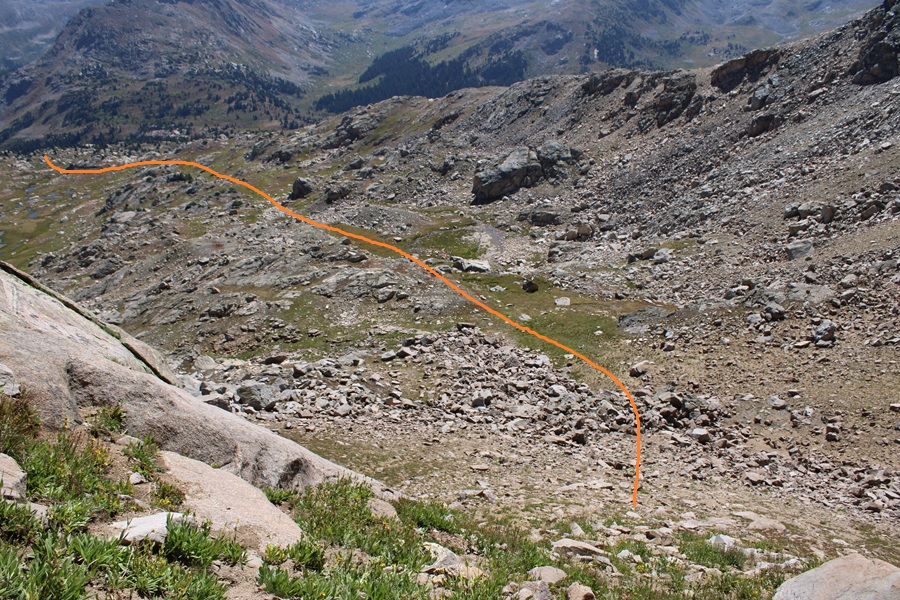
From the base of the gully I paralleled the ridge I’d hiked that morning, heading west until I’d reached my camping spot.
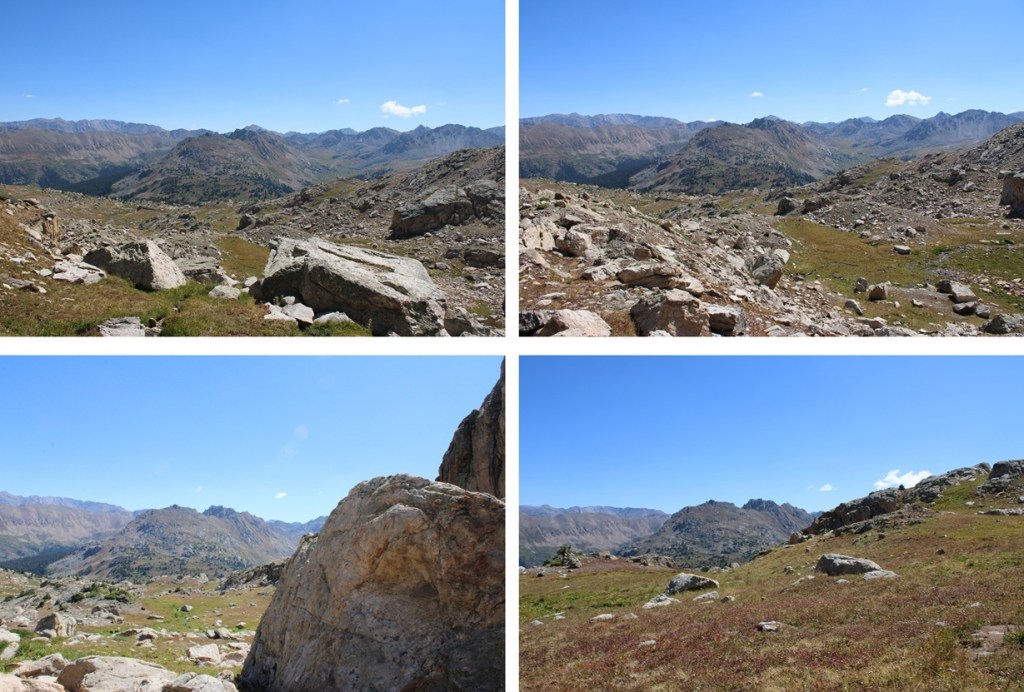
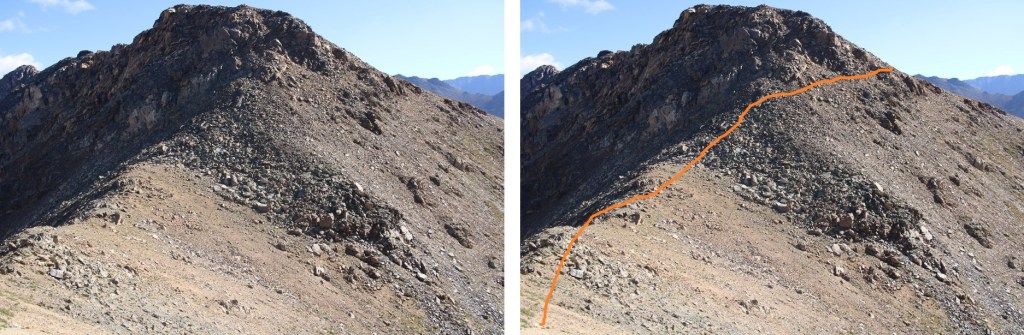
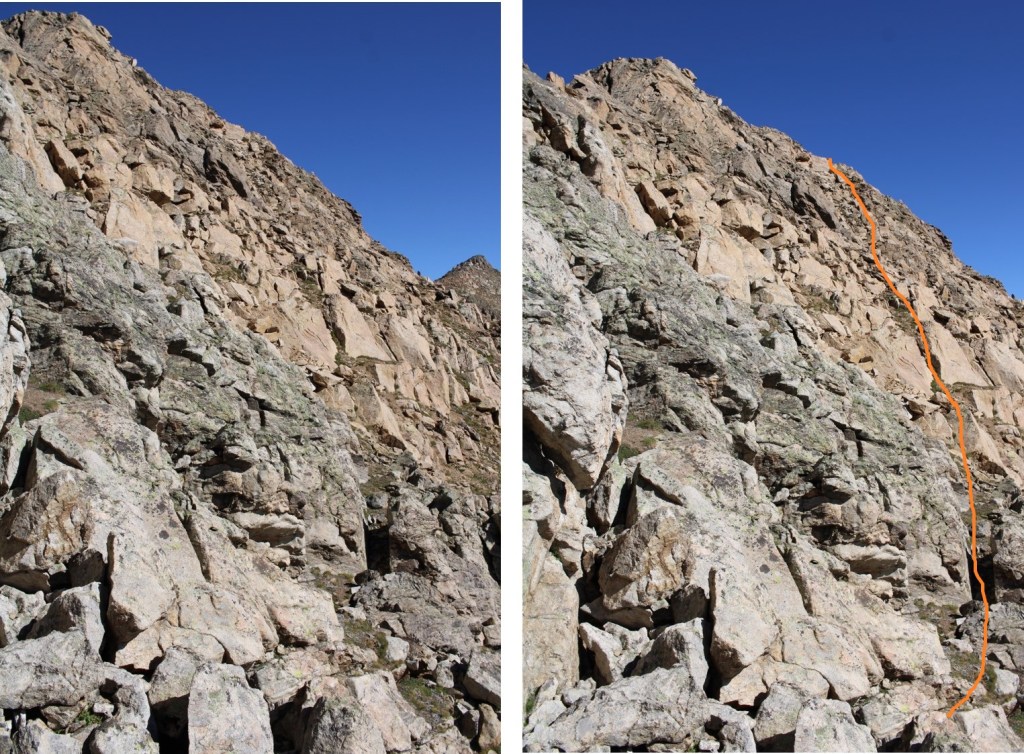
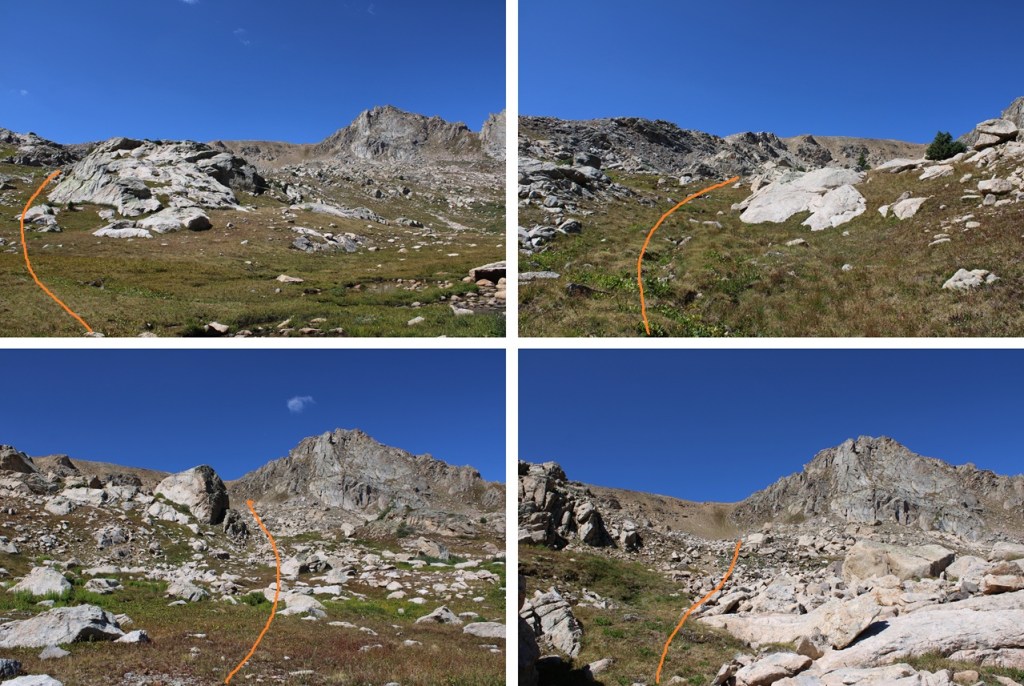
If you’re heading up from the basin doing this class 2 route, this is how the route would look:
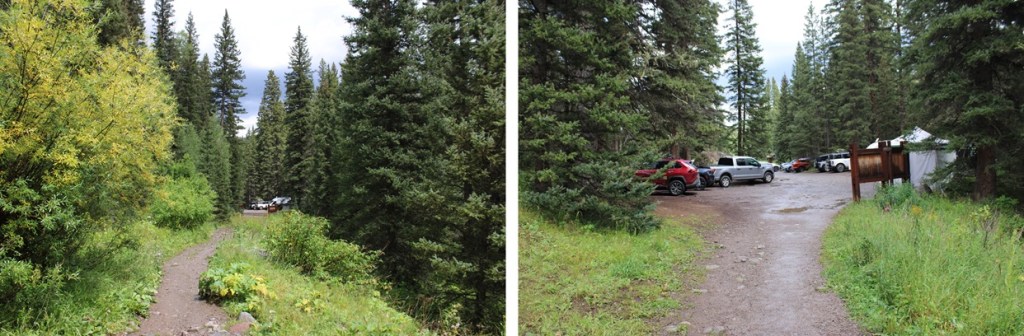
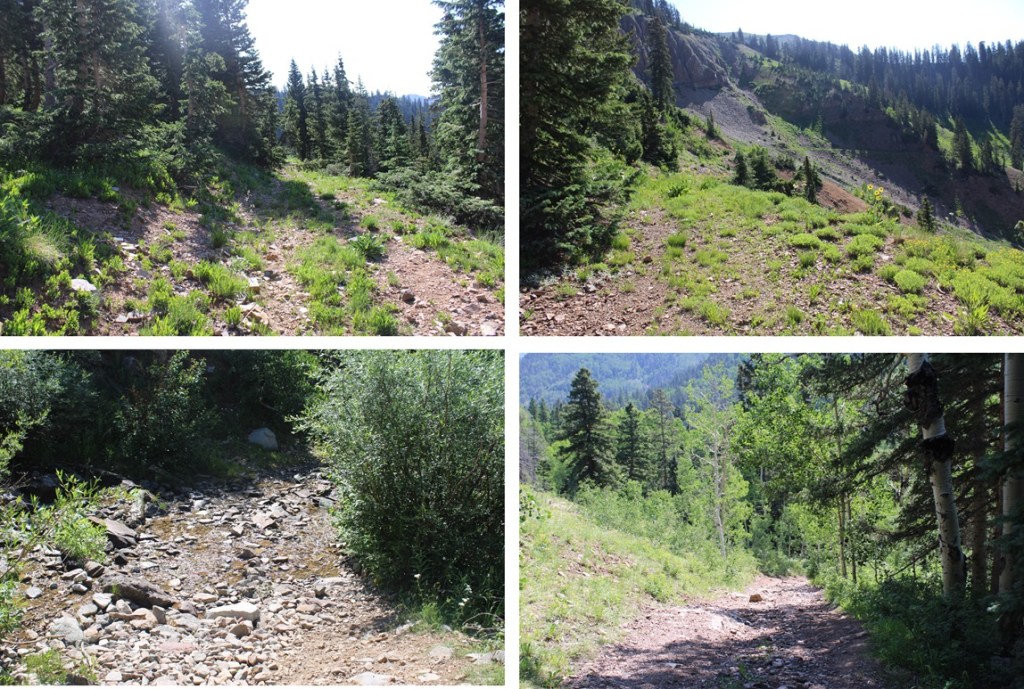
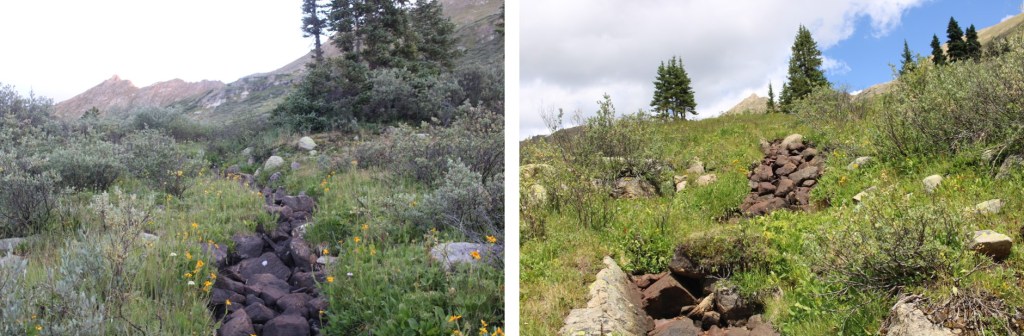
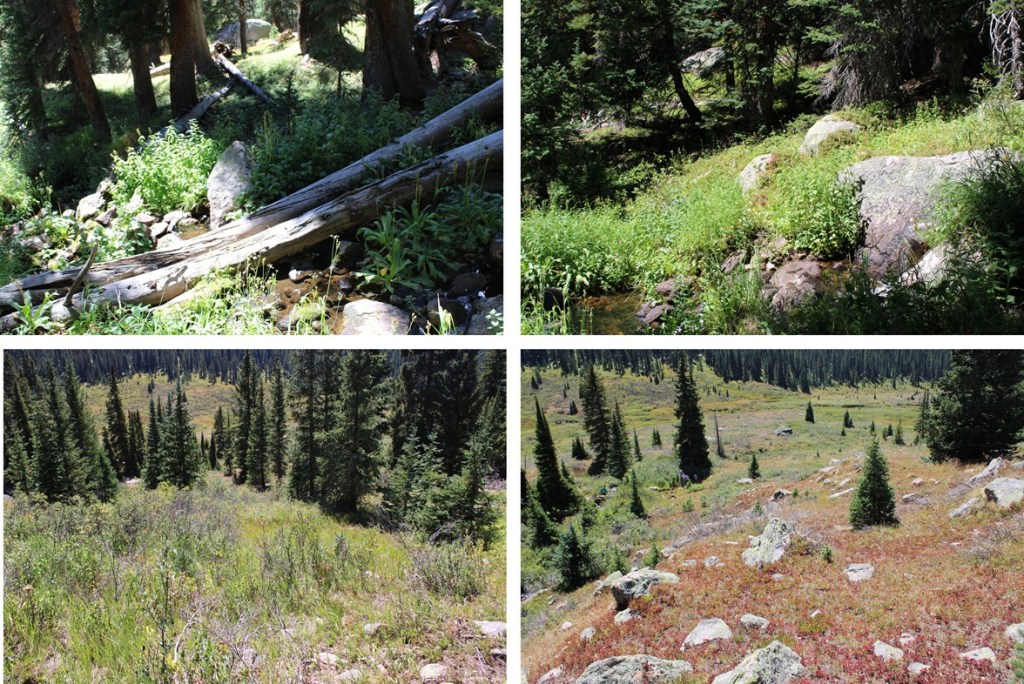
Back in the basin I followed the stream back down, heading Southeast, staying to the left of the stream until I was about 20 yards from the trail, then crossing the stream on an obvious area, and linking up with Lost Man Trail.
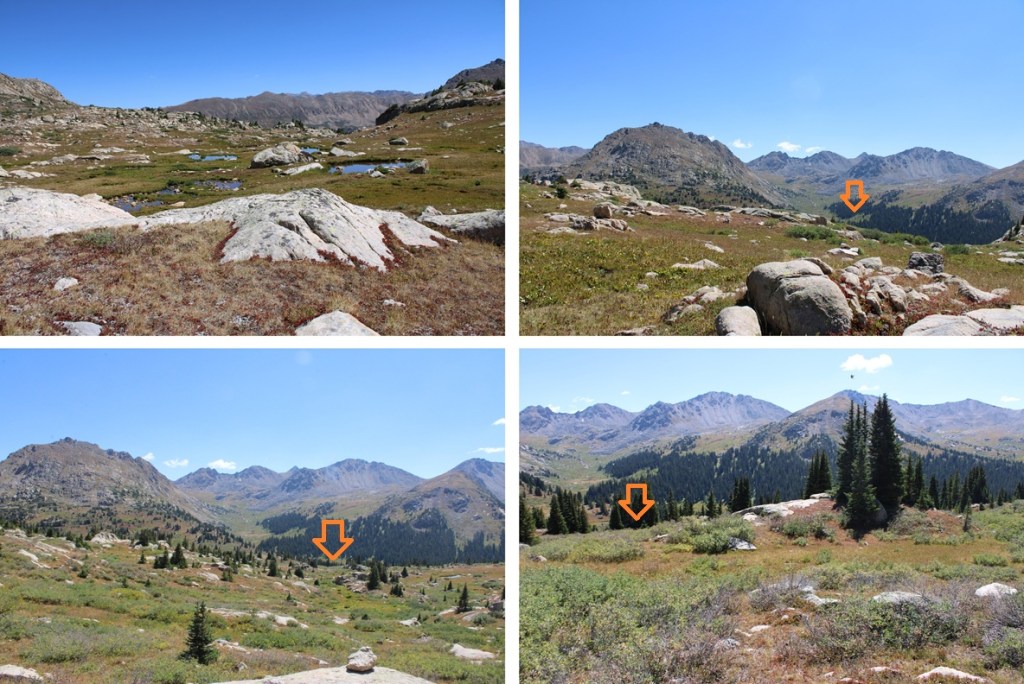
Back on Lost Man Trail I turned right and followed it back to the trailhead.
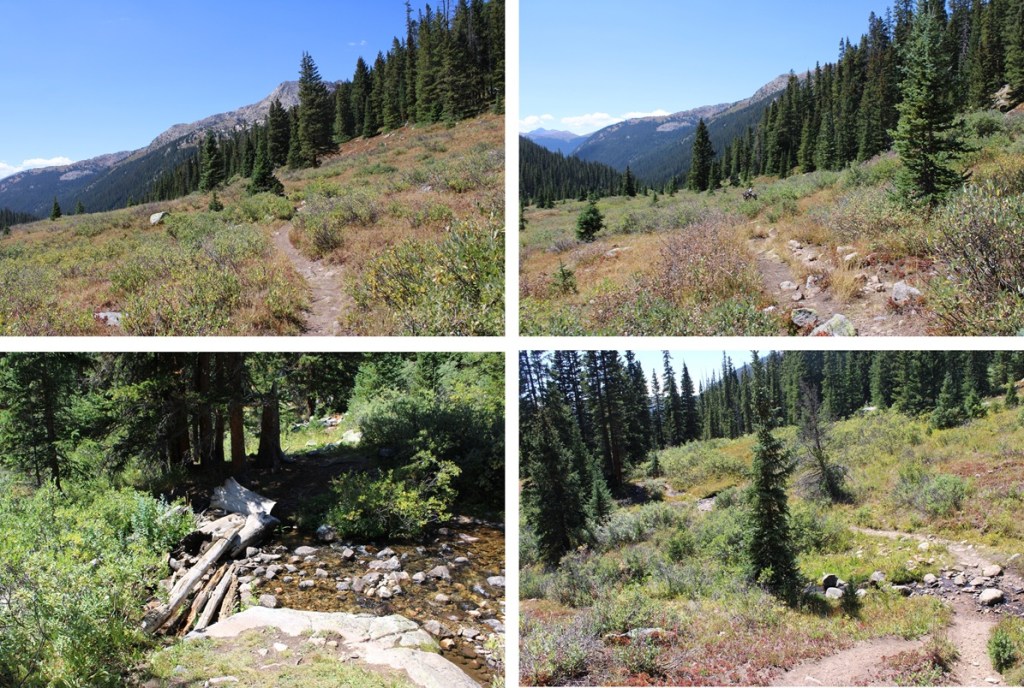
I made it back to my truck at 1pm.  Total stats for this hike vary.

Parking Area to campsite/upper basin: 5.43 miles, 1600’

Campsite to first attempt and back: 2.5 miles, 1000’

Campsite to class 3 summit: 1.3 miles, 1100’

Down summit class 2 route: 1 mile, 1100’ elevation loss

Campsite/upper basin to Parking Area:  5.43 miles

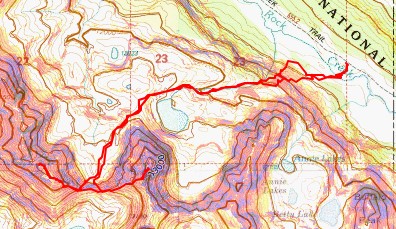
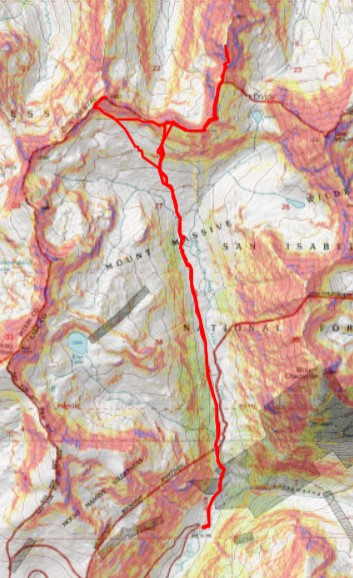
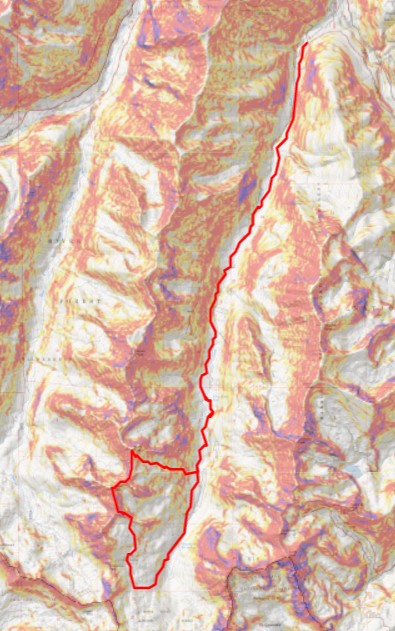
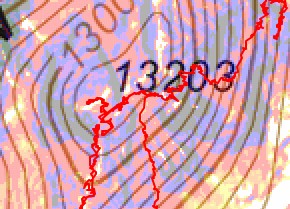
Topo for upper basin:
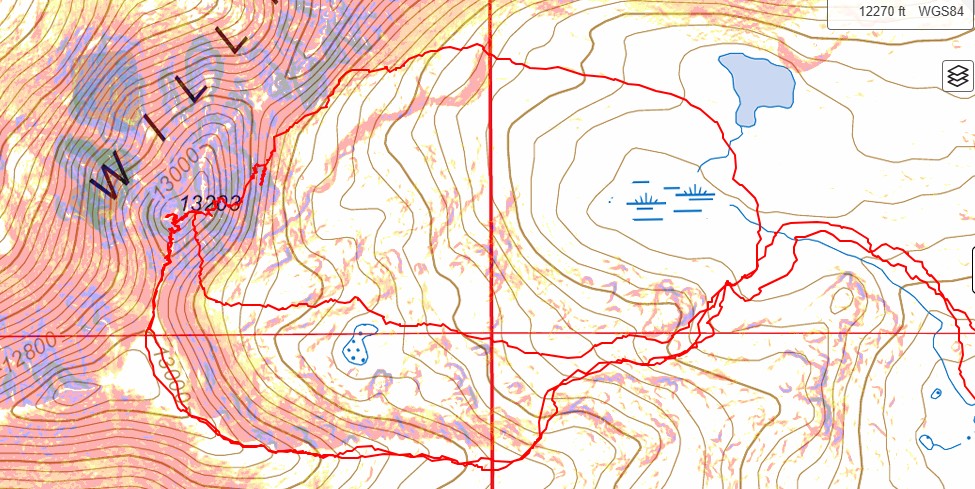
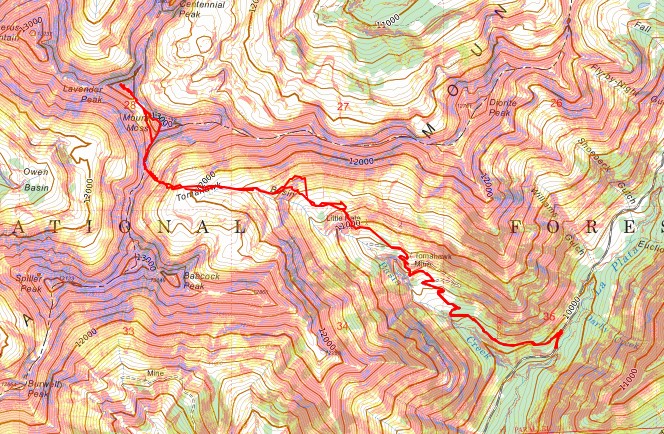
Route Topo:
On to the next trailhead!

P3 – 13,279 and P2 – 13,288

RT Length:  6.61 miles

Elevation Gain: 2539’

Edited to add:

I came back a month later and was successful in summiting P2.  Details below.

Full disclosure, I did NOT summit P2.  However, I came very close, and thought I’d share the information I have for those who might find it useful. 

I camped at 11330’ of elevation, along the Rock Lake Trail that parallels Rock Creek in the basin just before Rock Lake

The next morning I was on the trail at 6:30am, heading west.  My goal was to gain this ridge, and I did it poorly.  I spent way too much time route finding, so I’m going to try to make this easier for you.  You need to ascend this ridge, but DO NOT do it here.  There is a way to find a weakness and ascend here, which I did, but I was greeted with the steepest, worst scree I’ve ever encountered, where if I’d have fallen, I would have skidded all the way down, over the edge.  It was dangerous, and put me at a too high position and I needed to descend anyway. 

Instead, start out by crossing Rock Creek (I was able to jump across it) and head for the rocky section.

Parallel the rocky section until you come to just before the waterfall.  Then turn left, and head up the scree to what looks like a solid rock wall.  There is a very well-hidden access gully here, that will easily get you where you want to go. 

Climb up this easy gully, and immediately turn right, and head towards a drainage.

When I made it to the drainage, I followed it west as far as it went, until I was on a small ridge parallelling a pond.  There are a few game trails here that will lead you up.  Stay in the drainage, which goes from rocky to grassy as it ascends.

I came to a ridge and turned left.  Here I could see a rocky basin.  I followed the basin southwest, left, until it ended.

From here you can see two gullies.  One leads to P3, the other to P2.  I went up the gully to the left, and came down the gully to the right.  Both are loose and scree filled.  The P2 gully had larger rocks, which would have made it better (for me) to ascend, and the P3 gully had more scree, which would have made it better (for me) to descend.  Alas, I ascended the P3 gully, and descended the P2 gully.

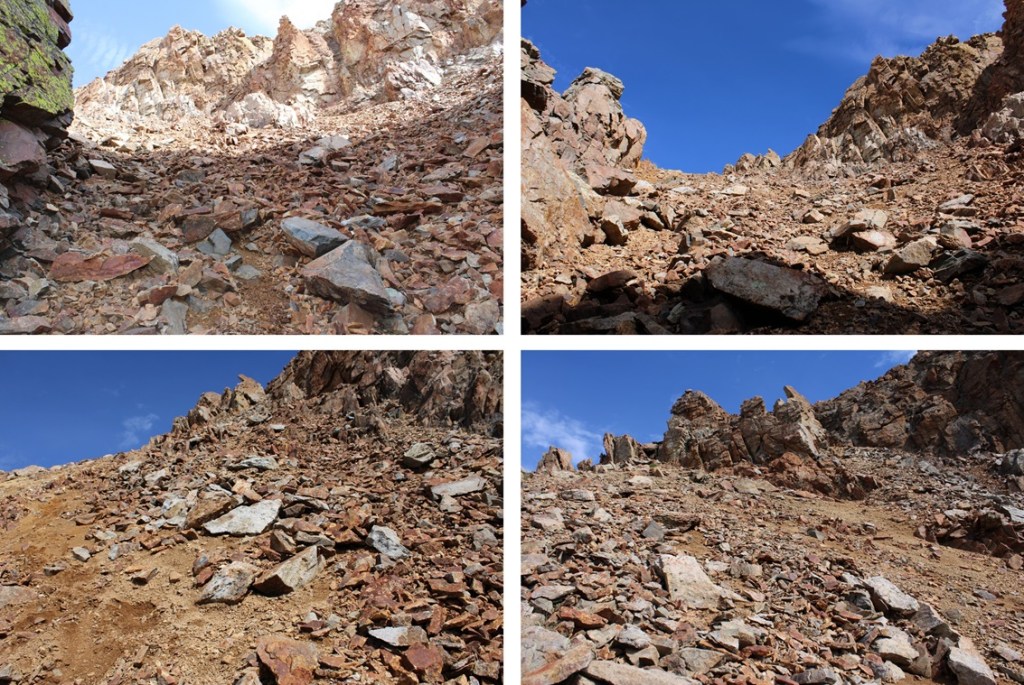
Here are some pictures of the P3 gully.  I ascended on scree, sticking close to the rock band, and headed towards the ridge.

Once on the ridge I turned left, and followed it northeast.  While it looks daunting, this was all class 2 on stable rock, and not so stable rock. 

Until I got to here.  If you haven’t already, now is your time to put on your helmet.  From here the rest of the route is exposed class 3 and class 4 climbing.  I chose to stick to the ridge.  Luckily, the rock here is solid and there are plenty of hand and footholds.

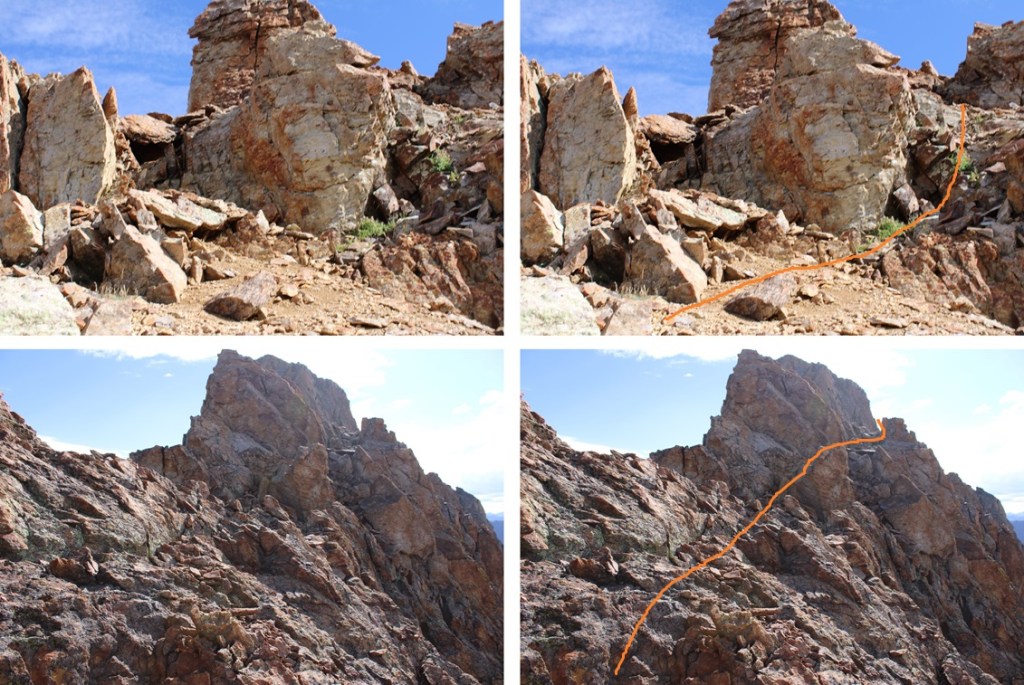
I stuck to the ridge here, so I won’t include direction lines, but I’ll show you a few pictures of this part of the ridge, which I considered class 3

Until I got to here.  I felt this was class 4, and the crux of P3.  This is the route I took, sticking a bit to the left as I felt there were more holds, but I can see how someone with a higher risk tolerance would have gone straight up the middle.

I could now see the summit of P3.  This is the route I took.

I summited P3 at 9:45am

P3:

From the summit of P3, I made my way back to the ridge.

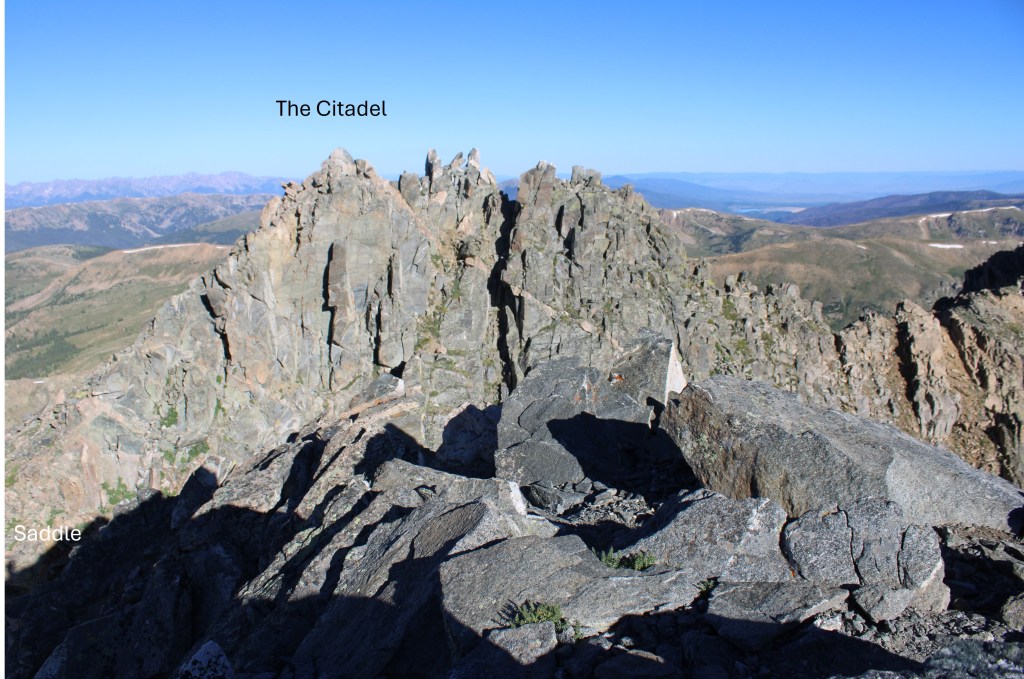
Back on the ridge, I followed it to the P3/P2 saddle

From the saddle, I headed up on talus and scree, following the ridge towards P2, but avoiding the large rock structures to the right.

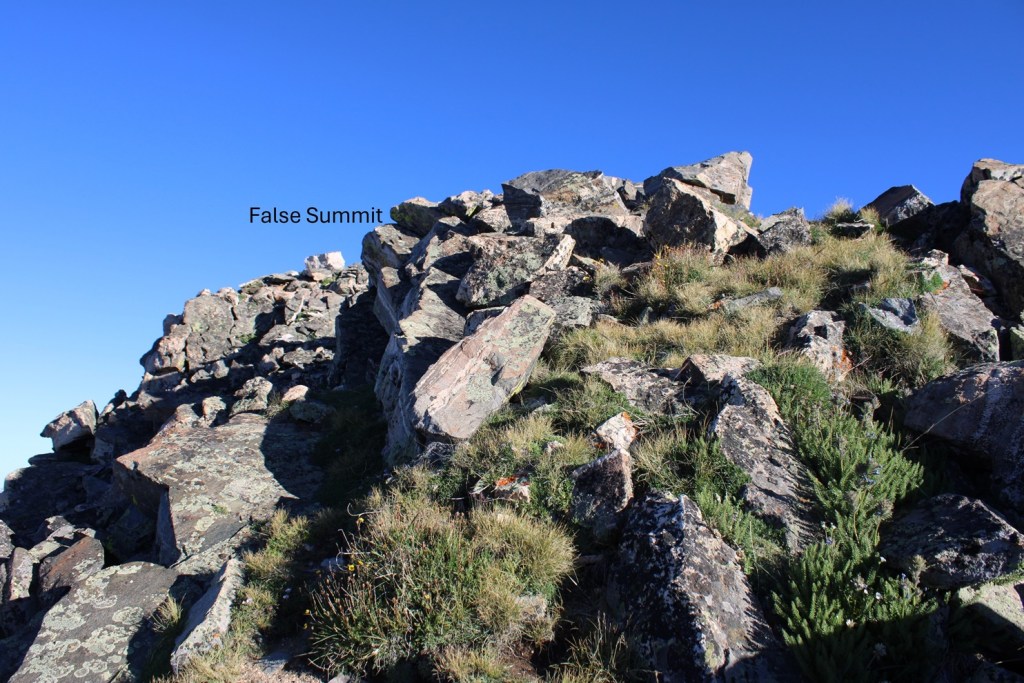
I then came to a sloping section, with a false summit.  I made my way towards the false summit

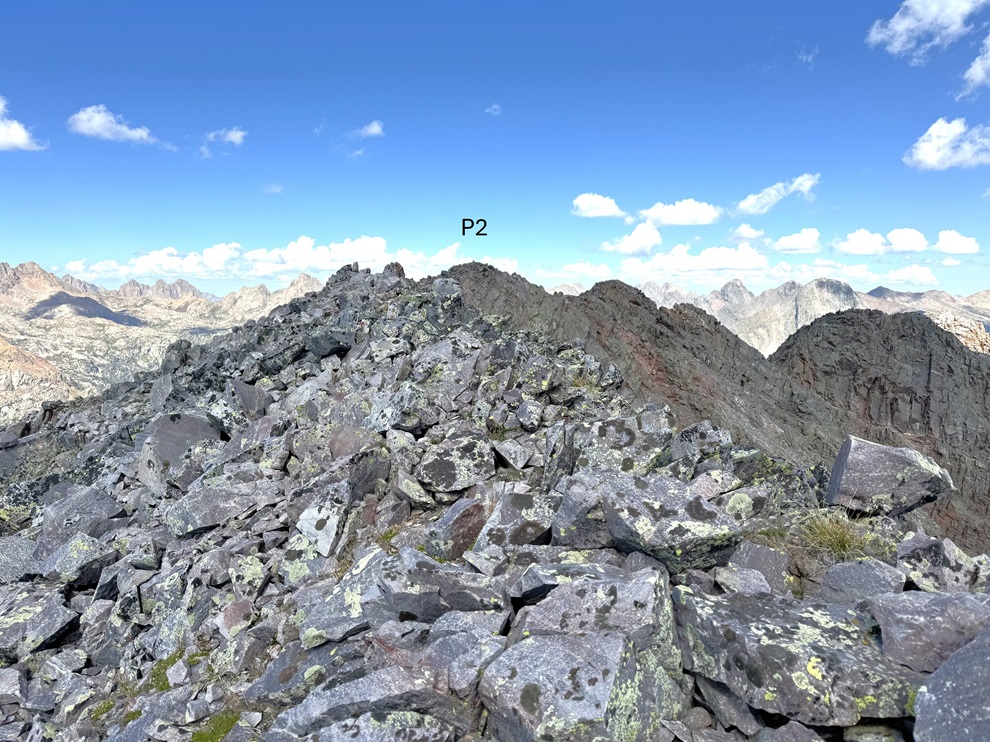
From the false summit, I could see the true summit of P2 in the distance.

I followed the ridge, and this is what I saw in front of me

The climbing wasn’t what bothered me here.  It was that long, yellow rock slab.  I’d heard it was maybe 40 feet, but being there in person, it looked double that.  I downclimbed a bit to get a better view, and the view didn’t get any better. Pictures DO NOT do this slab and it’s exposure justice.

At this point I had to make a very difficult decision.  I do a lot of crazy stuff while hiking solo, but it’s always within my abilities, and I try not to take unnecessary risks.  This rock slab was an unnecessary risk, and that’s coming from someone who’s favorite 14er is Capitol because of the knife’s edge.  I did not feel safe downclimbing this slab solo, or even with another person present, although I would have tried it going from the opposite direction if I didn’t need to downclimb it again.  I had about a 75% certainty if I attempted to downclimb this slab, I would fall.  And the exposure wasn’t pretty.

One of the reasons my husband encourages me to hike solo is he knows I don’t take unnecessary risks in the backcountry, and I want to come home safe to him.  I also want to be a Grandma someday, and I can’t do that if I die. 

I knew there was another way to summit by dropping down to the left, so I got out my cell phone and checked the weather.  The 10% chance of rain after 12pm had now become 80% chance of thunderstorms.  I wouldn’t have the time needed to route find my way to the summit of this peak and make it back to my tent in time before the storm came in.

So, I turned around at the final crux to the summit and headed back down.  I did a lot of scouting around while I was up there and know how I want to attempt this peak next time (I’m thinking of dropping down to avoid the edge or coming in from a different angle).  I’ll be back to summit this peak another way.

So, I turned around and headed back towards the P3/P2 saddle.

Just before the saddle I turned left, and took the P2 gully down into the rocky basin.

I then followed the basin back to the drainage, staying mostly to the right of the basin.

When I came to the drainage, I turned right followed it, staying to the left of the pond, back to the ledge, following game trails where I could find them.

Just before making it to the waterfall I headed right, found my access gully, and headed down.

I descended the rocks, then headed back to my campsite.

I made it back to my campsite at 1:30pm, making this a 6.61 mile hike with 2539’ of elevation gain and tons of route finding in 7 hours.

Oh, and that storm?  It dumped about 4 inches of slush, rain, snow, and hail on top of my tent in about 2 hours.  So now, I had another difficult decision to make:  Stay there overnight and wake up at 5am to a tent frozen solid, pack it up, and hike out, or just hike back to Beartown now.  For those of you who know me (and my Raynaud’s), you know what I did.  I packed it up and headed back to Beartown, hiking in the dark to make it back to my truck in time for my work meeting in the morning. It was NOT a fun hike out, as the trails were now covered in slush (I slipped a few times in the granite rock sections) but I stayed (relatively) warm.

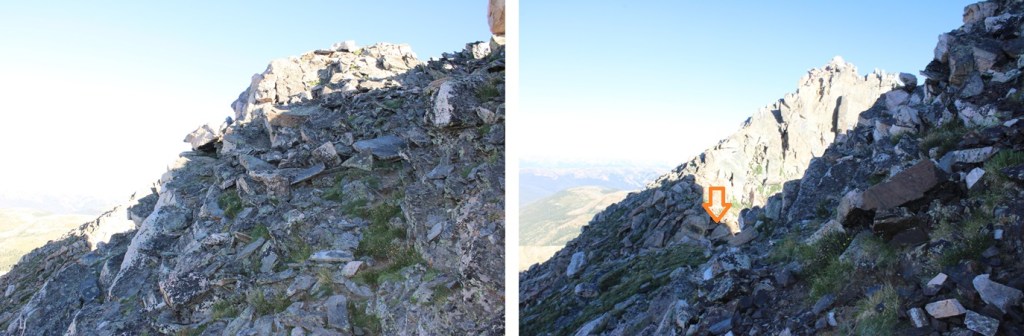
From the saddle of P3 and P2, I followed the ridgeline to 13190’, where you can see the false summit. From below the false summit, I went left (east) and found a gully.  I descended this gully, but not all the way.  Instead, I stayed high and traversed these rock outcroppings.  This route is basically class 3 and choose your own adventure.  I stayed high so as not to have to re-gain elevation, and this worked for me.  Here are pictures of the route I took:

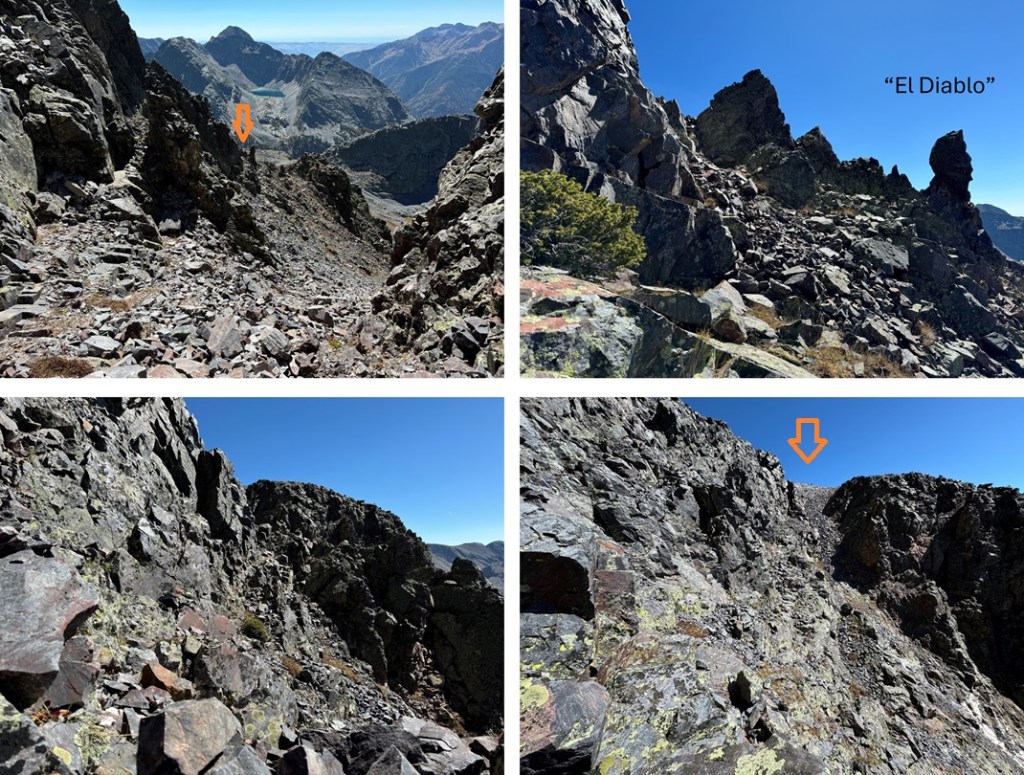
See this rock formation here?  While it’s difficult to see from this angle, I’m nicknaming him “El Diablo”, because to me he looks like a lot of things, but also closely resembled my High School Mascot, the Diablo.  Yes, my high school mascot is the devil.  For middle school we were the Banditos (imagine Yosemite Sam as a Mexican, complete with the mustache and beard, bullet harnesses and a gun in each hand).  Alas, after I went there the parents got upset and changed things and now they’re the “Leopards”.  The parents keep trying to change the Diablo mascot as well, but the students won’t let them.  In any event, I digress.  I went to the right of El Diablo on my way in and used him as a spotting point on my way out.  After passing El Diablo I could see a large gully to the right.  I stayed high on class 3 terrain and climbed the gully, which brought me to the base of the rock slab.

From there, I turned left, and it’s a class 3 climb to the summit.  I tried a lot of different routes that others said ‘went’, but I found climbing straight up the face was the easiest way to summit and stayed at easy class 3.  Climbing straight up the face is easier than it looks, with lots of ledges.  From there I was on a small ridge, and it was 10 feet or so of walking northeast to the summit. Here’s the overall route:

And my summit Photo:

P2:

Here are some pictures of the route back:

And the TOPO for P2

On to the next trailhead!

S4 – 13,256

RT Length: 11.57 miles

Elevation Gain: 4082’

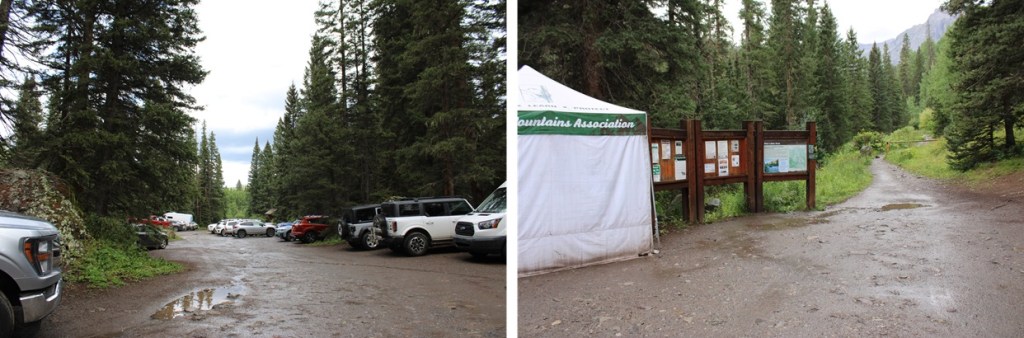
There were only two other vehicles in the lot when I parked at the Blue Lakes Trailhead.  It was raining, so I waited for the rain to stop, and was on the trail at 5am.  The trailhead starts at the south end of the parking area, and is clearly marked.

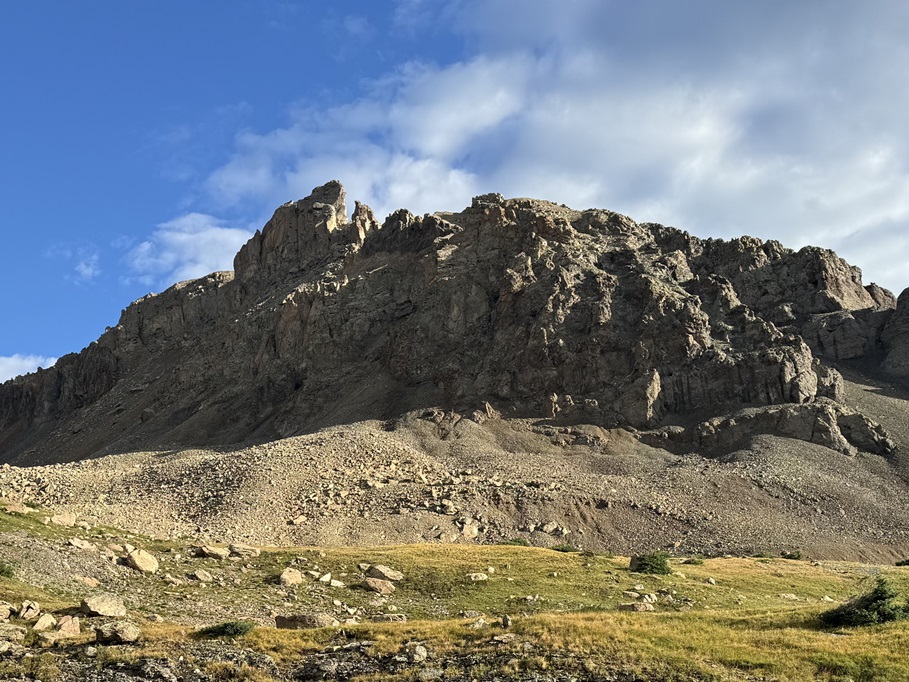
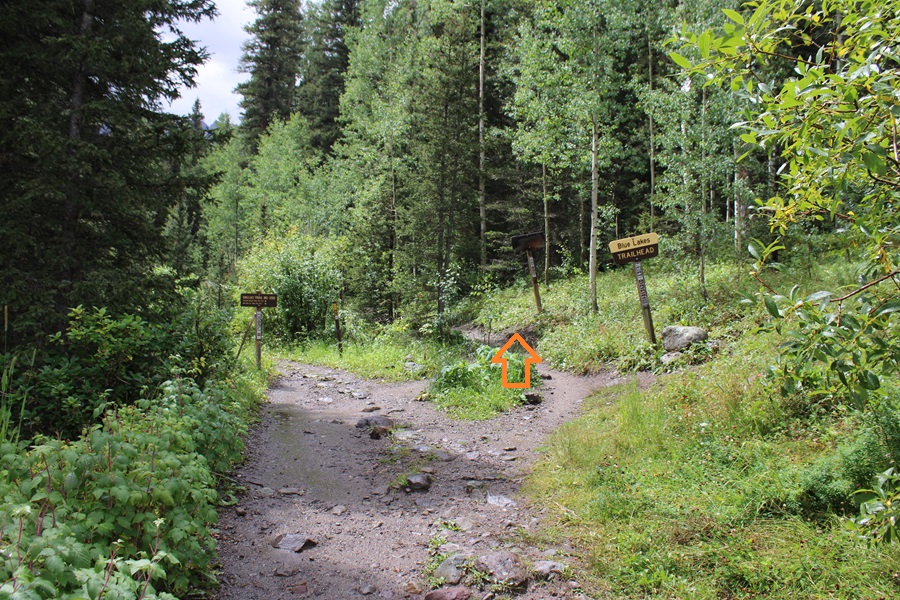
Immediately after the trailhead there’s a junction.  I went right, taking the Blue Lakes Trail.

This was the only junction until I made it to Blue Lakes.  I followed the trail 3.5 miles to Blue Lakes.  About 2.5 miles into the hike it started raining again, and I had to take shelter for a bit under a tree.  However, the trail was class 1, and easy to follow the entire way.

There was an easy creek crossing

And then I continued my way up to Blue Lakes

Once I arrived at Blue Lakes, there were several social trails to campsites.  I stayed on the trail closest to the lake, skirting the west side, towards a creek flowing into Blue Lakes.

At the last campsite before the creek, I followed the drainage on the right side of the creek up to treeline.

Once at treeline, or at least very close in a wide open space, I crossed the creek and headed west up the slope, keeping the creek to my right.

At the top of the slope I continued heading west, staying on the tundra.  You can go right and use the talus, but it’s going to be a LONG day of talus, and I’d rather use the tundra when available. 

At about 12330’, I went right and dropped about 50 feet down to the talus.  There is a game trail here on the talus that will bring you to the upper basin.

Once in the upper basin, there will be an obvious drainage to the right.  I went through the drainage, rock hopped for a bit, and then ascended 600’ of the worst talus ever to a gully.  I put on my helmet and started up.  Here’s the overall route:

As I ascended further up the gully, the talus became looser, but there were also areas of sand mixed with scree.  The rain that morning had turned the sand into a thicker substance, which gave me some much needed traction.  When you enter the gully, stay to the LEFT.  I tried to stay to the right because it looked more stable, but found I was unable to cross over to the left when the time came, because I was now in an hourglass, and traversing it meant rocks above and below me would give way in a rockslide towards the base of the gully, like a funnel (or an hourglass).  After the first few attempts at traversing from up high and sliding several feet before stopping, I downclimbed and re-traced my steps up this part of the gully, sticking to climbers left.  Also, if you’re doing this with other people (in your group or not) stay clear when someone is in the gully, and even if you don’t think anyone is below you on your descent, yell to see if anyone is there. Large rocks will fall as you ascend and descend (there’s nothing you can really do to prevent it). 

Keep heading left, until the scree ends

Once the scree ends, if you haven’t already, now is the time to put on your helmet.  The rest of the summit is class 3 and class 4 on the loosest terrain I’ve ever experienced.  NOTHING is stable.  Trust nothing above, in front of, or below you without attempting holds several times to make sure they are solid.  There is large kitty litter on solid rocks, loose talus, and rock slabs that look stable but are hanging precariously, especially from above. 

From the top of the gully I headed east, to follow the ridge.  Here’s the route I took:

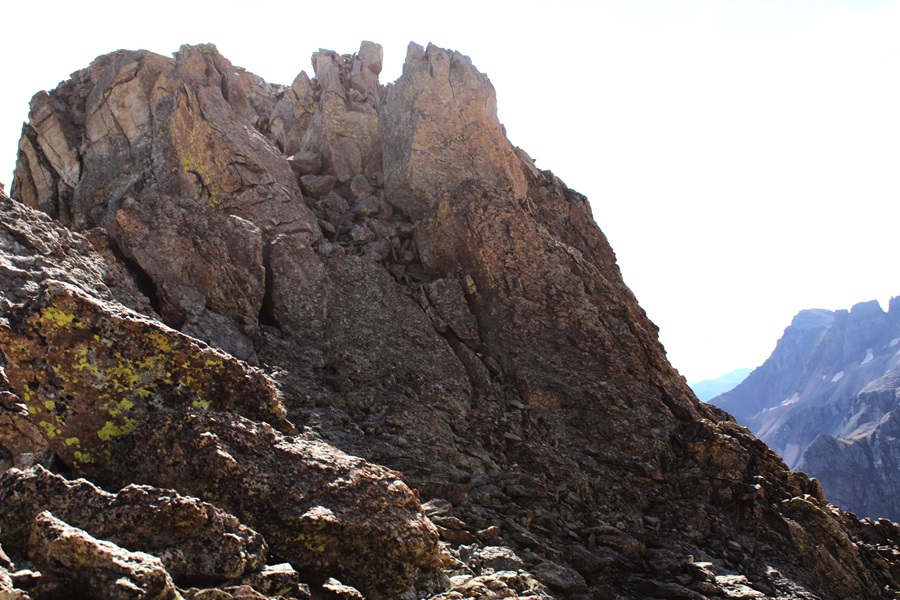
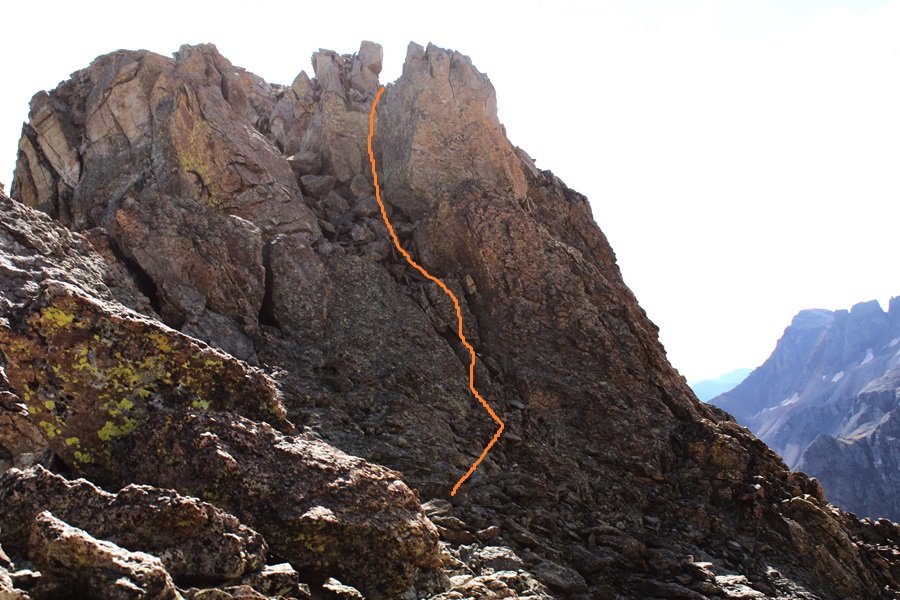
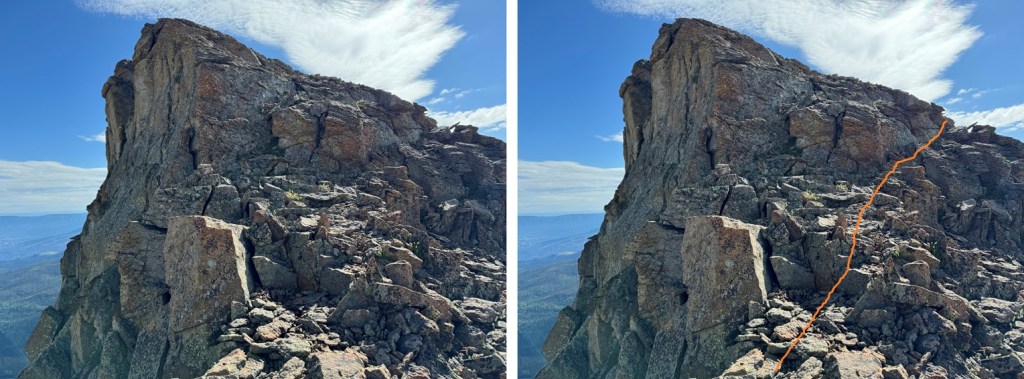
You should now have a good view of the class 4 chimney to the summit.  This is a very loose chimney, and it stops halfway and starts again.  Even the large boulders are loose, so be careful with hand and footholds until you’re sure it won’t move.  I started out by climbing straight up the center, until I came to a “y” where both sides looked perilous.  I decided the right side looked more protected.  The were both loose, sometimes with just large wobbly boulders stacked on top of each other to climb, and sometimes what looked like 10 foot boulders sitting atop rocks the size of a microwave.  Between the two chimneys, there’s probably 40 feet of climbing.  I wouldn’t trust an anchor here:  to many of the boulders are loose.  (There weren’t any anchors set up).

Here’s the overall route I took:

And some closer pictures of the chimney(s)

Chimney 1:

Chimney 2

From the top of the second chimney to the east you can see the route you scramble up to the summit

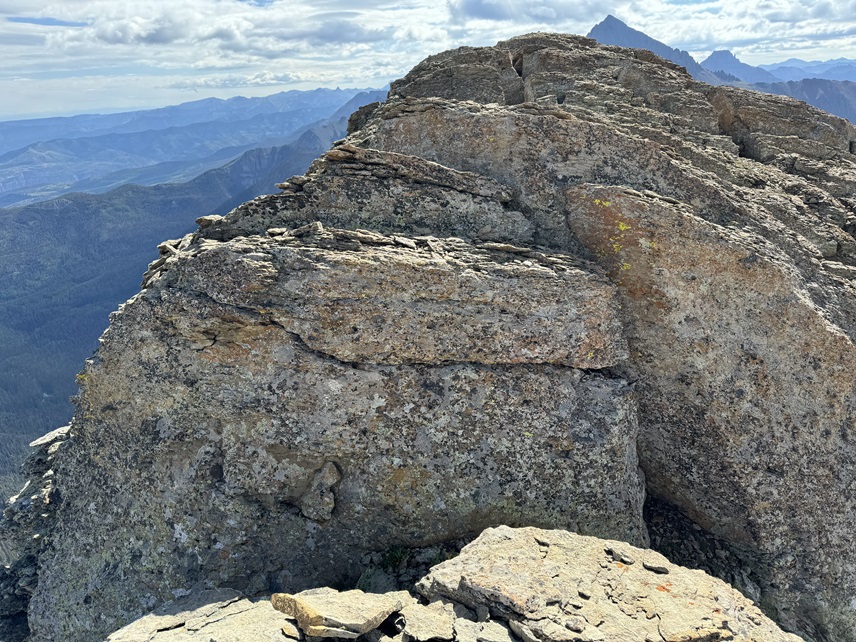
But wait!  There’s more!  Keep heading east, and climb down and then up this rock slab covered in kitty litter.  It’s not tall, maybe 7 feet, but another fun surprise!

And then it’s a quick walk to the actual summit, on… you guessed it, more talus!

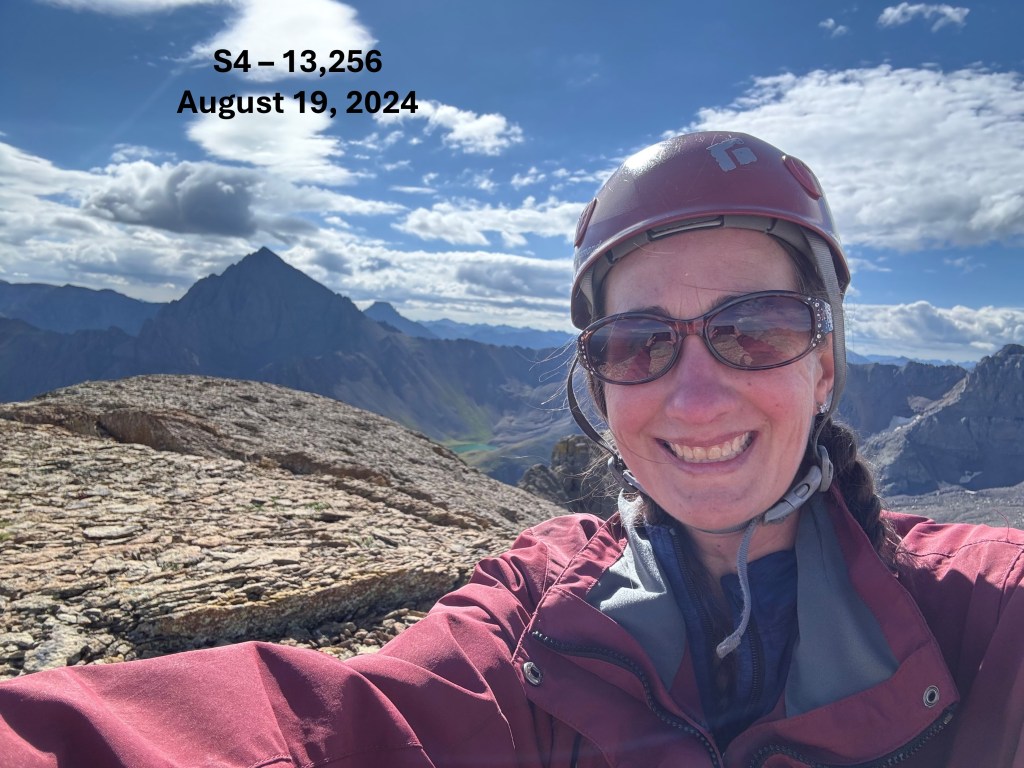
I summited S4 at 9:40am

S4:

And now to head back.  I re-traced my steps to the chimney(s)

Safely down the chimney(s), I made my way back to the top of the gully.

Here are some pictures of the descent down the gully

And the route down into the basin

Once in the rocky basin, I stayed to the right of the creek and descended on the talus to the tundra towards Blue Lakes.

I headed east back to treeline and crossed the creek

Then headed north back towards the Blue Lakes Trail

And followed the trail in the rain all the way back to the trailhead

I made it back to the trailhead at 12:30pm, making this an 11.57 mile hike with 4082’ of elevation gain in 7.5 hours

On to the next trailhead!

Navajo Peak – 13,419′

RT Length: 14.52 miles

Elevation Gain: 3346’

This hike starts from the Long Lake Trailhead inside Brainard Lakes Recreation Area.   This area is permitted.  There are basically two options for permits (I’m summarizing) either timed entry between 8am-5pm, or an overnight permit.  Overnight parking permits aren’t granted unless you have an Indian Peaks Wilderness overnight permit first.  Both permits go on sale at the same time.  Since I wanted to start before 8:30am, I needed to first get an IPW permit, then try to get an overnight parking permit. 

I was able to secure an IPW overnight permit for the weekend but had difficulty securing overnight permits to park inside of Brainard Lake.  Eventually I was able to get two 1-night (overnight) permits, one for Long Lake Trailhead and the other for Niwot Campground.  I tried to get two consecutive in the same area, but they weren’t available for the dates I was allotted my IPW permit. 

When I checked in at the Brainard Lakes Recreation area, they didn’t like what I had done (secured two one night permits at different sites), and decided a better option was to grant me a two night permit for Brainard Lake.  I’d have rather parked for two nights at Long Lake or Mitchell Lake, or even what I had done originally, which was one for Long Lake and the other for Niwot.  But they weren’t having that, so my mileage was increased by a couple of miles for this hike, since Brainard Lake is over a mile from the trailheads.  Also, after you’re inside the park, they have other ‘security checkpoints’ where you need to show you’re your permits again, and they also patrol the parking lots hourly to make sure your permit is valid.  Have I mentioned I’m not a fan of the permit system?  I’ve yet to see one that works smoothly, especially for mountaineers who are concerned with weather and start times.

As I was hiking early in the morning the next day, being flashed with bicycle lights from behind me at 4:30am, I realized there’s another option around the permit system: ride your bike from the winter closure to the trailhead.  I don’t own a bike, but this is definitely an option for the future… if I ever get a bike.

In any event, after minimal drama and parking a little further away than I’d have liked (but hey, it was better than parking at the winter closure…) I was on the trail at 4:30am, starting at the Brainard Lakes parking lot.  My first step was to follow the road for 1.3 miles to the Long Lake Trailhead.

Once at the Long Lake Trailhead, I followed Pawnee Pass Trail west

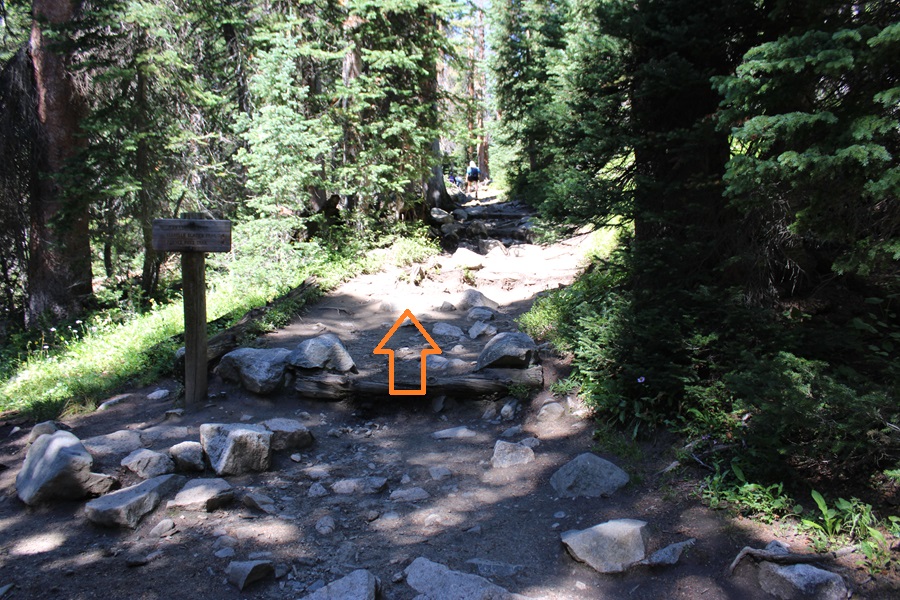
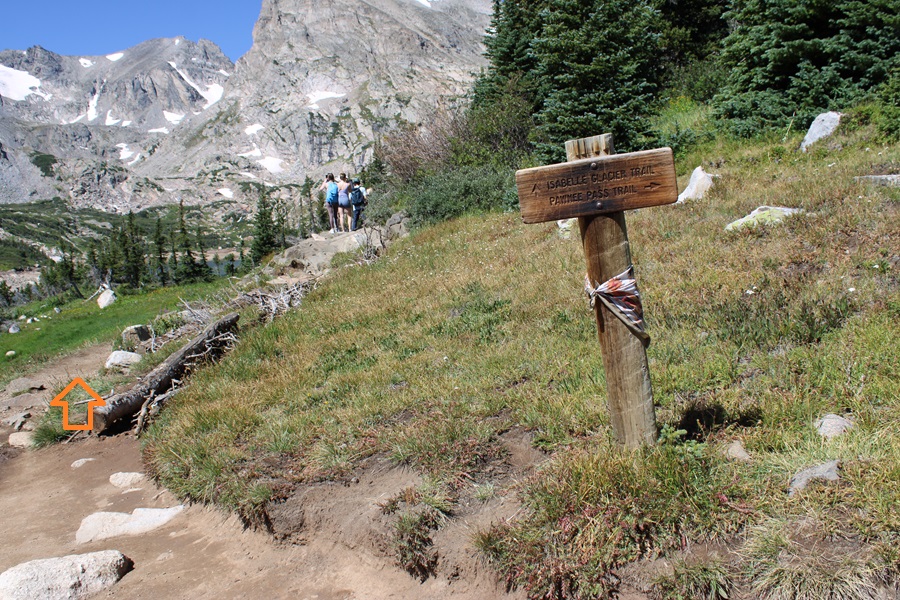
After hiking about 1.5 miles from the Long Lake Trailhead, I came to a junction and went right, following the Isabelle Glacier Trail

At the next junction I went right again, to continue along the Isabelle Glacier Trail. 

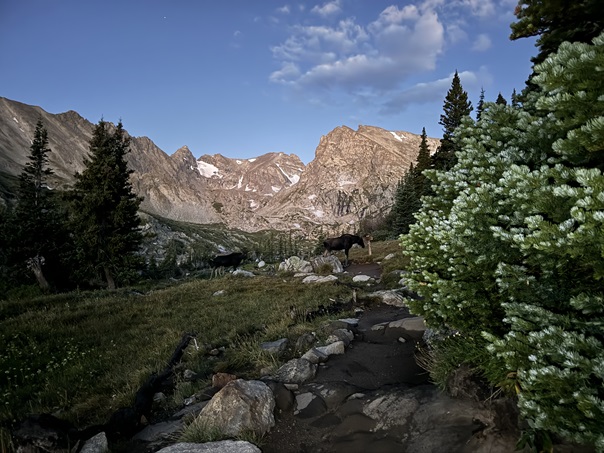
At the next junction, I came upon two bull moose.  When they saw me they snorted and grunted, so I hid behind a tree for 20 minutes until they’d made their way up the hillside, casually munching on willows as they went. I’ve been charged by moose in the past, and while other than the grunting and snorting (which could have meant “It’s too early to be awake”), I kept my distance.  Once they moved, I continued following Isabelle Glacier Trail

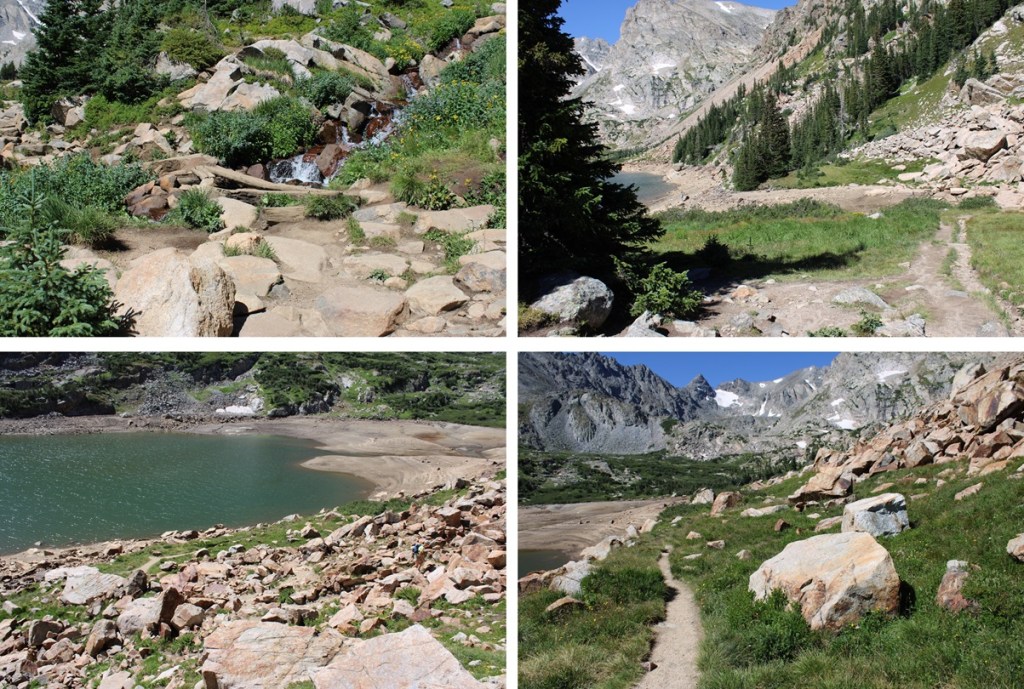
I followed this trail all the way past Isabelle Lake, west/southwest, through rocky areas and willows, towards Navajo and Apache Peaks.  This is a class 1 trail, but the willows, rocks, and creeks overtake it at times. 

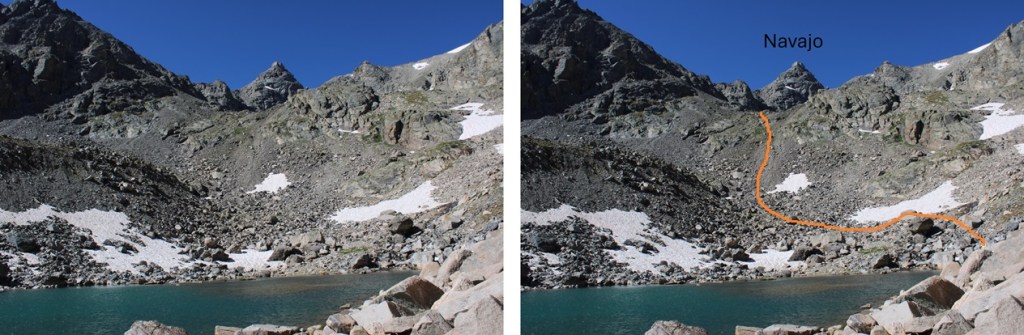
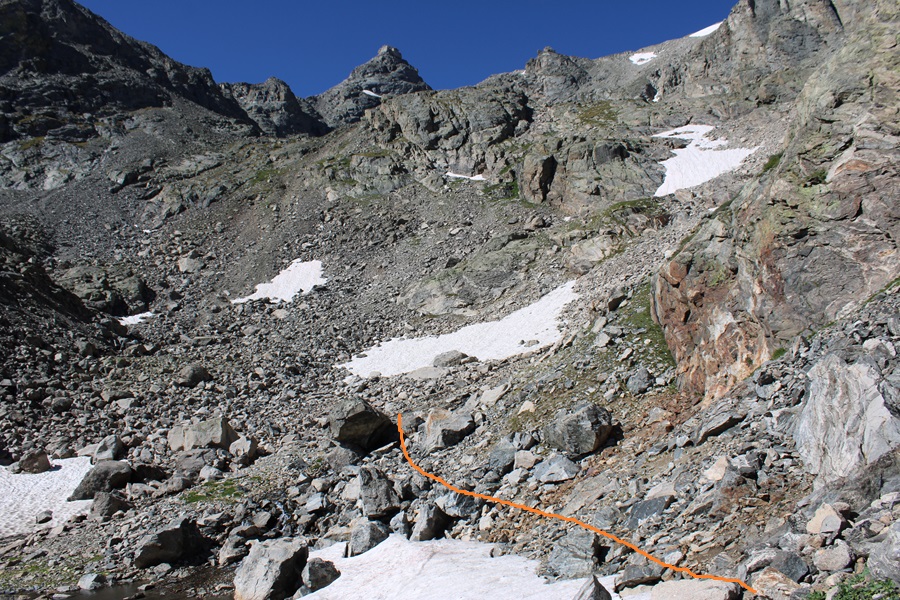
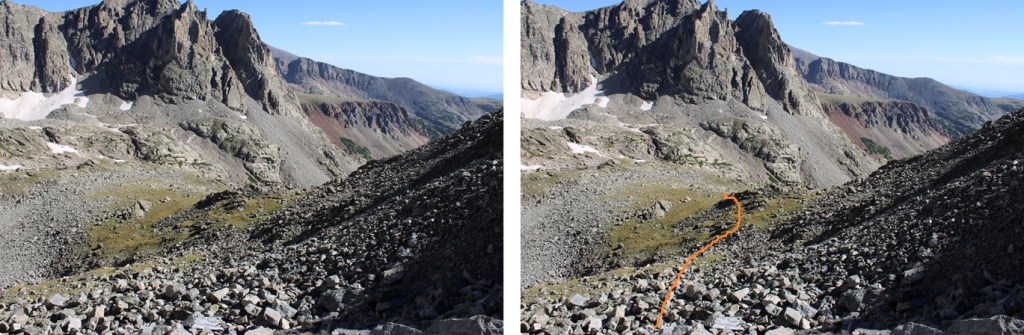
I came to the last pond before the glacier, and left the trail to head southwest into the upper basin.  Here’s the route I took

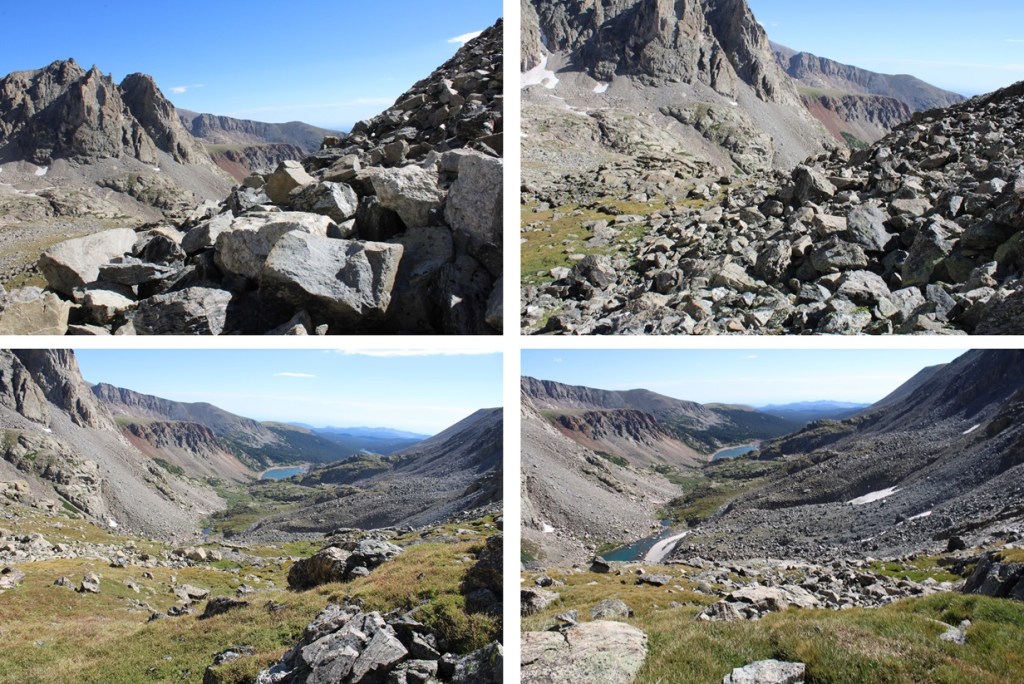
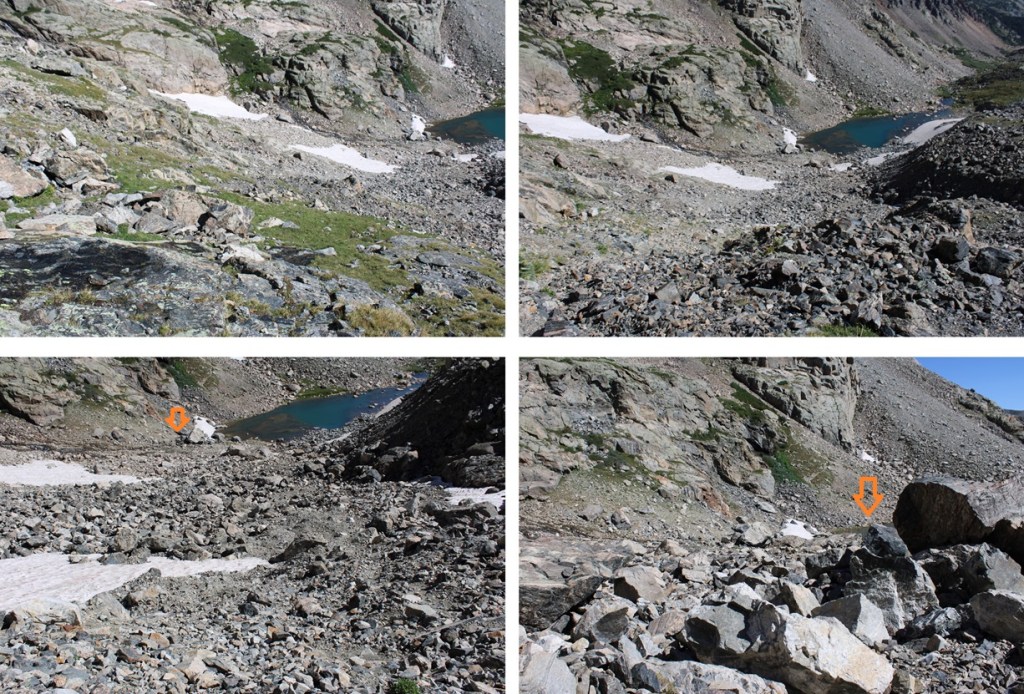
And some step by step pictures.  First, I had to leave the trail.  I crossed over the snow still skirting the lake, and headed towards the large boulder in the distance

I then crossed the creek, crossed the boulders (some were loose, most were not) and headed for the scree.  Luckily, it had rained last night, so the scree was easy to grip.

At the top of the scree I was greeted with tundra.  I kept following it, heading southwest

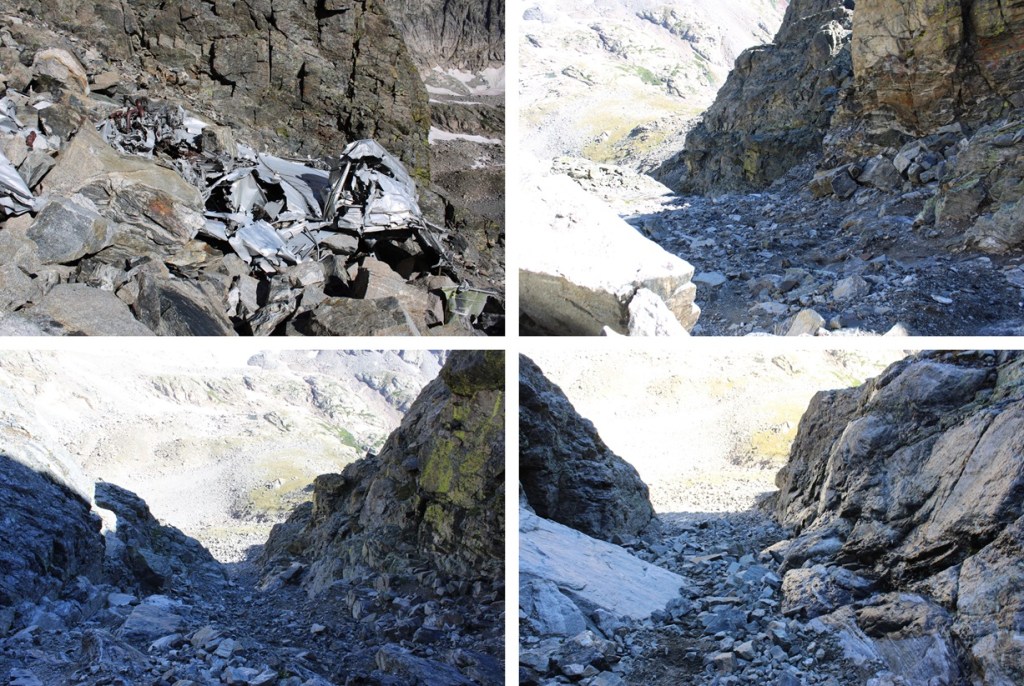
Now in the upper basin, I had a great view of the gully I wanted to take to ascend the ridge.  If you look around, you’ll see remnants of a plane crash that happened in the 1950s.  The higher you go up this gully, airplane gully as many like to call it, the more debris you’ll see.  This is the route I took up the gully.

I made my way southwest over some boulders towards the gully, until I found a scree path.  A few thoughts on this gully:  Besides the fact this was the only part of the hike I experienced insanely intense winds all day, it was easy to navigate, there were social/game trails to follow, it wasn’t very loose, and the scree was solid.  In short, it’s probably one of the easiest gullies I’ve ever ascended, and if they were all like this, I probably wouldn’t mind them so much.  I headed south until I saw an obvious “y” in the gully, and went right.  It’s easy to know where you turn right because you’ll see parts of the airplane to the right.

I went to the left of the airplane debris, then followed climbers right of the gully to the ridge (although both sides will get you there, just use the terrain you like best).

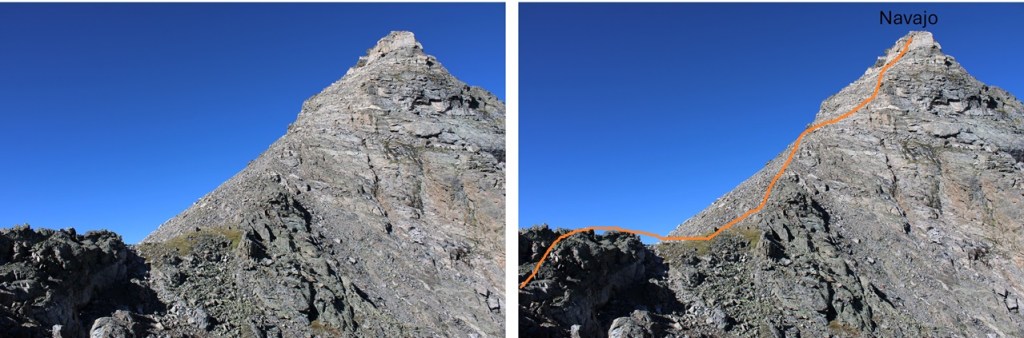
At the top of the gully, I could see the rest of my route to the summit of Navajo Peak.  Until the chimney at the end, the rest of the route is class 2.  If you find yourself in class 3 territory, you’re making it too difficult. 

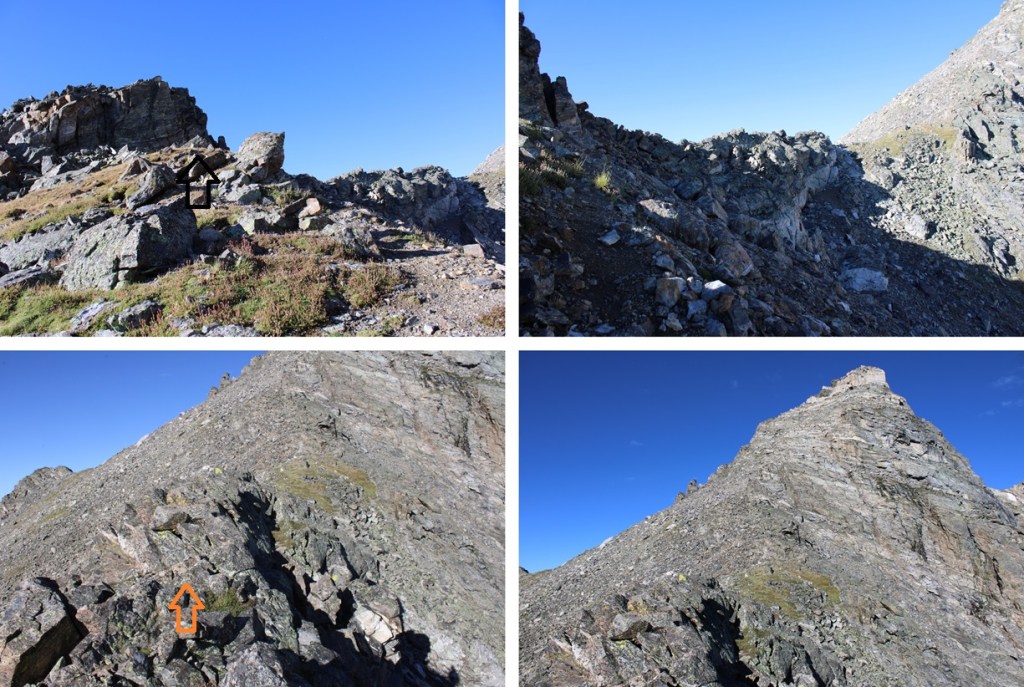
From the top of the gully I turned left and followed the saddle across a small ridge

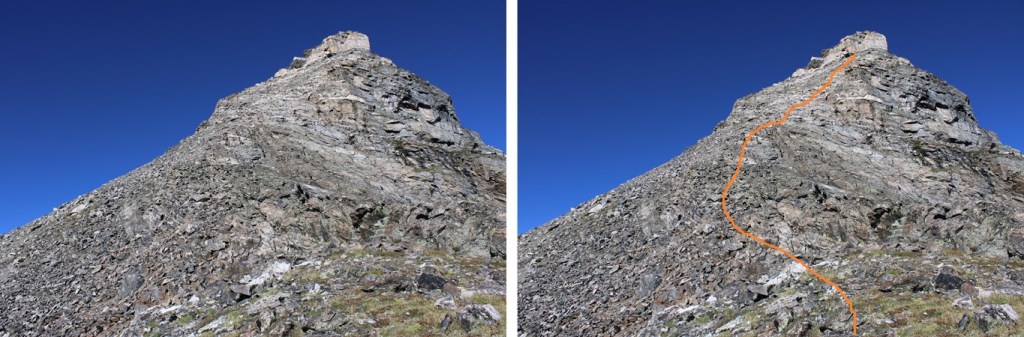
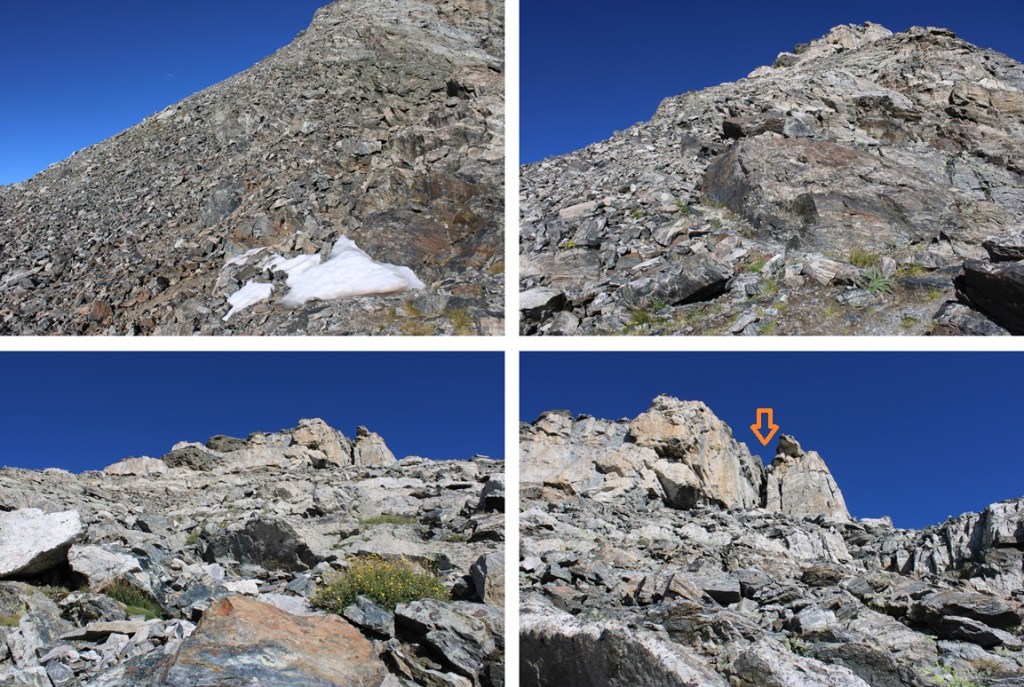
From here the rest of the route looks daunting, but there are tons of game trails that will get you to the right spot.  Aim for the very right edge of the rock formation, where you’ll see a chimney.  Once again, this should all be class 2.

Here’s a look at that chimney.  I found this chimney to be difficult class 3, easy class 4, so if you’re looking for a good practice chimney, this would be it. There isn’t a lot of exposure, and I was able to find adequate hand/footholds if I stretched a bit.  At the top of the chimney, exit left.

At the top of the chimney I turned left, and climbed over boulders a short distance to the summit

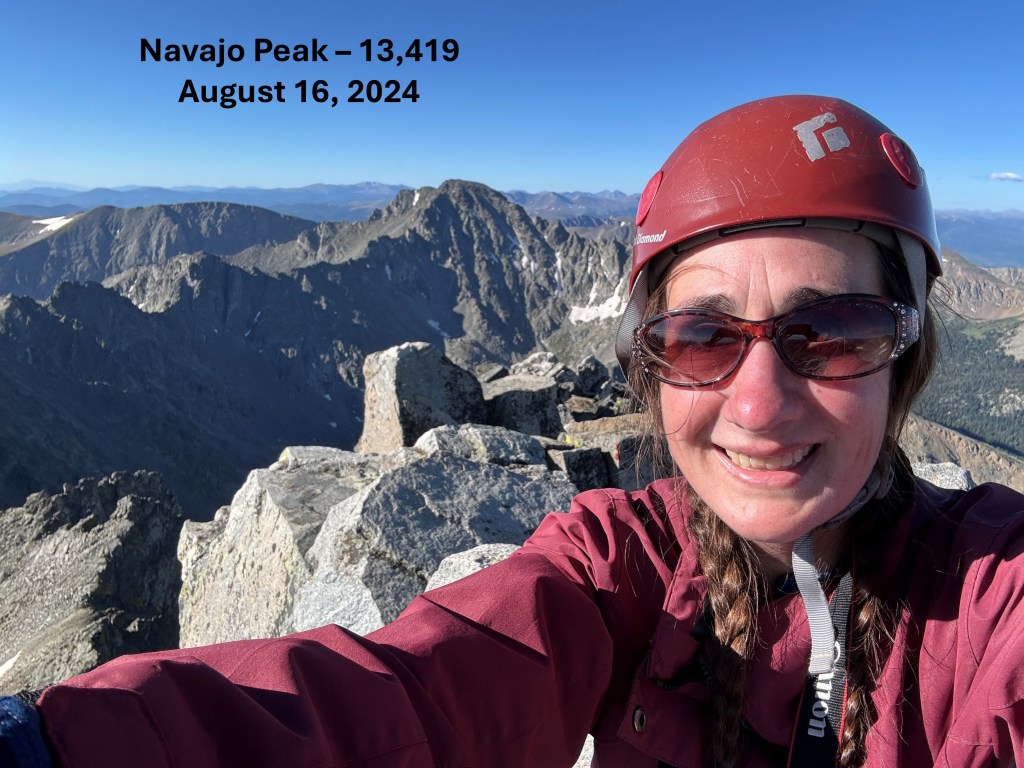
I summited Navajo Peak at 8:30am

Navajo Peak:

This was an out and back hike for me, so I turned around and headed back towards the chimney.

I descended the chimney, and made my way back down to the saddle.

Then headed back down airplane gully

Passing the crash site, and continuing to follow the gully north

At the base of the gully, I rock hopped towards the tundra I could see in the distance

I could now see Isabelle Glacier trail in the distance, and descended down into the lower basin towards the trail. 

Back on the Isabelle Glacier trail, I followed it east back to the Long Lake Trailhead.

Back at the Long Lake Trailhead, I followed the road 1.3 miles back to Brainard Lake

I made it back to the trailhead at 12:30pm, making this a 14.52 mile hike with 3346’ of elevation gain in 7.5 hours

The Citadel – 13,295

RT Length:  11.45 miles

Elevation Gain:  3255’

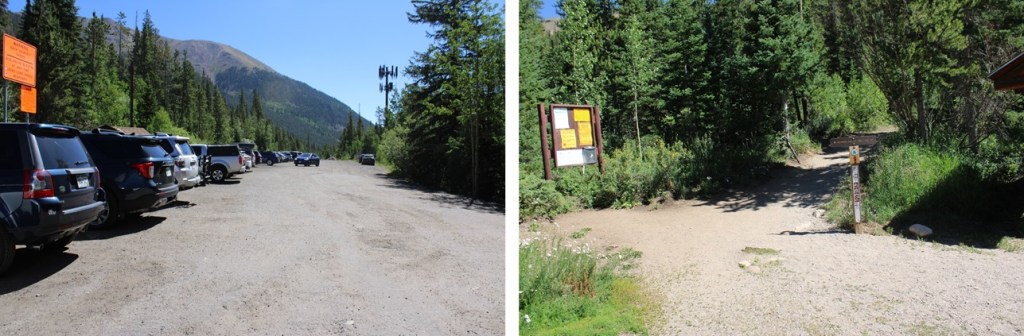
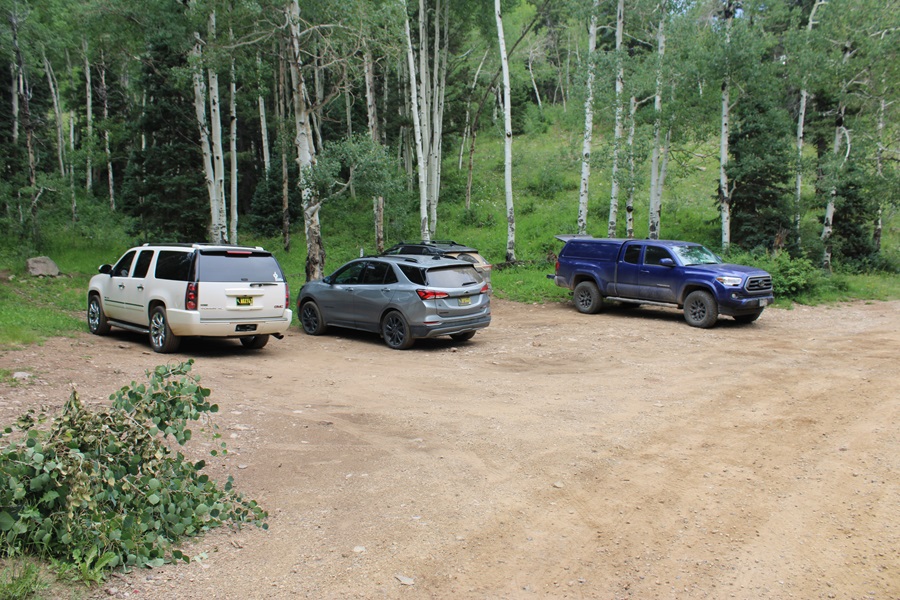
I arrived at the Herman Gulch Trailhead and was on the trail at 4:30am.  The trailhead has spots for dozens of vehicles (if not more), and the trail is clearly marked. 

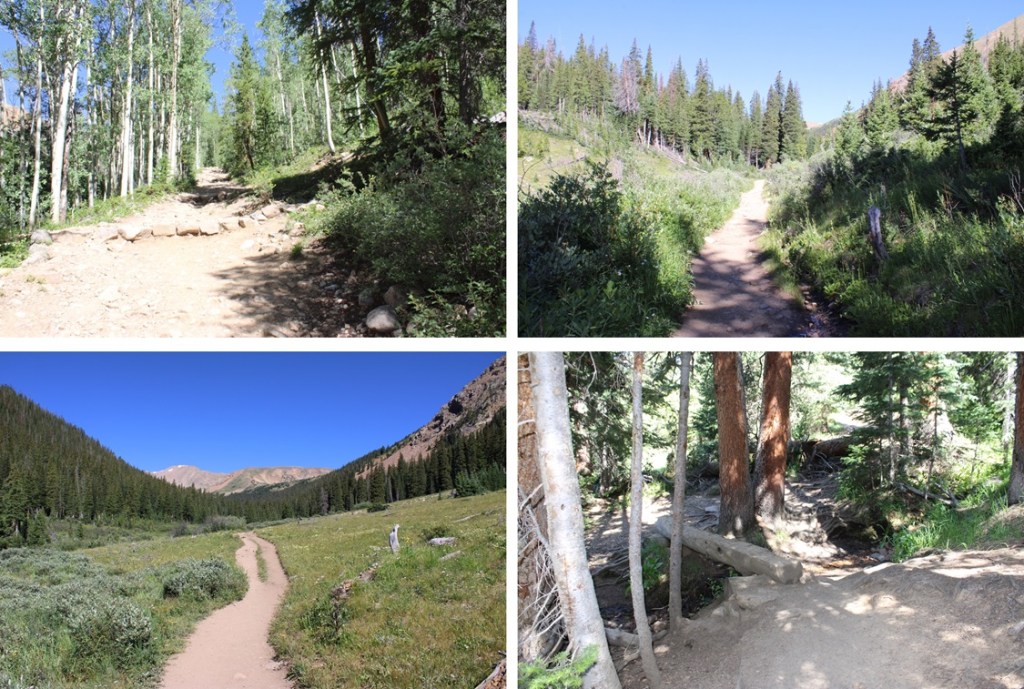
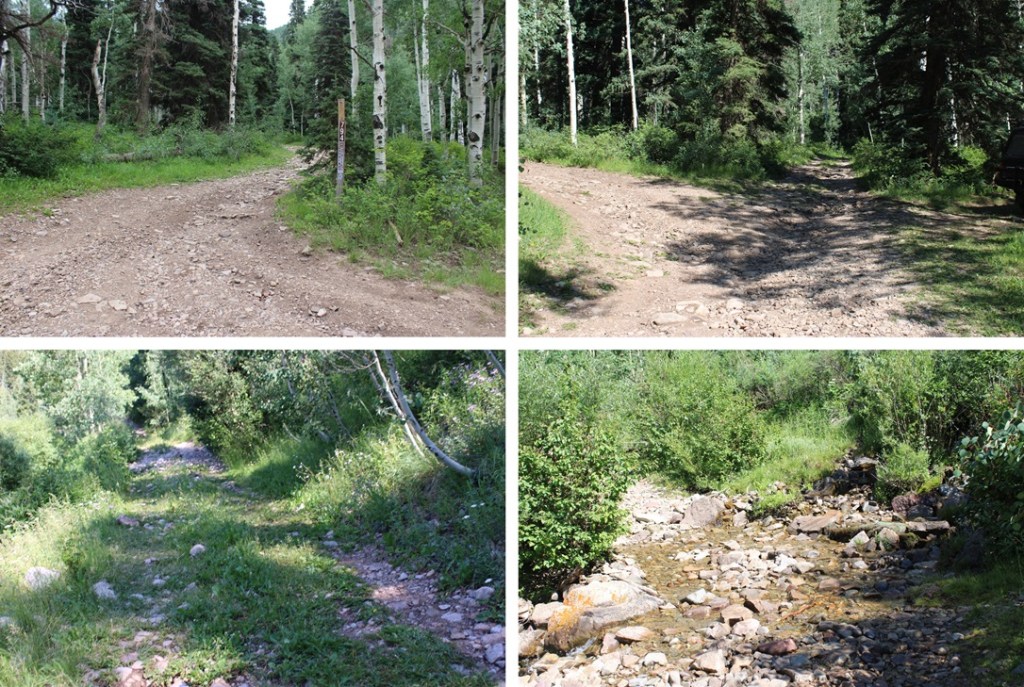
I followed the Herman Gulch trail for less than a quarter of a mile, until I came to the junction with Waterous Gulch Trail, turned left, and continuing following the class 1, well-defined Herman Gulch Trail all the way to Herman Lake.

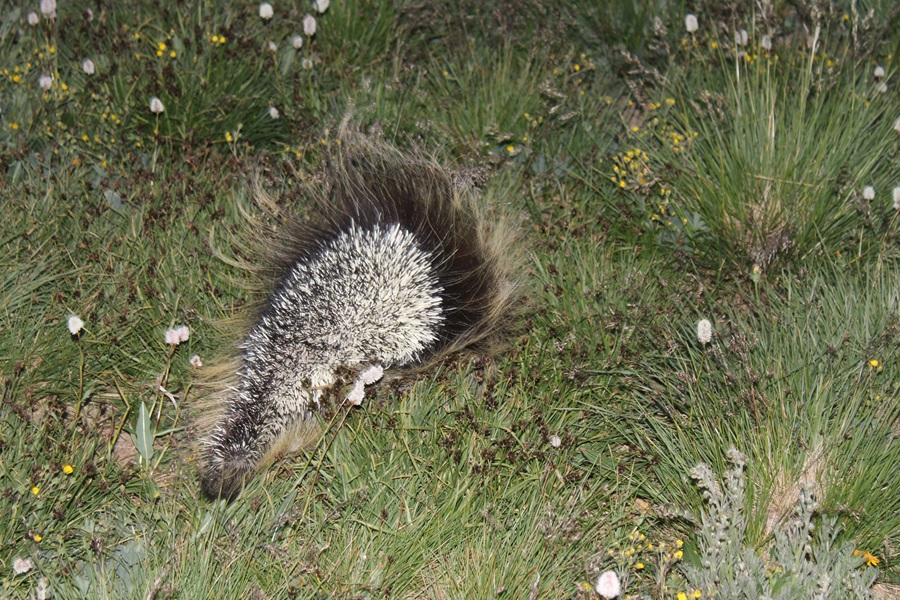
It was at about here I encountered a porcupine, which immediately turned and ran away from me. 

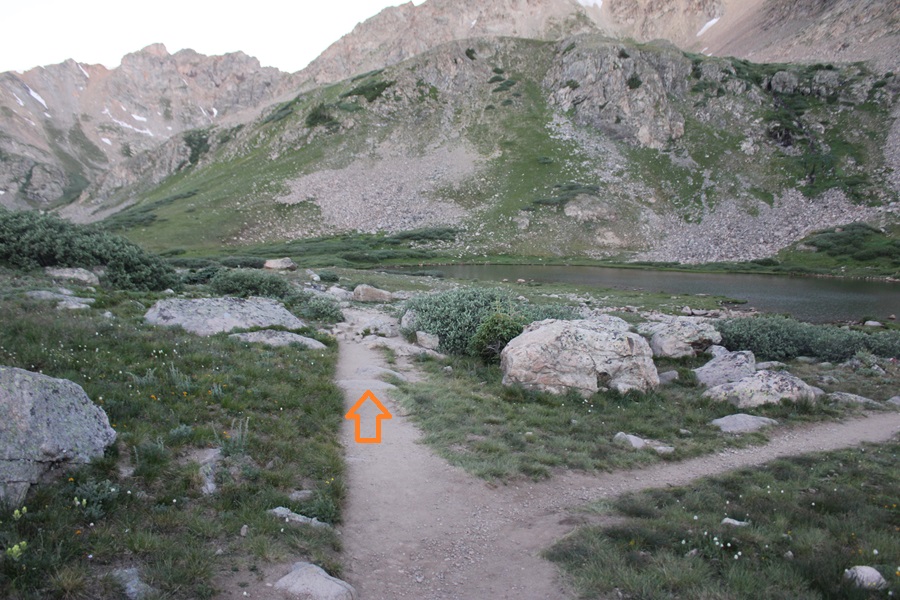
I continued following the trail, skirting the south side of Herman Lake

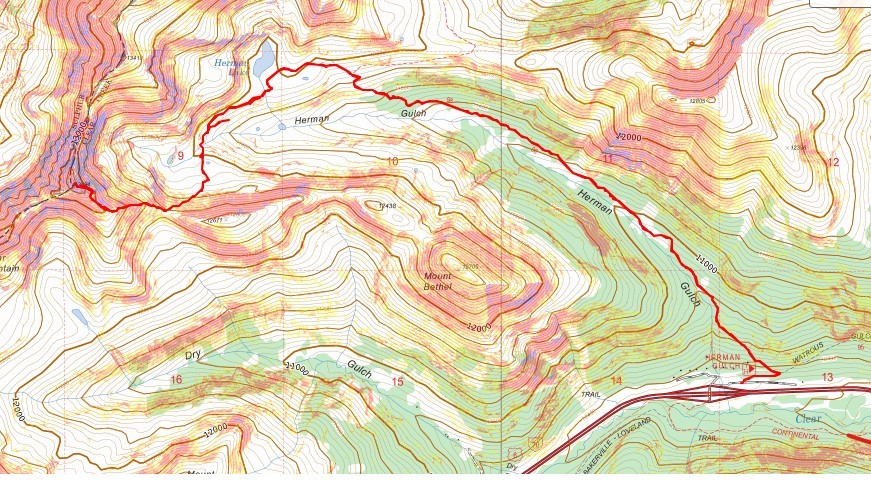
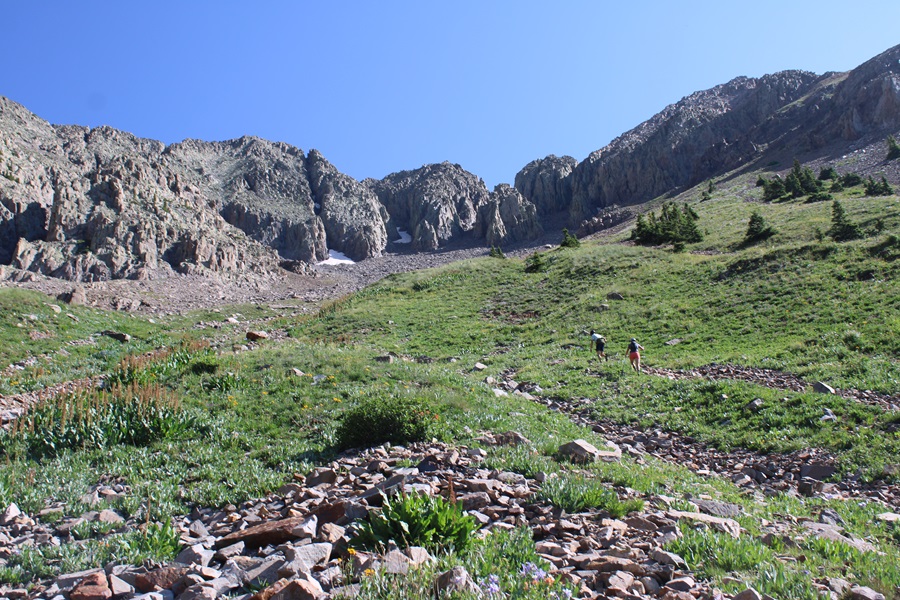
I followed this trail as it headed southwest towards the saddle of The Citadel and PT 12671.  Here’s where I was heading:

There’s a pretty good trail that goes MOST of the way, crossing the creek that flows out of Herman Lake and through the willows.  I lost a little bit of elevation during this part, but it was negligible.

At about 11970’ I came to another large creek, and here I left the trail to cross the creek

From here the trail is difficult to follow, but there are plenty of cairns to follow to get you to the saddle.

Now on the saddle, I turned right and headed west up the ridge, on a good game trail that was easy to follow.

Now to make my way towards the saddle.  The route will be obvious.

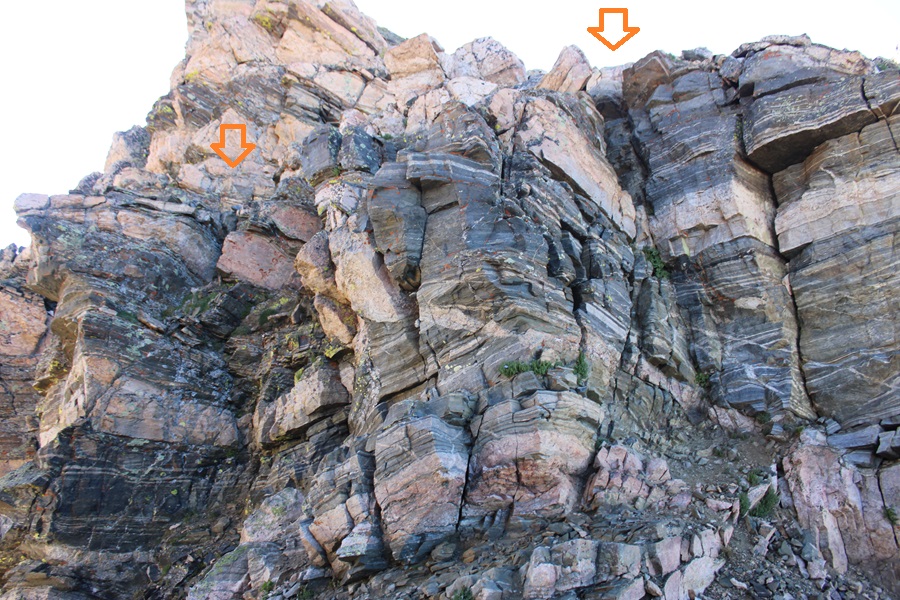
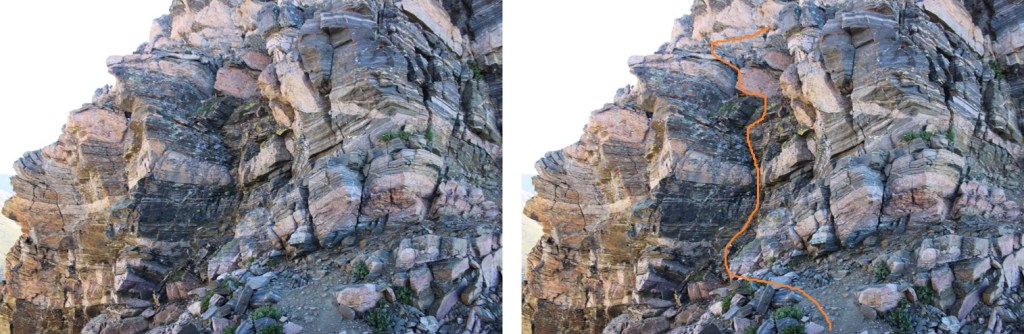
If you haven’t already, now is a good time to put on your helmet.  From the saddle, head northeast and look for a solid band of rock.  This rock band is important, because the gullies are miserable.  Once on the rock band, ascend towards the tundra, then follow the line of tundra northeast.  Once you’re on the tundra, you can stay on tundra until the top.  This is class 3, and a slip would have you falling quite a ways, like hundreds of feet before you stop, so take care in this area.  Here’s a visual representation of how I climbed from two different angles.  It’s probably a good idea to start memorizing the route as you’re hiking up the ridge from the saddle of The Citadel and PT 12671. 

And some pictures of my route:

From here, to the north, I saw what I thought was the summit.  It wasn’t, but I headed towards it anyways.

I made my way to the false summit, and could see the true summit to the west.

So, I downclimbed a bit, and headed towards the saddle ahead of me. 

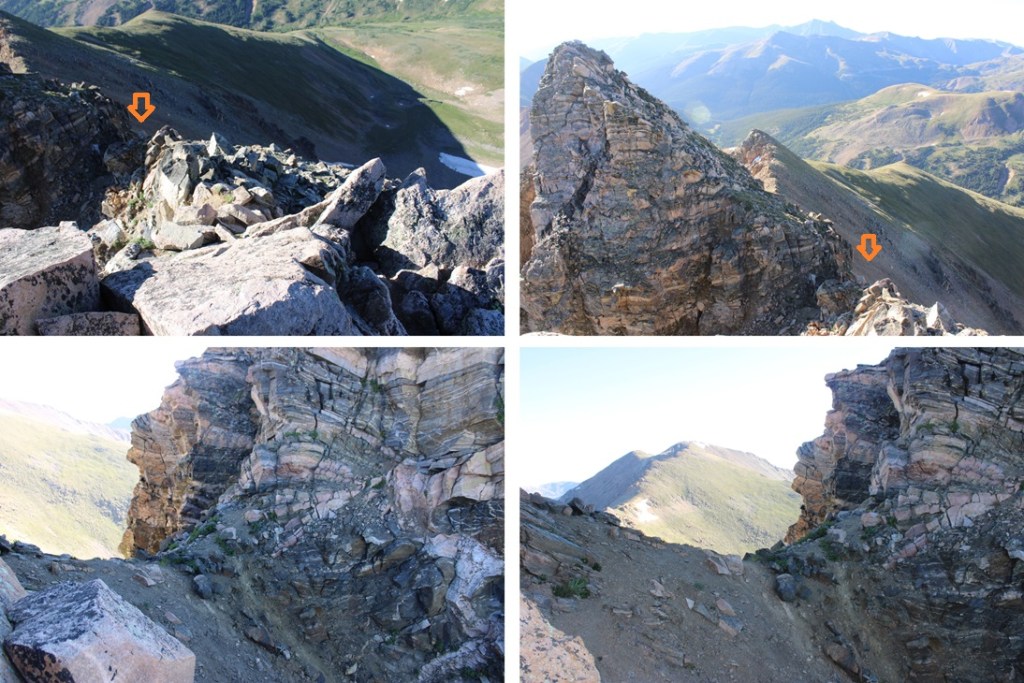
At this saddle, there was what I would consider a class 4 chimney to downclimb.  I sat there for about 10 minutes, waiting for the wind to die down before downclimbing.  The wind was insane, and I had to hide behind rocks to get away from it.  The downclimb was much more difficult than the upclimb, as it was committing, and I wasn’t sure there would be adequate footholds down below where I couldn’t see (there were).  Here’s what the wide chimney looked like to downclimb.  It was probably 10-15 feet of downclimbing.

Now to head to the saddle, and summit the peak.

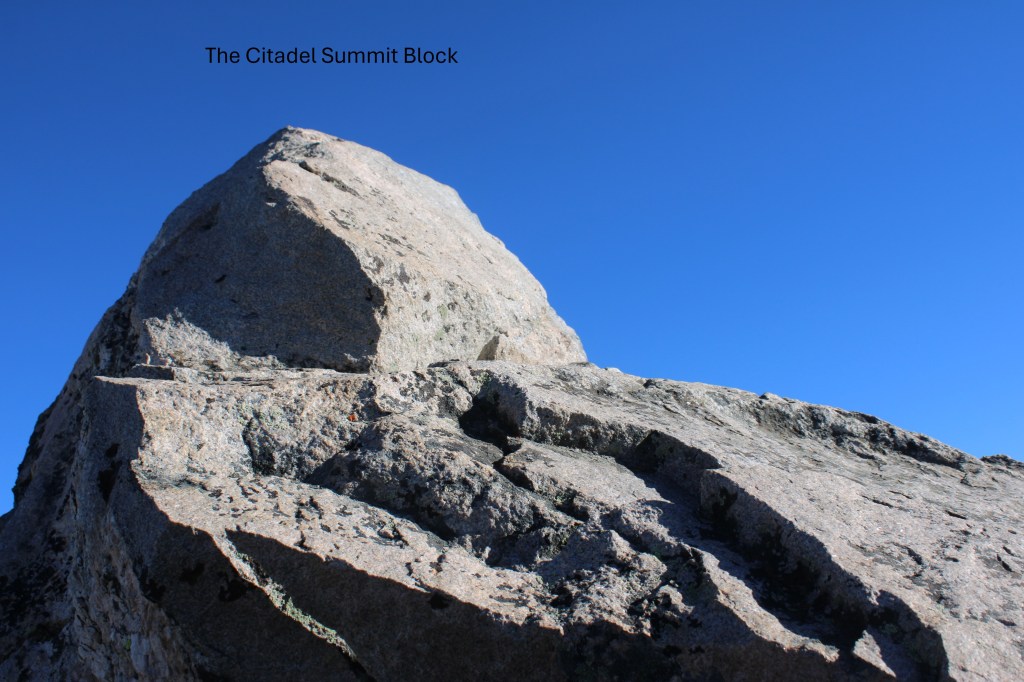
The summit was a short class 3 scramble to the summit block, which is a bit exposed. It was EXTREMELY windy today, and I had to hold on tight to keep from being blown over, but I was able to summit.

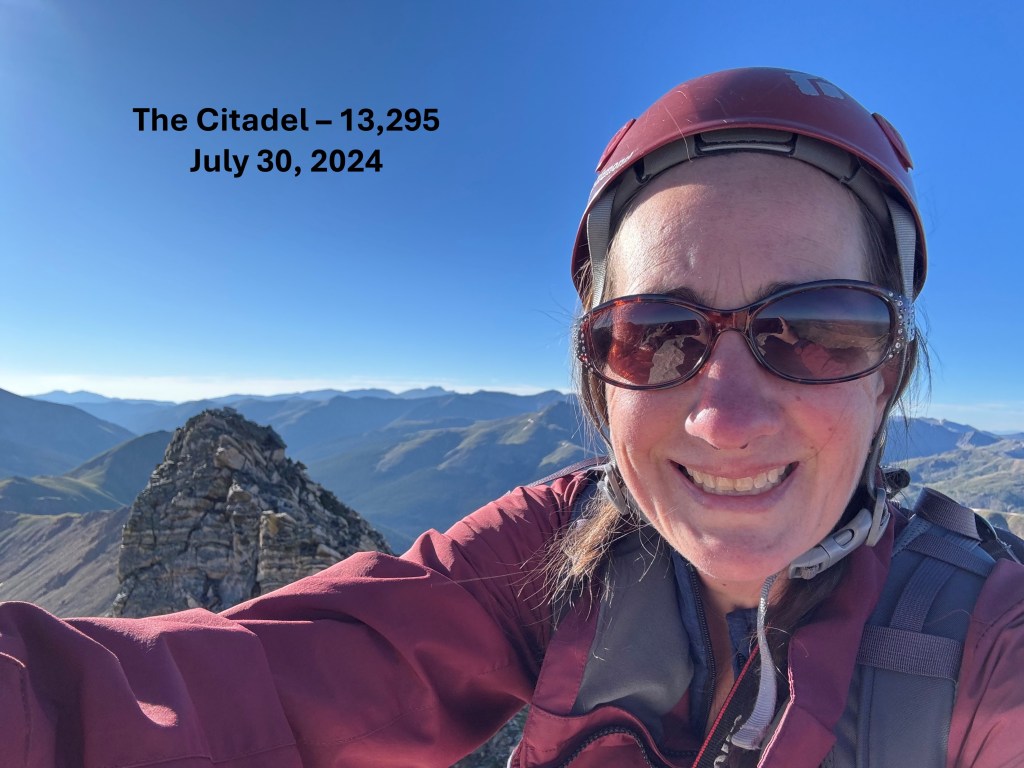
I summited The Citadel at 7:45am.  Sorry for the terrible picture and less than stellar video… I only took 1 photo, because I was afraid of losing my phone to the wind, and there wasn’t much room to move around on that summit block without falling (once again, wind).

The Citadel:

Here you can see the false summit to the east

I made my way back to the saddle between The Citadel and the false summit

Here’s a look at your options to upclimb.  There are two, I took the one to the left do downclimb and upclimb.

And now to make my way back to the grassy ledge.  There’s a cairn indicating where to descend.

And now to downclimb the grassy ledge.   Once again, I stayed on the tundra until I reached the rock rib, then headed for the saddle to the right.

I was now back on a trail, and followed it to the saddle of The Citadel and PT 12671.

Here’s an overview of my hike to Herman Lake from the saddle.  This was on a mostly class 1 trail, with cairns to help when needed.

Back at Herman Lake, I followed the Herman Gulch trail east back to the trailhead.  You’ll know you’re getting close when you can hear the illustrious sounds of I70 in the distance.

I made it back to my truck at 10:30am, making this an 11.45 mile hike with 3255’ of elevation gain in 6 hours.

On to the next trailhead!
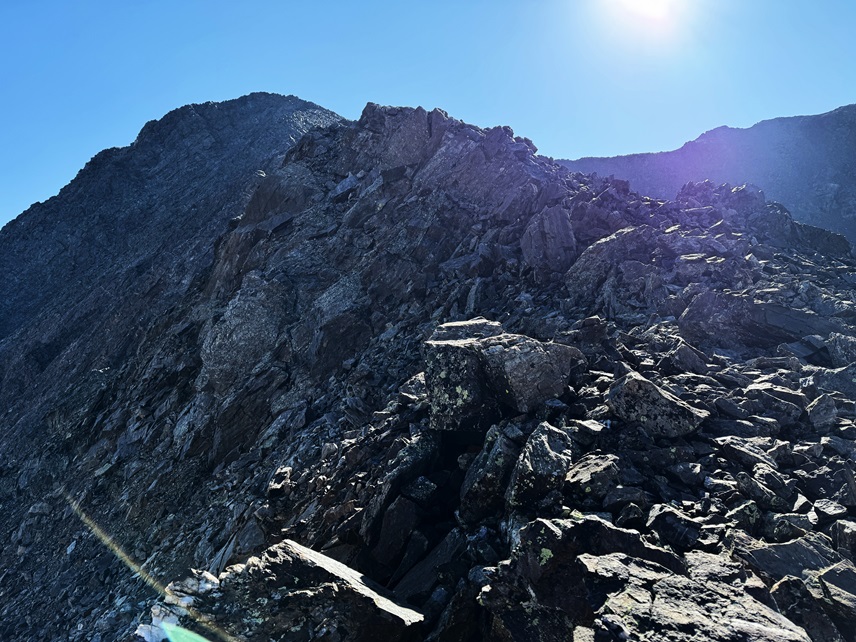
Babcock Peak – 13,161

RT Length: 9.23 miles

Elevation Gain: 3868’

I parked at a turnoff near Boren Creek and124/794 with room for about 5 vehicles if everyone parked nicely.  The drive in is dirt 2WD.   I was on the trail at 4:30am.

I followed 4WD road 794 for over 3 miles as it switchbacked it’s way northeast, following Boren Creek.

After hiking for around 3 miles I made it to treeline.

Here I turned right, and could see Babcock Peak to the north.

Route finding here was pretty easy.  I headed north towards the gully, aiming for the gully to the right.  I gained about 1500’ here to the summit in about a mile.  This gully is very loose, and full of all different sized rocks.  I didn’t stick to one side, but chose whatever route looked best.  Here are some pictures of the gully.  It’s pretty straightforward.

Just before reaching the saddle, I turned left, and ascended this much smaller gully

From here, it’s choose your own adventure to the ridge.  Everything is class 3 climbing, and I’m pretty sure there is no wrong way to get to the ridge, as long as you’re heading north/northwest.  I can’t say the same for heading down, so it’s a good idea to keep looking behind you for reference points for the way back.  Also, pictures were very difficult to put everything into perspective.  Right now you should be at the junction of the left and right gullies.  Take note of where you are, because this is where you’ll want to descend to on your way down, and as you can see by looking ahead of you, the initial climb to the ridge is steep and it can be difficult to know exactly where you are.  Here are some pictures as I made my way up to the ridge.

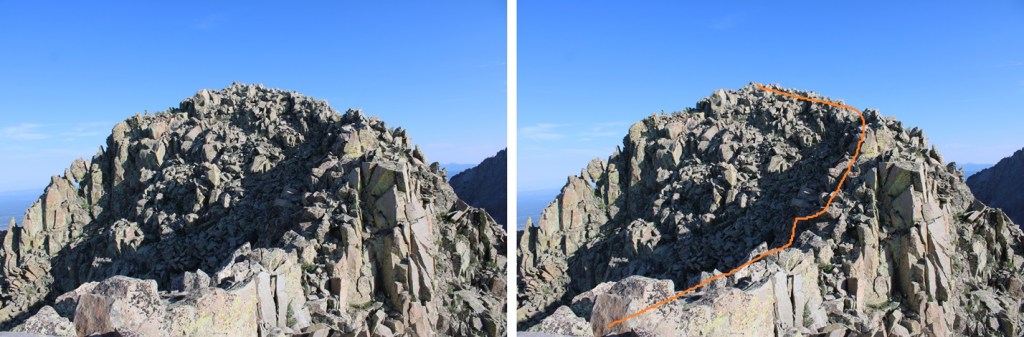
Once on the ridge, I turned left, and headed northwest towards the summit.  There was only one ‘tricky’ move, and the rest was class 2.

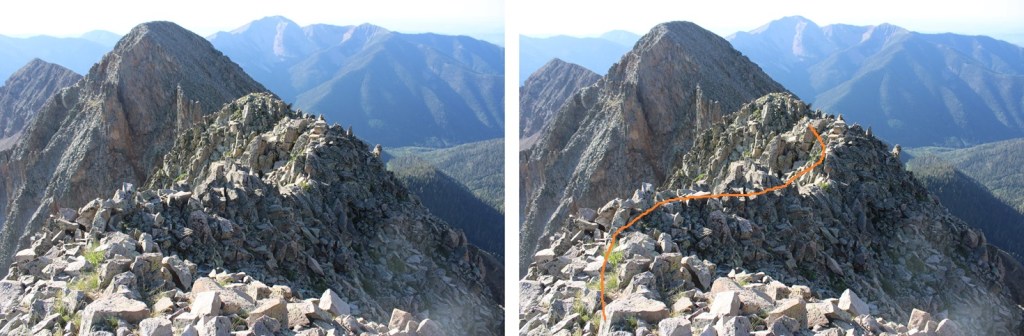
Here’s the tricky move.  Go right here to ascend the ridge.  It feels like difficult class 3 or easy class 4, with some exposure.

Then it was a quick ridge hike to the summit, staying on the ridge proper.

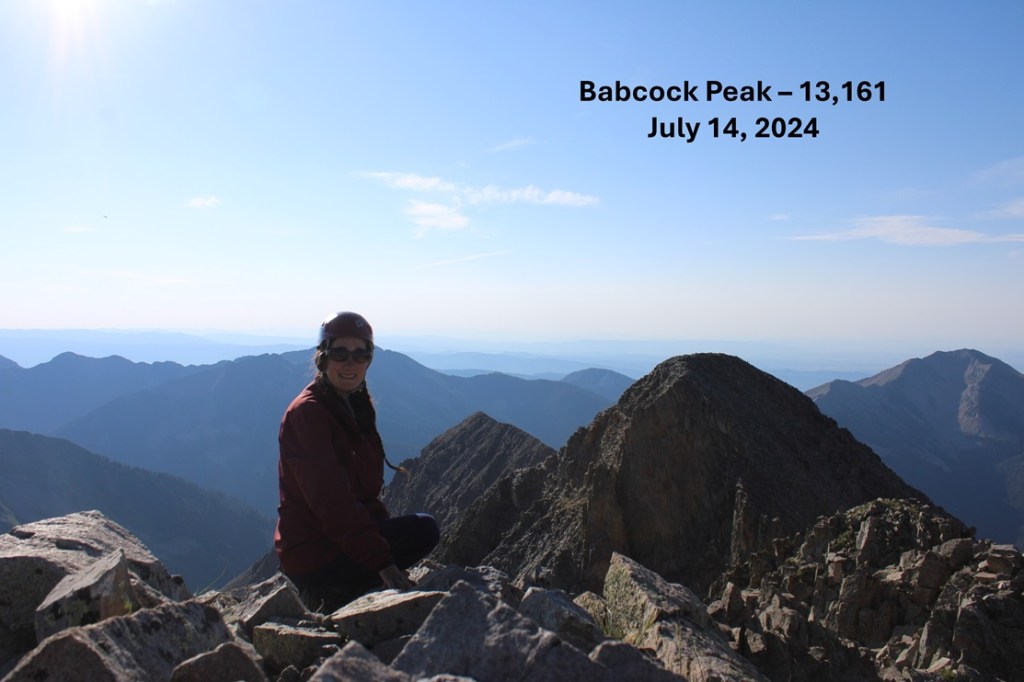
I summited Babcock Peak at 8am

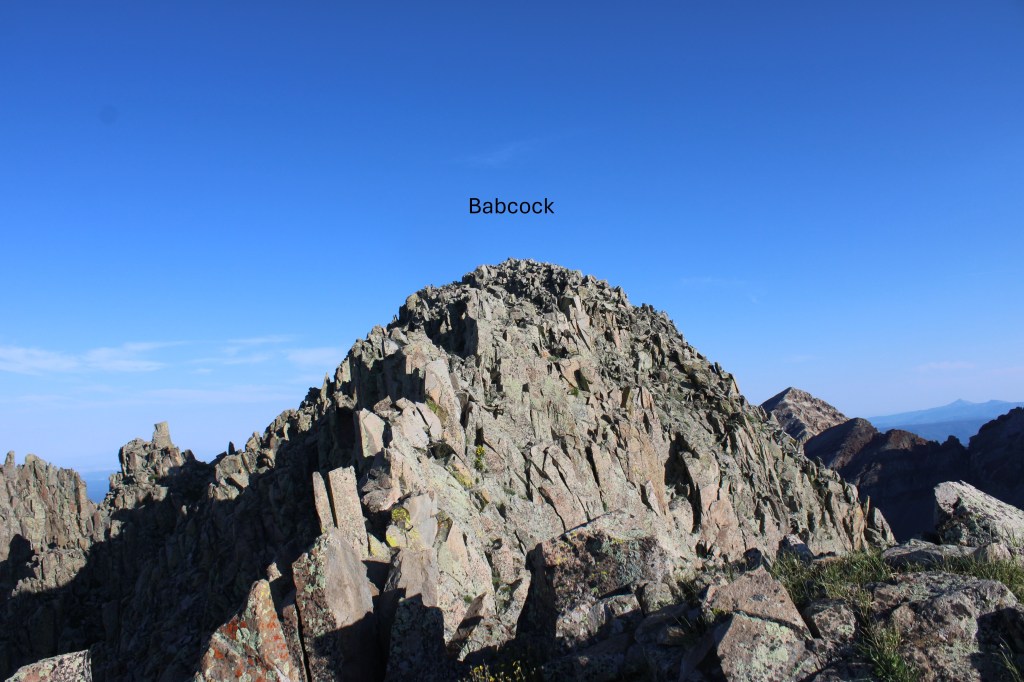
Babcock Peak:

Now to head back down. Here’s a picture of the ridge

And the one tricky section

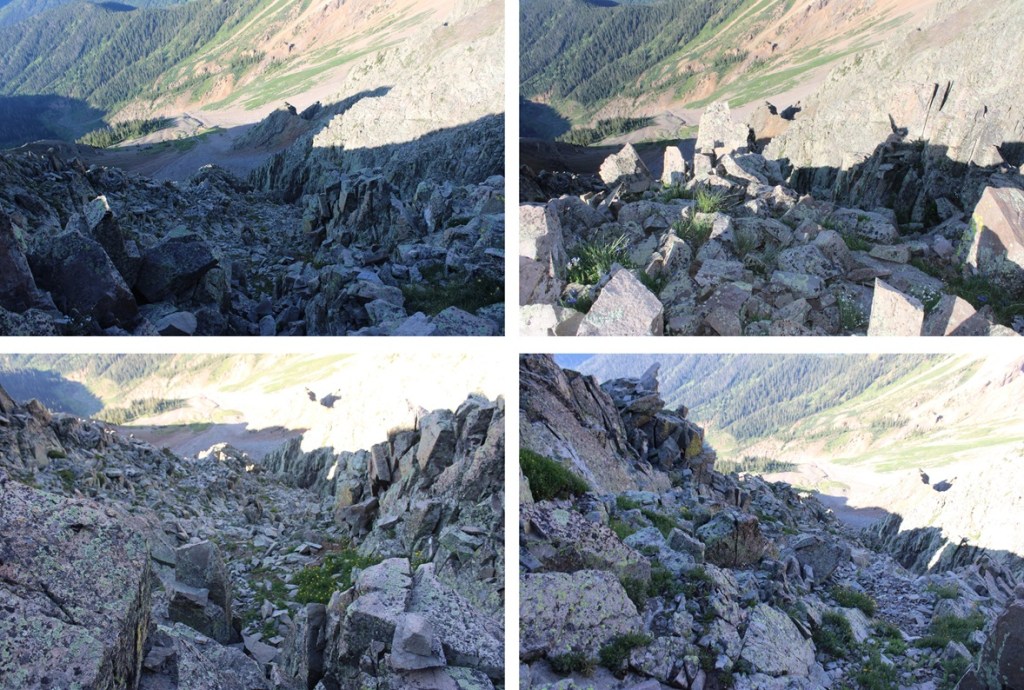
Now it was time to head back towards the gully.  Visuals are good here.  When heading down, keep moving to your left as you do so, making your way down to where the left and right gully meet up. 

Where the two gullies meet, I turned left and headed down the same gully I’d ascended.

And now, to descend the gully back to the 4WD road

Back on the road, I turned left and followed it southeast back to the trailhead.

I made it back to the trailhead at 10:30am, making this a 9.23 mile hike with 3868’ of elevation gain in 6 hours.

On to the next trailhead!
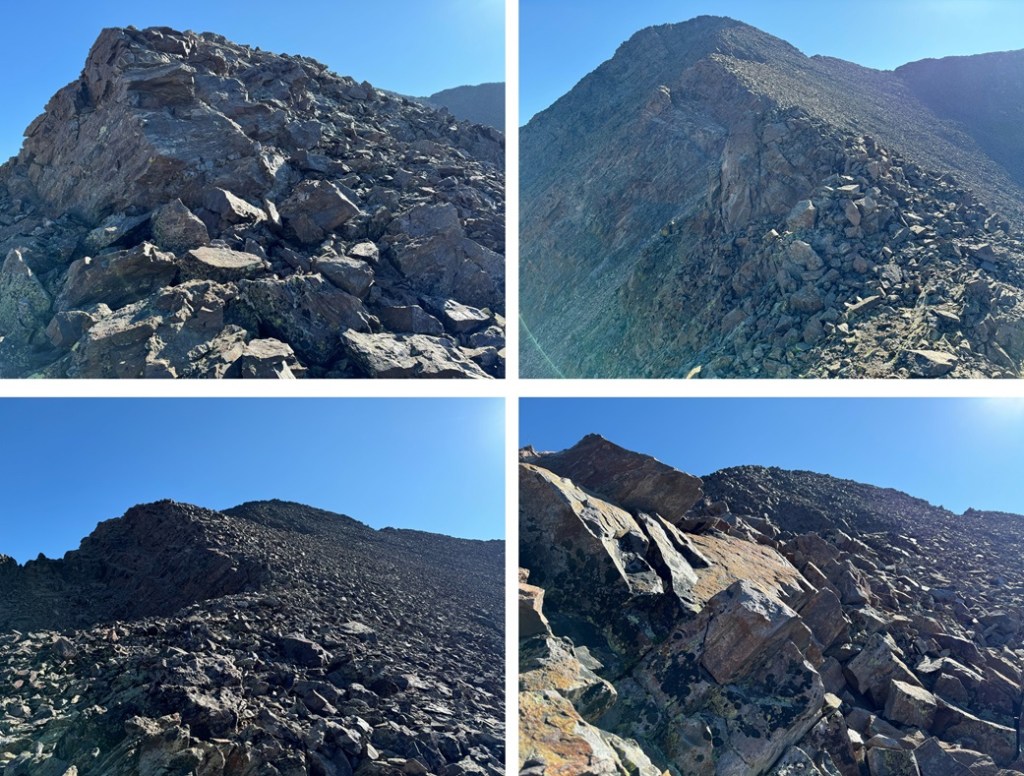
Mount Moss – 13,194 and Lavender Peak – 13,327

RT Length: 10.58 miles

Elevation Gain: 3604’

Once again, this wasn’t the peak I’d planned for today.  In fact, due to my carelessness with my new truck and forgetting to wrap the wires with rat tape, I had a 2am encounter with varmints and had to abandon a days worth of hiking (where I’d hoped to get in 5 ranked 13ers).  Not to bore you, but if you want to hear the story and see video footage, click here to find out what creature got stuck inside my truck, and the damage they did.  Also, rat tape your wires people.

So, after an 8 hour detour, I found myself at around 9800’, at the base of the Tomahawk Mine, parked off road 124 and 798 near Mancos.  I was up and on the trail at 6am

I followed road 798 for about 1.5 miles northwest.

After about 1.5 miles I came to a junction, and turned left.  You can continue on the road here, as it will eventually get you to the same place, but I wanted to see the Tomahawk Mine.  If you’d like to see the mine, turn left here, and follow the road.

The road will quickly end, but a trail will pick up to the right.  It will take you to Tomahawk Mine.

If you look closely, to the left of the mine is a trail that will lead you north, back to the 4WD road.

I turned left, and followed this road northeast until Little Kate Mine.

At the base of the mine, just as the road switchbacks to the right, I ascended a scree game trail northeast to treeline.  The trail is obvious, and splits and comes together a few times, but I generally headed towards treeline.

At treeline I headed west, towards Tomahawk Basin.  There’s kind of a trail here, but it’s really faint.

Now I needed to ascend into the upper basin.  There are several ways to do this (I went up a different way than I descended), but you basically want to get above the waterfall.  If you take the route I’ve outlined, there will be a faint game trail to the top, but you may need to search a bit to find it. 

I followed the creek as it headed west.  There is a faint game trail, but eventually it goes away.  Just keep heading west. 

Now in Tomahawk Basin, my next goal was to gain the ridge.  This was extremely steep.  I gained 665’ of elevation in .3 miles.  Luckily, the terrain was easy to navigate.  Here’s the route I took.

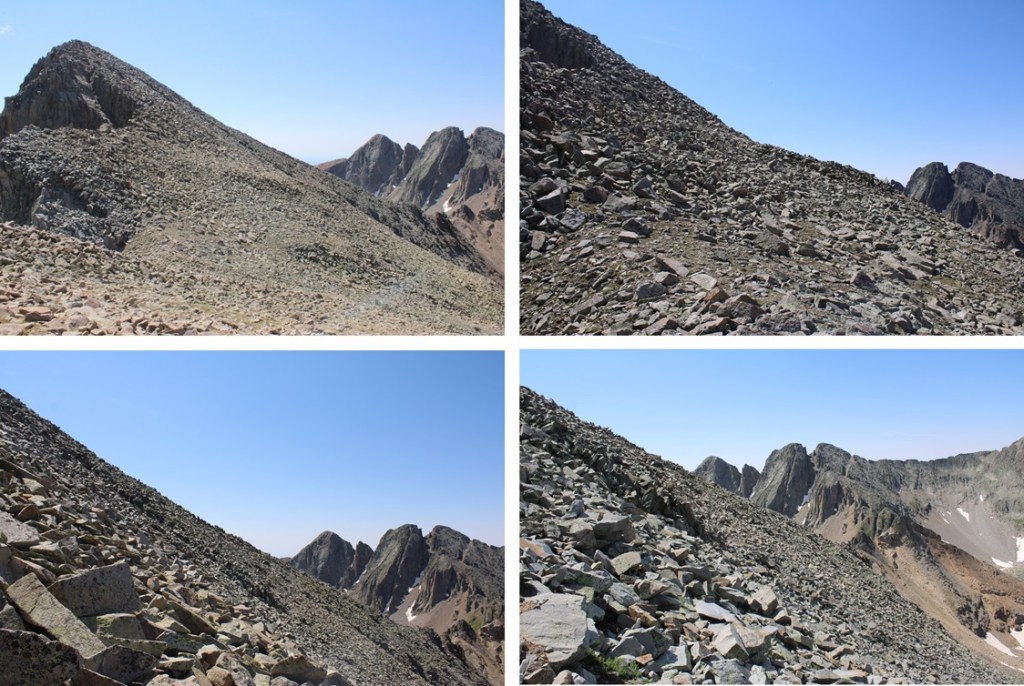
And some pictures of the hike to gain the ridge, staying mostly on tundra.

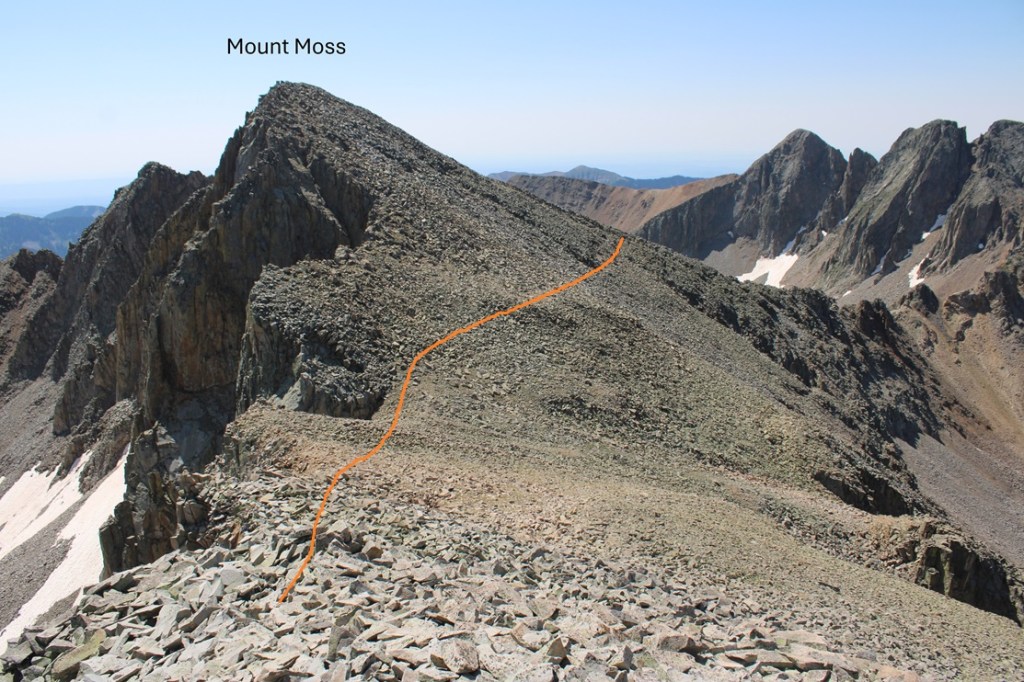
Once on the ridge I took a little break and put on my helmet.  There was a short class 3 section and some scrambling to do from here on out.  I headed north, following the ridge and then dipping down to the left.  It should be noted the ridge goes at class 3 most of the way, after the initial drop off to the left and re-gaining the ridge, but to make it easier there are game trails to the left of the ridge that I followed most of the time.   It should also be noted the rocks here are loose, so watch your footing.

I summited Mount Moss at 9:30am

Mount Moss:

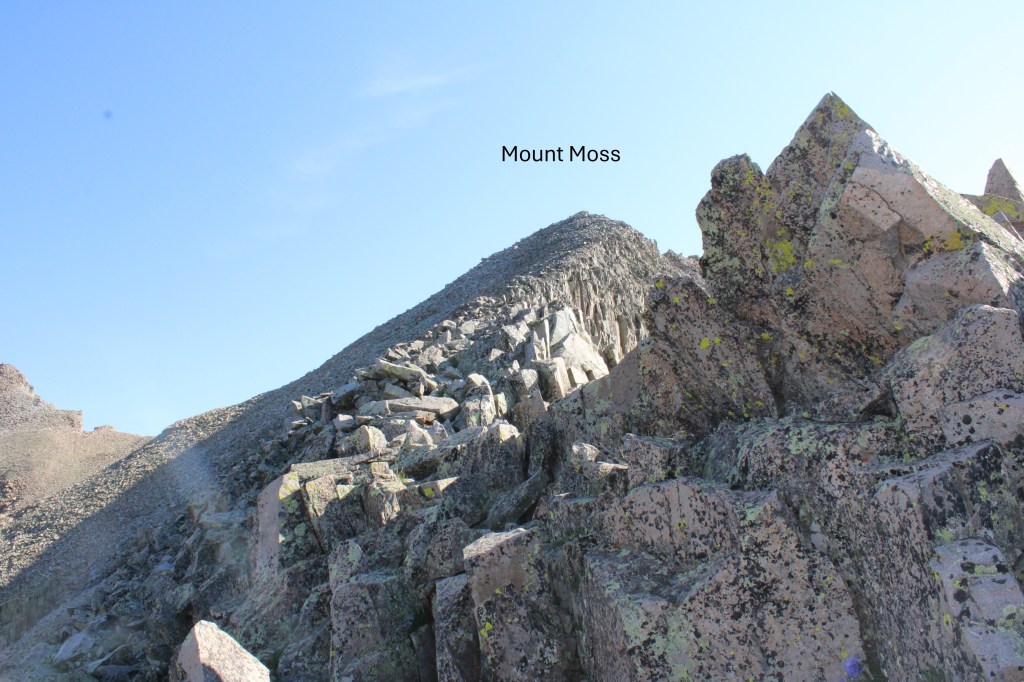
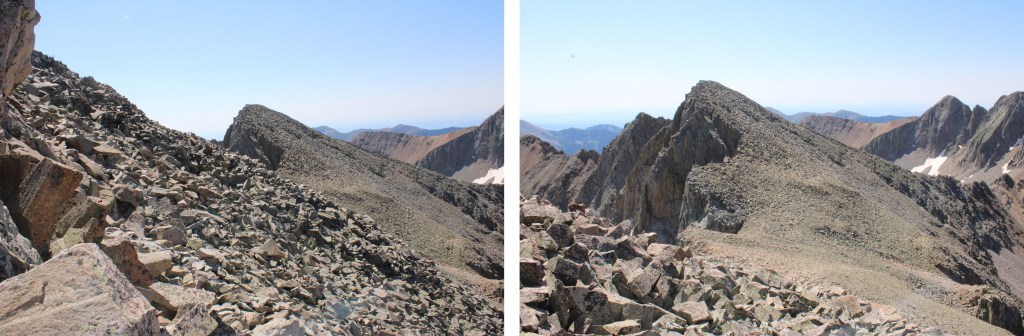
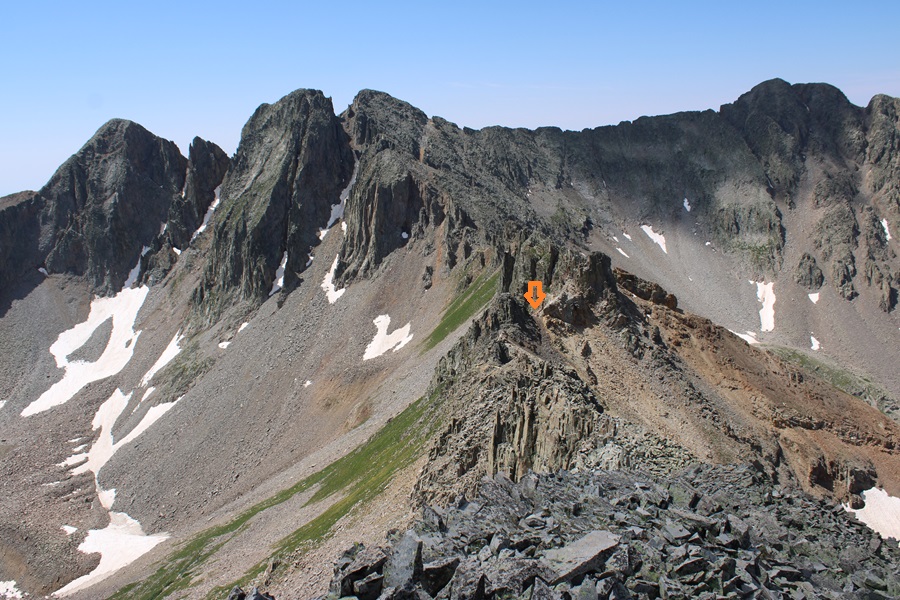
From Mount Moss I could see Lavender Peak to the northeast

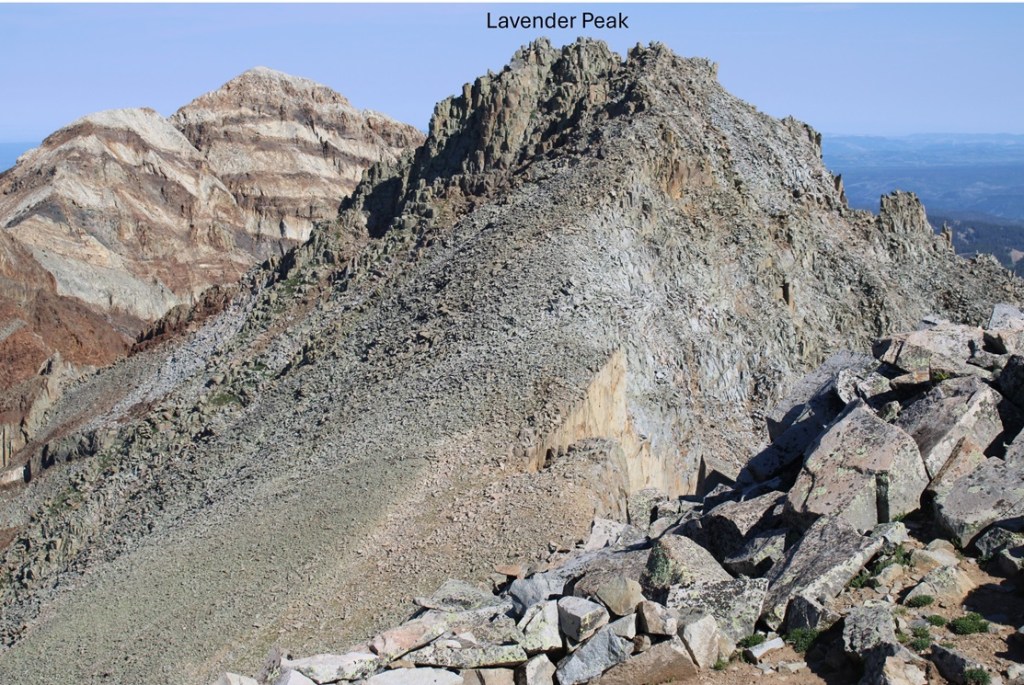
It’s a really good idea to take a good look at the route you’d like to take now, as when you’re below the summit it can be difficult to figure out where you’re at.  The summit of Lavender is the point furthest west.  This is the route I took to the summit, which was mostly class 3, but included a class 4 chimney.

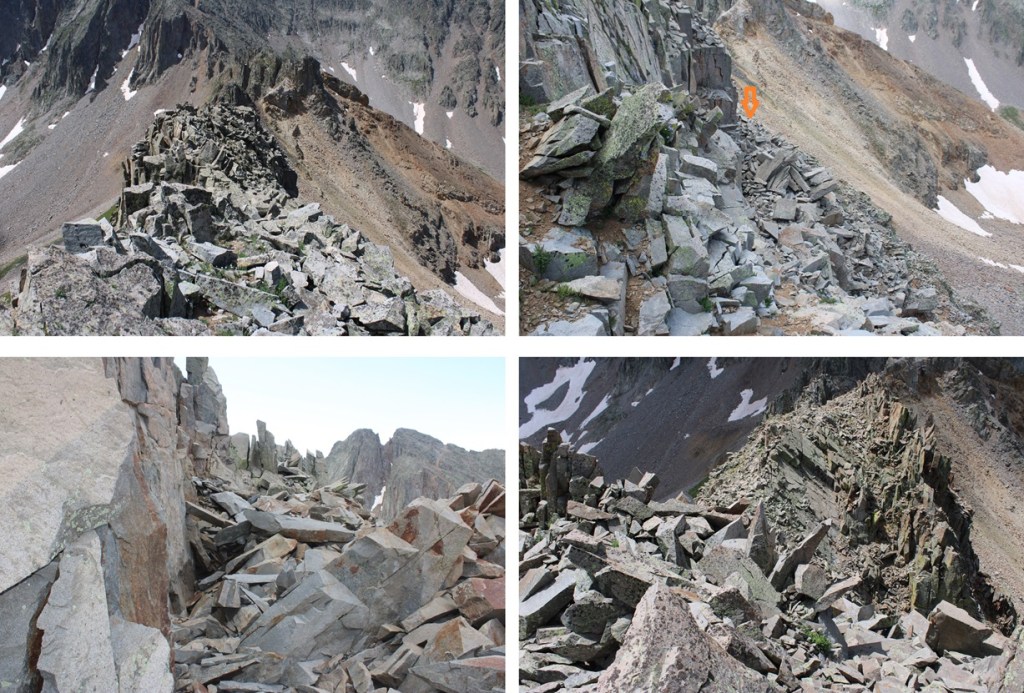
First, I descended to the Moss/Lavender saddle.  Once again, lots of large, loose rocks.

From the saddle, I ascend the ridge to Lavender to just below the gullies, at around 13125’

Next, I traversed west, looking for the gully I wanted to ascend. 

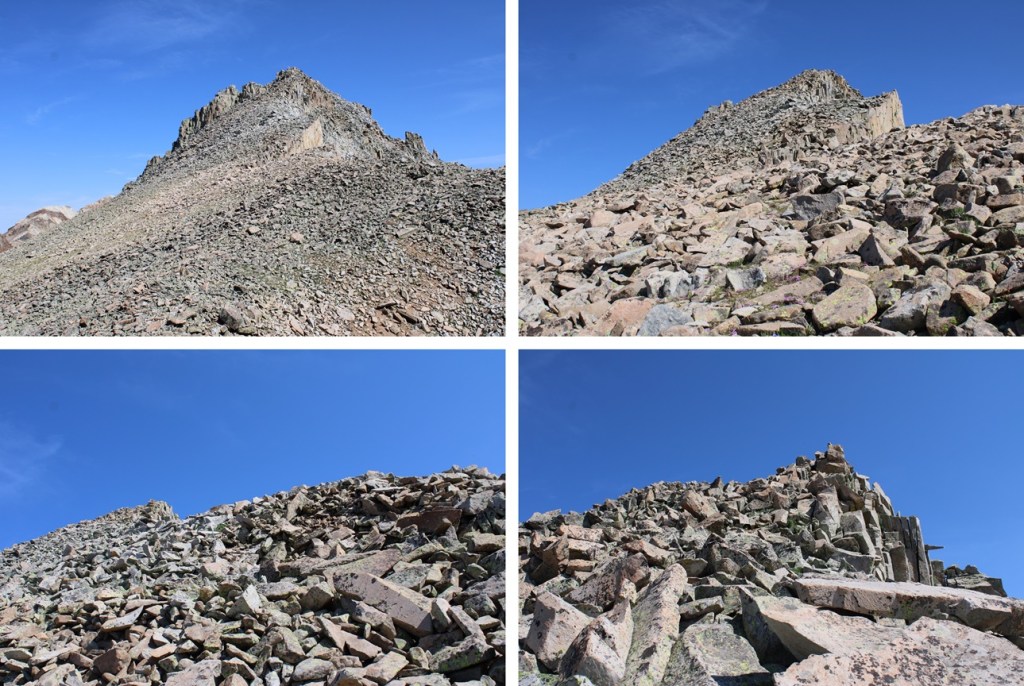
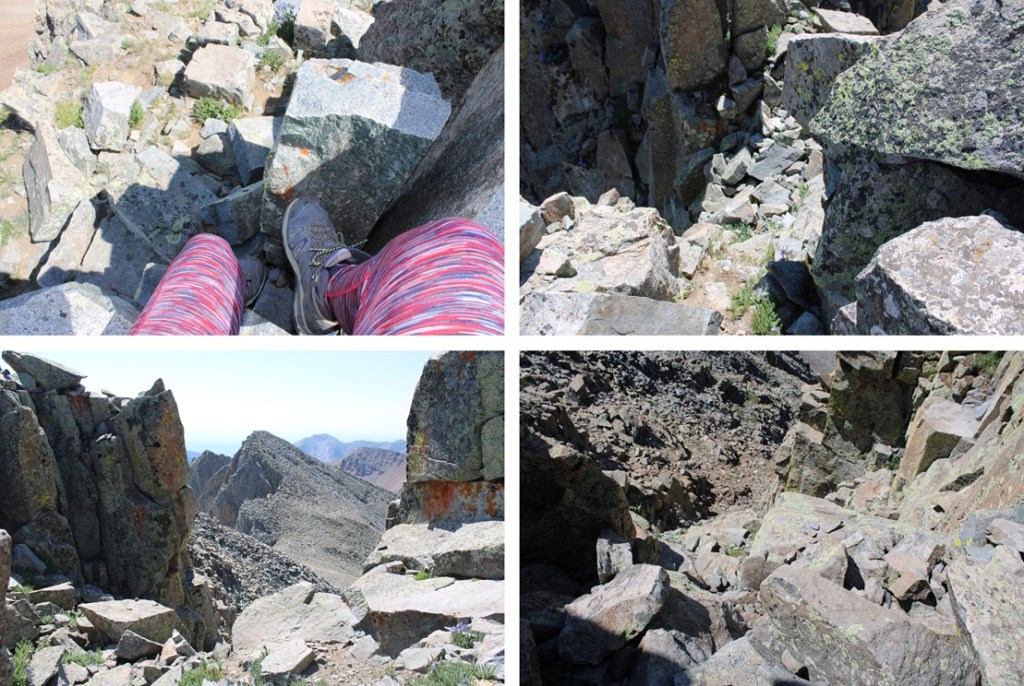
This is the route I took to ascend the gully.  There’s a difficult 3/easy 4 chimney to ascend, just below a cool looking cave.  Ascend straight up to the cave, to right around the cave, and the summit will be to the left. 

And some pictures up the gully.

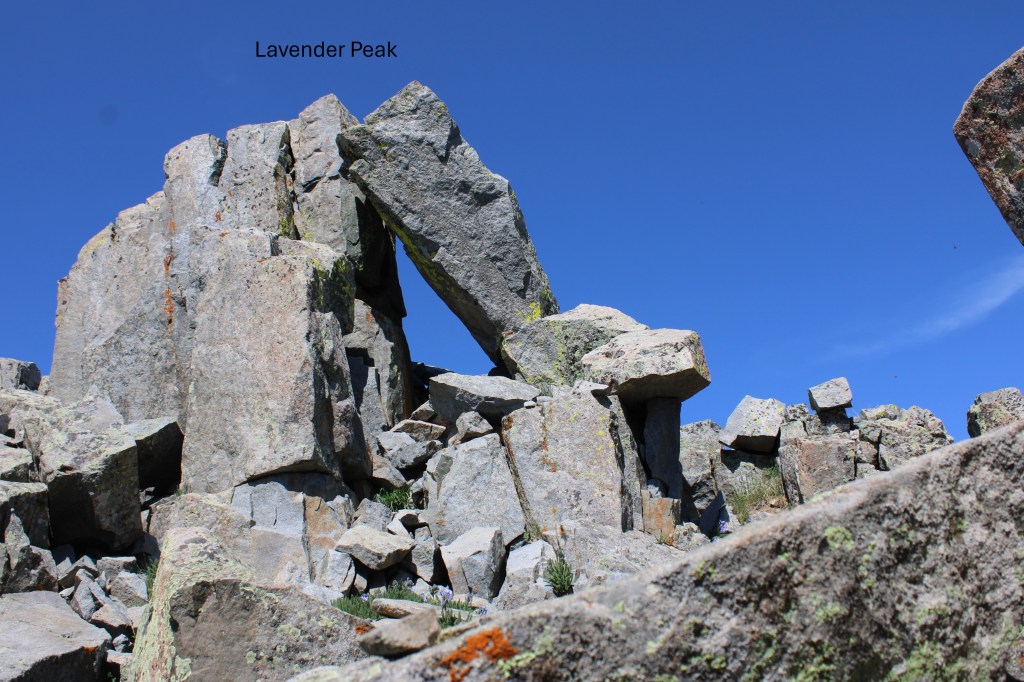
Once you get past the cave, the summit is to your left

It’s an easy trek to get there, up a small ramp

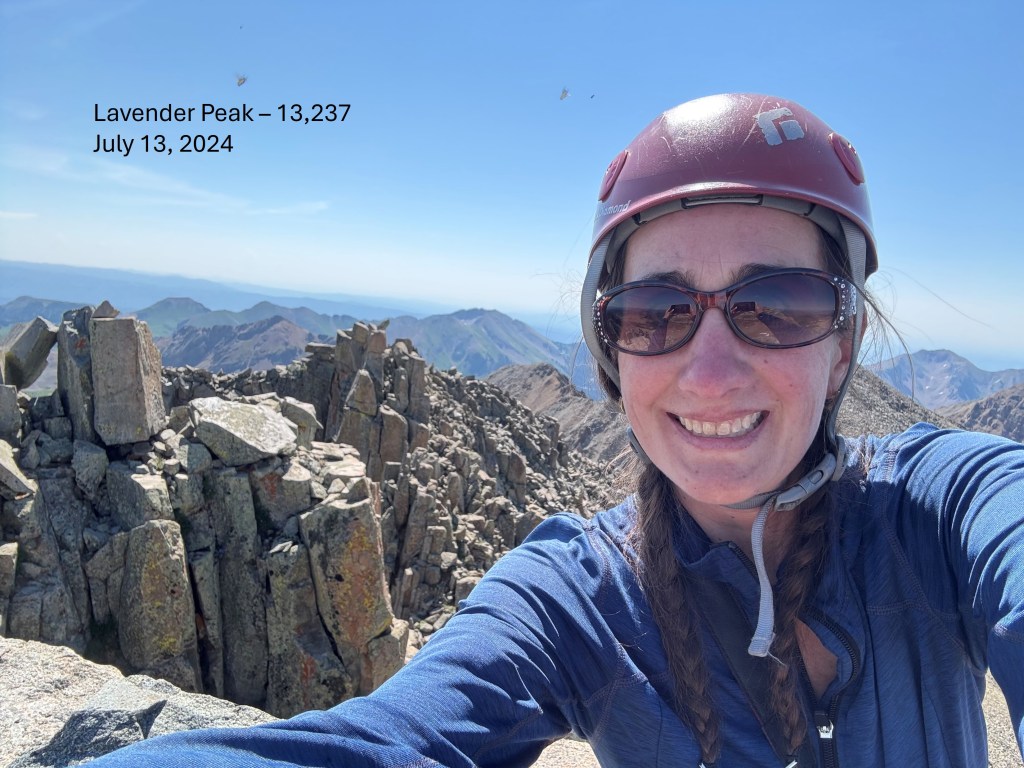
I summited Lavender Peak at 10:45am

Lavender Peak:

And now to head back down.  Here are some pictures of my way back down the gully.  I turned and faced the mountain for much of the trek down.

Safely down the gully, I made my way back to the Moss/Lavender saddle

Having no desire to summit Mount Moss again, I decided to traverse below the summit, staying at around 12900’ to get to the ridge

Once on the ridge, I followed it south to my entry point

And then back down into Tomahawk Basin

I made my way back to the scree trail

Then followed it back down to the 4WD road.

I followed the road a little more than 2 miles back down to the trailhead

I made it back to the trailhead at 1:30pm, making this a 10.58 mile hike with 3604’ of elevation gain in 7.5 hours

On to the next trailhead!

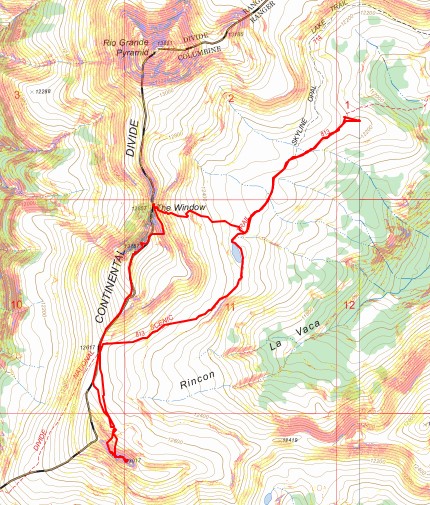
PT 13022 and Window Peak – 13,158’

RT Length (from basecamp): 1471’

Elevation Gain (from basecamp): 6.88 miles

Note: there’s a long approach for these peaks, so I decided to make this a backpacking trip.  I found a great basecamp for the Rio Grande Pyramid 13ers (and others).  The approach is about 10 miles and 3100’ of elevation gain, coming from Thirtymile Campground.  The approach can be found here.

I’d hiked up to 12210’ the day before, summited some peaks, and spent the night at my camping spot, so I was able to get up early and refreshed the next morning to hit the trail at 5:30am. 

This time, I was heading southwest on the Continental Divide Trail. 

This trail was easy to follow, and well established.  I followed it for just under 2.5 miles to the saddle of 13022 and Window Peak.

From the saddle I turned left and headed towards PT 13022.  I did not follow the saddle, but instead cut across to the rocky basin.

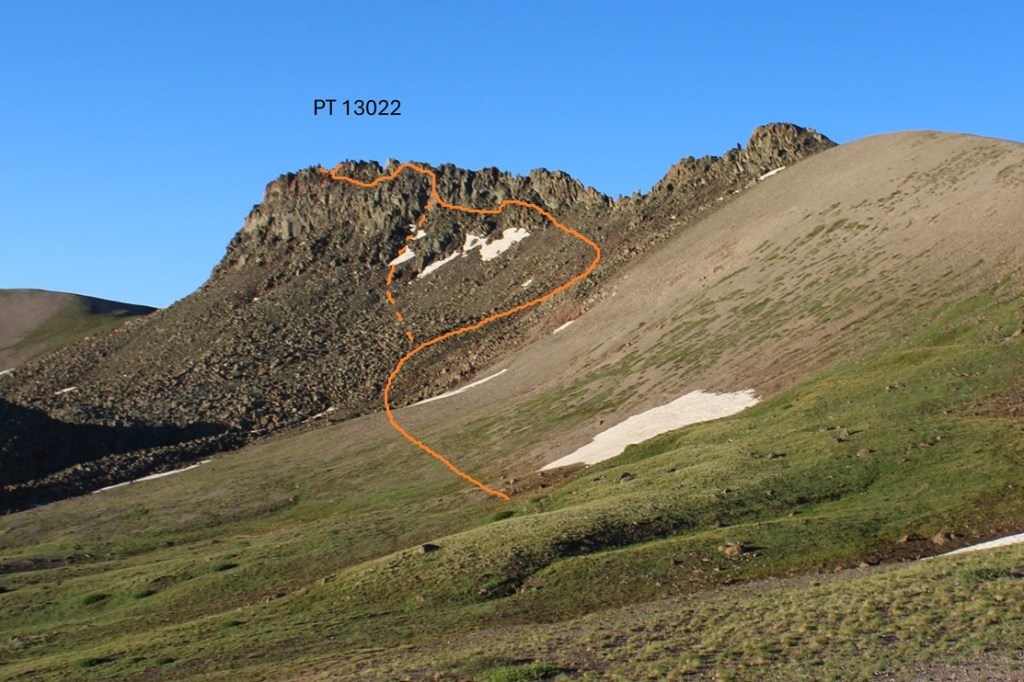
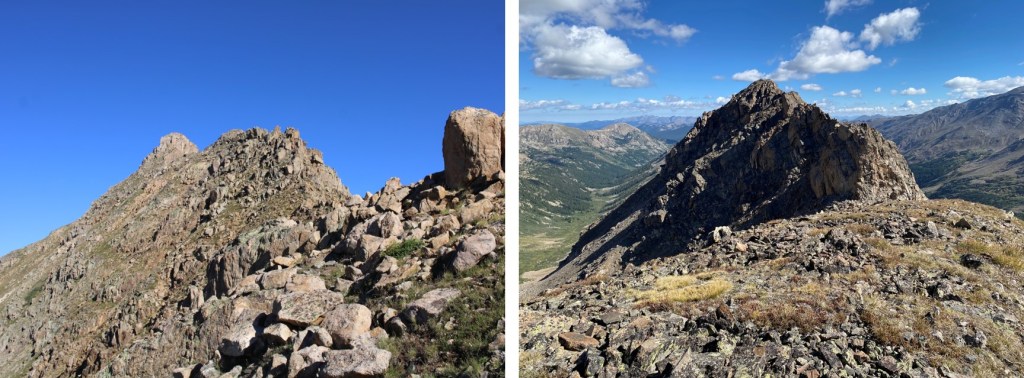
There wasn’t a trail here to the summit, and it looks like a viable route changes from season to season due to rockslides, etc.  This is the basic route I took to the summit, and back down.  The solid line is the route I took up, the dotted line is the route I took down.  I’d recommend taking the route I took down both ways.  The climbing here was class 4.  In fact, I saw a (very old) anchor set up along my route, so people at one point at least used ropes to descend.

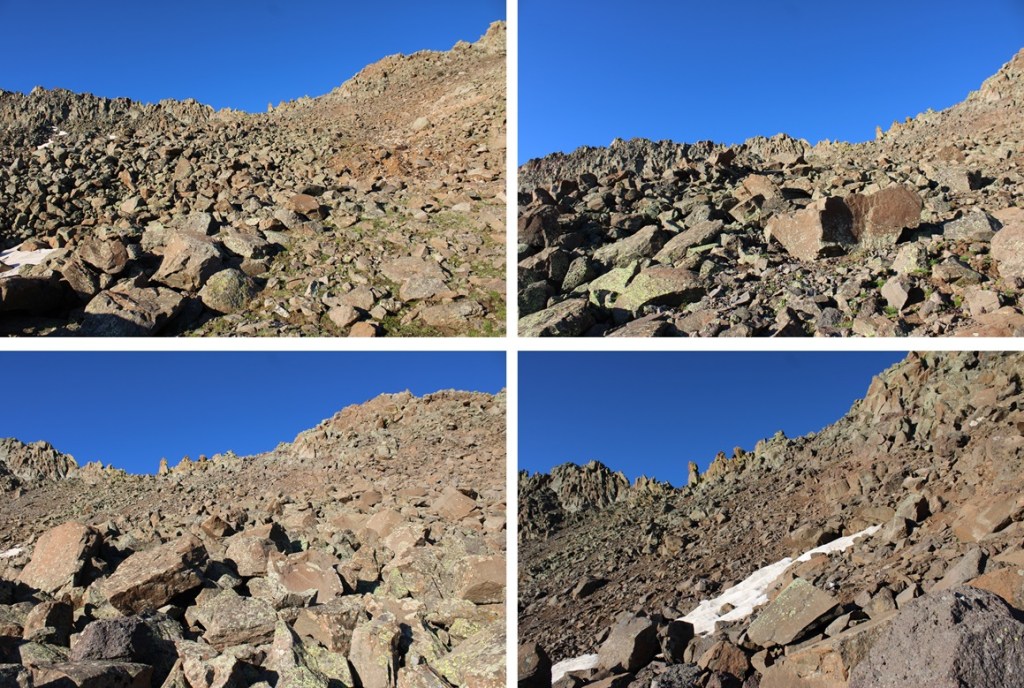
First, I made my way up the rocky basin.

Then I headed towards and up this rocky ramp

At the top of the ramp is where it really got interesting.  There were a few cairns here, but as I said earlier, it looks as if the route changes.  I scrambled my way up to the ridge, had about 20 feet of ridge climbing, then had to descend to find a viable route east.

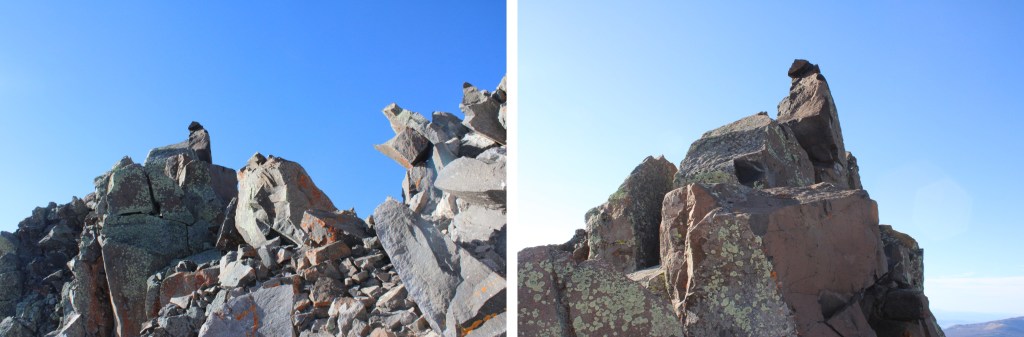
Ahead of me there was a rock perched atop a spire that looked like a cairn, and I assumed this was the summit.  Here is where I was aiming. 

I did my best to follow game trails and cairns where I could find them, staying below the ridge, doing my best not to fall down the loose gullies, making my way east.  Yes, there were times I had to crawl around rocks with serious exposure to avoid climbing the ridge.  I did not feel the ridge ‘went’.

Here’s that anchor I was talking about

I kept aiming for the cairn

I made it to the cairn, scrambling up some class 4 rock to get there, sat and took a video. 

I turned and looked to the west, and it seemed as if the point just a few yards away was higher, so I scrambled my way over there as well. 

When I got there, I found a summit register (which I couldn’t open) so I’m guessing it’s the true summit, although both points looked to be of equal height.

I summited PT 13022 at 7:30am

PT 13022:

Now to make my way down. On my climb up I had a better view of the mountain, and found a gully I thought looked safer to descend.  I downclimbed from my perch and started out by heading back the same way I’d summited, west.

Hey look!  A cairn!

Just for perspective, here’s a photo of where I left my trekking pole.  I scrambled around this rock to get back there.  If you look closely, you can see a cairn on the rock to the left of the trekking pole.  This was the crux of the route for me, both in and out.

I continued west, found a gully that looked stable-adjacent, and headed down.

Here’s looking back up at the gully I descended

And now to head back down the rocky basin and make my way back to the saddle with Window Peak.

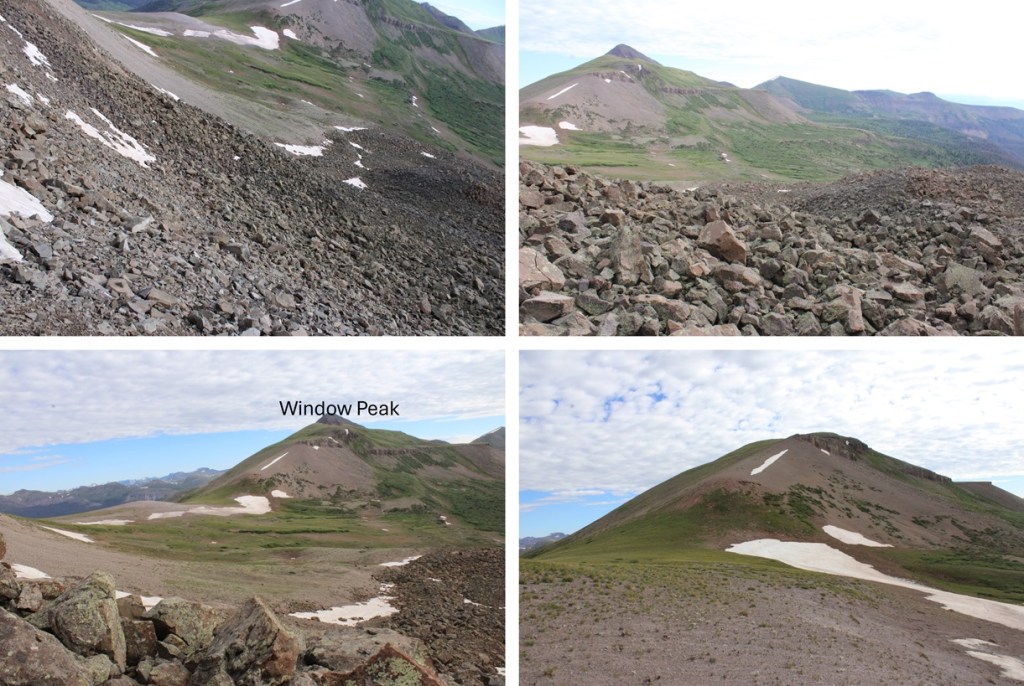
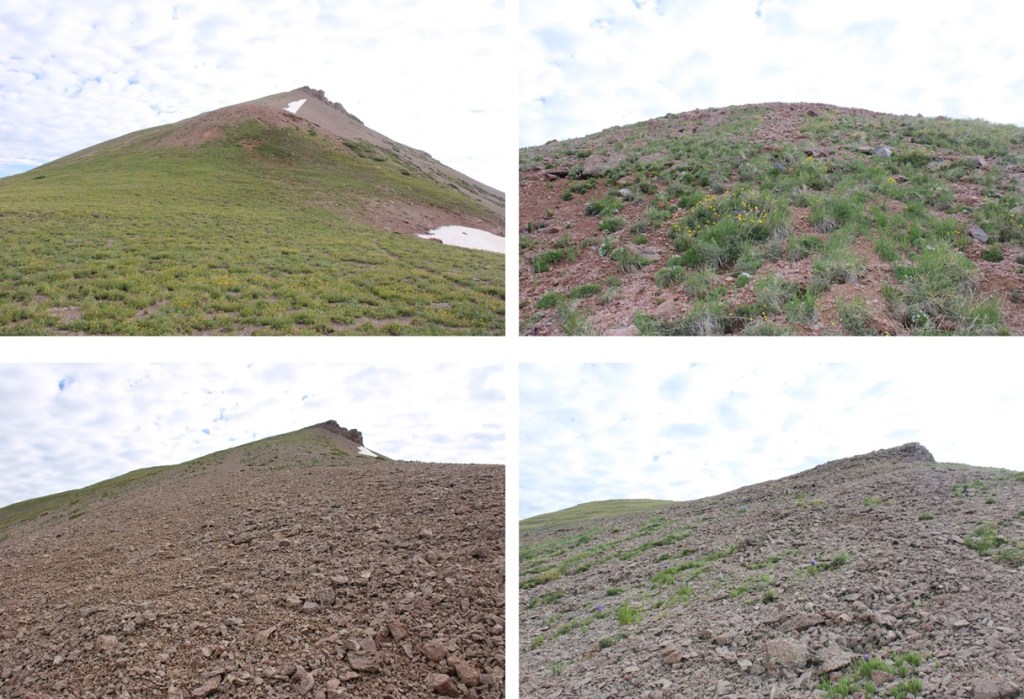
Window Peak isn’t ranked, but I needed an easy win, so I headed north, and followed the grassy slopes, which changed to rocky slopes, to the summit of Window Peak

There was a bit of a false summit here, so I just kept following the ridge

There were also some pretty cool rock formations along the way

I summited Window Peak at 8:50am

Window Peak:

I wanted to hike to the actual window, so I continued north along the ridge, descended a grassy gully until I was at 12900’, and then traversed north to The Window.

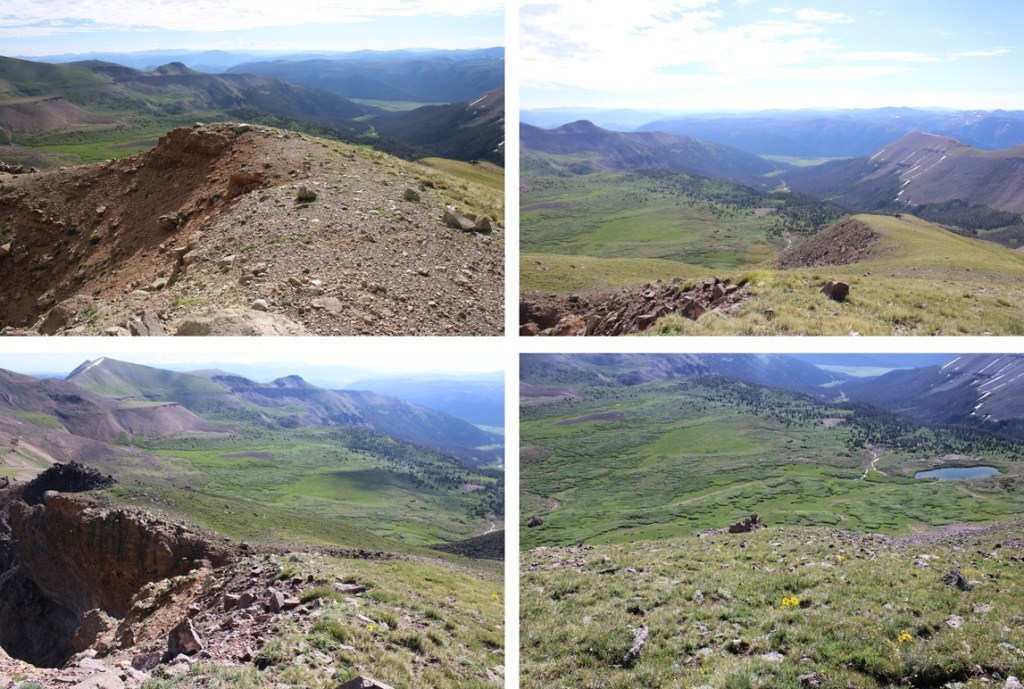
Now to head back to my campsite.  This was actually fairly easy.  There was a solid trail that descended from The Window, which eventually went away.  I followed the trail as far as I could, then just aimed east for the Continental Divide Trail, which I could see located by the pond in the distance.

Here’s a view of Window Peak

And my route back to the trail

Back on the Continental Divide Trail, I followed it northeast back to my campsite.

I made it back to my campsite at 9:45am.  This was a 6.88 mile hike with 1471’ of elevation gain from my campsite at 12210’.

On to the next trailhead!
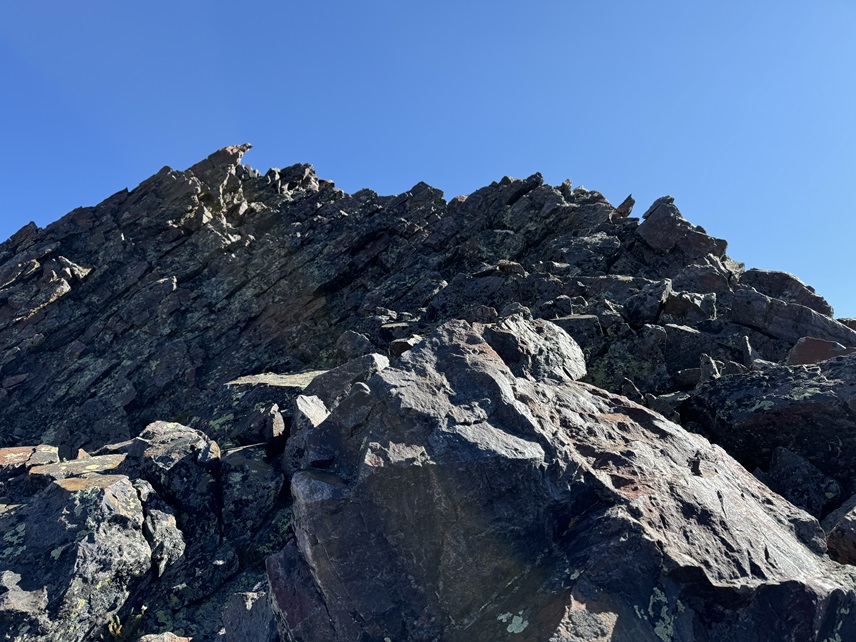
PT 13220 and PT 13291

RT Length: 11.89 miles

Elevation Gain: 3560’

Full disclosure, I did these peaks in two days.  The first day I got thunder stormed out just before the access gully of PT 13291, and had to turn around.  I came back 2 days later to finish the summit.

I stayed overnight at the North Fork Lake Creek Trailhead, and was on the trail at 5am the next morning.   The parking area has room for about 15 vehicles if everyone parks nicely, as well as some overflow spots on the short drive in.

The trail starts at the north end of the parking area, close to a locked gate.  It’s trail number 1483.

I followed this class 1 trail for 3 miles north into the basin

When I came to a creek, I crossed it and turned left. 

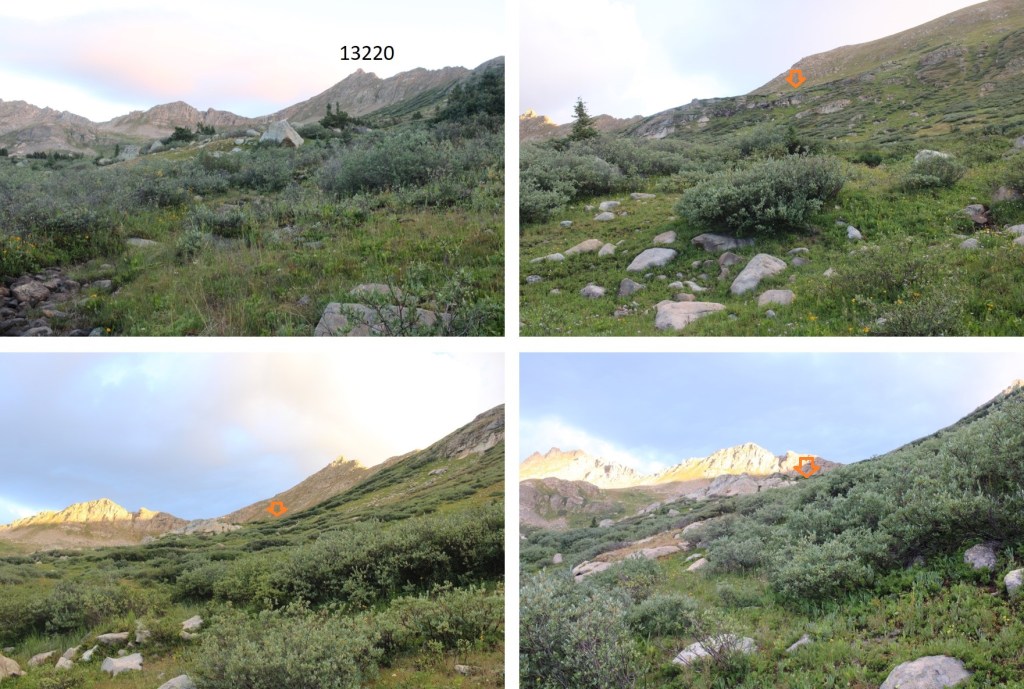
Here there is a faint trail for a few yards, and then it fades out.  I headed northwest into the upper basin.

Here’s an overall view of my route to the ridge

While there was no trail in the basin, I was easily able to follow dried up creek beds through the willows.  Staying on the dry rocks kept me mostly away from the willows, and became a great path to follow.

Once I got past the willows, I aimed for the ridge.  Specifically, this boulder first.

After making it to the boulder, a game trail picked up and took me to the ridge

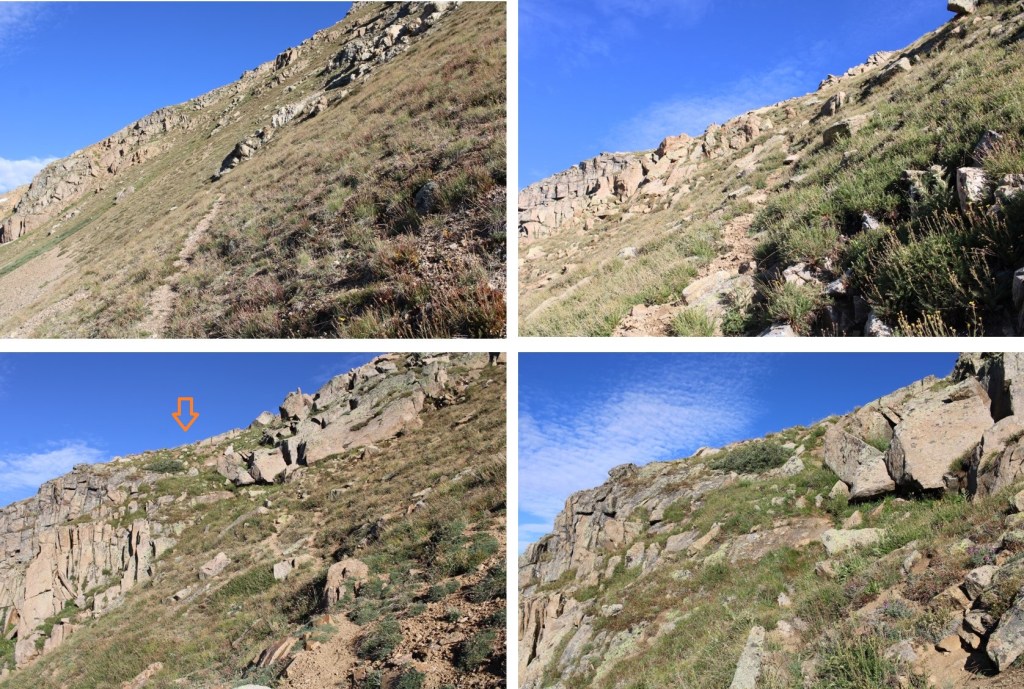
Once making it to the ridge, I turned right, and followed it northeast to the summit.  This was all class 2.

Here are some pictures of this short ridge

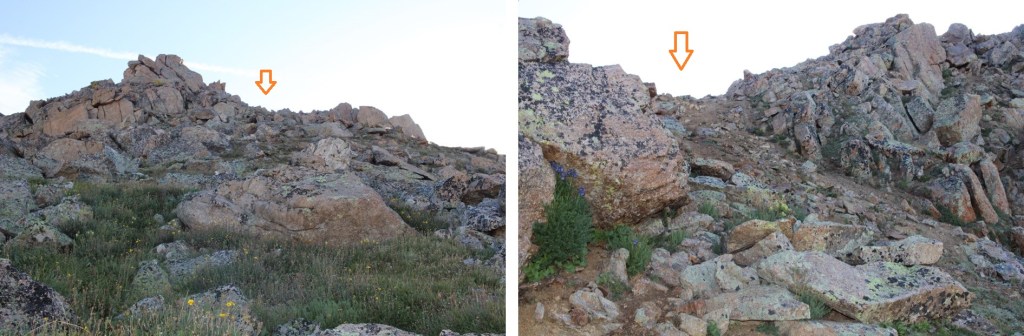
 I turned right at the top of the small gully, and walked to the summit

I summited PT 13220 at 7:45am

PT 13320:

PT 13291 was to the northeast, but to get there I was going to retrace my steps down the ridge first.  I headed back to the ridge.

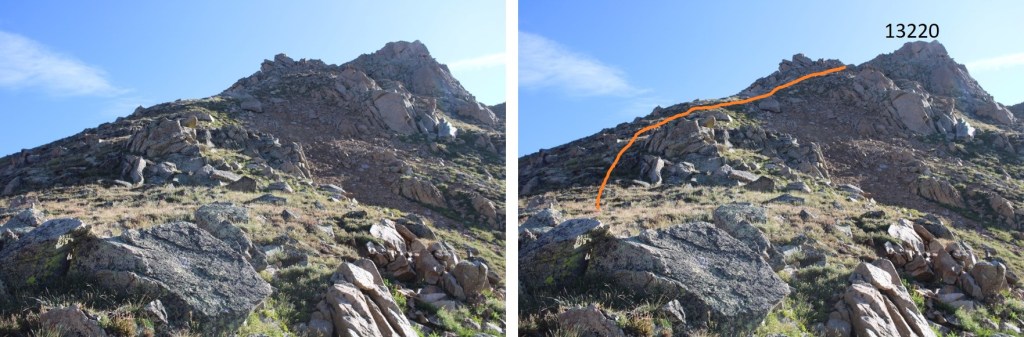
I picked up the game trail again, and skirted the rocky section that was on my left, and re-gained the ridge on a grassy slope.  Here’s my overall route

Once on the ridge again, I skirted this rocky section to the right.  Resist the temptation to ascend any higher until you get to the tundra and it will stay class 2.  Otherwise, you can go up the rocks at any point for some class 3 or 4 fun.

Now it was a class 2 stroll along the ridge as I headed east.

When I got to this point I put on my microspikes, turned right, and dropped down to navigate the formations.  This was class 2+, but the loose scree and exposure added a layer of fun.

This was my next obstacle.  My first thought was to go right up the center of the gully, but I ended up scouting around and found it was much easier, and still class 2, to skirt around and gain the ridge from the right side.

Back on rocky tundra, I now followed the ridge direct north.  This was all class 2.

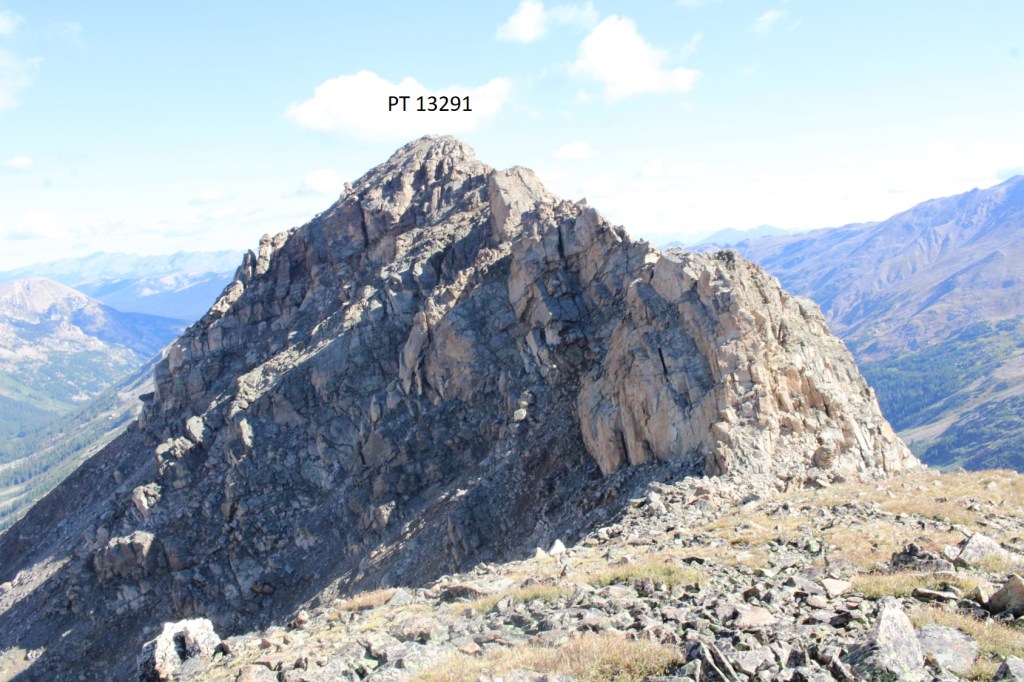
At the top of the ridge I got my first good view of PT 13291.  Unfortunately, the first day I was here I had to stop at this point due to time constraints and an impending thunderstorm.  It sucked to turn around, but it was something I had to do. 

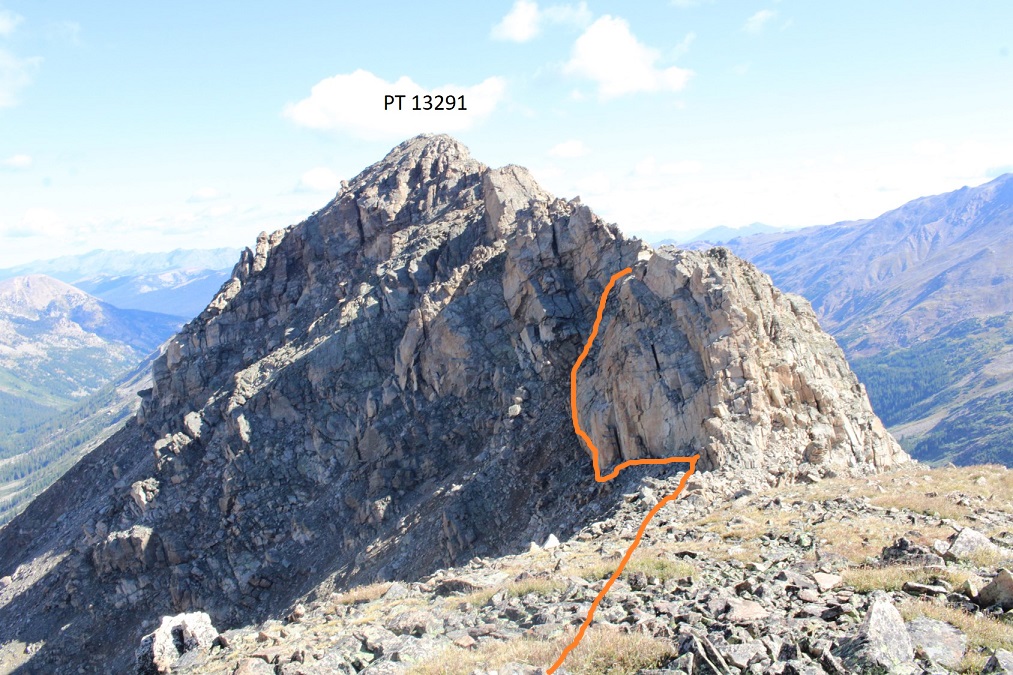
The next time I was here, two days later, this is the overall route I took to get past the steep rock in front of me.  Also, this is a good time to put on your helmet if you haven’t already done so. 

This looks loose and fraught with exposure, but the route is actually pretty solid and wider than it looks from a distance.  I started out rock-hoping on stable boulders, then descended west about 100 feet, staying as close as I could to the rock wall, to the base of a gully

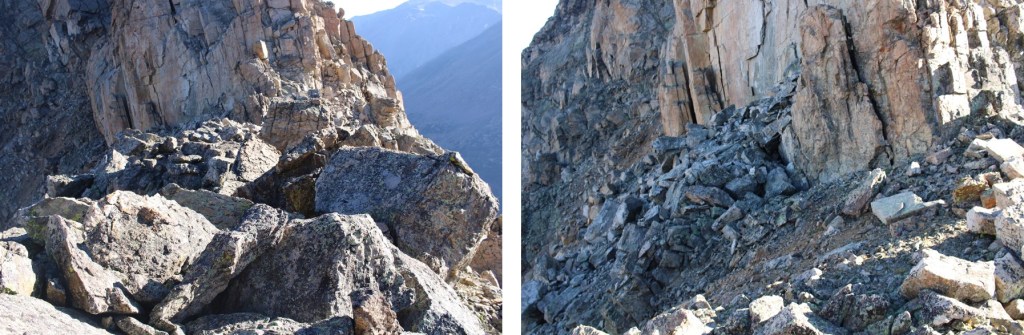
At the base of the gully, I turned right and ascended the 100-foot gully.  Climbers left was extremely loose, but the right side was steep but stable rock.  I chose to stay on the stable rock.  There is a cairn (circled) at the base of the gully, indicating where to ascend.

Here’s a view from 13220 of the gully I went up to access 13291.

Now for the fun part!  It was time to scale the east side to the summit.  This is choose your own adventure.  I stayed on the east side the entire time.  The ridge proper looks like it goes at class 4.  I stayed more to the east while climbing.

This is the overall route I took, dropping down about 25 feet, aiming for a break in the rocks, and then heading up the east side, keeping it mostly class 3, but once again, it’s choose your own adventure.

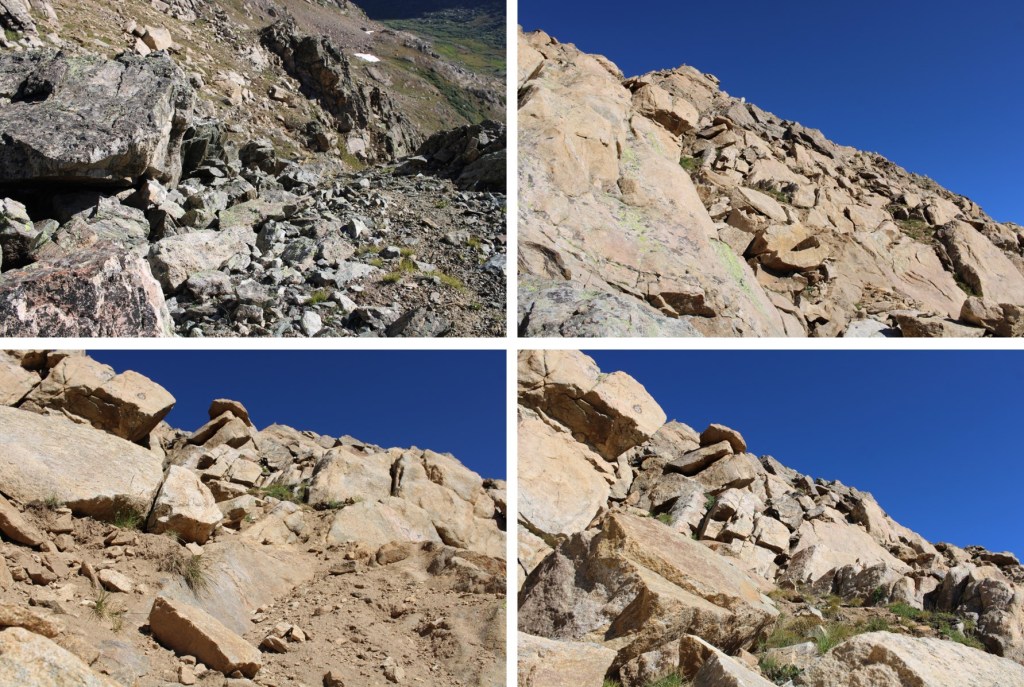
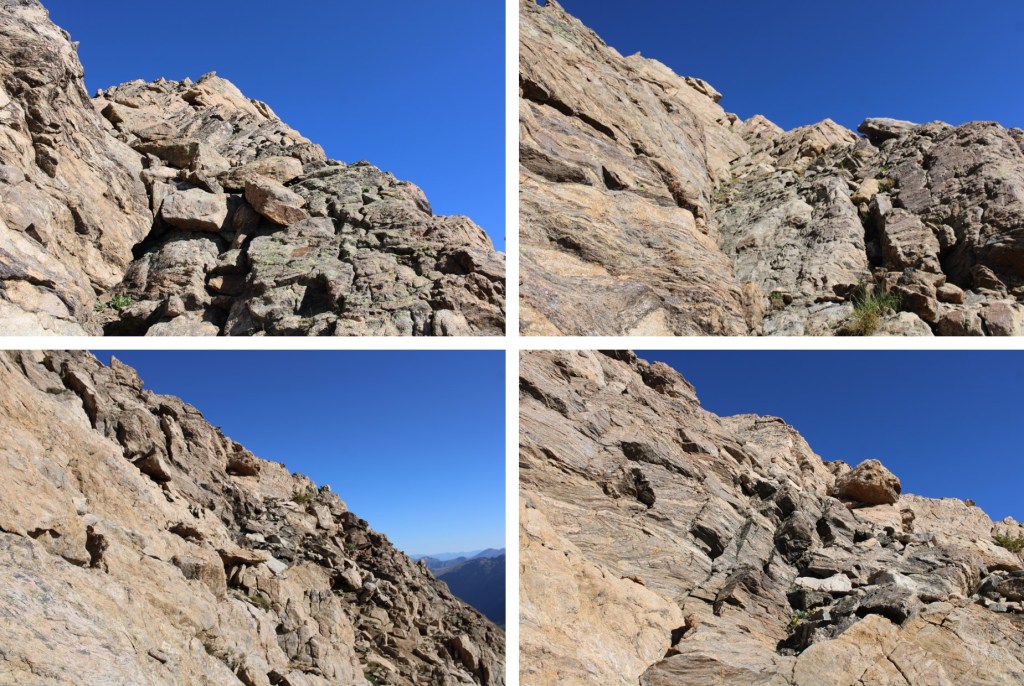
Here are some pictures of the terrain to the summit.  I dropped my pack to make for easier climbing.  It also made it easier to find my way back, as I just aimed for my pack below.

Now the summit was in sight.  There was a short class 4 chimney to climb with solid hand/footholds.

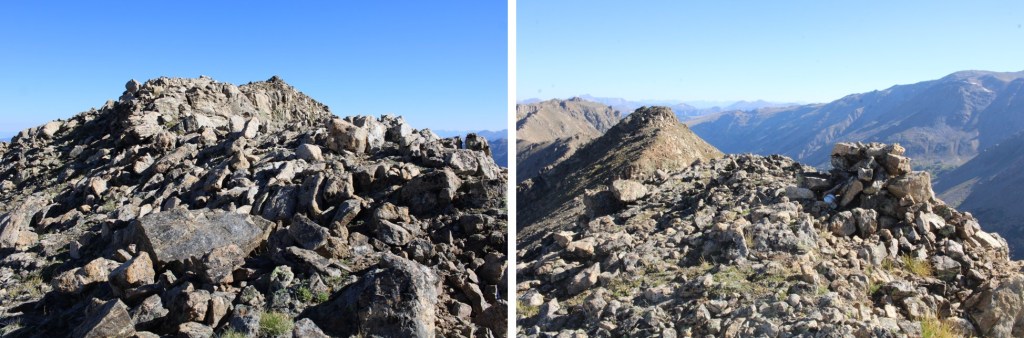
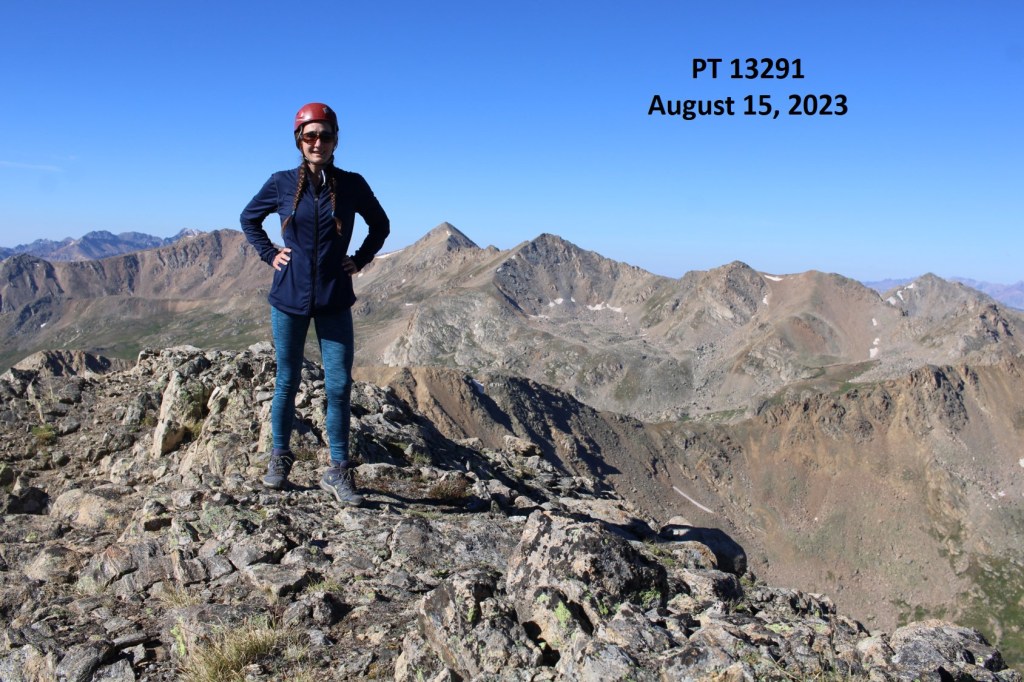
And then a rocky walk to the summit.  There was a summit register, but it was closed so tight I couldn’t open it.

PT 13291

Now to head back down.  I descended the chimney, and headed back towards my pack. 

Then it was up to the gully, down the gully, and around the west side to head back to the saddle. 

Back up to the ridge

And then I followed the ridge, descending it to the left, and curving around the south side.  It’s a good idea to have your microspikes on for this part. It’s class 2+, but the rocks are loose and the angle is steep.

I followed the ridge until I made it to just before where I’d accessed the gully from 13220.  Instead of heading down that way, I descended south into the basin below.  This was the same way I’d ascended earlier that morning.  This would be a good option if just doing 13291. It’s class 2, and led me into the basin.  I aimed for the thinnest section of rock below. The entire time I was hiking down, I was looking for the dry creeks that led me in, knowing they’d eventually bring me back to the creek crossing and the trail.  They were easy to spot from above.

Once in the basin, I followed the dry creeks to the trail

Here’s a look back on my route down from the ridge (and how I hiked in that morning). Taking the dry creeks keeps you away from most of the willows.

Back on the trail, I followed it south back towards the trailhead

Doing the math by combing my two days of hiking, the total for the route in one day should be about 11.89 miles with 3560’ of elevation gain.

On to the next trailhead!
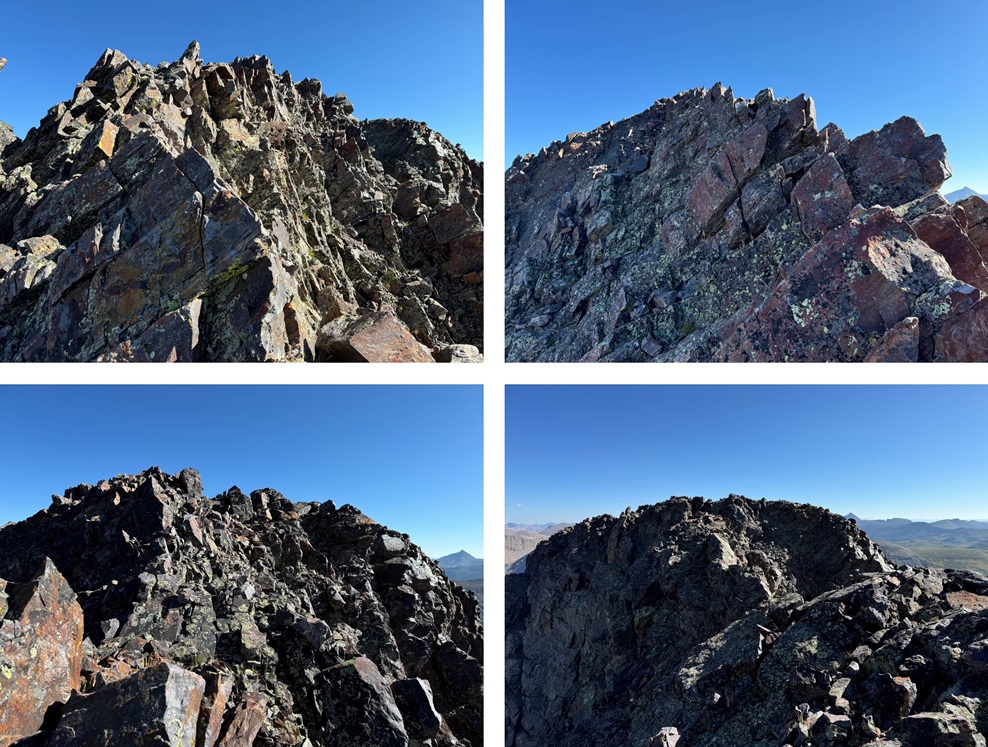
Hilliard Peak – 13,422 and Keefe Peak – 13,516

RT Length: 24.35 miles

Elevation Gain: 5700’

Due to weather issues, I did this as a multi-day trip. Due to permit issues, I camped just before the camping permit boundary for Conundrum Hot Springs (worked fabulously!!!). My stats are taken from several GPX files meshed together.

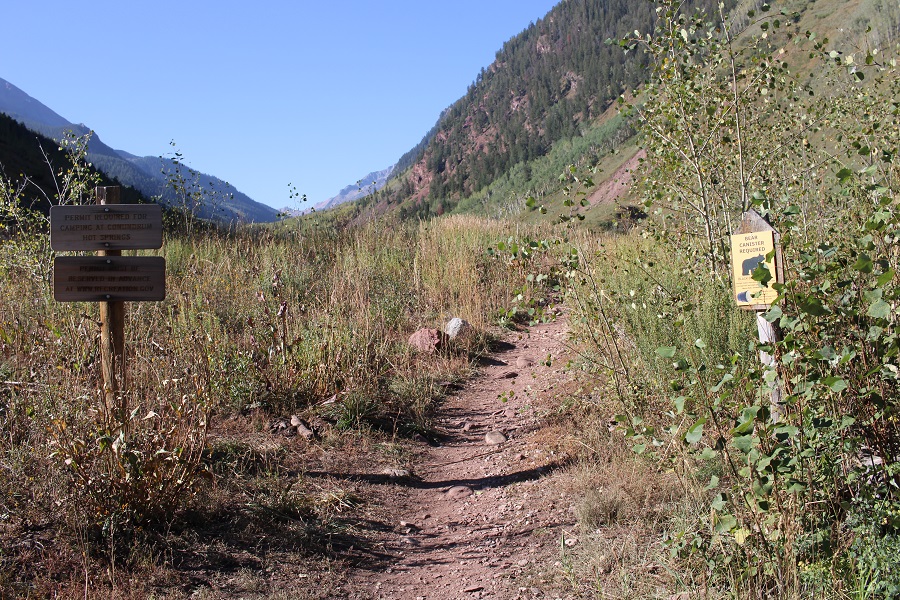
I started from the Conundrum Hot Springs Trailhead at 4:45am, after a quick nap on Independence Pass after a long drive and a long day.  Here’s the trailhead:

I followed the class 1 trail for 6 miles to the permit boundary, which is noted by a very visible sign. 

It was obvious this is a popular camping spot (just before the permit boundary).  There are a lot of social trails that lead off into the trees as well for campsites, if you don’t want to camp right next to the sign.  Here’s where I camped.   It’s relatively close to the stream, which is great for filtering water

I set up my tent, as I planned on being here for a few days. The next morning, I started out at 4:45am.  The trail is still class 1, and crosses Conundrum Creek several times.  All creek crossings were easy.

After about 2 miles I came to the Conundrum Hot Springs campsites, an old abandoned cabin, and more small creek crossings.  I took the trail to the right towards Triangle Pass

I was now still on Trail 1981, headed southwest, into the willows

At 12000’ I left the trail, and followed a drainage west

At about 12200’ I turned right and headed north, across the basin.  Yes, there were a lot of crows. 

I kept heading north, skirting a small pond.  This was all class 2

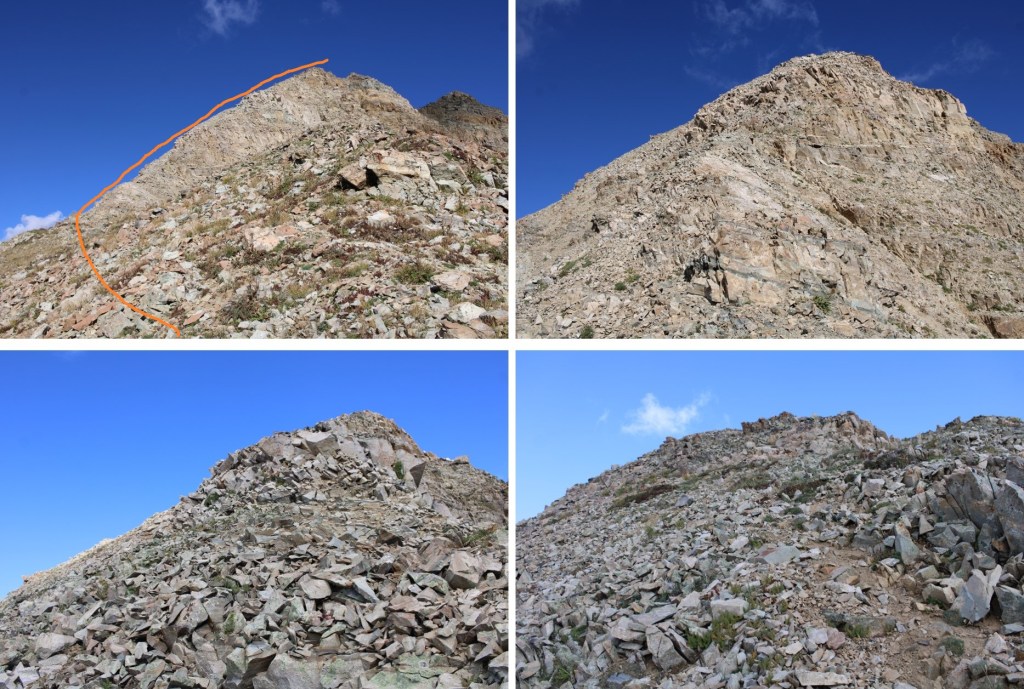
My goal was to gain this ridge.  This was my route (still class 2)

Once on the ridge I placed a large cairn, turned left, and headed west up the ridge

The terrain quickly narrowed and became class 3, full of chossy, loose rock. It never got more difficult than class 3, but the terrain was sketchy.  I was able to stay directly on the ridge.

As the ridge rose, it curved, and I stayed more to the left

I topped out, turned the corner, and saw more class 3 ridge work as I now headed northwest

I lost a little bit of elevation, then followed the ridge to the summit

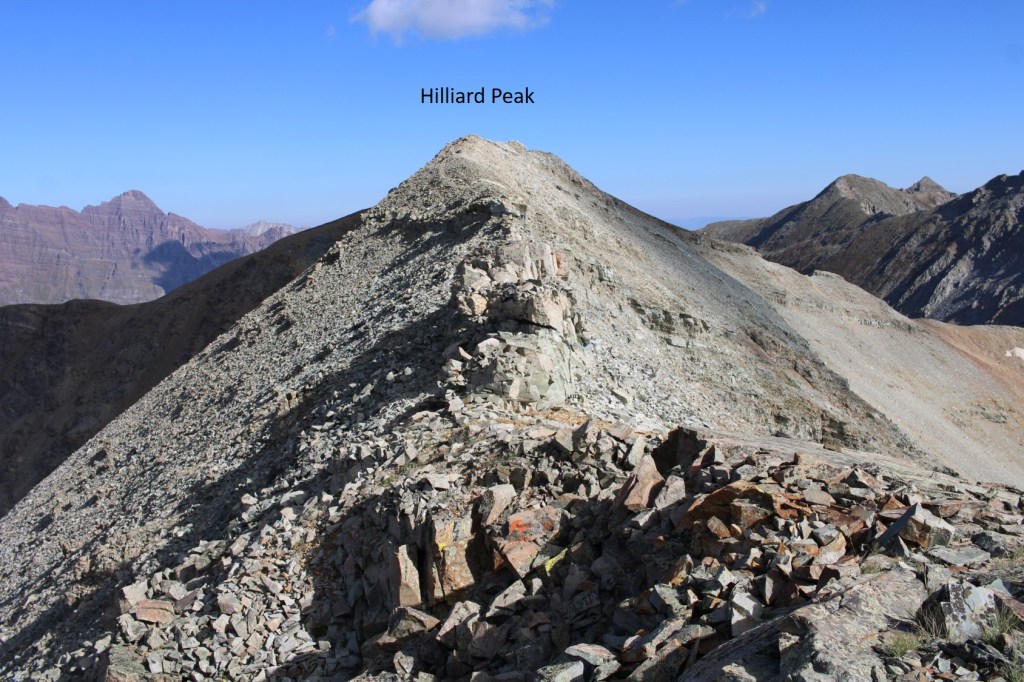
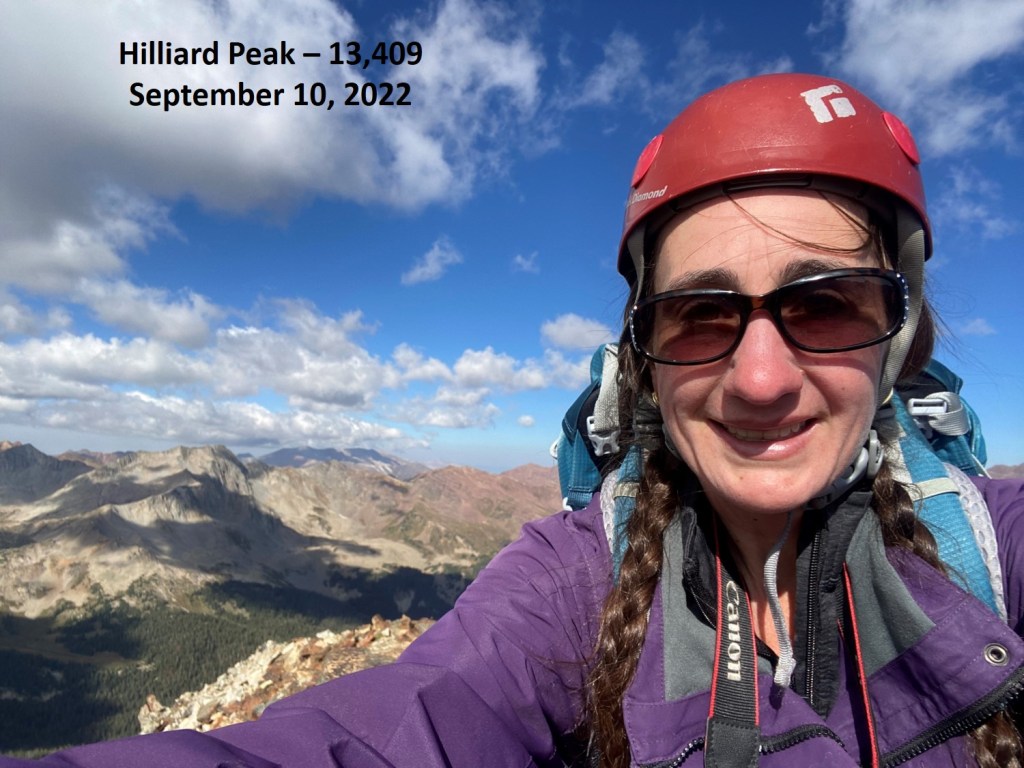
I summited Hilliard Peak at 9:45am

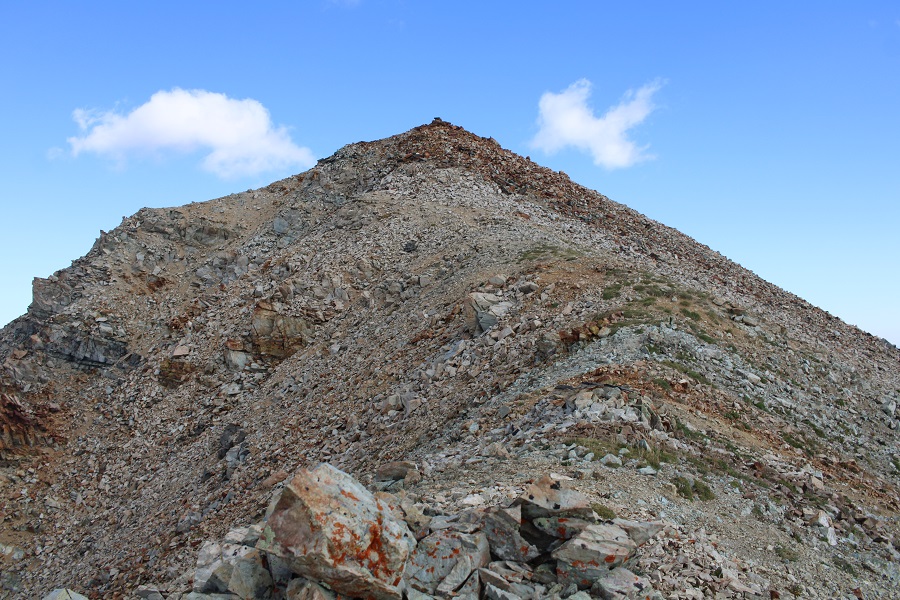
Hilliard Peak:

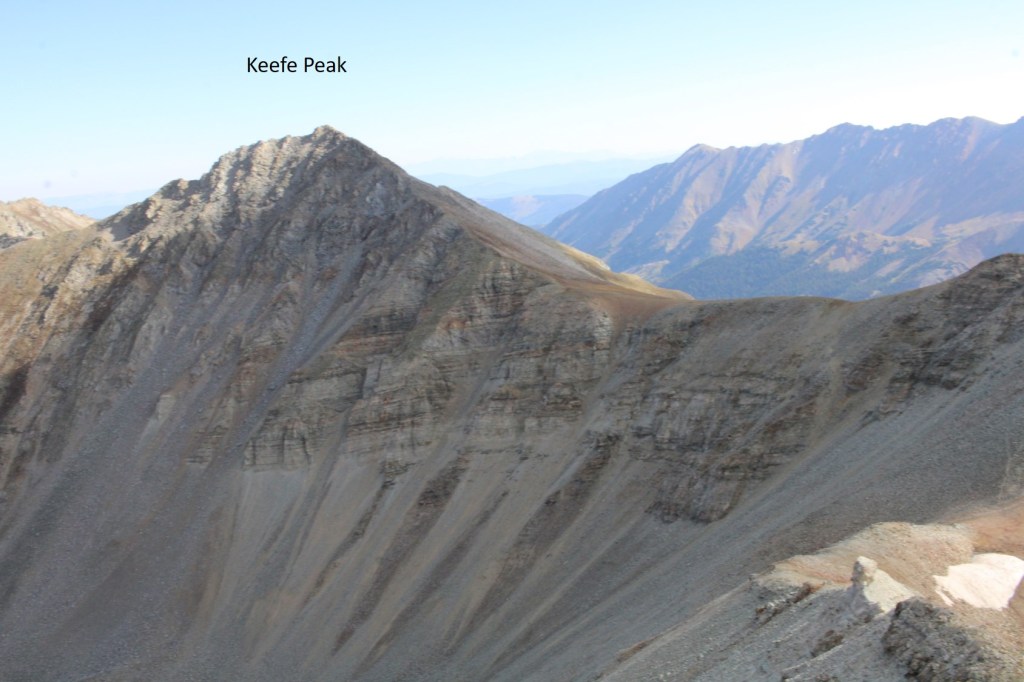
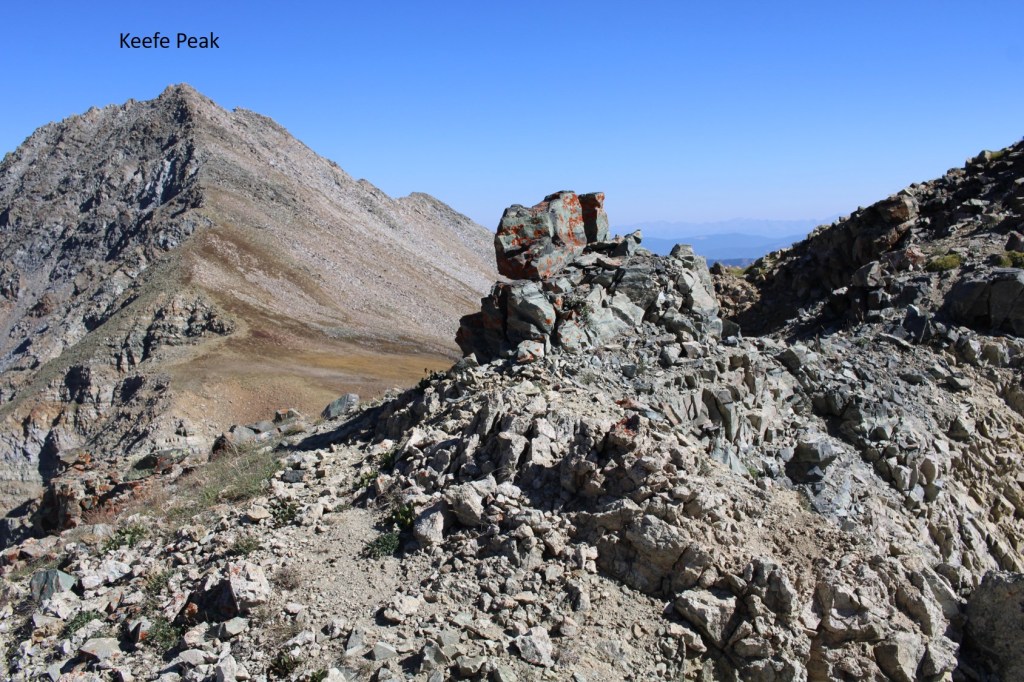
From Hilliard, I could see Keefe Peak to the northeast

But first, I was going to have to get over the crux of the route: This pointy mountain right here.

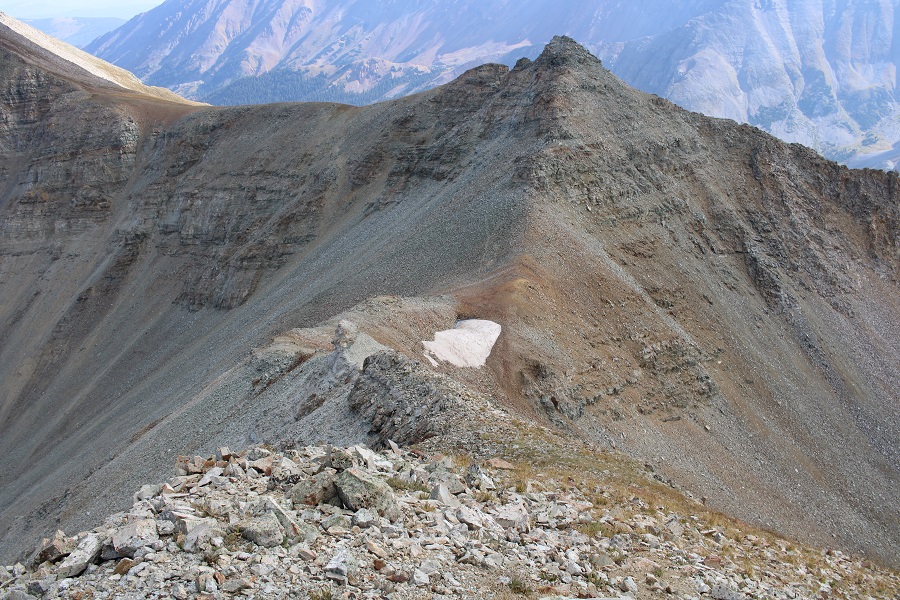
I followed the ridge northeast, and came across this fun formation. I easily passed it to the left

This brought me to a small saddle.  I ended up climbing this part by taking a game trail to the ridge, then crossing over to the right side and heading up

And now for the crux

This is the route I took

But there’s a lot you can’t see…  So here it is step by step.  This is class 4

This was a small, airy traverse, about 6 feet long, ad no more than a foot wide

The good news is after that it’s all class 2 to the top of Keefe Peak.

I summited Keefe Peak at 11am

Keefe Peak:

I decided to make this a loop, and head east down an old avalanche runout.  Let me preface this by saying it worked, but the runout is quickly growing back, and there was a ton of bushwhacking.  Plan your route carefully.  Here are some pictures of the route that led me directly back to the trail (1981) and Conundrum Creek below.

Here’s looking up at the route I took down.  You could also take this route up, and just do Keefe from this angle, and skip the class 4 section of the traverse.  It’s a lot of elevation gain in a short while though (3200’ in 7.5 miles) with a lot of initial bushwhacking, but it goes.  I came down the left side (when looking up), but would recommend sticking more to the right and avoiding the middle.

Back on the trail, I followed it back to my campsite, and stayed there for another night. 

Here’s a look at the route out from the campsite back to the trailhead.

And my topo map