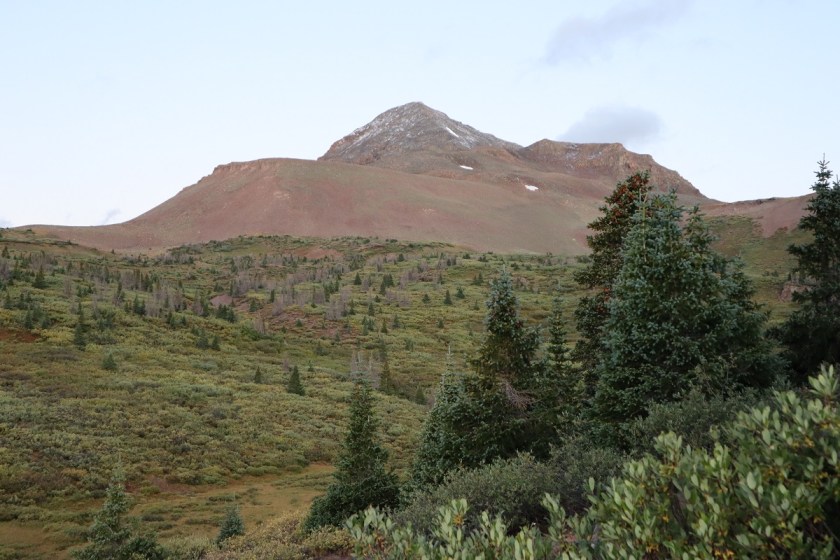
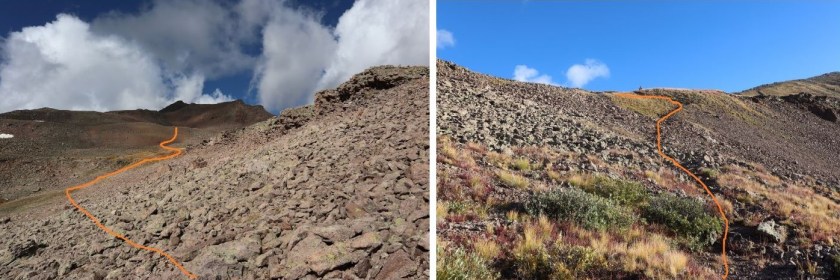
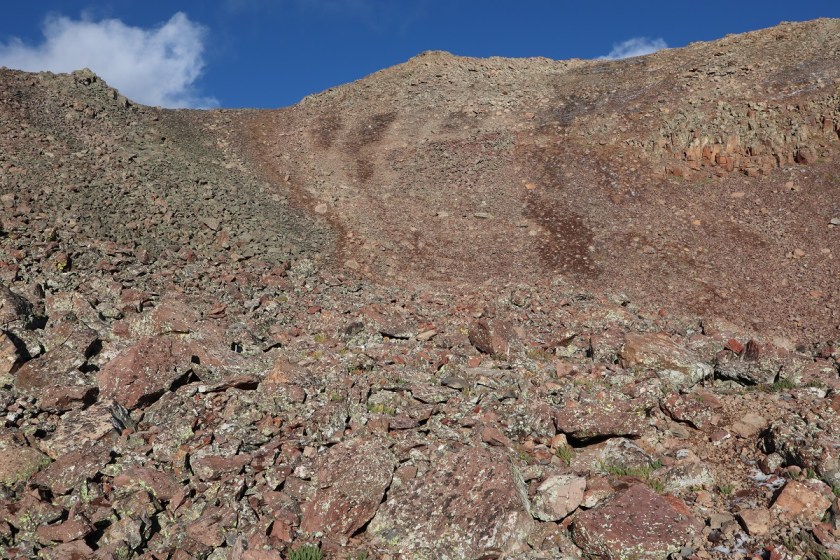
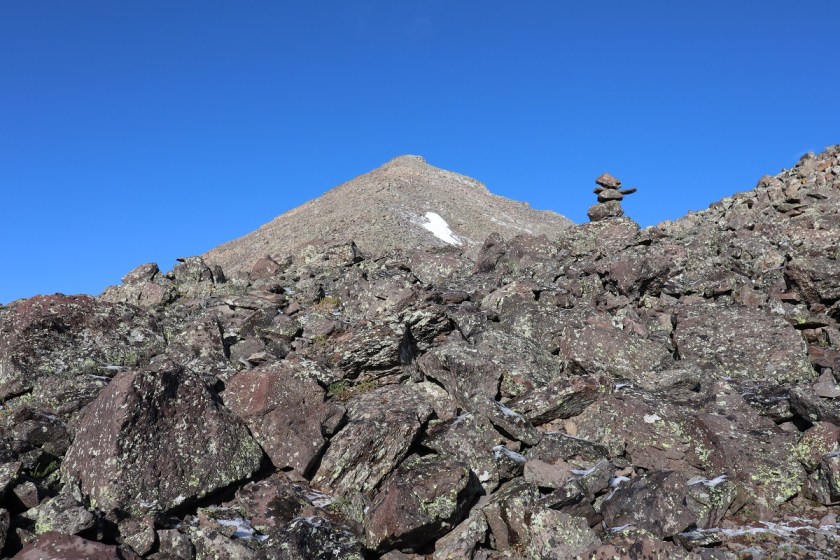
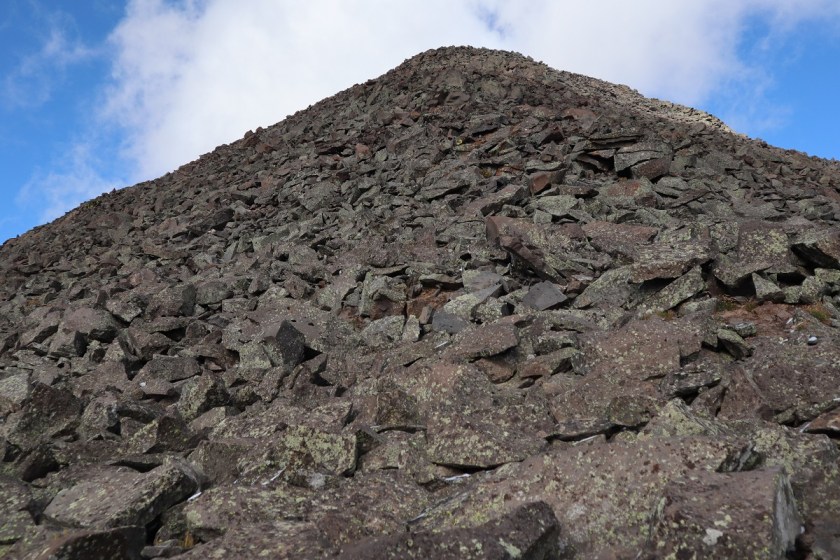
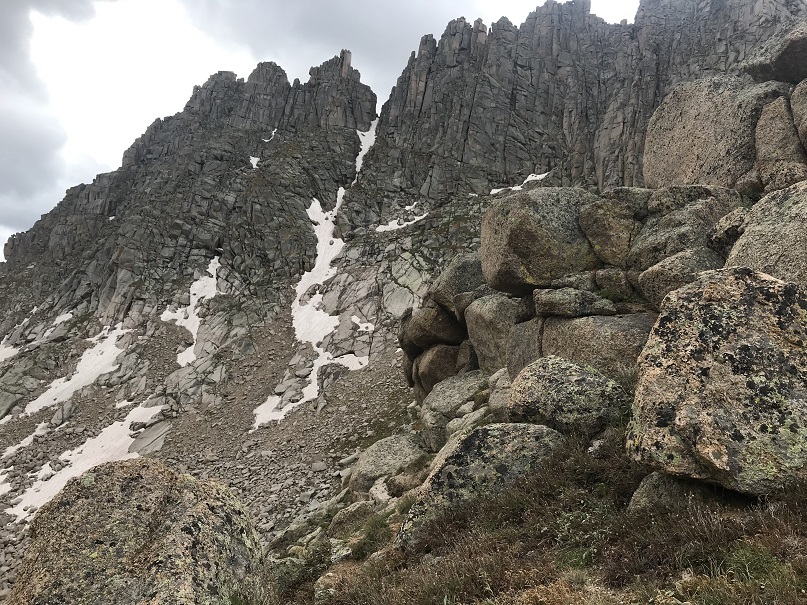
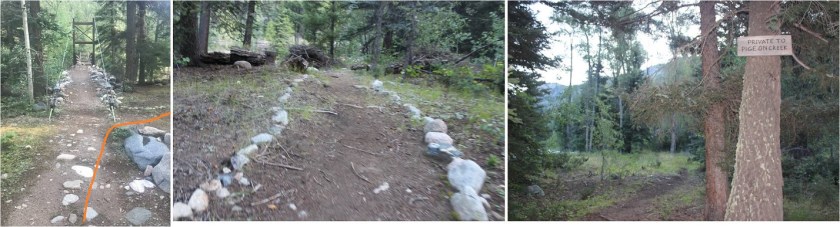
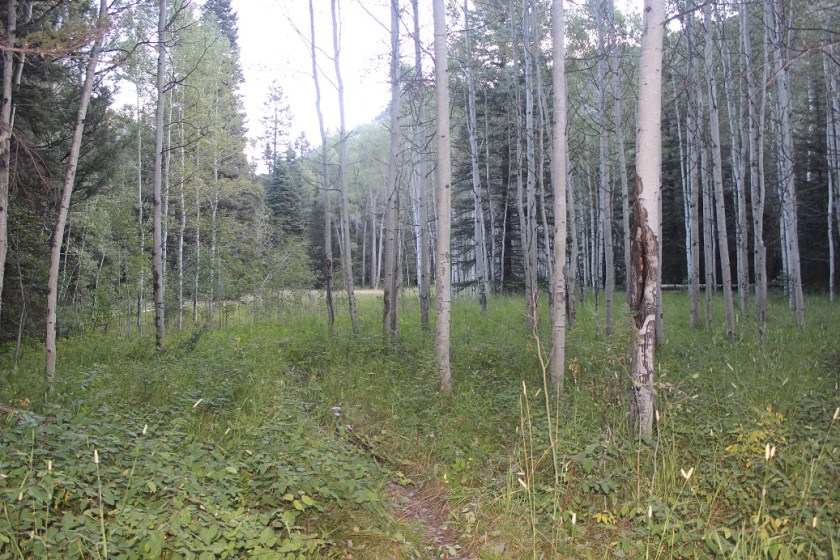
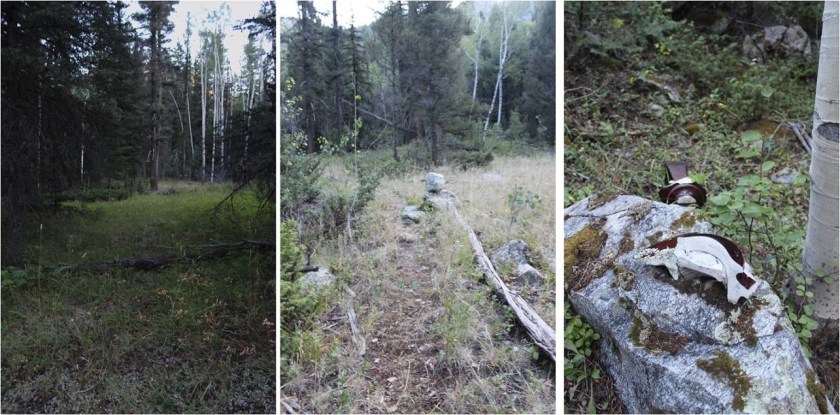
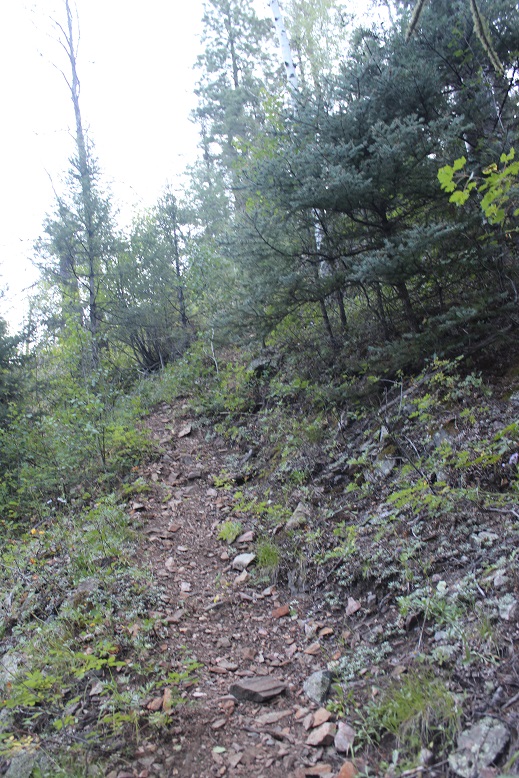
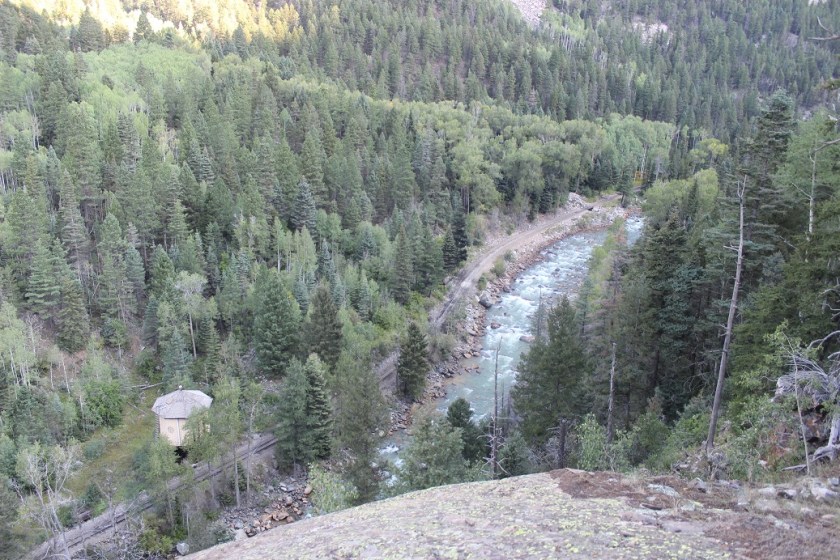
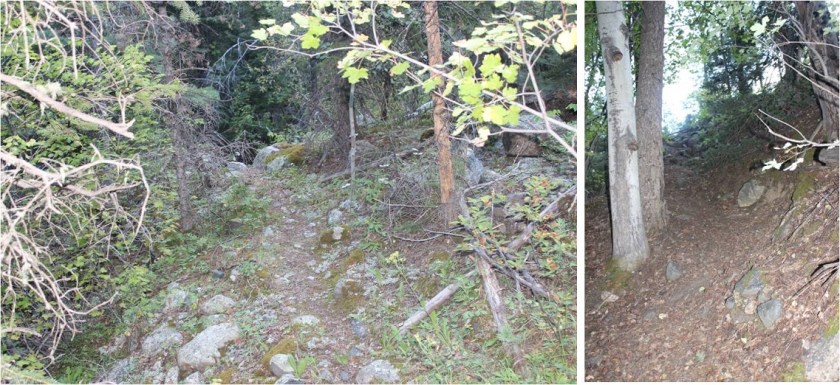
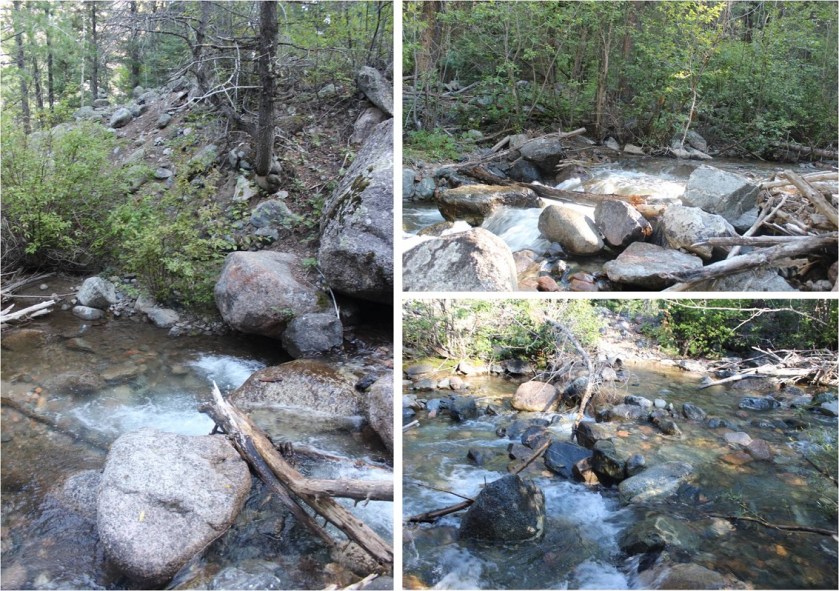
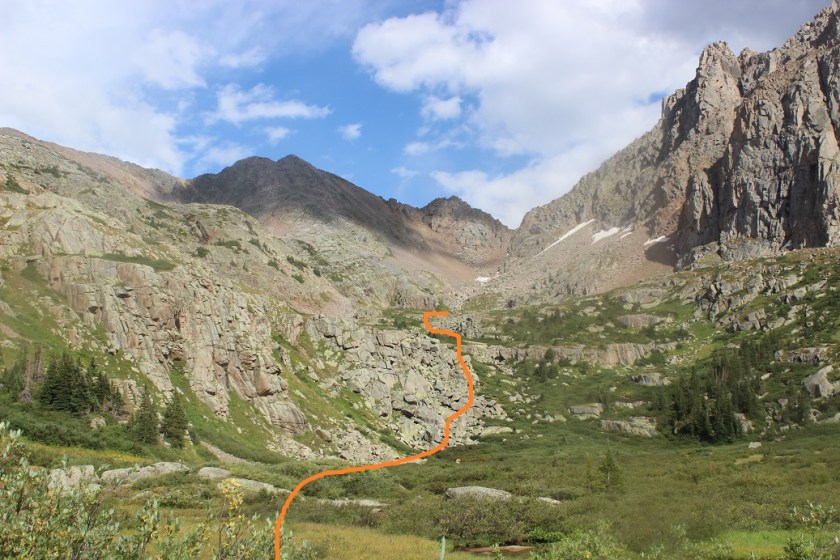
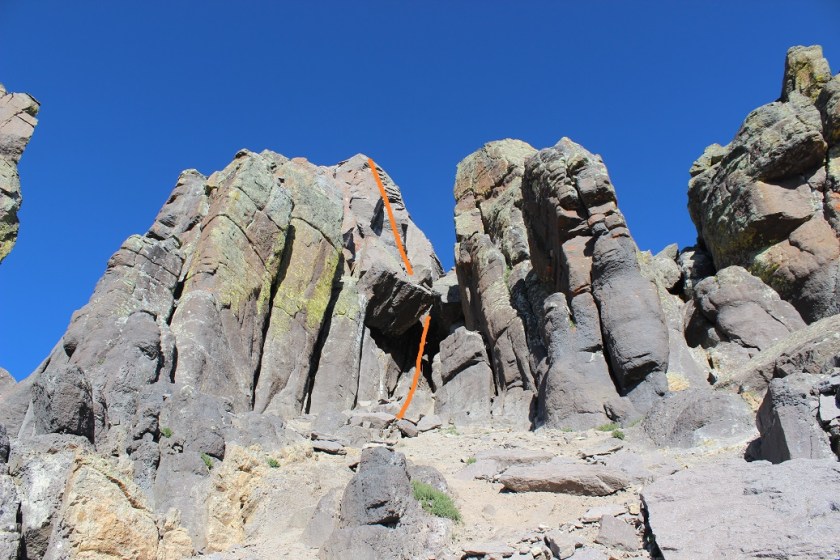
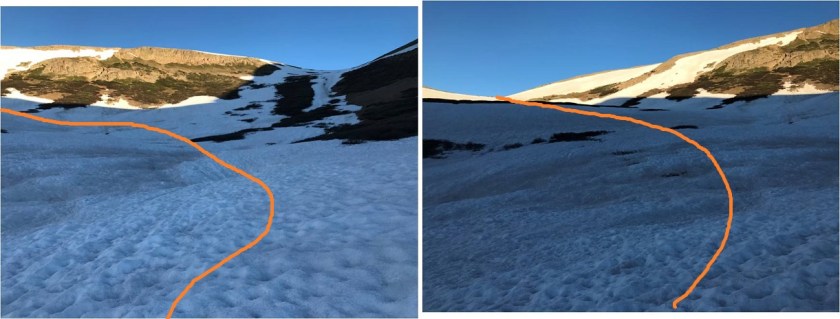
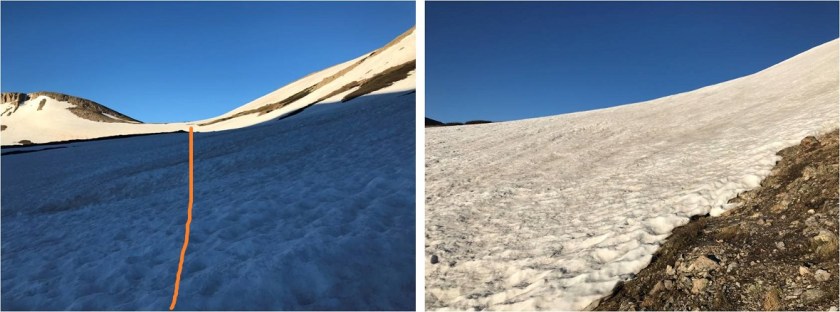
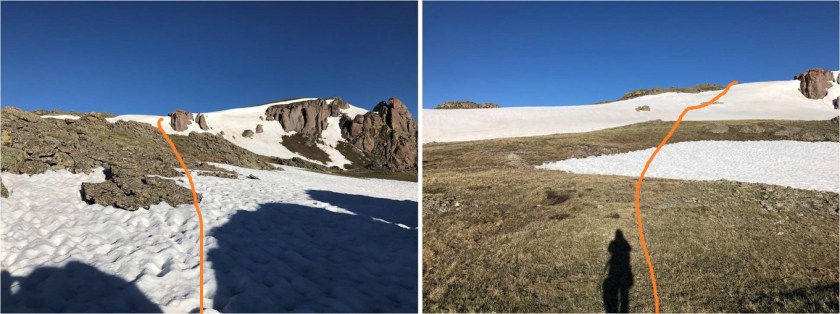
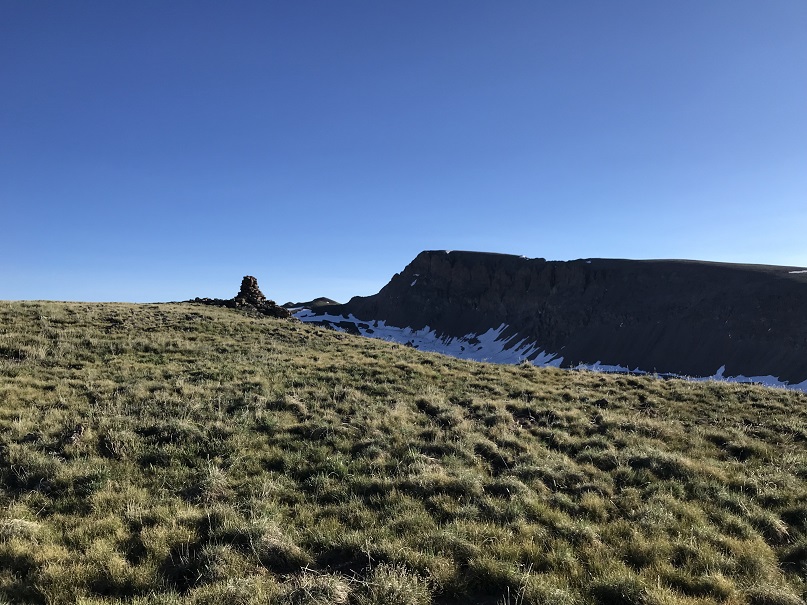
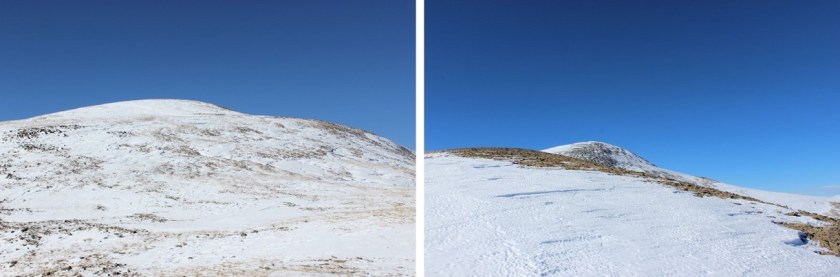
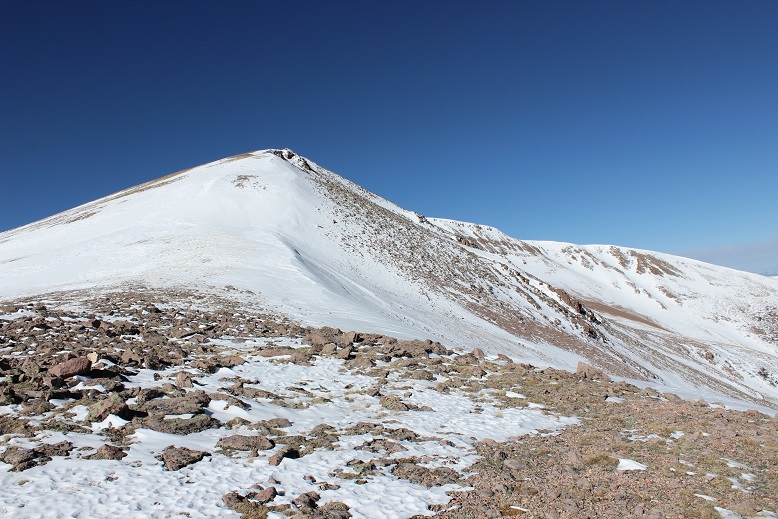
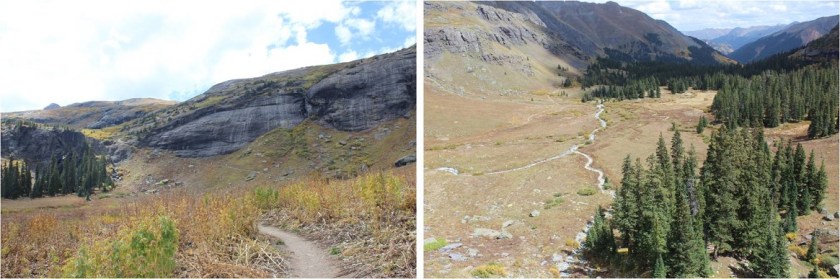
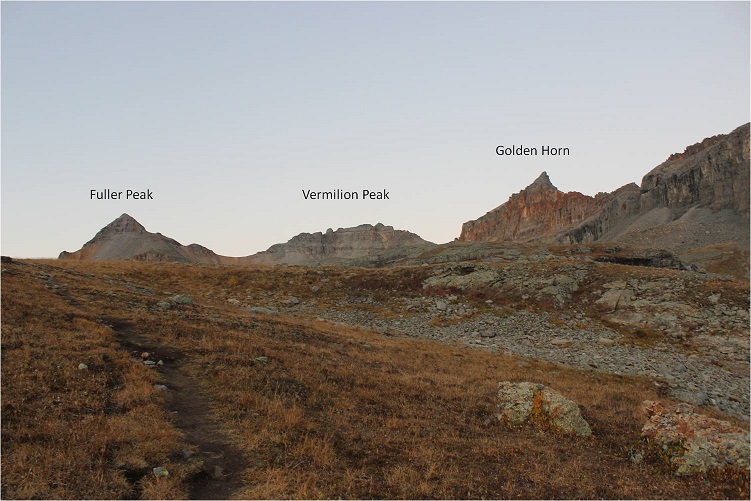
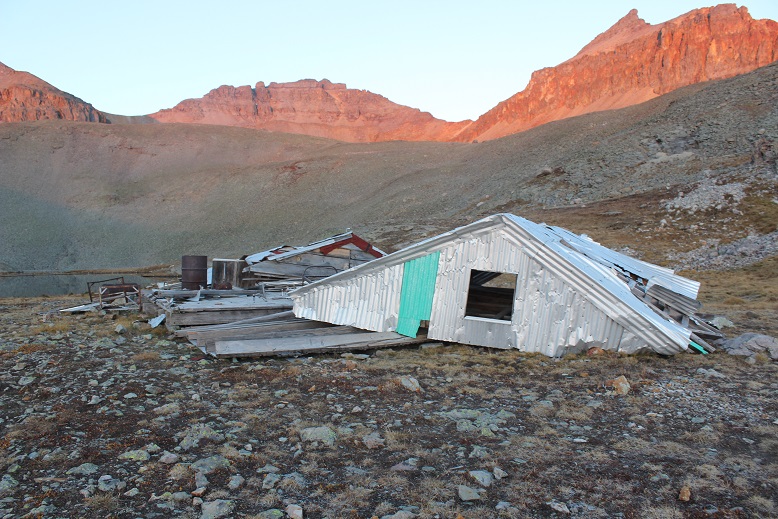
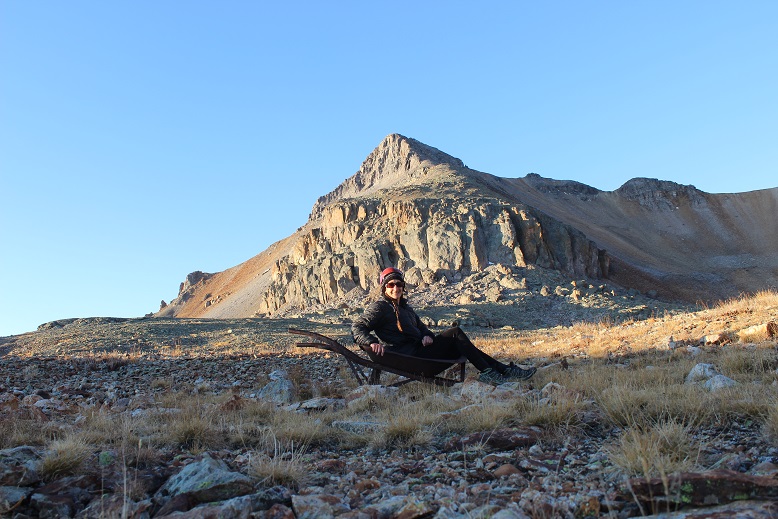
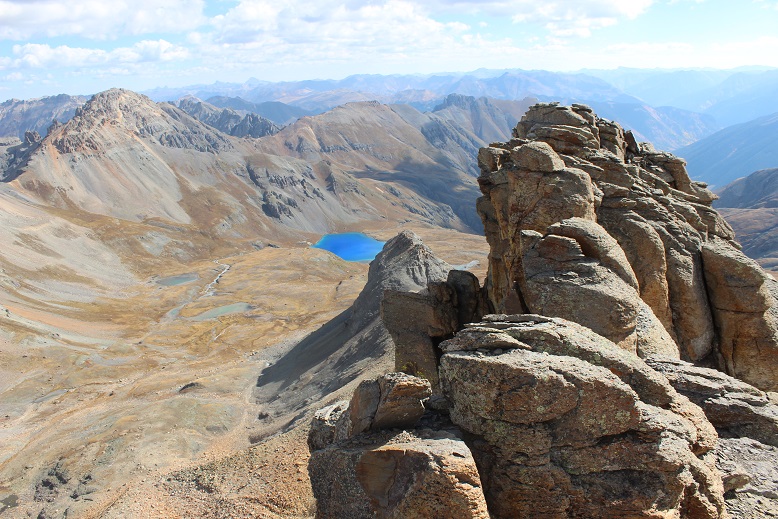
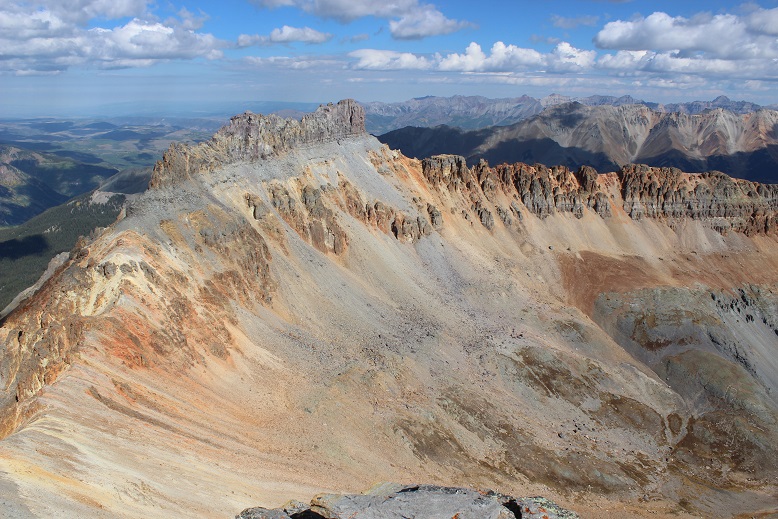
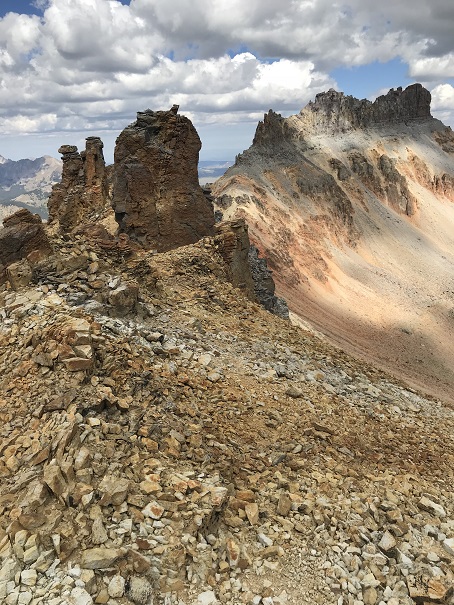
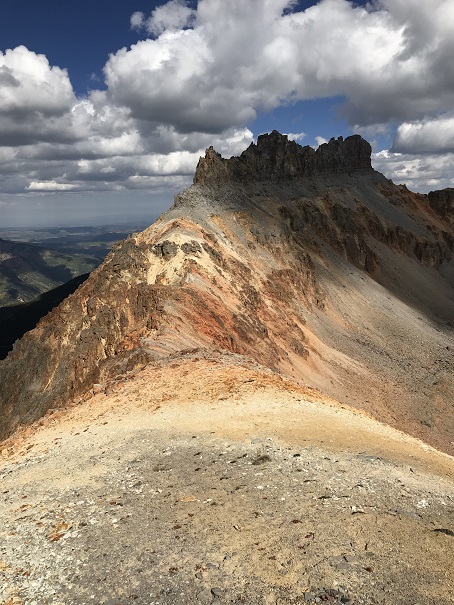
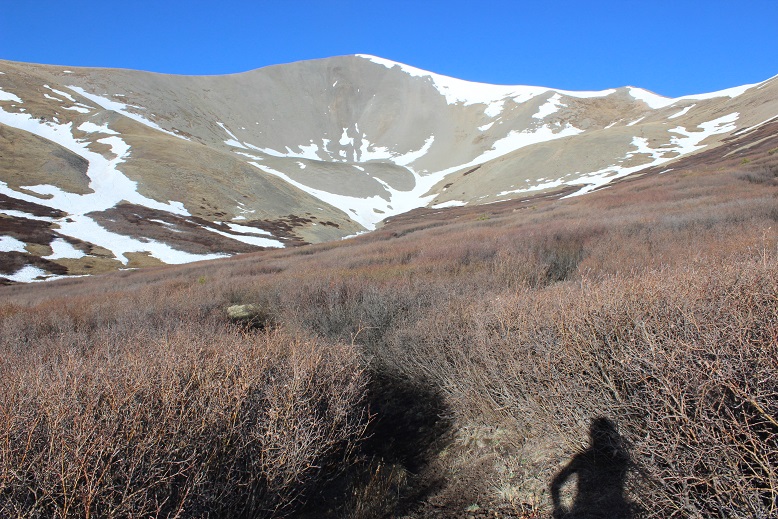
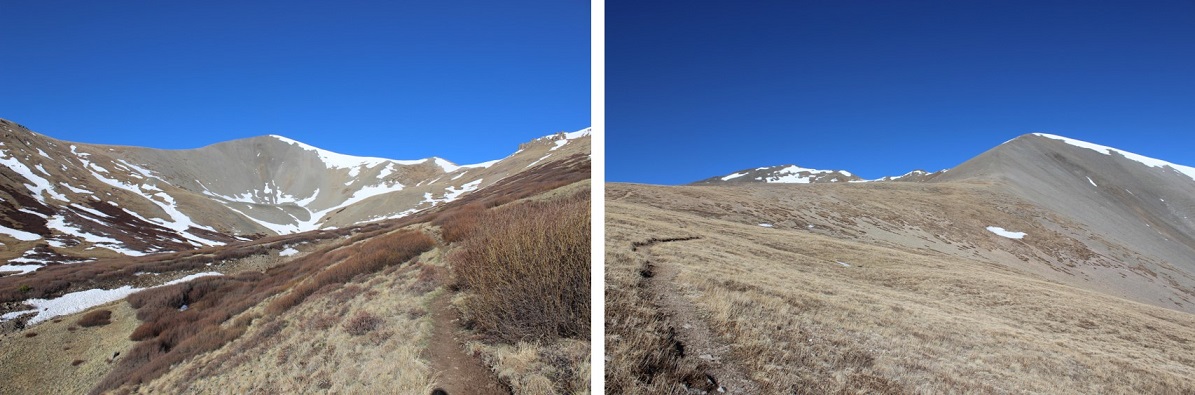
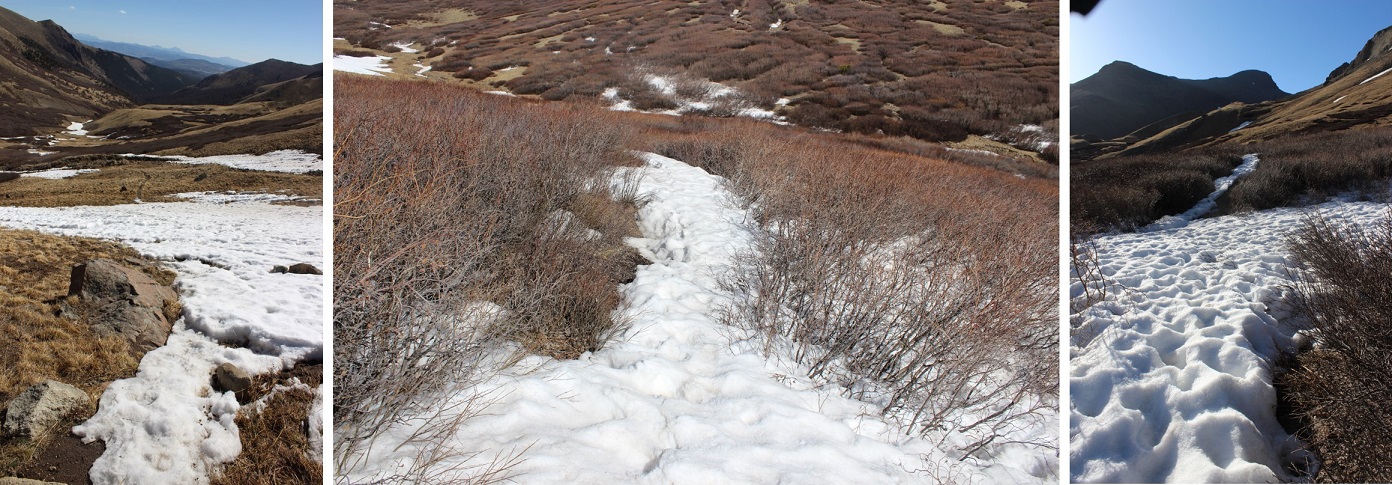
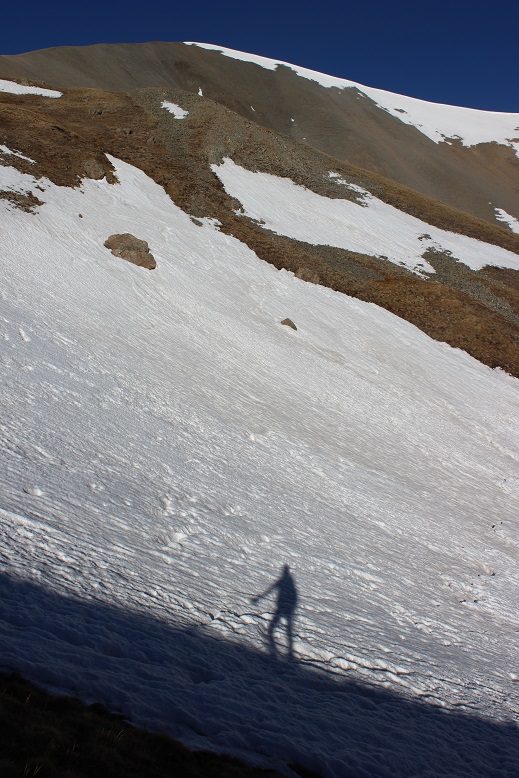
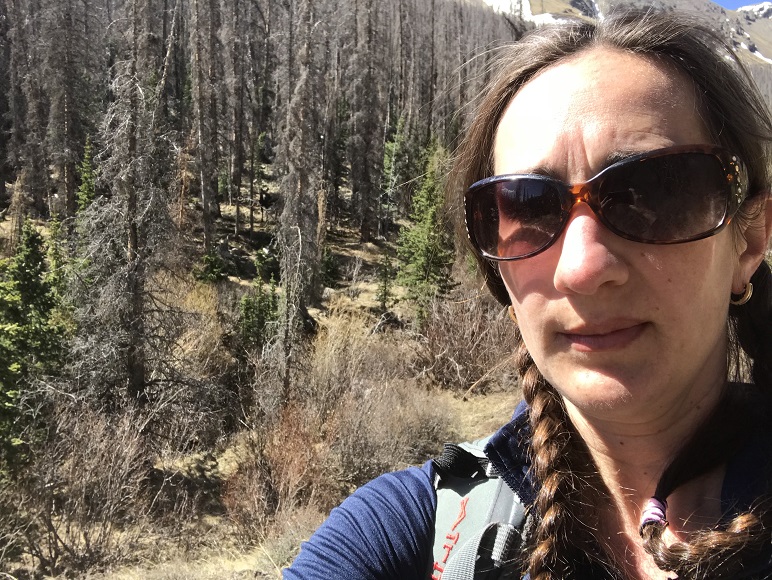
Baldy Alto – 13,698 & Stewart Peak 13,983

1

RT Length: 11 miles

Elevation Gain: 3961’

Colorado had it’s first measurable snow Thursday and Fridays are my hiking days. Of course I paid extra close attention to the weather and it looked like the San Juans were going to be cold and windy but the snow would be negligible.  I had a few other peaks in mind closer to home, but I’ve learned the hard way while the trail may be snow free, it’s unlikely the roads/highways would’ve been snow plowed at the early times I like to hike.

I’d thought about sticking closer to home but didn’t want to waste a full free day when I could be above treeline, summit or no. Also, I had some new winter gear I wanted to test out and the area with the best forecast for the entire state was near the Eddiesville Trailhead in the San Juans.  I made it a late start because (at the trailhead) it was supposed to be 1* until 7am, when it jumped to 7*.  It was going to be cold, and I figured sunlight would help.

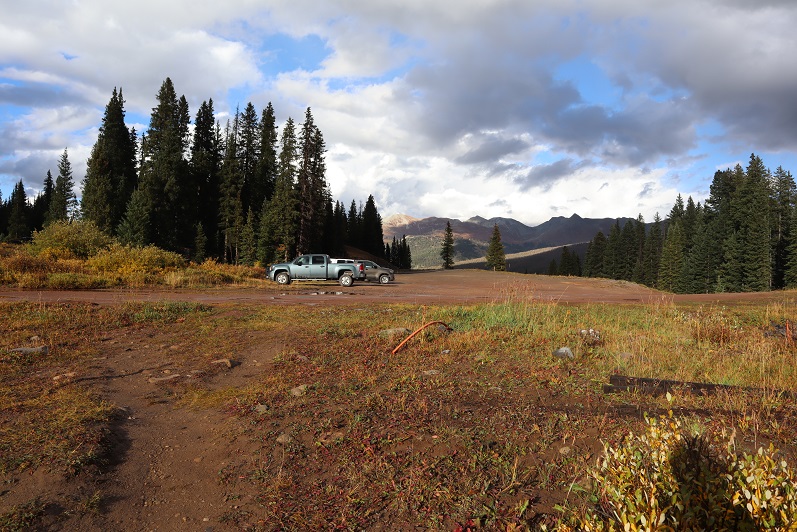
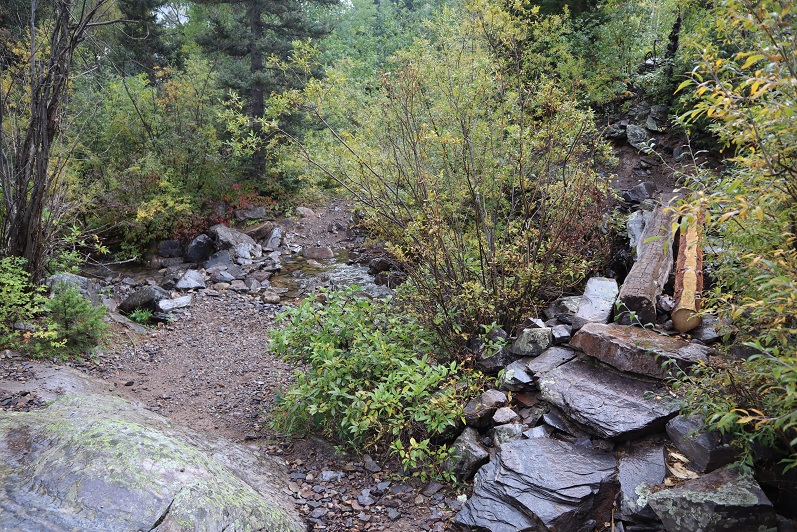
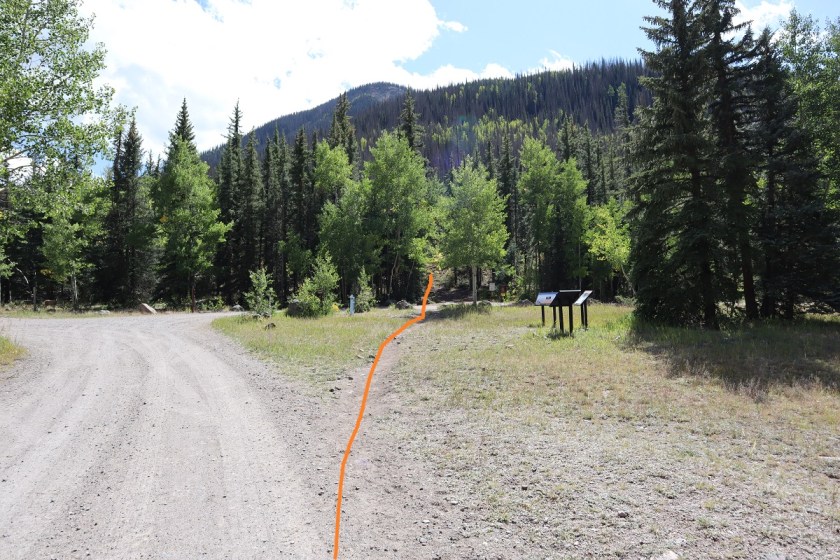
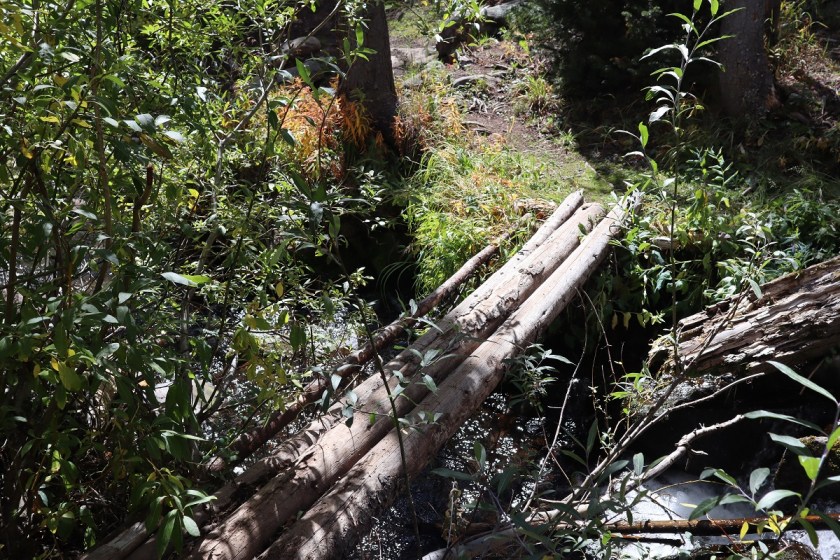
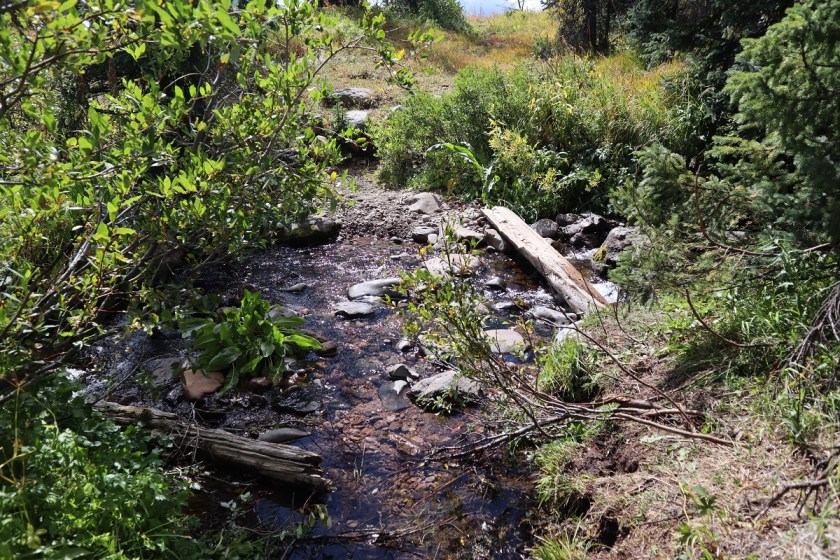
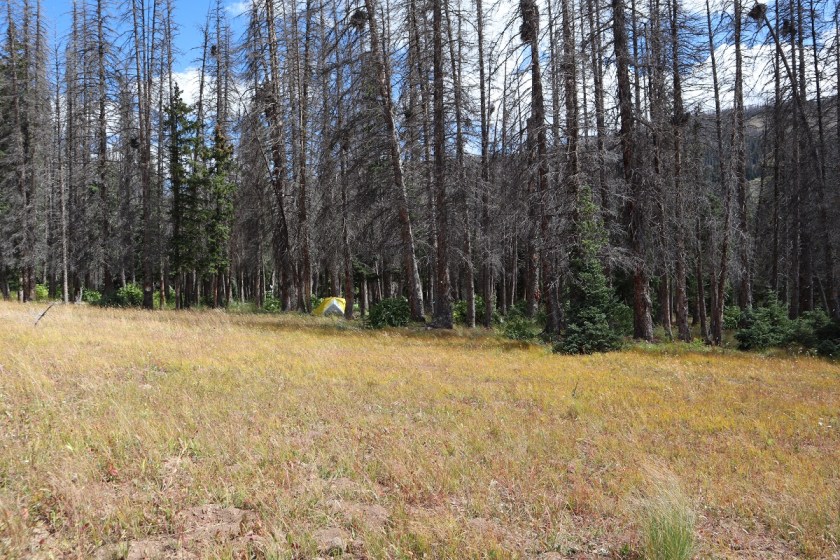
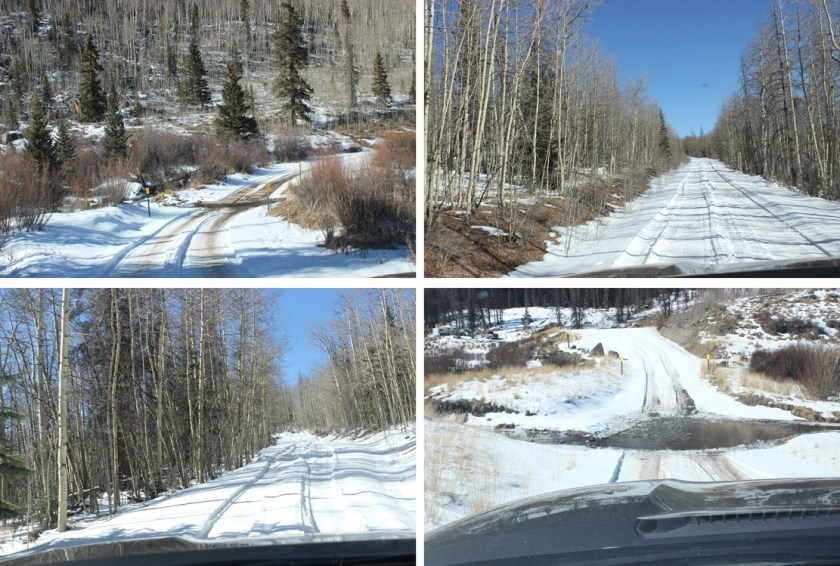
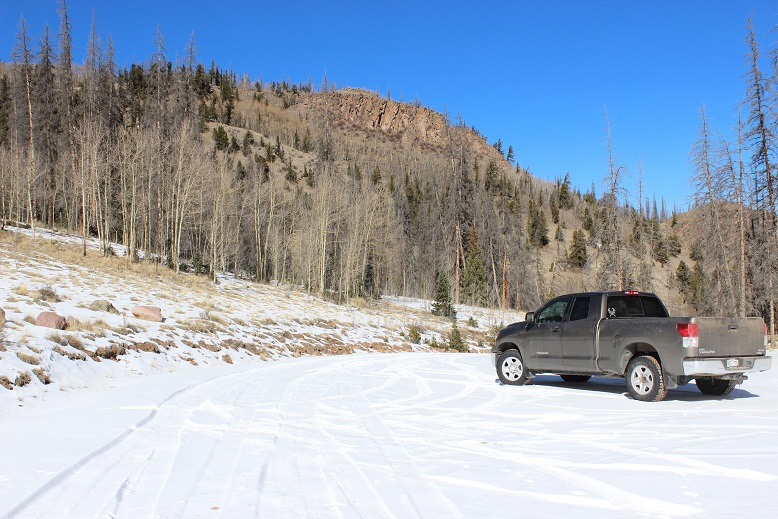
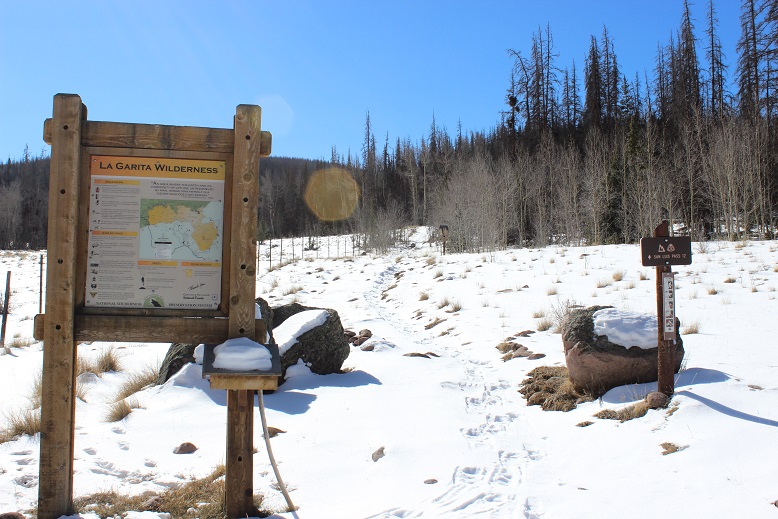
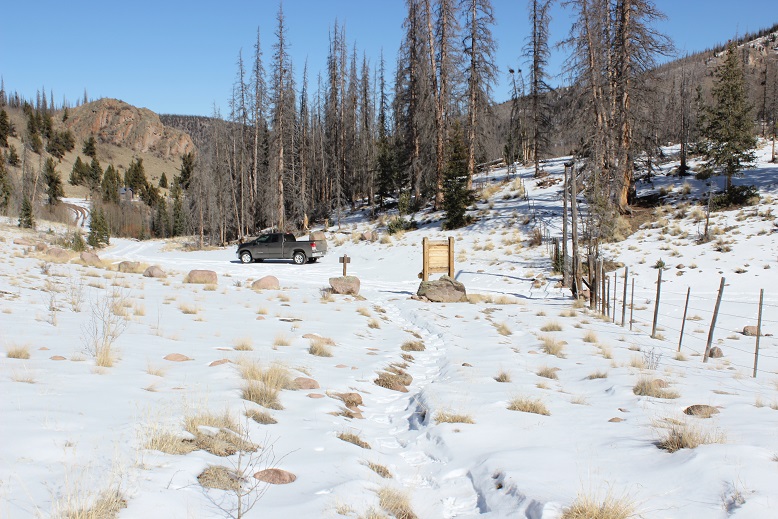
I left my house at 1:30am and arrived at the Nutras Creek Trailhead at 6:30am, surprised to see a tent set up near the trail but no vehicle. It’s a 24 mile drive on a dirt road to this point, and I wondered how they made it here?  My dashboard said it was 14* and I already considered today a win (to be fair, it went all the way down to 0* on my drive in and back up to 14*, so the forecast was in the correct range).  The creek crossings were negligible, just a trickle at the first and completely dry at the second.

2

Not knowing how much snow had actually fallen here yesterday I’d brought both my summer and winter hiking boots. It was icy on the way in and there was a sprinkling of snow on the peaks nearby so I opted for the winter hiking boots, just to err on the side of caution.  The last time I was here to summit Stewart Peak it had rained and my feet had been soaked in the first 10 minutes and were solid blocks of ice on the peak.  I didn’t want that to happen again.  The winter boots were overkill but also the correct choice.

I’ve needed new gear for a while, and this year saved up money to purchase better winter equipment. All of the centennials I hiked in cold conditions I did so wearing a snow bib I’d bought for $2 at a garage sale in 1998. After an intense winter/spring hiking season this year the bottom half were ripped to shreds thanks to my wonderful microspikes and snowshoes.  The jacket I’ve been wearing was a great jacket from a great brand, but I’ve sewn up over two dozen holes and it no longer keeps me warm/waterproof.  I need to wear compression socks when I hike (and basically for any activity that requires shoes) and I wear wool socks over them but the ones I’ve been wearing haven’t been keeping my feet warm.  My goal this winter season is “no blue toes” so I was trying out a new pair of socks (over my compression socks).  Also, gloves.  By far my most expensive purchase was when I splurged on a new pair of Alti Mitts last month:  I’m super excited to try them out.  These would be cumbersome but could be game changers.

So, I bought new socks, gloves, and ski pants (woot! No more taking off half my layers to use the restroom!).  Roxy makes a pair of outdoor snow pants that almost fit me.  The smallest size they make is one size too big for me, but I found they fit better if I wear yoga/moisture wicking pants underneath them.  Bonus: They’re not from the kids section and they kind of make it look like I have a figure instead of looking like the Michelin Man.

Finally, a new jacket. I’ve been in the market for a long time for a new winter mountaineering jacket but I’m frugal and don’t want to spend $500+.  I’ve gone to REI, Sierra Trading Post, and several other outfitters looking for something that would keep me warm without breaking the bank and came up empty.  I was in an online forum for people with Raynaud’s and someone very highly recommended a simple mountaineering jacket. I was exceedingly suspicious due to the (very low) price and because it was synthetic and made in China, but I purchased it on Amazon and figured I’d give it a go early in the season.  When it arrived I was doubly skeptical:  It came in a small 12x12X4 inch plastic case and didn’t look robust enough to keep me warm.  I left the tags on it in case it didn’t perform as advertised so I could return it and try again.

Fancied out in all my new gear I hit the trail at 7am, being careful to be quiet since the campers were not yet awake.
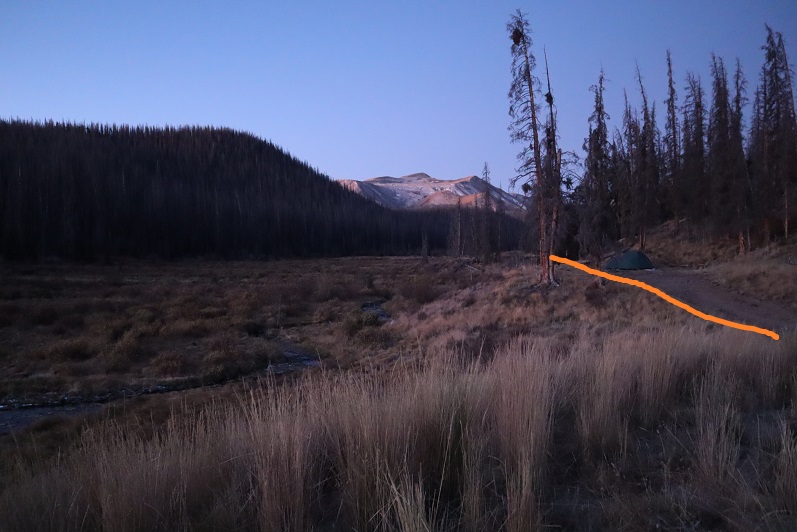
3

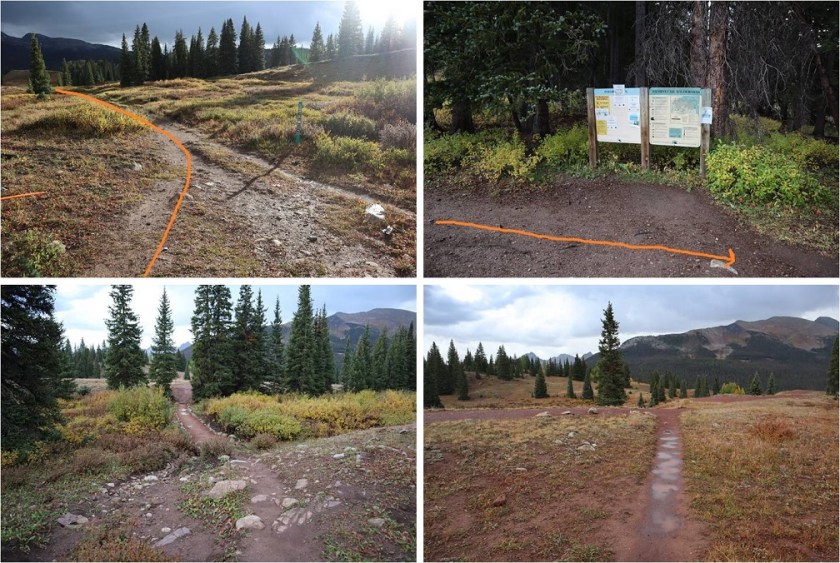
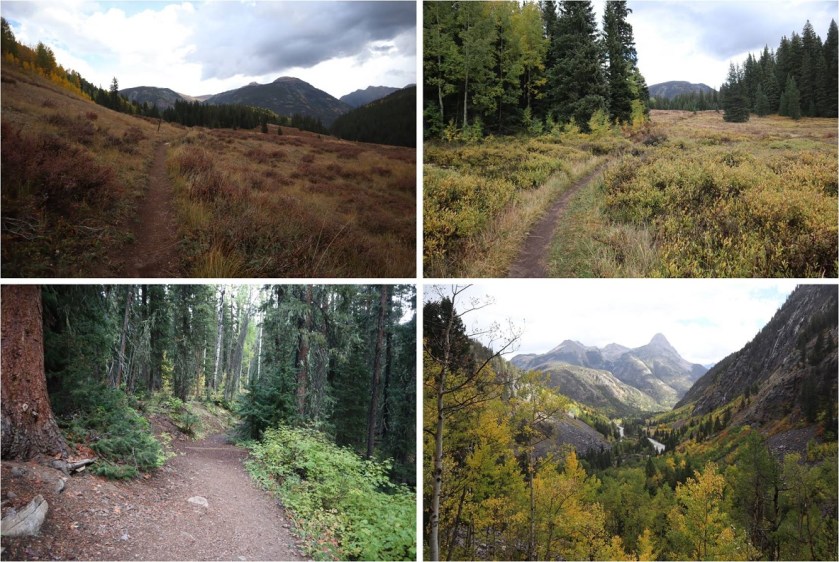
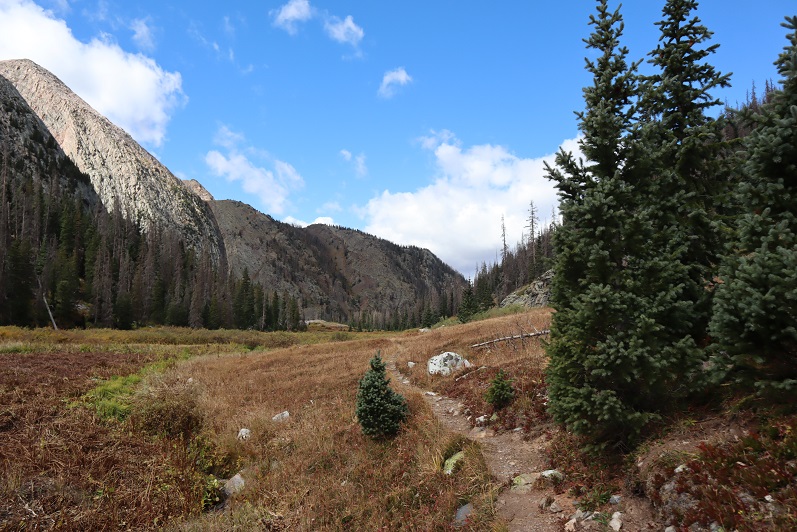
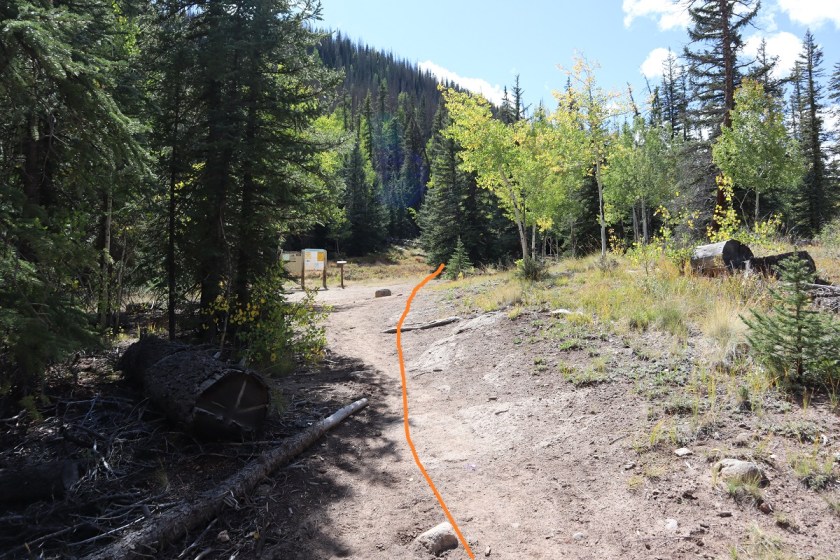
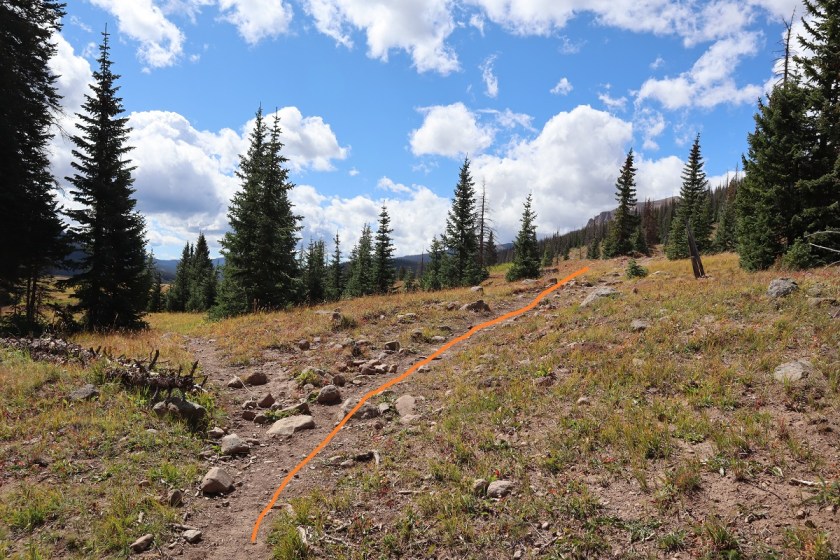
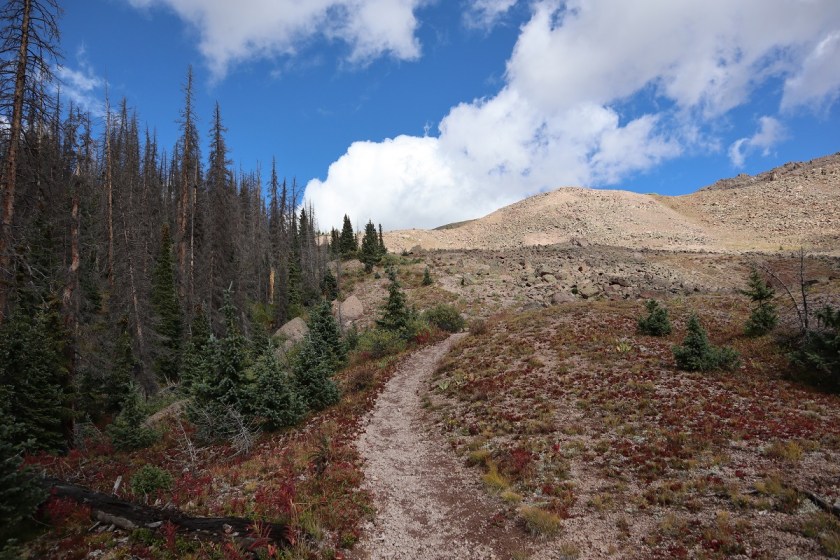
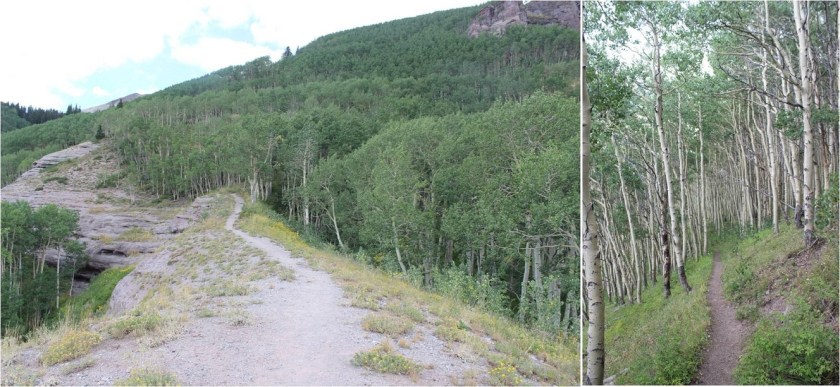
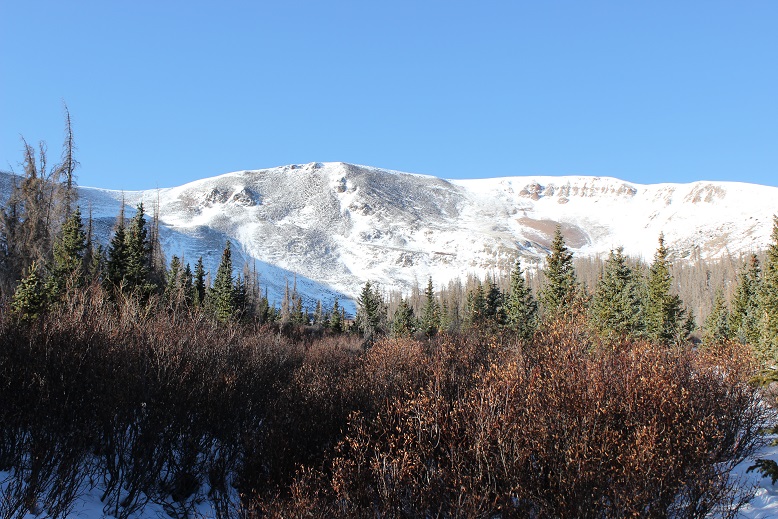
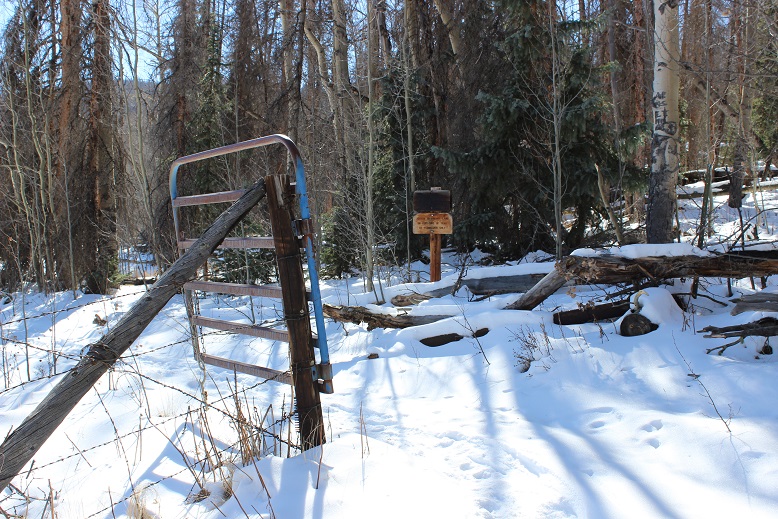
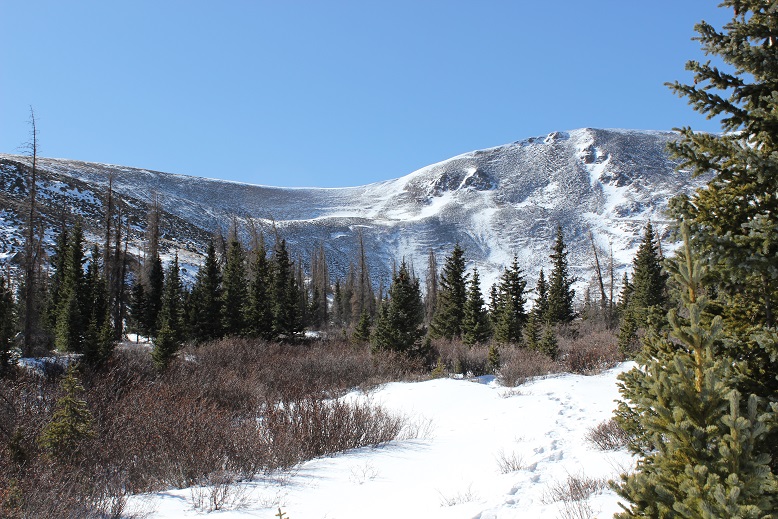
The first 2 miles of this trail follow Nutras Creek southwest on an easily identifiable trail. I could see a light dusting of snow on the nearby peaks.
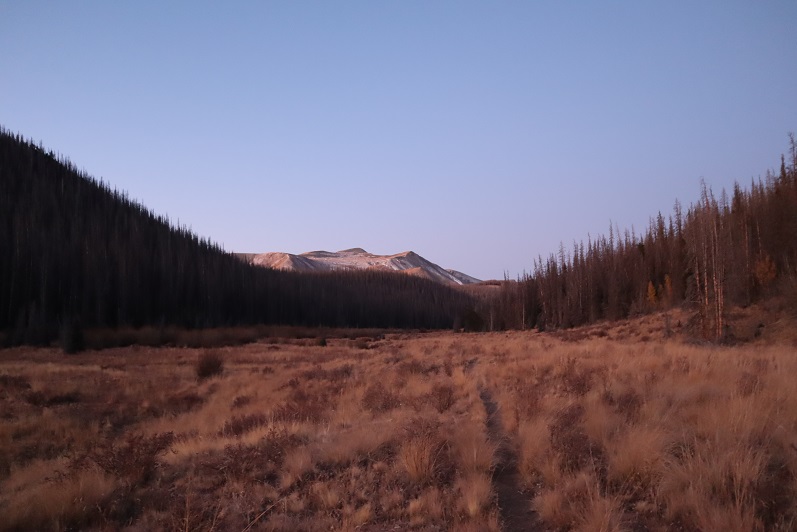
4

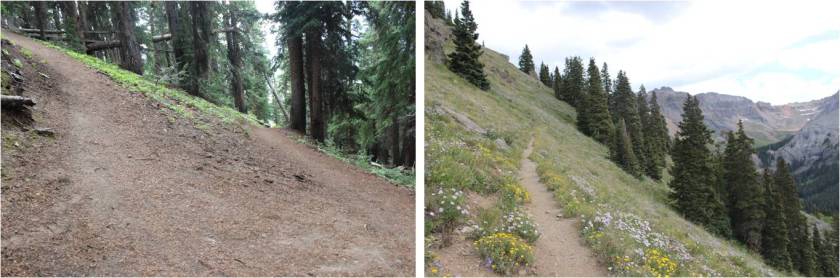
Anywhere there was water or where water accumulated there was ice
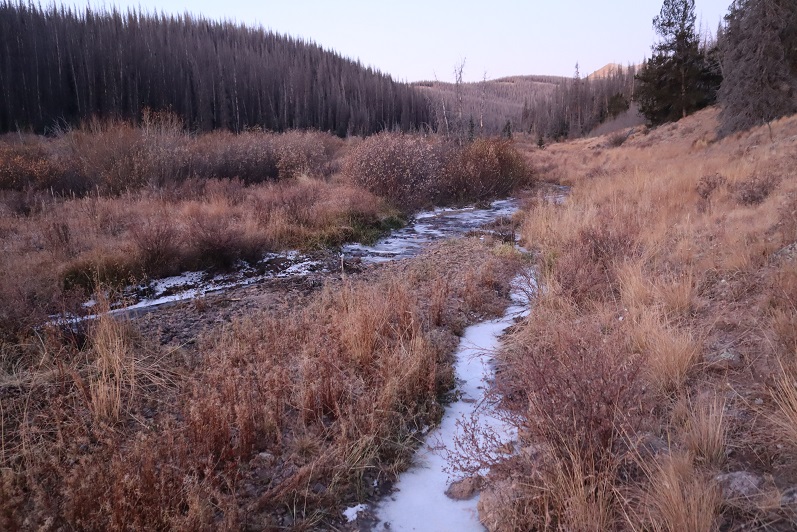
5

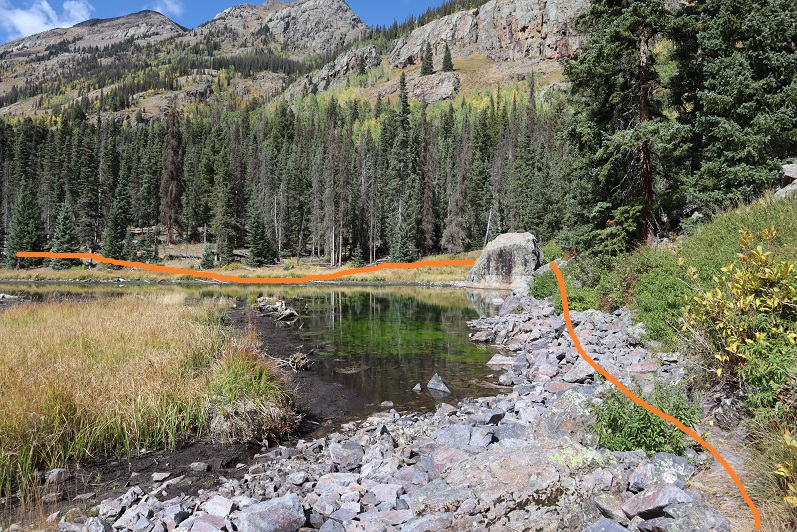
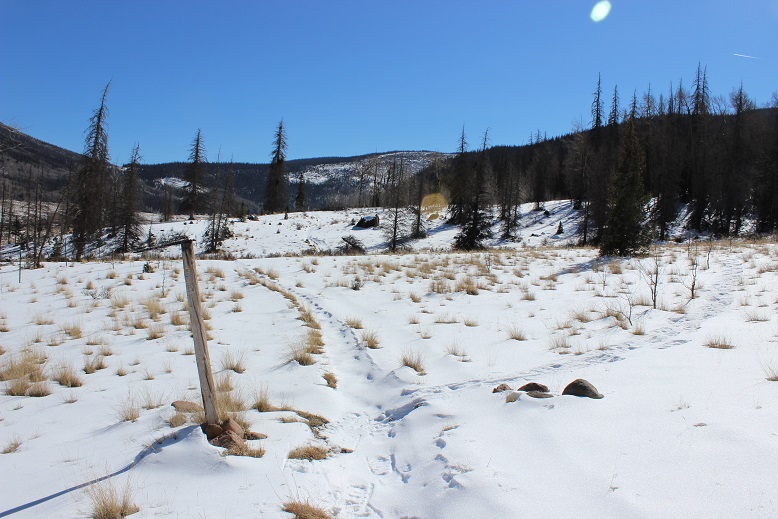
After 2.2 miles of hiking on an established trail I came to an area where I was close to the creek and it looked easily crossable. I’d need to be on the other side to summit Baldy Alto. I chose to summit Baldy Alto first today because I’ve already summited Stewart Peak and I wasn’t entirely confident my new gear would allow me to summit more than one peak today. The creek looked frozen solid until you stepped on it and then you plunged into the water, realizing it wasn’t more than an inch or two thick.  At its lowest point about 5 feet across.  My little legs weren’t going to be able to make that jump so I walked up and down the creekbed looking for a better way to cross (a log, large rocks, etc.).  When I couldn’t find one I added a few medium sized rocks to the creek and made my way across.
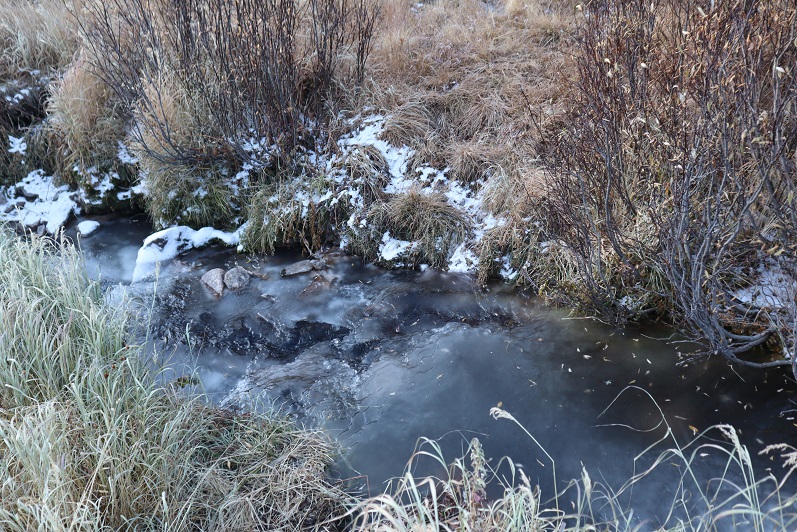
6

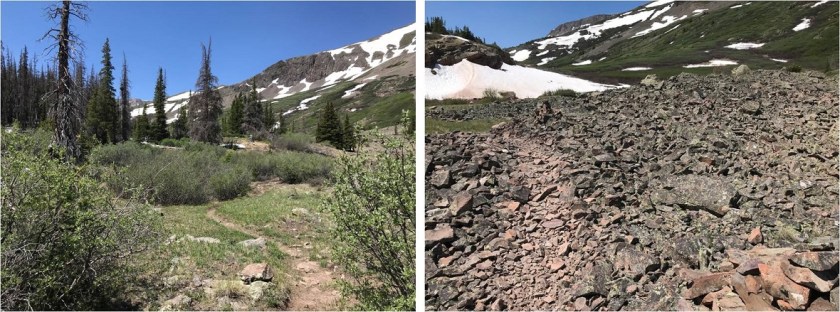
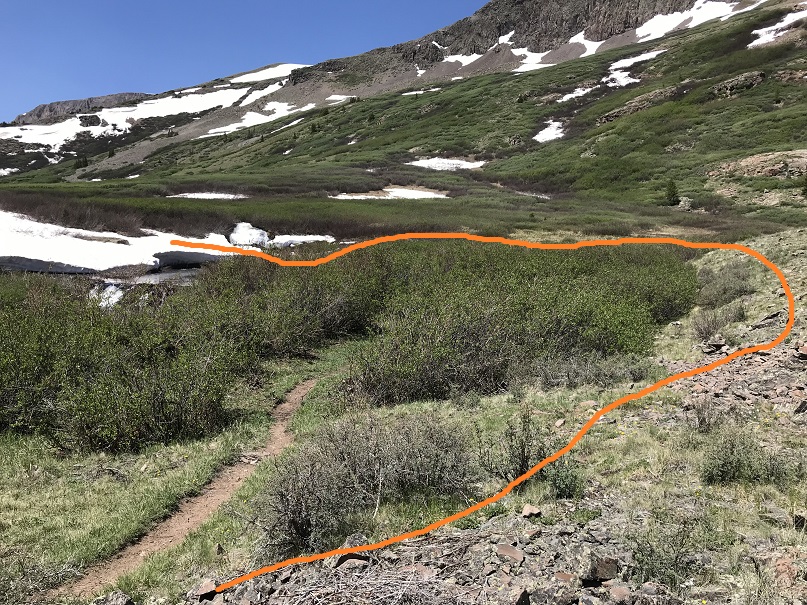
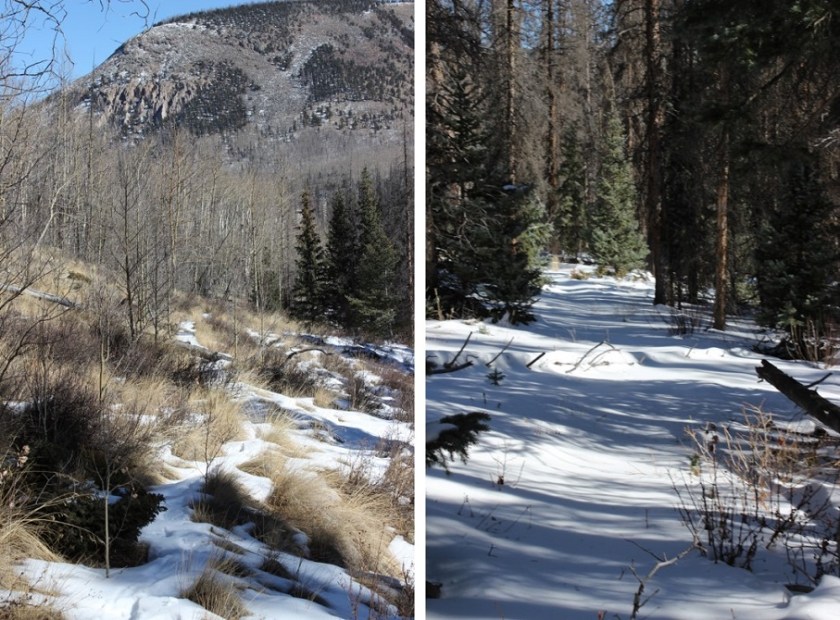
There was loose talus on the other side. My goal was to make it to the trees and then up to treeline.
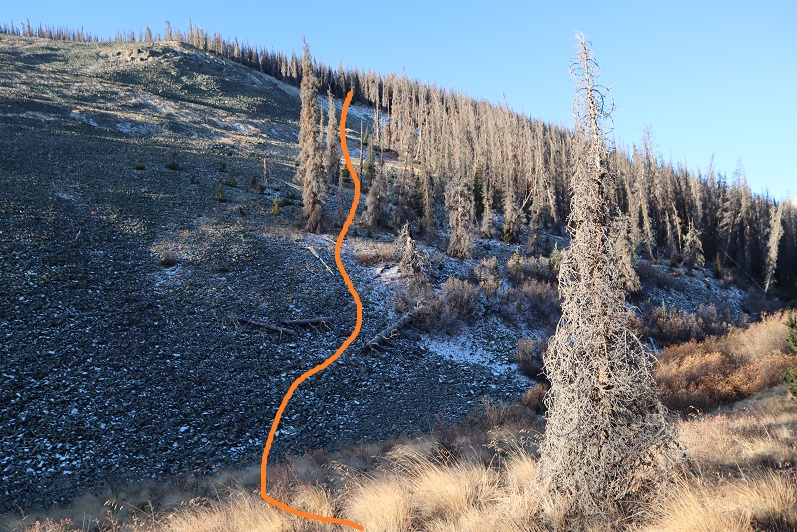
7

There was no trail, and once again the talus was very loose and would slide out from underneath me when I took a step. Once in the trees I just kept aiming southwest, looking for treeline
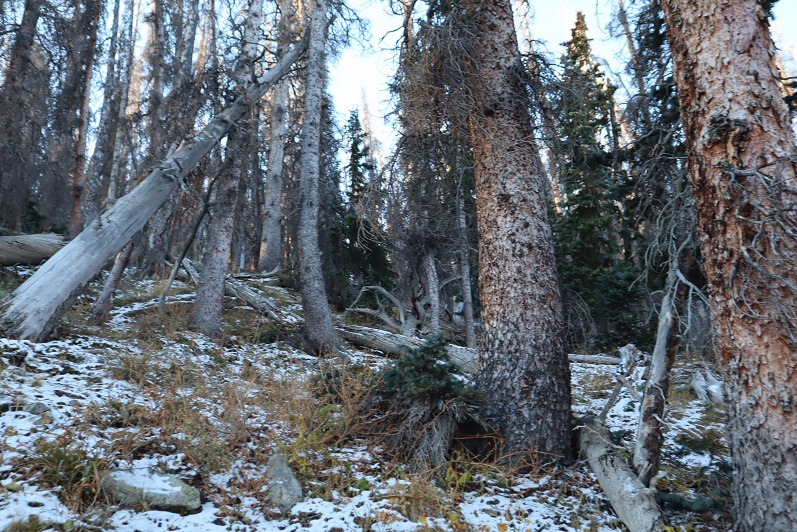
8

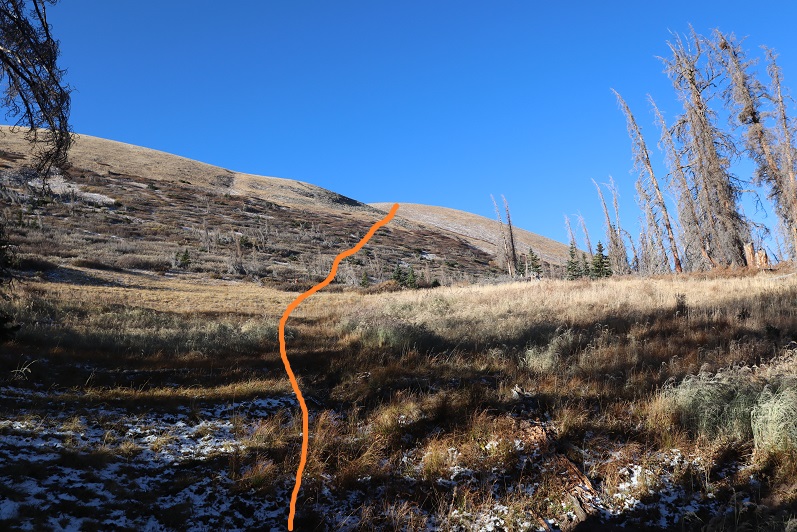
Just before treeline I came across an area where it was obvious elk frequently bedded down for the night. It felt special just to be hiking through the place.  Treeline actually came fast and I aimed for the ridge, knowing most of this hike would be above treeline.  Here I passed willows through game trails and some lose rocks (all class 2)
9

10

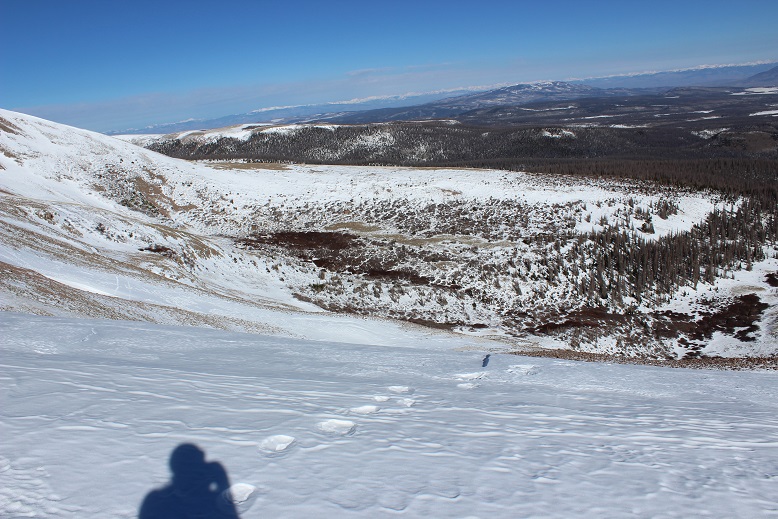
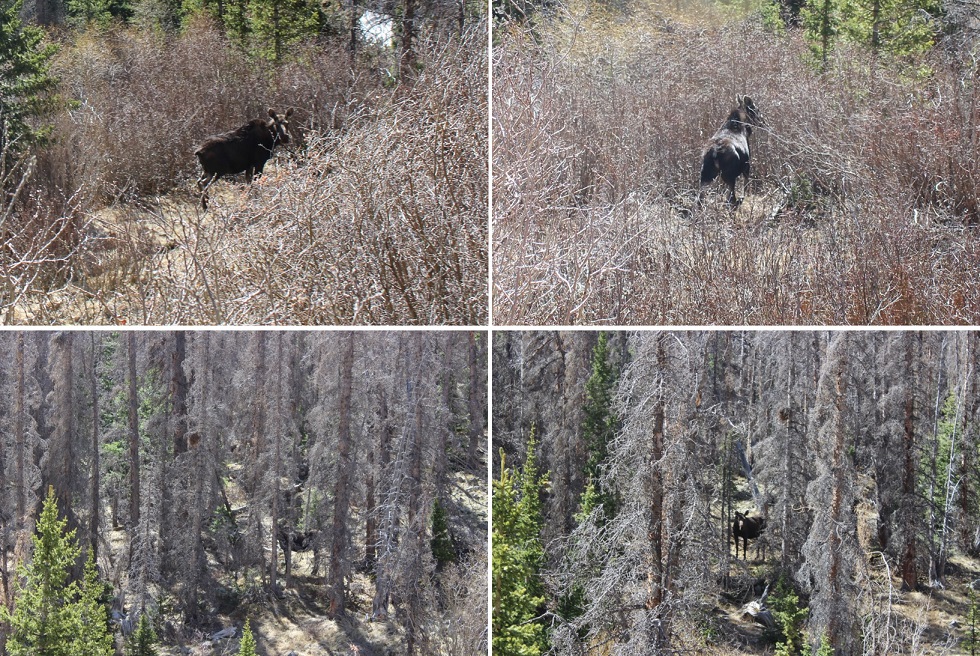
I was about halfway up the slope when I heard what sounded like a flock of seagulls conversing with a group of horses. Curious, I turned and noticed a herd of elk coming down the slope of Stewart peak. So cool!  They were making trails through the willows like nobodies’ business.  I followed them with my eyes, watching where they were headed.  I’d half expected them to make their way to the bedding area I’d just passed, but they turned and headed west, following the drainage.  I kept an eye (and ear) out for them as I made my way up the ridgeline.
11

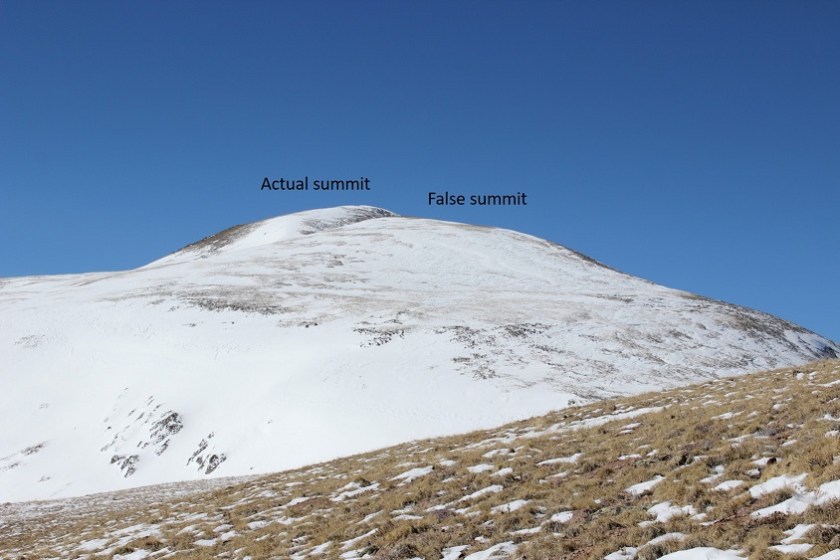
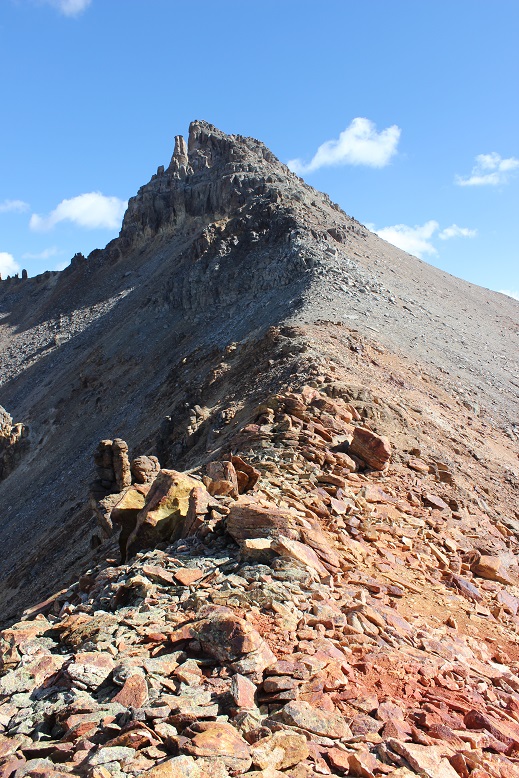
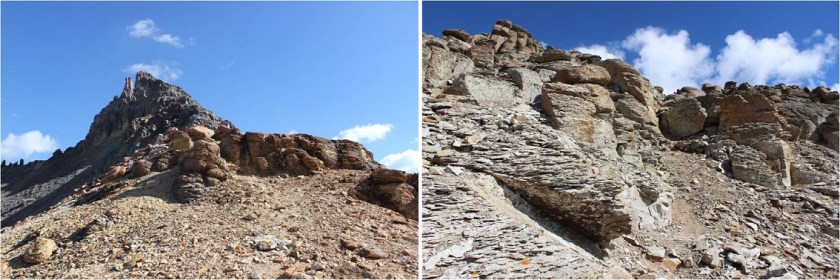
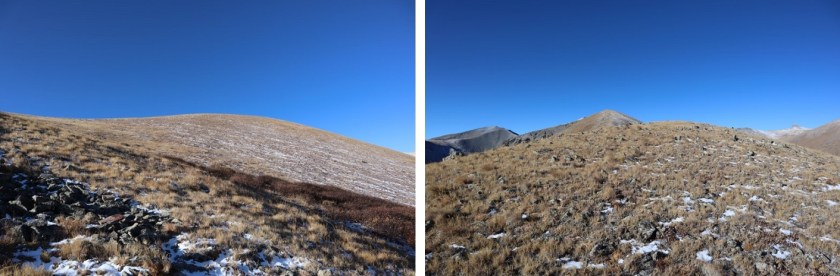
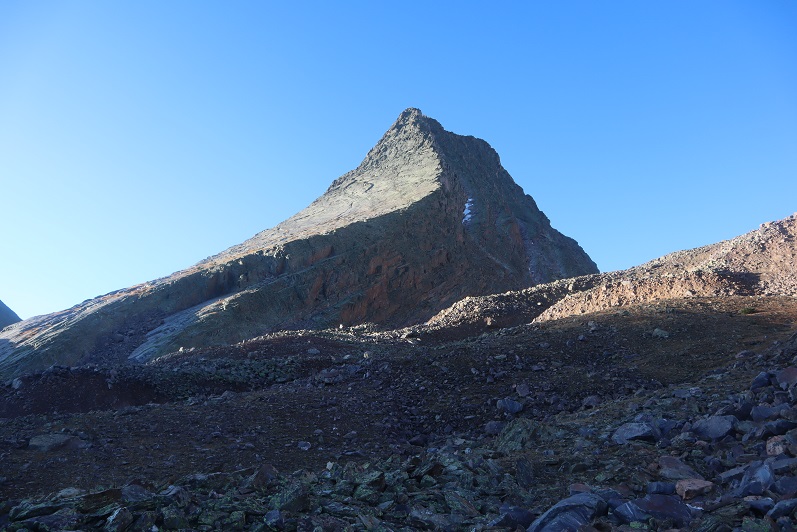
Last time I was here I hadn’t been able to see the summit due to clouds, so I wasn’t sure where the actual summit was. That ridge was long.  It felt like it took forever to climb, and every time I thought I was at the summit I realized it was a false summit and it was over the next hill.
12

The worst part? The wind.  Those 20-30mph winds never stopped.  The wind never got below 20mph, and several times I was knocked down by a gust.  I’m assuming the gust would have to be over 50mph to make that happen, so the forecast had been a bit off.  Wind chill with 30mph winds was forecasted today at -20, so it was cold, cold, cold.

The best part? My winter gear was working fabulously!  There was no way I’d still be hiking in these conditions if I was wearing my old jacket/gloves.  No way.  I could tell the wind was frigid but it was tolerable.  Snot was freezing to my balaclava and the top of my jacket which was a little annoying but I wasn’t miserable. I’ve found a lot of hiking is about being in a constant state of some sort of discomfort and getting past it to obtain your goal. Cold, yes.  Miserable, no.  Woot!  I have found gear that works!

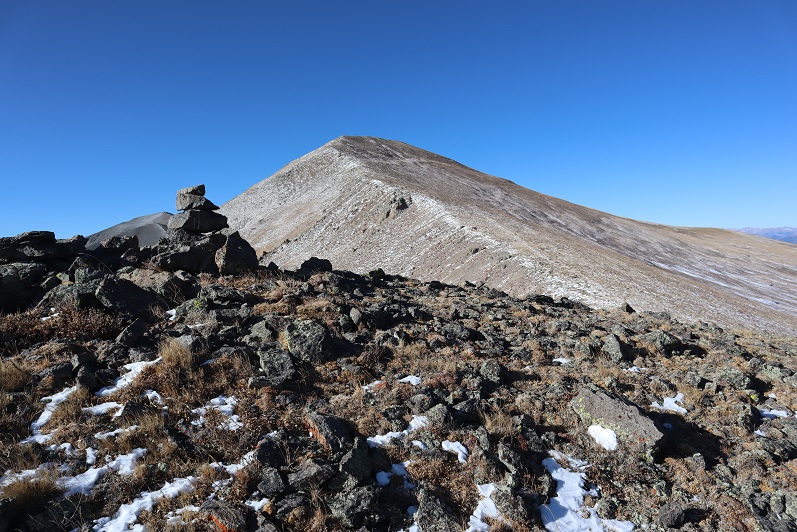
Finally, after 3 or 4 false summits I made it to a cairn and I could tell I was almost to the actual summit of Baldy Alto
13

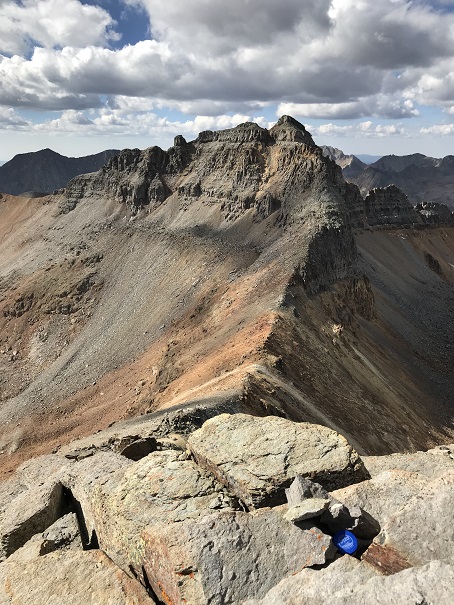
I’m not sure when I summited (I feared taking off my gloves for any reason due to the cold/wind to check my phone/time/etc), but I found with my new camera if I had a tool I could manipulate the buttons to take timed photo without taking off my gloves like I’d needed to with my last one. I found a pointy rock and made it happen (those buttons are small!).  It took about 15 minutes, but it worked!  High-Five to my new gear for making this possible!  Not sure how to take a video yet in these conditions (but I’m working on it).  There was no summit register.
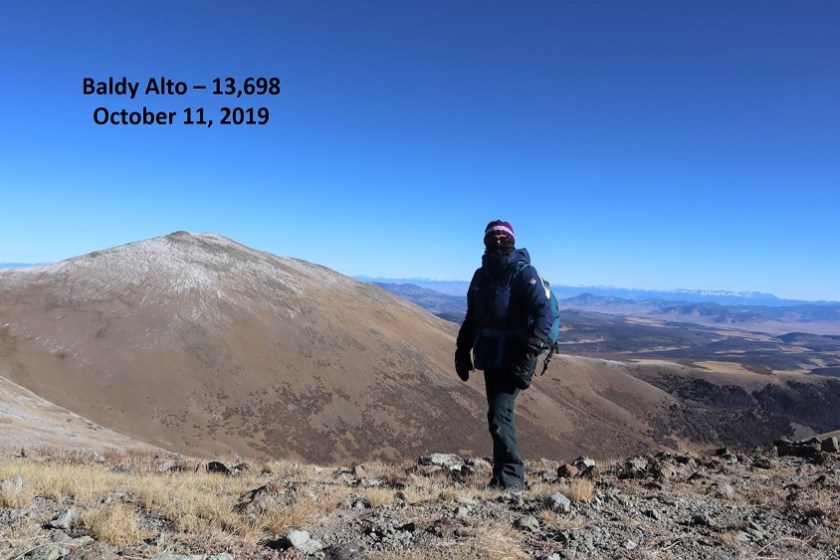
14

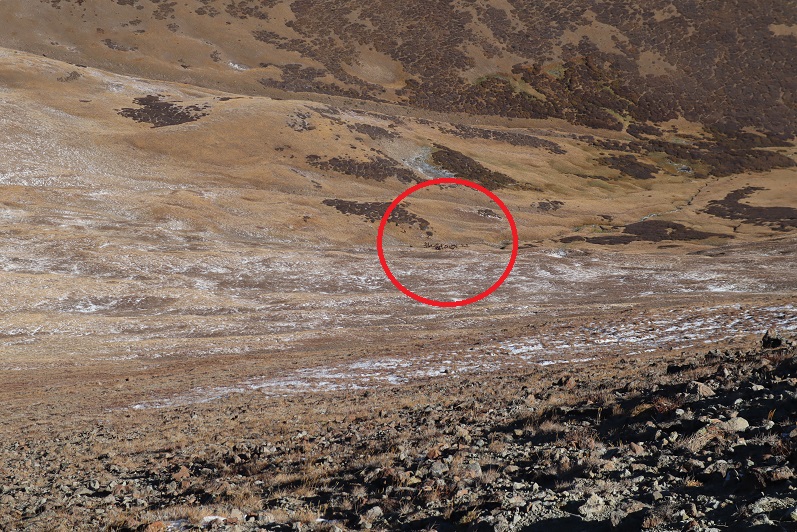
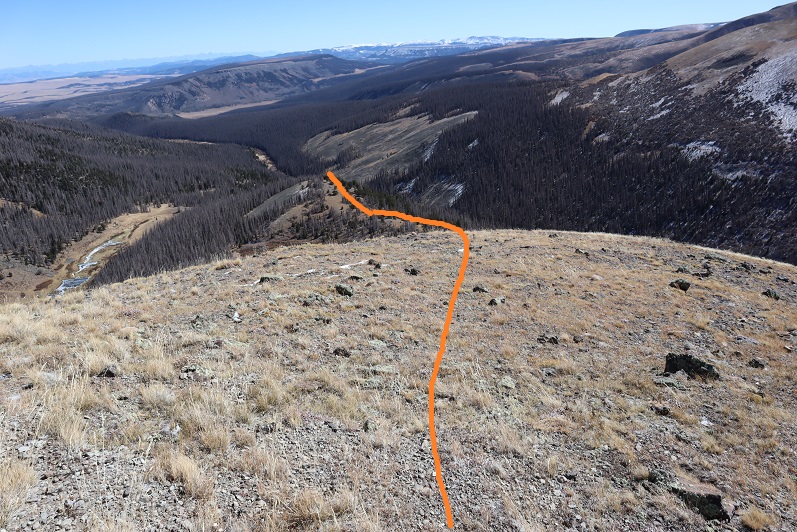
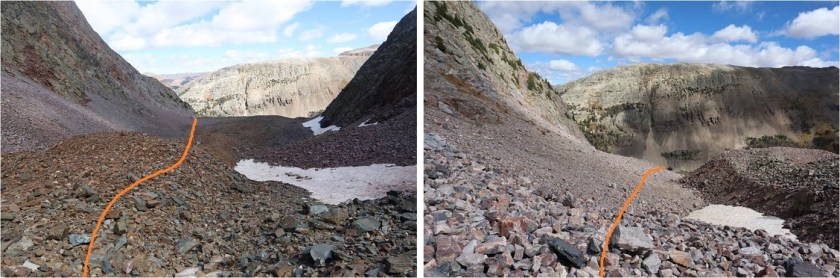
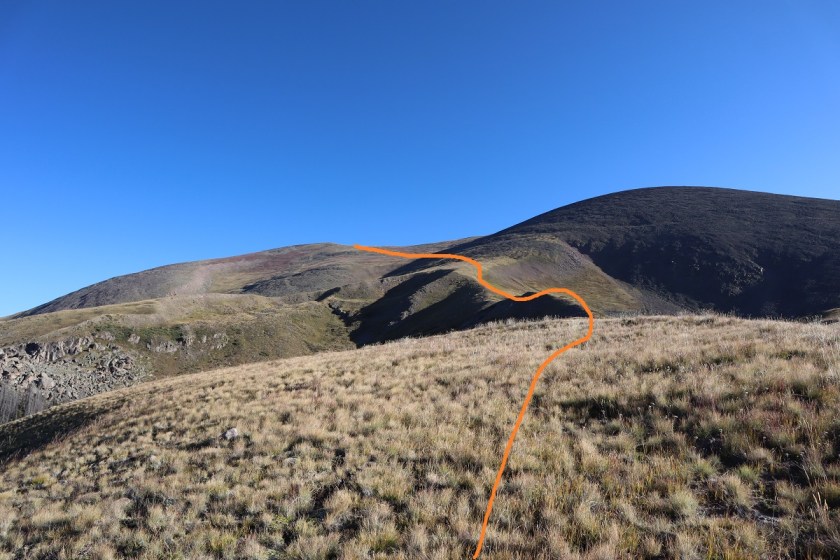
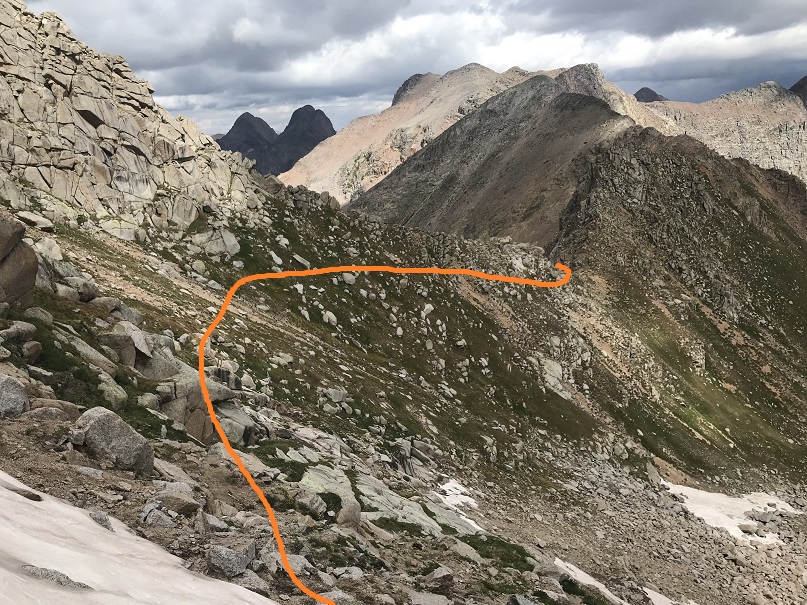
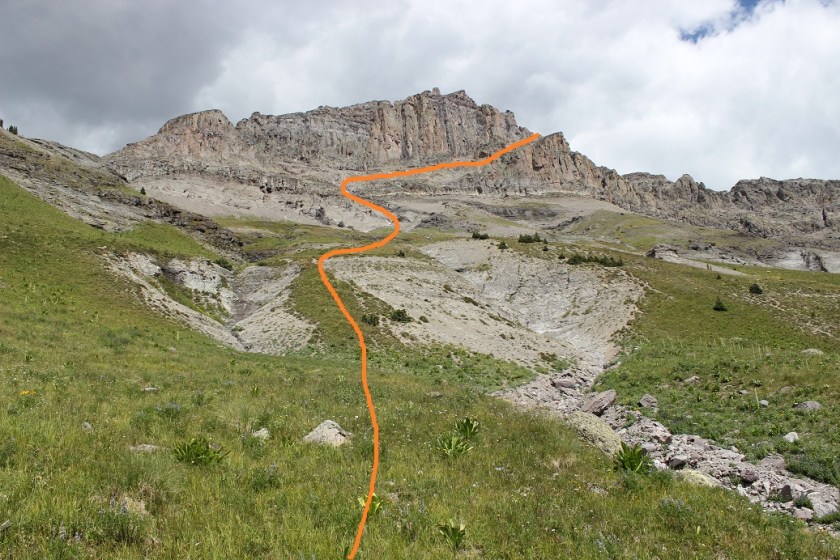
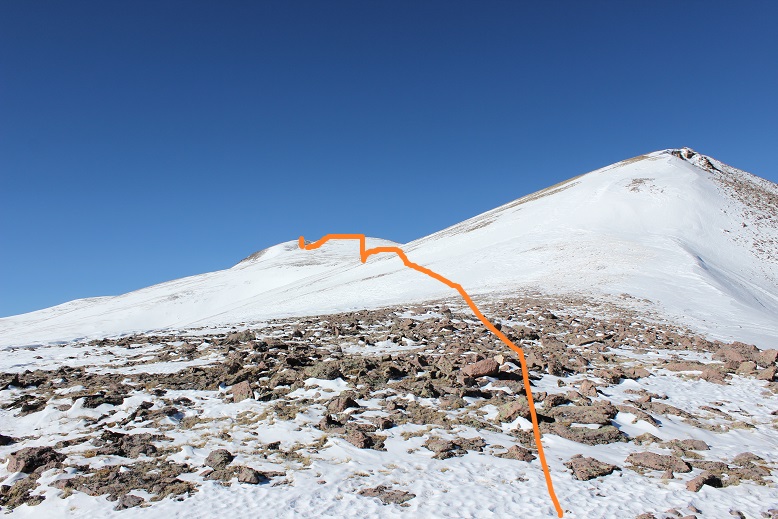
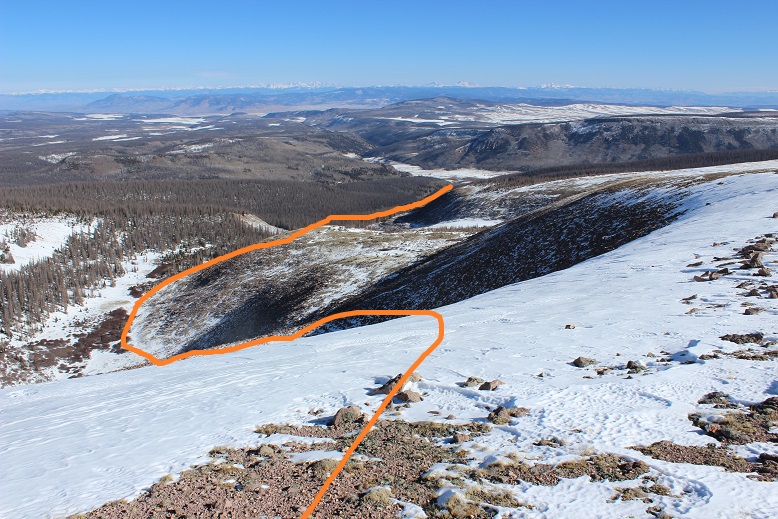
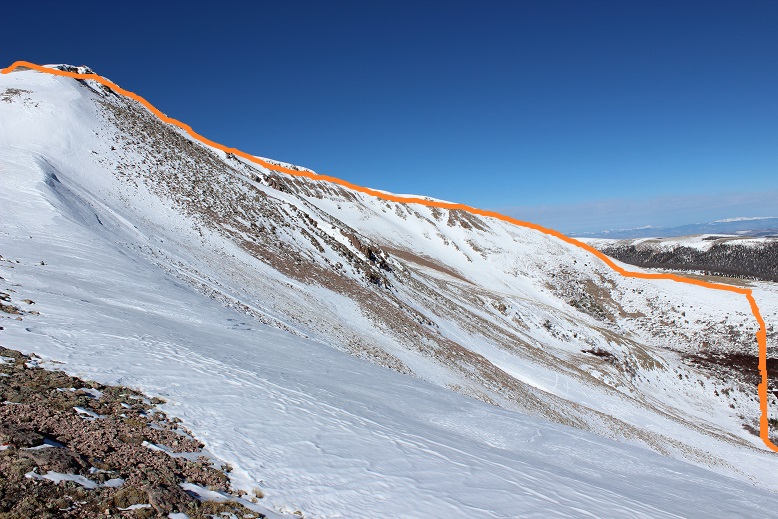
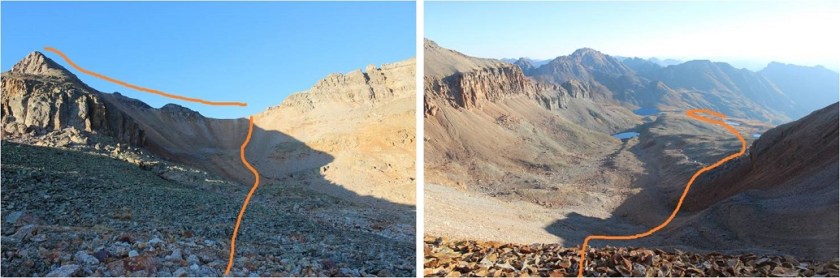
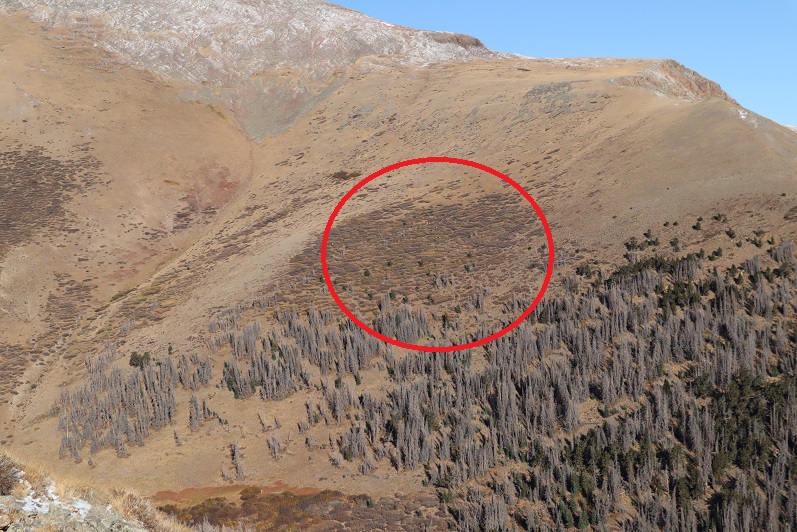
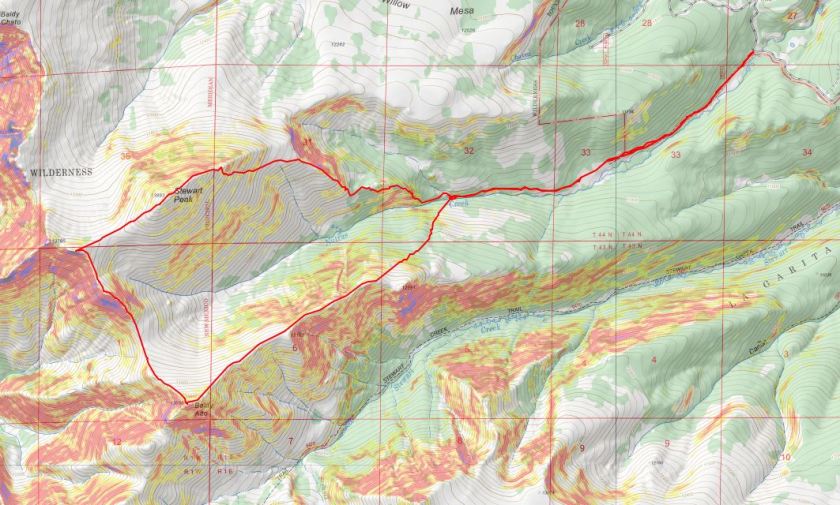
Despite the unrelenting winds I wasn’t unbearably cold and due to the minimal elevation gain/trail length I wasn’t tired yet at all, so I decided to take the ridge over to Stewart Peak. This is the route I took.  The elk are in the red circle at this point.  I could see but not hear them (the wind drowned out all other noises except its own howls).
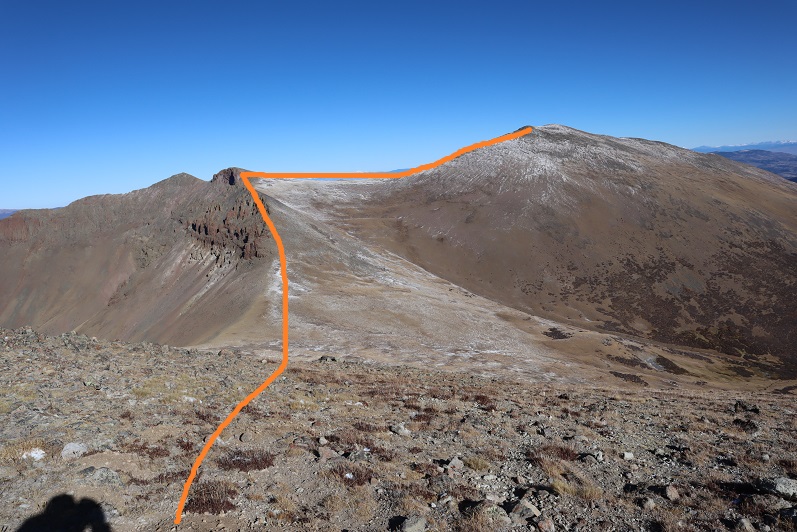
15

16

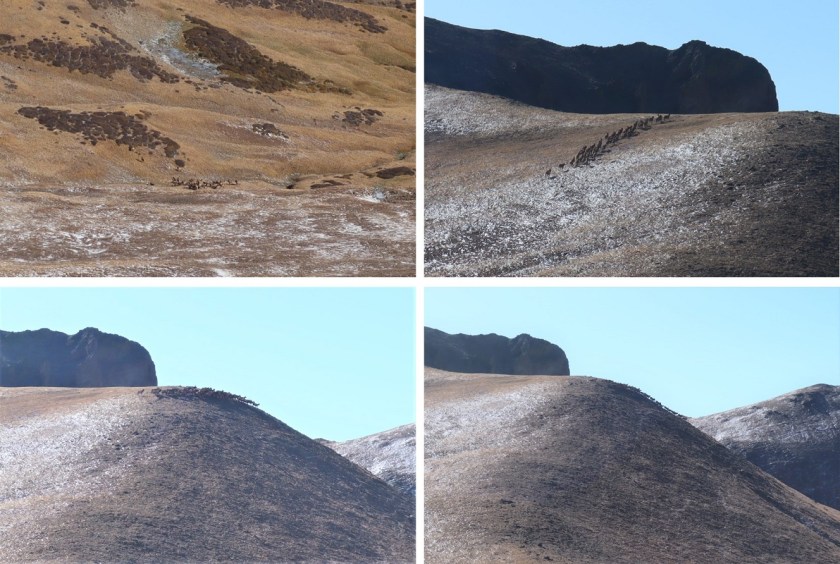
I aimed for the saddle. I’d been watching the elk for about 3 hours and thus far they hadn’t noticed me because I was downwind from them, but as soon as I hit the saddle that changed.  They could smell me now (if it hadn’t been for the intense wind headed their way the fact I’d been sweating for the past few hours meant I’d be hard to miss at this point even in lesser winds).  Their heads picked up and then each one looked at me and quickly fell into a procession.  They started moving together as one up the basin and onto the ridge I’d just crossed.  I found it intriguing a herd of elk would be intimidated by a single person.  They were all eyeing me, trying to sneak past me like a freight train.  I stood in awe for a moment, and then fumbled for my camera in the -10-20* weather (maybe colder with the higher than anticipated winds?). Knowing pictures would never do the experience justice I held the camera at my chest and just kept shooting, leaving my eyes free to take it all in.  It was magnificent, like something you’d see watching a documentary on National Geographic but on a much grander scale because I was in the middle of it and the reason behind their behavior.  I saw their eyes staring at me, their hooves stomping the dirt to dust, their heads moving up and down, the warm breath puffing from their noses into the cold air, and the muscles in their legs charging them forward.  They each looked at me individually but moved as one, up and over and down the hillside.  Wow.  Just… wow.  I didn’t want the experience to end, but they’d moved on and it was time for me to do so as well. The pictures really don’t do justice to the occasion.
17

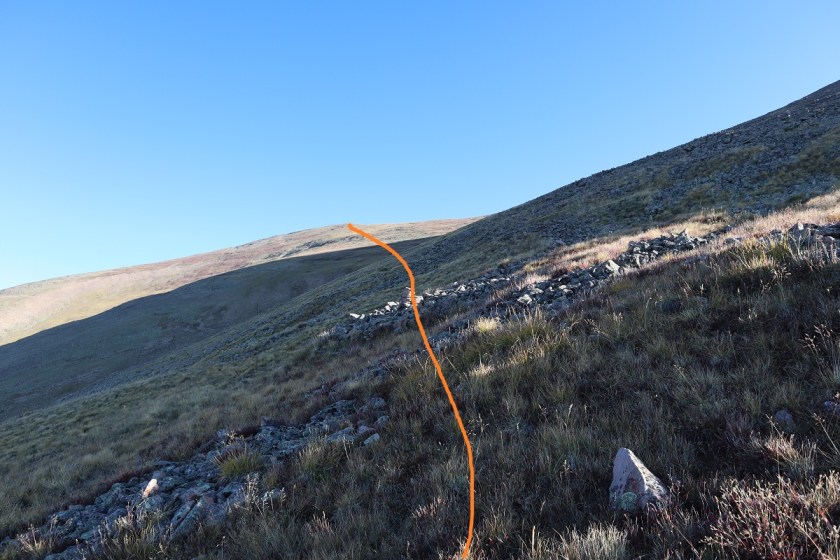
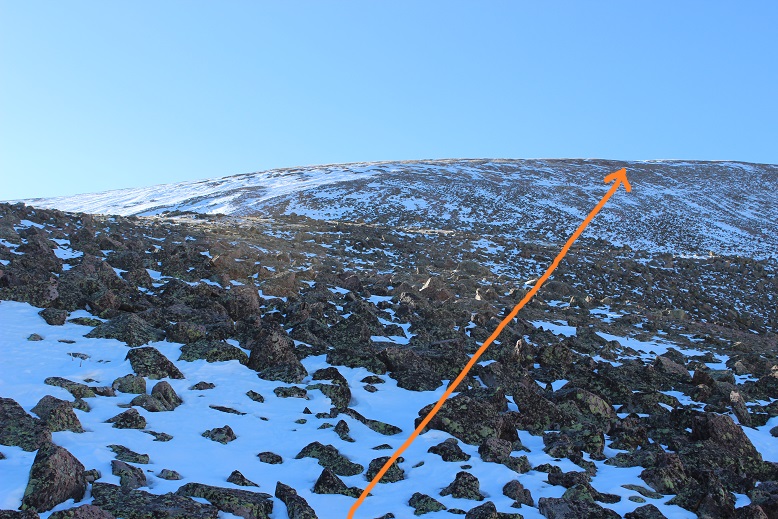
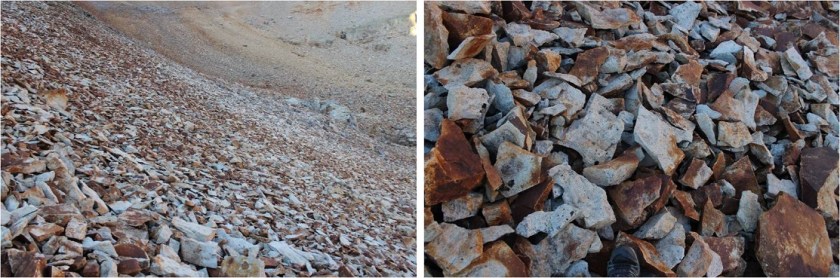
This next part of the hike was class 2, up and over the ridge on large, loose talus.

18

I continued along the ridgeline to this point. I’d thought this was Column Ridge and the point beyond was Point 13,795, but apparently the point beyond is the only one that’s a 13er (it’s not ranked).
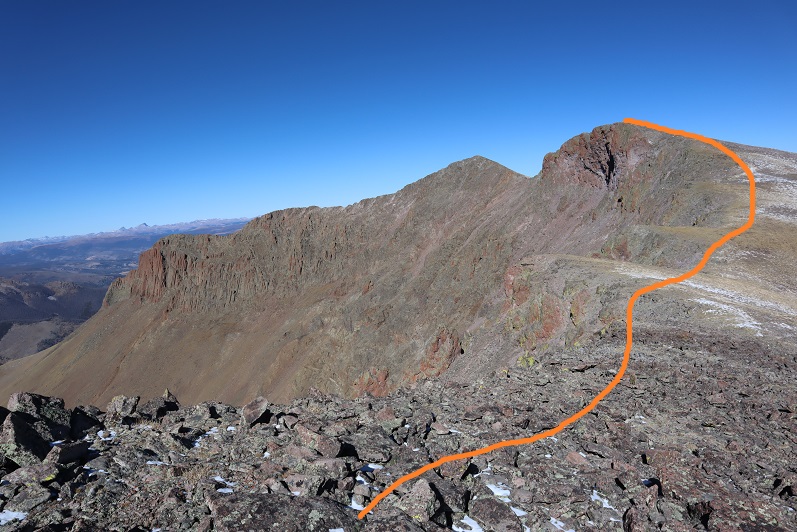
19

Oh well, that’s what I get for not taking out my map. There was a marker here though…
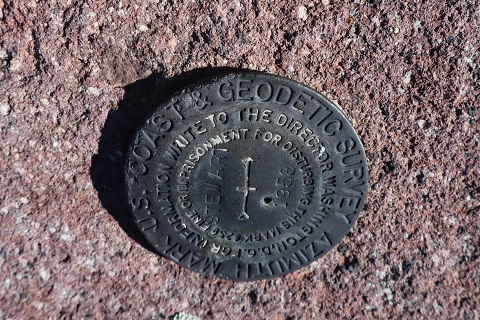
20

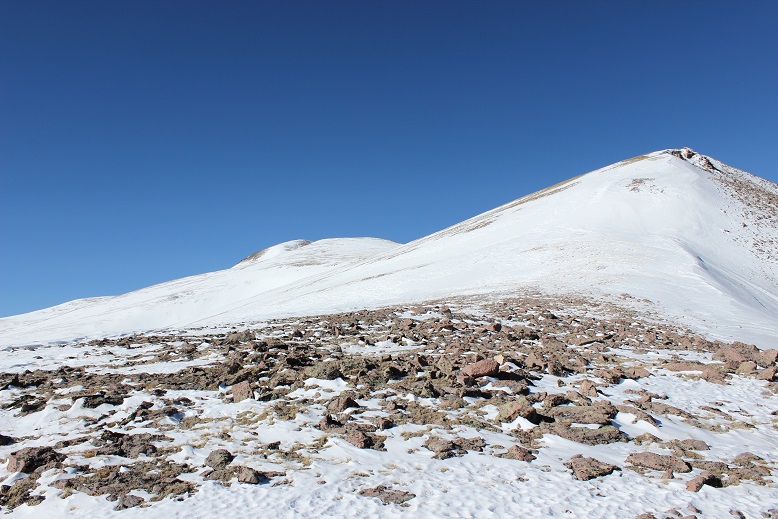
Time to head over to Stewart Peak. This was an easy trek
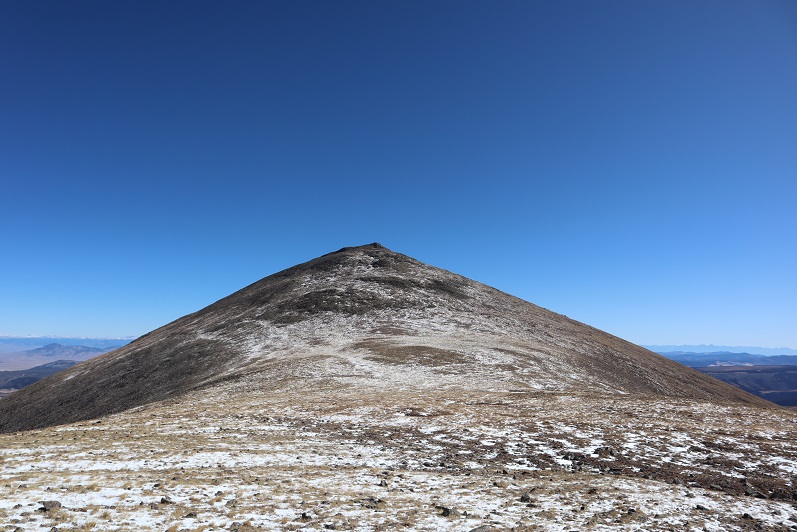
21

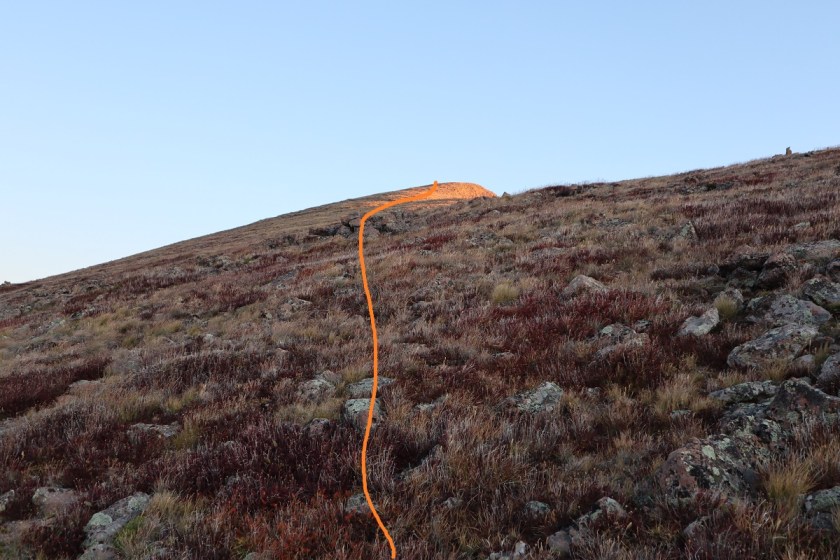
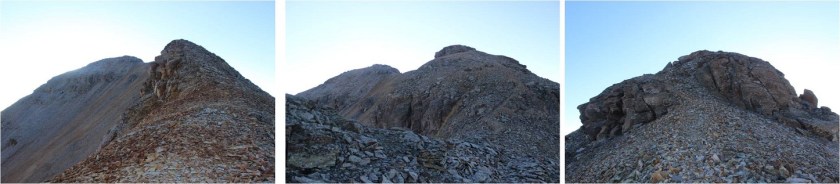
The last part looked like it might be tricky, but it wasn’t. I just continued up and over class 2 terrain
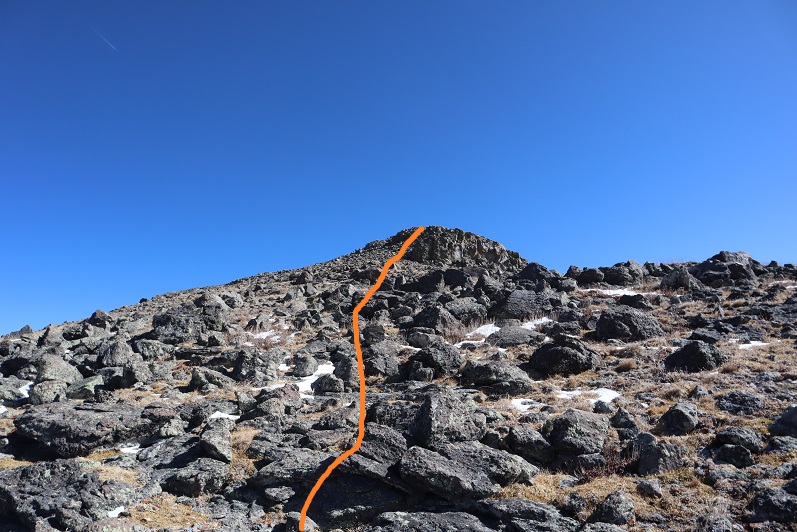
22

And then walked the rest of the way to the summit.
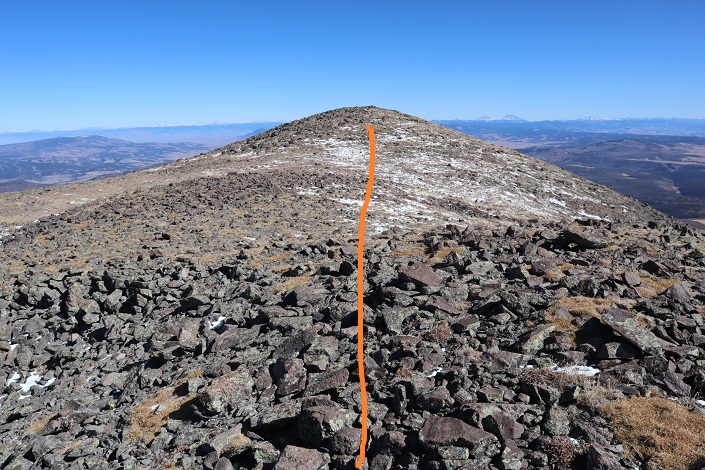
23

No videos today of the summit(s) due to cold/wind. I was able to get another summit photo again using a pointy rock.  I had a pencil and stylus in my pack, I just didn’t want to take off my pack to get them out because my gloves are cumbersome.  I’m thinking I’ll keep them a little more handy next time, and this week I’m going to attach longer strings to the zippers of my pack so it’s easier to open/close with my bulky gloves.  Also, I’m smiling in this picture.

24

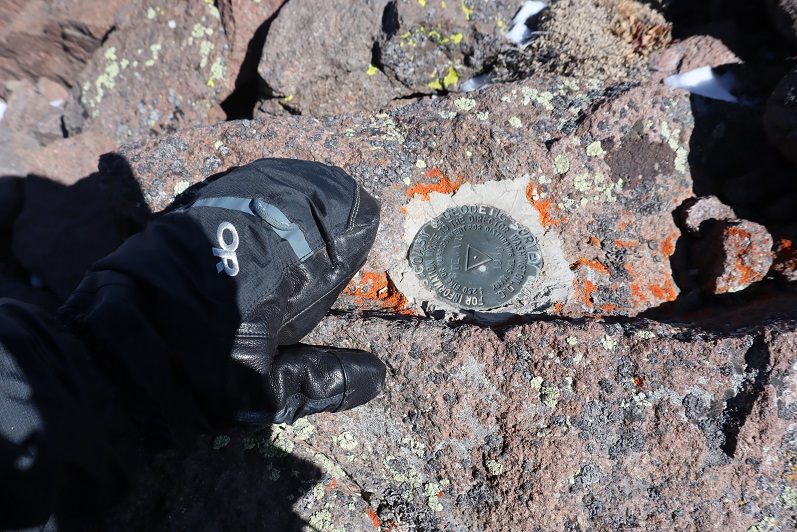
There was a summit marker here too… but no summit register
25

The hike today had seemed too easy. The most difficult part was dealing with the insane wind.  I hadn’t thought about it before starting out, but I didn’t know how to tighten the strings around the hood of my new jacket to make it fit my face, and once out there hiking I wasn’t able to figure it out without taking my jacket off.  Since I wasn’t about to take my jacket off in these conditions I resorted to placing my hand on top of my head to keep the hood from blowing off when hiking into the wind.  Not ideal, but it worked.

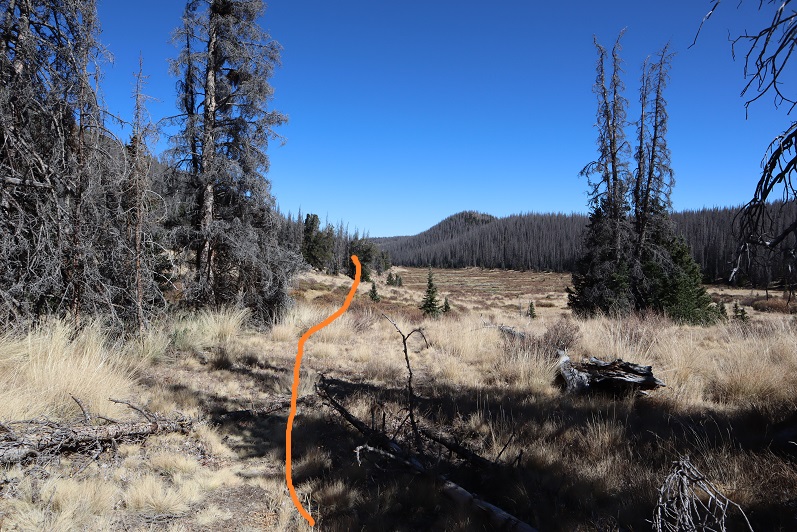
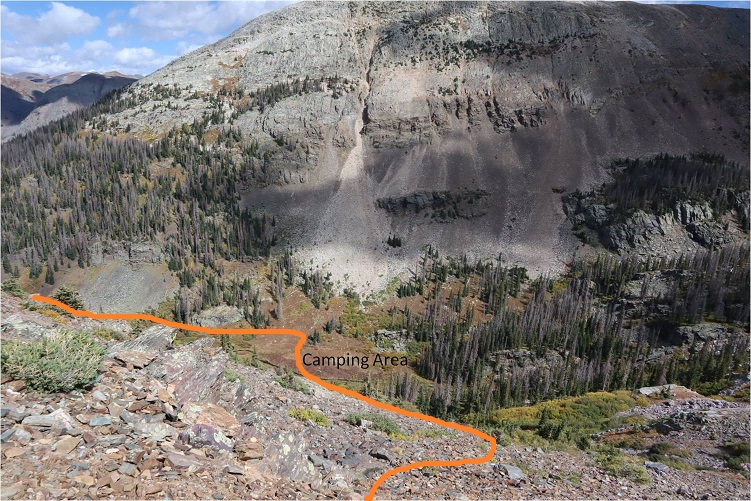
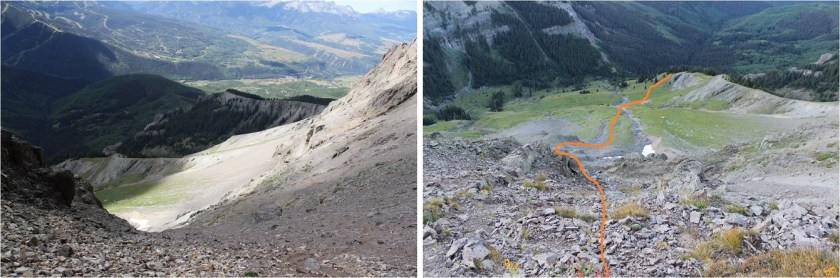
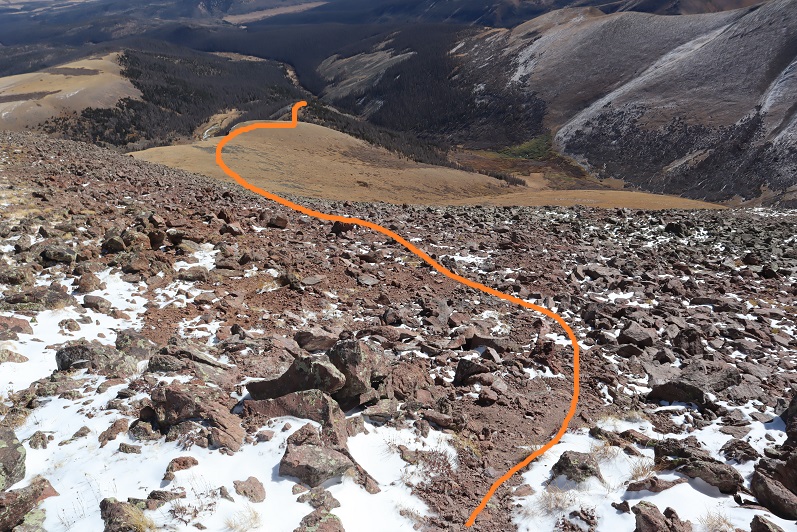
The trek down from Stewart Peak was actually kind of fun. I decided to just “wing it” since I’d been here before, and I didn’t take out my topo/etc.  I just followed the ridge to the end and aimed for the creek, knowing it would lead me eventually to the trail.

26

27

28

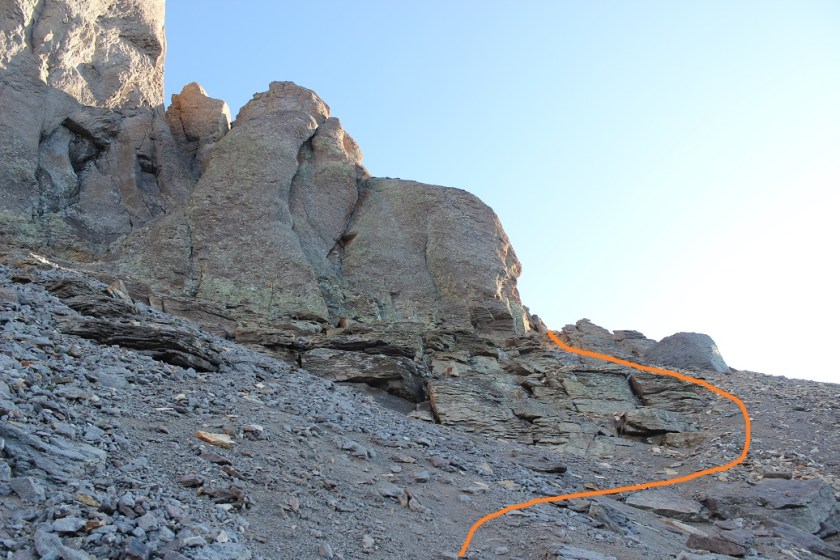
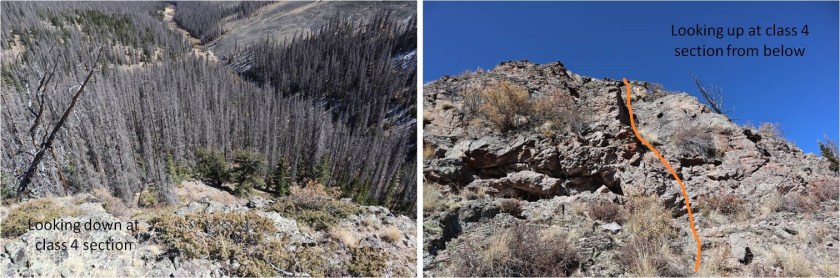
I’m not recommending this approach unless you have good route finding abilities and you like to rock climb because I made it to a section I’d label as class 4. I love to boulder so I went through this area with vigor instead of looking for another way around, but if this not your cup of tea follow the standard approach down Stewart Peak to the creek.
30

Also, there are tons of game trails here that look like actual trails but lead nowhere. It’s a bit… misleading.

31

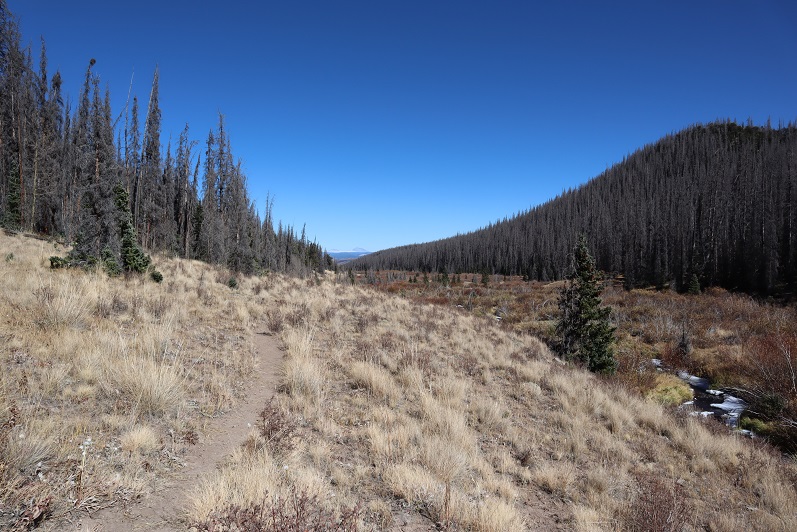
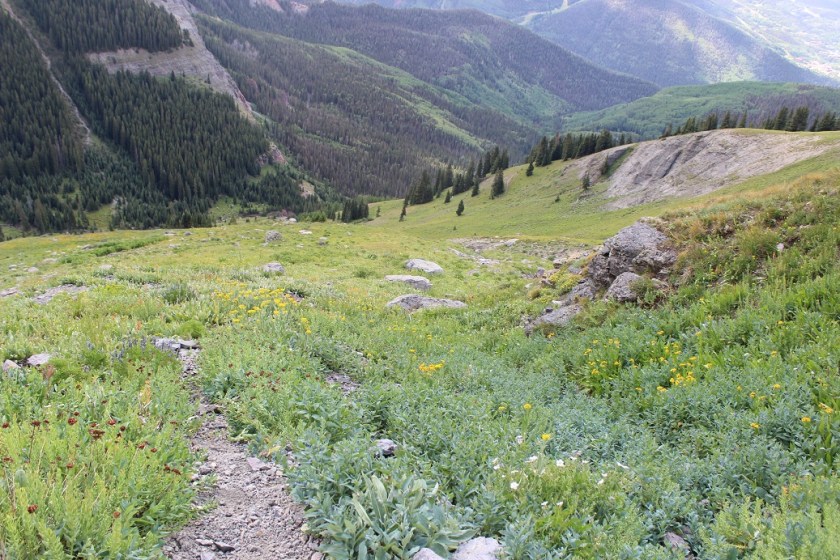
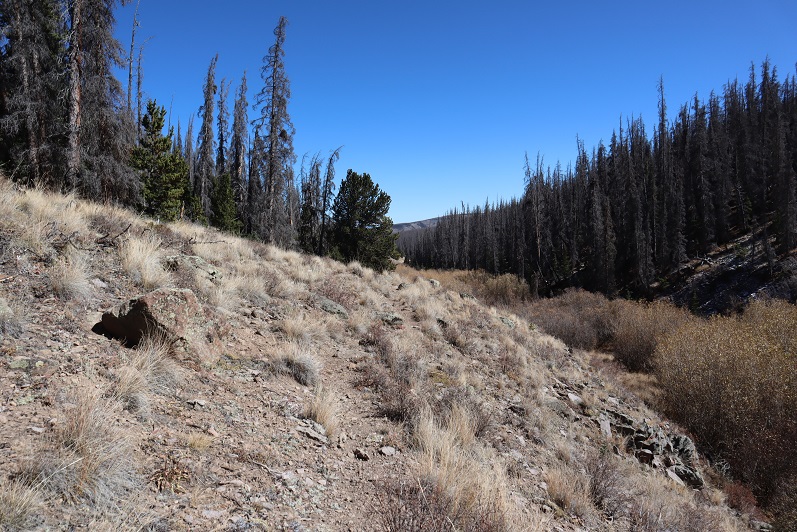
By keeping the creek in sight I was easily able to link up again with the trail out.
32

33

34

The entire time down I was thinking of how much easier this hike had been taking Baldy Alto first instead of Stewart Peak: the elevation gain had been more gradual and if I were to do this loop again I’d start with Baldy Alto. Once I made it to treeline the wind stopped and I could hear elk conversing with each other through the area I’d hiked that morning.  That got me wondering if there’s more than one herd up there, or if it was split up?

I made it back down to the trailhead and there was more gear at the campsite than when I’d passed it this morning. There was a young gentleman of about 25 years sitting in a camp chair, dressed head to toe in camo.  There were guns and archery equipment propped against the trees and a second tent set up.  He stood up when he saw me and said hello and asked me where I’d been.  I could tell by his accent he was from the south and my heart melted a little bit.  Apparently the check engine light had gone on in their vehicle so the rest of his party had gone to Gunnison to get it checked out.  They were here hunting elk and had spent last week in Wyoming hunting antelope.  He dripped of congeniality.  I’m a sucker for a well bred southern man and if he’d been around 40 years old and single I would have prolonged the conversation by telling him where he could find those elk.  Instead I wished him good luck and went back to my truck to clean up and head home.

I started at 7am and finished at 2pm, making this an 11 mile hike with 3961’ of elevation gain in 7 hours.

35

36

Please don’t judge me (too harshly) and know no one is paying me to say this, but the jacket I got was the Wantdo Waterproof Ski jacket (I’m not yet sure if it’s actually waterproof but others tell me it is).  It worked so well and exceeded my expectations, especially for such a low cost jacket (under $100).  I’m not sending it back and look forward to an awesome winter adventure season!  The gloves and socks and pants were phenomenal as well.
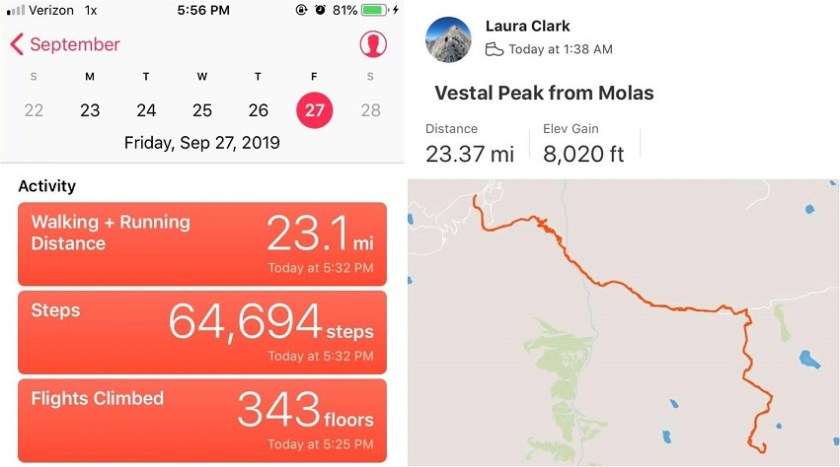
#100 Vestal Peak – 13,867

1

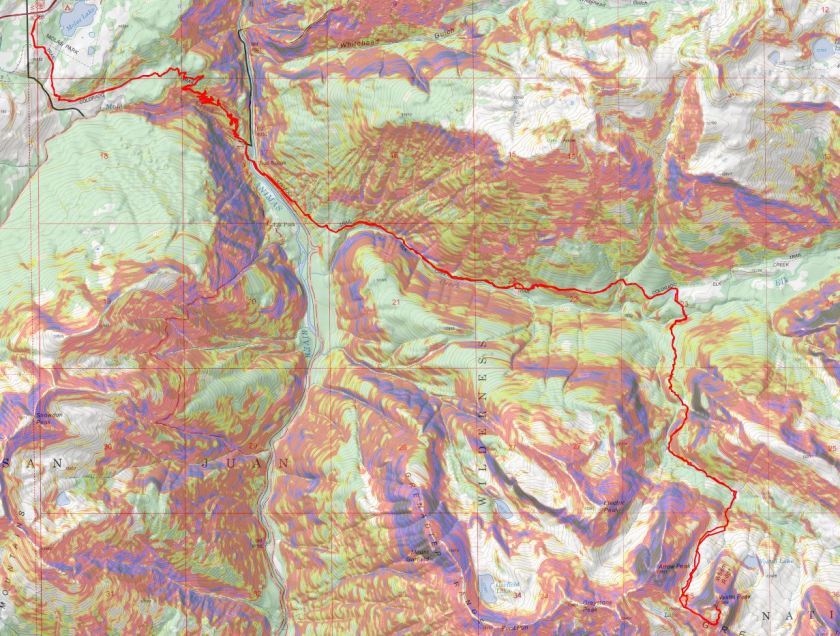
RT Length: 23.5 miles

Elevation Gain: 8020’

After a full week of work in Tennessee where I gorged myself on comfort food (fried chicken, fried oysters, collard greens, cornbread, etc.) and went highpointing in Mississippi because I could, my flight got in at 1:30pm and I drove from Denver to Molas Pass and slept for about 3 hours in my truck before waking up at 1:30am and hitting the trail.  There was one other truck in the large parking area when I arrived.

2

I checked the weather reports and anticipated rain/snow/wind for today so I put on my snow pants and went light on gear. Initially I’d planned on camping in the Vestal Basin and hiking Arrow and the Trinities as well, but with snow in the forecast I decided to make this a one summit/day trip.  The trail started at the south end of the parking lot.  It was really easy to follow and had plenty of signs

3

For about a mile the trail stayed pretty much level, and then it descended 1500+ feet down to the Animas River

4

At 3.8 miles I crossed a small creek

5

And heard a rustling in the bushes. I knew there was an animal about 6 feet off the trail, and it felt larger than a coyote but smaller than a bear. I tapped my trekking pole loudly against a rock a few times to flush it out/scare it away.  Usually when I do this the animal quickly runs in the opposite direction, but this time it started advancing towards me in the dark.  Thinking this was not a good sign I braced myself as the animal came closer to me, moving through the tall brush.  Was it a rabid raccoon?  A baby bear? (I swung my head from side to side:  Oh no!  Where’s mama???) and then suddenly it was on the trail in front of me and I realized it was a rather large beaver.

6

This beaver wanted nothing to do with me, it was just aiming for the trail as an escape route, and kind of looked like a land manatee (BTW, I just finished reading the book “On Trails” by Robert Moore and the experience of hiking has broadened for me and I was immediately reminded of why animals are attracted to trails. It’s a good book with no direct conclusion but connects many aspects of hiking:  you should check it out).

Seeing the beaver was cool: it was much larger than I thought they’d be.  The downside?  I had the “Beaver Song” in my head for the next 2 hours. Not as much fun as it sounds…

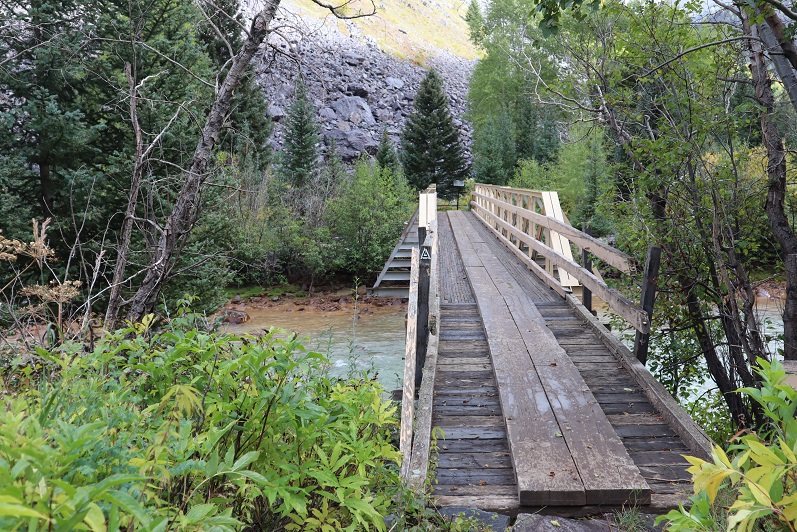
At 3.9 miles I crossed the bridge that goes over the Animas River

7

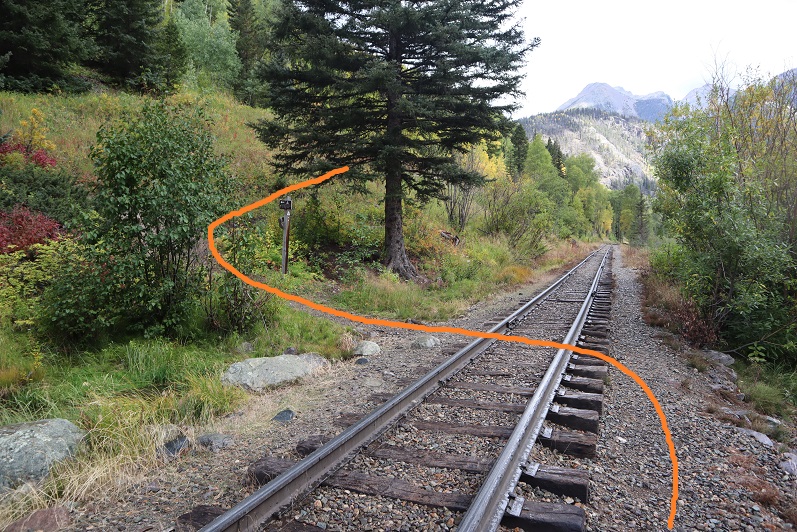
Turned right (southeast) and followed the train tracks for about a dozen yards, crossed the tracks, and followed the trail up the mountainside.

8

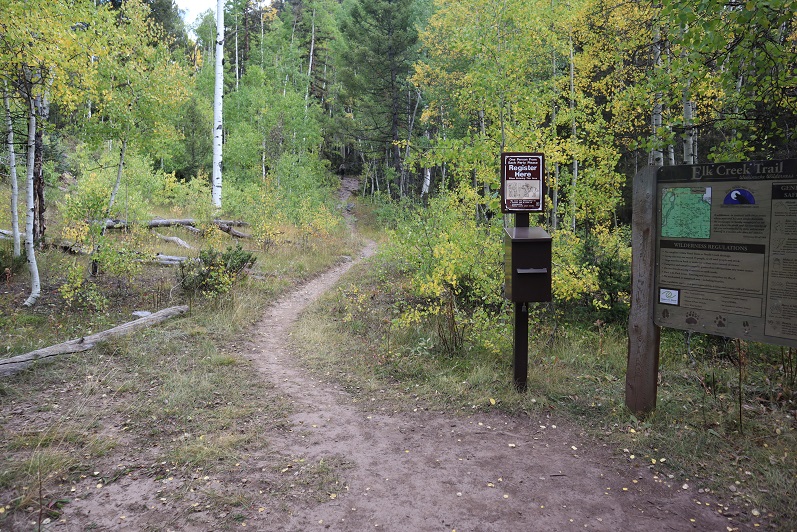
At 4.7 miles I came across the trail register and signed it in the dark.

9

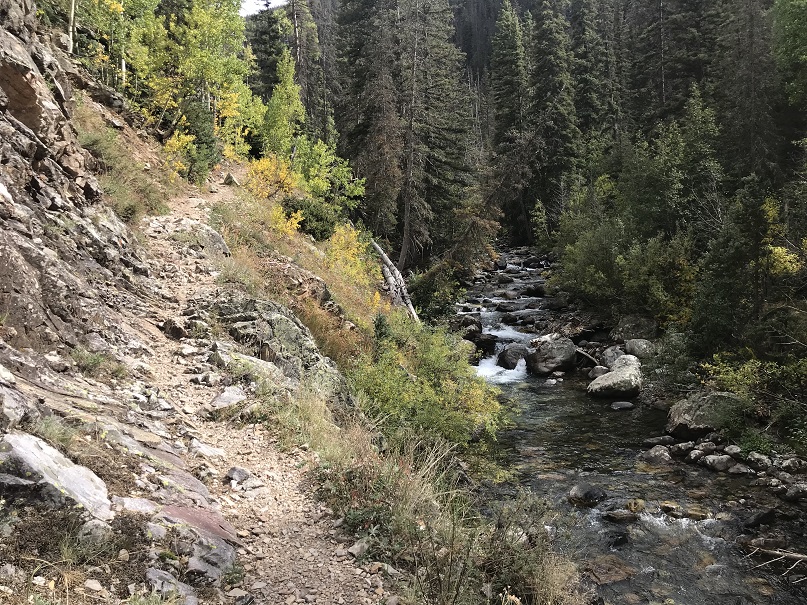
The trail parallels Elk Creek

10

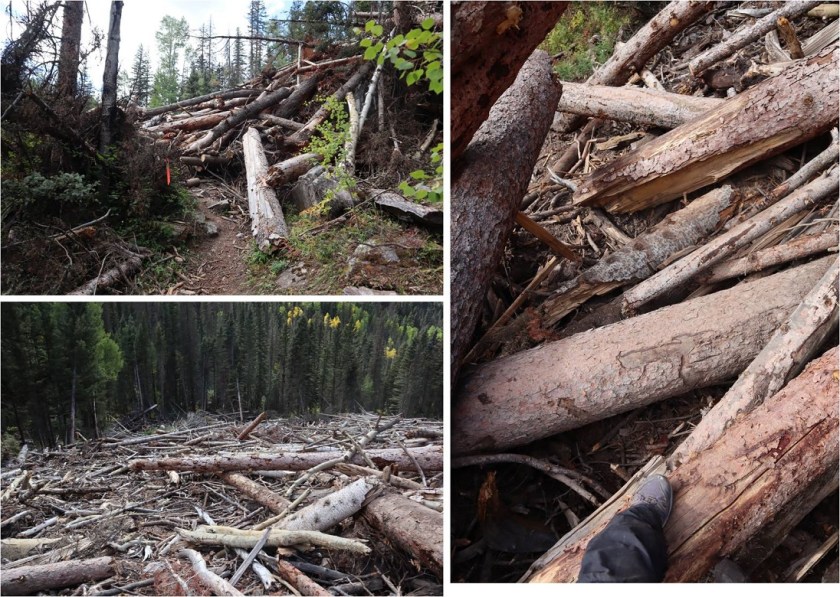
At 6.1 miles I came across the first area of avy debris. I’m guessing there were 3-4 slides all in close proximity that kind of ran together.  I’d heard there’d been avalanches here and to just follow the marked tape through them, but was surprised at how dense and large the debris was.  I was able to follow the marking tape easily through the first area but got lost in the second and ended up climbing a little higher than necessary.

11

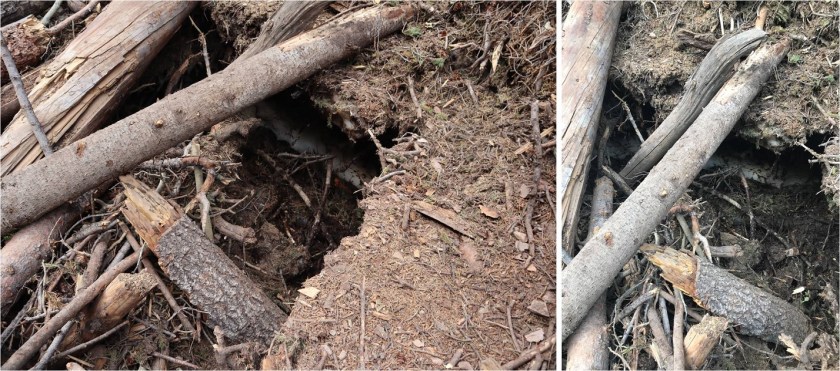
In the daylight I had no issues getting across the debris, but noticed there’s still ice and snow under the logs that’s melting and forming caverns, so be careful where you step! There were flies circling the debris.

12

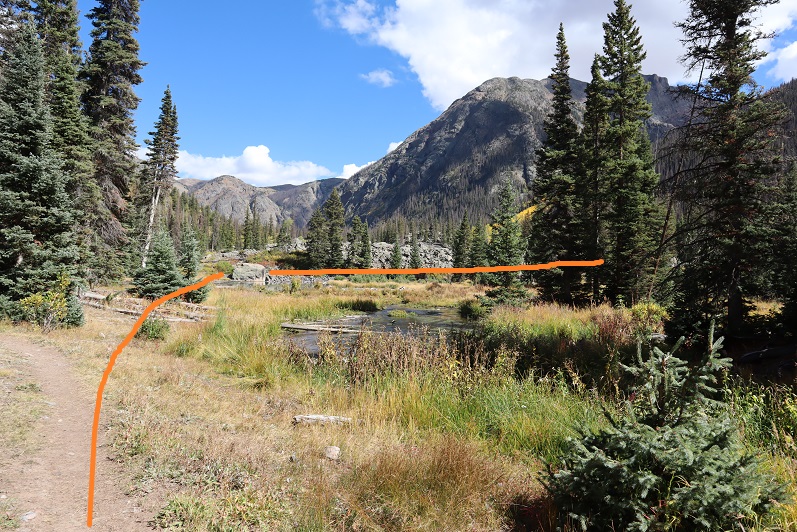
After the avy area I came across some beaver ponds and turned right (south). The best place to do this was just after the large boulder:  the trail parallels a pond at this point

13

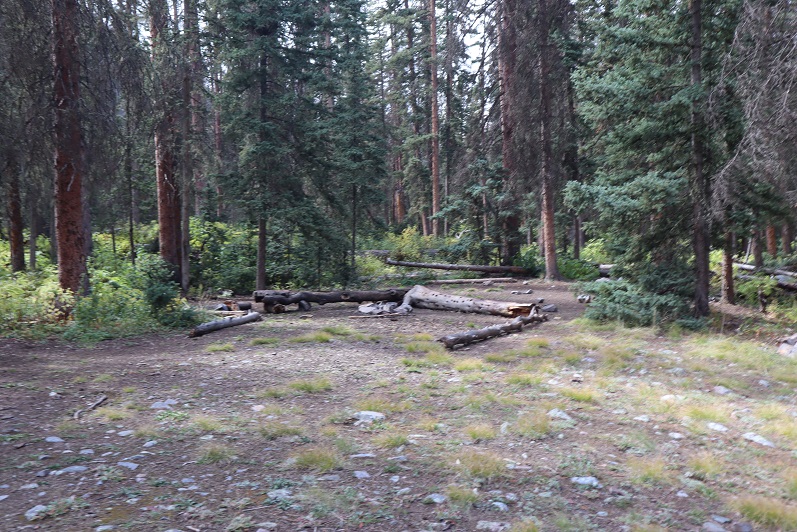
There was a good camping spot after the beaver ponds. Side note: anyone else’s carabineers hanging off your pack double as bear bells?

14

Mile 7 was the mile of creek crossings. What I couldn’t tell in the dark was this was some extremely clear water (it was refreshing on the way back to dip my bandana in it and cool off).  All of the creek crossings were easy and had several options (rocks and fallen trees abound)

15

The trail continued to climb up the mountainside. There were frequently fallen trees on the trail (not from avalanches) but they were all passable and for once I celebrated in being short because I could pass under them easily.

16

This part of the hike was really cool because I started hearing elk bugling. I tried to get some of it on video but it’s hard to hear (turn your volume to the max).  The bugling lasted for over an hour and came from all directions.

Elk Bugling:

The trail was well defined all the way to the basin. I reached the basin at 9.1 miles, just as the sun was coming up.  There was a light dusting of snow on the Trinities.

17

I followed the trail through the willows and lost one of my gloves. No worries though, because of my Raynaud’s I always bring at least 2 pairs (I had 3 today).

18

There’s an obvious campsite in the basin. I turned right (southwest) at the campsite at 9.8 miles- 11,380’, careful not to make too much noise because the campers were obviously still sleeping.

19

The trail crosses another small creek

20

And then climbs up the hill to another (rocky) basin/amphitheater

21

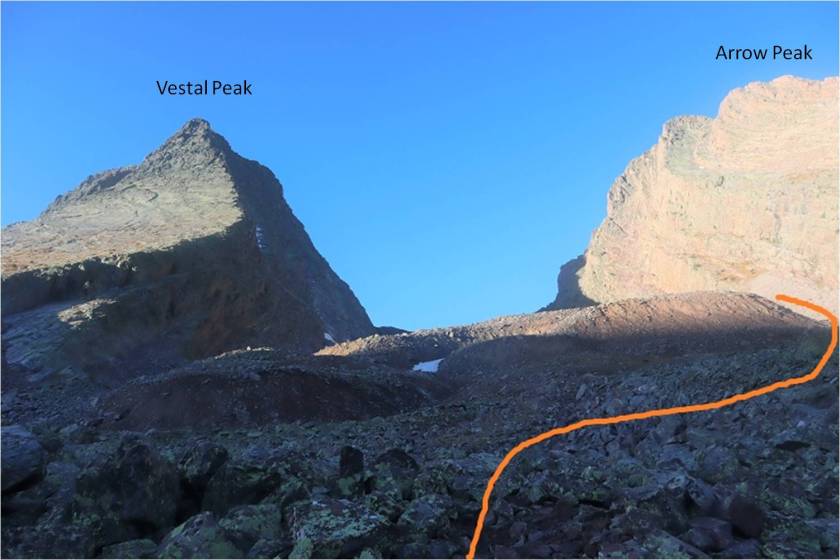
This is where the trail ends. I made my way over the talus, hiking closer to Arrow than Vestal

22

23

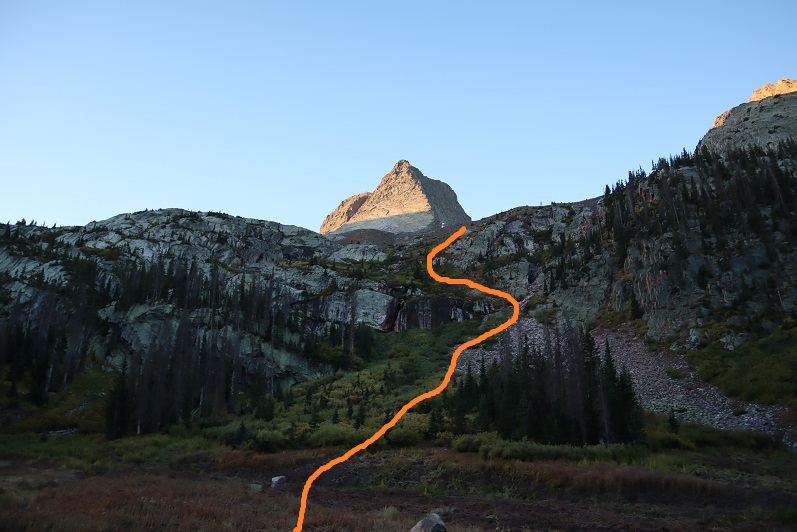
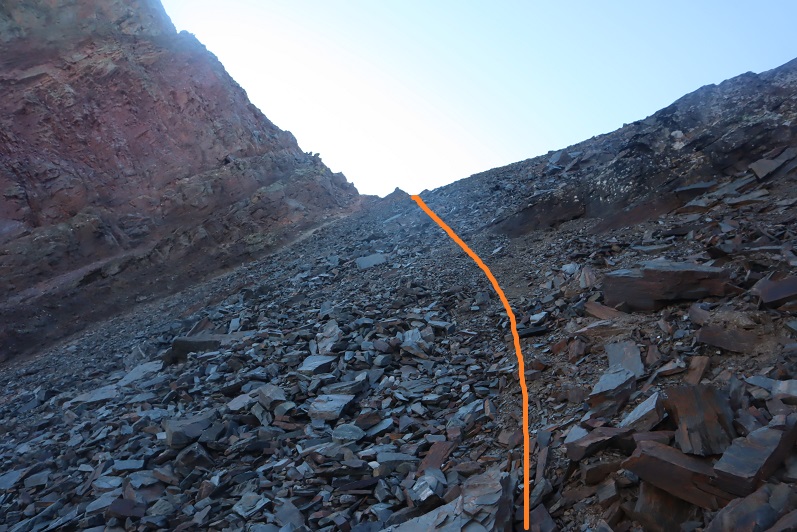
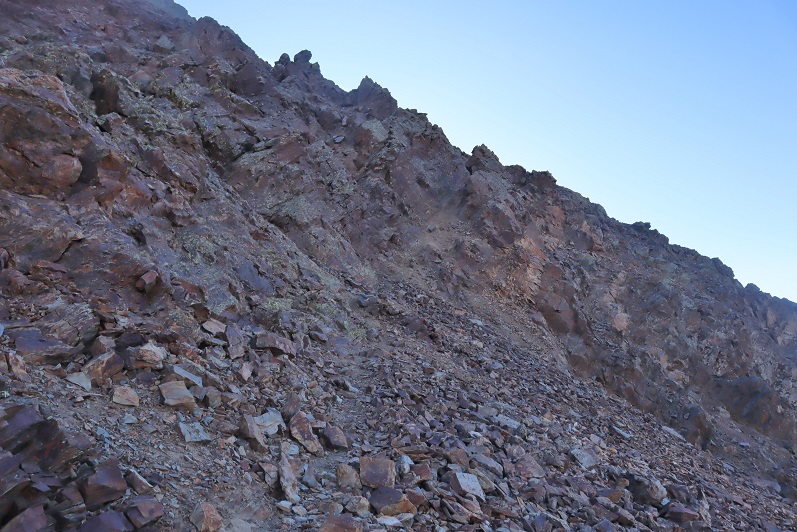
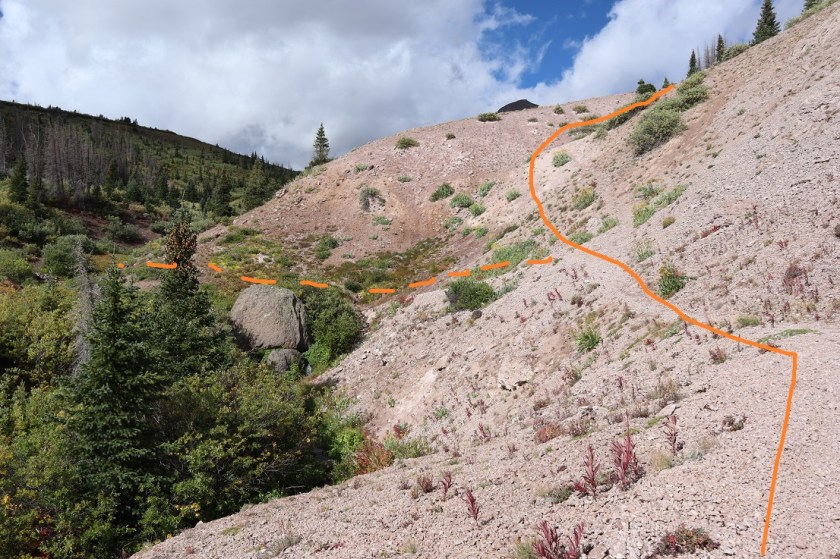
The goal is to gain the saddle at the top of the gully. This was harder than it sounds because that scree/talus is terrible.  I was glad I’d worn my helmet.  I strapped on my microspikes and took the solid line up, dotted line down.  I’d do it the same way if I did it again.

24

25

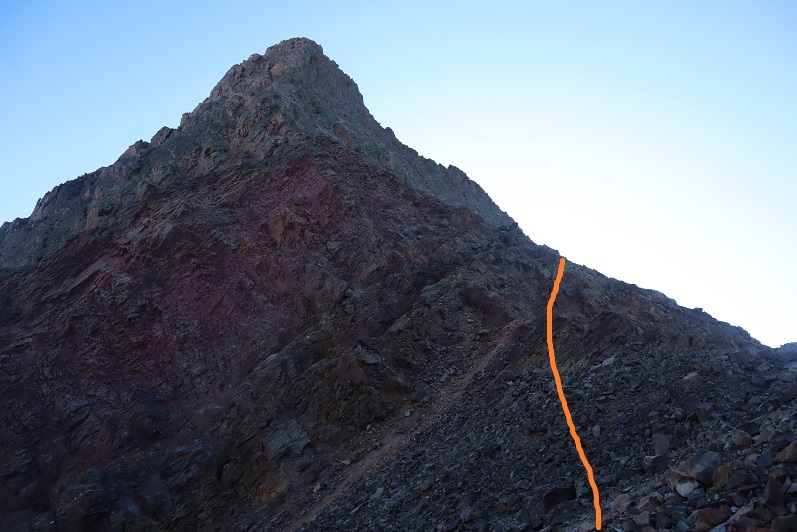
Once on the saddle I headed southeast around the backside of Vestal

26

27

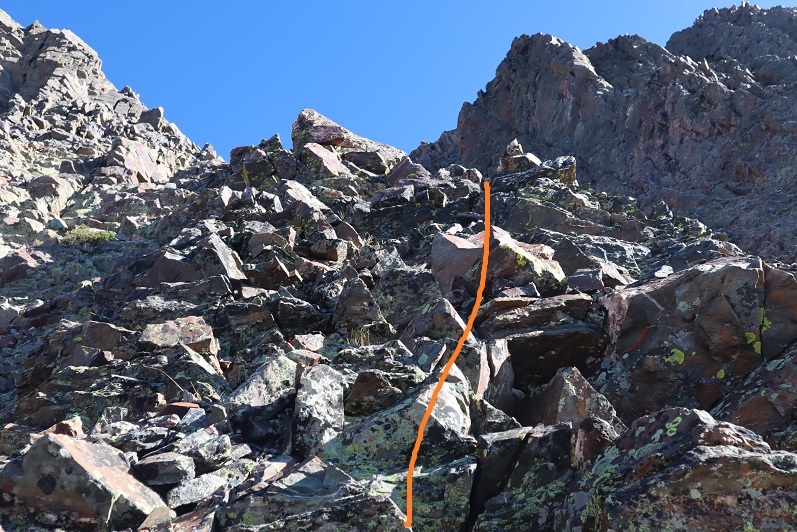
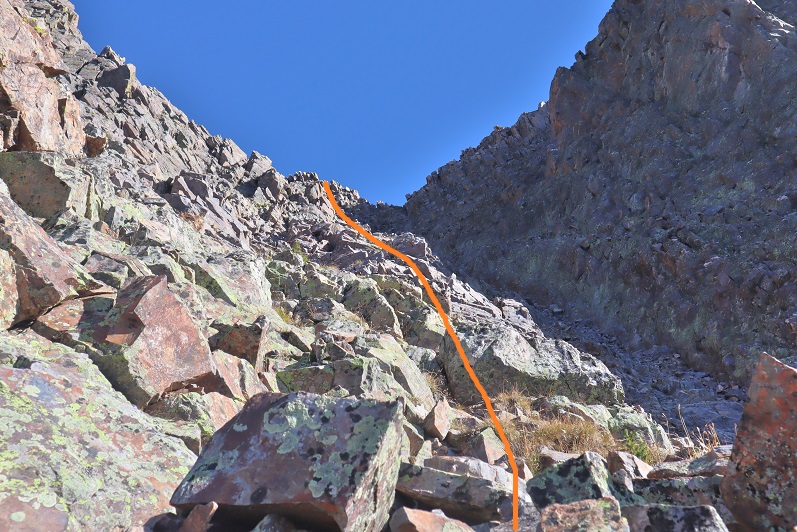
This eventually led me to an area of the mountain separated by a gully. Here I turned left (north) and climbed what I’d consider class 3 terrain towards the summit, careful not to go into the gully, aiming for where the gully originates.

28

29

30

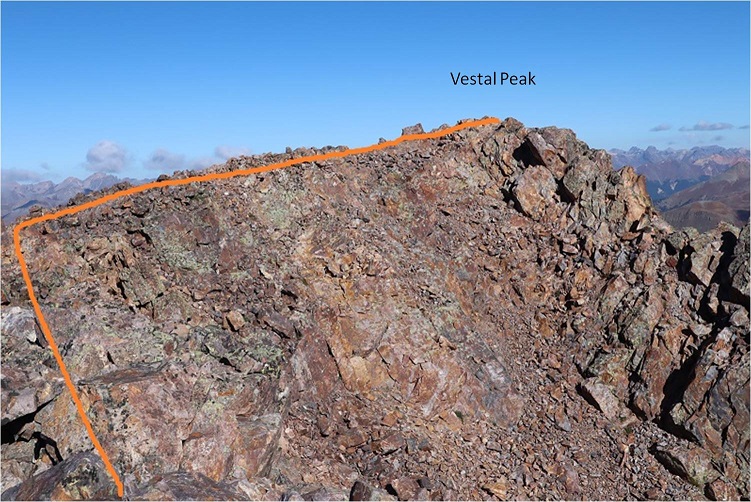
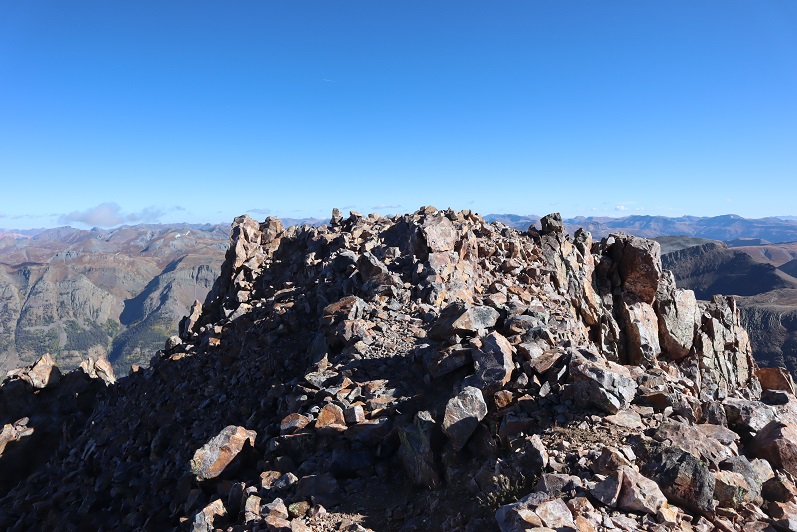
At the top there’s a false summit, but the true summit isn’t far off

31

32

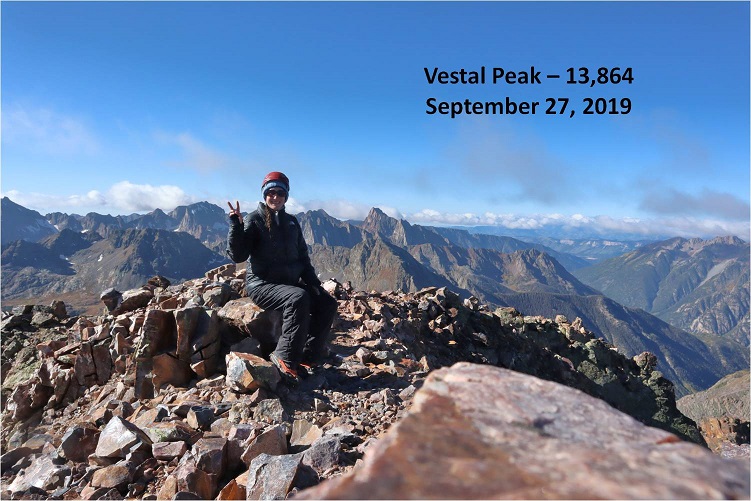
I summited Vestal Peak, my 100th Centennial, at 10am, after 8.5 hours and 11.4 miles of hiking.

33

Vestal Summit:

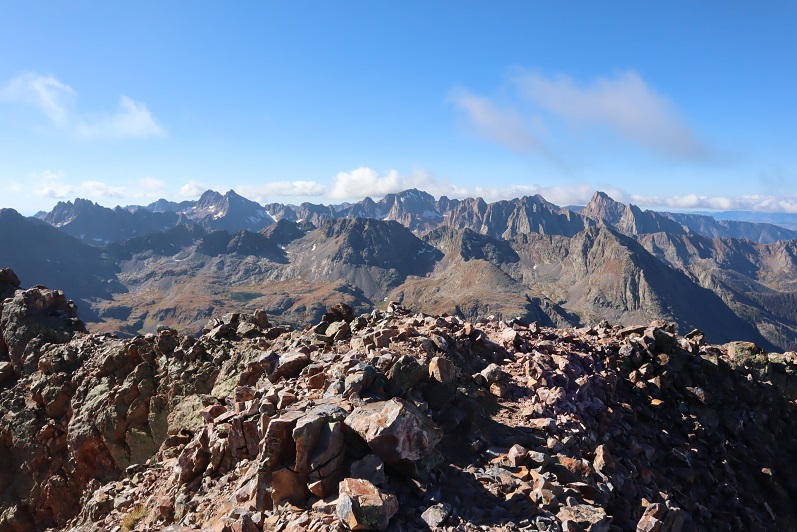
Despite the forecasted winds and cold temperatures and rain/snow it was a perfect day! I spent over half an hour on the summit, something I’ve rarely done, and took pictures of the Grenadier range and the beauty of the San Juans

34

35

Knowing the weather was nice now but it was supposed to turn I decided it was time to head back.

36

37

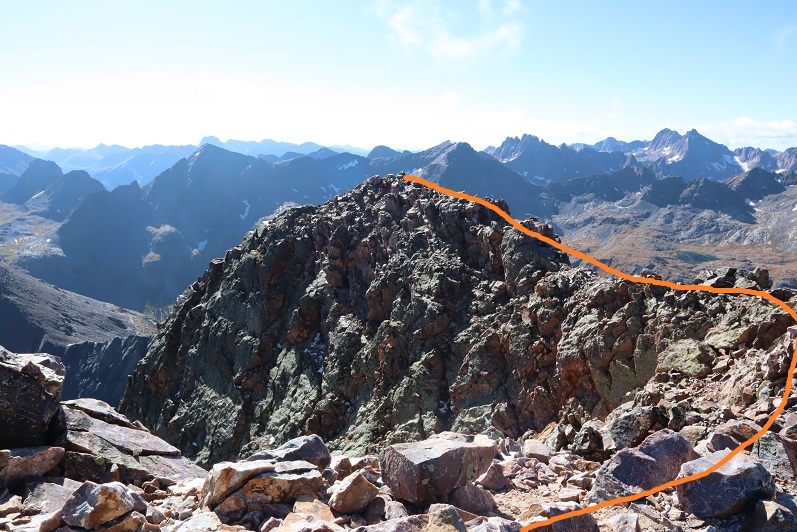
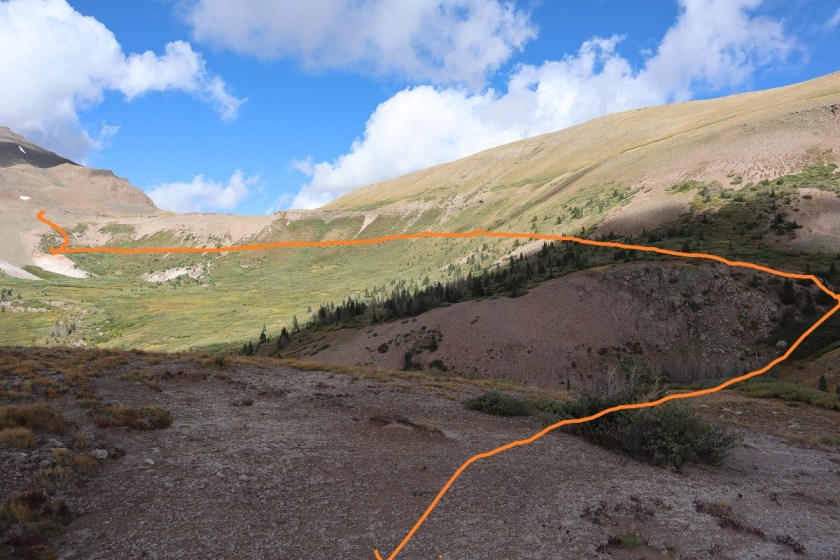
Here’s the path I took back down into the talus basin

38

It wasn’t pretty. In fact, I did something to a ligament in my ankle and it became very sore on the way down (still hurts, but it’s just bruised)

40

41

I decided to keep my microspikes on until I made it back down to the camping area. As I approached the area above the campsite I could hear someone shouting excitedly about nothing in particular and it looked like there were two people just finishing tearing down their tent.  I figured it was a parent and child out camping and slowed down a bit to give them time to head out before me.

42

At the camping area I sat down for a bit, enjoyed lunch (peanut butter and pretzels) and took off my microspikes.

Here’s a look heading out of the basin

43

I found my lost glove (woot!) and caught up to the couple within about a mile of hiking. They were two girls in their early 20s who were out backpacking together.  They seemed like they were having a terrific time (or high on something:  I don’t judge) and were wonderfully boisterous.  One of their boyfriends had dropped them off at one trailhead and was picking them up tonight at another one so they could make it a longer trip.  We chatted for a bit and then I was on my way.  The best part about the conversation?  No one mentioned we were women out here alone.

The hike out was beautiful in the daylight. I made it back to the beaver pond area (I suspect the beavers moved to down by the Animas river because there’s no current sign they’re here anymore).

44

The avalanche area was much easier navigated in the daylight. I followed the Elk Creek Trail back to the Animas River

45

There were a few waterfalls along the way

46

I made it back to the trail register and even though it was sunny it started raining. For the rest of the hike it rained and didn’t stop.  I was glad I’d worn waterproof clothing, even if it hadn’t been needed for much of the day.  The rain was nice in the beginning but eventually the thunder started and I got a bit antsy.  It was a beautiful hike out though, and much better than the trail back to the Purgatory trailhead (I’d take Molas over Purgatory any day).

47

48

The downside to the rain was the mud. It got really bad about half a mile before the trailhead and mud was starting to stick in layers to my boots.  The last mile felt like it took forever to finish, but that was most likely because by this time I was quite tired.  I’d made a good decision to make this a day trip:  as I turned and looked back at the Vestal Basin I could see it was covered in dark clouds full of rain/snow/graupel/etc.

I made it back to my truck at 5:30pm, making this a 23.5 mile hike with 8020’ of elevation gain in 16 hours.

49

50

I changed in my truck into new hiking clothes and took a quick wet-wipe bath. I re-braided my hair, ate a packet of tuna and drove to the next trailhead.  It rained the entire 5 hour drive there.

Phoenix Peak – 13,904

1

RT Length: 12.5 miles

Elevation Gain: 4441′

The last couple of trip reports have been rough to write: I’m traveling for work and using my work laptop computer for these write-ups which isn’t ideal. My work laptop doesn’t have simple functions like spellcheck (so please go easy on me there), everything I have is a “reader” and the keypad is slow, inaccurate, and last night it stopped working altogether. I googled the nearest computer store and this morning walked 2 miles to buy a computer mouse. I’m hoping the problem’s solved, but not holding my breath as the laptop is several years old and I’ve taken it to dozens of states and multiple countries so the hardware has been switched several times (I work for a software company, so this is a security measure). Side note “just in case”: I’m using this computer during off working hours, and not using it on company time.

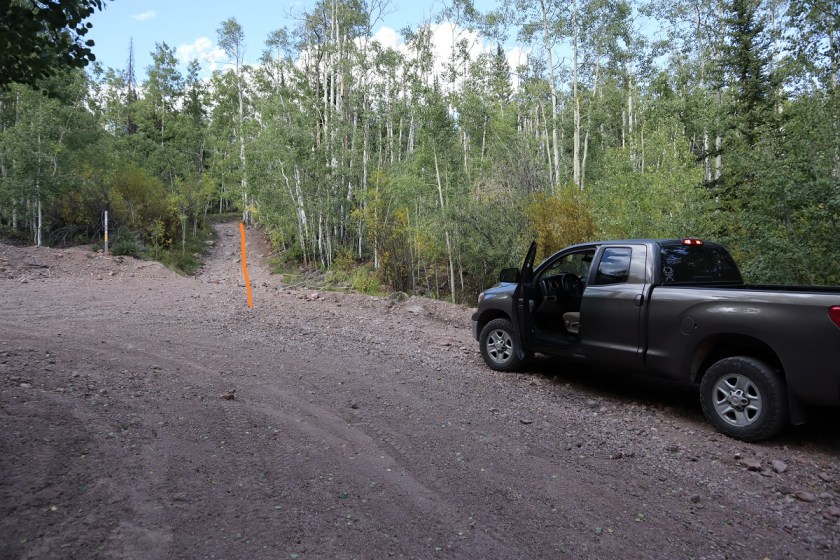
After summiting Rio Grande Pyramid yesterday I hopped right back in my truck and drove the short drive to Creede, CO. I knew the ‘easy’ road in (503) had been washed out, so I was getting creative and took in the 502. I Google wasn’t going to get me there, so I’d created the route on Caltopo and turned it into a gpx file. I credit this ability to those who’ve challenged my summits, as a few months ago I wasn’t even aware this sort of thing was possible because I don’t use a GPS when hiking. Now knowing this is a possibility with Strava it’s opened up a lot of back country roads for me! Woot! I made it to my desired area with no difficulties.

At the north end of Creede I took the West Willow Creek Road up past numerous mines and then turned right onto a 4WD dirt road after the Midwest Mine (County Road 502).

2

From this point on I was glad I’d creaded a GPX file, as the roads itersected a few times and it was nice to know I was going in the right direction. The road was easy 4WD with little room for passing but luckily I was the only one on the road on this Friday afternoon.

3

There were 2 hairpin turns where I had to back my truck up a couple of times to navigate, but my Tundra had no problem making it to the 502/502-1A junction.

When I made it here I got out of my truck, looked at the 502-1A 4WD road and said “nope”. I wasn’t doing that road to my truck (this ended up being a stellar idea). I carefully backed in to a spot big enough for 2 vehicles if we both parked nicely and got out my maps/info for tomorrow. I’d parked next to a small creek that hadn’t been on the map but I knew where I was on the road.

4

Today had been a long day so I had some tuna, a few pieces of beef jerky, some dried fruit and two shots of whiskey before heading to bed rather early (5:30pm?). I was parked at the beginning of 502-1A and a little worried because the area was so small that I’d impede traffic but on the positive side I didn’t see one vehicle that night.

It was a cold, cold night. My altimeter told me I’d parked at 10,000′, and the forecast told me it was supposed to be a low of 30* at the summit (a few miles and several thousand feet of elevation away). It was colder than 30* where I parked. I woke up halfway through the night and put on socks (they were off because they needed to air out after yesterday) and I even got out an extra sleeping bag and put on my knit hat. It was so much colder than last night! I was thrilled when my alarm went off at 2:30am, and puzzled when the first thing I saw was a vehicle coming down the road at me. Kind of interesting the only vehicle I’d see at all was one at 2:30am. They didn’t stop and I never saw them again, so I’m not sure where they were headed. I put on my winter gear (winds were expected again today and it was already below freezing outside). I was on the trail by 3am.

I started the morning with a Raynaud’s attack in my hands and was worried this would prematurely end my hike. I put on my gloves and pumped my fingers back and forth: this hasn’t happened in a while and I wasn’t happy.

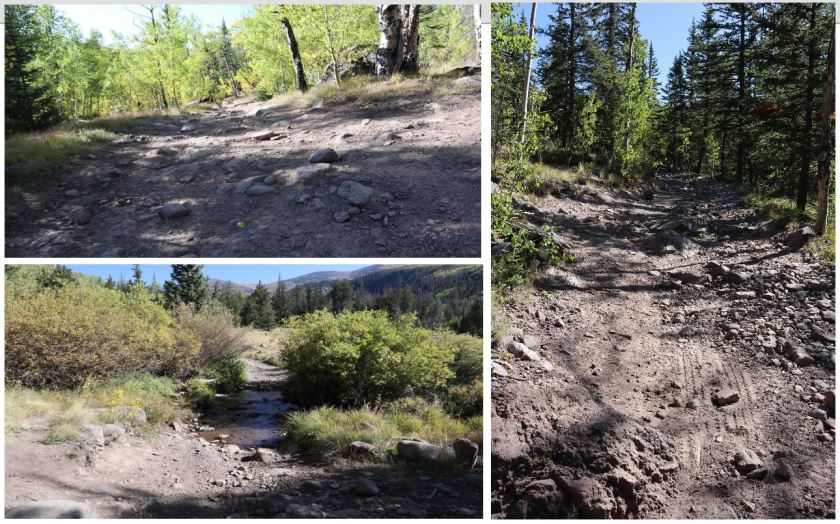
Immediately I was glad I’d decided to park my truck and hike to Phoenix Park. The road was what I’d consider “extreme 4WD”, and nothing I’d subject my Tundra to. The pictures don’t do it justice; you need high clearance and a good dose of insanity to navigate this road.

5

The only downside? The road started around 10K and seemed to loose hundreds of feet in elevation. It was actually only a couple hundred feet, but it felt like forever and I was worried it would ‘hurt’ on the way out.

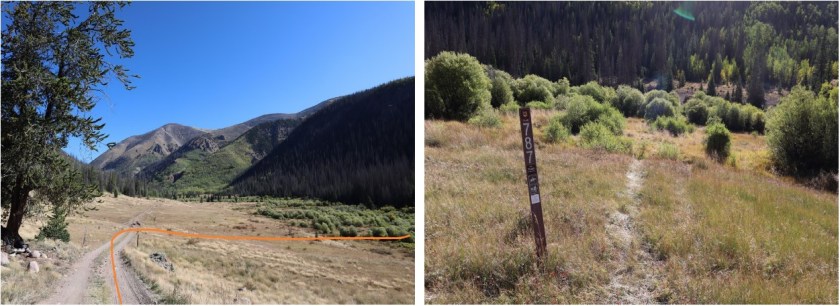
After 1.6 miles I made it to the turn off from the 4WD road to the trail (787)

6

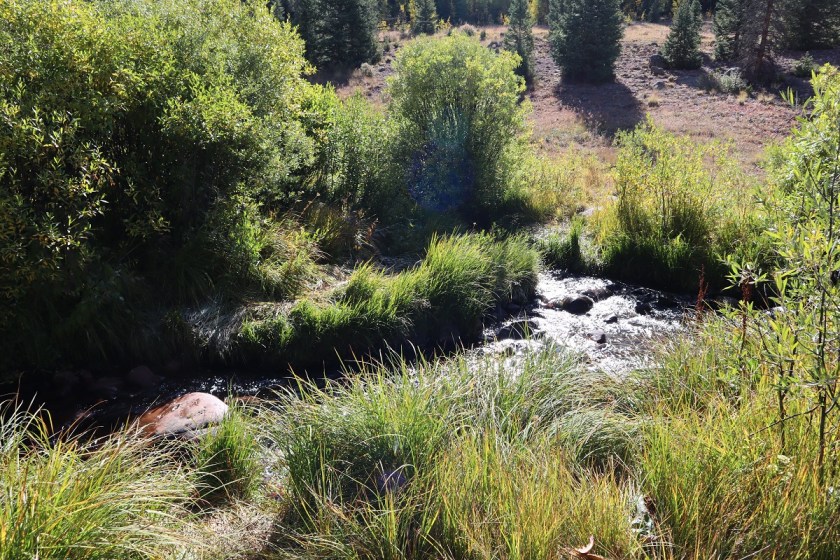
Well cairned but not well established, the 787 quickly crosses a stream

7

and comes across an avalanche area. I’m not sure when the avalanche occured, but there’s a trail to the left of trampled down grass to follow

8

This trail doesn’t look like it’s used often, and would be difficult to follow if it weren’t for the numerous cairns marking the way as I headed northeast

9

Still hiking in the dark I was now starting to get really cold. I switched my gloves for my mitts and trudged on, glad there wasn’t any wind. At 2.3 miles I came across another stream crossing and then quickly another at 2.4 miles

11

At this point I began to regain all the elevation I’d lost earlier in the morning. I could tell I was surrounded by raspberry bushes and lots of shrubs and plants turning fall colors, all covered in frost. I scared a bunch of ptarmigans at one point and they scared me as well. About halfway to the top of this area I could smell sheep (I used to raise them, and they have a very distinctive smell). Since it was dark I decided to figure out where they were: I hit my trekking pole harshly against a tree and heard to my right a loud snap, bleat, and rustling. The sheep went in the opposite direction and I continued on, following the cairns. I crossed one final stream at 4 miles. Here is where the trail ended.

12

I headed south until I came across a cairn with a large wooden pole, turned right (east) and followed the slope in the dark

13

Here there was a solid trail for about 200 yards that went along the ridgeline

14

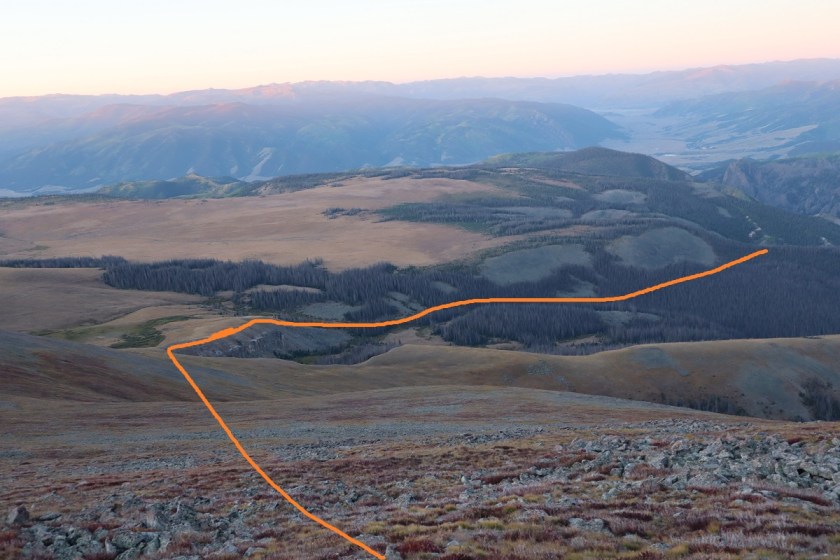
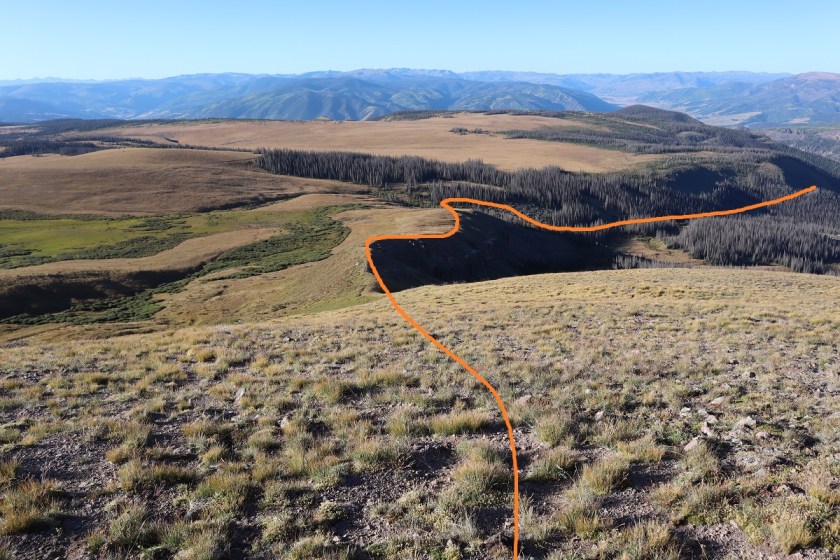
and once I made it to the end of the ridge the trail disappeared. From here I just needed to head to this point, and there was no exact way to get there so I took what I felt was the path of least resistance. Note, this point is NOT the peak, but it’s close.

15

Halfway to the ridge it became windy. By ‘windy’ I mean sustained 40mph winds with a few icy 60mph gusts thrown in. It was so cold my water bladder froze (something I hadn’t anticipated with a forecasted low of 30* on the summit). I kept pumping my fingers back and forth, put on my balaclava, and trudged on, noticeby tired from yesterday’s 25 miles. I heard an elk bugle in the distance and thought how amazing it was to be out here all alone.

The sun began to rise as I was halfway to the point

16

The wind never stopped. There’s a lot I could say about the cold for the rest of the hike, but I’ll end it here: it was cold, cold, cold. And windy. The kind of cold and wind where the snot dries as it’s flying from your face and then comes back and freezes to your cheek (another reason I like to hike solo: not the most glamerous of moments).

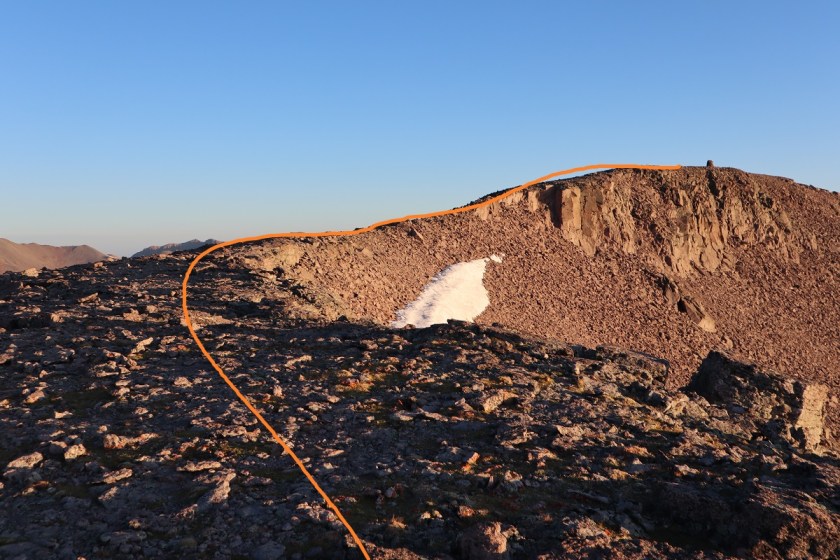
At the top of the ‘point’ I could see the rest of the route before me. Thankfully it was short and there was a well developed cairn to welcome me.

17

I just followed the ridge to the left as it swung around to the right

18

The rocks here were looser than expected but it was an easy final hike to the summit.

19

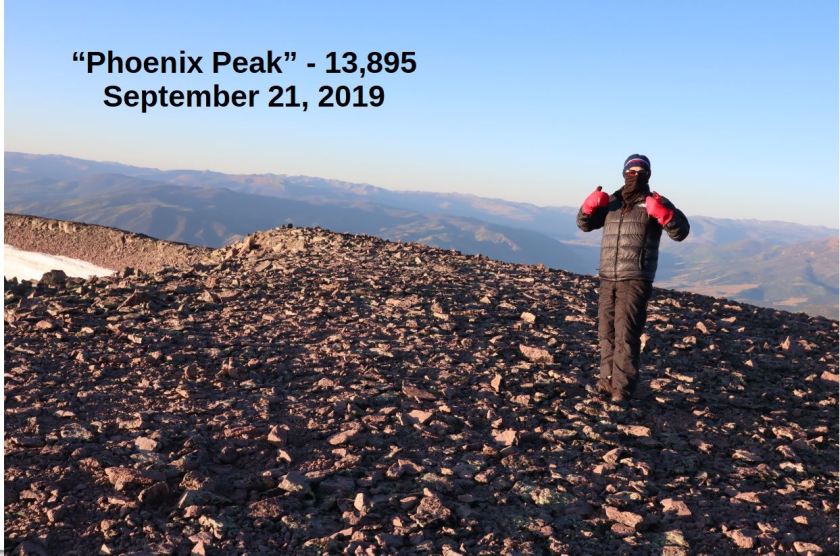
I summited at 8:15am

20

“Phoenix Peak”:

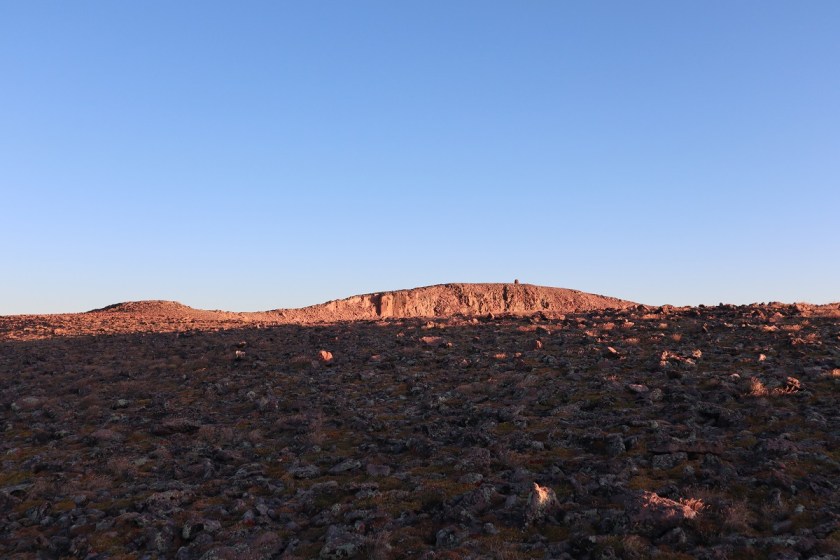
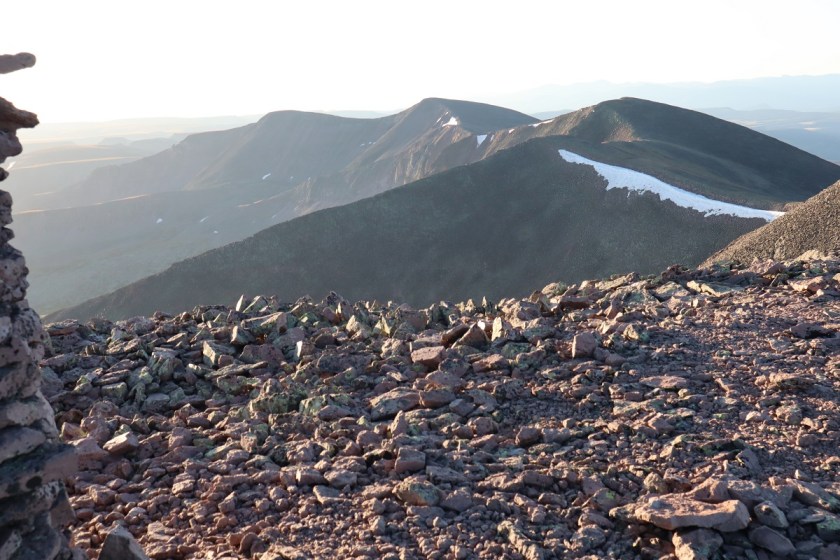
From here I could see unranked 13er la Garita Peak, but it wasn’t on my agenda today because I needed to get back home to watch my daughter perform at halftime. After getting a quick summit photo and video (the cold is telling me this may be the last of the year) I headed back down.

21

Here’s the route back down. Be careful not to desced too soon (specially if you ascend in the dark). There are two ridges you can take back down, and the correct one is the second one you see from the summit.

22

23

I made it back to the large cairn

24

and headed back down the hill (stay below the boulders)

25

The wind stopped just where it started (about a mile and a half below the summit) and I was able to warm up. Back in the treeline I took off my gloves and balaclava and tried to crunch the tube of my water bladder to get water to flow. It was light now, so I stopped when I came across a large raspberry patch. I picked one and it crumbled in my hand. Curious, I took a closer look and upon further inspection realized they were frozen! Not completely frozen but frozen enough to add a small crunch and a much needed flare to their refreshment (for in the sunlight I was now warm). I picked a handful and ate frozen raspberries for the next 10 mintues, wondering why there weren’t any animal tracks near here? The currents weren’t as tasty, so I left those for the birds.

26

The sheep were gone and I never saw any elk, but I did see and hear dozens of crows on my way down. I wondered what had died? There was a stream along the avalanche area

27

and here’s a look out from the last stream crossing back onto the 4WD road

28

It was still 1.5 miles back to my truck, and as I walked this road I was thankful I hadn’t taken my truck this way: it was worth the walk, and actually not that bad. The last few hundred feet of elevation gain I’d been dreading was all completed in the shade and didn’t slow me down that much.

29

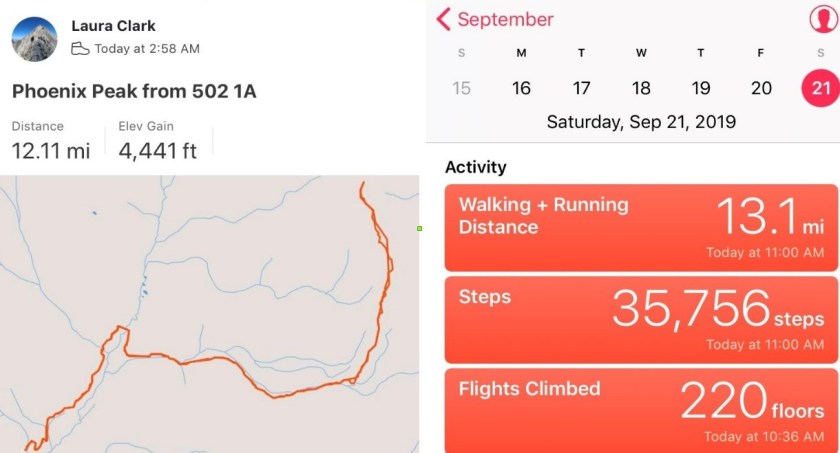
I made it back to my truck at 10:30am, making this a 12 mile hike with 4441′ in elevation gain in 7.5 hours.

30

31

I drove home and made it in plenty of time to be at my daughter’s performance. I put all my dirty clothes in the laundry and when I changed it found a dead grasshopper in the bottom of the bin. Sorry little guy! I’m sure it got caught in the holes in my snow pants (I REALLY need a new pair, but despite shopping at multiple stores can’t seem to find one that fits).

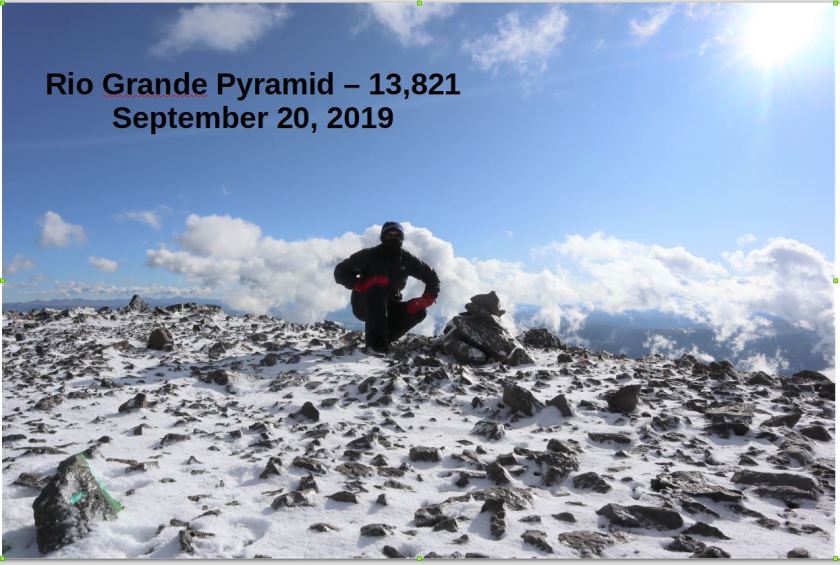
Rio Grande Pyramid – 13,825

1

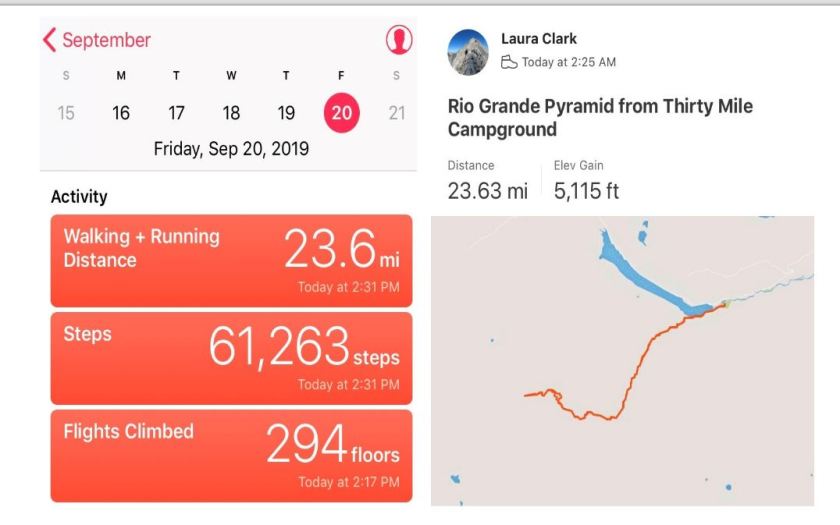
RT Length: 23.5 miles

Elevation Gain: 5115′

NOTE:  I have been to this area again, and have a better approach.  Please use this approach to the base of Rio Grande Pyramid.

I finally received my new camera in the mail and was quite excited to try it out. I left my house at 8pm and arrived at the Thirty Mile Campground at 1am after a long but easy 2WD dirt road in. There’s a designated area for backpackers/hikers to park.

2

I really wanted to get out on the trail, but as soon as I parked my truck it started raining. Hmph! It was supposed to stop raining at 1am, but from the looks of things the rain was just getting started. So I got all ready to go and then leaned the drivers seat back and tried to get some rest. I set my alarm for 20 minute intervals, and after the fourth time realized the rain wasn’t going to stop so I might as well get going. I put on my poncho and snow gear (I’m still in the market for waterproof pants, choosing instead to get the Alti Mitts this month because keeping my hands warm is more important) and headed out on the trail.

This is the start of the trail. It follows the Weminuche Trail.

3

4

I signed the trail register (which was a mess!!! It needs a new notebook) and was off

5

The beginning of the trail is easy to follow, if a little muddy. Since it was raining I expected the mud. I hiked alongside the Rio Grande Reservoir and after a little over a mile I turned left and headed up the drainage area. As I was hiking here I heard a loud “snap” and figured I’d scared a deer.

6

There was an easy creek crossing

7

and lots of mud (mixed with horse manure)

8

After turning the corner to the left (south) I encountered a small boulder field

9

Before coming to a well built bridge at 2 miles. I crossed the bridge and turned left. It was still raining.

10

From here the trail switchbacked a bit through some aspen trees

11

and was a bit washed out in areas but there were side trails to navigate the damage

12

From here I hiked for what seemed like forever along the CDT. Forever. It was relatively flat hiking and I could tell I was in a basin, with lots of large boulders strewn about and open space.

13

At 4.2 miles I came to another stream crossing

14

and continued hiking in the mud (and rain) to another stream crossing at 5.3 miles

15

There also seemed to be camping here

16

Still on the CDT, I went right here

17

and kept following the CDT

18

After 6.8 miles I came to the CDT Junction and once again stayed right

19

Now heading west I passed a small pond and celebrated the rain stopping (finally!!!)

20

I entered and exited trees and came to an area that looked good for camping after about 8.5 miles

21

I entered the trees again

22

23

and after what seemed like forever (9.5 miles actually) I made it to treeline! Still on a good trail I passed another small boulder field

24

At the top of the boulder field I had a choice to go left or right. I went right (although both ways will get you where you need to go). Overall, I felt the way I chose was shorter (at least, it should have been if I’d taken the direct route the first time and not got bogged down in the willows).

25

I made it to the top of the hill and this is what I saw. All I needed to do was to make my way around the willows to the gully and ascend the rest of the way to the peak. Also, it was evident it had been snowing on the peak while it had been raining on me this morning

26

Here I lost the trail, and initially tried to cut across the willows and head straight for the gully. That didn’t last long: there were little streams everywhere and boggy areas and the willows were saturated with water (so I became so as well). It looked like there were trails through the willows, but they always ended at a stream and an area of willows too thick to pass.

I retraced my steps and went right (northwest) and trudged up the hillside. Eventually I found a surprisingly intact trail and followed that around the mountainside and up towards the gully (on my way back I followed the trail further, knowing where it began).

27

Here there were still willows but they were much more manageable. An added bonus was the sun was starting to warm things up and evaporate the rain. I was still “soaking wet” but now I was able to dry off in the sun.

28

Once out of the willows I followed the cairns up the hillside and aimed for a class 2 gully

29

30

This gully wasn’t really that bad…

31

and at the top there was a cairn

32

All I had to do now was head straight up the slope to the summit. Unfortunately, here is where the sprinkling of snow began. It didn’t require traction, but it did require careful footing, as a lot of the snow had turned into ice.

33

The boulders were a bit loose, but I found several dirt paths that led straight up

34

After hiking for 11.7 miles I summited at 8:50am

35

Summit:

It was really, really windy at the summit, and while it had looked clear while hiking up from below, now I wasn’t so sure. The wind and snow made it cold, and looking at those clouds I wanted to make it down as soon as possible. Those mitts has been a good choice.

36

Route finding on the way down was much easier than on the way up.

37

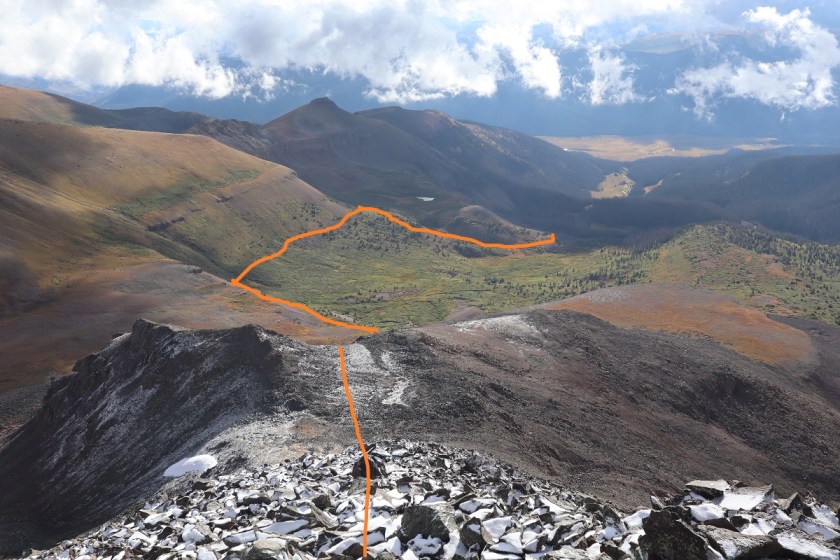
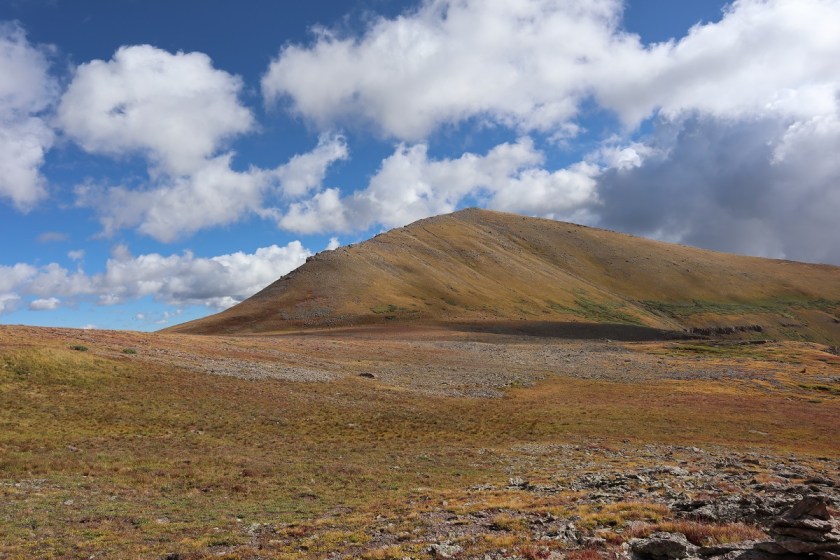
Here’s a look at “Fools Pyramid” if you’re thinking of attempting it. I had another big day tomorrow and I was worried about the potential snow for today so I didn’t head that way, but it’s definately something I’d consider in the future. I found a really great camping spot near treeline (before the boulder field by a stream) that I’d like to hike into some day, spend the night, hike “Fools Pyramid” and PT 13,261, camp again, and hike out the next day. Today was not that day.

38

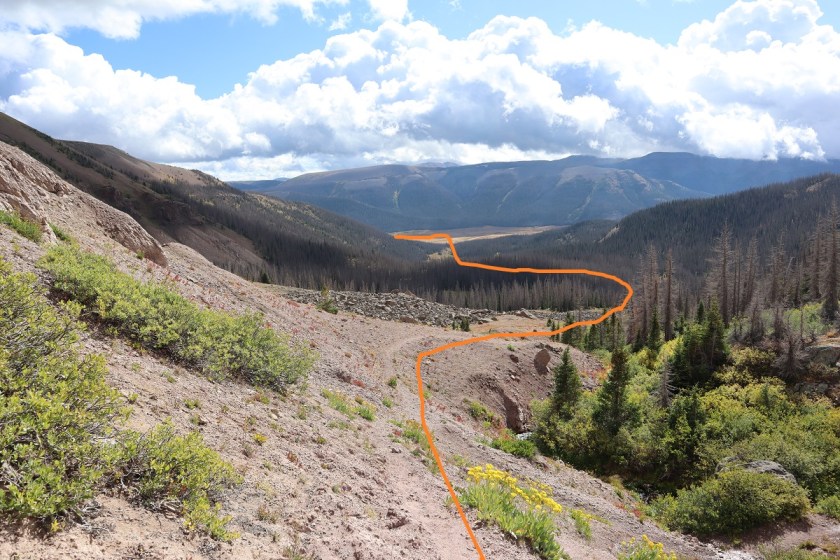
Once at the top of the basin here’s the route back on the CDT

39

40

The further I descended the more the wind picked up. I heard what sounded like gunshots and realized I was hearing trees falling over. I kept looking at the clouds, wondering if it was going to rain again, but the wind seemed to blow them away as quickly as they came.

On my way down I came across a strawberry patch and even a few raspberry bushes.

Back down in the basin I had a clear view of the trail in the daylight. What I thought might have been tents in the dark ended up being large boulders. The wind here became insane. I’d stir up a bird as I was walking on the trail, and startled, it would try to fly away, only to be swept sideways in the wind. This happened about a dozen times (the birds were sheltering from the wind in the bushes) and I felt bad every time one took to the air. They were usually pushed by the wind sideways into bushes.

41

42

Just before I made it back to the bridge I came across someone who had all the right equipment but looked too clean and tidy to be a thru hiker. I asked him where he was going and he said he’d just started and was trying to find a lake. I’d travelled pretty far and hadn’t seen one, and told him as much. His response was it was 180 miles in. I was jealous, and wished him luck.

The last 5 miles took what seemed like forever for me to complete, and I was glad I’d chosen not to summit those two other peaks: I was tired!

I made it back to the trailhead at 2:30pm, making this a 23.5 mile hike with 5115′ of elevation gain in 12 hours.

43

44

Jagged Mountain – 13,833

1

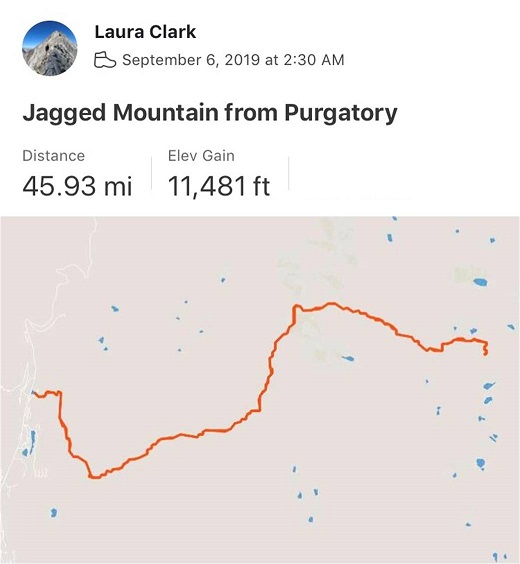
RT Length: 46 miles

Elevation Gain: 11,481’

Elapsed Time: 47 hours, 11minutes

50 meter rope was perfect (but tie the ends, because it was close)

I knew the risks going in: The weather didn’t look all that great and my first day in would be from no sleep from the night before, but I’m used to these circumstances and decided to go ahead and attempt Jagged Mountain this weekend.

If I were to do this climb again and I had the time availability I’d stretch it into 4-5 days.   Unfortunately, with my work/volunteer/mom schedule I knew I’d never get that much time off in a row, so my plan was to hike up to the base of Jagged Pass the first day, either summit Jagged that night or the next morning, hike back down to the Animas River the next day and camp somewhere between the cutoff to Noname and the base of the Purgatory Trail, and hike out the third day, with the understanding I could change plans as I went (one of the benefits of solo hiking).

I’d spent quite a bit of time going through my gear to make it lighter, and I think I shaved off about 10lbs, making my pack a much more manageable 35lbs (including rope, harness, webbing, etc.)

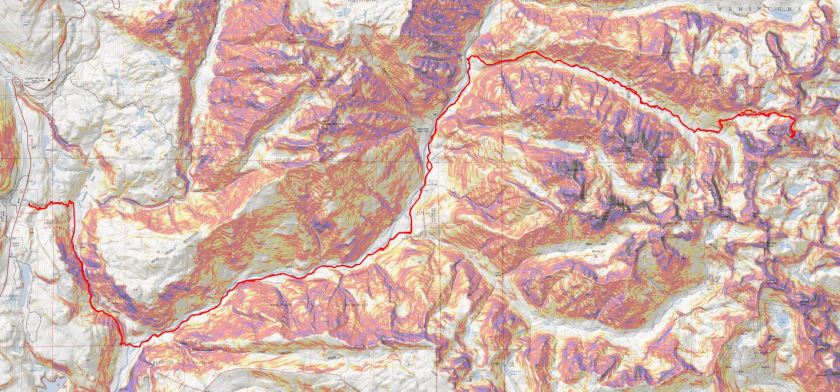
I drove the 6.5 hours to the Purgatory Trailhead and was on the trail by 2:30am. This is the third time I’ve hiked in from Purgatory, and the third time doing so in the dark.  I decided to get some stats from Strava this time.

  • First Trail Bridge @ 4.3 miles, 2 hours of hiking.
  • Second Trail Bridge (cutoff to Chicago Basin) @ 9.9 miles, 4 hours 30 min of hiking
  • Needleton Bridge @ 10.8 miles, 4 hours 50 min of hiking

The Needleton Bridge area has some private property surrounding it, and several social trails to cabins. This is the correct trail to bring you towards Pigeon Creek and Noname Creek.  It starts just to the right of the Needleton Bridge.

2

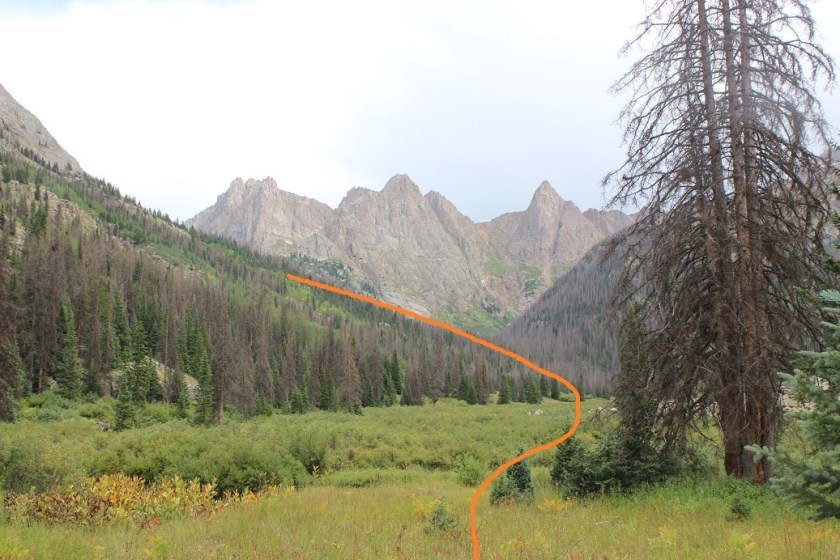
The path here is easy to follow and brings you to the “campers meadow” / Aspen Grove at the turnoff for the Pigeon Creek approach to Ruby Basin

3

From here the path was much better than I’d anticipated. There were cairns and a semi-worn footpath to mark the way north through the forest, paralleling the Animas River

4

Then, for no reason whatsoever (except of course the river below) comes Water Tank Hill.   It’s worse than it sounds: 200’ straight up the side of the mountain (and then back down to the river afterwards).

5

When I got to the top of Water Tank Hill I noticed the water tank was actually on the other side of the River. I decided this would be a great place to take a rest.  As I sat down I noticed a Black Bear racing over the tracks and through the yellowish/green grass in the middle right of this photo.  I was reaching for my camera when I saw her cub bounding after her.  I wasn’t fast enough to get a picture, but thought to myself:  Cool!  About 10 years ago I’d taken the trail from Durango to Silverton and asked one of the workers how often they saw bears, and he said in the 25 years he’s worked there he’s only seen one.  I felt pretty special to get to see this pair this morning.  I also asked myself what they were running from?

6

I sat here for a bit and had breakfast (I decided to force myself to eat this time). Beef Jerky and Almonds for breakfast isn’t all that bad.  After a short rest I put back on my gear and headed down Water Tank Hill, which was just as bad as the way up

7

Back at river-level the trail was once again straightforward. I thought to myself how this trail was much easier than the Pigeon Creek trail (but to be fair I’d done that one twice in the dark both ways, and I was doing this one in the daylight).

8

I crossed several creeks

9

And turned right (east) and followed the Noname Creek trail. Once again, the trail was easy to follow (but obviously not maintained)

10

It follows the Noname Creek. I found a patch of raspberries growing as the crow flies from the raspberry patch on the trail to Ruby Creek, as well as thimbleberries (which always seem to grow alongside raspberries)

11

The difficulty came when I reached the first avalanche area (I think there are 3 in total, but two of them kind of run together). I’d heard to avoid most of the debris to cross the creek, and so I did so.  This ended up being a terrible idea (maybe I crossed at the wrong section?).  There were trees piled on top of trees that reached heights well over my head.  This made crossing the river a bit dangerous, as the trees weren’t stable and there were huge gaps.  Hundreds of trees criss-crossed the creek.

12

Eventually I had to cross the creek again and there was still avalanche debris to contend with

13

The above picture is deceptive, as there are still large areas of trees piled on top of each other to cross and no clear path to take. The trees are tumbled together and rotting.  I had to secure each step carefully, even if it looked like the log was solid (some would roll).  Crossing this area took a long time, and is not something I’d recommend doing in the dark.  As I came out of the 2nd avalanche area I realized what I should have done was stick more to the left (north) and I told myself I’d do that on the way back.   I was so excited when I reached a trail again!

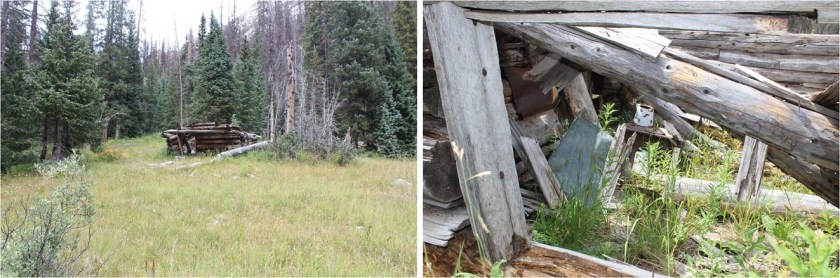
About half a mile after I found the trail again I hiked a bit up a hill and found myself at the Jagged Cabin, which was more run down than I’d anticipated. I made it here after 18.2 miles in 10 hours, 42 min.  I’m sure the avalanche area slowed me down…

14

I took off my pack and rested for a bit, going over the next part of the route.

15

I put back on my pack and headed east through willows and more forest and more uphill. I went left at this junction and came across another small avalanche area that was annoying but not difficult.

16

I entered another clearing and went left again, up the hill to the basin below Jagged Pass

17

Here route finding was a bit of a challenge because there were so many trails, but as long as I stayed on a trail and kept the stream to the right of me I was headed in the correct direction

18

It started raining halfway up this hill, and this is where my troubles began. I’d totally expected it to rain (each day called for rain between 12-5pm).  I just hadn’t anticipated how drenched I’d get from just a little rain.  You see, I was hiking through overgrown grass and willows

19

The rain collected on the plants and soaked my pants as I walked through them. I think it’s worth noting everything I was wearing was “waterproof”, including my socks, pants, and jacket(s). Within 15 minutes I was soaking wet.  No worries though, because I had a change of clothes in my pack and I could dry off once I reached my campsite.  Here’s the rest of the route to the small lake I camped at.  There was no trail here and the route I took included some boulder hopping

20

21

I made it to my campsite at a pond just below Jagged pass (12,210’) after 21.1 miles and 13 hours 30 minutes of hiking. Note, this is NOT the unnamed lake at 12,522’

Jagged Campsite:

It was about 4:30 in the afternoon. I set up camp quickly, thankful the forecast only called for rain until 5pm.  Camp was just a tarp, bivy, and sleeping bag, so setting up didn’t take long.  I changed my clothes, laid out my wet pants and socks to dry, ate dinner (more jerky and nuts) and filtered some water.  There were flies and mosquitoes, but the flies seemed particularly interested in me.  I’d been sweating all day and they were intrigued.

22

As I was filtering I found an umbrella that had seen better days. I wondered how it got here?  In any event, it soon became “useful” (not really) as it started raining again.  I quickly packed up the clothes I’d set out to dry and sat under the mangled umbrella, watching the rain.

23

The rain didn’t look like it was going to stop anytime soon, so around 5pm I decided to take a nap. I woke up around 7pm to a fantastic view of my campsite in the evening glow.

24

I was also a little bummed: Had I just missed my opportunity to summit Jagged by taking a nap?  There wasn’t a cloud in the sky, so the rain couldn’t have lasted too long.  Oh well, it had been a long day, so I decided to go back to sleep to prep for tomorrow.

It rained most of the night. On the positive side, I was nice and warm and dry inside my bivy and sleeping bag.  I woke up several times:  a few because it got stuffy and I couldn’t breathe (but due to the mosquitoes I’d wanted to keep my set up as air tight as possible).  Another time it was to rain, and once to a very loud grinding noise coming from below me.  It sounded like a rabbit slowly biting through a carrot, and a little like a hand saw slowly cutting through wood.  I heard this a few times and figured out it was most likely a marmot burrowing below me, extending its tunnels (or something).

At 5am I woke up to clear skies and sat in my bivy for a full half hour just gazing at the stars. I could make out dozens of constellations, a few satellites, and at least 4 meteors flying through the sky. I was pleasantly surprised at the lack of clouds.

Curiously, I thought I saw a flash light up the mountains. The first time I saw it I thought my eyes were playing tricks on me.  The second I looked around for lightening (sure that was what it had been).  No clouds, so it couldn’t have been lightening.  The third time I saw it I thought maybe it was someone hiking in the dark and their flashlight was causing it?  That didn’t make much sense, and I couldn’t see anyone with a flashlight below, so I ruled that out as well.

I didn’t want to move, not only due to the amazing nighttime view but also because it was a bit chilly; but I needed to get a move on.

I left all my nonessential gear under my tarp, put on my helmet, and even though it was dark I headed in my intended direction. There was a grassy slope to the left (north) of me I took to a rocky area and up and over the pass

25

I made it about 5 minutes before I had to stop because I couldn’t see anything and it was getting dangerous traversing over the wet, rocky area. I sat in one spot for about 20 minutes, allowing the sun to rise before continuing on.  As I sat there I could see what I hadn’t been able to from below:  a storm to the west.  It had been lightning I’d seen, but luckily the storm seemed to be petering out.

This gully was full of rocks and nasty scree that took careful foot placement but was straightforward

26

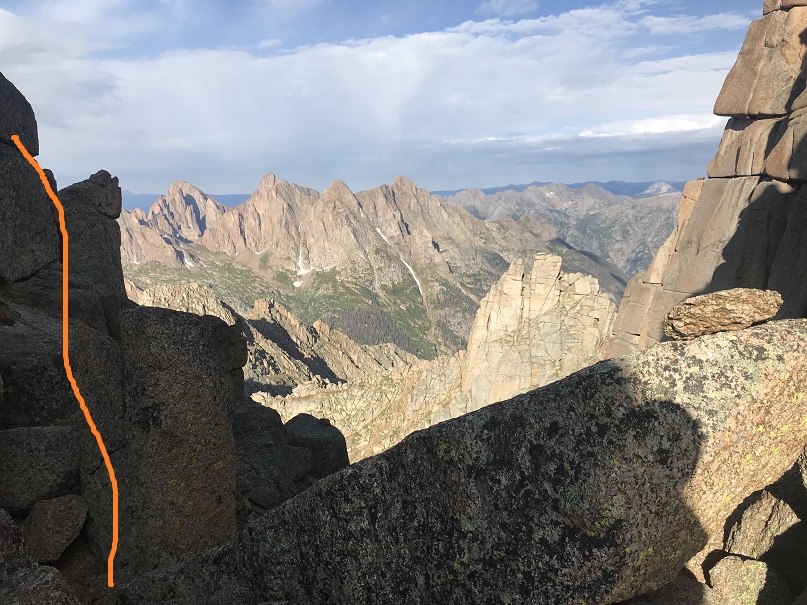
At the top of the gully I turned right (south) and got my first good look at Jagged Mountain

27

I spent some time planning my route. Here’s the route I took, staying below the areas of snow and just to the right of the gully.

28

29

This area is steeper than it looks

30

Here’s the path to the first crux, just to the right of the gully

31

I turned to look back on the way I’d come and noticed that storm that looked like it was going away wasn’t. In fact, it was coming right at me! Ugh!  It was only around 7am and it wasn’t supposed to rain until noon but yet here was obvious rain headed my way.   I was glad I wasn’t in the Vestal Basin right now.

32

The rain started falling and I got out my poncho, put my back to a rock, and sheltered in place for half an hour, waiting for the rain and graupel to stop. While I sat there I did a lot of thinking.  I knew due to this rain the rocks would be wet, so I’d have to be very careful.  Also, I needed to set a turn back time, which I set for 12pm.  In my mind I was thinking this rain could be a good thing:  It wasn’t supposed to rain until noon and it was raining now: maybe this would be it for today? (insert God laughing here).

Once the rain stopped I set to work at the first crux. You’re supposed to go over these grassy slopes, but I wasn’t able to get over the first bit.  I wished I’d brought my rock climbing shoes!!!  I tried and tried and tried but I just wasn’t tall enough to get myself up and over the first rock:  I had no traction with my feet and nothing to hold onto with my hands.  There had to be another way?

I went to the right and found another area that looked “easier”. I attempted to gain the slope this way but wasn’t able to pull myself up here either. Ugh!  So I went back and tried the slopes again, but it just wasn’t working.  I went back to the second area, took off my pack, and was easily able to climb up.  This was no good though because I needed my rope to rappel.  So I attached a small rope to my pack and tried to haul it up after me:  the rope broke.  Face palm.

Ok, next idea: I rummaged around in my pack for my knife but was unable to find it?  My idea had been to use it kind of like an ice pick for leverage on the grassy slope (since there were no rocks/etc. to grab onto).  I was upset I couldn’t find my knife, but I did find my microspikes and decided to put them on.  These gave me the traction I needed to pull myself up and onto the slope from below.  I then made my way around and finished the first crux.  (The dotted line is how I think you’re supposed to get over this area, but I wasn’t tall enough to make it happen).

33

The climbing became steep. I’m assuming this is the second crux

34

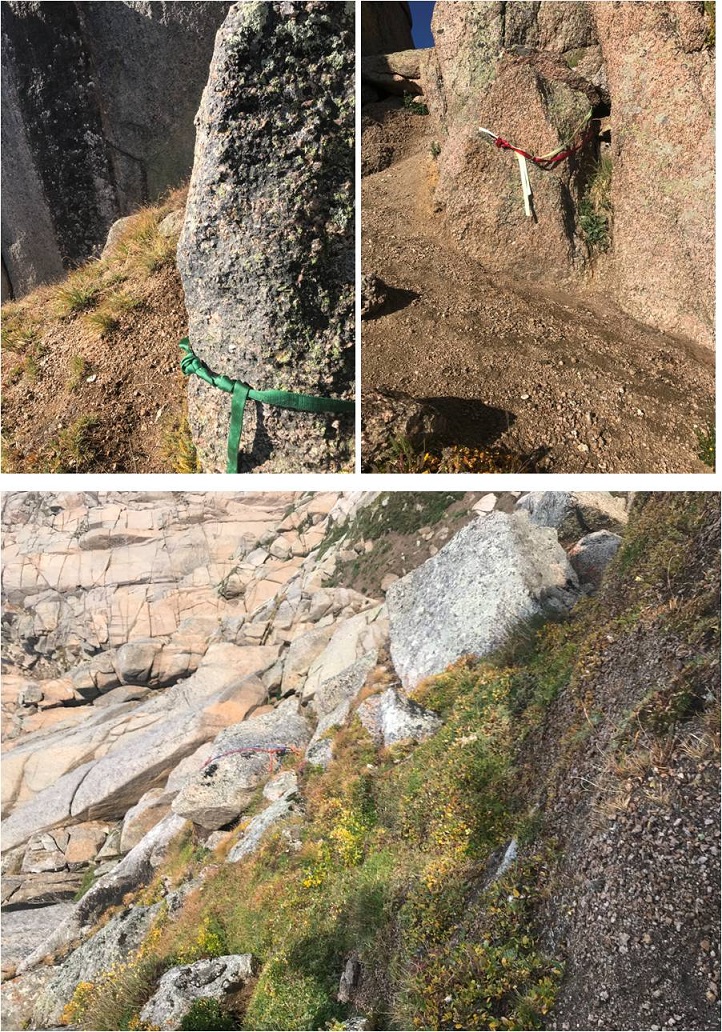
There weren’t cairns here but I knew I was on the right track because I kept seeing anchors set up. I inspected each one on my way up and they all looked good enough to use on my way down.

35

I made it to the notch, got my first good view of the sky and turned left. It looked like the weather was going to hold out for me today after all!

36

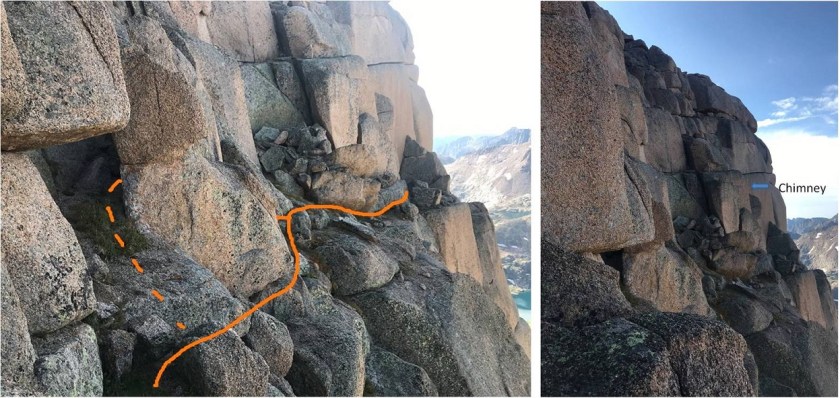
Here’s that airy traverse. There’s a lot of exposure here but luckily for me the rocks were dry and it was a short section.  I took the solid line, but if I hadn’t been wearing my backpack I could have fit through the hole where the dotted line is (behind the rock is a tight fit with a pack).

37

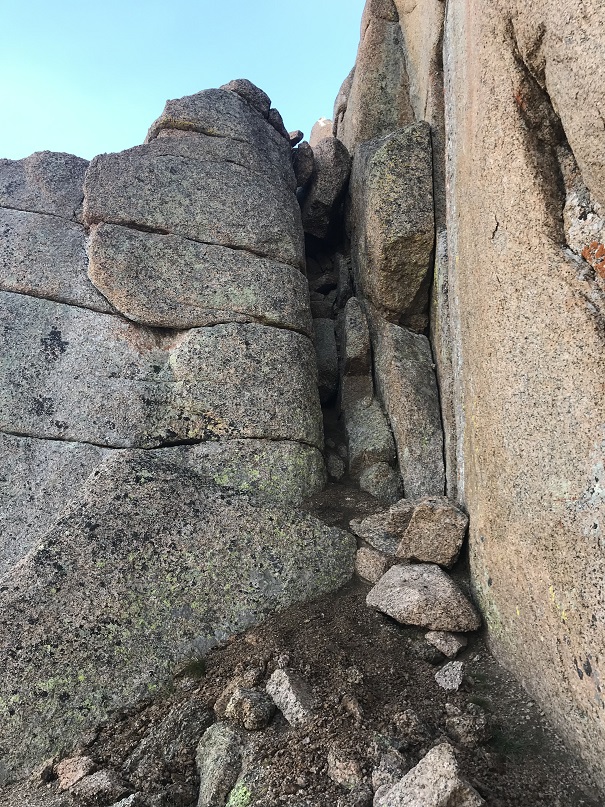
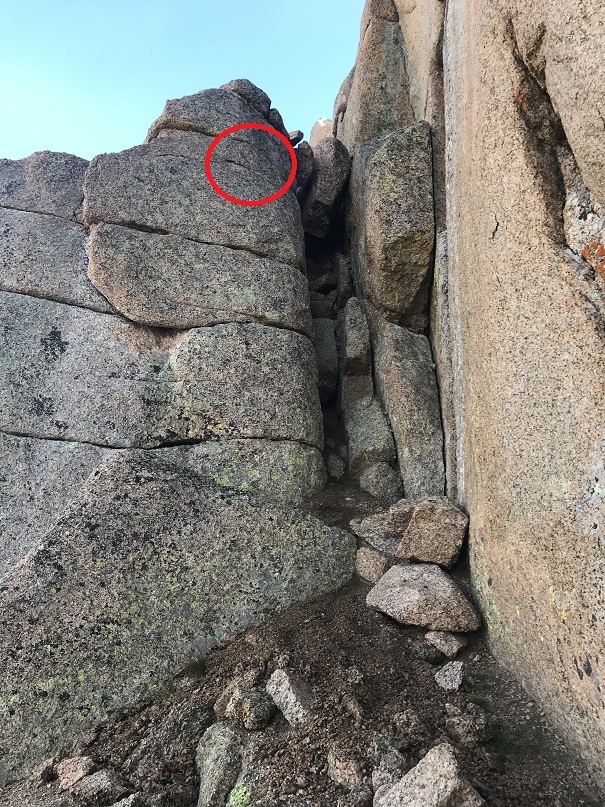
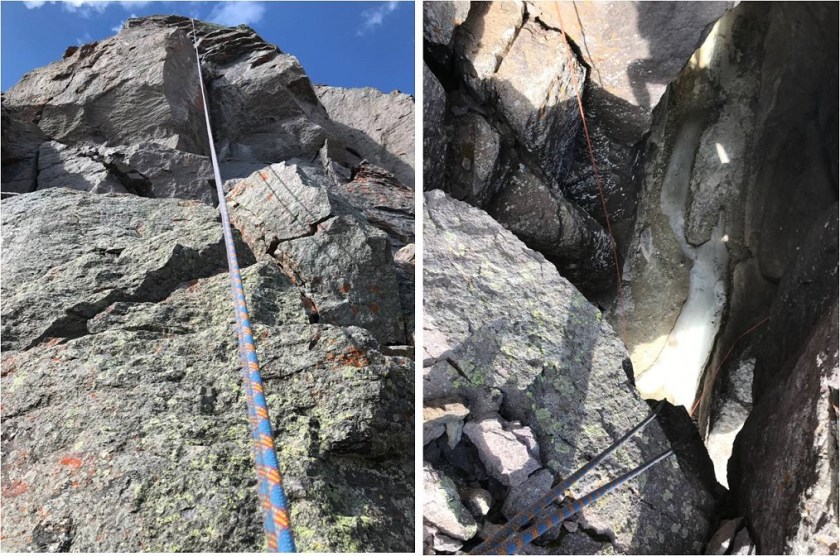
I was feeling pretty good about myself at this point as I rounded the corner and saw the chimney. It used to be a class 3 chimney but there had been a rockfall and the top two rocks in the chimney were “new”. I’d heard they weren’t that difficult.

38

So I decided to just go for it. Indeed, the first part of the chimney was easy.  Easy until I came to the place just below those new top two rocks.  They were positioned in such a way they were overhanging the rocks below.  I tried and tried and tried but I wasn’t able to get around the rocks, so I retreated to the bottom of the chimney and studied the route again.

It looked like the way to get over this area was to balance on the ledge to the left and haul myself over. So I tried again, but that crack was smaller than a pencil and there was no way I was going to be able to balance on it without rock climbing shoes.  Drat!

39

I was getting seriously frustrated and tried several more times from numerous different angles and was unsuccessful. What was really demoralizing was I was so close to the summit!  I went back down the chimney (again), took off my pack, and studied the rocks.  There had to be a way up and over this area, and I had to bring my rope with me (there was no way I was soloing down the chimney without a rope).  I told myself I was going to keep trying over and over again until my turnaround time at noon.  I was kicking myself for the second time today for not bringing along my climbing shoes, but I wasn’t ready to give up yet.

I just needed a little bit of leverage. That’s when I got an idea!  I put on my climbing harness, attached my rope to the belay device (because I’d need the rope on the way down but couldn’t carry it up in my hands).  I took some webbing and carabineers with me and left everything else (including my camera) at the base of the chimney.

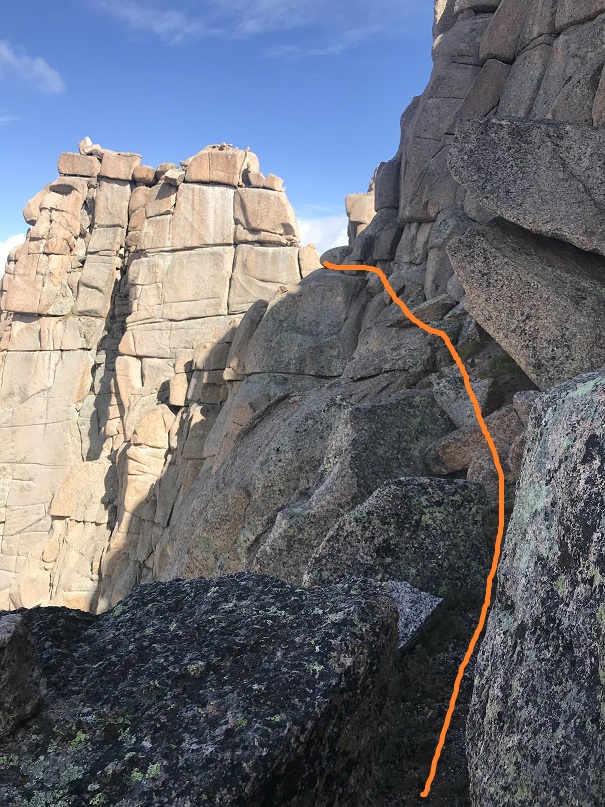
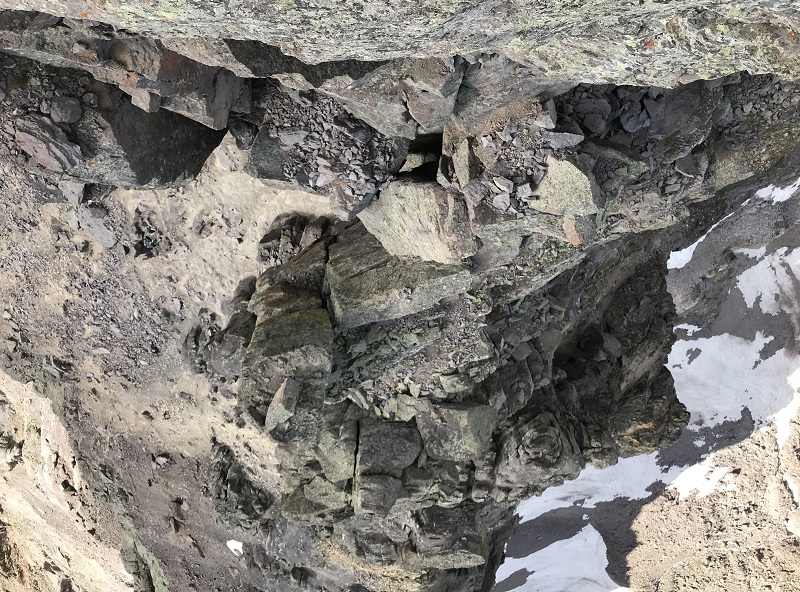
I climbed back up the chimney again and this time when I made it to the rocks at the top I turned around and faced away from the chimney. What I did next I’m sure isn’t kosher, so I’m not going to describe it in detail (but if you’re interested I’ll tell you at a 14er HH). It involved a lot of upper body strength, some webbing, and a move I learned in elementary school when I’d play on the bars at recess.  My feet made it up and over the right side of the chimney first and I hauled the rest of my body over, thrilled I’d figured this problem out!!!  Here’s the route I took and a look back down from the top of the chimney

40

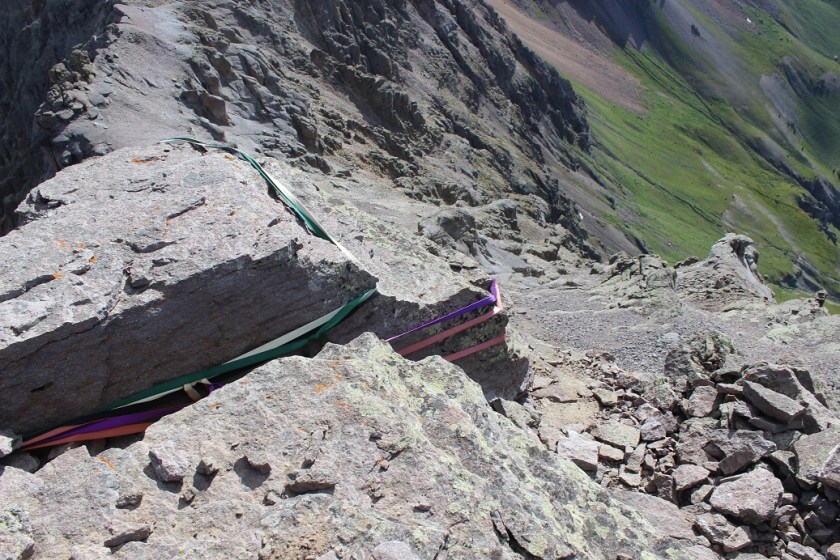
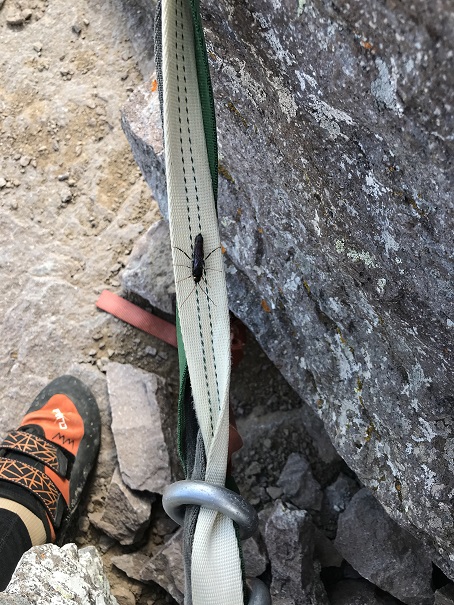
There was an anchor set up about 10 feet from the top of the chimney that looked sketchy. I was glad I’d brought my webbing and rope up with me and decided to secure it now before summiting, lifting and pulling the rope hand over hand until I had it all above the chimney.  I didn’t need a lot of webbing but I’d been unable to find my knife, so if you get up there and wonder why someone left all that webbing I can assure you it wasn’t on purpose:  I just didn’t have anything to cut it with (I did have more webbing in my pack however, so this wasn’t all of it).

41

I summited Jagged Mountain at 10am

42

Jagged Summit:

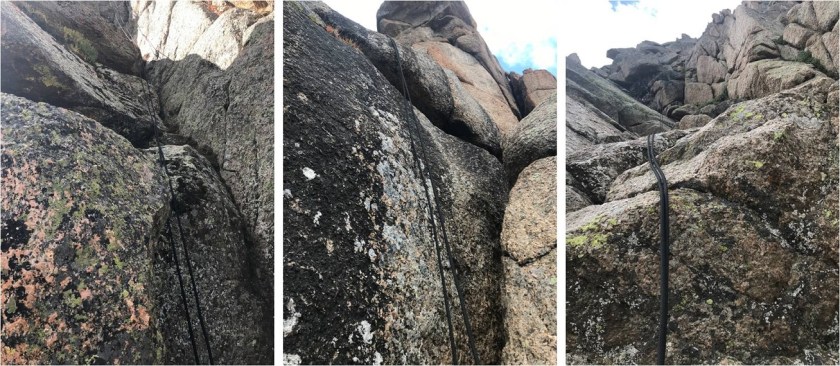
Here are some summit views and a pretty robust anchor set up if you want to rappel the 165 feet down instead of heading back the way you came (that’s a lot of rope!)

43

Jagged Mountain was by far the most challenging summit I’ve ever attempted. I was very proud of myself for not giving up, even when I seriously wanted to.  Now I just had to get back down to my campsite safely.  I turned to exit the way I’d come and rappelled back down the chimney, retrieved and recoiled my rope and put back on my gear.

Here’s looking at the traverse back to the notch

44

I used every anchor station on the way back down, collecting and recoiling my rope after each descent (that’s exhausting!)

45

I brought a 50 meter rope with me and it was exactly the right length. I rappelled 4 times (including the chimney) and on the last rappel to right above the snow my rope just touched the ground (a great reason to tie a knot in the ends of your rope!).

I was coiling my rope here when I saw the flight for life helicopter heading towards the Animas River. I said a silent prayer for those involved (stay safe adventuring out there friends!), put on my microspikes and headed back to the pass, keeping an eye on the weather.

46

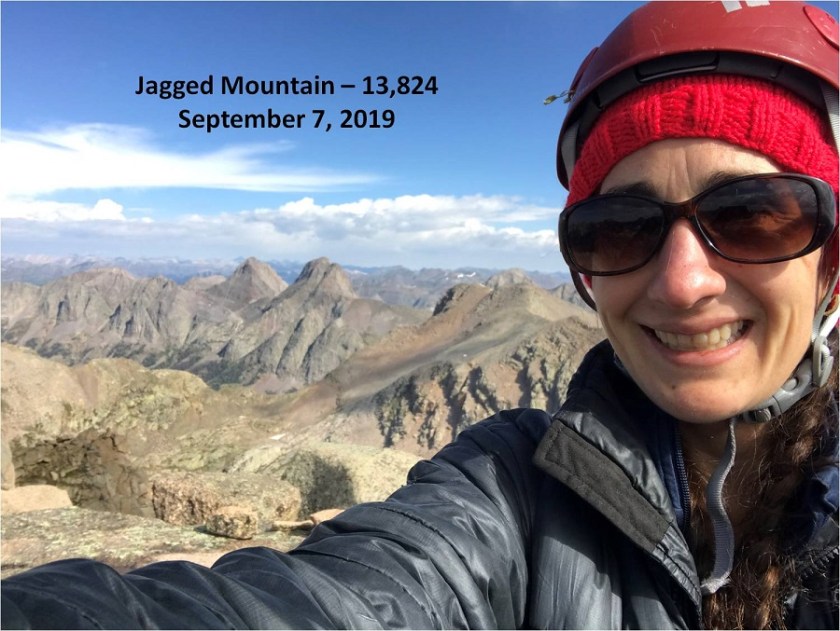
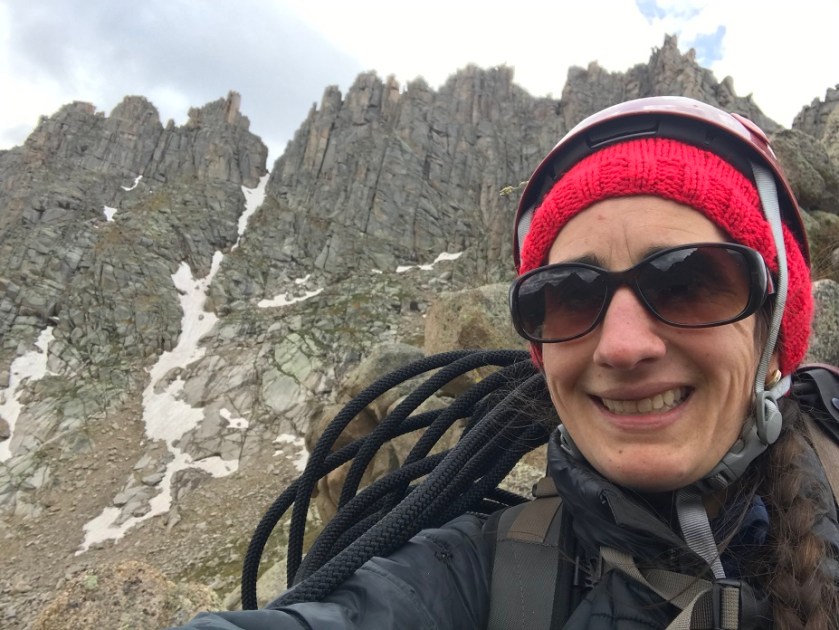
At the pass I took a selfie just because I could and because, hey, it’s Jagged

47

Here’s the route to my campsite (note I camped below the unnamed lake: I didn’t see a reason to hike all the way up there?) and the path out through the basin.

48

I made it back to my campsite around 12:45pm, making this about 6 hours campsite to summit to campsite: that’s a long time for 2 miles round trip!  (I blame it on the rain…)

It had been my intention to hike back to my camping area, eat lunch, gather my gear, filter some water, and head back. Mother Nature had other plans.  As soon as I made it to my camping area it started to rain, so I turned myself into a tarp burrito and rested for about an hour. When it became apparent the rain wasn’t letting up anytime soon I had some choices to make.  I didn’t have any dry clothes but the ones I was wearing because I’d been unable to dry my wet clothes from yesterday.  I could:

  • Stay where I was and wait out the rain and hike back the entire route tomorrow. By doing this I’d be chancing the snow forecasted for tonight and the conditions would be similar to today since the sun wouldn’t have been out to dry the rain
  • Hike back now in the rain and stop somewhere along the way to camp in wet clothes
  • Hike all the way to Purgatory in wet clothes (approximately 20 miles)

I knew I’d gotten more sleep last night than I usually get in 2 nights time so I was well rested. I also knew if I tried to sleep in wet clothes I would just shiver all night (and sleeping naked wouldn’t have been any good since I’d need to put on wet clothes in the morning and hike out anyway, so I might as well just hike out now).  I have a lot of energy and need to exhaust myself to go to sleep:  staying put didn’t mean rest.

Curiously, the umbrella that had been there yesterday was now gone. I’m assuming a marmot took it?

I decided to hike out, so I packed up my gear (found my knife in my sleeping bag: It must’ve fallen out of my pocket last night) and in the beginning tried to use my tarp to shield me from the rain (in case you’re wondering, it didn’t work). I was soaking wet in the first 5 minutes.  Everything, including my waterproof pants, socks, jacket, and shoes were sopping wet. I could actually see the water oozing out of the top of my shoes and when I put my arms down I saw water dripping out of my sleeves.

It rained. And rained.  And rained.  After about 2 hours I screamed (to no one in particular) ‘”STOP RAINING!”  It didn’t work and it didn’t really matter:  the ground and trees and bushes were going to be wet for days (the forecast called for more rain/snow).

My main concern was getting past the avalanche area while it was still daylight. I stayed north this time and went over some boulders, avoiding trees where I could, which ended up being the better idea.  There was still no trail to follow, but I was able to pick up faint game trails at times through the 3-4 foot brush.  The difficulty of the avalanche area was compounded by the rain and slick conditions.  I was slipping and sliding over tall-grass camouflaged wet rocks and trees; the only consolation being I was doing it now instead of tomorrow (in worse conditions).

In case I didn’t describe it properly last time, the avalanche area is full of enormous trees and branches piled on top of each other in various states of decomposition and some areas are like trap doors: they looked olid but you could fall right through them.  My shins and thighs and forearms are covered in bruises.  My hiking pants are completely torn up and I’m in the market for a new pair.  I kept falling and about halfway through my phone stopped working (I’m guessing because it was waterlogged).  I didn’t dare get out my DSLR in these conditions so I mentally resigned myself to losing pictures/my track, which stunk because I really wanted them from this climb!

Thankfully I made it out of the avalanche area and back on the Noname Trail in the daylight, and from there booked it down to the Animas River. I wanted to get as much of this hike done in daylight as possible so I wasn’t taking breaks.  I was taking “bend over to get the weight off my shoulders and pump my thighs up and down” breaks though, usually for 5 seconds worth of ujjayi breath before continuing on.

As I hiked I looked for fresh animal racks in the mud and unfortunately didn’t see any. There were brief periods where the rain stopped, but I’d only get about halfway dry out before it started raining again.  I didn’t bother being careful crossing the creeks:  my feet were already soaked, so a little creek water wouldn’t hurt any.

I made it to about a mile before Water Tank Hill when a man surprised me. He was dressed head to toe in rain camo.  “Oh, I didn’t see you” I announced (well, duh) and we talked for a bit.  He looked like a hunter but I noticed he had a tripod in his pack and guessed he was a photographer.  He had an accent that suggested Eastern Europe. He was soaking wet as well and had no idea how he was going to get dry tonight.  When I told him I was hiking back to Purgatory he first said “wow, that’s a long way!” and then asked me if I’d come this way on my way in.  We had a laugh over 200 feet of “why am I doing this?” (Water Tank Hill) and then I was on my way.

I made it up Water Tank Hill and decided to take a short break. It was 8pm.  I played with my phone again and was finally able to get it to turn off and reboot.  Once it was done I was able to open my phone again: yes!!!  I hadn’t lost my data and it looked like my tracker was still going.  I was still soaking wet and my feet felt like I was hiking in water shoes, but this, this was a major win!

From here it didn’t take long to make it back to Needleton, where I breathed a huge sigh of relief, knowing I still had 11 miles to go but they would all be on a well established trail with no route finding. I just needed to keep going, slow and steady.

I’ve hiked the Animas River Trail several times, and it’s getting easier to know where I am and how much further I have to go, even in the dark. For the first time I didn’t see any campers (most likely due to the weather forecast).  I stopped for another break at the base of the Purgatory Trail.  Despite not having time to filter water I still had plenty so I didn’t filter any now.  I had some peanut butter and was on my way again to hike the last 4.3 miles up to the trailhead.

I’ve done this last part three times: once in the daylight and twice now in the dark.  Let me tell you, hiking up Purgatory in the dark is the way to go!  The daylight sun in demoralizing.  Sure, tonight I was soaked due to the rain, but I wasn’t gulping down water every few seconds to stay hydrated.  Also, the first couple of times I hiked this trail I got frustrated due to all the ups and downs in elevation.  It’s no fun to gain elevation just to lose it again.  So I changed my mindset this time:  I was going to have to do the last mile directly up from the river anyway: I might as well enjoy the downhill times while I could.

I made it back to my truck around 1:45am, making this a 46 mile hike with 11,481’ in elevation gain in 47 hours. I took off all my gear, cleaned myself up, and decided to take a nap before heading home.  I tried for 30 minutes to fall asleep, couldn’t, and got up and just drove home (too much sleep yesterday?)

There had been a 30-70% chance of rain today from 12-5pm, but it had rained at 7am, 12-5pm, 7pm, 8-10pm, and as I turned my truck on to leave it started pouring again…

49

50

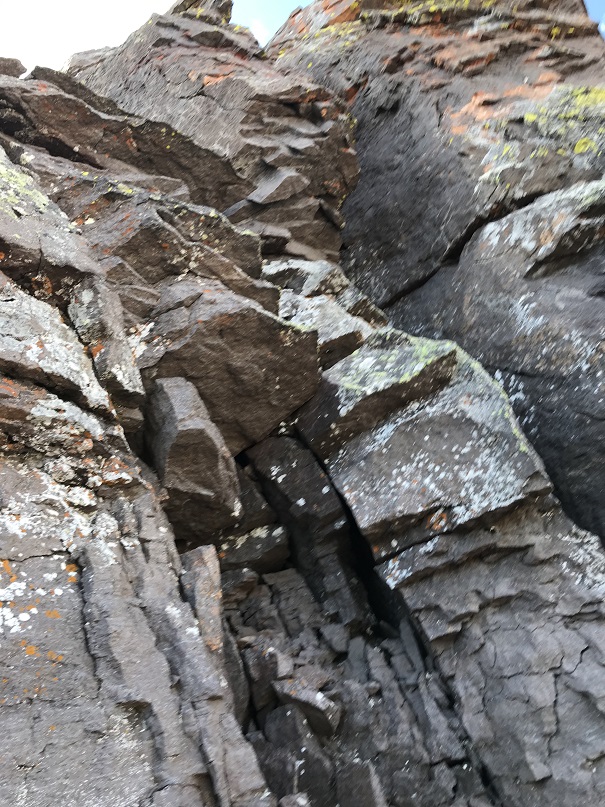
Dallas Peak – 13,812

1

RT Length: 12 miles

Elevation Gain: 5445’

There are a lot of really good reports on this mountain, but I’m visual and like a lot of pictures so I’m adding what I have to what’s already out there…

In keeping with my “sleep is for amateurs” theme this month I made it home yesterday just in time to pack up the truck and make it to the campground before dark.  I helped my daughter set up her tent and then walked around the campground talking with the other families (I was hosting a Girl Scout Family campout, which was pretty chill, seeing as how everyone was basically “family camping” at the same spot).  We’ve done this for the past 10 years now so I know every family has their own routine.  Most go off roading and a few go into town.  Everyone canoes/kayaks.  My daughter wanted to get her homework done the first day so she could enjoy the weekend, so I decided to let her do that and I’d go hiking.  4 hours away.  (Hey, in my mind the trailhead was 6 hours from my house, and by combining it with this trip I knocked 2 hours of the drive there and 2 hours back).

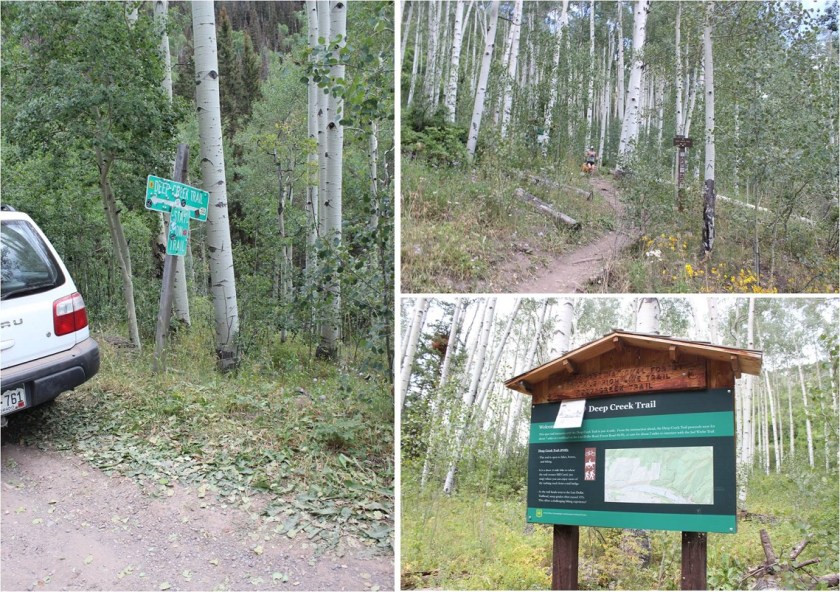
I was able to fall asleep around 8:30pm and got up at 10pm to drive the 4 hours to the Mill Creek / Deep Creek Trail (please do not confuse this with the Mill Creek Campground: you won’t end up in the right spot).

While sleep may be for amateurs, I’d had less than 4 hours sleep in the past 48 due to my South Colony Lake hike yesterday, and I found on the drive to the trailhead I was more tired than I’ve ever been driving. This scared me, so I pulled over to the side of the road and spent 5 minutes trying to fall asleep.  This didn’t work, but it did give me about another half hour of driving in before I felt too tired to go on and decided to set my alarm for 20 minutes.  20 minutes was the magic number, and I was able to effortlessly drive the rest of the way to the trailhead, hike all day, and make it back to the campground without feeling the need to sleep again.

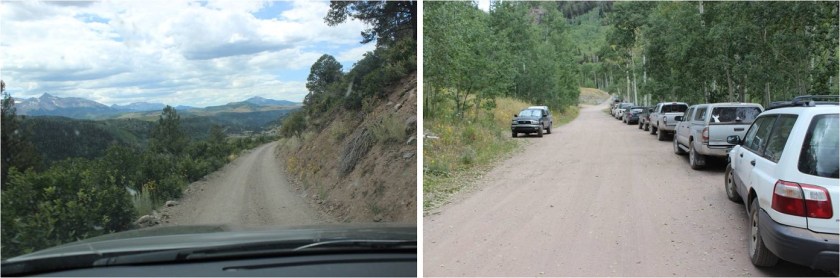
I was surprised to find the trailhead is at the end of a shelf road, and even more surprised to find so many vehicles parked there.

2

I was on the trail at 2:45am, a little disappointed in how heavy my pack was containing all my gear (60 meter rope, harness, belay device, webbing , etc.). I put on my helmet at the trailhead before starting the hike.  The trailhead was very easy to find.  I followed it northeast along the Deep Creek Trail.

3

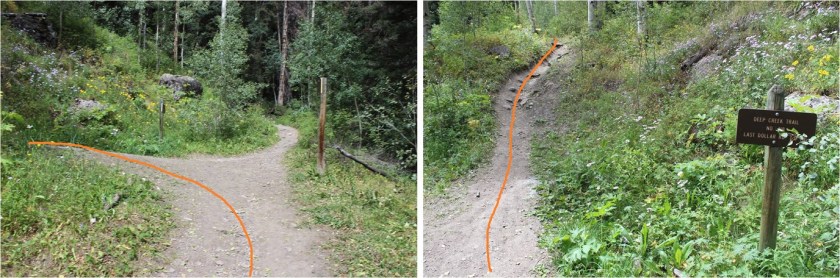
After about half a mile I turned left (west) at this junction and continued on the Deep Creek Trail

4

The trail switchbacked 5 or 6 times up the mountainside and then curved north around it, following a well defined trail

5

After a total of about 1.7 miles there’s another trail junction. I turned right (north) here

6

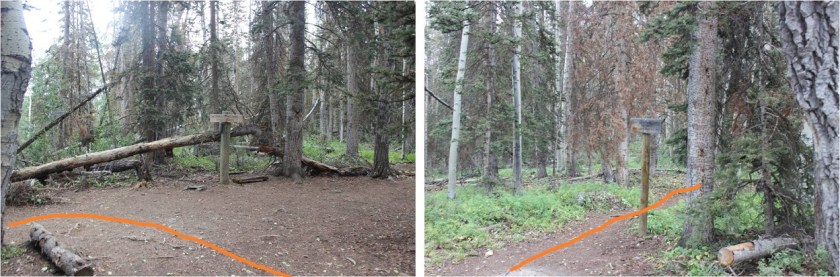
And followed the Sneffles Highline/Deep Creek Trail north through some aspen trees

7

And switchbacked another 8 or 9 times up the mountain, transitioning through pine trees and then tundra mixed with pine

8

I was enjoying the lights of Telluride as I hiked in the dark, but I wasn’t enjoying the soreness in my shoulders.   I took an ibuprofen and trudged on.  This is where the trail looses about 300’ of elevation for no good reason.  Luckily it’s not too drastic of an incline because it’s dispersed over half a mile, but it still hurts on the way out.

9

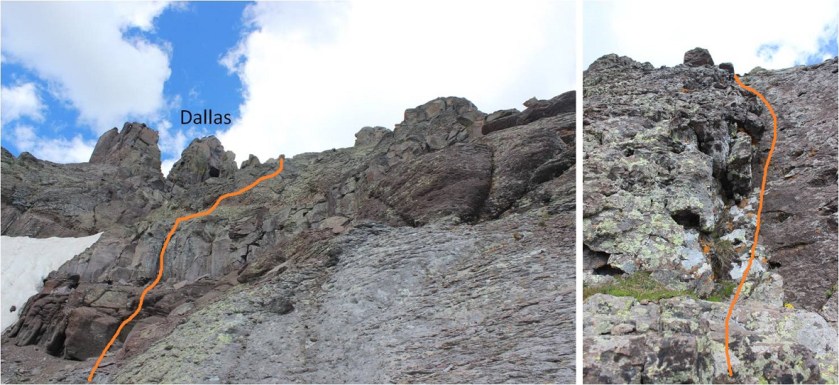
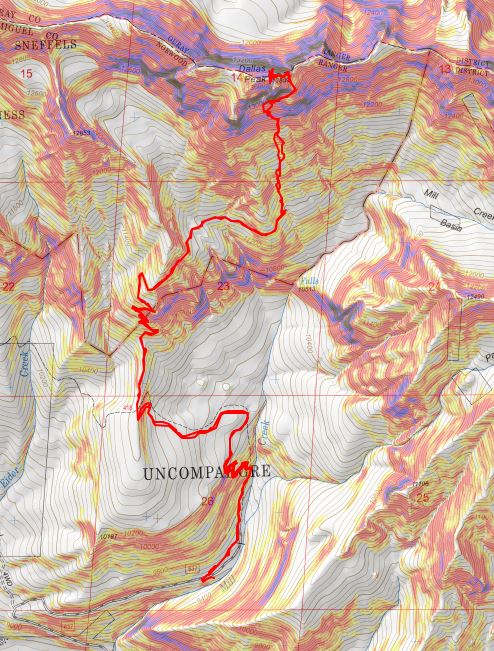
This decrease in elevation will take you to the base of Dallas Peak. Here you leave the trail and find your own way up the grassy slopes towards the cliff bands.  Here is the route I took:

10

I started this in the dark, and just followed the tundra north, which eventually led me to a gully and a rocky cliff area. There was a lot of loose rock and scree here that slowed me down quite a bit (that and I was tired from all the hiking I’d already done this week).  This is also a good time to put on your microspikes.  I’ve heard there’s class 3 scrambling here but was able to find a class 2+ scree route by following social trails.

Just before making it to the cliffs I turned right (northeast) and followed some cairns to the ridge

11

12

You continue following to the left (northwest)

13

14

Until you see a gully to your left. Ascend via the class 4/5 section to the right of the gully.  There are plenty of hand/foot holds here, and at the top there are anchors to rappel down (I didn’t, but if the rocks were wet I could see how this would be useful).

15

16

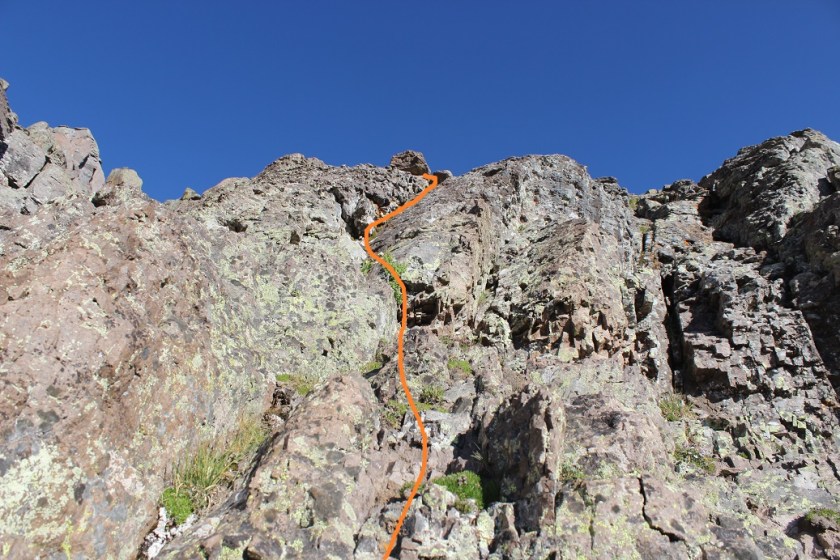
Once I gained this section I made my way to the base of the summit block and changed my gear, putting on my climbing shoes (totally worth carrying them) and harness. At this point I was exhausted:  My gear was heavy and that mile of scree/talus had taken a lot out of me.  Here’s the first part of the route:

17

This was as fun class 5 chimney climb that took some fancy footwork (only because I’m short). At times I was pressing my back to the rock for leverage and using my palms for support.

18

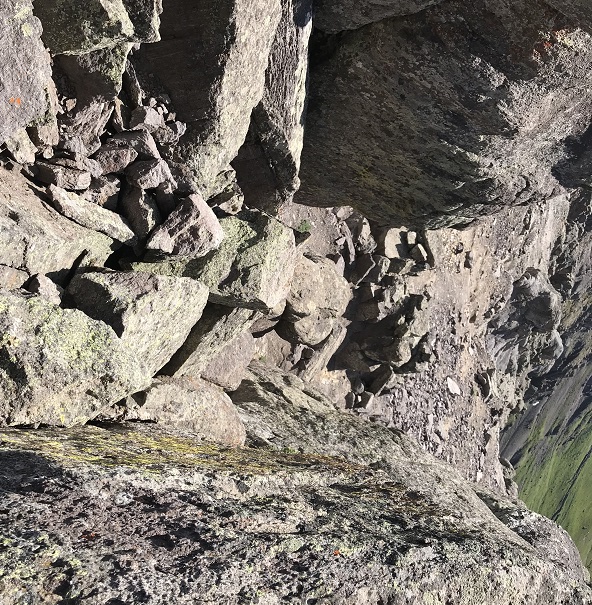
Here’s looking back down on this section

19

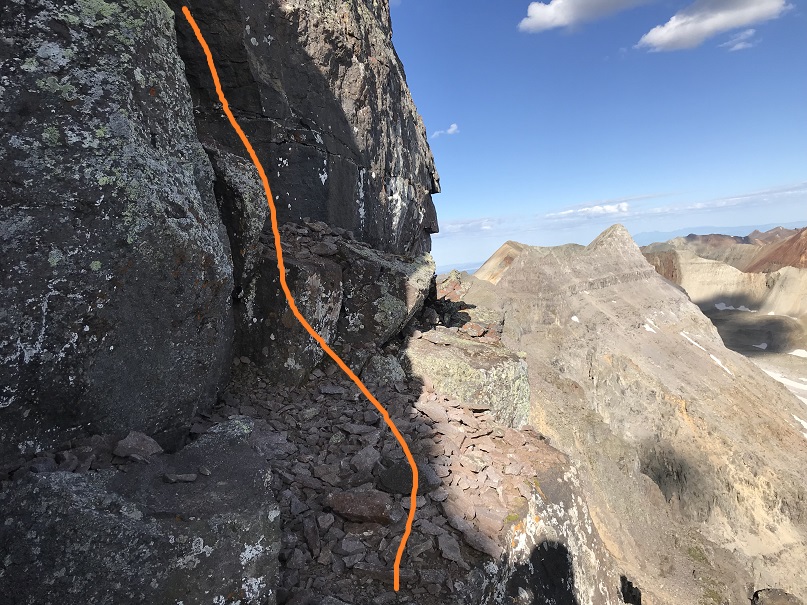
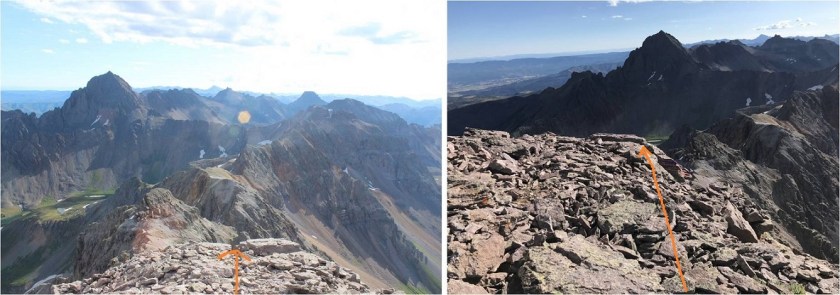
Here is where the route gets tricky. Even though you want to summit by going straight ahead (west) this is not the way to summit. Continue right around to the north side of Dallas.

20

Cairns weren’t helpful here. I kept finding areas that looked ‘summitable’ but for me weren’t.  It was getting frustrating but I refused to give up:  I’d make it half or even three quarters of the way up a line only to find the hand/foot holds ran out, and I knew there had to be a safer way. In total there were two obvious areas I tried that didn’t work before before coming to the correct one at the bottom of a small dirt filled gully on the north side of Dallas

21

Here’s what it looked like from the bottom

22

I was able to climb up this area without ropes, although it was slow going and I was careful with every hand/foot hold. I was very glad to have my climbing shoes.  I summited at 9:15am.

23

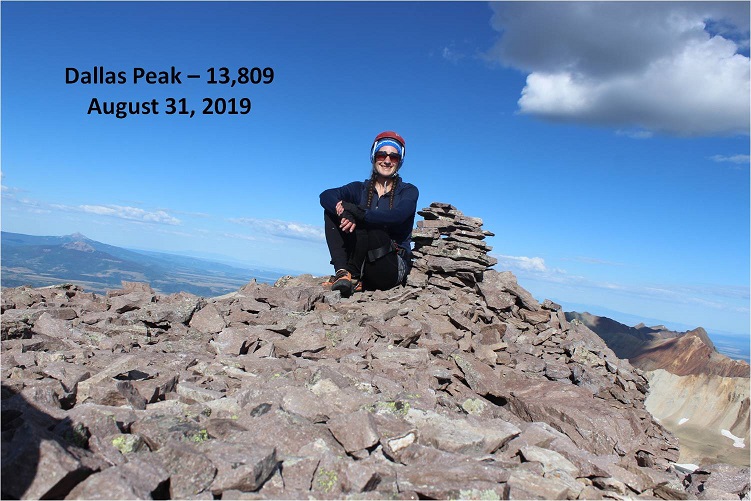
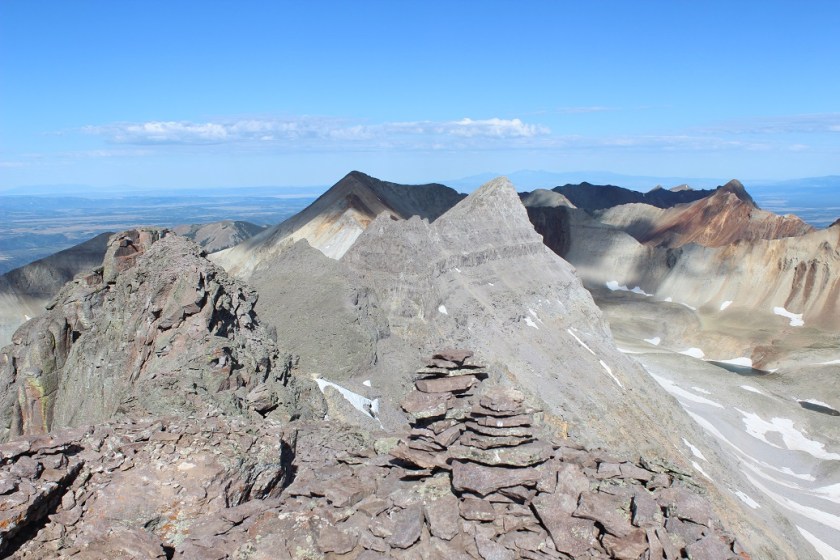
Dallas Peak:

I was quite thrilled with myself for making it up without ropes, and decided to spend a long time on the summit, enjoying my success.

24

The way off Dallas Peak is to rappel to the southeast

25

There was quite a bit of webbing already set up.

26

The only problem? This guy.  He refused to move, and quite honestly I didn’t want to scare him and have him bite/sting/fly all around me.  So I talked to him for a bit and told him if he didn’t move, I wouldn’t kill him.  This arrangement seemed to work, as he never left his spot.  He was about 2 inches long.

27

I set up my gear and threw my rope over the side. It got tangled, so I had to haul it back up, untangle it, and throw it again.  Success!  On the way down it’s instantly committing.  You aim for the hole (the hole is the halfway point down).

28

I double checked my set-up, leaned back and felt secure, so I unhooked my slings and started down, aiming for the hole in the rock

29

When I made it down to the hole I found it was a ledge: I could have set up a second rappel from here if need be (but my 60 meter rope was more than long enough).  Here’s what it looks like looking up and down from the ledge.

30

I leaned back one more time and started the rappel down through the hole, noticing there was a rope that had been left there. When I made it to the ground I saw a sign on the rope asking others to leave it as they found it, as its owner is coming back this winter to retrieve it.

31

I unhooked my belay device, pulled my rope through and recoiled it, mentally thinking through the rest of the descent. I felt confident I could descend the class 4 section without rope, so I put it away in my bag.

Here’s the way I rappelled down

32

I decided to keep on my climbing shoes until I made it back down past the class 4 section. I wasn’t disappointed, as the rock was easier to navigate than it had been on the way up wearing climbing shoes.  I felt very secure down-climbing this area.  Also, it looks very different on the way down

33

Here’s a look at the way down from the ledge. I stuck to the left (east) of the snow and just aimed for the obvious trail below that cut across the side of the mountain, so glad I was doing this now in the daylight

34

35

36

I made it back to the trail and all I could think about was making it back to the campground as soon as possible: I’d promised my daughter I’d make dinner.  I found some raspberries along the way that were delicious, so that settles it:  Raspberries in the San Juans just taste better.

I made it back to my truck at 1:30pm, making this a 12 mile hike with 5445’ of elevation gain in 11 hours

37

38

I made it back to the campground around 5:30pm and we stayed up and chatted around the lake/campfire until late into the night. This is how I spent the rest of my Labor Day weekend, relaxing in the beauty of one of my favorite Centennials…

39


Half Peak – 13,866 & Point 13,164

1

RT Length: 18.5 miles

Elevation Gain: 5640’

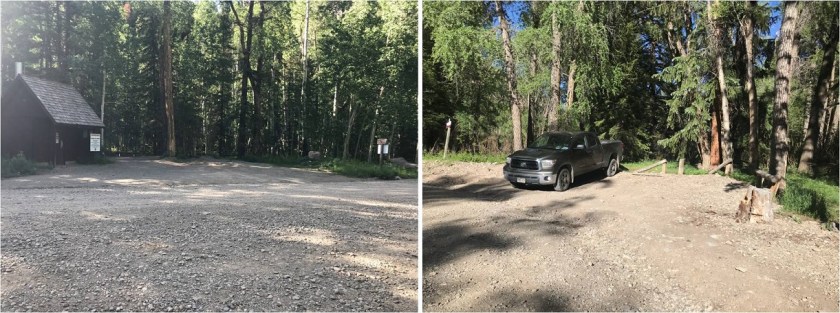
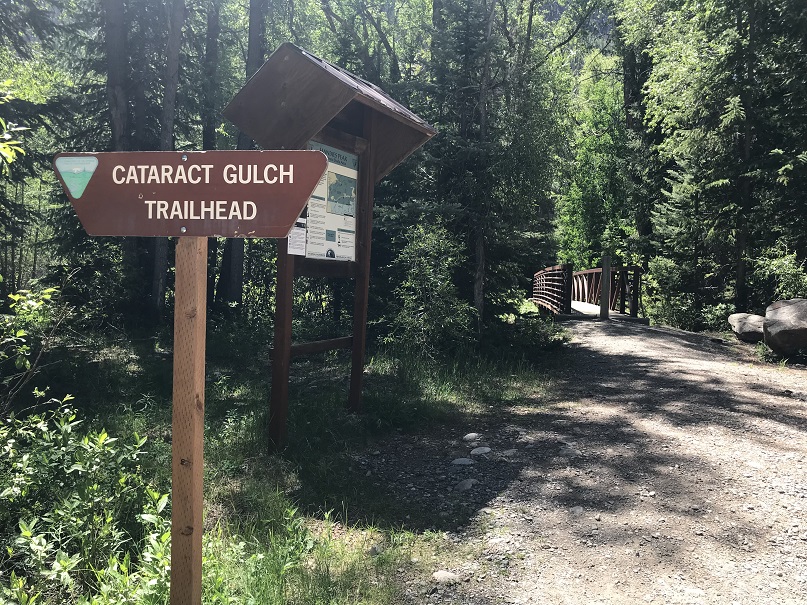
I arrived at the Cataract Gulch trailhead the day before, after summiting Point 13,832.  I was pleasantly surprised to find a well stocked and clean bathroom, as well as plenty of open parking space.   Mine was the only vehicle in the lot, despite it being 4th of July weekend.

2

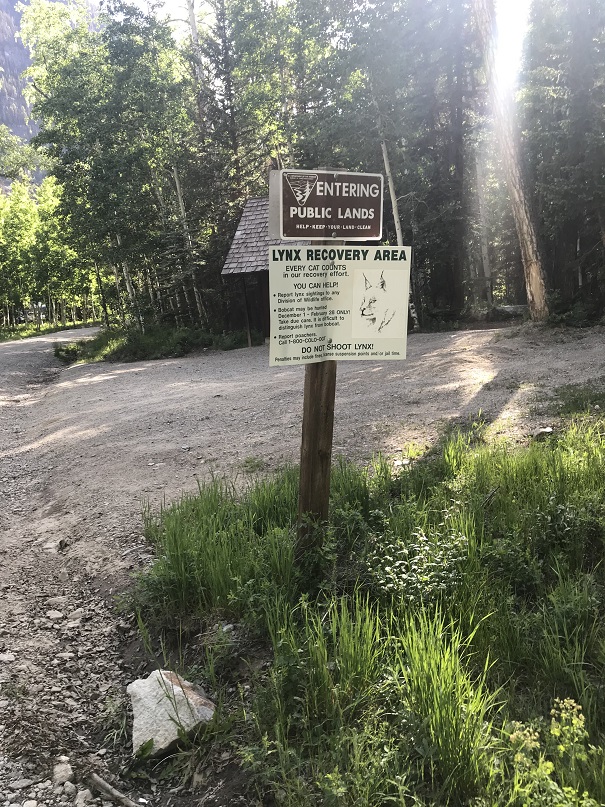
Also, apparently this is a Lynx recovery area, which I found interesting.

3

I’d ended my hike early and desperately needed to catch up on sleep, so I went to sleep around 2:30pm and only woke up twice:  once because it was too hot in my truck (the sun was going down but at exactly the right angle to heat up my vehicle drastically in just a few minutes) and another time I around 10pm. I still had over 4 hours of potential shut eye so I took a melatonin with a shot of whiskey and fell back asleep.  I didn’t wake up again until my alarm went off after 2am, so I consider it a successful night of truck camping (I notoriously sleep terribly at trailheads).

I fished around in my backpack for my flashlight and couldn’t find it.  I was sure I’d placed it in the small pocket the day before, but it was nowhere to be found. Luckily, I always carry a spare as well as extra batteries.  Immediately I remembered why I didn’t like this flashlight:  it was TOO bright.  That sounds like a good thing, but when hiking in the forest in the dark I’d actually rather not see every detail.  This flashlight was too good. I was going to have to replace it when I got home.

On this hike I was armed with a topo map, a compass and some beta from the campers I met last night, as well as a rough route description.  I started on the Cataract Gulch trailhead around 2:45am, crossing Cottonwood Creek on a well built bridge over a swiftly flowing creek

4

5

And then I crossed the creek twice more on well placed log bridges I had to hunt for in the dark because they weren’t on the main trail.  I was seriously worried I’d have to ford this creek multiple times before discovering the log bridges, which were (as usual) easy to spot in the daylight.

6
This trail had a trail register (Woot!  More noise!) and was easy to follow up to the first avalanche area

7

The avalanche area was very small and well packed down

8

I didn’t have any difficulties until I made it to the waterfall area.  There had been a small avalanche and it looked as if the trail wanted me to cross the waterfall.  I took out my topo map and it looked too early to cross yet, which meant I’d have to follow the waterfall up for a ways first.  There was no trail so I bushwhacked in the dark up the mountainside, paralleling the creek.

9

Here’s when I came to the crux of the waterfall. It was still dark out (I’m guessing it was around 3:30am) and the waterfall was raging.  I could feel the spray of water on my face, even though I was standing several feet away.   I went right and left looking for a better way up and encountered very large boulders blocking the route in every direction.  I could tell I just needed to ascend 15 feet or so (maybe less) and I’d be where I needed to be to cross the waterfall.  It took some fancy footwork and a class 4 move, but I was able to work my way up the side of this boulder, up and over to flat terrain.  (Side note, apparently I made this too difficult and there’s an easier way I was unable to find in the dark.  Check out Angry’s conditions report for a class 2 route over the waterfall).

10

There was a camping area directly above the waterfall, and I was able to pick up a trail again.  I was already considering today a success:  the campers I’d talked to the night before hadn’t made it this far.  The trail rounded a corner and brought me to a creek crossing above the waterfall.  I had 2 options here:  either balance my way across the log and potentially fall in the water (I was carrying a full pack) or take off my shoes and wade across.   In the dark I took off my shoes and put on my water shoes (hurray for new gear and dry socks!).  Yes, I’m sure some could have walked across the log, but I decided to use the log for stability and wade across, keeping my feet dry in the long run.

11

The well established trail picks up directly after the creek crossing

12

And brings you to a boulder field

13

Just after the boulder field there’s another creek crossing.  Unfortunately, the creek was running quite high here and I became frustrated trying in the dark to find a passable route.  I noticed some cairns to the right and followed them to what looked like a goat trail through the willows.  This led me to a snow bridge that looked ready to collapse any day now, but it would get me across the roaring creek.

14

Check out the snow bridge.  I was so excited to come across this in the dark.  There weren’t any footprints from here on out, so I crossed my fingers I’d be able to find my way.

15

I didn’t find many pictures of this route, and to be honest route finding was difficult in the dark due to the snow, so I’m going to do my best to post some details.  I followed the well defined (when there wasn’t snow) Cataract Gulch Trail.  Just after the last creek crossing I headed south and rounded a large boulder

16

The (still snow free) trail brought me to a ravine

17

(In case anyone wants to see what the trail looks like at 4am…)

18

Here the snow picked up, covering the trail about 80% of the time.  This was both good and bad:  It was nice to see a trail every once in a while, but it was covered so much it was difficult to follow and became frustrating to someone like me who hikes on established trails when available.  Just head south until you reach Cataract Lake. It feels like you’re hiking forever, but I promise you it’s there.  My tracker showed it at 4.9 miles from the trailhead.

19

Here the birds started waking up.  This is one of my favorite part of early morning hikes!  I also saw a herd of Elk in the meadow.

Video:

Continue past the lake and you’ll come to a trail junction.  Continue heading South

20

You’ll pass a small pond on your right and head towards Cuba Gulch, which is also the East Fork Middle Pole Trail (another well defined trail when there’s no snow).

21

Follow this trail west as it hugs the side of a mountain, unfortunately losing a little bit in elevation in the process.  Here’s the general idea of where you’re headed

22

And some close ups.  There was quite a bit of snow here, obscuring the trail.

23

Here I rounded the small basin and headed to a small saddle

24

This section is steeper than it looks, and snowshoes were helpful.

25

Turn right at the saddle and follow the trail towards Point 13,164.  The dotted line is the suggested route to summit this ranked 13er, but I didn’t like the angle of the snow, so I continued on the trail until I found a better way to summit.

26

This is the route I took to gain the ridge of Point 13,164:  I needed snowshoes and an ice axe here

27

At the top of the ridge I wound my way north to the summit.

28

From there it was an easy walk up a tundra slope to the summit with a rather large cairn and a great view of Half Peak

29
I summited at 7:10am

30

Video:

Also, the San Juan’s still have a lot of snow!!!

31

Ok, back down so I can get started with Half Peak.  Here’s the view of the way I went back down and then gained the ridge to hike up Half Peak.

32

Side note:  If you’re not interested in summiting 13,164 here are the coordinates along the trail you turn east at to gain the ridge of Half Peak

33

This is a long but gentle slope with no defined trail.

34

The crux of this route comes just before the summit at around 13,500’.  There is a narrow ridge to navigate.

35

Ther37e’s a lot of exposure but I agree with Roach’s assessment this can be kept class 2 with careful footwork.  I found the best strategy was to stick to the ridge in most places, dropping down 15 feet or so only when necessary

36

Here’s a picture looking back.  The ridge reminded me of the catwalk along the ridge to Eolus.

37

From here it’s an easy walk to the summit

38

The summit is large and pretty flat

39

I summited at 8:30am

40

Video:

Here’s a look back on the route up the slope

41

I’d initially planned on hiking Quarter Peak (a bicentennial) today as well, but in the morning I’d gotten a look at Half Peak and the decent route off Half and towards Quarter had a lot of snow.  I didn’t feel ready to commit to the descent in this warm weather.  However, looking at Quarter from Half the ridge up to the summit of Quarter looked dry enough to summit without tackling snow

42 (2)

Oh well, time to head back down.  The snow was softening up, and the snow below the saddle required snowshoes once again (more necessary this time).   In this picture you can see a river flowing underneath several feet of snow

43

Here’s a look at the route back from Cataract Lake

44

I was almost back to the river crossing with the snow bridge when I looked over at the basin and saw 3 Bull Moose enjoying lunch together in the willows!  Very cool!

45

Video :


I crossed the snow bridge, following my previous tracks.  Here I started seeing people on the trail.  I warned those with unleashed dogs about the moose up ahead and gave some people advice on how to find the snow bridge so they could hike to the lake.  Actually, the park ranger/mom in me talked to everyone on the way down, but mostly just to see where they were headed.  Today was such a beautiful day to hike!

I crossed the stream above the waterfall, descended the waterfall the same way I’d ascended, and made it back to my truck at 12:45pm, making this an 18.5 mile hike with 5640’ in elevation gain in 10 hours.

46

Here’s a topo map of my route

47

Organ Mountain 13,808

1

RT Length: 9 miles

Elevation Gain: 3500’

My hiking days got switched this week due to mandatory Friday dentist appointments. (Side note: anyone know of a great dentist in Colorado Springs that’s open nights and weekends?  I love my dentist office but their hours stink!!!).   I was willing to give up my hiking day this week for dental hygiene but when I asked my kids what they wanted to do this weekend one was gone and the other wanted to sleep until 4pm (she’s a teenager, this is doable for her) but she wanted me to take her to see the school play at 7pm.  Woohoo!  This gave me a Saturday hiking day, and I could drive further since I didn’t need to be home by 3pm.

So I changed my schedule and took a nap Friday night and woke up at 11:45pm and drove the 6 hours to the Eddiesville Trailhead in the San Juans. The weather wasn’t supposed to be spectacular (0-29* at the summit, with wind chill making it 0 to 10*) but as I was driving down the dirt road my heart sank as the temperature dropped to -5* and held there for a bit.  I got excited when it rose to 7* (I know, crazy to be happy about 7* weather) and disappointed again when it went back down to 0* and then held steady again at -5*.  With my Raynaud’s I was seriously worried a hike wasn’t going to happen today: I’ve never hiked in such cold weather and had my doubts.

I’d seen a report from earlier this week stating the trailhead was still open (woohoo!) but that it was icy. Let me tell you, they weren’t kidding!  I’ve never experienced this kind of ice before.  Granted it was -5* outside, but the dirt road was covered in 2-4 inches of ice and there was no way to gain traction on the road.  This is the very first time I’ve ever experienced my 4WD Tundra slip in the 6+ years I’ve been driving it on ice and snow.  It caught me off guard, but I straightened it out and kept it under 5mph until I reached the trailhead.  Those steep hills with tight curves were a killer!  I could tell by tire tracks several other vehicles had slid into the drainage on the side of the road in the past few days.  There was a pretty good rut going for tires which was nice, but would have made passing another vehicle a nightmare.  Here are pics from my drive out.  The creek crossing(s) were fun, especially the second one that had a thick layer of ice at 5am I got to break through with my truck:  My truck was happy!

2

There were tons of animal tracks along and through the road. Very cool!  Hopefully I’d see some wildlife today.  I saw some of the biggest white rabbits I’ve ever seen.  Seriously.  They reminded me of the jackrabbits we had in Arizona, the ones the size of racoons.  I arrived at the trailhead at 5:30am to -5* weather and snow everywhere and a gate preventing me from driving further.

3

I’m still learning about winter condition hiking and where my limits are, so I’d decided before even arriving to give it a try and turn back if needed. I’d driven all this way, hadn’t I?  I might as well use this as a learning experience, -5* weather or not.

So I put my snowshoes on in the truck and bundled up for the cold weather with multiple pairs of gloves, my balaclava, knit hat, etc. I opened the door and was greeted with intensely cold air, but luckily no wind.  I took a deep breath:  I could do this! (Probably).

The trail actually had signs, which was an unexpected treat.

4

I followed the trail through a gate and to the left (southeast) for about 150 yards

5

until I saw this post and turned right. There was supposed to be a trail here, but it was invisible in the snow.

6

My fingers were burning. Seriously burning from the cold.  I stopped and took off my felt gloves that were under my mittens and just wore my mittens.  My hands were instantly warmer, but I was giving up finger flexibility:  I would no longer be able to take off my mittens to actually do stuff (like adjust my snowshoes, take photos, look at my phone/gps, etc).  (Another side note: Someone seriously needs to invent better gloves.  I need actual gloves with finger casings for dexterity, but unfortunately they don’t keep my hands warm enough.  I need mittens that have small fingertip holes made with thin weatherproof fabric that retract inside the mitten but you can poke your fingertips through when necessary.  Someone please invent these.  But I digress…

Now that my hands were warm my hike instantly looked more promising, despite the cold weather. The lack of wind below treeline helped too.  The trail varied from large amounts of snow to just a little on the trail. It was easier to just keep my snowshoes on, so I did, even when they weren’t necessary.

7

As the sun started to rise I got my first good look at Organ Mountain (this isn’t the summit).

8

Did I mention the animal tracks? It was obvious no one had been on this trail for quite a while.  Well, no one but our 4 legged friends.  I saw tiny prints from mice, fox prints, and the biggest rabbit prints I’d ever seen.  Oh, and the deer and elk and moose prints were everywhere. This is how I knew they were moose tracks…

9

The animal tracks were super helpful for finding the actual trail. There was a trail here, but it was invisible with all the snow.  Luckily the animals knew where it was (mostly).  When the animal tracks obviously veered off the trail I just followed the creek.  This trail follows the Hondo Creek all the way to treeline, so as long as you parallel the creek you’re fine.

And check these tracks out! I instantly knew these were mountain lion tracks and got excited!

10

They followed the trail for over a mile and were headed in the same direction I was. I found it fun the lion didn’t always stick to the trail, but sometimes hopped onto logs and traversed them seemingly for ‘fun’ and then jumped back along the trail again.

11

Then all at once the tracks veered off in another direction. I decided to follow them for a bit to see if they paralleled the trail I was on or went another way.  While these tracks were hours old (I could tell by traces of elements left by the wind) I still felt it prudent to see which direction the lion had taken so I knew whether or not to be on the lookout.  Imagine my surprise when the tracks led me to its den no more than 50 feet off the route I was on!  With no tracks leading back out I quickly retraced my steps and continued my hike (sorry, no pictures:  I want to keep the kitty safe!).

I continued following Hondo Creek until treeline and got a great view of the route before me.

12

My research said to take a route to the right, but to me the left side of the mountain looked easier: Give me quick elevation gain over the long way any day!  So, despite my map and trail directions I decided to go up the left (south) face of the mountain.  It just seemed safer, especially since avalanche danger is more prominent on the north/east faces right now. Not that there was much snow to worry about.  I was worried about the wind.

13

This was a steep climb and would have been easier without the traces of snow, but the rocks were semi stable and I didn’t need to worry about causing an avalanche/rockslide below me. I kept my snowshoes on for stability.  I was able to gain the ridge in about half an hour and could see the rest of the route before me.  This is where the wind picked up (25mph) and took the 0* temperatures to new negative levels.  But I was dressed well, and as long as I didn’t take off my gloves I was ok.

14

This is the route I took.

15

And looking back down from the ridge at the route from my truck to this point

16

There are several false summits on this mountain. After gaining the ridge I was on a small plateau that gave me a break from elevation gain (here’s looking back at the plateau)

17

But there were still two other points to gain

18

I stuck to the drier areas and just followed the ridge up to 13,400’ where there was a small rock wall and a lot of wind. It wasn’t too steep and as long as I didn’t stop I didn’t get too cold.

19

20

From here I dipped down and climbed the approx. 400’ to the summit or Organ Mountain. Sorry, but I don’t have many pictures from the summit.  I couldn’t take off my gloves and my DSLR camera was doing that fun thing where it takes 50 seconds to take a picture, and I was, well, FREEZING!  That wind was brutal!  I got out my cell phone to take a video and it went from 40% battery to 9% and turned itself off before I could even start videoing, let alone take off my gloves to start the process.  Great.  I’d made it, but my camera(s) hadn’t.  Here’s the one terrible picture I got from the summit before my cameras failed.  I summited at 9:28am.

21

I didn’t stay long because I was cold and on a mission to get home before 6pm so I could take my daughter to a play tonight, so I turned and booked it back down. When I made it to point 13,400 again the wind died down for a bit and I was able to plug my phone into the solar powered battery charger I’d brought.  The phone turned on again, but my route had been lost.

I made it to the ridge and had a great view of the way I was supposed to gain the ridge to the plateau but hadn’t. No regrets!

22

Time to head back down! (Those tracks aren’t mine… I’m guessing Mountain Sheep/Goat)

23

Here’s the route I took. I just headed for the basin.  Yes, it’s steeper than it looks, but the rocks are relatively stable, especially with snowshoes on.

24

I made it back to the basin and followed it back to Hondo Creek. At the top I found the remains of what’s most likely an elk/moose, and probably the source of a few of the mountain lions’ meals (or had been this past spring/summer: the carcass had been picked pretty dry by this point).  It was the right distance away from the lion den to be its food source, and it had been buried at one point.  There weren’t any tracks here, but I didn’t stop to investigate much either.

25

Now I was racing against the clock. Luckily, I had my previous tracks to guide me back down the mountain.  Knowing I just needed to follow the creek I took a more expeditious route and stayed to the north of the creek, instead of dropping down into the creek as I had on the way up.  This made the trek much faster.

As I descended the temperature warmed up and I was much more comfortable. I made it back down to my truck at 12:15pm, still the only vehicle in the lot. This was a 9 mile hike with 3500’ of elevation gain completed in approximately 6.5 hours.

26

I immediately changed out of my gear and switched my snow boots to sandals for the drive home.

27

The drive out was much easier than the drive in, but I was more careful as well. There weren’t any vehicles parked at any of the trailheads.  I passed a truck with a trailer full of wood who didn’t seem to mind driving on the snow to get around me, and a large tractor with the biggest tires I’d ever seen wearing chains crunching down the road.  And I didn’t die from exposure!  Woot!
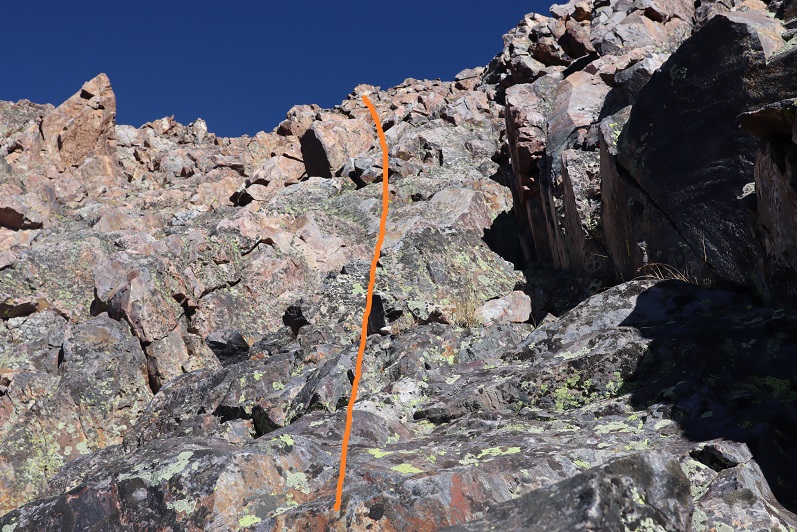
28

Vermilion Peak – 13,909, Fuller Peak – 13,777, & Golden Horn – 13,789′

1

RT Length: 13.2 miles

Elevation Gain: 5117’

The weather all over Colorado has been fantastic all month (meaning sunshine like summertime). In fact, Colorado Springs has had more days over 90* this year than it has in over a century. This is pretty surprising for September, and I’ve been doing my best not to waste every opportunity to get outdoors and hike.

Many of Colorado’s 13ers are in the San Juans, which is a good 7 hour drive from my house. The distance makes it difficult for me to make it there on my Friday hiking days (because I usually need to be home by 3pm to pick up my daughter from school).  So I promised myself whenever I had 2 days free in a row I’d head down to the San Juans for some hiking, and do my best to hit as many peaks as possible in those 2 days by camping at the trailheads.  Earlier this month I hiked Pigeon and Turret in a day, and my plan had been to hike the a few more peaks the next day.  That obviously didn’t happen, but I was going to try my plan again of jumping around and trailhead camping two days in a row when I could make it to the San Juans.

The opportunity came faster than I’d anticipated. I found out on a Thursday my entire office (it’s a small office) would be gone Monday and Tuesday the next week, so I’d be working from home.  Oh, and Tuesday was my birthday!  I looked at the weather forecast (sunny on Monday and 20% chance of rain after noon on Tuesday), and decided right then and there I was making a trip to the San Juans for my birthday.  This didn’t give me long to plan my routes, etc. but I was determined to make it happen.  Unfortunately there isn’t a lot of recent beta on this area, so I did as much research as I could and told myself I’d just have to wing it.

After tucking my kids in for bed I left my house on Sunday night around 8pm and made it to the trailhead earlier than anticipated (3:30am). The dirt road to South Mineral Campground is a 2WD dirt road, well maintained, and at the trailhead has room for about 20-30 vehicles.

2

Oh, and I’d seen no less than 7 porcupines waddling along the side of the 2WD dirt road in (not all in the same area). Drat:  I’d forgotten my moth balls.  Oh well, I’d have to cross my fingers this time.  The moon was absent but the night sky was filled with millions of stars. I’d arrived early and because I wanted a good look at the basin in the daylight I decided to try and get in an hour nap before starting my hike.  I was surprised at how well this worked.  I closed my eyes and what seemed like a minute later my alarm rang, indicating it was time to get moving.

The trail starts on the west end of the parking lot. There’s a trail register to sign before heading out (one of the nicest and well kept registers I’ve ever seen at a trailhead).  I started at 4:40am.

3

I took the Ice Lake Basin Approach, which is a very well maintained trail that crosses a small stream and switchbacks west. It looks like there’s been some recent trail overhaul and maintenance in the area, and even a shifting of much of the trail west, with lots of dead trees/branches covering the old trail.  I was unable to find the 4WD parking area that’s been suggested as a possibility for shortening the hike in (I’ve also seen beta indicating this 4WD lot has been destroyed with “no parking” signs in the area now).

4

There were dozens of signs asking hikers not to cut trails.

5

The trail was easy to follow all the way to the Ice Lakes Basin, gaining in elevation steadily.

6

I made it to the Ice Lakes basin while the sun was beginning to rise.

Ice Lakes Basin:

Instead of stopping at Ice Lake I took a quick picture from the trail and turned south and hiked to Fuller Lake. I wanted to see the lake and old cabin.  Had I realized how blue those lakes were when I first passed them I’d have taken the time to explore more, but in the early morning light they weren’t yet impressive.

7

There was a trail the entire way to Fuller Lake.

8

What I wasn’t prepared for were the amazing reflections of the mountains on the water as the sun rose. Pictures do not do this area justice!

Unfortunately, the cabin has been destroyed, most likely by weather.

11

From here there was no trail for the rest of the hike. I could see Fuller Peak to the southeast, and hiked without a trail through the basin towards the saddle of Fuller and Vermilion.

12

Along the way I saw an old wheelbarrow. Of course this meant a picture was necessary

13

Here’s the route I took up to the saddle and over to Fuller Peak and a look back down the basin and the way I hiked in as seen from the saddle.

14

It’s steeper than it looks, and I was glad I was doing this part of the hike before the sun was too high in the sky. The rocks are semi loose talus. Annoying is what they are…

15

From the saddle turn left (southeast) and follow the ridge to the summit. It’s an easy class 2 hike with several small false summits.

16

The only downside was I was hiking directly towards the rising sun. It made seeing anything clearly impossible.

17

I made it to the summit of Fuller Peak at 8am

18 Fuller Peak 13761

Fuller Peak:

The views were amazing! I looked back at Vermilion and the route I needed to take to the summit.   After returning to the Fuller/Vermilion saddle stick to the ridge

19

Here’s a view of the route from the saddle. Follow the ridge up and to the left

20

After you go left you’ll encounter a loose dirt gully. Climb the gully to the notch

21

At the top of the gully you’ll see two towers. Pass them to the left

22

And climb another gully

23

The gullies here seem to go down forever! (don’t worry, this isn’t the one I climbed, but one I wouldn’t want to fall down)

24

From here follow the rocks to the summit

25

I summited at 8:45am

26 Vermilion Peak 13894

Vermilion:

My next task was Golden Horn. I returned to the Fuller/Vermilion saddle and traversed the area on the northeast side of Vermilion between the cliffs and a scree ledge towards the Vermilion/Golden Horn Saddle.  You’ll need to descend lower than you think you will.  Follow this route (as seen from Fuller)
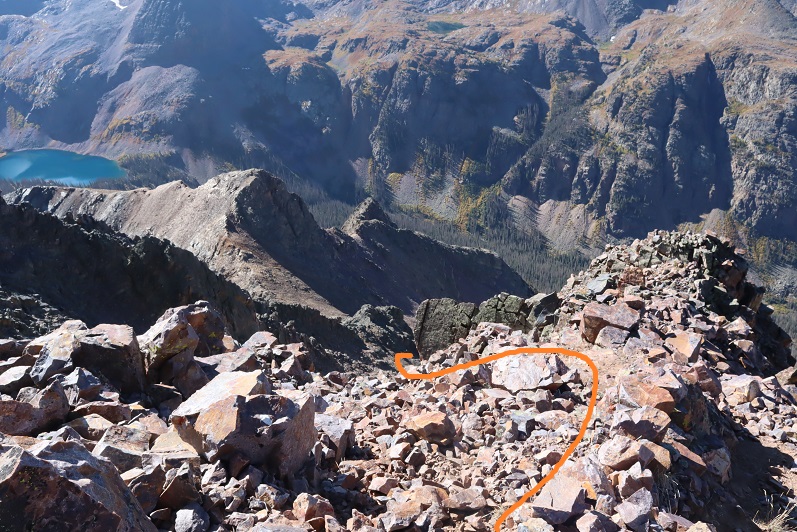
27

The scree & talus ledge is wider than it looks, with some large boulders thrown in. The rocks aren’t loose.  Here’s a picture looking back from the Vermilion/Golden Horn Saddle

28

Here’s a look at the route from the saddle.

29

It’s a pretty straightforward climb, but about halfway up the ridge is when things get spicy. The scree intensifies and it can be difficult to find good footing.  Luckily there’s not much exposure.

30

There aren’t any cairns but the route is obvious. There are two summits to Golden Horn.  The summit register is on the summit to the west.  Here’s a picture looking back at Vermilion

31

I summited at 10:15am

32 Golden Horn 13780

Golden Horn:

The views were amazing! I could see Ice Lake for the first time in the daylight and was immediately impressed:  I had to make it down there!

33

My day had been going pretty good so far. It was still morning and I had the rest of the day ahead of me.  The only thing that was troubling was the clouds creeping in.  It was supposed to be sunny all day.  There were way too many clouds for this forecast to be accurate.  I had to keep an eye on the weather.  I turned and looked northwest:  Pilot Knob.

34

Hmmmm. It looked tempting.  The only reservation I had (besides the weather) was beta.  I had great information on Fuller, Vermilion, and Golden Horn, but there just wasn’t a lot of data out there on Pilot Knob.  At least not much recent data.  While planning this hike I’d been short on time and only planned on the three peaks I’d already summited.  I mulled it over:  I’d done some preliminary research on Pilot Knob (in fact, I’ve done enough on all the bicentennials to know which questions to ask, when I’d like to summit them, which routes I want to take, etc.).  I knew I was supposed to summit Pilot Knob from the south and west face, looking for a chimney that would lead to a scramble to the ridge, and there was a crux I really wanted to get a first hand look at (a crack traverse/climb near the summit).  Even though you summit from the south the approach is usually to the north (and I was south).

Trip reports last time I checked were few and far between, with the newest being 3 years old. The best beta was years before that.  You were supposed to approach from the north and traverse southwest before summiting from the south/west, and I was on the south.  I figured I could probably summit today, so I decided to descend Golden Horn the way I’d come by heading back to the Vermilion/Golden Horn saddle and look for a route over to Pilot Knob.

From the saddle I traversed west to the Golden Horn/Pilot Knob saddle.

35

The first part (before getting to the saddle) was a fun, difficult class 2 scramble. It was the most intense scrambling of the day so far.  If you stick to the ridge you’ll do fine.

36

Here’s a look from the Golden Horn/Pilot Knob saddle, looking up at Pilot Knob

37

I kept watching those clouds. They were starting to bug me, blowing in and around with what looked like deep blue, rain filled centers.  I made it up the ridge of Pilot Knob, and navigated to the southwest to look for a chimney that would lead me towards the summit.  Instead I quickly encountered a very loose and scary talus filled gully.

38

It was obvious several large rock slides have occurred in the area since the last trip report. Many previous trip reports indicated a “well cairned route”.  I didn’t see a single cairn, but there had been so many slides in the area they could have been destroyed by one.  OK, back to the loose talus.  This was unlike anything I’ve ever seen:  I’d step on it and a 5 foot wide avalanche of rock would give way, tumbling down below me and gaining speed and larger boulders as it went.  The first time it happened it startled me.  Two steps later when it happened again I was seriously scared I was going to fall with it and braced myself:  unfortunately there was nothing to grab onto.

39

I knew there was no way I could safely traverse any further west, but I needed to in order to find that rock wall. OK, so this wasn’t going to happen. Maybe I’d accidentally missed the rock wall I was supposed to climb?  I’d just turn back and try again.  It took me quite a while to backtrack to where I’d started on the south side of Pilot Knob:  I was seriously scared I’d fall in an avalanche of talus with every step, but I made it back and decided to try again, thinking to myself traversing the area would be achievable and much safer in winter/spring with consolidated snow and crampons rather than all this talus/scree.
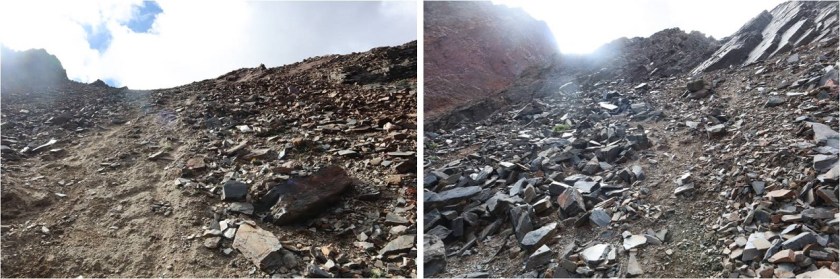
I just needed to gain the ridge. There had to be more than one way?  I spent about an hour and a half trying to climb every area I could, but none of the routes I took went all the way to the top, and these were not class 3 moves as described in previous trip reports.  They were class 4+ on loose and crumbling rock.  Every time I found what looked like a solid route rocks would flake off both above and below me:  Rocks the side of softballs and some the size of microwaves.  I’d make it 20 feet up the side of a “wall” only to have to turn back and head back down.  Rope wouldn’t have helped because none of the towers were stable enough to support a climber that way.  I was glad I was the only one out there today.

40

I’m stubborn, so I did this fruitless climbing up and down walls for much longer than I should have and took more risks than I’m willing to admit to my mom. I even went over to the east side and tried that way.  Nope, there wasn’t a way to gain the ridge from either side, and I couldn’t descend the slope and try to make my way to the north side to summit that way (it cliffed out).  I was super frustrated. Hmph.  I had to remind myself Pilot Knob wasn’t even on my list of climbs for today so I shouldn’t be too disappointed.  But I was.  I mean, I had hours left of daylight (it was only noon) and I really wanted this summit.

Wait! I know, I’ll just descend into the basin and re-gain the saddle from the north side, traverse southwest and try it that way!  I was positive the right rock wall was on the other side of that talus/avalanche gully I couldn’t traverse.  I made my way back to the saddle and looked at the route I wanted to take.  Here’s a picture of that route from Golden Horn.

41

I looked up at the clouds, and it was obvious I was going to have to turn back.  There wasn’t enough time to descend into the basin and re-ascend to try and summit.  Oh well, I need US Grant too.  I’d just combine the two the next time I was out here.

I made it back to the saddle and headed down into the basin. Here’s a look back at the route I took

42

I felt I was getting pretty good at this descending down a scree slope into a basin thing. As I was hiking down I thought to myself how the area looked like it usually held water.  It was made up of tiny flat rocks about the size of a silver dollar but an inch thick.  The kind you’d usually see on the bottom of a lake or pond.  Hmmm.  I guess since it was such a dry year there wasn’t any water.  I was walking on a lake/pond bed.  And it was squishy.  In fact, walking across it felt just like walking over a bog.  No sooner had this thought entered my mind than realization hit and it happened:  I heard a sucking sound as my left foot sunk into the muck up past my ankle (mind you, I was walking on rocks at the time) and was almost impossible to dislodge my foot.

No. No.  No, no, no!  I know how to get myself out of a bog/quicksand if I have to, but I really didn’t want to end up covered head to toe in mud (I was camping tonight after all and wouldn’t see a shower anytime soon).  So I dislodged my left foot and ran as fast as I could, kicking up my heels as I went, trying to escape the mud that was trying to pull me under with each step.  All in all it wasn’t that bad:  with the running I only sunk up to my ankles, but I could tell if my foot had rested in any one place I’d have sunk much further as the mud had great suctioning abilities.  Then I’d really be stuck. I made it to stable ground and let out a sigh.  Crisis averted!  My shoes and pants were caked in mud, but that was the worst of it. Here are my footprints looking back

43

I turned east and was greeted with a daytime view of Ice Lake. Wow!  This was beautiful!

44

As I got closer I could see how truly clear the water was.

45

Ice Lakes:

This was amazing! I stopped for a while, took a bunch of pictures, and then headed on my way back down the basin where I was greeted with aspens changing color.  I’d missed them on the way in when it was dark.

46

There were tons of people on this trail! I must have passed dozens (and it’s a Monday).  It was a long 4 miles back down.  I made it back to my truck at 2pm.  And it never did rain.  Oh well, this gave me time to find my next trailhead in the daylight.  I took off my muddy pants, socks, and shoes and put on my sandals for the drive.  Near the 550 on the road out I got cell service and stopped by the side of the road for a bit to do some work (emails, etc) and text my kids to let them know I was down the mountain and headed to the next.

Here’s my route with a close-up of my Pilot Knob attempts. Don’t worry, I’ll be back for this one!

47

My drive took me through Silverton. I’d heard the fall colors weren’t supposed to peak here for another 2 weeks, but right now it looks beautiful.
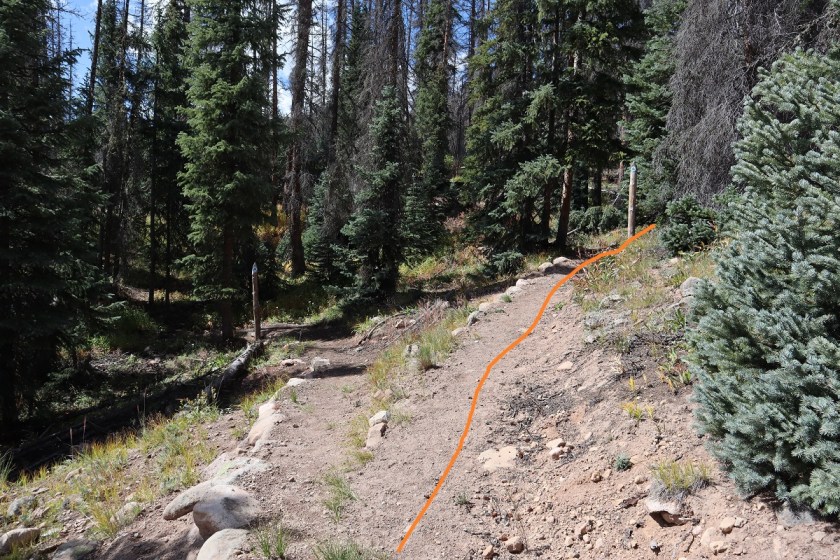
48

I had conflicting directions on how to get to the Burns-Gulch trailhead, so I brought both with me. From Silverton I took County Road 2 past Eureka on a 2WD dirt road, and ate the dust from off road vehicles the entire way.  For a Monday afternoon it sure was crowded!  Leaf peeping season is definitely in full swing!
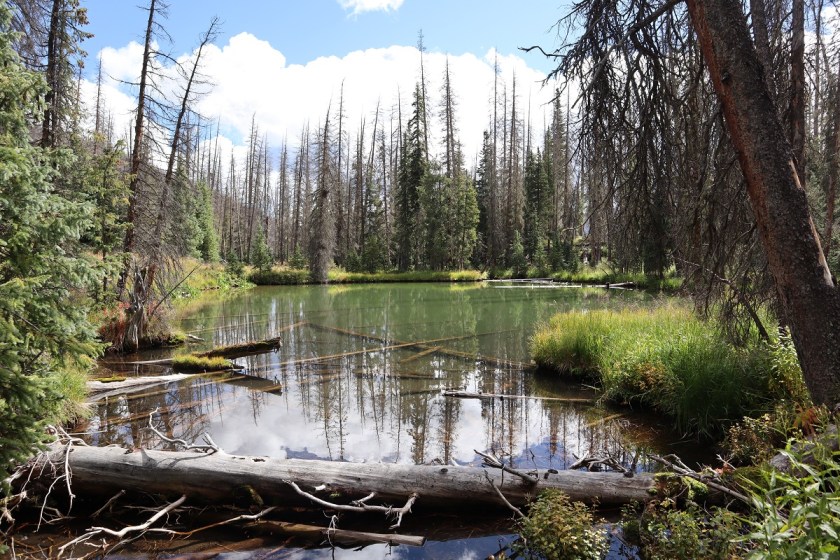
49

I made it to the base of the trailhead on the Animas River and my directions ended. So I pulled up a GPX file of the route to see where I needed to be:  about 2 miles up a narrow shelf road.

50

The road was much narrower and steeper than it looks and filled with bowling ball sized rocks. I took it slow:  this road was more difficult than I’d anticipated (but nothing my truck couldn’t handle). I just hoped no one would drive towards me from the top:  There was no way I could turn this truck around on such a narrow road, and passing another vehicle wouldn’t be easy.

There was a campsite at the 4WD trailhead at 11,720’ and no other vehicle was in sight. Sweet!  It looked like I was going to have the site all to myself for the night.

51

I got to work making dinner: Mountain House Beef Stroganoff.  When it was ready I poured myself a glass of wine in the measuring cup I brought for making dinner, sat back, and enjoyed the view.

52

Life is good! Sitting in the bed of my truck looking at the mountains was so relaxing.  As I was sitting there I heard a creek to my right and got up to investigate.  This was wonderful!  It was about 10 yards from where I’d parked my truck.  I enthusiastically washed my hands in the running water. They were gross from today’s adventure and it felt good to have clean hands and fingernails again.  I got up to turn around and head back when my left sandal broke.  I mean really broke, like duct tape can’t fix it broke.  Drat!  I was going to have to tiptoe the 10 yards back to my truck without wearing shoes.  The first step I took landed my left foot on a thistle.  Wonderful.  I made it back to my truck,  poured myself another glass of wine and spent the next half hour picking splinters out of my foot (mostly on the heel and arch).  I looked around at the mountains: Life was still good!

I got out my maps and route info for the next day and tried to identify the peaks around me and the best route to take (I had several options). I studied my chosen route until I felt it was time to get some sleep: it was starting to get cold.

I decided to sleep in the cab of my truck because I fit perfectly across the back seat and because I could. Two shots of whiskey later I was ready to go to sleep.  I laid my head on my pillow and a fly landed on my arm.  I thought about how much fun having a fly buzzing around me while I was trying to sleep would be and debated whether or not to open the door to let it out.  In the end I decided I’d rather not let all the warm air out in doing so, so I made a deal with the fly:  “Fred “(I named him Fred)”If you promise not to buzz around me all night I promise not to kill you right now”.  Fred flew away to relax on my steering wheel and I fell asleep thinking this wasn’t a bad way to spend my last day of being 37.

To be continued…

53

San Luis Peak – 14,014

1

RT Length:  13.8 miles

Elevation Gain:  3600’
I’ve never had a traffic ticket in my life, but I was pulled over by two different police officers on the drive to the trailhead this morning.  I left at 12:30am for this hike, and at about 1:30am I saw police lights flashing behind me.  I knew I wasn’t speeding.  I never speed when driving in Colorado at night.  I’ve had too many rabbit, deer, elk, bear, fox, porcupine, bear, squirrel, etc. dart in front of me at close range to drive over the speed limit.  It’s a death sentence for both you and the animal.   I actually drive slower at night than I do during the day.  Confused, I pulled over into a closed Sonic and looked for my license and registration.  The officer was very nice, and let me know I had a headlight out.  After making small talk for about 10 minutes he gave me his card and let me go.

About an hour later I saw flashing lights behind me again, and once again pulled over to the side of the road.  This time I was prepared (I hadn’t put away my license and registration yet, so it was still in my lap).  The officer walked up to my car:

Officer:  “Do you know why I pulled you over?”

Me (as nicely as possible): “Yes, I was just pulled over a little while ago.  I have a headlight out”

Officer:  “Nope, you were speeding”

Me (a bit shocked): “Isn’t the speed limit here 60mph?”

Officer:  “Yes, but I clocked you coming over that hill at 62.”

I took a deep breath and apologized for going over the speed limit.  He asked me for the card of the previous officer that pulled me over, and then went back to his truck for a minute.

You can imagine all the things I wanted to say at that point, but I just put on a smile and politely waited for him to return.  When he came back he gave me his business card (and kept the other officer’s card for himself).  He chatted with me for a bit about where I was going, and then eventually…

Officer: “I’m going to let you go with a warning, but from now on keep if 5 below the speed limit.  Here’s my card.  It has my phone number on it. See, right here (he pointed to the phone number he’d written on the back of the card).  If you have any questions about why I pulled you over today, call me.  If you get pulled over again for your headlight being out before you can fix it call me and I’ll take care of it for you.  My number is right here (he pointed again).  Call me if you have any questions”.

At this point I clearly knew what was going on, thanked him, and was on my way.  I had no intention of calling him.

I’d started the drive with a full tank of gas, and planned on getting gas before the turnoff to the dirt road that led to the trailhead, but unfortunately I drove for over 75 miles and never saw a gas station.  It was going to be tight, but I thought I could make it.  Note to others driving from the North:  The last gas station is in Saguache, and it’s closed overnight, so you need to get gas in Salida.

I drove down 27 miles of 2WD dirt road in the dark to the trailhead.  The conditions were actually pretty good. There were a few downed trees in the road, and the creeks were pretty low for this time of year.  Here are some pictures from the way back (note, the creeks rose about a foot during the day)

2

There isn’t actual parking at the trailhead, you just park on the side of the road.  So I parked, got my gear together, and was on my way at 5:15am.

3 Trail in Dark

This trailhead has signs!  Woot! I love a trailhead with good signage.

4

I followed the Stewart Creek for a couple of miles on easy terrain

5

Eventually coming to an area with a lot of beaver dams.

6

I saw a beaver swimming in the pond in front of me and decided to take a quick video.  The birds were chirping, the sun was rising, and the beaver was swimming peacefully from his den when all the sudden: Whap!  This happened:

https://youtu.be/frKwkqjOevY

Hmmm… is it mating season?  I continued on, noting how most of the trees were dead here.  It was really quite sad.

7

I passed the remnants of a cabin

8

And started seeing tracks. Lots and lots of tracks.  I’d been seeing deer and cattle tracks (and scat), but these were different.  These were moose tracks.  It made sense:  The creek/willow area was prime moose habitat.  I’ve seen moose in the San Juans before, so I decided to keep a lookout for them. Oh, and there was moose scat too.  Lots of it!

9 Moose Tracks

The trail was very easy to follow for most of this hike.  The only time it was challenging was when it crossed the creek and came back.  There were so many dead trees on the trail there wasn’t a clear path to follow.  It was obvious people had broken branches and climbed over logs to try to make their way back to the trail.  This will not be fun when the trees here get their summer leaves…

I exited the trees and was immediately deposited in the willows.

10 Willows

It was here I saw the moose.  Or, well, what I thought was a moose.  I only saw it for about half a second, bounding away from me.  It looked too light colored to be a moose, and I couldn’t tell how tall it was because I only saw it’s ears above the willows.  I walked around a bit to see if I could see where it bounded off to, but was unsuccessful.  I rationalized it was probably a moose, because elk don’t usually travel alone and I’d seen moose tracks.  I spent the rest of the hike wondering if I’d seen a moose or an elk.

Well, here I was in the willows, so I decided to try out something.  I teach outdoor survival skills, and I’d recently learned you can eat willow buds, the inner bark, and leaves (remember, this is in a survival situation:  in reality this doesn’t offer many calories, but when there’s no food, it’s an option).  I like to actually try out the stuff I teach people before teaching it if possible, so I took off a few buds in varying states and ate them.

11

This is what I learned:

  • The small buds were actually not too bad.  They tasted a bit nutty.  The only problem is it would take tons of them to make much of a dietary difference.  They could be picked and put in your pocket to chew on though and to keep your spirits up.
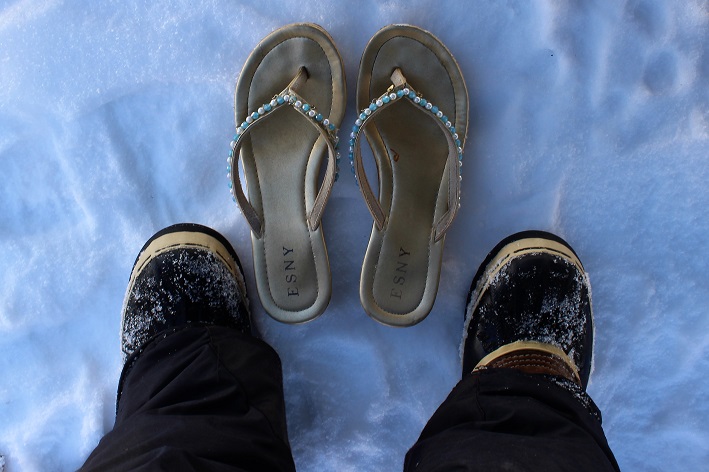
  • As you can probably imagine, the catkins are terrible and fluffy.  Stay away from them.
  • I didn’t take apart the plant and try this, but I’d probably boil the inner bark before eating it.
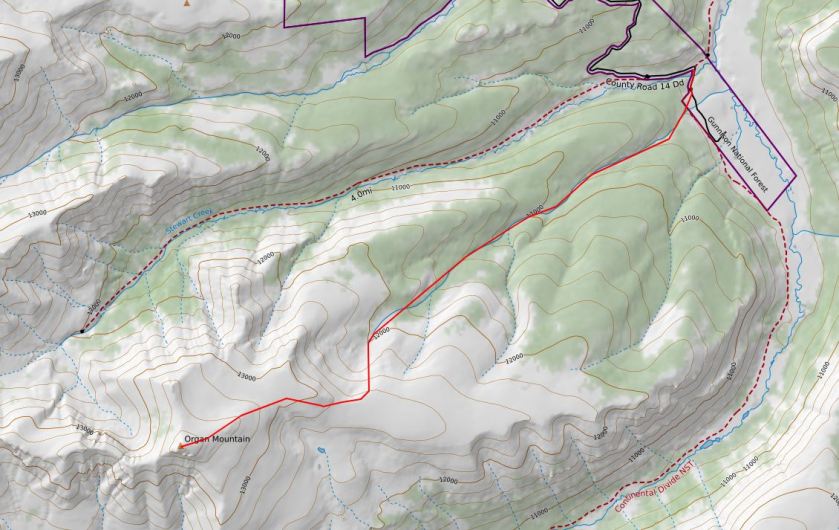
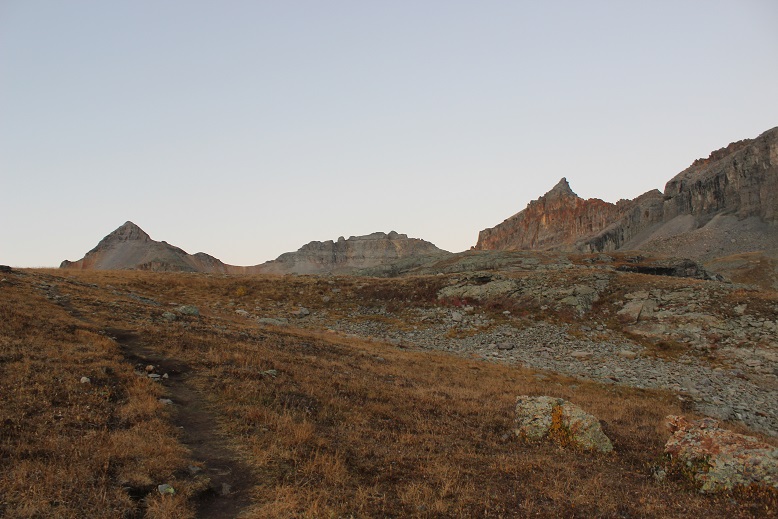
  • The leaves were bitter.  Stick to the buds.
  • In the end I didn’t get sick, so I’m considering this experiment a success.

Shadowselfie with the willows!

12 Willows 1

Back to the trail.  I looked ahead of me and saw what I assumed was the peak.  It wasn’t.  The actual San Luis Peak is behind this peak (which is unnamed because it’s not really a peak)

13

From here the trail had a little bit of snow in places.  It was consolidated and limited, and more of a minor annoyance than anything.  No traction (except shoes) needed.

14

Another shadowselfie because I do that kind of thing

15

The trail was actually very well maintained.
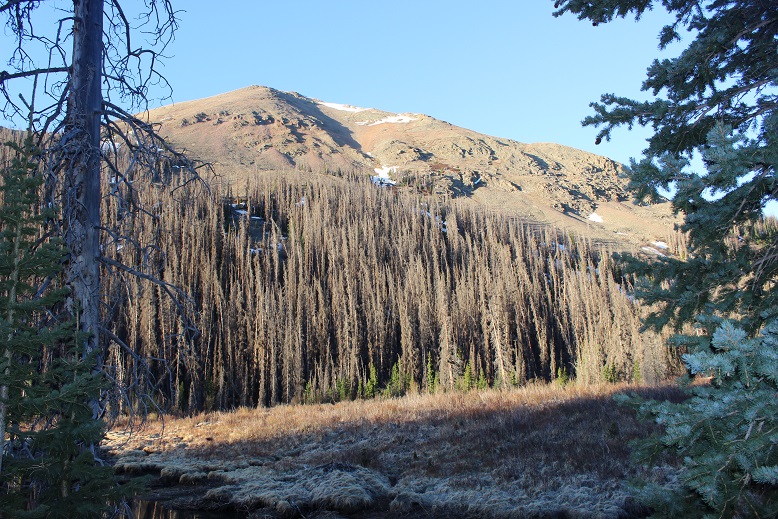
16

I made it to the saddle and took a look back down at the basin

17

Ahead of me I could see the actual San Luis Peak.  The trail was very easy to follow, and full of talus.
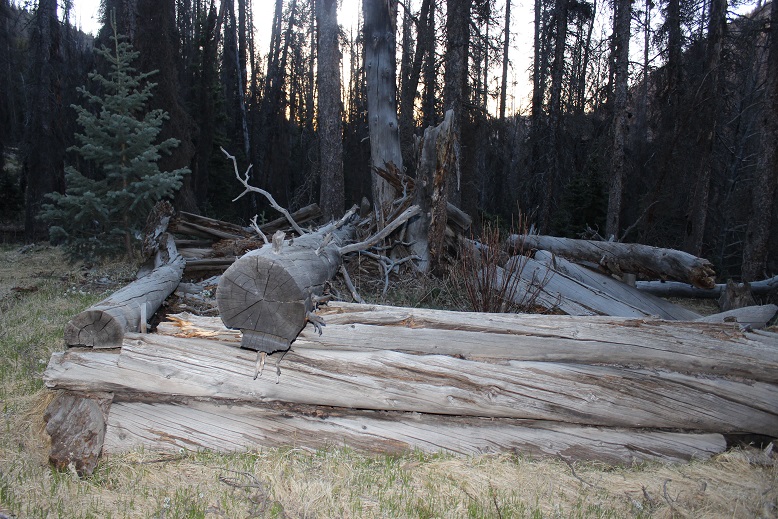
18

I summited at 8:30am.

19 San Luis Peak 14014

I love the summit marker!  So few peaks still have them.

20

Video from the summit: https://youtu.be/wP-qS_WAG4Q

The summit wasn’t that cold, so I spent a few minutes doing yoga before heading down. OK, I stood on my head and balanced because I was the only one there and could.

When I was hiking down I looked up at that peak that looks like it’s San Luis Peak but isn’t, and saw something there that wasn’t before.  It was far away and I couldn’t quite make it out. It was either a person or a goat.  I hadn’t seen anyone else today, or any other vehicles, so I assumed it was a goat.  It was!  (Sorry it’s not a great pic… I was pretty far away when I took it).

22

The entire way back I looked for that moose.  I was positive I was seeing moose tracks and scat, and this was the perfect area to see a moose!  Also, I didn’t want to be surprised by one.  I saw a grouse who didn’t like her picture taken…

22

And when I was exactly 3.3 miles from the trailhead I heard a rustling, looked up, and there she was!  A beautiful cow moose!  This was not the same creature I’d seen before.  She trotted over to the opposite side of the creek and tried to hide in the trees by shielding her face with a trunk.  I found this comical, as the trees did little to actually hide her.

23

Without saying a word it was obvious we both wanted to adventure alone today, so we made a silent agreement: she’d stay on her side of the creek and I’d stay on the other. I let her win the staring contest.

24

I did my best to steer clear of her, but was able to get a few photos and a quick video.  I’ve seen moose while hiking before, and I understand their body language.  If this was a fight or flight decision, this moose would definitely have chosen the flight option.  She was skittish and wanted nothing to do with me.  She watched me carefully until I was gone.  I thought it odd she didn’t have a calf and was obviously not pregnant.  She looked fully grown.

https://youtu.be/ZNJfGE6x5ug

All in all it was a great hike today!  I made it back to my truck at 11am and checked my pedometer:  13.8 miles in just under 6 hours with lots of picture stops and summit playtime.  Total success!

I didn’t see anyone on the 27 mile dirt road drive out, so maybe no one knows the trailhead is open?  Oh, and my GPS stopped working on the dirt road and wouldn’t re-load, so I had to try and figure out directions in the daylight from the route I’d taken in the dark.  I had print directions, but they just didn’t seem right, so I didn’t use them and went by memory:  dangerous because I was very low on gas at this point.  I ended up choosing correctly, and made it to the Saguache gas station with about a gallon of gas to spare.  Next time I’ll fill up in Salida on the way to the trailhead, as apparently that’s the last stop for gas….