Click on a menu, or use the search feature to access hundreds of trip reports. Contact me if you'd like more information about a hike, or a GPX file
Author: Laura M Clark
Laura has summited over 500 peaks above 13,000' solo, including being the first woman to solo summit all of the Colorado 14ers, as well as the centennials. After each hike, she writes trip reports for each one and publishes them on her blog, which is read by fans all over the world. Author of Wild Wanderer: Summiting Colorado’s 200 Highest Peaks, which is available to purchase on Amazon.
The Rico-Silverton Trailhead past South Mineral Creek has to be one of my favorite trailheads to spend the night. The 4WD road in isn’t very 4WD (except for the creek crossings), and there are rarely any people there. Also, no marmots. I was woken up in the middle of the night by a rustling sound I thought was a rodent in my truck, but ended up realizing it was just my elbow brushing a bag of chips.
It was another cold night, but I was ready to go at 5:45am. It was still dark, but I’ve taken this trail numerous times, so I knew which way to go.
The trail starts at the south end of the parking area, and immediately crosses the creek
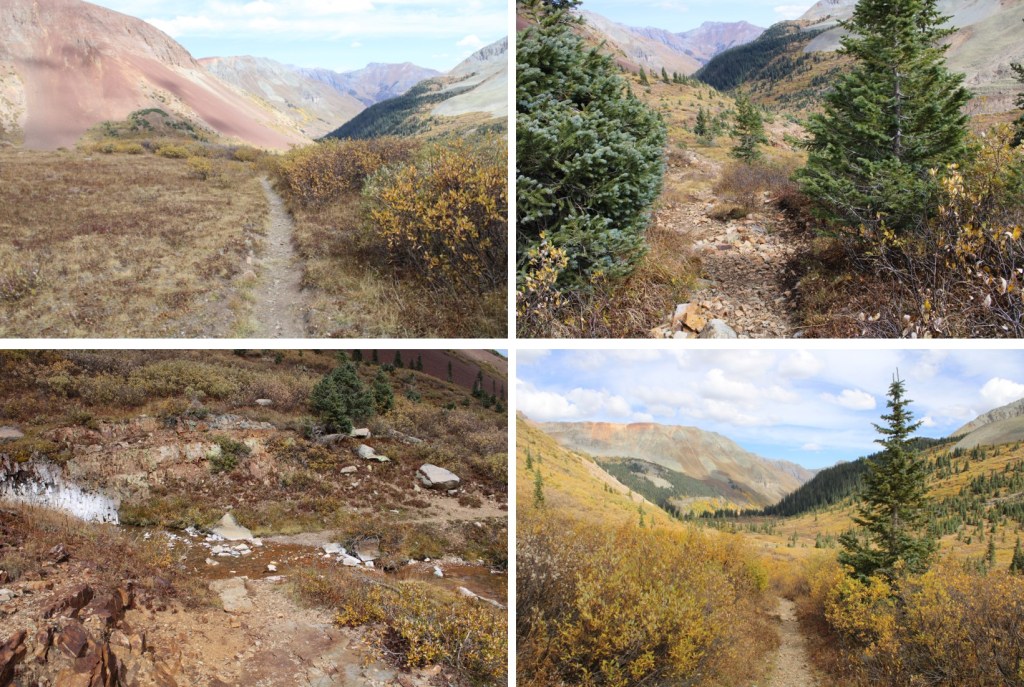
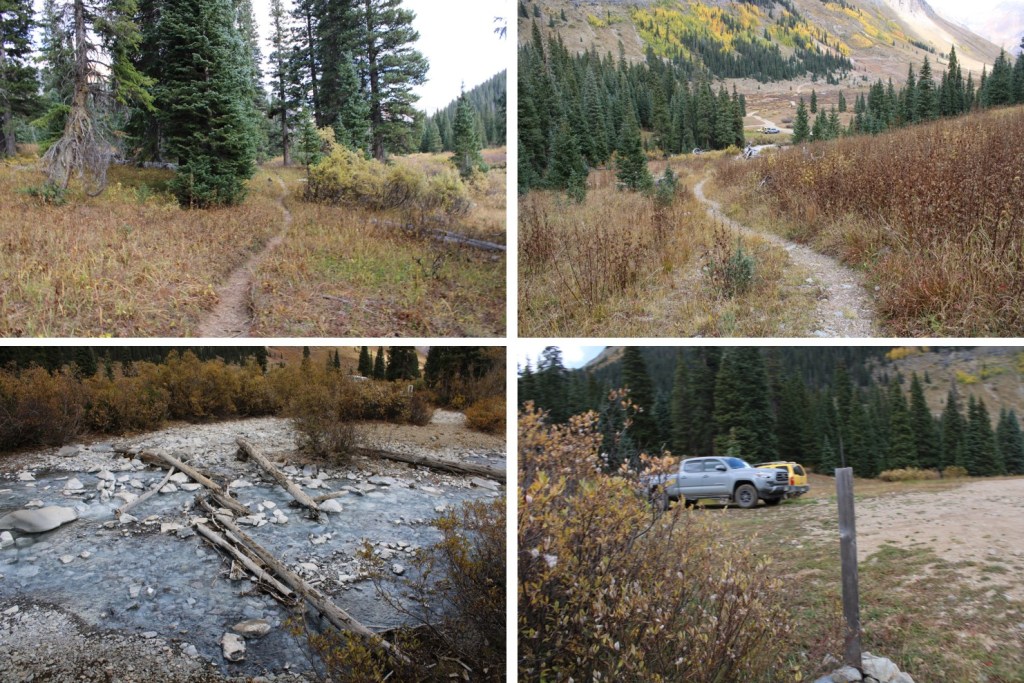
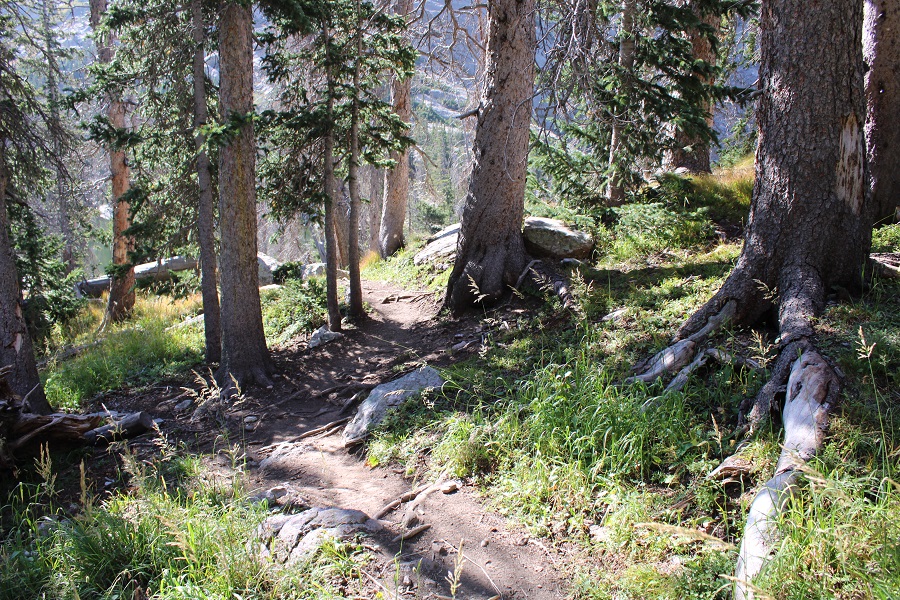
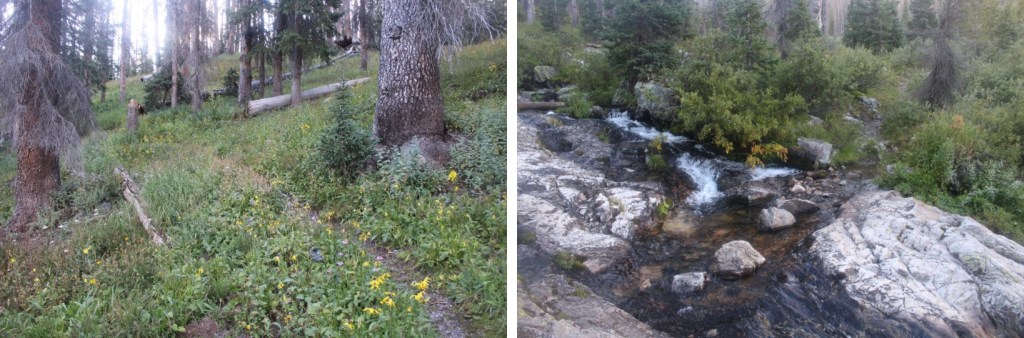
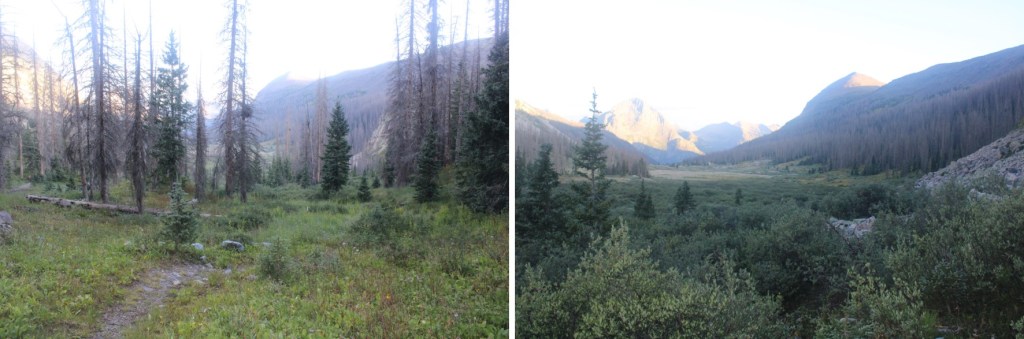
I followed this class 1 trail all the way to treeline, crossing the creek several times along the way.
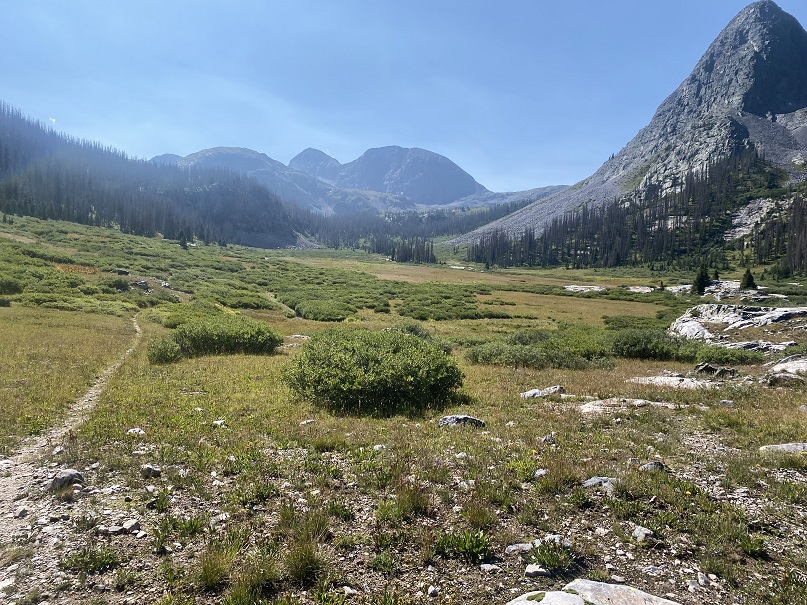
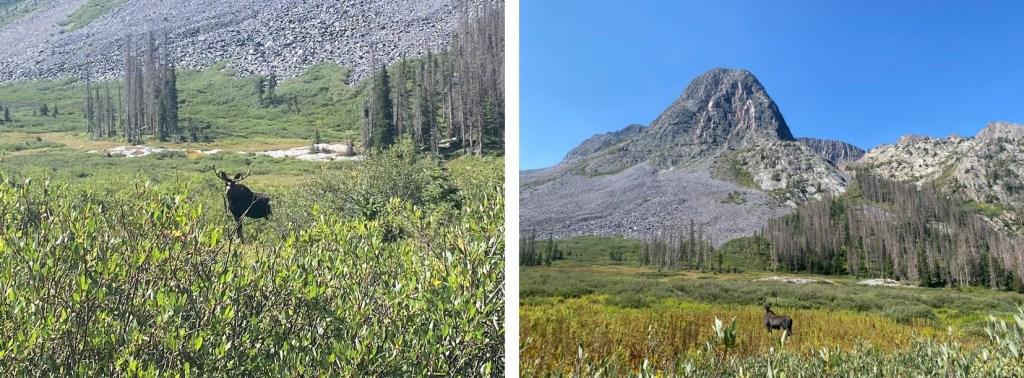
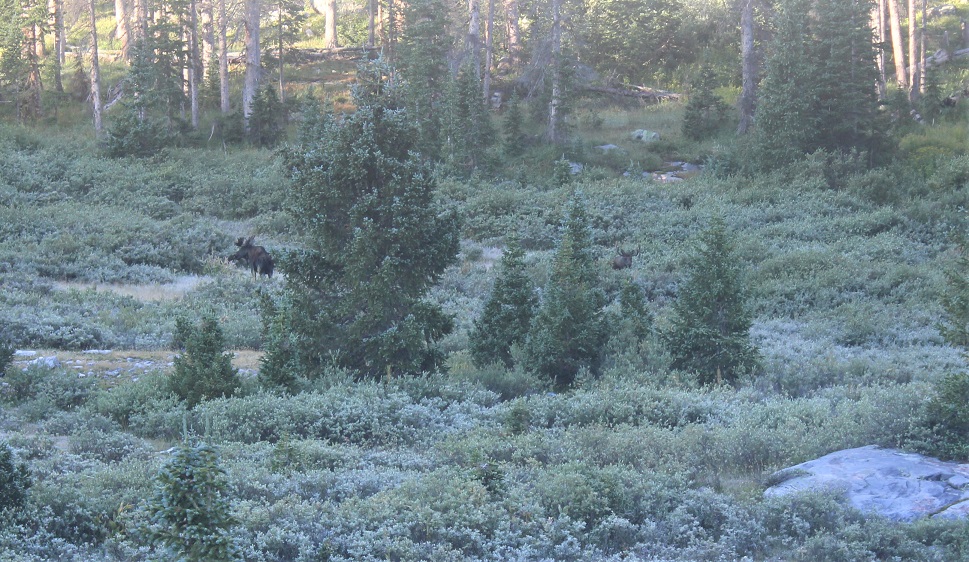
Another perk of hiking here is a mama moose owns this basin. Every year for the past few years I’ve seem mama, mama and baby, or mama and yearling in this basin. It’s been neat to see mama get bigger, and baby(ies) as well. This yearling seems to be female, as she didn’t have antlers. I saw these two just as it was beginning to get light out, so the pictures didn’t turn out well. As soon as they noticed me they headed south, slowly making their way over the pass.
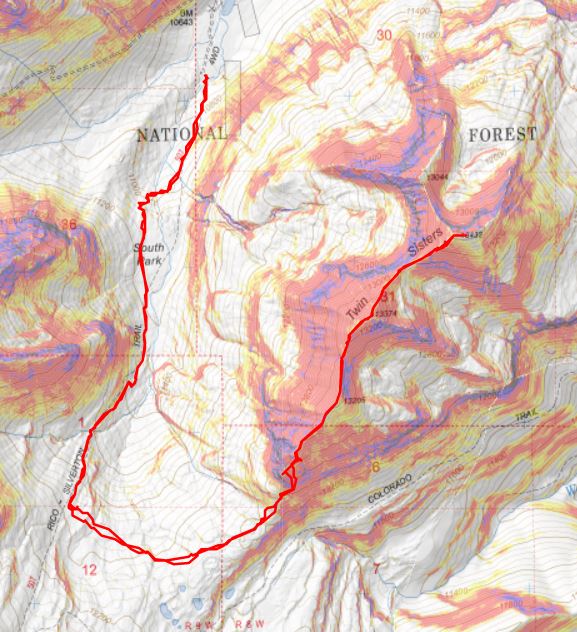
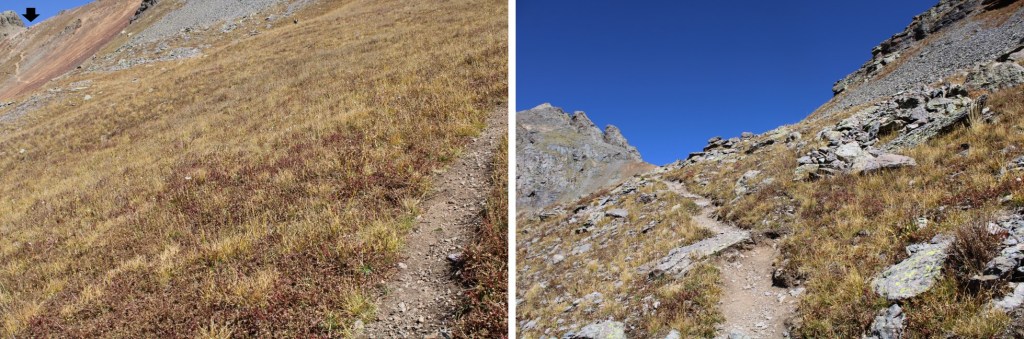
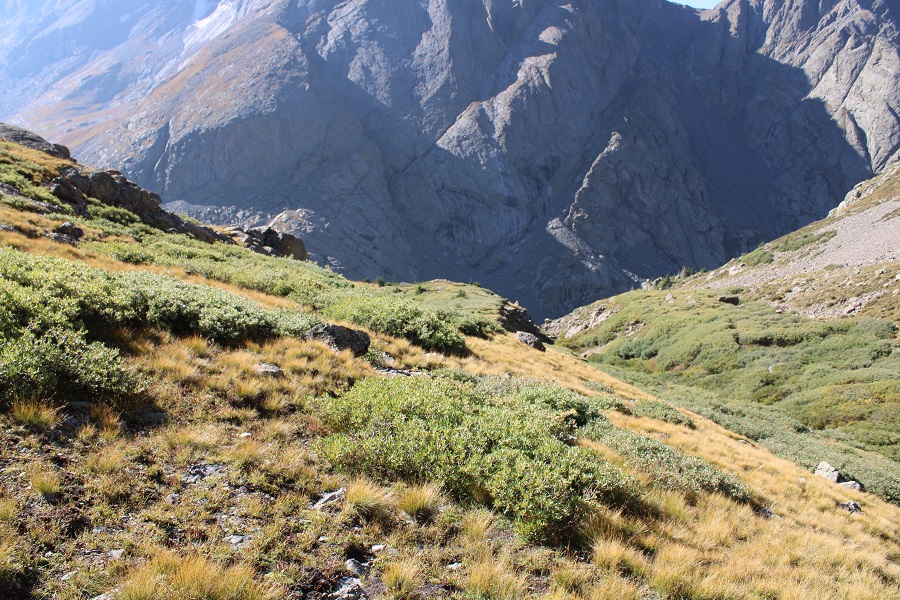
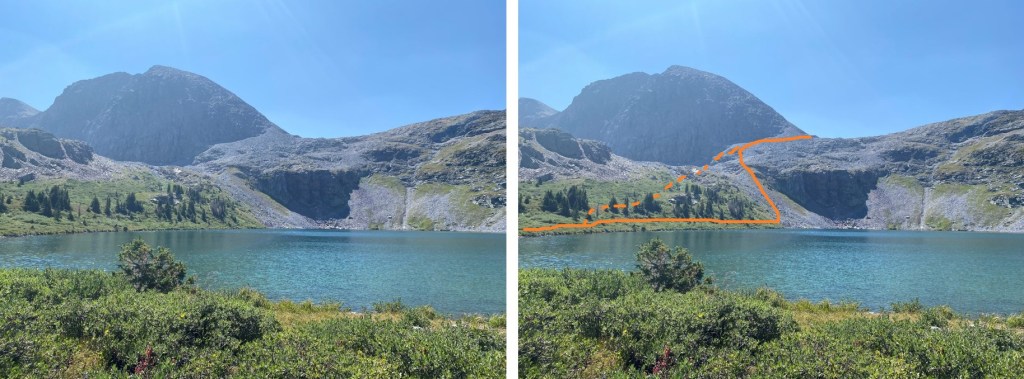
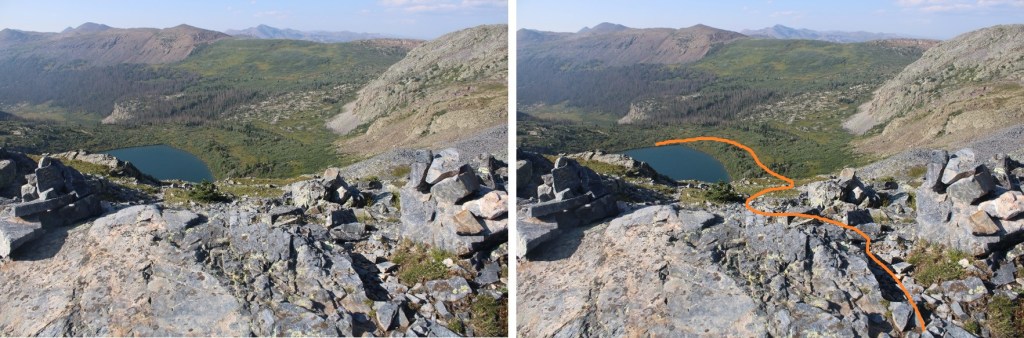
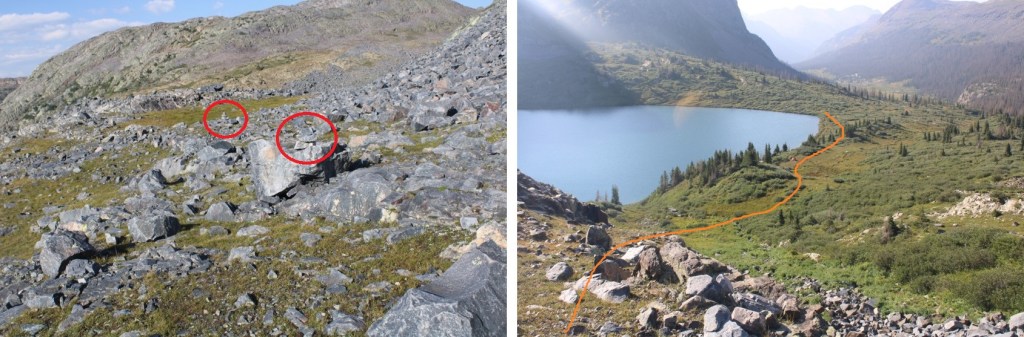
I hiked the Rico-Silverton Trail for 2.2 miles, to about 11925’, and then left the trail to follow the contour of the upper basin east, towards the south side of Twin Sisters. This is the route I took
And some step-by-step pictures:
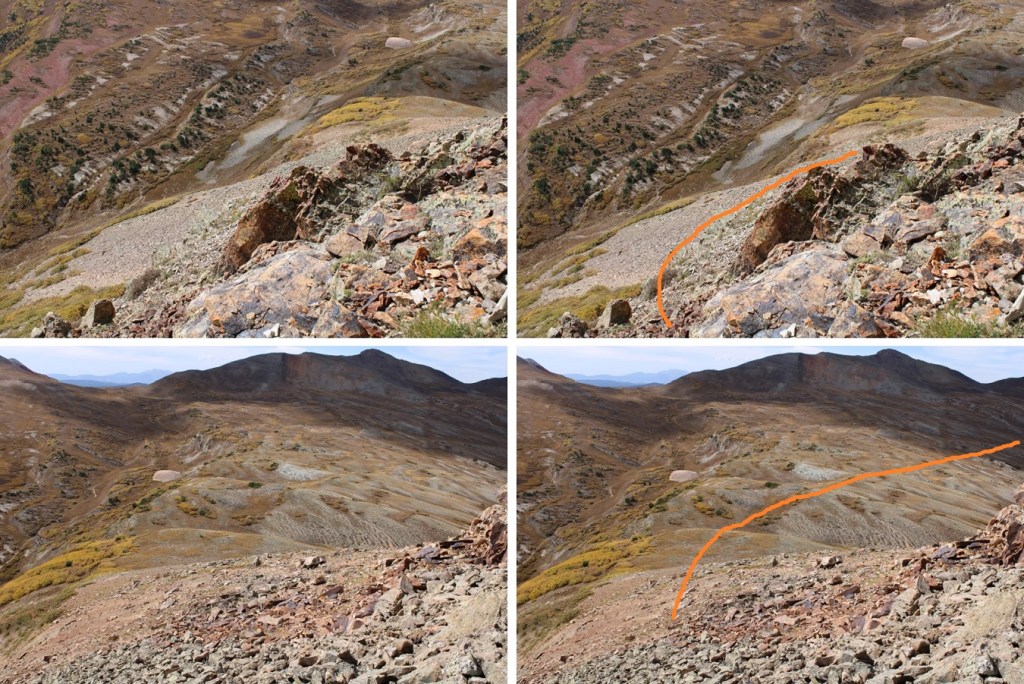
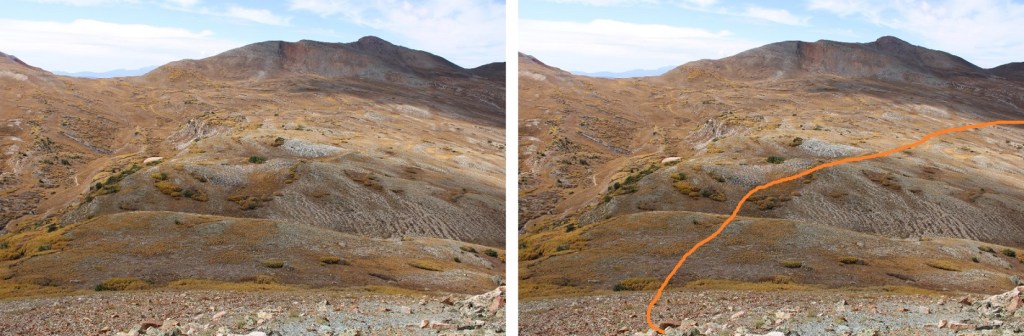
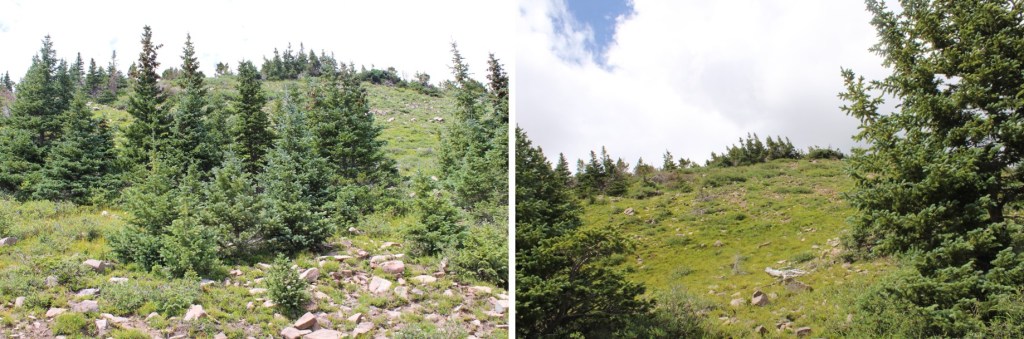
There are some faint game trails here, but they aren’t really needed, as long as you’re heading for the base of the mountain
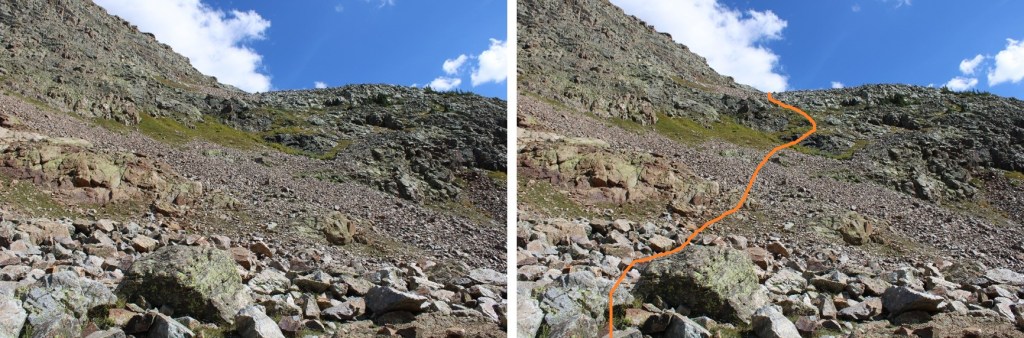
Once there, I found a clear path through the willows and ascended the talus
I was surprised when I heard coyotes yipping during the day: I usually only hear them at night
Coyotes:
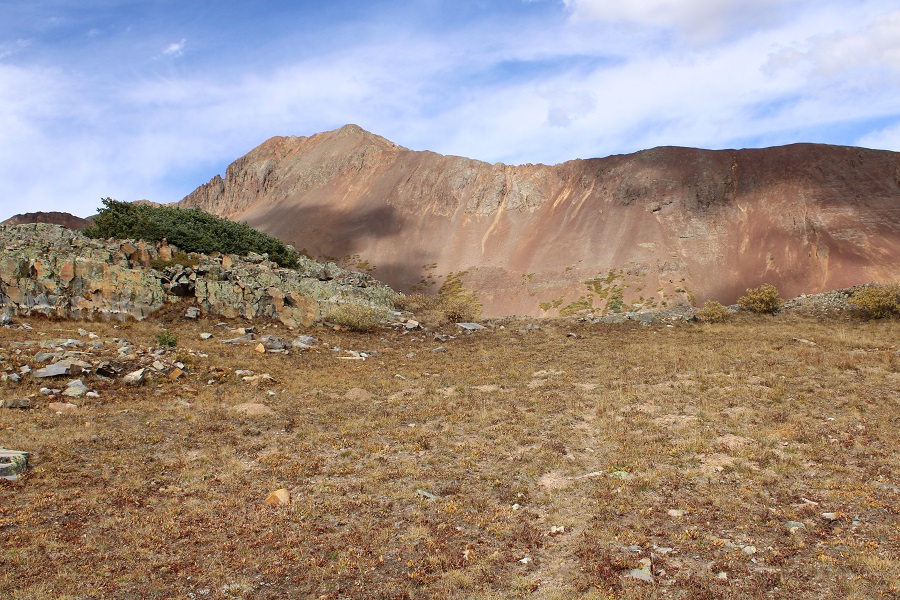
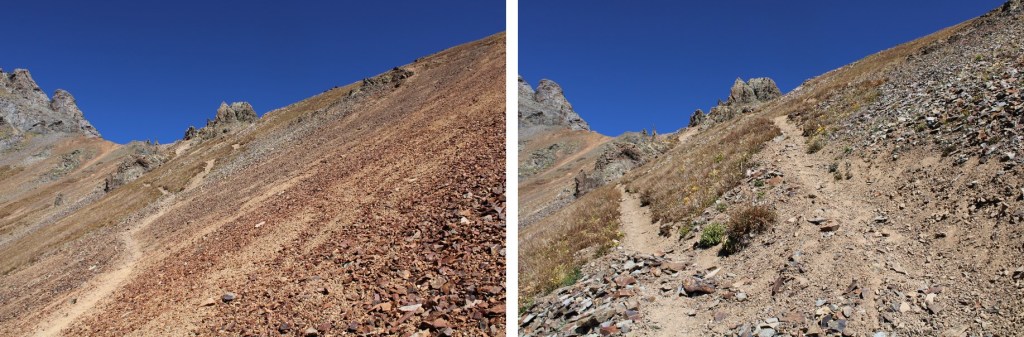
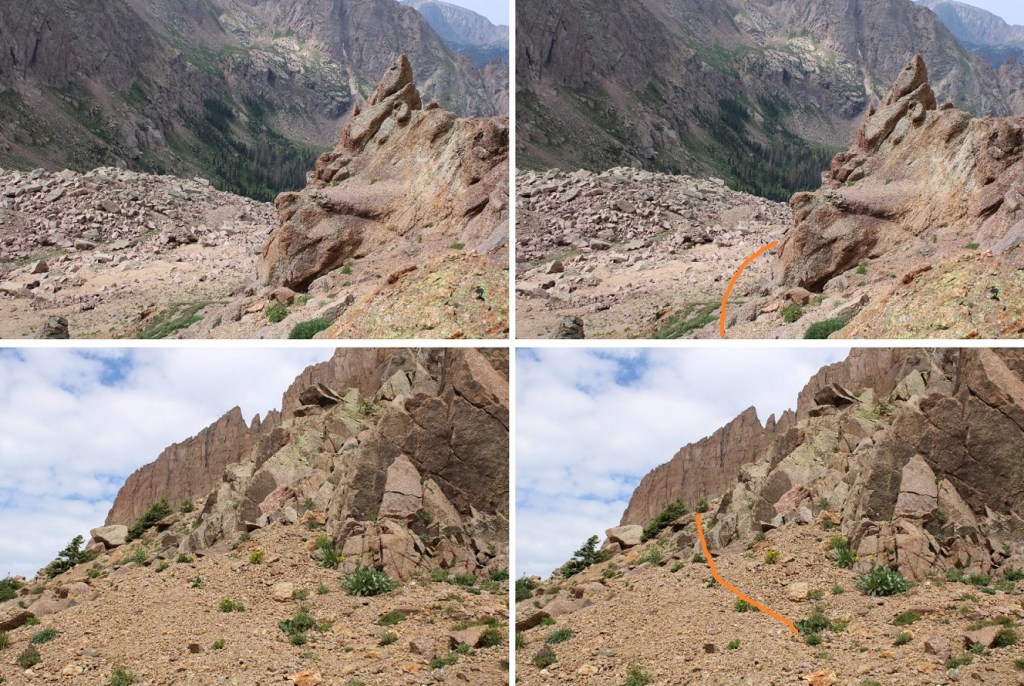
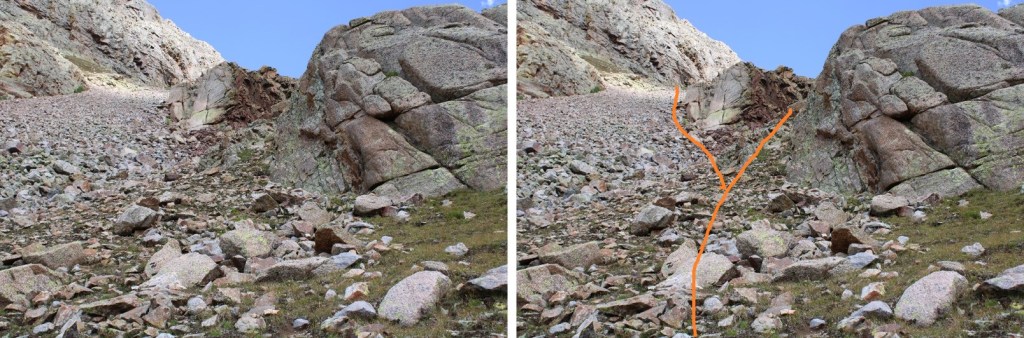
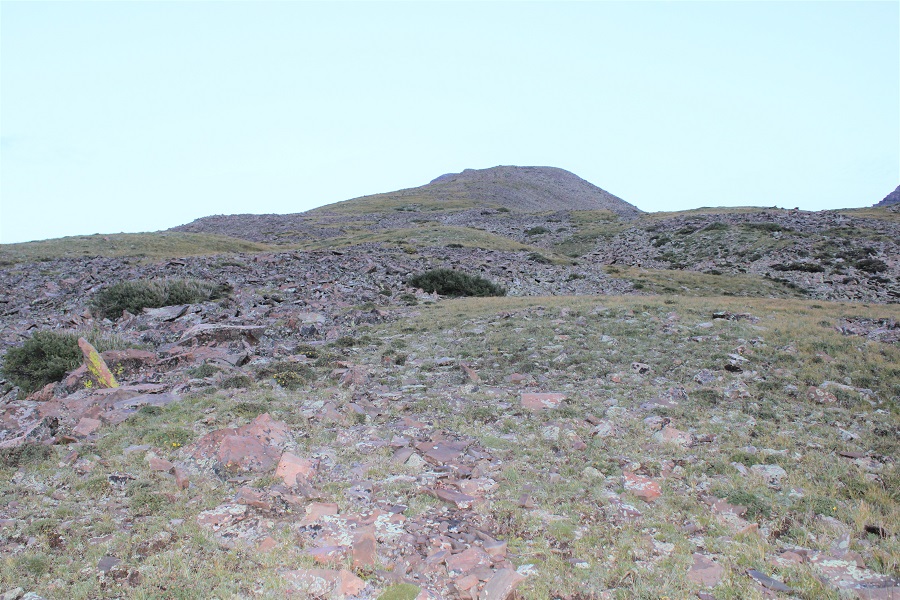
Following this line brought me to the base of the rock outcroppings. I put on my microspikes, and followed where the slabs met talus until I found the gullies.
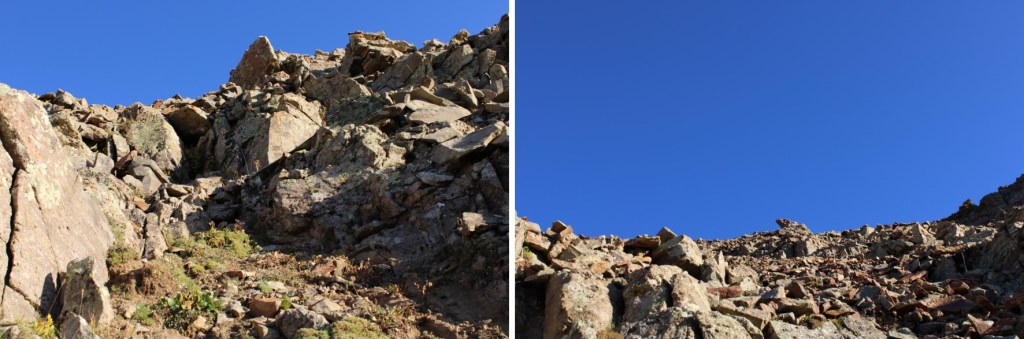
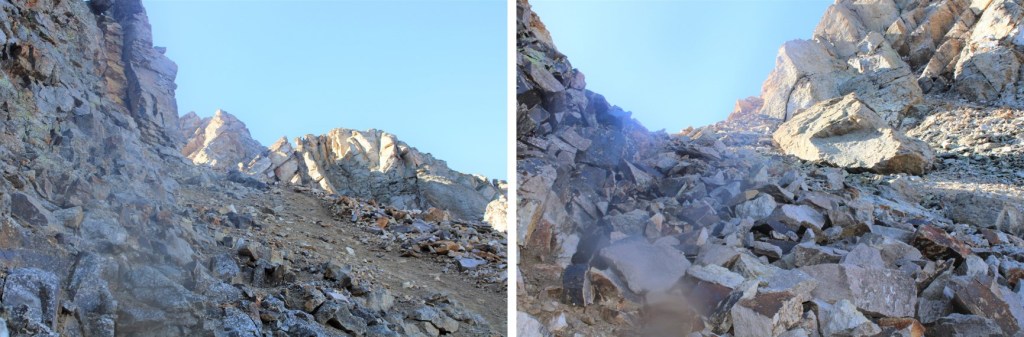
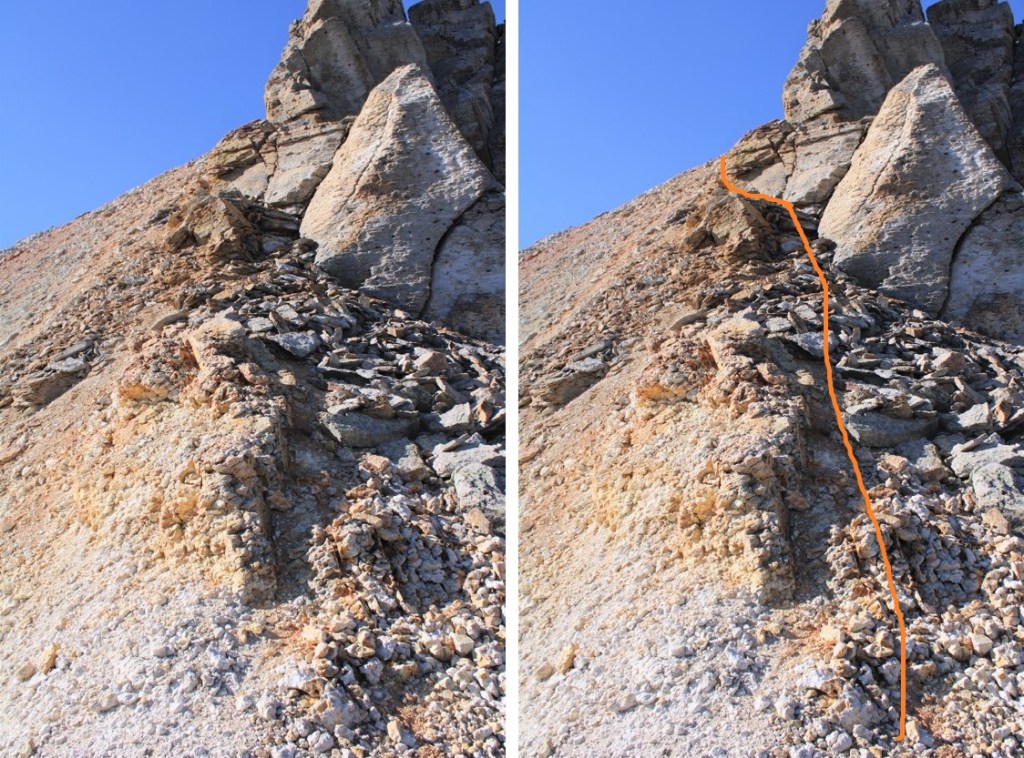
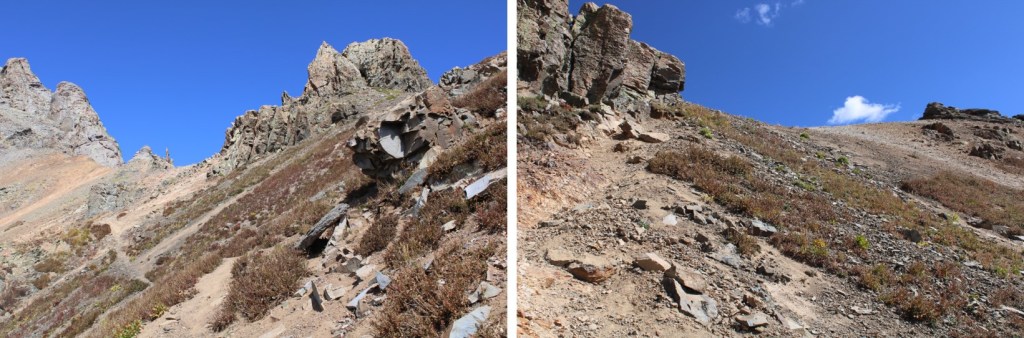
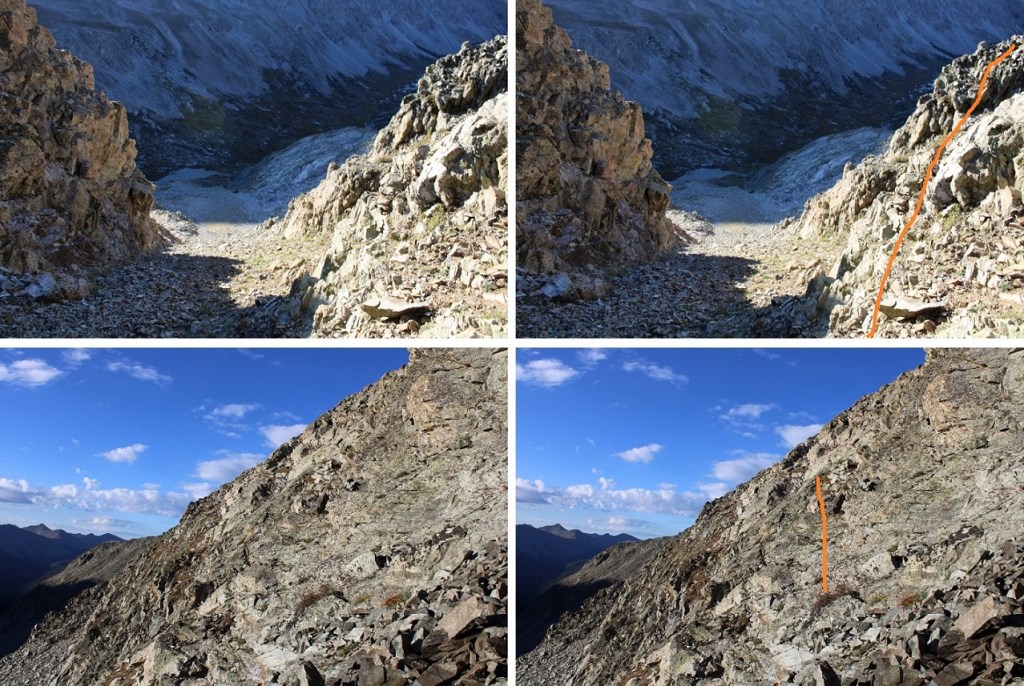
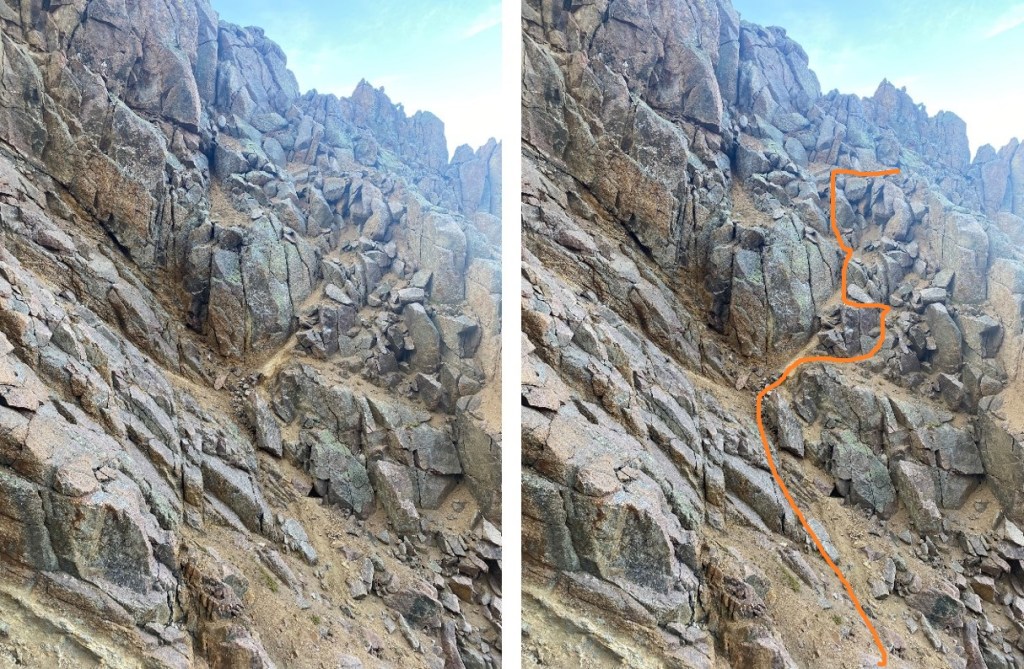
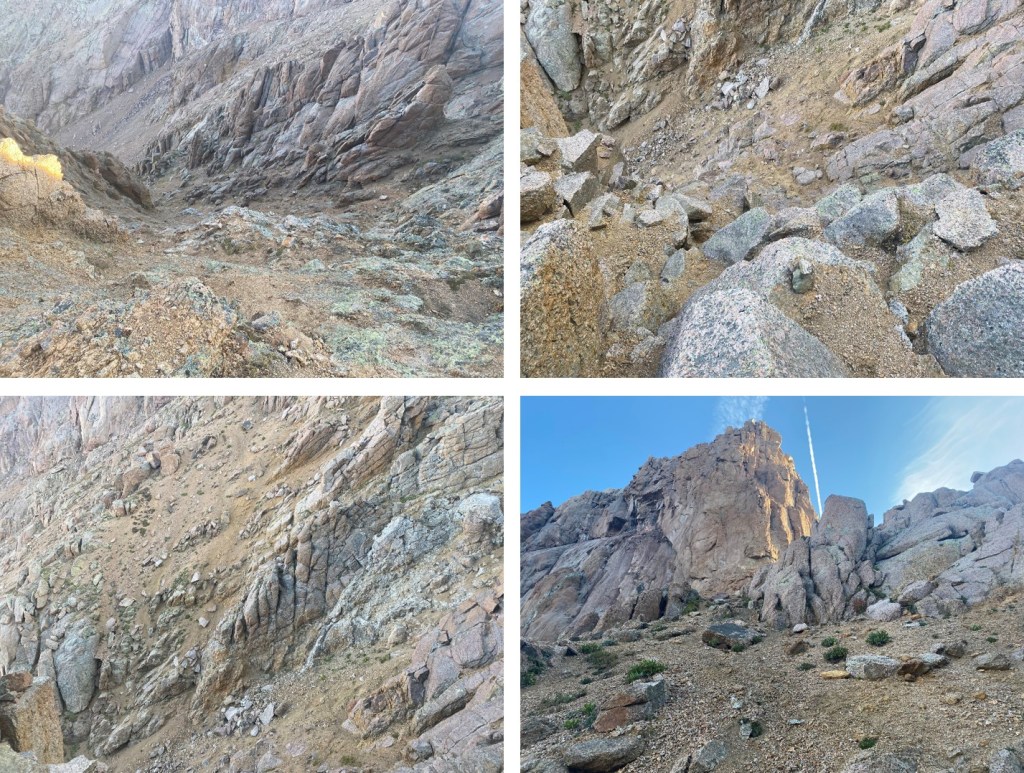
All of the gullies go, but, as I found out on my way back down, find the first one and stick with it (turn left and follow it to the ridge). You’re aiming for the ridge, which means hiking northwest. Microspikes were extremely helpful here. This shouldn’t be more difficult than class 2+
It’s going to be a chossy-talus-scree-filled mess, but it’ll go
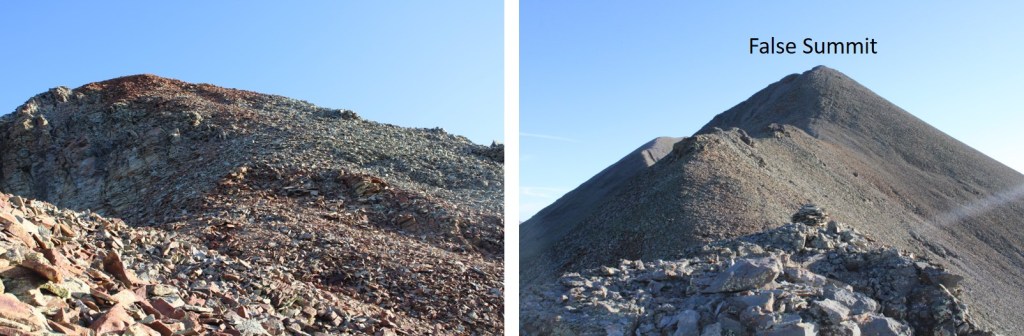
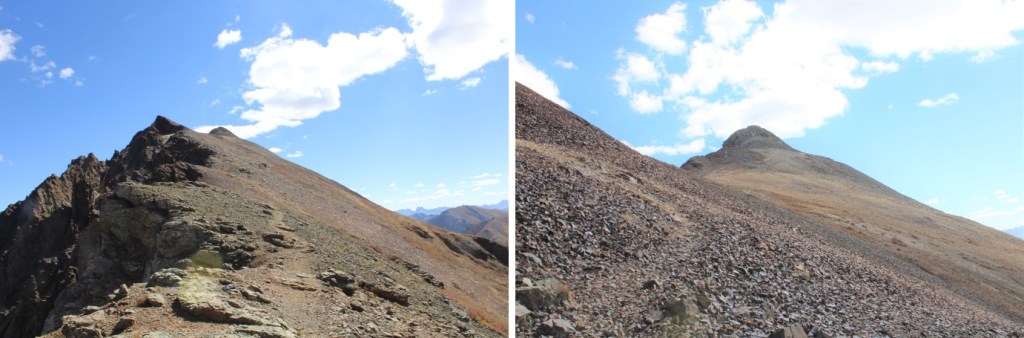
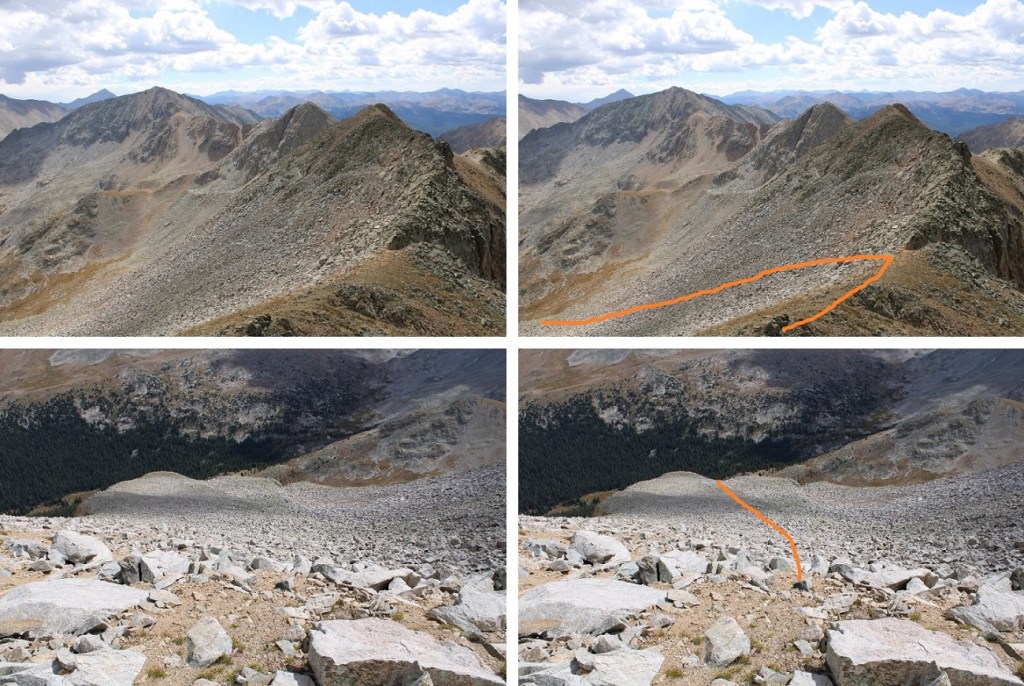
Once on the ridge, I followed it northeast, staying on the ridge. There’s a false summit here. I kept my spikes on, but they were overkill. The rock here was talus, and annoying, but firm.
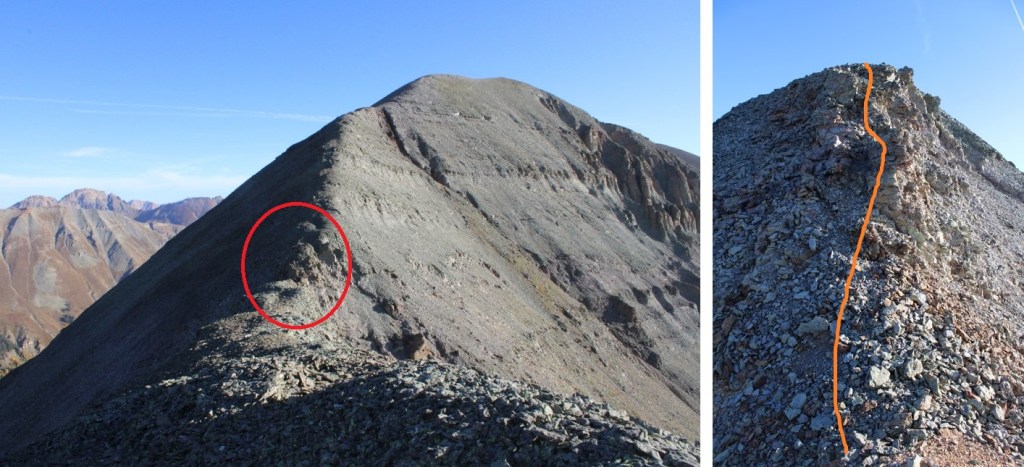
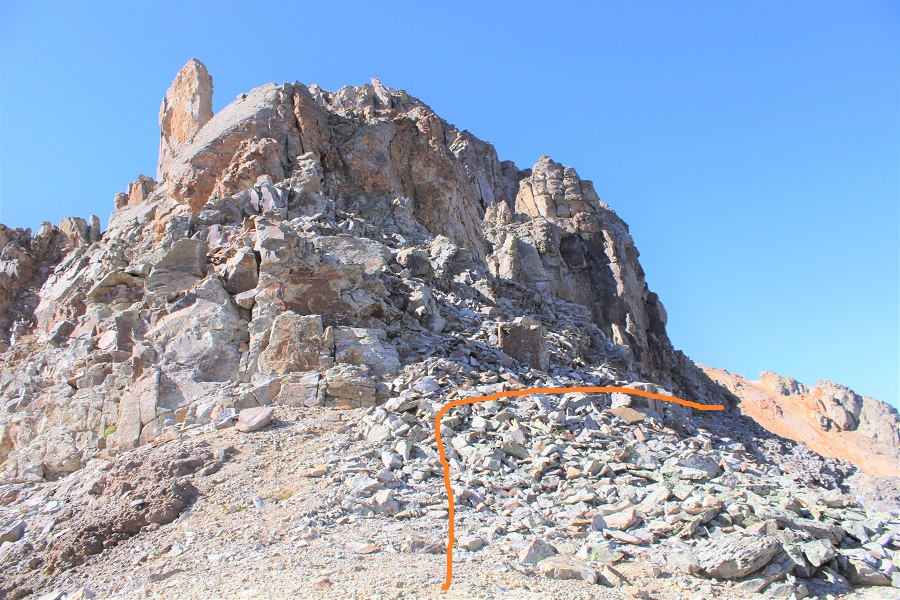
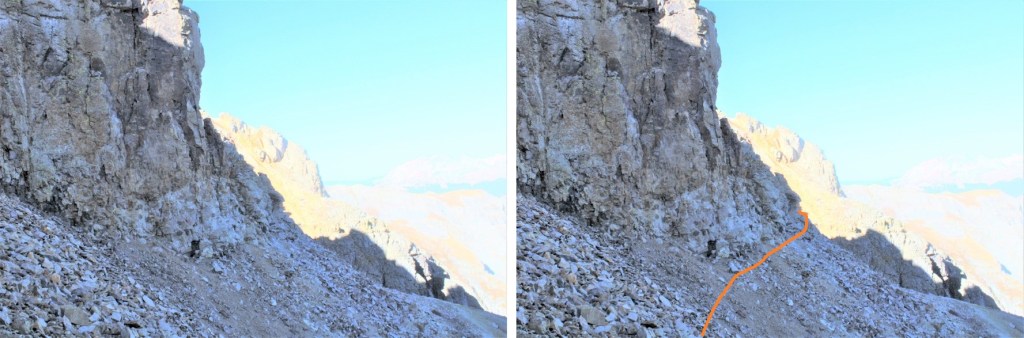
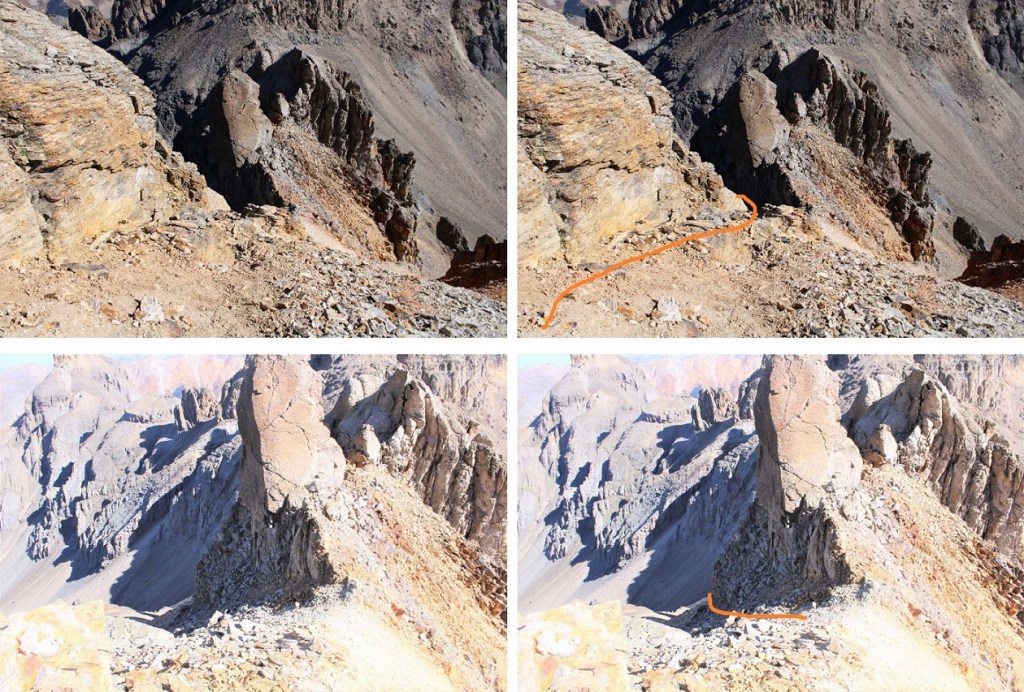
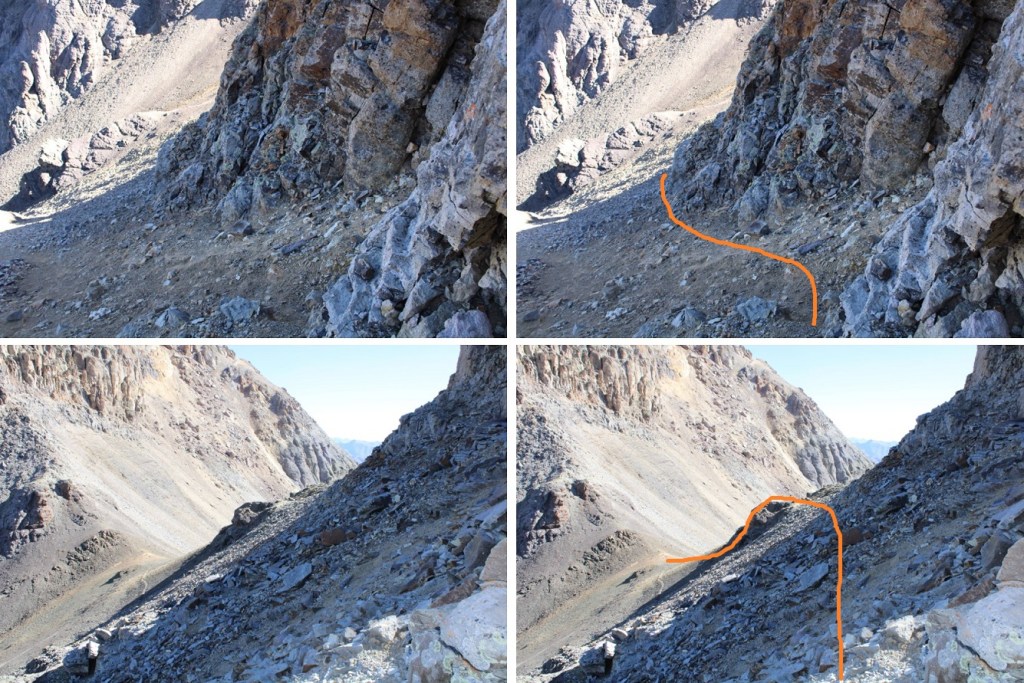
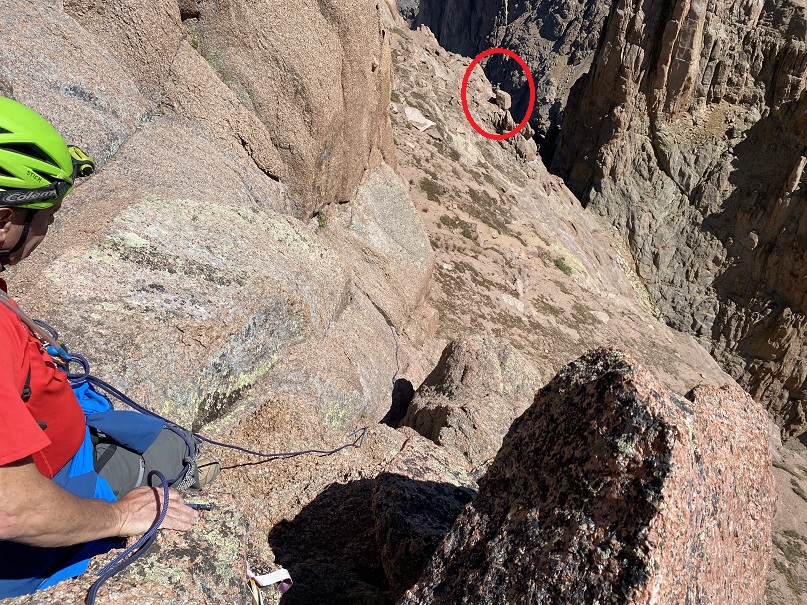
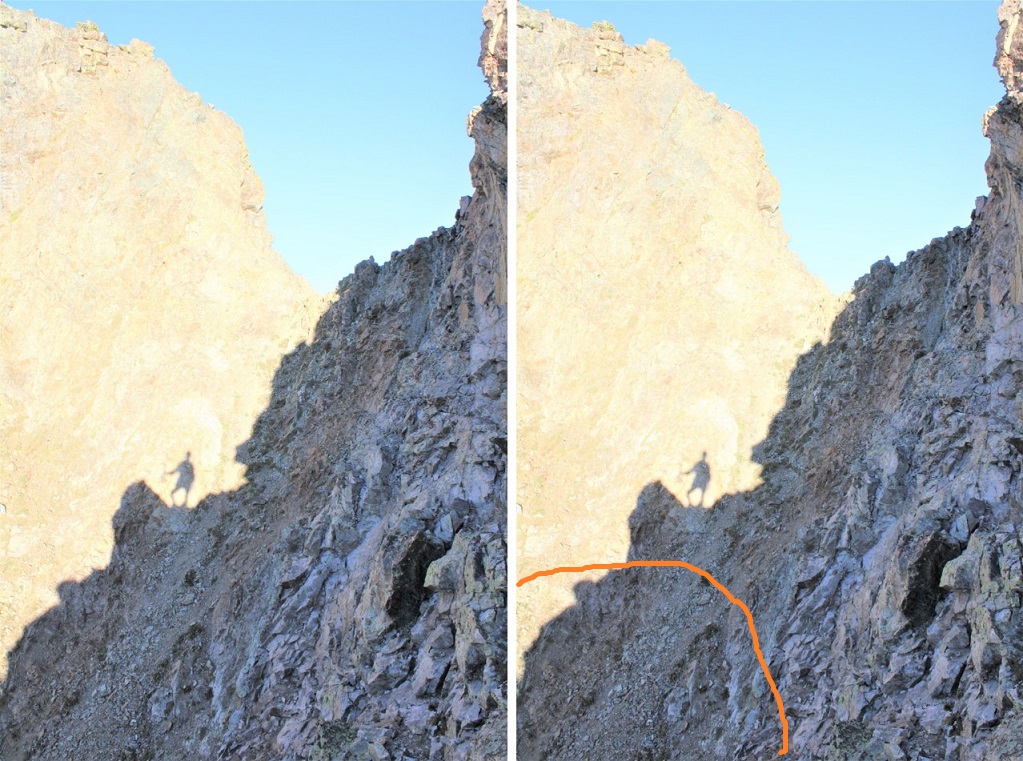
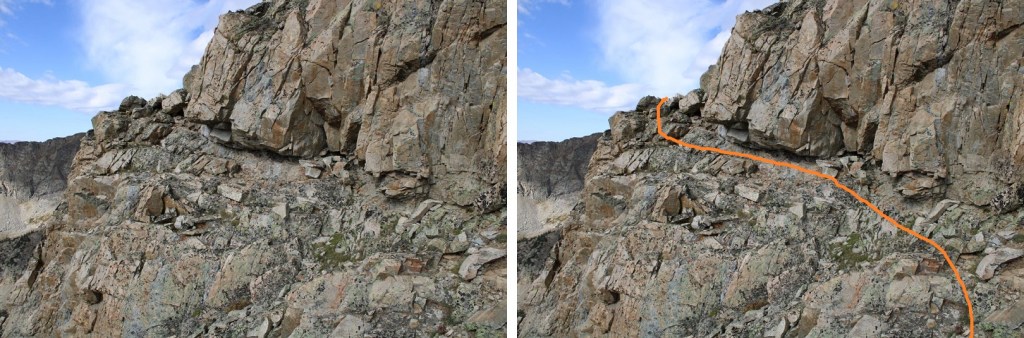
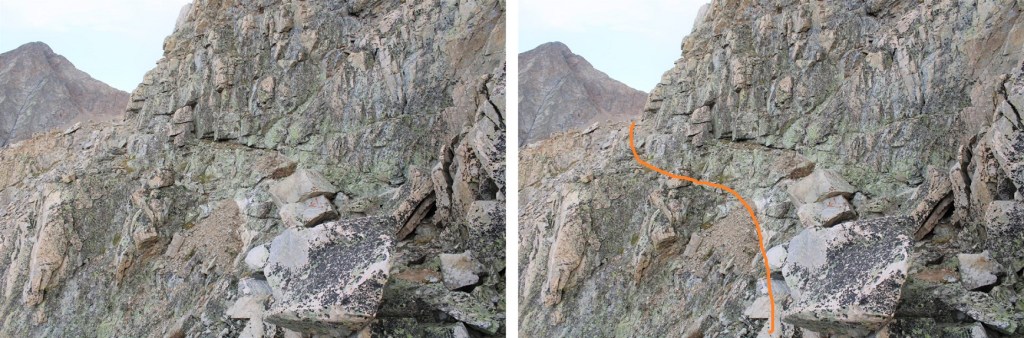
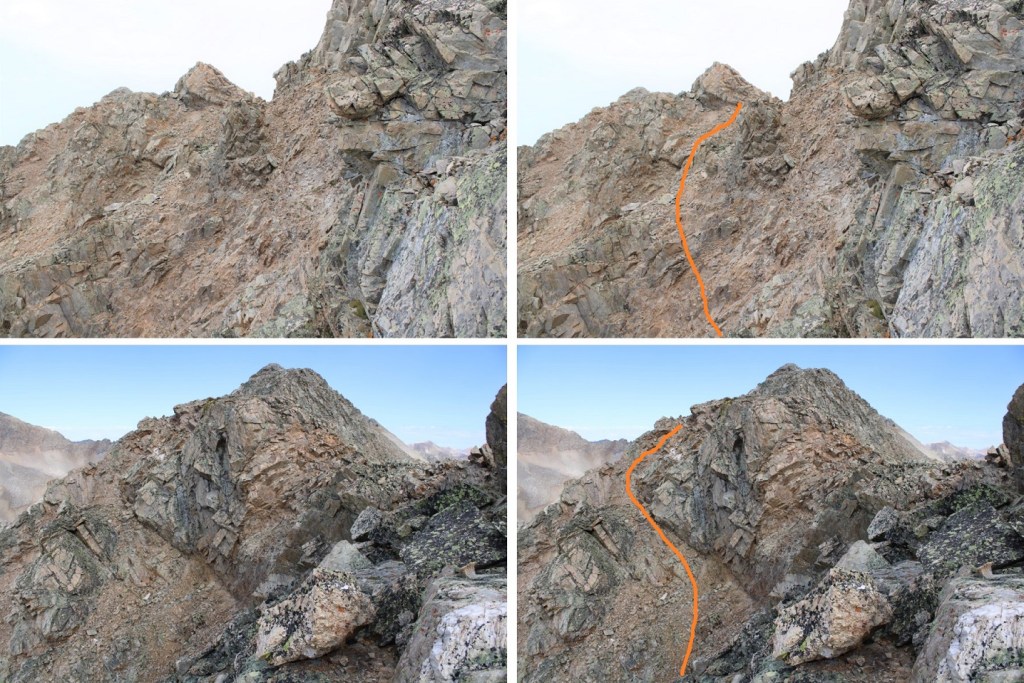
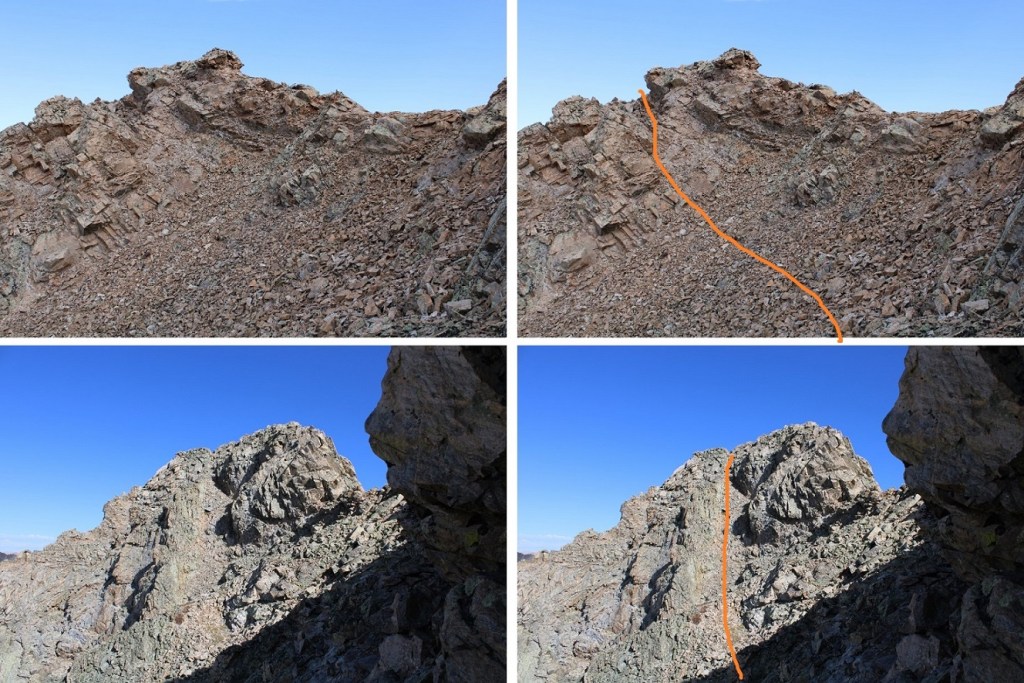
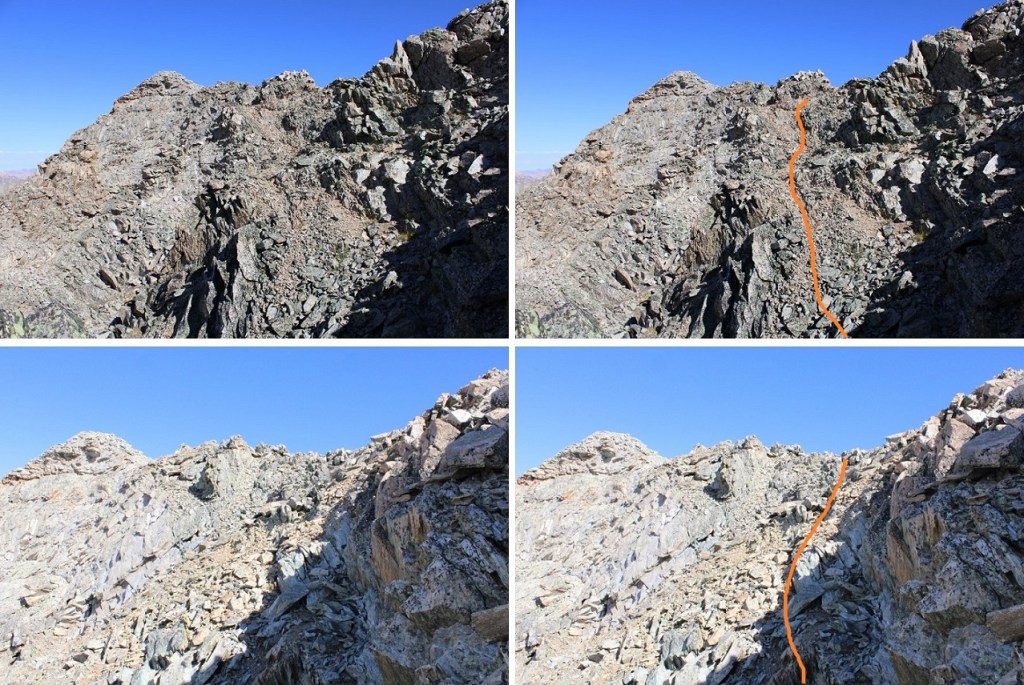
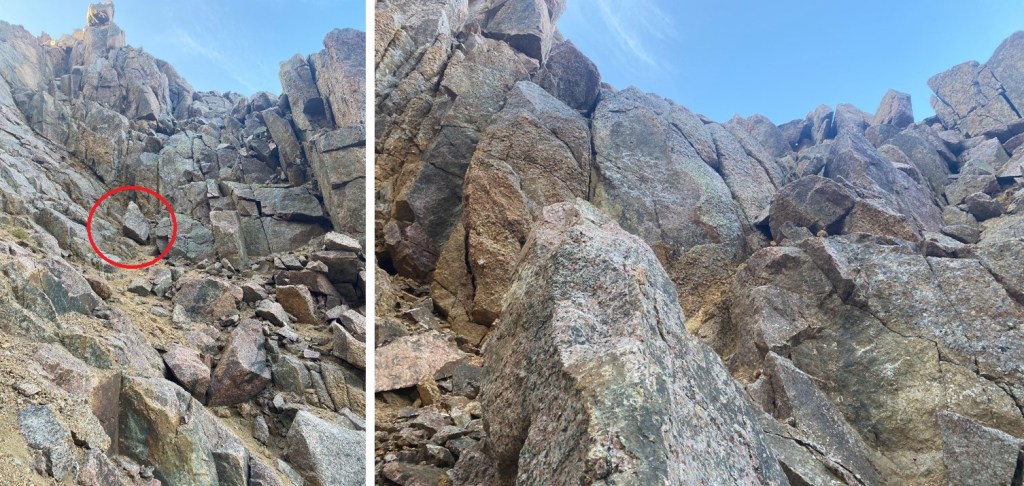
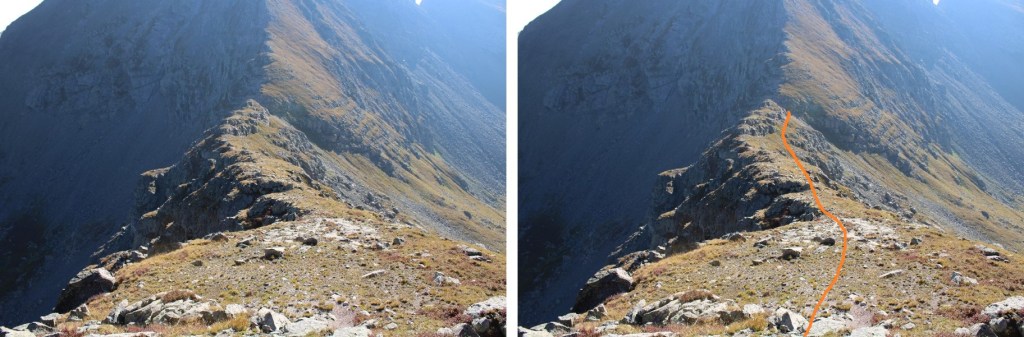
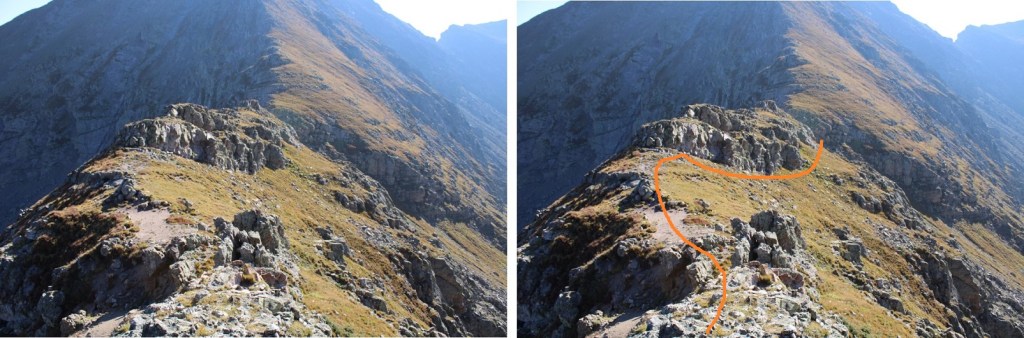
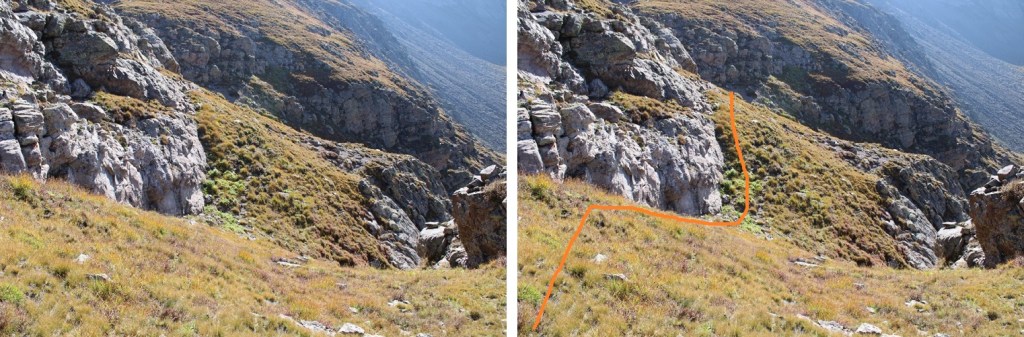
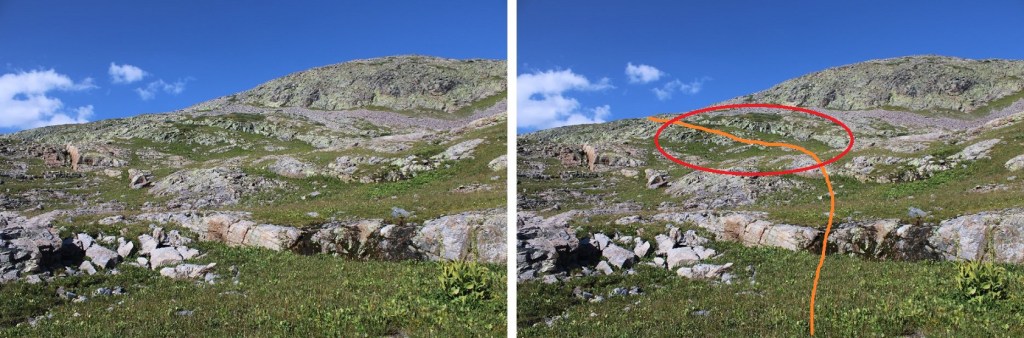
Hitting the false summit was a bit of a downer, but the hike had been easy thus far, so it was kind of expected. I continued following the ridge. There’s a quick chasm to cross in the circled area. It can be kept at 2+. I dipped down to the left about 30 feet, then re-ascended and started climbing towards the summit
Form here it was a simple ridge hike to the summit
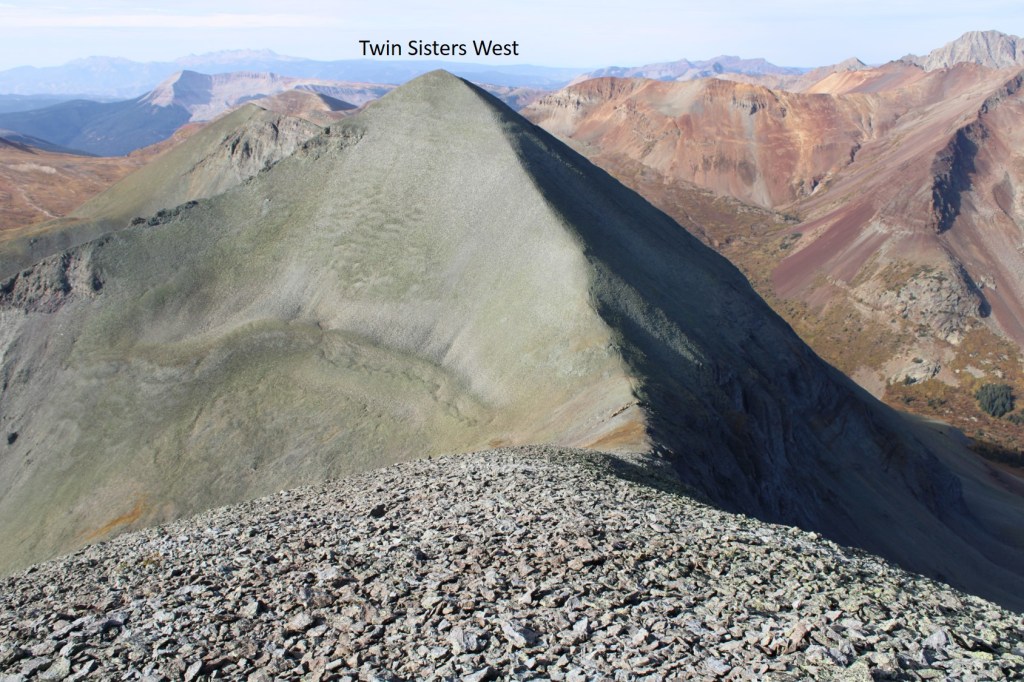
I summited Twin Sisters West at 8:40am
Twin Sisters West:
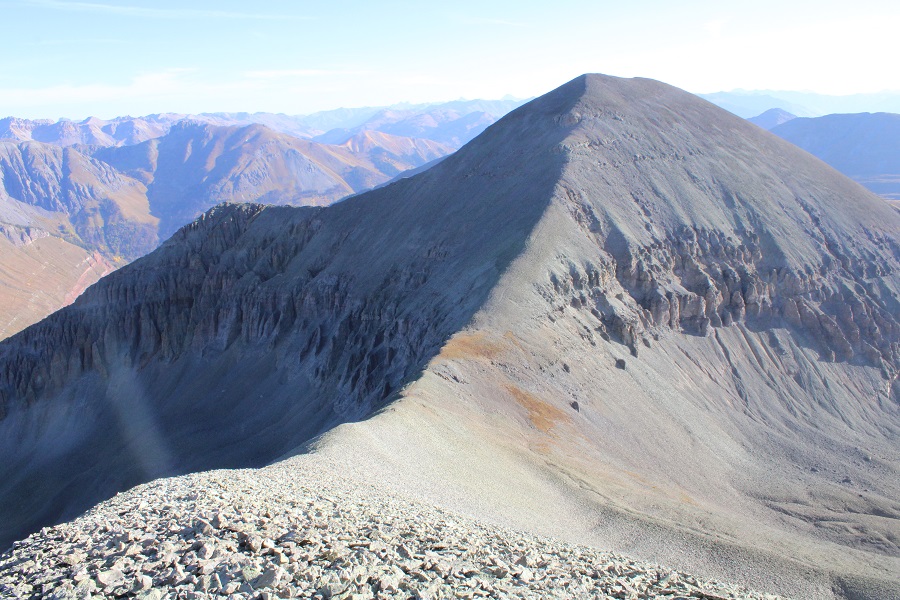
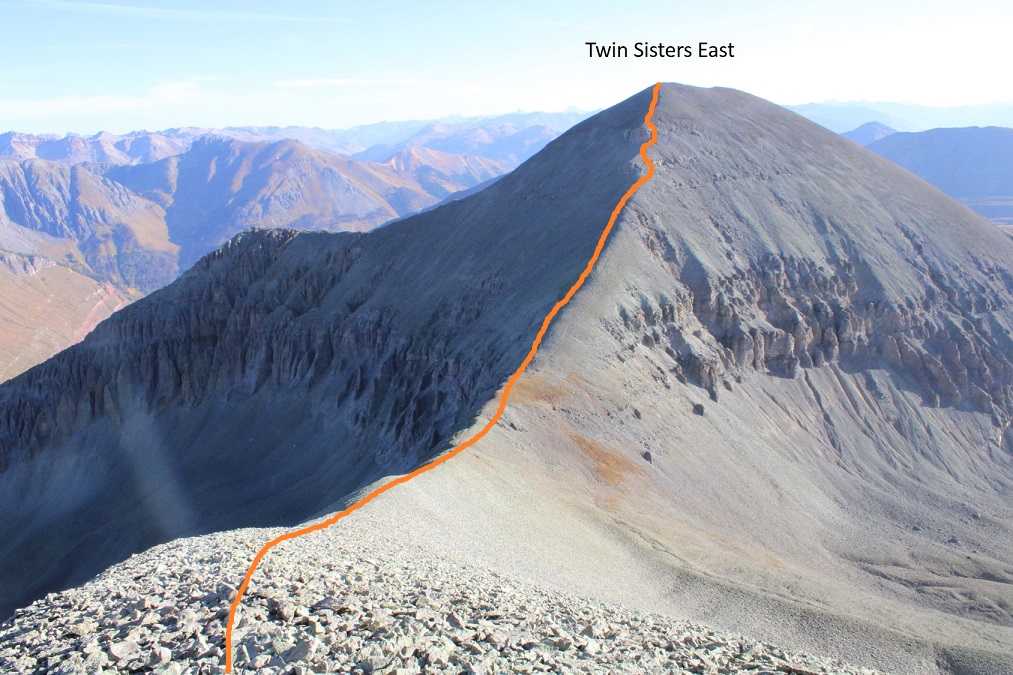
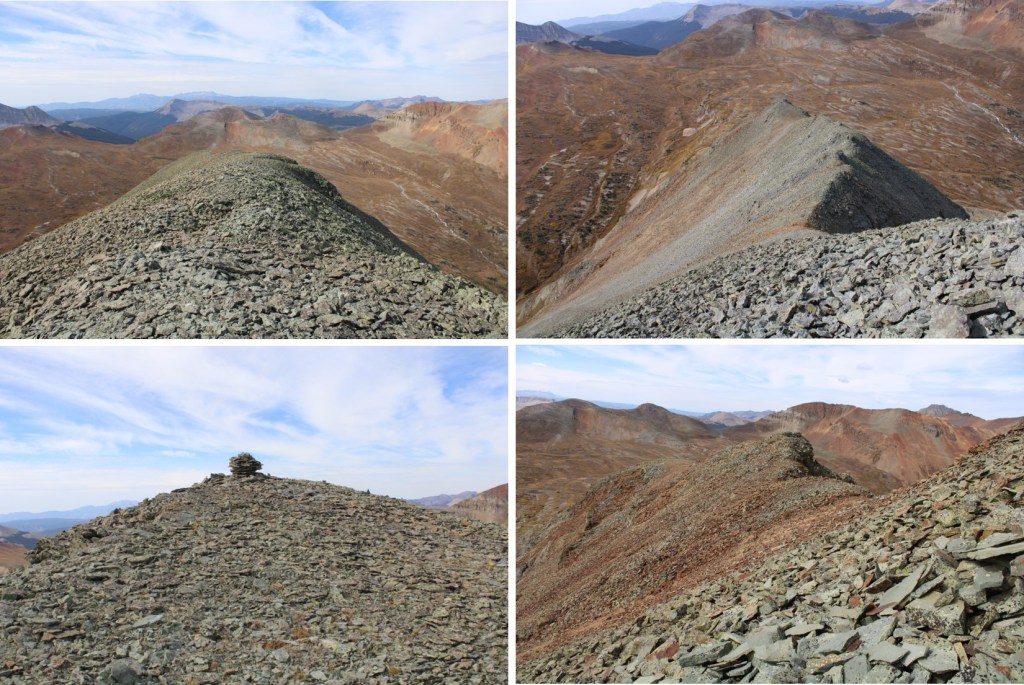
From the summit of ‘west’ it was easy to see the route to Twin Sisters East: I just needed to follow the ridge
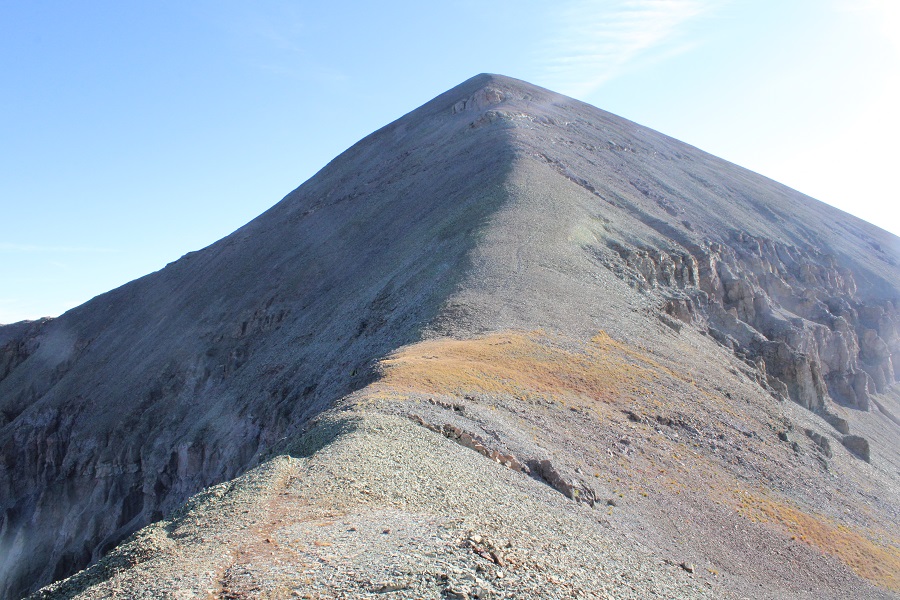
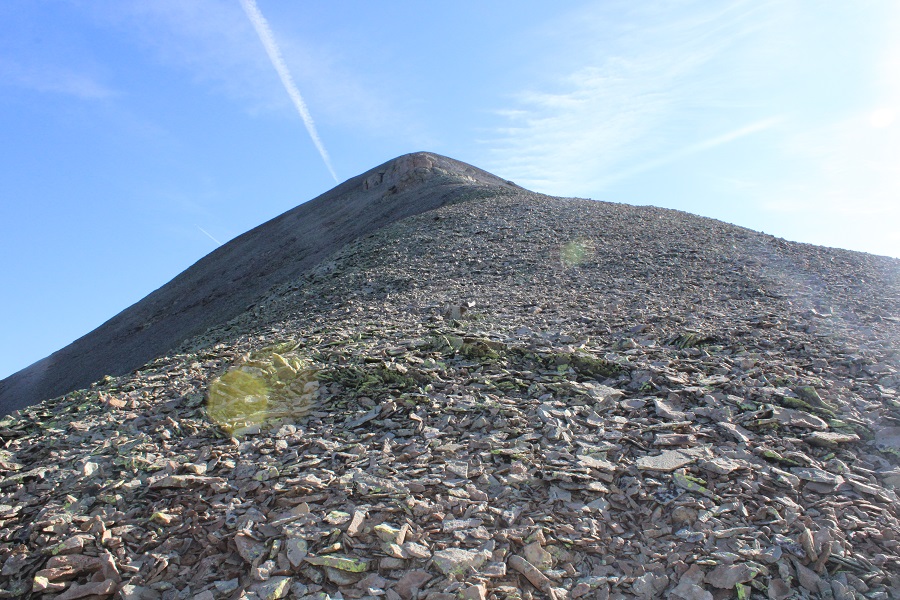
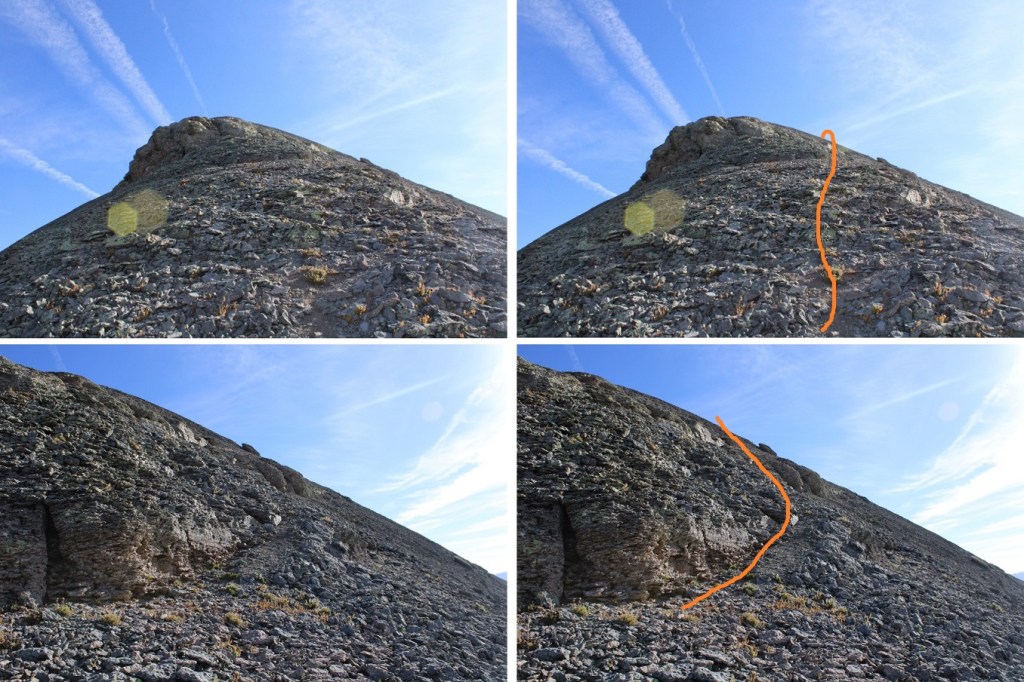
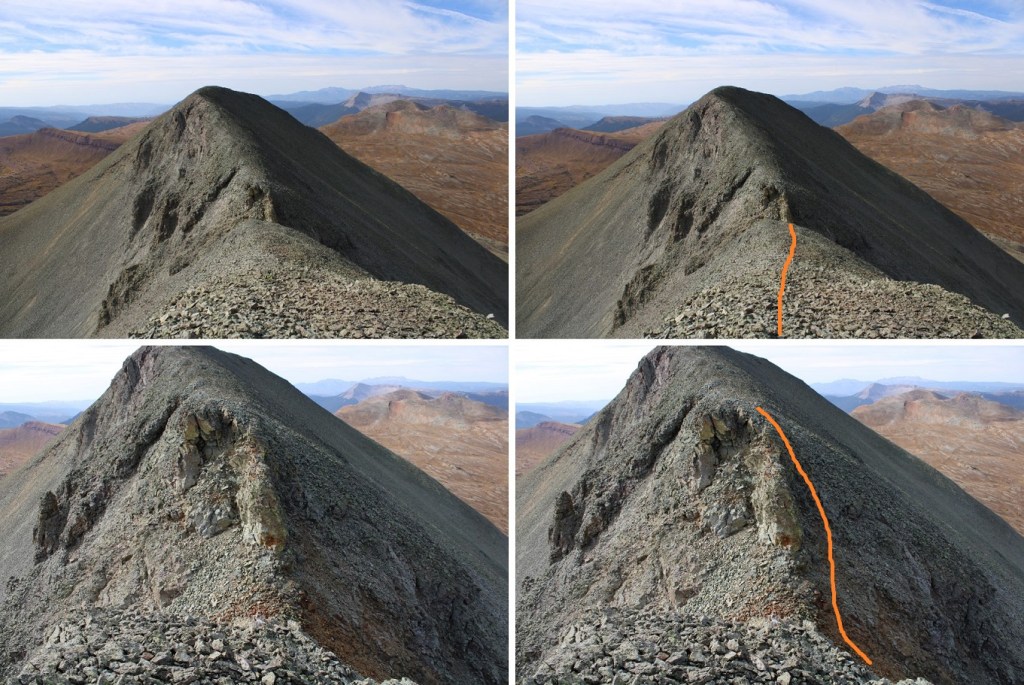
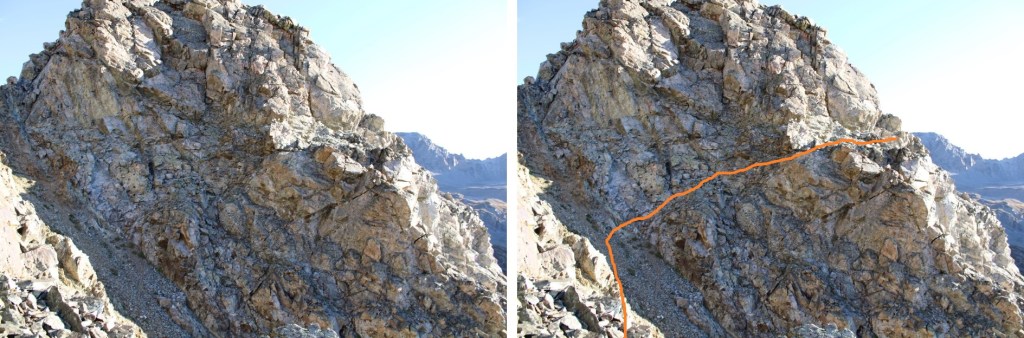
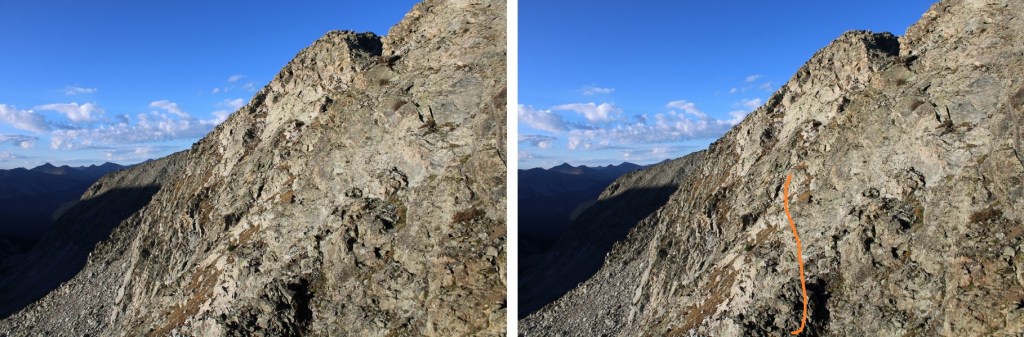
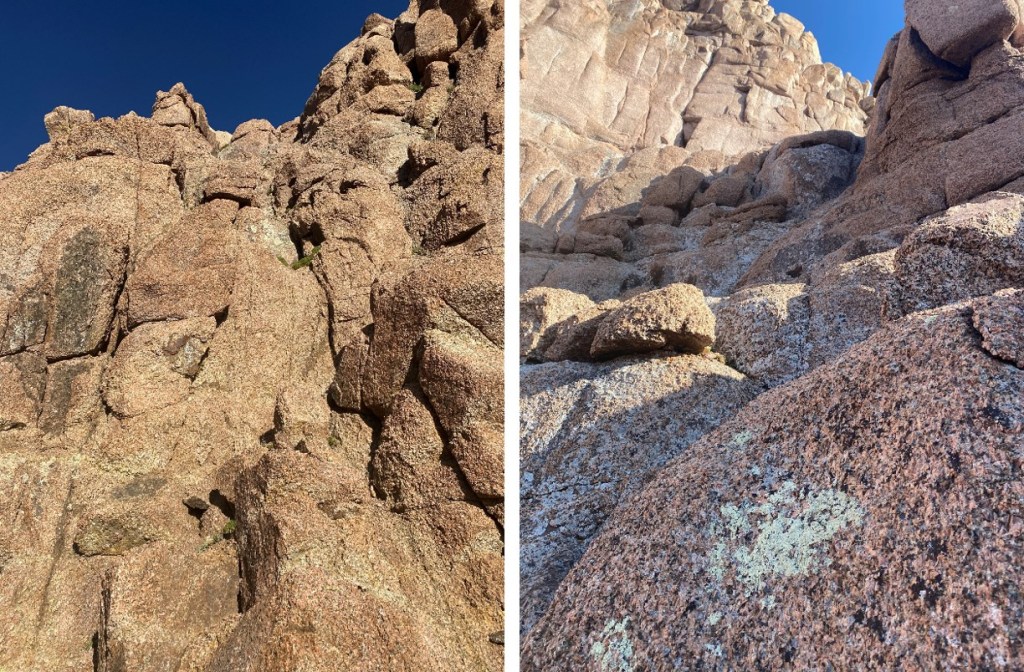
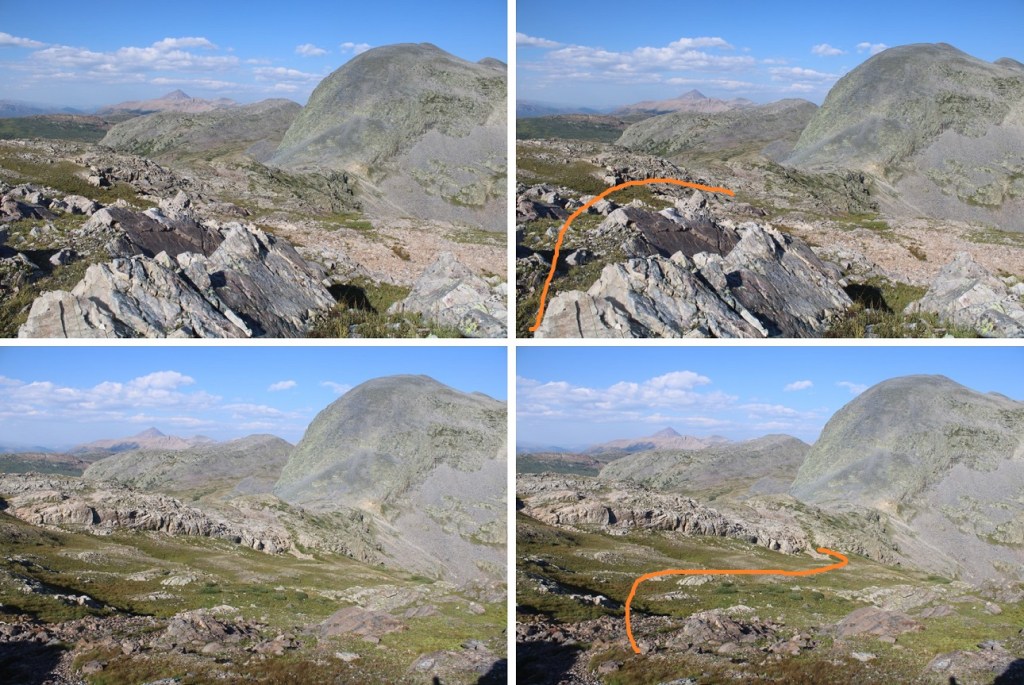
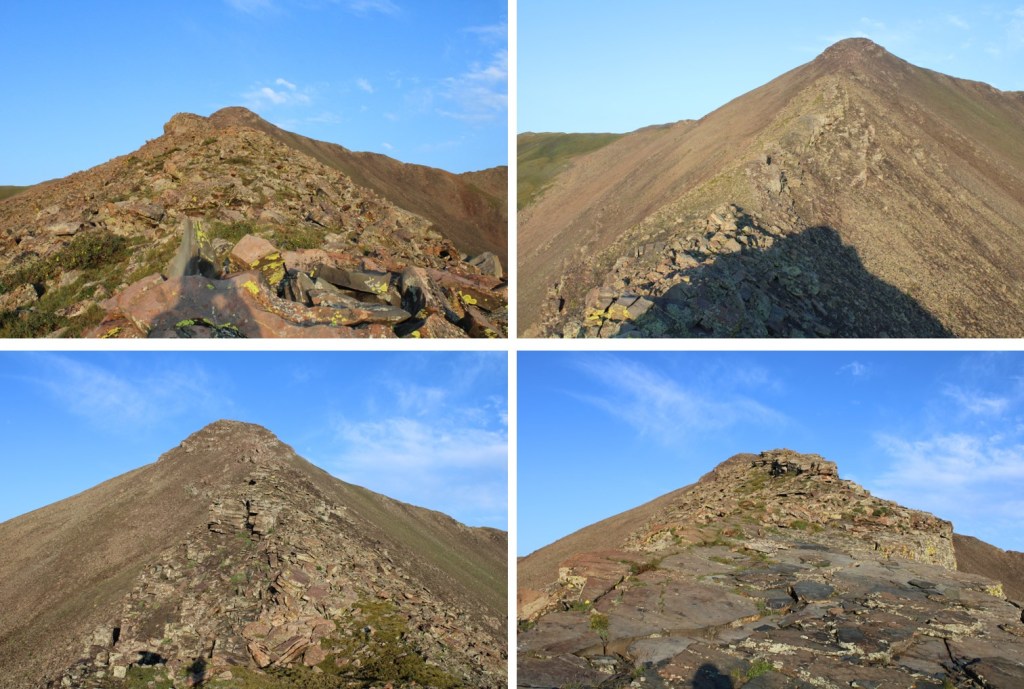
There were no big surprises on this one. There were some game trails to the right, but they didn’t seem prudent. I just followed the ridge, and then closely navigated the rock problems, which were all class 2. This is the route I took
And some closer pictures
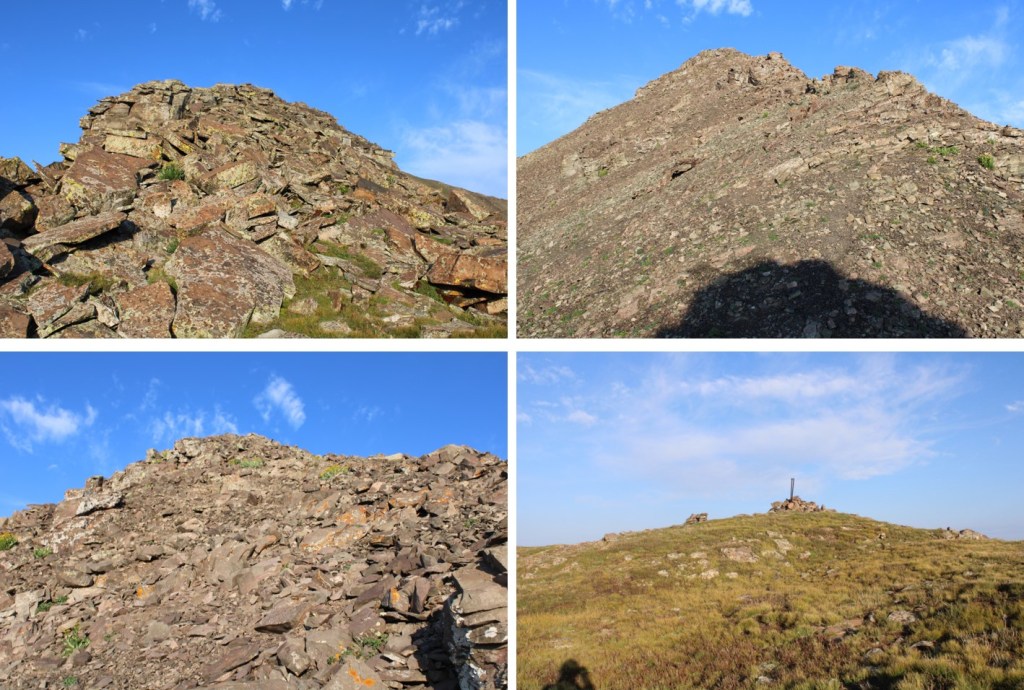
The summit was relatively flat. I wasn’t sure where the exact summit was, so I waked the entire length, just to realize the summit was at the top of the ridge
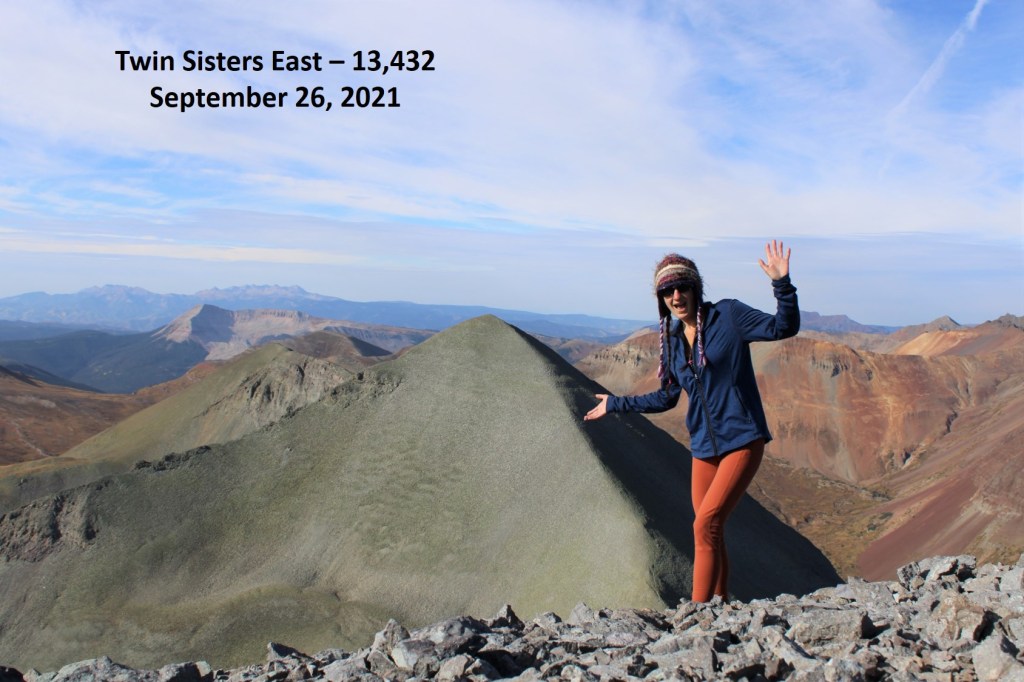
I summited Twin Sisters East at 9:20am
Twin Sisters East:
Because I’d done most of my hiking in while it was dark, I decided to make this an out and back trip so I could get better pictures of the trek i. So, I retraced my steps back to Twin Sisters West. This was a simple ridge hike
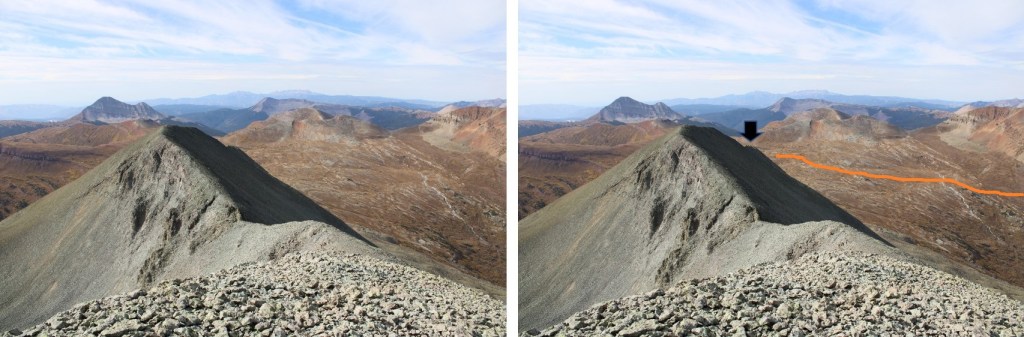
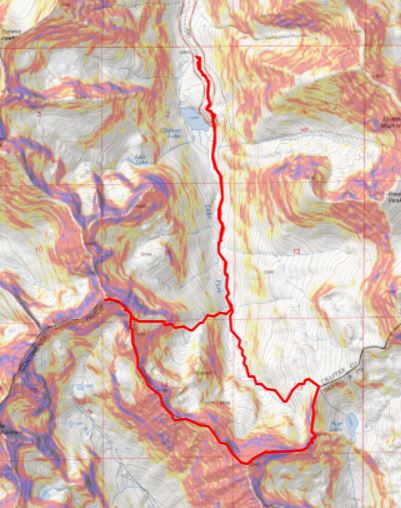
From Twin Sisters West I continued following the ridge southwest. It’s important to follow this ridge all the way to the end (black arrow). Also, here’s an overview of the route around the basin. Fun fact: the white area isn’t water, but rock from a dry stream bed. I’m sure at some point in the year it holds water, but I’ve only seen it dry.
Here’s a close up of the ridge problem
And following the ridge to the end
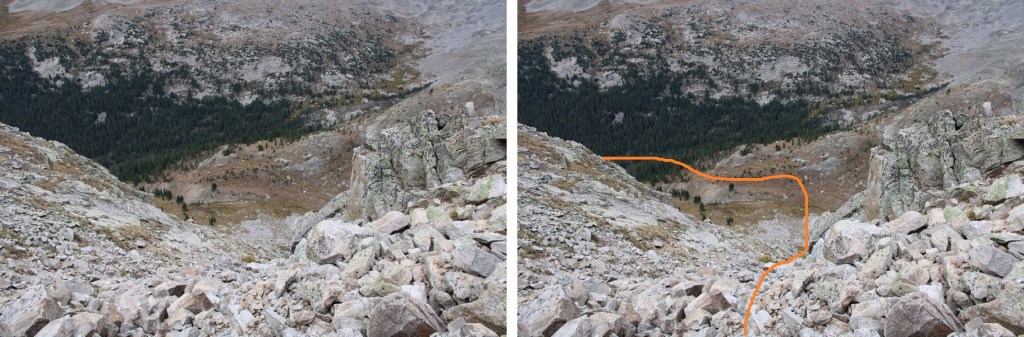
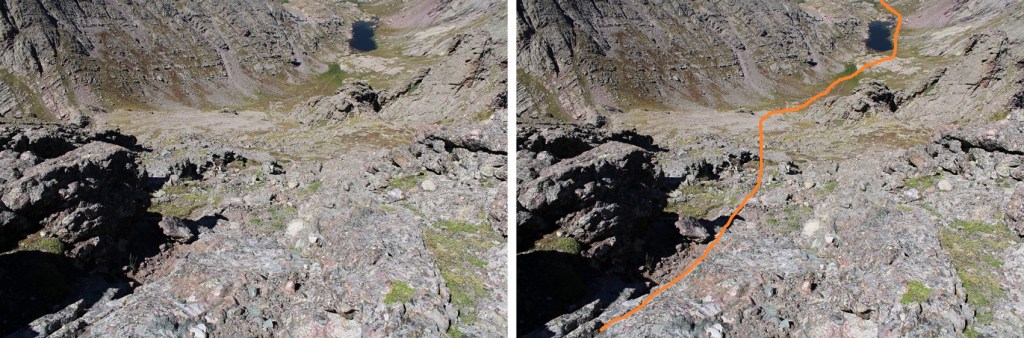
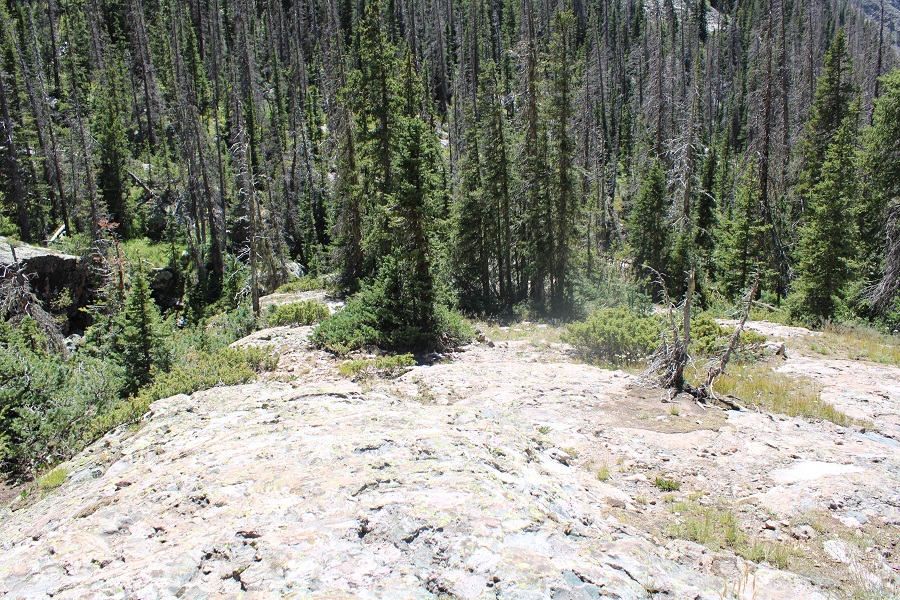
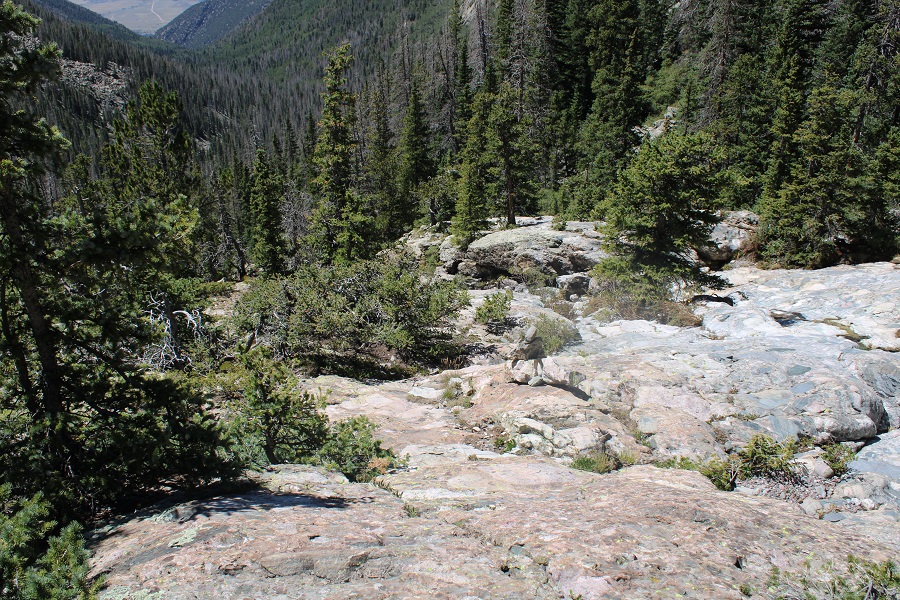
Once at the end of the ridge, I turned left and scree surfed/carefully navigated my way down the gullies
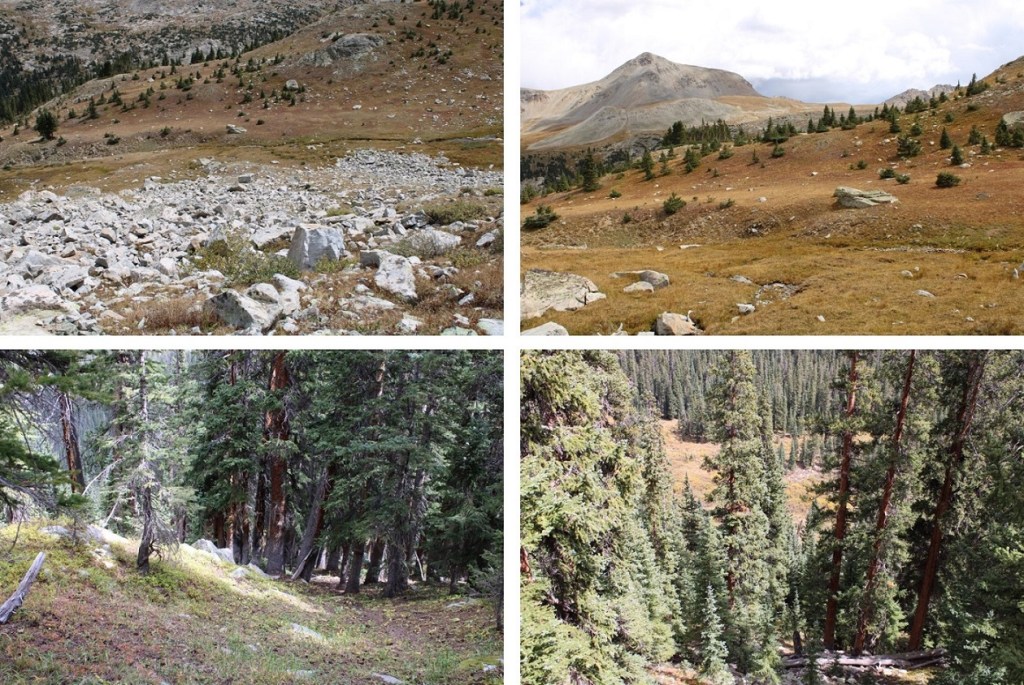
At the base of the gullies I turned right, and headed out of the basin
There were faint game trails here
That led me back to the Rico-Silverton Trail, which I took north back to my truck
I made it back to my truck at 12:30pm, making this a 10.32 mile hike with 4101’ of elevation gain in 6 hours, 45 minutes.
Due to colder weather than anticipated, I’d abandoned my initial backpacking trip after the first night and was looking for a “Plan B”. Going through my binder of potential hikes, I narrowed it down to ‘something around South Mineral Creek’ and decided to drive to the trailhead. It was full when I got there, but that was ok, as I was planning on hiking the next morning (I’d already put in 15 miles that morning).
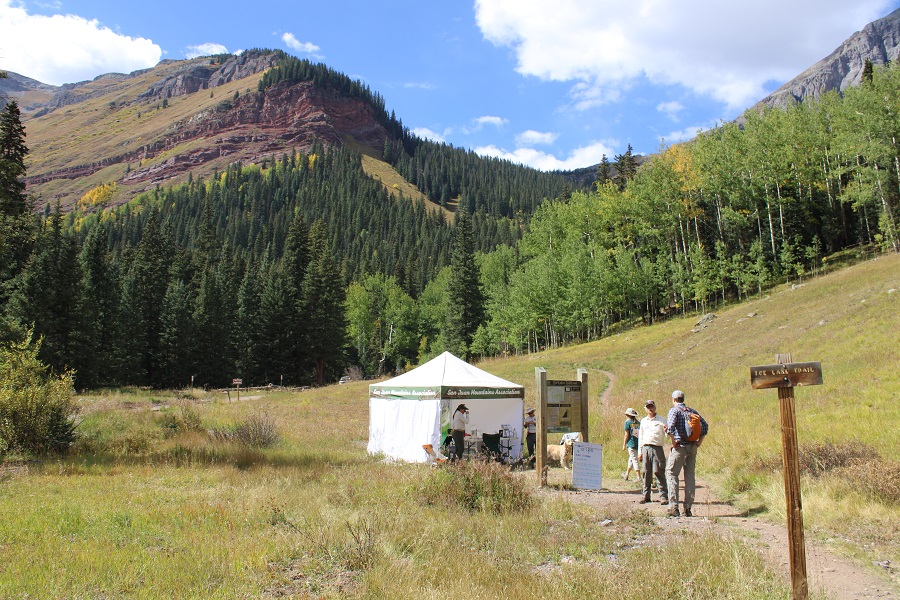
The trailhead was open this week, after being closed due to last year’s fire. There was an information center set up at the trailhead, with a place for volunteer park rangers to talk with hikers. There were also signs educating hikers about wildfire.
Speaking of wildfire… where was it? From the parking area there was no evidence of a fire. As people slowly made their way back to their vehicles and left the parking area, I ate my dinner of noodles and chips, sipped some whiskey, and read a book. I made it an early night, wanting to get some sleep before it got really cold.
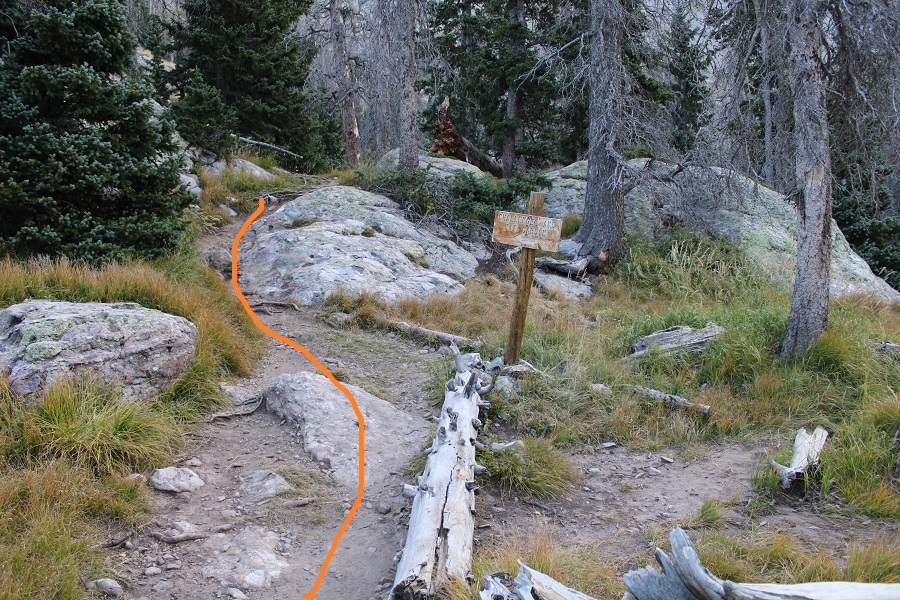
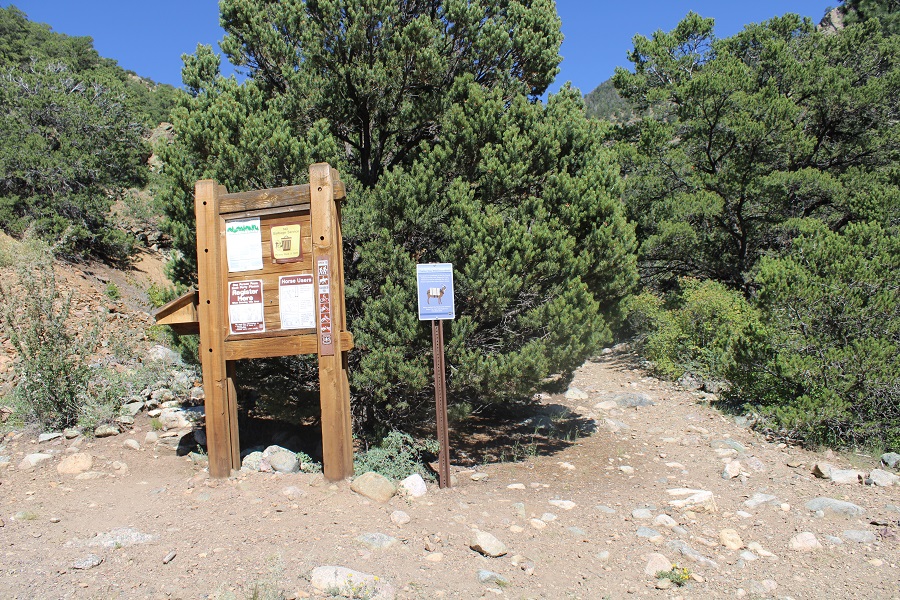
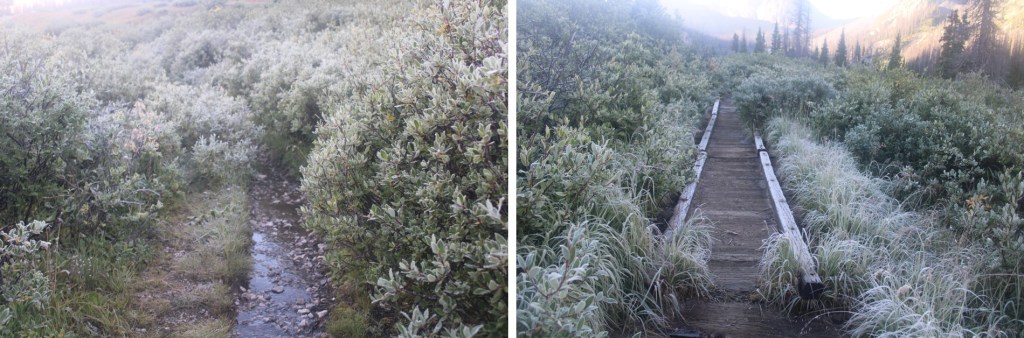
It got really cold. Another night in the 20s, which made for a layer of frost on everything when I woke up. I didn’t want to get out from my sleeping bag, where I was warm. And, I had a headache? I really wasn’t feeling it this morning, but got ready anyway, and was on the trail at 6:30am, 2 hours later than I’d originally planned. It was still dark outside. The trail starts at the west end of the parking area, and has a trail register and signage. I didn’t sign the trail register, because it was covered in a layer of frost and my hands were cold enough at it was.
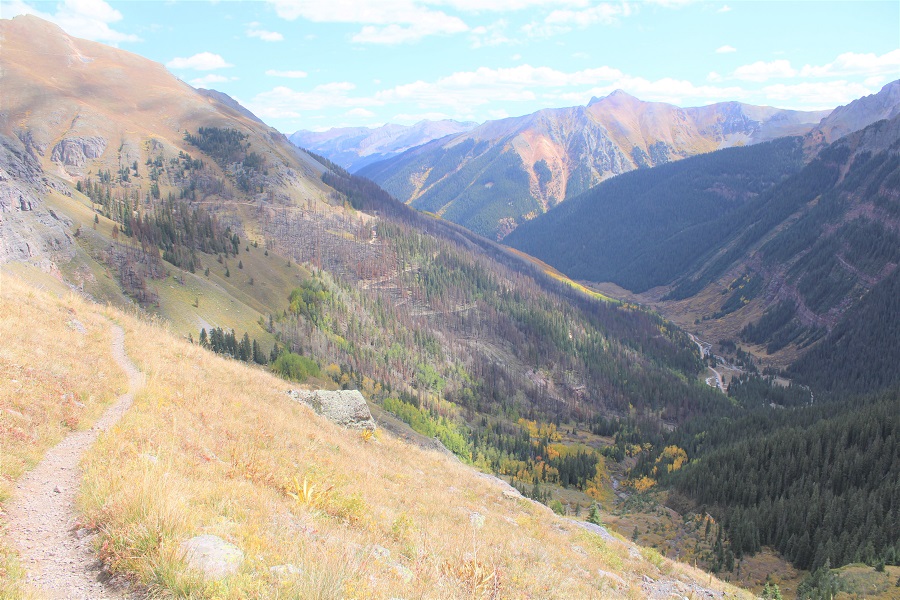
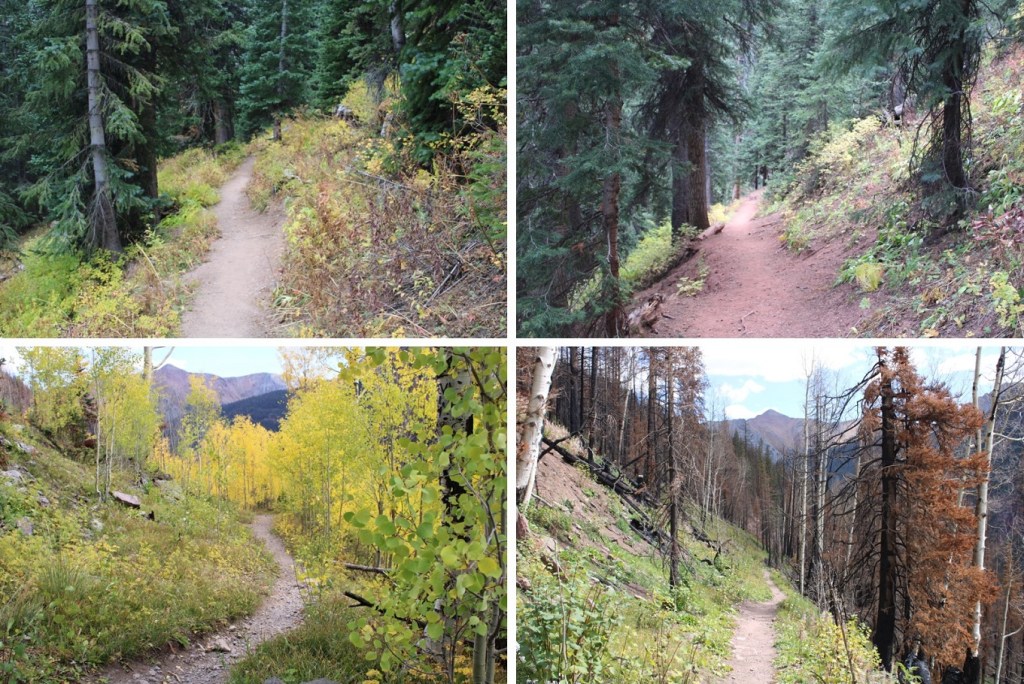
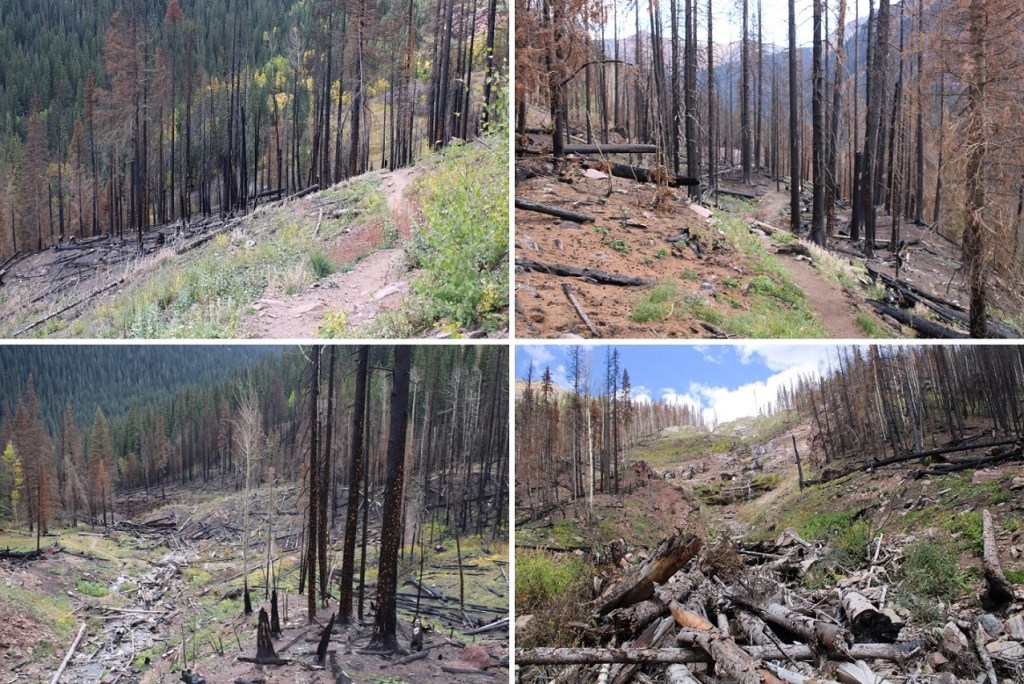
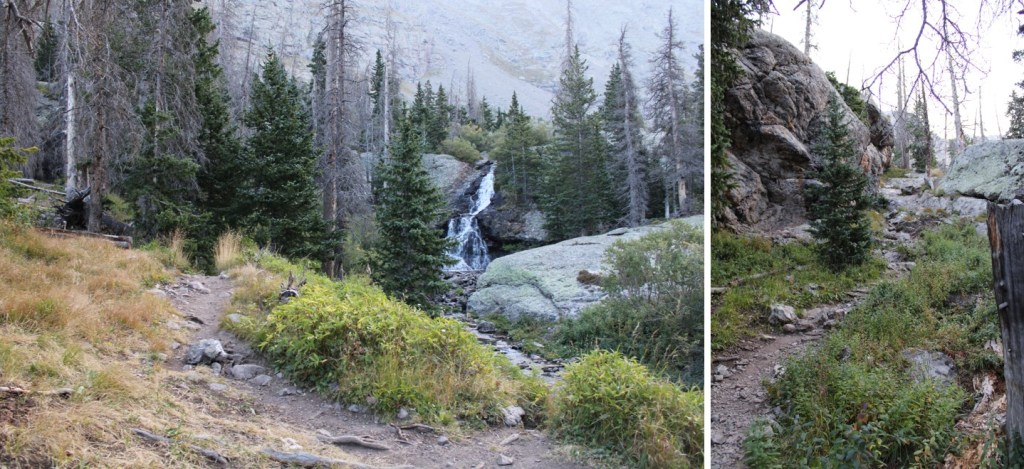
The trail was very easy to follow. The fire burn area was short, and ended just before the waterfall/4WD trail cutoff. It seemed to follow the avalanche area from a few years ago. The trail seemed unaffected, and was clear of debris.
I followed this class 1 trail 2.5 miles to treeline. At treeline, I started feeling more like myself, excited now I chose to hike today (isn’t that always the case?).
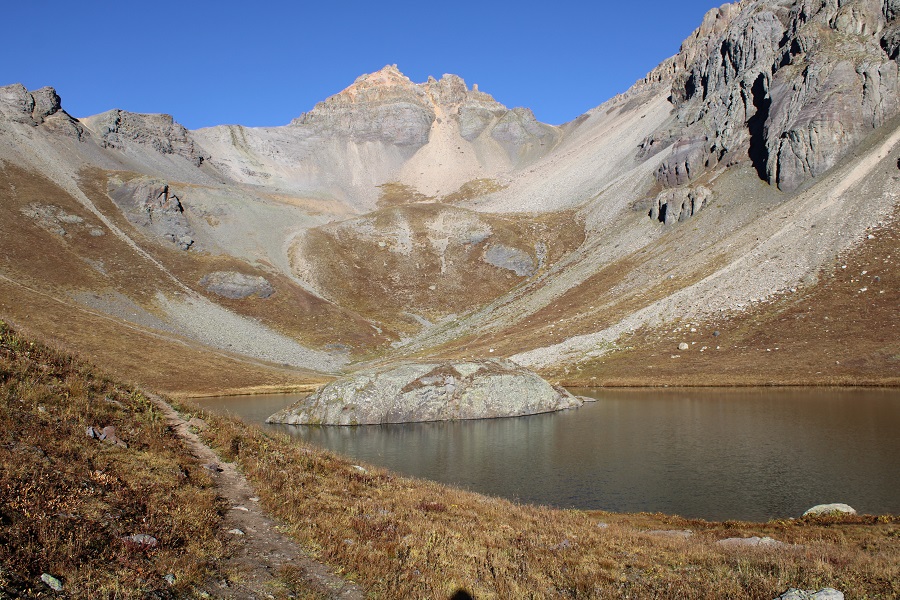
At the junction around 11425’ I turned right and followed the trail into the upper basin, towards Island Lake.
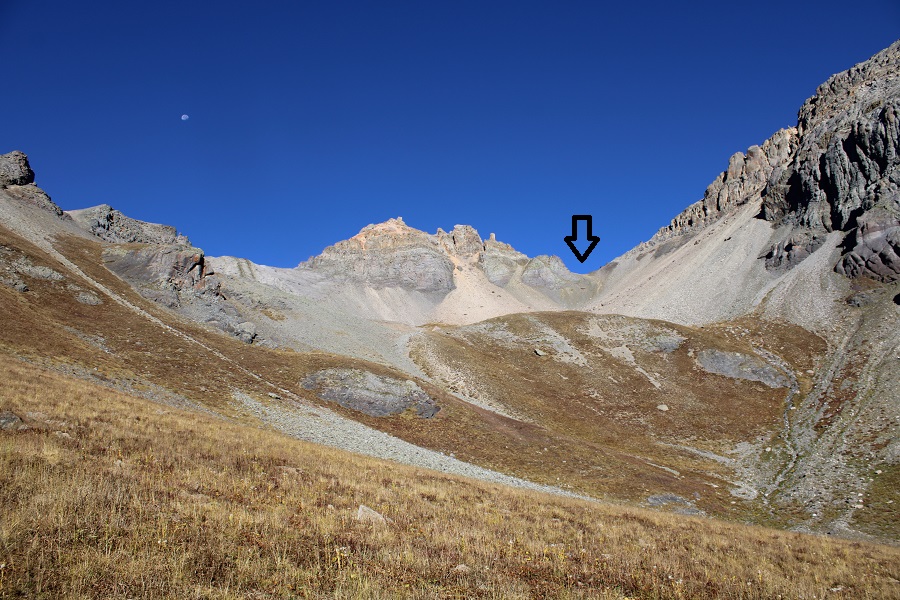
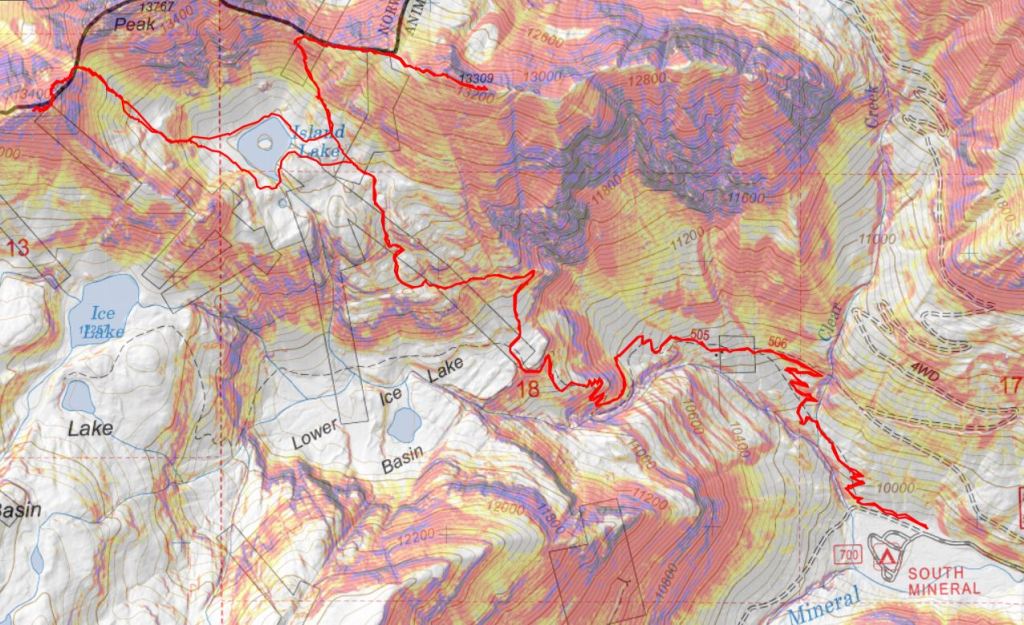
Here’s an overall view of the hike to the V4/US Grant Saddle (the lake isn’t visible yet, but it’s straight ahead).
At the junction I turned left, towards Island Lake. This is the junction I’d be coming back to when it was time to hike V2.
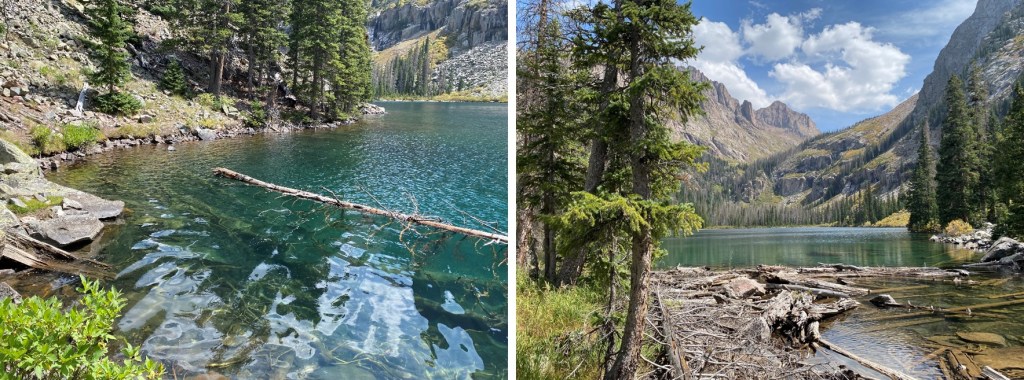
I decided to skirt the lake to the left, on the obvious trail, but you can take either side. Note: there isn’t a clearly defined trail to the right, but it’s an easy trek either way. There was a thin layer of ice on the lake.
Once past the lake it’s ‘choose your own adventure’ to the saddle. All routes go here.
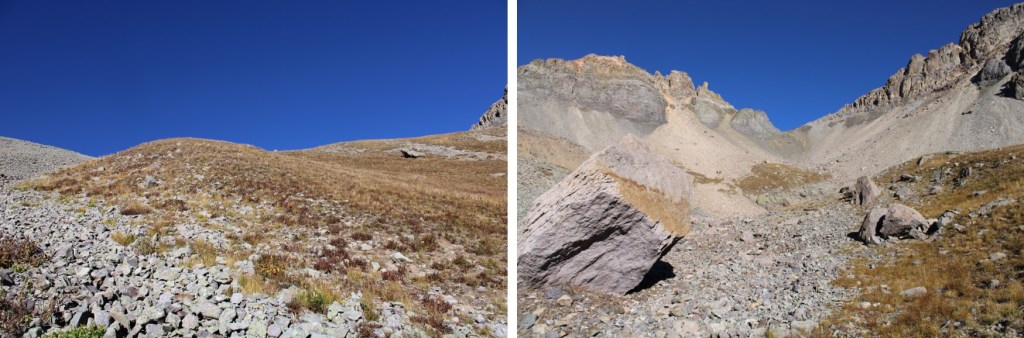
Here are some closer pictures
When I hit the scree I put on my microspikes, and didn’t take them off until I made it back to this spot. There’s a runnel you can follow, as well as tundra and scree routes.
Once at the saddle I turned left, towards V4
I skirted the north side of V4, hugging where the talus met rock, following the contour of the mountain west. This is loose rock.
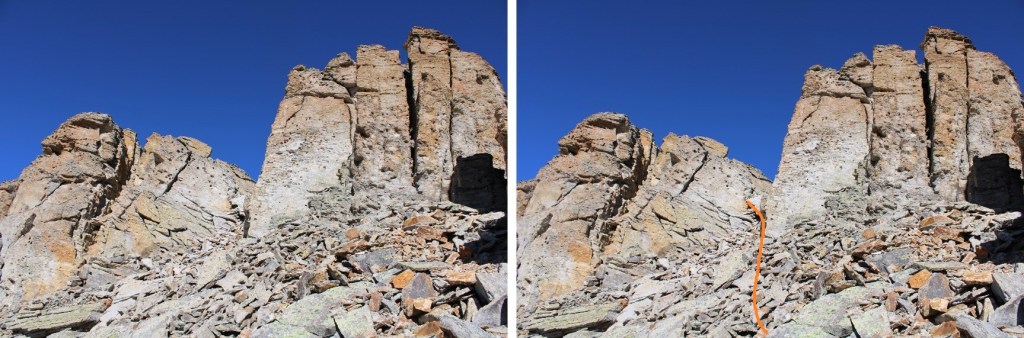
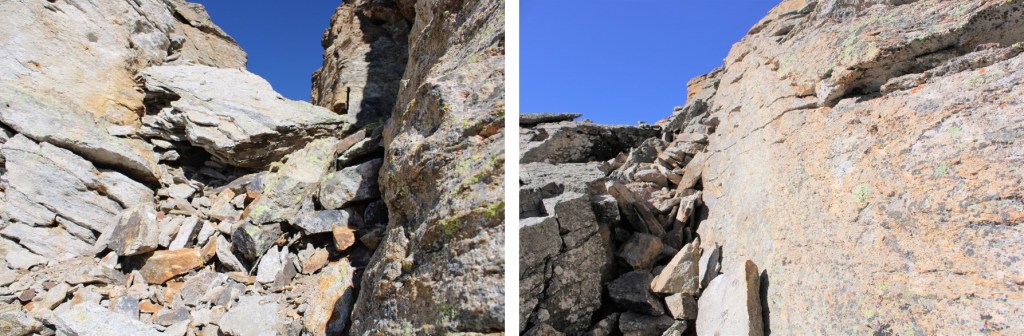
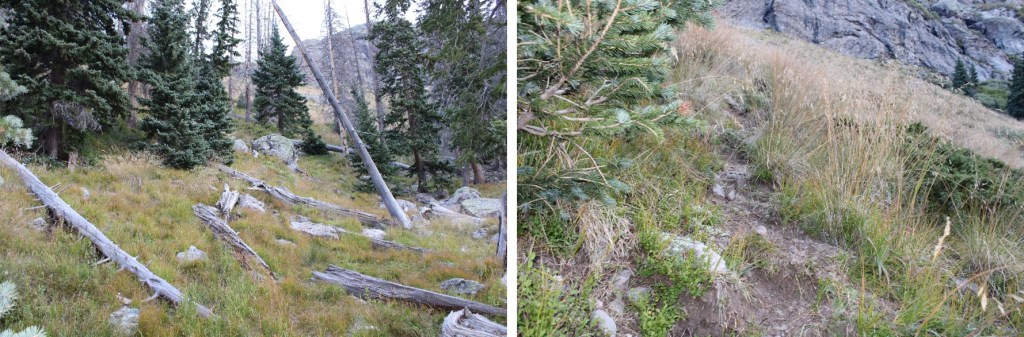
Following the contour of the mountain brought me to a scree-filled gully. I ascended this gully (microspikes were very helpful here, as it’s steep).
At the top of the gully I turned right and followed the scree up
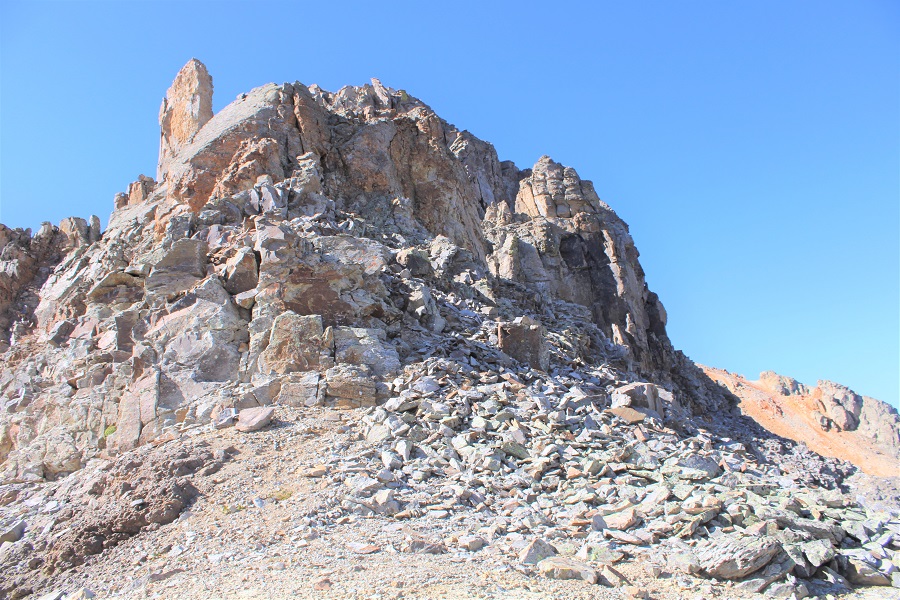
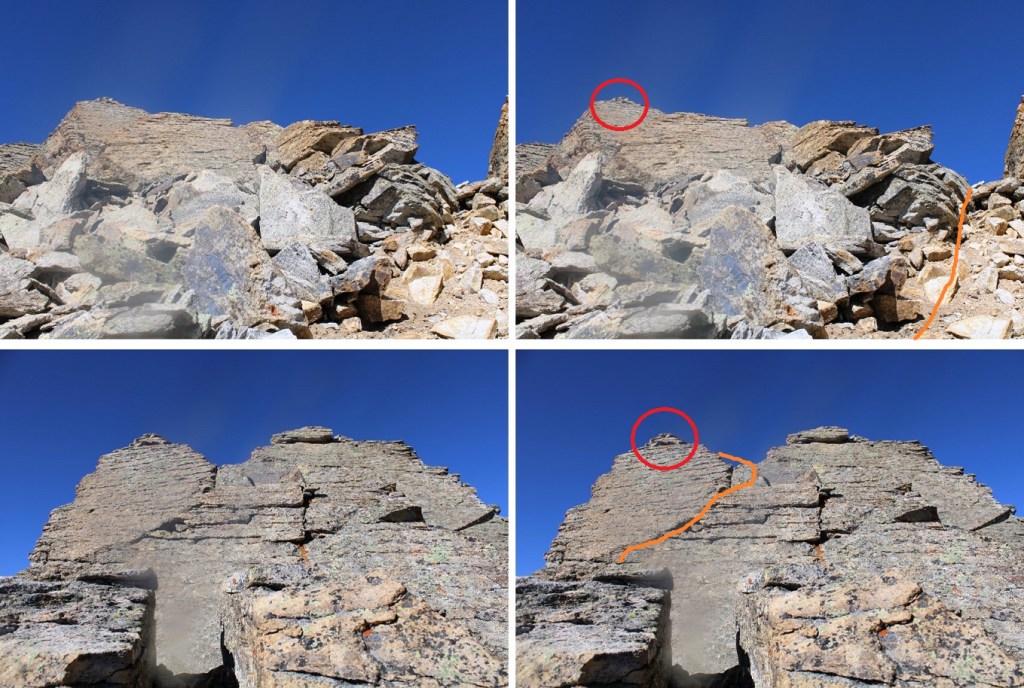
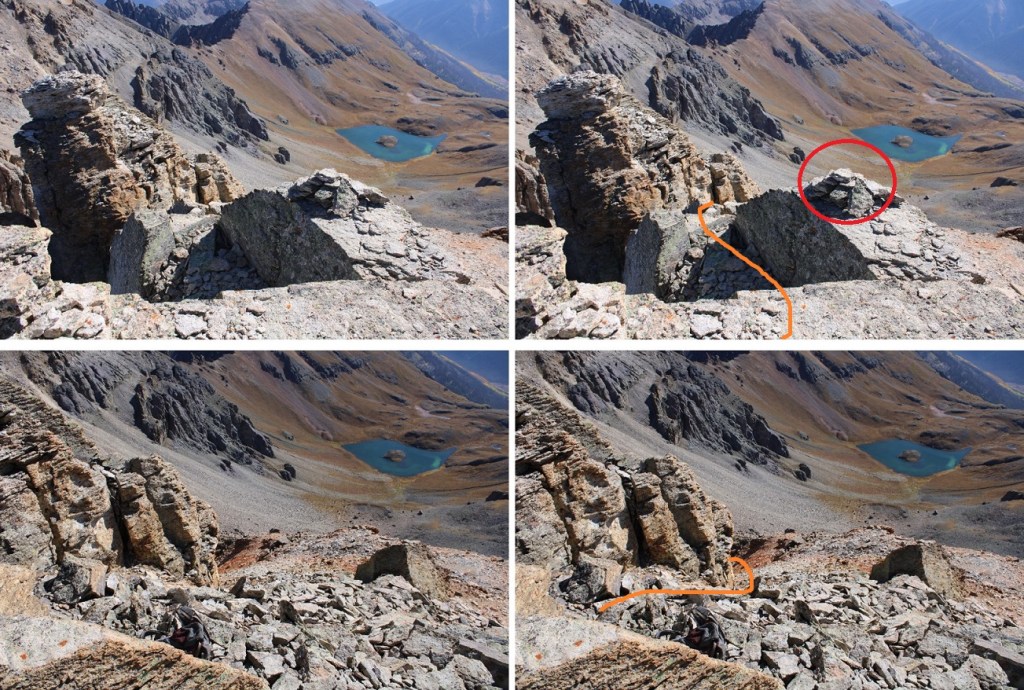
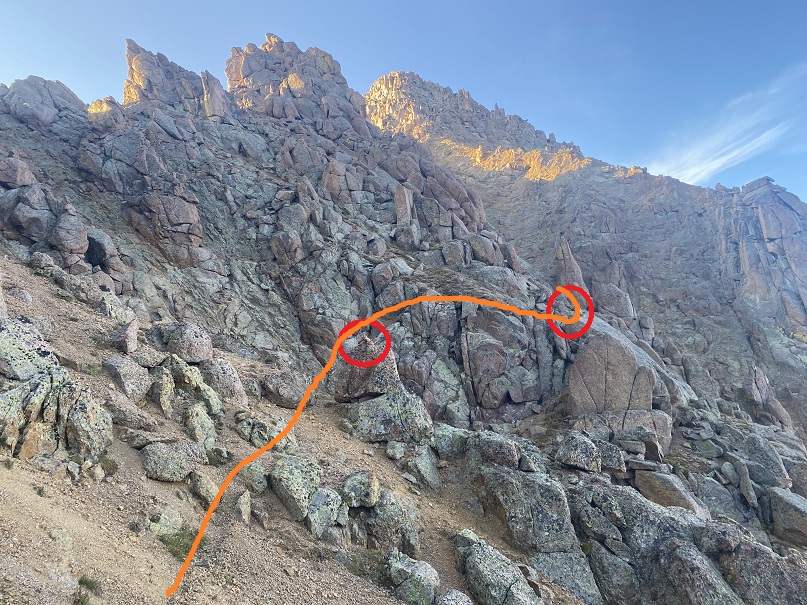
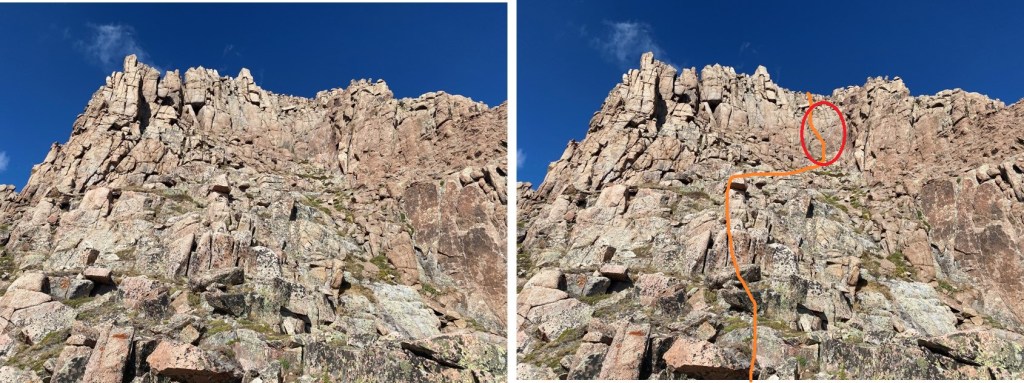
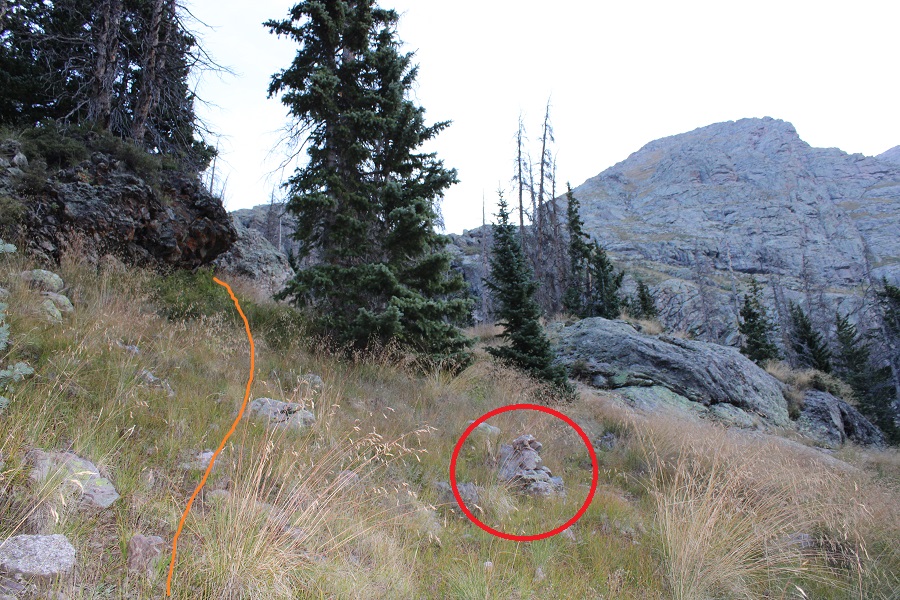
This is where it got complicated. I’m not entirely sure which it the actual ‘summit’. I saw a cairn, and scaled the first tower I came to (this was easier than pictures make this look). The cairn is circled in red
But when I got to the top, it looked like the actual summit might be the next tower.
So, I checked my altimeter. It read 13,540’. I backtracked and made my way to the next tower
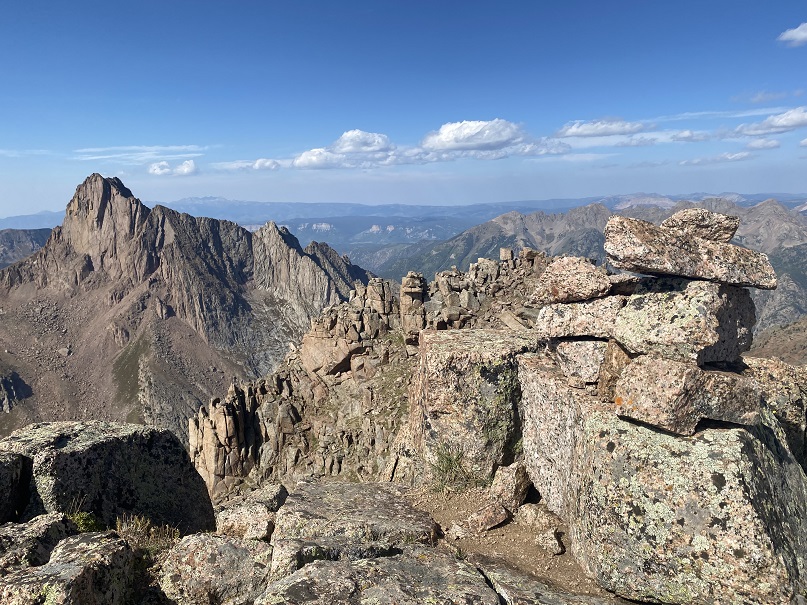
But when I got to the top of the next tower and checked my altimeter, that too read 13,540’. I turned and looked back: the first point now seemed higher to me, and it had a cairn, so I figure that was the high point. Peakbagger said the peak was 47 feet behind me, but somewhat closer to the first tower… which would have put me in empty space.
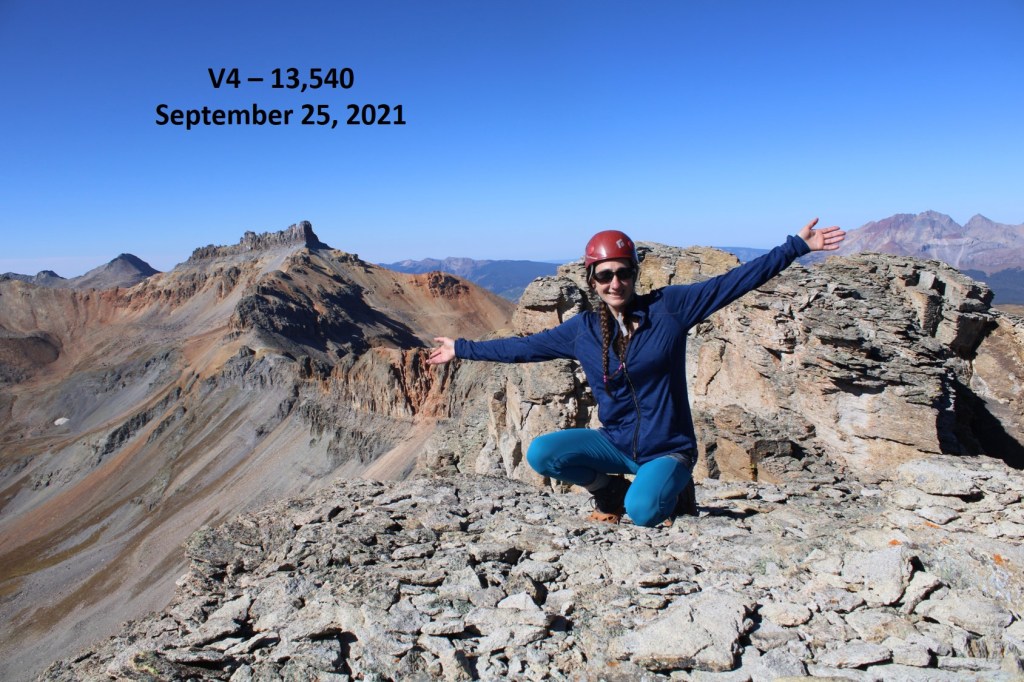
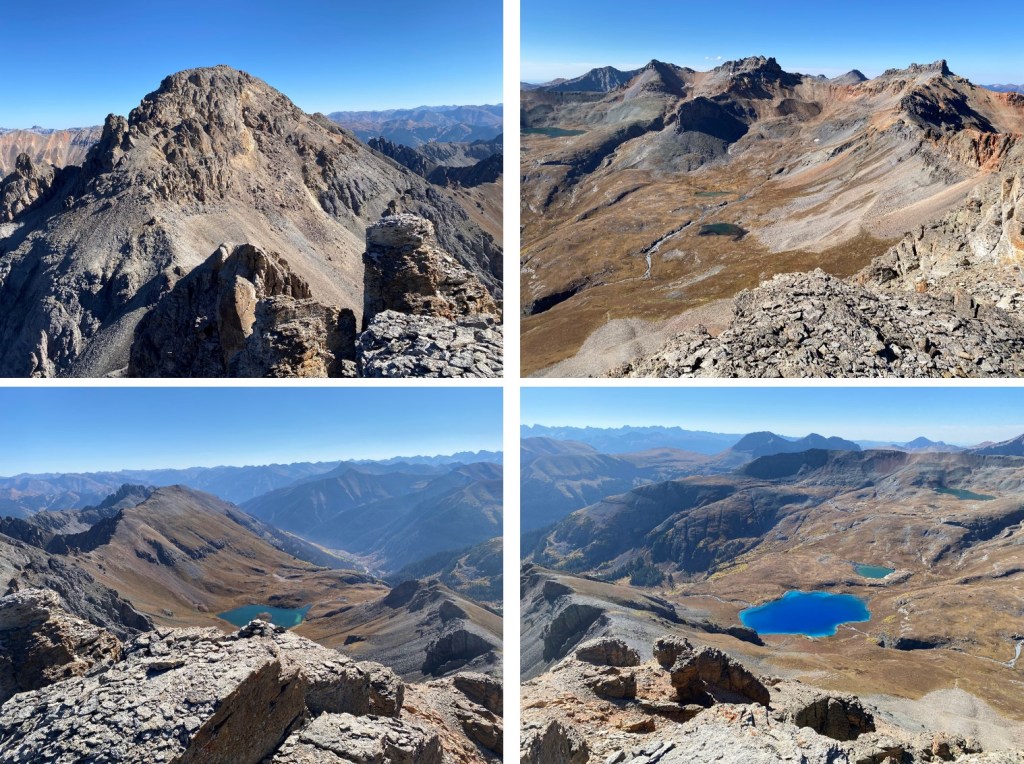
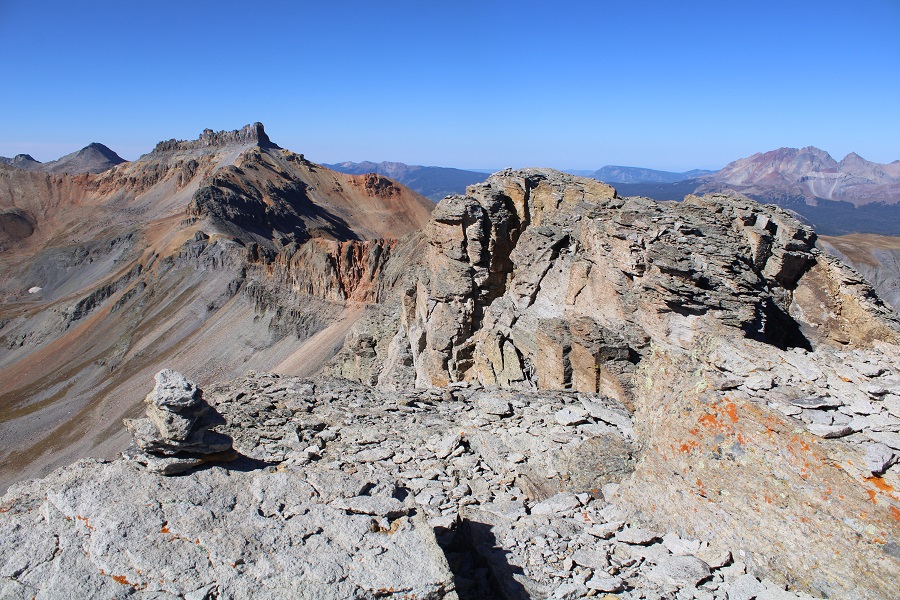
I made my way back to the first tower and took some pictures. I summited V4 at 10am. (Not sure why I said V3 in the video, but by the time I realized my mistake I was already back by Island Lake).
V4:
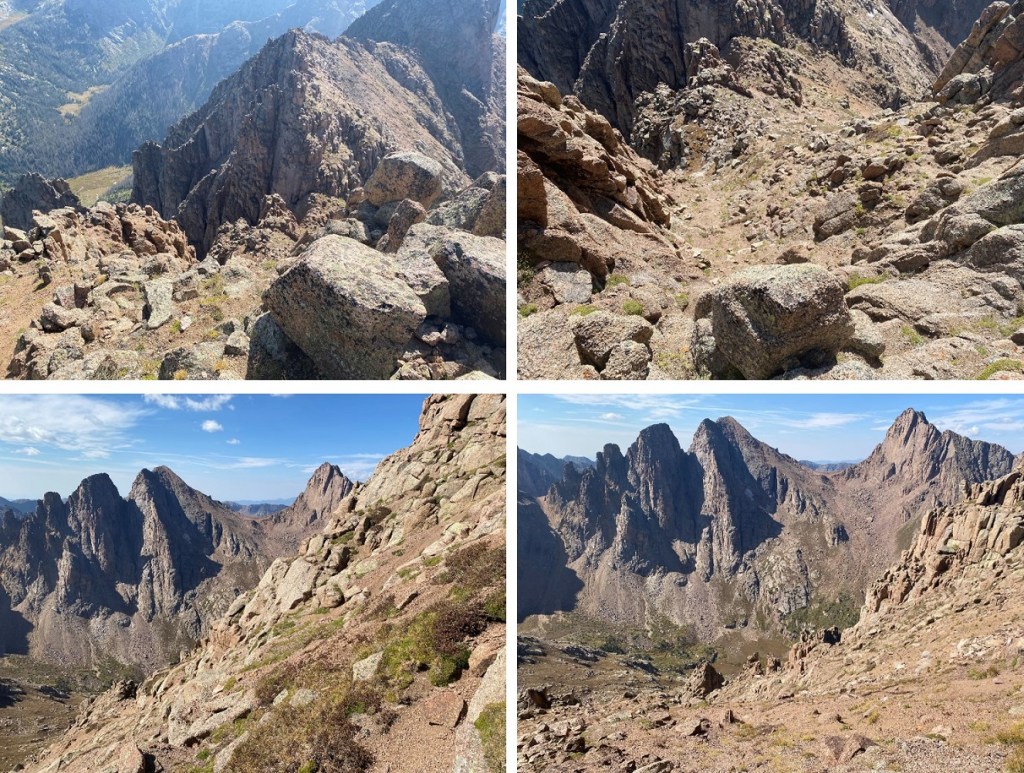
I headed back the way I’d come, back towards the US Grant/V4 saddle
I stayed high here, to avoid the loose choss
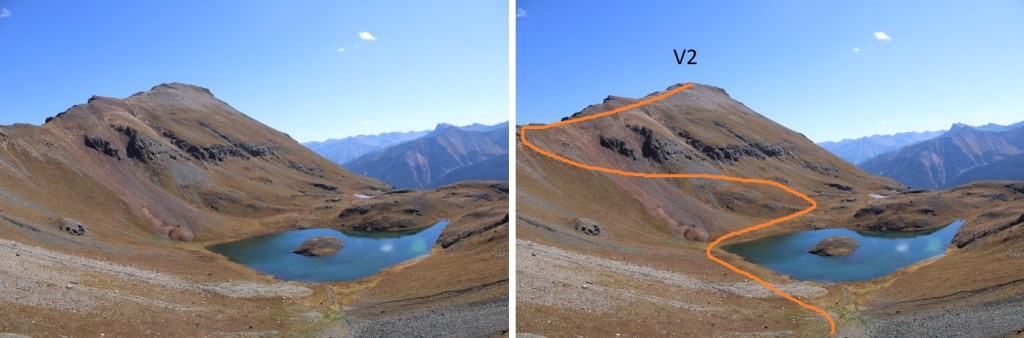
My next objective of the day was V2. Here’s the overall route I took to get there
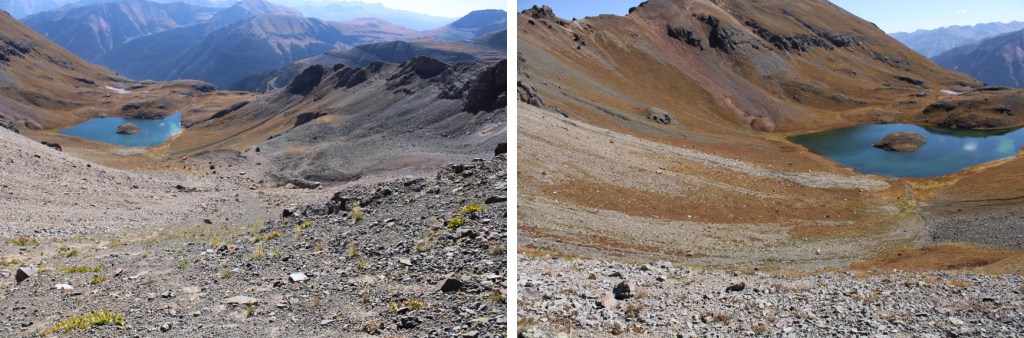
I made my way back down towards Island Lake, this time skirting the lake to the north, picking up the obvious trail on the other side that leads to the US Grand/V2 saddle.
There’s a small fork in the trail about halfway up the hillside, but it doesn’t matter which way you go, as they both merge back together. Microspikes are a good idea here too.
Once at the saddle, I turned right and followed the ridge east, immediately coming across a memorial plaque
There was a trail here, and it was easy to follow.
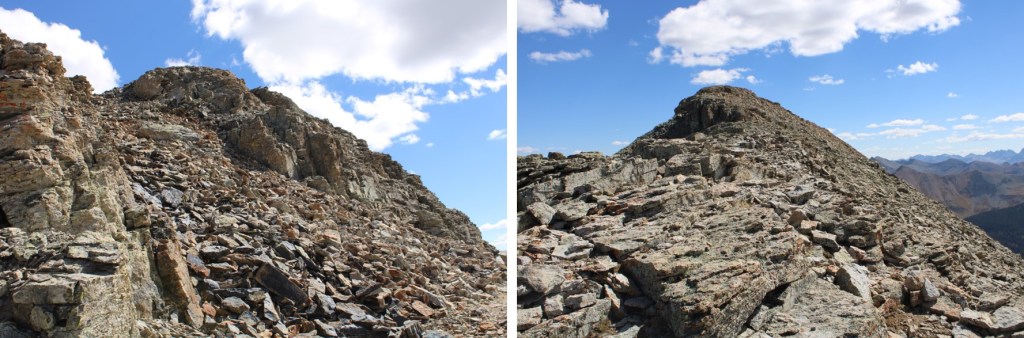
It was a bit rocky near the summit, but there was still a trail to follow. Easy class 2
The summit was long. I walked the entire length to make sure I summited, but I’m pretty sure the actual summit is about 1/3 of the way across. There’s a wind break there.
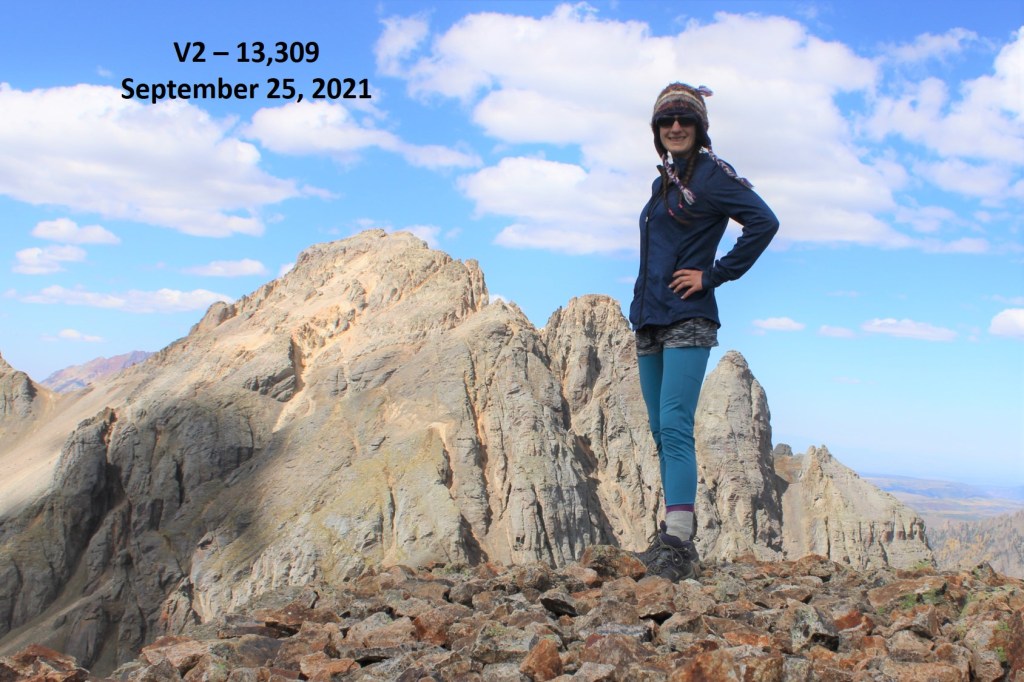
I summited V2 at 12pm
V2:
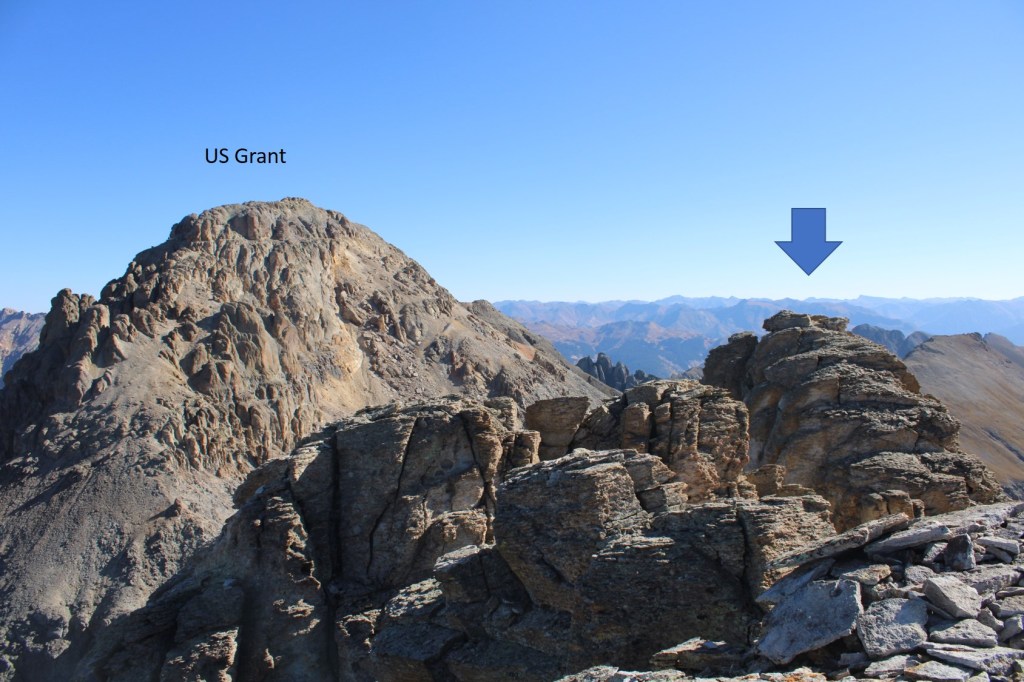
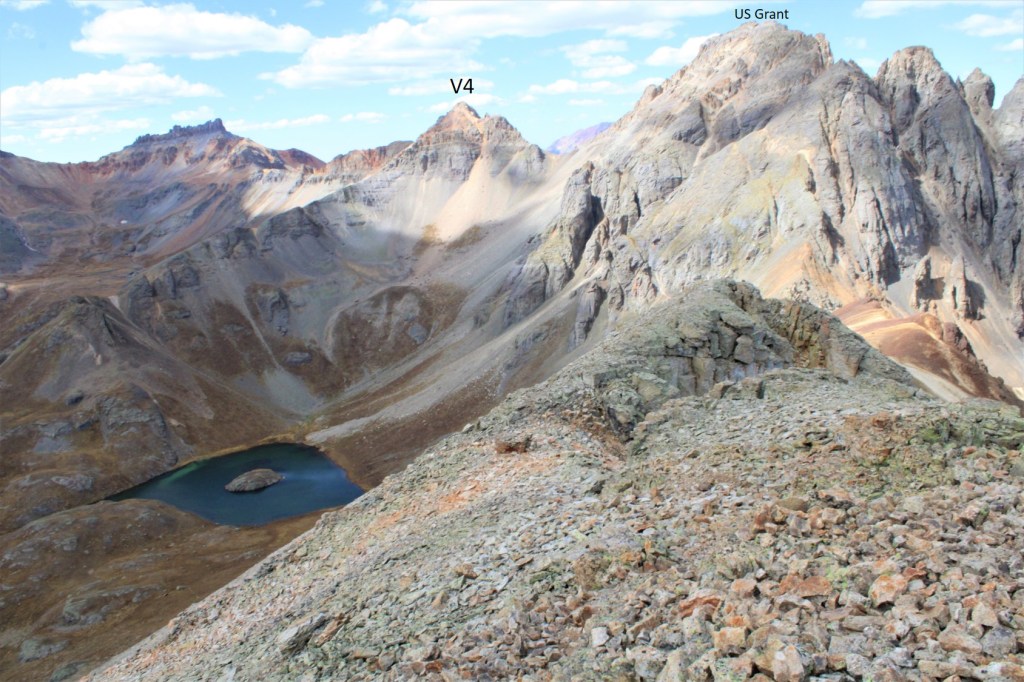
From the summit, here’s looking back at V4
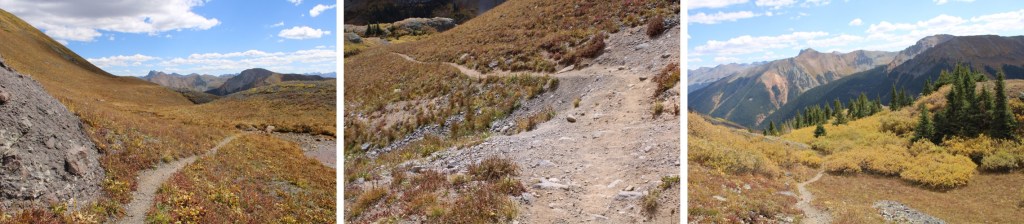
It was getting cold, quick, so I headed back to Island Lake, and followed the trail from the morning back out of the basin
Here you can see the burn area (along the 4WD road)
Here are some pictures from the hike out
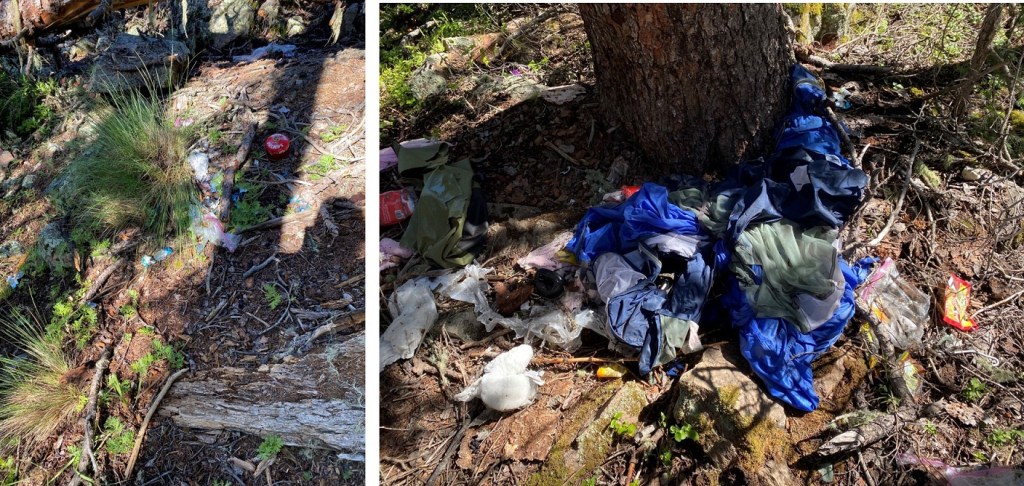
There were so many people on the trail hiking out! And everyone seemed to have a dog. I was discouraged to see trash on the trail: it hasn’t even been open a week and people are already littering. I picked up a few pieces on my way out.
I made it back to my truck at 1:30pm, making this a 12.74 mile hike with 4921’ of elevation gain in 7 hours
I didn’t want Peak Fifteen to be my Bicentennial Finisher. I really didn’t. In fact, last month I attempted Peak Fifteen, but had to turn around due to several factors: There was too much water in the couloir and if the section I was in was really class 4… my skills had gone south. It hurt to hike all the way in from Purgatory and not get a summit, but I knew the conditions weren’t safe. So, I turned around, went back home, and did more research.
This time, I brought my friend and climbing mentor, Tim. My thoughts were to climb this peak with him, get the hang of it, and attempt it solo at a later date. Spoiler alert: After successfully summiting this peak, I do not think I’ll be attempting it solo.
It was a long hike in from Purgatory. We ended up hiking a little slower than anticipated, so we stayed the night at the campsite at Ruby Lake; something I’ve always wanted to do. It was already dark when we arrived, and I’d only brought one set of clothing, so it was a cold night for me as my sweat turned to ice at night inside my bivy. This made for interesting (zombie filled ) nightmares.
The next morning, we were up before sunrise to be willow warriors and thrash our way into Ruby Basin. We made it just as the sun rose.
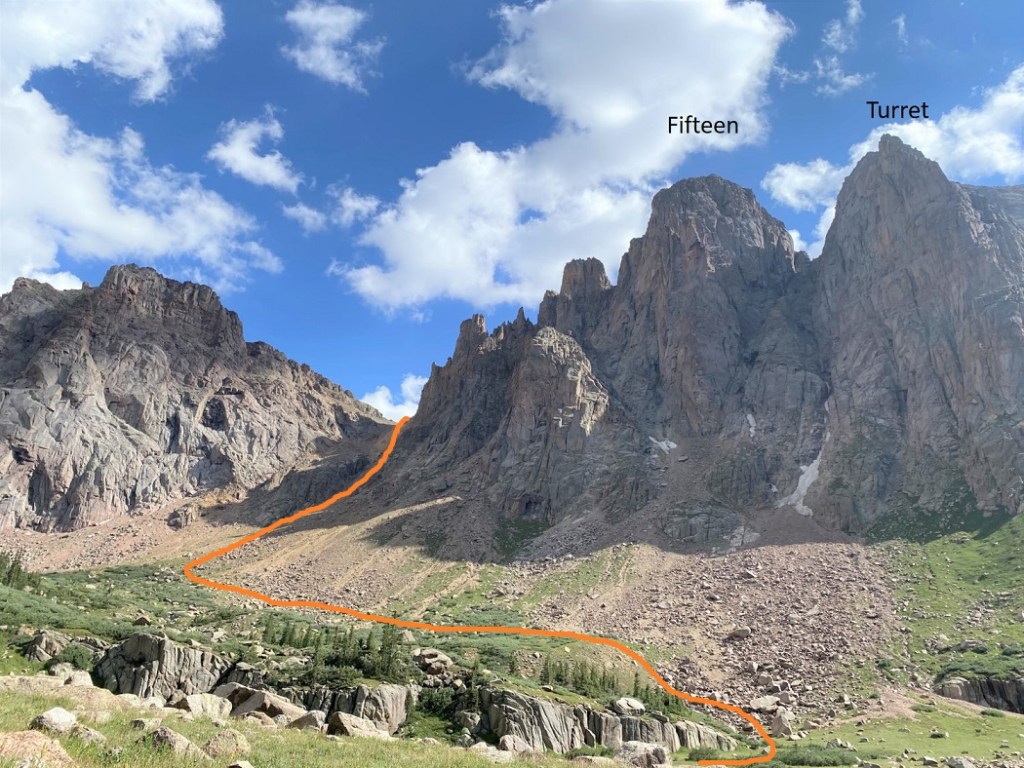
Here’s the route we took up the gully to the saddle. We stayed just above the willows, and hiked southeast across the basin until we were directly below the gully, then ascended the gully.
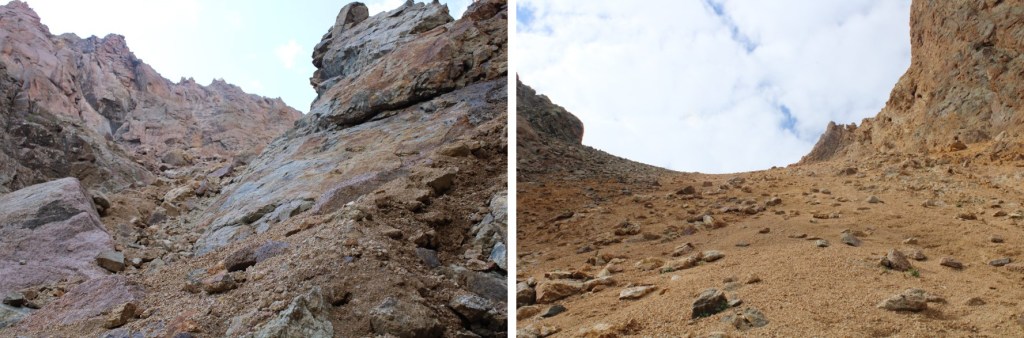
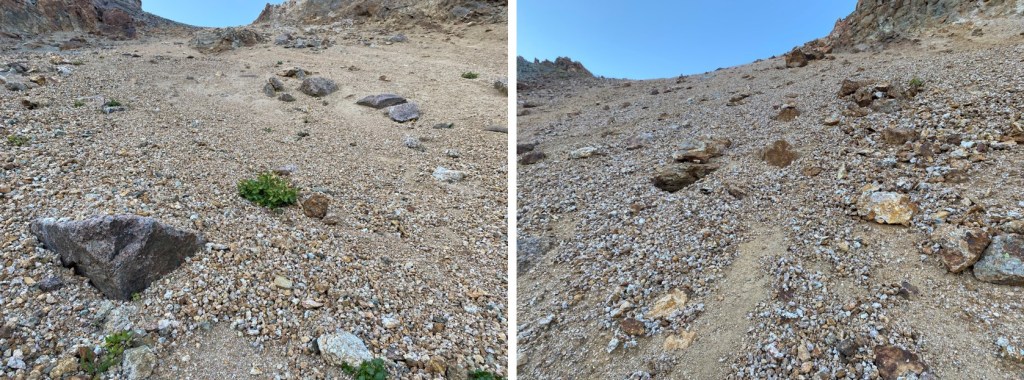
When I was here in August, there was snow under the scree in this gully. Because it was under the scree, I didn’t see it and it caught me by surprise when I unexpectedly sank up to my waist in slush. Back in August, I made it up this gully by going right, but this time we went left. It looks like the conditions change here frequently, so pick the line that goes best for you. Also, microspikes help here with the scree (if you don’t use microspikes on scree you’re making it more difficult than it needs to be: get some spikes for summer too). Here are some pictures of the gully
The second half of the gully is full of large rocks, which eventually give way to scree. This scree is some of the worst scree I’ve experienced. This is where your microspikes really come in handy. Back in August I followed fresh goat tracks to the saddle. Those tracks in September had been used several times and formed nice switchbacks. However, it appears these tracks are destroyed every winter, and need to be remade every summer/fall.
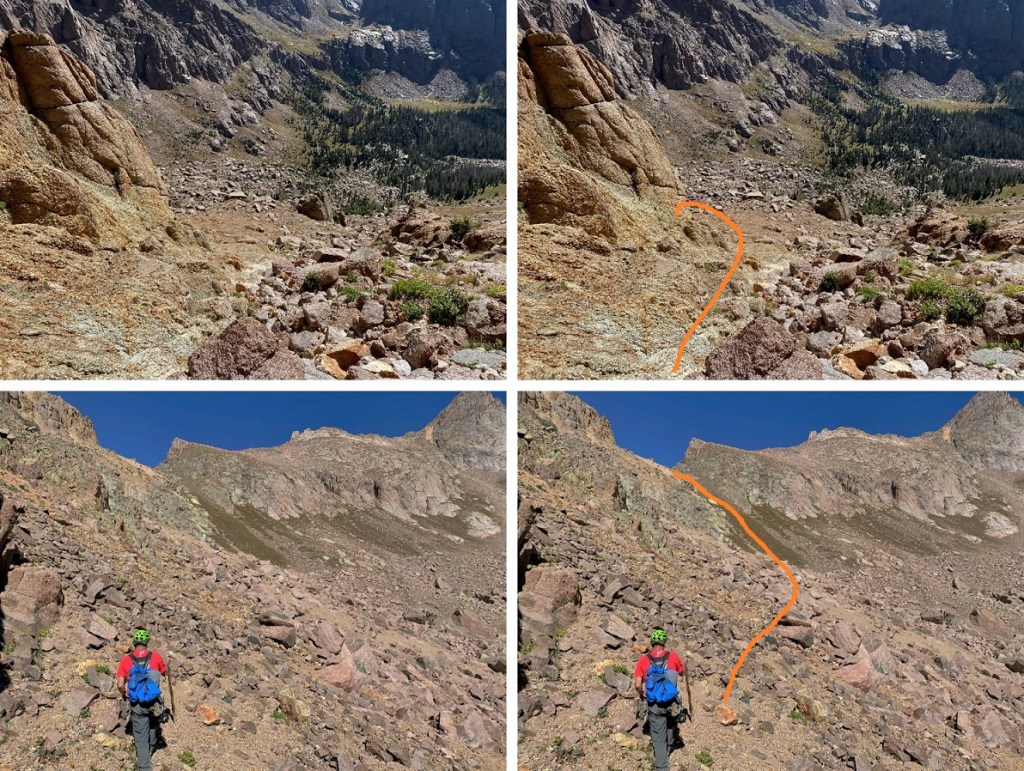
Once at the top of the gully it was time to lose about 350’ of elevation. We did this by following the scree southwest, staying high but just below the rock outcroppings (we took a different approach on the way back).
We continued down to about 12,500’, and then entered the Peak 15/Peak 16 gully
This is the gully you’re looking for. There are cairns here, and it’s the first, obvious route ‘up’
The first part of the gully is class 3, and just requires some rock hopping.
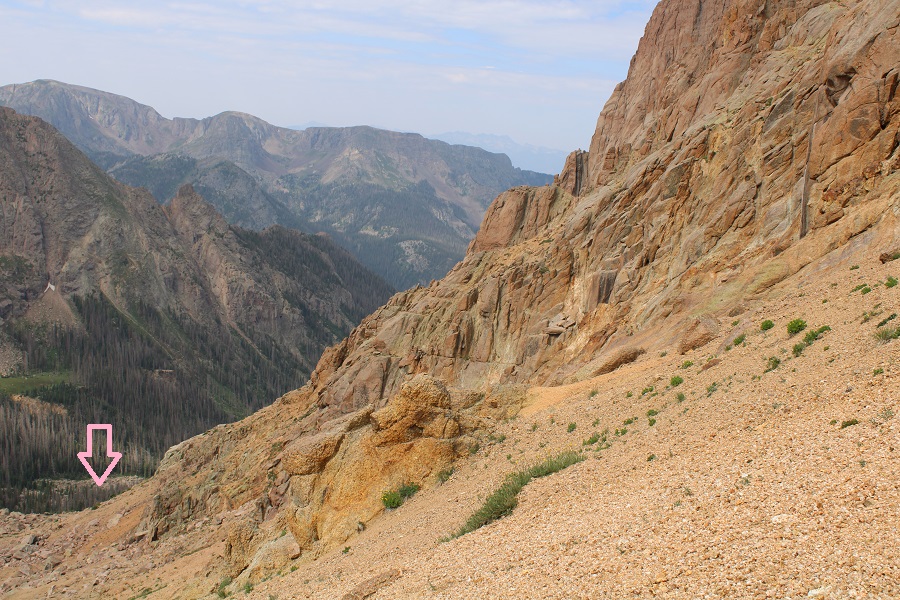
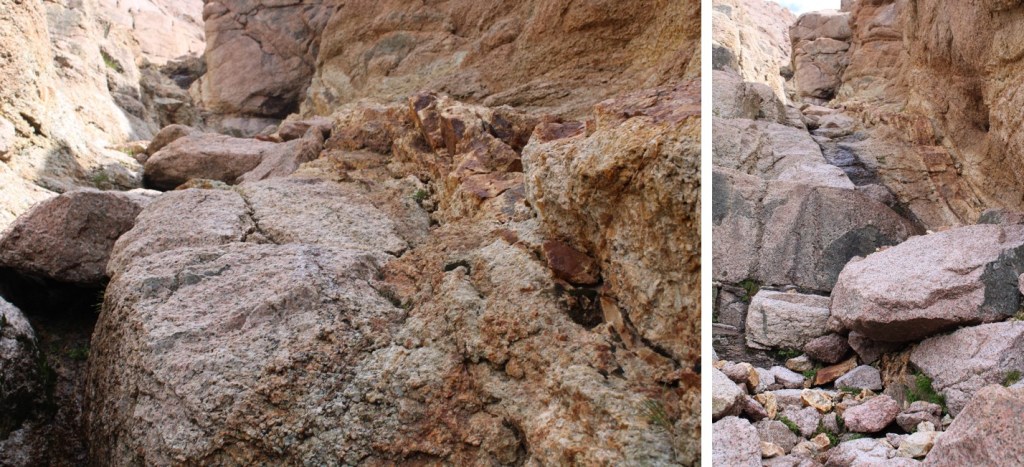
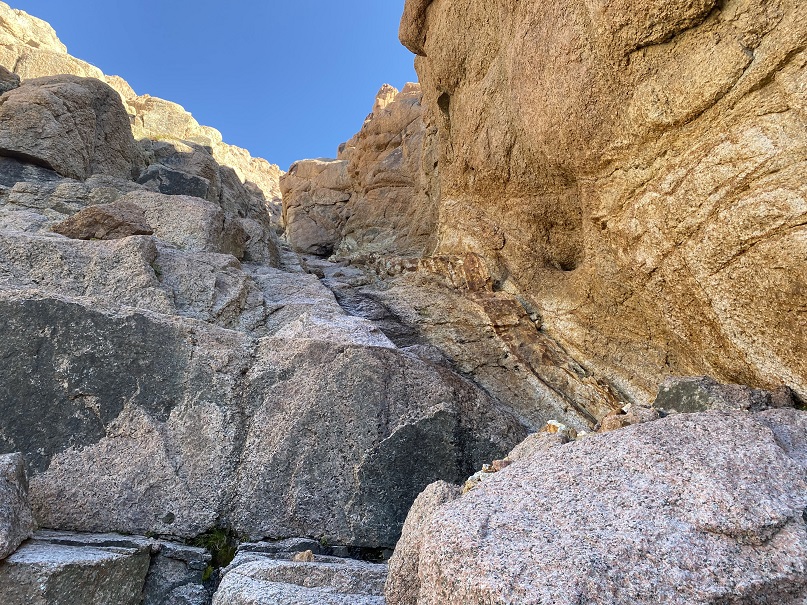
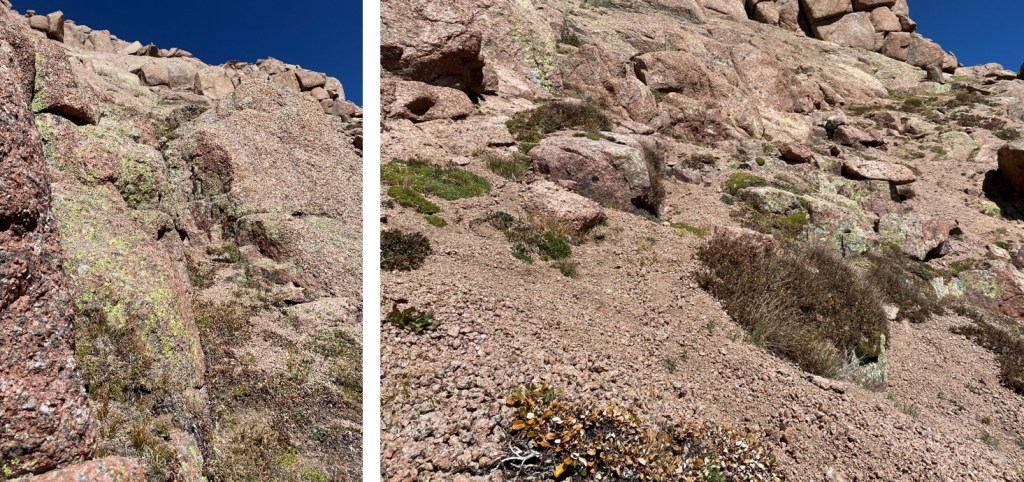
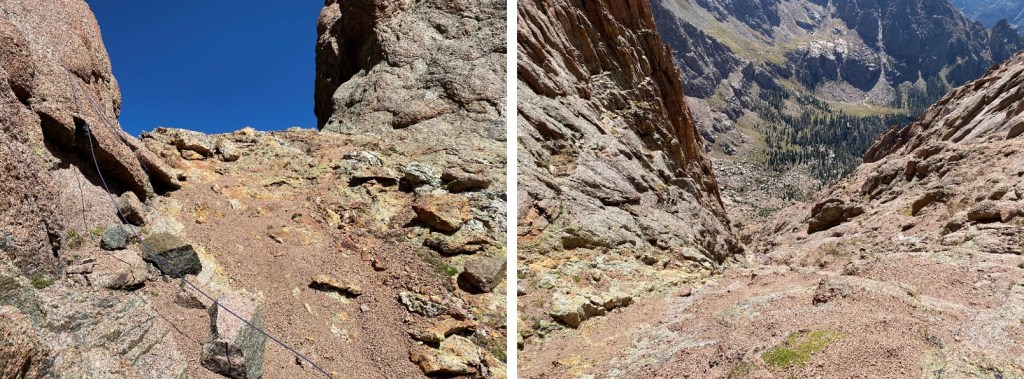
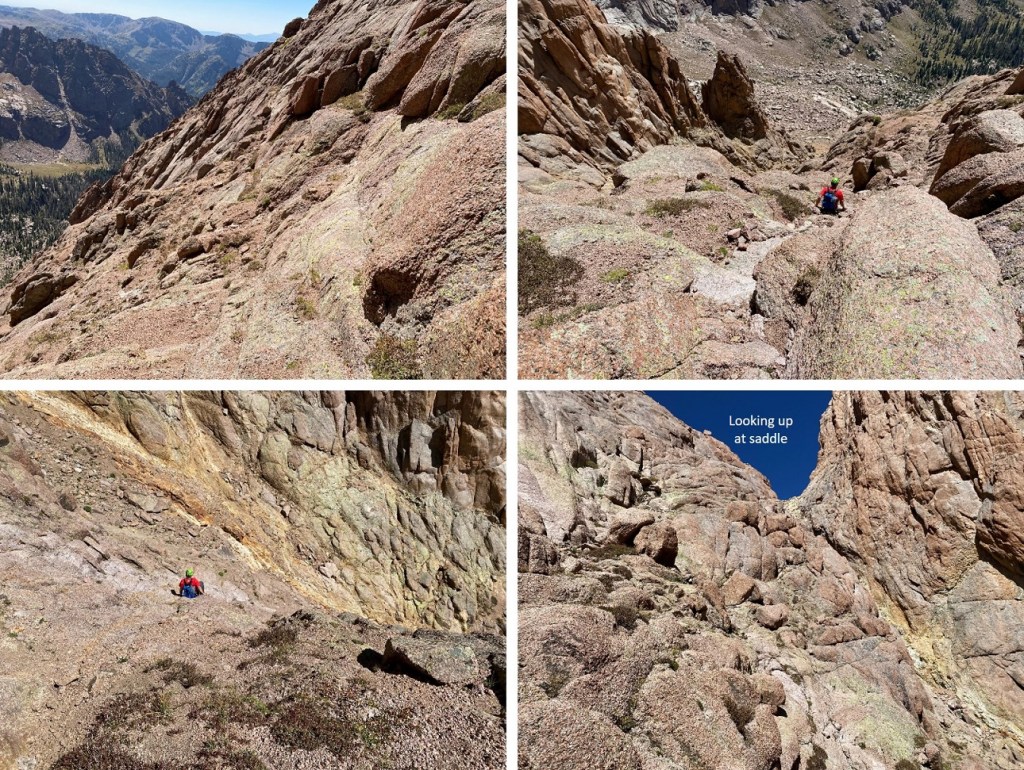
This gully turns into a couloir, and becomes easy to follow, but difficult to climb. This is the first class 4 section. There were no good hand/foot holds, as everything crumbled in my hands. In August it was running with water. Tim spent some time cleaning away the loose rock, making climbing easier. Even in mid-September, there was still water here. Wearing a pack with climbing gear/rope makes the ascent that much more difficult.
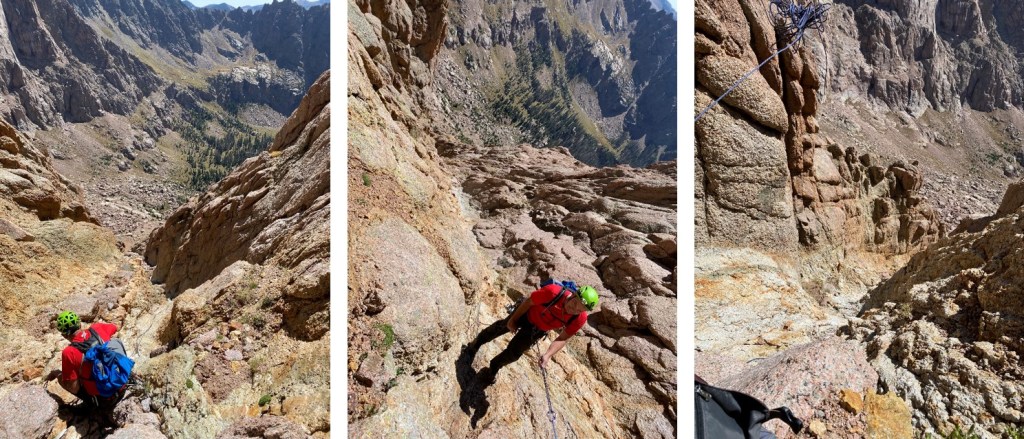
The second class 4 section of the couloir was… more than class 4. I started up, and when I got about halfway through realized I may have been in over my head. I couldn’t climb down, so I had to keep going up. Since I was ‘stuck’ it became a mental exercise, where I told myself “If I can do this while on rope, I can do it off rope as well”, but to be honest it was intense and I didn’t feel comfortable soloing this (but I did). There was a lot of deep breathing involved. I’d recommend roping up here, if you can find a way to do so. Climbing shoes would have been helpful (but they were in my pack…). We both felt this was class 5, not class 4. I belayed my partner on this section from above.
Just above this section there are anchors set up. It’s good to take note of where they’re at as you’re passing them. There will be three sets of anchors in the couloir. Here are some more pictures of the couloir. A lot of the webbing set up looks faded, but there’s plenty there. We cleaned up some of the older webbing and hiked it out (the stuff we didn’t even need to cut because it was frayed and falling apart).
The couloir seemed to last forever. At 13,050’ we exited the couloir, below the 15/16 saddle, and went left up the ledges to 13,300’. This was class 3 scrambling with a lot of kitty litter (kitty litter is the name of the game on this climb). Where applicable, I noted Tim tossed unnecessary obstacles aside, like tumbling rocks and kitty litter, to help clear the route.
When we were about 50’ below the Peak 15/16 saddle it was time to rope up for the slabs. This picture looks at the saddle, but we were headed the opposite way, left/west (this picture is just a good visual of where you’ll be)
We were headed west, across the ledge system.
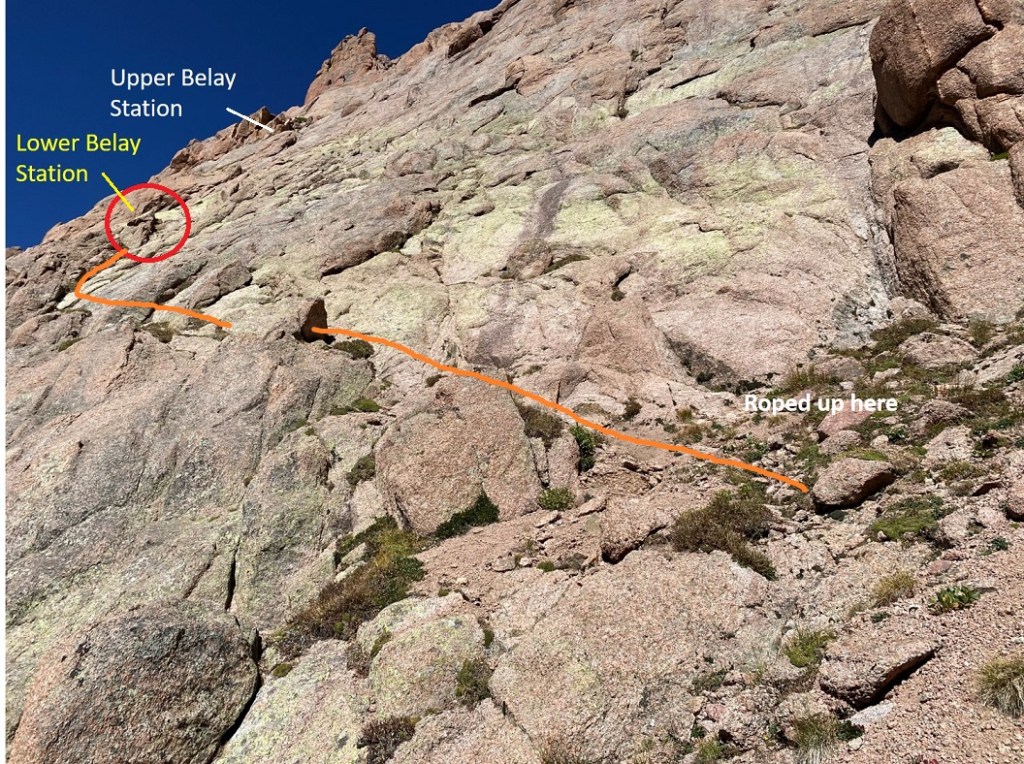
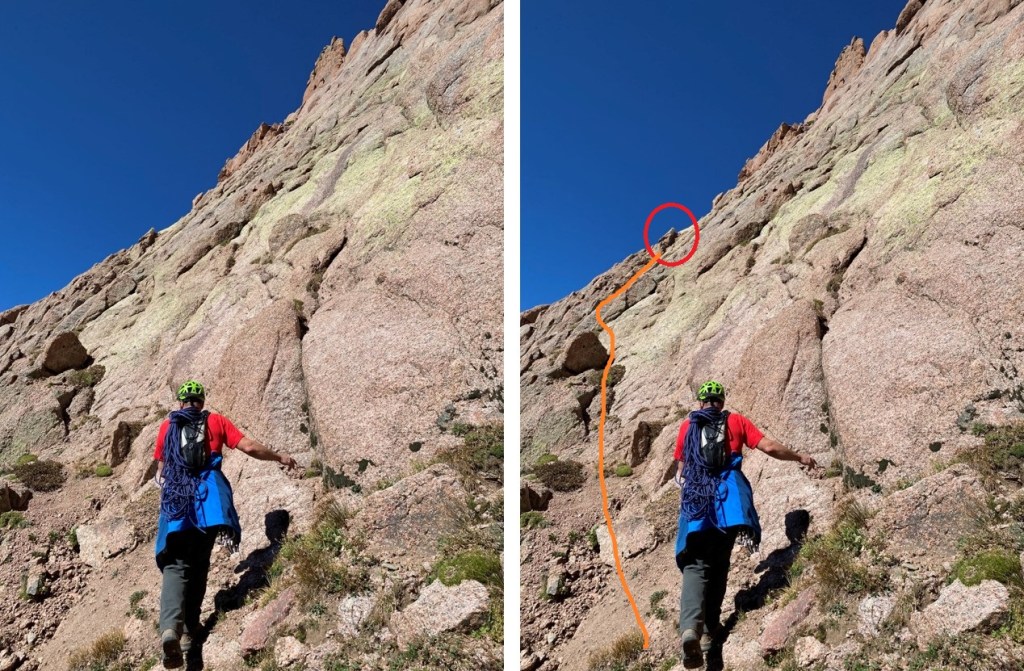
While we were still on level ground, we roped up. Then Tim led the way across the slab. It was good to get roped up first because there wasn’t a lot of room at the rappel area to do so. Here’s an overall view of our roped ascent and the belay stations. I put on my climbing shoes, but Tim didn’t feel his were necessary.
This is what it looked like getting there. We are aiming for the red circle to get to the lower belay station.
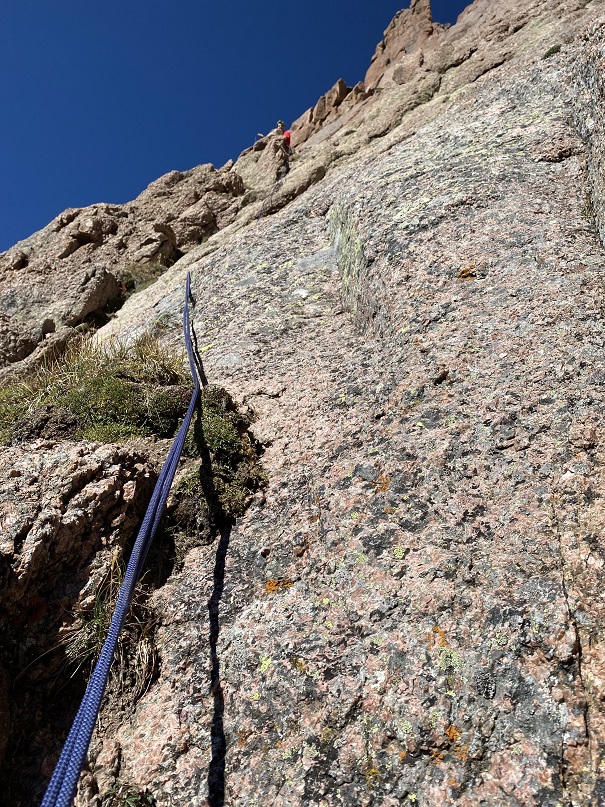
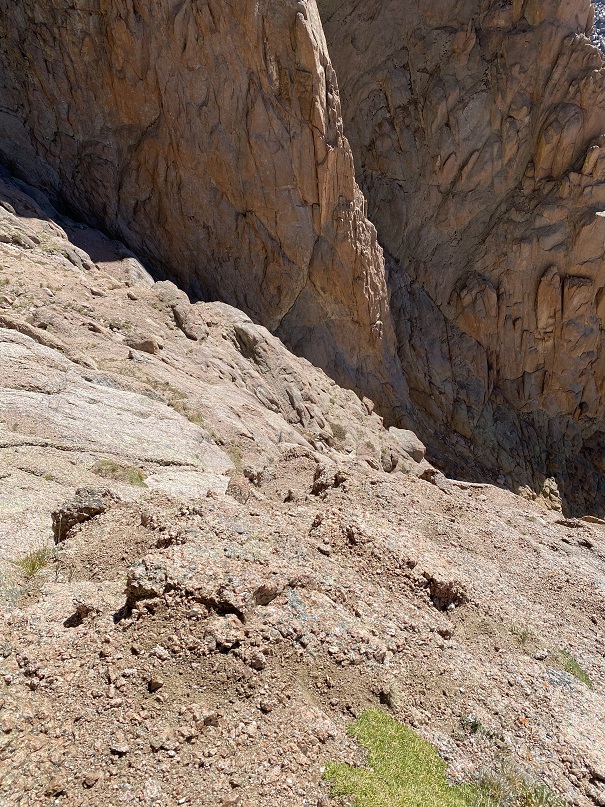
Once at the lower belay station I was set up to belay Tim from below as he set the protection and climbed first. Here’s looking back at the traverse
Oh, there’s some exposure here.
Since Tim’s the more experienced climber (WAY more experienced) I’ll let him describe this part of the route, starting with his overview:
Look for a series of shallow ledges that leads to a three foot wide ledge with a horn big enough to straddle. This is still 4th class terrain, so you can simply belay sitting next to the horn without an anchor.
If you feel you need one, wrap the rope end around the horn three times to make a tensionless hitch or use a cordalette. Bring your second up and have them belay from the three foot wide ledge below you. There will be about three horizontal seams you can place pro in ranging from #3 Camalots to .25. I managed to place five pieces total.
After your last piece you want to head for a shallow V slot next to some bulges. This is the 4th class exit and leads past a rock with a crack in it you could build an anchor in. This is exposed and one could fall from there, and you may be out of gear as I was. Continue then above this to where the steepness of the pitch eases off and there are two scrubby evergreen bushes. You can sling some of the roots for a sketchy, but adequate anchor. Once your second is up, you can both walk to the right towards a large, grassy ledge where the final 3rd class gully is.
I’m not a serious climber: I’ve been climbing for a few years, but I’m no expert. I was glad to be roped in, and wouldn’t have wanted to do this part without someone belaying me (or the other way around). A fall would have been fatal. Tim called it “poorly protected 5.4”. He placed 5 pieces of protection.
From the upper belay station, we turned right and followed the slopes east, looking for an access gully/kind of a small chimney.
The gully is about halfway to the saddle. This is what it looks like from below
From the east side it’s easier to see. This is class 3, with a cairn at the bottom.
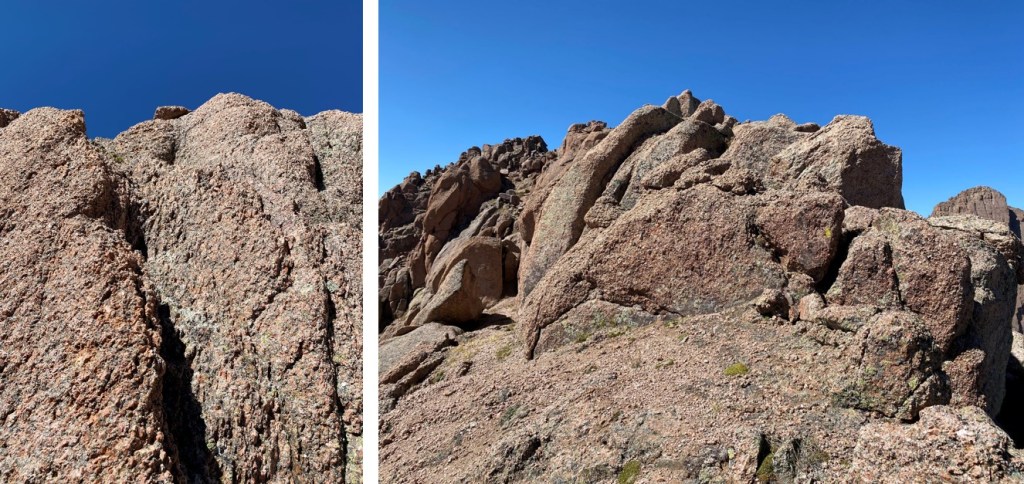
Once up the gully, we followed the ledges northeast to the ridge. This was “choose your own adventure”, but we aimed for the northeast corner of the ridge
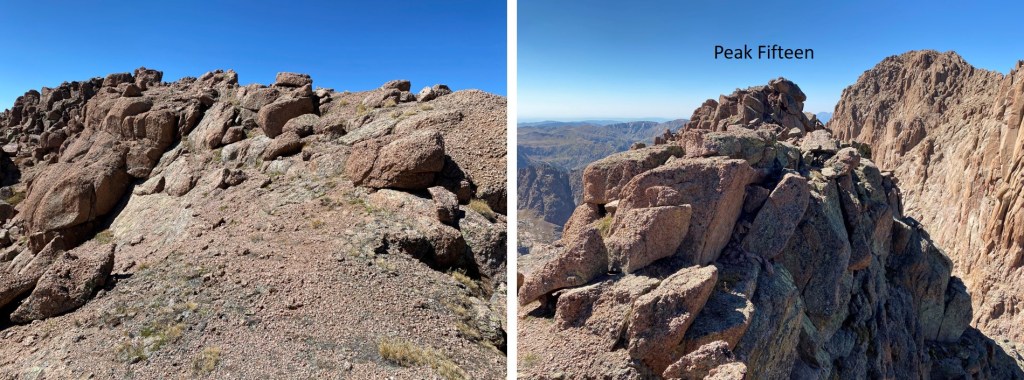
Once the furthest northeast we could go, we ascended the ridge via a short, easy class 3 ramp, and scrambled west to the summit
Final, class 2 scramble to the summit (easier than it looks)
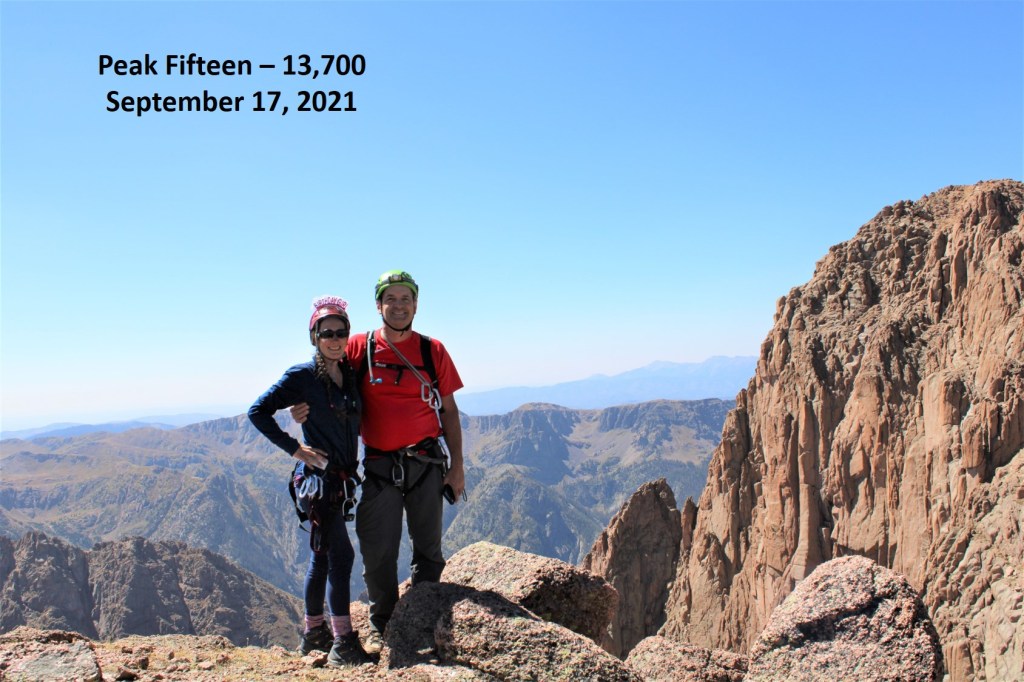
We summited Peak Fifteen at 12.30pm. Also, yes, it was my birthday, so I was celebrating not only my bicentennial finisher, bust also turning 41. Woot!
Peak Fifteen:
We stayed at the summit for quite a while, enjoying the beautiful day and awesome views. The summit register was a tube, so naturally the paper inside was wet. I added a pencil to the register, signed my WW’s, and we headed back down.
Note: we rappelled 6 times before making it to the bottom of the couloir. That’s a lot of rope work! There were adequate webbing/rings set up, which held just fine but are bleaching and might need to be replaced next season (see pictures). We cleaned up some of the ripped/damaged rope and brought it out. We brought a 60 meter, 7.9mm rope. It worked perfectly for the ascent and rappelling down, but being smaller in diameter, tended to get stuck in the cracks. Also, this is where I learned Tim curses when ropes get stuck.
We followed the ridge east back to the ledges, which we followed southwest.
At 13570’ we headed back towards the saddle and the anchors. We rappelled down from the first anchor, and afterwards headed towards the second anchor, circled in red.
The second rappel
Here’s looking up from the bottom of the second rappel
The third rappel brought us to the Peak 15/16 saddle
Here’s looking up and down from the saddle
Once at the saddle, we went southwest on slopes, following the couloir to the right
We made our way back to the couloir, and rapped 3 more times to the bottom. We counted 6 rappels in all.
From the base of the couloir, we made our way back to the scree-saddle, this time taking the direct, grassy/tundra approach, to avoid the scree. We saw mountain goats here.
And then back down the scree filed gully, scree surfing to the basin
From the basin we hiked back through the willows to our campsite at Ruby Lake, making it back around 6pm. Round trip from Ruby Lake to the summit of Peak 15 and back to Ruby Lake made for about a 13 hour day. All that rope work sure took its time! We celebrated with some whiskey and wine; after all, this was my bicentennial finisher, and it was my birthday… no one got hurt, and, this was much harder than anticipated by both of us for different reasons and we were successful. All reasons to celebrate!
We made it an early night and were up at 6am to hike back to Purgatory. The night was much warmer, if only because I didn’t go to sleep in wet, sweat filled clothing. The hike out went fast, as we talked much of the time. We made it to the Animas River/Purgatory trail bridge, and were surprised to see people in sandals carrying small children (some of them crying). Apparently, the train stops at Cascade Wye now for passengers to get off and walk around (not sure if it’s ever done that before?).
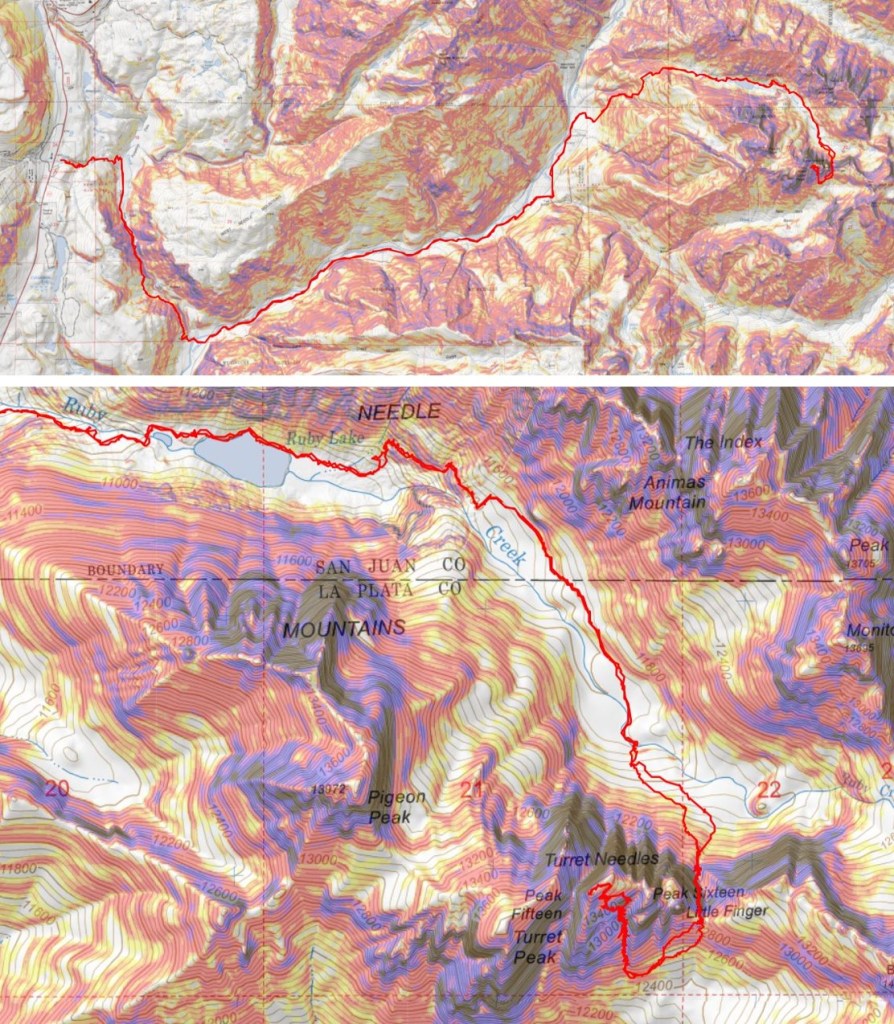
We made it back to Purgatory Trailhead around 2:30pm. My tracker says we went 53.34 miles, with 13765’ of elevation gain.
I would like to thank Tim for being my climbing partner and accompanying me on this trek, which I’m sure ended up being more of an adventure than he bargained for! I believe this climb takes two experienced climbers to complete safely; It was nice to have someone I could trust join me. In addition, he’s been my climbing mentor, voluntarily taking me climbing and ‘teaching me the ropes’ for years. He’s the one who taught me how to set up anchors, how to climb and rappel safely, and all about proper gear. I couldn’t have done all the other class 5 bicentennial peaks without his instructions. I still keep his safety checklist with me in my climbing gear.
I also want to thank everyone who has posted trip reports in general, but specifically trip reports for Peak Fifteen, as for me it was the hardest of the bicentennials. We all experience hikes/climbs differently, and it was nice hearing the difficulty/route finding levels from other climbers. If you plan to climb this peak, please take it seriously, and read all trip reports you can find on this peak before attempting a climb, as they all offer great insights.
I’m not a fan of the Rockdale Trailhead. It’s an adventure in itself, starting with a drive through Clear Creek
And then the road to get to the trailhead is littered with dips and rocks. I feel I’m a pretty good driver on 4WD roads, but I have a hard time avoiding some of the obstacles on this one. If you drive to the upper trailhead be sure of your driving skills/vehicle.
I made it to the trailhead and was on the trail at 5:30am. The trail is class 1, and starts out by heading south along trail 1461.
After hiking for less than half a mile I came to the avalanche area. Last time I was here was recently after the avalanche, and it was difficult to navigate. They did a lot of work in this area, and now you can drive a car through it (if vehicles were allowed, that is). I passed around the gate, and continued along the trail.
Just before making it to Clohsey Lake there’s a junction in the road and it becomes a trail. You can take this, or continue taking the road to the lake and pick up the trail on the other side. I chose to take the trail up and over the small mountain
I followed this trail south for 3 miles from where I parked, through pine trees, willows, across streams, and eventually to treeline.
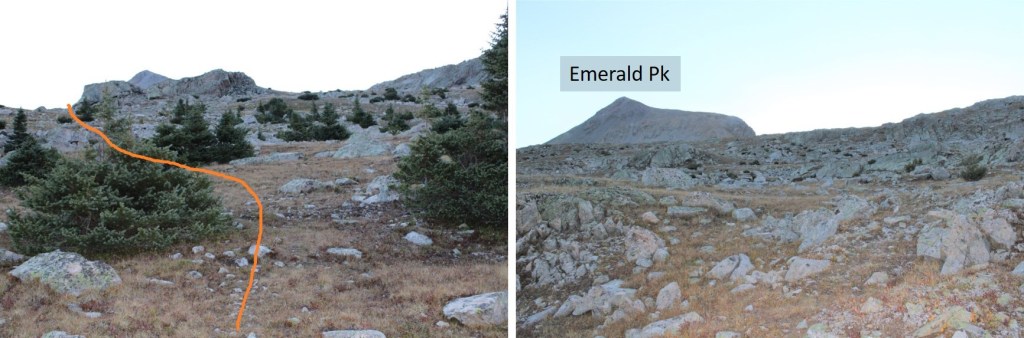
After about 3 miles the trail kind of disappeared/fizzled out. Last time I was here I found cairns to take me to the ridge, but this time I didn’t see any. No worries though, I just kept rounding the hillside, heading northeast towards the ridge. You’ll want to just head towards the ridge, but easier terrain is to your left (northeast).
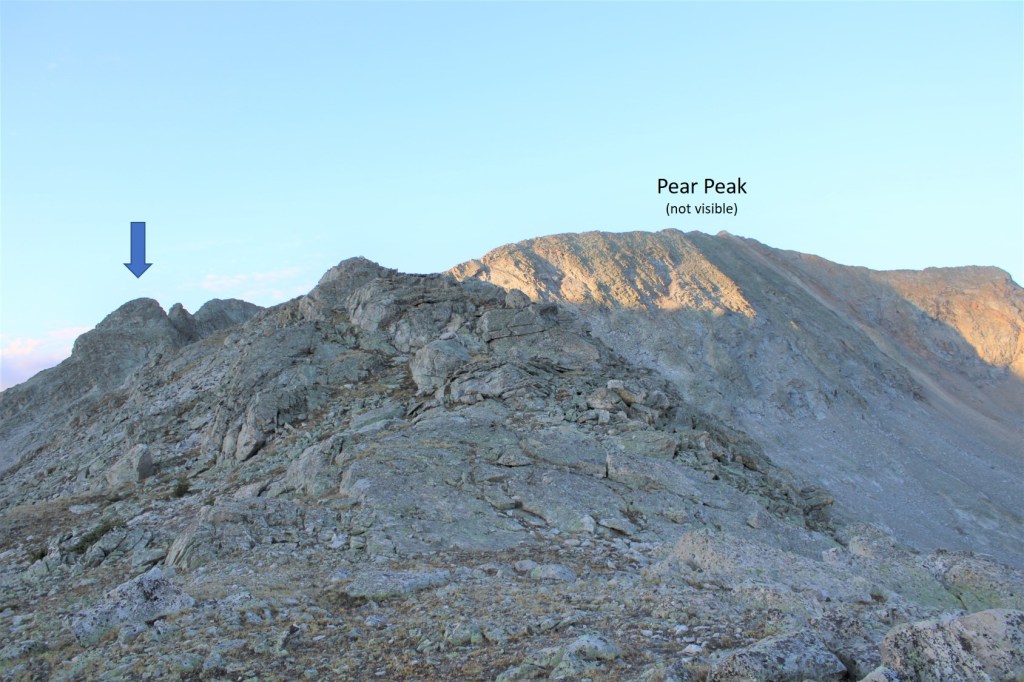
It was 3.75 miles to the ridge. Once on the ridge I turned right and followed the ridge south. I could mainly stay on the top of the ridge, dipping to the left a few times when necessary. I was headed towards the black arrow.
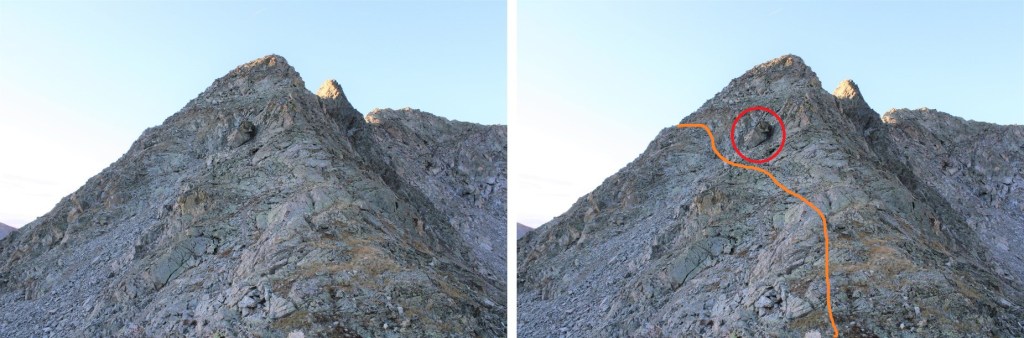
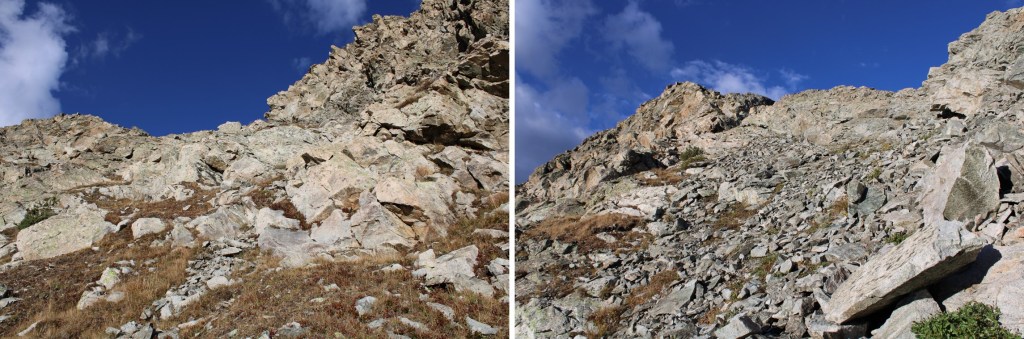
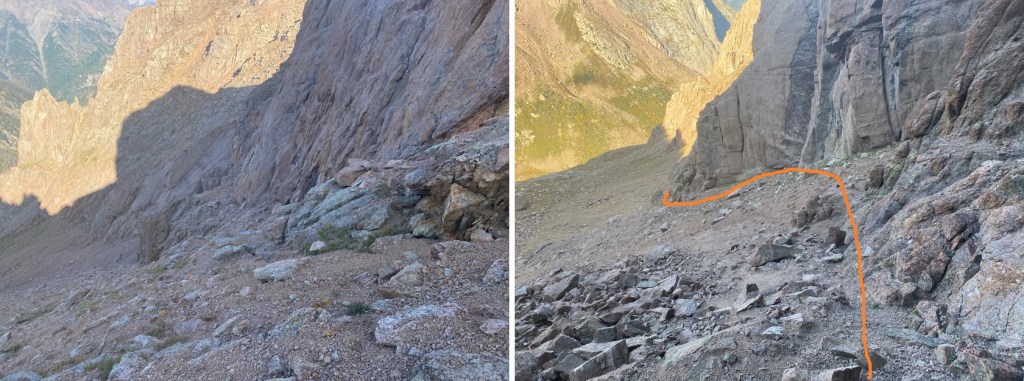
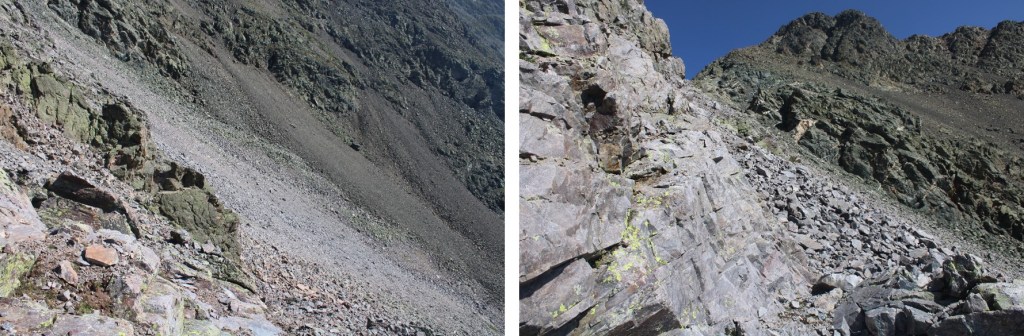
To continue to follow the ridge I had to make it around this point. I aimed for just below the large boulder, then went left, following dirt and scree and hugging the mountainside.
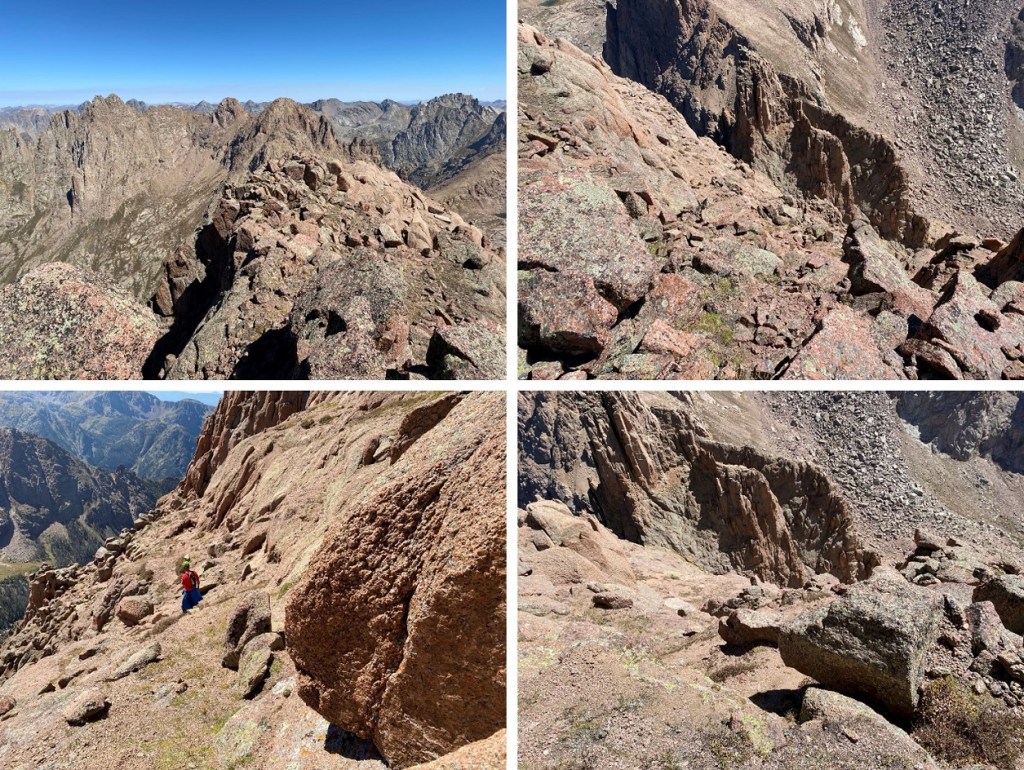
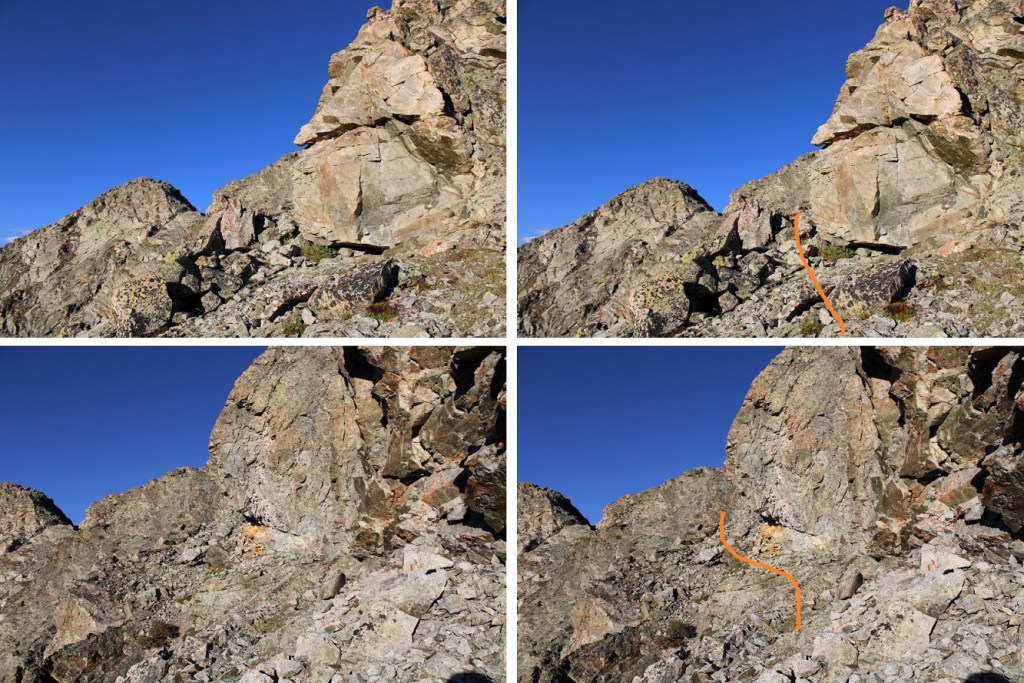
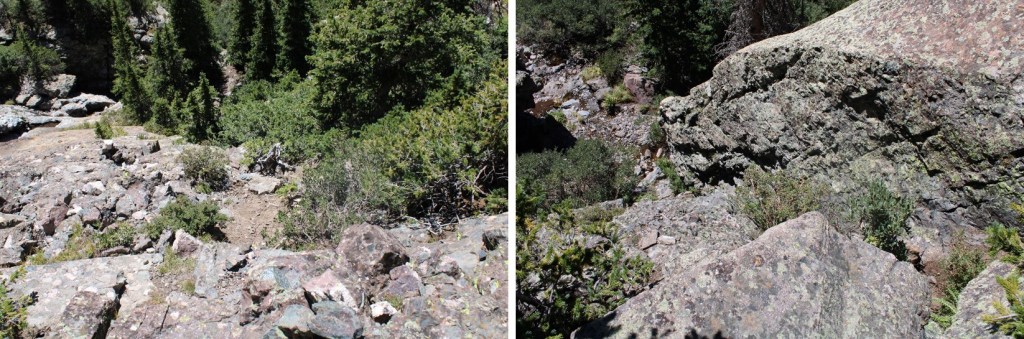
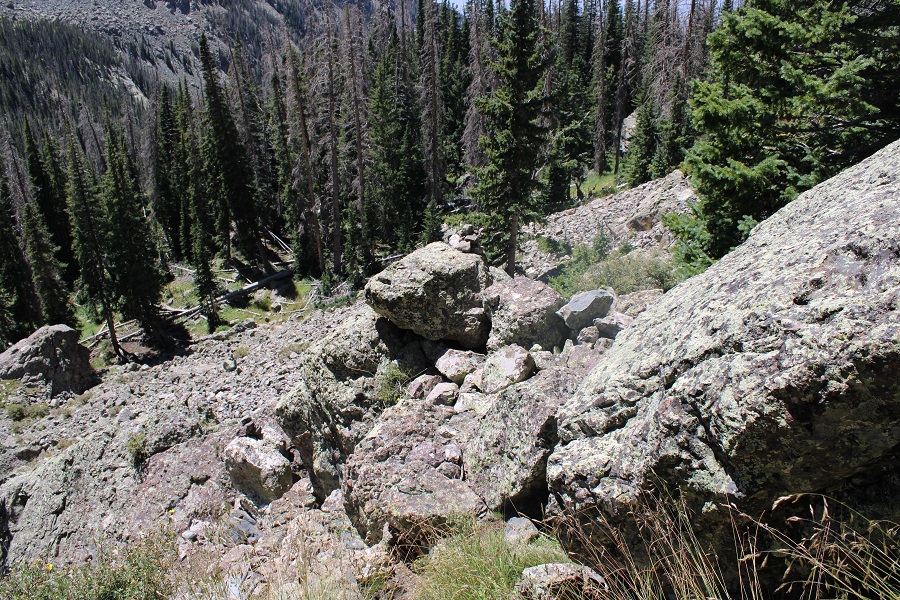
This part was easy, but as I rounded the corner, I came upon gullies full of choss. This area felt class 4. To navigate these, I hugged the gullies, dipping down to cross the first big one, and then remaining level before eventually finding what looked like a game trail to the ridge.
Here’s the view and my route from the first big gully. I stayed level to get across the chossy gullies. It’s harder/steeper than it looks.
Safely across the first gully, here’s looking back at the route I took down
Now I continued at level elevation heading south, until I found an obvious route to the ridge. Until this time the ridge had been rock slabs, spires, and choss, but once it became rocks and tundra I headed up, then turned left to follow the ridge.
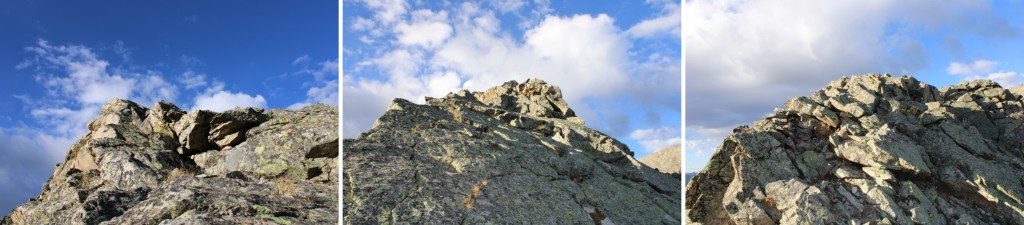
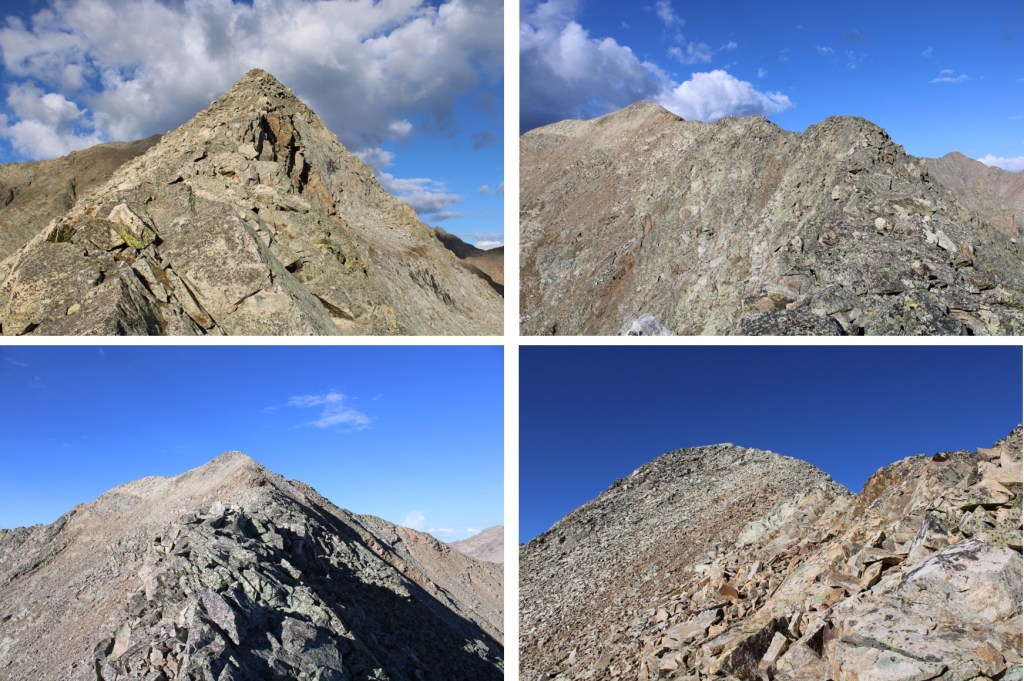
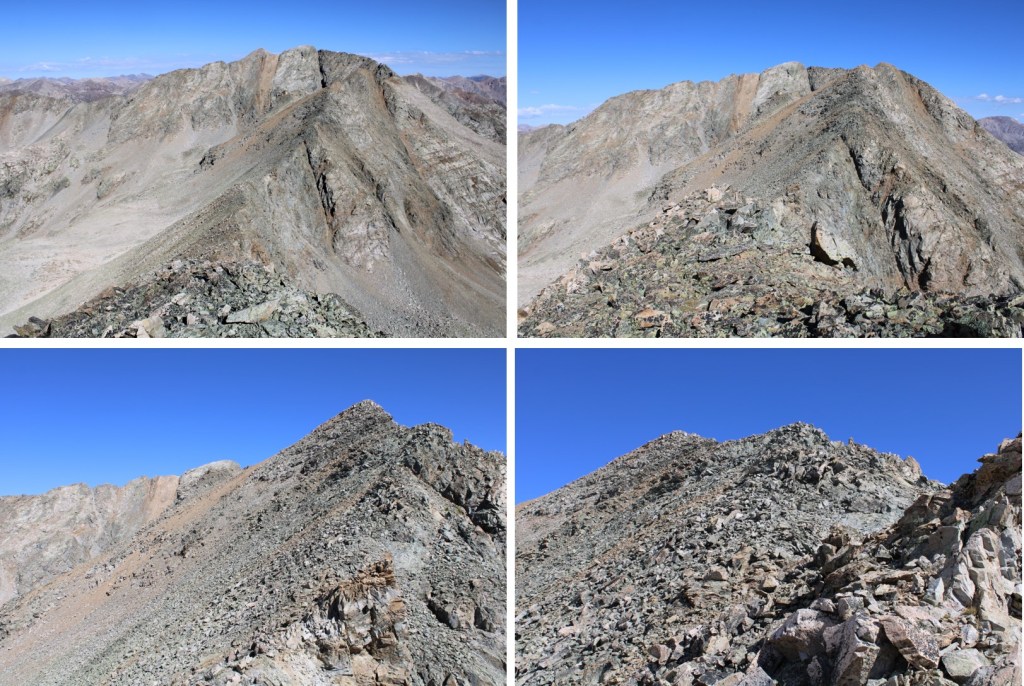
From this point on, the ridge ‘goes’. It’s mostly on large, solid rock, but remember, these rocks can move. It’s about three quarters of a mile from here to the summit of Pear Peak. The ridge felt consistent class 2-3. I didn’t feel there were any class 4 moves on this ridge.
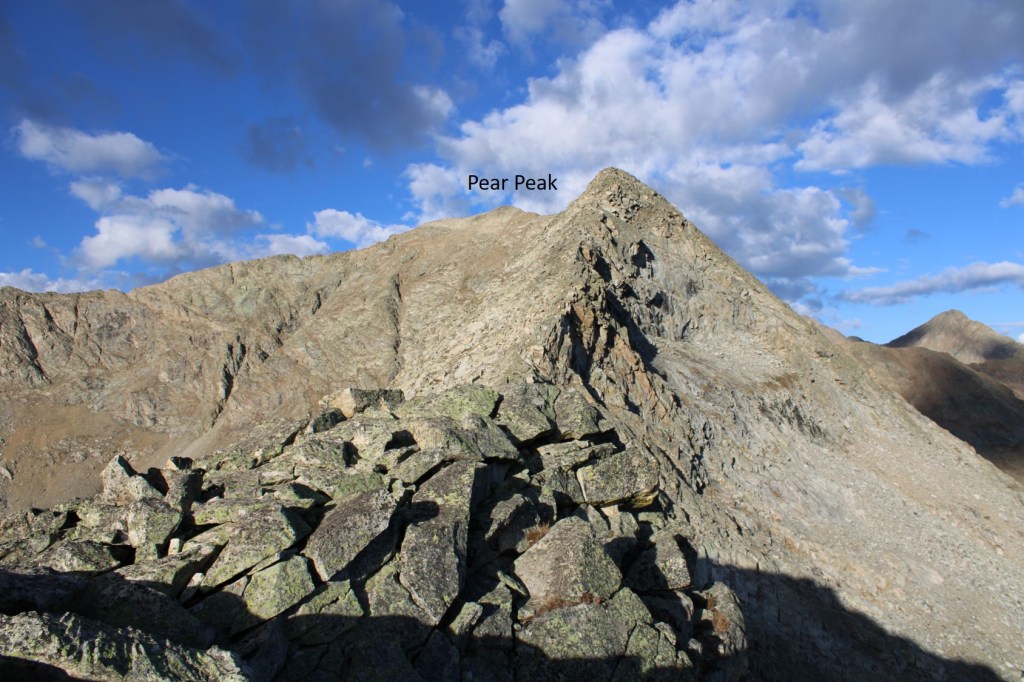
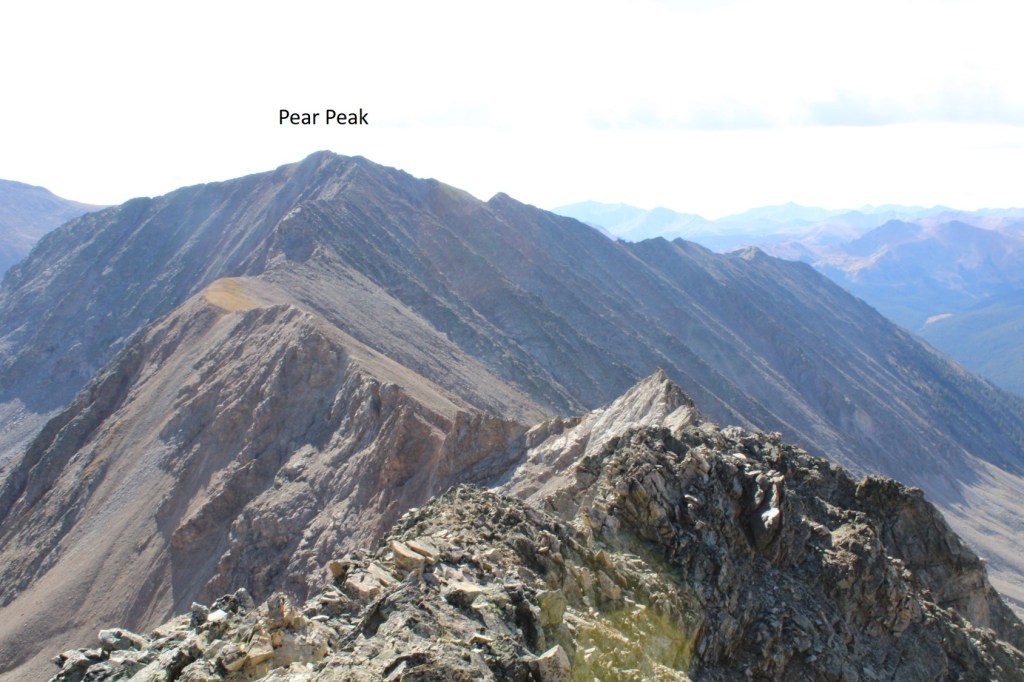
If I ever felt the need to dip off the ridge, I went left. Pear Peak is actually to the left, past the false summit (which isn’t really a false summit because you can see the true summit most of the time)
Here are some more ridge pictures
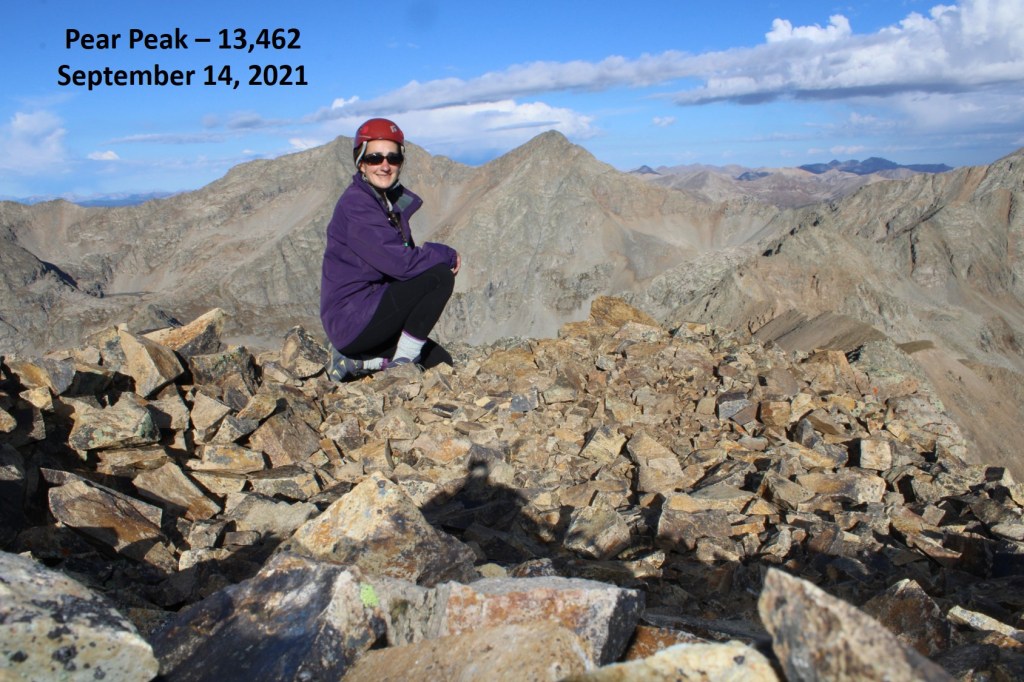
I summited Pear Peak at 8:45am
Pear Peak:
Now the easy part, as I turned northwest and descended the ridge to the Pear Peak/PT 13220 saddle. This was class 2, once again sticking to the ridge and dipping to the left when necessary.
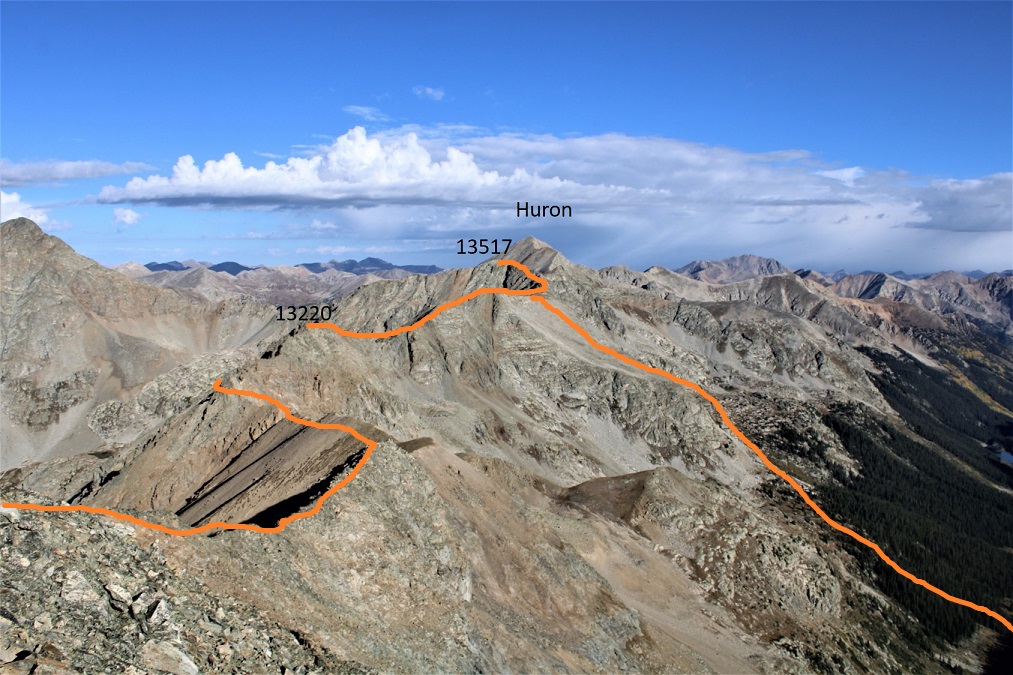
Here’s an overview of the rest of my route, mostly following the ridge, except for a short area on the way to 13220 where I stayed left (more on this later). You also have a good view of the decent route from here. Now’s a good time to study it.
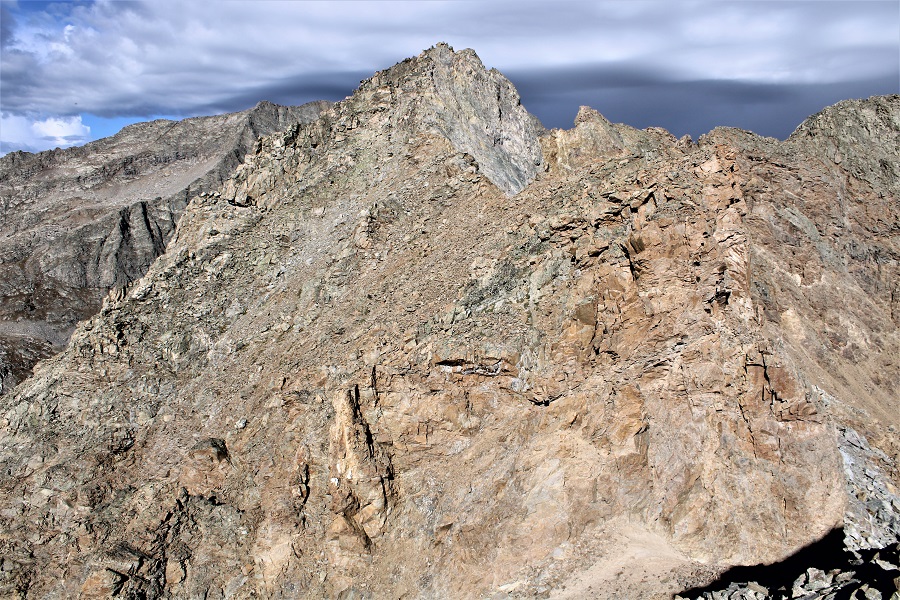
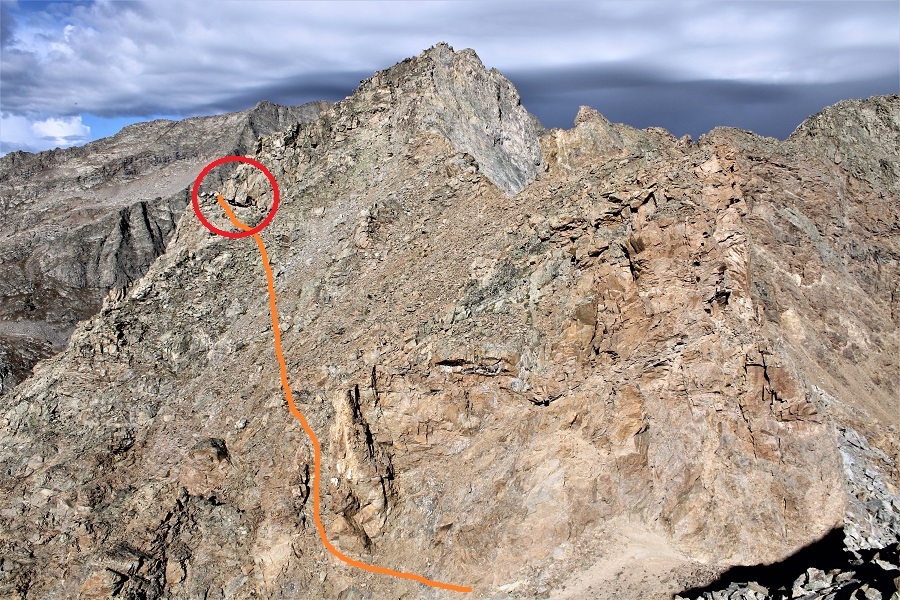
Ok, down the ridge to the Pear Peak/PT 13220 saddle. It’s all class 2, and you’re aiming for a scree filled gully, circled in red
Once you make it to the gully, the choss and adventure begins.
I dipped down into the gully, crossed it, and then stayed level in elevation as I rounded the south side of the peak, aiming for two protruding rocks.
Once I started heading north, I followed game trails up gullies and back to the ridge. This area seemed to go on forever.
Once on the ridge it was class 3 to the summit
I summited PT 13220 at 10am
PT 13220:
Here’s looking back at the route from Pear to PT 13220. It was 1.5 miles from Pear to 13220.
Next up, PT 13517 (more ridge work!)
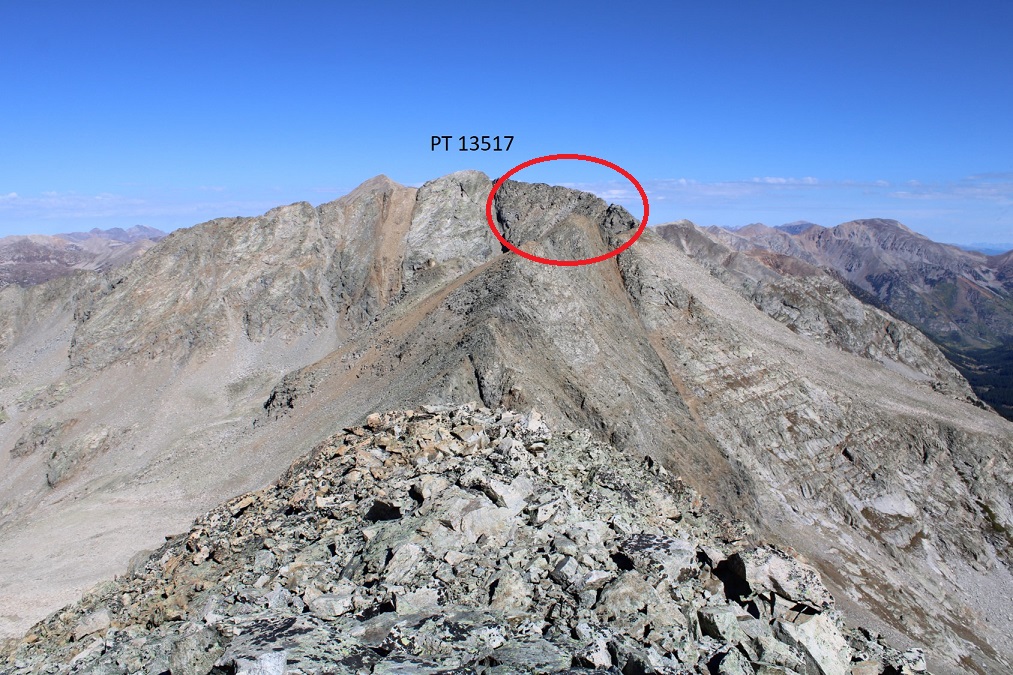
I followed the ridge the entire time. The ridge to the saddle was class 2. The difficult part is the ridge circled in red, which I felt was consistent class 3, with a bunch of class 4 moves thrown in.
The trek to the saddle was mostly on rocks, with a short ridge at the end (yes, you can stick to this ridge too)
I entered the final ridge by going around to the east, then ascending the ridge by heading northeast.
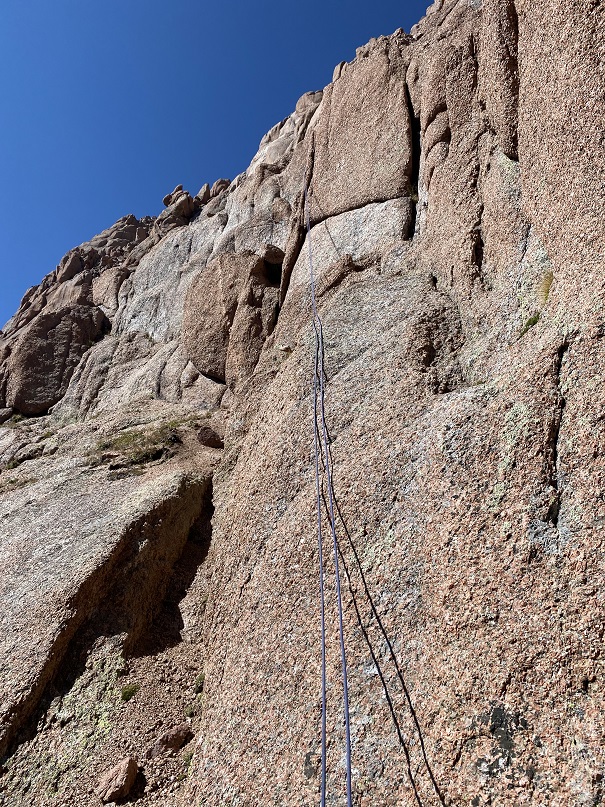
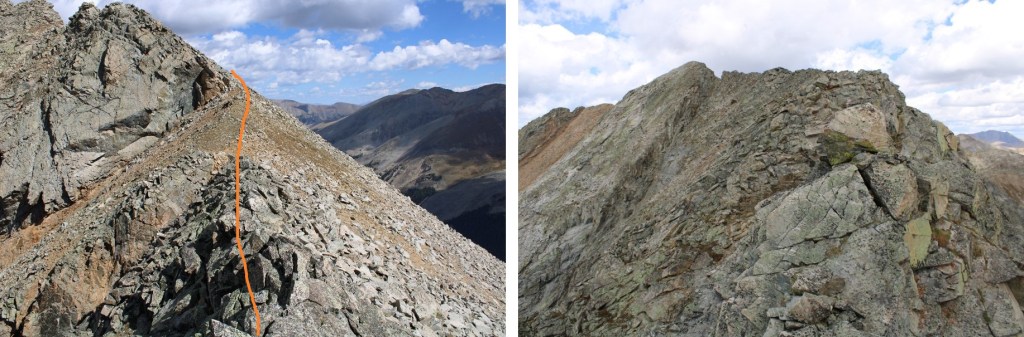
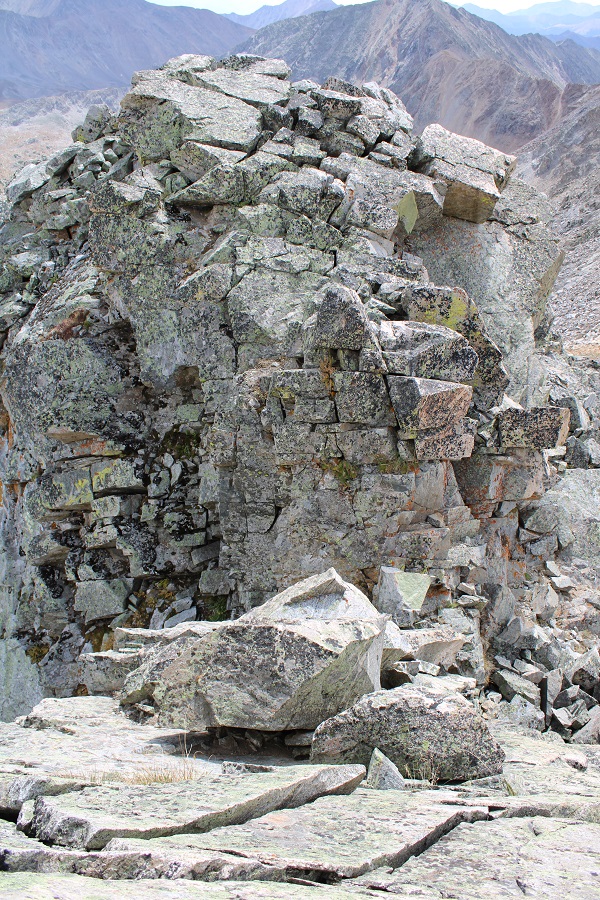
As I said before, this is a class 3 and 4 ridge. There are too many specific moves to illustrate here, as the climbing is consistent, so I’ll just show a few of the fun ones. While the rock looks solid, and mostly is, please be careful of the ones that look solid but roll. If you can’t go straight up the rocks, look for game trails to the left. Nothing should feel over class 4. To put it in perspective, I consider difficult class 4 anytime I need to remove my DSLR camera from around my neck, or put my trekking pole away to climb. I didn’t have to do either of those things on this ridge, but it was the most difficult climbing of the day.
The last little dip before the final push to the summit was class 2
I summited PT 13517 at 11:15am
PT 13517:
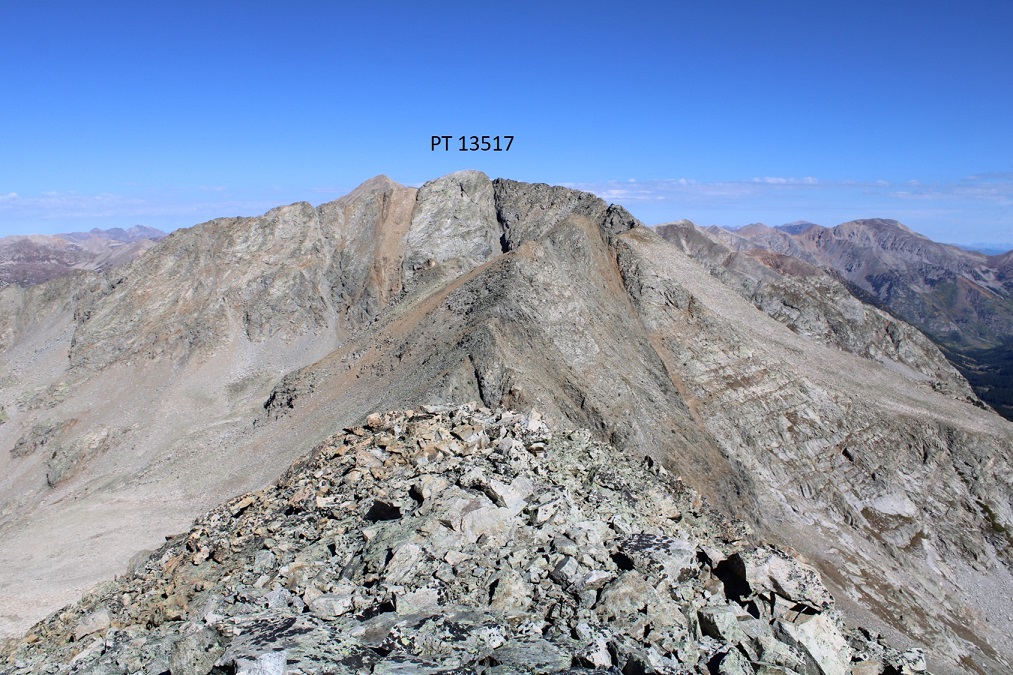
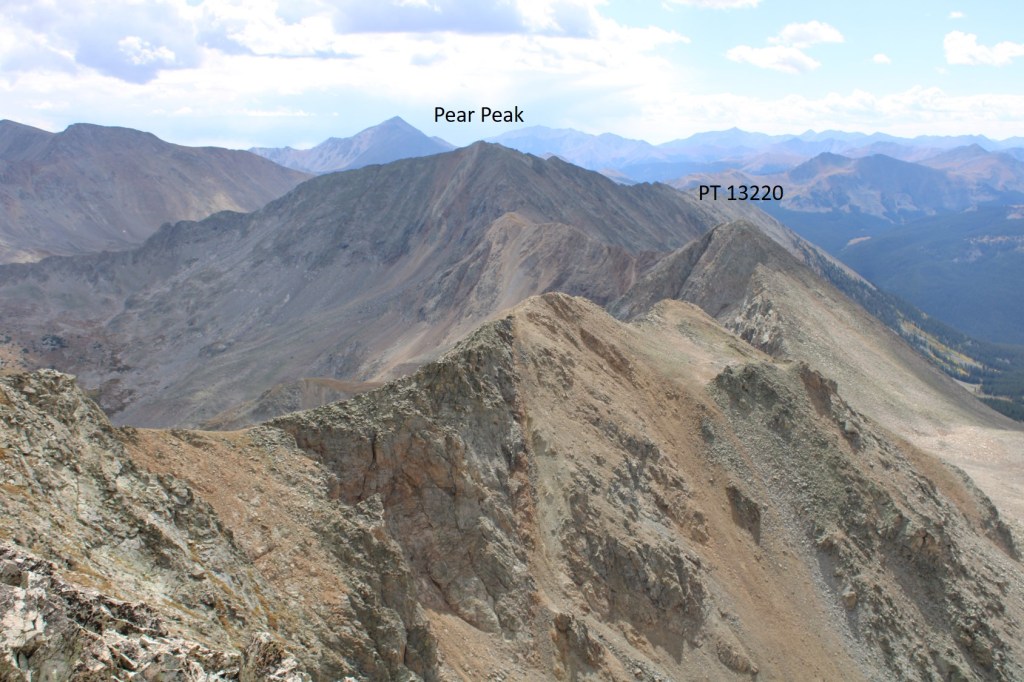
PT 13517 was a little over a mile away from PT 13220. Here’s looking back at PT 13220 and Pear Peak
I turned and retraced my steps back to the saddle.
Here’s the other side of that initial class 4 move
Back at the saddle, I headed east, and took the gully to the left down
The gully had scree, tundra, and bounders. I was easily able to find a way down this gully, but it looked challenging to find a good way to go up. I was glad I chose to do Pear first.
Here’s my overall route down the gully, across the small basin (I stayed high here) and back down to the trail. I followed a waterfall northeast, keeping the waterfall to my left to exit so I wouldn’t need to cross the water. This brought me to willows and the trail I’d used to hike in.
The hike out was uneventful, except it rained. I know it looks like it was a beautiful day, but in reality, just before PT 13220 it was snowing, and it rained/hailed/graupeled a bit on my way down. There were also people fishing at Clohsey Lake who had a few dogs. I was about 100 yards from them, but their dog wouldn’t stop barking at me. I’m sure that made for wonderful fishing.
I made it back to my truck at 1:45pm, making this a 11.89 mile hike/scramble with 3995’ of elevation gain in 8 hours, 15 minutes. And now, for the fun drive out!
Here’s a view of Clohsey Lake and the basin from Pear Peak
I started this hike from Purgatory Creek Trailhead. I’ve put together a route description of the trek from Purgatory to Ruby Basin, which can be found here.
For my first day in, I decided to camp at the Ruby Basin junction. I started at 3pm and made it to my camping spot at 6:45pm. I made it to the train tracks just as a train was approaching, to which a passenger pointed at me and said “Hey look: Wildlife!” and everyone got out their cameras and waved at me. I smiled and waved back. I gathered some acorns to snack on as I hiked (just before the railroad tracks there are tons of scrub oak, and the acorns are now in season).
I was so glad it didn’t rain! I think this is the first time I’ve done this approach where it hasn’t rained. As I got closer to my camping spot, I came across two girls camping there already. I chatted with them for a minute: they were headed to Ruby Basin too, to hike Turret. I wished them well and picked a spot closer to the Ruby Basin junction to set up for the night. I dried out my clothes as best I could, ate some popcorn, and went to bed.
It was a warm but windy night. I was up early, and spent a good half hour just stargazing. Eventually I got up and was on the trail at 5:45am, headed to Ruby Lake. I made it to the lake just before 9am. Today I was taking my time, so I sat by the lake for a bit, filtered water, and watched the trout swim by the shore, every once in a while snagging a fly for breakfast.
My only goal today was to make it to Ruby Basin. I knew it wouldn’t take long, but I wanted to hike in the cool of the morning, instead of the heat of the day. Here’s looking back at Ruby Lake from just before making it to the basin
I made it to Ruby Basin, in all its willow filled splendor, at 10:45am. For those doing the math, it took me less than 5 hours to hike from the Ruby Basin cutoff to Ruby Basin, and I took my time.
There was a tent set up in the far side of the basin (east), but I didn’t see anyone camping there. Basically, I had the basin to myself. I strapped on my creek crossing shoes and took a walk in the creek(s). They were running at a trickle.
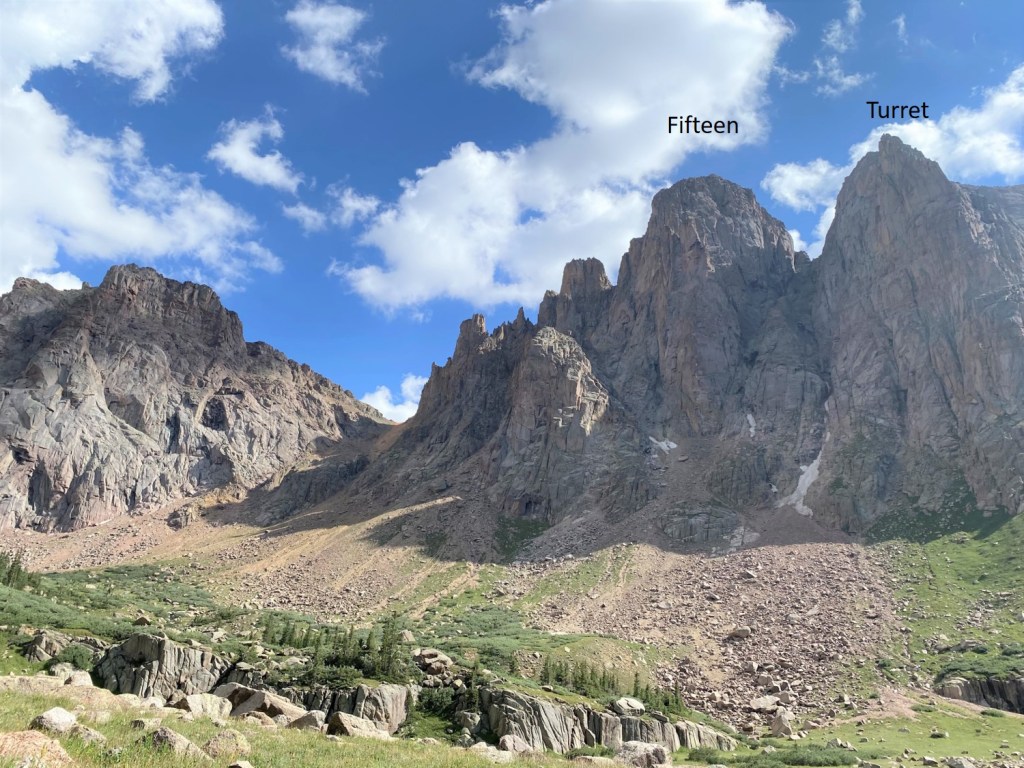
I relaxed for the next few hours, drying out, enjoying the sunshine, and going over my notes for my day tomorrow. This was my second attempt at these peaks. It hurt to turn around last time, but I had bad beta (and not enough beta, as I had other goals in mind and these peaks had been secondary). I’d been up in my head that entire weekend, and in the end turned around much sooner than I should have. I went home, got better beta, and was now back to attempt these peaks again. Around 2pm I saw the girls I’d met the night before enter the basin, and to my surprise, they headed directly up Turret. Rock on ladies!
Also, there were bees and crickets. Crickets everywhere! They jumped around my ankles as I walked through the basin, munched on my journal and hopped onto my gear. I ate dinner and went to bed as the sun was going down (it goes down over Turret early this time of year).
Once again, I got up before my alarm, and spent some time stargazing. I saw several shooting stars, and a few airplanes coasting across the night sky. There was no moon, but I could see the stars clearly. I made out a few constellations, and noted the frost on the outside of my bivy. I wanted to start at first light, but ended up starting a little earlier, around 6am. These are the peaks I was attempting today
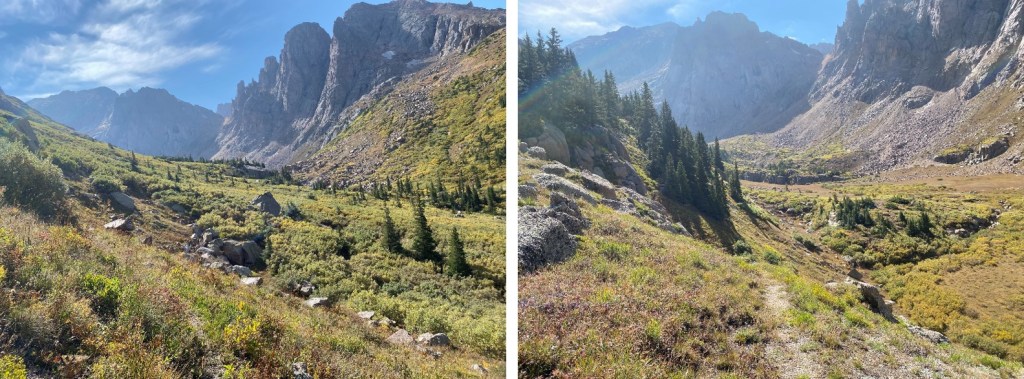
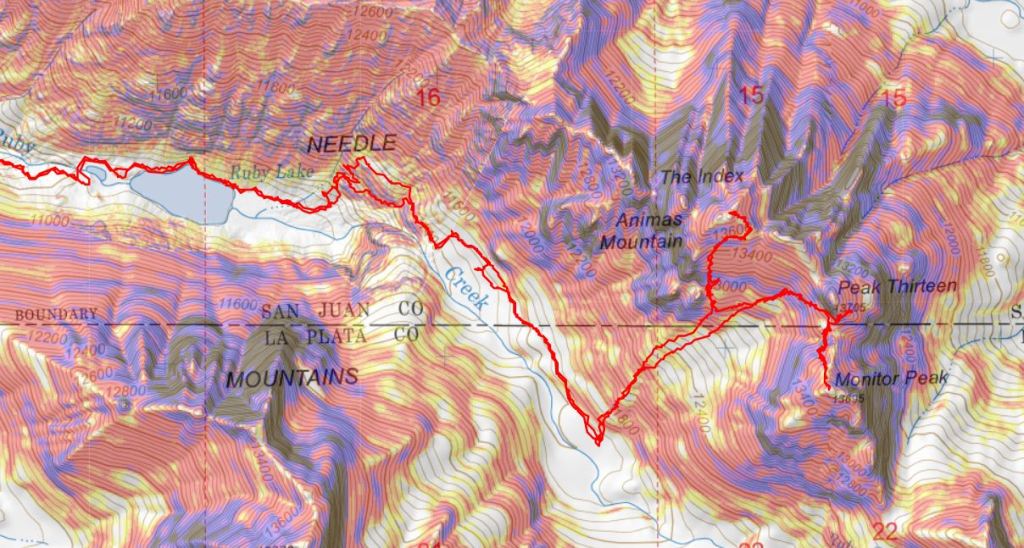
Here’s an overview of the route from Ruby Basin to the upper basin below Animas, Peak 13, and Monitor. After about 20 feet of willows, I was able to stay on tundra the entire time. This is choose your own adventure, but it’s easy to find a class 2 route into the upper basin. I just kept aiming towards Peak 13.
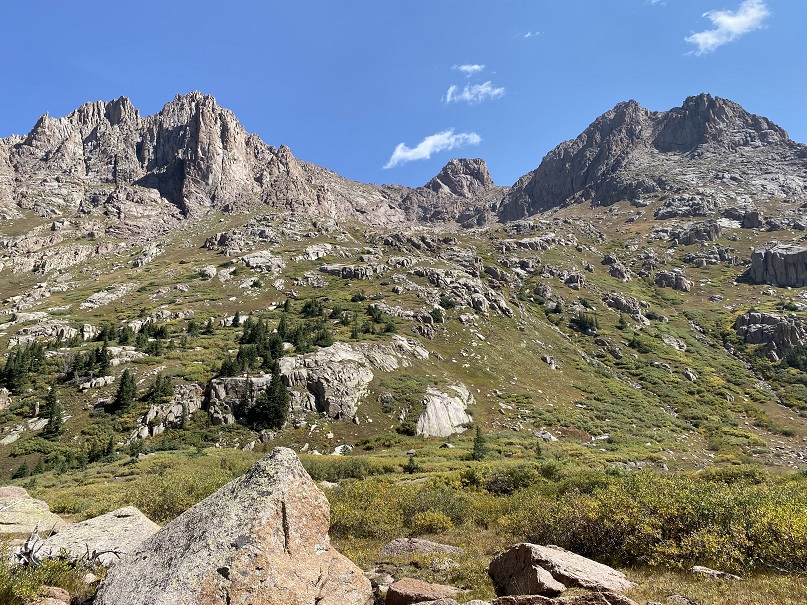
Here’s a look at the upper basin.
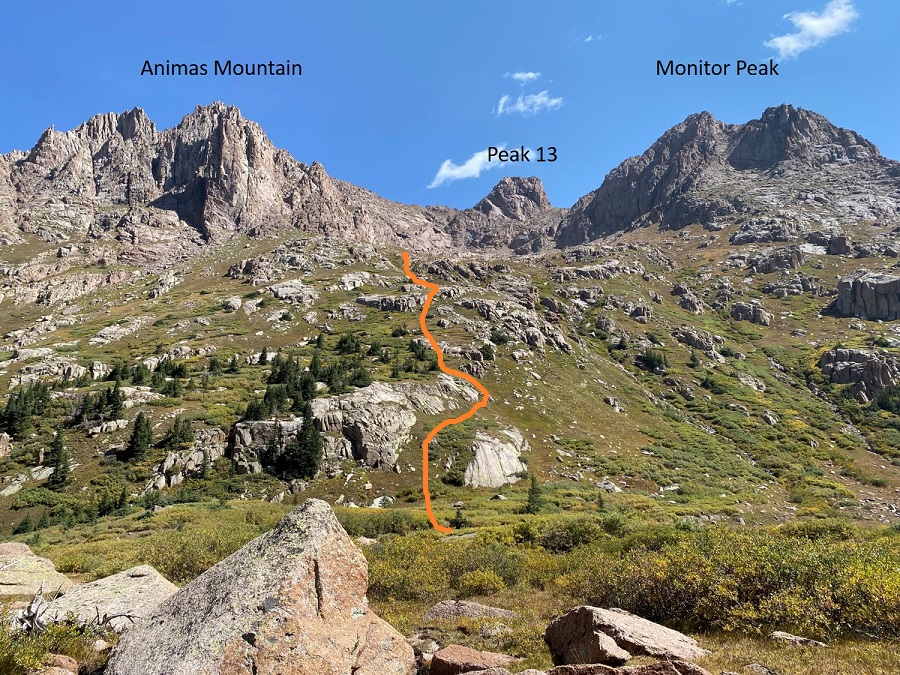
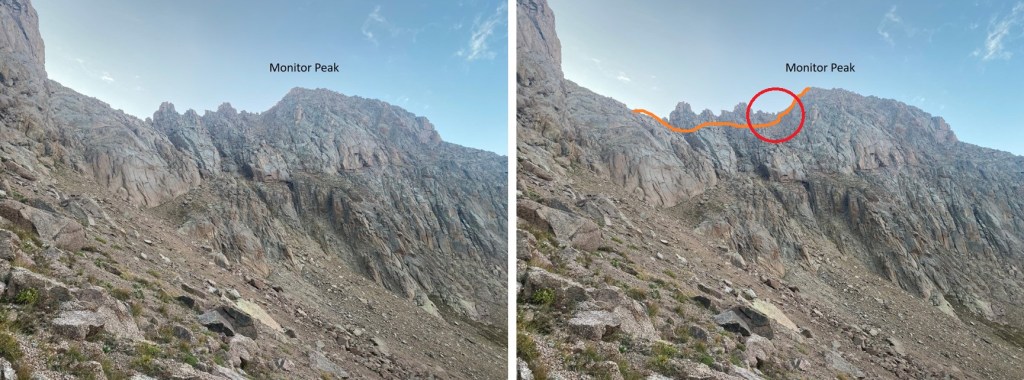
I was headed towards Monitor Peak first. There are several ways to do this. This time I took what I consider to be the ‘easy’ approach. Directly below Peak 13 there are two ramps you can ascend. I chose the further one, as it was less steep. I followed the basin northeast, towards an obvious ramp. It’s just below a section of a white and black streaked slab.
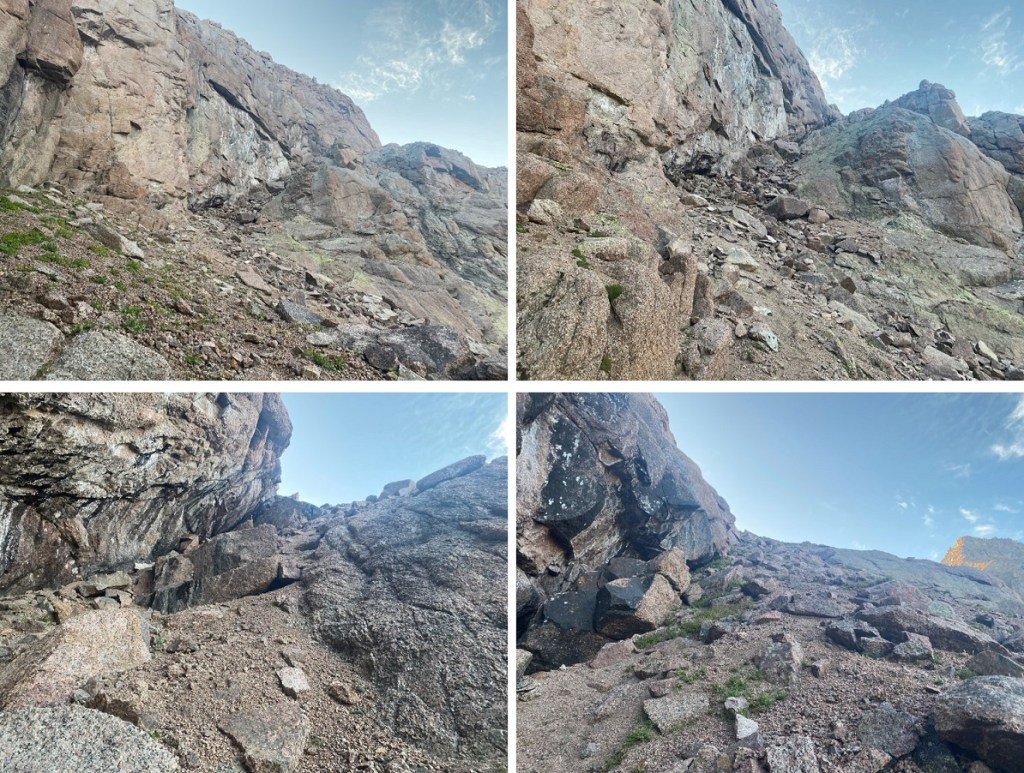
Here are some closer pictures. There are two ramps here, an upper ramp and a lower ramp. Both go, but the upper ramp is less steep, and all class 2 in my opinion.
Also, while you’re here, look to your right. Find this gully (circled in red). It’s the gully you will be aiming for when ascending the ridge (ascending to the ridge before this point is fruitless). Here’s an overall view of the climb to Monitor from the Peak 13/Monitor saddle. You’ll know you’re in the right gully because there’s a white vein of rock going through it (more on this later, but from this spot you can clearly see the white vein, so it’s a good time to get a visual of where you’re aiming).
But first, let’s get to the saddle, by going up that ramp. As you can see, it’s wide, and easy to navigate.
The top of the ramp deposited me at the Peak 13/Monitor saddle. Well, actually, I didn’t need to go all the way to the saddle. I skirted the saddle and continued south across scree, following the ridge.
Now for the gullies. There are several of them, and in order to cross the first one I had to descend about 100 feet down, then re-ascend. Before doing that however, I got a good look at my route. This looks harder than it is. Here’s the route I took after re-ascending the gully.
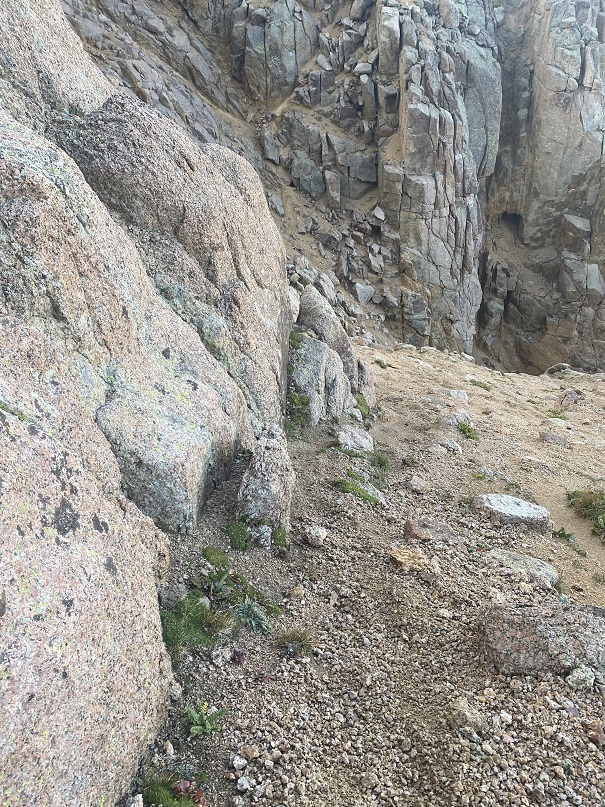
But first, I had to descend on kitty-litter scree, and then re-ascend.
When re-ascending there were a couple of ways I could have gone (all felt class 3). This is the way I chose.
Get a good look at your intended route from above, as this is what it looks like from below. Hint: aim for this rock, go behind it, turn right, and follow the areas covered I dirt.
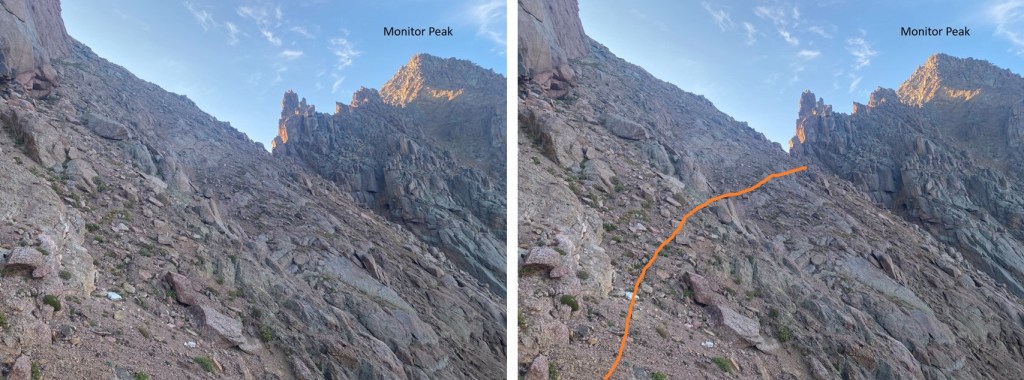
Ok, now to find that gully. Luckily, from here there were cairns, and even a bit of a game trail. I followed them south, staying well below the ridge
I rounded the corner, and could clearly see the correct gully. I followed this gully to the ridge
Once on the ridge, I turned right, and followed it to the summit, dipping to the right at the end, but always following a class 2 game trail.
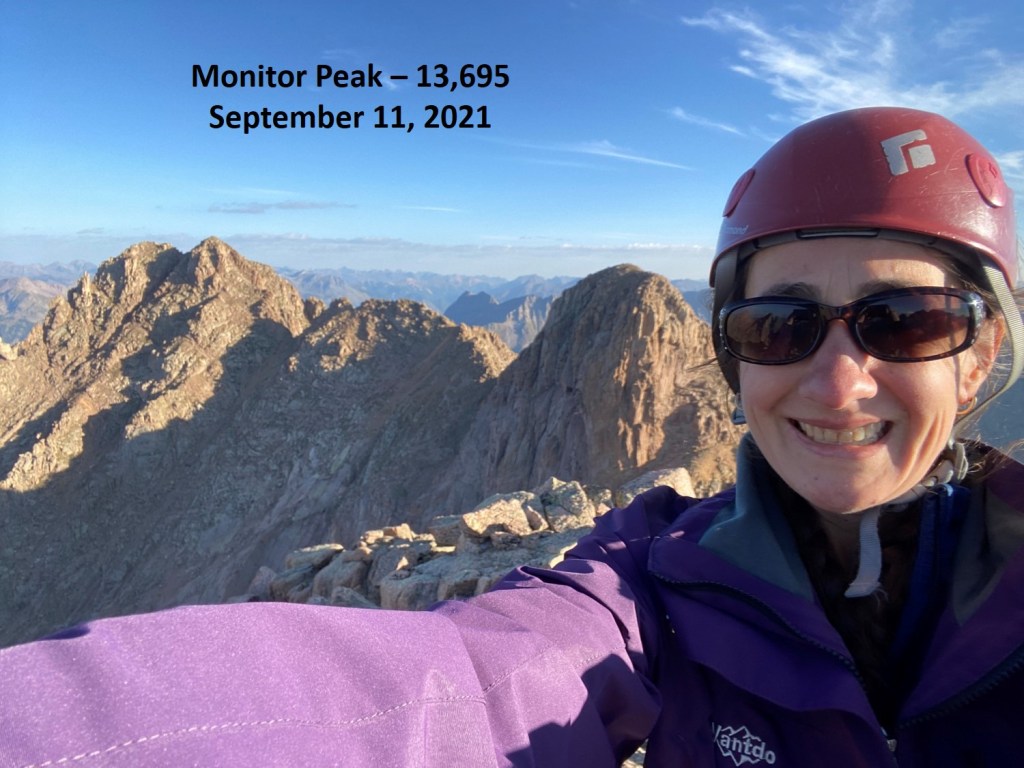
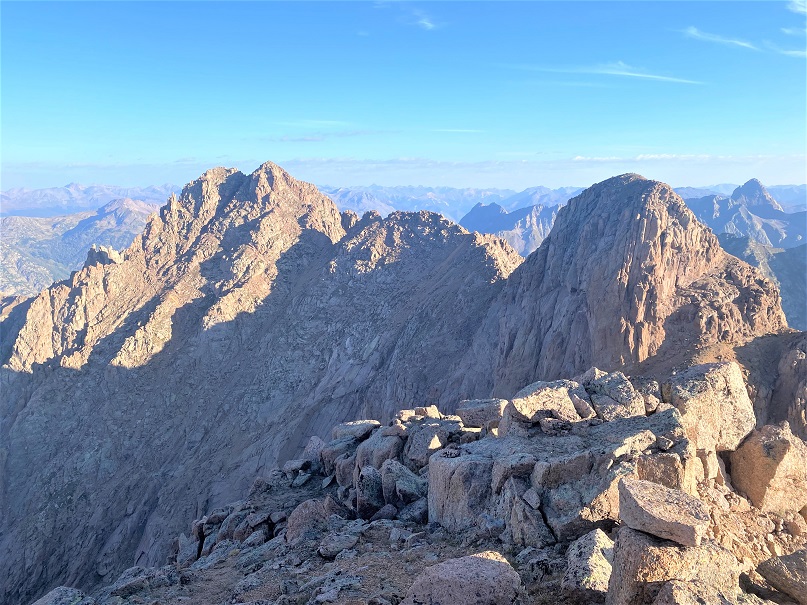
I summited Monitor Peak at 8am.
Monitor Peak:
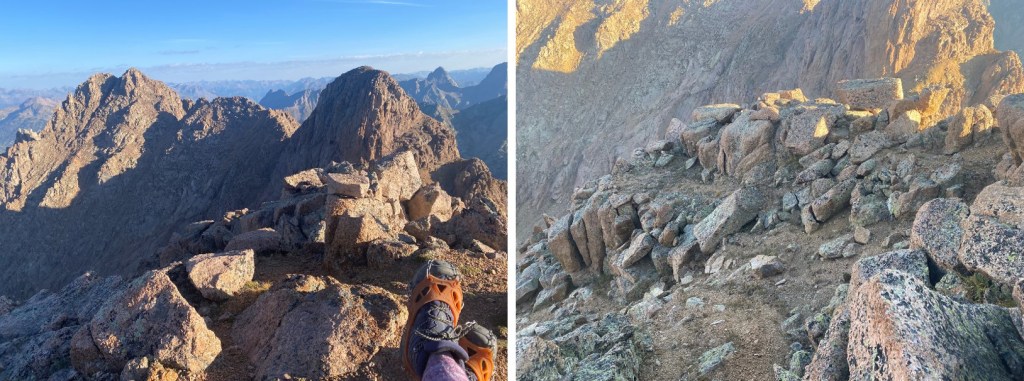
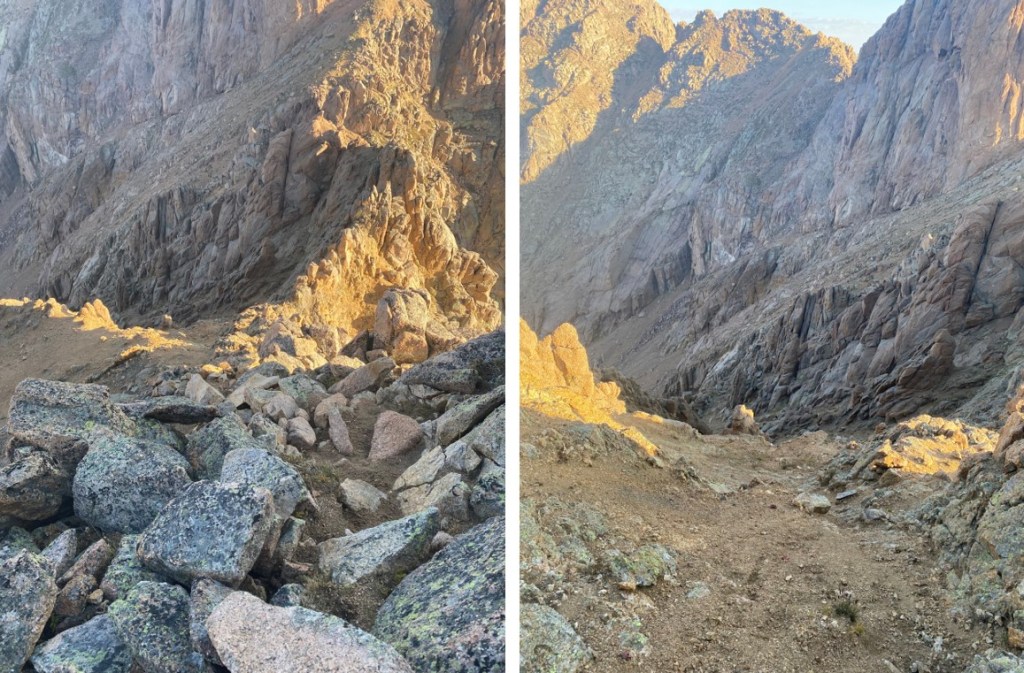
There was a summit register in need of new paper (but with 2 pencils), and great views!
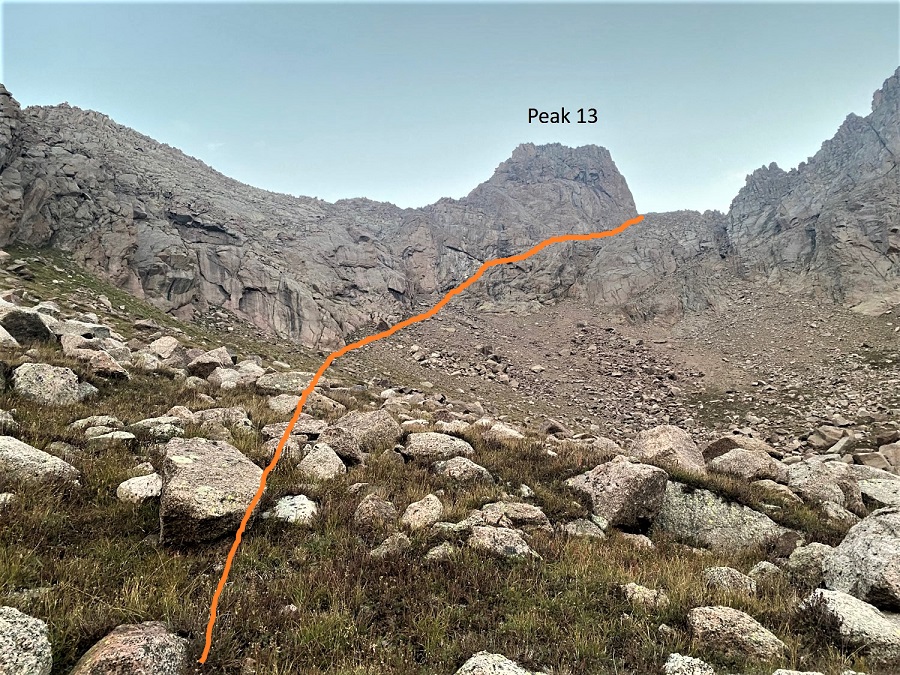
Next on the agenda was Peak 13. Spoiler alert: I didn’t summit Peak 13. When I got to the area where I was supposed to “just go straight up” I found that while it was class 4, there were no hand/foot holds, and everything I tried to grasp turned to kitty litter in my hands. Since I hike solo, I have a rule not to upclimb anything I don’t think I can downclimb (if I don’t have rope), and while I could probably have upclimbed this, I wouldn’t have been able to downclimb it, and a fall would be deadly (lots of exposure). In any event, I’ll describe the process of getting there. Now is also a good time to get a visual of how I climbed Animas Mountain as well. These were my routes:
From the summit of Monitor Peak, I headed back to the Monitor/13 saddle, retracing my steps
Once at the saddle I followed it northeast, to an obvious stopping point. Here I turned to head up, and, like I said before, I deemed it unsafe, so I turned around, tried several other ‘ledges’, and in the end decided to just head back to the upper basin and summit Animas from the gully. I was very happy with this choice. Here are pictures of the two possible routes up to Peak 13 I decided not to take
Instead, I descended back into the upper basin by way of the upper ramp.
I followed the contour of the mountain all the way down to 12860’, and the only obvious gully that ‘went’
I then followed this gully north. There are lots of divergences here, but if you keep heading north, they all seem to ‘go’. I just kept the spires to my left and followed the obvious contour of the gully. I as able to keep this all class 3. If you’re in class 4 territory, back up and look for an easier route.
When I made it to 13580’ I headed east, towards the sandy saddle between Monitor and 13500’
I didn’t go all the way to the saddle however, because I saw cairns leading me up the ridge (class 2).
Here’s the overall route to the summit, all well cairned. The circled area is a brief class 4 chimney section (less than 10 feet or so) that is the only obvious way out of the gully. When you make it above the chimney you’re about 20 vertical feet from the summit on easy to navigate ledges.
To get up the chimney I jammed my arms into either side and used my forearms to lift myself up. On the way down, I faced the rock and put both hands/arms in the left crack to lower myself down. You may be asking yourself why I was fine climbing this chimney and not the class 4 section on Peak 13? It’s because the rock here was firm, and I didn’t have to worry about it crumbling in my hands as I was climbing. When I made it to the top of the chimney I turned right and followed the cairns to the summit.
I summited Animas Mountain at 10:30am
Animas Mountain:
There was a trail register in dire need of paper. With no place to sign I put it back and turned and descended the same way I ascended, back to the saddle, and then down the gully. Note, I did not descend the scree filled gully, but instead the rocky one I ascended, this time keeping the rock spires to my right.
Once in the upper basin I headed southwest on the slope, back to my campsite. It helped to stay to the right of the waterfall area, on the tundra.
I made it back to my campsite in the Ruby Basin at 11:40am. I ate lunch, packed up my gear, thanked the marmots for not messing with it this time, and headed back through the willows towards Ruby Lake. It was a really hot day. I stopped at the lake to dip my bandana in the water and cool off my face. The water felt so good! As I was skirting the lake and looking at the clear water I couldn’t help but want to jump in. I did some mental calculations, and before I could stop myself I set all my stuff aside and went into the lake. I swam around for a few minutes, hopped back out, dried off in the sun (it only took about 30 seconds in the dry Colorado heat) dressed and was back on the trail within 10 minutes.
I made it to the Chicago Basin cutoff and decided to once again spend the night. There was a woman in a hammock waiting for her husband, who was running the Chicago Basin 14ers (woot!). I couldn’t help thinking to myself how I wish I could find a partner who would support me like that (or join me?). I set up my gear, talked with a man who’d lost his water filter and had a busted eyebrow (he got it crossing the creek?). I told him where to find the train, and campsites, and made it an early night (again). I woke up before my alarm, and was on the trail at 4am, out and back at the Purgatory trailhead at 8am. Side note: hiking in the Purgatory Flats area on the way out was by far the coldest part of my weekend. By this time I’d already taken off my coat and gloves, but had to put them back on because the temperatures were so cold. I’m thinking this isn’t the best place to camp for the night.
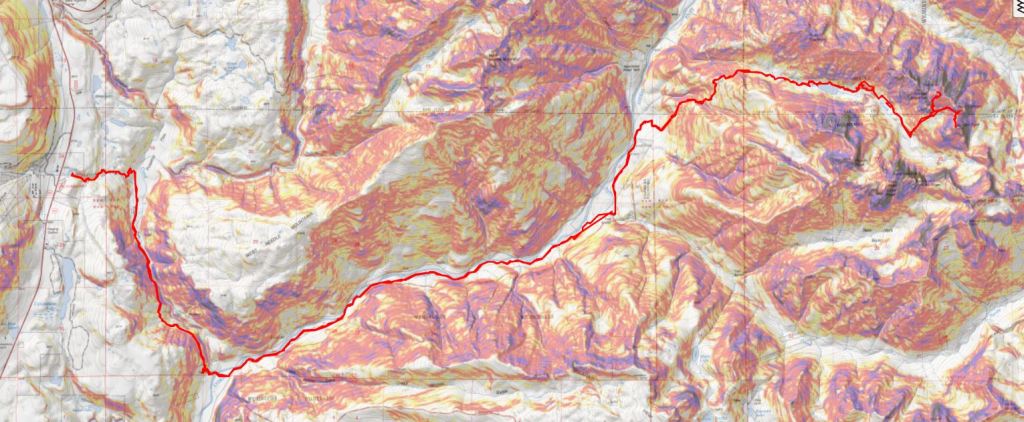
CalTopo tells me my stats were 45.07 miles with 12724’ of elevation gain.
I’ve taken the Willow Lake trail several times, and I’m guessing if you’re doing this peak you have too, so I’m going to start this report from the camping area just before Willow Lake. If you’d like detailed instructions on the approach, click here
I would also like to recommend pairing this up with other peaks in the area: PT 13153, Mt Adams, PT 13580, etc. This felt like a really easy day.
I was on the trail at 4:30am, surprised at how easy the approach was this time. I attribute it to taking the week off from hiking to visit my son in Alaska, and in doing so, consuming about 10 times more calories than I normally would, thus giving me an excess of energy.
There are several spots to camp just before making it to Willow Lake, including one very large area at 11500’. There are still plenty of areas to hang bear bags already set up (for public use). I continued to hike west. My tracker told me I’d hiked 5.3 miles to this point.
I followed the sign left that took me on the trail for Challenger/Kit Carson
About 10 yards after this sign I left the trail and headed north up the hillside. There are cairns here, but they may be difficult to see in the tall grass.
There are game trails here. I saw tons of deer and bighorn sheep the last time I was here, and this time I saw a few deer. Find a game trail and follow it north, keeping the creek to your left and rock outcropping to your right.
At the top of this hill there are cairns indicating you should go right, but if you do so, you’ll be going through a lot of willows. Instead, parallel the creek, staying to the right of the creek, and you can follow a game trail to the end of the basin, staying out of the willows, or at least keeping them to the easy ones that just reach your knees. Just keep heading north.
You’re aiming for this gully
Here are some step-by-step photos (just keep heading north, this is class 2 terrain on tundra). First, stay to the right of the creek, and to the left of the willows
Then, continue north towards the gully. I was easily able to cross a creek and avoid the willows. I kept to the left of the willows and right of the creek the entire time.
Next, I ascended the gully. This was easy as far as gullies are concerned. I was able to stay mostly on grassy areas. Note, you do NOT need to ascend all the way to the top of the gully. About 15 feet before topping out, take the grassy ramp to the left, staying below the rock outcropping of the ridge.
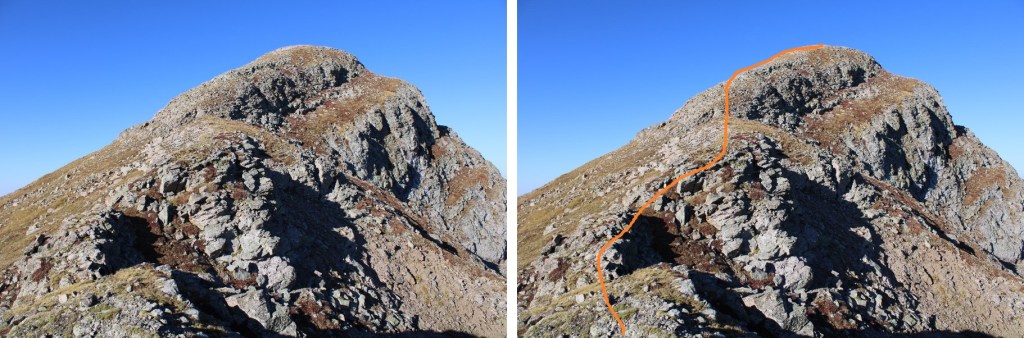
This grassy area is easy to follow. I just stuck below the rock. Here’s an overview of the route to the summit.
And step by step, first, following the ridge west
After the rocky ledge, I stayed on the ridge all the way to the summit. Once again, all class 2, and you can stick to the ridge.
Yes, this stays at class 2 (it looks harder than it is)
There’s a small false summit, and then it’s an easy trek to the peak
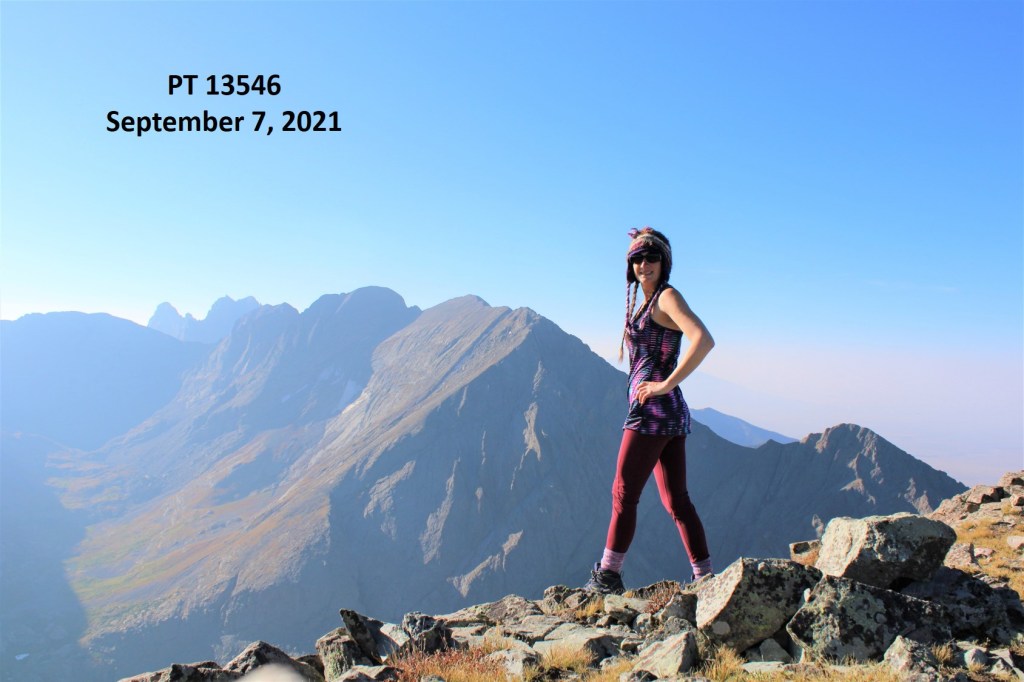
I summited PT 13546 at 8:30am
PT 13546:
It was a hazy day. There was a summit register, but it was one of those pipe ones, so the paper inside was wet. It was also completely full of signatures, so I left the paper in the tube and added another one. There was a nice view of the Crestones; I just wish it was a little less hazy today.
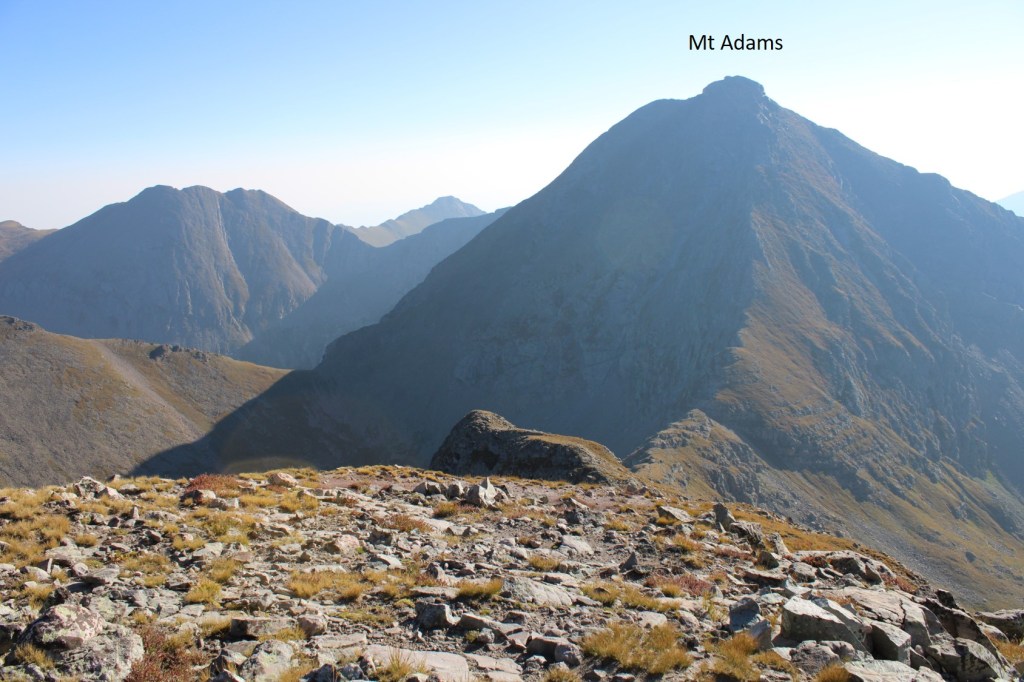
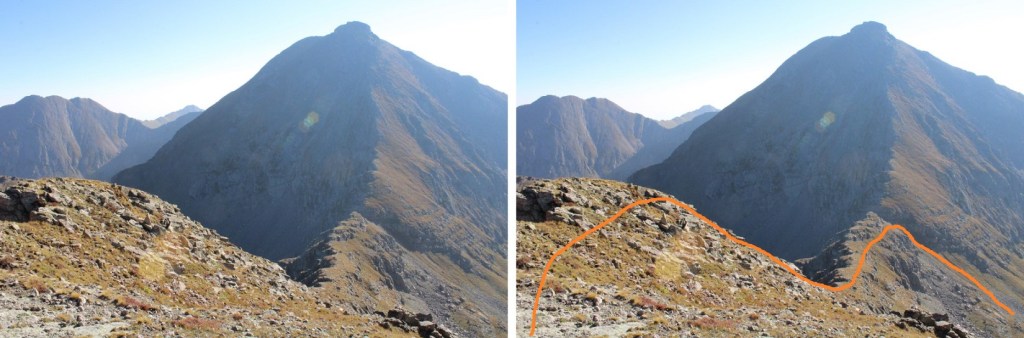
I turned and headed back the way I came in, aiming for the Adams/13546 saddle. If you look closely, you can see a route to Mt Adams. I still had to get to work today, so I didn’t have time for Mt Adams (or PT 13153). Both look straightforward though from the saddle.
Here’s how I exited the ridge
Once back on the saddle, I headed south out of the basin
At the south end of the basin, I turned and followed the grassy ridge down (make sure you’re on the grass, not in the trees: there will be game trails here)
From the grassy area, the trail is easily visible. I made it to the trail, and followed it west, back to the trailhead.
I made it back to my truck at 11:30am, making this a 14.15 mile hike with 5337’ of elevation gain in 7 hours. While it was hazy today, it felt like a perfect day to be out!
So as not to reinvent the wheel here, if you’re considering this hike from Purgatory, please see my detailed Purgatory Approach Trip report from earlier this month.
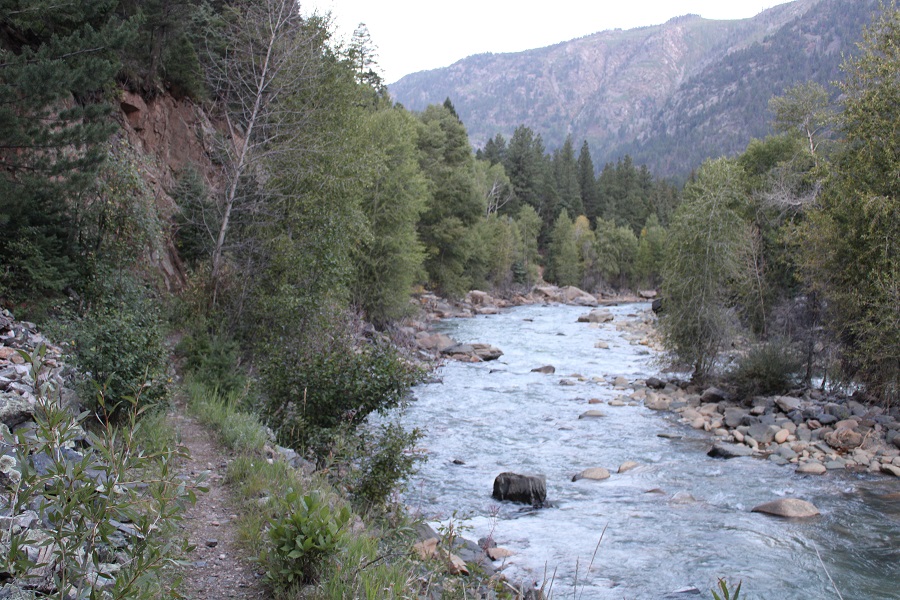
I started this day at the Purgatory Creek Trailhead around 3pm, but will start this report from the Needleton Train Stop. Oh, and it rained the entire first day. The. Entire. Day. I had on rain gear, but was soaked, and my camera lens fogged up. I was so glad to have on new hiking shoes that were still waterproof. From the Needleton Train stop, I followed the Animas River on somewhat of a trail. This trail starts out going through private property (it’s private all the way to Pigeon Creek), so please stay on trail.
I crossed Pigeon Creek, and continued paralleling the Animas River, doing my best to follow the cairns.
After hiking a little over a mile from Needleton I ascended Water Tank Hill, and called it a day. (For those of you wondering, Water Tank Hill is at 8250’ of elevation, and the trek up isn’t that bad, just under 200’ of elevation gain). It wasn’t raining anymore, so I set up my bivy. Note: I don’t advise this. Since I was solo and only had a bivy it was doable, but I wouldn’t set up a tent here, or camp with a bunch of people, as there isn’t much room. Also, it smells like goats. There are campsites just a bit further up the trail.
I did my best to air out my wet gear, jotted some notes down in my journal, ate some popcorn (diner!) and got to bed as the sun went down. With all the clouds in the sky it was a beautiful sunset, but my camera was still fogged up, so no pictures.
2 hours later I heard a big clap of thunder, and just like in the movies, it started pouring rain. Great. All that gear that was drying out was no longer drying out. I stuffed my jacket and pants inside my bivy, and covered myself up as the rain turned to snow (and back to rain again). As water droplets slowly dripped on my face, I thought to myself: it’s going to be a long night.
I set my alarm for just before sunrise, but I didn’t need it. I woke up, watched the bats flitter back and forth, catching their breakfast, and within 7 minutes had gathered my gear and was on my way again, still following the Animas River north.
I crossed Ruby Creek
Passed some primitive campsites, and then crossed Noname Creek
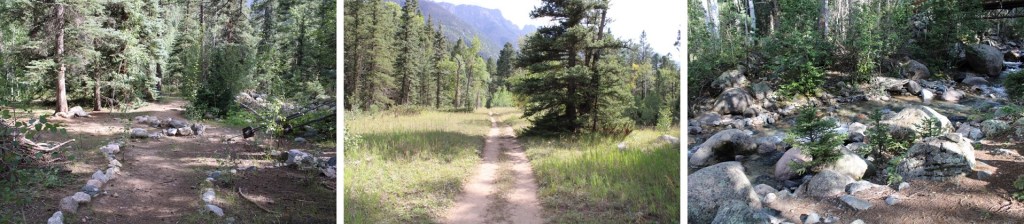
After hiking for 2.25 miles from Water Tank Hill I made it to the junction with the Noname Trail. This is actually where the trail became clearer and easier to follow. The junction is hidden by some trees. Look for the two cairns, outlining a trail, to the right. At the top of this entrance area are several blueberry bushes (but be sure to know your berries: they all grow in the same place, but they’re not all edible).
I followed the cairns east, paralleling Noname Creek as I made my way into the basin.
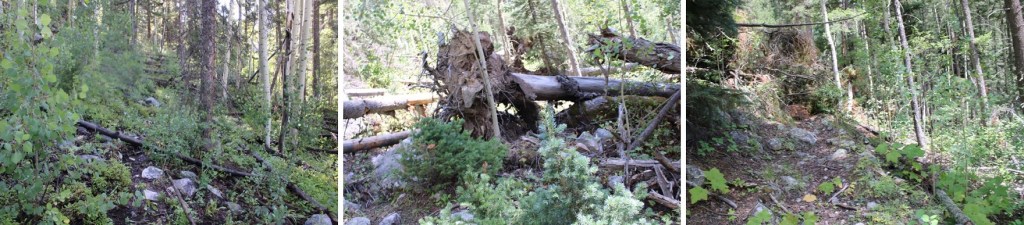
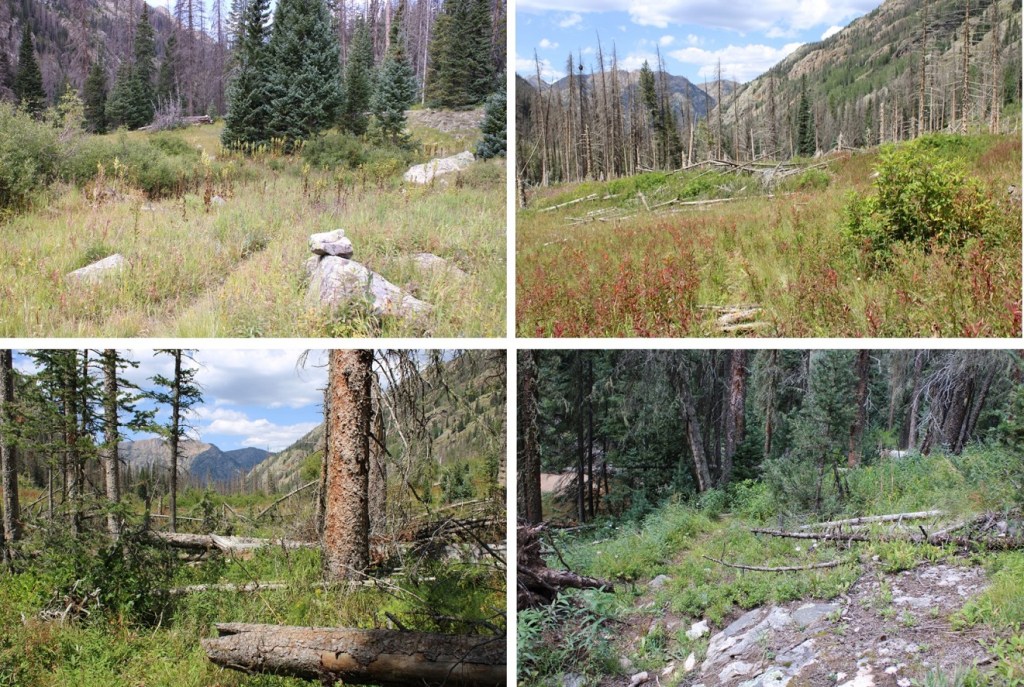
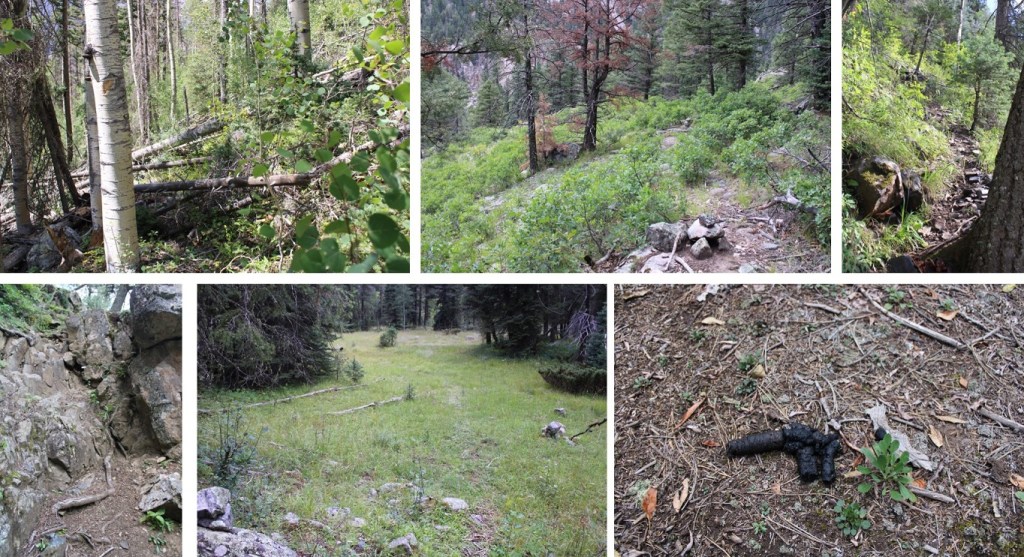
The trail here wasn’t too bad when compared to the past 3 miles. There is a slightly defined trail into the basin. The only difficult part here are all the fallen trees. Many don’t yet have a workaround, and they’re annoying. You can still see a pretty good trail though.
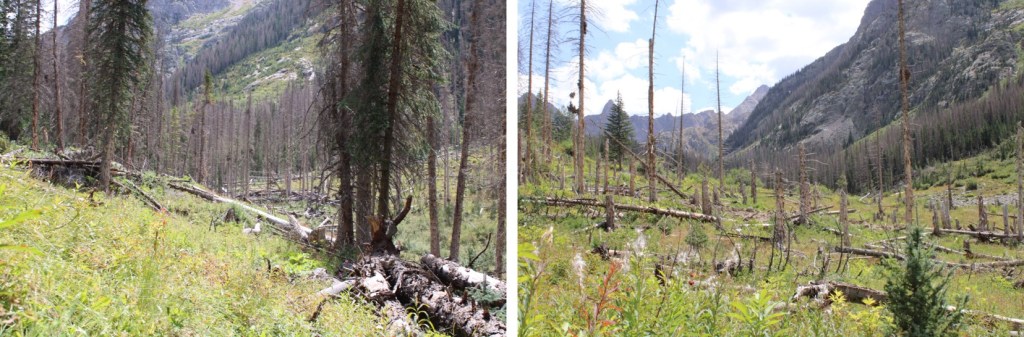
About halfway to the basin on this trail I came across the avalanche debris from a few years ago. I’m sad to say, there still isn’t much of a trail through this stretch. However, if you find a game trail, follow it! The trail parallels Noname Creek, and to follow this ‘trail’ properly you’ll need to stay further north than would seem intuitive of the creek (don’t cross the creek, always stay on its north side). This is what the avy debris looks like: it’s overgrown, so look for game trails. Note: watch your step, as the grass/flowers here are taller than the debris and you could easily find your ankle stuck between the logs, but there is a defined trail of tromped down grasses if you can find where it begins.
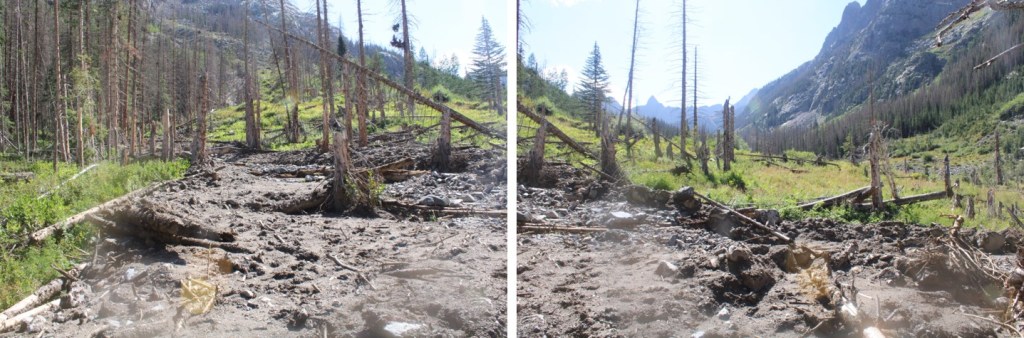
I came across a mudslide runout that hadn’t been here last time, finally found a solid game trail, and followed it to Jagged cabin
At Jagged cabin I was halfway through the basin, and decided to take a break. I ate lunch and aired out my gear from the rain/snow the night before. Within 20 minutes, it was all dry and I was ready to go again.
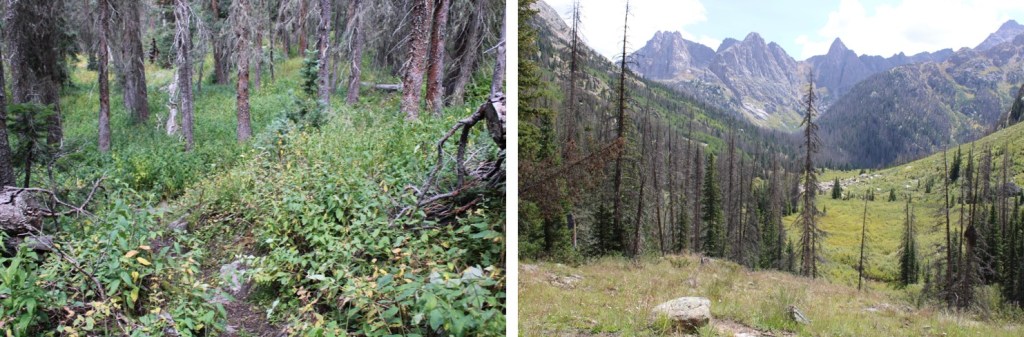
My 20 minute break over, I continued following the basin east. Willows are involved here, but the trail is much easier to follow.
I crossed a second, new mudslide runout area, placed some cairns, and continued along the trail
There’s a nice campsite right along the trail
I entered more brush, and found a junction. I went left at the junction and followed the trail northeast up the mountainside.
There’s more than one trail here, but they all lead to the upper basin. If you’re on a game trail headed north, you’re in the right area.
Just before reaching the upper basin there are willows. These are easy to navigate as far as willows go.
Once in the upper basin I messed up a bit, as you can probably see by my GPX track at the bottom of this post. I didn’t go with my gut instinct, and instead went with a GPX file I had. I didn’t realize until later it was a hand drawn GPX file. (Side note, it should be REQUIRED for you to post you hand drew the file if you’re going to make it available for download: I was smart enough to turn around, but not everyone would have made the same choice). In any event, here’s the path you should take to Lake 12,522, both routes work and stay at class 2:
If you have a GPX file that says to go further around the rock outcroppings, know it’s drawn in (although, to be fair, there is a way to go from the Jagged Mountain route, but that’s now what happened here). I had more than one GPX file that said to follow the outcropping and then ascend to the north, but when I attempted it, I was wearing a full pack and it was more than class 4: this should be a class 2 hike, which leads me to believe someone hand copied someone else’s hand copy, which isn’t cool (that’s the only reason I’m addressing it here; because I had more than one similar file. Go with your gut instinct and follow the obvious rock gully… you’ll even come across some cairns).
OK, enough on that rant. Here are some close-up pictures of the route to the lake at 12522’
You can’t see it in this picture, but the lake is to the lower right. To get there, I skirted the rocks high, just below the strip of tundra, and made my way to a gully runout below Peak 5, following that to the lake.
This lake has several spots to camp, but most of the shoreline is solid rock slabs that drop off into the water. It would be difficult to walk the perimeter of this lake. I set up camp on the north side. The next few hours were spent jotting down notes (I was mad I’d wasted over an hour of time route-finding, and had a lot of venting to do), trying my best to eat something, enjoying the view of Jagged, and listening to the pikas keep tabs on what I was doing, executing a call and response tactic from all across the lake. I once again made it an early night.
Pikas:
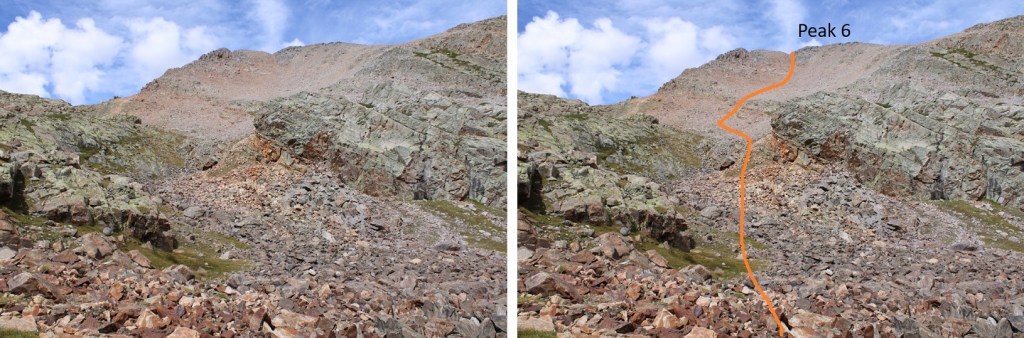
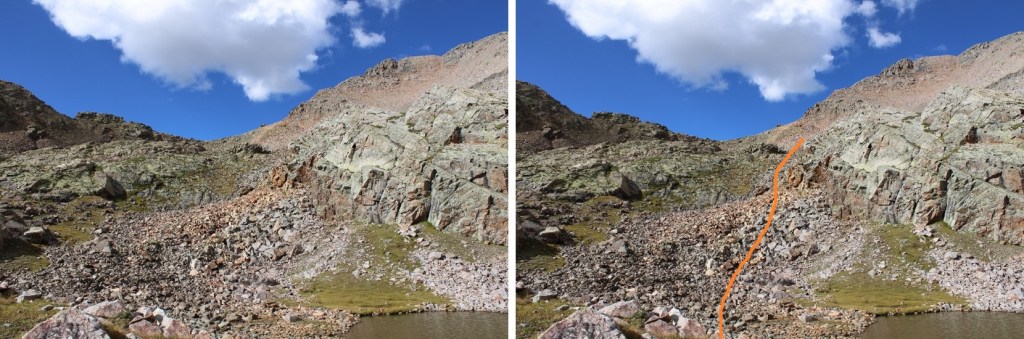
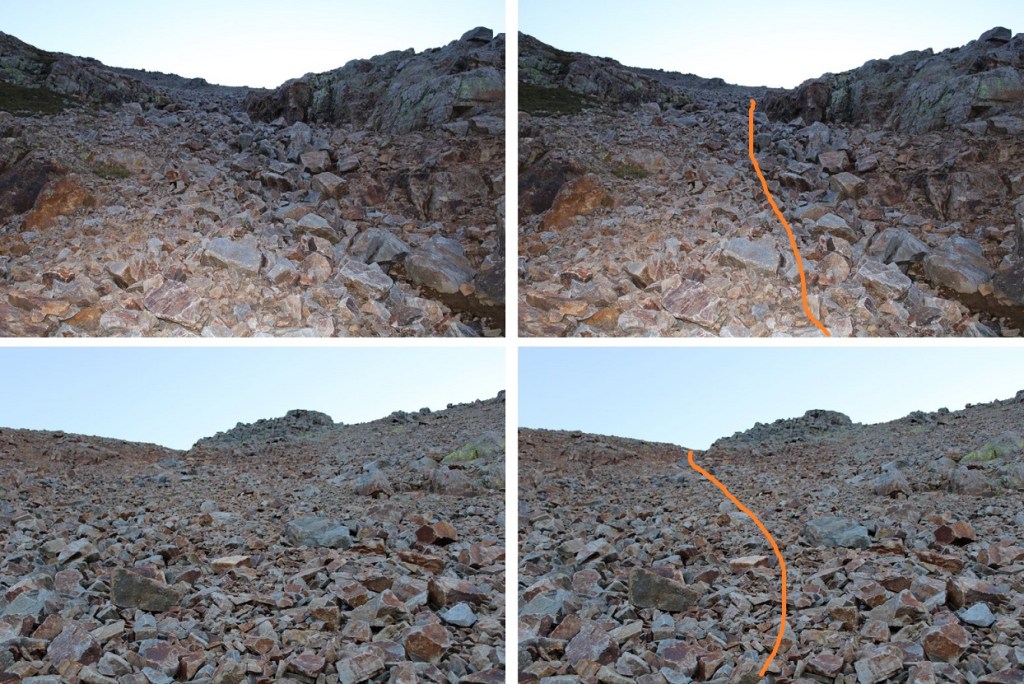
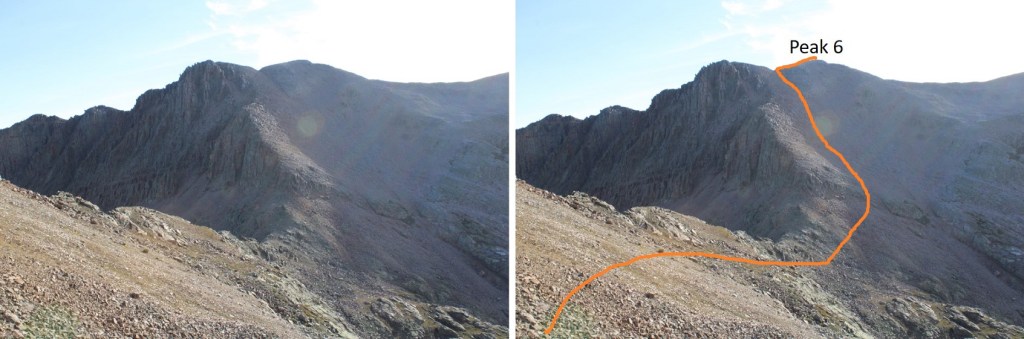
I was up at first light the next morning. To summit Peak 6, I headed northeast from my campsite, following the scree. Here’s an overall view of my route
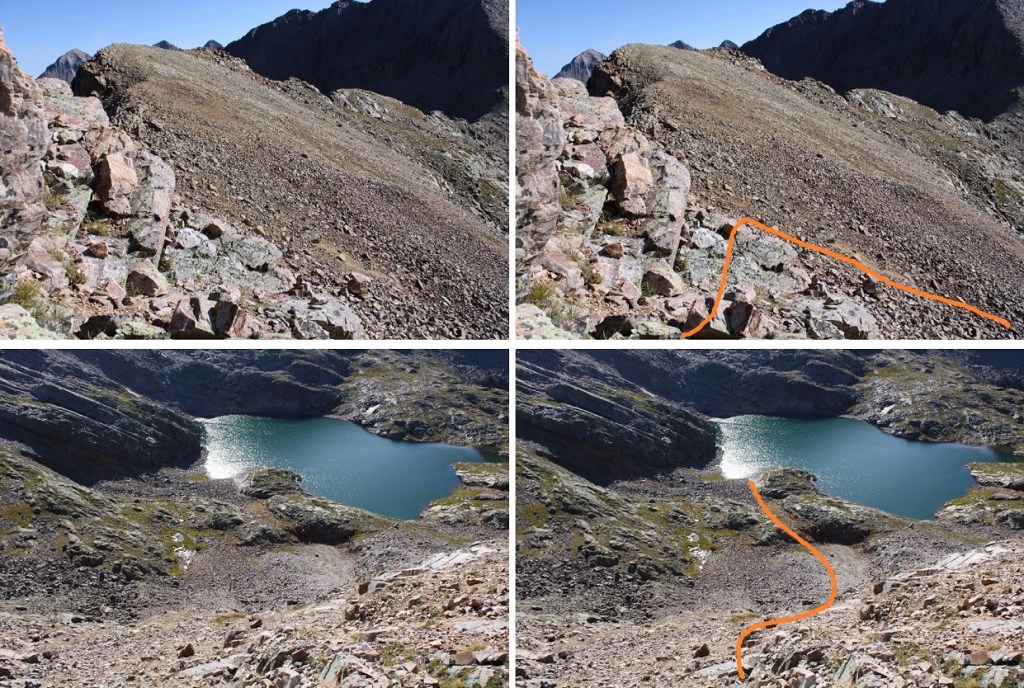
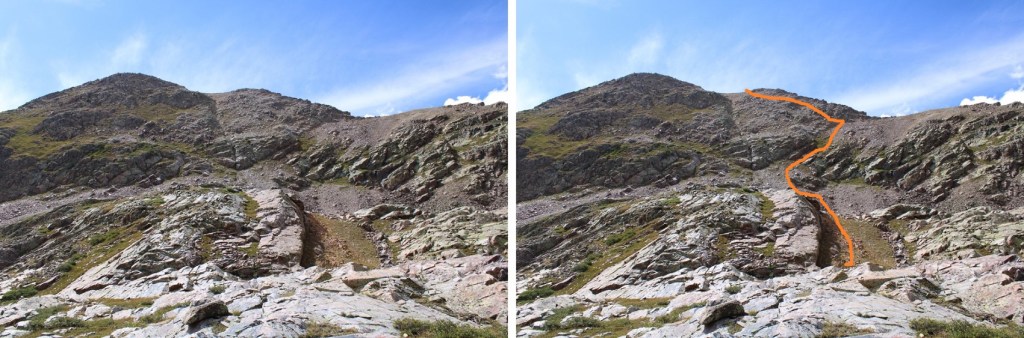
And some step by step pictures. There was scree here, and the rocks were steep, but I felt the entire route was class 2. I stayed close to the rock outcropping in the upper gully, and I saw a swift moving pine marten near the upper ridge.
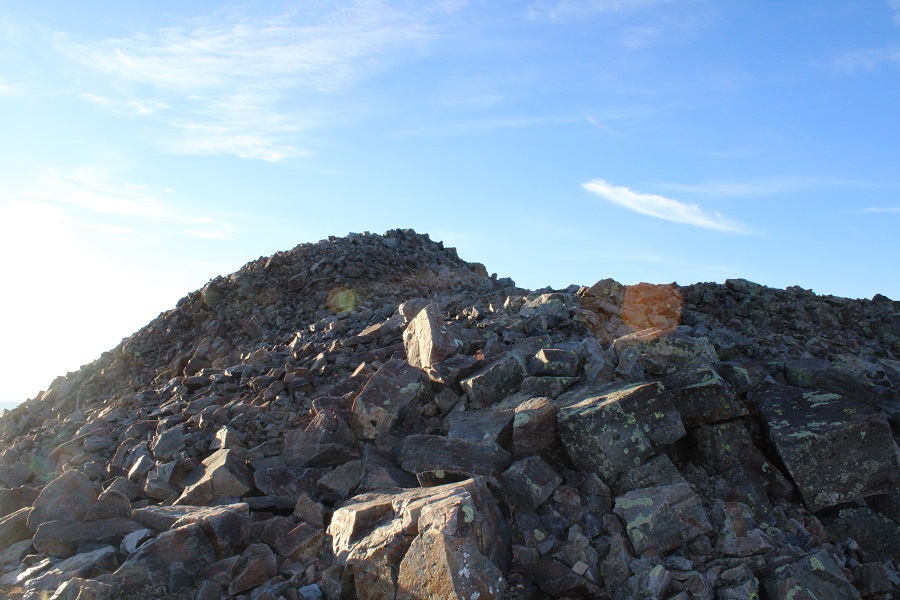
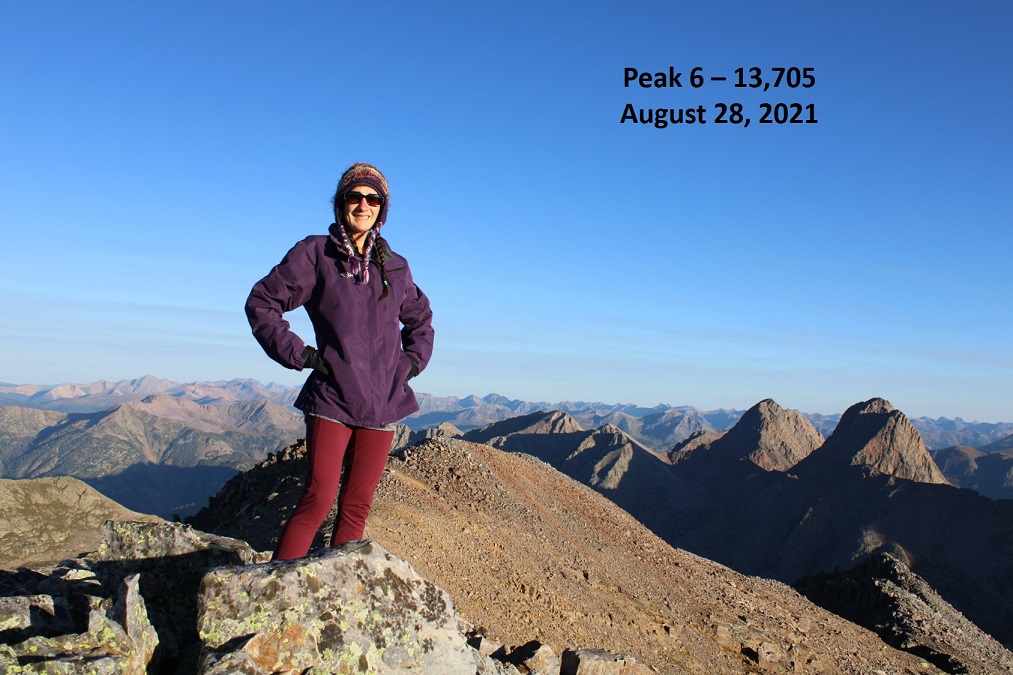
Once on the ridge I turned right and easily walked to the summit of Peak 6
I summited Peak 6 at 7:15am (and had cell service!)
Peak 6:
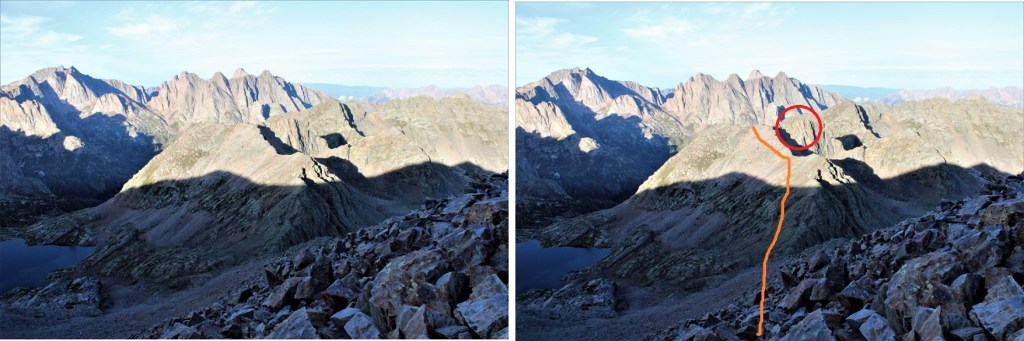
I intended to summit Peak 5 today as well, but was having trouble… seeing it? For reference, here’s Peak 5 as seen from Peak 6, along with my route. Peak 5 is circled in red
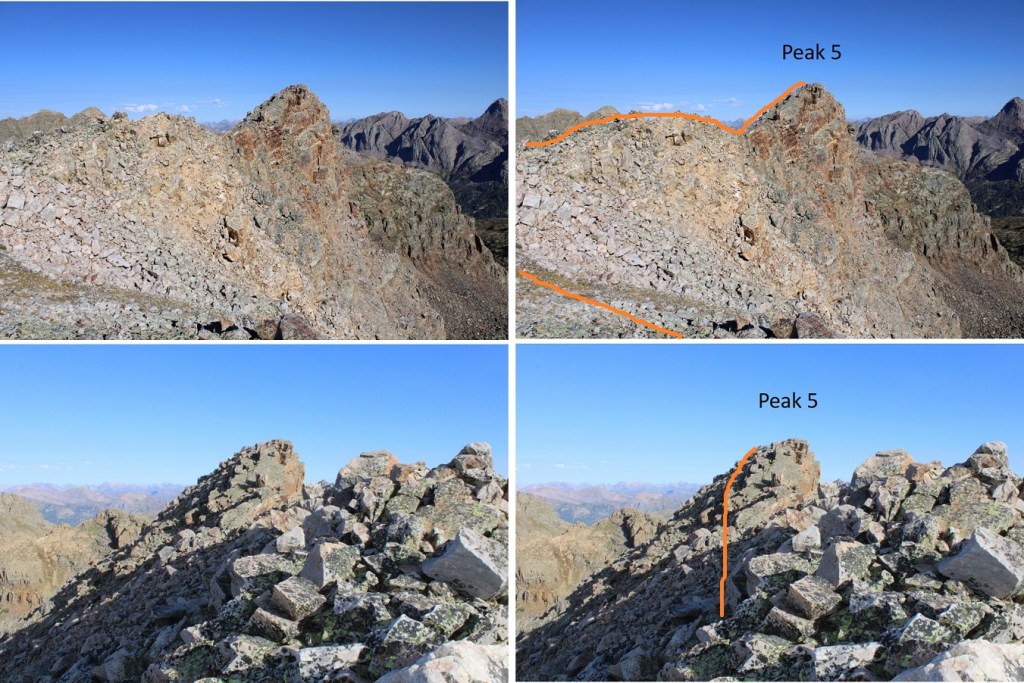
The ridge from Peak 6 to Peak 5 doesn’t ‘go’, so I descended down Peak 6, staying as high as I could on the scree, making it to just below the Peak 5/6 saddle. From there, I looked for black band in the rock, skirted under that, then aimed for a grassy patch, ascended the grassy patch, and aimed for the saddle. There is no need to stick to the ridge here
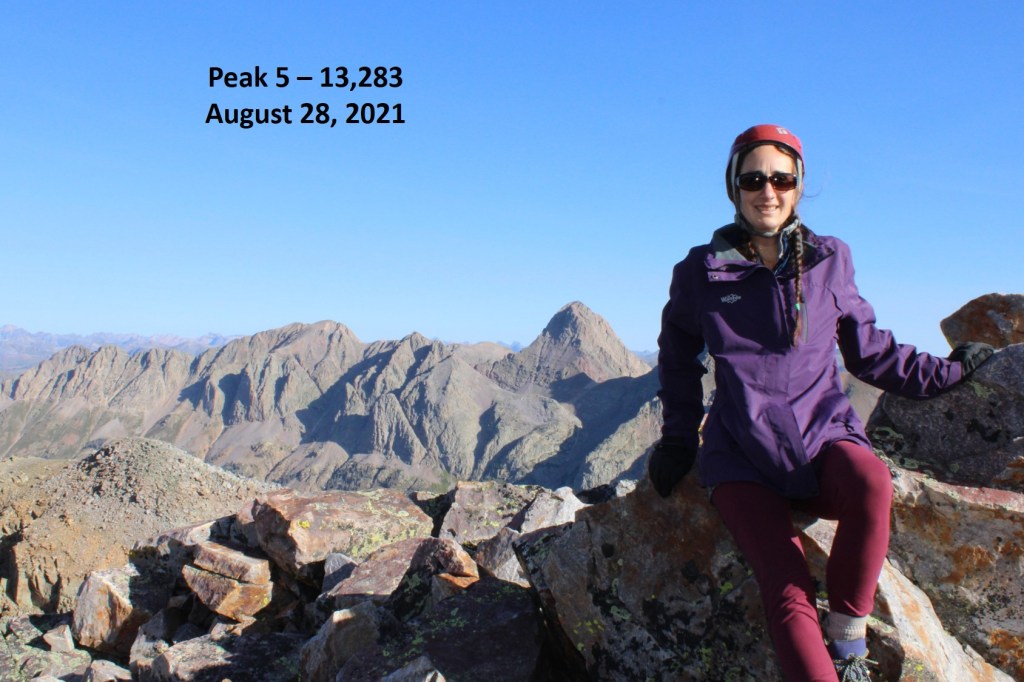
Once on the small saddle I could see Peak 5, and was a little apprehensive: that looked more than class 3. I dropped my gear, put on my helmet, and made my way over, only to find it’s an easy class 2 hike from the west side. I re-gathered my gear, and made my way over to the summit.
I summited Peak 5 at 8:45am. Unlike with Peak 6, I did not have cell reception here.
Peak 5:
I made my way back to the ridge, where I had a good view of my route down from Peak 6 to the ridge on Peak 5
I looked for the scree gully, and followed it back down to my campsite.
It would be hard to cliff out here, but you should get a good idea of your intended route from below before you start out for your peaks. Here’s what my route looked like from the lake, down from Peak 5 (you could also take this route in reverse, ascending this way)
I retrieved my gear. It was now 10am (I’d started around 6:30am, so it was less than a 4 hour loop) and made my way out of the lake area and back to the upper basin.
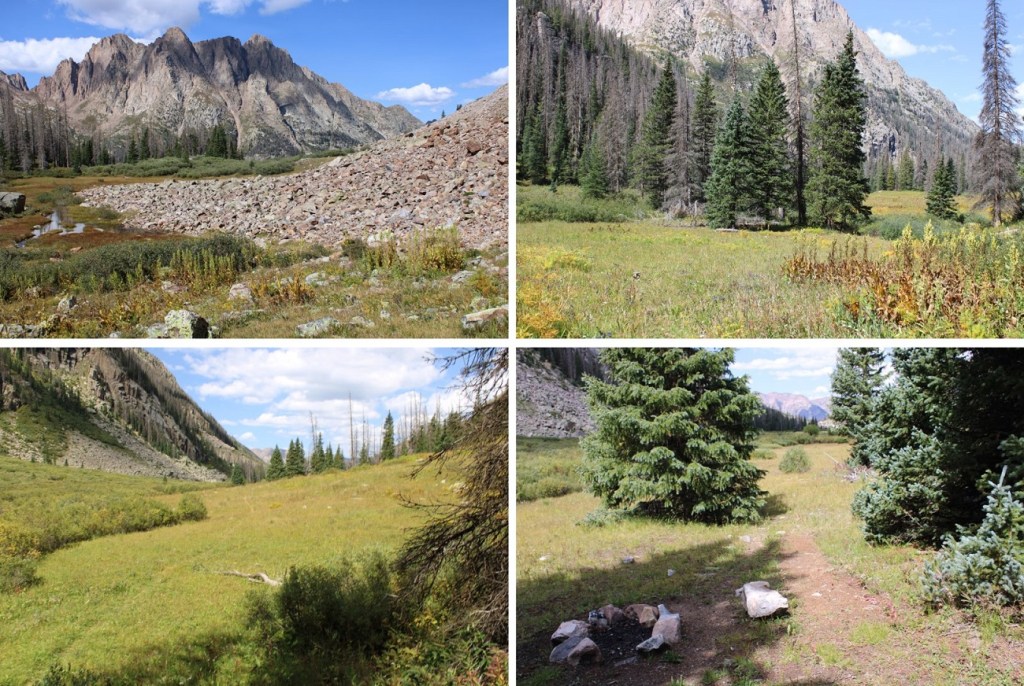
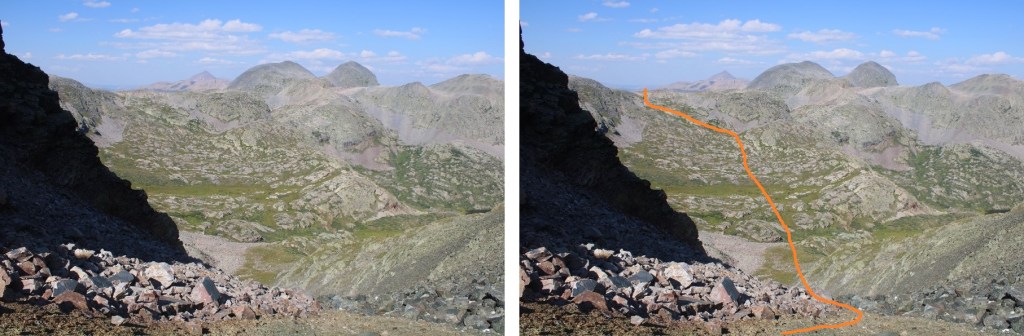
Then followed goat trails through the willows to the lower basin
It took me 2 hours to make it to Jagged Cabin from my camping spot by the lake. It was now noon, so I had a snack and a quick break before heading on through the avalanche area. It was much easier to find game trails on my way back than it had been on my way in.
The trail was easy to follow to the Animas River, and I had an easier time up and over Water Tank Hill than I thought I would have (it’s really not so bad). I arrived at the hill the same time as a train, and watched it for a few minutes fill up. Then it was on my way towards Needleton and the Chicago Basin area cutoff. Along the way, just before Pigeon Creek, I saw a small bit of bear scat that hadn’t been there on the way in. I know there’s a mama bear (and sometimes cub) that frequents this area, and wondered if I’d get to see her today? (I didn’t)
There was a family staying at one of the houses at the Needleton Train Stop. They had a fire going, a generator, and were pulling water from the river. I waved as I passed and continued on towards Needle Creek. When I made it there, I decided to just spend the night. I’ve always wanted to spend the night here, but it hasn’t worked out with my schedule. I was in no real hurry to get home at this point, so I set up camp. I had the whole place to myself the entire night. It’s weird not to have a compelling reason to hurry home; now that I’m an empty nester, I’ll be able to get in more hiking time. Side note: I made the decision not to bring deoderant on this backpacking trip because it was a smellable and added extra weight. Added to that, I was wearing the same clothes the entire trip, so what good would deoderant do anyway? On this third night backpacking, curled up as tight as possible inside my bivy to stay warm in the cold, shivering and not able to get a breath of fresh air from outside the bivy due to the cold weather conditions, I regretted this decision; I could strongly smell myself and it wasn’t ideal. Good news: by the next morning I was nose blind.
Chicago Basin cutoff:
Up early the next morning, I was on the trail by 6am, and made it back to the Purgatory parking area by 10am, making this a 54.06 mile trek with 12383’ of elevation gain.
Final side note: Just before getting to Jagged Cabin, on top of a hill but paralleling Noname Creek on an obvious game trail, I found what looked to be a recent cache torn open and destroyed by critters. I’m not sure if someone left this to be used later this summer, if they ‘forgot’ their gear, or if they left it after finding it ruined, but it’s all destroyed and useless at this point. It’s also trash. There’s a full tent that looked like it had been stored properly (torn to pieces now, of course), tons of food wrappers (like, at least 10 different wrappers from Ramen, and lots of snacks: it was a ton of food at some point, but diminished to empty wrappers now), a small radio, a destroyed first aid kit, an Ursack that had been ripped into pieces, etc. I took what I could, but there was a lot to carry out. Maybe if everyone took a little bit we could clean the area up?
I decided to take the Cottonwood Creek approach just because I haven’t done so before, and I’m glad I did. While there were some class 3 sections on this approach, the drive in was 2WD and there were way less people. Bonus: I didn’t have to re-climb Broken Hand Pass on my way out. This is my new, preferred way to hike Crestone Peak, Crestone Needle, and Broken Hand Peak (etc.)
I made it to the trailhead late, and wasn’t on the trail until 6:30am. There’s a trail register and obvious start area.
From there, I followed the class 1, Trail 743 and Cottonwood Creek for about 3.5 miles before coming to a fun rocky area. It’s August, and I saw tons of blueberries, strawberries, raspberries, and rose hips along the approach. Once the class 1 area ends, there are plenty of cairns to guide you.
This rocky area was a set of large rock slabs that went on for .75 miles. These were steep at times, and I wouldn’t want to attempt them in rain/snow. There are tons of cairns here, so if you don’t see one, you’re off route. The nearest one may be behind you. Keep the creek/waterfalls to your right.
Still well cairned, the trail now becomes rocky, and this is where you’ll find some of the class 3 and easy class 4 moves. There wasn’t an obvious junction, but I was now on Cottonwood Trail 861, headed northeast.
This was the sketchiest part for me the entire day
Of course, there are multiple sections of willows. Once again, a well cairned area, but these are willows, so be prepared to get whacked in the face by willow branches. Some of the cairns are under the willows, but there are obvious trails.
I was now back on the well established, class 1 Cottonwood Trail.
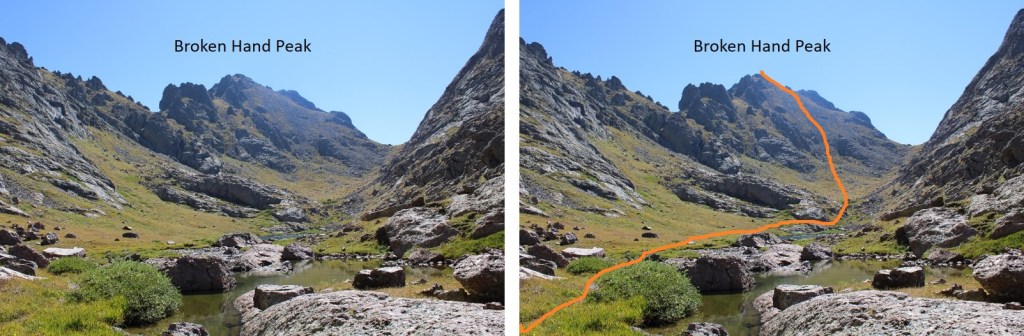
I followed this trail east, around Cottonwood Lake, towards Broken Hand Peak. Here’s an overall view of my hike up Broken Hand Peak
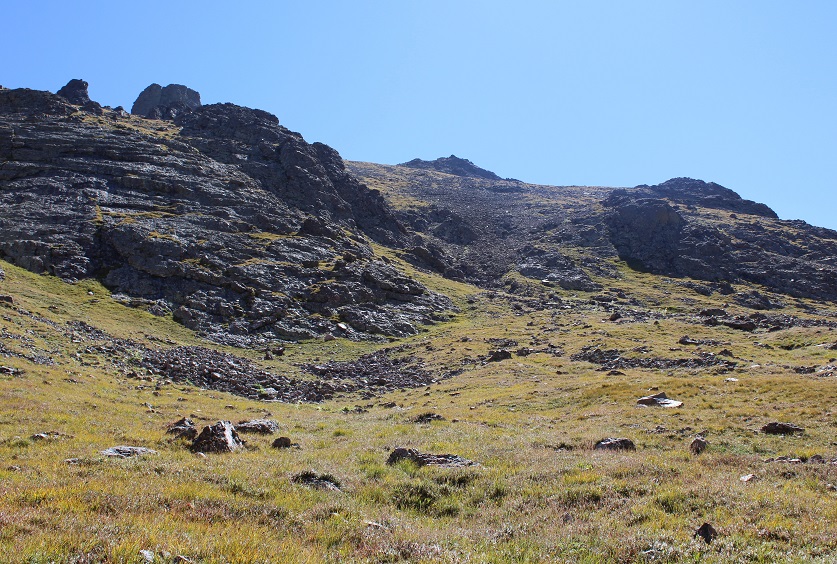
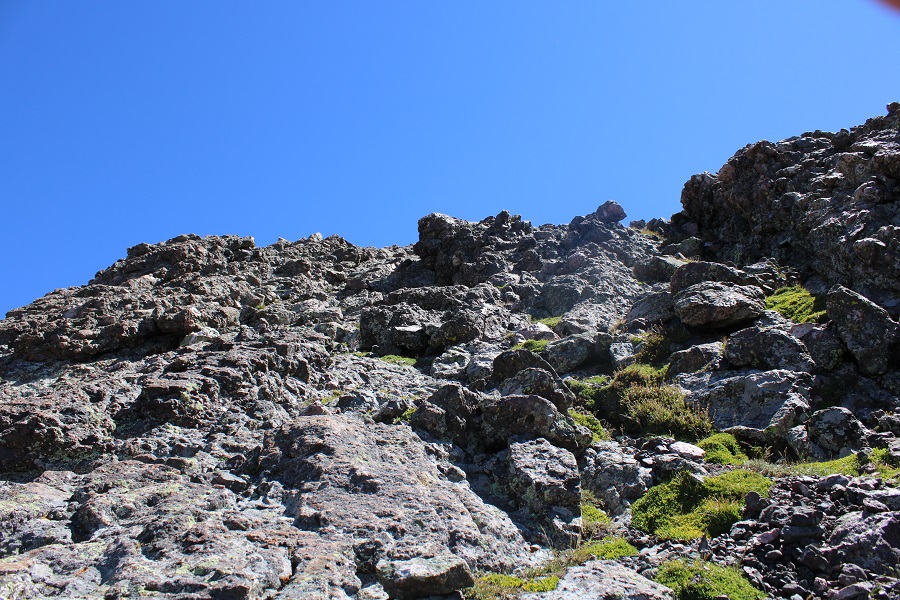
I skirted Cottonwood Lake to the left, following the class 1 trail, then left the trail before it headed towards Broken Hand Pass, and instead headed east up the slope to Broken Hand Peak. This was straightforward, class 2 the entire way. Here are some closer pictures of the route
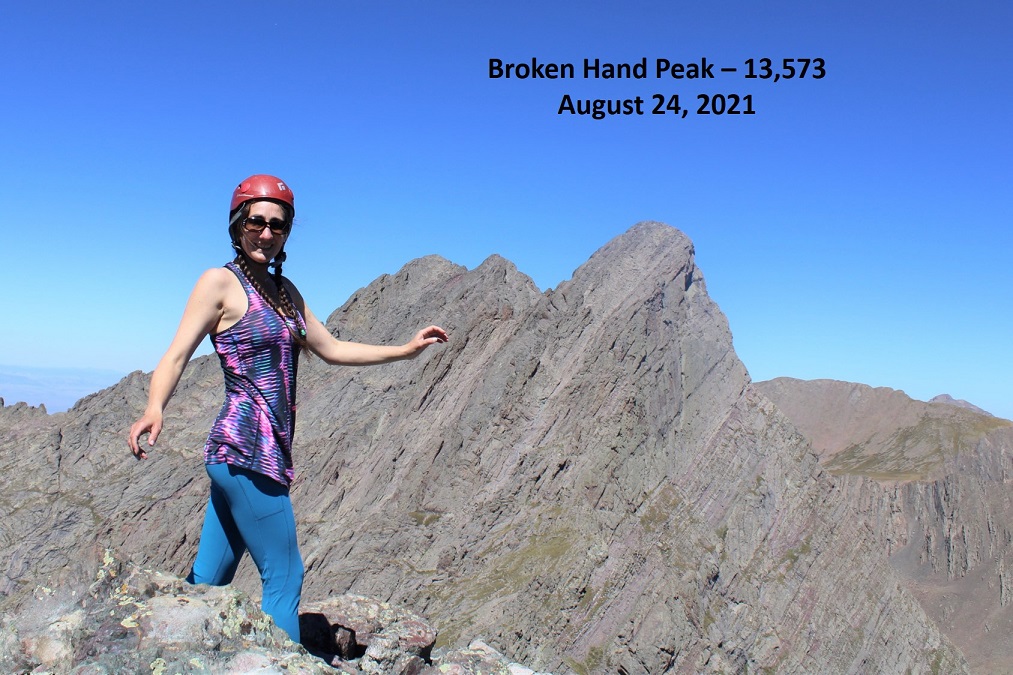
I summited Broken Hand Peak at 11:15am.
Broken Hand Peak:
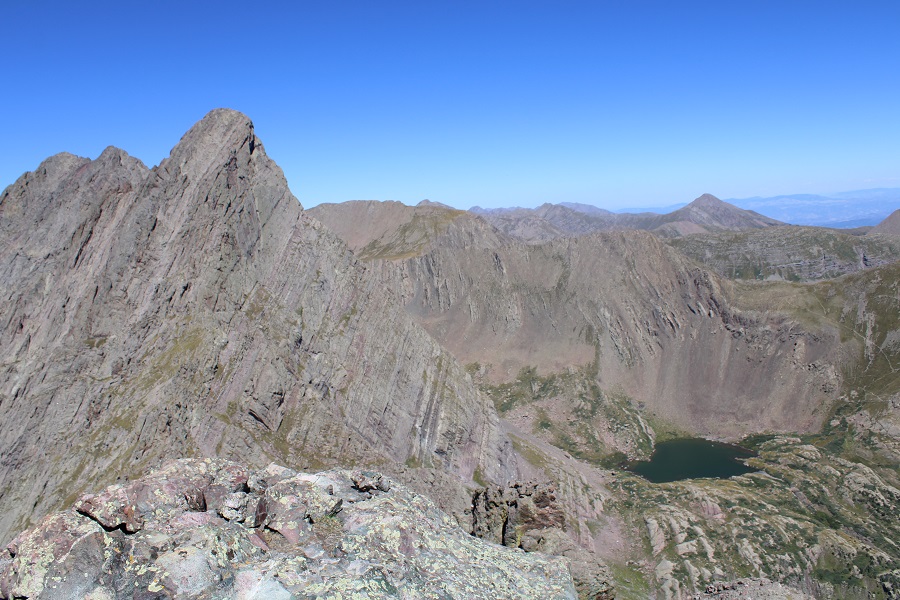
It was a beautiful day! I stayed longer on the summit than I normally do, just enjoying the good weather (and cell service!). check out Crestone Needle and South Colony Lake.
Then I was off, retracing my steps, heading back down towards Cottonwood Lake. Here’s an overview of the route back to the lake
And then back through the willows and down the class 3-4 section
Following the cairns back down
Once past the rock slabs, it was an easy hike on class 1 terrain back to the trailhead.
I made it back to my truck at 3:30pm, making this a 14.41 mile hike with 5793’ of elevation gain in 9 hours.
This trip changed so many times before it even began. I have an actual job, with responsibilities, meetings, etc. I drove down to Durango Wednesday night, slept in the cab of my truck at a Walmart (the topper is still on order), got “the knock” at 10:30pm, moved, then woke up and worked/had meetings in my truck the next day. Then I drove to Hunchback Pass through Silverton (my favorite way to get to Hunchback pass). It started raining as soon as I hit the dirt road, and didn’t stop. There was a 60% chance of rain today, but I was still hoping to find a window and hike either 5 or 10 miles to a camping spot (depending on when it got dark, weather, etc.).
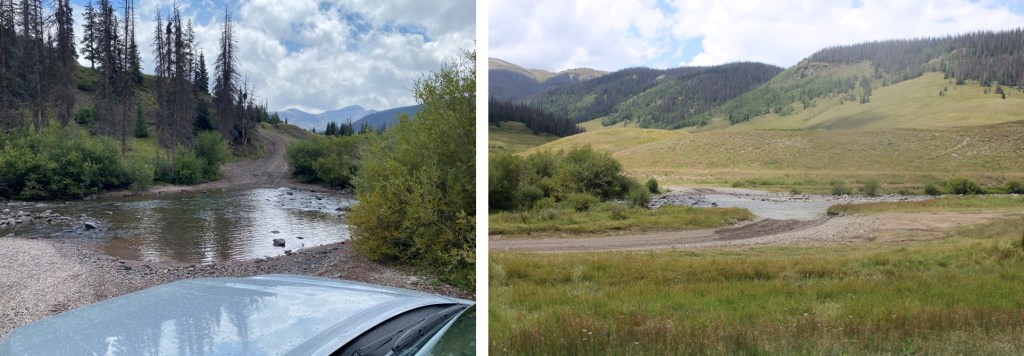
The road over Stony Pass was sketchy in the rain. Miles did great, but there were a few times I was worried the mud was too deep to get through. I was a bit worried about the river crossings too, but Miles once again had no trouble.
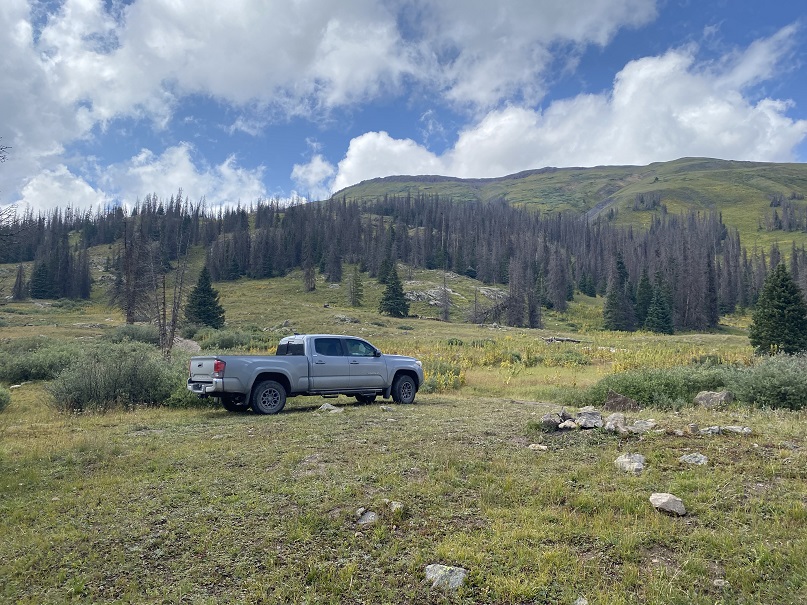
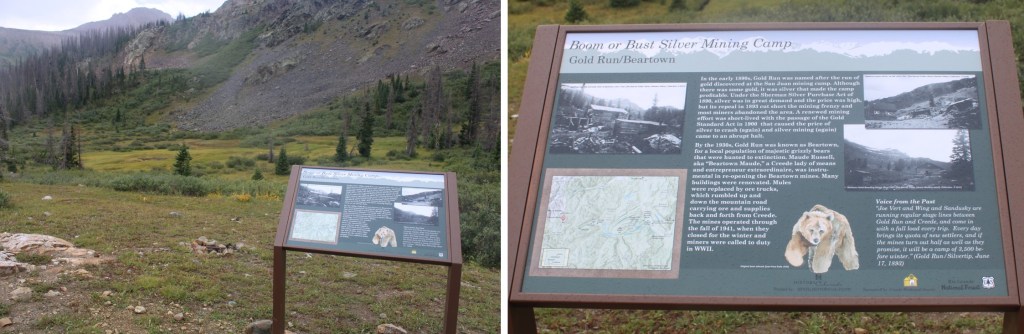
I’ve been to this area 3 or 4 times, and know the perfect place to park: It’s a pullout at 11230’, just before you hit the trees (again), and before getting to Beartown. My truck can make it further, but from past experience I know it’s going to get Colorado pinstripes from the willows and I have the opportunity to scrape the frame a couple of times as well. I love my truck, so I parked here, about 1.3 miles from the trailhead, in a flat spot with a campfire ring at 11235’.
I parked and waited for the rain to stop. The rain turned to graupel, then rain again, then hail. I could see the clouds coming over Hunchback Pass, and they weren’t getting any prettier. Wave after wave of new sets of clouds kept cycling in. After waiting for a few hours, I decided to just get some sleep. I know many of you would start out in the rain, but with my Raynaud’s I can’t risk it: If I get wet/cold that’s it for me, as I cannot warm up. I woke up every hour to check on the weather. The rain didn’t stop/clouds didn’t clear until 4:30am. That was a 15 hour rain delay that was seriously messing with my summiting plans.
I put on my rain gear to ward off water on the trail dripping from plants, and was on the trail before 5am.
Day 1 went like this:
Gained 1275’ over 2.8 miles (to Hunchback Pass)
Lost 2350’ over 5 miles (to Rock Creek Junction)
Gained 2503’ over 6.4 miles (to pass over Rock Lake)
Lost 500’ over .5 miles (From pass across basin)
Gained 1150’ over 1 mile (from basin to Oso/Soso saddle/to Oso Summit)
Woot! Summit!
Lost 1150’ over 1 mile (back to basin)
Gained 500’ over .5 miles (back to saddle)
Made it back to Rock Lake (losing about 600’ more)
Ok, so, let’s start from the beginning: From my parking space at 11235’, it was an easy hike to the trailhead, passing through Beartown. There were two other 4WD vehicles parked here, a 4Runner and a Tacoma like mine, unmodified, so you know it’s doable (choose wisely).
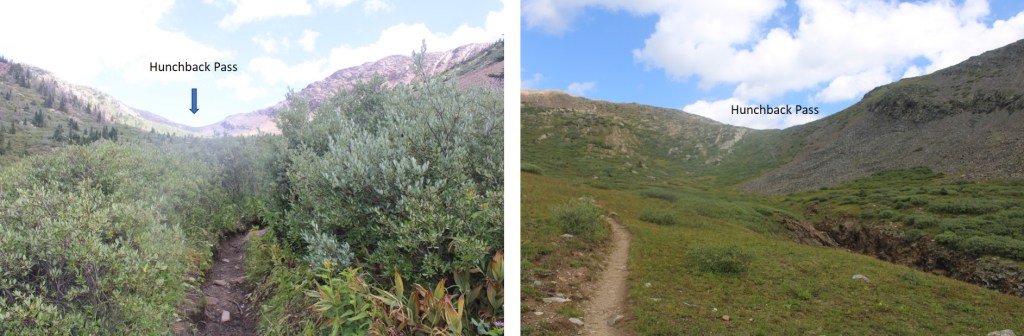
Once at the trailhead (813) I followed the Vallecito Trail up to Hunchback Pass
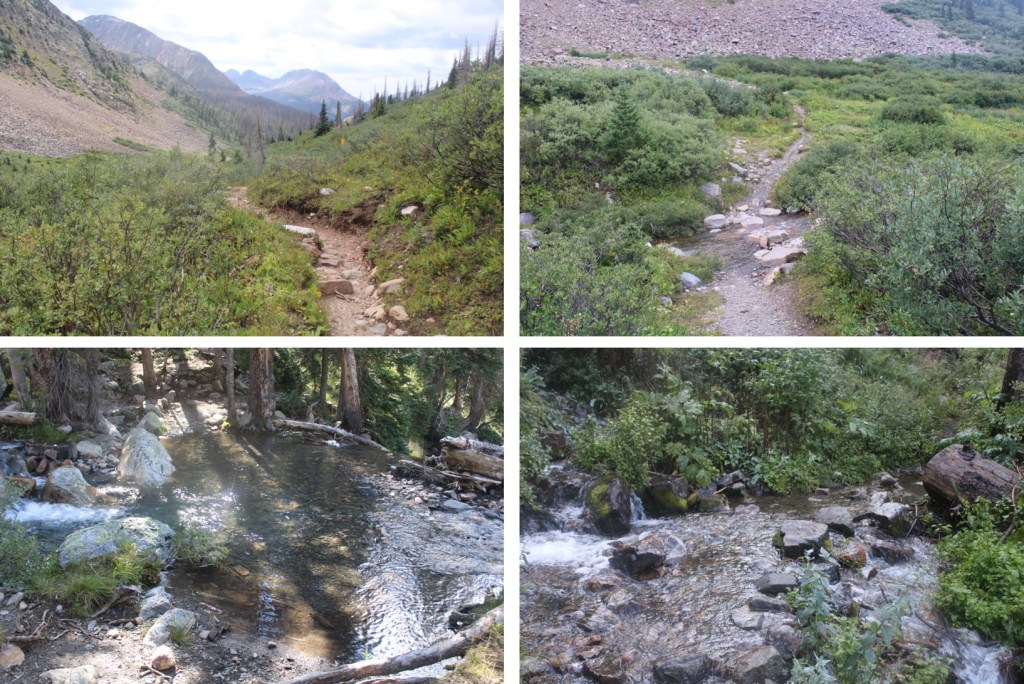
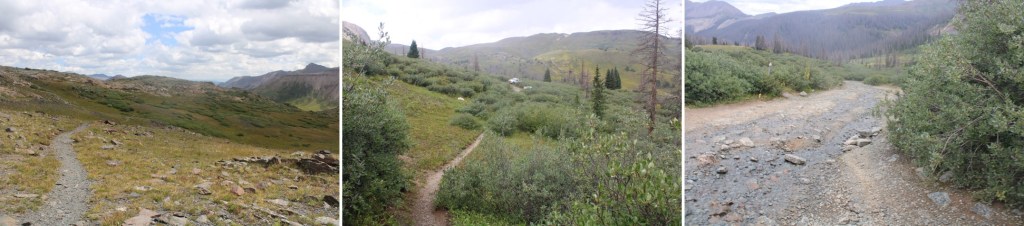
And then I headed south through the basin, following the trail down for 5 miles as it lost 2350’ in elevation
There were willows here, and I was glad to have on my rain pants. There were a few stream crossings, all easily crossable.
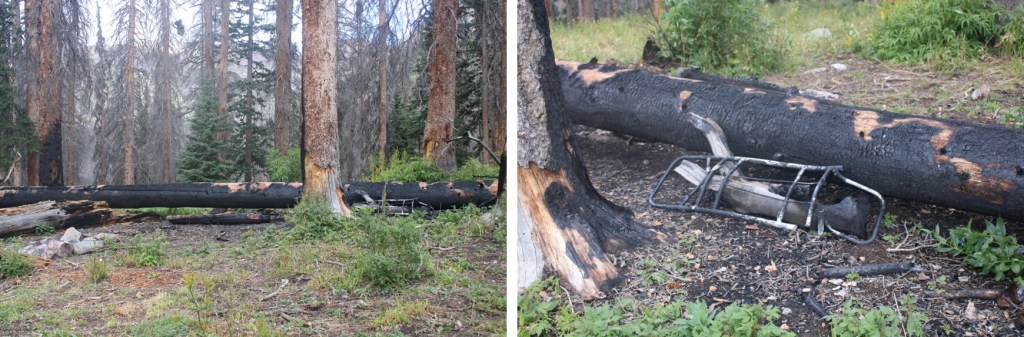
I saw evidence of someone’s fire getting out of control: looks like they lost their pack in the process. I wonder how they put it out? In case you’re wondering, yes, the ground was cold and the fire was out (I’m sure the 15 hours of rain last night had helped).
After hiking for a total of 7.8 miles (from where I parked) I made it to the Rock Creek Junction, and followed that trail southeast for another 5 miles up to Rock Lake. This trail was also class 1, and easy to follow.
Just before making it to Rock Lake I passed through a basin
In this basin was a bull moose. I didn’t worry too much about him, because he was hundreds of yards away from me, on the opposite side of the basin. I continued on the trail, but once he noticed me, he raced towards me and stopped a few yards away. He charged me (it was a bluff). I knew not to make eye contact with him, which was what he wanted. I could actually feel him willing me to look at him. I kept my head straight and walked the trail with a purpose, ignoring him. He continued snorting and pawing at the ground and shifting his head from side to side. Then he paralleled me for about 50 yards, walking about 5 yards to the west of me. When he was done, he trotted away and took in a view of the mountains.
As he trotted away I breathed a sigh of relief, and continued on the trail, exiting the basin and making my way to Rock Lake.
I arrived at the lake at 11am and decided to set up my campsite for the night. I didn’t see anyone else here.
It was still early in the day, so after a quick snack I left my heavier gear and just brought the essentials: I planned to summit Mt Oso today. To do that, I skirted Rock Lake to the east and ascended the rocks
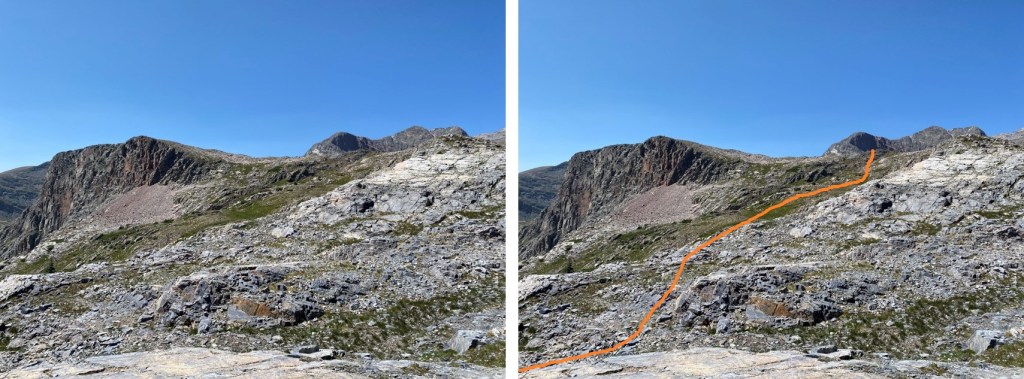
As I made it to the rocky area, I came across a cairned trail, and followed that trail southwest. Note, I took the solid line up, the dotted line down. The dotted line was easier, but both ‘went’. You can’t tell from below, but there’s a grassy area by the dotted line that helped me avoid the willows (pictures on my way down).
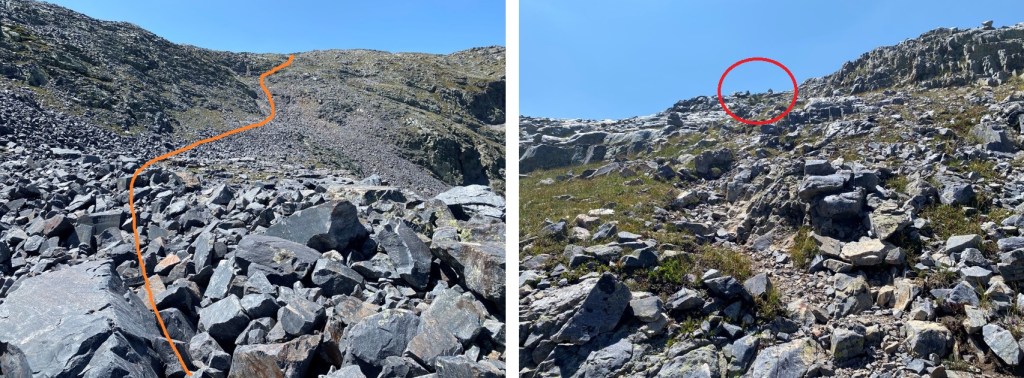
Here’s the cairned route, with the ‘exit cairns’ circled in red
Here’s where I left the trail. If you continue following the cairns, you’ll go down to Half Moon Lake. I was headed towards Mt Oso, so I left the cairns and continued heading up (west).
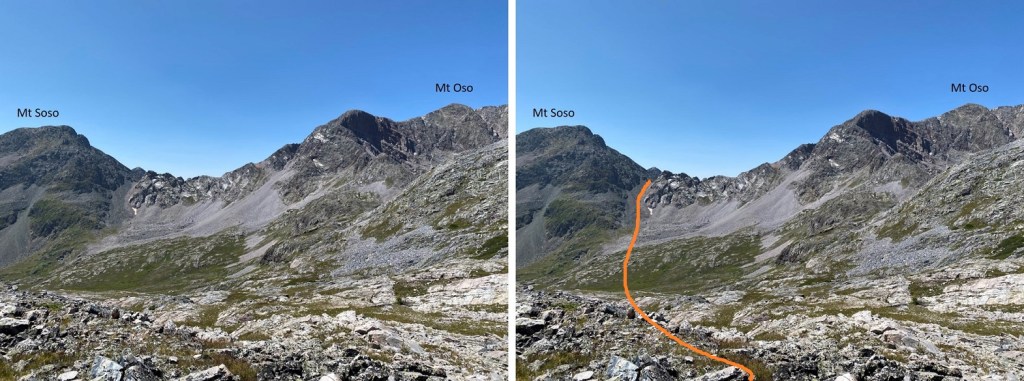
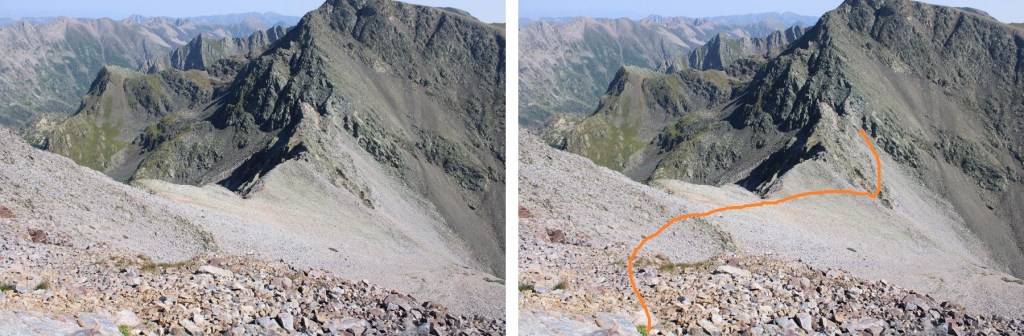
Time for more elevation loss, and gain. I was headed for the Mt Soso/Mt Oso saddle. This required me to lose 500’ through this basin, and then ascend the gully.
The basin was easy to cross. There were small streams and some willows to navigate, but the route was obvious (and choose your own adventure: just keep heading towards the gully/saddle). The gully was a mix of large, loose boulders, smaller loose rocks, and scree.
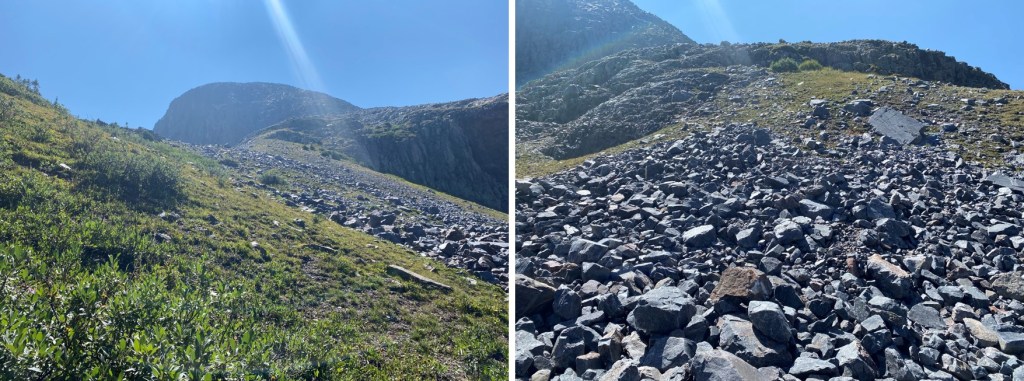
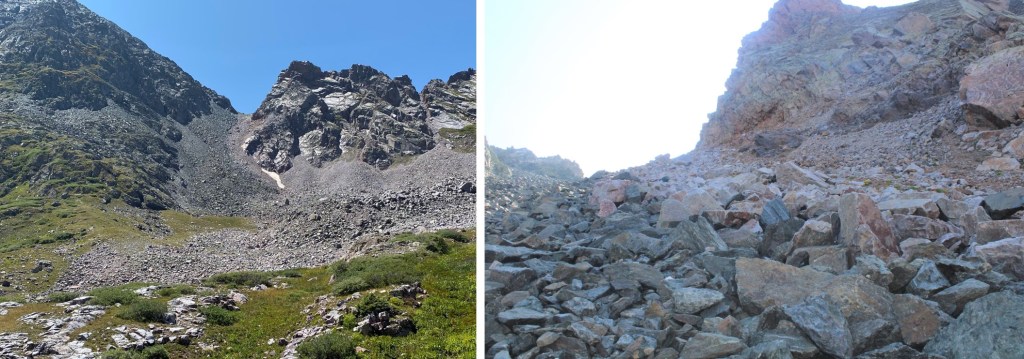
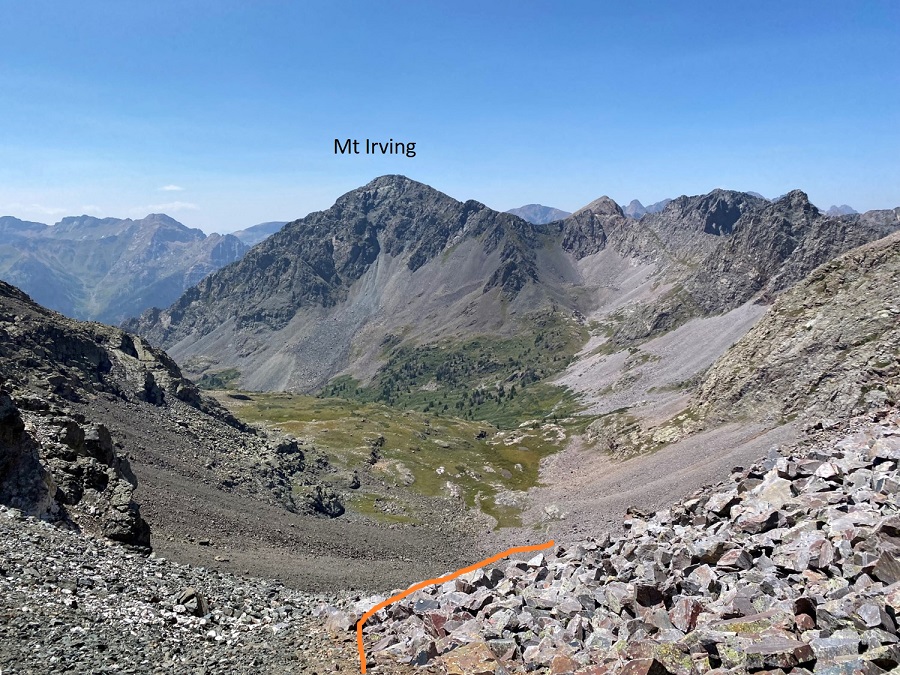
Once at the top of the gully/saddle, it was once again time to lose elevation. Being here also gave me a great view of Mt Irving. I descended the gully to the northwest, staying on the scree at the base of the rock outcroppings, rounding them, and losing 175’ in elevation.
Stay low here. You’re going to want to stay high, but you’re aiming for a green rock band to cross. It’s lower than you’d like it to be (around 12600’)
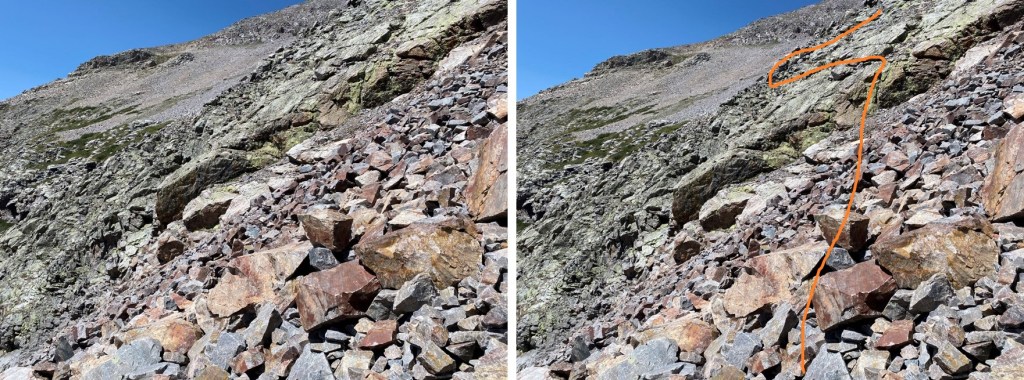
There’s a little bit of scrambling to get over the rock band. I was able to keep it as easy class 3 by taking this route
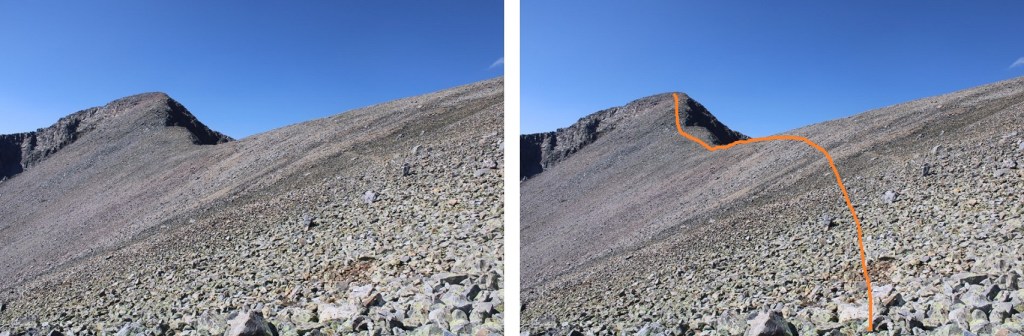
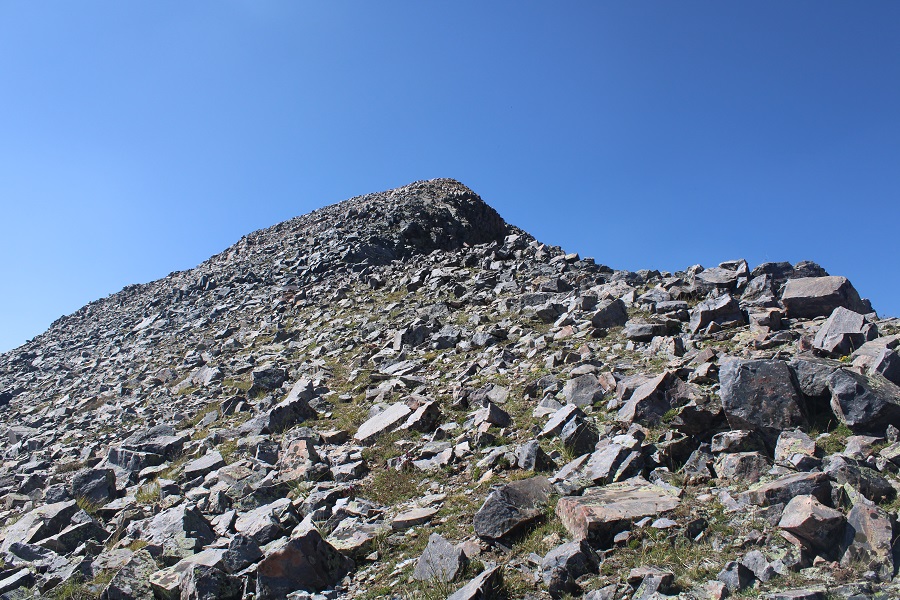
Once across the green rock outcropping, it was time to gain the ridge. I turned and headed north. The rocks here were large and loose, with some scree mixed in.
I went low just before ascending the ridge, following a scree/game trail
And then followed the ridge to the summit
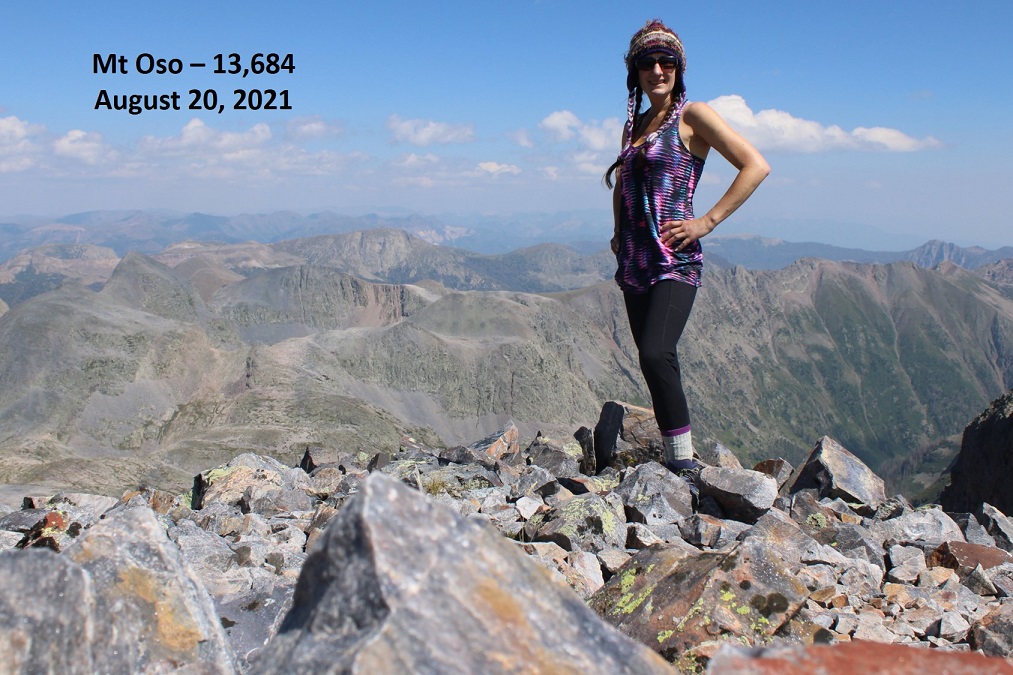
Summit of Mt Oso
Mt Oso:
There was a large, military grade summit register, with a moving dedication inside, as well as some ceramic bowls (I’m sure that’s not what they actually are, ad that they have a purpose?).
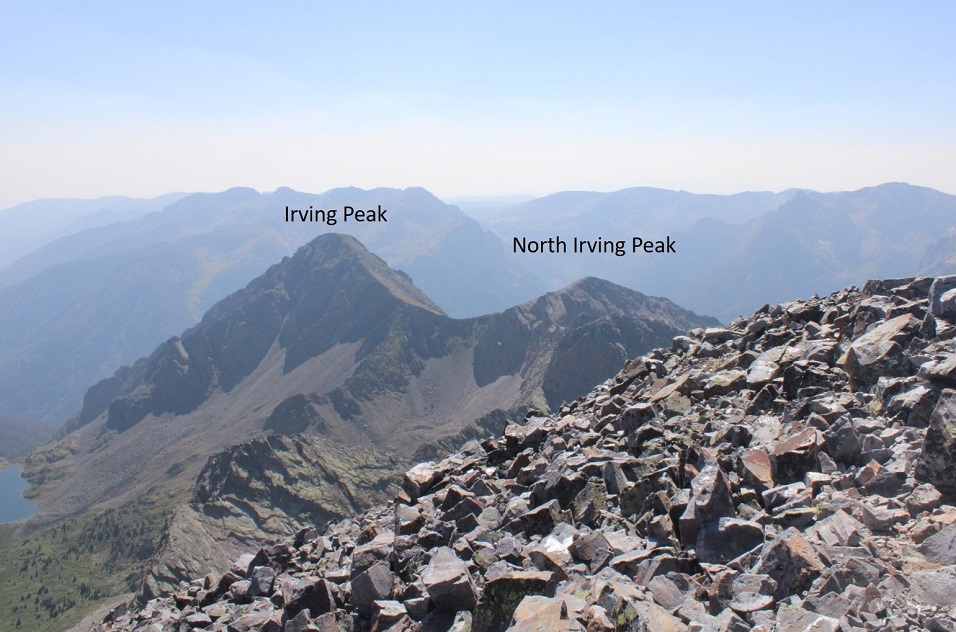
I looked over at Irving and North Irving. I did the math in my head, and there was no way I had time to loose the 1500’ of elevation, then regain 1300’ to summit Irving, plus hike back with all those ups and downs to Rock Lake before sunset. It’s important I’m in my sleeping bag before the sun goes down, which limits my hiking time. Oh well, just one peak for this trip.
So, I turned and headed back towards the Oso/Soso saddle
Back at the saddle I retraced my steps down the gully, back across the basin, and up to the next ridge, finding a grassy bank to ascend
The route looks much different heading back, so be sure to study it on the way in. Stay just below this cliff band
And now to head back down to the trail
You know you’re back on trail when you see cairns
Back down to Rock Lake. Here’s an overall view of the route I took down, and check it out: another camper! I walked by his tent, and apologized for doing so, but told him he was camped in the only area without willows…
There are lots of cairns here to guide you back down.
I made it back to my campsite as the wind started picking up. I was glad I’d made the decision to head back. I jotted down some notes, and looked at my tracker: I’d done 18 miles today, with almost 7500’ of elevation. I sat in my tent for a while, glad I’d decided to bring a tent, listening to the wind howl outside. I eventually fell asleep, and woke up to frost inside my tent. Lovely. I quicky broke camp and headed back down into the basin. Everything was covered in a thinl layer of frost.
Oh, did I mention the trails were mucky? It was from all of that rain yesterday. The entire way in, and out, I was walking on water/mud/avoiding puddles, glad I was wearing new hiking boots that were still waterproof.
On my way out of the basin I decided not to take any chances, and wore my helmet. Towards the end of the basin I spotted the moose again. This time he had a friend, and didn’t seem to care I was there. I’ve seen over 20 moose in Colorado while hiking, and this was the first aggressive one I’ve come across. It’s interesting today he had no interest in me, while yesterday he was overly intrigued/agitated I was there.
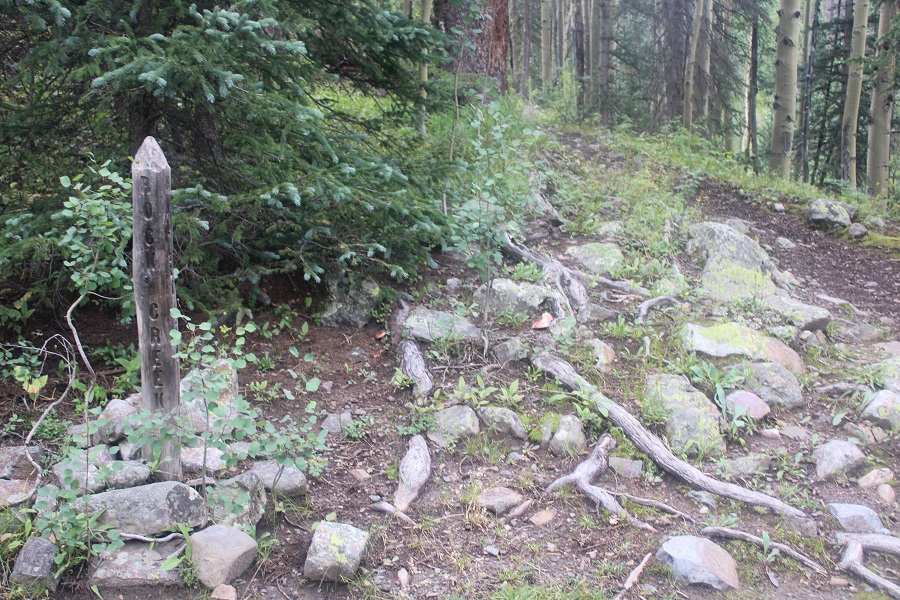
I followed the Rock Creek Trail back down to the Vallecito Trail
Then took the Vallecito Trail back up to Hunchback Pass
And then back to the trailhead, the road, and my truck
When I made it back to my truck, my tracker told me I’d hiked 33.61 miles with 9833’ of elevation gain.
Now, for the hour and a half drive back to Silverton! Oh, also, side note: If you’re driving these back roads, make sure you know where you’re going! It’s easy to get lost back here. I met a man in a jeep as I was hiking back to my truck who was totally turned around. He wanted to know how much further down the 4WD road to the ‘real’ road. I had to tell him he wasn’t going in the right direction (this road is a dead end) and that Silverton was many, many miles away. An easy way to not get lost out there without cell service is to load your track onto CalTopo, then add a line and trace the roads you wish to take, then use that track your drive.
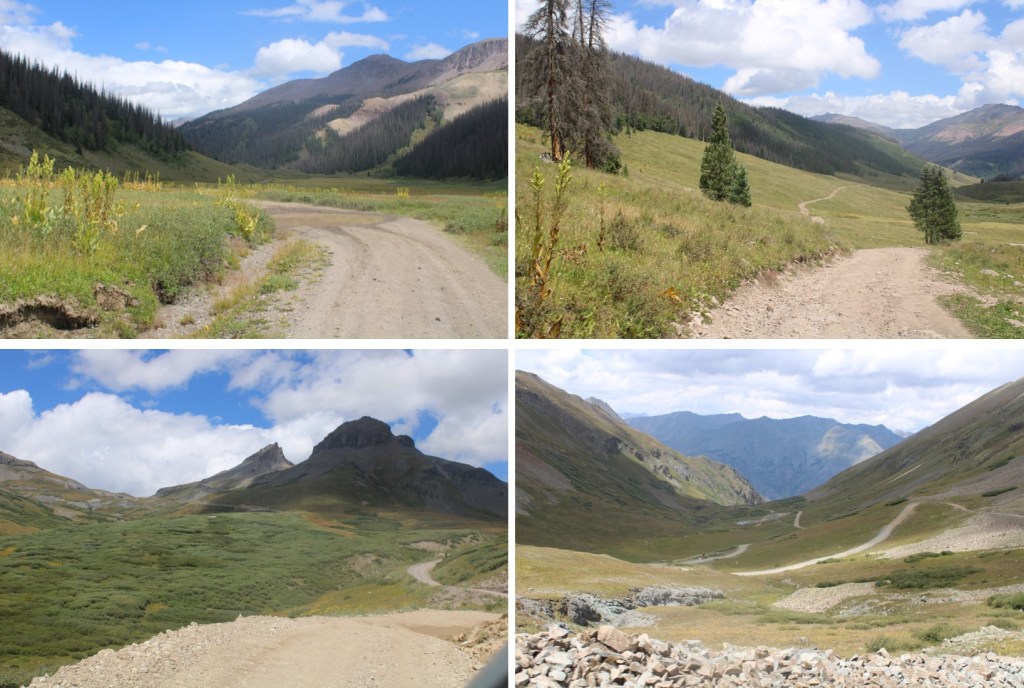
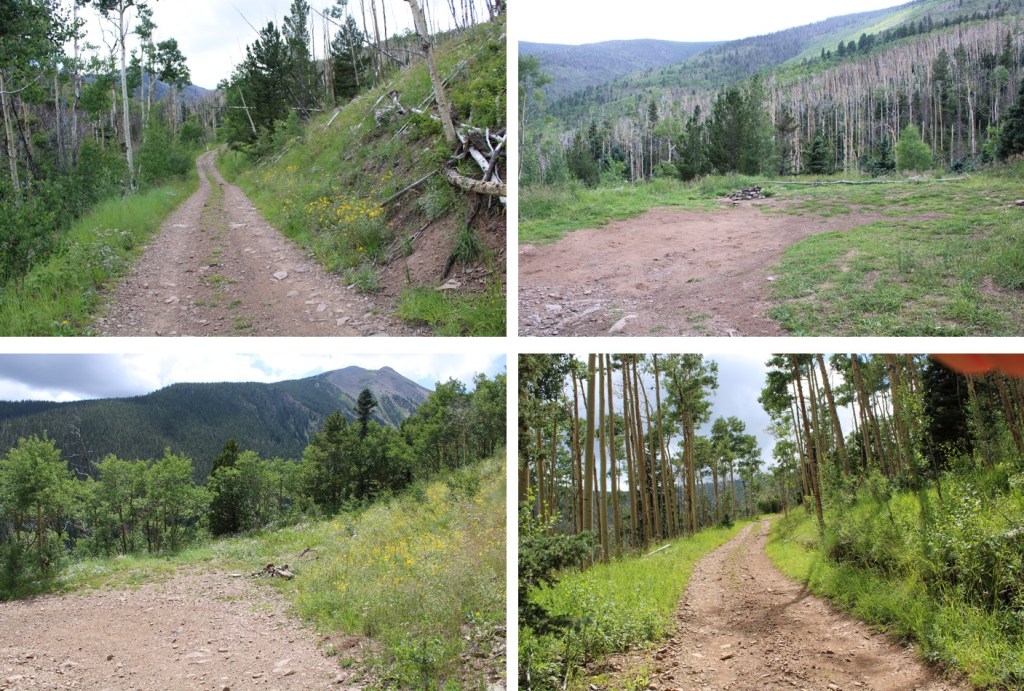
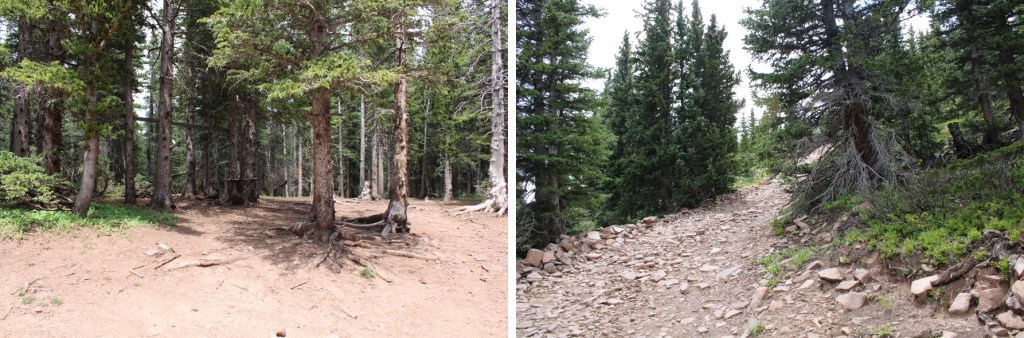
Just for fun, here are some pictures of the road out…
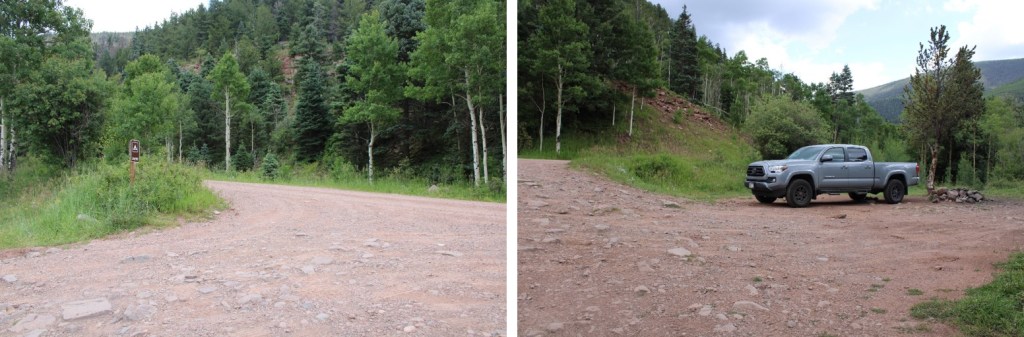
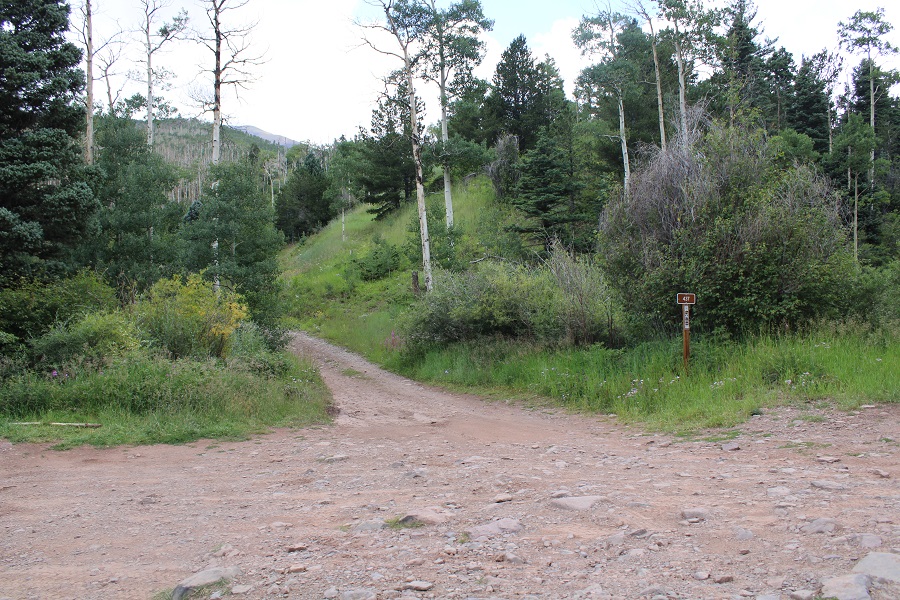
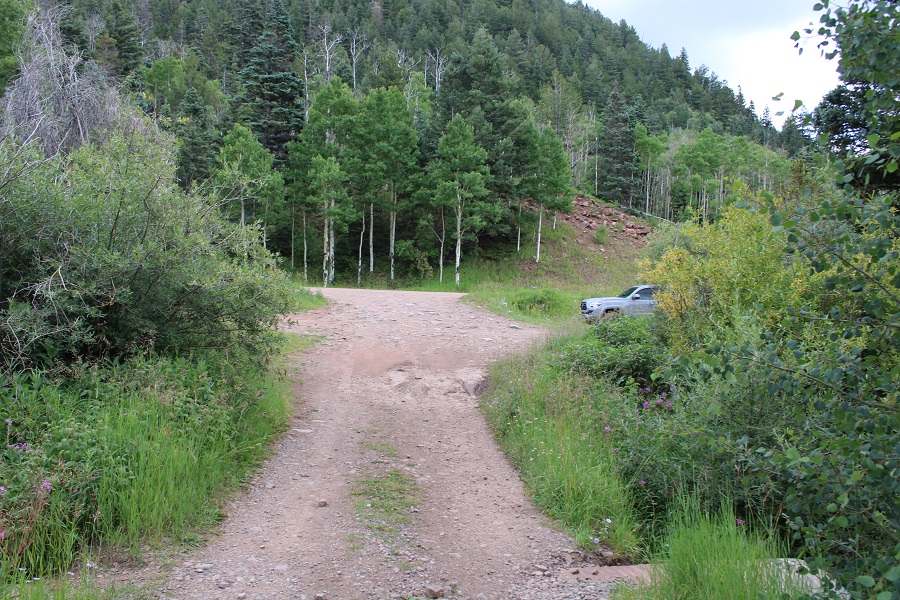
There’s a lot of dispersed camping spots along 34, and just before reaching the Purgatorie Campground off 34 there’s dispersed camping spots on the left, at the junction with 437. It was dark when I arrived, so I parked at the camping spot on the side of the road and was on the trail at 4:30am.
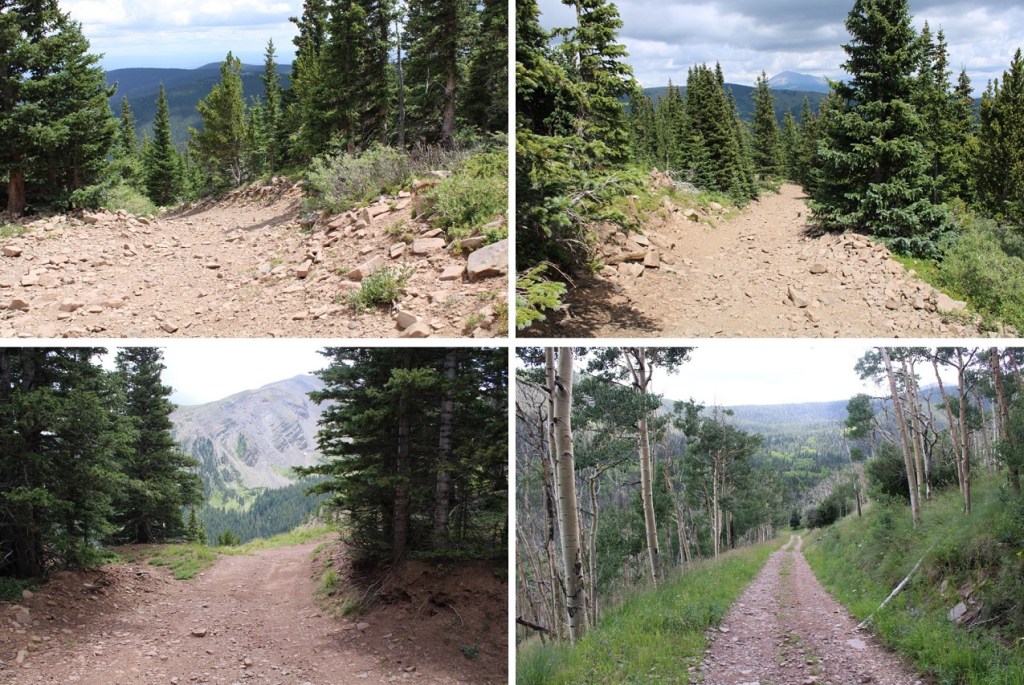
The trail follows road 437, and, although I didn’t know it at the time, my Tacoma could have easily made it all the way to 11700’ (the end of the road). However, by the time I figured this out it wasn’t worth going back to get my truck, so I kept on hiking.
I followed 437 for just over 3 miles to 11700’. There were several dispersed camping spots along this road as well, mostly at switchback junctions.
Just before the last surge of elevation gain there’s a kind of junction in the road. Turn right here, as taking the road to the left doesn’t go anywhere. There will be a nice camping spot on the right, and then a steep section of road and you’re at the end of the road (and another campsite)
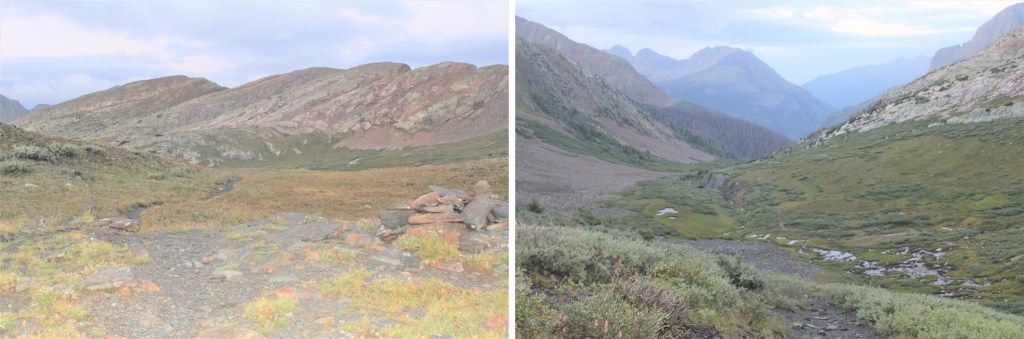
Where the road stops the fun begins! I headed west to treeline by ascending this hill. If you look carefully, you’ll find cairns here that will get you to treeline: there are several cairned routes here.
Once at treeline the route will be obvious: Juts follow the ridge west. I brought a helmet, but didn’t feel the need to wear it at all today. The toughest part of this route is easy class 3, and usually just a move or two at a time.
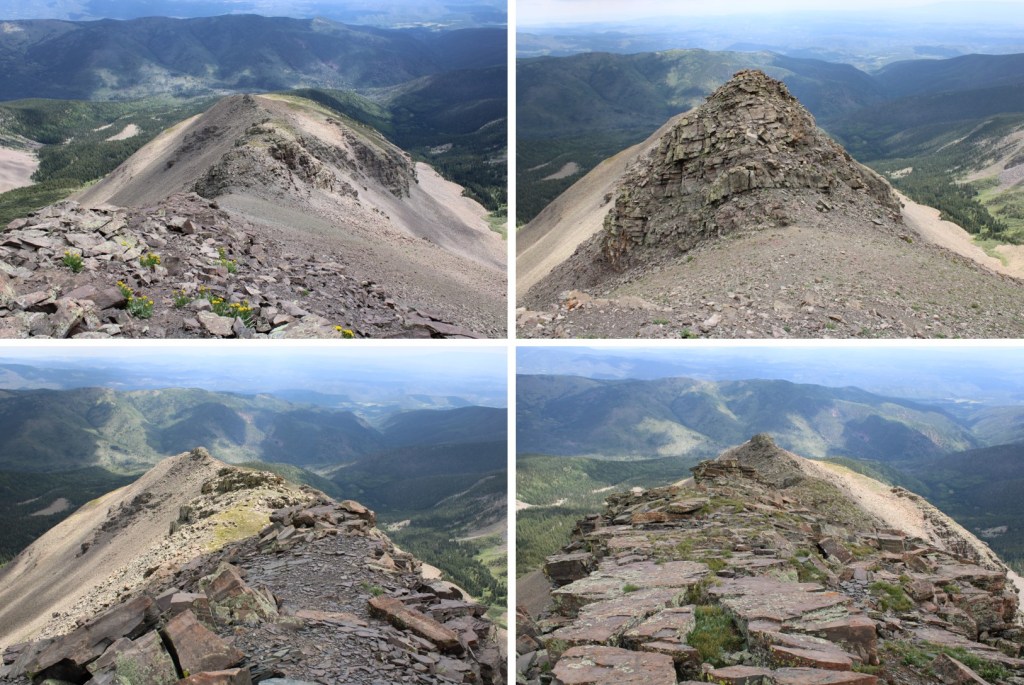
You can stay on top of the ridge the entire way to the summit: even if it looks like you’ll cliff out from far away, you won’t. Here are some ridge views…
I summited unranked Mt Maxwell and took a look around. On the summit there was a property boundary marker, and just a little further west was a “No Trespassing” sign. I’m not sure why anyone would want to continue west, as the terrain cliffs out, but this is the boundary for the Trinchera Ranch. This was the one and only “No Trespassing” sign I saw. I did see property/boundary markers, and made sure to stay on the San Isabel National Forest side of the markers.
I decided to give the boundary line plenty of space, knowing they have game cameras set up here, and turned and headed south towards Mariquita Peak, being sure to stay at least 50 feet east of the ridge to ensure I was on San Isabel National Forest Land, even if I couldn’t see a boundary marker. I hear the rules for accessing this property change, so be sure to have the most up to date information. This was the most up to date info I could find: https://cpw.state.co.us/learn/Maps/RFW_Trinchera_South_geo.pdf
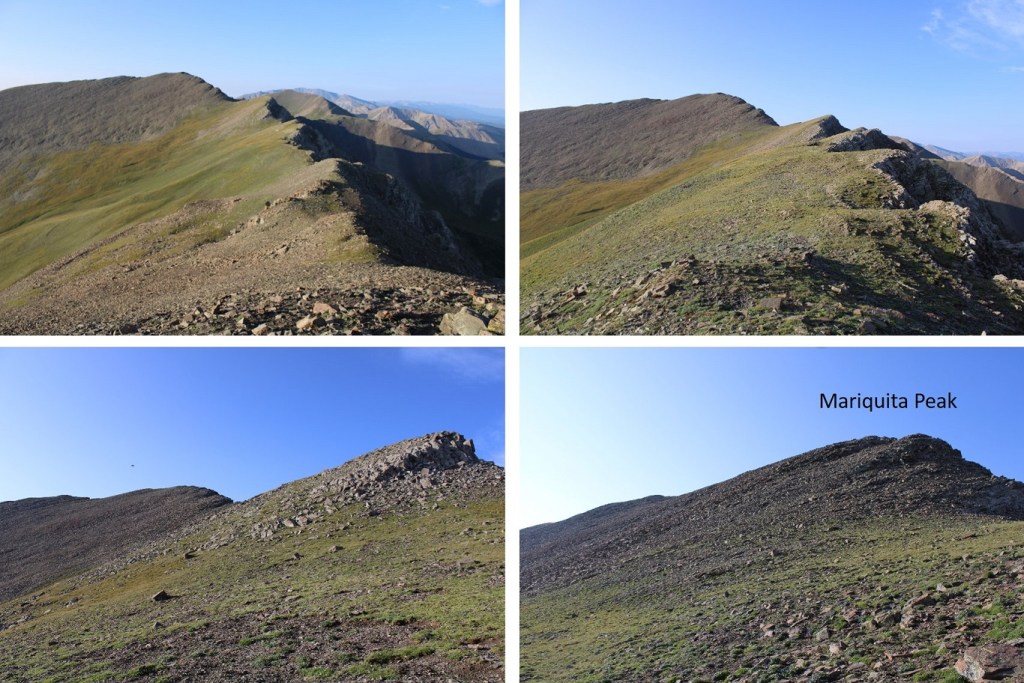
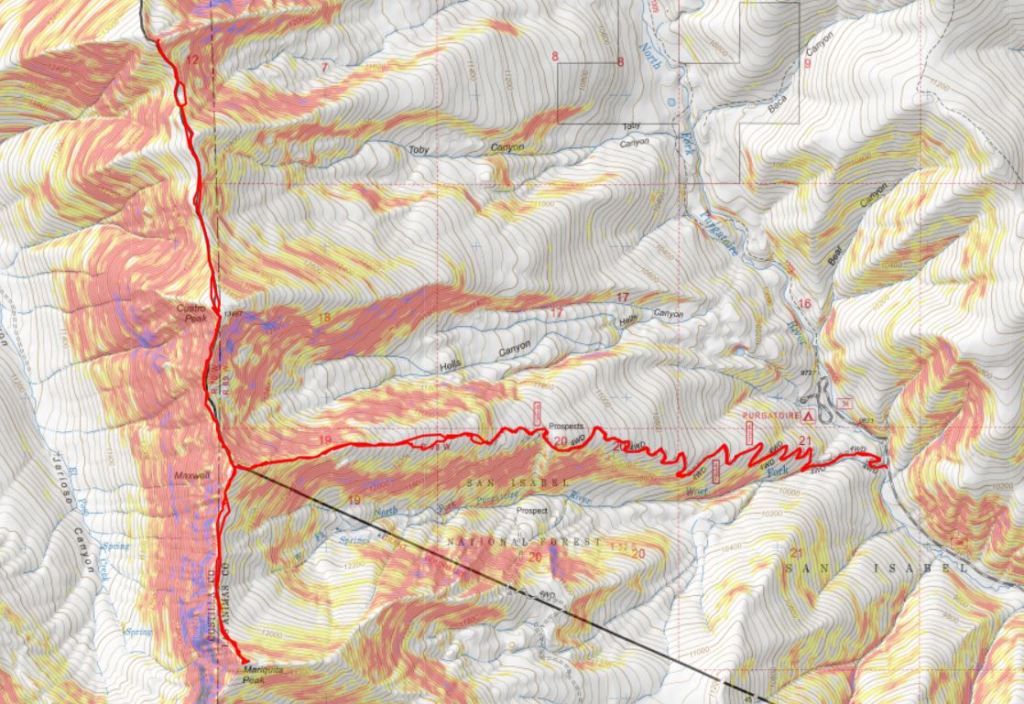
Here’s the route I took to Mariqueta Peak
The beginning of this hike was rocky (better pictures on my way back), then became an easy tundra/ridge hike, before once again becoming rocky. There was nothing technical about this hike. I descended just under 300’ to the saddle, and then ascended about 400’ to the summit.
On the summit there was another property marker, this one placed inside the summit cairn. I made sure to stay east of this marker as well. I summited Mariquita Peak at 8am.
Mariquita Peak:
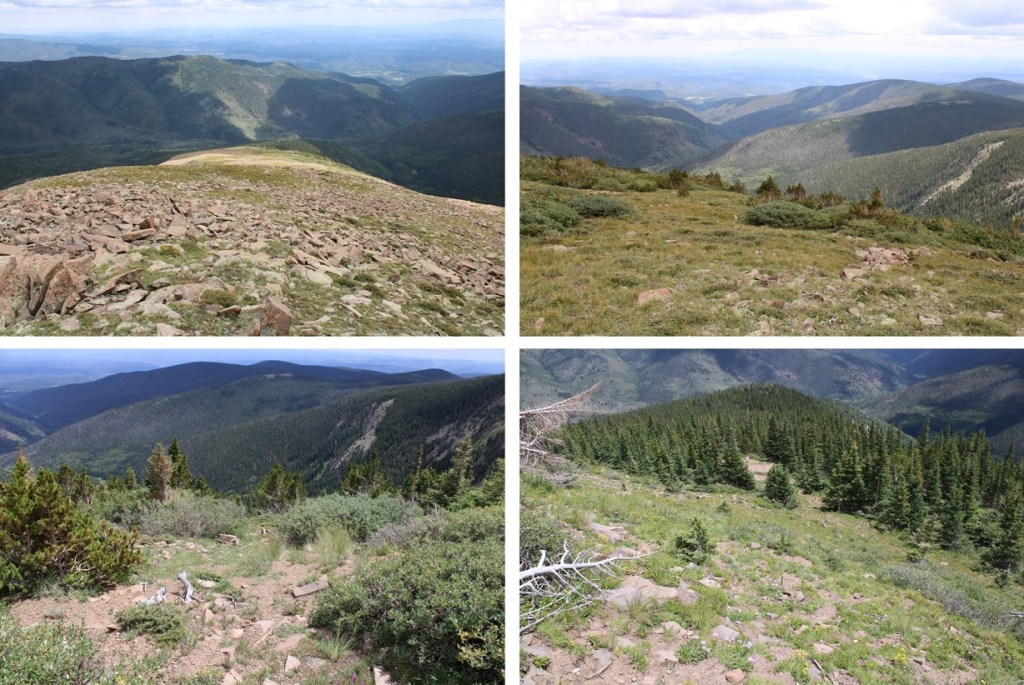
Here are some pictures of the path back to Mt Maxwell (once again, I stayed east to remain on National Forest Land)
As I ascended Mt Maxwell I stayed right, avoiding the rocky sections
I re-summited Mt Maxwell at 11am
Mt Maxwell:
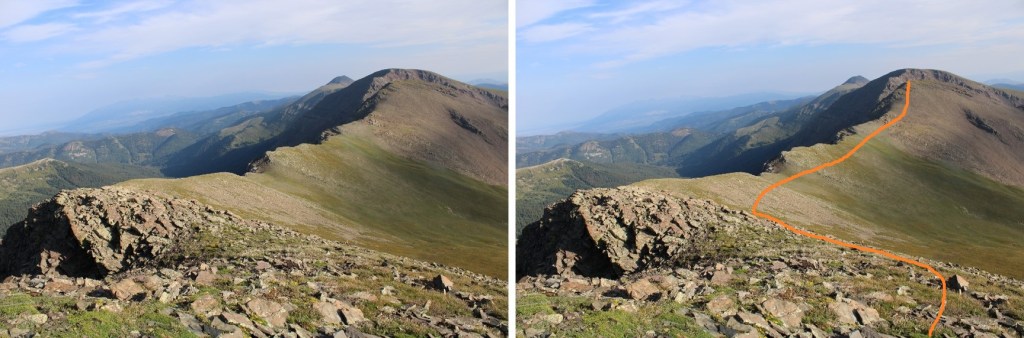
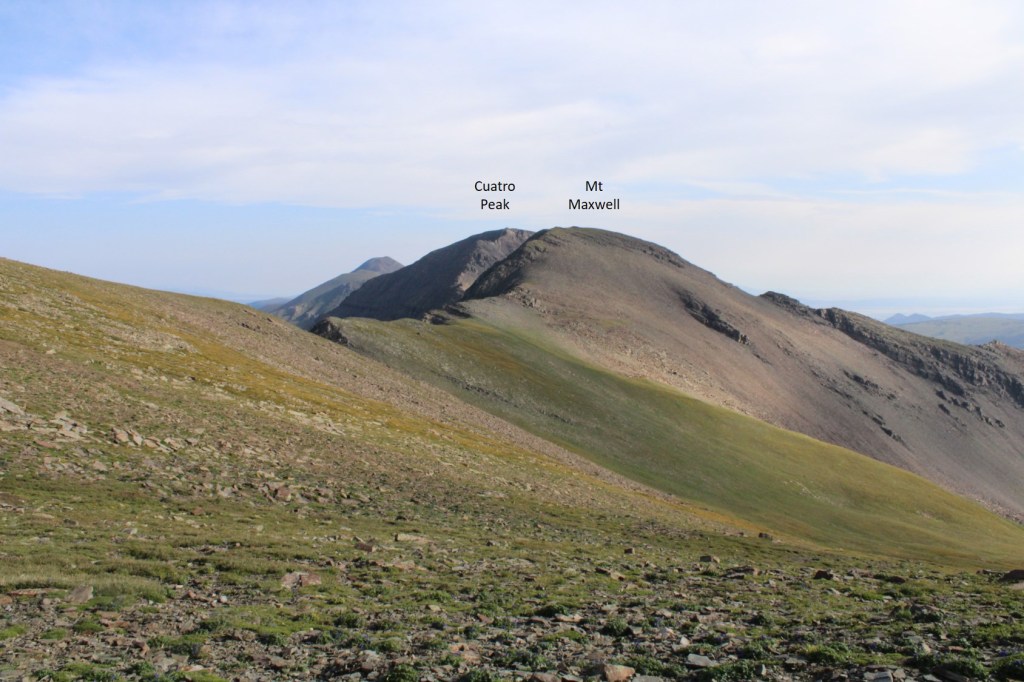
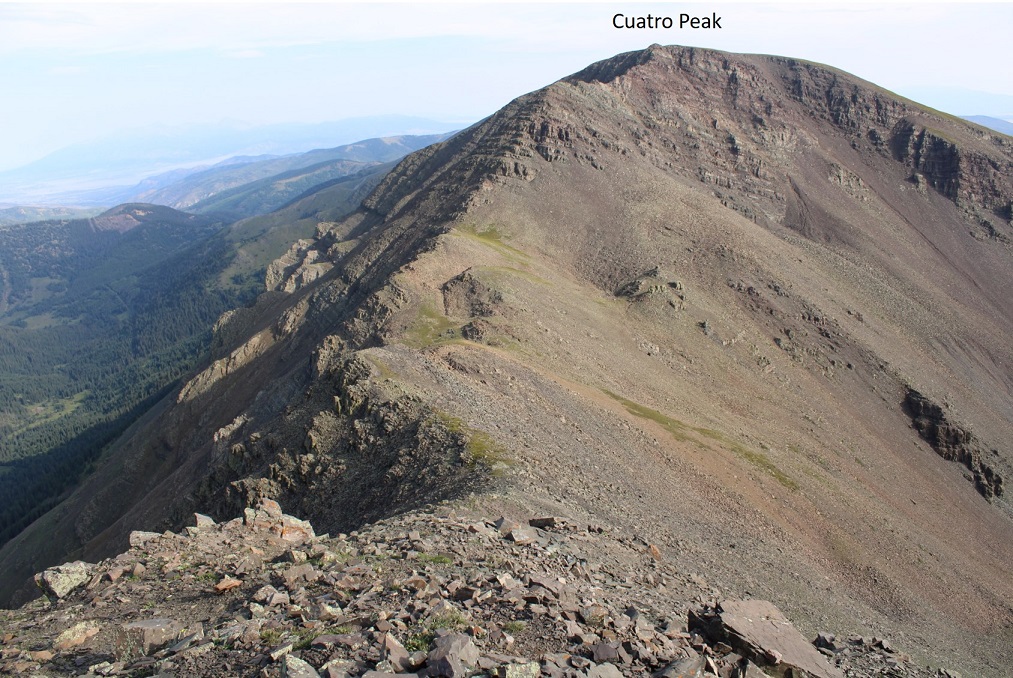
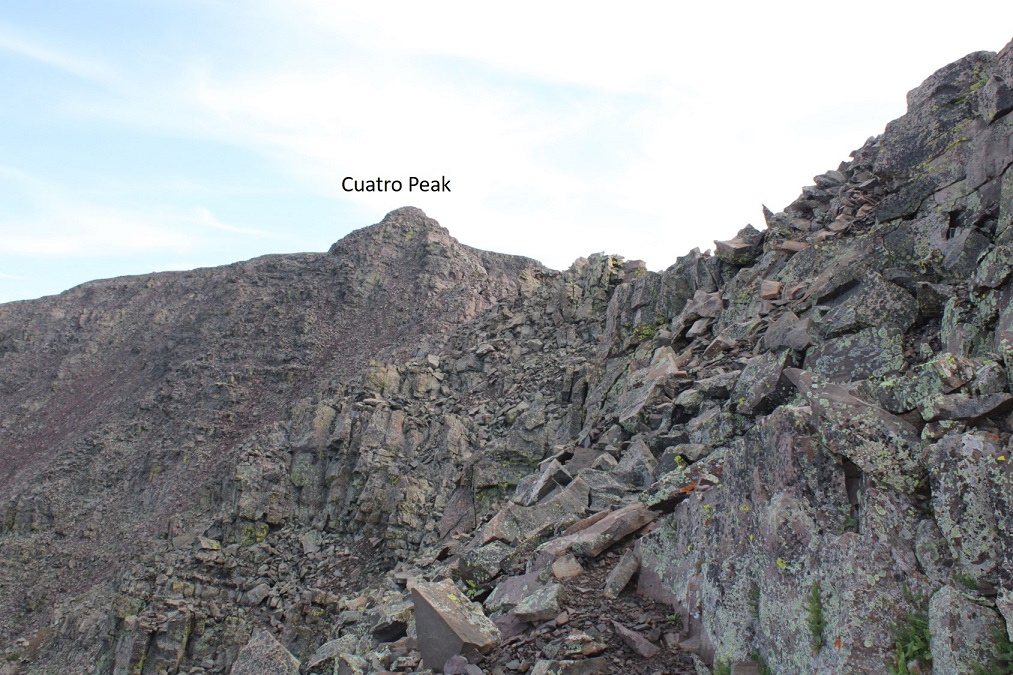
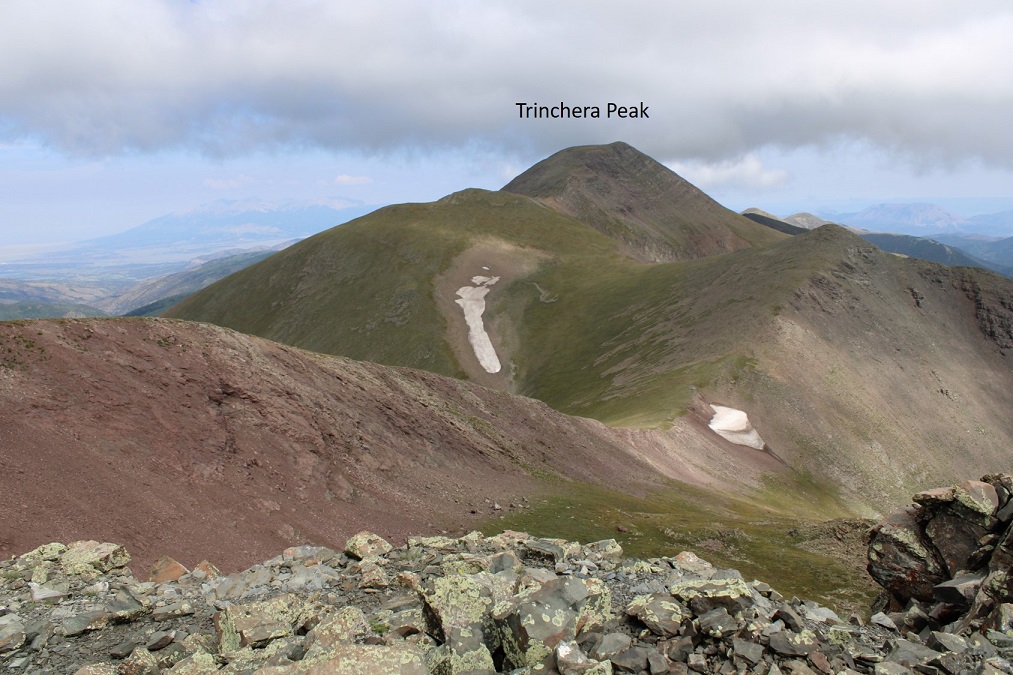
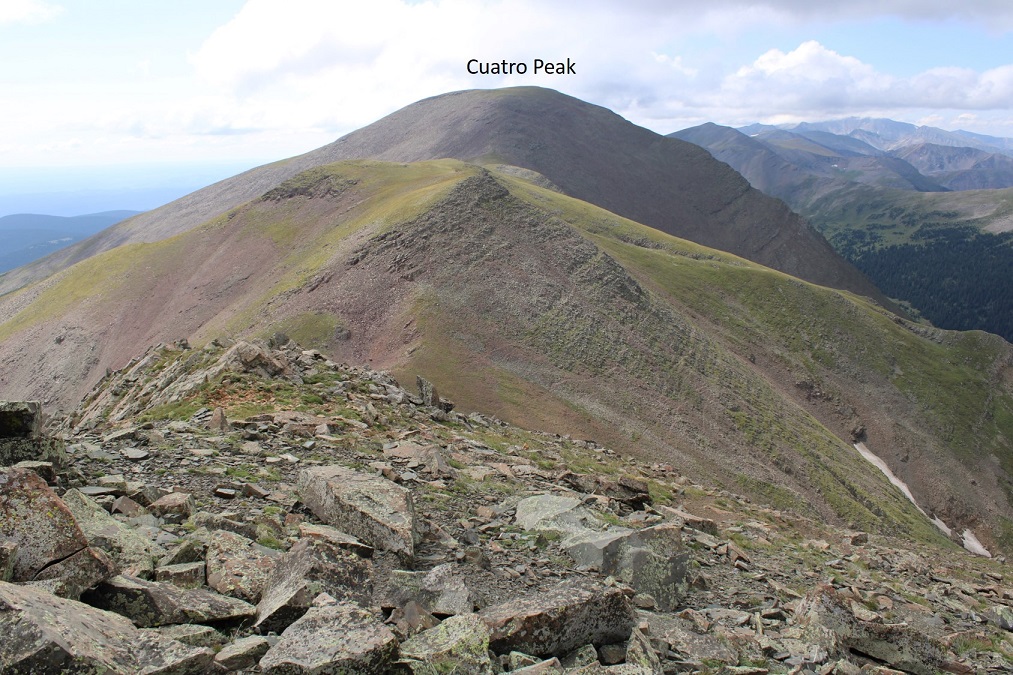
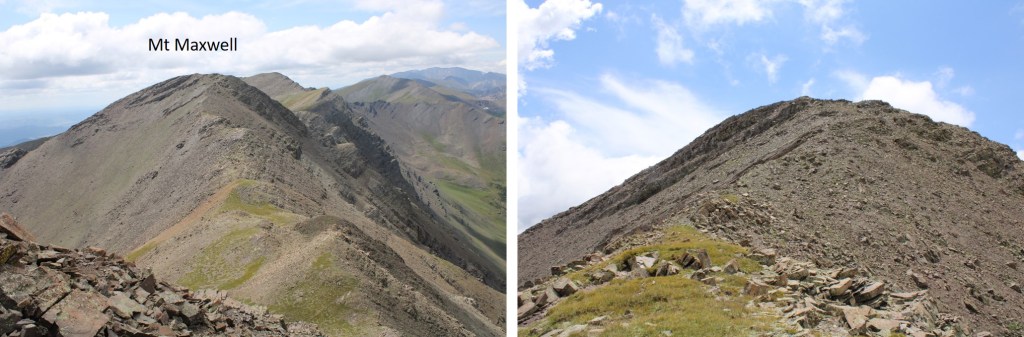
From Mt Maxwell, Cuatro Peak (to the north) looks daunting
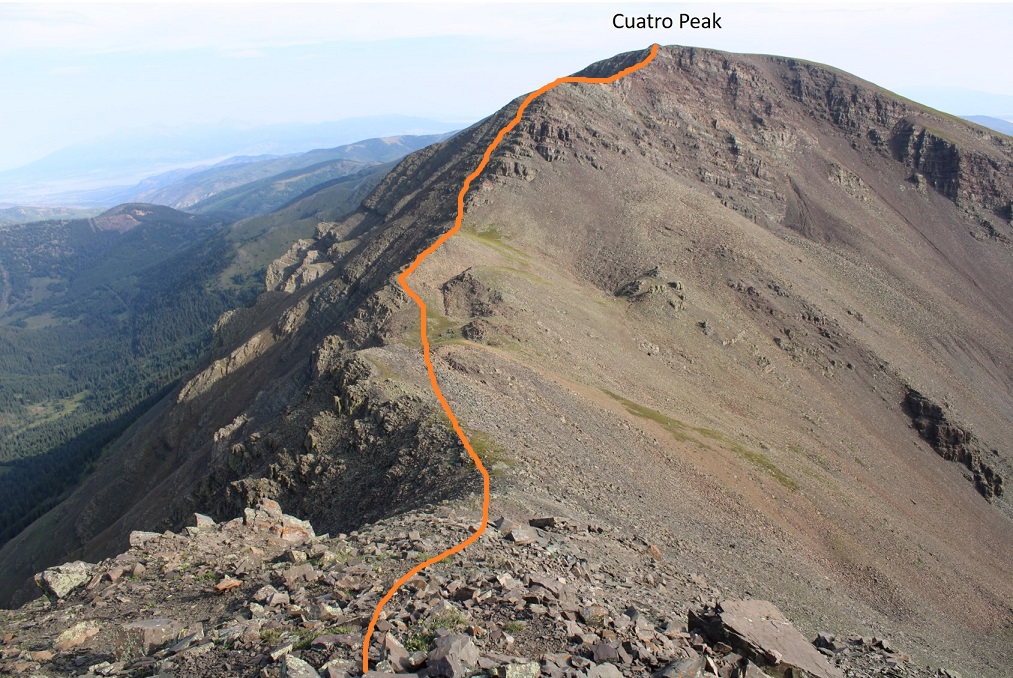
It’s actually a lot easier than it looks. Most of this hike is class 2, with just a few easy sections of easy class 3. Here’s the overall route I took, staying west initially until I made it to the ridge, and then taking the ridge all the way to the summit.
I headed down to the saddle. This was rocky but easy to find traction
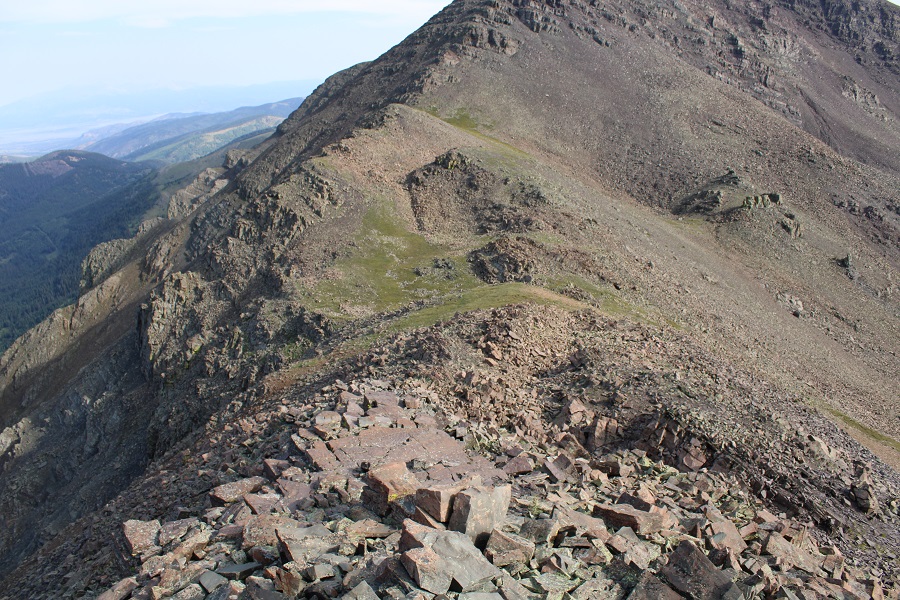
Once at the saddle I made my way to the ridge
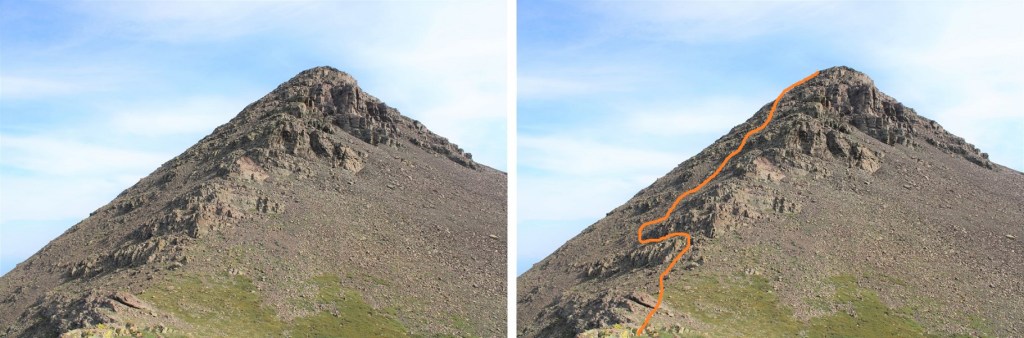
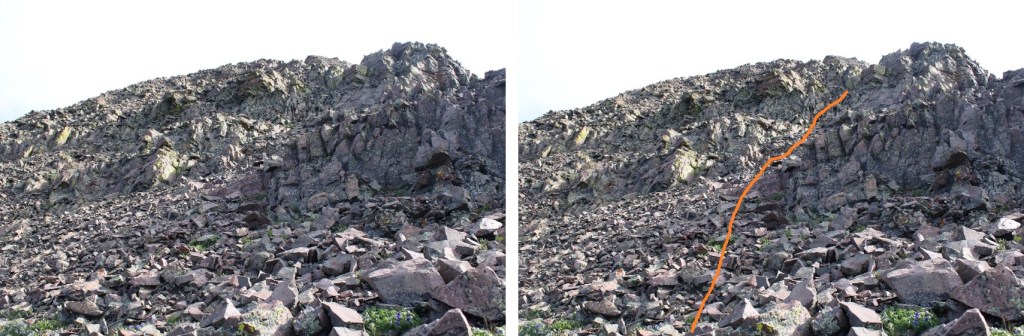
This next part looks daunting, but it’s all class 2. Here’s the route I took to the upper ridge
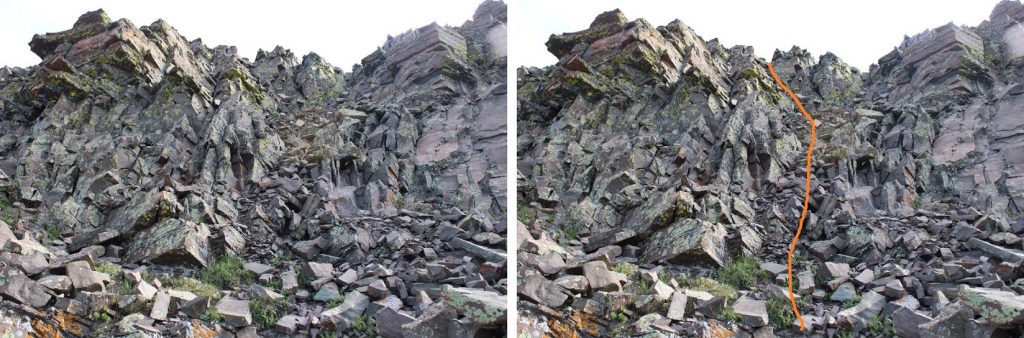
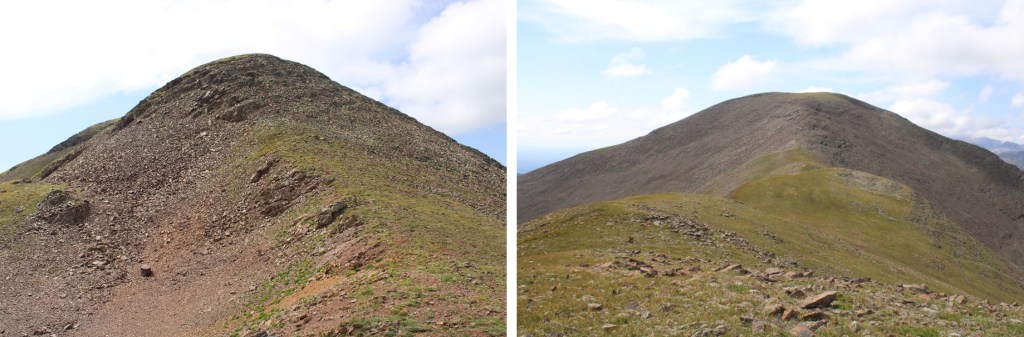
It’s choose your own adventure, but there are plenty of game trails for reference. Here are some pictures of the route up to the ridge. There’s an easy class 3 gully, that really only requires one or two class 3 moves.
Once on the ridge it again looks daunting, but you can pretty much stay on top of this ridge the entire way to the notch. If you do feel you need to dip down, go left (west). You’ll lose and need to regain elevation, but there’s less exposure.
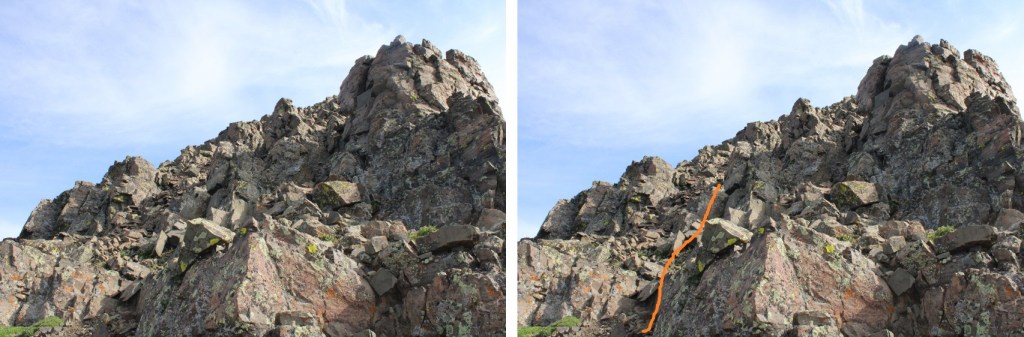
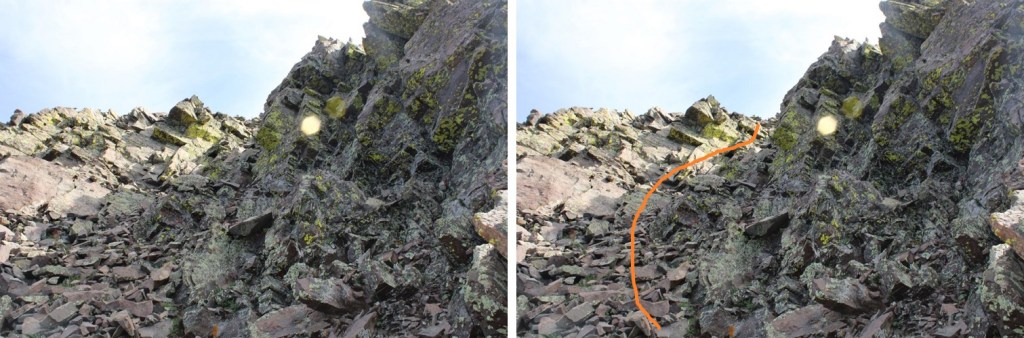
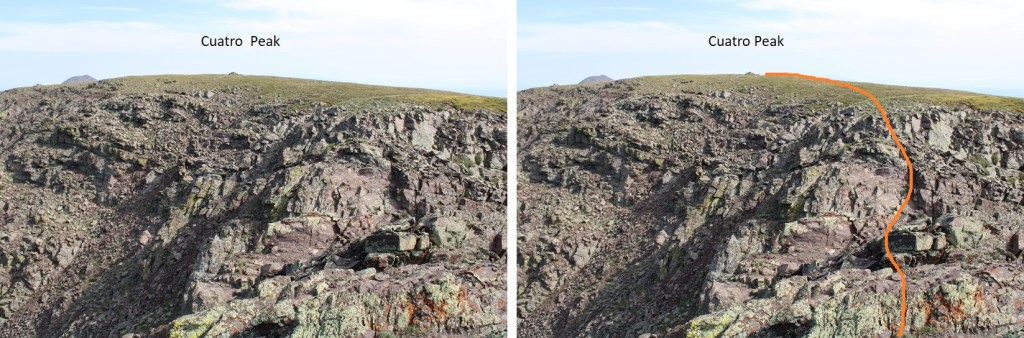
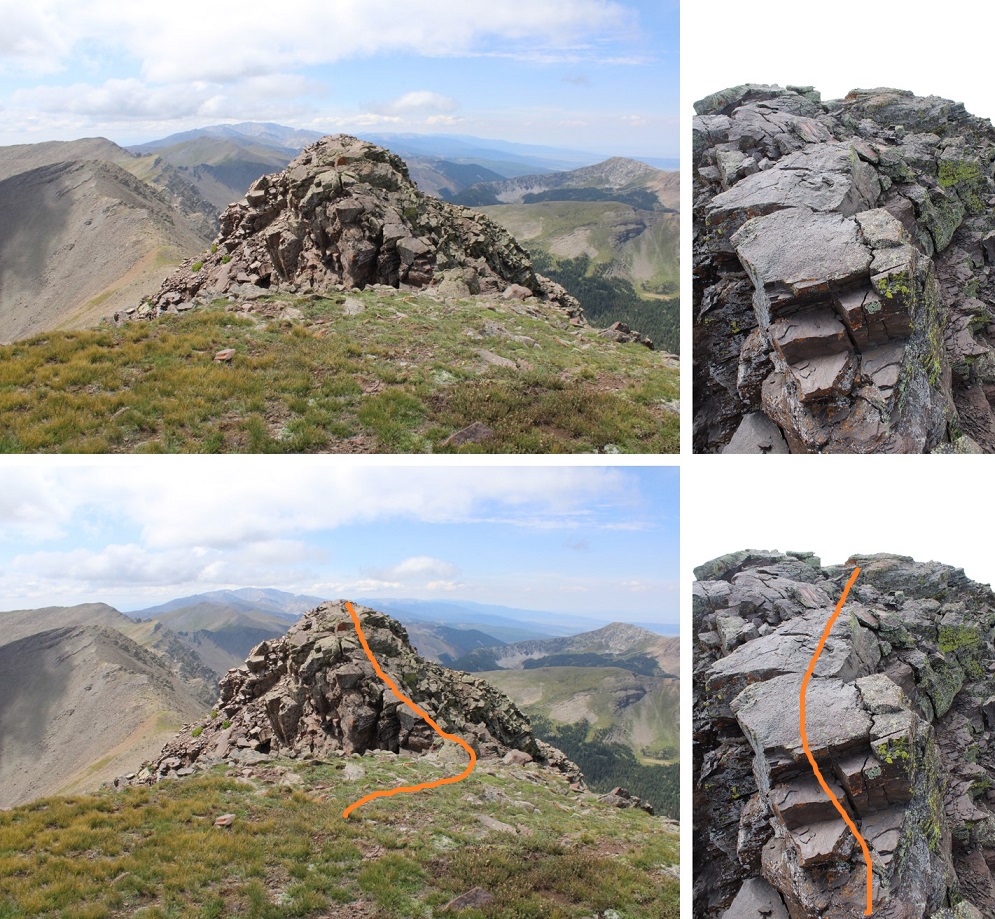
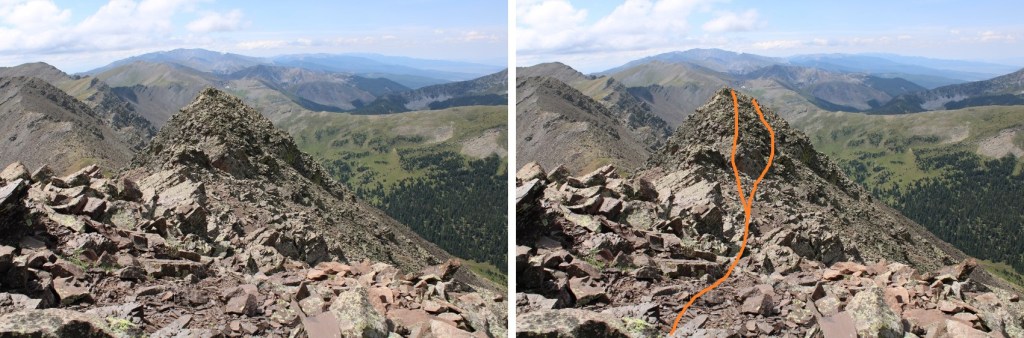
There was one final gully to ascend with some class 3 moves to get out of the gully. Here’s the overall view
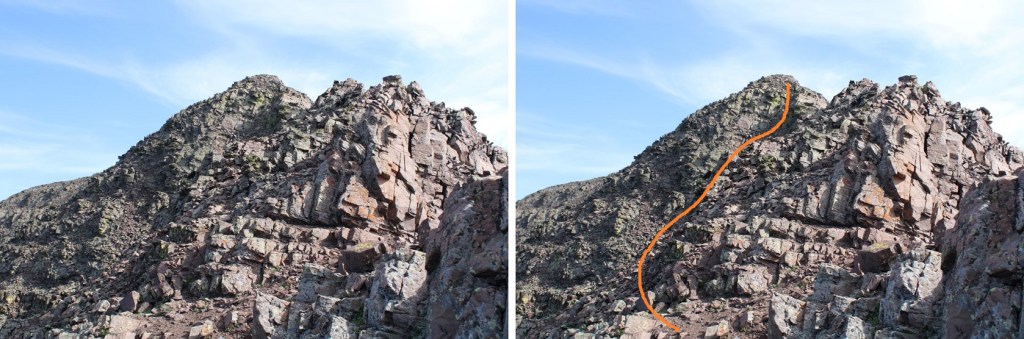
And the final push to the top
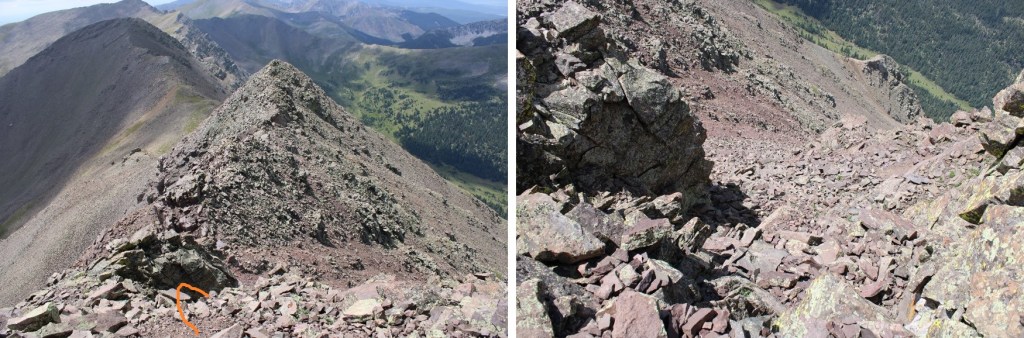
Back on the ridge you’re so close to the summit! But there’s a final chasm to cross. I stayed on the ridge proper, downclimbed a short, easy class 3 section,
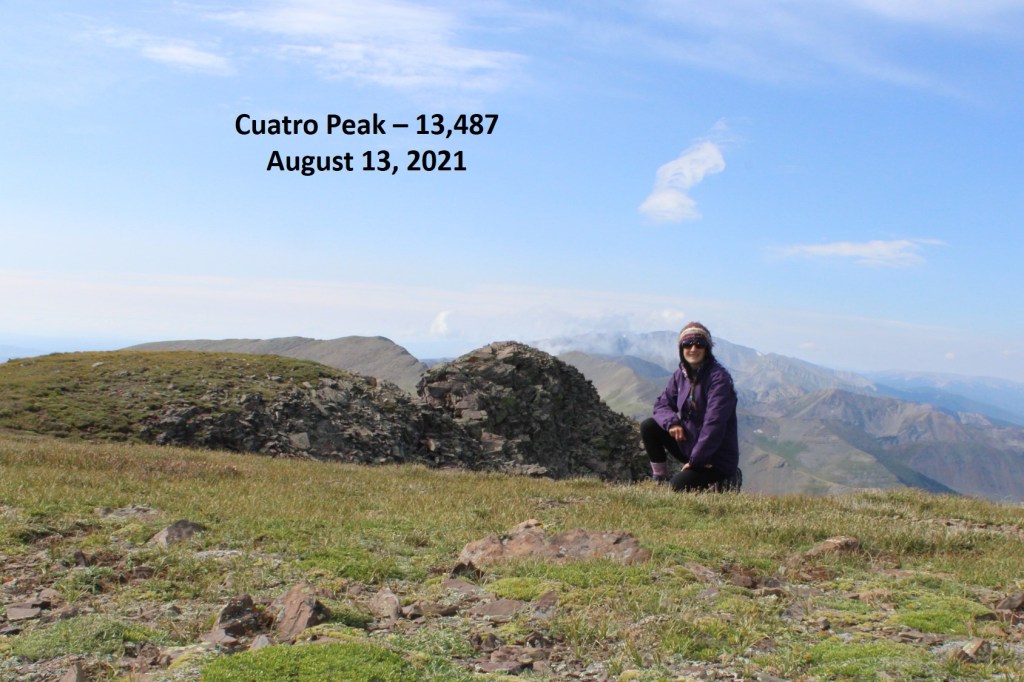
I summited Cuatro Peak at 9:40am
Cuatro Peak:
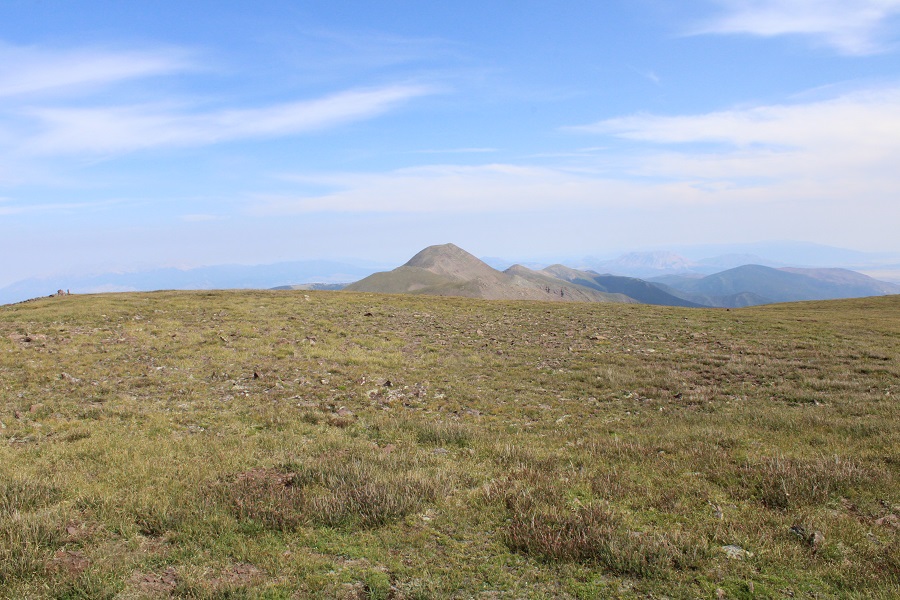
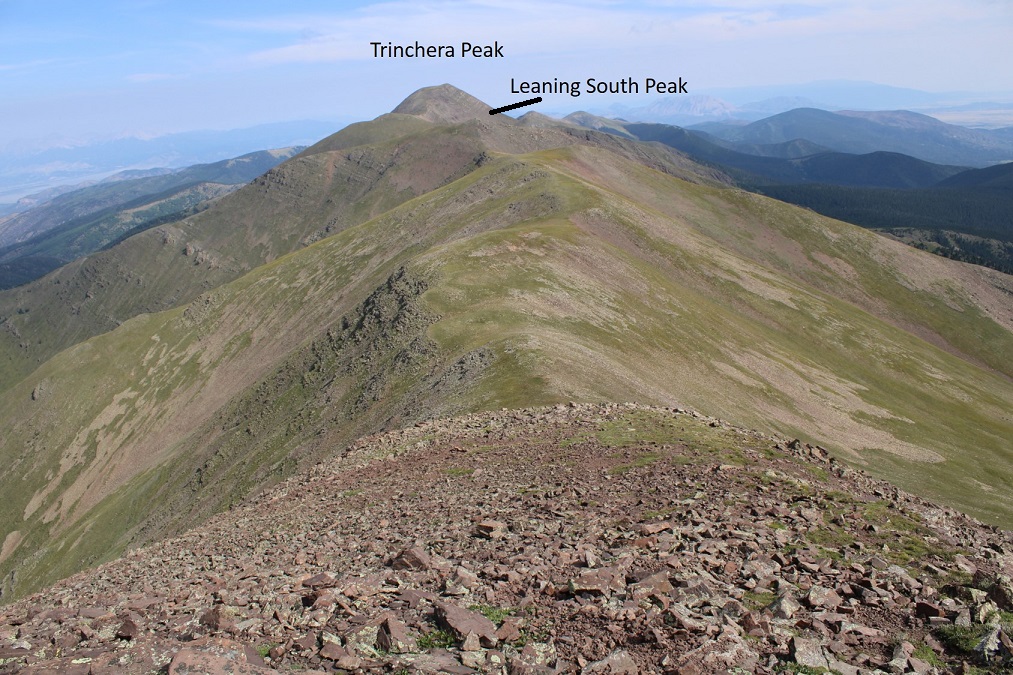
I followed the ridge north to continue on to Leaning South Peak
This was a class 2 ridge hike, mostly on tundra, except for the areas that lost elevation, where there were rocks and scree thrown in. I was aiming for Leaning South Peak, but there’s another ranked peak (Trinchera) beyond
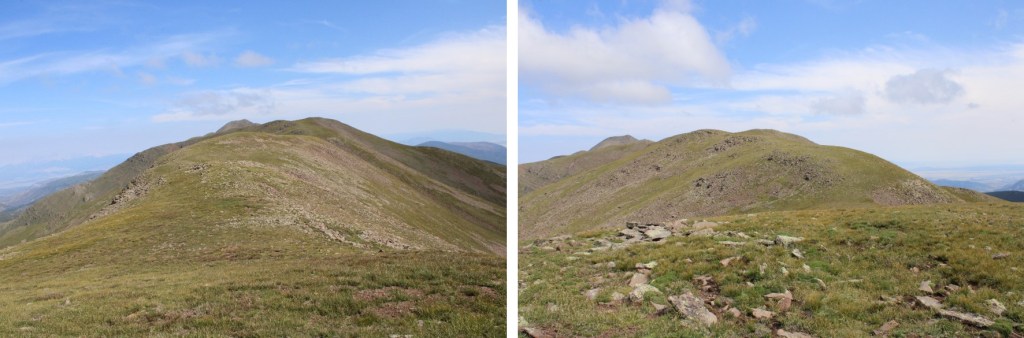
I continued following the ridge north
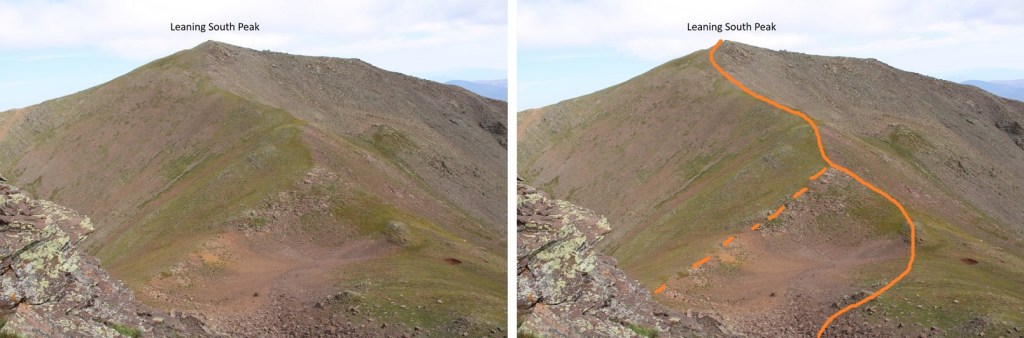
Just before the last bit to Leaning South Peak I lost 240’ of elevation, then gained 310’ of elevation to the summit of Leaning South Peak. No need to stay high here, as you’ll be losing elevation anyway (although on the way back it was easier to go straight up to the ridge).
Here’s the path I took to the summit, solid line up, dotted line down. I liked the dotted line better on the way back.
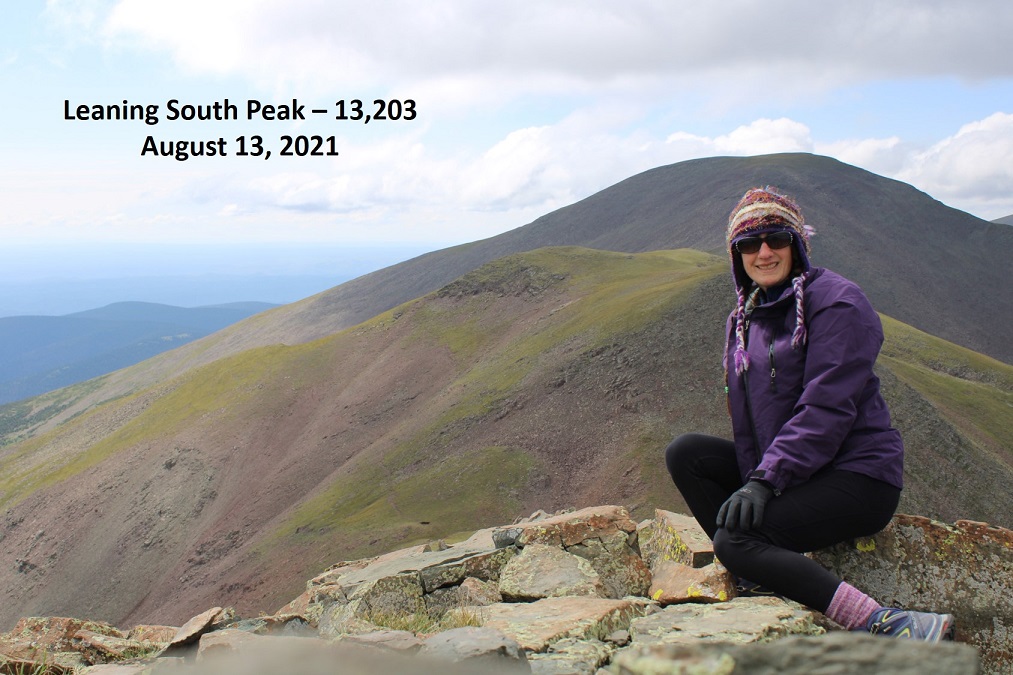
I summited Leaning South Peak at 10:30am
Leaning South Peak:
There was a summit register, but it was broken and the papers inside were wet and unreadable. I replaced the summit register and turned and headed back, as the weather was starting to turn and it’s a long way back. You can make this a loop if you’d like, by continuing on to Trinchera and then heading down to Blue Lakes Campground (etc., depending on where you park your vehicle), but I already had Trinchera Peak, so I decided to turn back. Here’s looking over to Trinchera for those interested
From Leaning South Peak, here’s a view of the route back to Cuatro Peak
And a few pictures from along the way to Cuatro
Once back at Cuatro Peak I made my way back onto the ridge. This is easier than it looks
Then back down the gully…
And across the ridge. Route finding here was much easier on the way down. You can either stay on the ridge, or dip to the right
And back to the saddle and up Mt Maxwell
Then it was back down the ridge. This is also easier than it looks, and goes to easy class 3.
From the ridge I aimed for the willows and treeline, and eventually the road
And followed the road back to my ruck
I made it back to my truck at 2:30pm, making this a 15.73 mile hike with 6807’ of elevation gain in 10 hours









































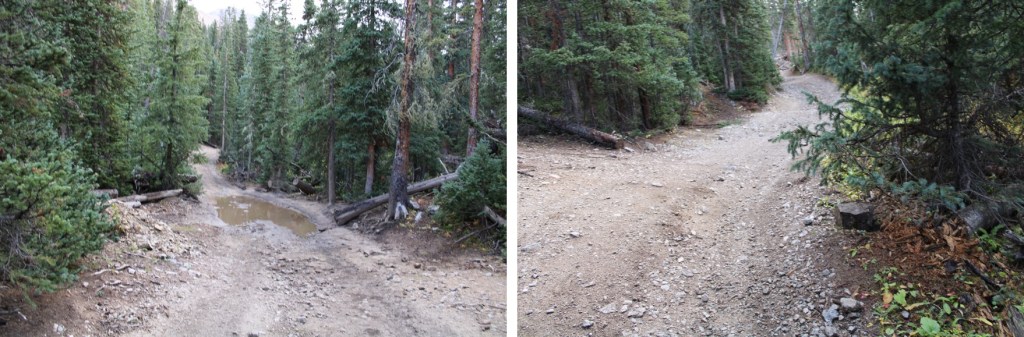
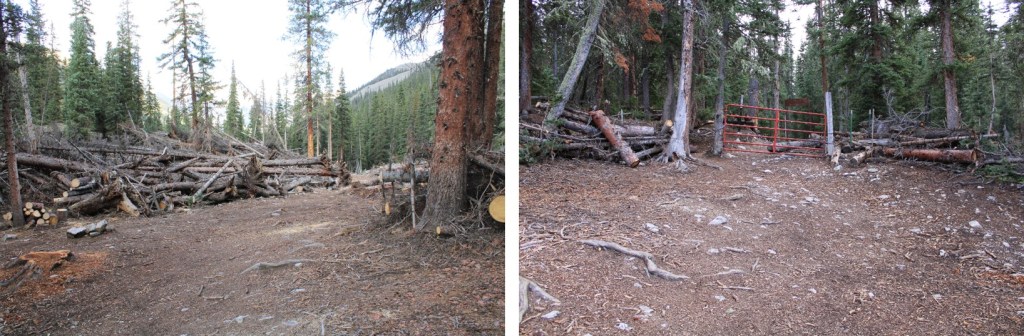

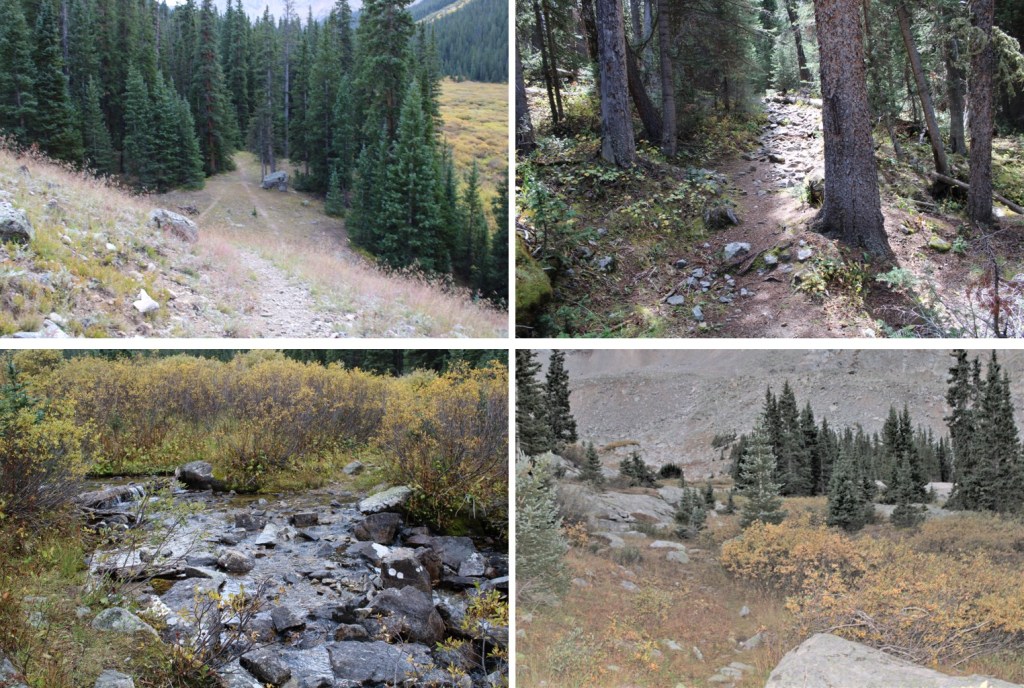
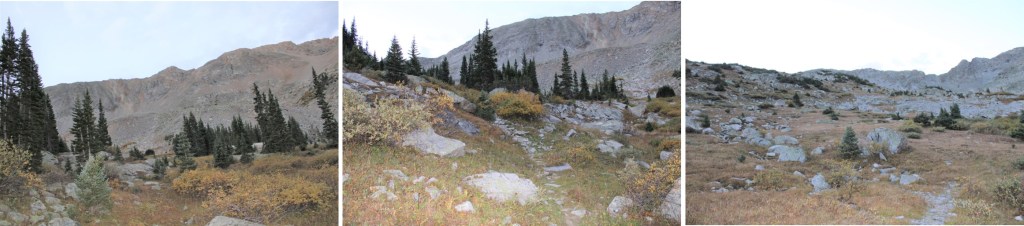























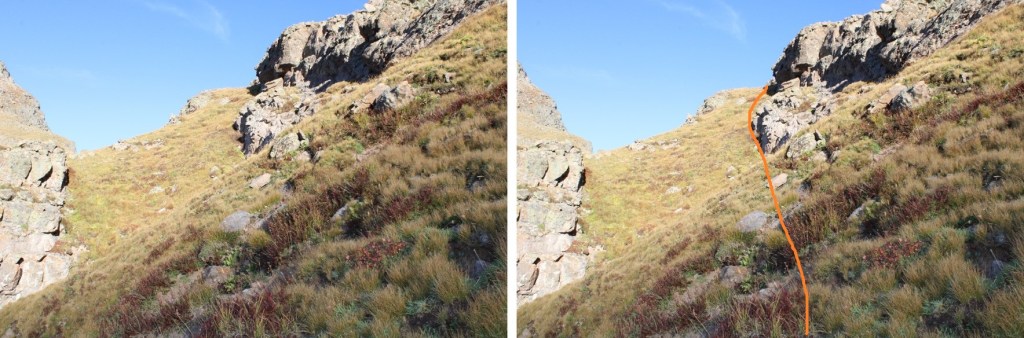

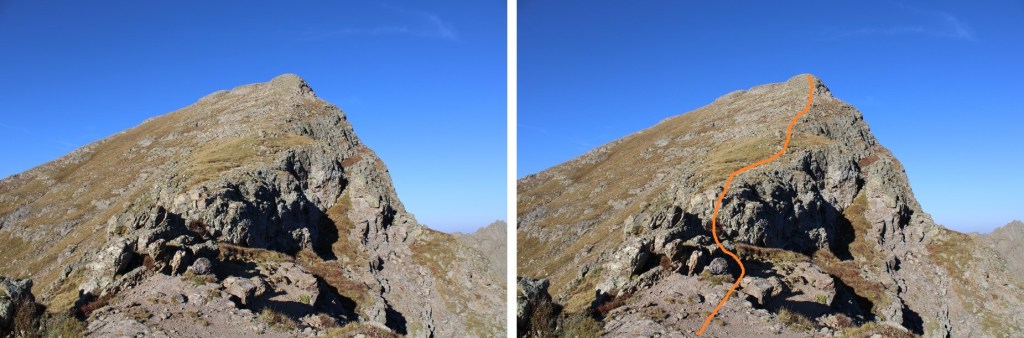
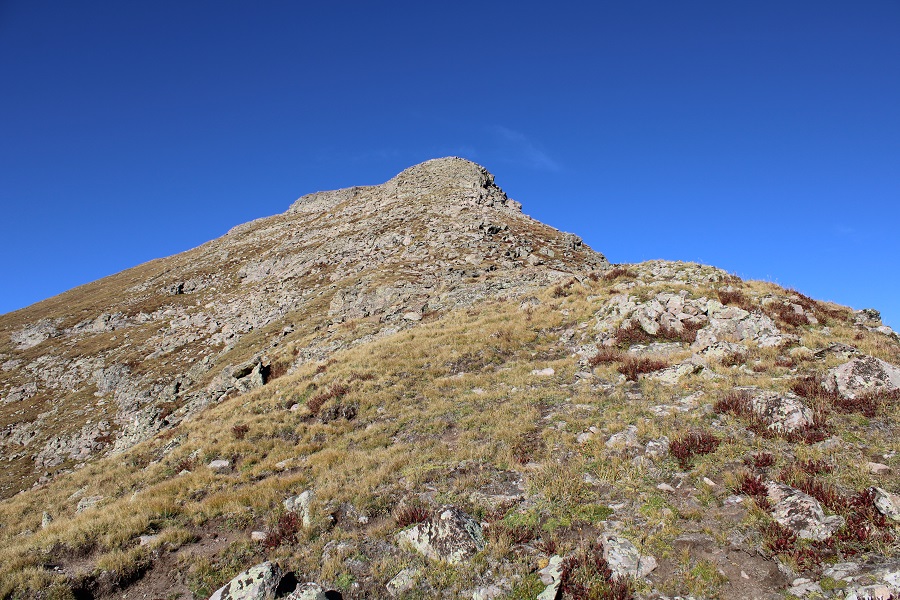
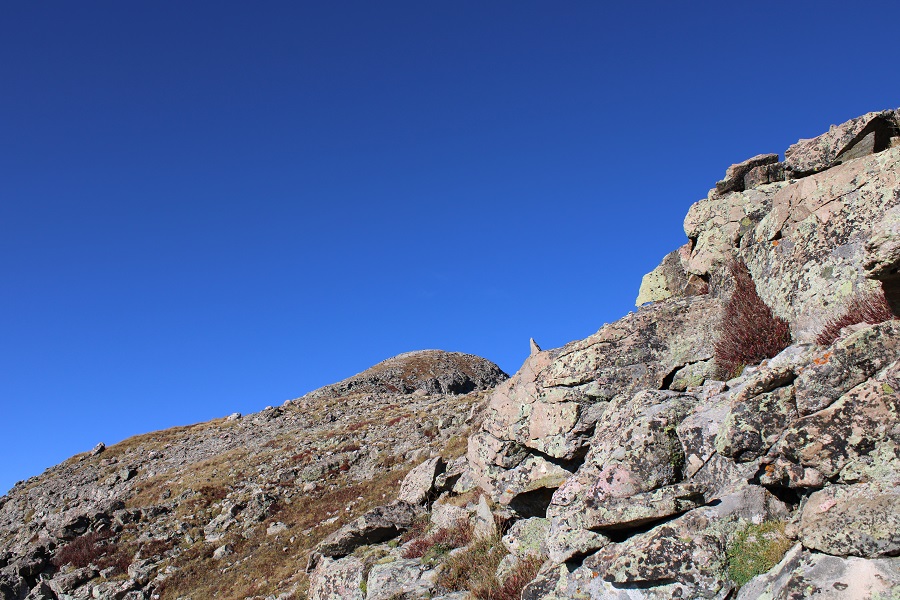










































 Wild Wanderer