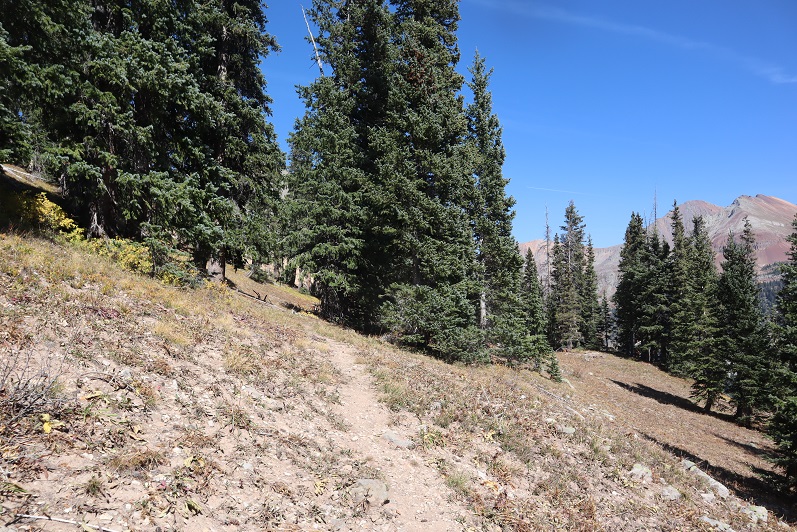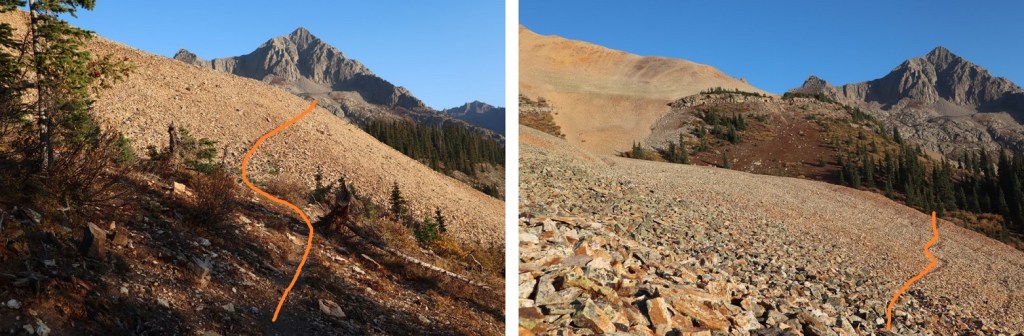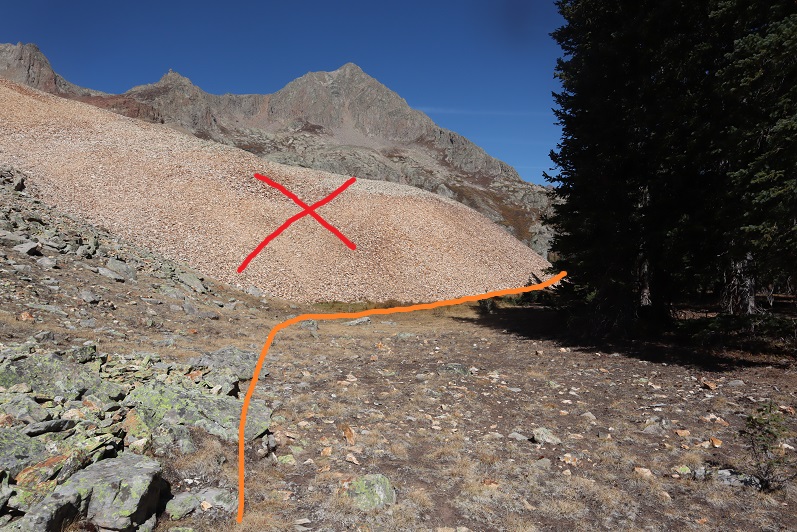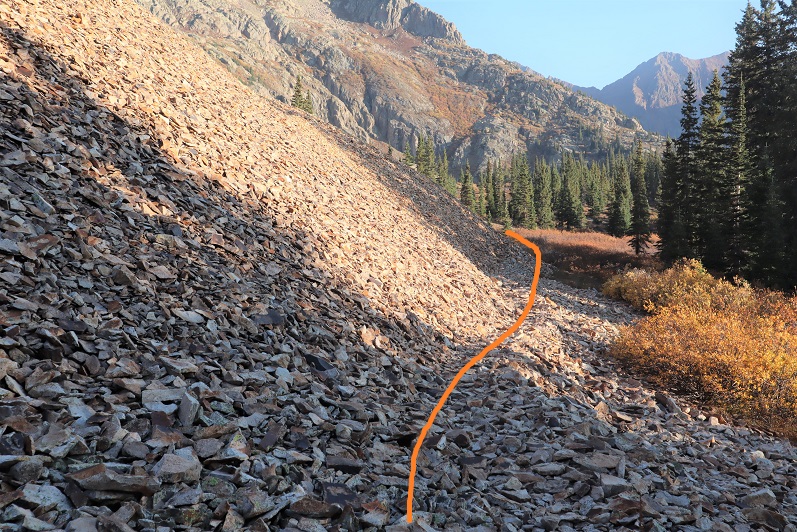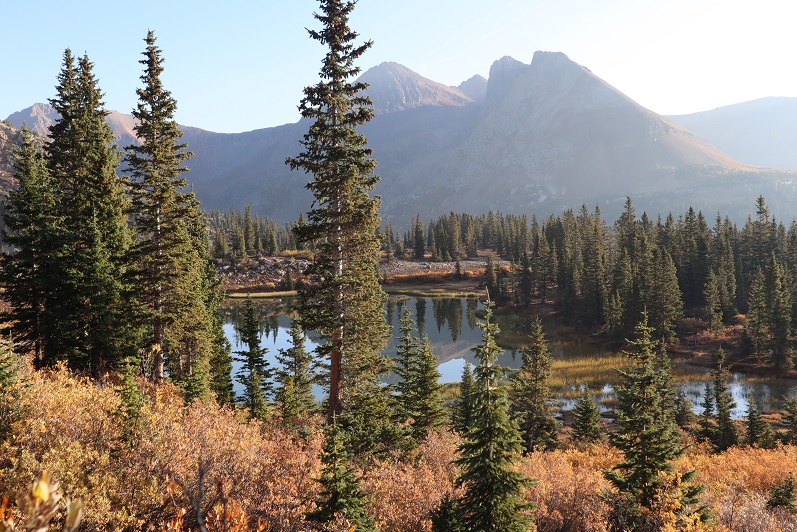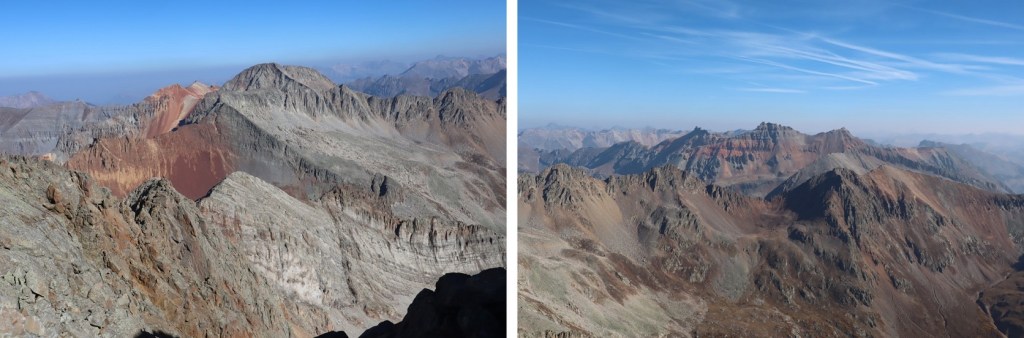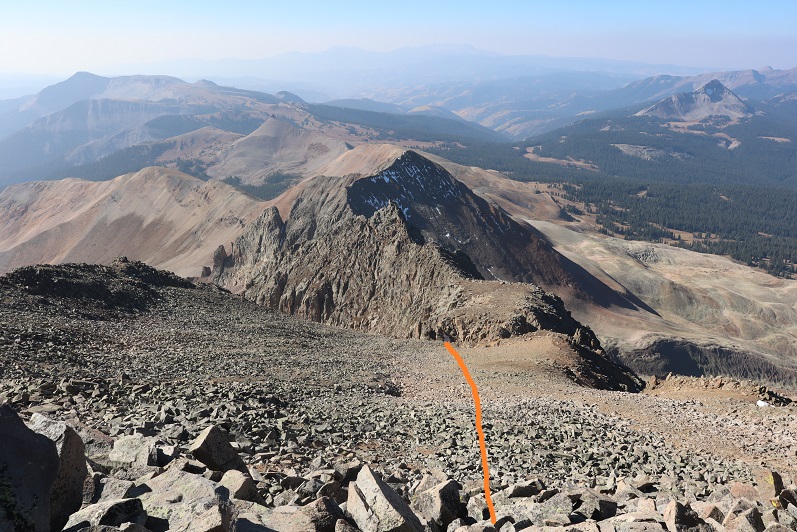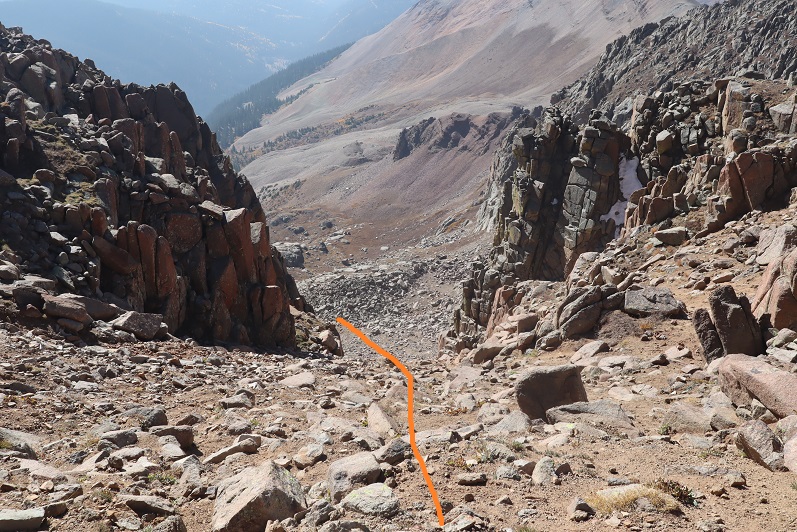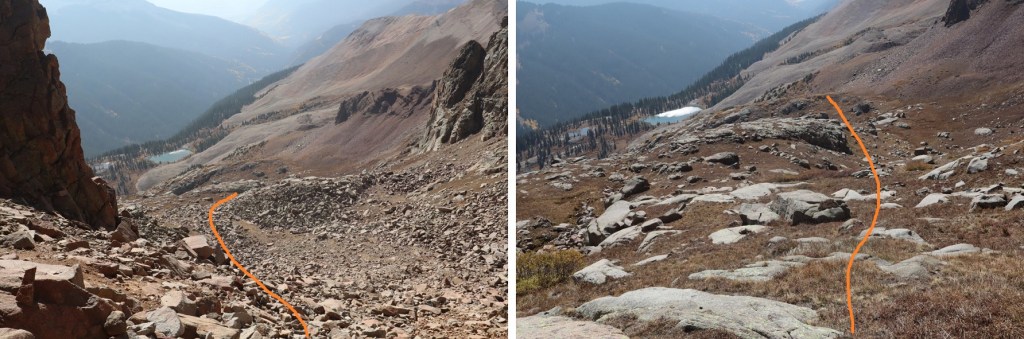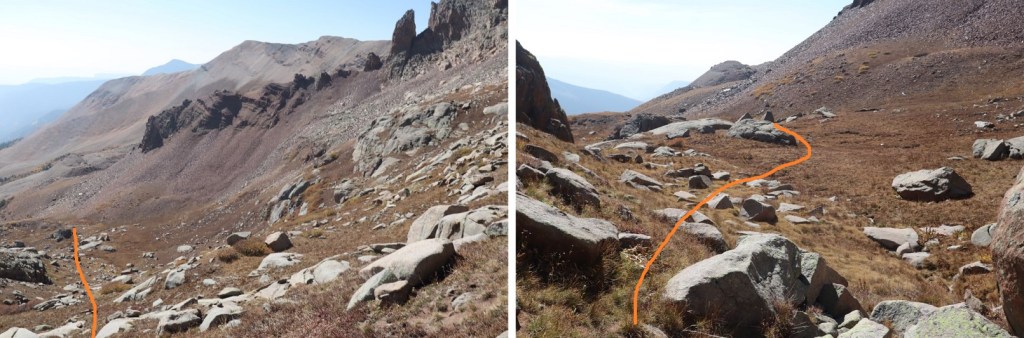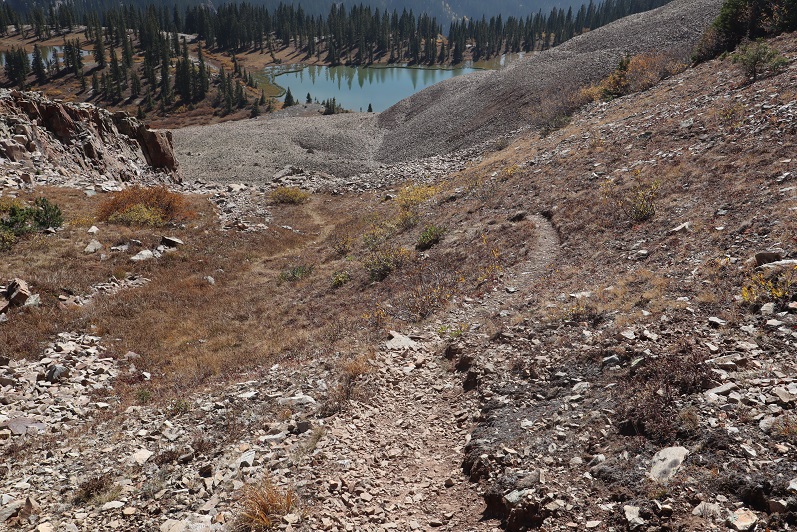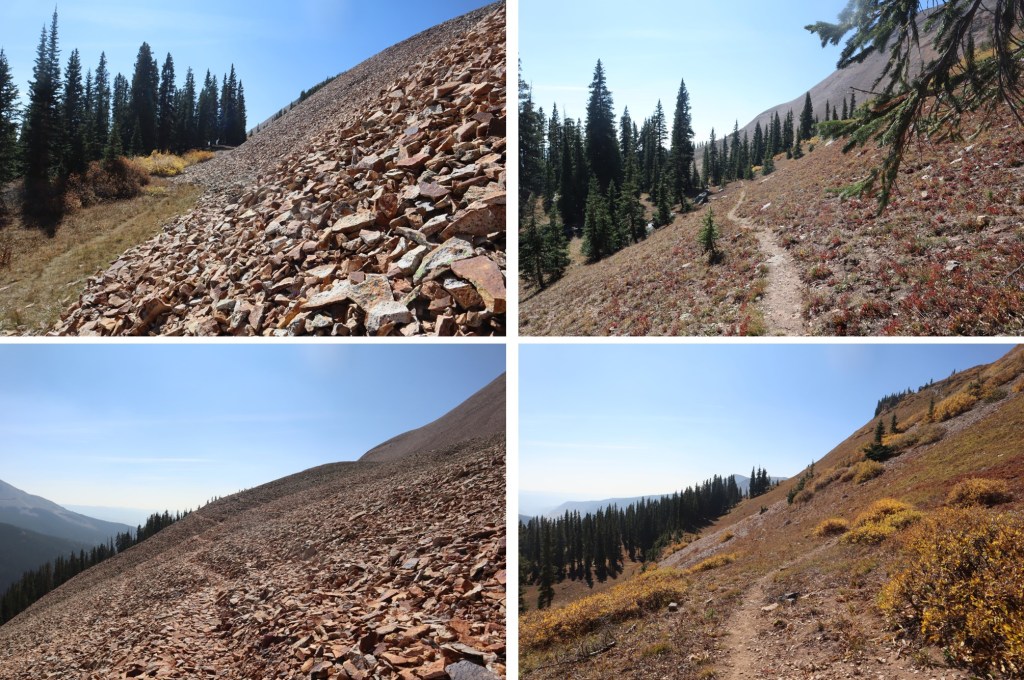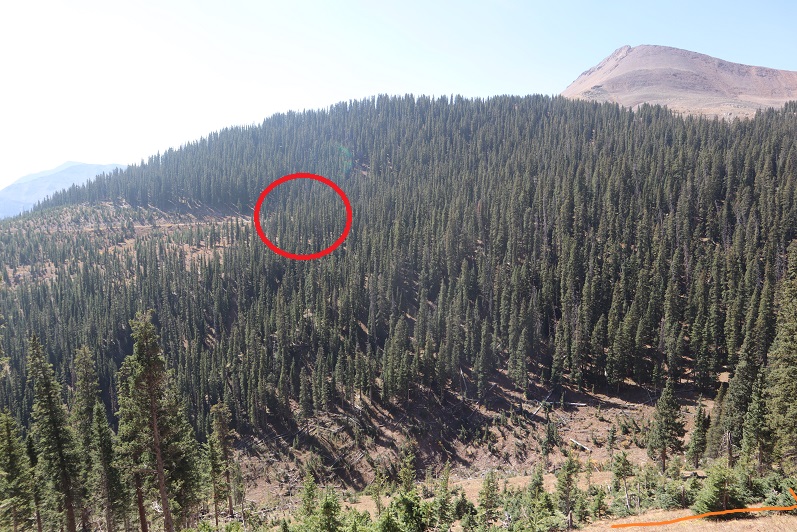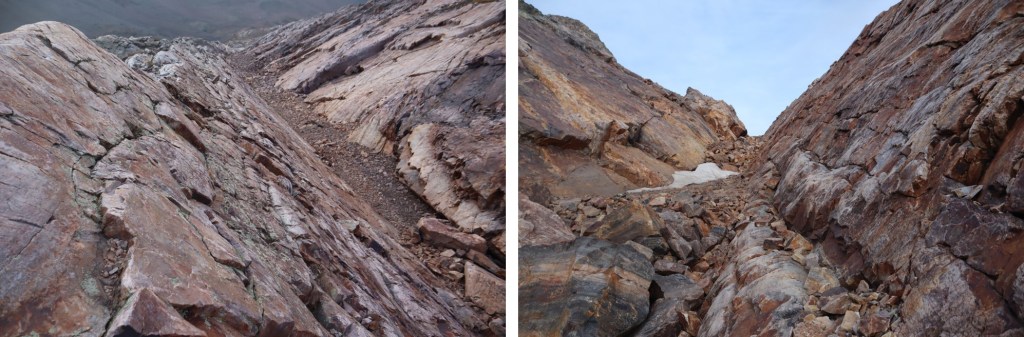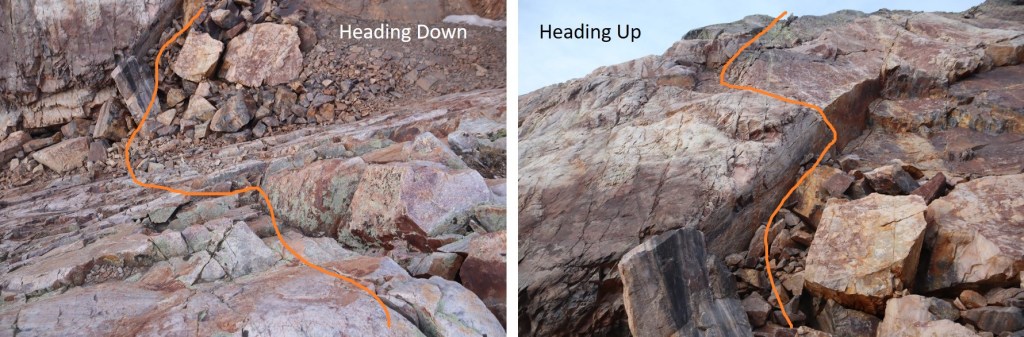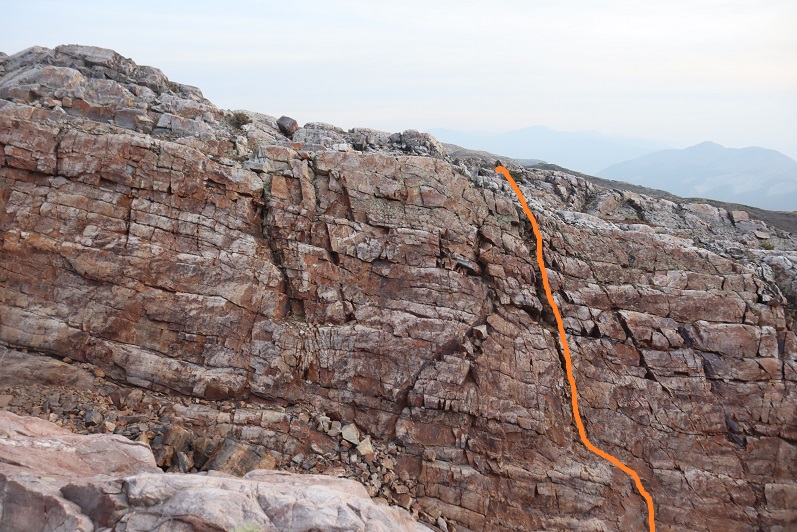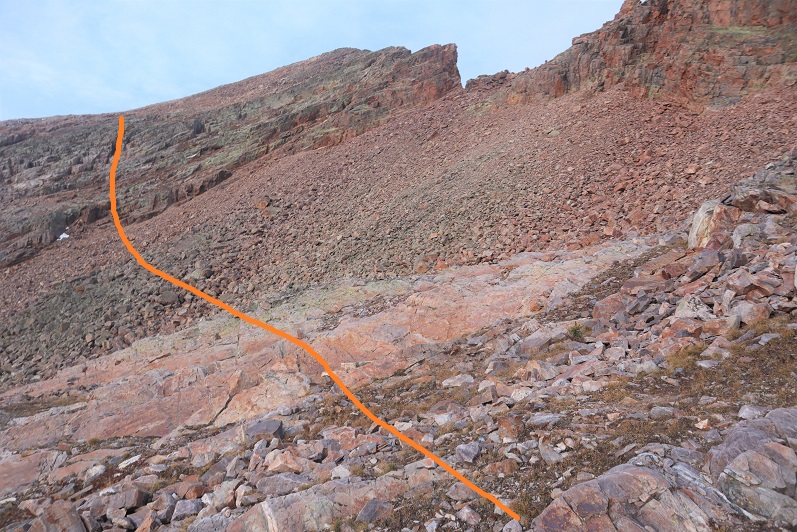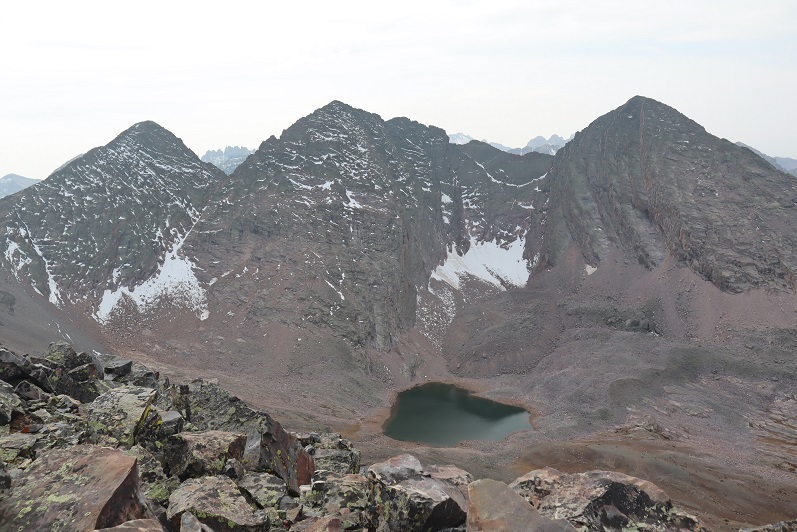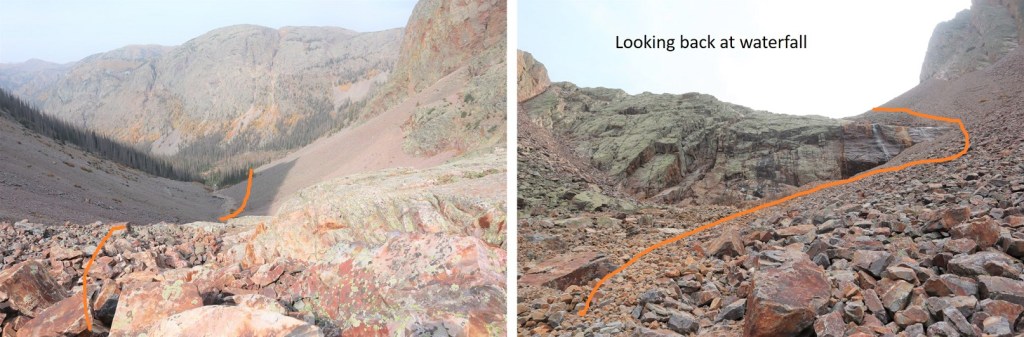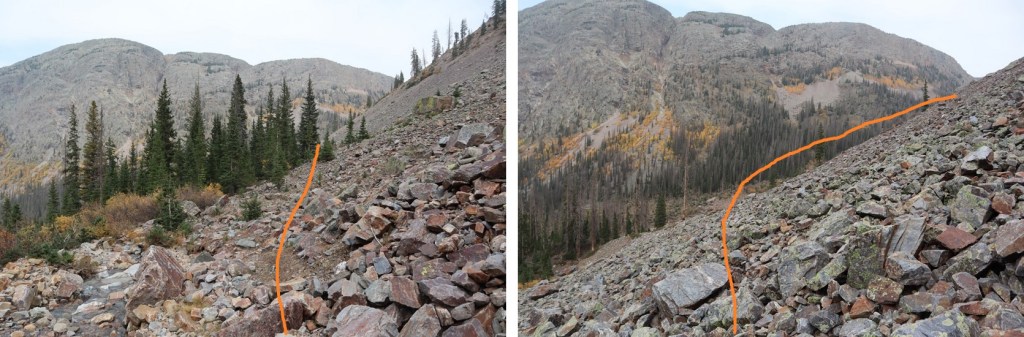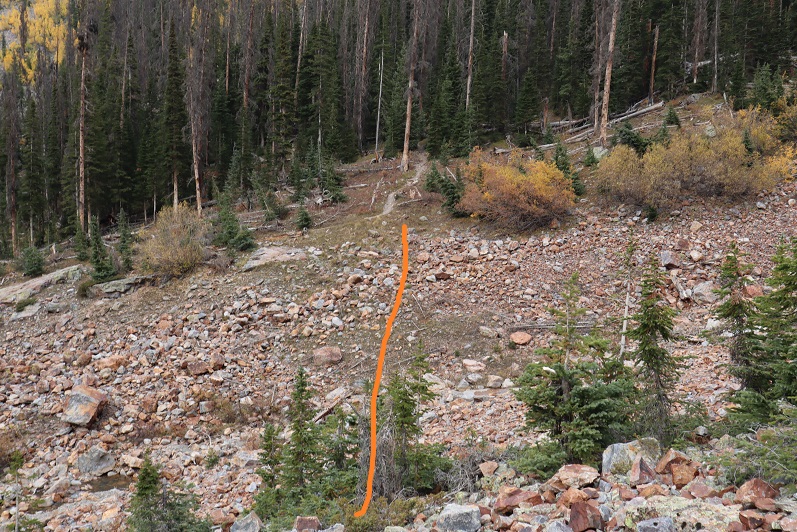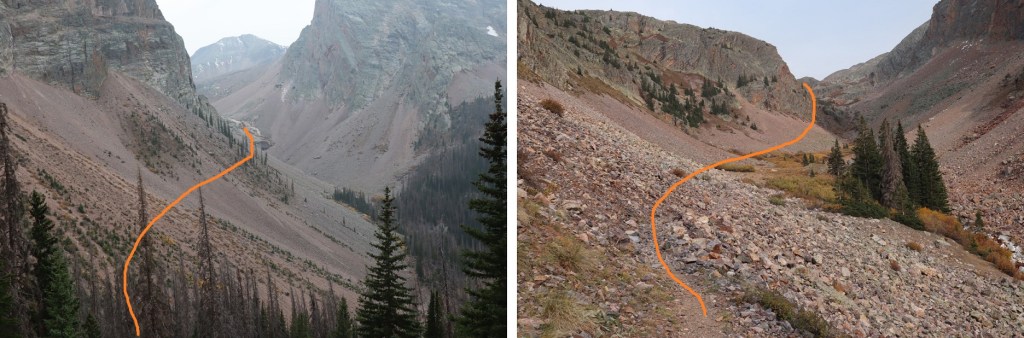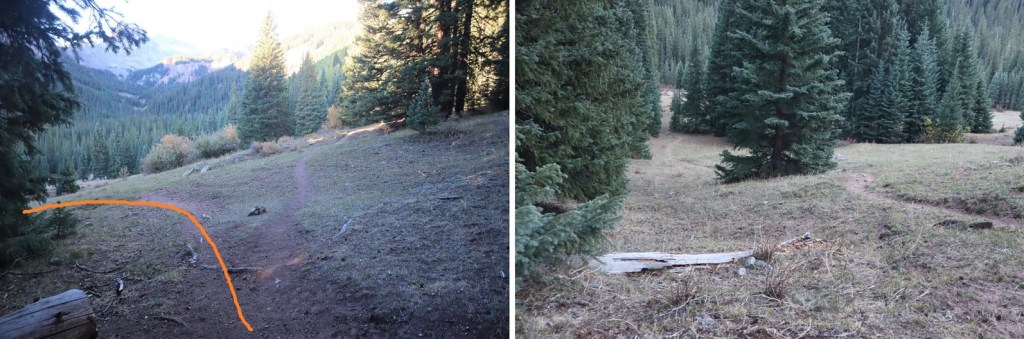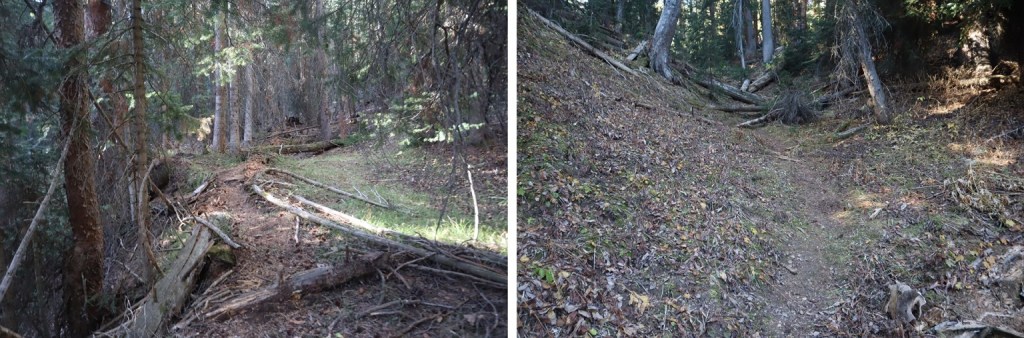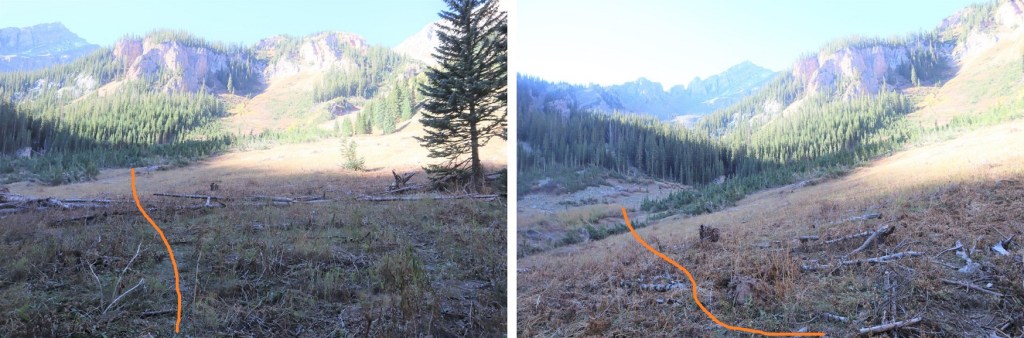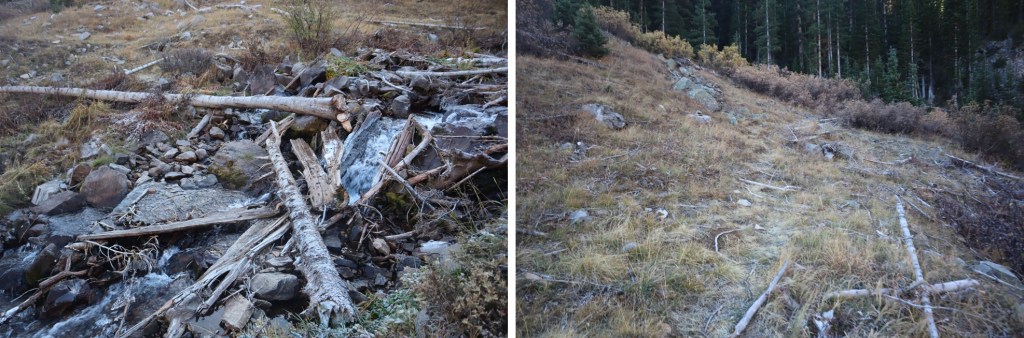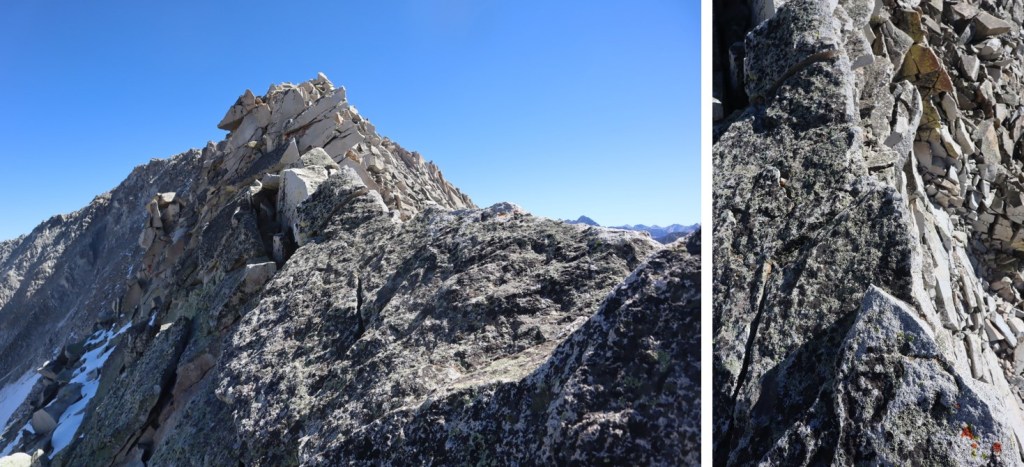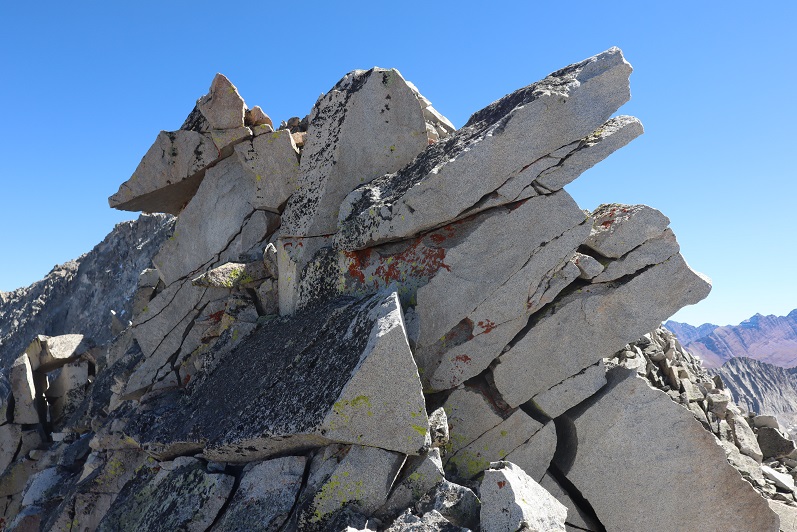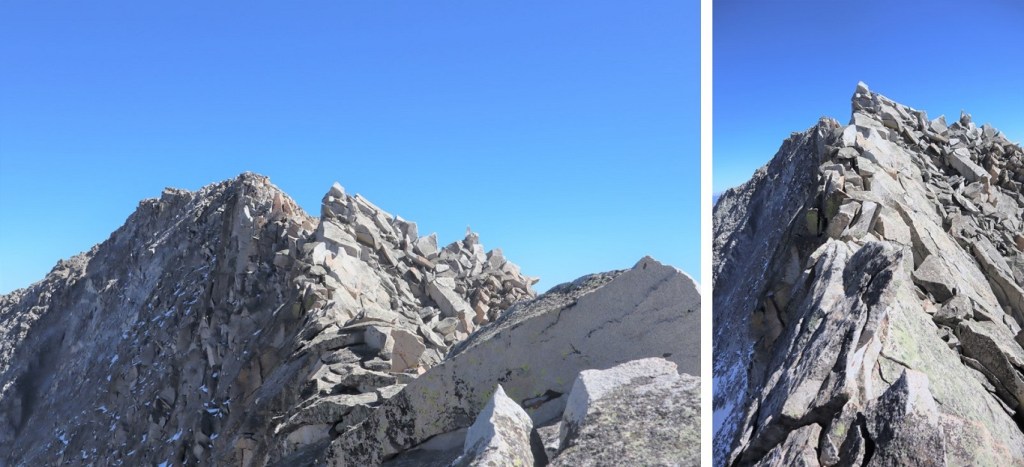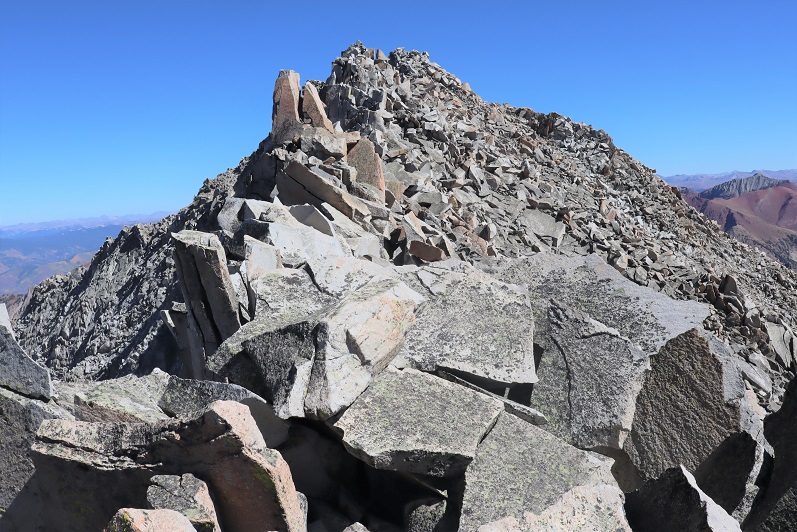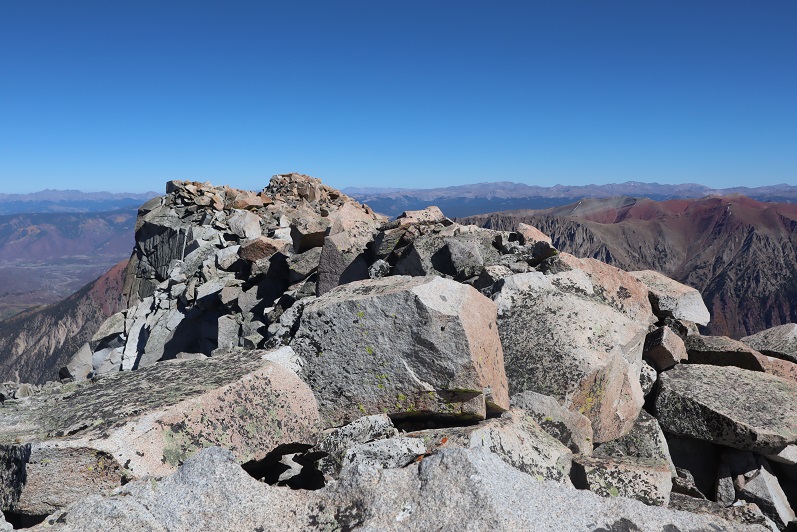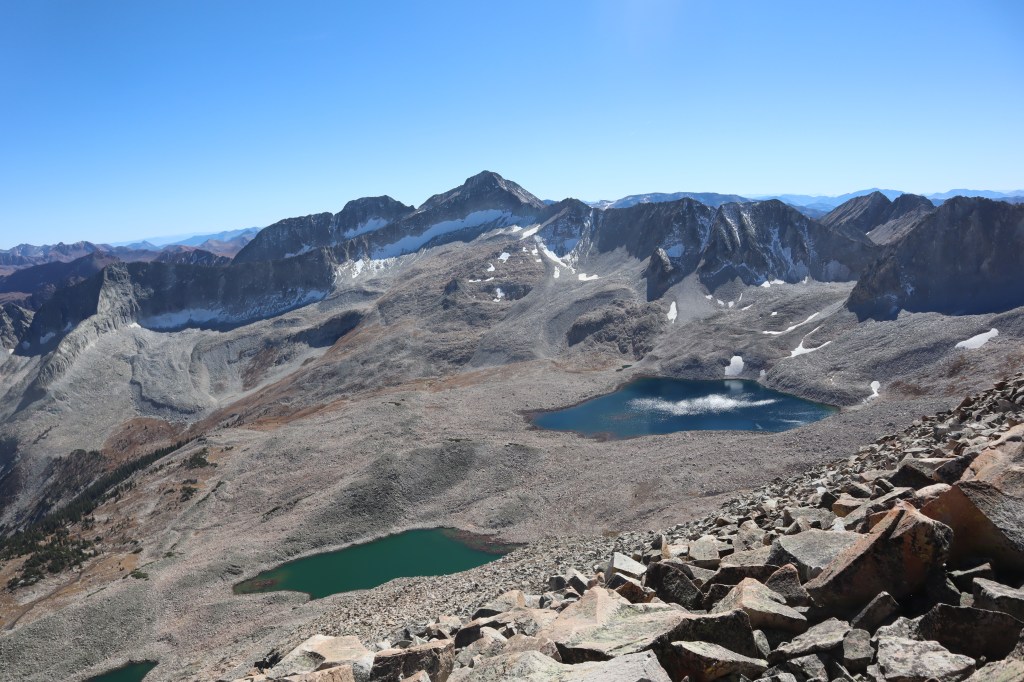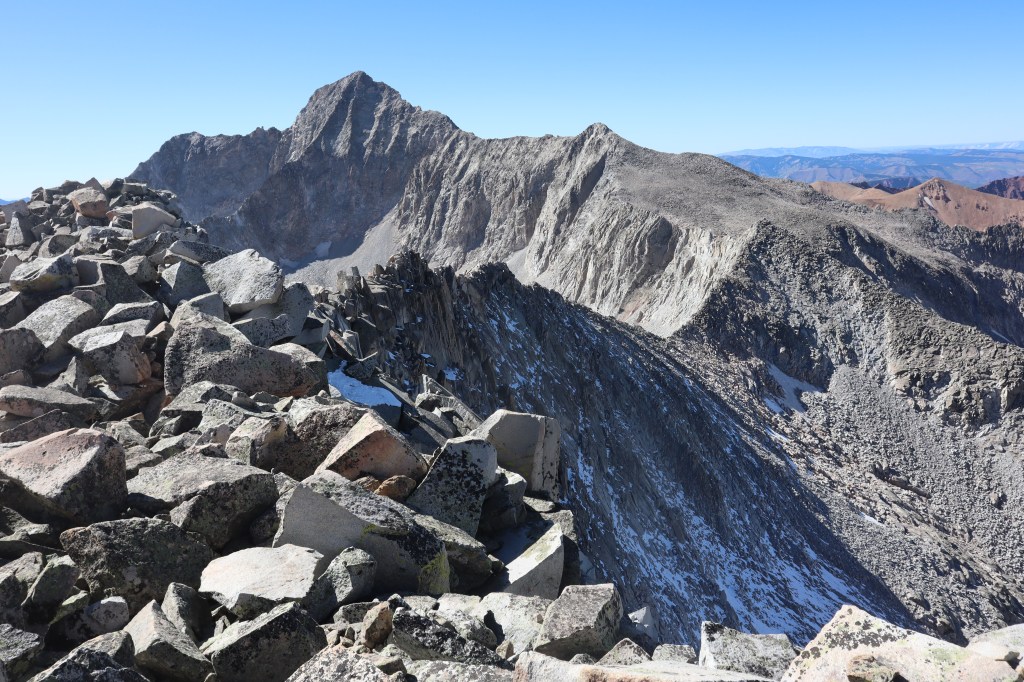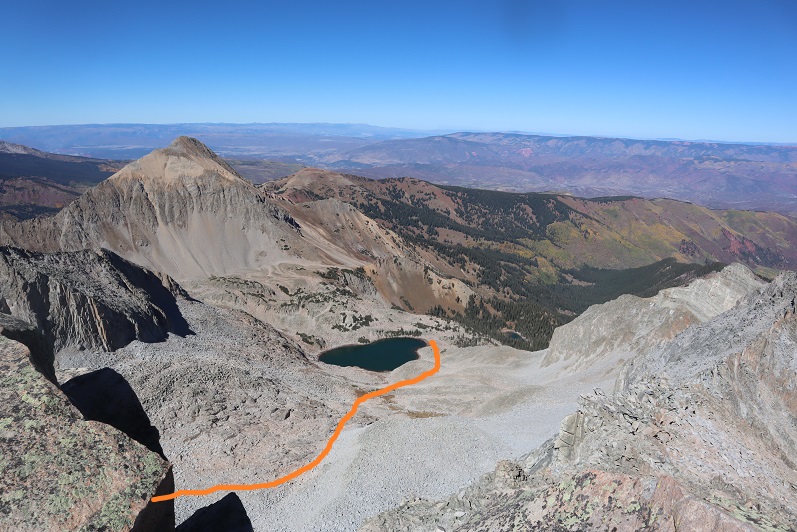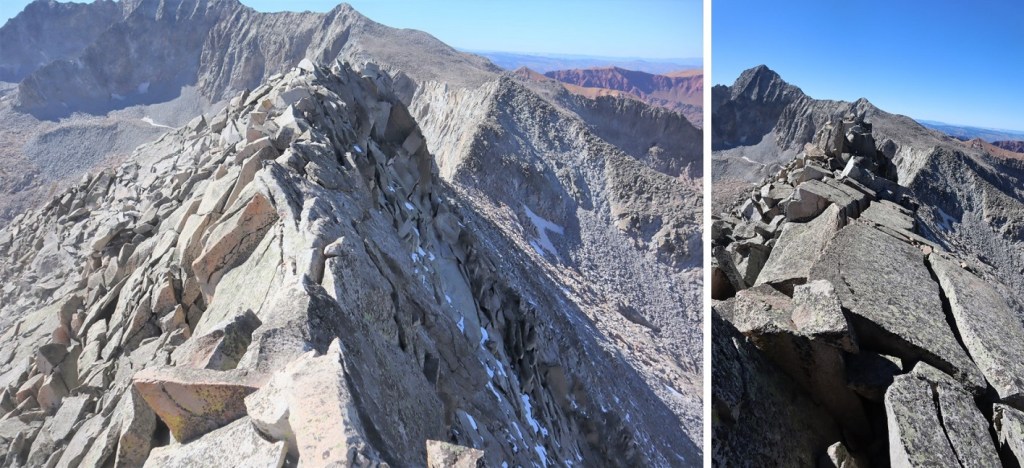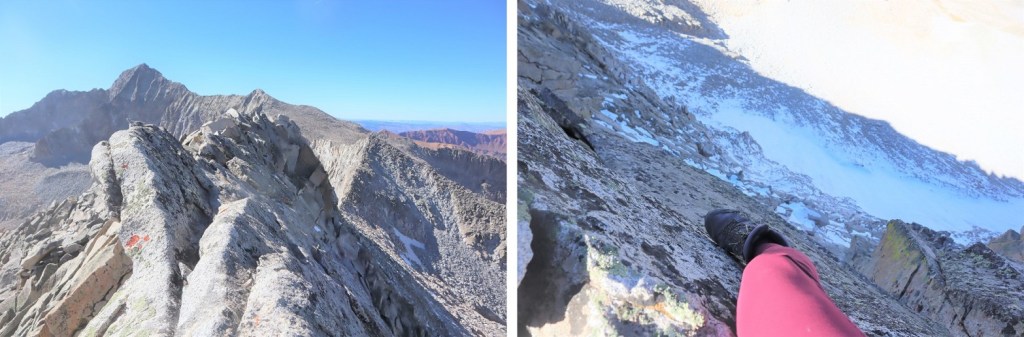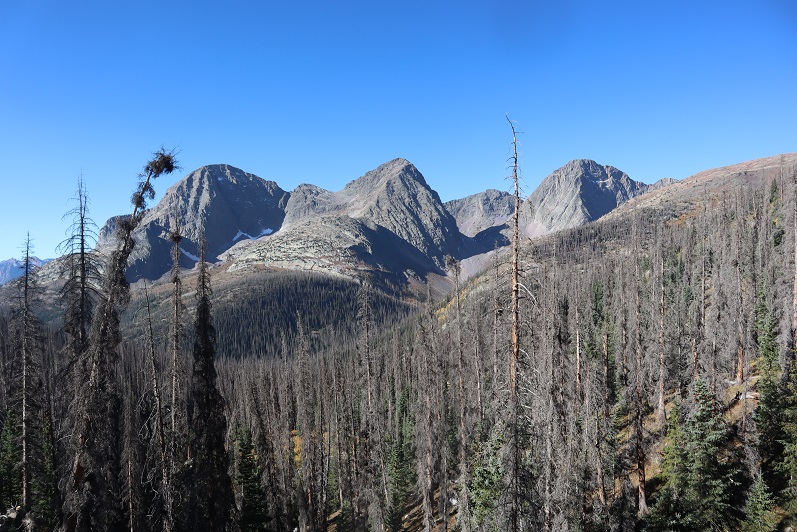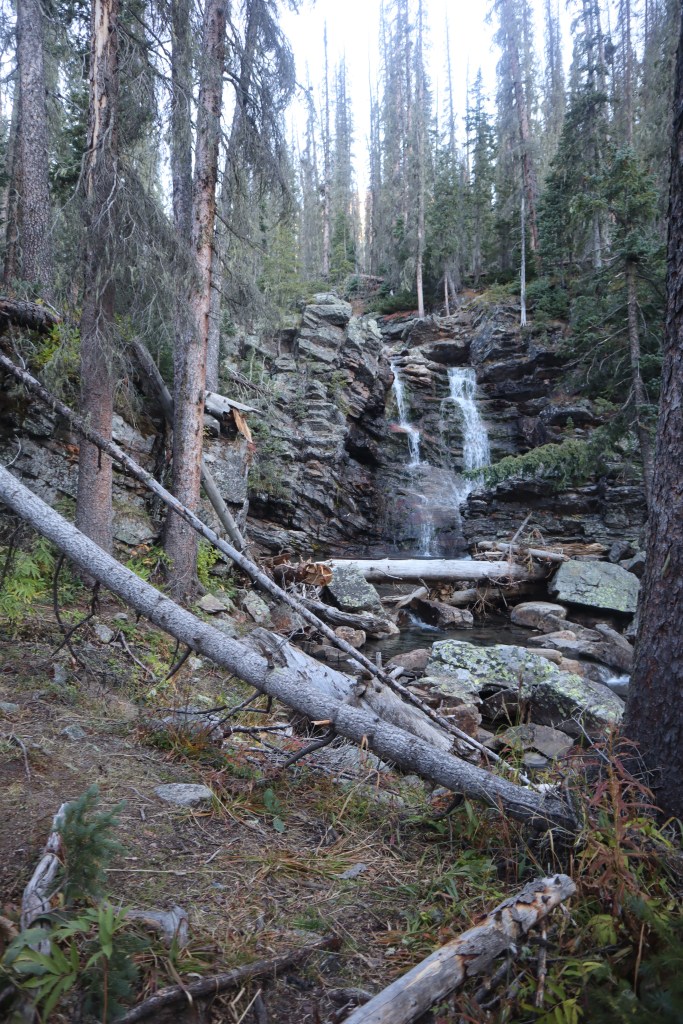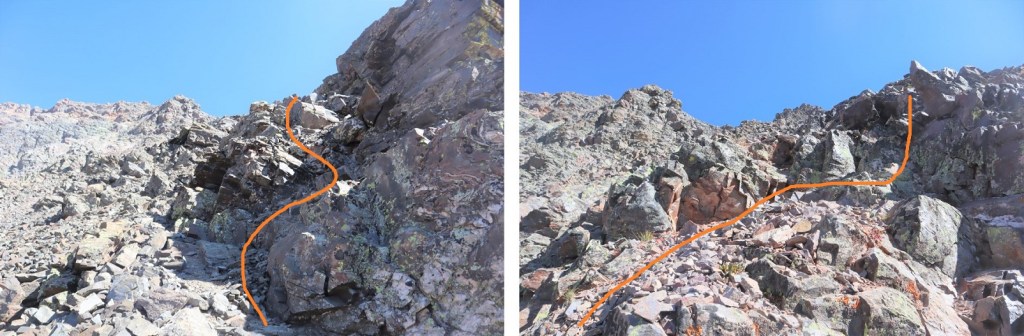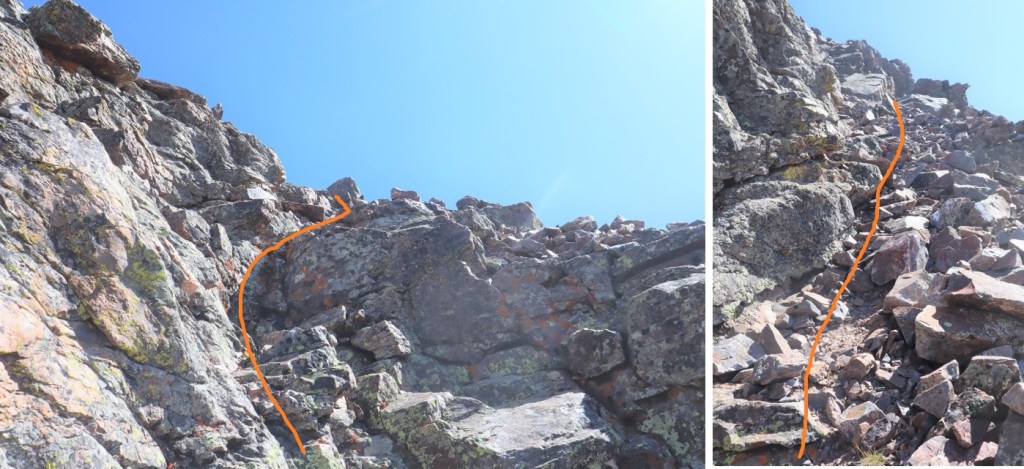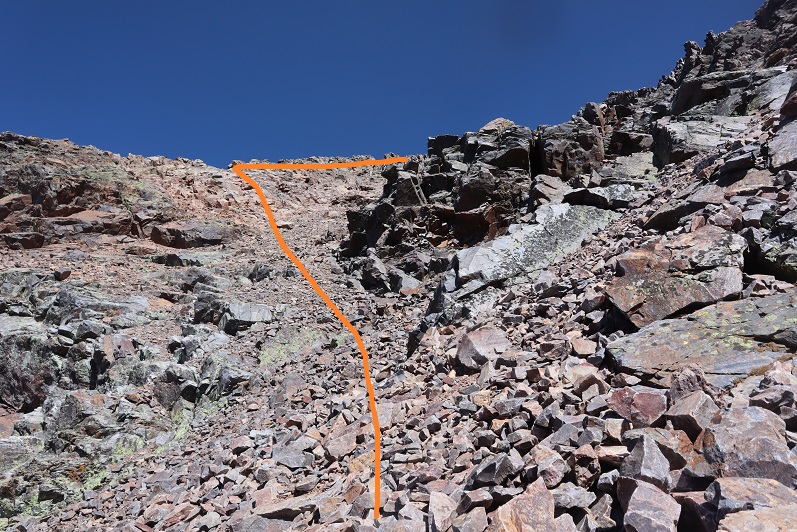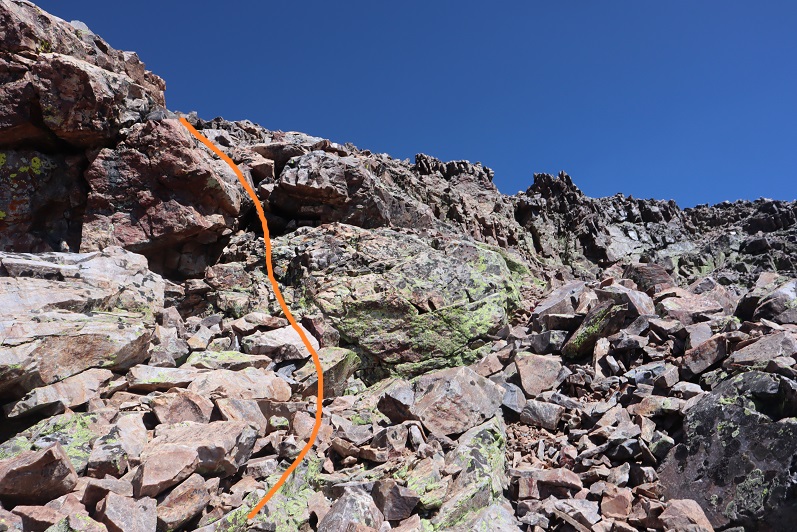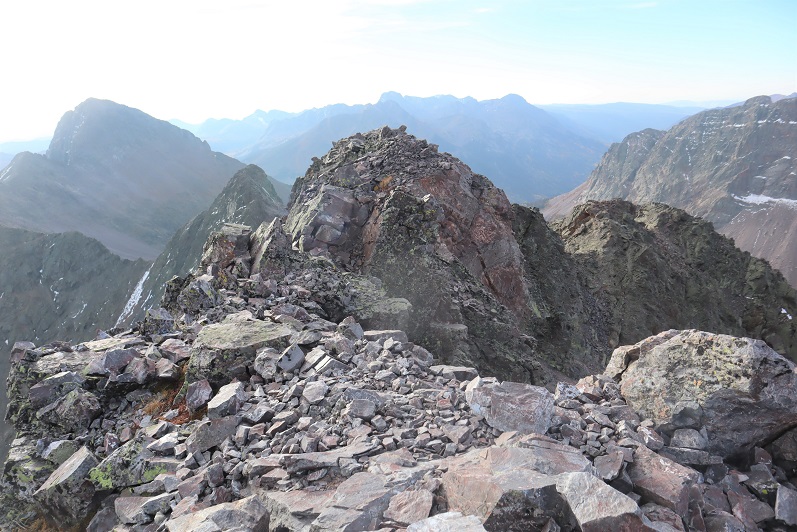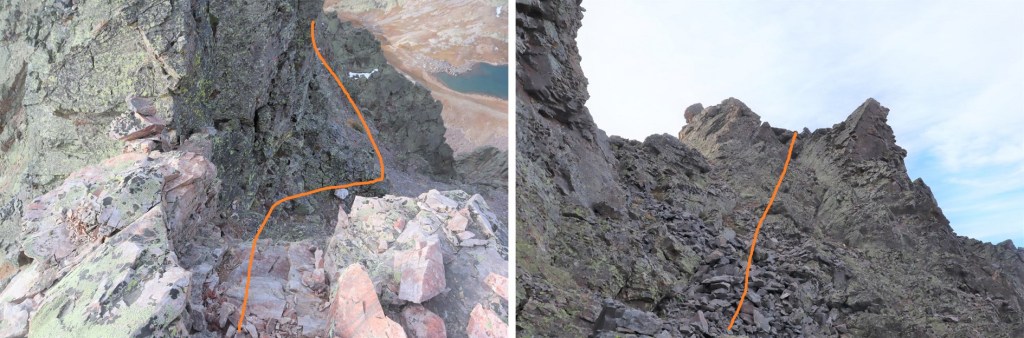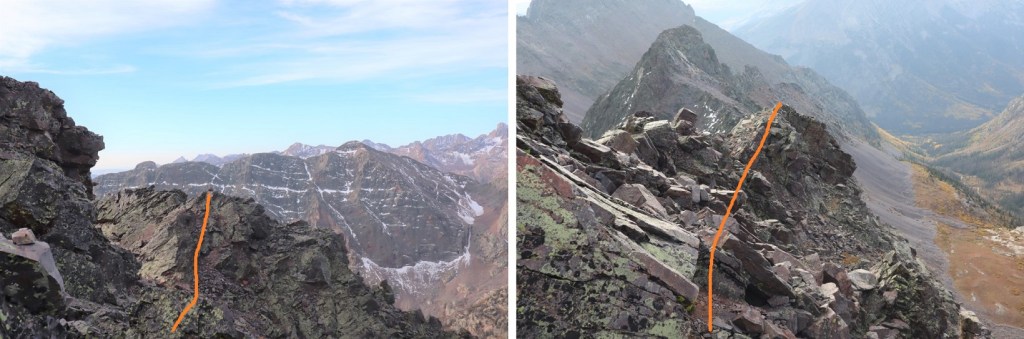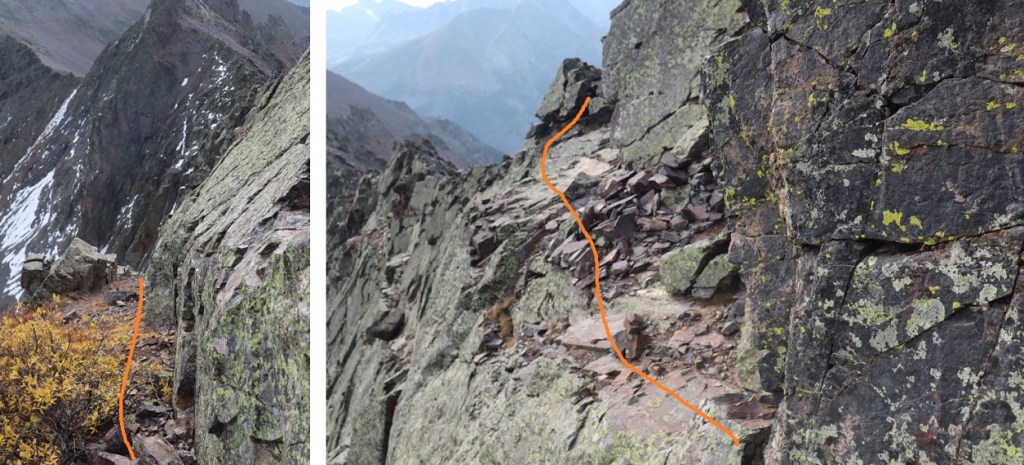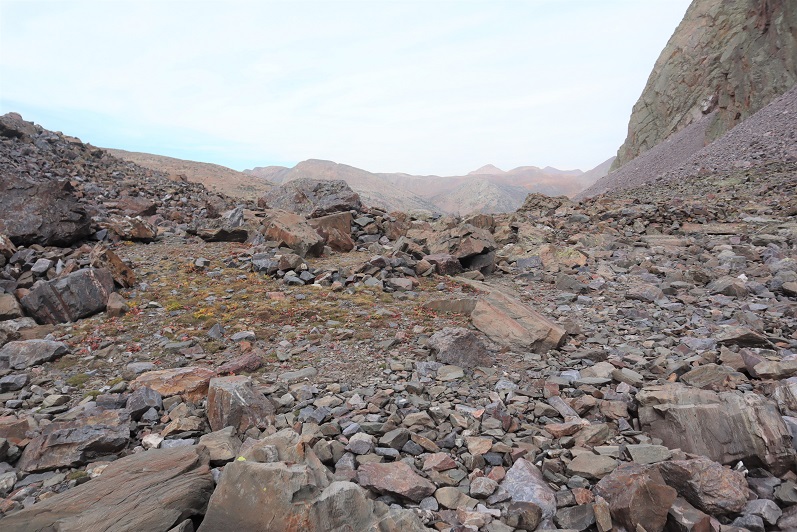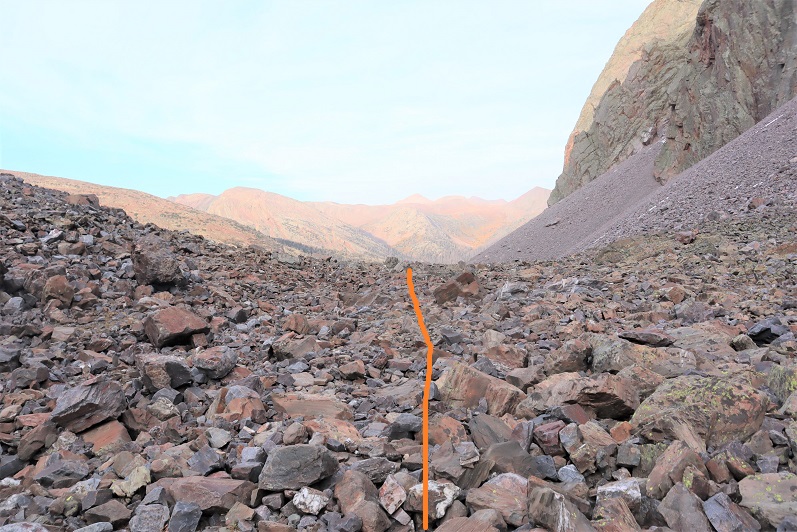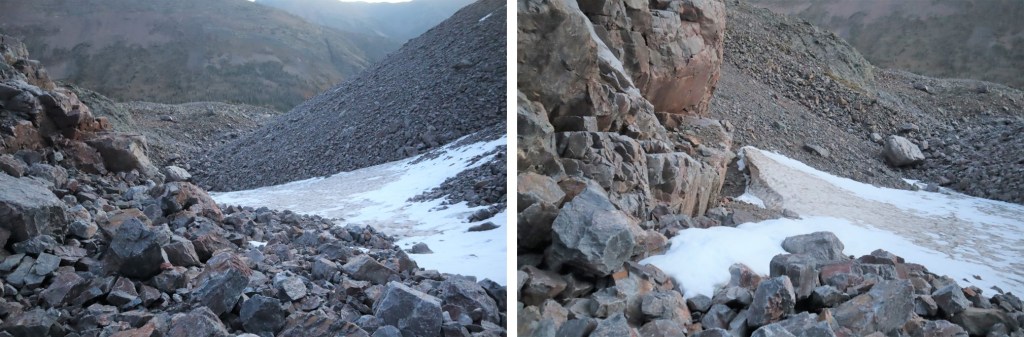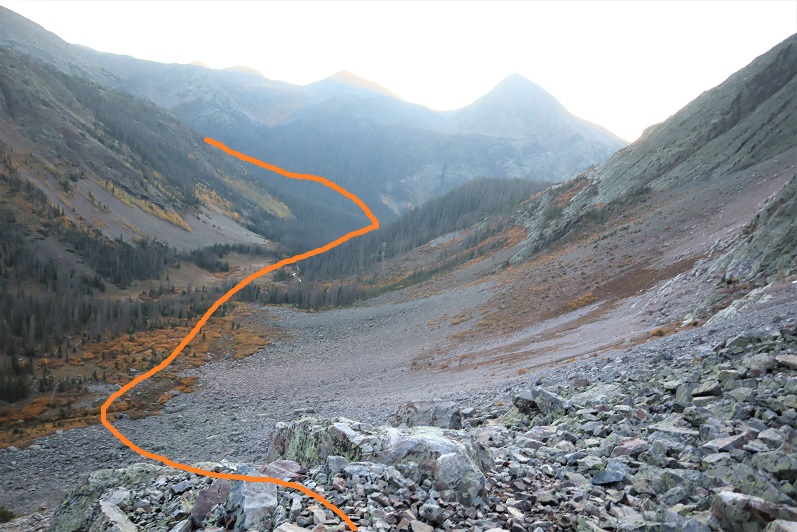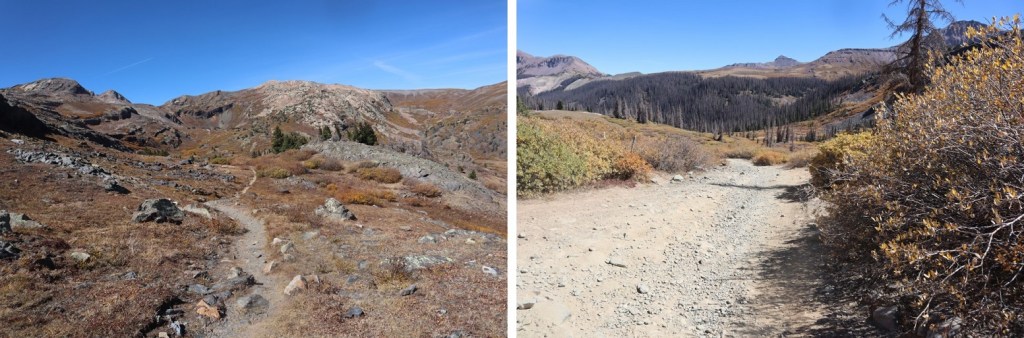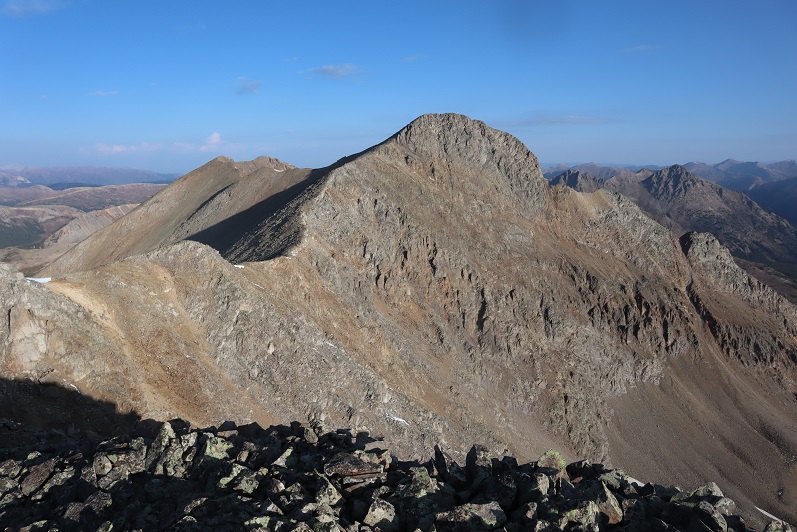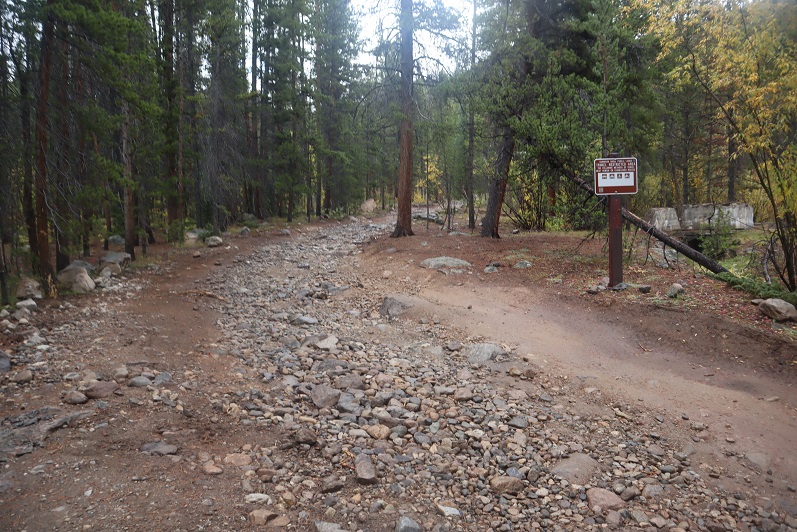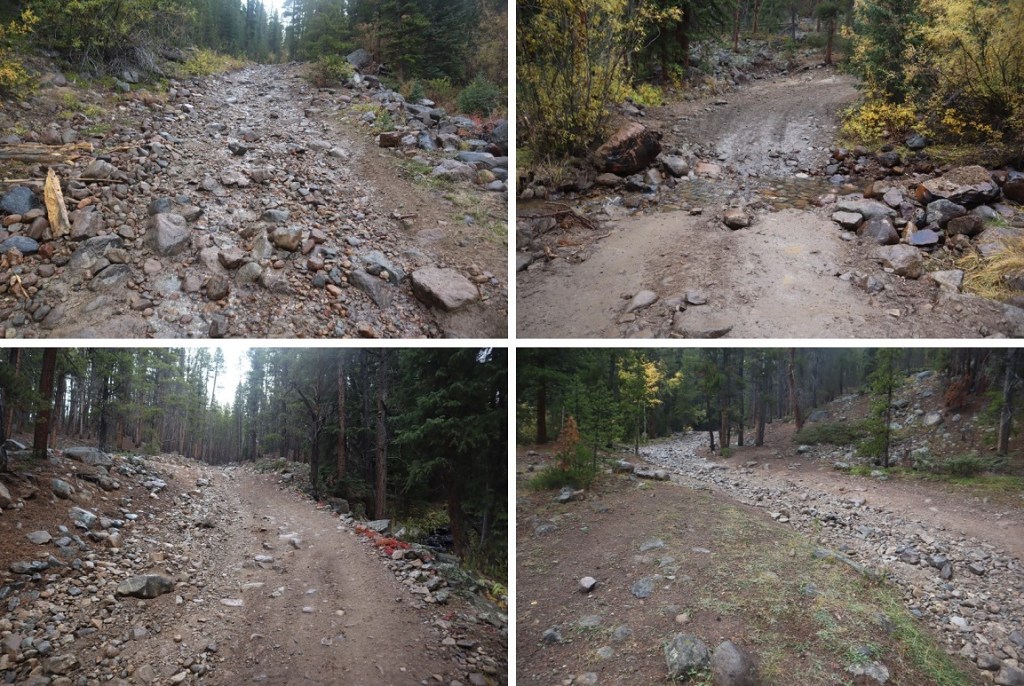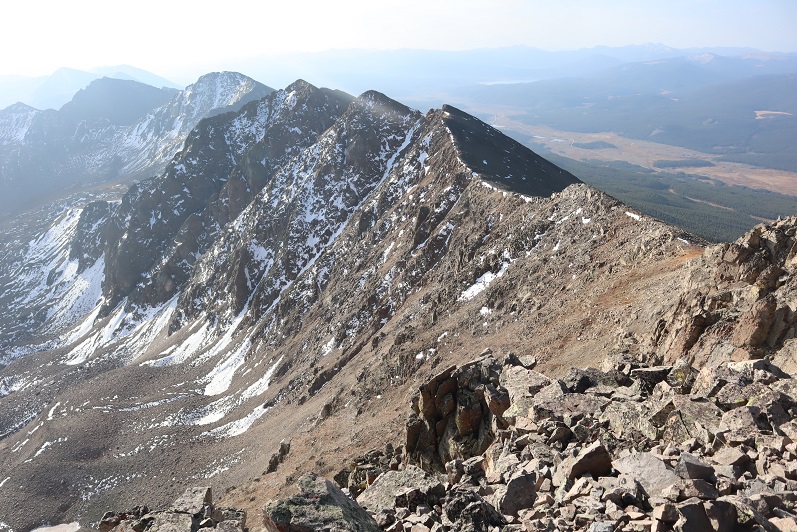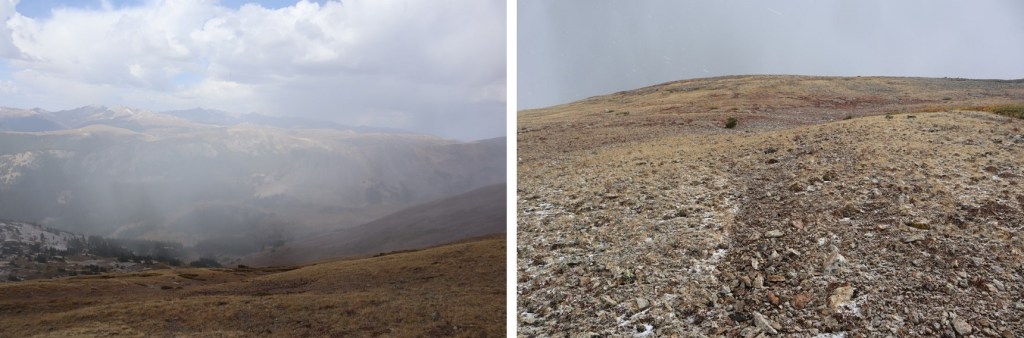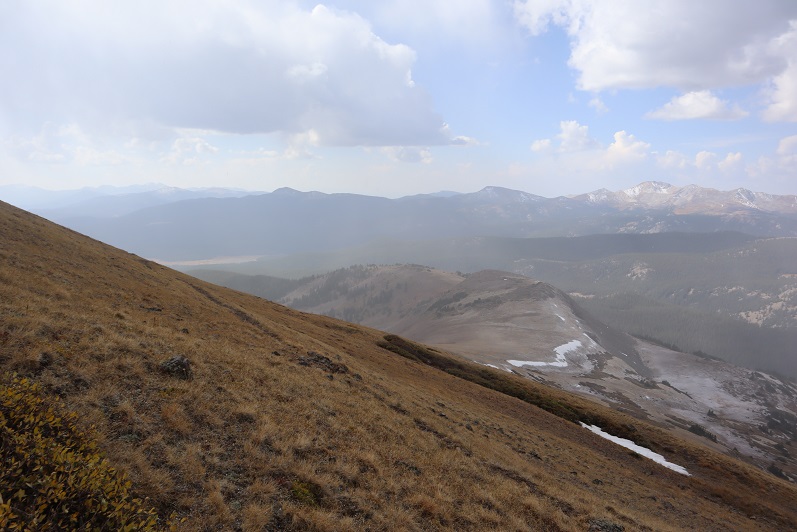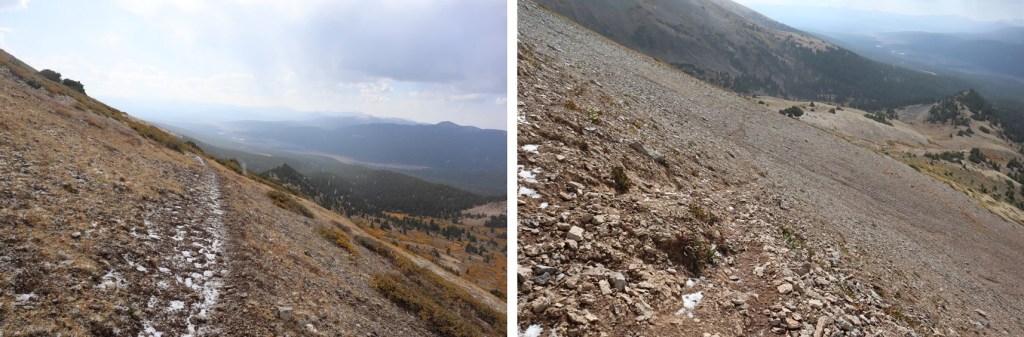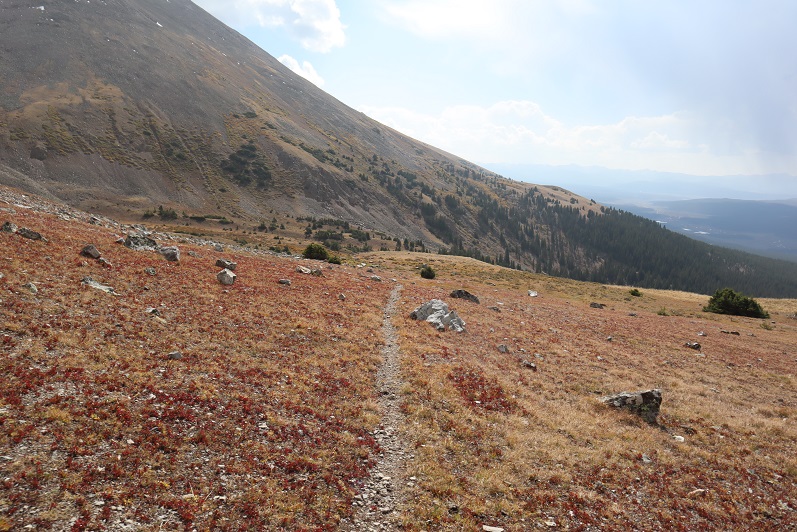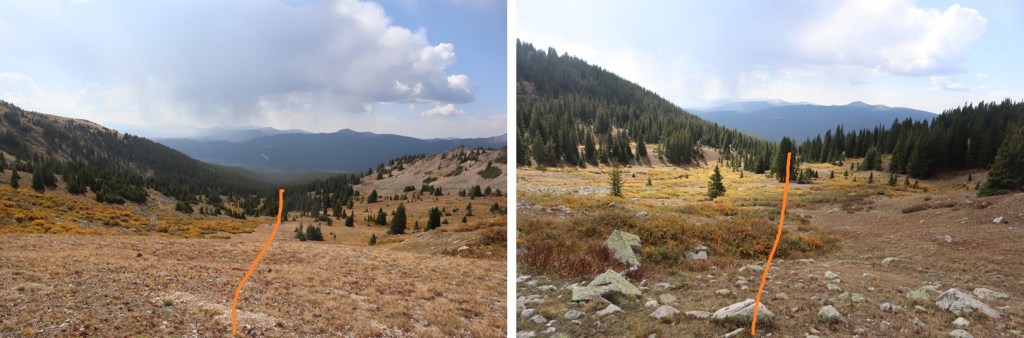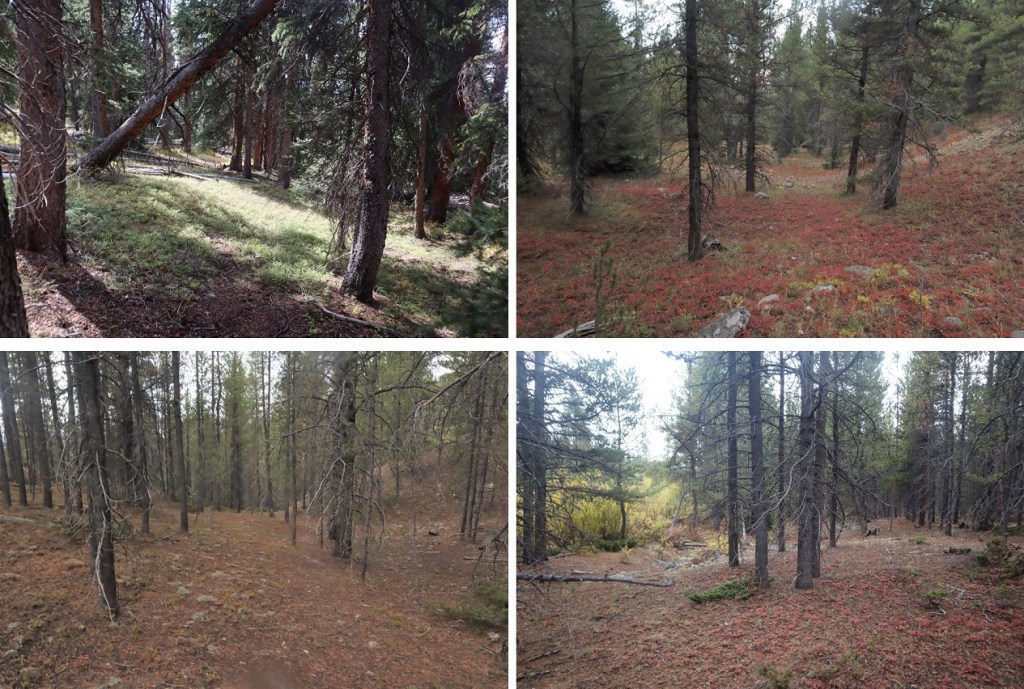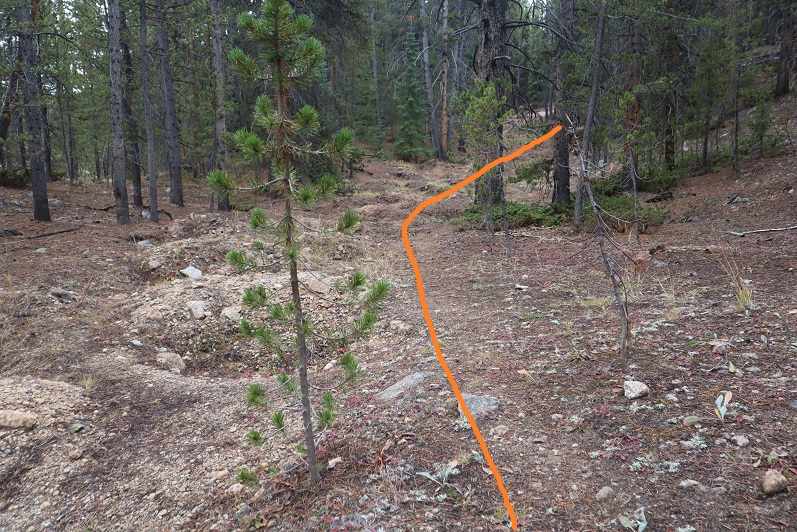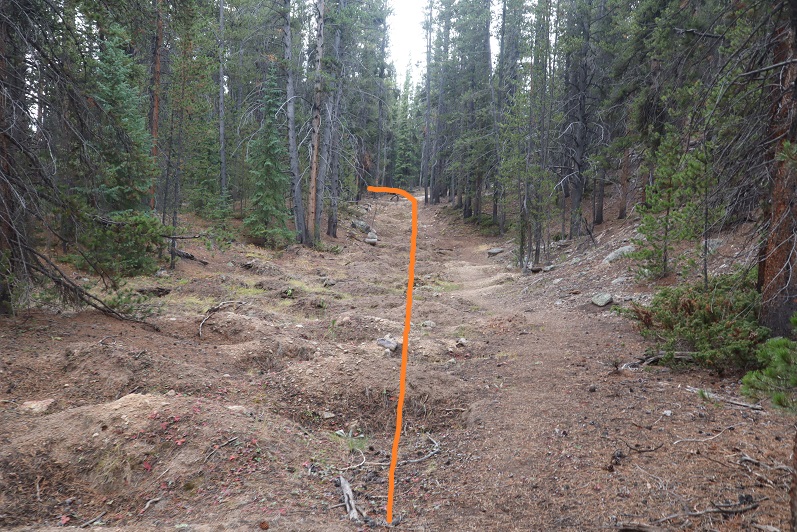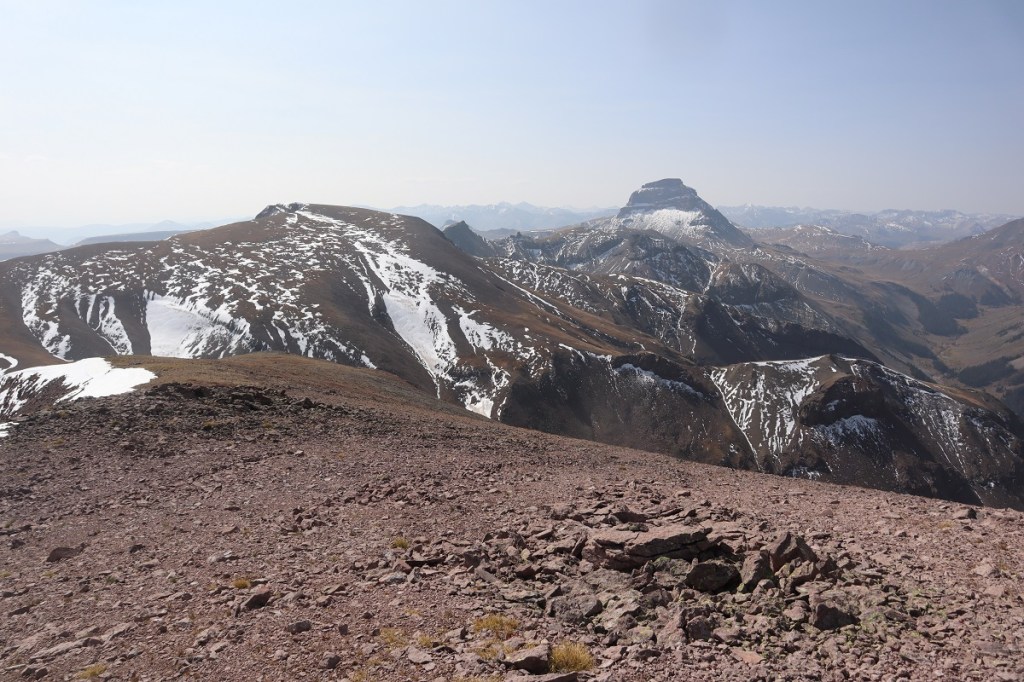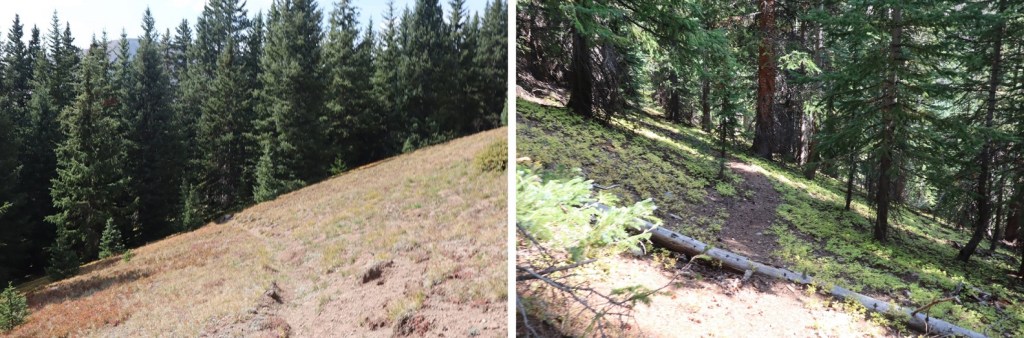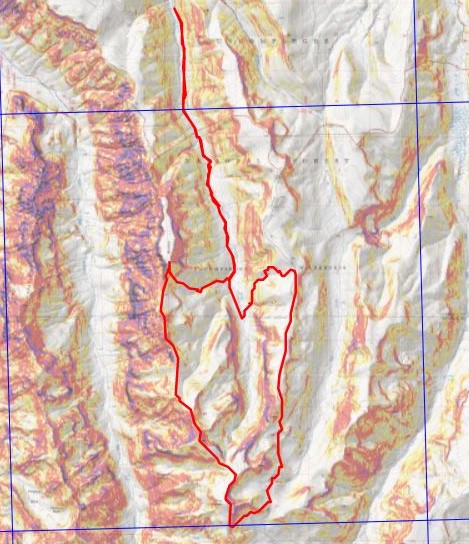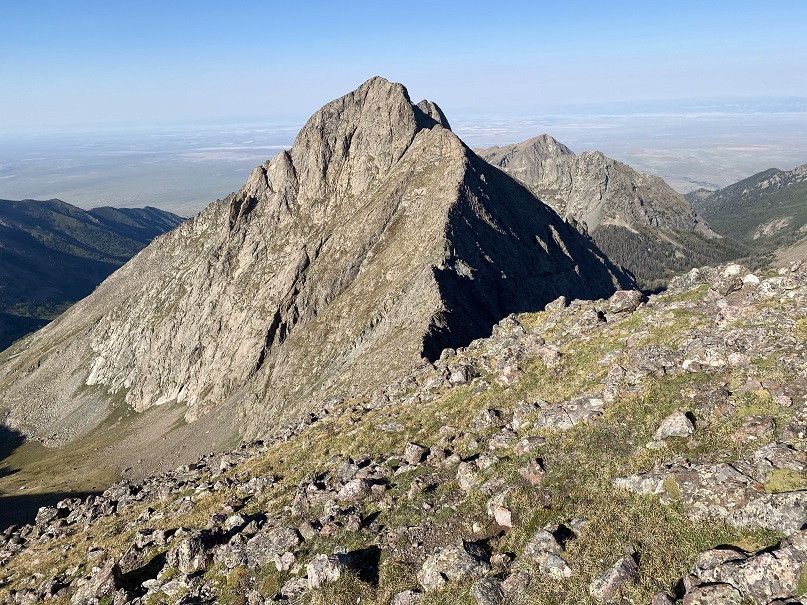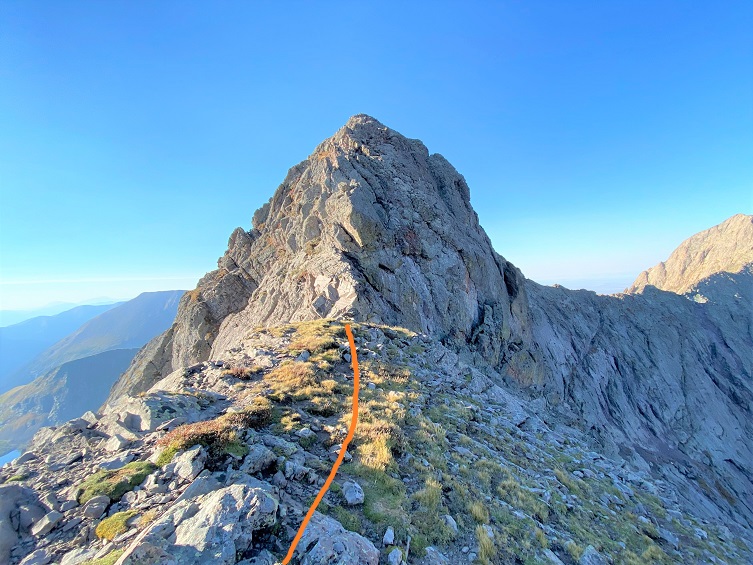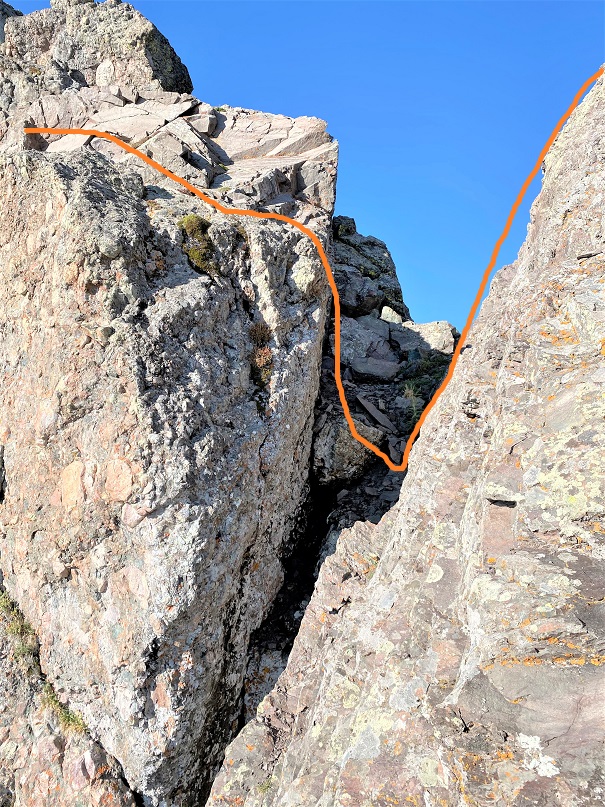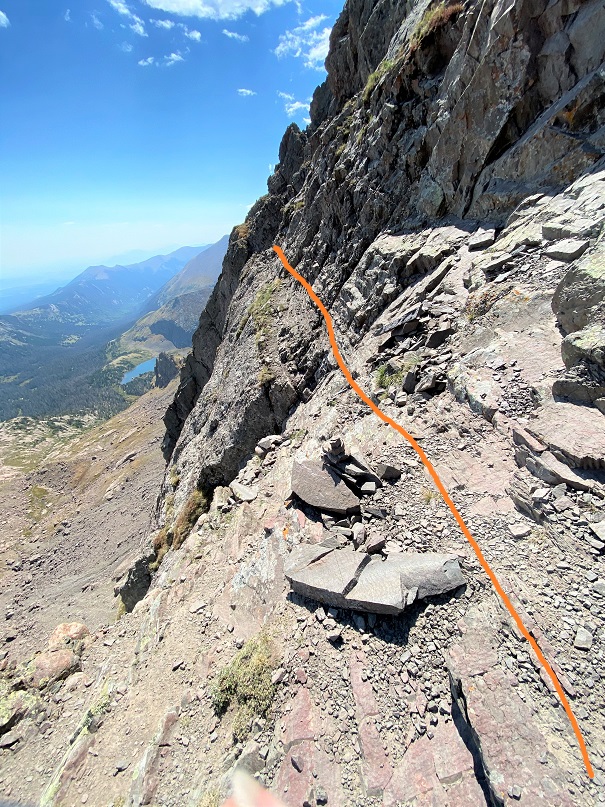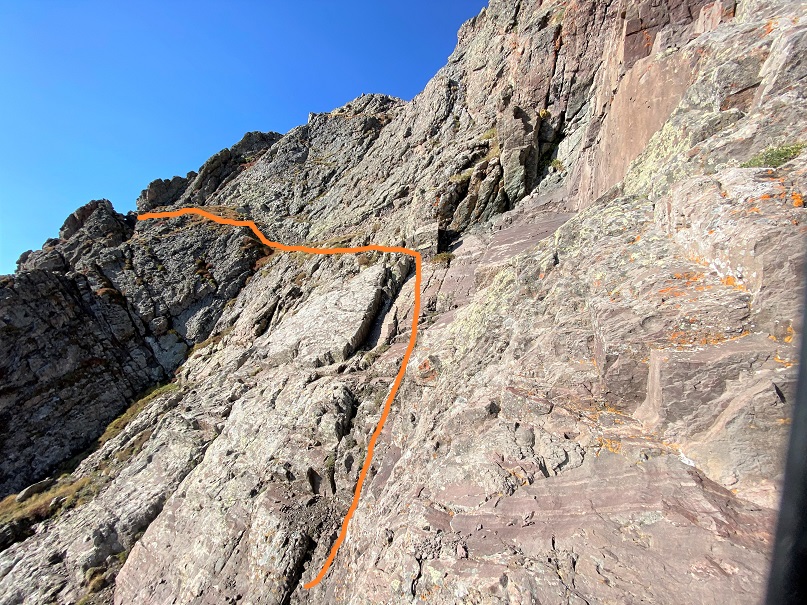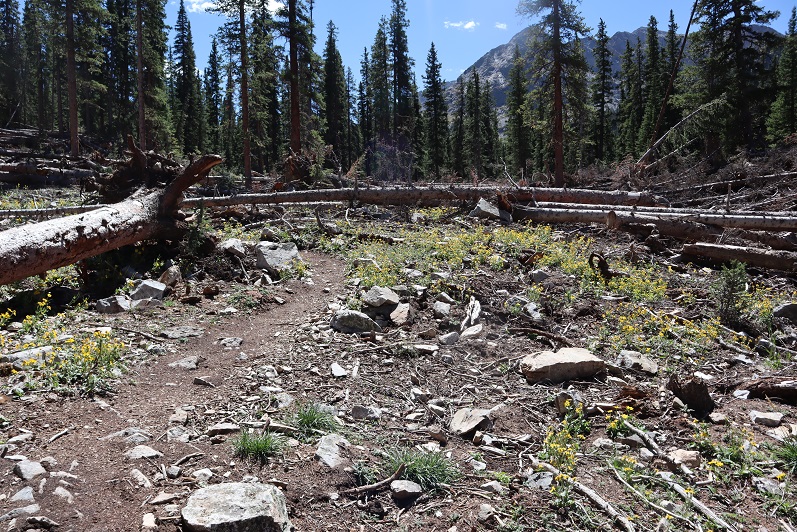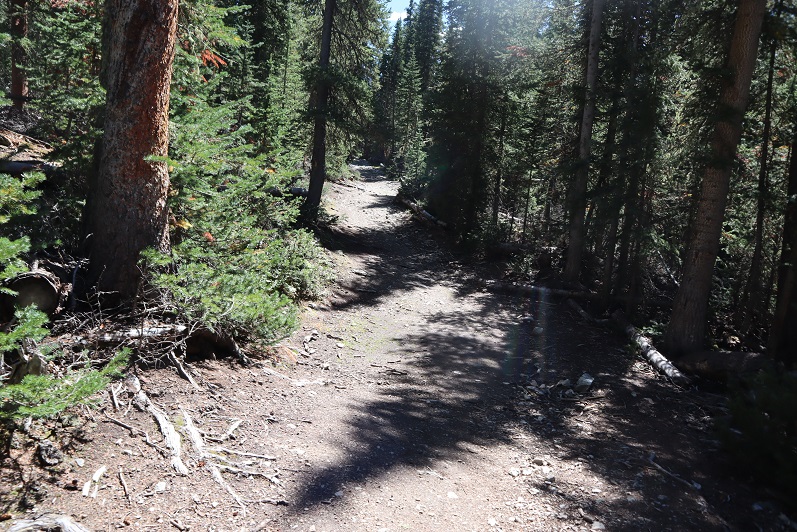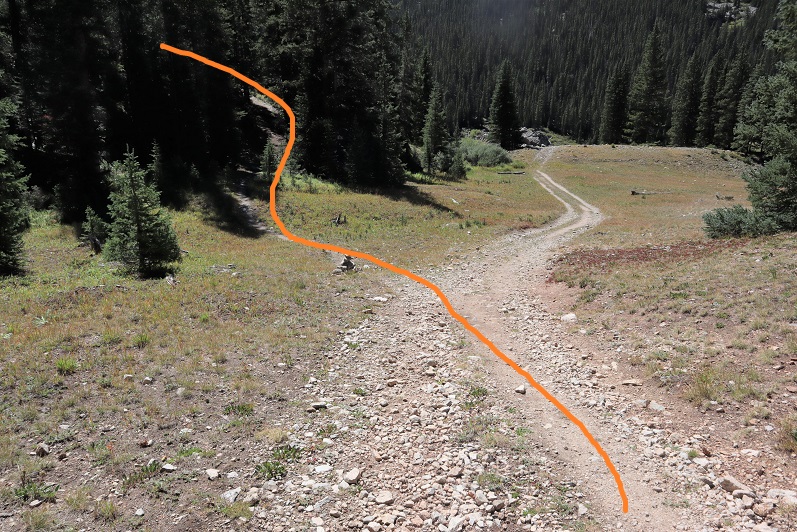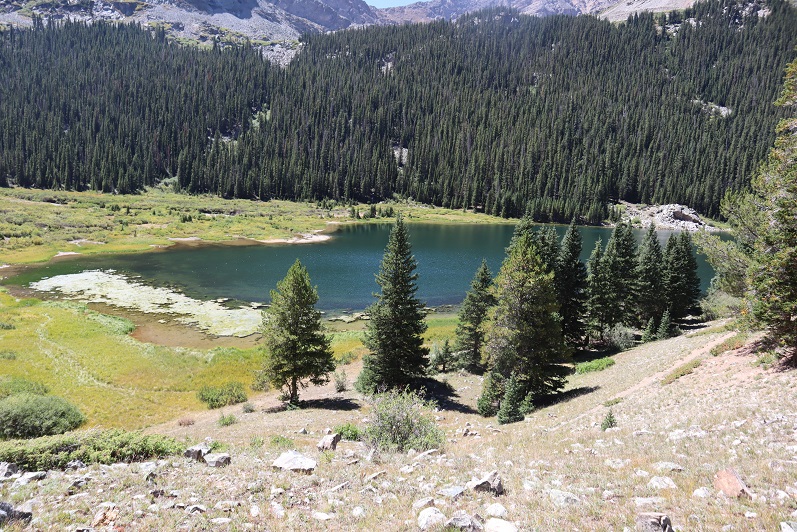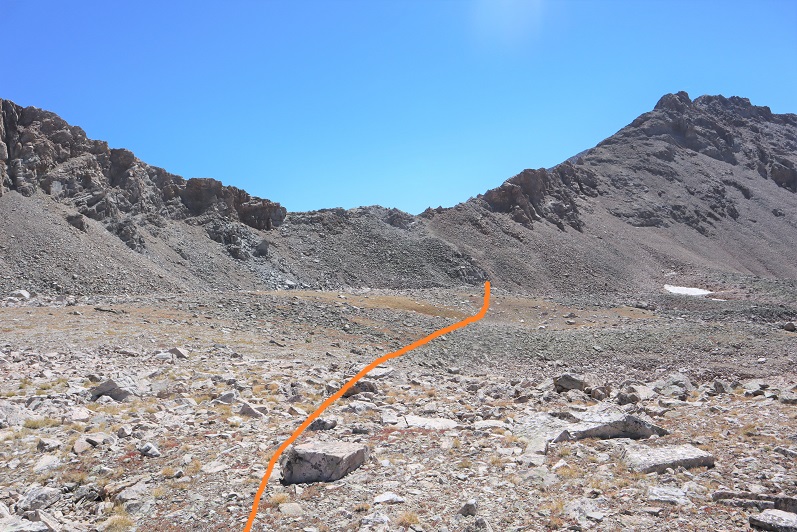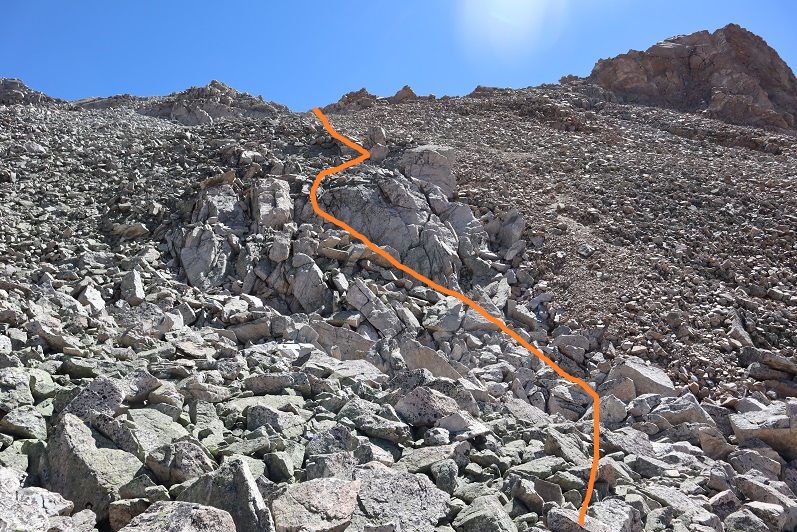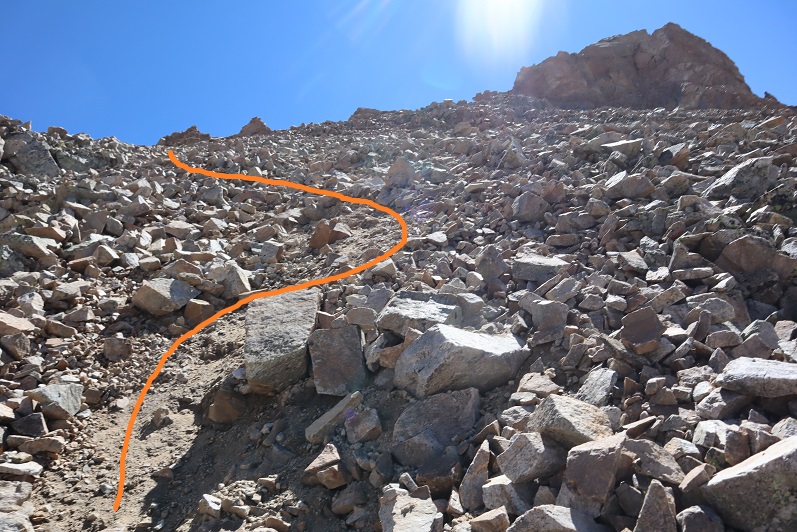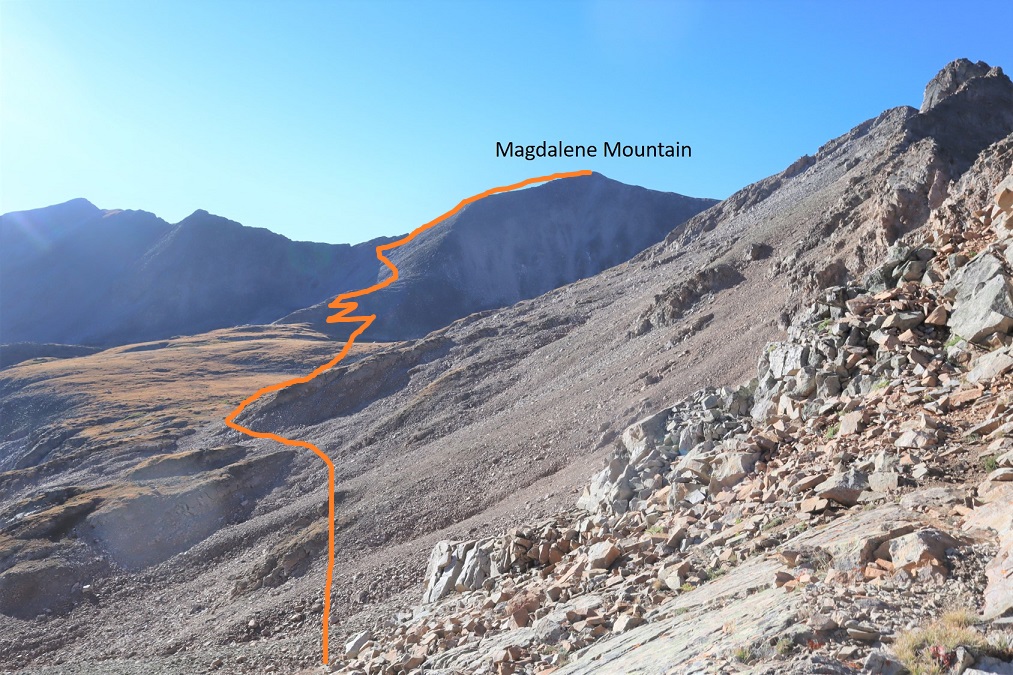
Aztec Mountain – 13,310, Grizzly Peak C – 13,700, McCauley Peak – 13,555

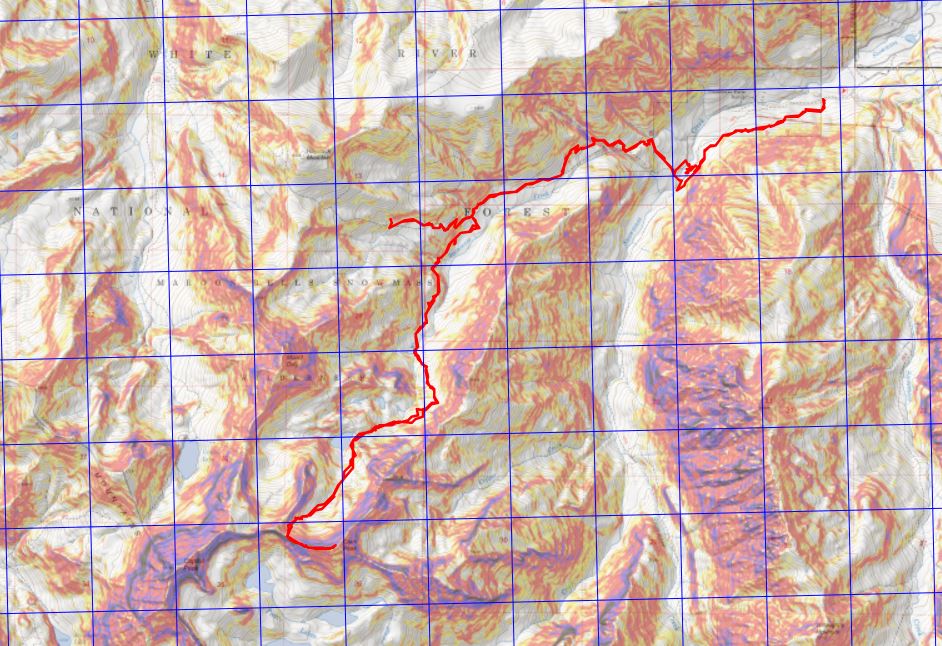
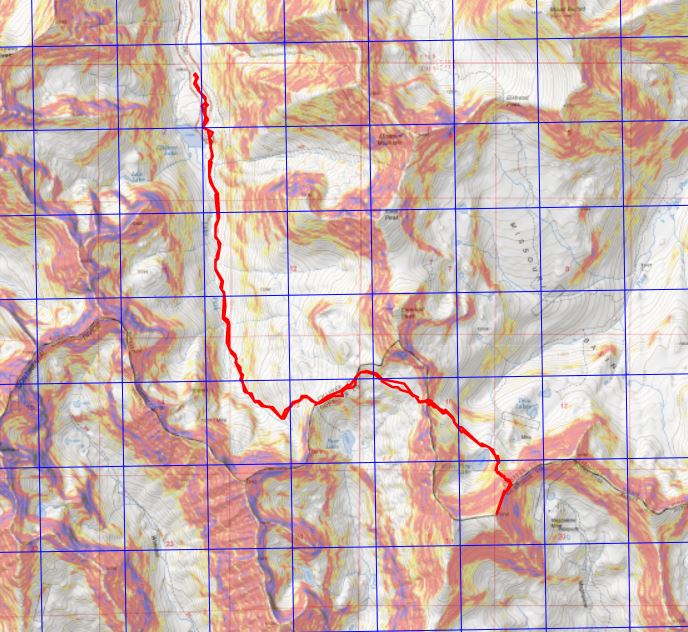
RT Length:  49.5 Miles (CalTopo) 42.61 Miles (Strava)

Elevation Gain:  9166’ (CalTopo) 13428’ (Strava)

Day 1:  Approach, Columbine Lake, Aztec Mountain

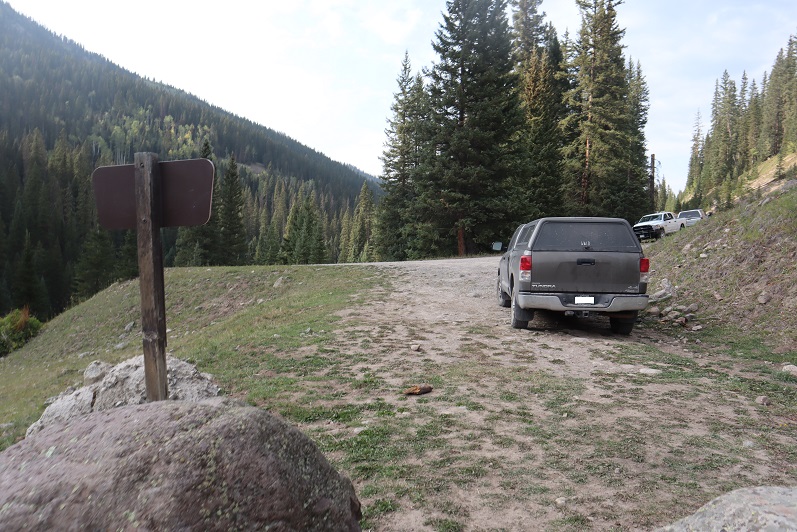
After quite a long drive I made it to the trailhead around 9pm.  Just before Vallecito campground there’s a sign indicating trailhead parking is to the left.  I parked, and was surprised I had cell service.  There were several horse trailers in the parking area, and a few vehicles. 
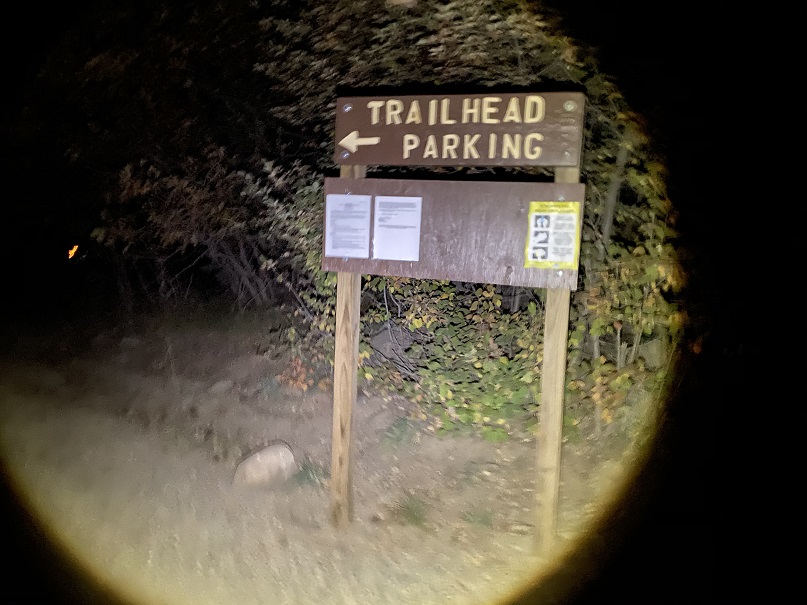
I tried to get some sleep, but my nap earlier in the day had lasted longer than it was supposed to (my alarm didn’t go off, and 30 minutes turned into 3 hours).  So, I read a bit, made a few phone calls, and got to bed later than anticipated.  I was up and on the trail at 2:30am.  The trail starts at the northeast corner of the campground. I started and ended the hike in the dark.  Also, I had my new camera with me, and was interested in how the pictures from today would turn out.
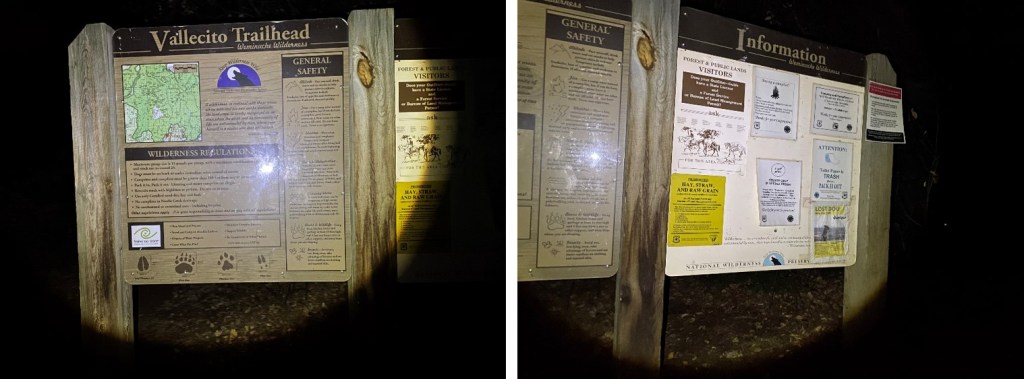
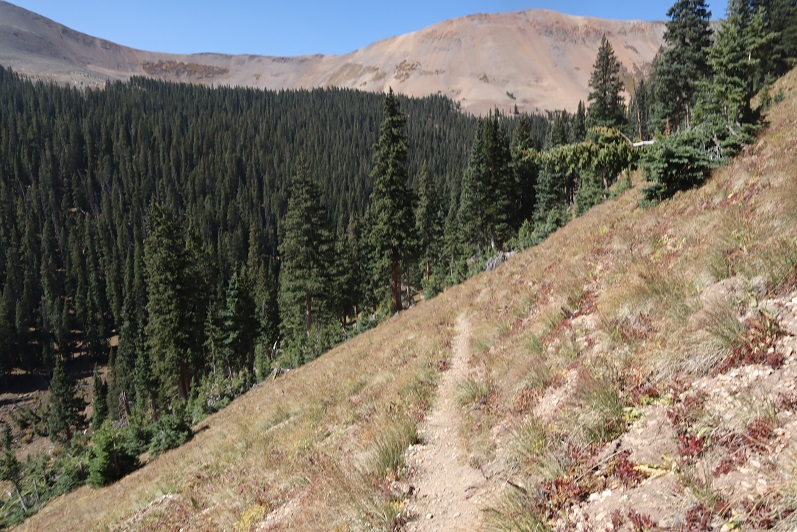
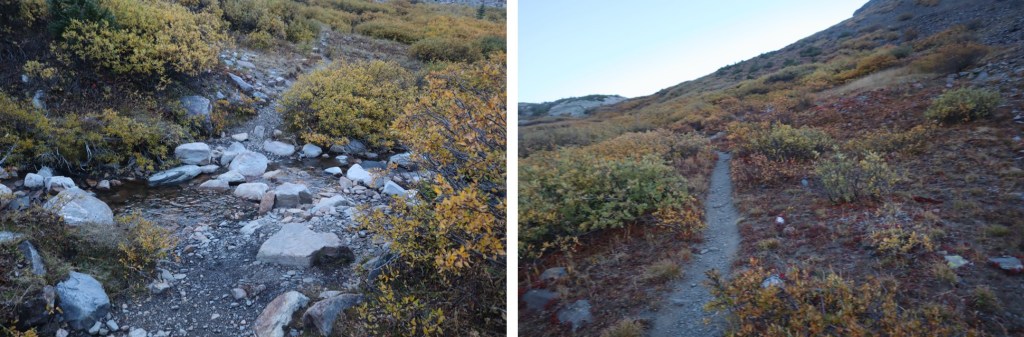
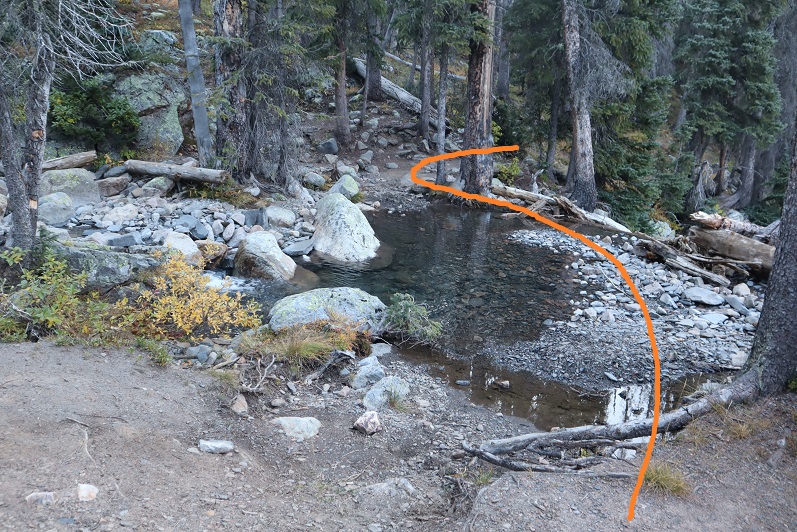
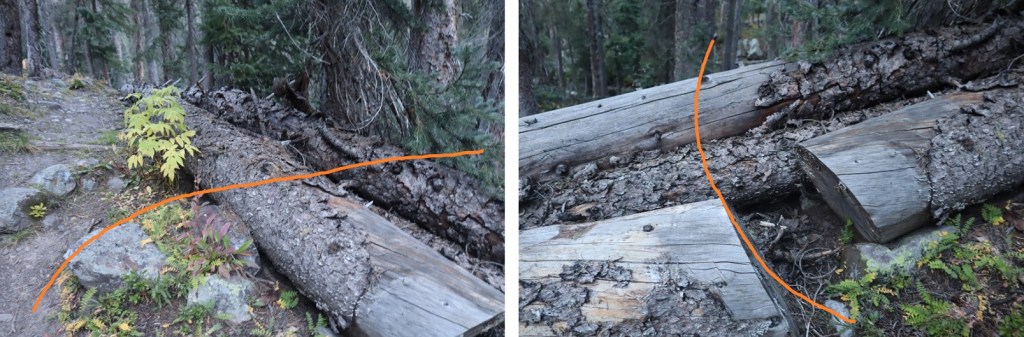
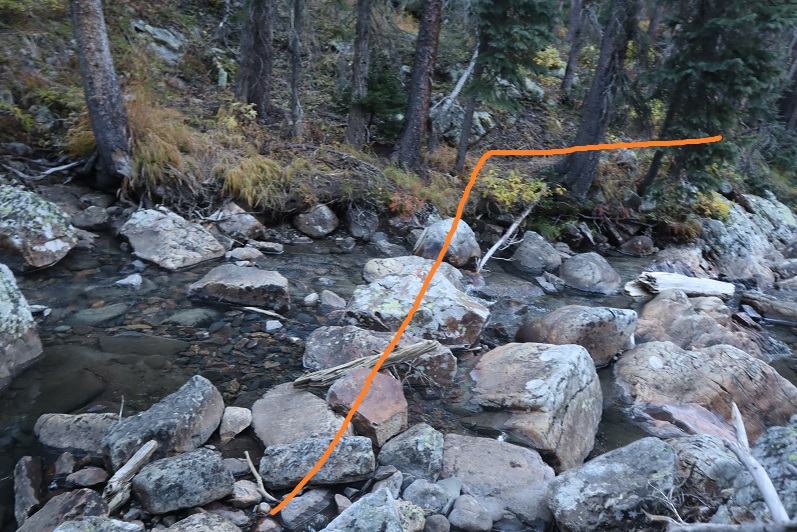
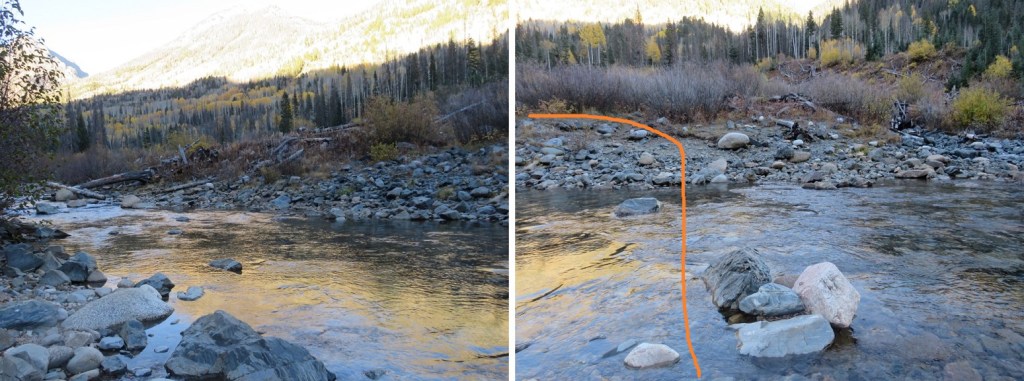
This is a class 1 trail that goes north without any junctions, so it’s difficult to get lost/off track.  I crossed the first two bridges (there are actually 3 if you consider the one that leads you out of the campground but doesn’t cross Vallecito Creek), but made it to the third bridge while it was still dark.  I couldn’t see across the river, and I didn’t want to cross without a visual, so I laid out my sleeping pad and took a nap for 30 minutes until it got light enough for me to see, then I put on my sandals and crossed the river.  I’m glad I waited until daylight:  crossing wasn’t too difficult, the water only went up to my knees, but there were pockets/pools where I could have sunk in the water much, much further.  My advice is to cross this creek (river?) in the daylight.
I continued hiking along the class 1 trail, but the stream crossing was causing me to have a Raynaud’s attack.  Surprisingly, it was in my hands and not my feet.  I kept pumping my fingers and balling my hands into fists, willing them to warm up and stop burning (yes, I realize that was a juxtaposition).  My fingers burned for another 2 hours. I should have stopped and warmed up some water to revive them, but instead I continued hiking until I came to the Vallecito/Johnson Creek Junction.  I made it to the junction after hiking for 10.3 miles, and continued left (west) towards Johnson Creek
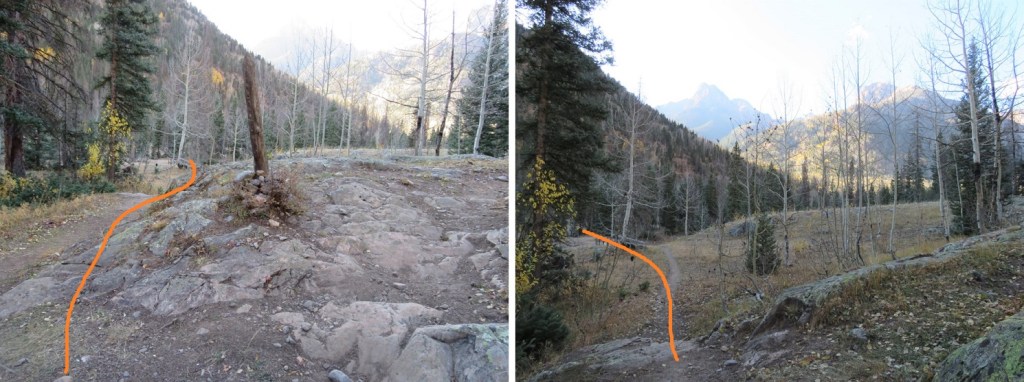
This led me over the 4th bridge, where I continued heading west, up into Vallecito Basin. 

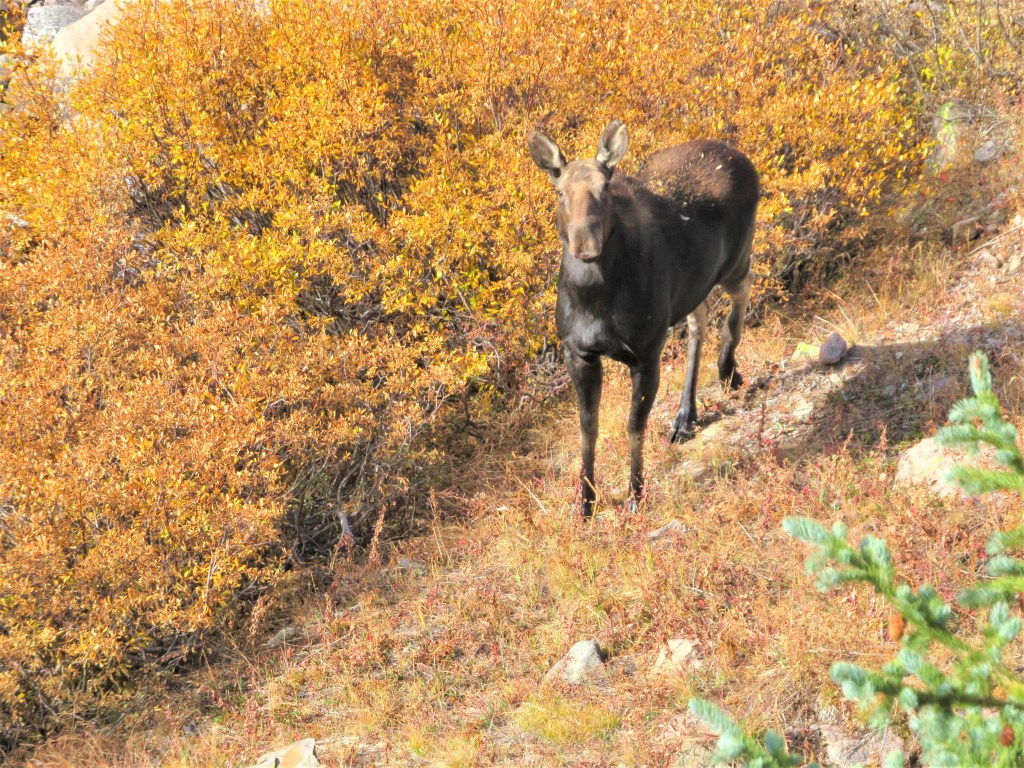
Just as I entered the Vallecito Basin I came across a moose. She was just as surprised to see me as I was her.  She was the size of a horse, adorable, and reminded me of a puppy dog, but I gave her space.  After the initial inquisitive look she gave me she pranced off to the trees and watched me timidly as I hiked away.
I continued on, up a thousand or so switchbacks, through the Vallecito basin to Columbine Lake.

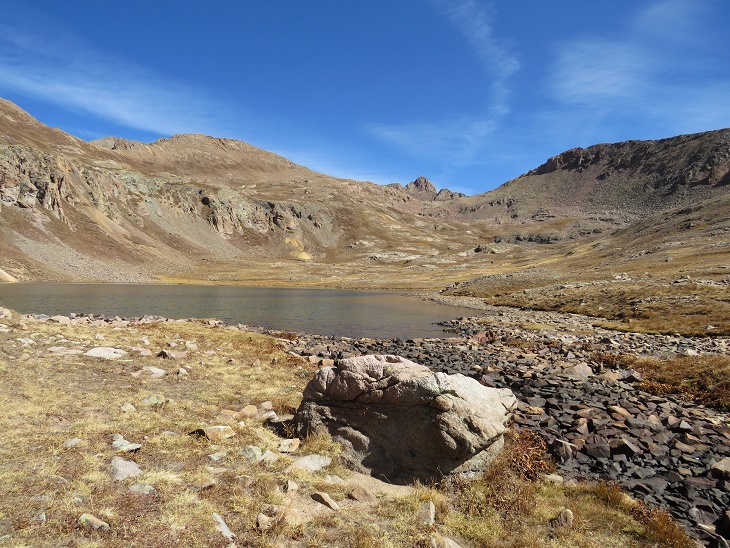
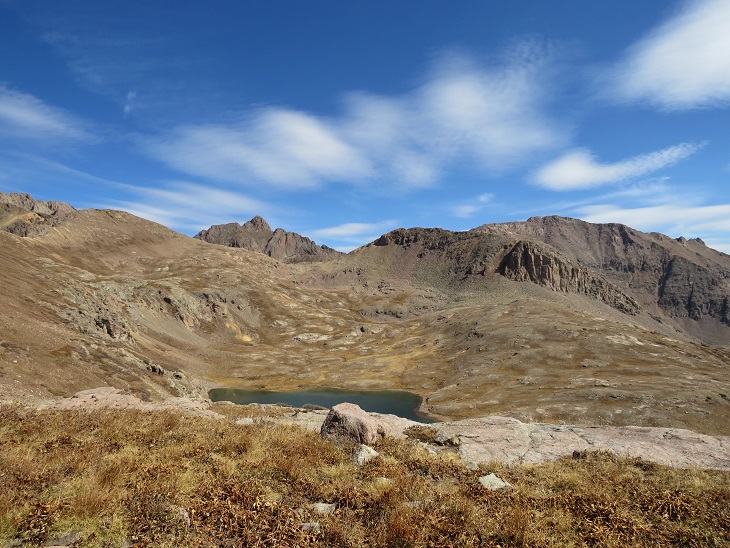
It took me 18.5 miles to make it to Columbine Lake.  I made it there at 1pm and decided to sit and take a break for a while.  It was here I realized my biggest mistake of the weekend:  I didn’t have any chapstik.  My lips would be burning until I made it back to the trailhead (and especially after each shot of whiskey).  I snacked on a packet of tuna, filtered some water, and considered my options.  I’d wanted to hike Grizzly and McCauley today, but I didn’t think I had enough time to make it back before the sun went down behind the mountains.  I need to be in my bivy before the sun sets, so this was a serious concern for me.  But I wasn’t tired yet.  I decided instead to leave my large pack here, take just what I needed in a small pack, and summit Aztec Mountain this afternoon instead. 

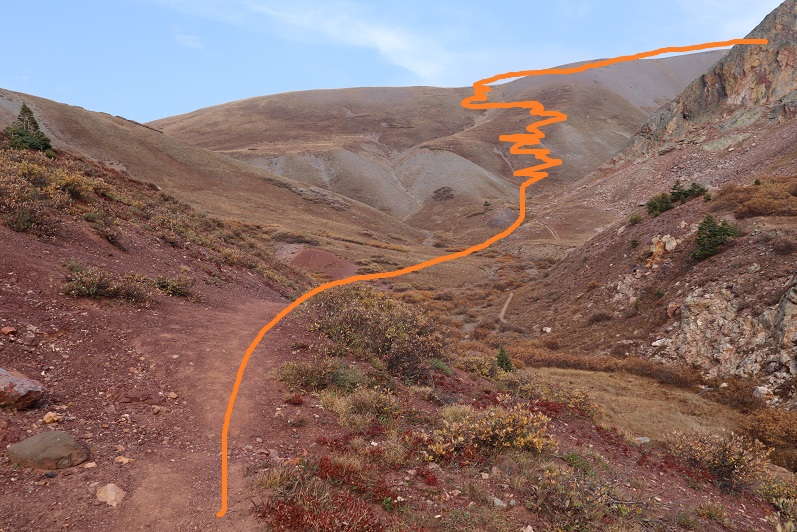
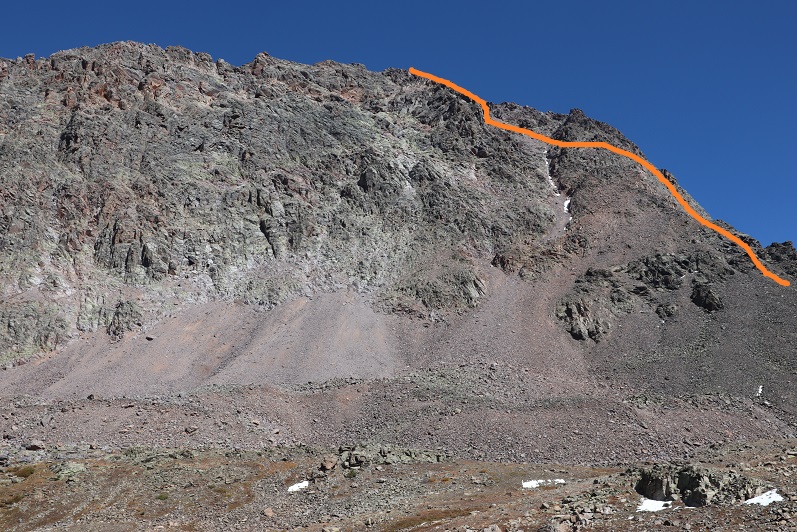
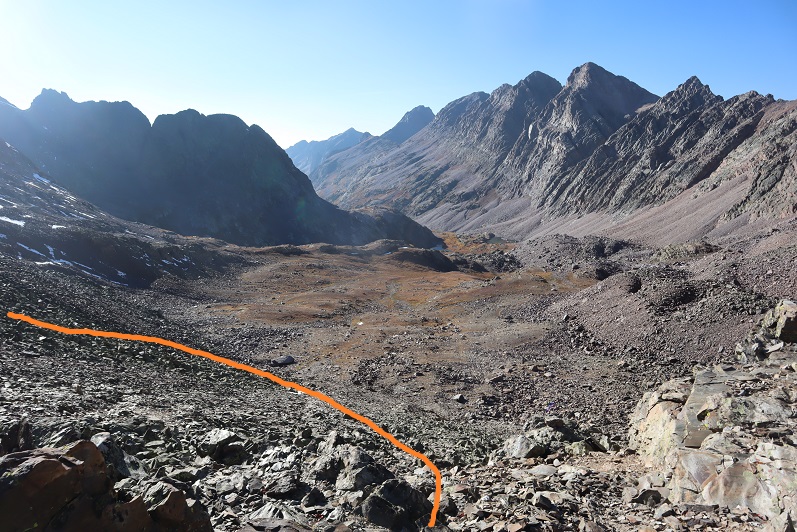
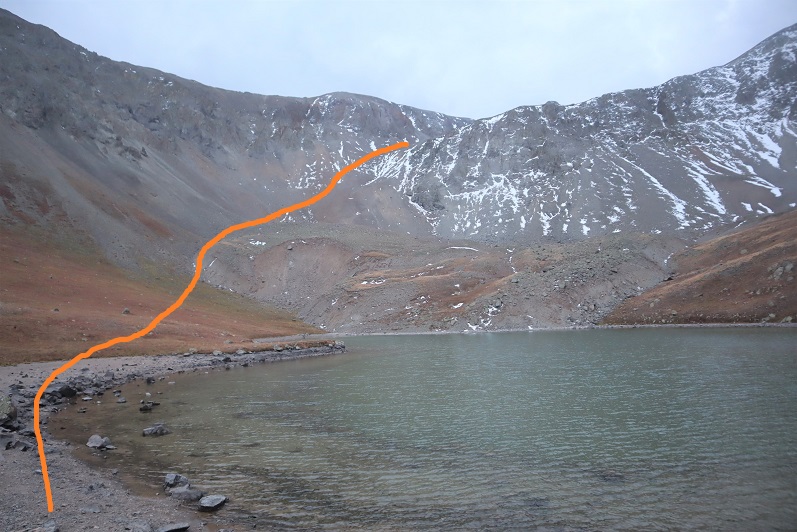
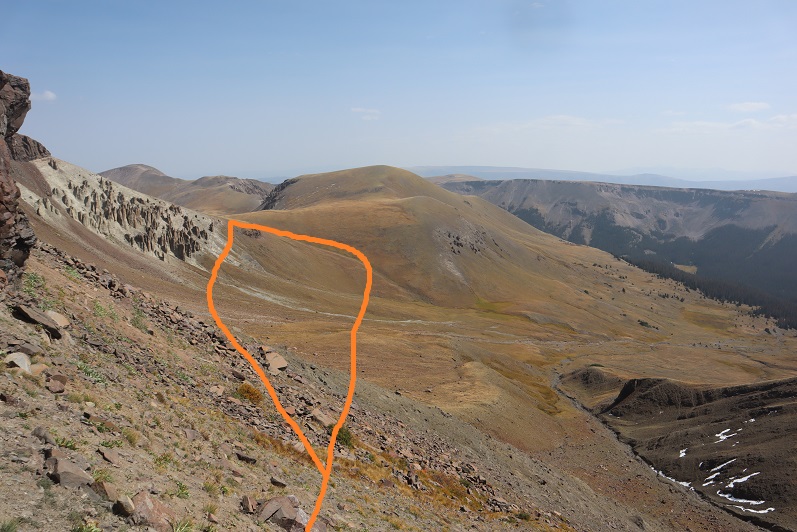
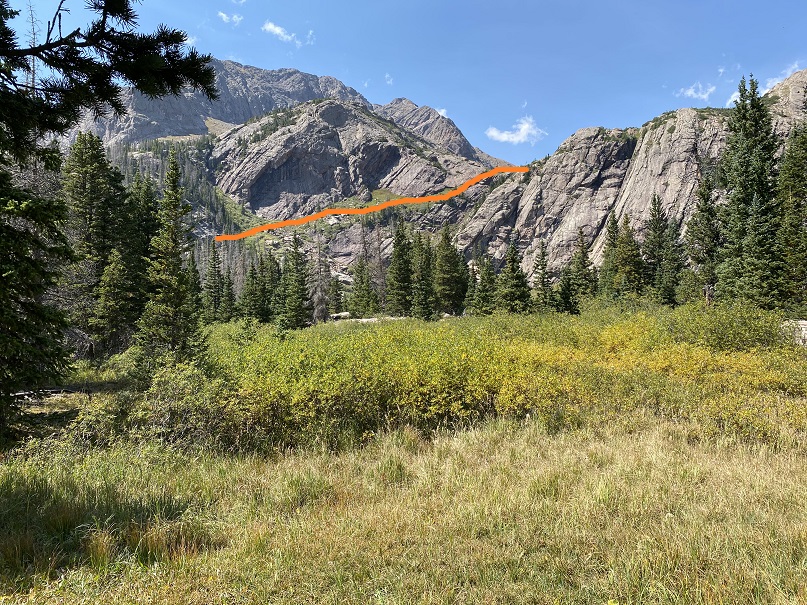
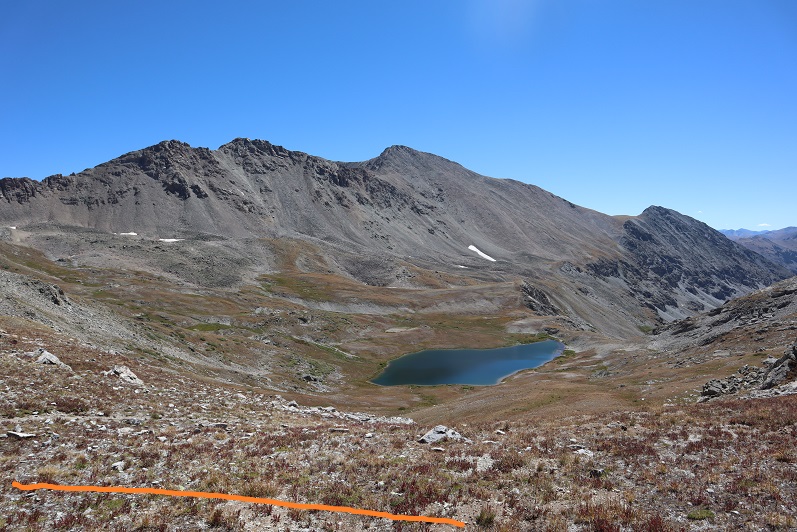
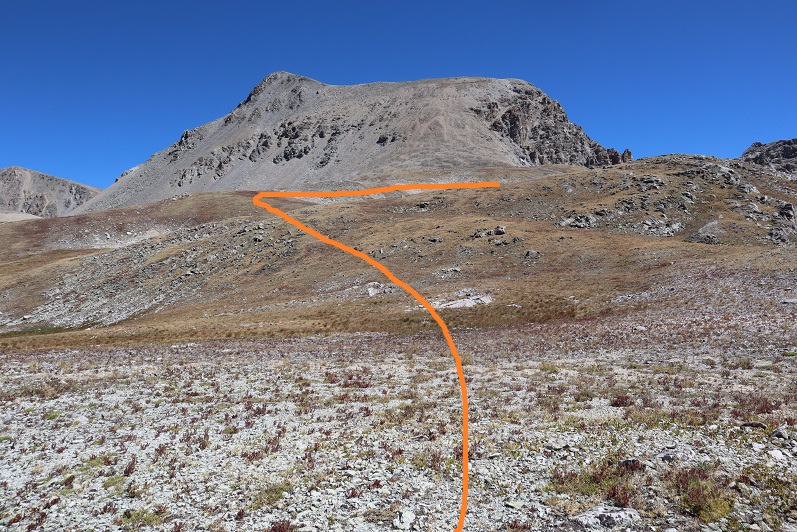
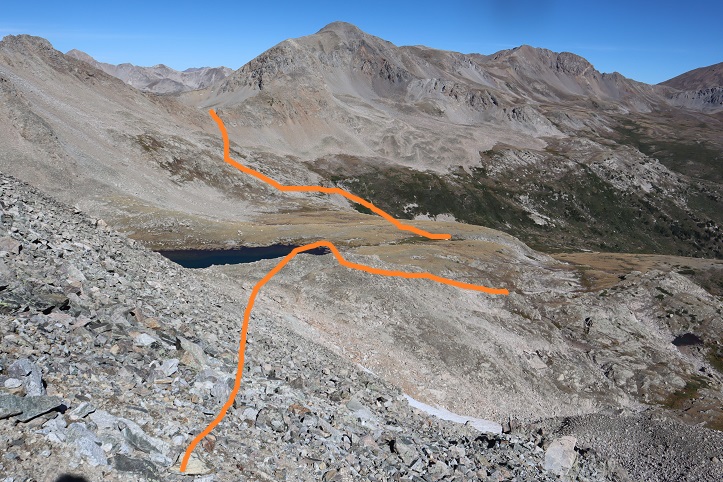
Here’s an overall view of the route I took to the ridge to Aztec Mountain, as seen from Hope Pass the next day

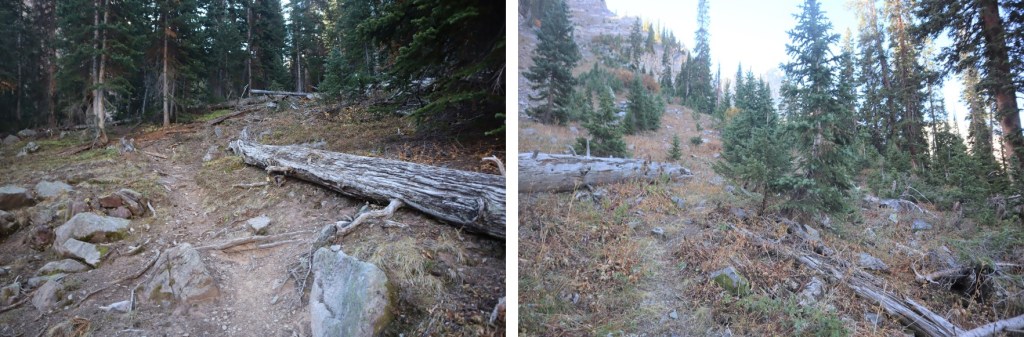
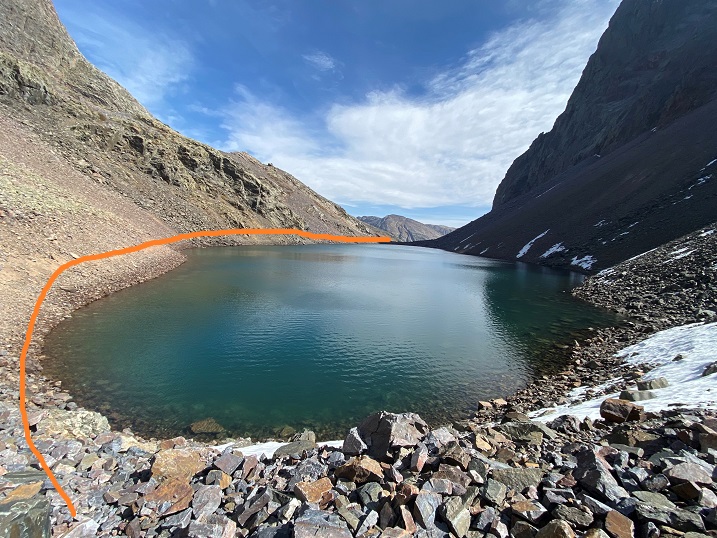
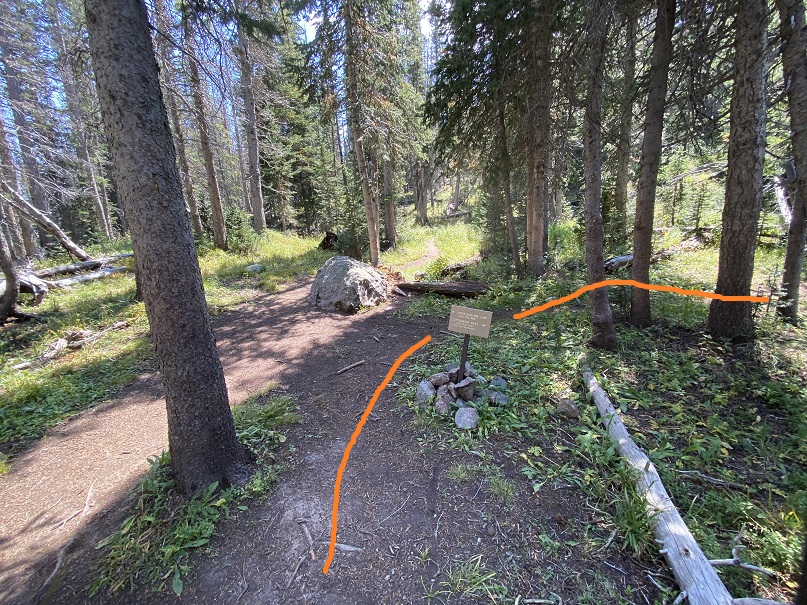
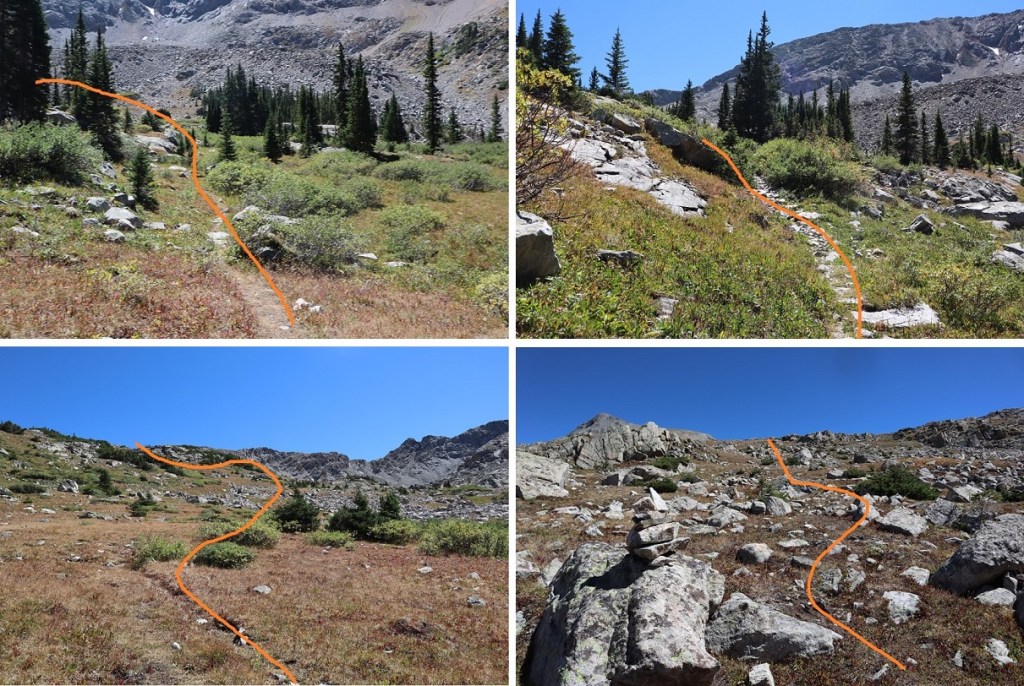
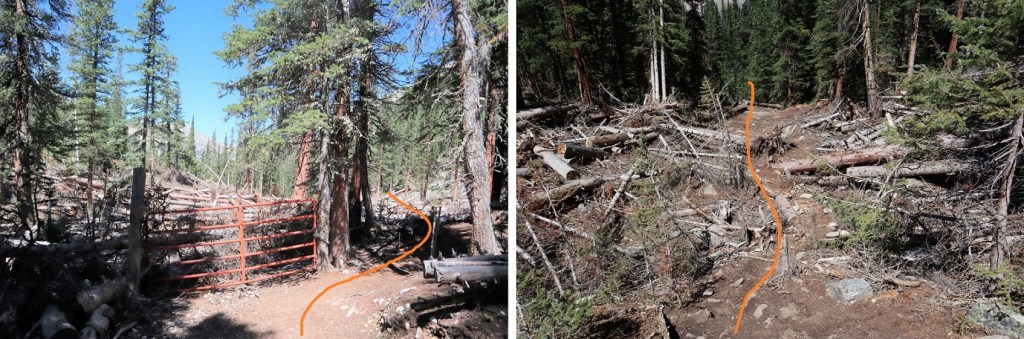
From Columbine Lake I turned and followed the trail northwest towards Columbine Pass, then turned left when it hit trail 541 (no signage, and in fact I had to wing it for a bit as the trail didn’t quite go through, but it was obvious from below where the trail was and I just aimed for it) and headed south.
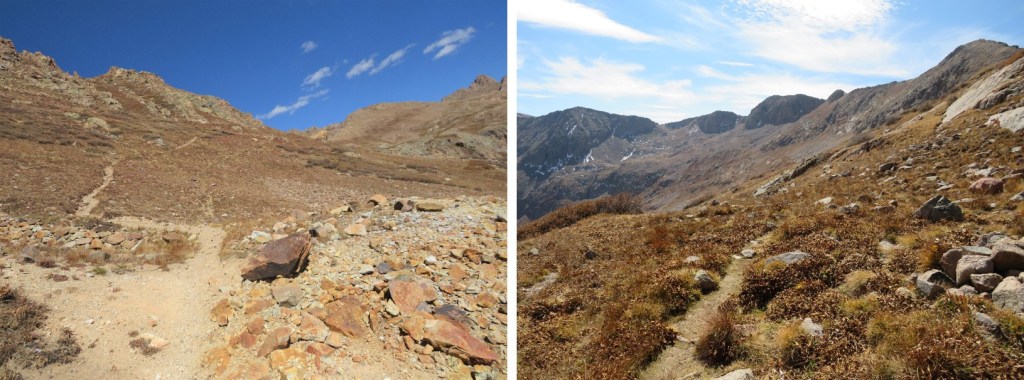
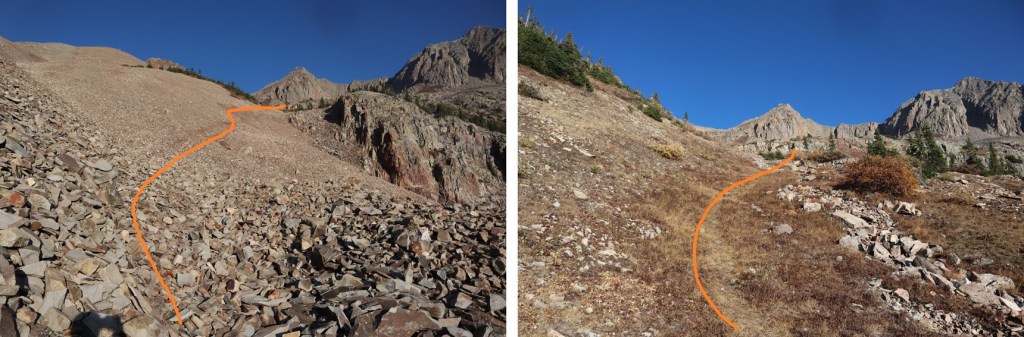
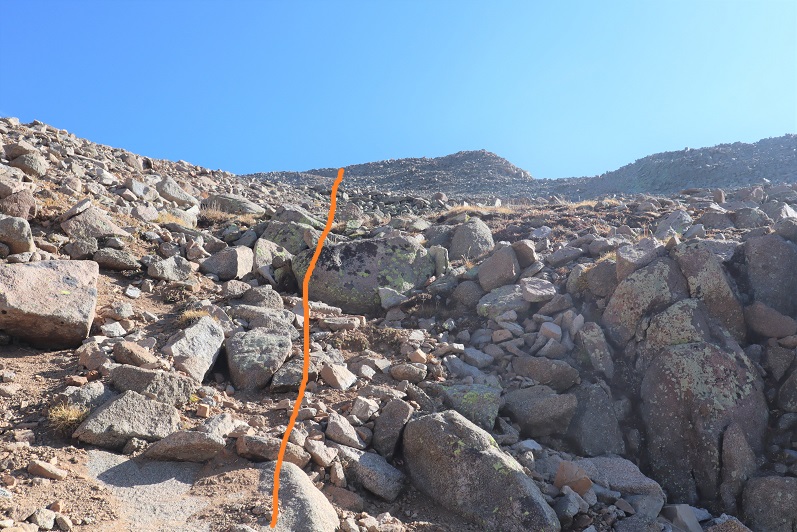
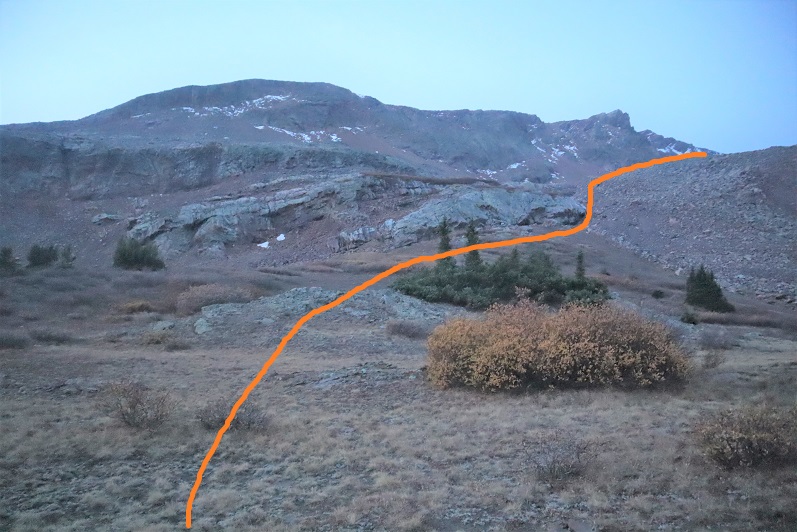
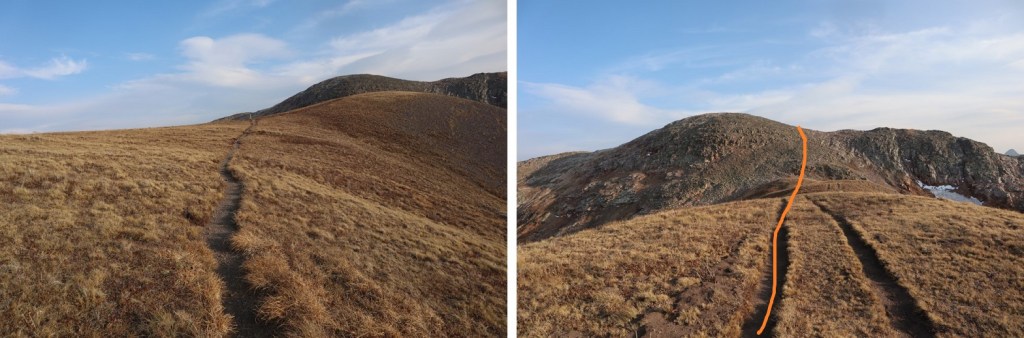
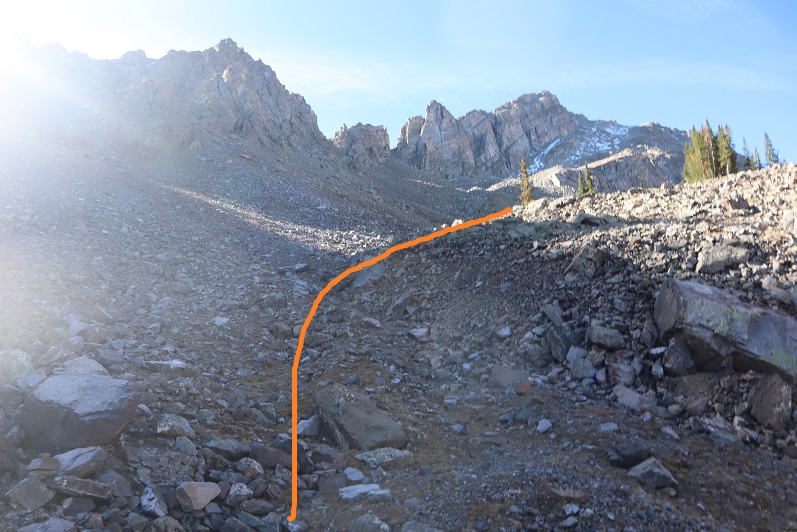
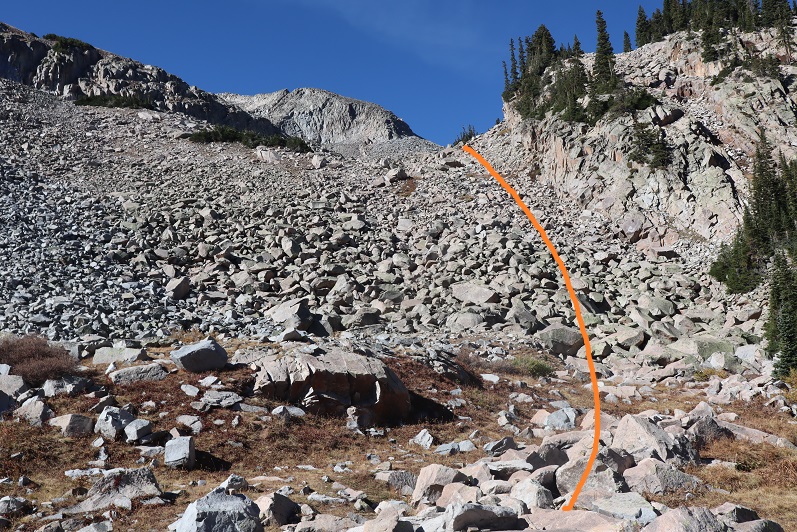
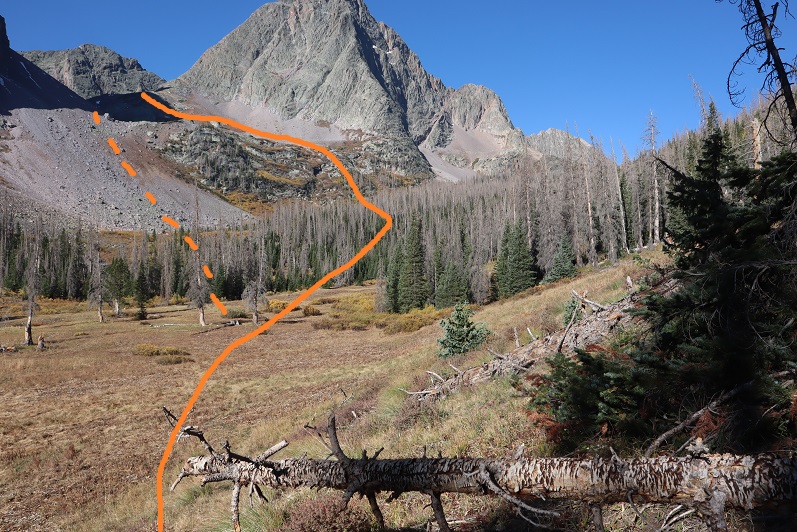
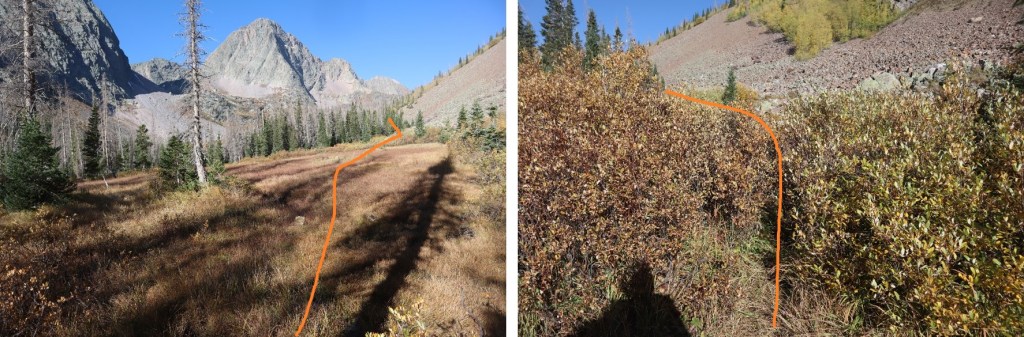
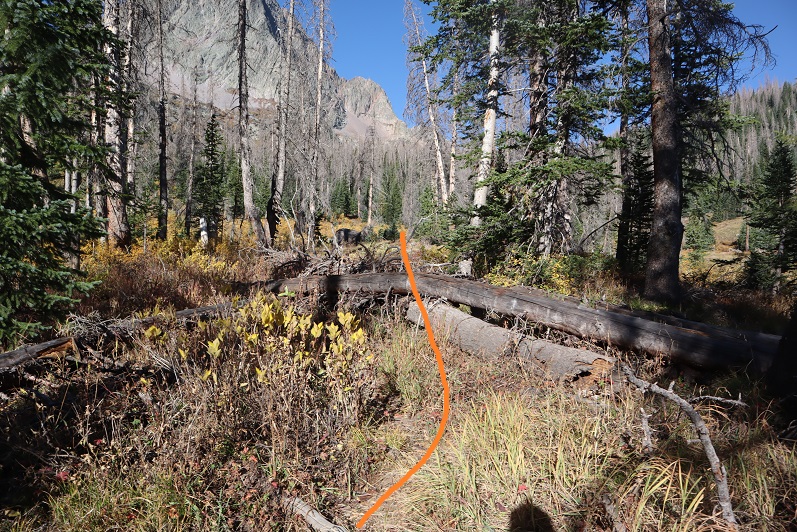
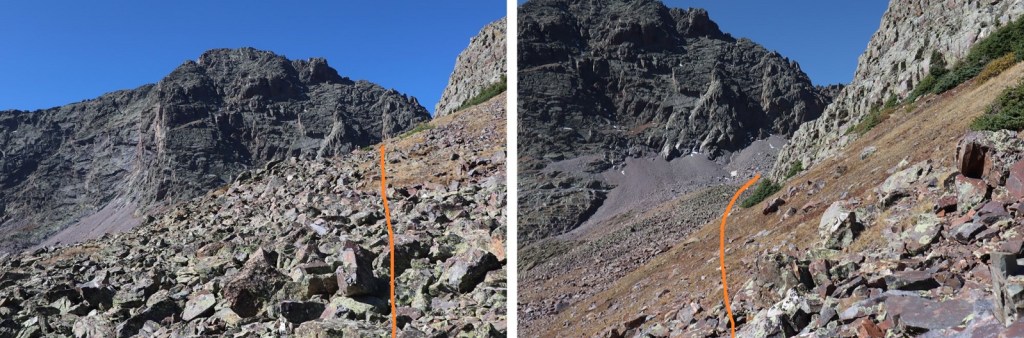
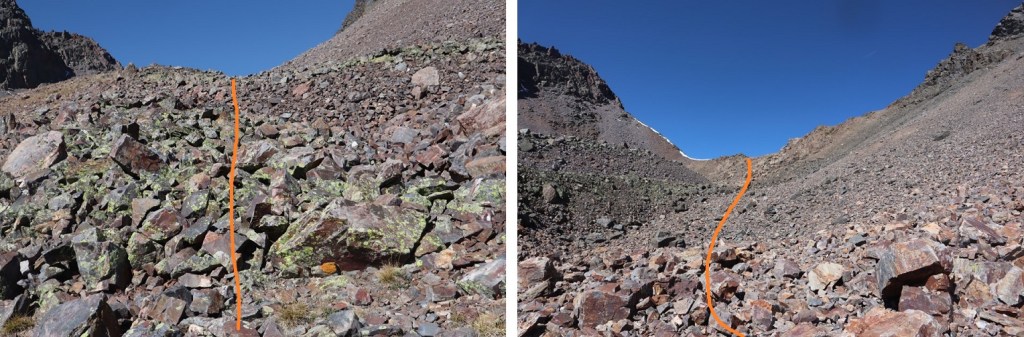
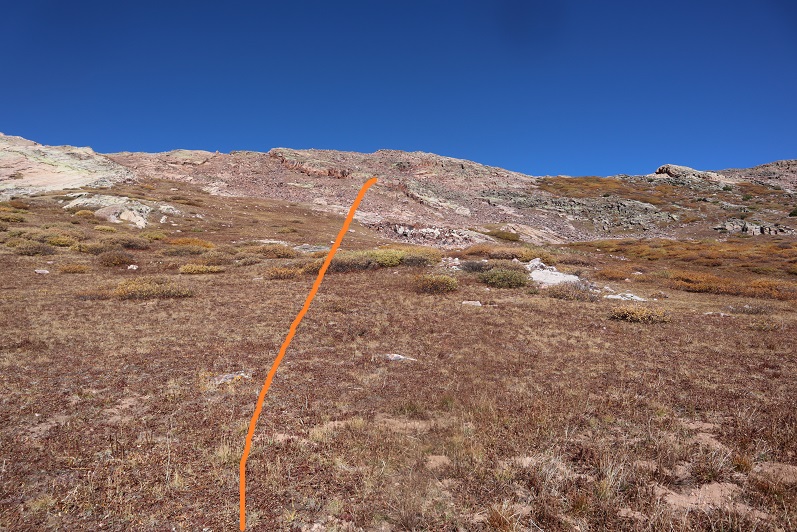
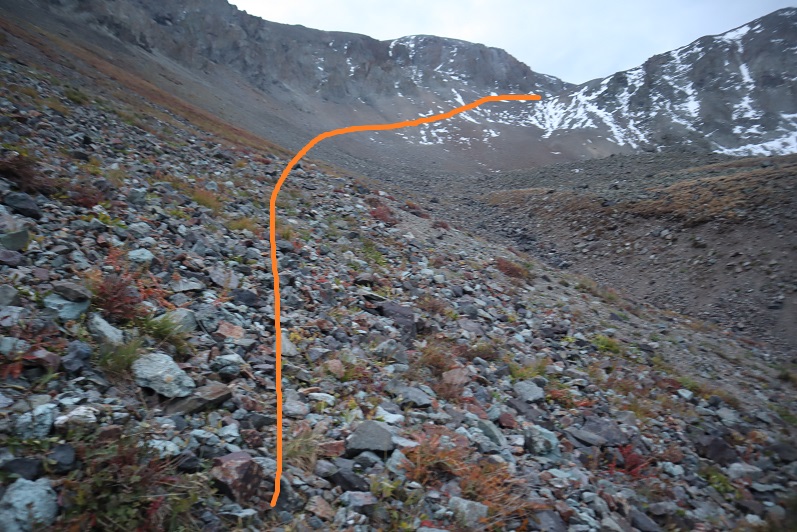
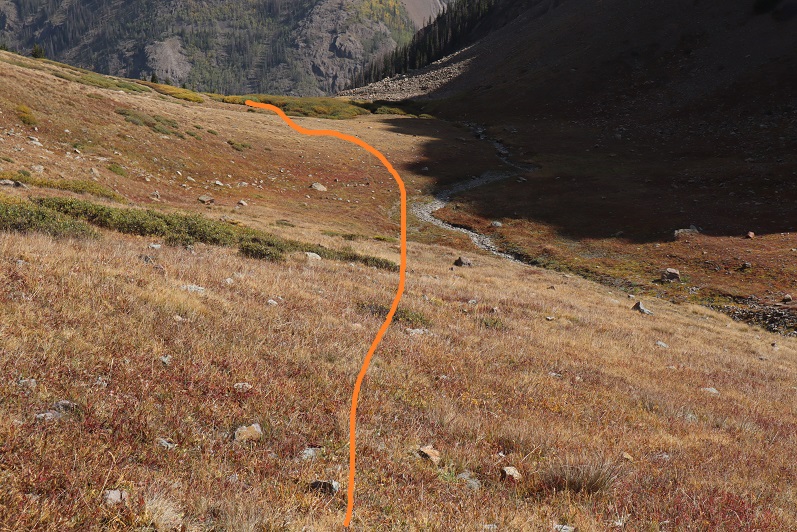
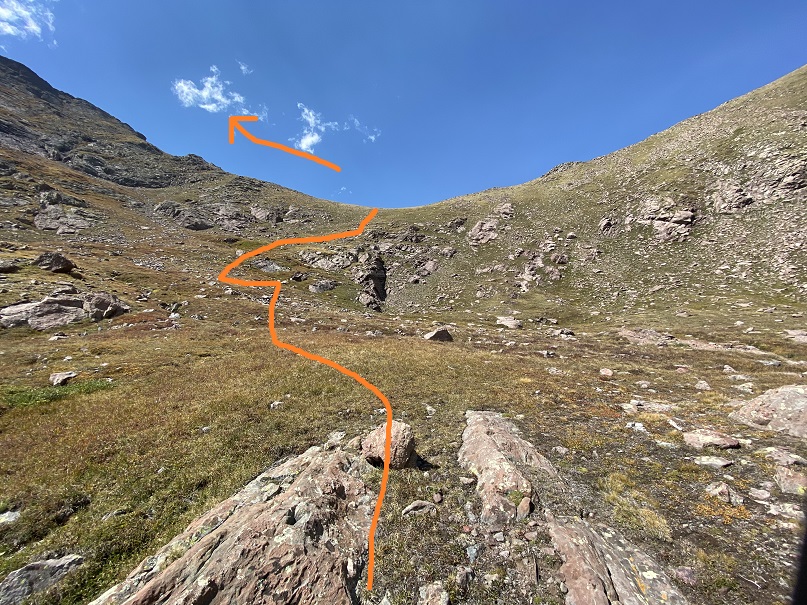
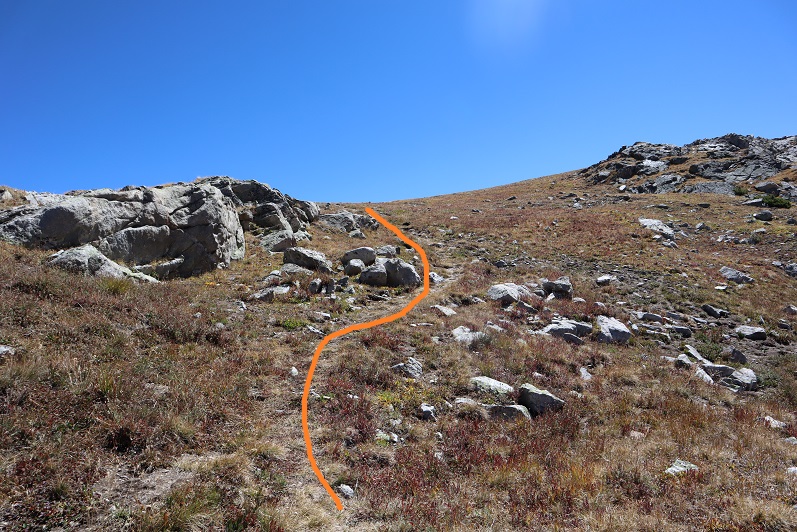
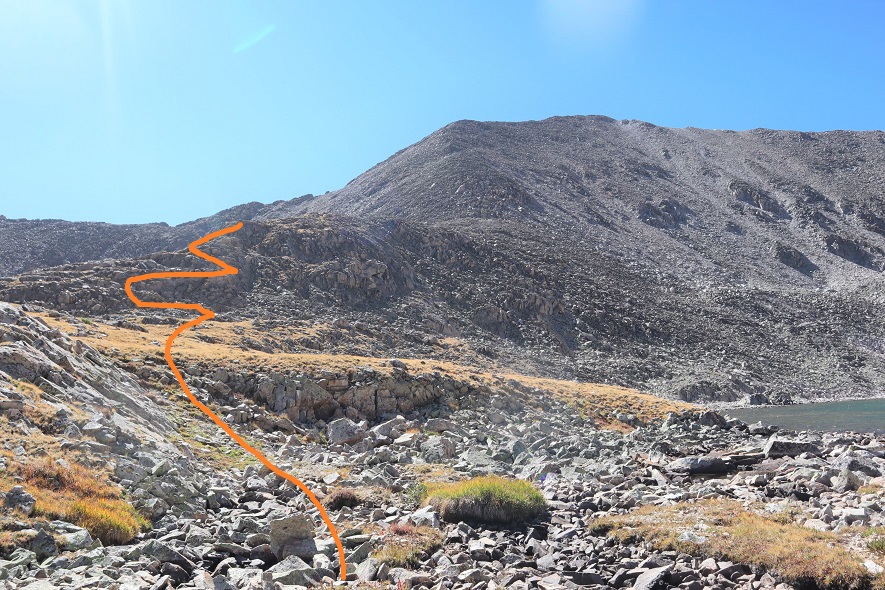
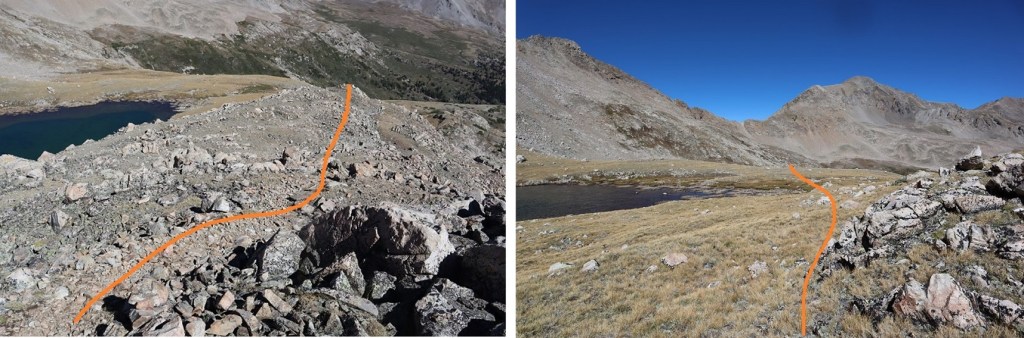
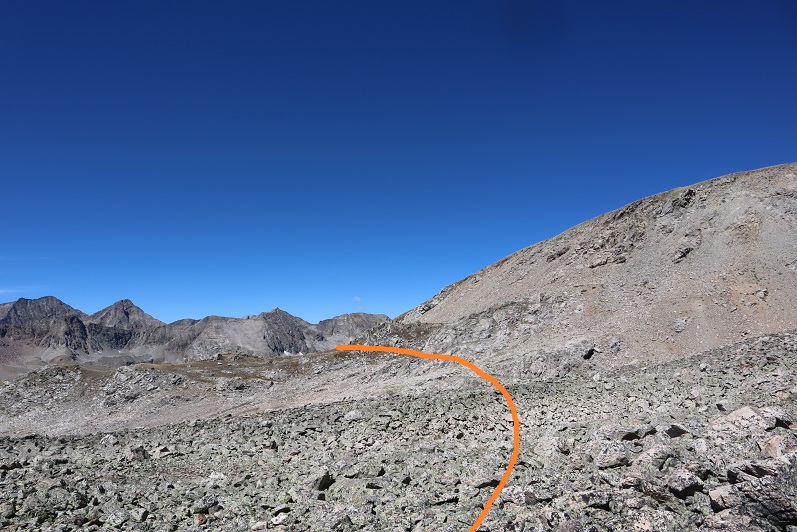
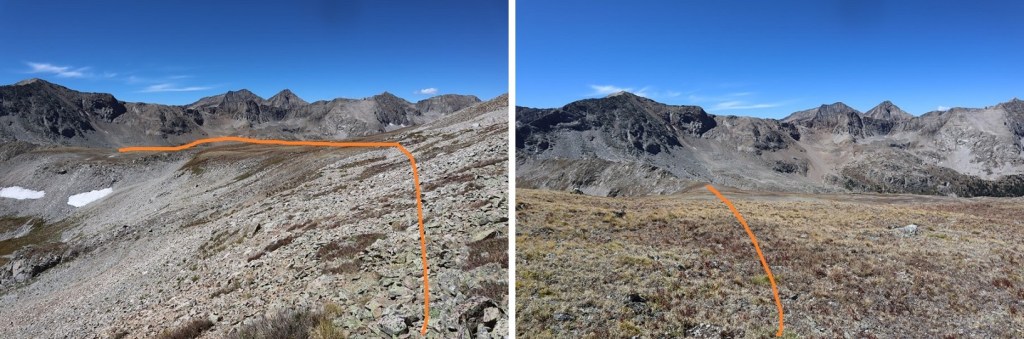
I followed trail 541 for .7 miles, and then left the trail and aimed for this grassy area.  My goal was to gain the ridge, and this seemed the best place to do so, as I could see a path on tundra/scree up to the ridge.  After hiking up and down this is the route I’d recommend to ascend the ridge.

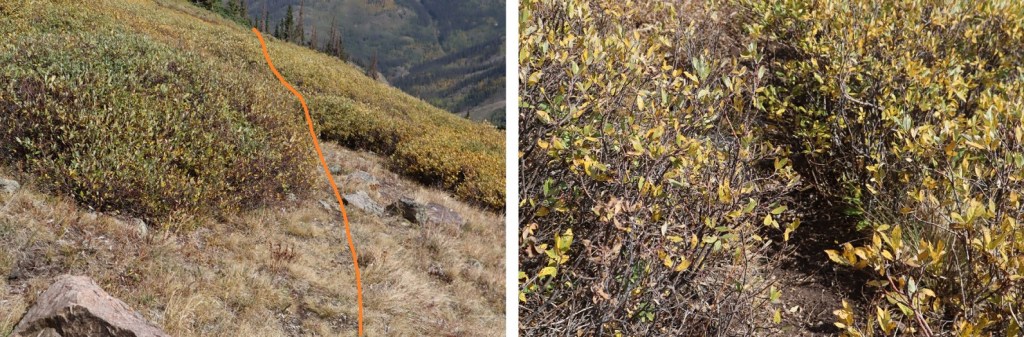
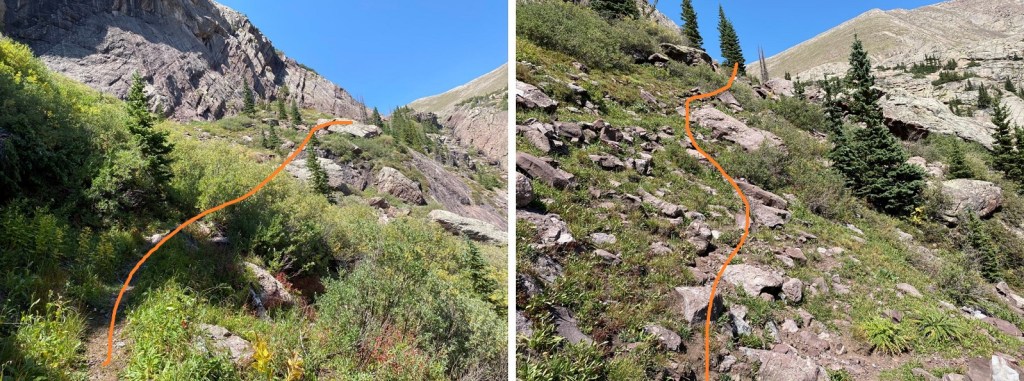
The terrain here is steep, and it was slow going, but I was able to ascend the ridge

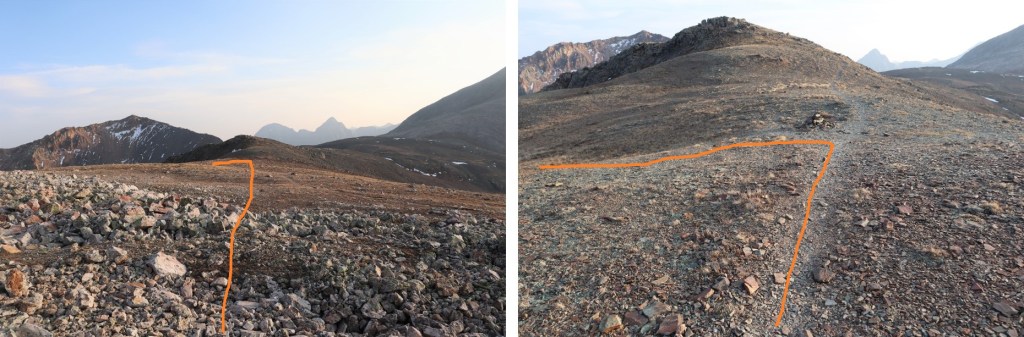
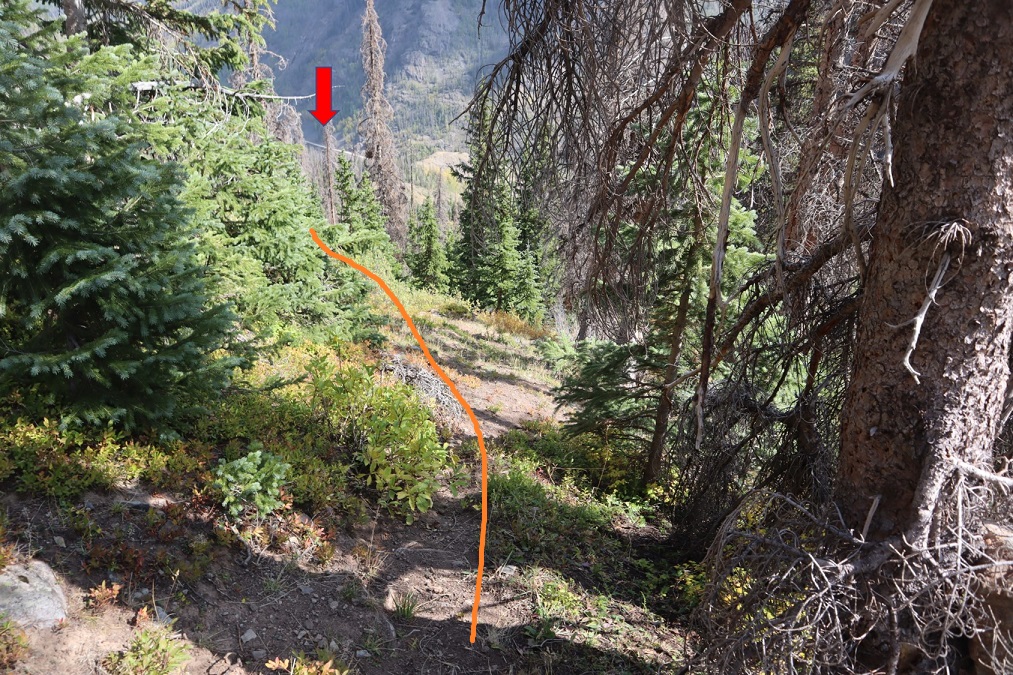
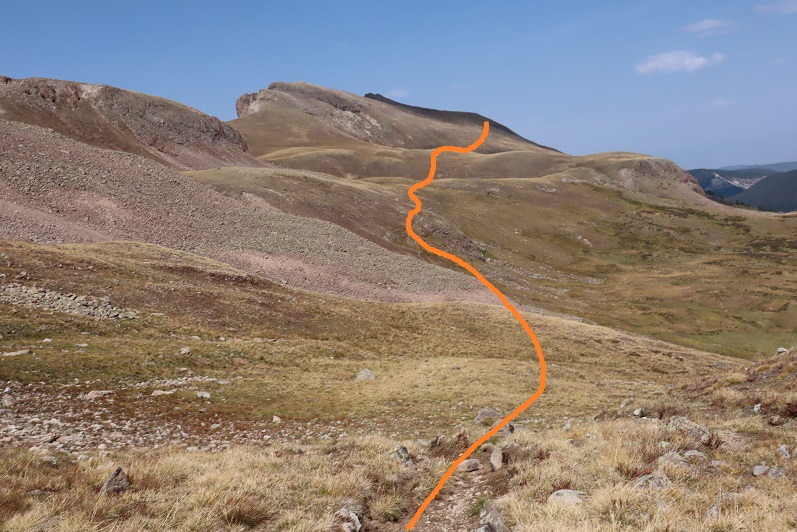
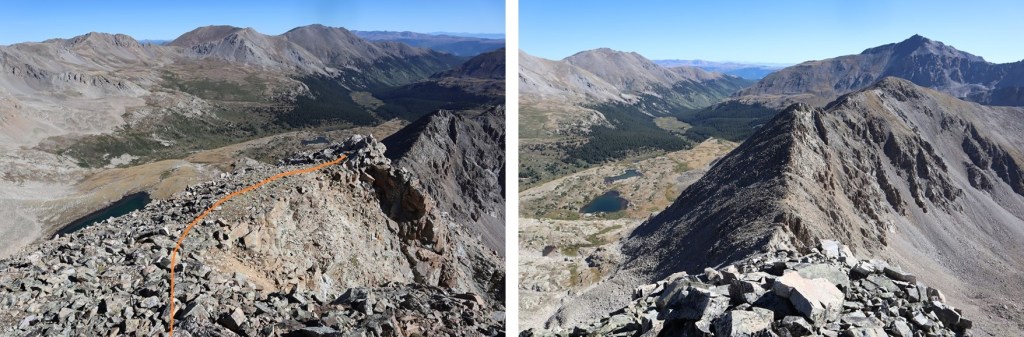
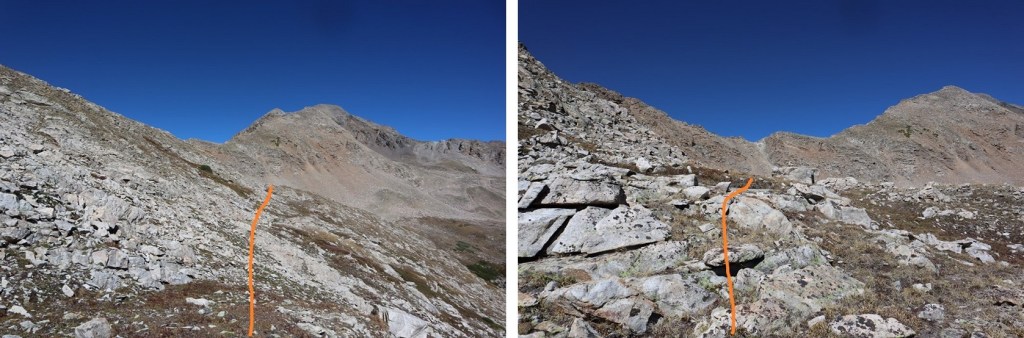
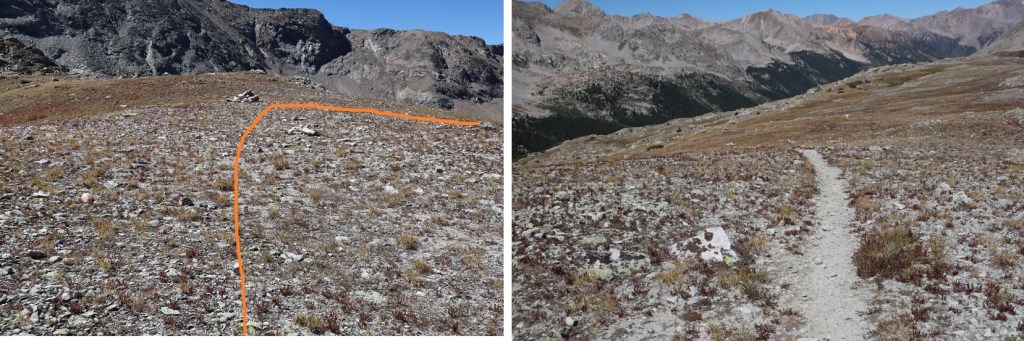
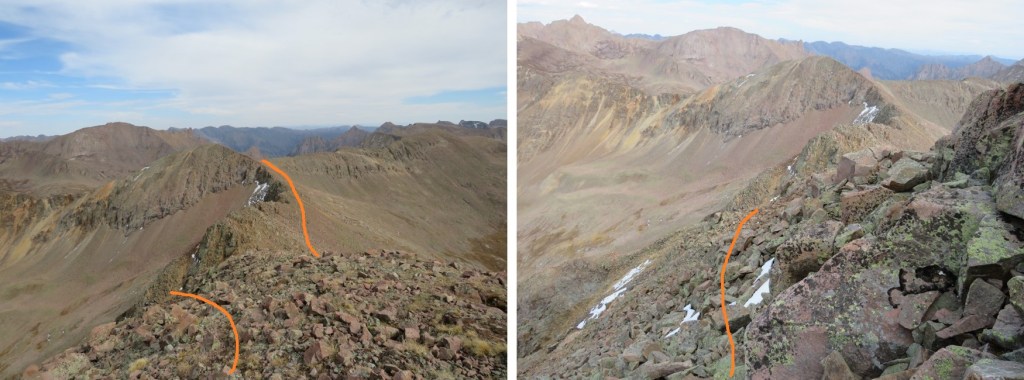
Once on the ridge I was at a bit of a saddle.  There is no need to head right (north) to gain this point, as it’s not ranked and you’ll just need to head back down anyway.  Instead, skirt the point by heading west.
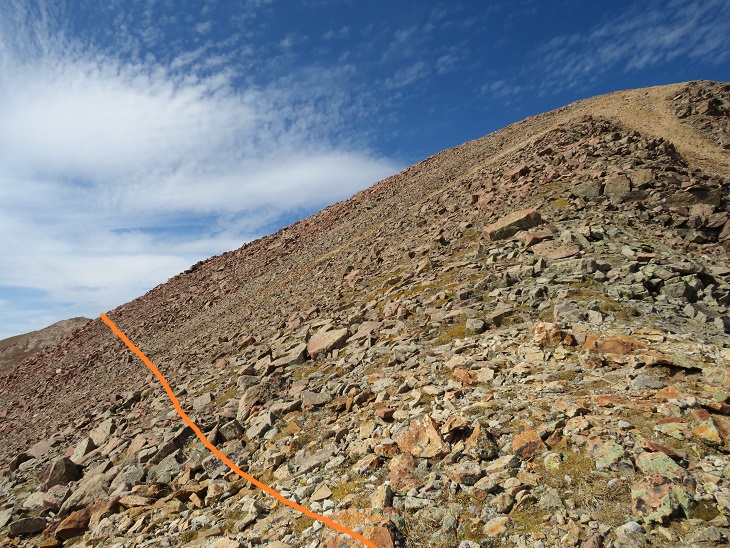
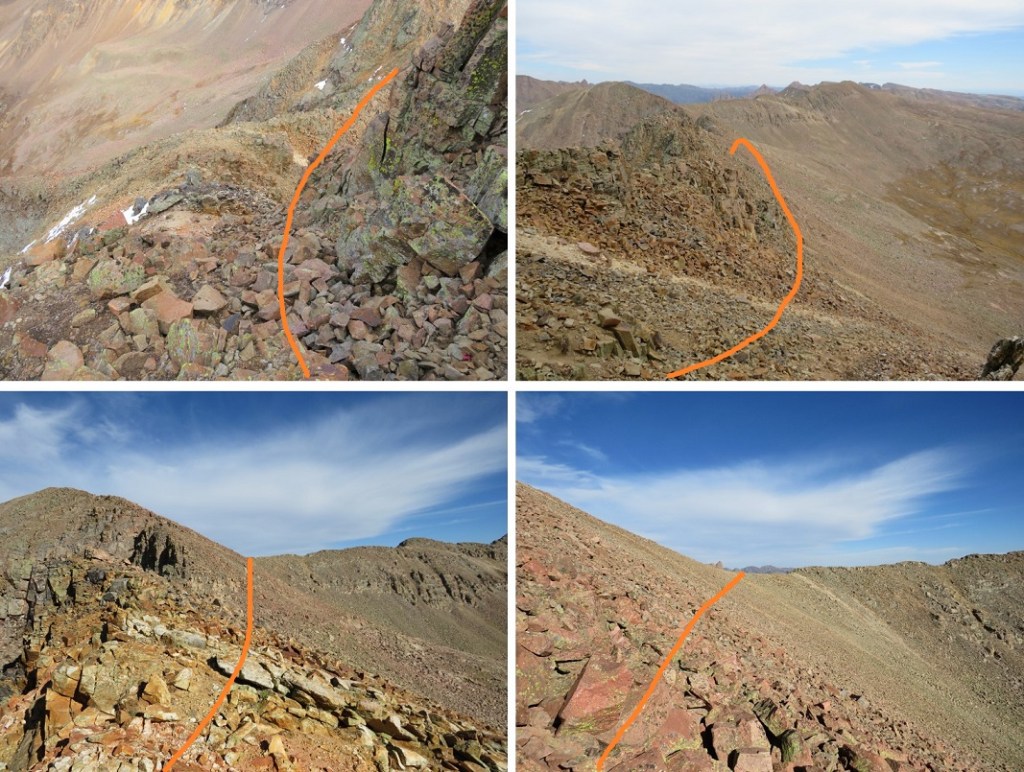
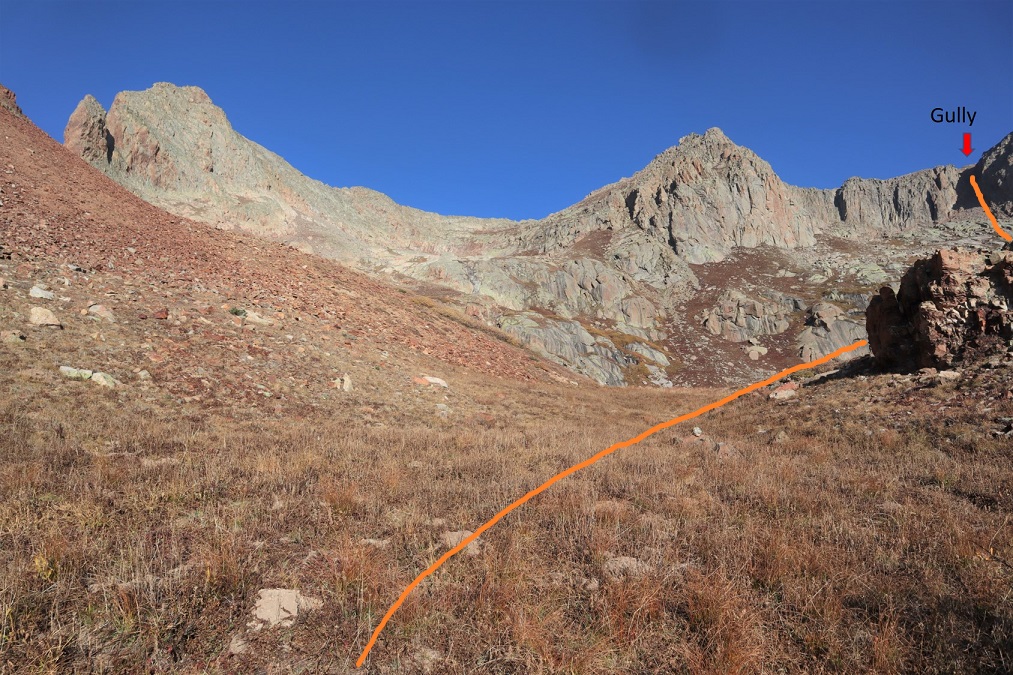
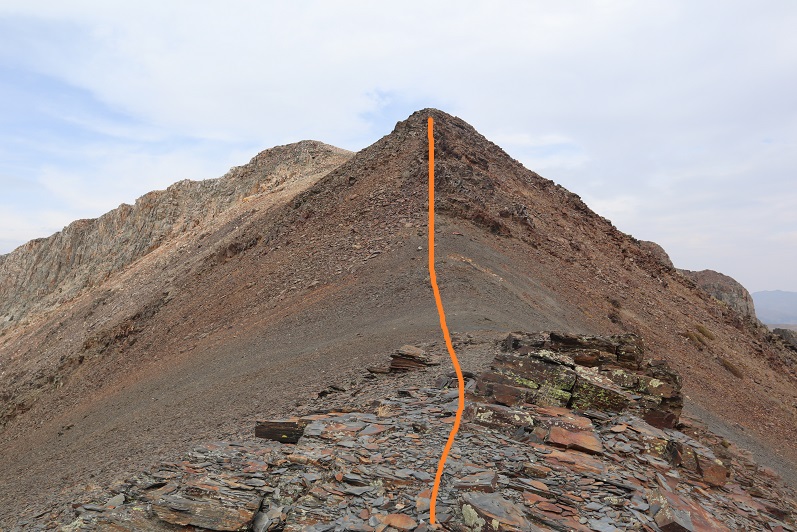
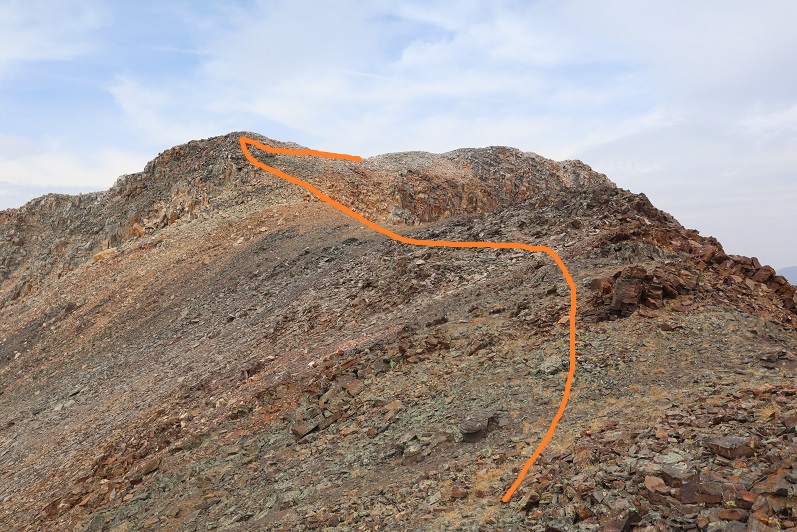
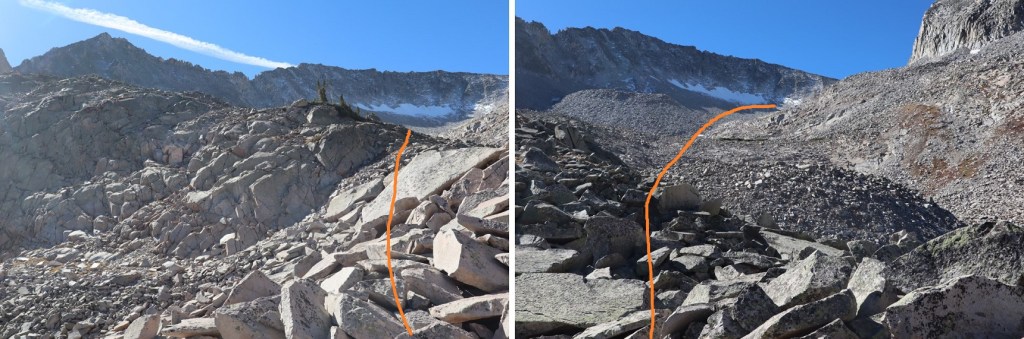
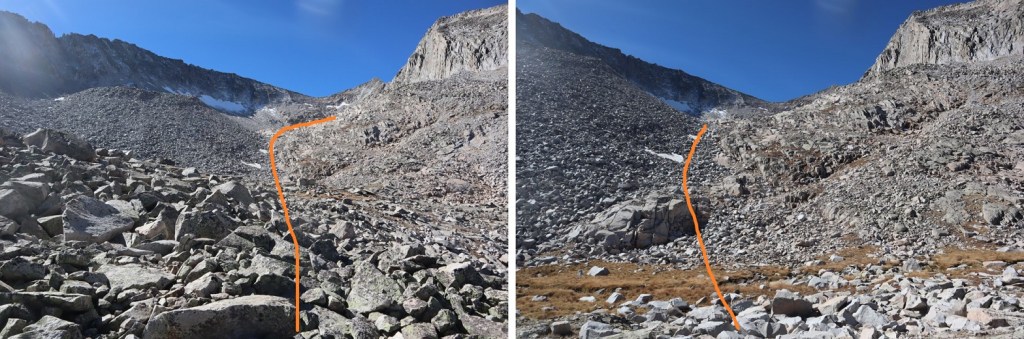
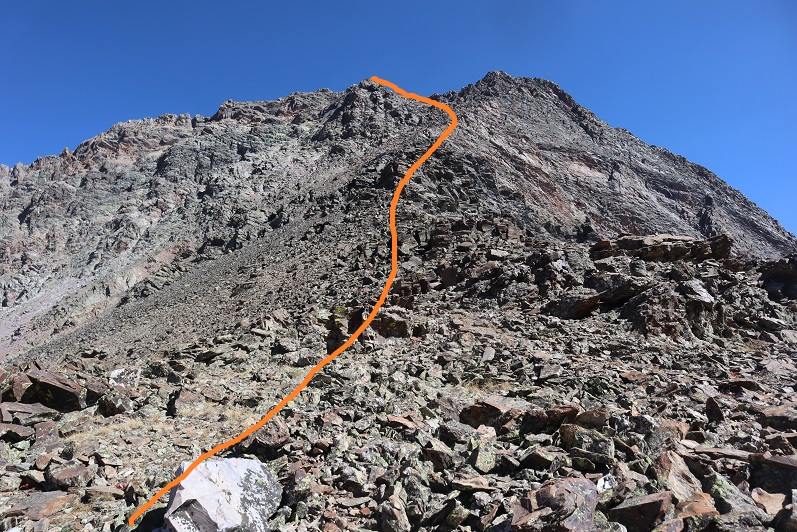
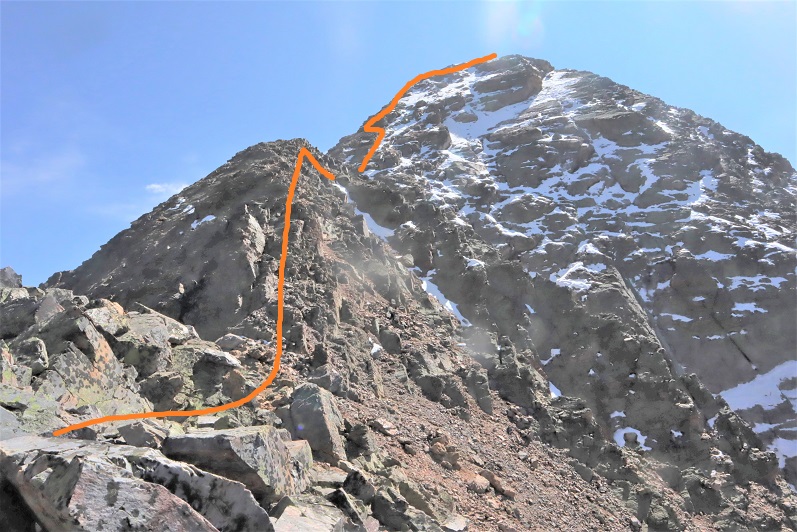
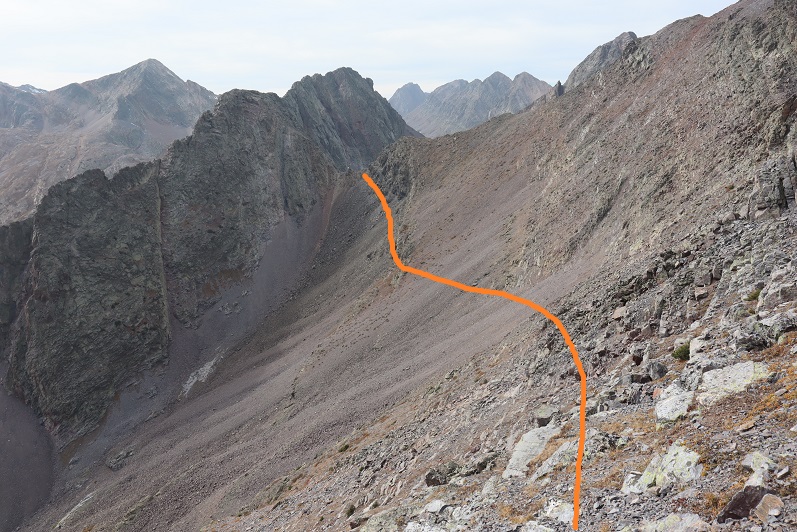
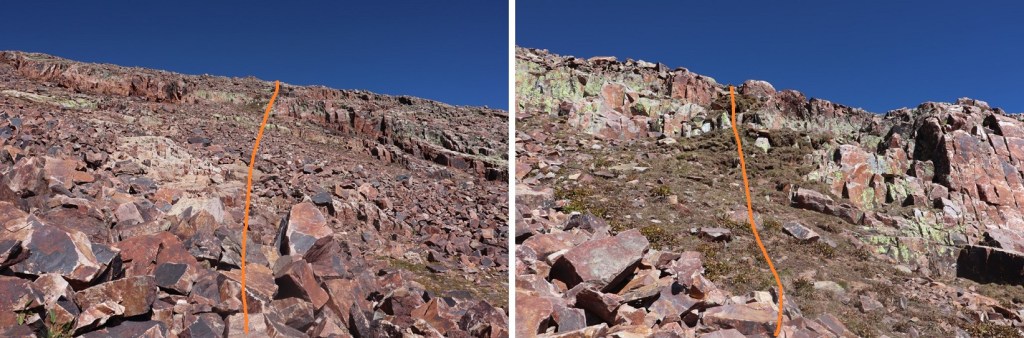
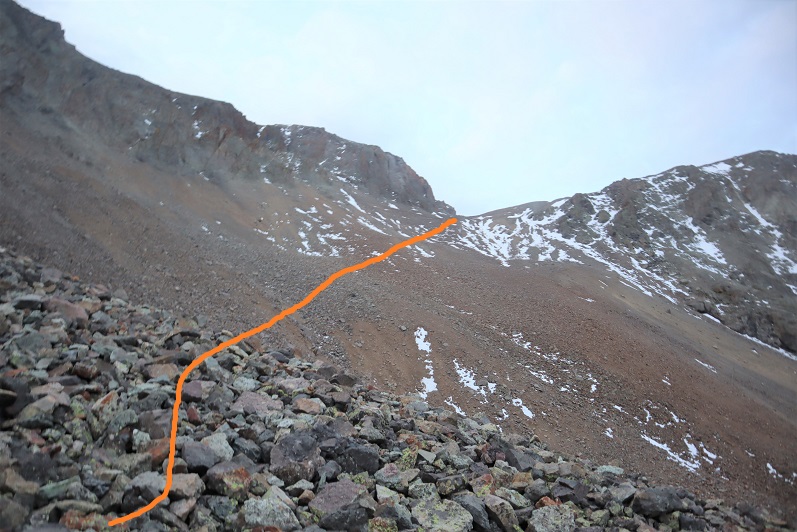
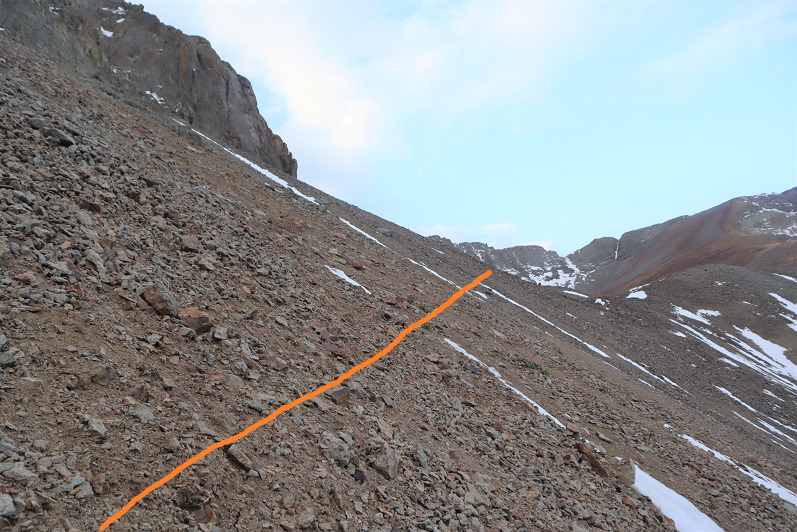
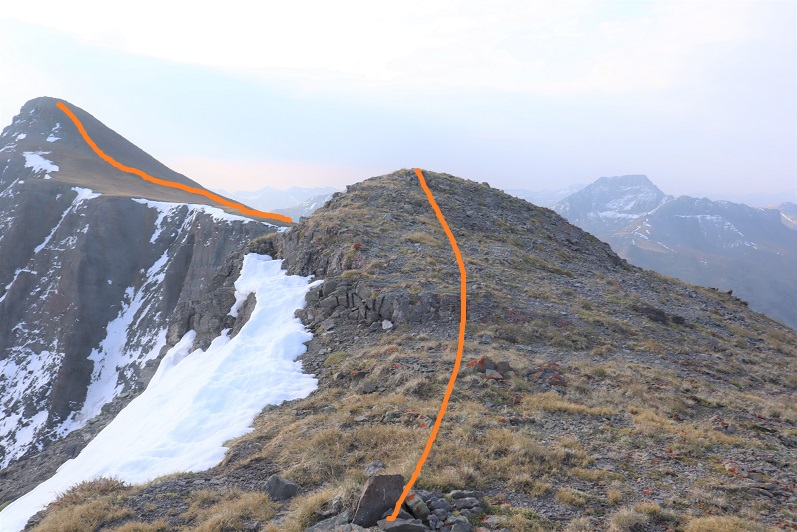
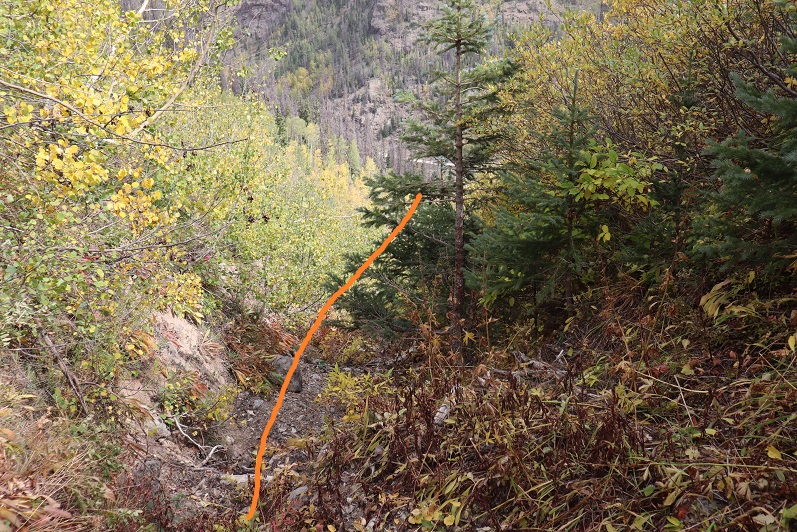
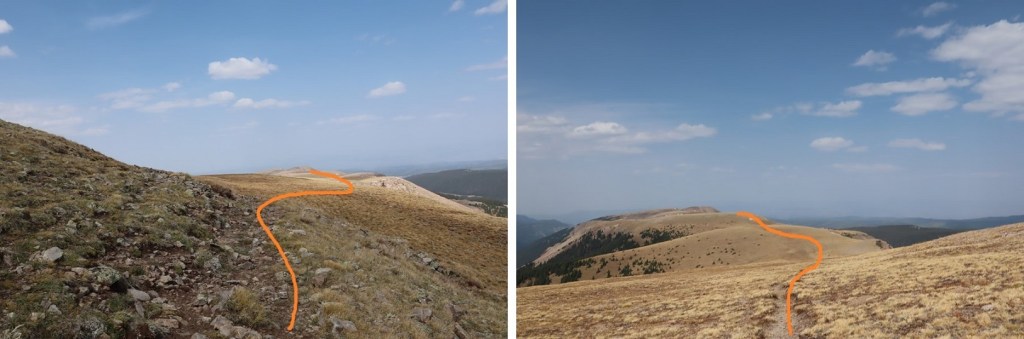
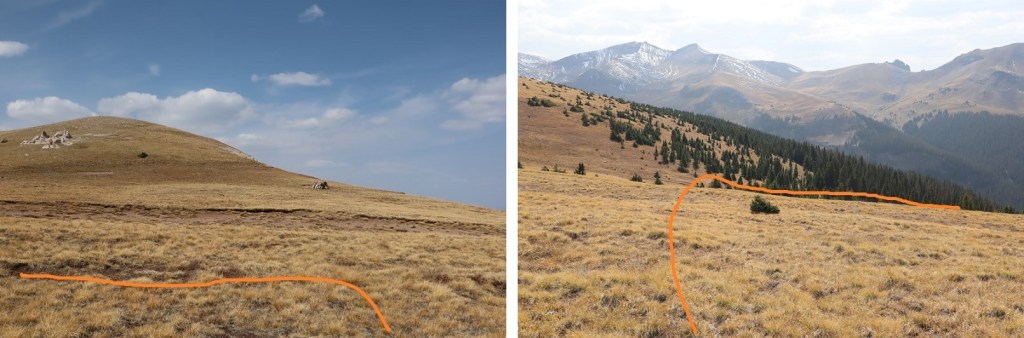
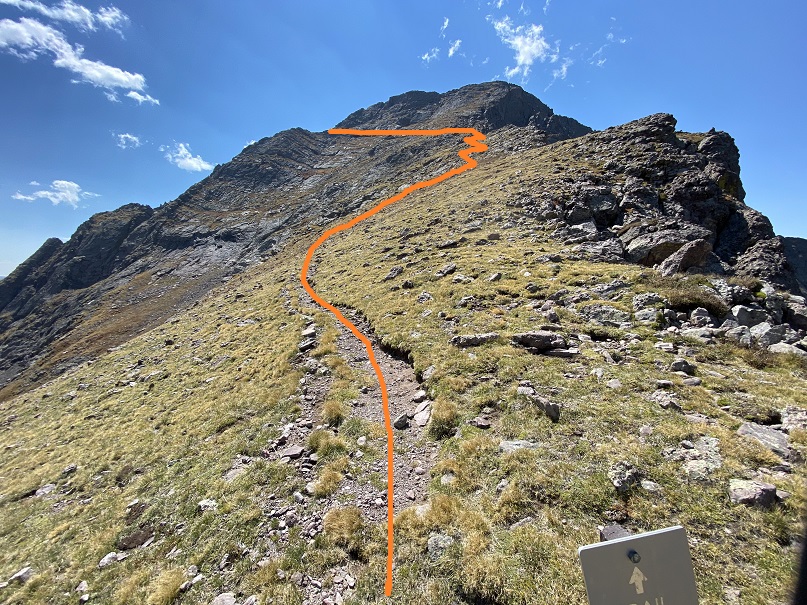
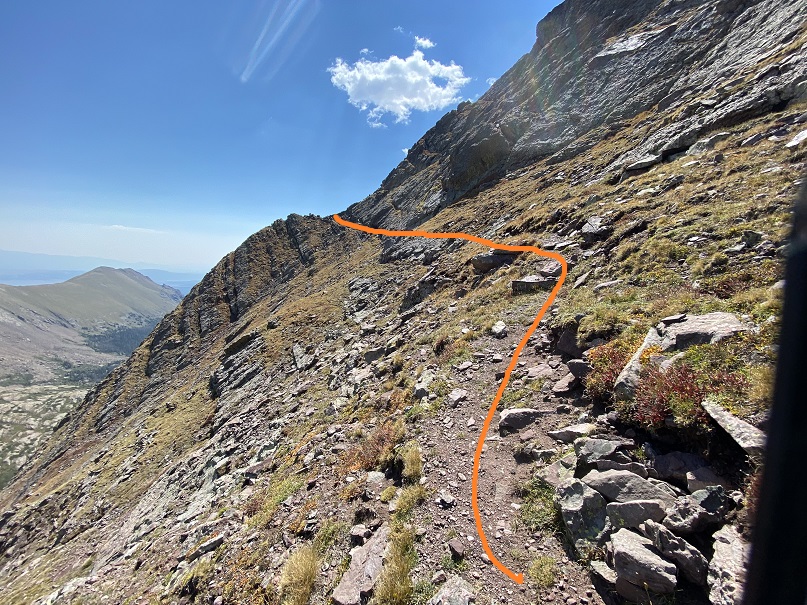
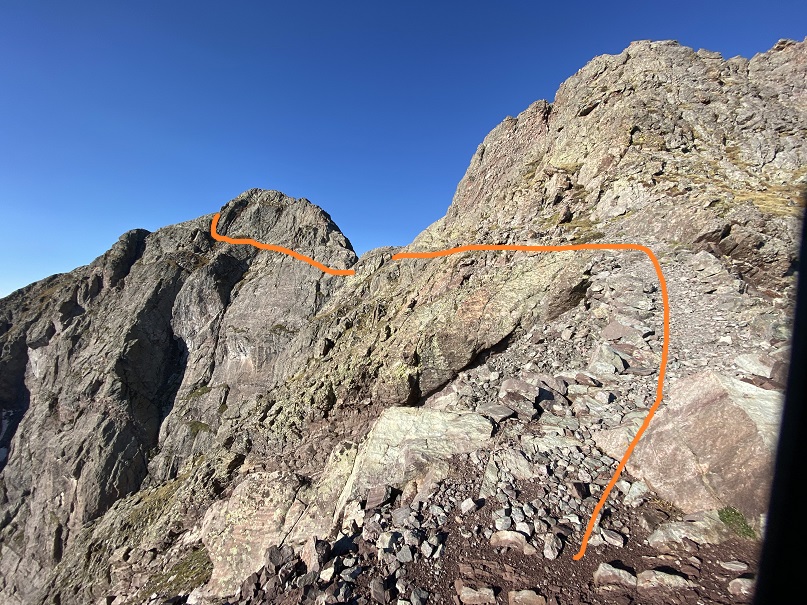
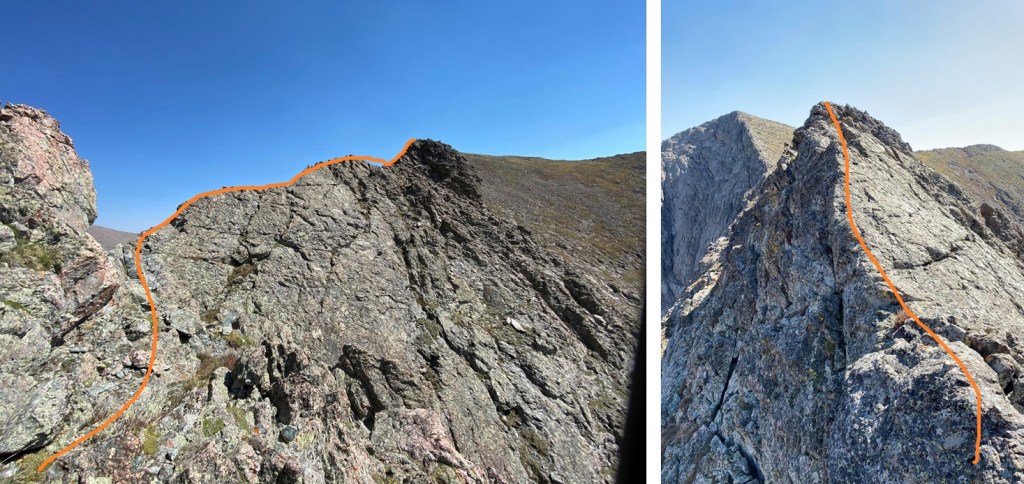
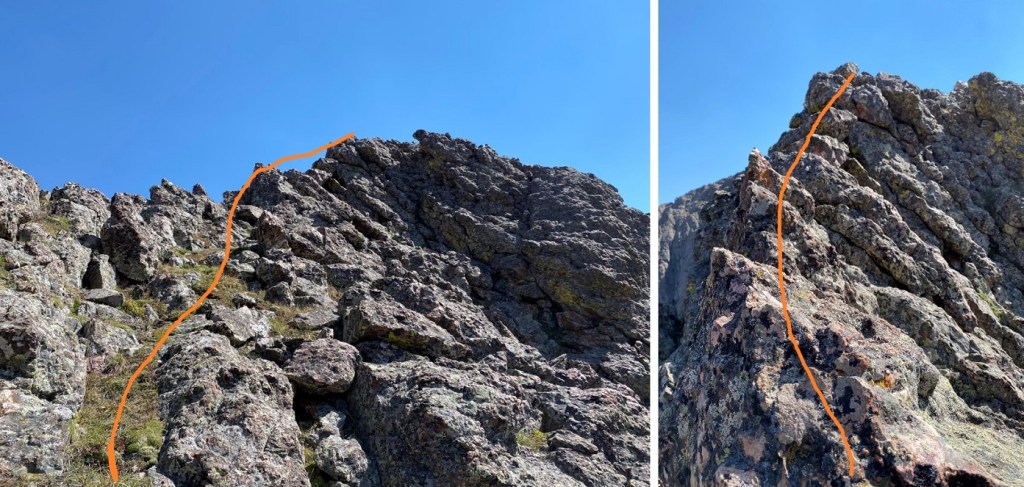
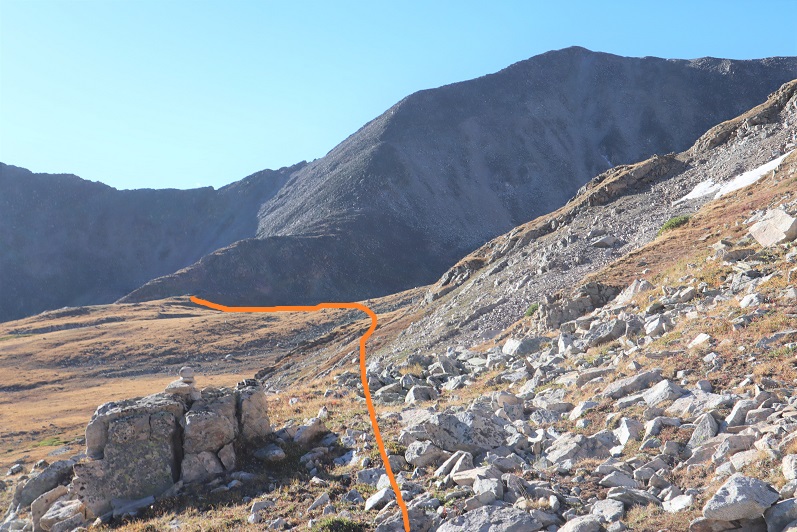
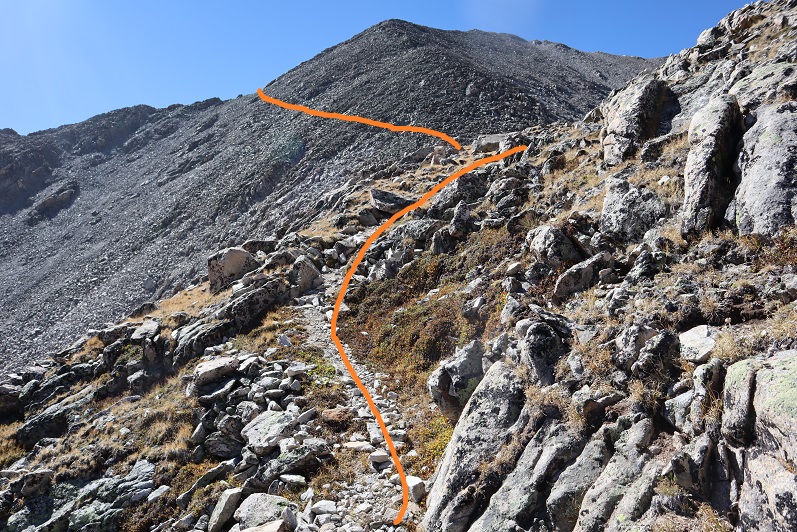
This will bring you to the ridge that will lead you to Aztec Mountain.  This ridge doesn’t ‘go’.  Staying low is the better option here.  Here’s an overview of the path you’ll want to take

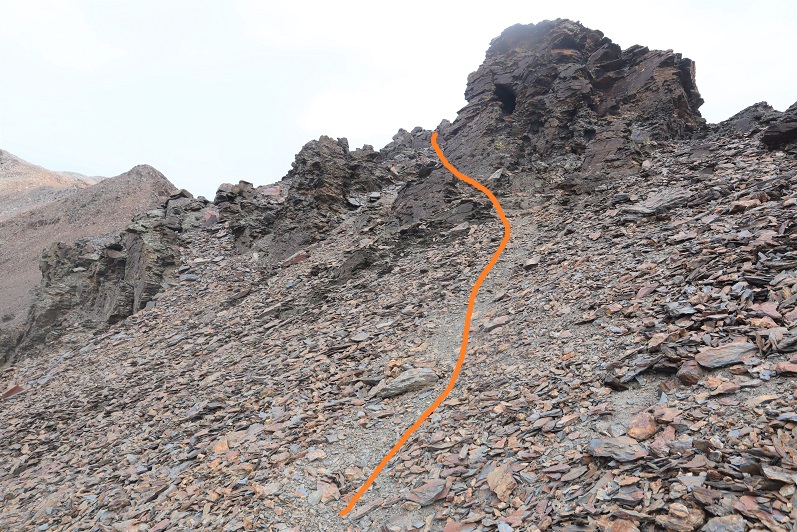
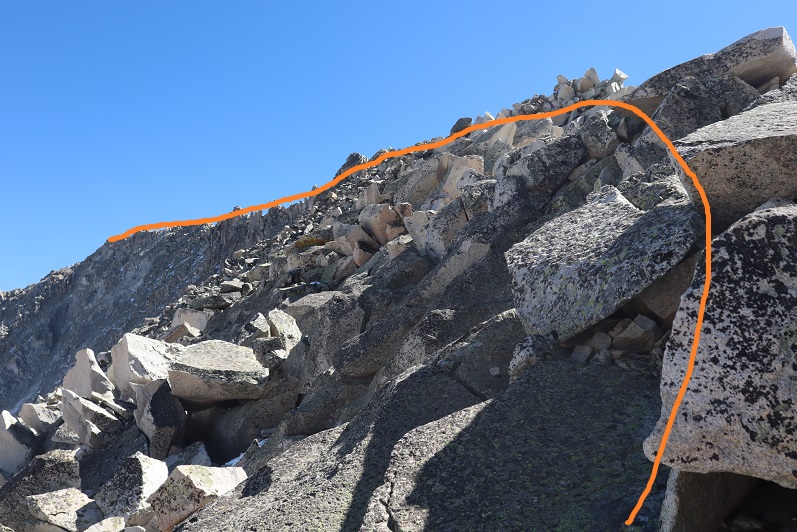
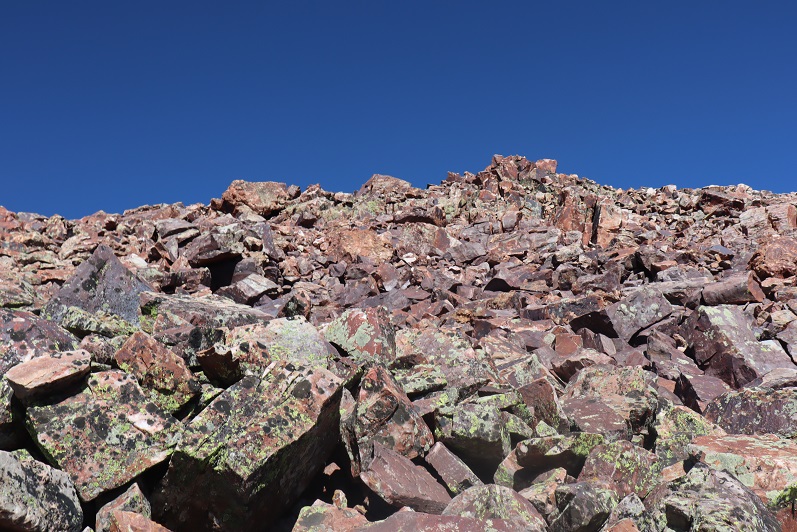
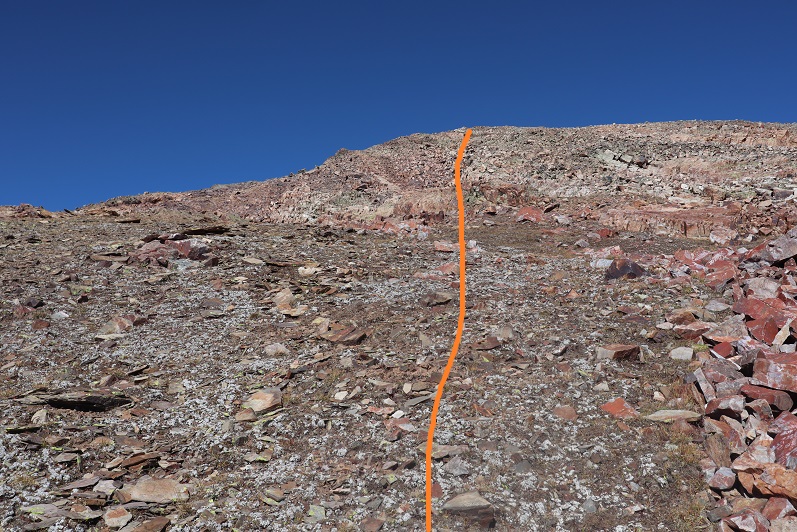
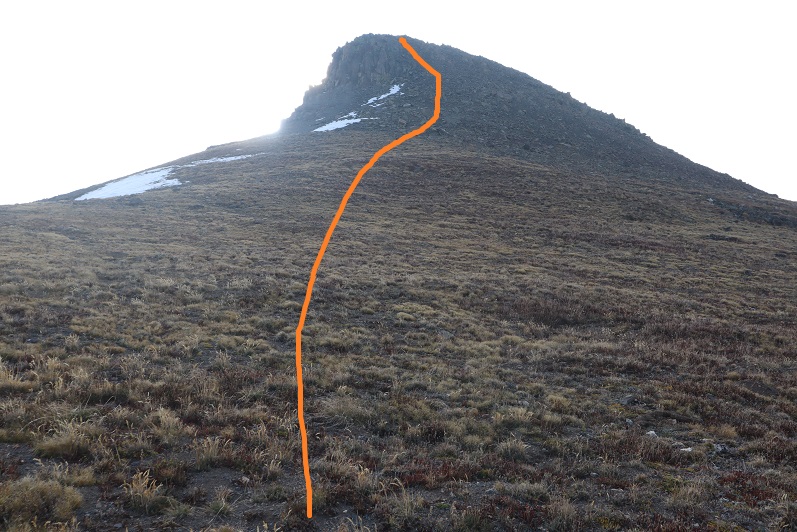
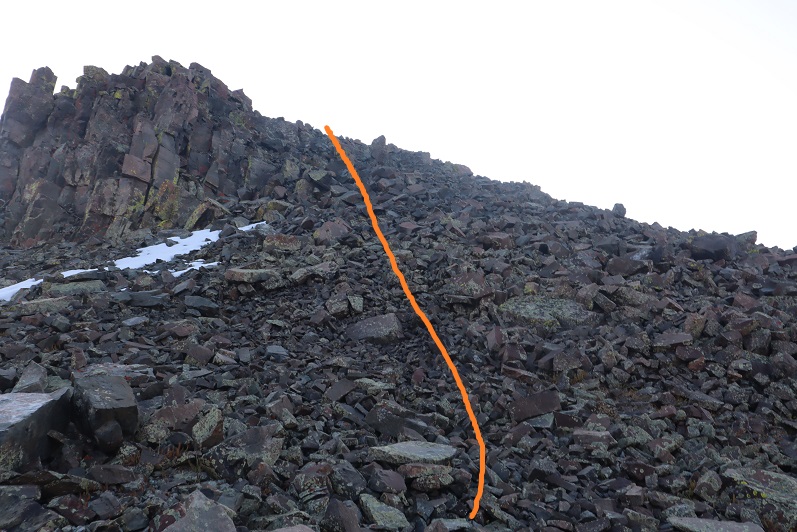
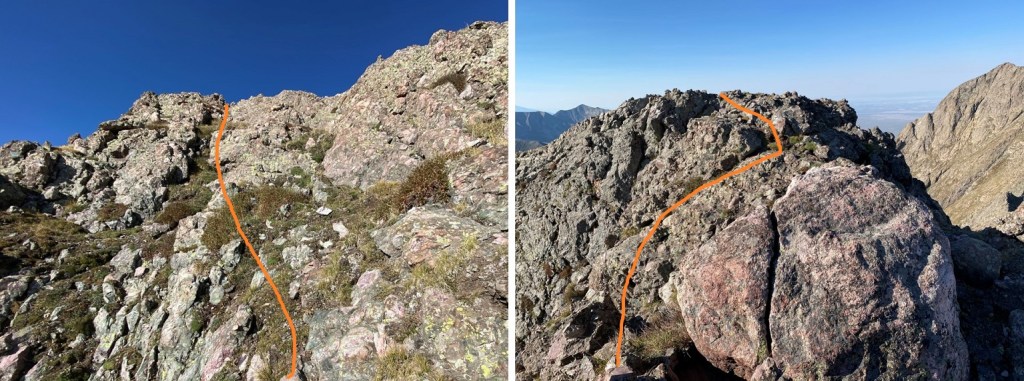
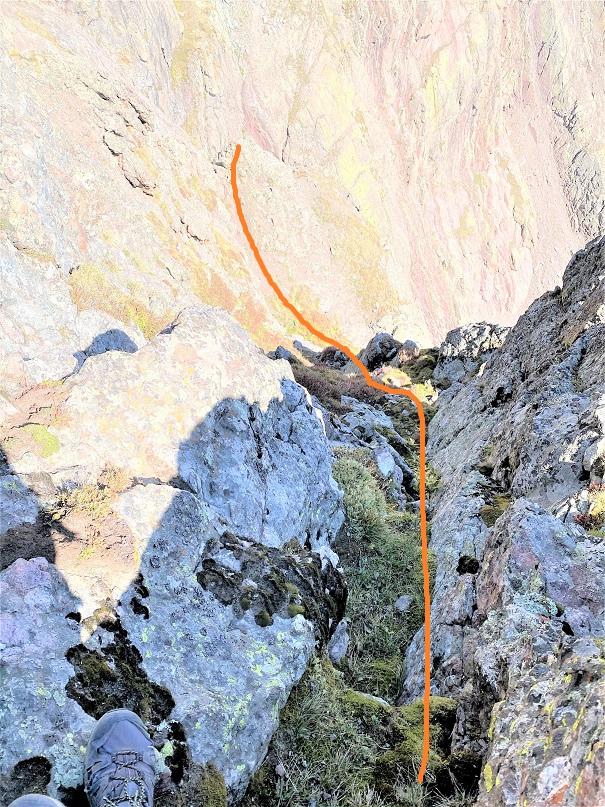
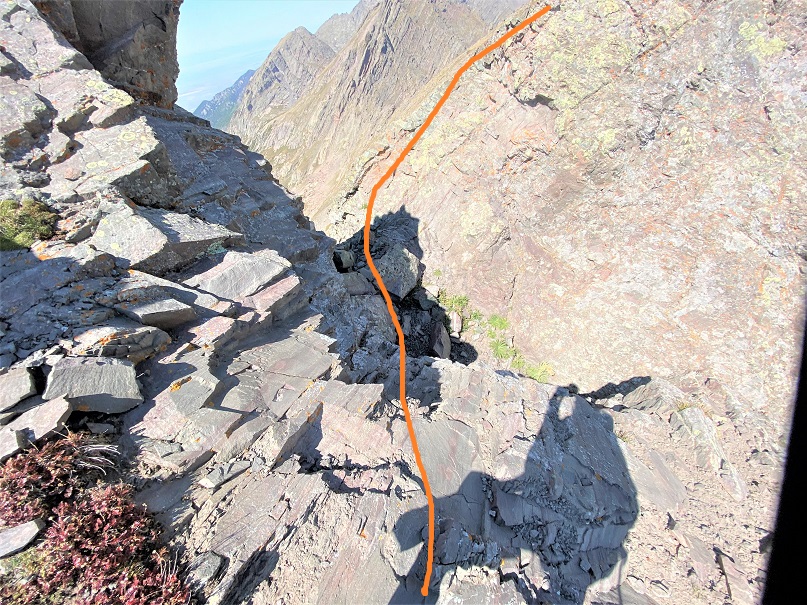
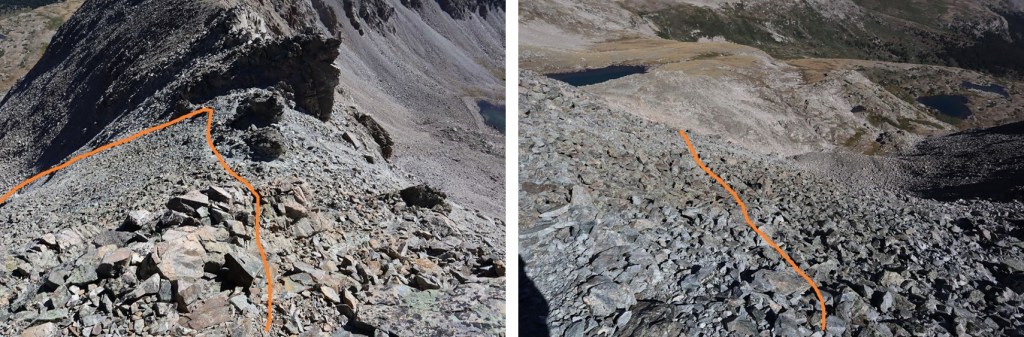
Staying low keeps this class 2.  The final gully is easy to access, and the final scramble to the summit is straightforward
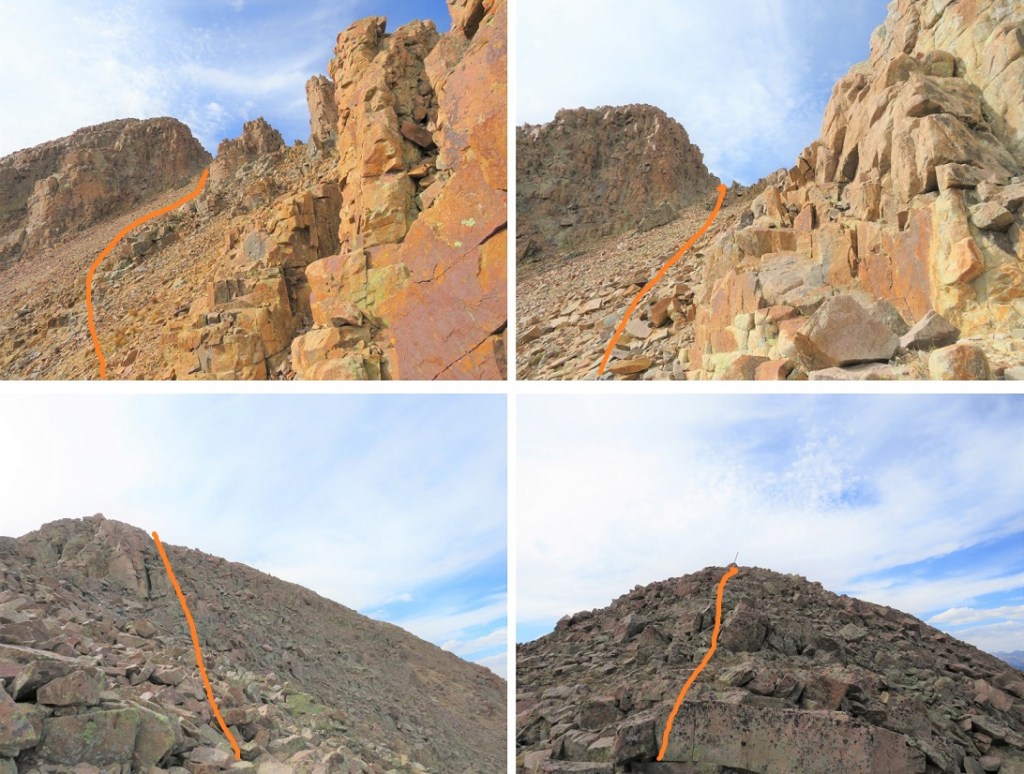
I summited Aztec Mountain at 3:15pm

Aztec Mountain: 

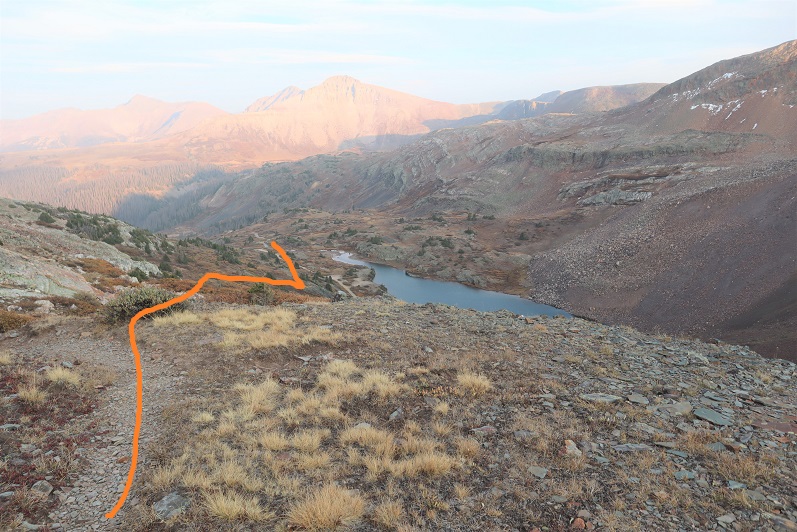
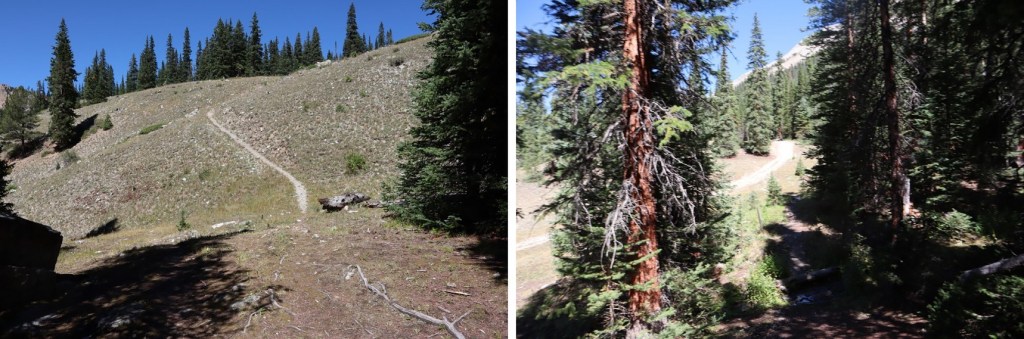
Here are some pictures of the way back down to Columbine Lake
I was chasing the sun, trying to make it to the lake before the shadow of the mountain made it there and cooled everything down.  Between the shadow and I it was pretty much a tie, so I gathered my gear and hiked a bit further into the sunshine and set up camp for the night.
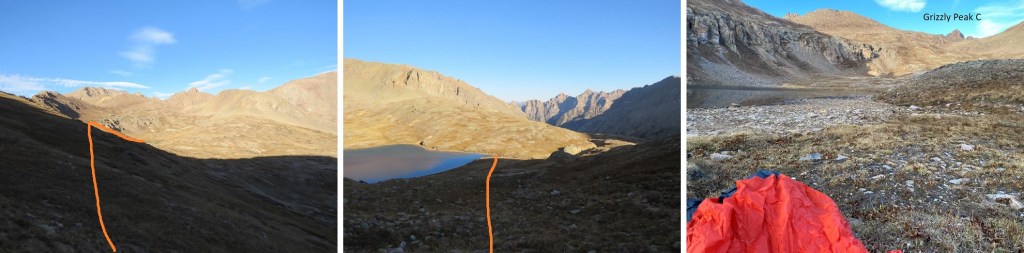
I made it back to Columbine Lake at 5:15pm, satisfied with my choice to hike Aztec Mountain today instead of Grizzly and McCauley.  I was spending the night at 12,300’, with a great view of Columbine Lake.  I went to dry out my feet but my sandals were still wet from this morning (I’d forgotten to take them out and place them in the sun when I left for Aztec).  I ate dinner, filtered some water, heated the water in my jetboil and filled my Nalgene with warm water for the night.  I looked around for my extra pair of socks but couldn’t find them, so I guess my feet weren’t going to dry out tonight.  I placed the water bottle at my feet and looked at my tracker:  it said I’d done 20 miles today.  Not bad.  I snuggled up in my sleeping bag and bivy and looked over at Grizzly Peak.  I thought about the approach tomorrow, jotted some notes down in my journal, put on all the clothing I had with me, and called it an early night. 

It was a long night.  A long, cold night.  I was warm in my bivy and sleeping bag.  Halfway through the night I felt something sniffing my ear.  Seriously. It felt like a dogs’ muzzle and startled me awake.  From inside my bivy I flailed my arm at it, unzipped my bivy, and looked around.  There was no moon but the sky was bright with stars.  I could see the mountains and the lake and rocks and tundra, but no animal.  It hadn’t made a noise when I’d touched it, but I’m guessing it was a fox or a coyote with an ear fetish.  The air is thin at 12,000’.  A few hours later I woke up, noticing breathing was more difficult than usual.  To breathe better I quickly opened my bivy to get in a few gulps of air.  Not only did this not help with my breathing, but when I put the bivy back over my head the condensation from my breath had turned to ice.  Wonderful.  Note to self:  don’t unzip the bivy. 

Day 2:  Grizzly Peak C, McCauley Peak, Descent

The morning couldn’t come soon enough.  Just before first light I re-heated the water in my water bottle, packed my gear and was on the trail with just the essentials, leaving my big pack at the lake.  I took the same trail I’d taken to summit Aztec, but at the junction with trail 541 I went right and followed the trail towards Hope Pass. Here’s an overall view of the route from yesterday’s hike

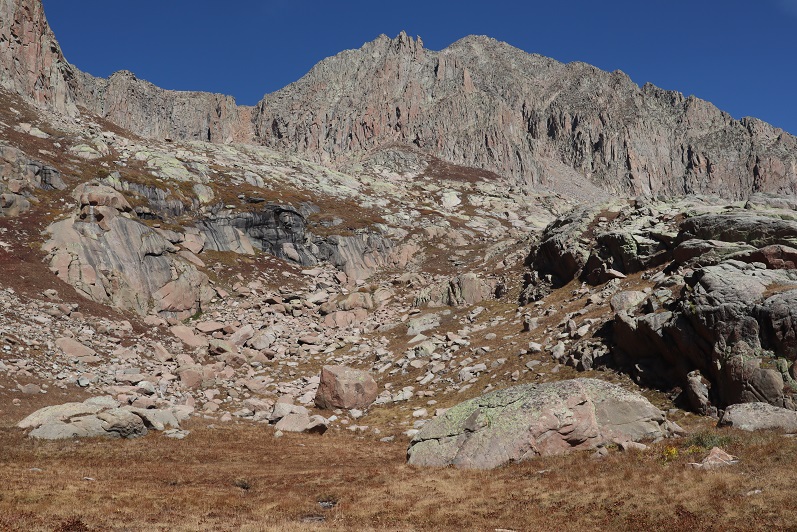
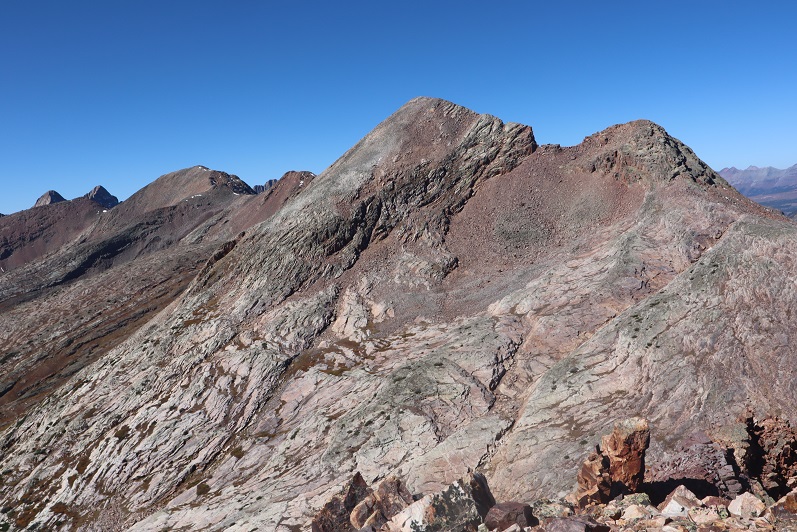
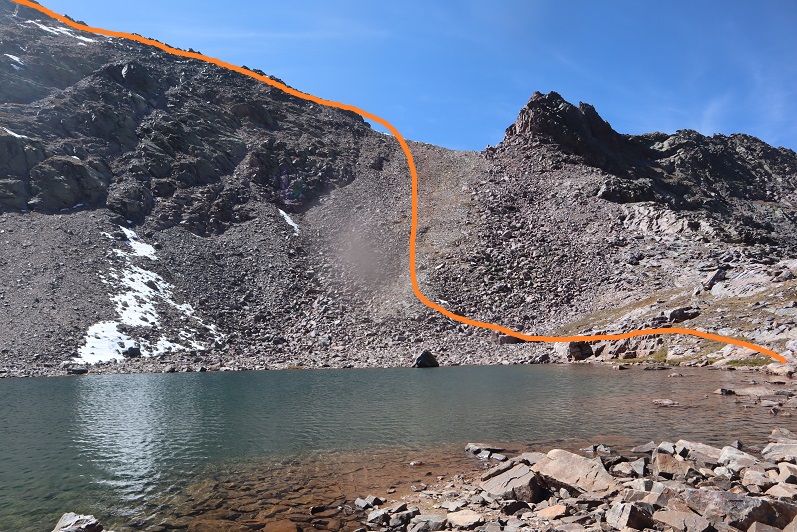
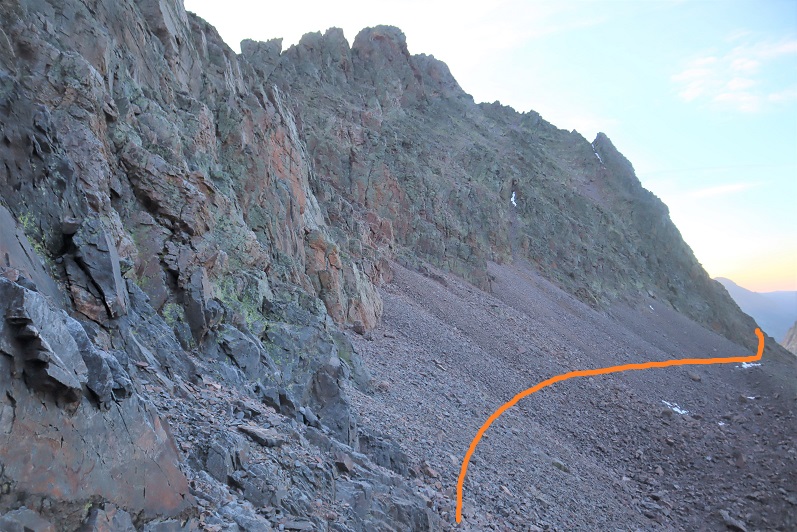
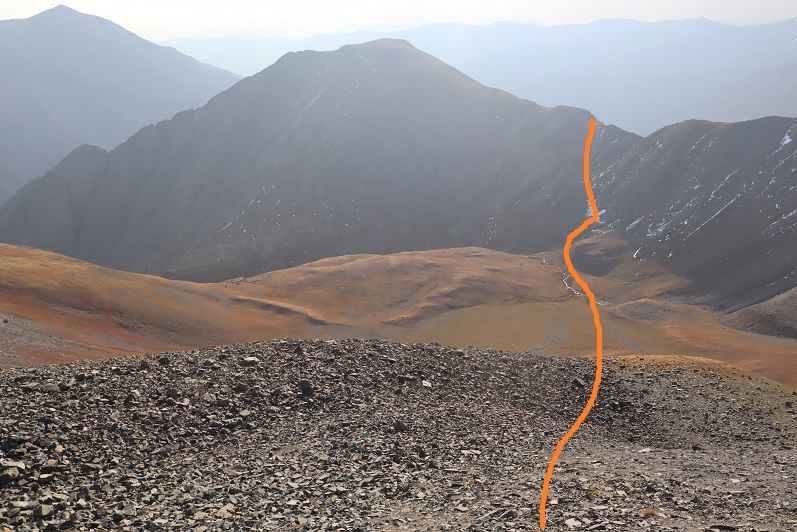
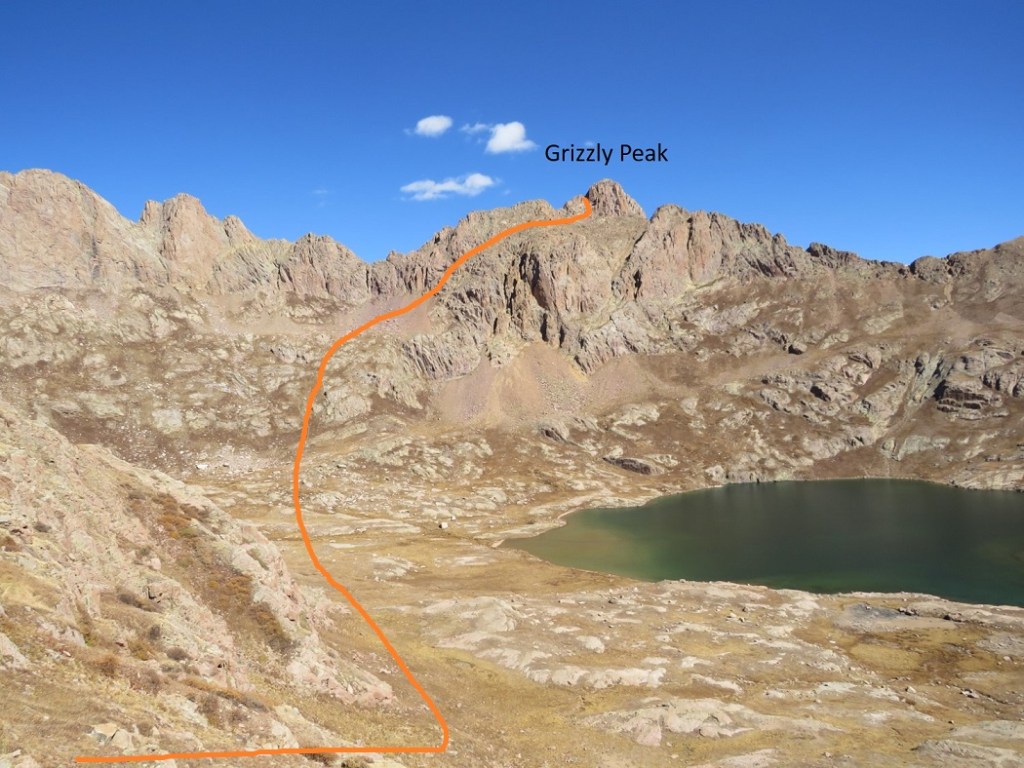
This part of the hike was on a nice trail, and when there wasn’t a trail there were great cairns.  From Hope Pass I got a good look at Grizzly Peak C, and the route I wanted to take to gain the ridge.  Here’s the overall route I took, aiming for a gully and rock rib that ascends the mountain
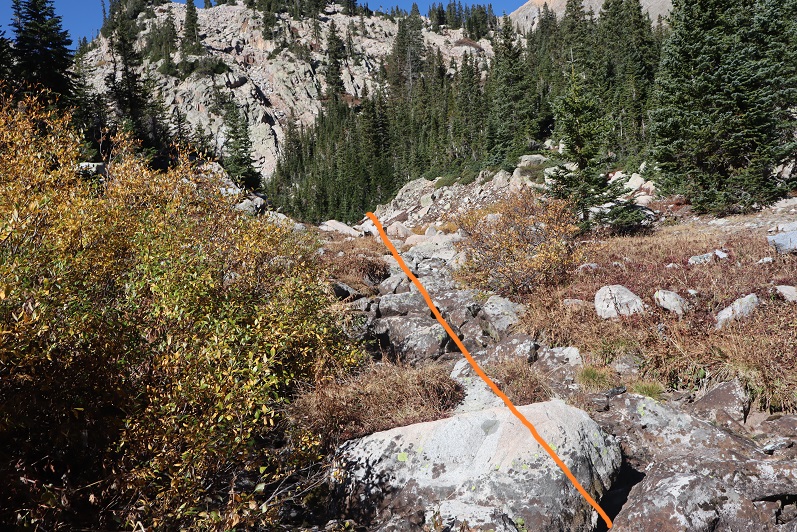
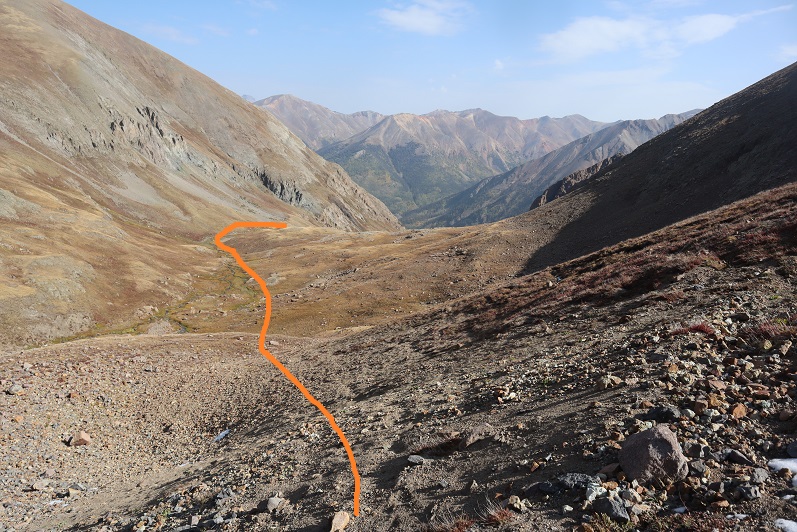
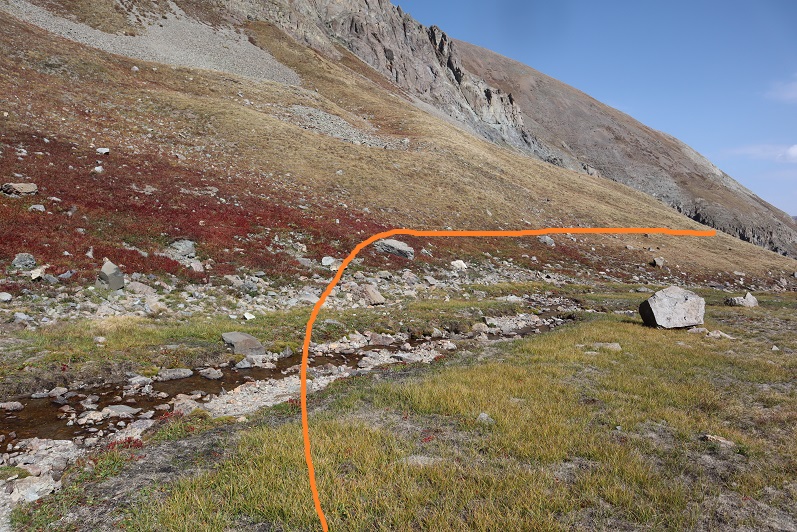
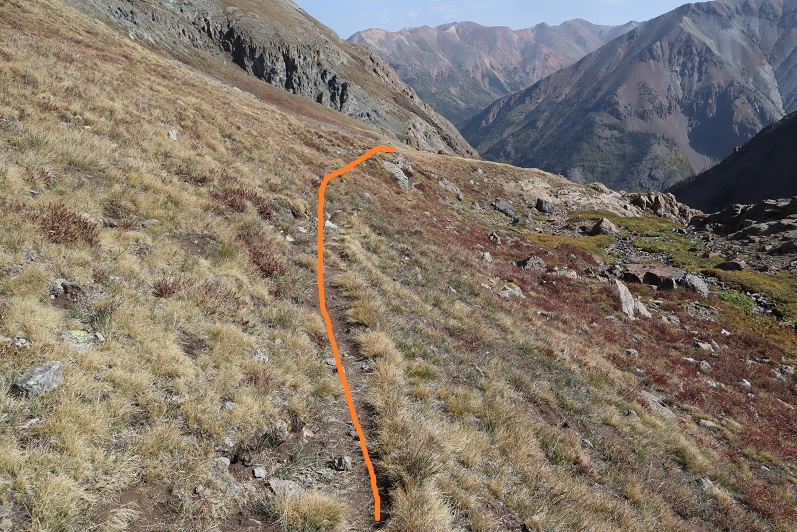
I didn’t descend to Hazel Lake, but instead stayed high, aiming for the grassy slopes below Grizzly’s ridge.  There are several ways to do this
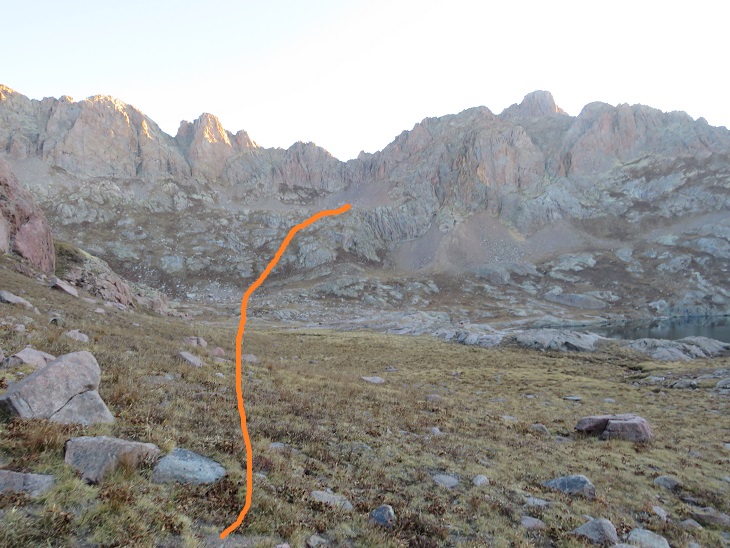
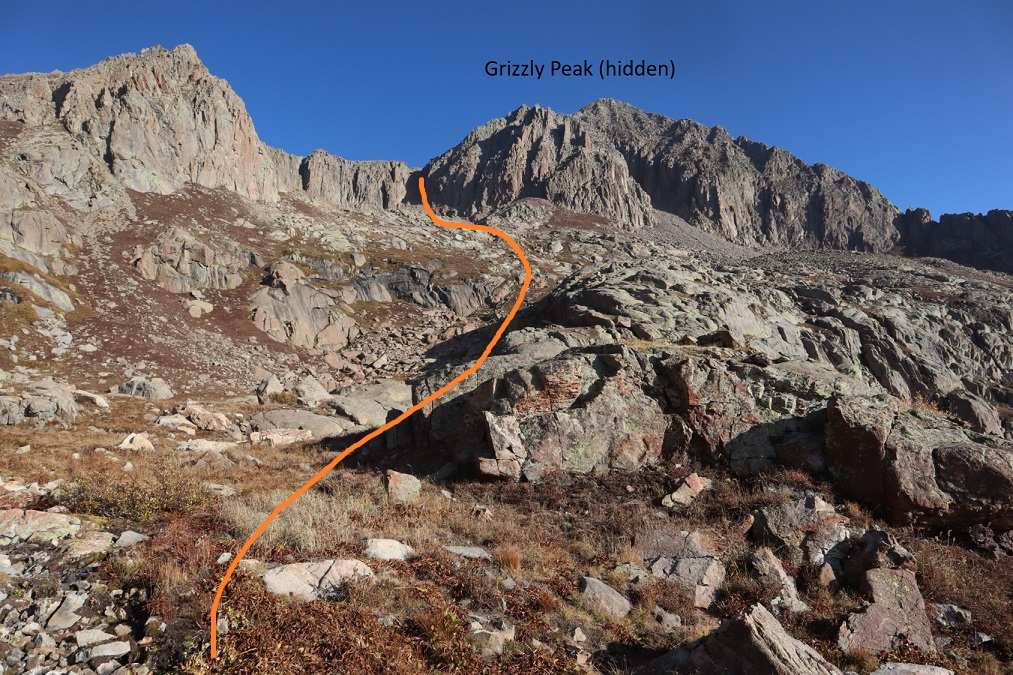
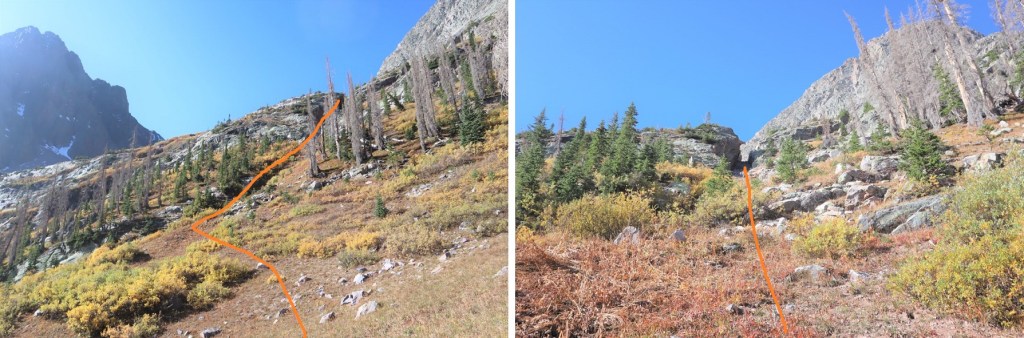
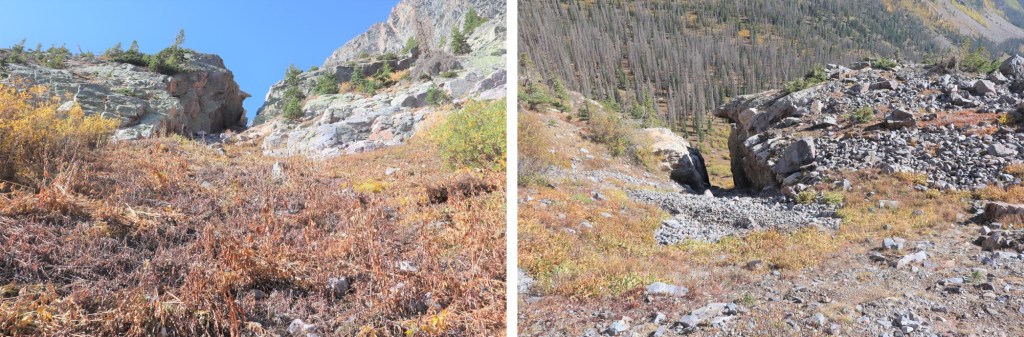
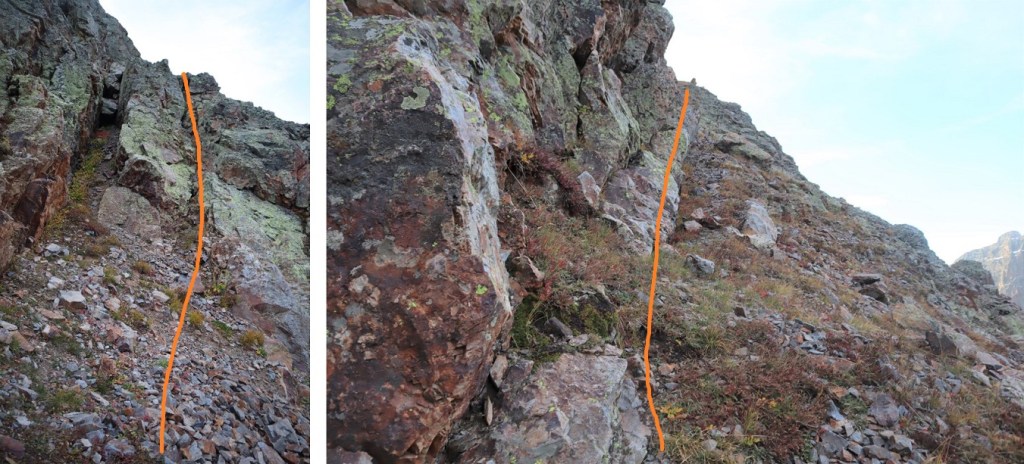
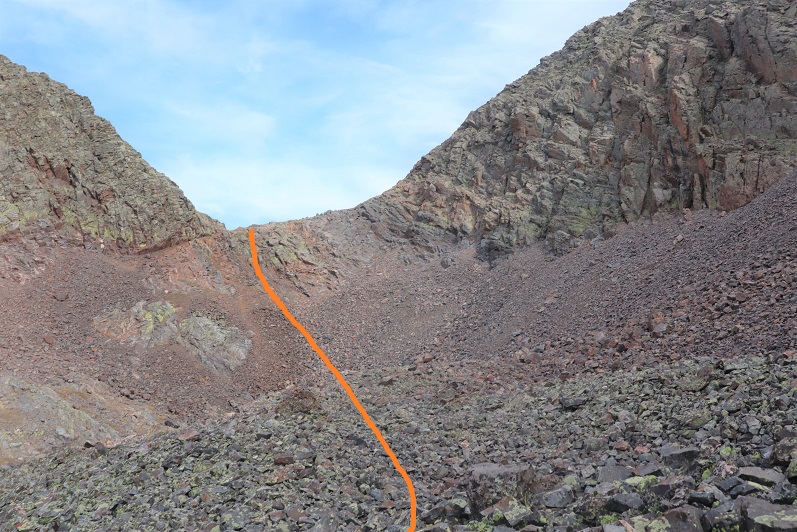
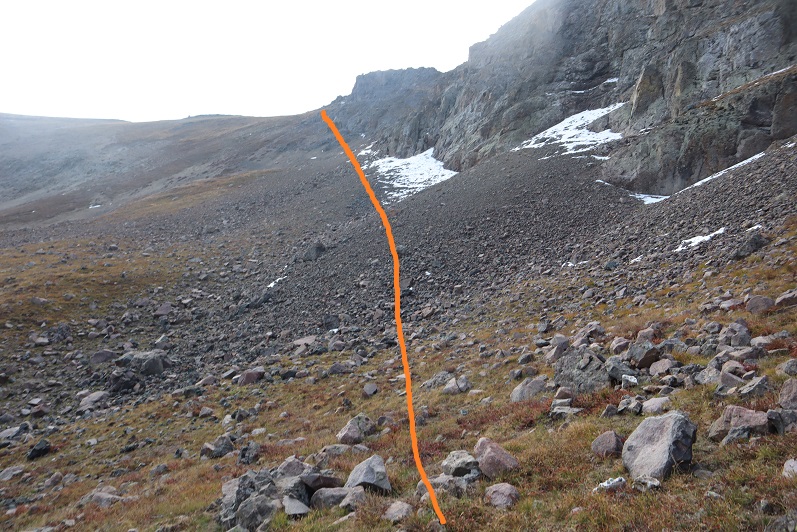
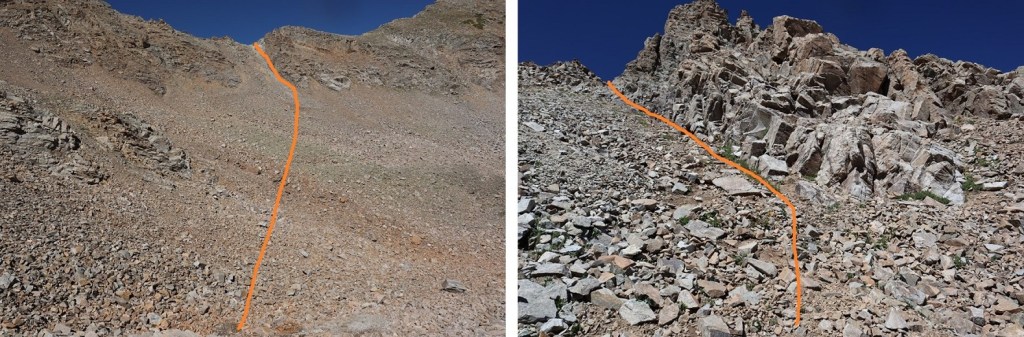
From there I aimed for the obvious gully/notch/access point (not sure what to call this?)
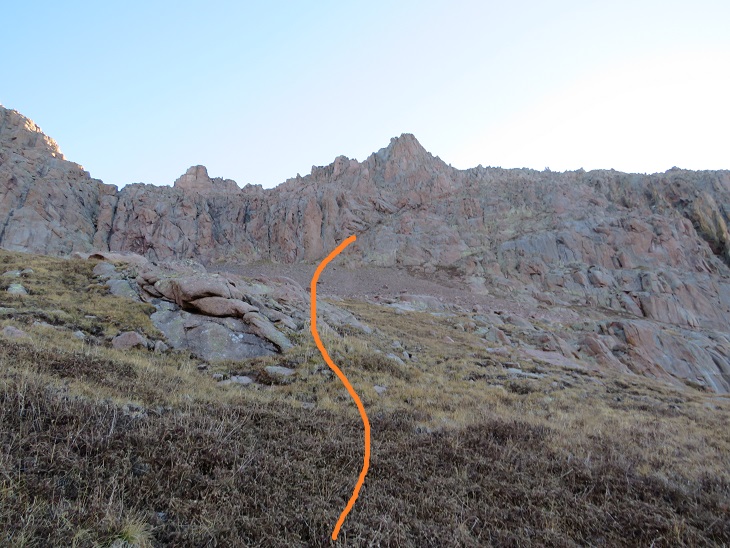
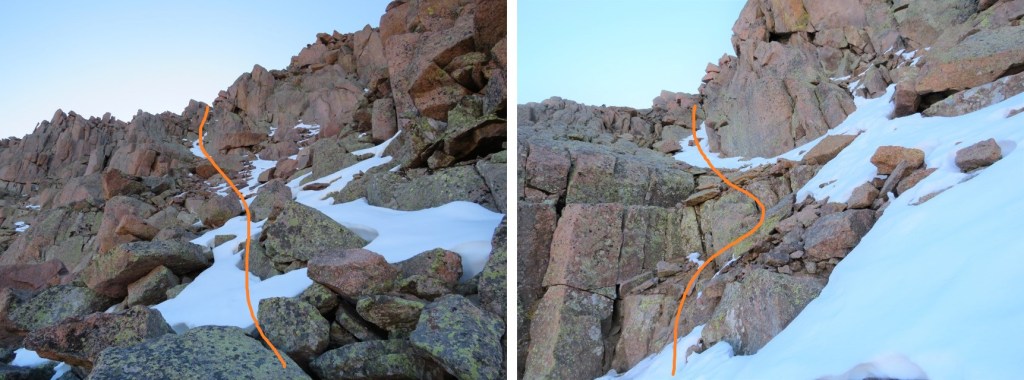
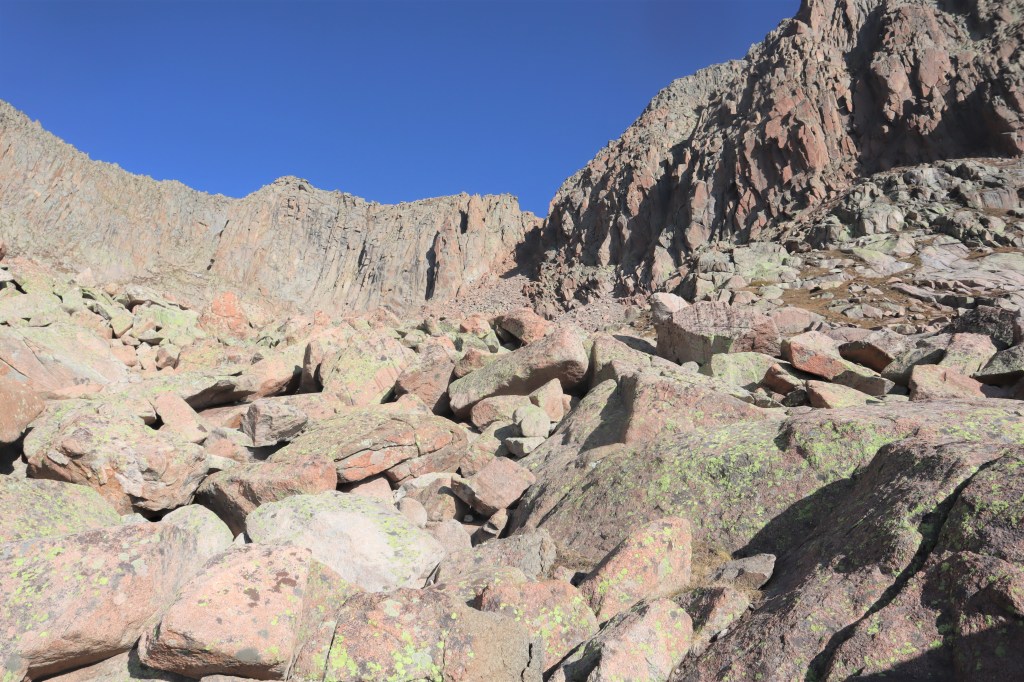
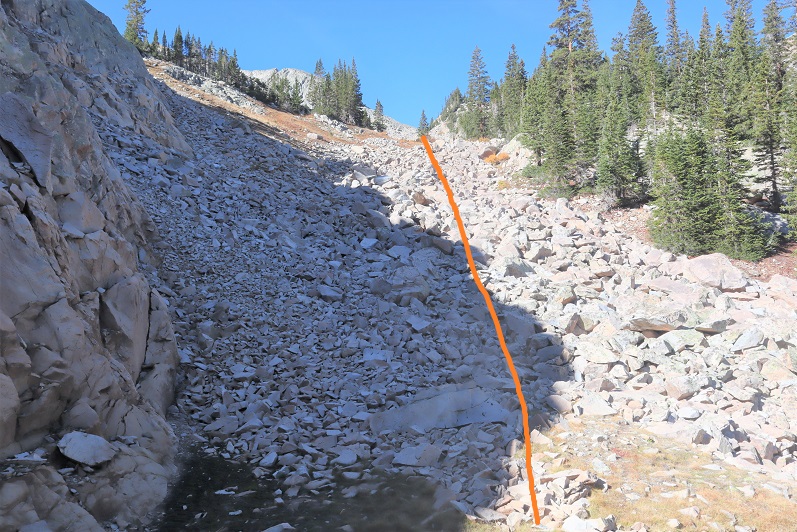
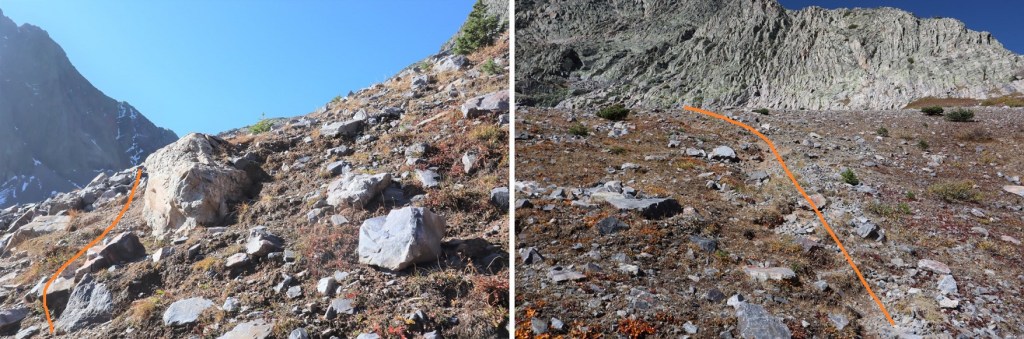
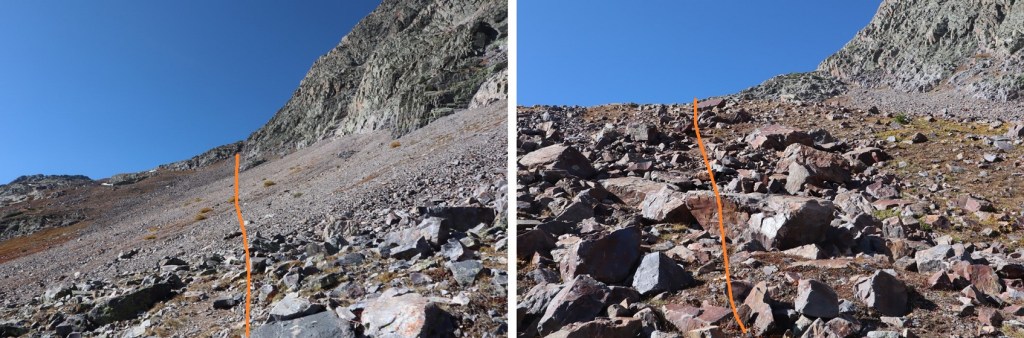
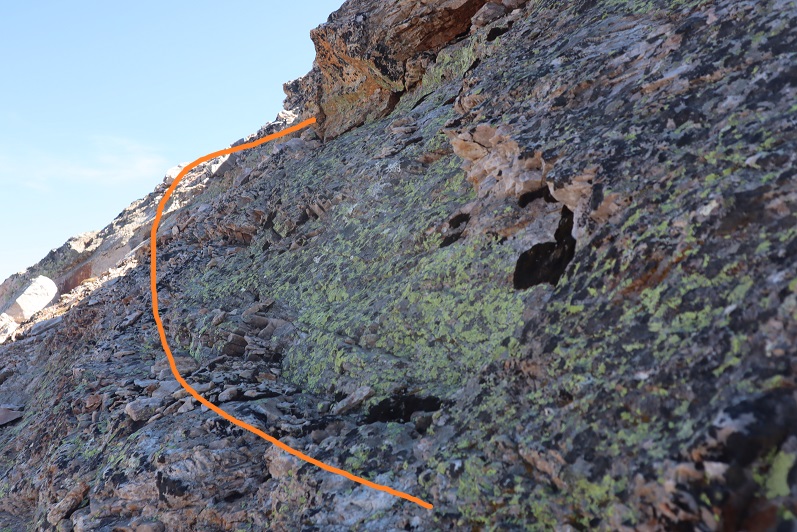
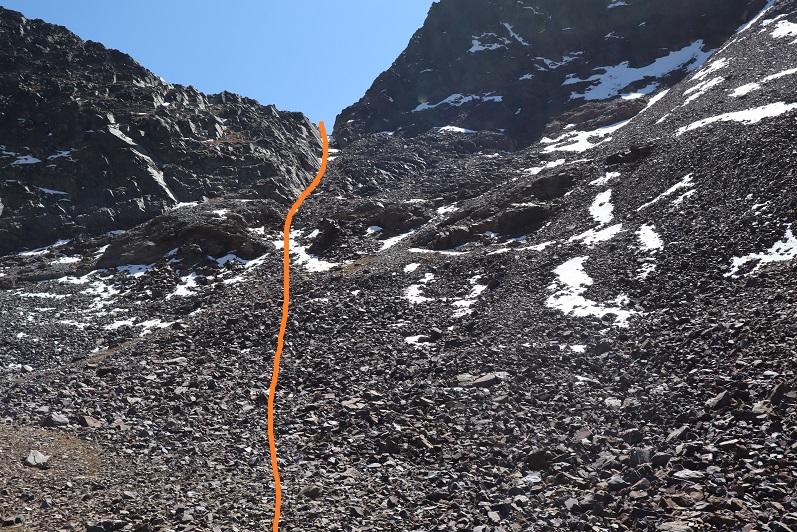
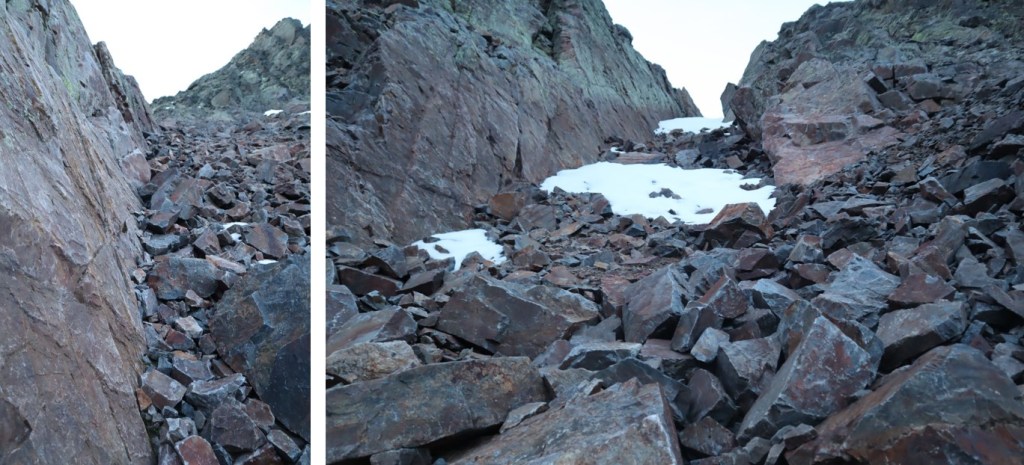
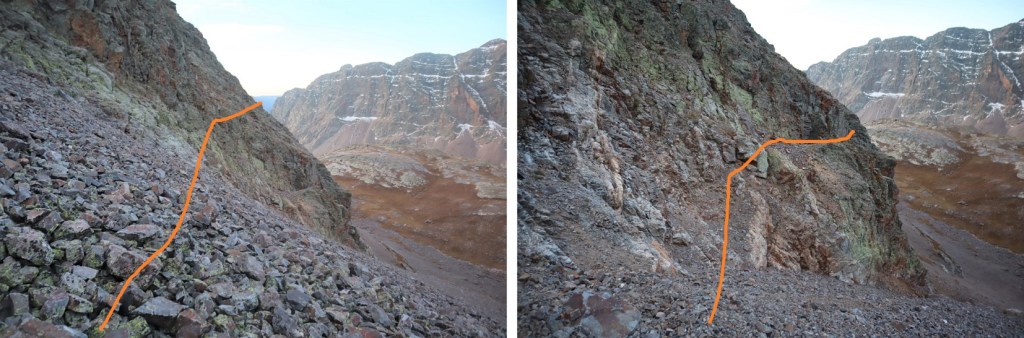
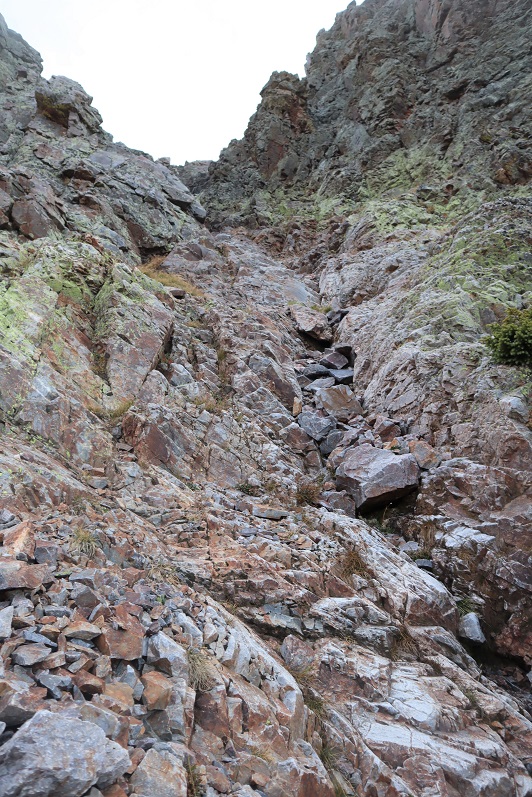
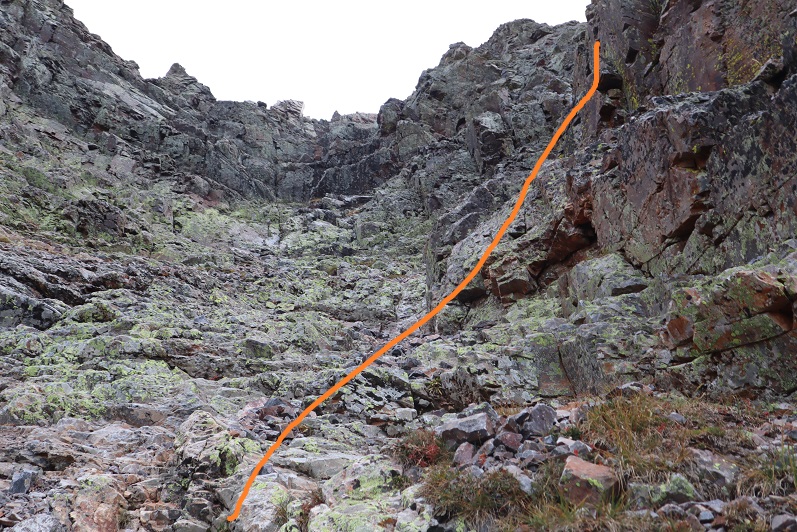
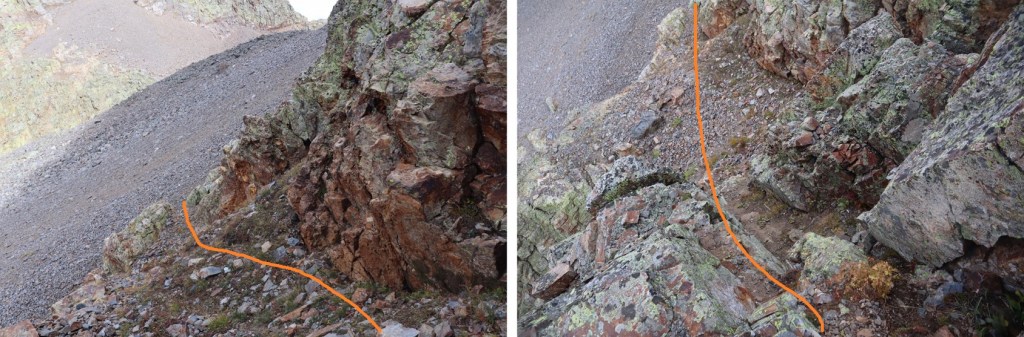
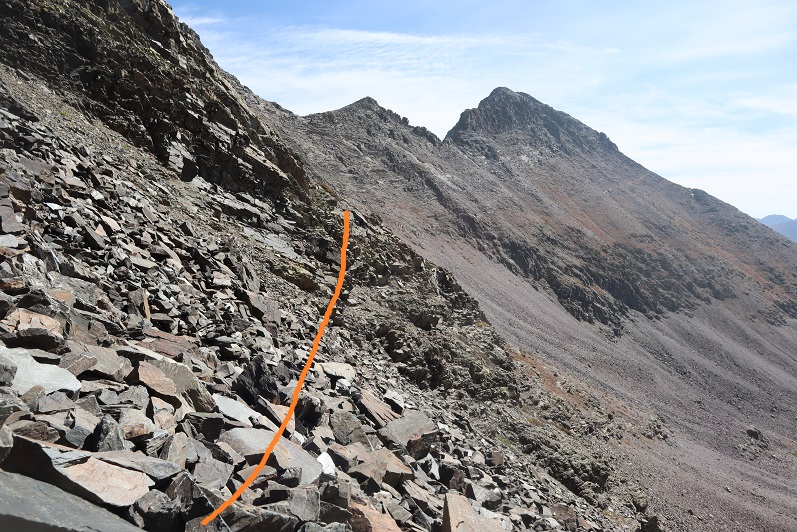
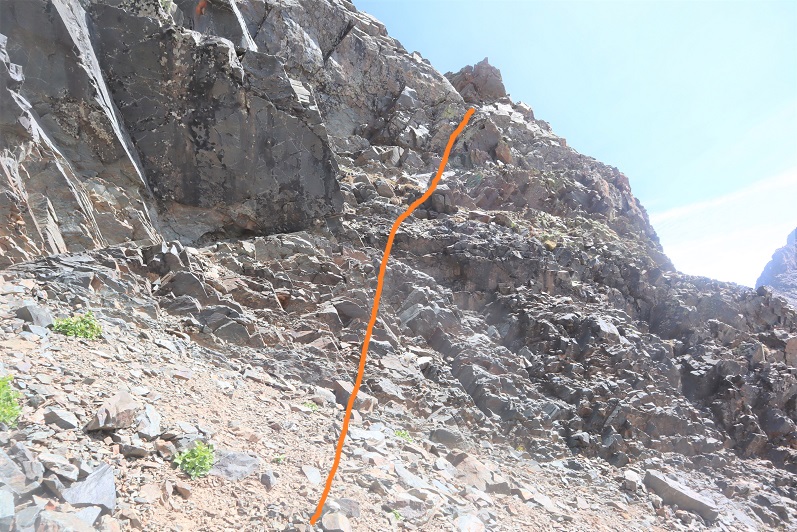
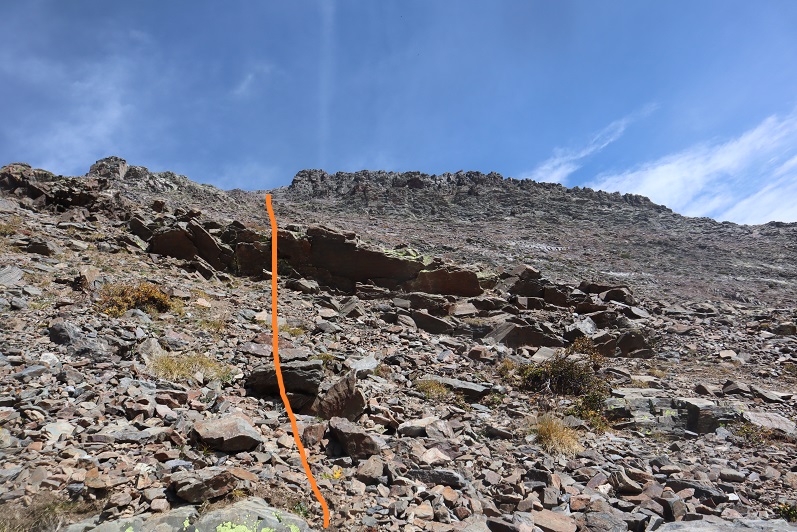
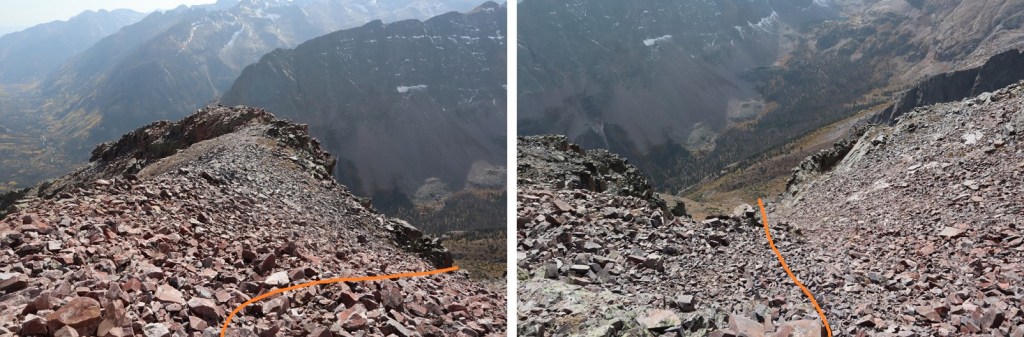
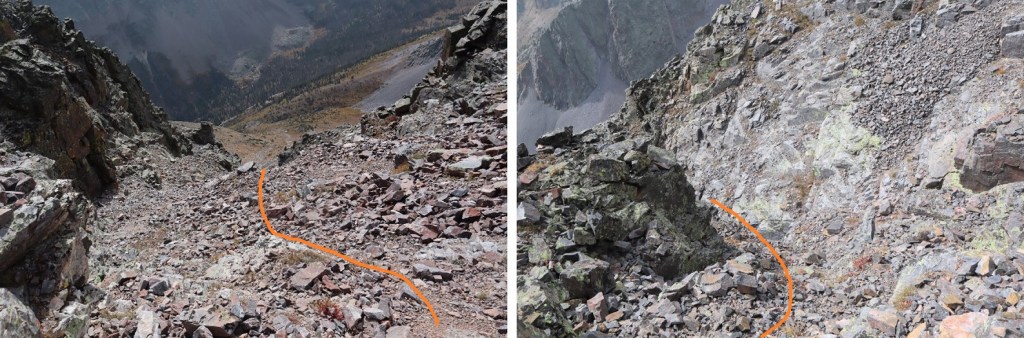
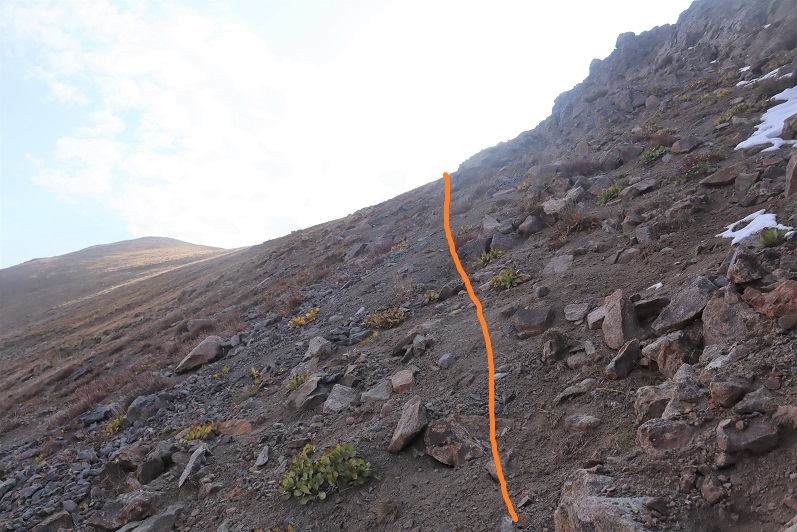
This gully/notch/rib is easy to follow to the ridge.  Stick close to the wall and follow it southeast as it hugs the mountainside.  It starts out as class 3 but after the initial solid gully it becomes class 2.  I was pleasantly surprised to find cairns here.
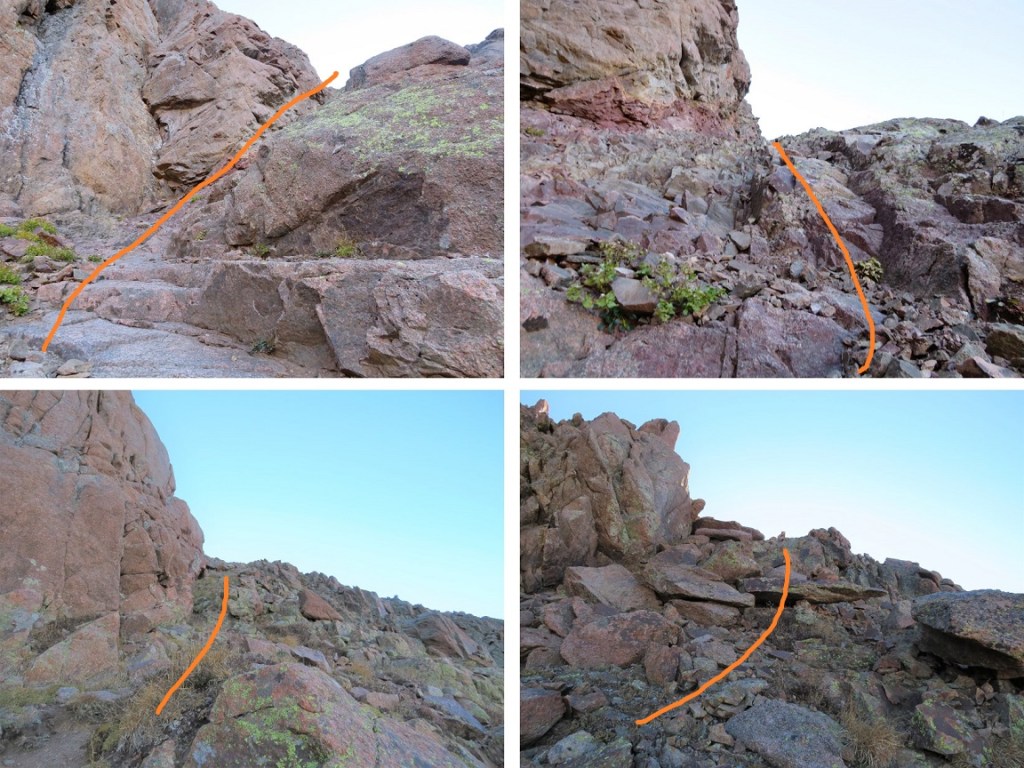
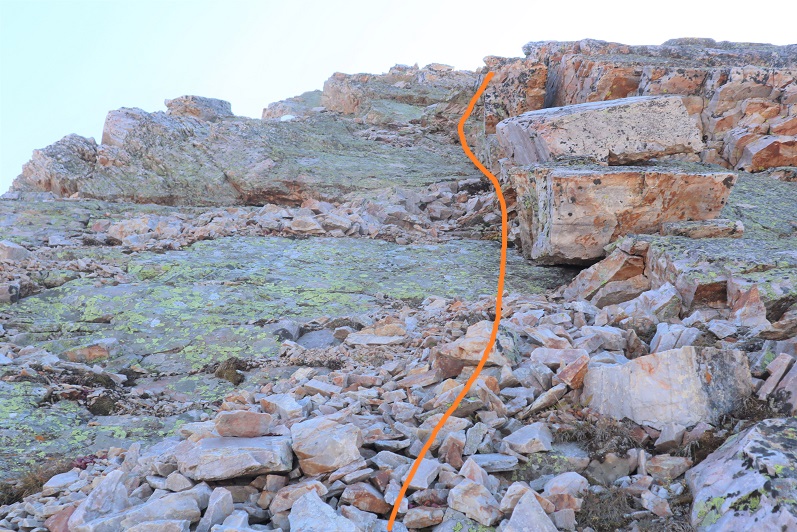
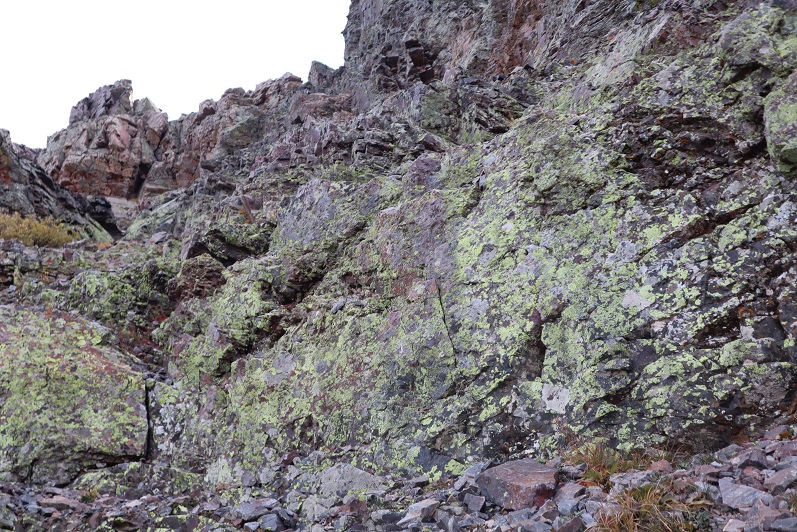
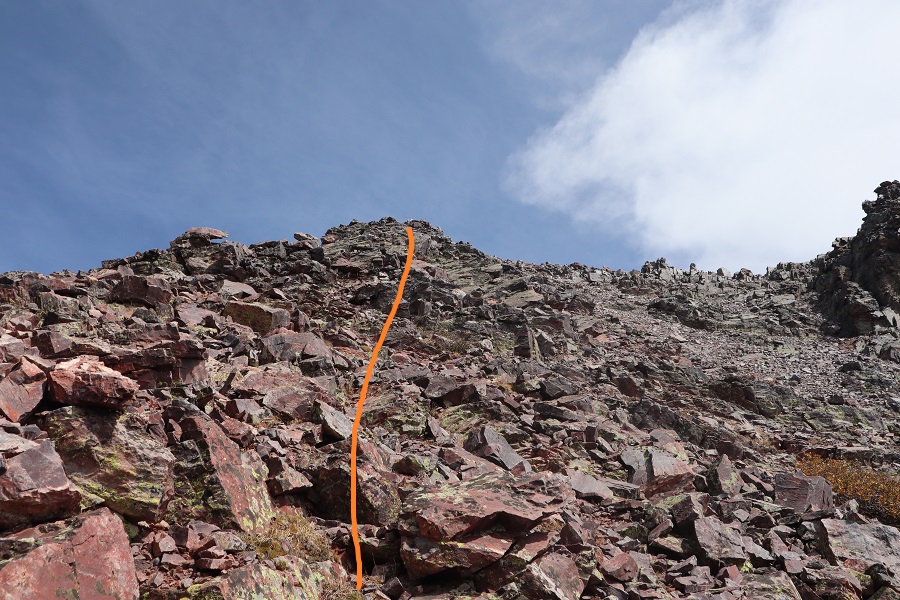
Here’s the last bit to gain the ridge.  Aim for the notch (there are cairns here too).  The last part of this is class 3.
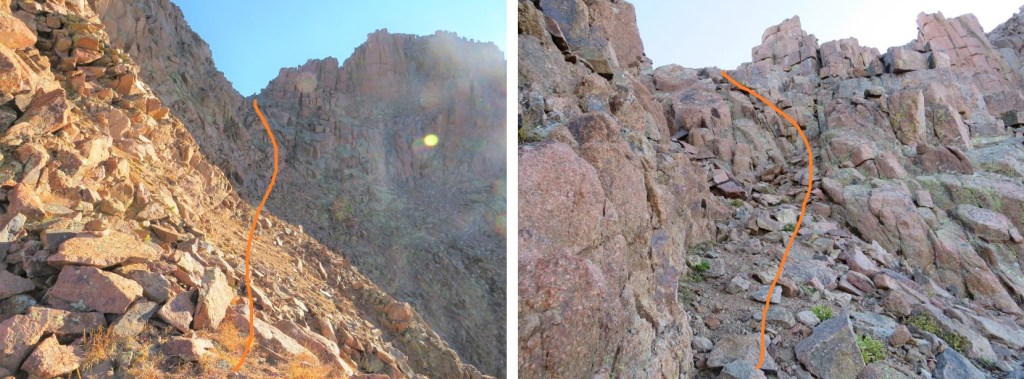
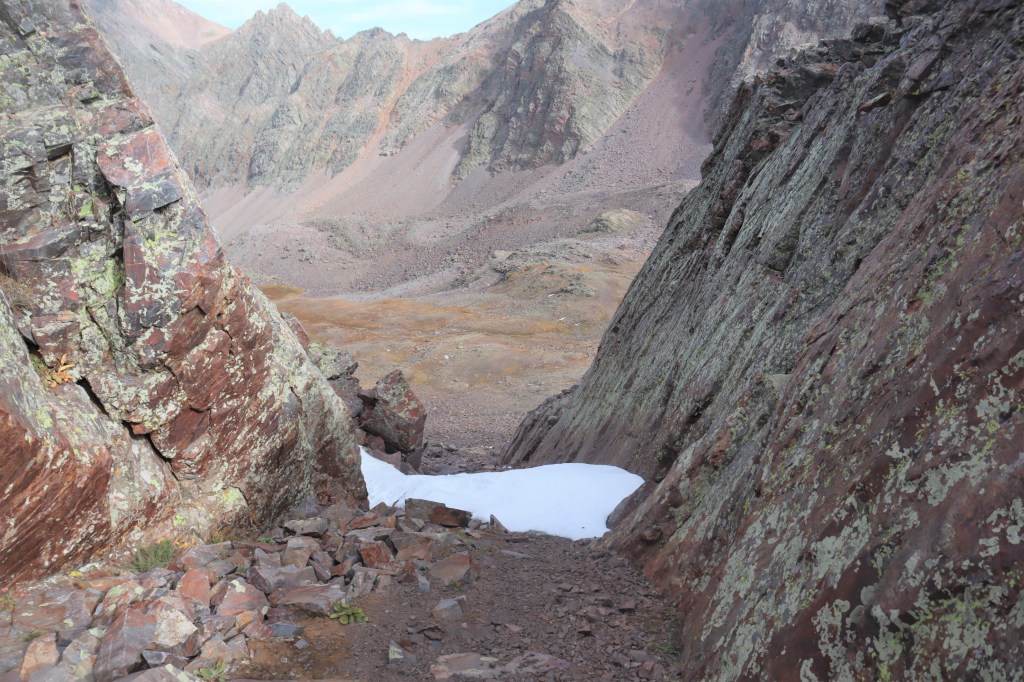
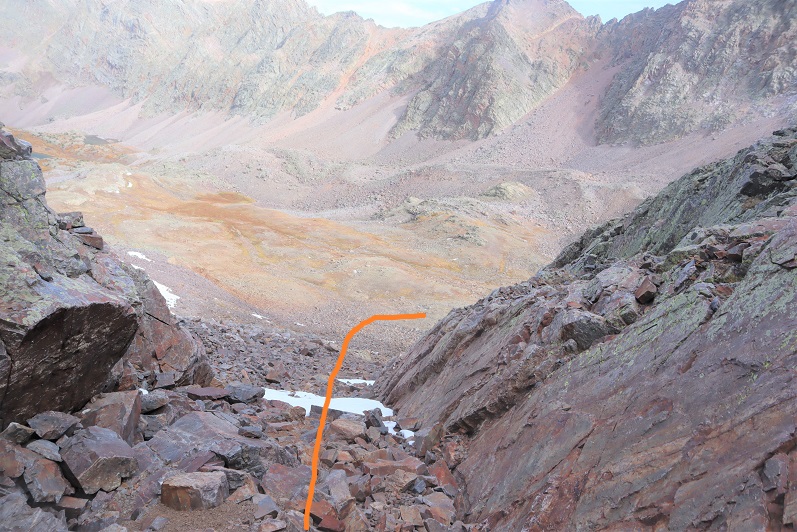
I went through the notch and found snow on the other side.  This wasn’t unexpected, as I’ve spent the past 3 weekends in this area and knew north facing terrain was holding snow.  What was unexpected was the amount of snow, and how it all lined the trail.  It ranged from non-existent to 3 foot drifts, and from bulletproof to sugary.  What’s important for the reader to know is there are multiple ways to summit Grizzly Peak, and tons of cairns to prove it, so I was able to get creative these last 250’ or so to the summit.  I rock hopped where necessary, kicked in steps, and created trenches to get to the summit, always heading up and east.  Here are some highlights.
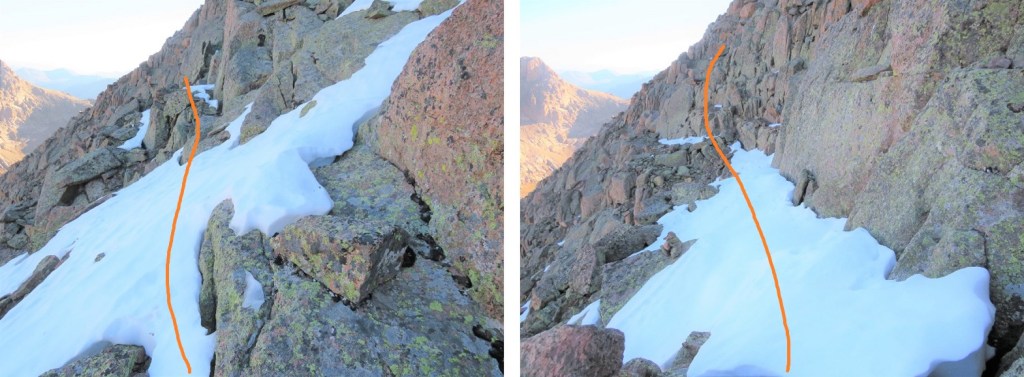
The last bit to the summit was luckily snow-free, and class 3-4 (the chimney was class 4)

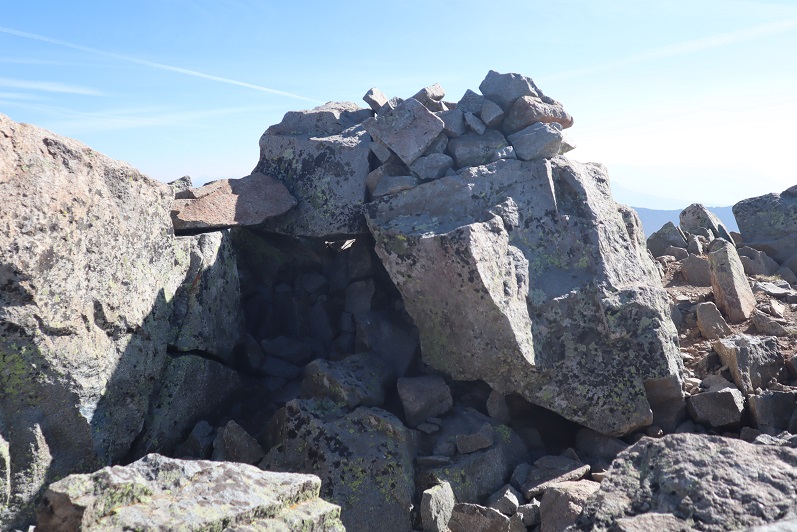
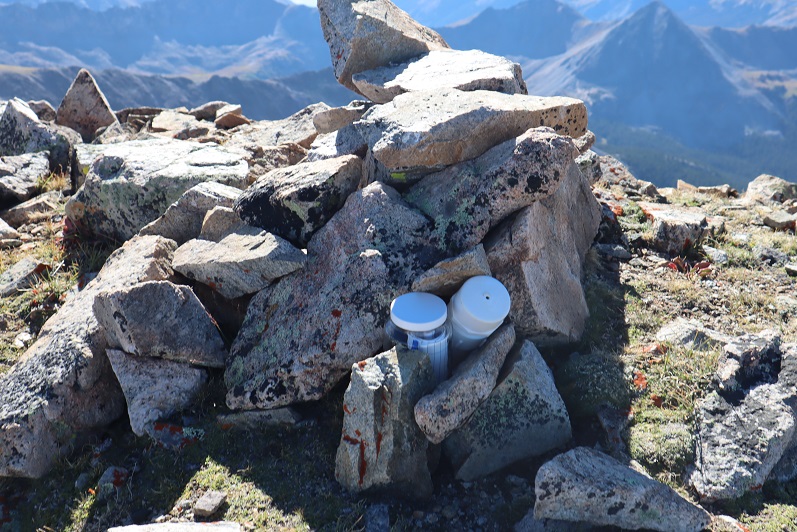
As I made it to the summit I wasn’t sure if the true summit was left or right.  I went right and luckily chose correctly (there was a summit register beneath this point).
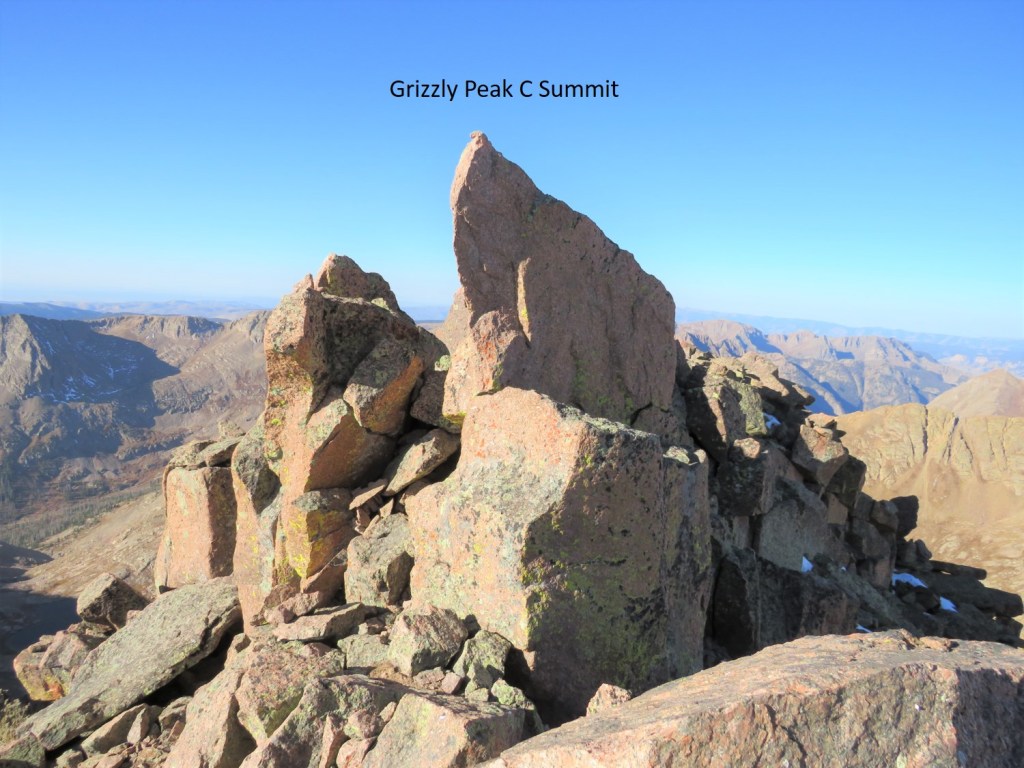
I summited Grizzly Peak at 9:15am.  I know some of you are wondering, did I did I sit at the top of the summit point?  The answer is no.  The point was too pointy to sit directly on top of, but I did climb up the summit boulder, sat on it about a foot from the point and touched the top, so I’m calling it a summit.  You can sit wherever you’d like.  I also didn’t take the video from the point, as I do a 360 degree video and wasn’t about to attempt turning in a circle while standing on the point. 
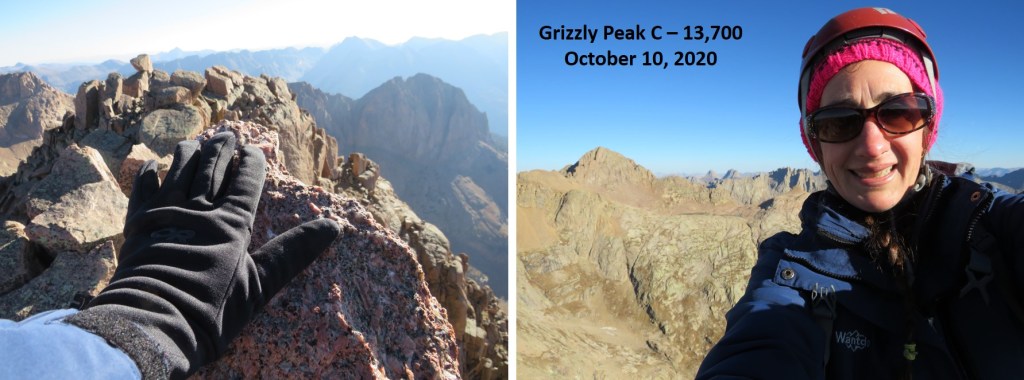
Grizzly Peak C: 

Time to head back down. I down climbed the chimney and headed back, retracing the steps I’d left in the snow to the notch

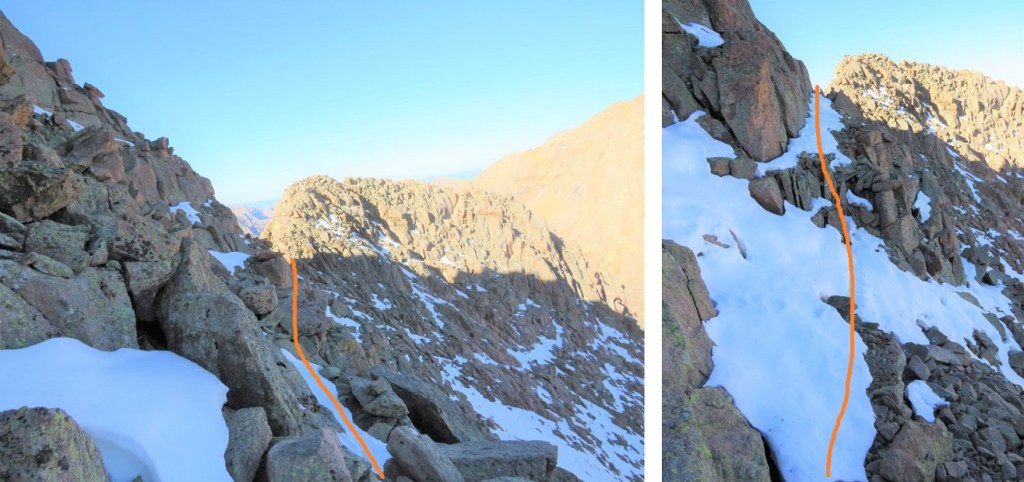
I made my way back down around the side of the mountain to my entry point

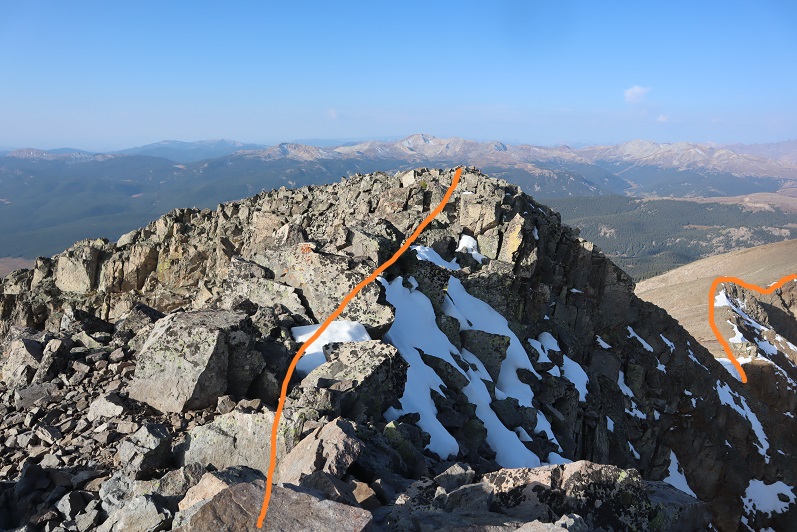
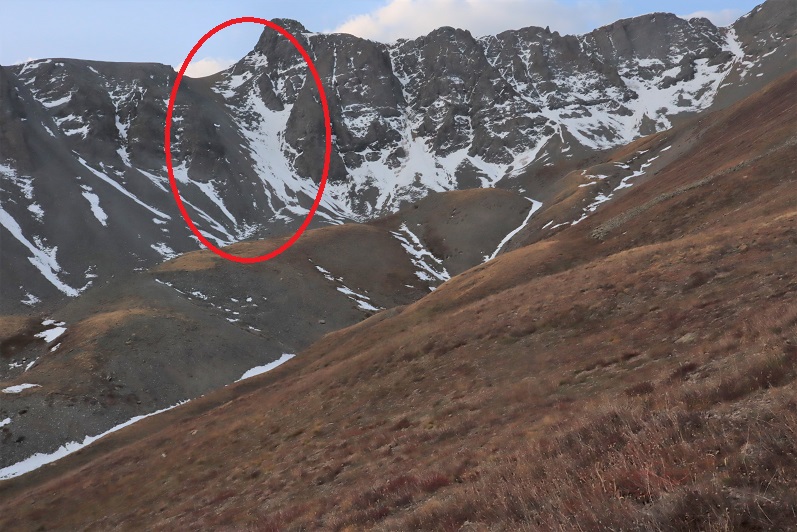
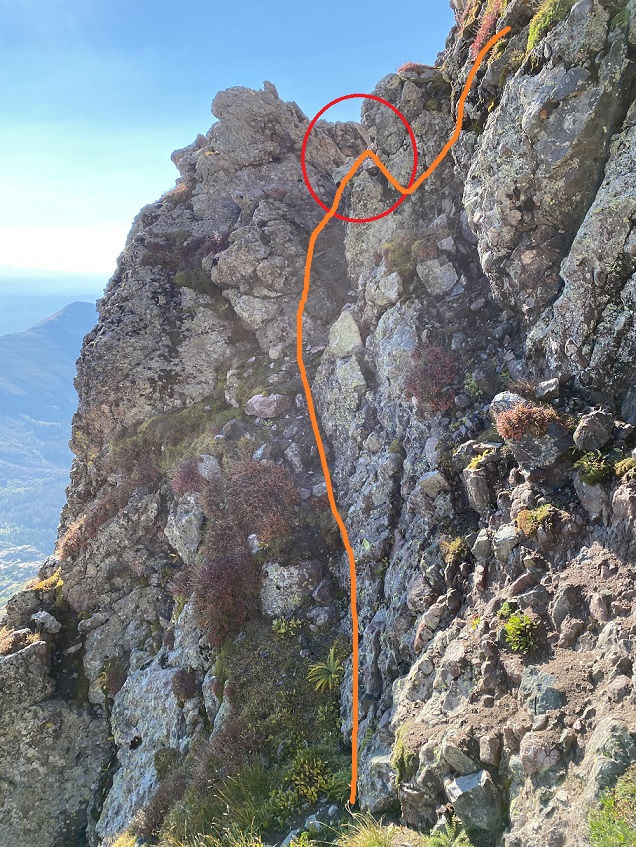
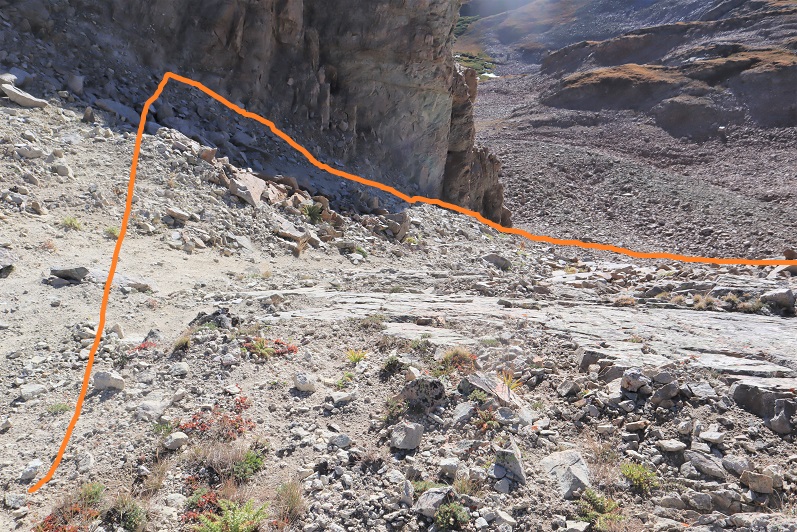
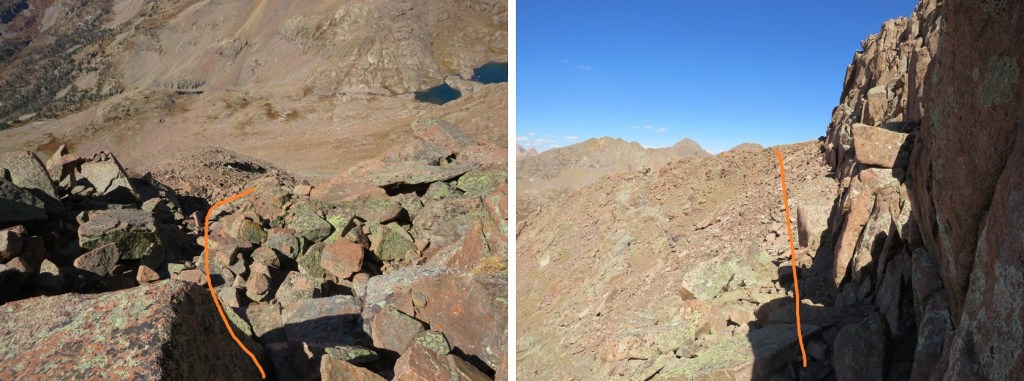
My next objective was McCauley Peak.  I could clearly see the line I wanted to take, up the grassy slopes to the Grizzly/McCauley saddle.  Staying high didn’t cliff out, but there was one class 4 downclimb required in the area circled in red.  If this scares you, you can just go lower initially (the dotted line) and re-gain elevation.

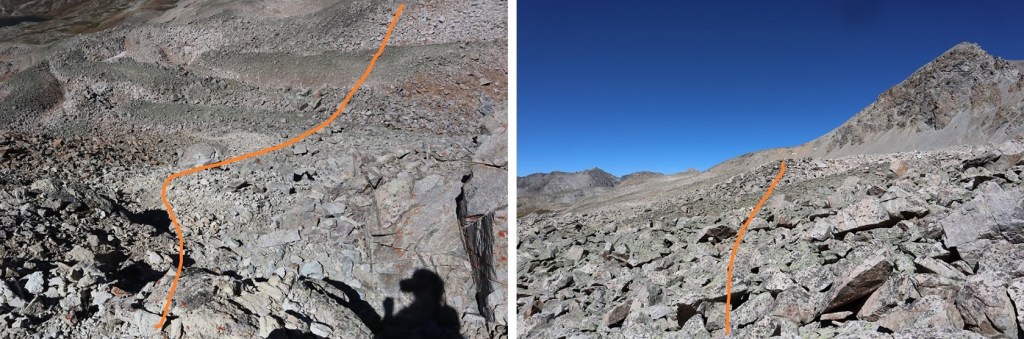
I gained the saddle and headed south along the ridge.  This was all class 2
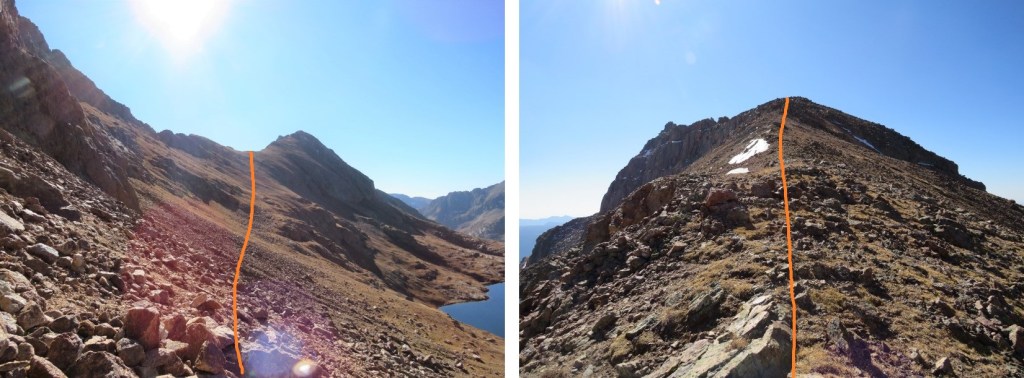
From the top of the ridge I could see the rest of the route.  There were cairns here indicating I should go low, but the route was no more than class 3 sticking to the ridge.  Here’s an overview of the route I took
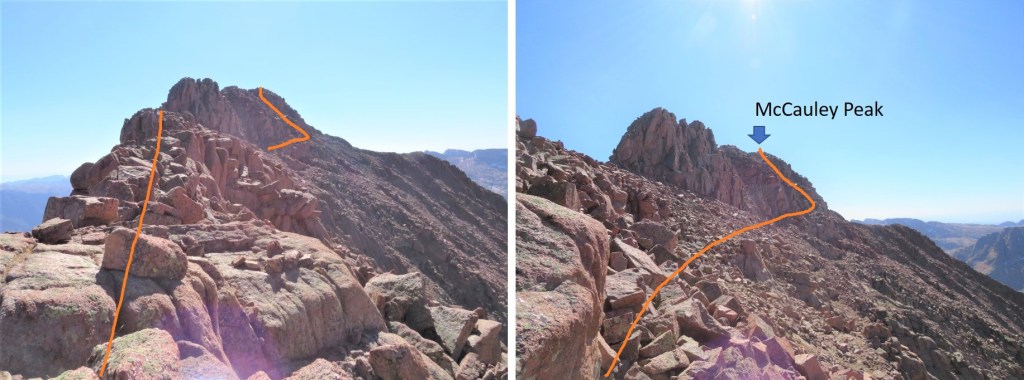
The summit is actually the southernmost point.  I rounded the west side of the mountain and found a gully to ascend (note:  all gullies here ‘go’).
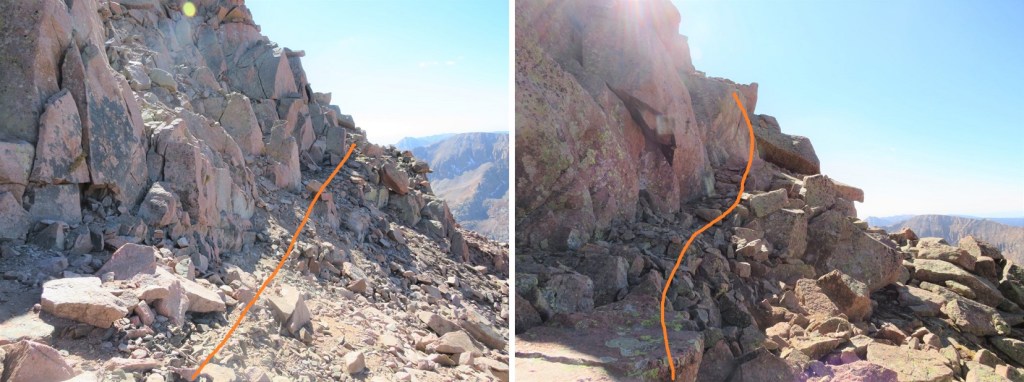
There was one class 3 move and then it was all class 2 to the summit
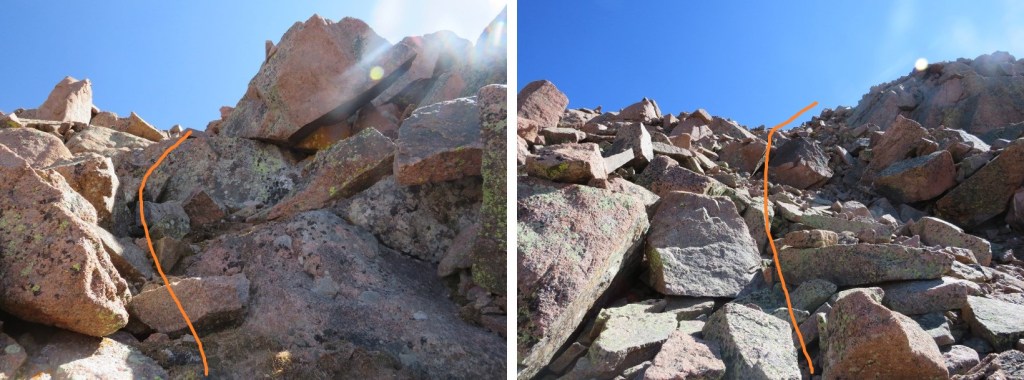
I summited McCauley Peak at 11:30am
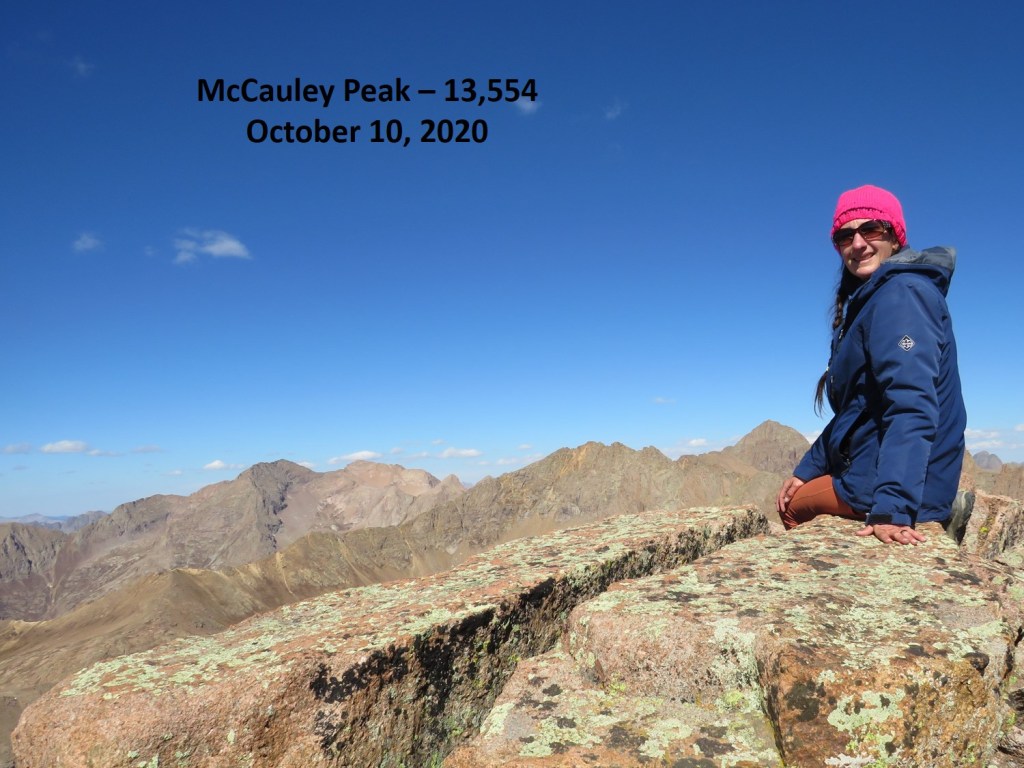
McCauley Peak:

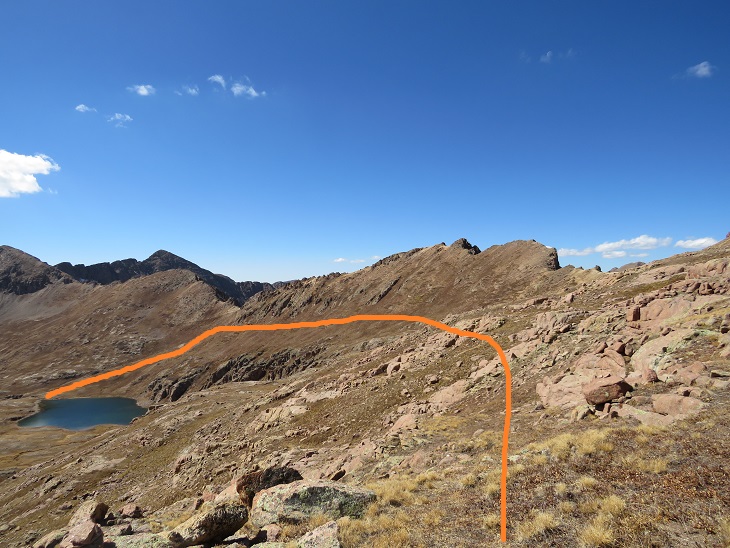
It was a beautiful day!  The predicted winds never materialized, so I stayed a little longer on the summit than usual.  Then I headed back down the gully and over the ridge
Here’s the overall route back to Hope Pass

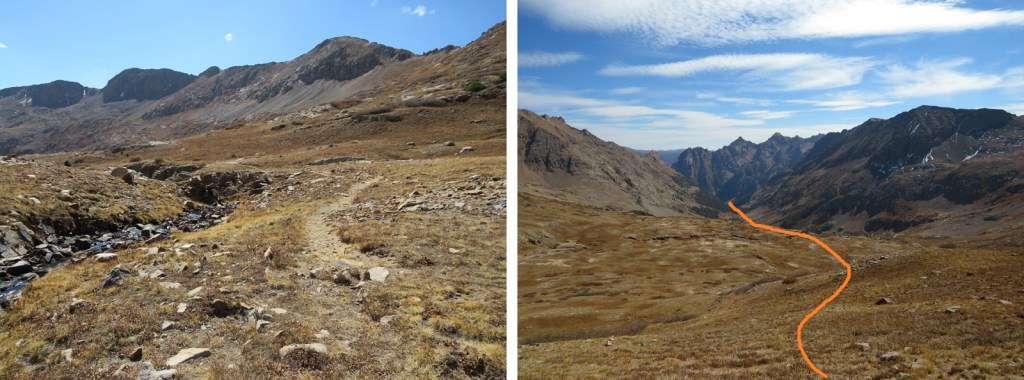
And the route from Hope Pass back down to Columbine Lake (and my stashed gear)
I made it back to my gear at 1:30pm.  I mulled it over, and decided instead of sleeping here tonight I was just going to hike as far back as possible, stopping along the way if need be (there are tons of camping spots along this trail).  I consolidated my gear and was on my way back down the basin towards those thousands of switchbacks.
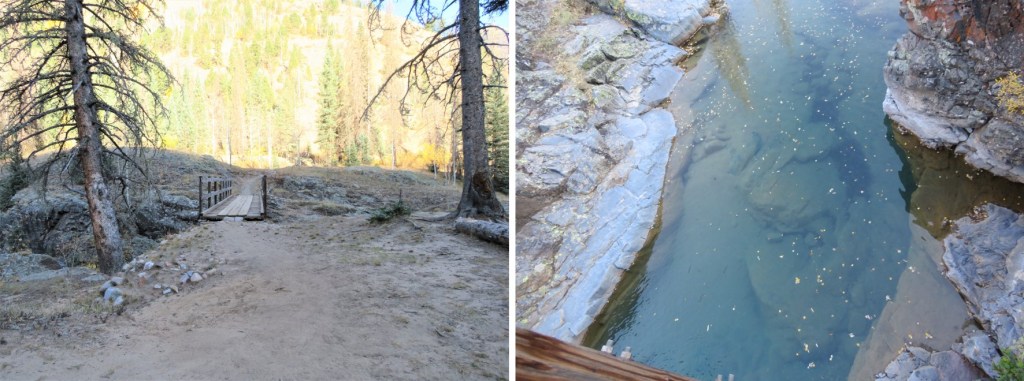
Back down to Vallecito Creek and its bridges (or lack thereof).  This was much more enjoyable in the daylight.  I was able to appreciate the creek and its depth, and even saw dozens of trout swimming in the deeper pools.
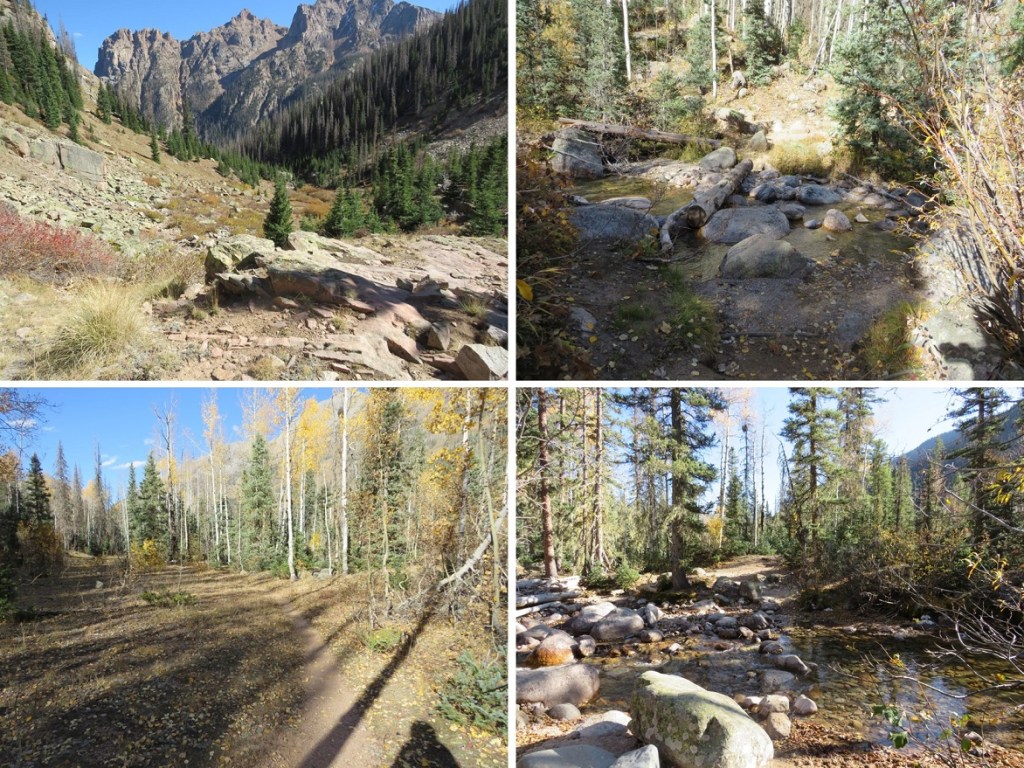
I followed the class 1 trail back to the trailhead, following the creek, and passing a hunters’ camp along the way.  The mules said ‘hi’ as I trekked by.  There were no people to be found.
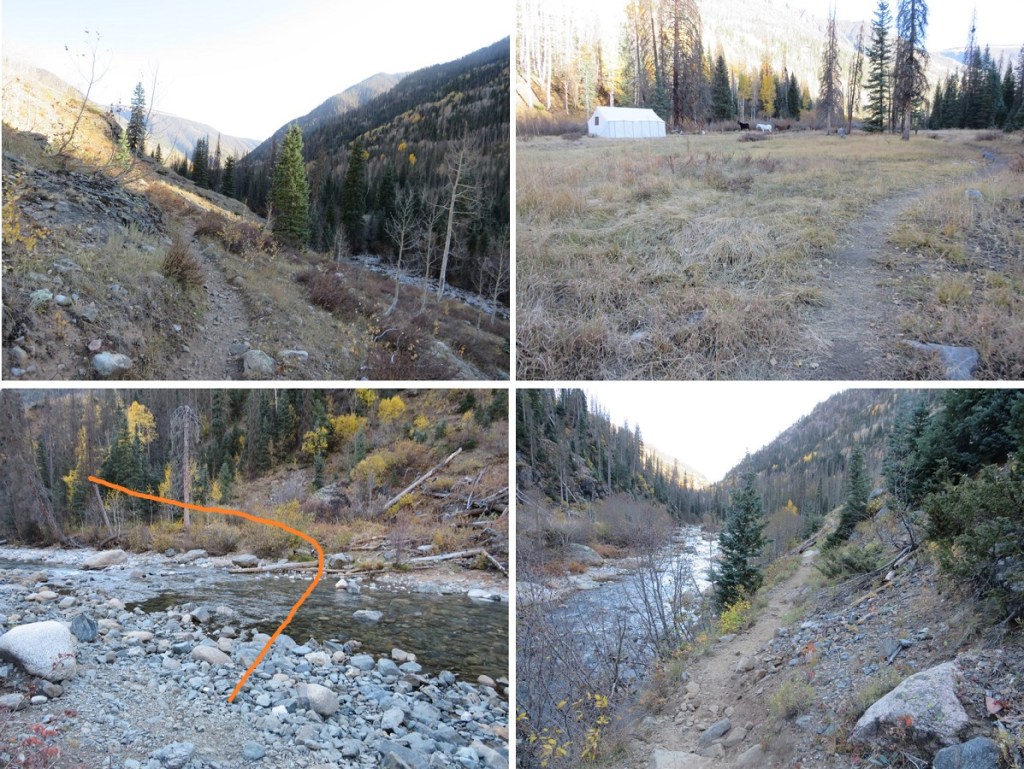
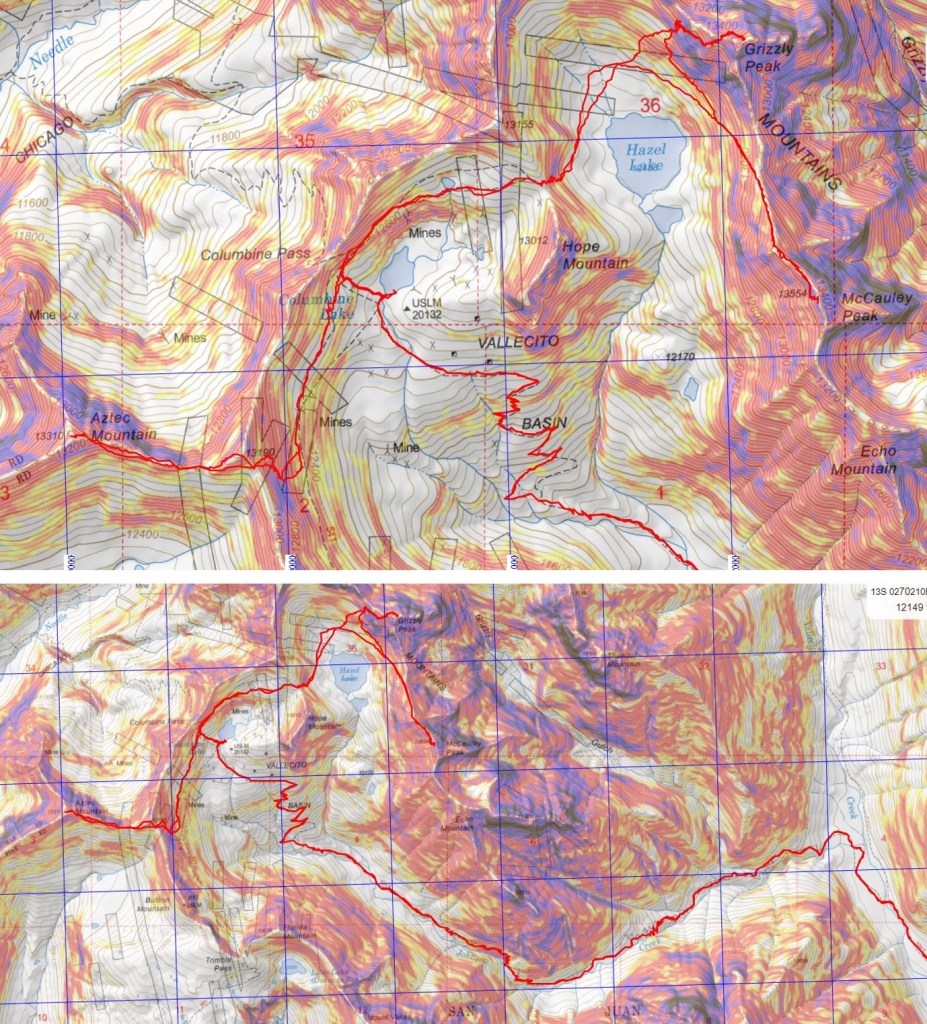
The whole way back I was prepared to stop and camp, but I was making great time so I just kept going.  I mean, I really, really needed that chapstik.  About a mile from the trailhead my camera stopped working.  It wasn’t until I made it back home I realized the battery had somehow fallen out.  This was weird because the door was still closed, and I only realized it was gone when I opened it to take out the flash card. Luckily I have a spare.  I made it back to the trailhead at 8pm, and found my extra pair of socks sitting nicely in the passenger seat.  I have very different numbers for my stats looking at CalTopo and Strava.  I usually go with CalTopo for numbers for consistency sake, but I’ll just leave these here for you to decide which are more accurate, along with a few topo maps of my route. 

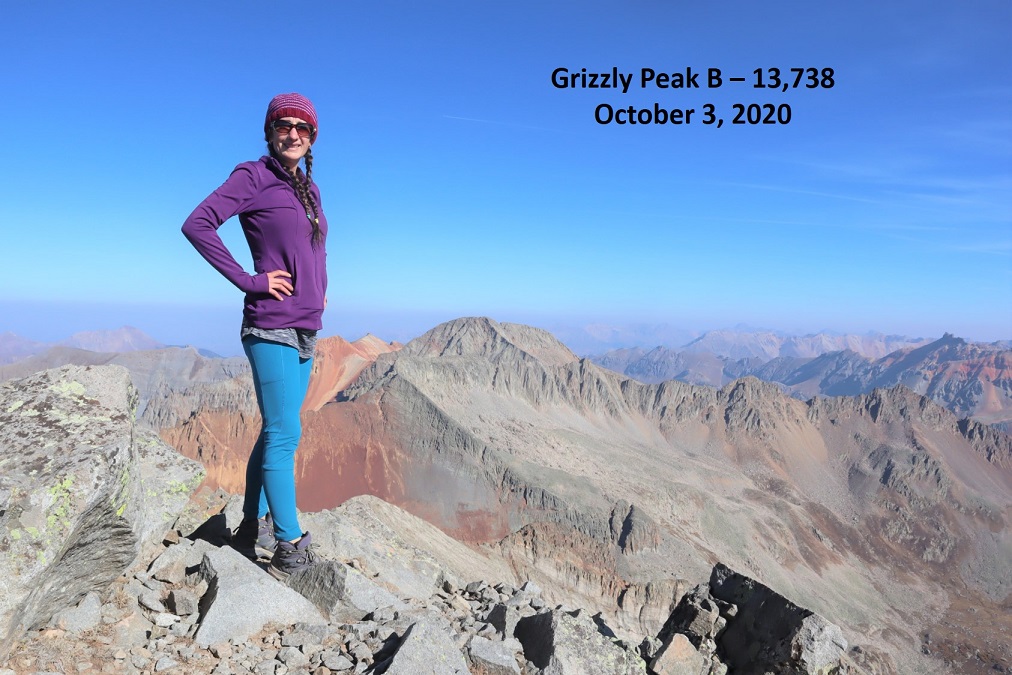
Grizzly Peak B – 13,753

RT Length: 9.96 miles

Elevation Gain: 3543’

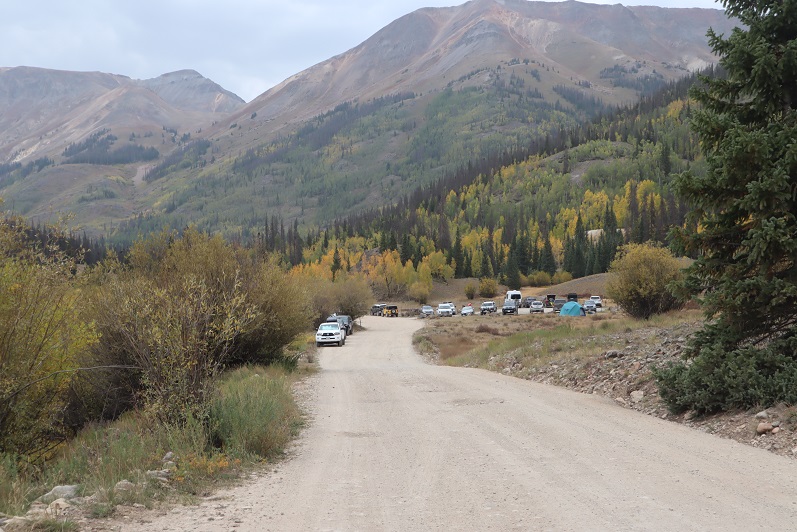
I drove in from Kite Lake after hiking some 13ers in the area.  It took me about 2 hours to drive to Silverton, 40 minutes to drive to Purgatory, and another hour and a half to drive to the end of Forest Service Road 579.  This is an easy 4WD road, but there are few spots to turn around.  I was getting seriously worried about my trip out tomorrow until I (finally) made it to the end of the road.  The road abruptly ends at a campsite, which was good news to me, as that meant there should be fewer chances to pass other drivers on the way out because the road doesn’t really ‘go’ anywhere.  Mine was the only vehicle at the trailhead.

It was 10:30pm when I made it to the campsite, and I should have been exhausted after hiking/driving all day without sleep the night before, but I wasn’t.  I was cold however.  I turned on my heater and jotted down some notes in my journal while sipping on some whiskey.  I played a few games on my phone and looked over my topo map for the next day.  I hadn’t found a lot of good information on this peak, so I’d planned a route myself and I was trying to memorize it so I wouldn’t need to break out my map too often tomorrow.  As I sat there, I was reminded of something someone had said to me a few days before: “Don’t you ever relax?”  Yes, yes I do.  This was relaxing. 

My heater was starting to make my sleeping area too warm so I shut it off and decided it was a good time to go to bed.  I woke up and was on the trail at 6:30am.  The trail begins just behind the campsite

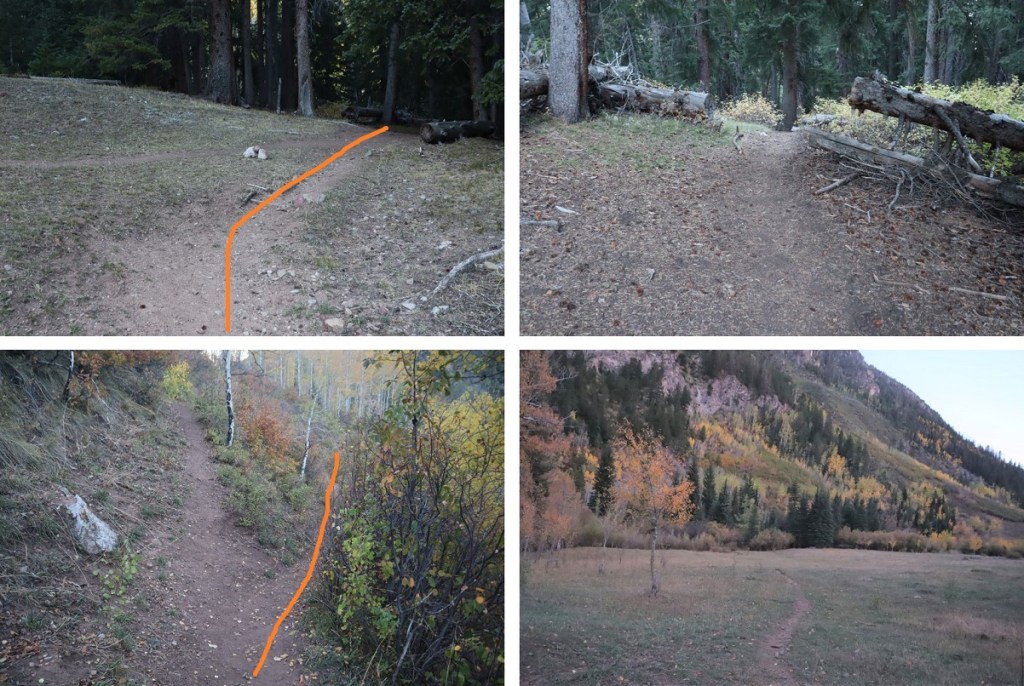
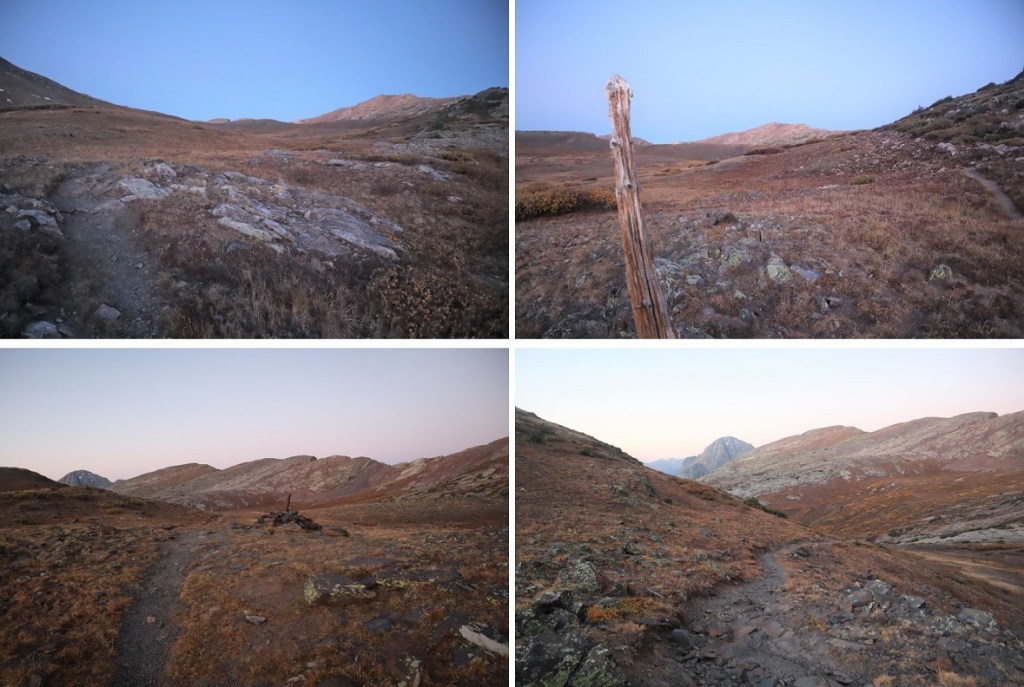
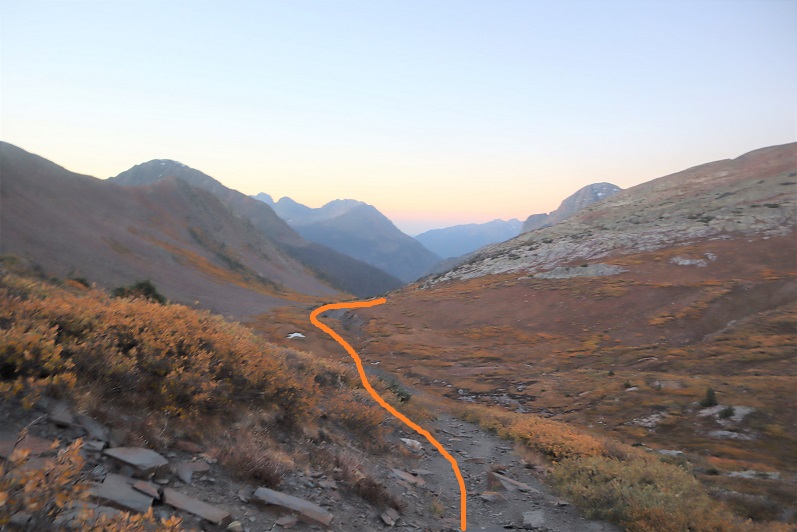
I could smell the fires and hooped the views would be better today than yesterday.  Immediately I noticed flashlights shining in the distance.  No way?!?  I hadn’t seen another vehicle on my way in, and I was very far from any other trailhead.  That’s when I remembered I was hiking on the Colorado Trail and this must be a good area to camp for the night.  I followed the trail northeast as it descended down to a creek, crossed the creek, and headed east, still following the trail

I stopped here because something was rubbing against my ankle.  I’ve never had to put on a band-aid while hiking before, but I thought I’d better now because my ankle would be rubbed raw if I didn’t.  Yep, I still need new hiking boots. 

I put together a topo map for this route, and in doing so later found there were trails on the route that weren’t listed on the map.  The trail I found went lower than I wanted to go, so I didn’t take it initially, but ended up being brought back to it several times, so I’m going to give you beta on the way you should take, not the way I took (which was loopy). 

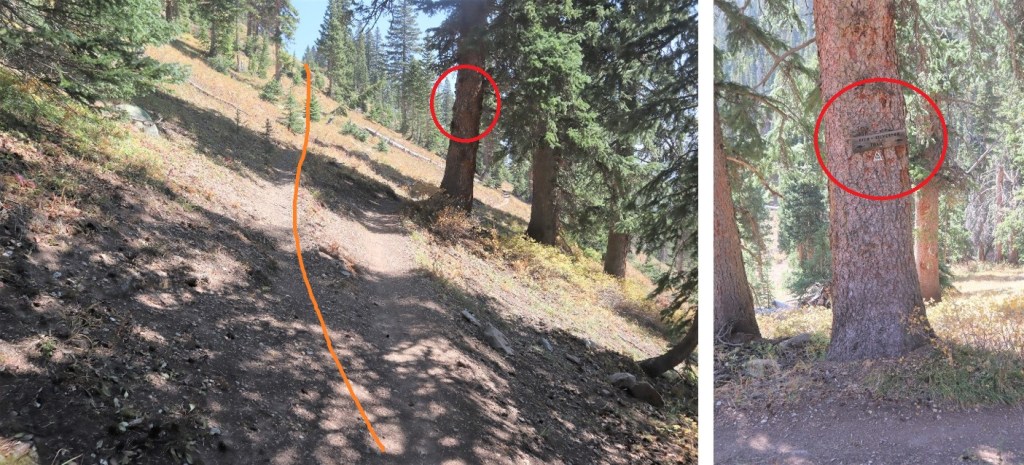
After crossing the stream, head east for .35 miles. Here there will be a faint junction, and if you look carefully, a sign to your right that says “Rico-Silverton Trail” (circled in red).  Take the upper trail here and follow it until you pass an obvious pond (about 1.2 miles). 

When you get here, there will be 2 trails.  Do not ascend the scree!  Instead, skirt the scree to your right

And continue following the trail as it skirts the lake to the left

Just after the lake the trail will curve to the left.  Follow the trail northeast up the basin

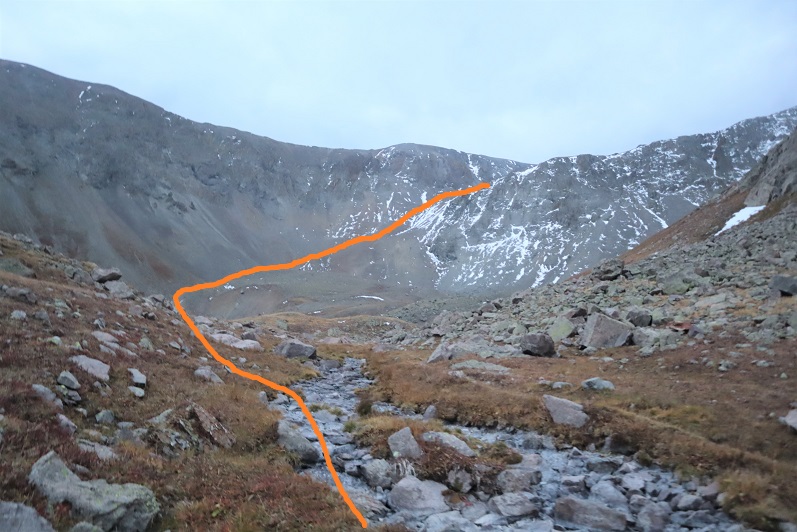
This is where the trail stopped.  I wanted to ascend via the upper gully, so I followed the basin as it curved right and then left.  Here’s a visual

Some boulder hopping brought me to the base of the gully

I stuck to the right to ascend the gully on rocks, and descended more to the left on the scree

As far as gullies go, this one wasn’t too bad.

At the top of the gully I continued north

I came to an abrupt drop-off, turned right, and followed the ridge a short distance to the summit

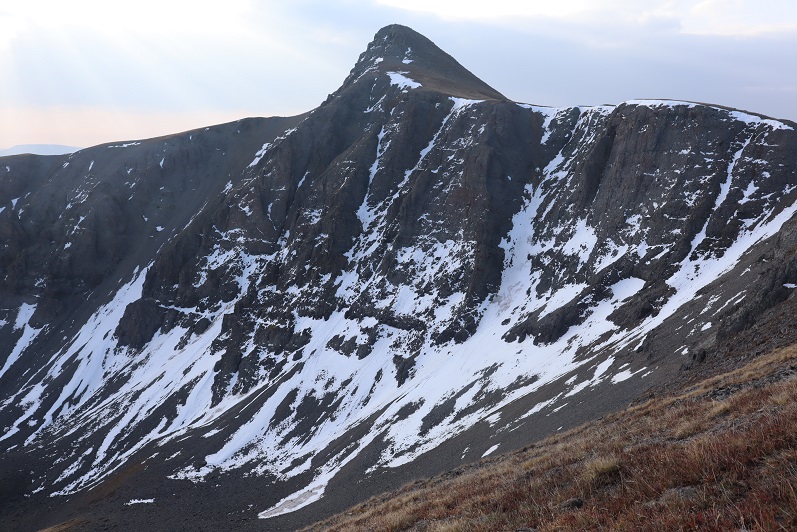
I summited Grizzly Peak at 10:10am

Grizzly Peak: 

The views were amazing!  Much better than my views the day before that were shrouded by haze from the fires

I headed back down the way I summited

Descended the gully

Back down the basin

And picked up the trail

My way back to the trailhead was so much easier than the way in, as I just followed this (unnamed, unlisted) trail back to the Colorado Trail/Rico-Silverton Trail. 

Just before descending back to the Colorado Trail I could see where I’d parked my truck

I rounded the mountain and started my descent to the creek

Hooked back up with the Colorado Trail

Crossed the creek

And gained some elevation as I headed back to my truck, staying left to head to the campsite when the Colorado Trail went right

And within a dozen yards or so was back at my truck.  There was one other truck parked in the area (a Tacoma).

I made it back to my truck at 12:45pm, making this a 9.96 mile hike with 3543’ of elevation gain in just over 6 hours.

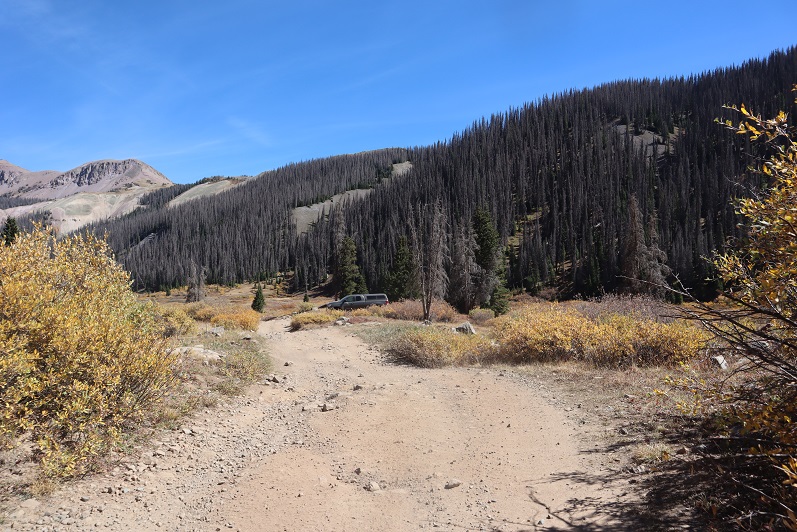
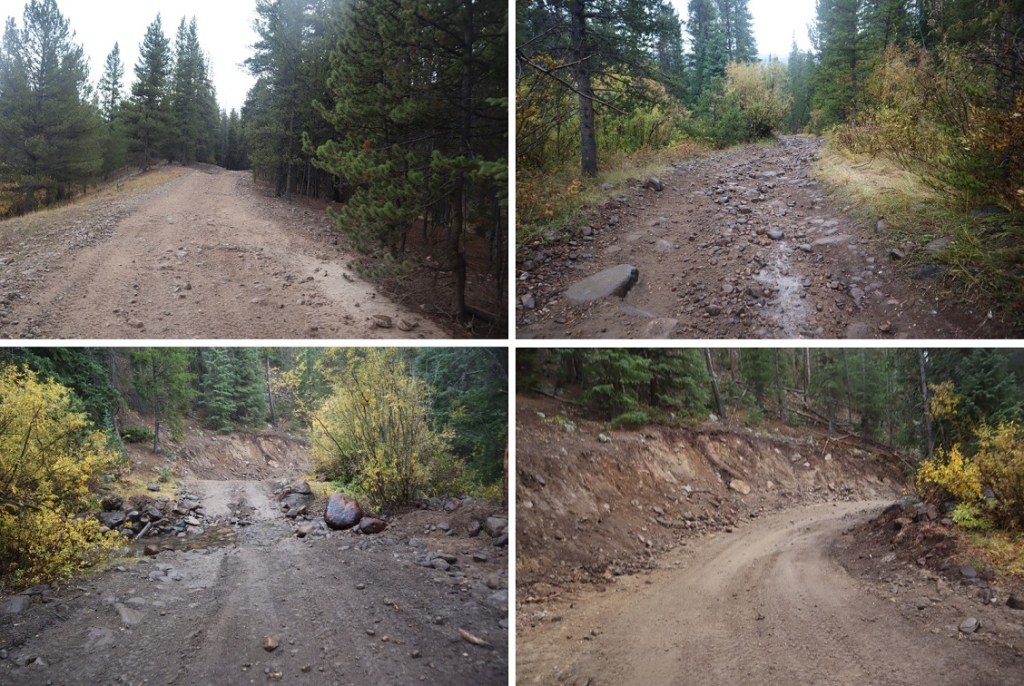
Even though it was a Saturday afternoon I didn’t pass another vehicle on the way down to the 2WD road, which was good because there were long stretches with no turnarounds/passing points.  The leaves were beautiful!  (I took this picture near the bottom once the road evened out).

Also, this is the last 4WD trailhead I need to use to get to any of the bicentennials I still need to summit!  Woot!  Just 10 left to go, and they’re all accessed via 2WD roads.  Now about that skid plate…

White Dome – 13,627, Peak One – 13,599, Peak Three – 13,478, Peak Two – 13,475

RT Length: 15.03 Miles

Elevation Gain: 6051’

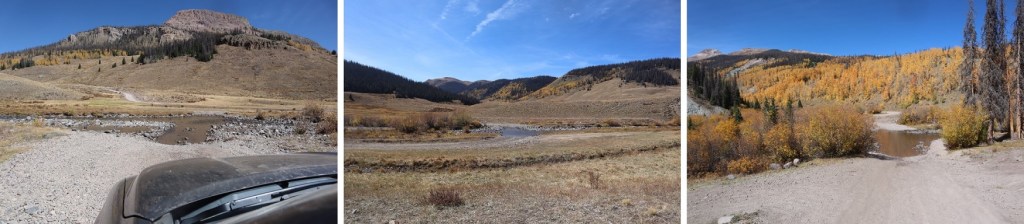
I was in this same area last week, and got a good view of the route I wanted to take to summit these peaks.  This weekend the haze from the fires obscured a lot of the photos, but I think I can still get the general description across.  I once again drove from Silverton to Beartown, but I decide to drive a little further up the road this time towards Kite Lake.  That wasn’t the best idea (the road gets worse as you drive towards Kite Lake) but my truck still made it.  She wasn’t thrilled with me, and I’ll be replacing her skid plate this week, but she made it. I drove in and out in the dark, so here are some pictures from last week’s drive.

I parked yards before the lake and was on the trail at first light: 6:30am

I realized on my way down I could have taken the trail to El Dorado Lake to gain the ridge, but that’s not what I did on my way in.  You should though.  Instead, before Kite Lake I headed south, and then southwest and followed the drainage below Hunchback Mountain to the ridge.

Once on the ridge I came across a trail, and followed it northeast

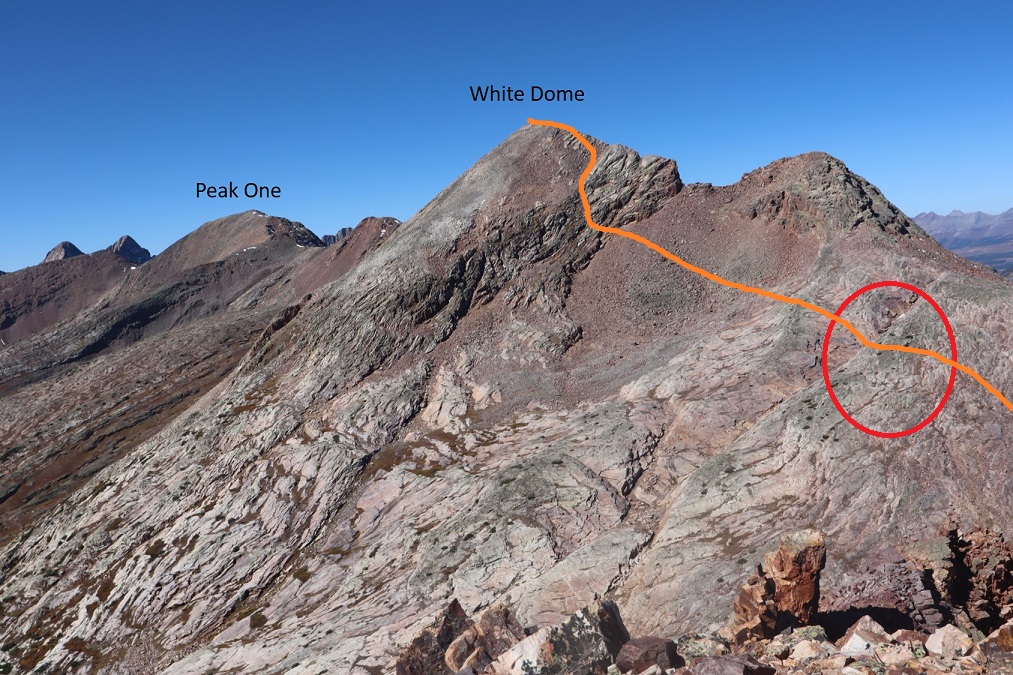
This would bring me to a rocky rib.  Here’s an overview of the route up to White Dome, with the rib circled in red (it’s deeper than it looks).  The rib drops down about 25 feet, crosses a ravine, and then gains 30 feet.  This is class 3, closely bordering on class 4, and the only time I wore my helmet the entire hike. 

Here’s looking down and up the ravine

And how I crossed

Here’s looking back on how I climbed into the ravine.  This is pretty much vertical, straight down.

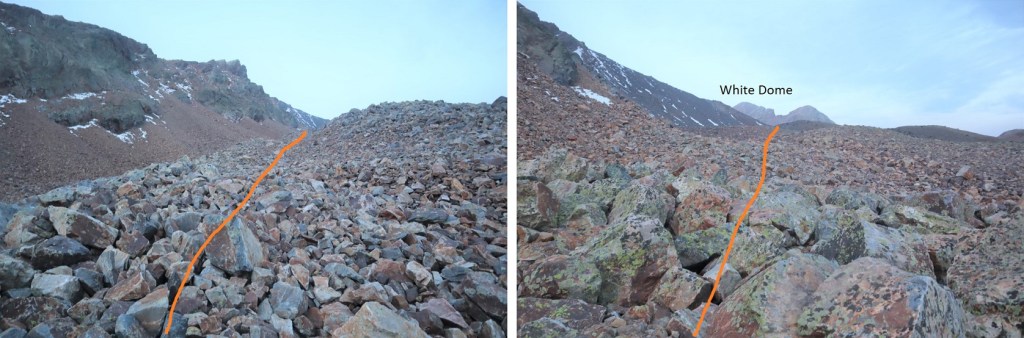
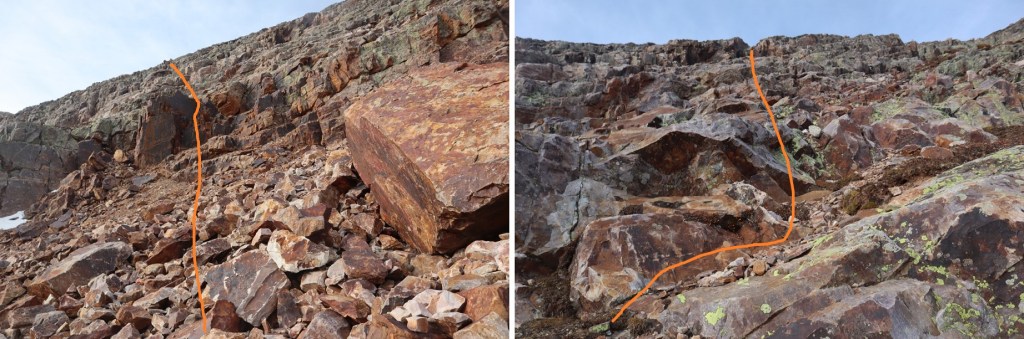
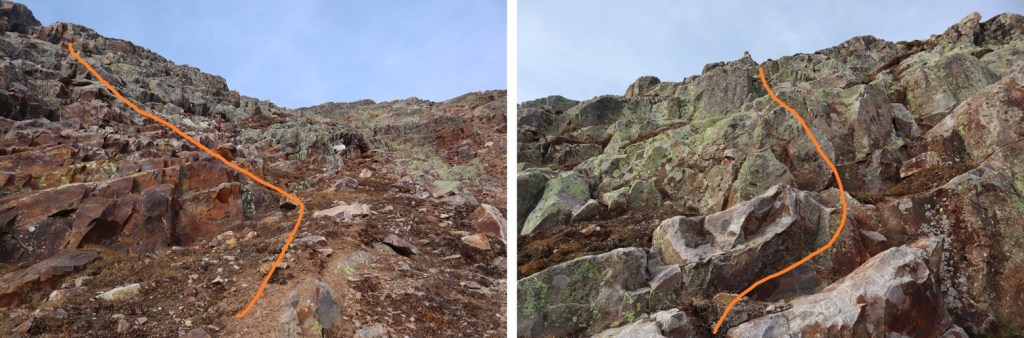
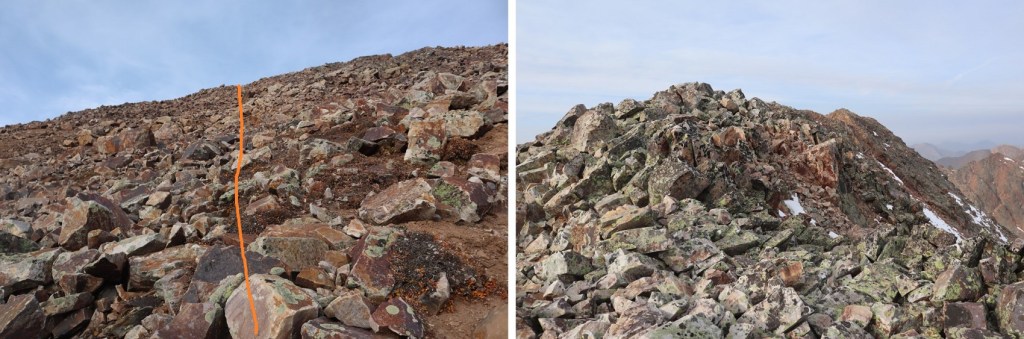
Once out of the ravine I continued southwest across some talus, aiming for another rock band.  This was easy to climb up, and there was a cairn at the top, indicating the route to take.  This is all class 2/easy class 3.  Here are some photos:

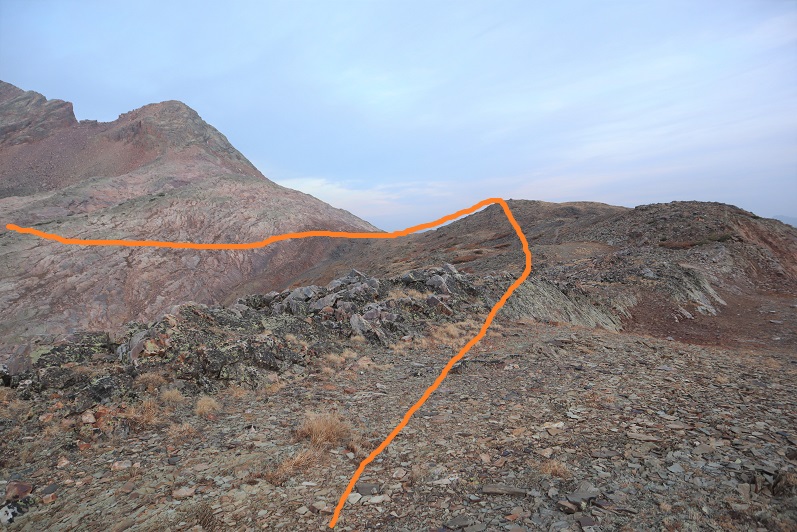
Once I gained the ridge it was an easy hike west to the summit

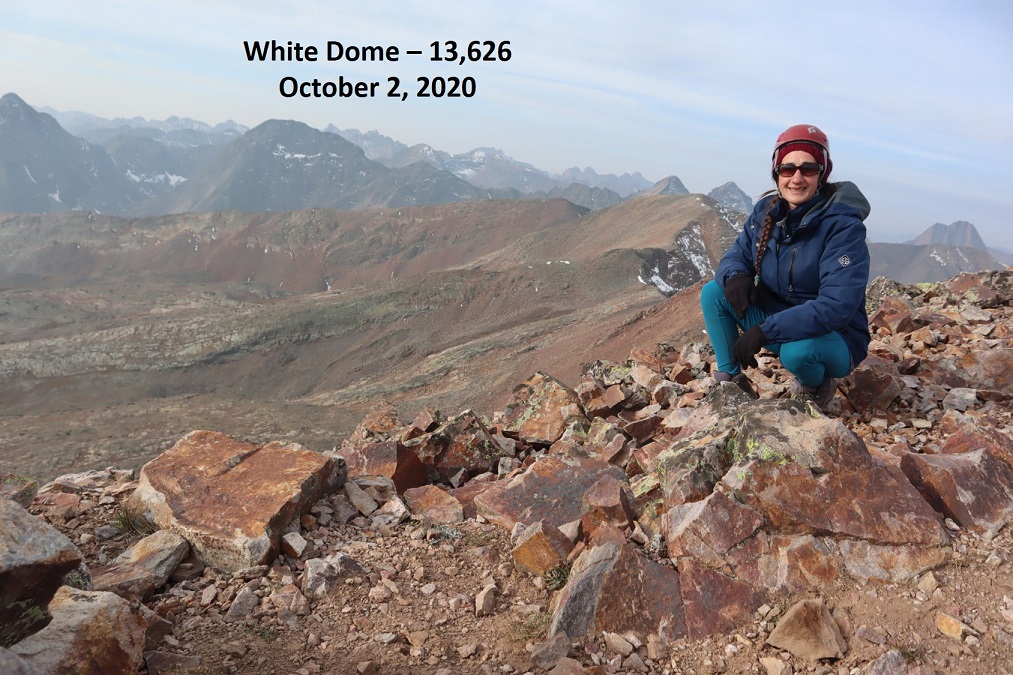
I summited White Dome at 8:45am.

White Dome: 

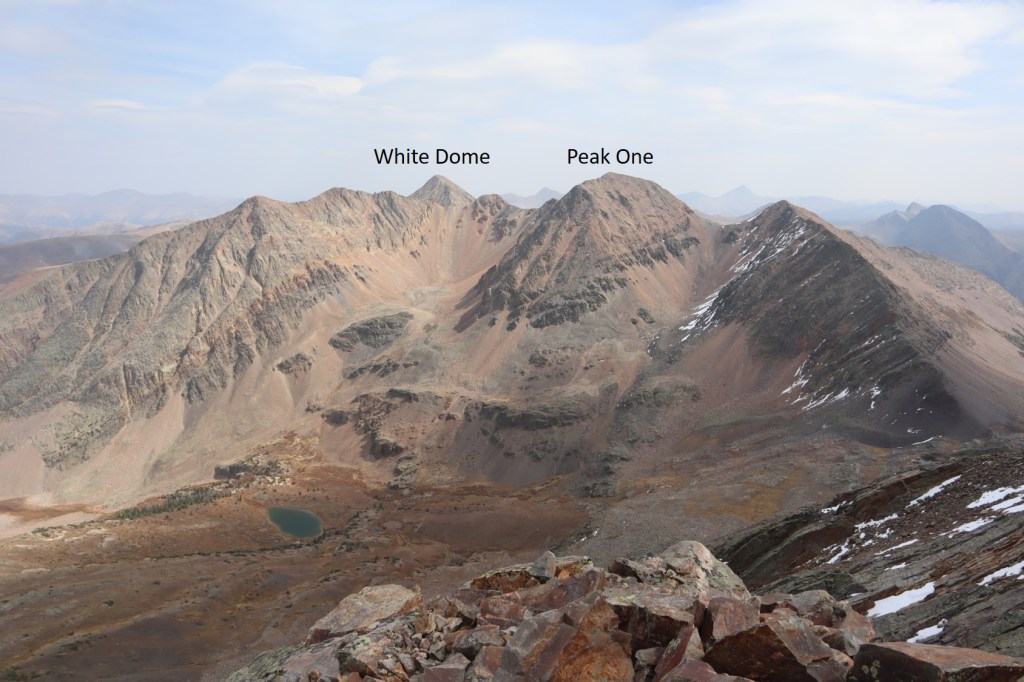
Next up was Peak One.  Here’s an overall view of the route

This was a ridge hike, with no large obstacles to summiting.  I dipped down once or twice to the right when needed, but this is all class 2

Here’s looking back at White Dome

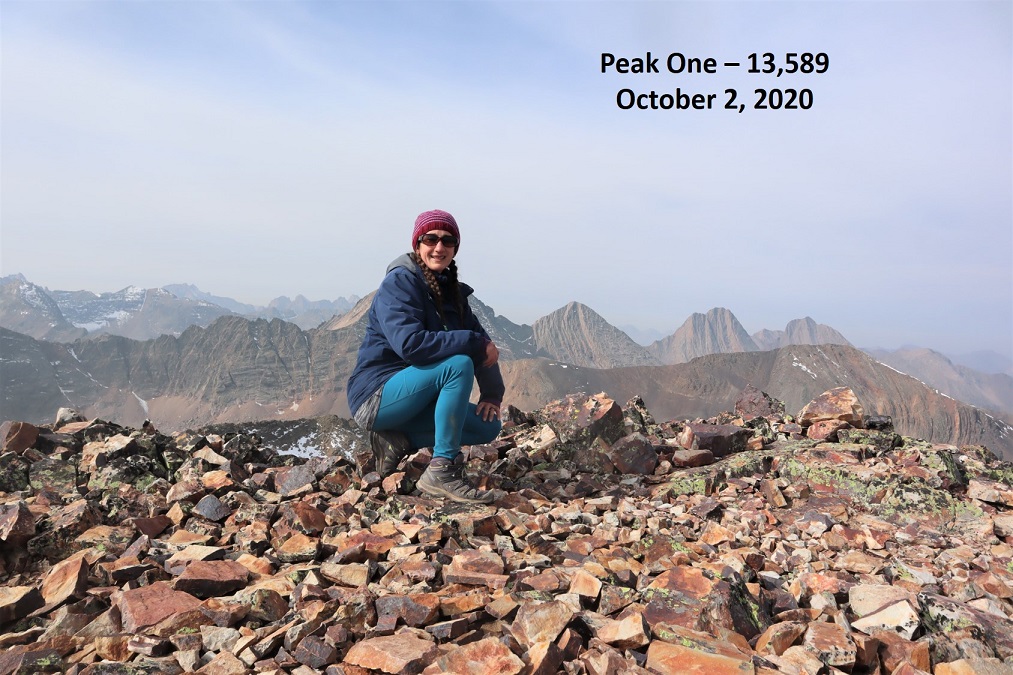
I summited Peak One at 10am.

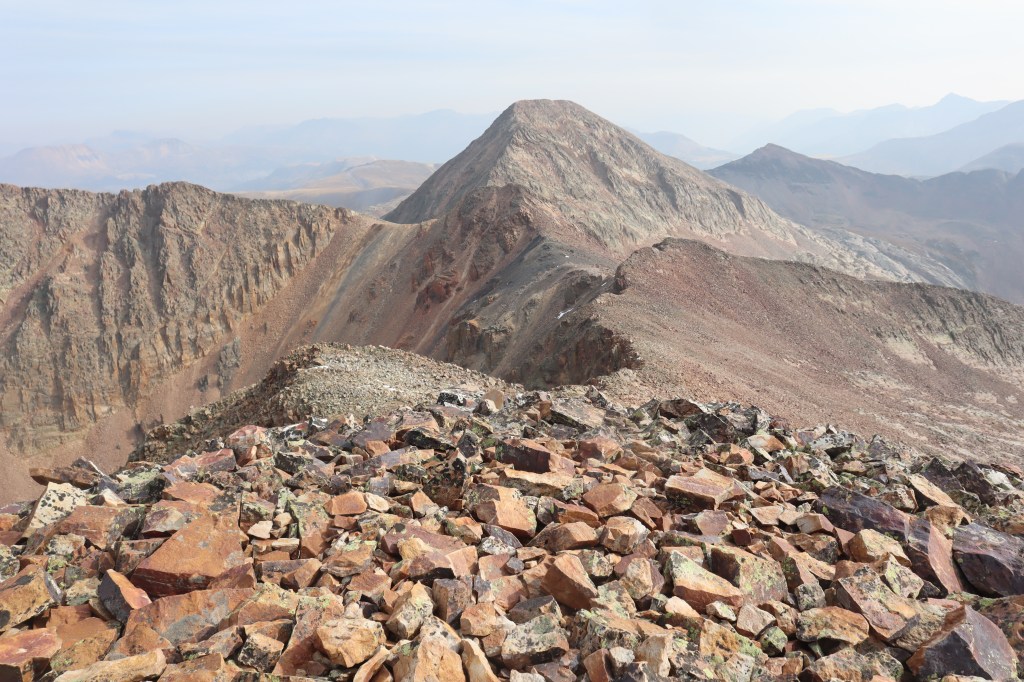
Peak One:

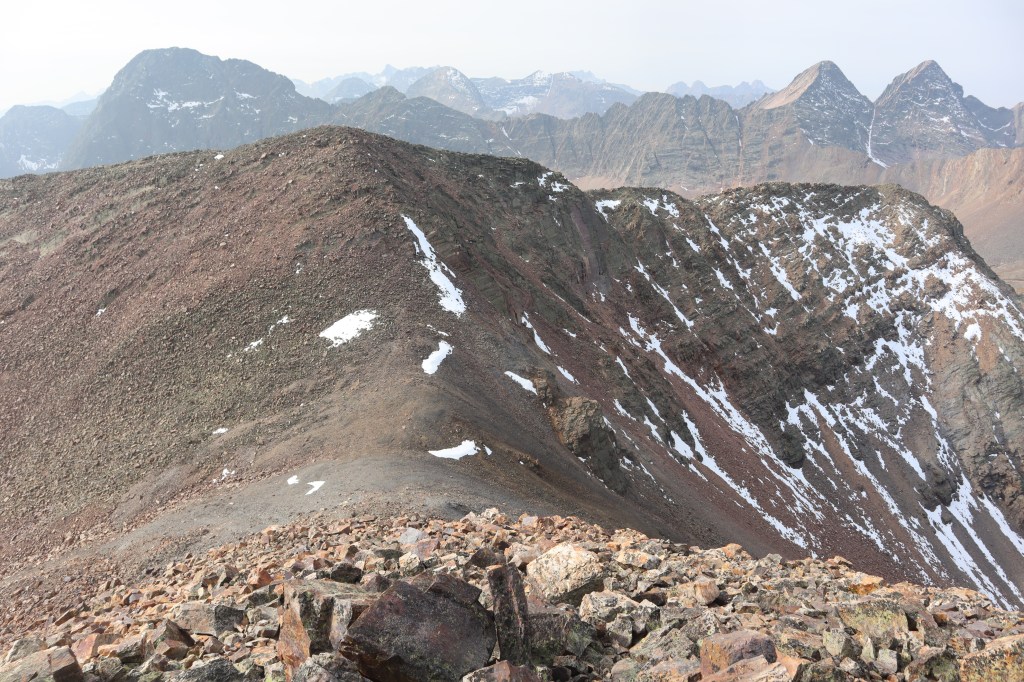
Now I had a decision to make.  I could either turn back and head for my truck now, or make this a loop.  I looked at my stats.  I’d only gone 3 miles.  Nope, not enough mileage/elevation/work to justify the drive in.  I was going to make this a loop and summit Peak 3 and Peak 2 today as well.  It would significantly raise my elevation gain (mostly on the way out) but it would mean I would need to make that 1.5-2 hour drive on a dirt road from Silverton one less time.    Here’s looking at Peak Three and Peak Two from Peak One, with my overall route there and down into the basin that would lead me out

I started by heading south and following the ridge down, losing over 900’ of elevation.  This ridge was class 2, with nothing too tricky.  I could mainly stick to the ridge, but it would be obvious if I needed to dip right or left.

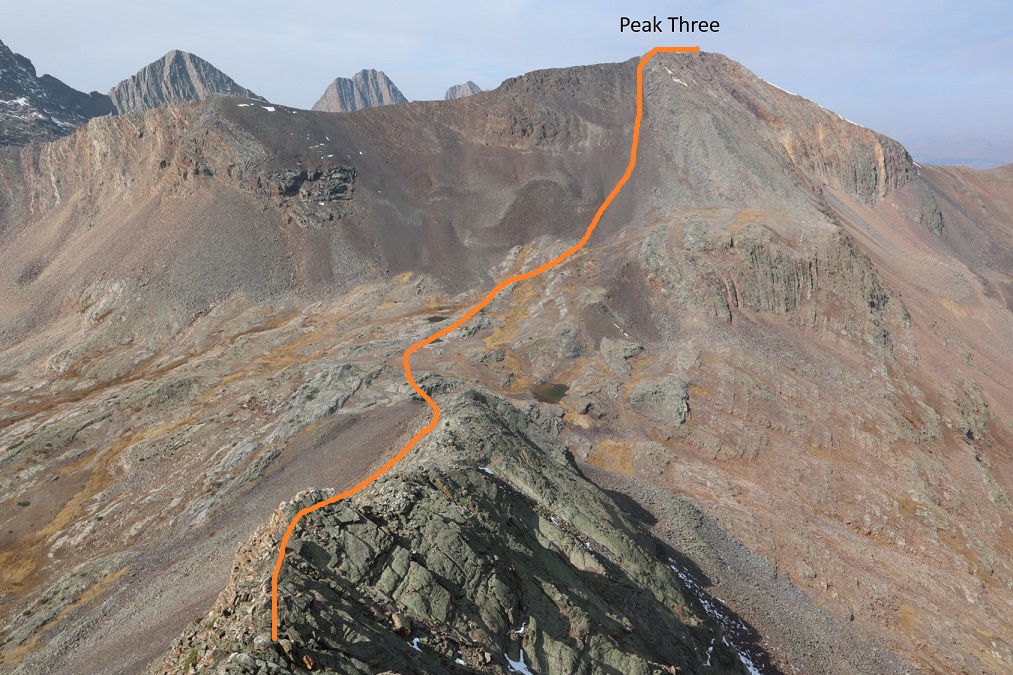
Here’s my overall route from the ridge over to Peak Three

And a look back at Peak One

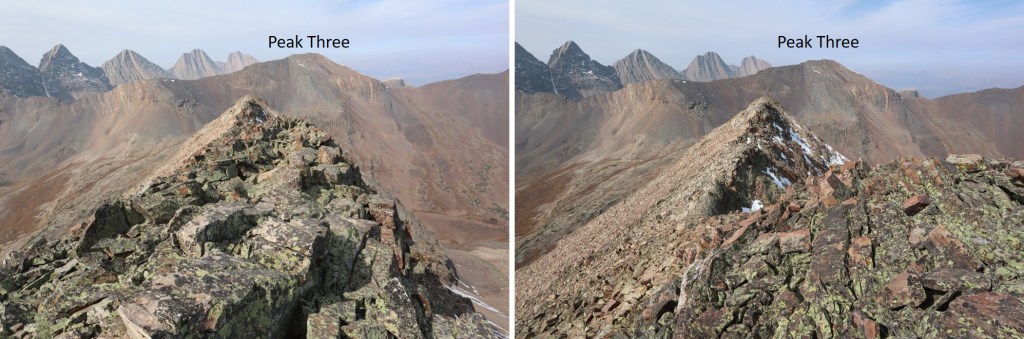
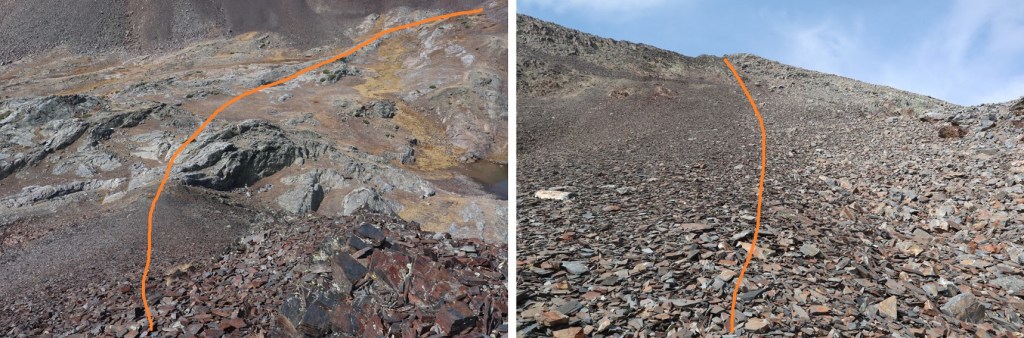
And some step by step photos of my way to Peak Three.  After losing approximately 900’ I regained another 800’ to the summit, first by taking a rock rib towards the upper basin, and then ascending using the scree filled gully.  The scree here wasn’t too bad. 

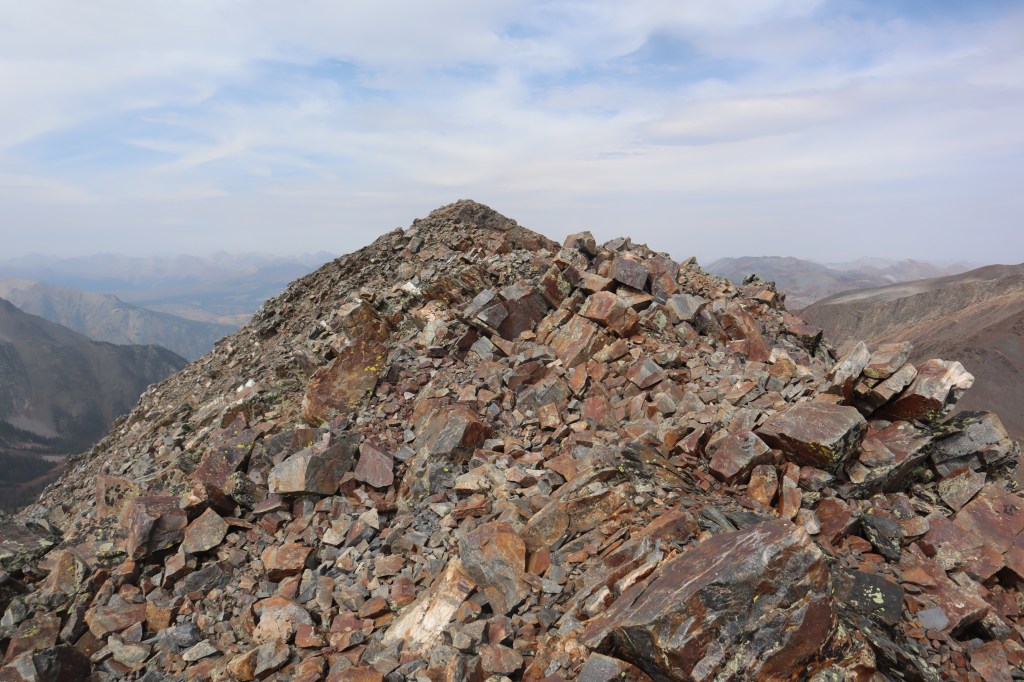
At the top of the gully it was a quick hike to the summit

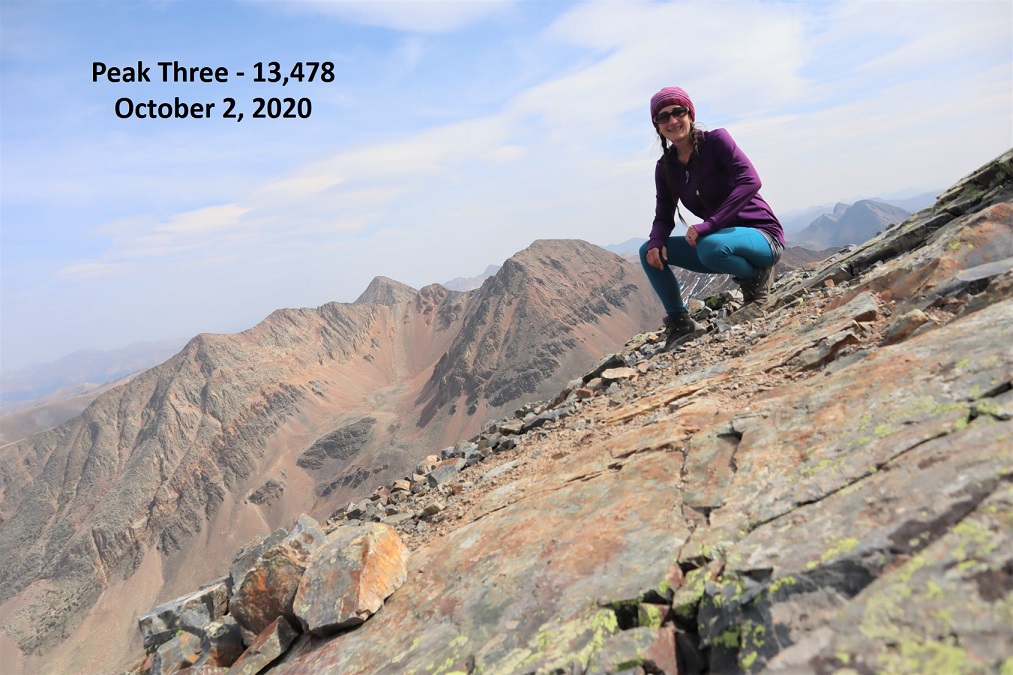
I summited Peak Three at 12:30pm.  I had a hard time getting my camera to cooperate, so we get a unique summit photo this time

Peak Three:

There were some pretty awesome views of the Trinities, and Wham Ridge looked dry (I didn’t get a clear picture of Vestal Peak however, sorry!)

And here’s looking back at White Dome and Peak One

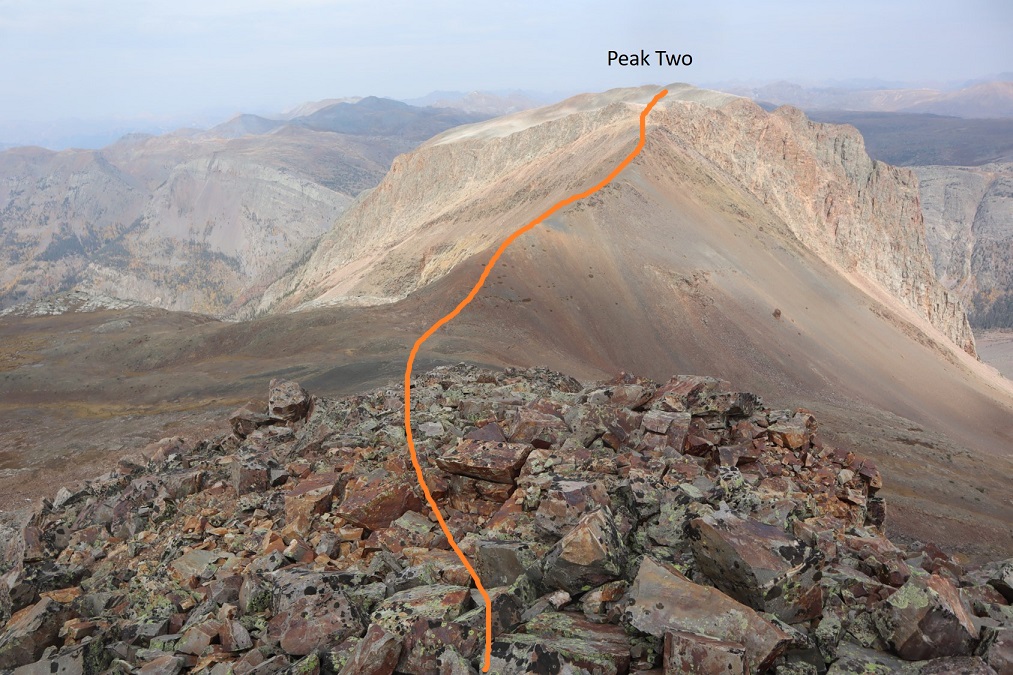
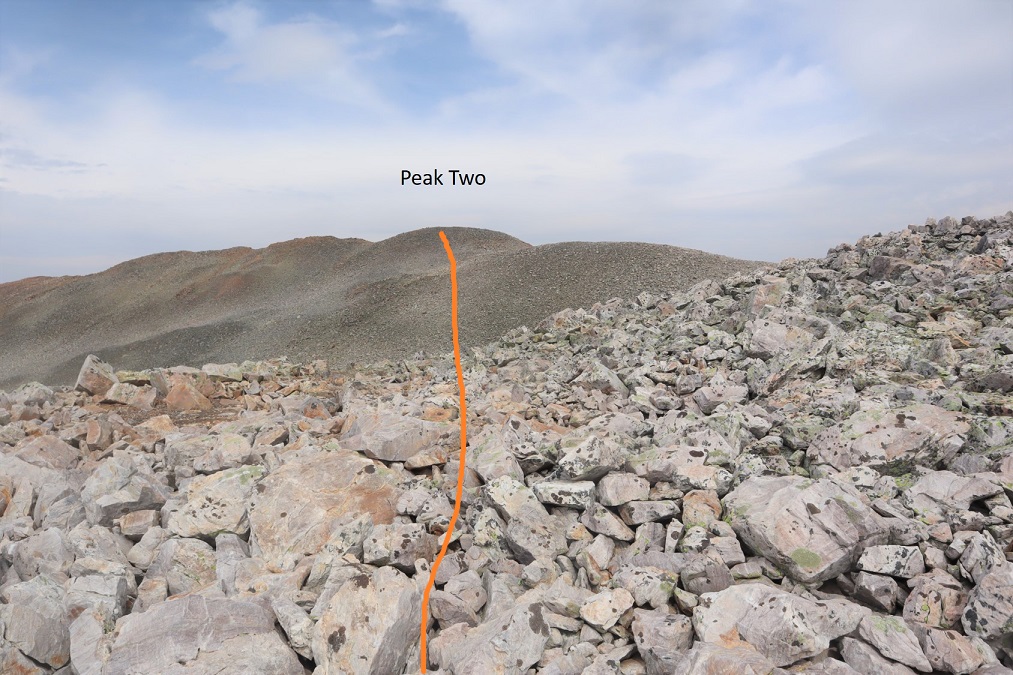
Now on to Peak Two.  Here’s the overall route

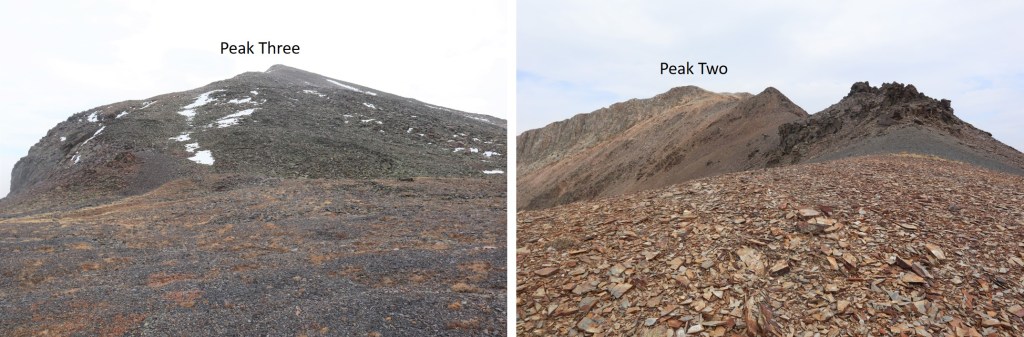
This is an easy ridge hike.  I started out heading north and just followed the ridge.  Here are some highlights.  From the saddle, looking back up at Peak Three and Peak Two

There’s actually a trail here that skirts the ridge to the left

Then it’s straight up this point to a false summit

And a quick dip and rocky trek to the summit

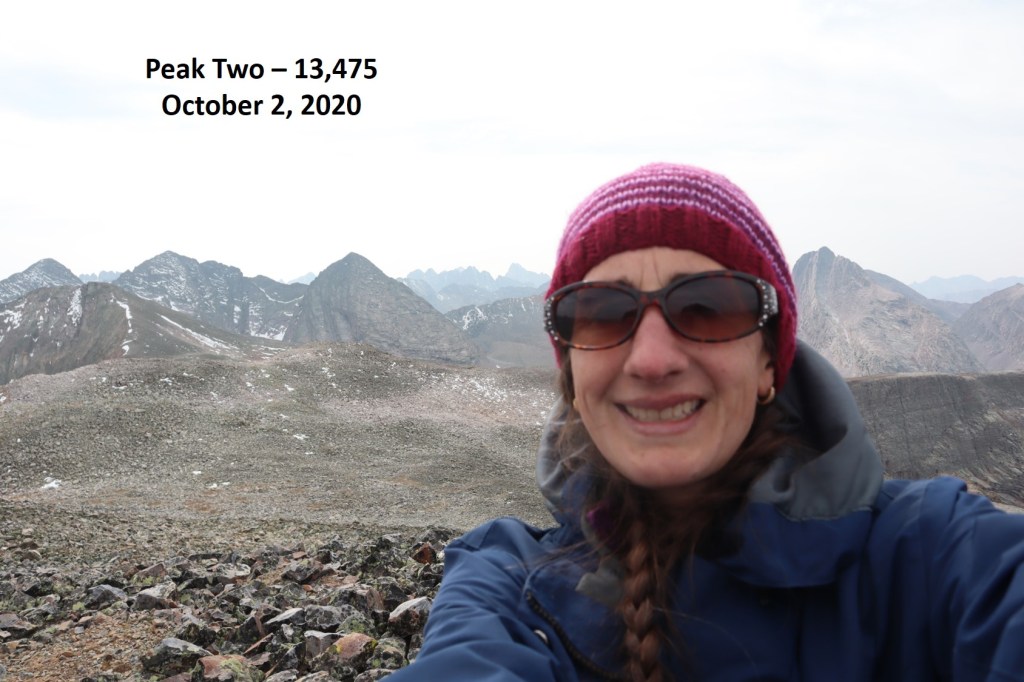
I summited Peak Two at 1:50pm.  Something was wrong with my camera.  I couldn’t set up the timer for a photo, so I just took a selfie, which ended up being unfocused.  I also couldn’t use any of the buttons, the visual playback didn’t work, and I wasn’t entirely sure the camera was taking a photo (even though I heard a click).  Oh well, I guess it’s time for a new camera.  I’ve never liked this one anyway….

Peak Two:

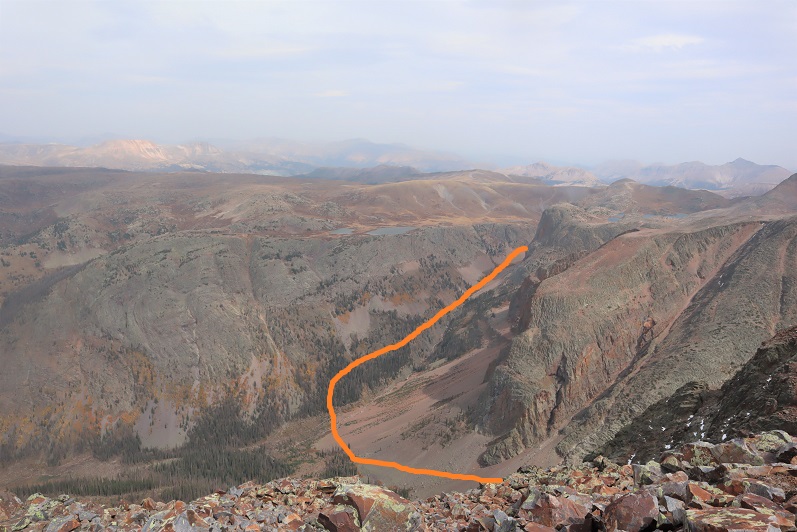
I looked to the northeast, and could see my intended exit route.  I planned to hike back down to the basin and catch up with the Colorado Trail.

That first required me to head back the way I’d come to the Peak Two/Peak Three saddle

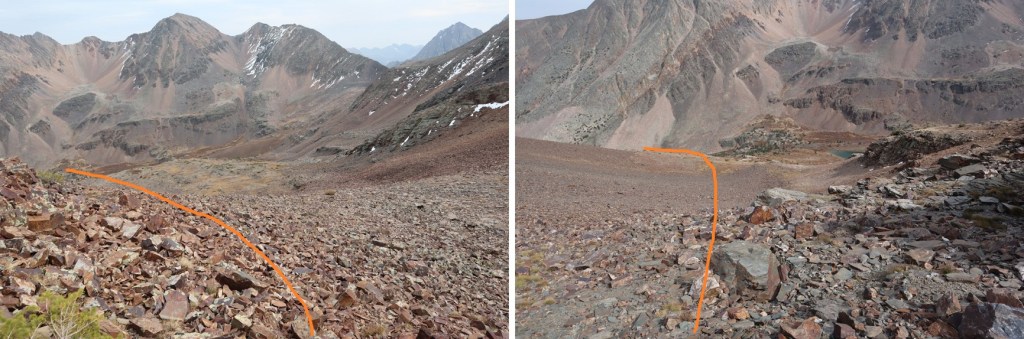
At the saddle I turned left and headed east and then north out of the basin

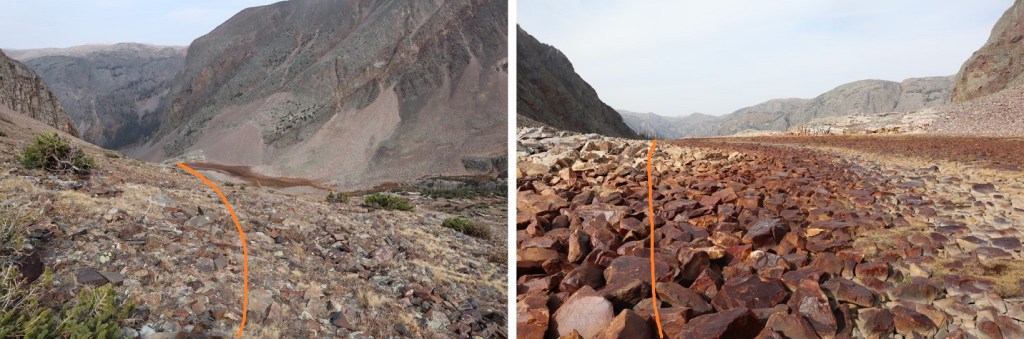
As you’re exiting, you’ll want to stay left to avoid a smooth rock waterfall

After the waterfall, aim for the trees, pass them to the right, and you’ll be able to see where the Colorado Trail picks up below

This is where I slipped on a rock the size of a microwave that decided to roll as I was using it for balance.  I didn’t hurt myself, but I did bang up my camera, and when I went to take another picture all the buttons were functioning again (which was nice, but I’m still investing in another camera).  Also, I need new shoes with better traction (this has nothing to do with the rock rolling, I just need new hiking boots).  After this I followed the Colorado Trail east for 3.5 miles, gaining about 2100’ of elevation on a class 1 trail

The last bit was especially fun, as it involved dozens of switchbacks (sarcasm)

At the top of the hill I turned right and followed the trail south until I hooked up with the El Dorado Lake Trail, and took that east to Kite Lake and my truck

I made it back to my truck at 1:50pm, making this a 15.03 mile hike with 6051’ of elevation gain in just under 12 hours. 

On to the next trailhead! 

Clark Peak – 13,579

RT Length: 25.36 Miles

Elevation Gain:  6619’

This was my second attempt of Clark Peak.  On the first attempt I’d been unaware there was a creek crossing, and the creek looked too high for me to safely cross in the dark.  A storm was coming in later in the day, so waiting for daylight hadn’t been an option.  I’d turned around and done another peak instead.  This time I was prepared (or so I thought) for the creek crossing.  Also, please don’t make the same mistake I did crossing the creek…

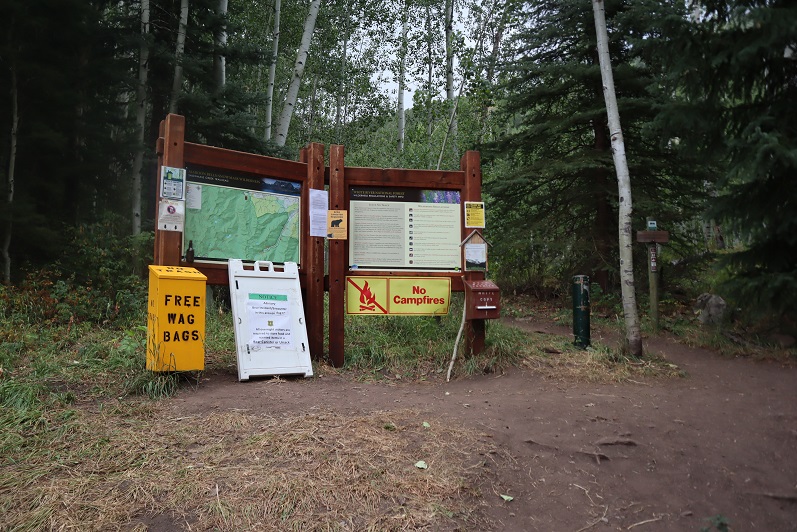
I drove to the trailhead the night before and got a few hours sleep before staring on the trail at 5:45am.  The trailhead has space for about 20 vehicles, and good signage

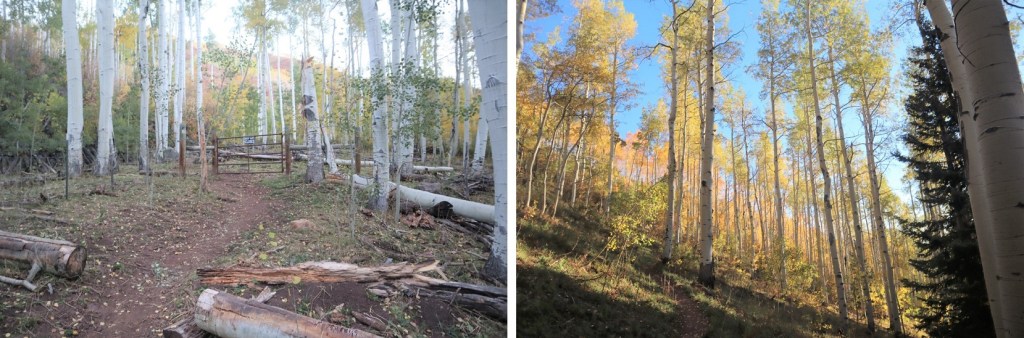
I started off following the Maroon Snowmass Trail south, and then southwest.  I went through two unlocked gates

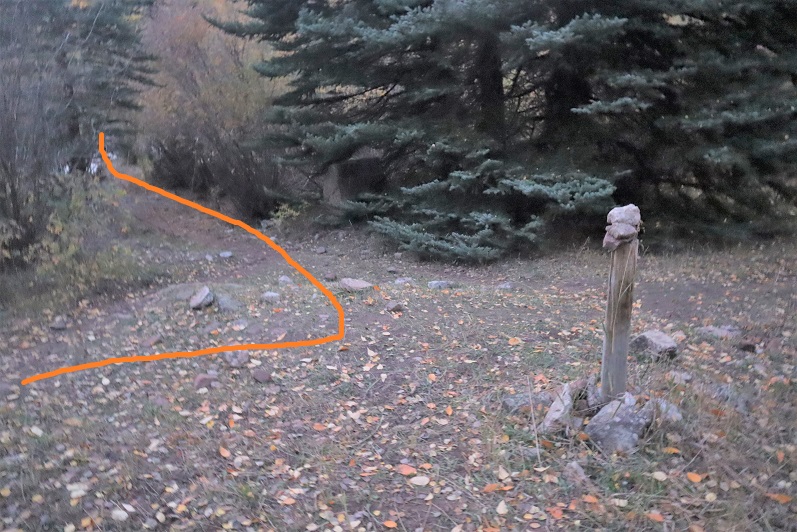
And shortly after the second gate there’s an unmarked side trail that leads down to cross Snowmass Creek. However, after my last failed attempt I’d done more research, and was told I’d gone too far last time and to look for an easier crossing earlier.  So I did.  I ended up crossing the creek and then running into Beaver Ponds about 20 yards long.  I was able to gingerly cross them, stepping through a thin layer of ice while doing so.  I picked up a faint trail on the other side, which brought me to the actual trail, where I noticed last time I’d indeed been in the correct area.  Hmph.  So I’d done all that wading in cold water for nothing.  Here is where you should cross:

Doing so will bring you to the West Snowmass Creek Trail.  A well-defined, class 1 trail.

The trees were absolutely beautiful!  It was still early morning, so these pictures aren’t the greatest, but the trees had me daydreaming.

This is where I made my second mistake of the morning:  I missed the cutoff.  The cutoff comes after hiking for just over 4.5 miles.  It’s an obvious junction you can see if you’re not looking up at the trees. And cows (there were cows in the meadow). I ended up hiking quite a ways past this junction, just following the trail.  It wasn’t until I realized I was switchbacking and I wasn’t supposed to be that I noticed my mistake.  This mistake cost me well over a mile and added about 1000’ of elevation to the hike.  Here’s where you turn left

After hiking a few dozen yards south the trail abruptly ends.  When it ends, turn right and head west towards the hillside.  A trail will pick on the hillside.

Here’s where I made my third (and final) mistake of the morning:  When you see the path split in two, take the higher one (the lower one is a cow trail that leads you through gooey mud then ends).

From this point on the trail becomes faint.  At times I questioned whether I was on an actual trail at all.  It will parallel West Snowmass Creek, and stay high.  Here are some photos:

I came to a clearing and headed southeast, crossed West Snowmass Creek, and once again picked up a trail.

I took this trail to treeline, where it ended. I put pink surveyor’s tape on a tree so I’d know where the trail picked up on my way back.   

From here the rest of the hike was full of rocks and boulders.  I headed southwest

I lost a little bit of elevation before gaining it again

Rock-hopped up this drainage

Followed the creek for a bit until it ended

Ascended another drainage and at the top turned left to skirt Moon Lake

This basin never seems to end!  I just kept heading southwest

At the end of the basin it was time to gain the ridge.  I stayed right of the drainage. 

This was mostly class 2, but towards the end became class 3 to avoid the snow

Once I gained the ridge I turned left and followed it to the summit.

Ha!  That’s an oversimplification.  I did indeed follow the ridge. The ridge proper goes all the way to the summit.  However, it’s a fun scramble to get there, with a lot of exposure, and more than one knife edge.  If you did Capitol Peak and it left you wanting more, this is the peak for you!  Here are some highlights:

I summited Clark Peak at 2:25pm

Clark Peak:

There were some great views of Snowmass and Capitol Peak, and check out the ridge looking back!

Here’s looking back on the way in through the basin and around Moon Lake

Here are some pictures of the ridge on the way back.  I had fun with the exposure here

At the saddle I turned right and headed back through the basin

Skirting Moon Lake to the east and back to the trees

Next profile pic?

Once at treeline I picked up the trail again.  After crossing West Snowmass Creek I headed for the trees.  The trail picks up again in-between these two trees

Here are some pictures of the trail back down.  As I was hiking, I heard a faint bugle.  It didn’t sound like a normal elk call:  it sounded close but faint.  Usually when I hear an elk bugling it resonates, it’s crisp, and I can hear it from far away.  This didn’t seem loud enough for being so close. As I reached the meadow I noticed a hunter sitting beneath a tree.  I raised my hand to silently say hi, he did the same, and I continued back to the trail.

I kept picking up my pace.  Due to this morning’s route finding errors this hike was taking me much longer than I’d anticipated.  It was quickly getting dark, and I wanted to get back to cell service so I could call my daughter and tell her I was ok, just running late.  I ended up using a flashlight for the last two miles of the hike.  Here are some pictures from the rest of the way back to the creek.

I crossed the creek and took Maroon Snowmass Trail back to the trailhead

I made it back to my truck at 8pm, making this a 25.26 mile hike with 6619’ of elevation gain in just over 14 hours.

Storm King Peak – 13753, Peak Seven – 13682, Peak Nine – 13404, Mt Silex – 13636, The Guardian – 13,624, Hunchback Mountain – 13,136

RT Length: 39.49 Miles

Elevation Gain: 11,981’

Day 1:  Approach, Storm King Peak, Peak 7, Peak 9

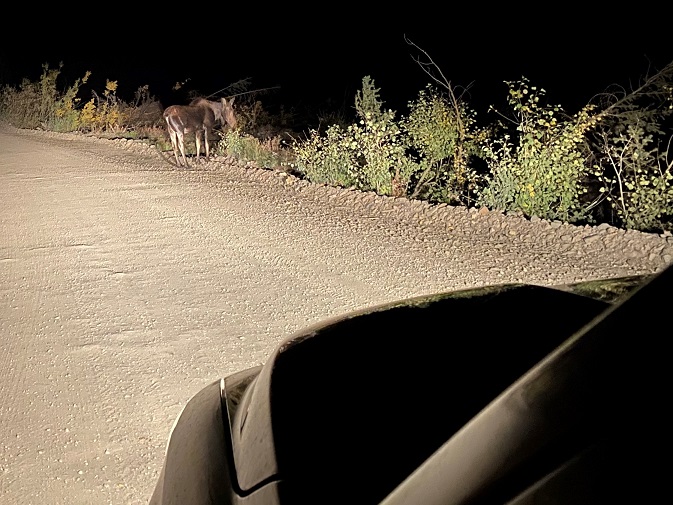
I’ve put off these peaks because I was a bit anxious about the drive in from Silverton, but the weather was perfect and they’re on my list, so off I went.  After a Girl Scout meeting where we sewed masks (I have a girl working on her Gold Award who did an awesome job leading the meeting), I drove 8 hours to the Hunchback Pass trailhead.  Along the way I saw a moose.  And let me tell you, this is why they don’t call it “moose in the headlights”:  they really don’t care. I sat there for a bit watching her, and then just drove by.  She munched on willows as I passed.

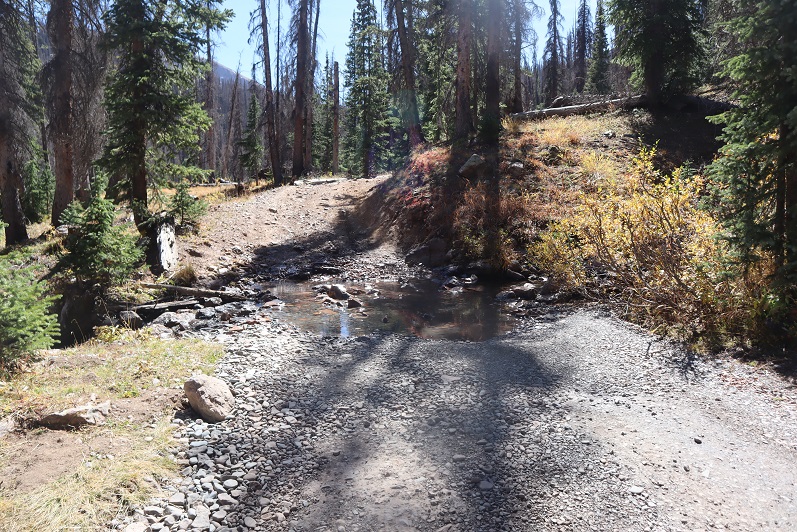
The drive in on the dirt road was underwhelming.  I have no idea what I’d been worried about?  It took me an hour and a half, and was actually quite pleasant.  These pictures are from the way out, but it was just as easy to drive both ways.  I never had difficulty passing others, and 4WD was only needed once or twice.  This is actually one of the better 4WD roads I’ve done this year, and if weather permits, I’ll be back again next week. Here are some pictures from the drive in

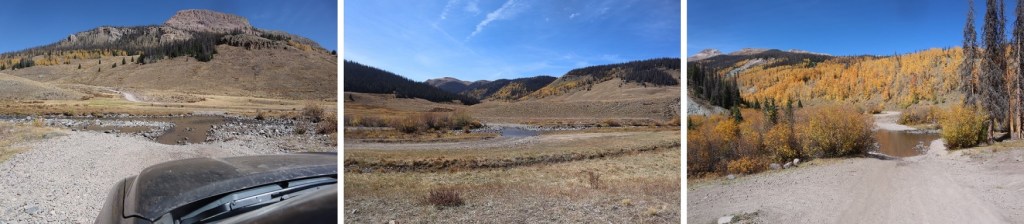
And the Rio Grande river crossings (easy in late September)

I found a place to park much sooner than I needed to. I’m not sure why I stopped here except it was dark and I was tired and it was a good spot, but I could have continued driving another mile to the trailhead and been fine.  I parked, slept for half an hour (I’d been up for 24+ hours, and needed the rest) and was on my way at 5:30am. 

Since I’d parked along the road I followed the 4WD road for 1.3 miles before turning left onto Trail 813.  There was room for 2 vehicles to park at the trailhead.  There’s a trail register here, but nothing official. 

I followed the class 1 trail as it curved up and over and then down hunchback pass.  As I was hiking the sun rose, and I got a good look at Hunchback Mountain.  I didn’t have a topo for it, but it looked doable.  I’d file that one away and maybe attempt it on the way out.

From the top of Hunchback Pass I hiked for 3.4 miles and lost almost 2000’ of elevation as I followed the class 1 trail down the mountain, crossing small creeks and navigating through willows.

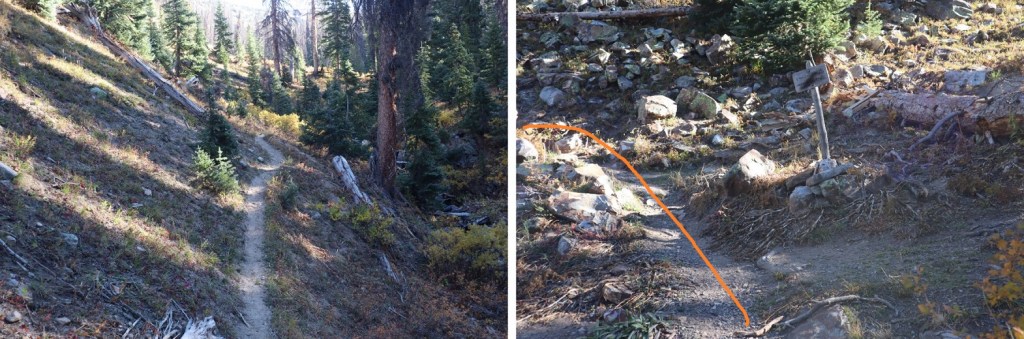
Stay straight at this sign/junction

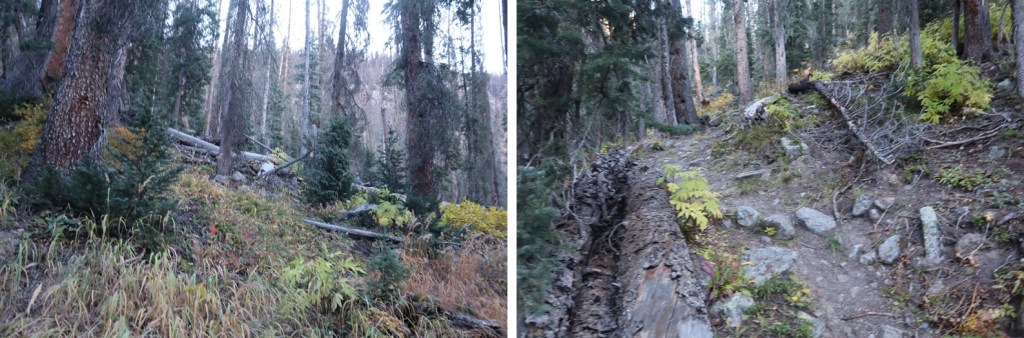
I missed the initial turnoff and had to do some route finding (because there is no official turnoff).  However, after hiking for 3.4 miles there are some logs on the right side of the trail, split in half, and a waterfall. There are waterfalls all along this trail, so don’t just look for a waterfall, but look for the split logs.  Leave the trail here and head west.

From here you’ll quickly come to an easy creek to cross and a waterfall.  This is Nebo Creek.  You can camp here, and it’s worth spending a little time enjoying the area.

There is no clear trail here, but there is a bit of a game trail.  Several in fact.  They all go to the same place, so follow stormy creek by heading west, stay north of the creek for better terrain.  Here are some pictures.

I headed west for just under 2 miles.  I believe the standard way to enter the basin as it leads to Lake Silex is to use the obvious scree/rock filled gully (dotted line).  I didn’t do this, and I’m glad I didn’t (I did take it down and was disappointed, as it seemed more trouble than the way I took up).  Instead, I went further west, found a different, smaller gully by the rock/grass/willow filled slopes, and ascended that way.  Here’s an overview

And step by step

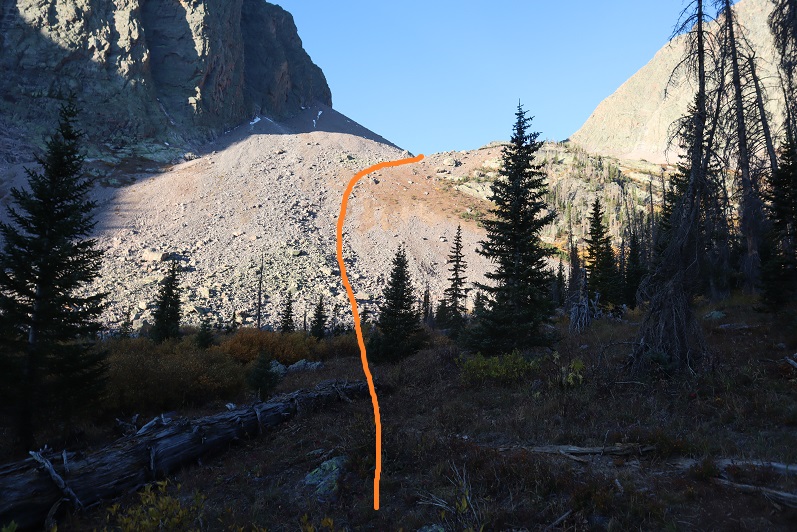
I was able to follow game trails the entire way, and even saw some cairns in areas.  At 11500’ I turned left and headed south, then southwest up the side of the mountain, aiming for this narrow gully. 

Here’s looking up into the gully, and back down from the top.  The rocks here were solid and it was an easy climb

From the top of the gully I still had a ways to go.  I headed south, and then west, curving high along the side of the mountain. I wasn’t headed to Lake Silex today, but instead to the pass, so staying high was helpful. 

After rounding Lake Silex I headed up the rocky gully to the pass at 12800’

It took me 10 miles to make it to the pass.  I took off my gear and took a break.  I ate a packet of tuna (I’d forgotten to eat breakfast) and decided to leave my large pack here and just take some water and a first aid kit in my small pack for the rest of the day.  Before I left, I filled my water filter up with snow and laid it out in the sun, hoping it would melt so I could filter it later.

First up:  Storm King Peak.  Here’s a view of the overall route from further down the pass below later in the day.

And a view from the pass

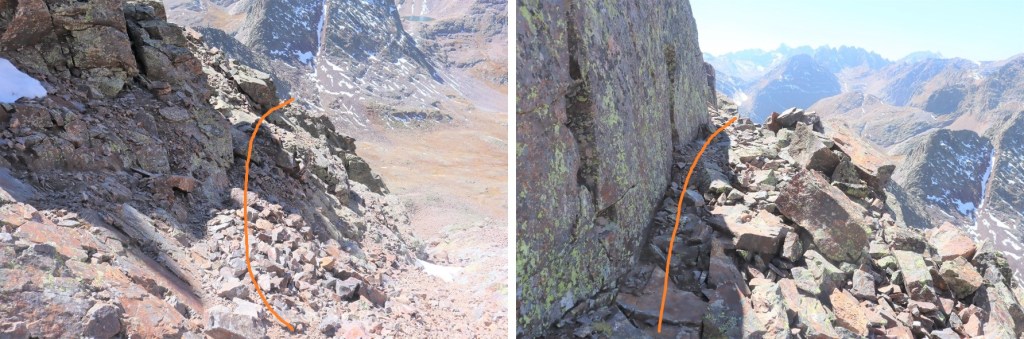
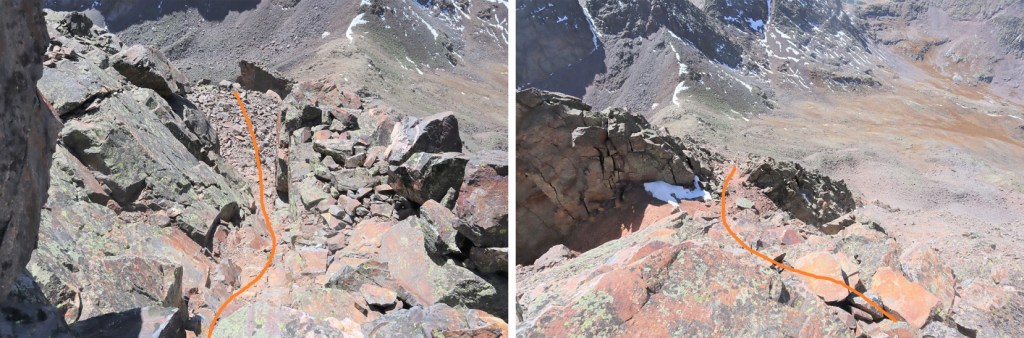
I did some scrambling, following the ridge north east.  There really is no established route here, just pick your line.  It shouldn’t be harder than class 3

At 13430’ there’ll be a small dip, and an obvious place to cross the gully

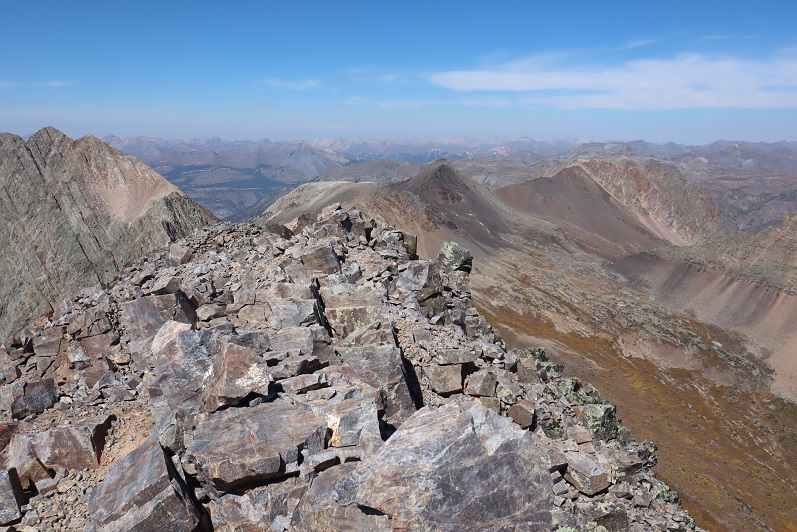
After crossing the gully, I headed north along the ridge. The peak is just to the left

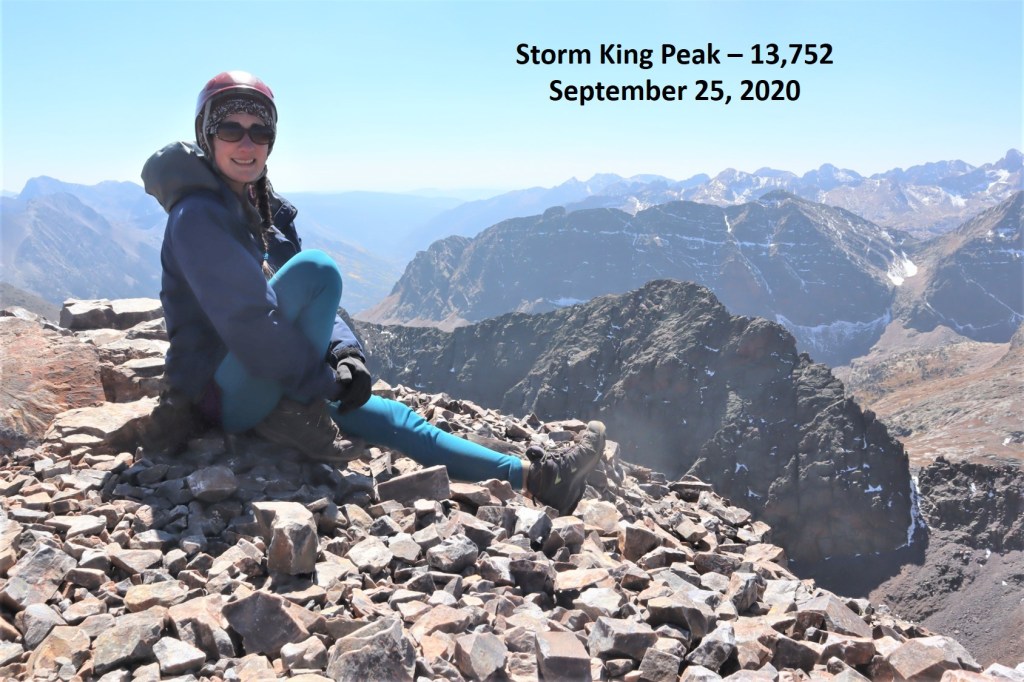
I summited Storm King Peak at 12:25am

Storm King Peak:

Here’s the route back down to the pass

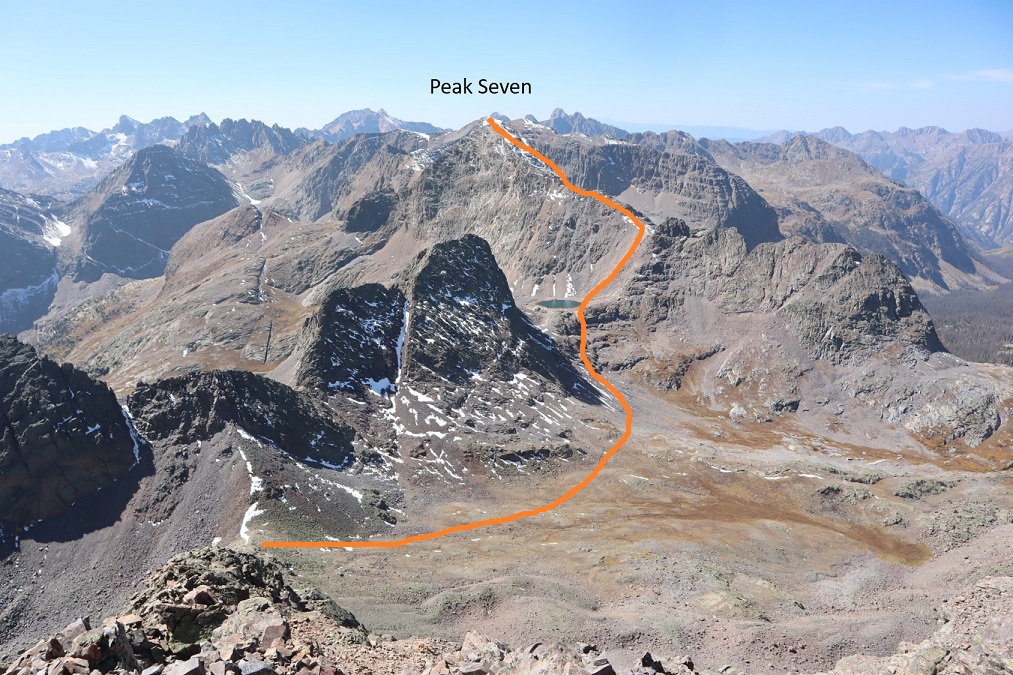
From the pass my next objective was Peak Seven.  I headed west, losing about 300’ as I descended into the basin, and then headed back up towards Peak Seven.  Here’s an overall look at the route

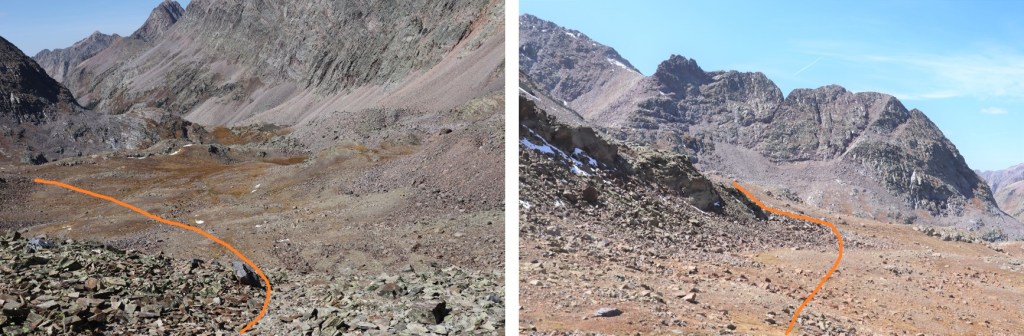
This was pretty straightforward.  Here are some step by step photos.  First, I entered the basin and then rounded the side of Peak 8

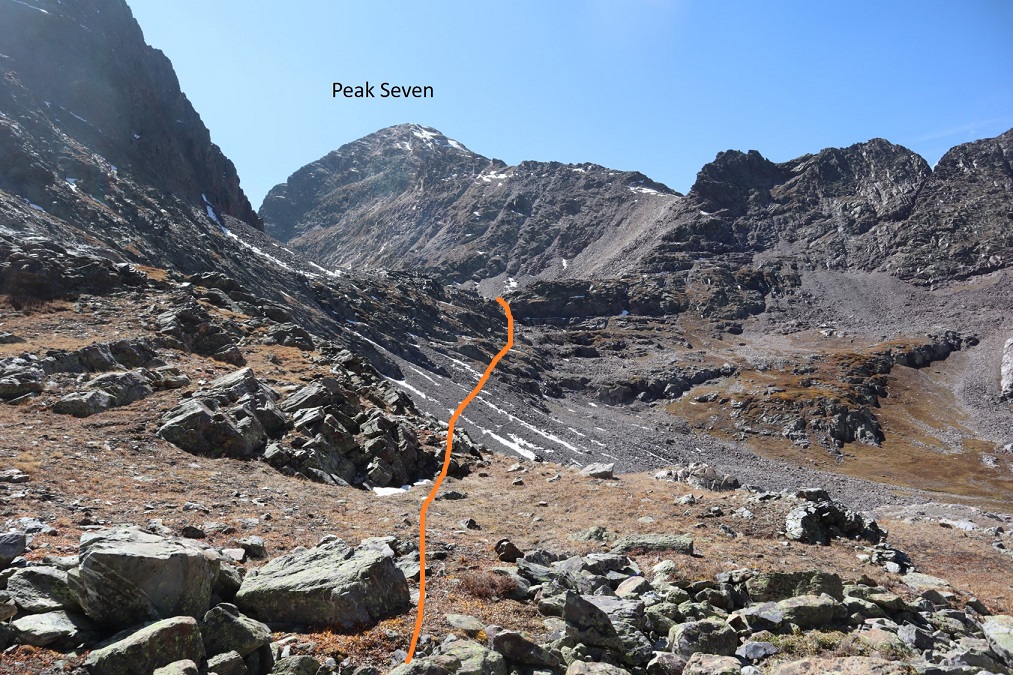
There were a few game trails here.  I stuck high, and then aimed for a gully that would bring me to the pond underneath Peak Seven

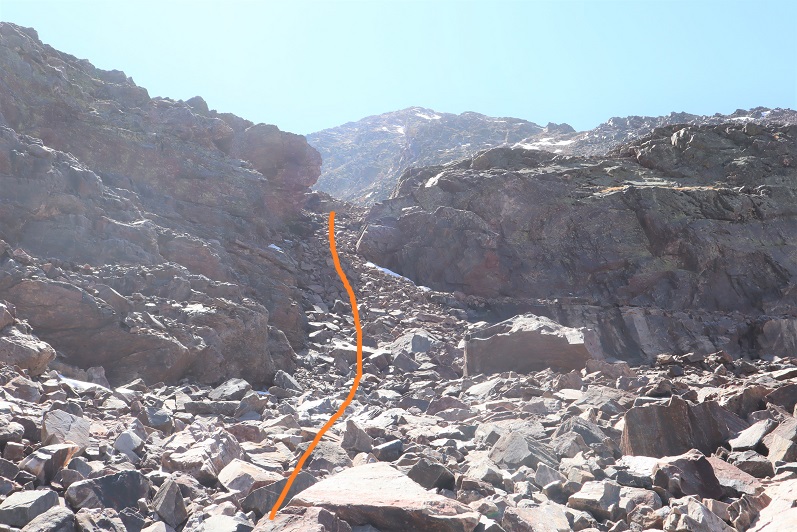
From the pond I turned right and headed west up the gully

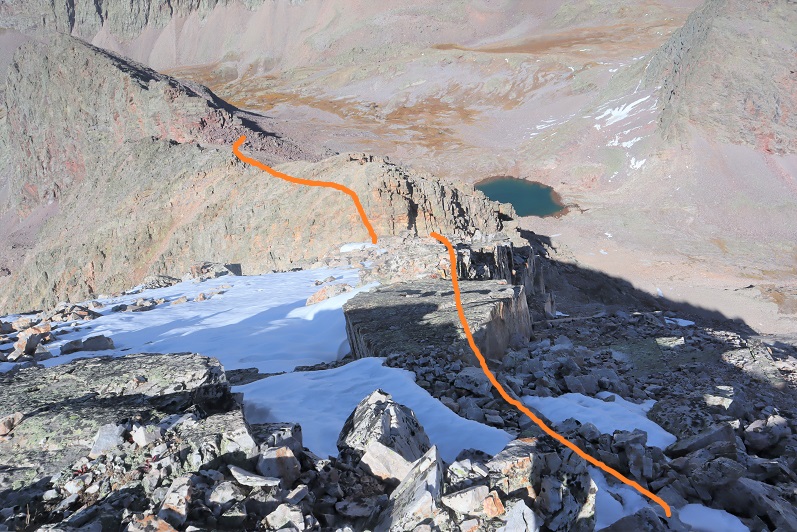
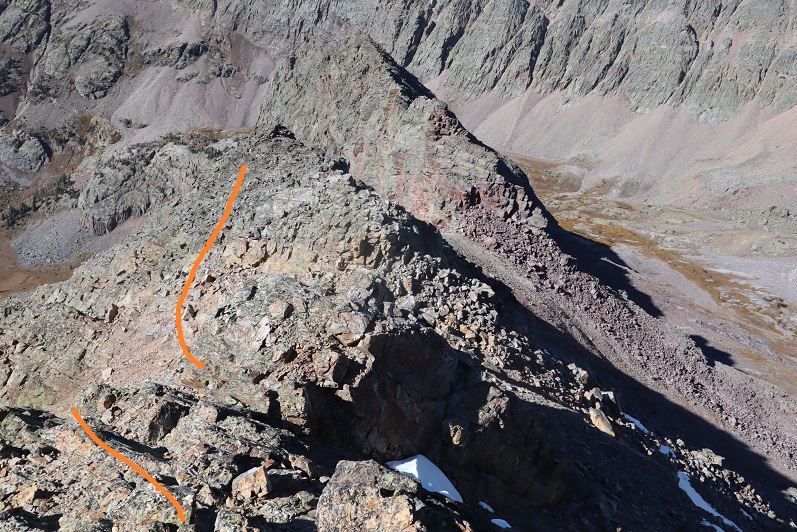
Once I’d gained the ridge I headed south.  There was some scrambling here, and due to the fact there was snow on the normal route I had to get a bit creative.  Instead of going up the face I stuck to the left and avoided the snow, and had some fun class 3/exposed scrambling instead.  Here’s the basic route

There was a nice, airy game trail that led me to some rock slabs, which I used to ascend

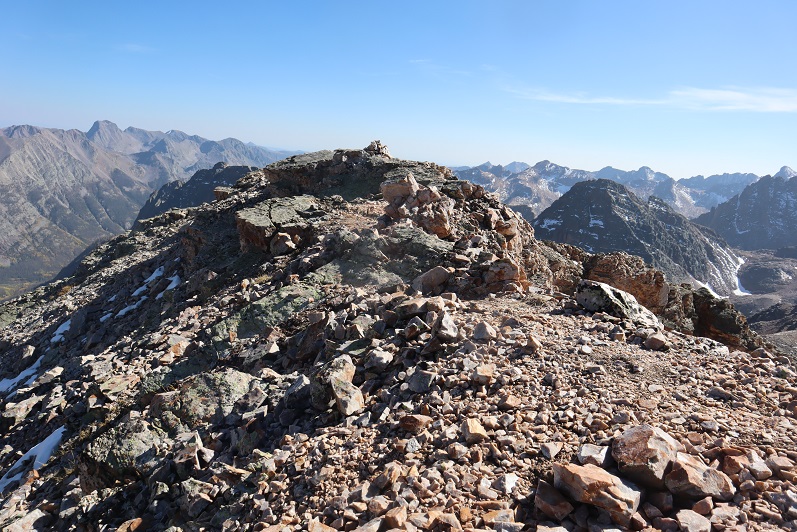
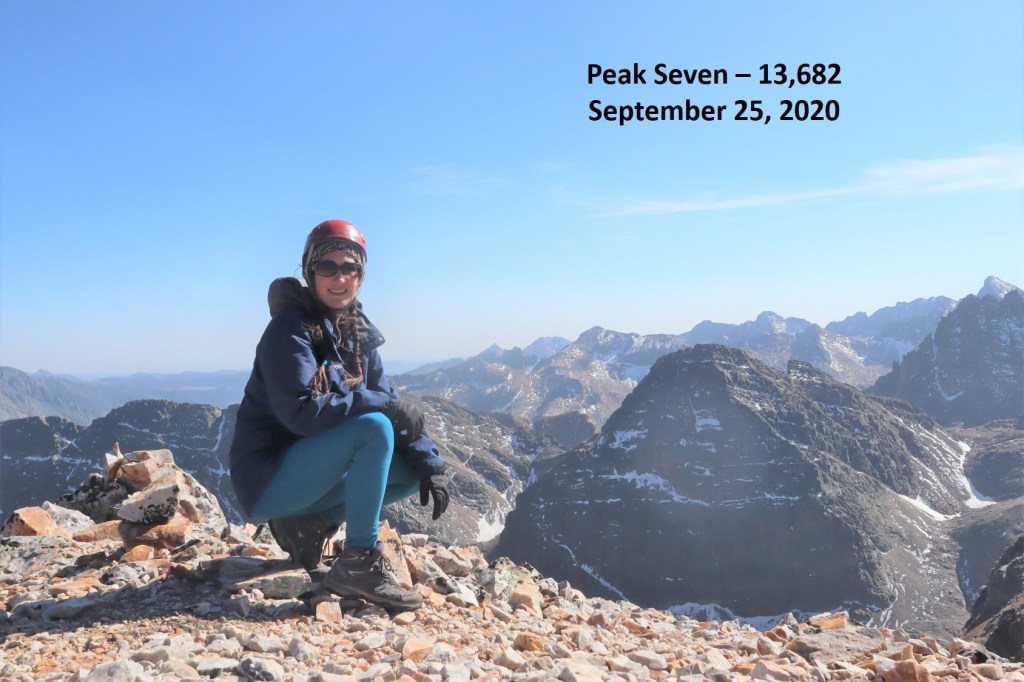
I summited Peak Seven at 3:10pm

Peak Seven:

Heading down Peak Seven was just as fun as heading up.  Here’s the way back to the saddle

From the saddle I hiked back down to the lake, and made my way over to the south side of Peak 8, intent on attempting Peak 9 today as well. 

However, as I rounded the corner to Peak 8 I noticed the sun was already starting to set behind Peak Seven.  It’s fall, and the days are short.  Looking at the hike ahead, I knew I wouldn’t be back to my gear before dark.  I have Raynaud’s, and I need to be bundled up and in bed as the sun goes down.  I sighed and retraced my steps back to where I’d left my gear at the pass.  Once I got there, I’d do some thinking.  Here’s the route from the top of the gully of Peak Seven back to the pass.

As I made my way back to the pass I noticed a gully in between Peak Eight and Peak Nine.  It looked like it went. 

I filed that away and kept hiking to my gear

As I hiked, I strategized.  I could hike back down to the lake to set up camp, but right now I was really upset about not getting in Peak Nine today as well. The approach was a lot for one peak, and I really didn’t want to drive/hike in all this way in the future just for Peak Nine at a future date.   Maybe I could get it tomorrow morning?  I got out my topo map and the route I’d passed on my way to/from Peak Seven indeed looked like it went, but I was a little worried about the snow.  Luckily, I’d packed spikes.  I decided to sleep on the pass tonight (at 12,830’) and attempt Peak Nine first thing tomorrow. 

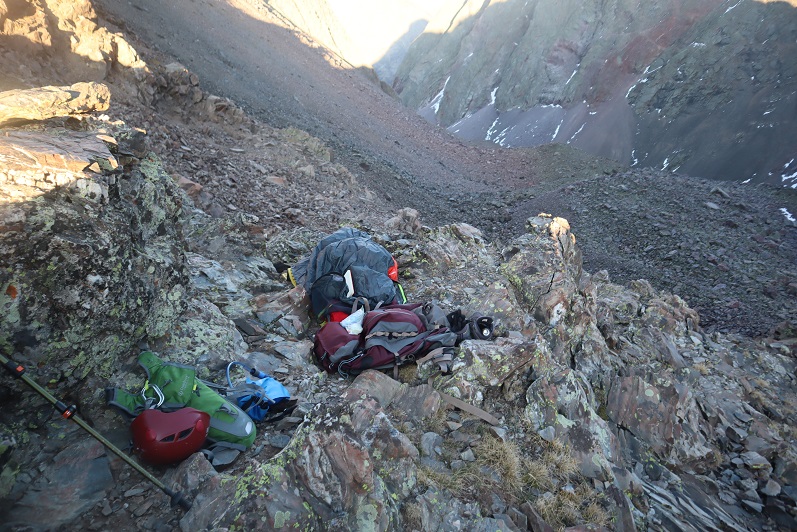
I made it back to the pass and looked for a place to spend the night.  I didn’t have many options, and all of them were rocky.  And windy.  Time to set up camp.  Check out my bivy for the night.  Side note: it’s hard to dry out your feet when it’s windy and cold.  I ended up putting dry socks on and wearing my sandals.

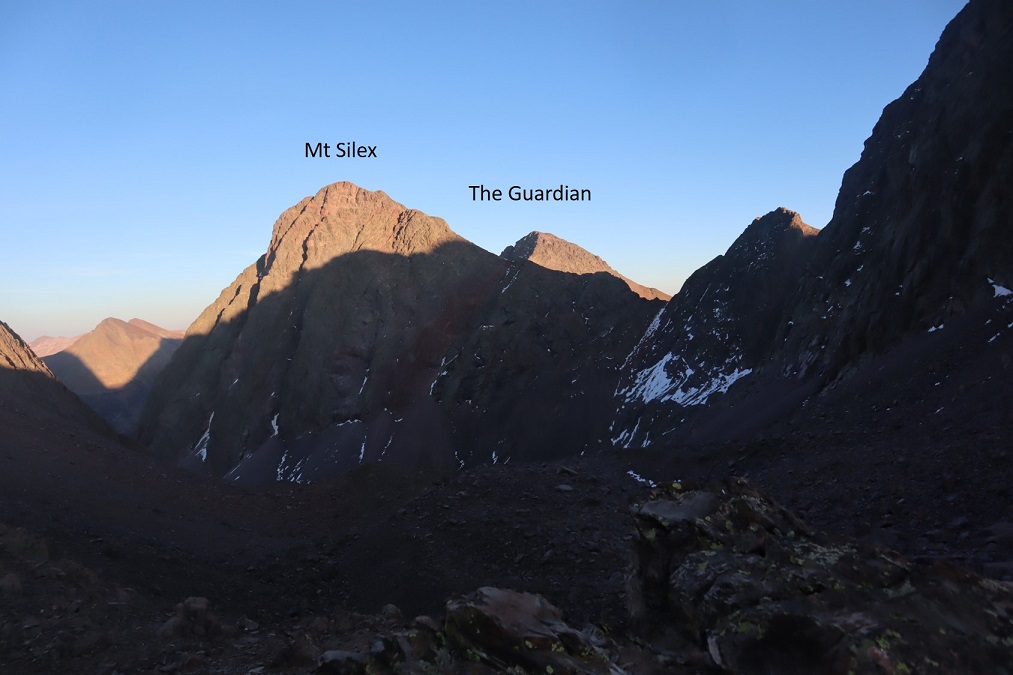
As the sun started to set I filtered some water (glad I’d thought to melt snow now that I wasn’t camping at the lake), jotted down some notes, and had dinner (a handful of peanuts and 4 or 5 slices of dried mangoes:  eating while hiking makes me nauseous, so I probably only get in 500 calories in an entire backpacking weekend).  Oh, and a couple shots of whiskey.  That adds calories.  I set up all my gear so in the morning all I’d need to do was put away my sleeping bag and bivy (important when you have no function of your fingers, which I won’t in the morning cold), watched the sun set, and poured over topo maps for two other of tomorrow’s peaks:  Mt Silex and The Guardian

Anyone else think it looks like The Guardian is wearing a mask?

I set my alarm, bundled myself up in all my clothes, gloves, hat, etc. and went to bed.  It was a windy night but my bivy did its job.  I woke up at 5:30am and it was still pitch-black outside.  I watched a few shooting stars and re-set my alarm, knowing getting outside of my bivy with this wind/cold would be a bad idea.  By 6:30am it was just starting to get light.  I enjoyed the sunrise tucked inside my layers, and then as quickly as possible put away my bivy and sleeping bag and bundled my gear together.  I was going to attempt Peak Nine with just my daypack today as well (which I’d pre-packed last night), so I left my large pack on the pass and started out.

Day 2:  Peak Nine, Mt Silex, The Guardian

I started off the same way I’d headed towards Peak Seven yesterday, heading down the pass, but when I saw the access gully for Peak Nine I turned left (south) and up

I’d been a bit worried about the snow, but it wasn’t a nuisance.  Most of the gully was dry.  I didn’t need to put on traction to kick in steps in the snow, and it didn’t cause me to slip.  There was only about 20 feet or so to deal with. 

I was excited when I made it to the top of the gully to find I was in the perfect spot to continue the hike.  I stayed high and aimed for the ridge.  Note:  Here it became very windy. The wind didn’t stop all day. 

At the end of the ridge an obvious cairn trail picks up.

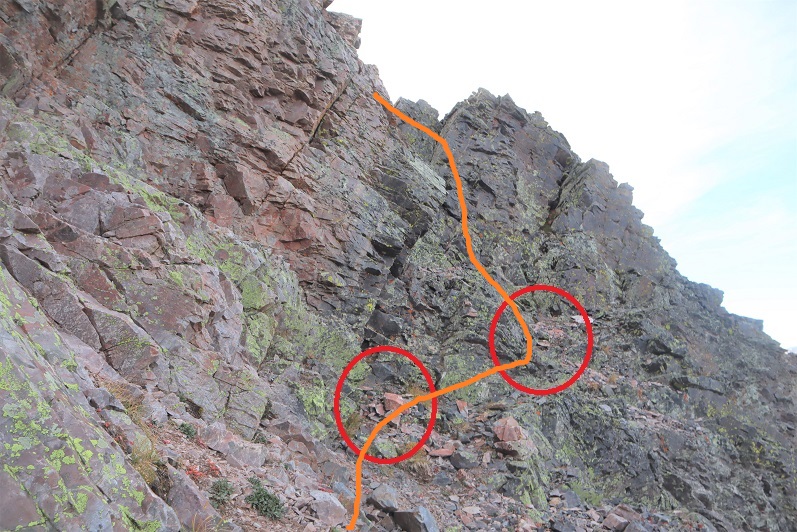
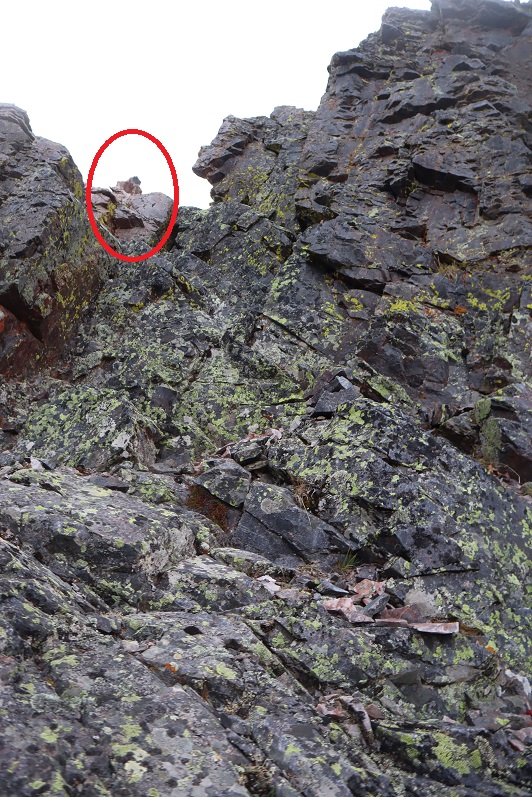
It will lead you up a class 3-4 chimney and then around the mountainside. 

You have the option of taking the gully or the ridge.  I took the gully up, the ridge down.  The gully takes some route finding and I found it to be class 4.  The ridge is easily and highly cairned.   Here’s the entrance to the gully.  I don’t think there’s a way to cliff out, but there are tons of options to ascend.  Just keep heading northeast

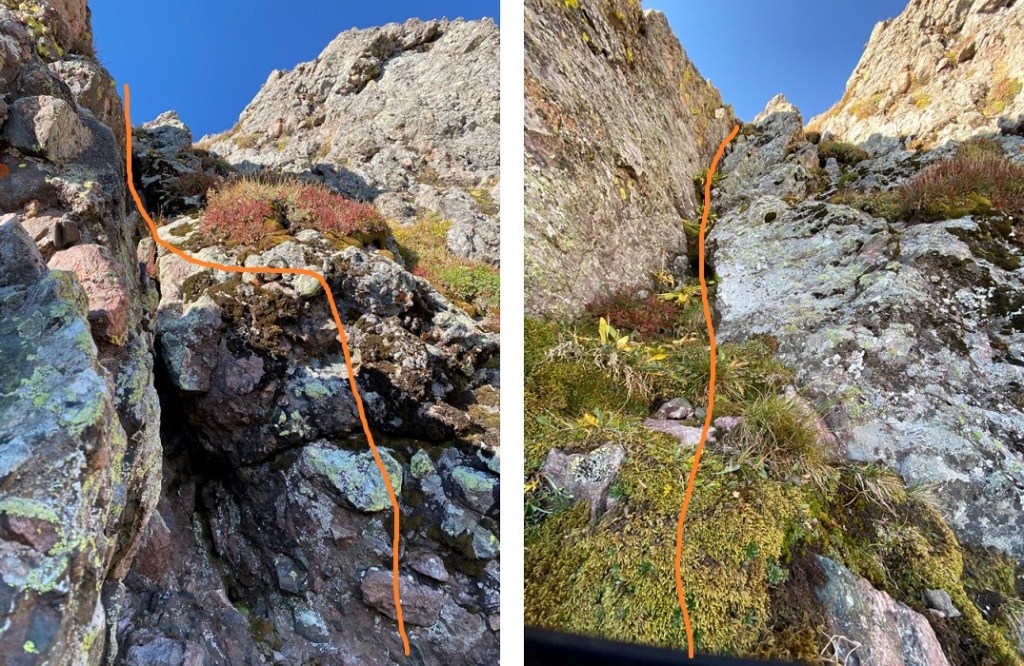
Here are some photos from inside the gully

If you keep heading northeast you’ll hit a wall.  There will be cairns in the northeast corner of the top of the gully that lead you both to the exit route back down the ridge, and to the summit.

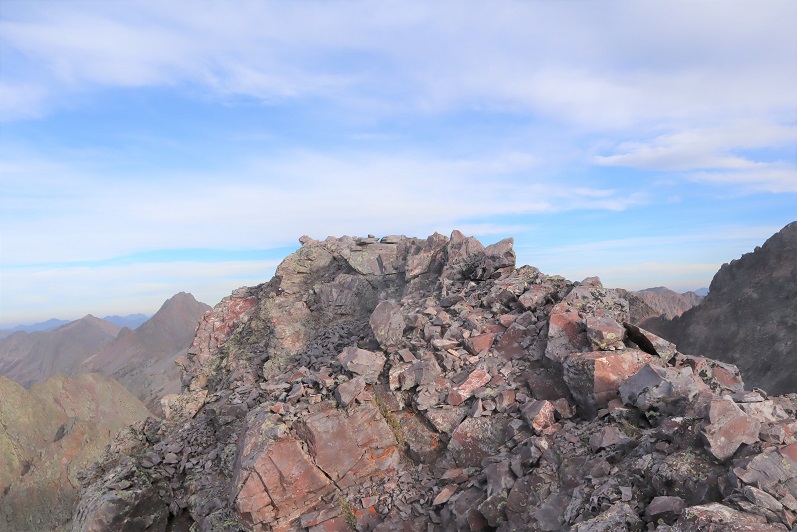
These cairns will take you to the ridge, which if you follow northwest will take you to the summit

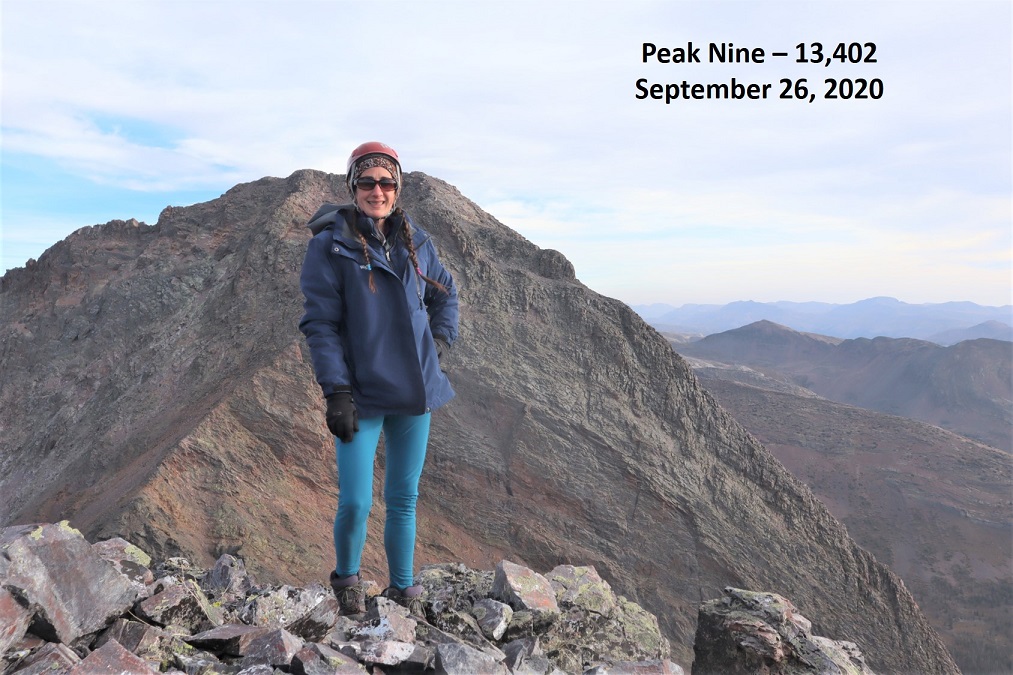
I summited Peak 9 at 8:25am

Peak Nine: 

Here’s looking down the gully from the summit.  Here you can see you can pick your route but need to head to the northeast corner to gain the ridge

I’m not gonna lie, I didn’t want to head back down the gully.  I’d known there was a ridge route when I’d ascended, which kept me going up, but the class 4 moves were bordering on class 5, and I felt safer taking the ridge down.  Here are some pictures of the very well cairned route down the ridge.  I followed the ridge southeast the way I’d come, dipped down a bit, then found the cairns that led me back up to the ridge

I then followed the ridge

Dipping down to the left once, then staying to the right for the rest of the ridge

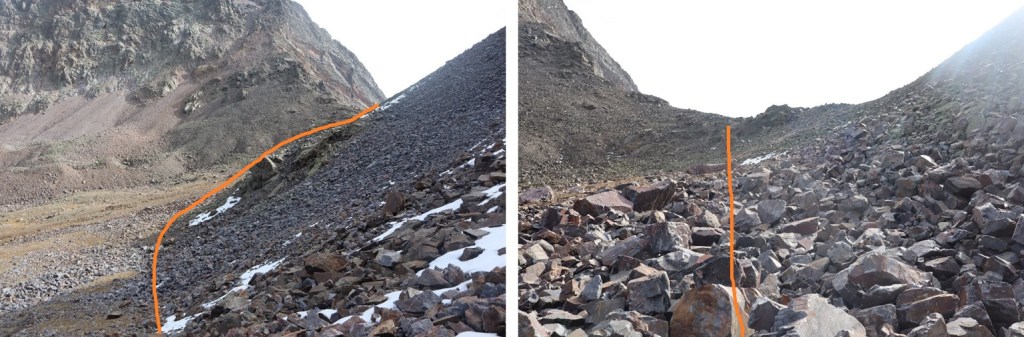
The ridge led me to a short gully.  I took it southwest

And this brought me back to the trail I’d hiked in on.

I followed it back to the chimney, climbed down

And aimed for the gully I’d hiked in through

I used my kicked in steps from this morning to descend, then made my way back to the pass and my gear. 

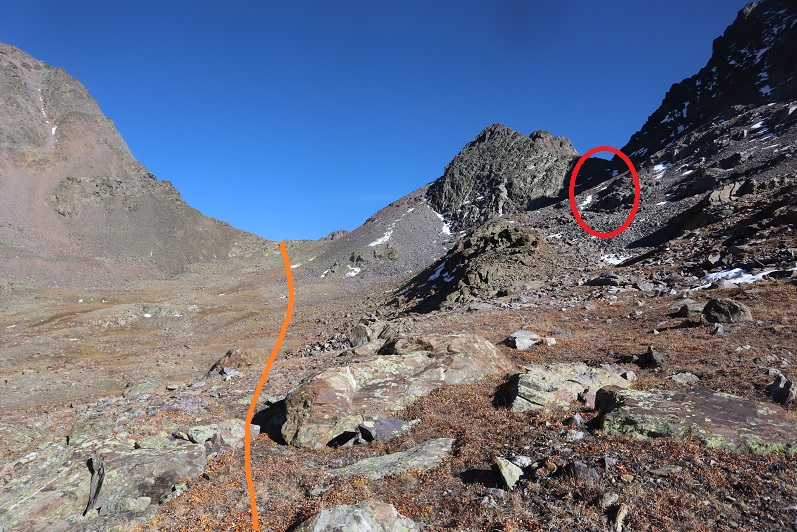
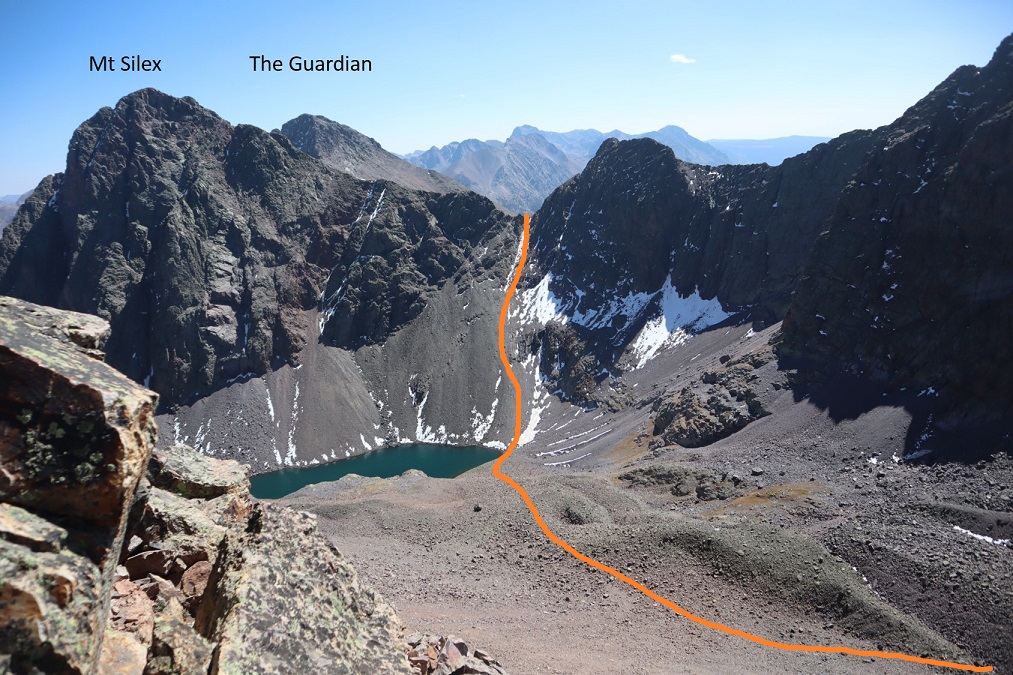
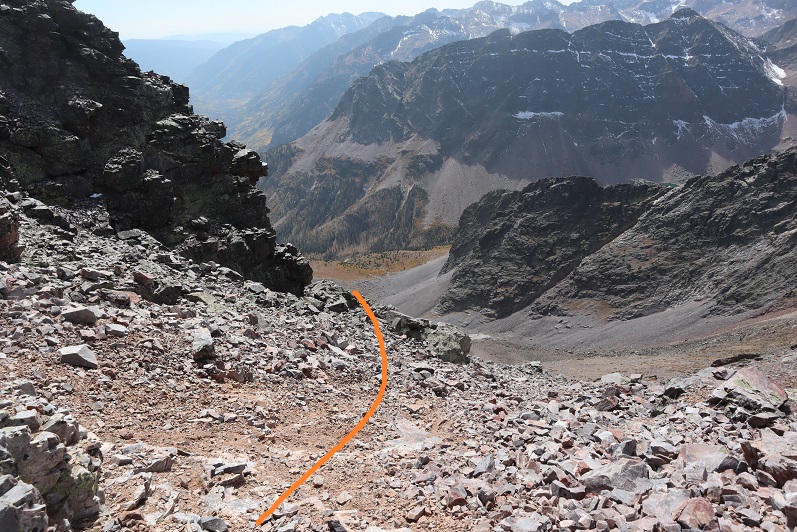
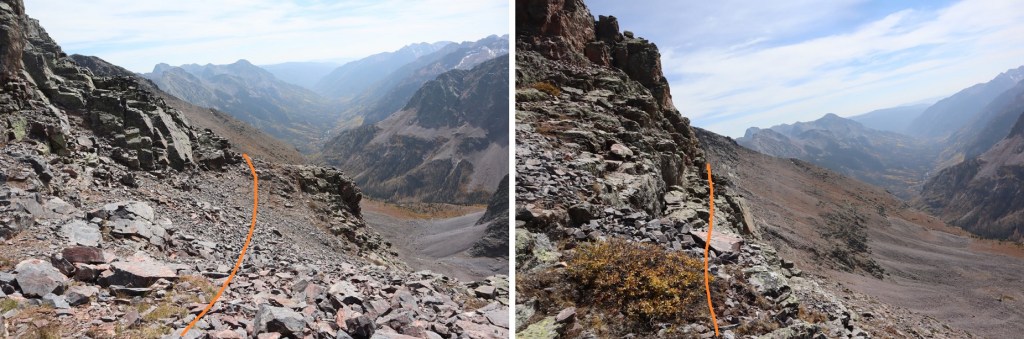
I sat at the pass and had a packet of tuna and looked at the time.  It was still early, so I figured I had plenty of time to hike Mt Silex and The Guardian today as well.  I gathered my large pack and set off for Lake Silex below.  I was a bit worried about the access gully (circled in red).  The snow looked to be covering the entire last part of the route, and I wasn’t sure I’d be able to get up the gully. 

I dropped my large pack at the lake.  It was now 11am, so the sun wouldn’t be my friend as I ascended the gully:  it would be shining in my eyes the entire time.  Here’s an overview of the route I took from the pass, down to the lake, and up the gully

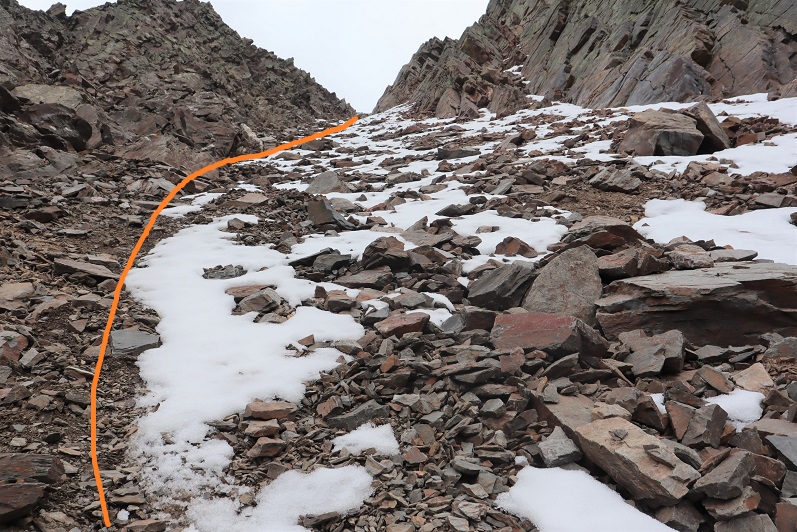
When I got to the gully the snow wasn’t as bad as it had looked from down below.  I was able to avoid most of it by sticking to the left

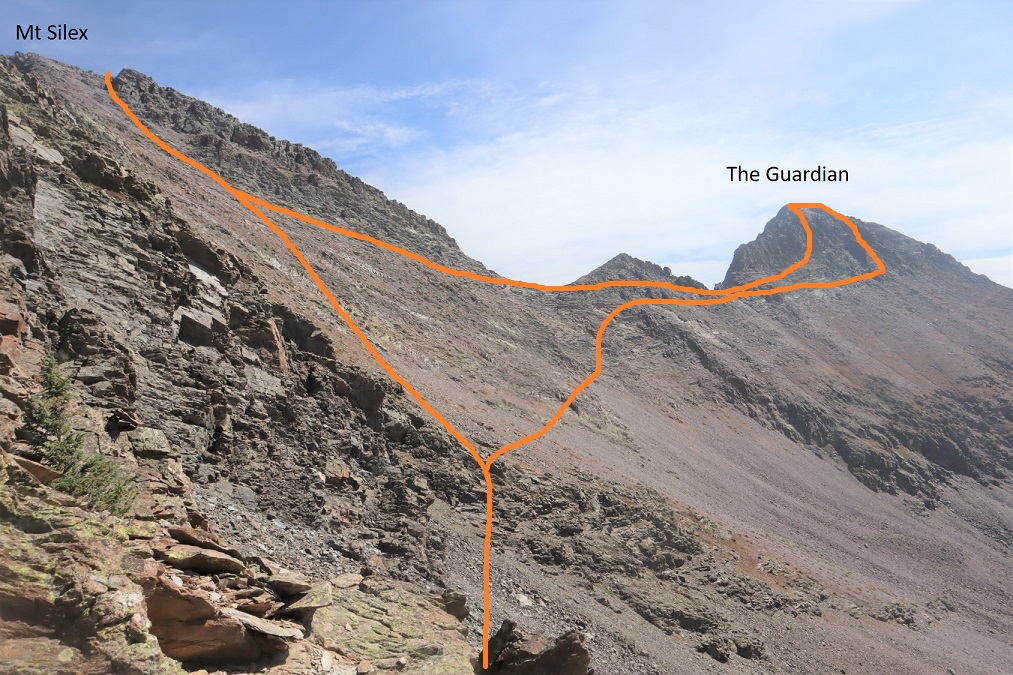
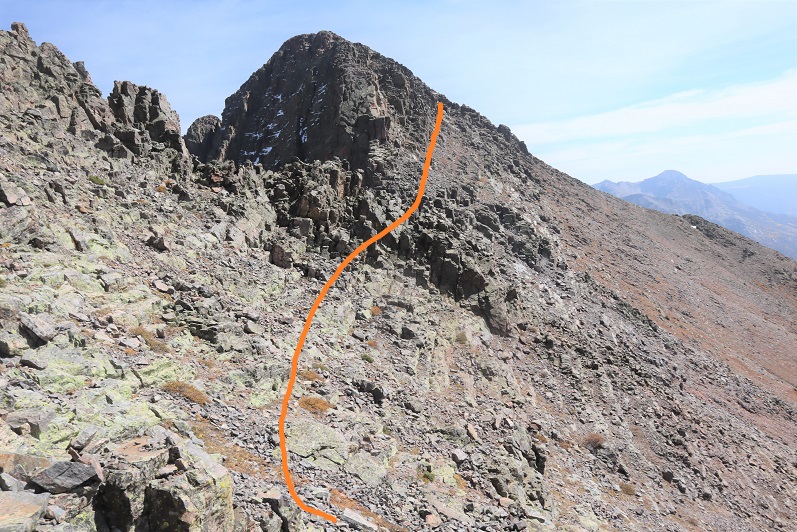
Here’s an overview of the route I took to summit both Mt Silex and The Guardian and back from the top of the gully

I started out kind of low, but my advice is to gain the ridge as soon as you can and follow it to the summit.  I took more of the gully route, which made things more difficult than they needed to be.  Here’s my route

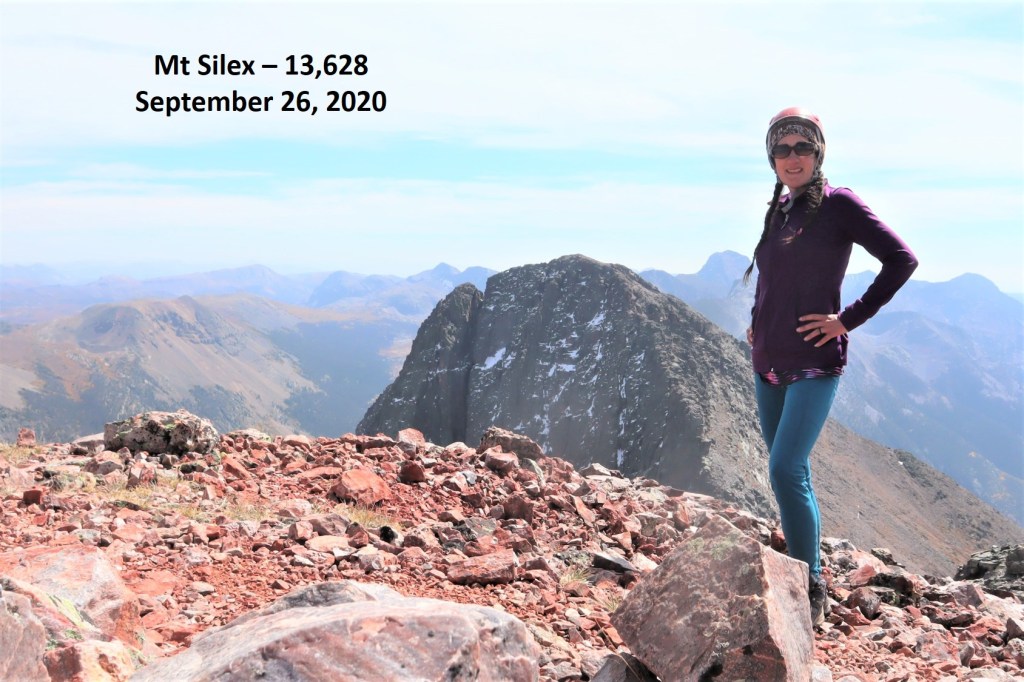
I summited Mt Silex at 12:55pm

Mt Silex: 

Here’s a look back down the ridge I’d just hiked up

Now to head over to The Guardian. I went back down the gully, and hugged the side of the mountain

Then I stayed high and worked my way southeast

Here’s step by step. 

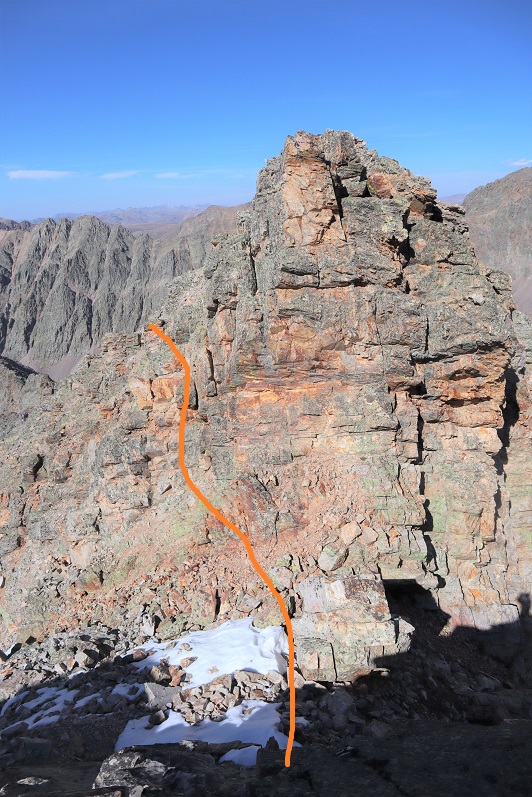
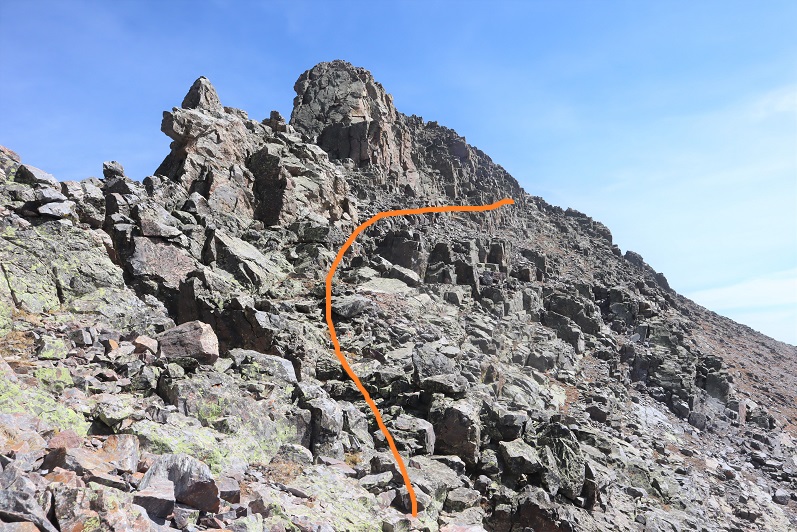
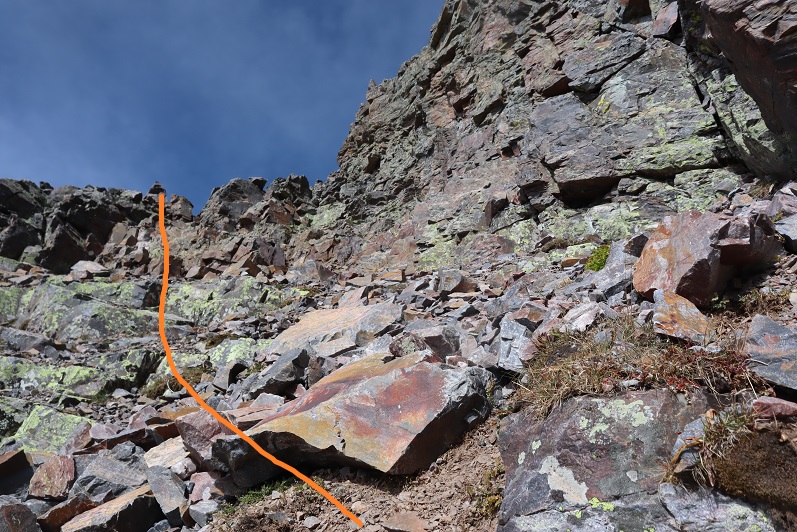
At around 13400’ I came to a gully, turned and headed northeast to the summit. The climbing here was class 4, and seemed to get sketchier as I went. 

At the top of the gully was a well-cairned summit ridge

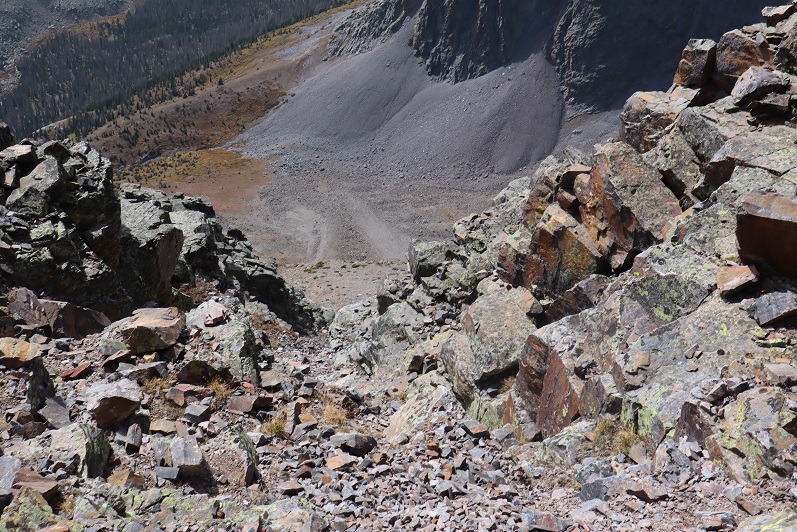
Here’s a look back down the gully

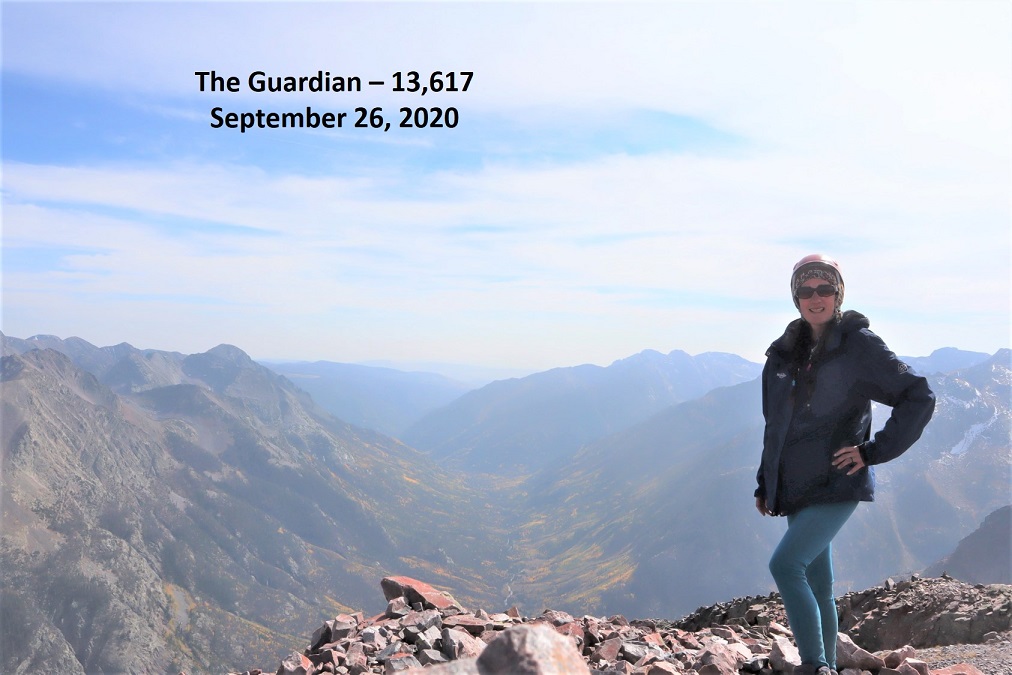
I summited The Guardian at 2:55pm.  The views were a bit hazy due to the smoke from the fires

The Guardian: 

As I’d summited, I noticed an easier gully I could have accessed to summit if I’d hiked just a little further southeast.  I decided to take that gully down. It’s scree filled and I scree surfed down.  This is class 2.

At the bottom of the gully I turned right

I had a great view of my route back to the gully that leads back to Lake Silex.  It’s important to stay high here, as it does cliff out a little below.  Here’s my route

Here’s a look back at the route down from The Guardian, staying high to avoid the cliff bands

Back at the top of the gully here’s looking at my route back to Lake Silex.  I hiked down to the lake, gathered my gear, and went around the north side of the lake, looking for a spot to spend the night.

At the northeast side of the lake I found a set of 3 windbreaks and picked the most well-constructed one to spend the night.   

I set up my gear inside a windbreak built in-between two large boulders.  It was well made, but the wind was so intense the barrier wasn’t doing much to keep out the wind. 

I filtered some water from the lake, ate dinner (my last packet of tuna, a handful of peanuts, and a few shots of whiskey) and made it an early night. 

The wind howled all night long. It was intense, but my bivy once again did its job. 

Day 3:  Descent, Hunchback Mountain, Hunchback Pass

I woke up the next morning, gathered my gear, and was off at 7am.  I followed the gully northeast towards Stormy Gulch.

There was still some snow left in this gully from last winter. 

I made my way down the scree and back Stormy Gulch

I much preferred the way I hiked in rather than this scree hike out.  Here’s looking back on the scree slope

I picked back up the faint trail and followed it east

The waterfall seemed a good place to stop for a bit.  I sat on a log and relaxed for a few minutes before the long hike back up to Hunchback Pass.  Once again, this would be a great camping spot.

I crossed Nebo Creek and quickly found the trail. 

I followed the trail north past treeline, keeping a steady pace as I still had one more peak to climb and didn’t want to get too tired too quickly.  I filtered water one last time and took frequent breaks just because I could.

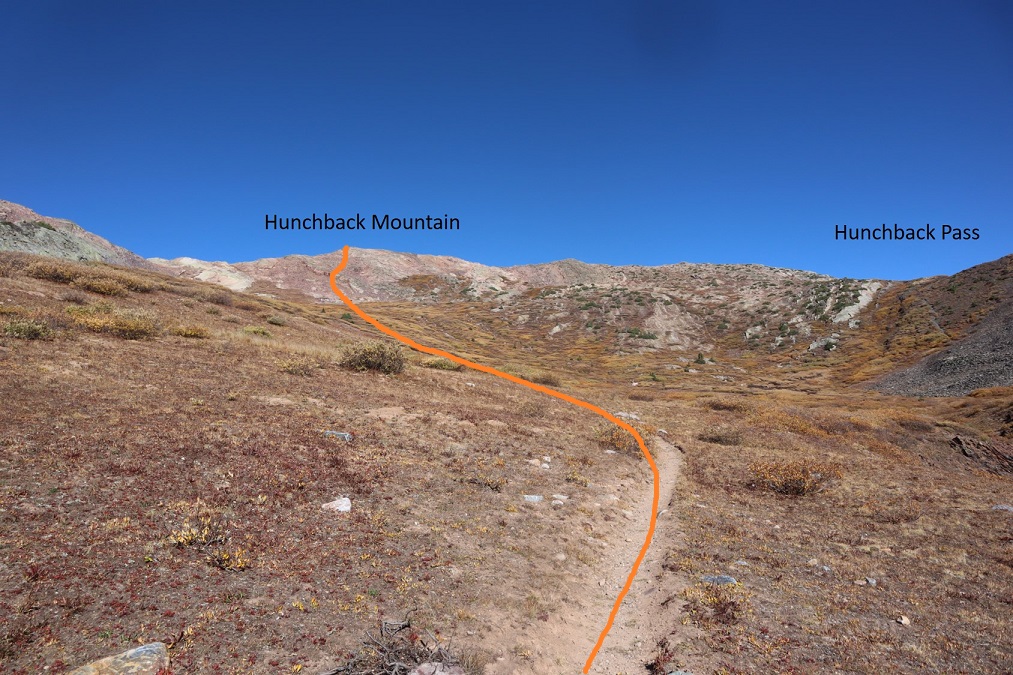
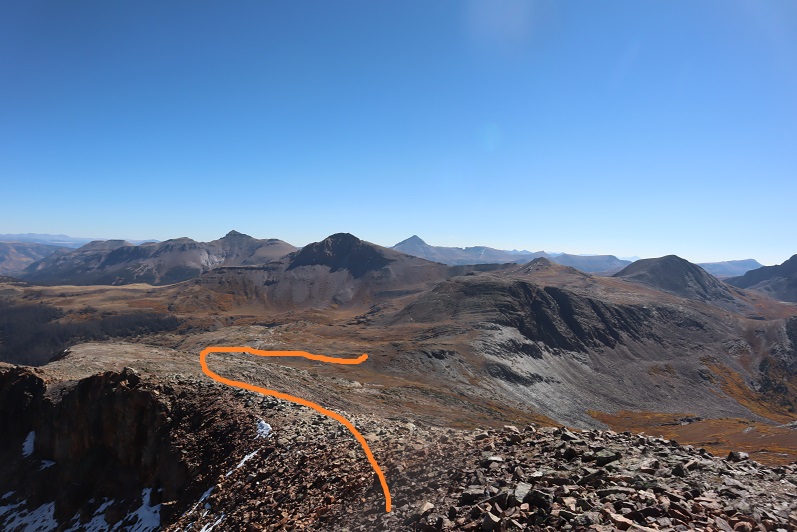
Once above treeline I had a great view of Hunchback Mountain.  Here’s the overall route I took to the summit

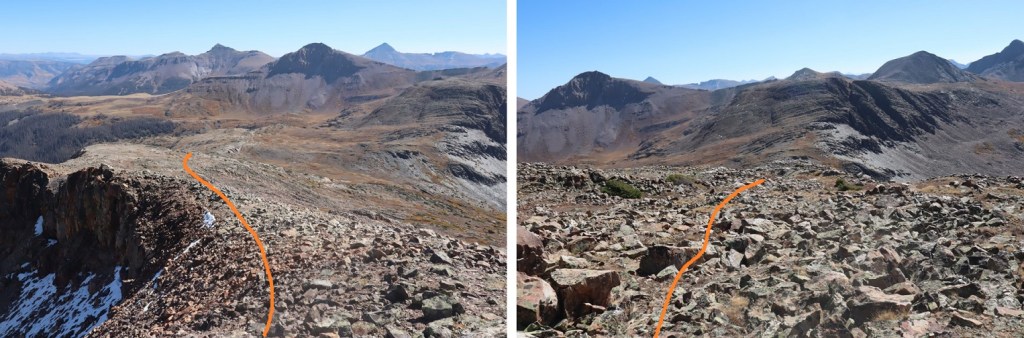
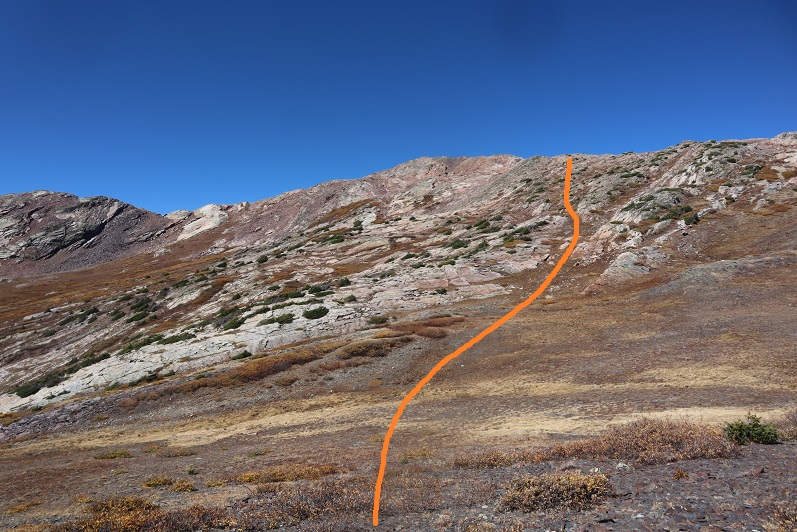
And step by step, all class 2.  Sometime during this part of the hike I lost one of my gloves.  It was really windy, and I suspect it was blown out of my pocket.  Time for a new pair of gloves. I left the trail and aimed for a small grassy area near a band of rocks

After the grassy area the terrain became rocky.  I aimed northwest (note, this is a false summit)

Here’s a view of the summit of Hunchback Mountain

I summited Hunchback Mountain at 11:15am

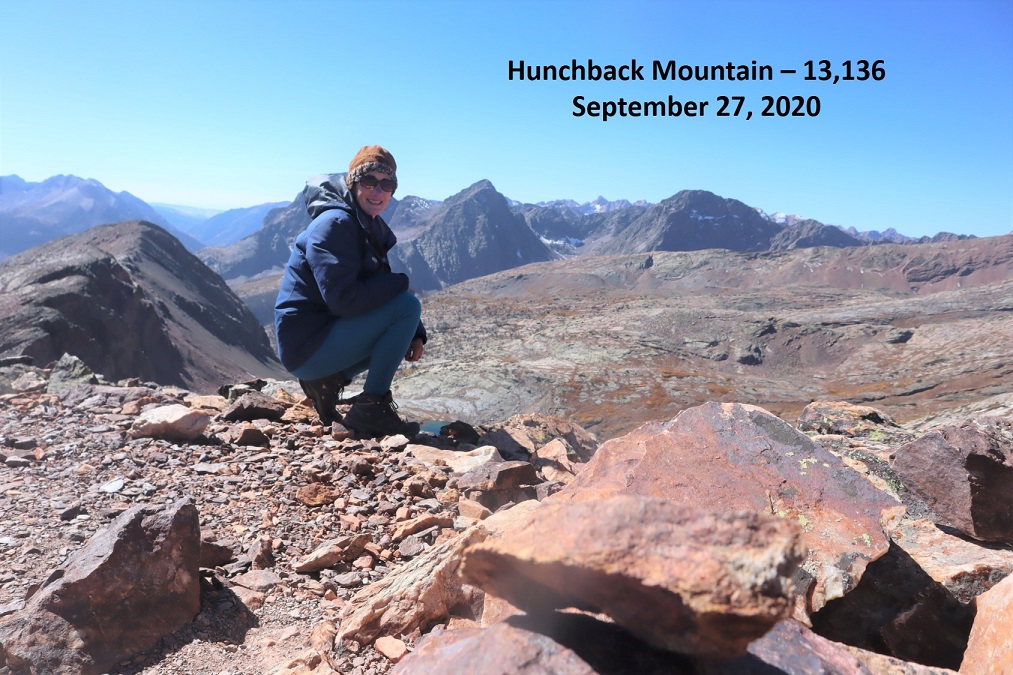
Hunchback Mountain: 

I spent some time on the summit, getting a good look at some 13ers I wanted to attempt next weekend if the weather held out.  I figured out which route I wanted to take next week, and then it was time to head towards Hunchback Pass.  I just followed the ridge east until I reached a tundra/willow filled gully, then followed the gully back to the trail.

Here’s looking back on my descent

Back on the trail it was an easy hike back down to my truck

I made it back to my truck at 1pm.  This was a 3 day hike, with 39.49 miles and 11981’ of elevation gain according to CalTopo, 28.9 miles and 19042’ of elevation gain according to Strava.  I’m not sure why the big gap in elevation gain/mileage, but to remain consistent I always use CalTopo data.

Anderson Peak – 13,631 & Petroleum Peak – 13,505

RT Length: 12.14 miles

Elevation Gain: 4624’

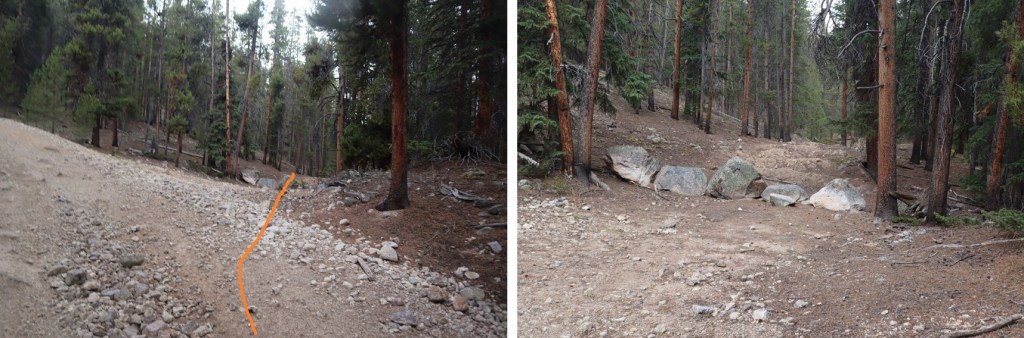
From Tellurium Creek Road. There is no real trailhead for this hike.  A good place to park is at the junction between 742 and 584, and to start out following 584 north.  The rest of the road is 4WD, but is really better suited for an OHV.  There also isn’t a good place to park further up.   I did not park at this junction but should have.  Instead I drove up the 584 road and after about a quarter mile decided I loved my truck too much to continue.  There are some really big rocks.  My truck could have made it further (I didn’t know it at the time, but I’d already driven the worst part) but I decided instead to find a place to park between some trees and hike the rest of the road. 

From my parking spot I followed the 4WD road for a mile before turning right onto a closed road.  In the dark I missed the turnoff, but in daylight it’s obvious, marked by large rocks closing the road to vehicle traffic.

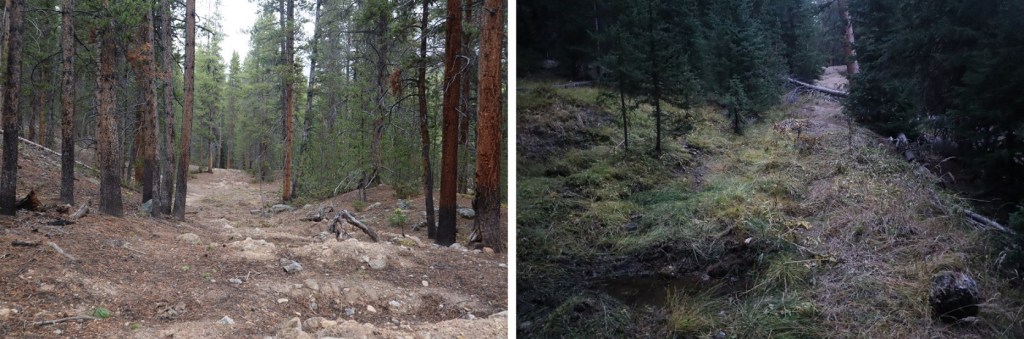
This is an old mining road that switchbacks up the side of the mountain.  They really don’t want you driving on this road:  as if the rock barriers weren’t enough, they’ve mounded the road as well.  It’s still easy to follow.

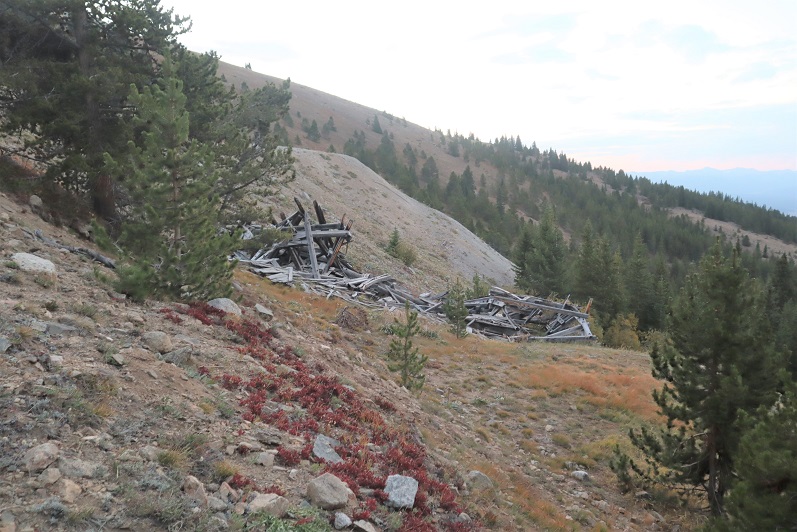
The road passes the Enterprise Mine

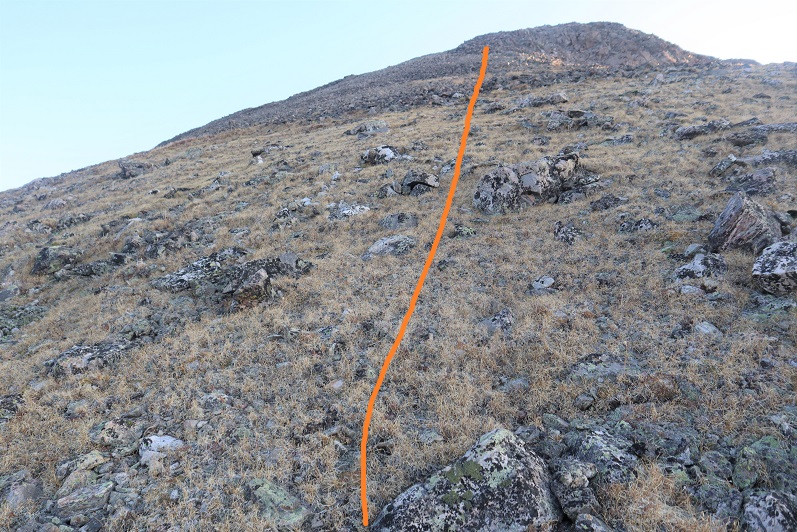
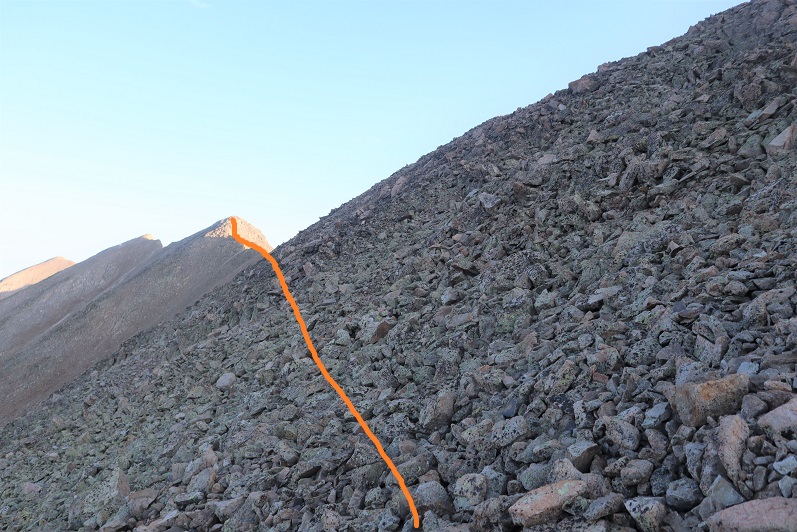
And switchbacks a few more times up the mountainside before heading to another mining claim.  I took two more switchbacks after the Enterprise mine, and then left the road to head north up the mountainside.

Once I’d gained the ridge I turned left and followed the ridge northeast.

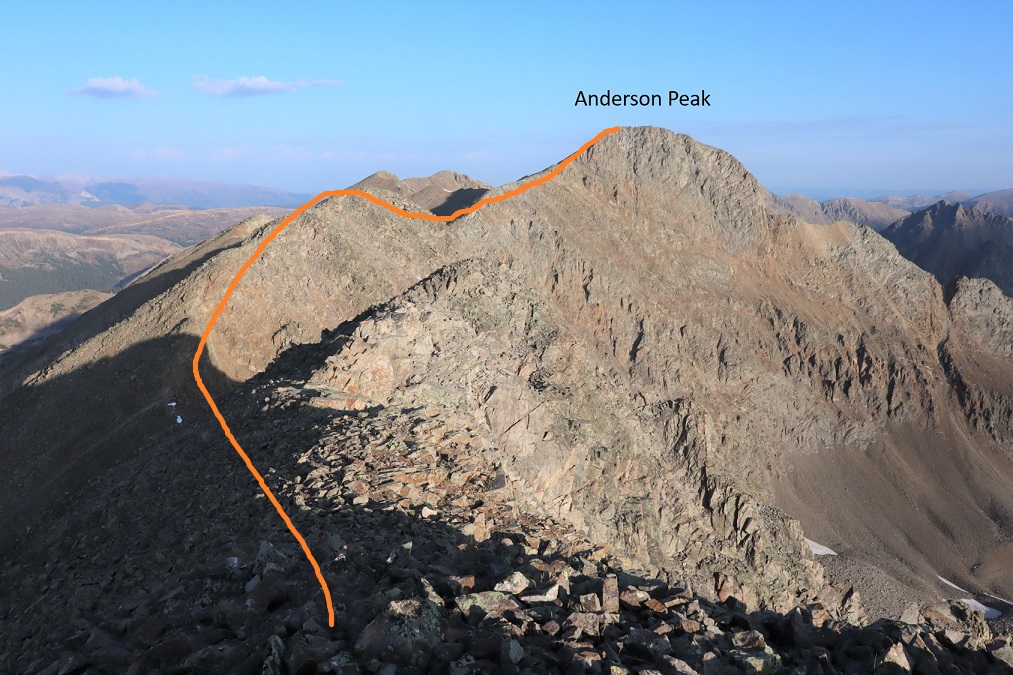
From here on out this is a simple ridge hike, but there are a lot of false summits

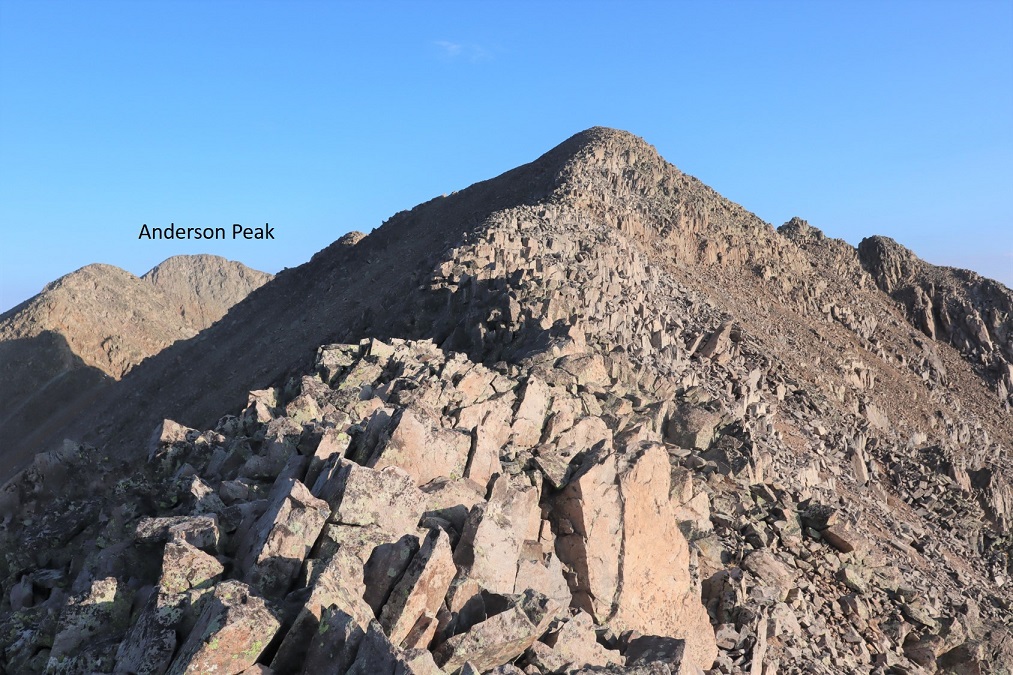
Here’s the actual summit of Anderson Peak

It’s a long but straightforward, class 2 ridge walk to the summit (with a lot of small ups and downs)

For some reason I saw an anchor set up on the ridge?  I’m not sure what the reason is, considering this is all class 2 and it’s not near the summit. 

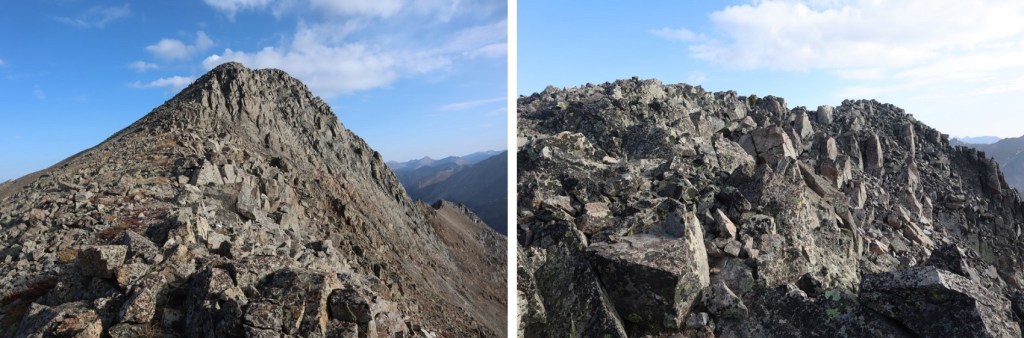
Here’s the last bit to the summit.  Notice how blue the skies are?

I summited Anderson Peak at 8:45am

Anderson Peak: 

https://youtu.be/sX7Og2Fu62c

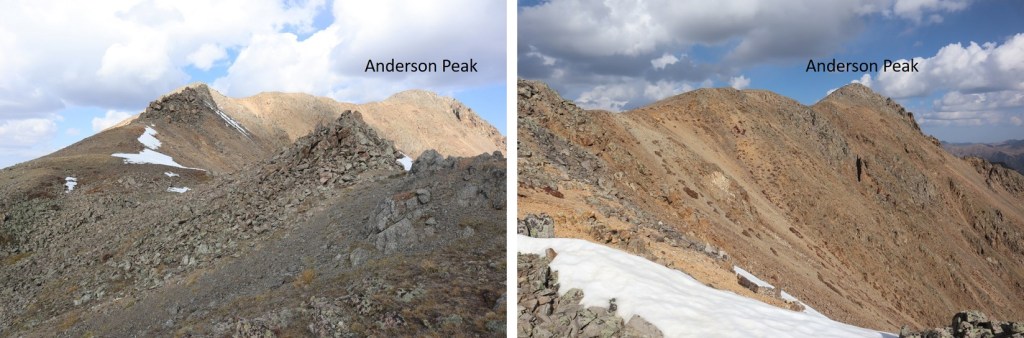
Here’s looking back at the ridge

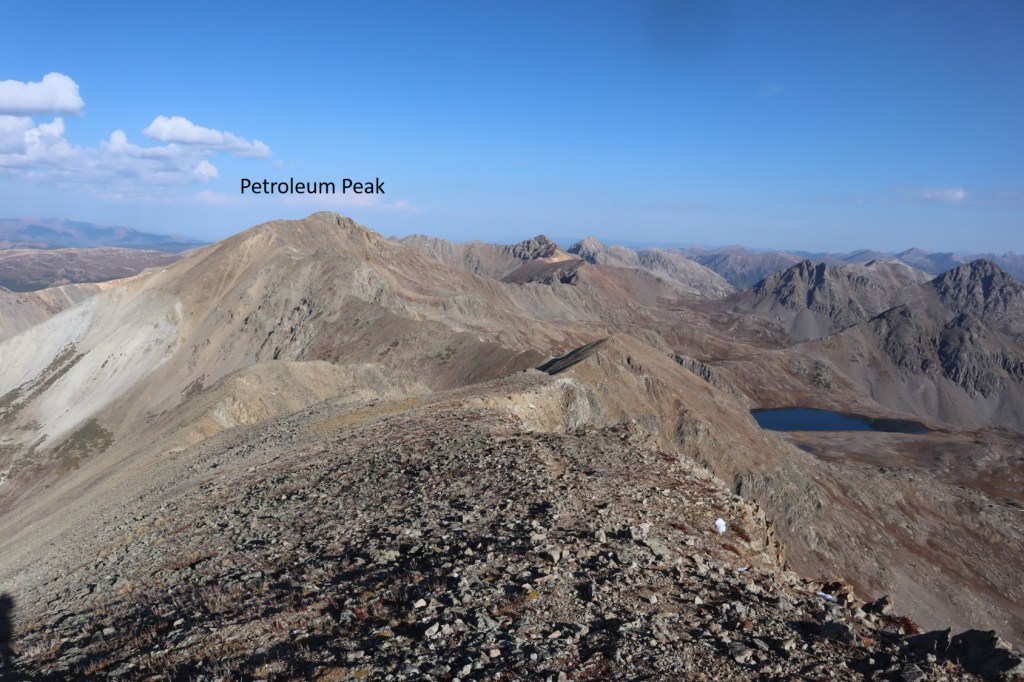
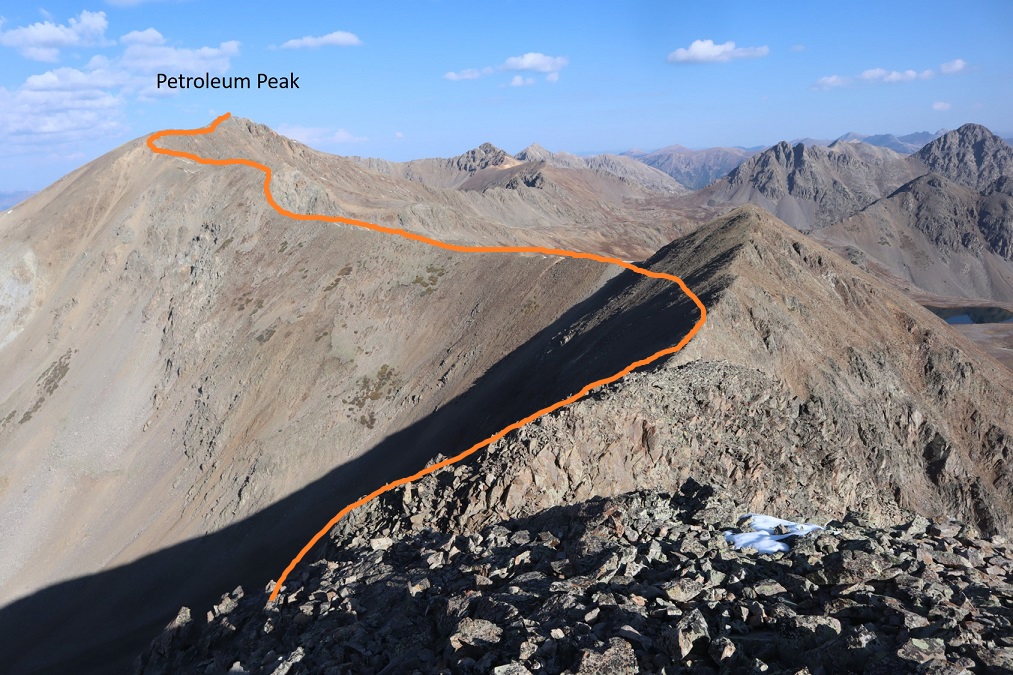
I turned around and continued following the ridge that led to Petroleum Peak

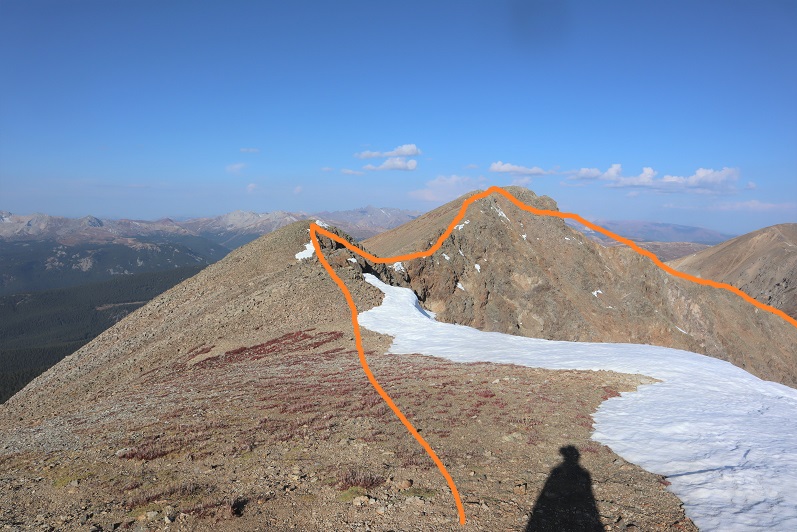
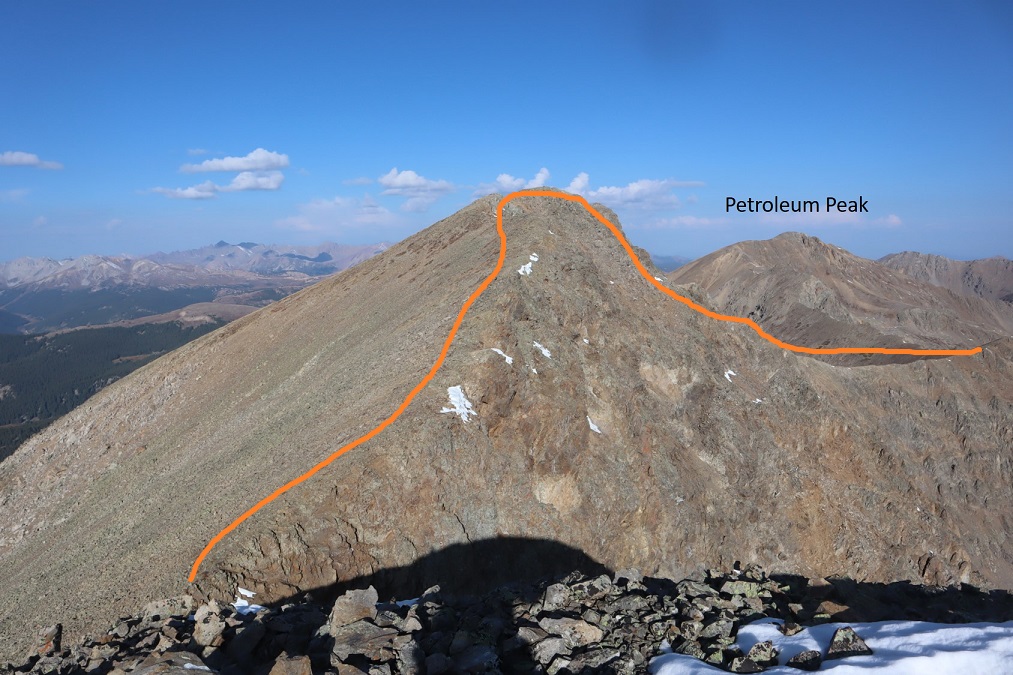
Here’s an overview of the route

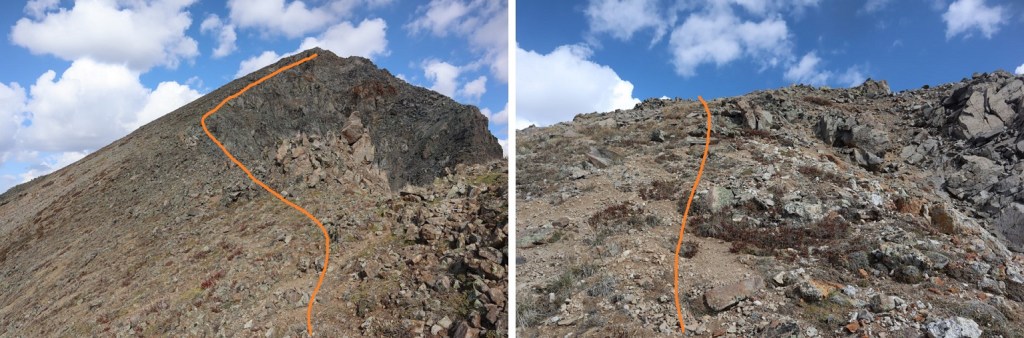
And step by step, all class 2.  Notice the increasing clouds?

Getting up this section was a little steep, but still class 2

I stuck to the ridge the entire way

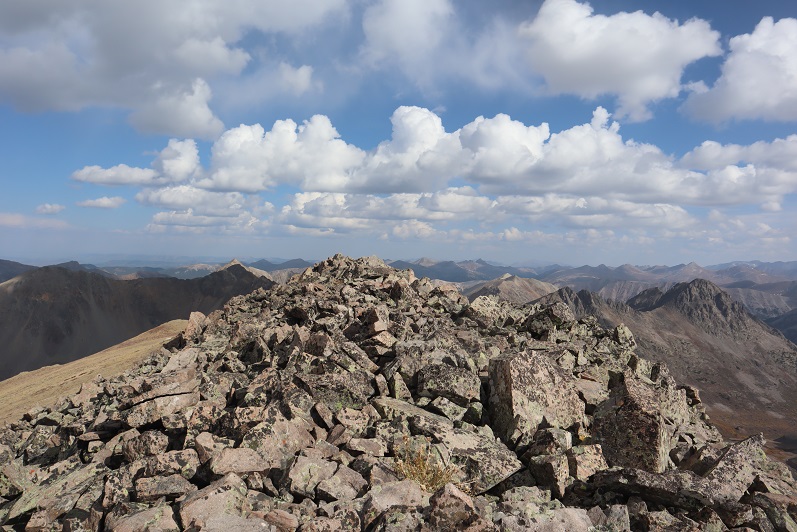
The summit was long and it was difficult to tell where the actual summit was. I walked all along the ridge and found the summit cairn/register further to the north. 

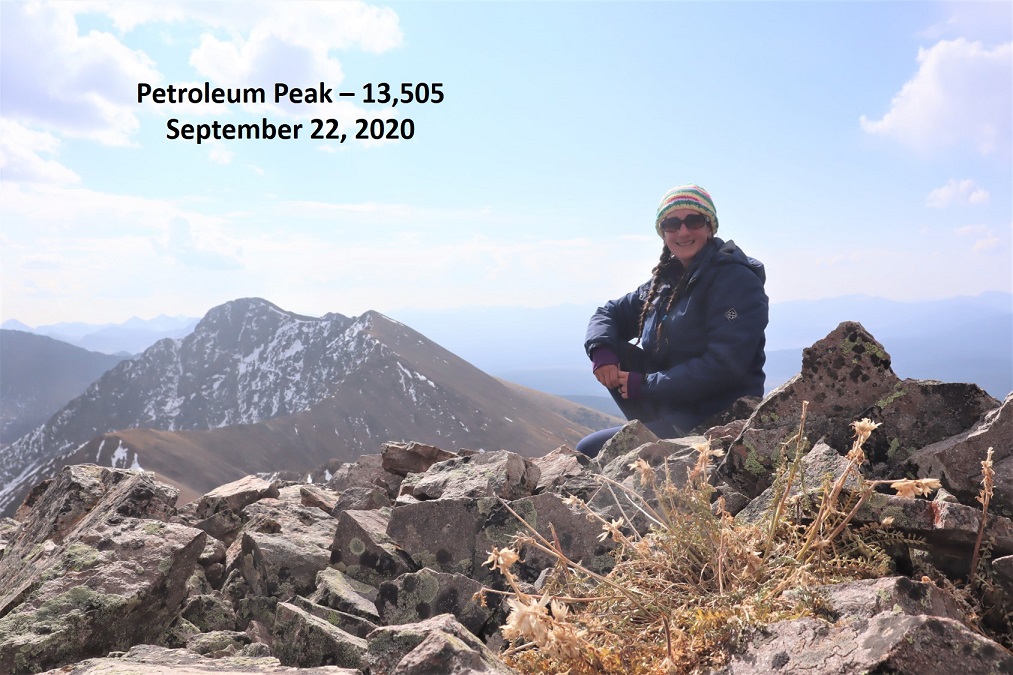
I summited Petroleum Peak at 10:10am

Petroleum Peak:  https://youtu.be/agIJEkY3uqQ

Here’s a look back at the route from Anderson Peak over to Petroleum Peak

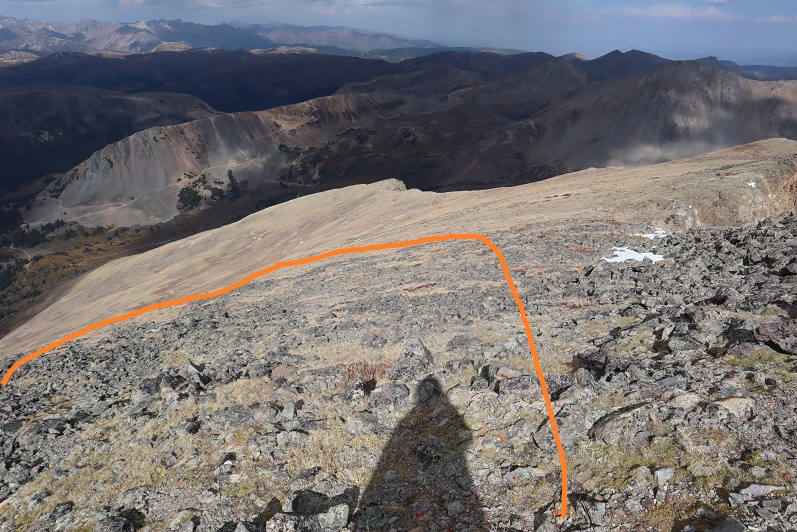
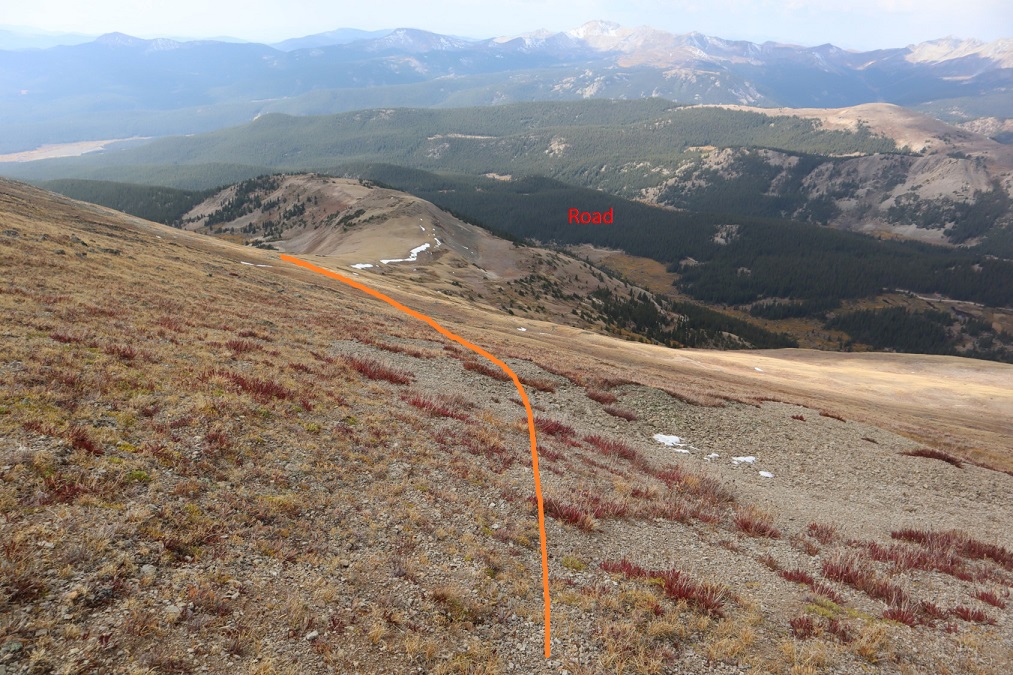
It wasn’t lost on me the clouds were increasing at a rapid rate.  It wasn’t even 10:30am yet, but the forecast predicted a 20% chance of thunderstorms after noon.  It looked like they were going to happen, and I wanted off the mountain as soon as possible.  I continued following the ridge north to avoid rock hopping, then turned and followed the mountainside as it curved south. 

Now, I could have just aimed for the road and taken that back to my truck, but where’s the fun in that? Side note: If you’re not good with route finding off trail, aim for the road. 

Oh, and those clouds I’d been worried about?  Around 10:30am it started snowing!  Wow!  That had happened FAST!  I put my camera away during the worst of it, but it wasn’t too bad, just unexpected.  Mostly graupel and small flakes.

I continued curving around the side of the mountain until I came to a well defined game trail, then followed that to a basin.

Once in the basin the trail ended.  I turned right and followed the drainage 2.5 miles.  There is no trail here, but if you stick to the creek you will eventually make it to the road you hiked in on.  The brush can be thick at times, there are some willows to contend with, but it’s easy to stay near the creek. Eventually you’ll want the creek on your left, but feel free to navigate back and forth as needed.

Eventually I made it back to the bumps in the dirt that told me I was back to the destroyed 4WD road

And took the road a short ways southeast to 584 and back to my truck

It rained lightly the rest of my way out. 

I made it back to my truck at 12:15pm, making this a 12.14 mile hike with 4624’ of elevation gain in 6 hours, 45 minutes. 

Now to drive home and get back to work! 

PT 13801 & “Campbell Creek Peak” – 13,454

RT Length: 11.29 miles

Elevation Gain: 4559’

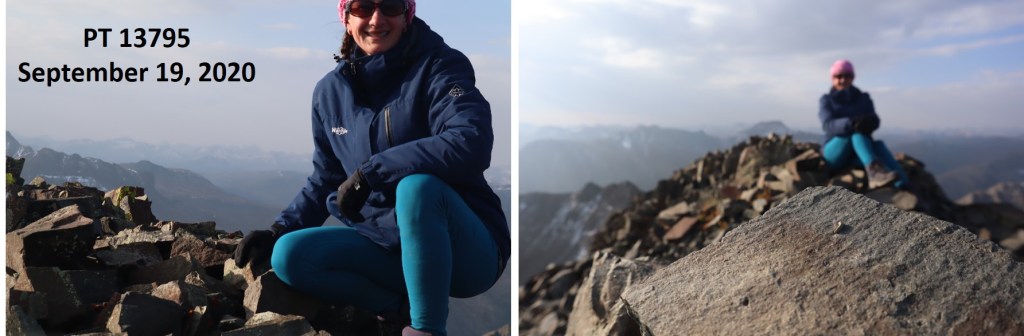
To finish off my birthday weekend I wanted to hike two more 13ers, which would bring my total to 200 unique Colorado 13er summits.  I chose these peaks because we’ve recently had our first snow and I’ve attempted this peak before and turned back due to snow/conditions.  If I wanted to get PT 13795 in this year I was going to have to do it soon.   

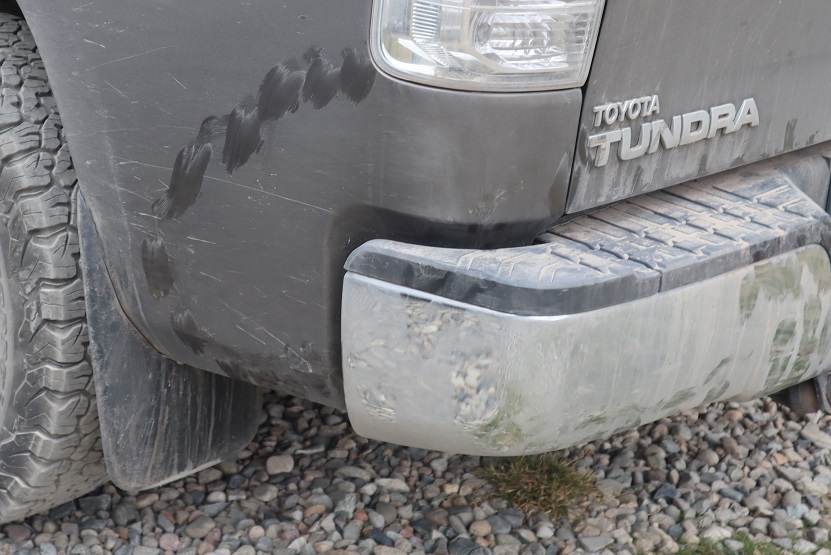
I drove down to the Grizzly Gulch/Silver Creek Trailhead and didn’t make it there until after dark.  The parking lot was packed, there were several tents set up, and tons of campers enjoying campfires.  In short, it was loud and everyone seemed to be enjoying themselves.  I parked, fired up my jetboil and made my birthday dinner of cup noodles and mashed potatoes.  As I ate dinner, I made some notes from the days climb, then got ready for bed.  There are clean bathrooms at this trailhead (no toilet paper though).  As I came back from the bathroom I ran into a rather large deer licking my truck.  I tried to shoo it away but she wouldn’t budge, so I carefully made my way into the back of my truck while she continued licking my bumper.  On a positive note, by 9pm the entire trailhead was silent and everyone had gone to bed, so I had no problem falling asleep.

I awoke to 32 degree weather and a layer of frost on top of my sleeping bag.  Looks like I’m going to have to start winterizing my topper.  Since it was cold I put on my puffy as well as my windbreaker, knit hat and gloves, and was on the trail at 5:15am.  

I started out by heading west, following the same trail as Handies Peak.  If you’re reading this I’m going to assume at this point you’ve summited Handies Peak and I won’t go into detail about the initial approach.  If you’d like to see the approach I’ve written it up from my failed attempt of PT 13795 last year.

I followed the Grizzly Gulch trail through the woods and past treeline.  After hiking for 2.5 miles I turned left and headed southeast towards an upper basin.  There was a faint trail here

Once in the upper basin I came to a lake.  There were two tents set up, so I tried to be quiet as I passed.  I skirted the lake to the left and headed towards the gully that would bring me into another basin.

Ascending the gully beyond the lake was class 2+.  The scree here was awful:  I’d take one step forward and slide backwards.  I actually used my ice axe and trekking pole here for stability, glad the sand was wet from the recent snow.  There was no trail, so I just aimed southeast and tried to avoid the snow (it was bulletproof by the way).

Once in the upper basin I had a few options.  I’ve read trip reports where hikers have used the gully to the left, but I’m not a fan of gullies.  In fact, I consider ‘gully’ to be a 4 letter word.  I took a look at the gully and said “nope”.  Instead I took the ridge to the right.  This was an easy hike on tundra, and should be the standard route.

Here’s a look at that gully I didn’t want to ascend

Just before gaining the ridge the tundra gave way to rock

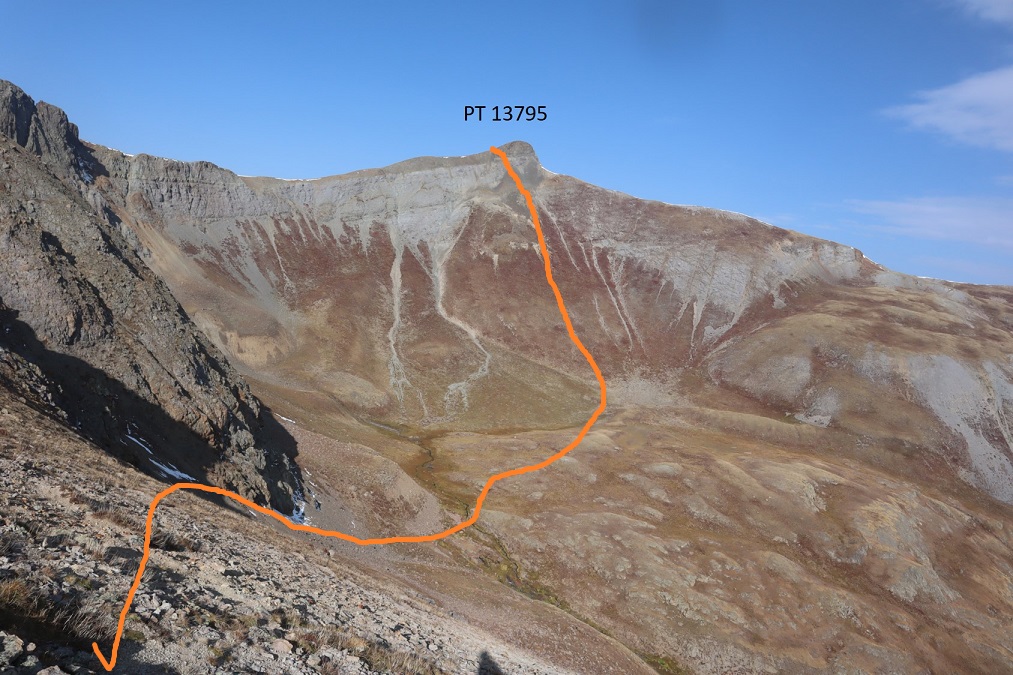
At the top I turned left and headed southeast for an easy tundra stroll towards PT 13795

The last push to the summit was rocky, but stayed class 2

The summit was rocky as well

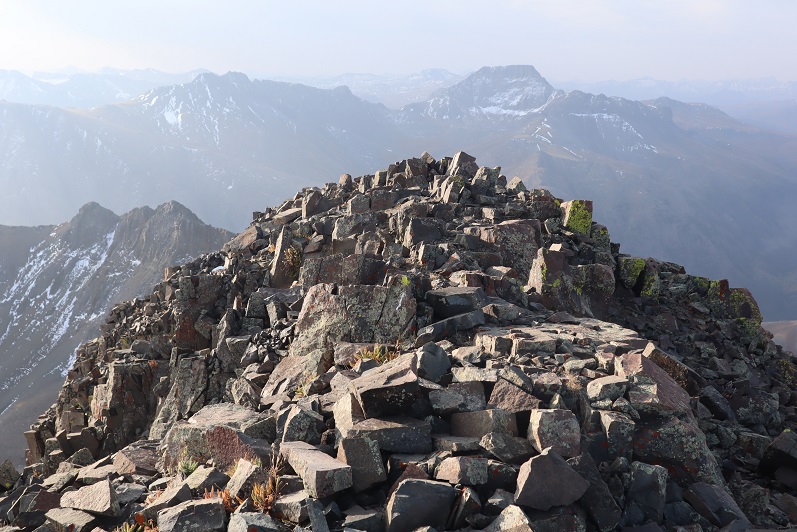
I summited PT 13795 at 8:20am. I only took 2 photos, and when I got home they were both terrible (oh well). 

PT 13795:

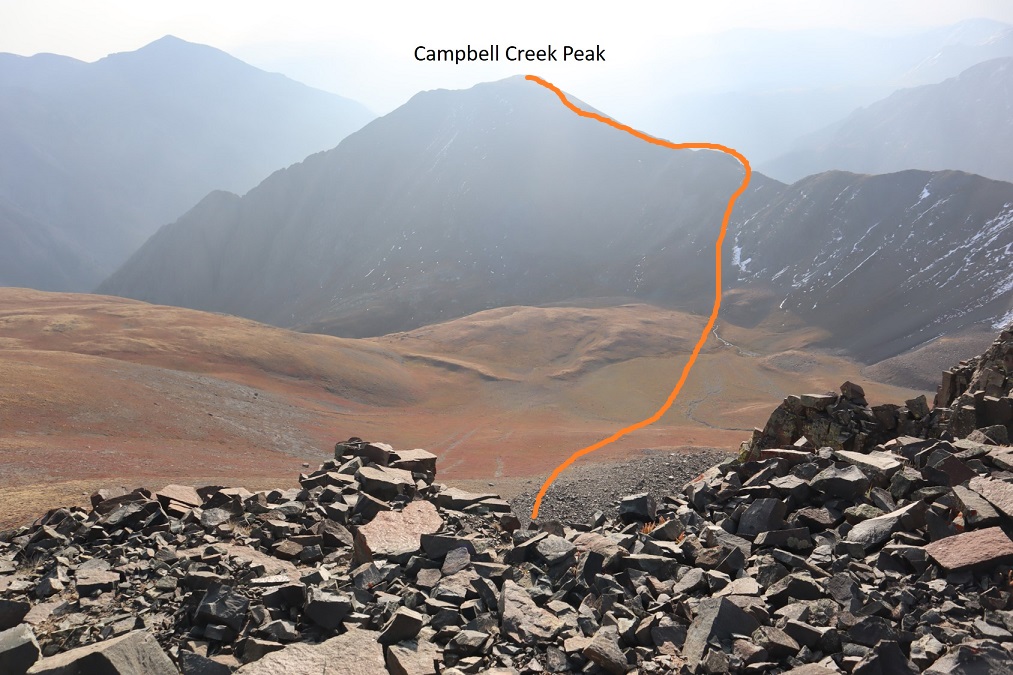
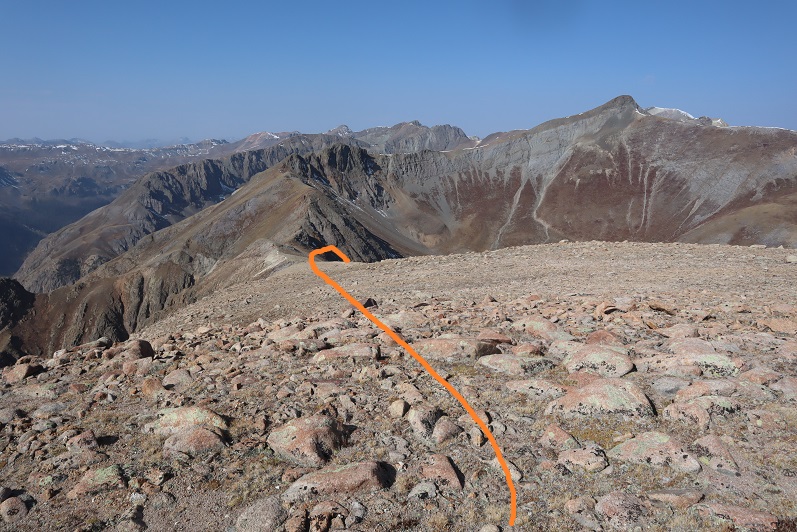
It was really hazy due to the fires, so I had a hard time getting a clear view of Campbell Creek Peak.  I’d heard the ridge between PT 13795 and Campbell Creek Peak didn’t ‘go’ so I was going to need to drop down into the basin and ascend another gully.  That gully didn’t look too bad.   Here’s the overall route I took

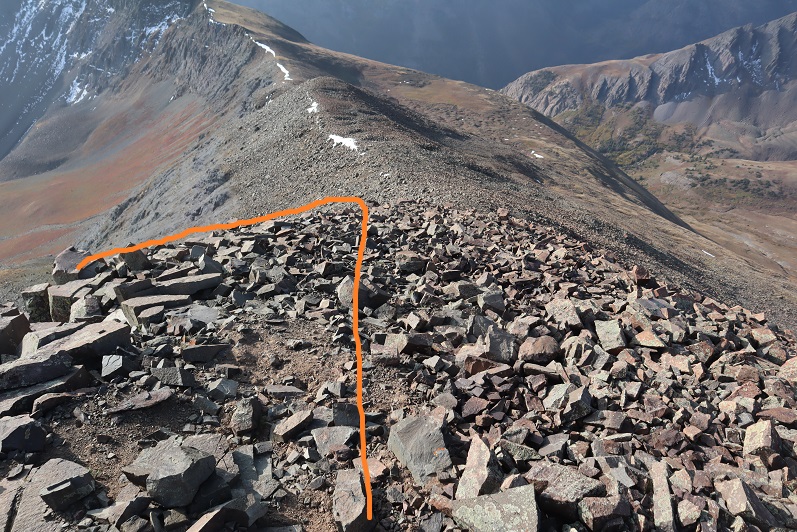
First heading south to avoid the class 3-4 section directly below the peak, and then east towards the basin

I just aimed for the stream, and then stayed to the left of the rock to gain the ridge

Here’s a look back at the route I took down from PT 13795 (it’s not as steep as it looks, but I was glad I’d hiked down this and not up)

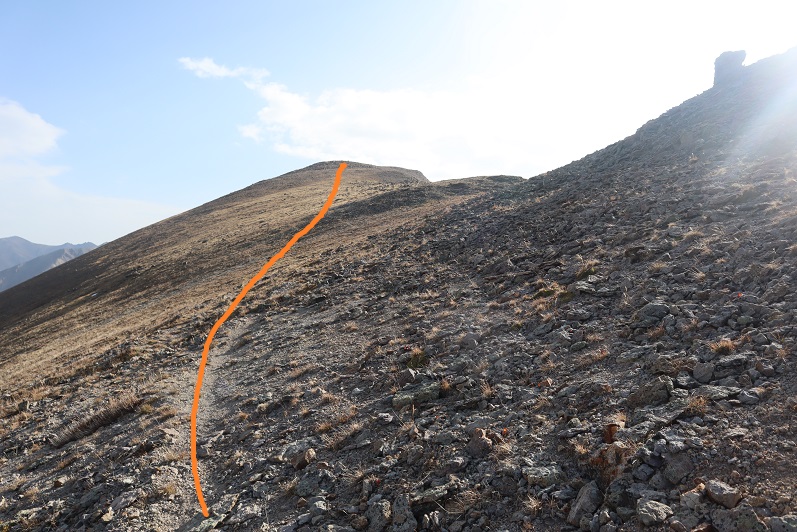
I followed the ridge northeast to the summit of Campbell Creek Peak

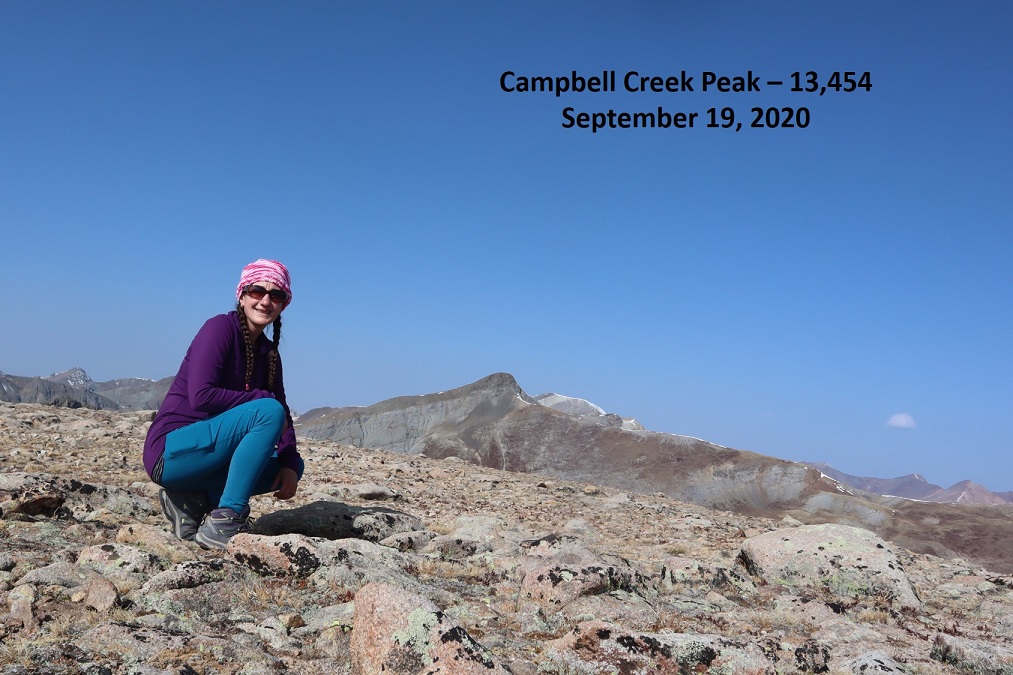
I summited Campbell Creek Peak at 9:45am

Campbell Creek Peak:

After summiting I turned around and headed back down the ridge and into the basin.

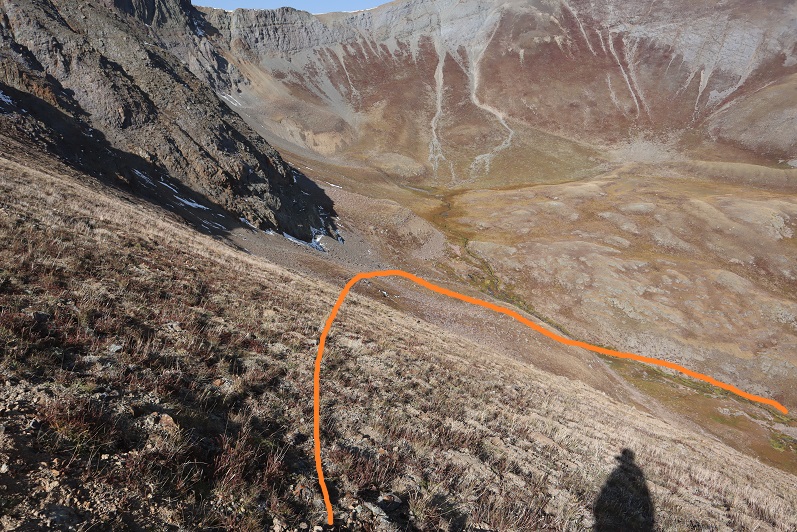
Once in the basin I turned right and followed Campbell Creek north.  I crossed the creek towards the end of the basin and picked up a faint game trail

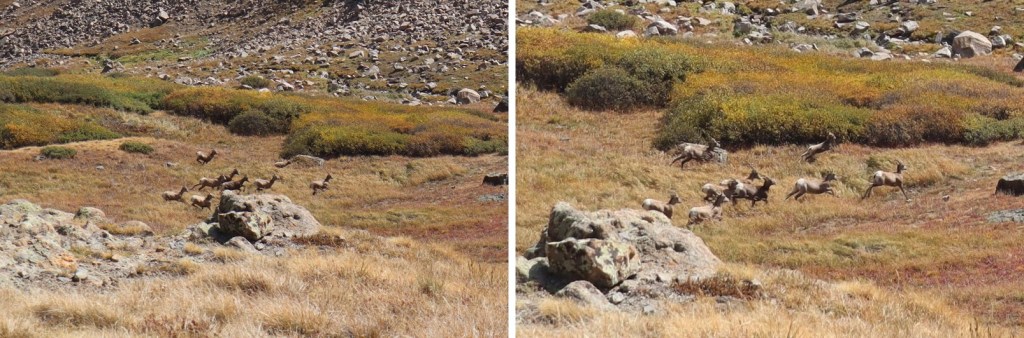
It was here I saw a herd of Bighorn Sheep.  They also saw me and quickly bounded away.

The game trail I was on kept disappearing and reappearing, so I decided to just follow the creek out of the basin

This led me to a large patch of willows.  I followed game trails northeast through the willows, around the side of the mountain

From here on out there was a lot of bushwhacking and route finding involved.  Luckily, I could see CR 30 in the distance, so I just kept traversing the side of the mountain, heading northeast and aiming for the road, slapping willows, bushes, and branches out of my way as I went. 

Eventually I came to a gully and followed it own to the Gunnison River, crossed the river on avalanche debris, and followed the road a mile back to the trailhead. 

Here’s a look back at the gully I came down

I made it back to my truck at 12:30pm, making this a 11.29 mile hike with 4559’ of elevation gain in 7 hours 15 minutes.

Oh, and I didn’t get a picture of the deer licking my truck, but there were obvious signs it had when I got back and saw it in the daylight.

Campbell Creek Peak was my 200th unique 13er.  Not a bad way to end a birthday weekend! 

Sheep Mountain – 13,168, PT 13,100, PT 13681 & Silver Mountain – 13,714

RT Length: 25.26 miles

Elevation Gain: 6689’

Ah, the thrill of changing plans. I like to check off a bucket list item for my birthday, usually involving a lot of effort or planning and mileage.  I was supposed to do the Rim to Rim Grand Canyon hike for my birthday, and due to COVID and the shuttles not running so my boyfriend was going to be my shuttle driver (with the east gate closed it’s now a 5 hour drive from one rim to another).  However, last week I broke up with my boyfriend.  After the breakup I gave myself a day to wallow, and then came up with a plan B (Plan C was Rim to Rim to Rim).  In the end I wasn’t able to hike Rim to Rim on my birthday, but I was able to find someone to shuttle my truck a week earlier (in exchange for a photo shoot along the way at both Horseshoe Bend and Ouray Via Ferrata… to be featured in his next book).  So instead I hiked Rim to Rim on September 12, and decided for my birthday I’d try to get in a long hike somewhere in the San Juan’s.  

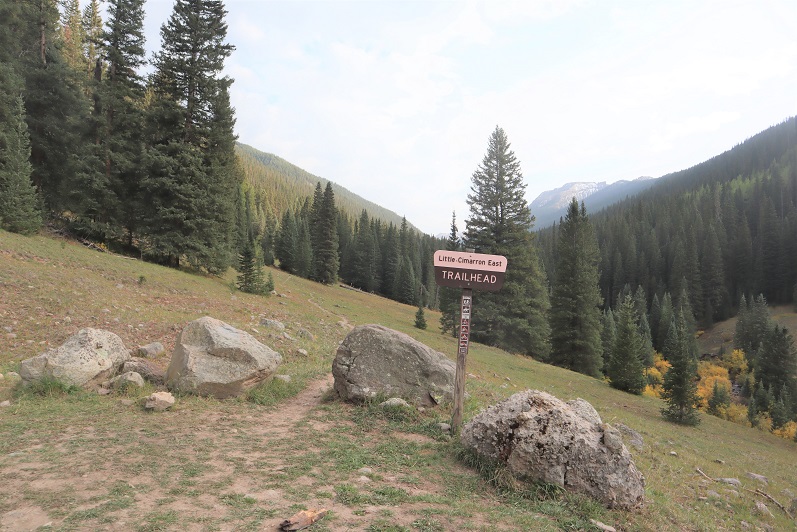
After birthday dinner with my daughters I drove to the Little Cimarron East trailhead and parked for a few hours sleep.  This is a 2WD drive on a dirt road.  There was space for 2 vehicles at the trailhead, but it looks like you can park along the road as well if needed.   Side note:  This trailhead is much preferred to the Nellie Creek Trailhead approach.  Hands down. 

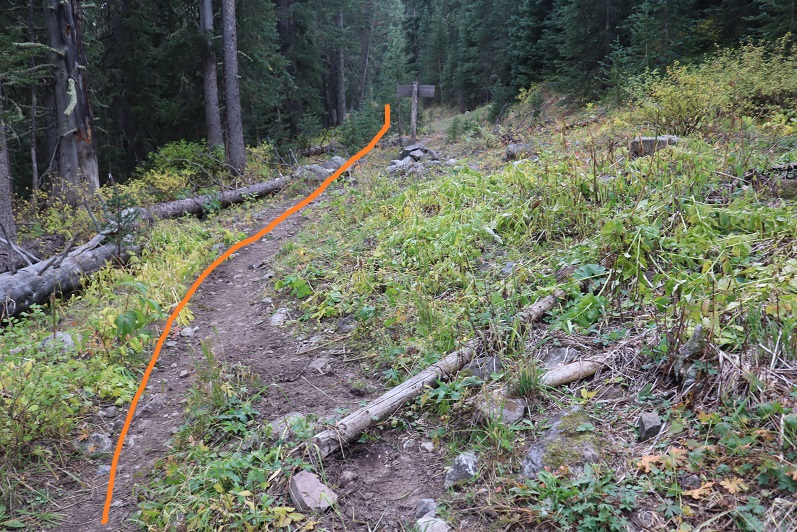
I got in a few hours sleep and was on the trail at 4:30am.  This is a class 1 trail (at least until the first stream crossing) that looks like it used to be a 4WD road. 

After the stream crossing there’s a junction.  Continue straight.

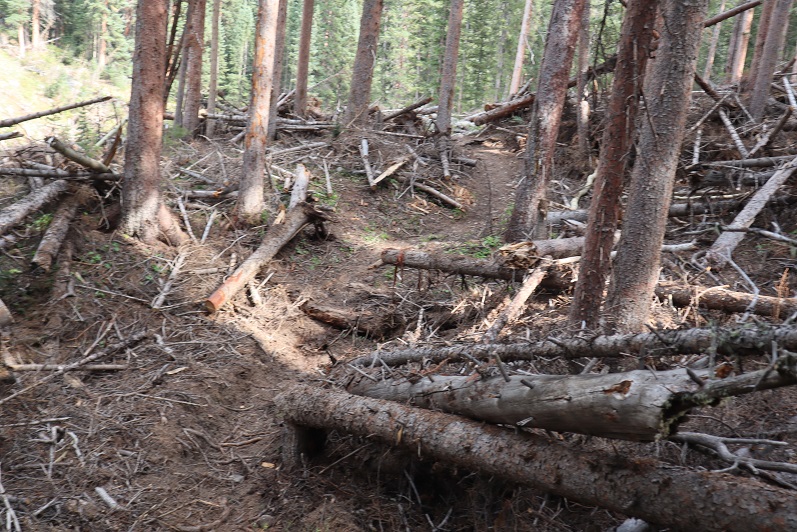
The trail goes through an avalanche area but a clear path has been established. 

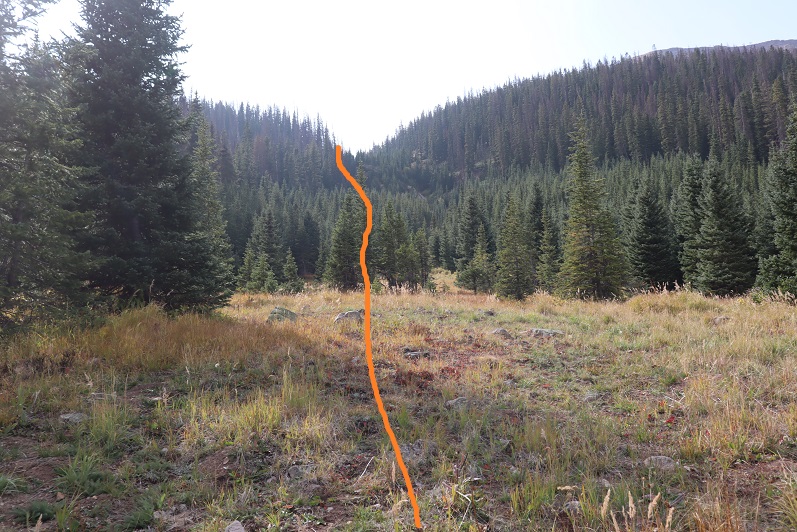
After hiking for 5 miles (exactly) I came to a small meadow.  Here I left the trail and headed west, staying to the left of the gully, but following it up.

I eventually picked up a faint trail.  There were a lot of game trails in the area, so I kept losing then re-finding the trail. 

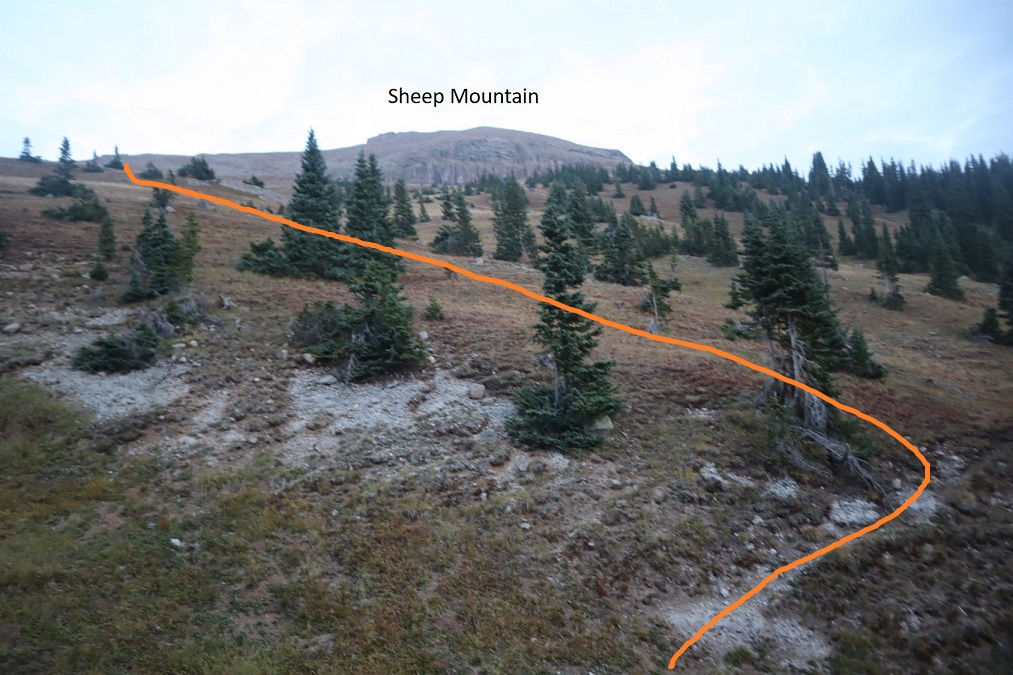
When I hit treeline I crossed the gully and headed left and northwest up the side of the mountain

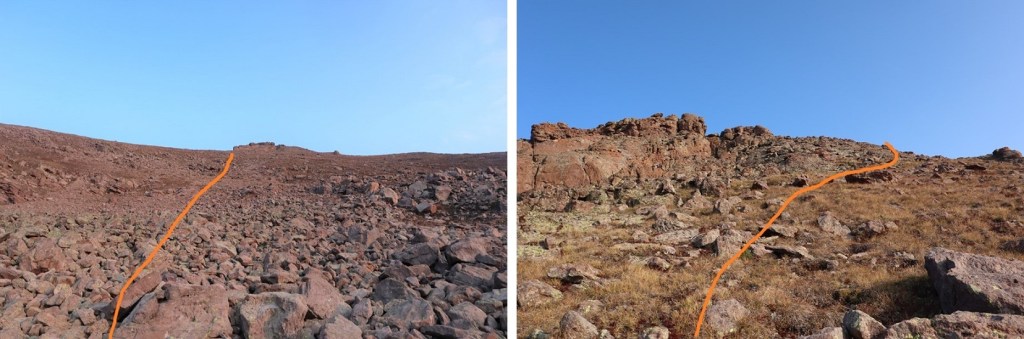
The rest of the hike to the summit of Sheep Mountain was fairly straightforward.   Here’s the route I took, staying to the left of the cliffs

Once on the ridge I skirted the rocks to the right to keep this class 2

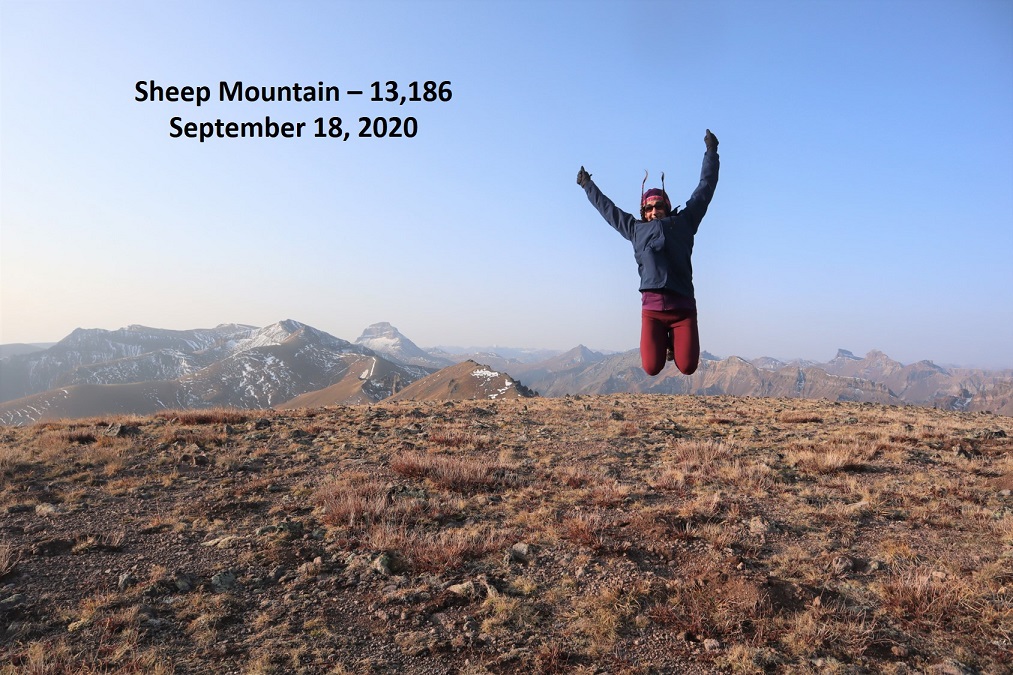
I summited Sheep Mountain at 7:55am.  The summit was wide and flat and it was my birthday, so I decided to jump for the photo.

Sheep Mountain:

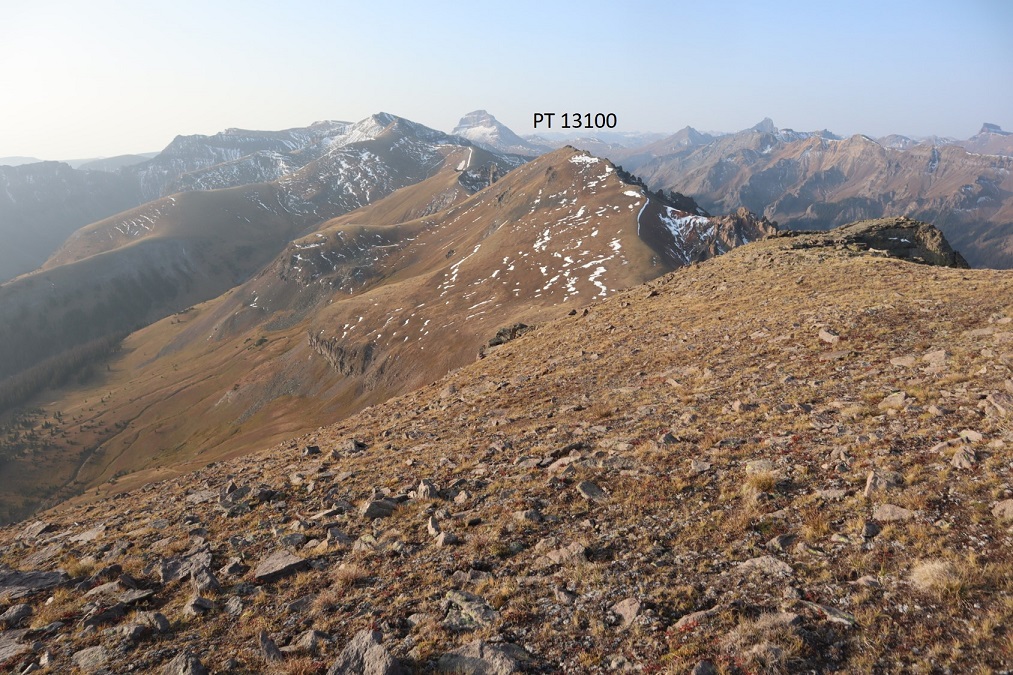
I was making this a ridge hike today.  Next on the agenda:  PT 13100.  I turned and followed the ridge south

This was an easy class 2 ridge to follow.  As times I stayed left to avoid rocks. 

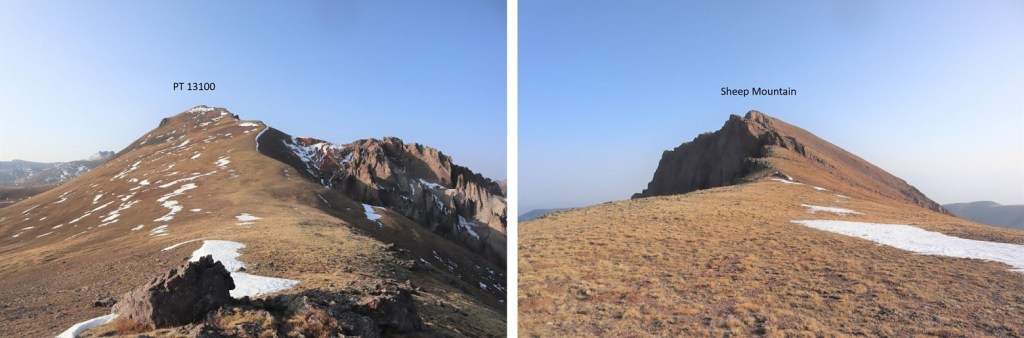
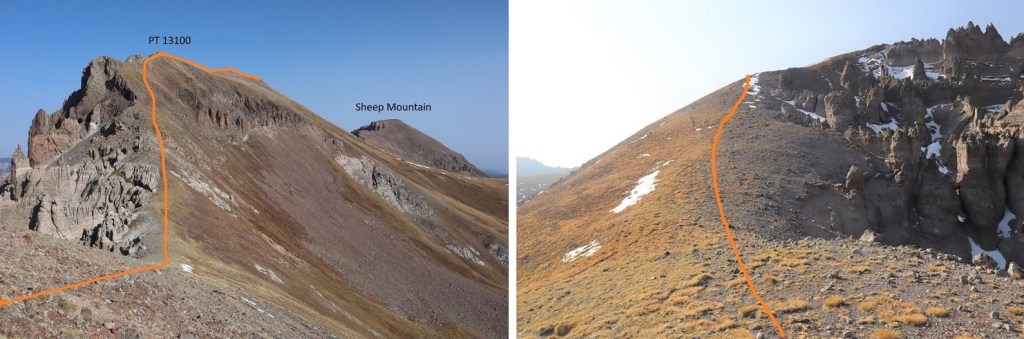
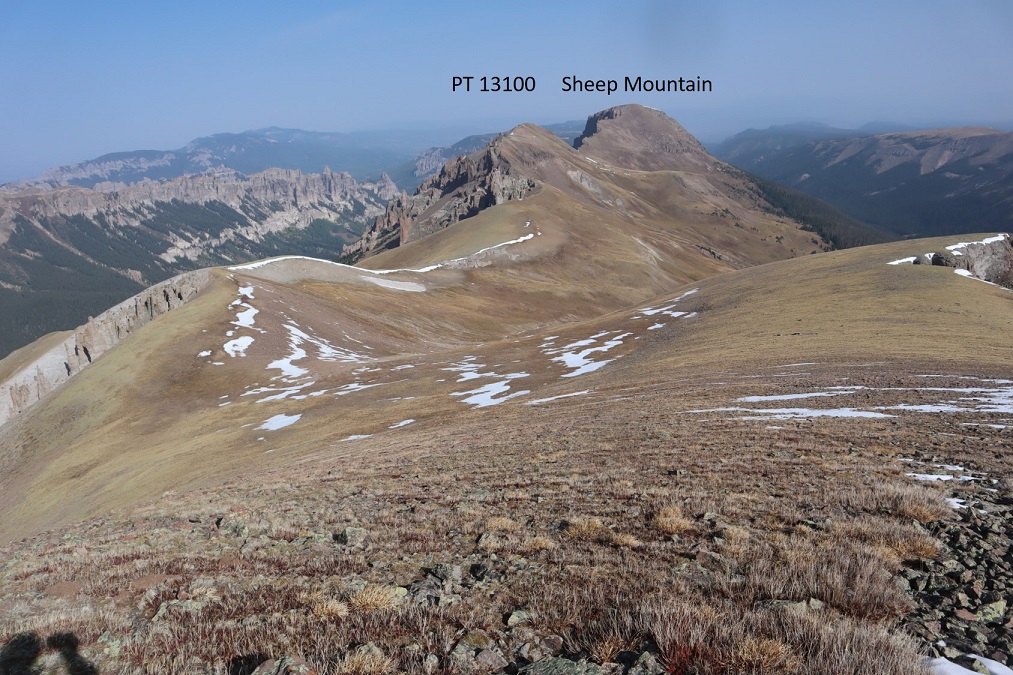
From the saddle, here’s looking up at PT 13100 and back at Sheep Mountain

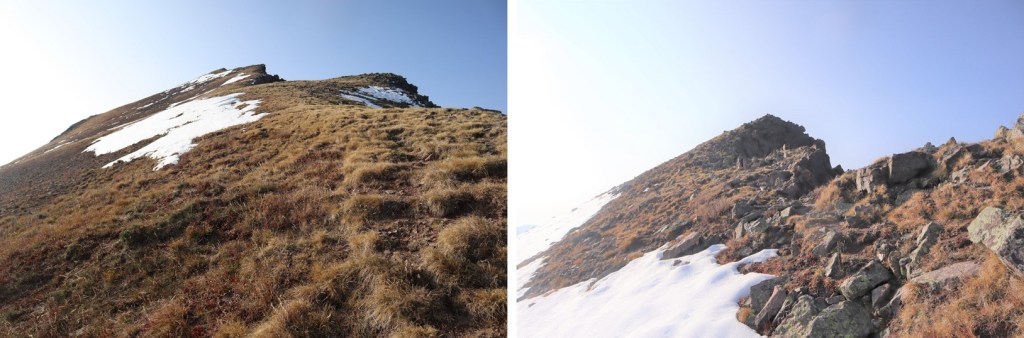
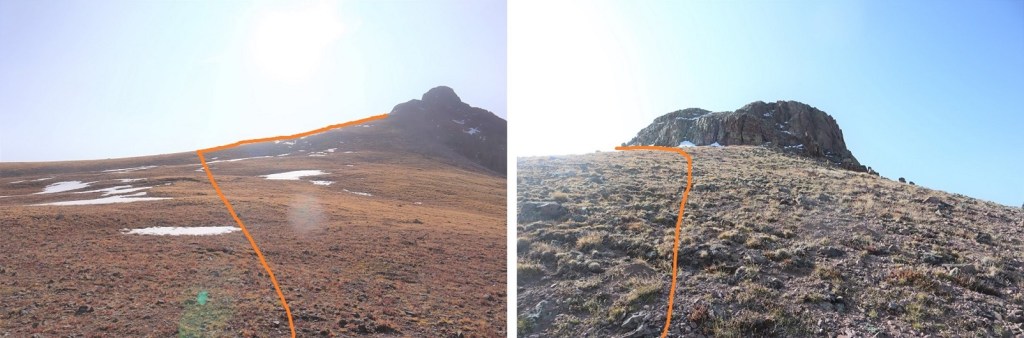
It was a simple ridge hike up tundra until the very end.  Then the terrain became rock and it was difficult to tell where the actual summit was, so I followed the entire ridge.  I spied a cairn and I considered the cairn the summit.

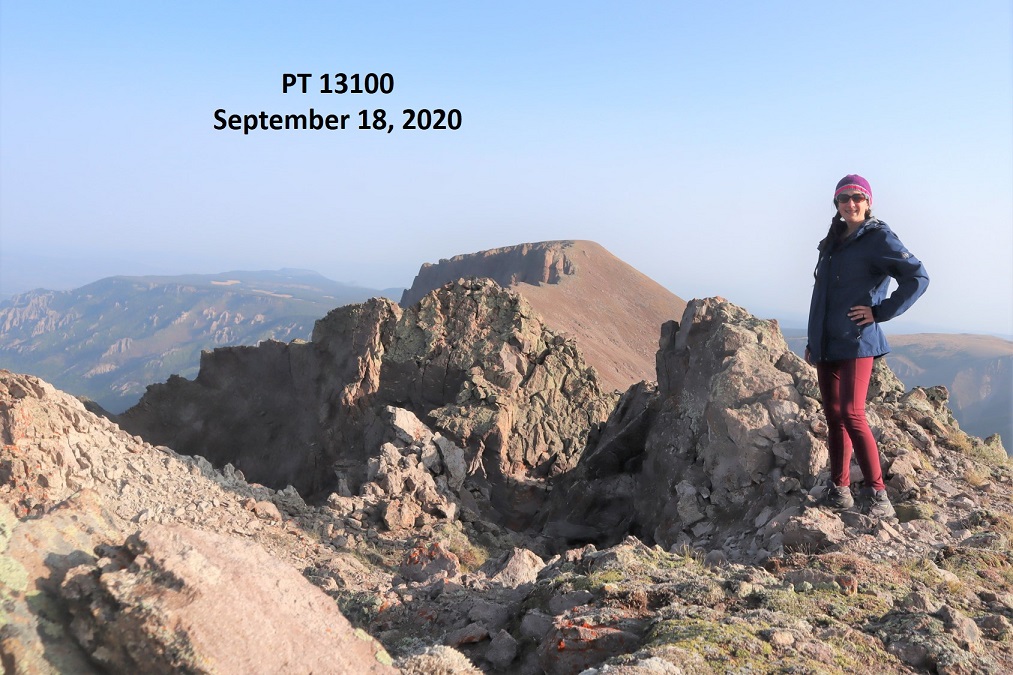
I’ve circled the summit cairn in red (although the rock outcropping certainly felt/looked the same height)

I summited PT 13100 at 8:50am

PT 13,100: 

Next up was PT 13,681.  Once again, I followed the ridge south

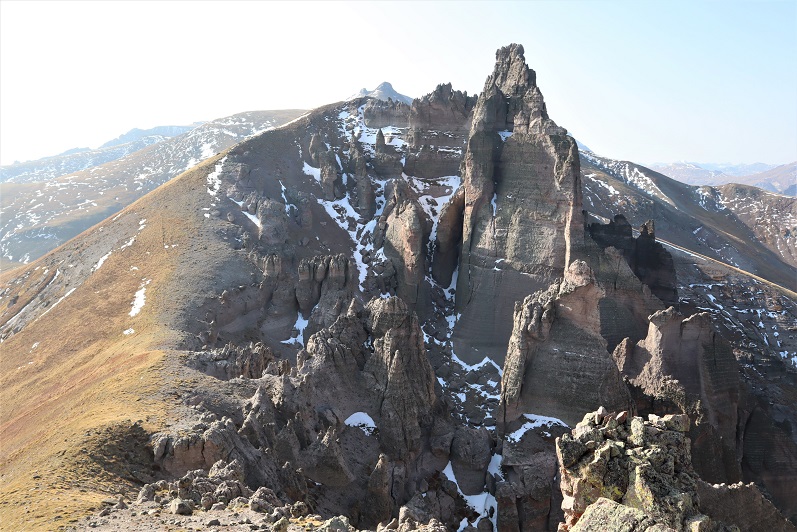
The volcanic ash towers at the saddle were pretty cool!

From the first saddle, here’s looking back at PT 13100 and Sheep Mountain, along with my route, and a look up the ridge

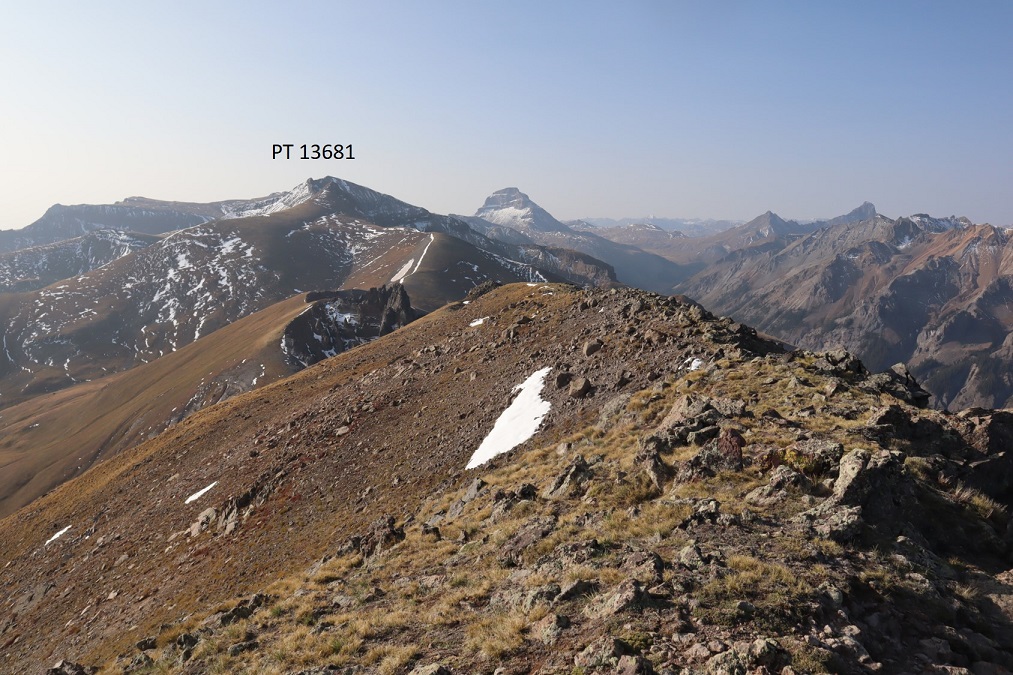
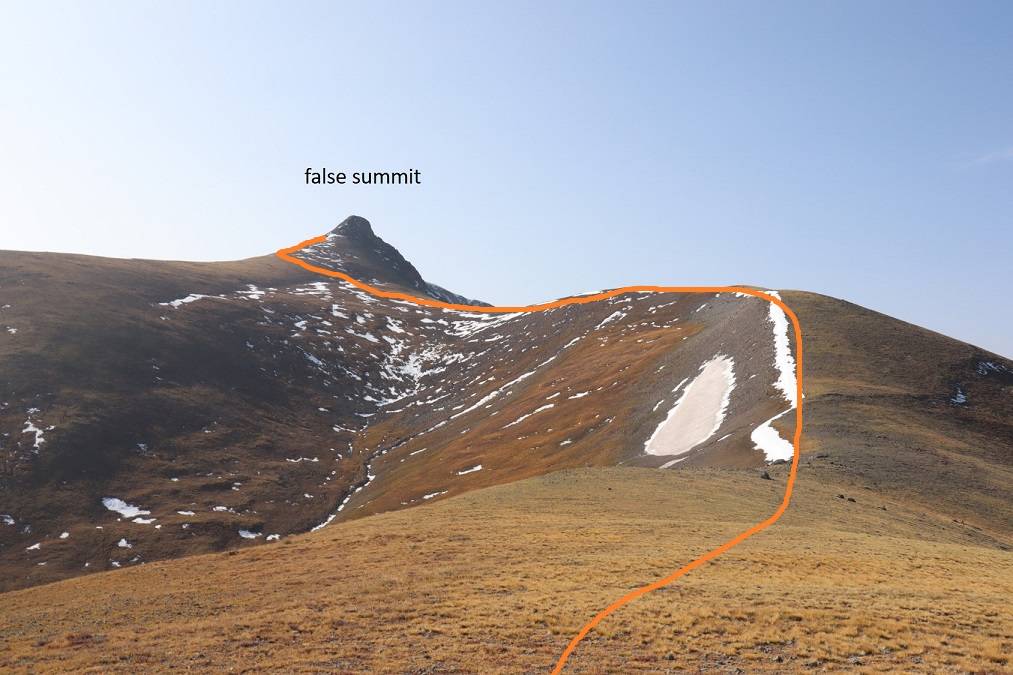
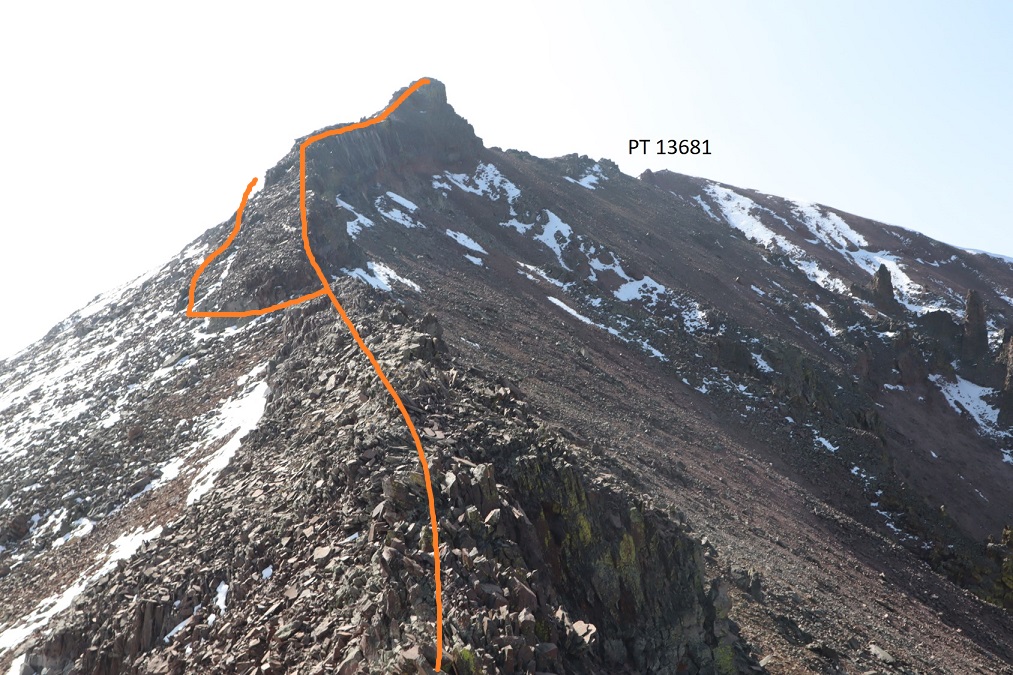
I followed the ridge to the false summit of PT 13681

When I made it to the ridge, instead of climbing the false summit I stuck to the left, keeping this class 2

Here’s a look back from the ridge

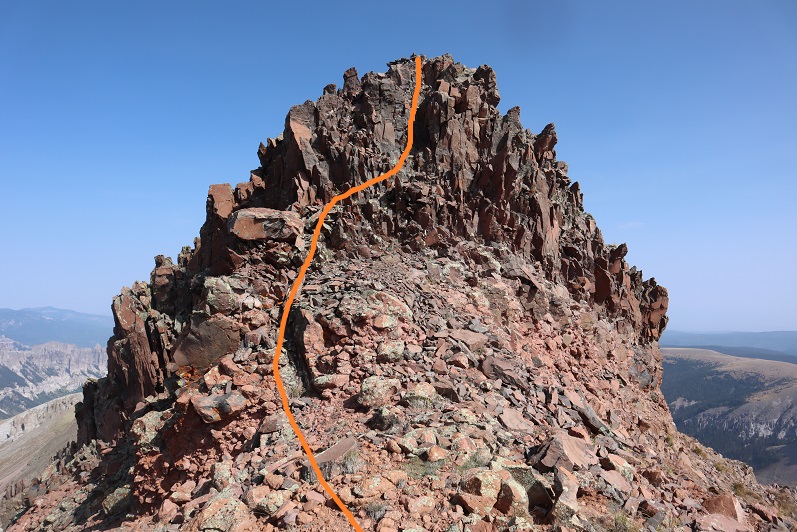
After skirting the false summit to the left I could see PT 13631.  I stayed low until I made it to the saddle, and then stuck to the ridge until I hit the second false summit

From the saddle, here’s looking back at how I skirted the bump

From here I took the ridge straight up and over, making this class 3.  You can keep it class 2 by going to the left and skirting the ridge.  They both end up in the same place.

A view from halfway up the ridge

If you go over the ridge, this is the downclimb (still class 3, not as bad as it looks)

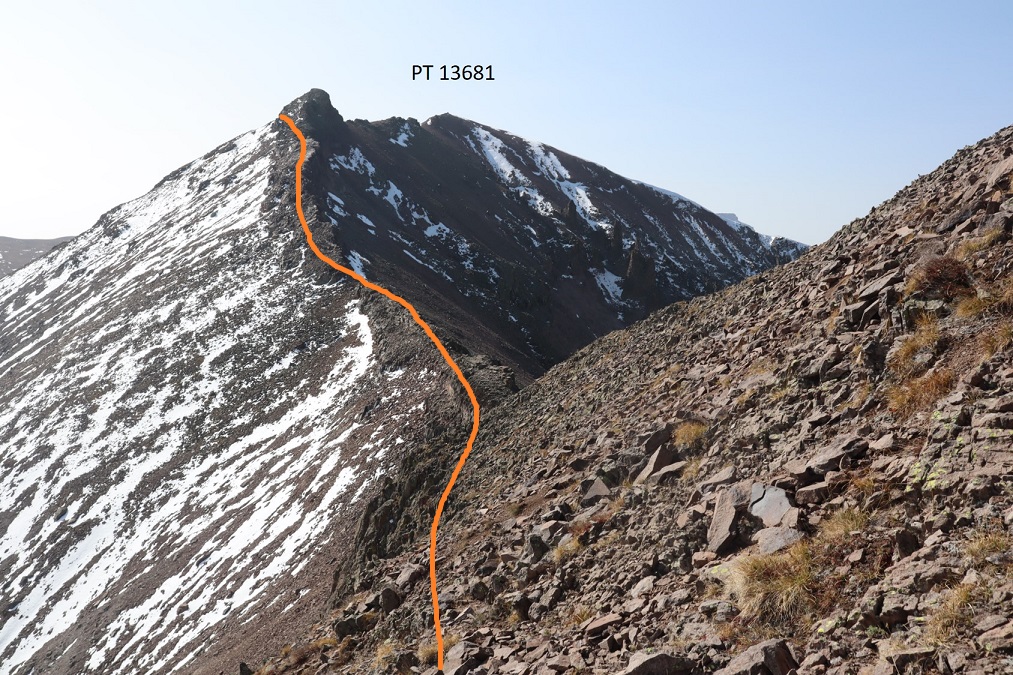
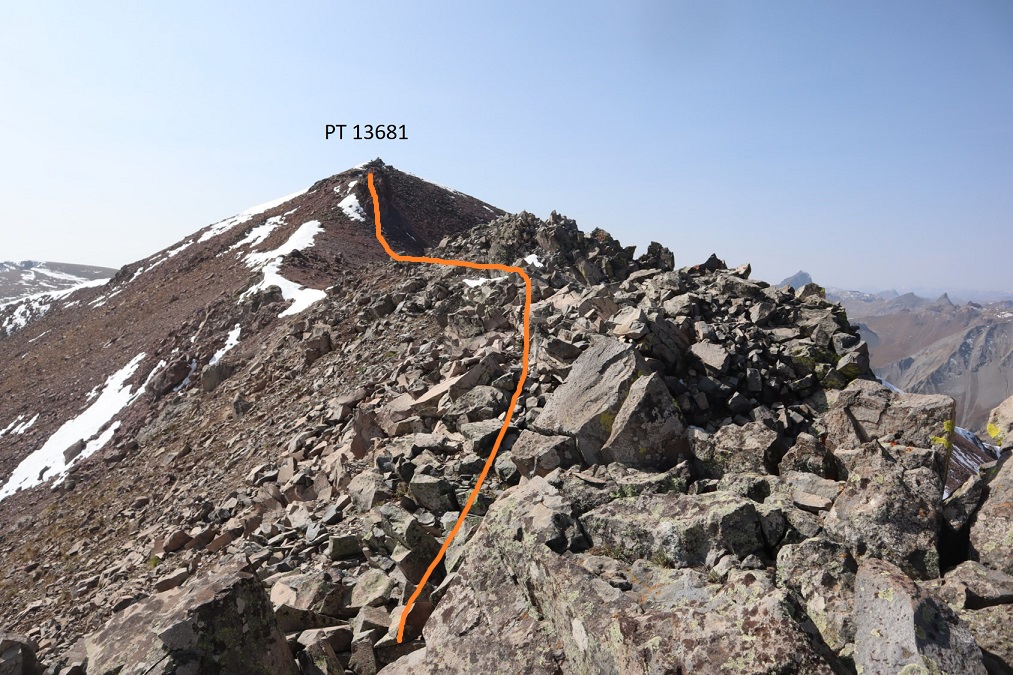
And here’s the rest of the class 2 route to PT 13681

I summited PT 13681 at 10:45am

PT 13,681:

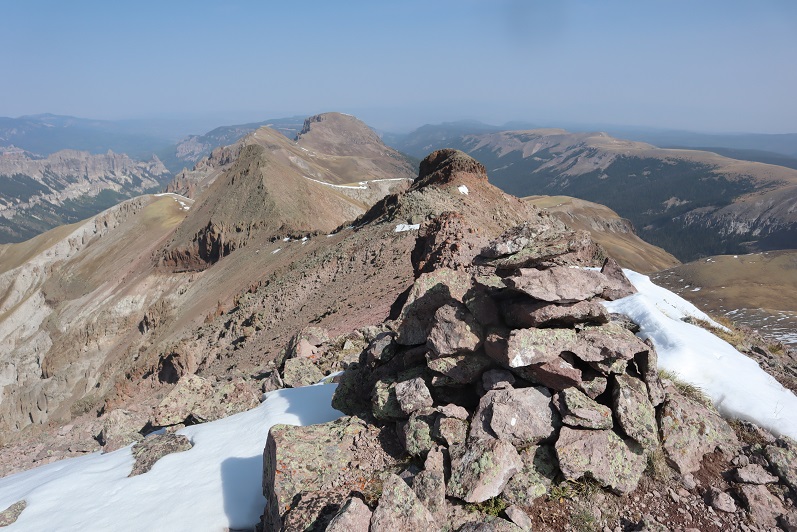
Here’s a look back on the route so far

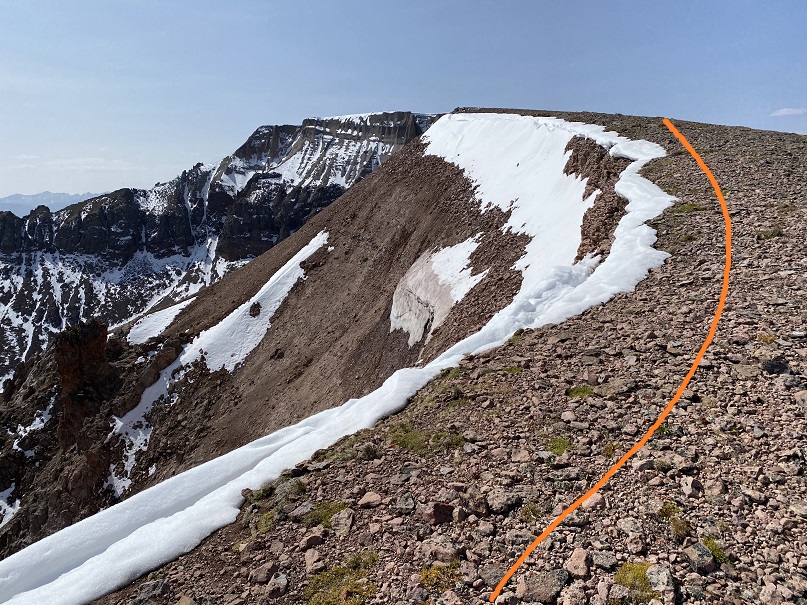
And a look at the route to Silver Mountain. The rest of the way was a simple tundra ridge walk

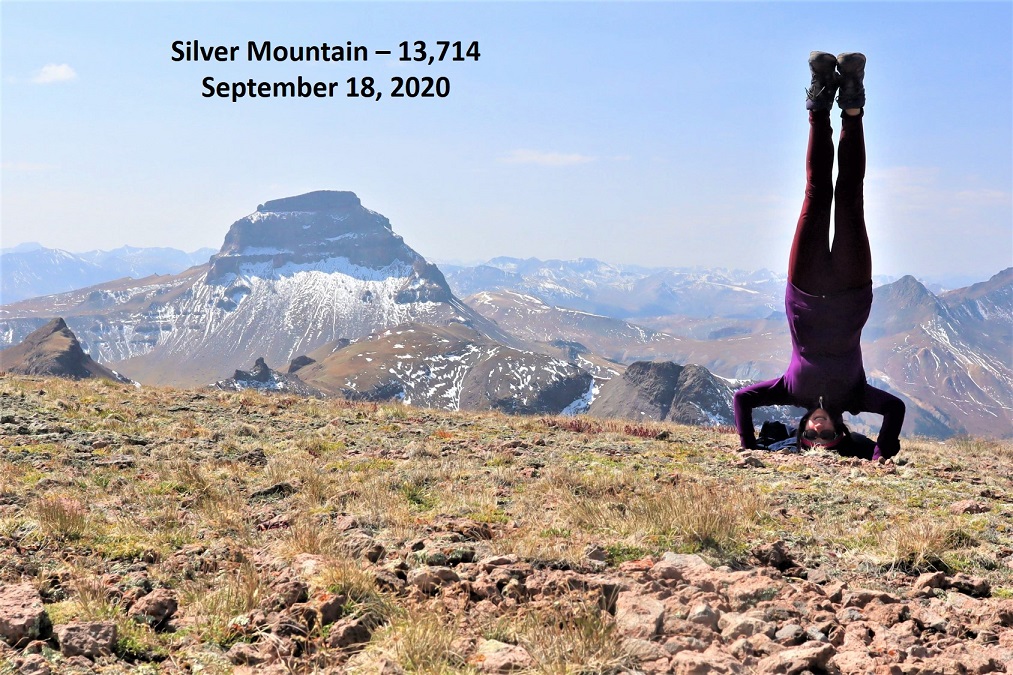
I summited Silver Mountain at 11:35am, and since it was my birthday (my 40th!) I kept my tradition of standing on my head because I still can.  Also, this is harder than it sounds, as I had to set up the automatic timer, get far enough away from the camera and then actually do the headstand before the camera took the picture. 

Silver Mountain:

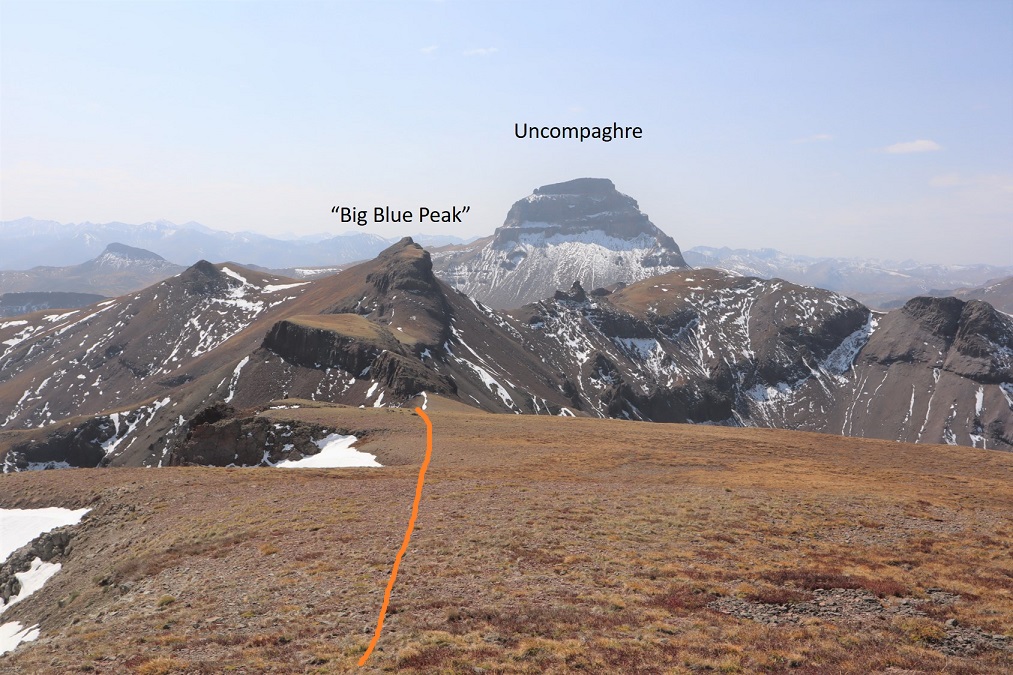
Now to head back down.  I had several options, but chose this one because it looked easier on a topo map (it most likely wasn’t).  I continued south along the ridge to the Silver Mountain/Big Blue Peak (unranked) saddle.

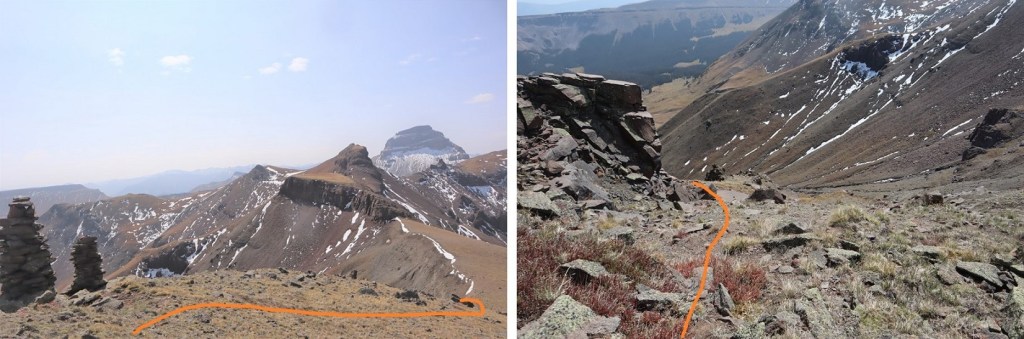
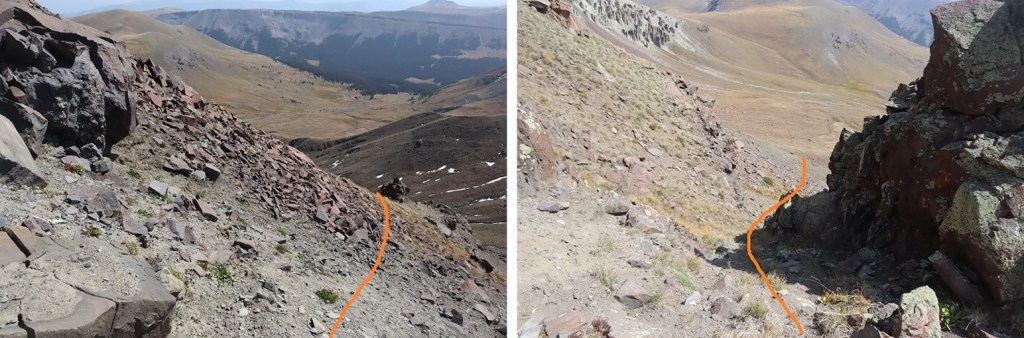
After passing the two large cairns, I continued a bit further down, turned left, and headed east down the gully

My goal was to link up with the Fall Creek Trail.  Here you can see it to the right.  However, I didn’t want to lose too much elevation, so I took a game trail up high to the left (they both link up on the other side of the hill).  I lost just over 1000’ of elevation here, and gained under 200’ by staying high to the left.

Once at the top of the hill I figured my elevation gain was over for the day.  Boy, was I wrong!  I dipped down once again, losing another 400’ of elevation, only to gain another 500’ of elevation to make it to the next ridge.  I was following the Fall Creek Trail, then switched as I stayed high on the Little Cimarron Trail, but this trail doesn’t look like it gets used much by people.  There are many game trails in the area that parallel this one, and they make route finding frustrating at times.  Here’s the overall route:

Once I’d regained the ridge it was a nice 2 mile tundra walk on a fairly visible trail.  Side note:  It’s hunting season, and the elk are bugling.  Advice to hunters:  Practice using your bugle call BEFORE trying it in the wild for the first time. I heard some pretty funny noises coming from what were obviously hunters and not elk. 

At exactly 2 miles of mesa walking, and just before reaching this old shack I turned left and headed west.  Here the trail pretty much ended.  There were 2 cairns in the area (which surprised me, the first I’d seen all day), so I just kept aiming for the valley below, where I knew I’d pick up with the trail I’d hiked in on. 

I had a good view of the path I’d taken up to Sheep Mountain that morning

Gradually, the Little Cimarron Trail became more visible, as I followed it towards the creek below.

I crossed the Little Cimarron River (more of a creek now)

And headed north, easily picking back up the trail

I stayed right this time at the junction between the Little Cimarron Trail and Little Cimarron East Trail, crossed the stream again, and followed the trail back to my truck.  Along the way I saw a dad holding a rifle and two daughters, both under 10 years old, sporting camo and bright orange hunting hats.  They were the only other people I saw all day.  The girls had big smiles, and looked thrilled to be camping/hunting with their daddy. 

I made it back to my truck at 5pm.

This was a 25.26 mile hike with 6689’ of elevation, completed in 12.5 hours.  Here’s a topo of my route. 

Not a bad way to celebrate my 40th birthday!  On to the next trailhead!

Milwaukee Peak – 13,526 and Pico Aislado – 13,621

RT Length: 13.7 miles

Elevation Gain:  4500’

We go family camping with the Girl Scouts every Labor Day weekend, and every Labor Day weekend I spend one of the 4 days hiking.  I left the campsite at 1am, intent on driving up to Music Pass trailhead early in the morning when there weren’t any other vehicles on the narrow 4WD road.  Just my luck, around 3:30am I ran into a rather large Ram 3500 truck, carrying a trailer in the bed, coming down the road.  It took us about 20 minutes to find a way around each other.  Luckily, I only had the one truck to pass.  The trailhead was full of trucks however (lots of hunters). It was earlier than expected so I took a quick nap and was on the trail at 5am.  

The trail starts at the west end of the parking area, and heads west.

There’s a trail register shortly after the trailhead. 

The trail here is easy to follow

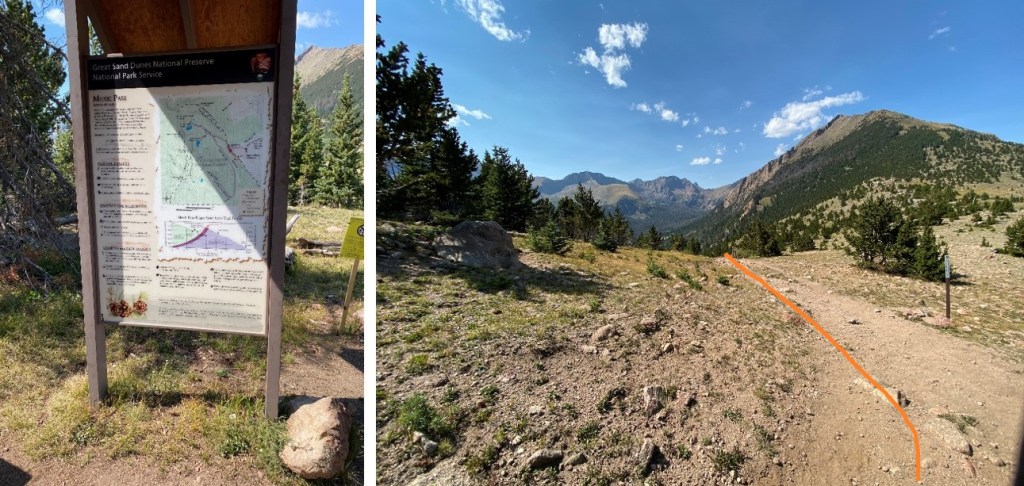
I made it to Music Pass after hiking for 1.25 miles, and realized I’d forgotten my camera (so, sorry, selfies with my iPhone once again today).  There’s an information sign here, and another trail register.  Last time I opened this register 50 moths frantically flew in my face, so this time I left it closed. 

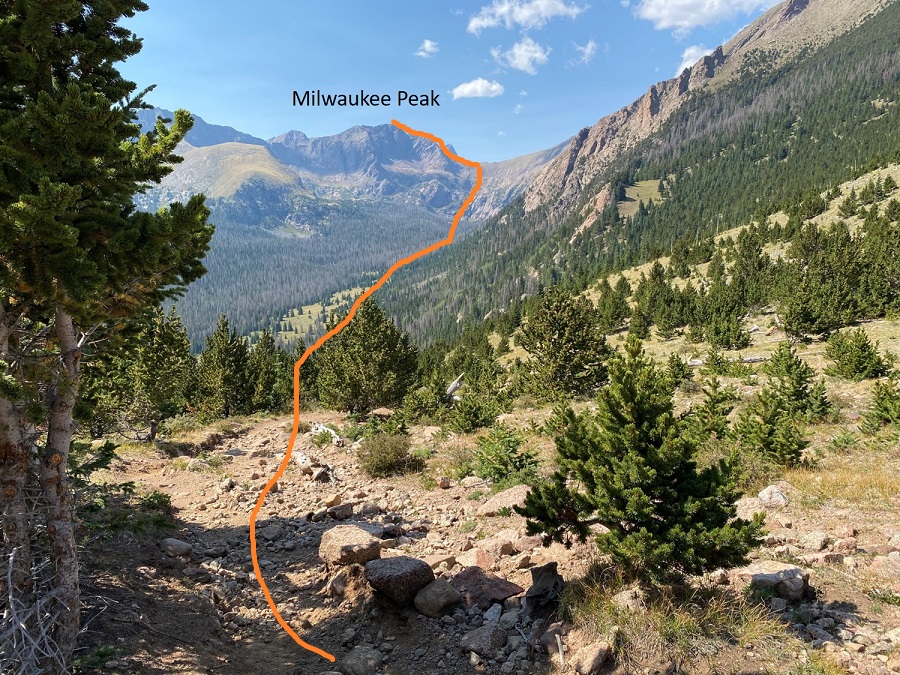
From here I followed the trail as it lost 450’ of elevation and headed northwest along Sand Creek Trail 1337.  Here’s an overview of the route towards Milwaukee Peak

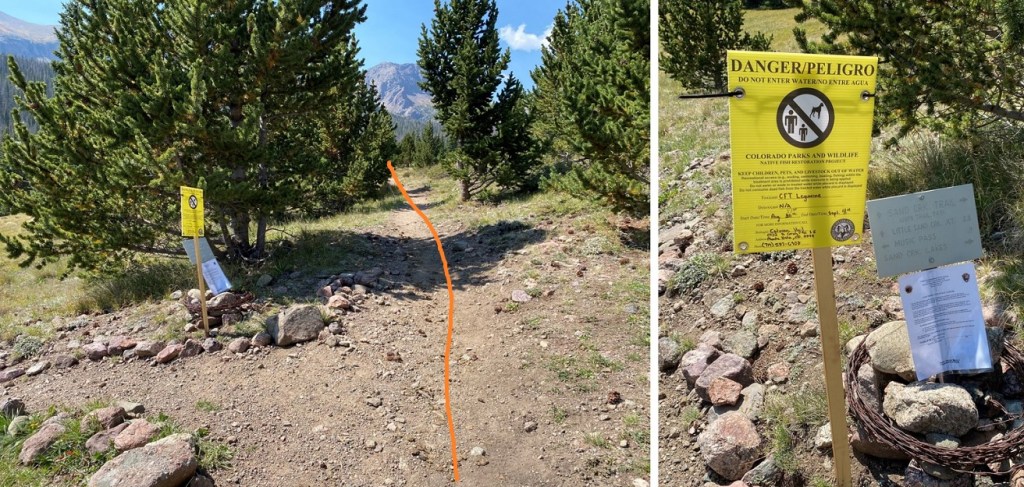
And step by step, first descending into the basin.  I continued straight at this crossing.  Note, there were signs saying not to enter the water, as they were being treated to remove all fish from the drainage.

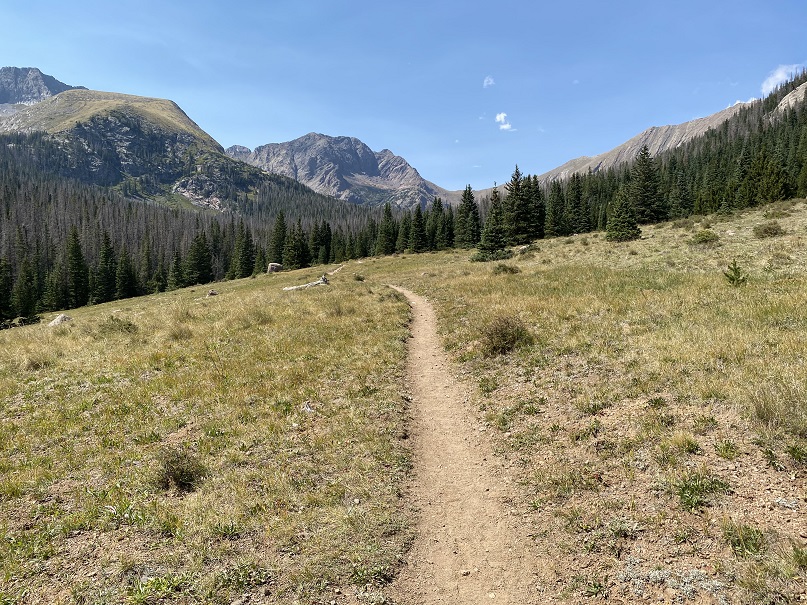
I followed Sand Creek Trail

Staying right at the second junction

Crossing a stream at 11420’

The last junction I came to was for Upper Sand Creek Lake and Cottonwood Pass.  I turned right and headed towards Cottonwood Pass

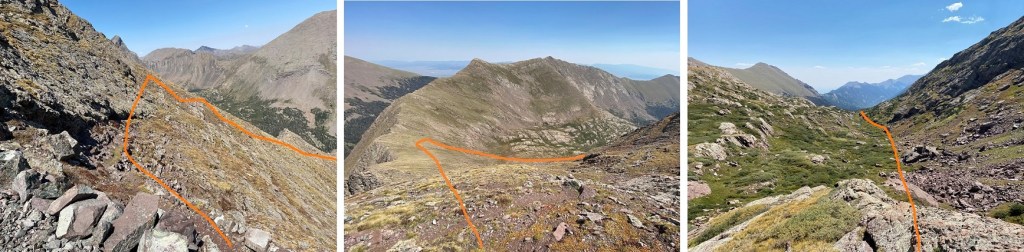
The trail continued through the basin.  Eventually I was going to have to find a grassy ledge and follow it to an upper basin. Here’s that ledge I’d be aiming for

But before that I had to make my way across several small streams

There was evidence of the fish kill in the streams, as well as tons of dead worms; and bear tracks

I came to a sign that said the trail ended, and told me to follow the cairns.  The cairns were extremely helpful, but I did get lost crossing the final stream.  I couldn’t figure out where to do it, but it was obvious on my way back.  If you (like me) aren’t able to completely follow the cairns in the dark, cross the stream and head northwest up the side of the mountain and you’ll eventually hit the trail, as it will become obvious.

The trail weaves through the forest towards a grassy ramp that leads to the upper basin

Once in the upper basin the trail ends, but there are many great cairns that will lead you to the saddle.  The ‘trail’ stays to the left.

At the end of the basin the goal is to ascend to the saddle.  There are cairns that will get you there.  This is the basic route

At the saddle the trail picks up again.  I turned left and headed southwest along the trail, rounding the north side of Milwaukee Peak.  Here’s an overview

And from the ridge, rounding the corner

Once I’d rounded the corner the real fun began.  Now’s a good time to put on your helmet if you haven’t already.

Here’s an overview of the rest of the hike

And step by step.  Here’s the first big obstacle. I went down here

And came to a notch with a class 4 rock to climb.  This isn’t more than 8-10 feet high.  There are plenty of hand and foot holds here.  Make sure to ascend to the left

Here’s another look at the notch from a different angle.  This is how you want to ascend/descend

Once past the notch there was a narrow ledge to traverse, with a large drop off.  I was toe-heeling it across this area and leaning into the mountain.  This would not be a fun place to slip.

Next, I aimed for this notch (stop at the notch, don’t go past it)

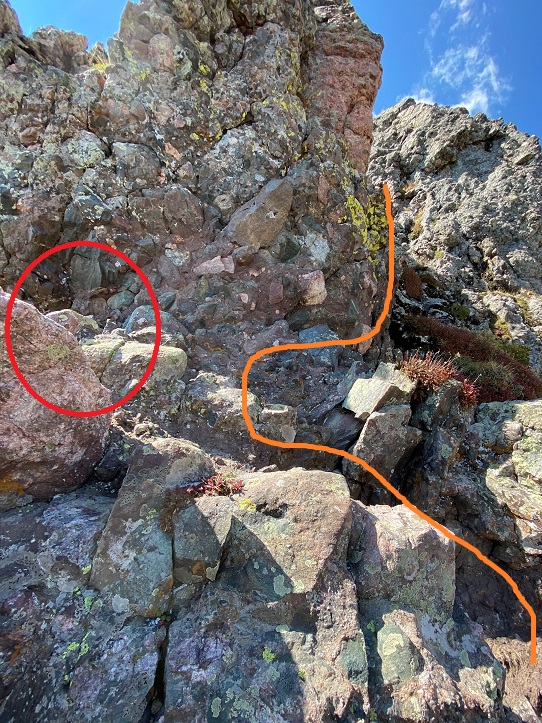
At this notch there’s a boulder a couple feet wide blocking the path.  It’s easy to hop over, but don’t.  This is your indication to ascend the gully.  I’ve circled where the is rock in red


Here’s another view. In this picture the rock is circled on the left, and this is how you enter the gully

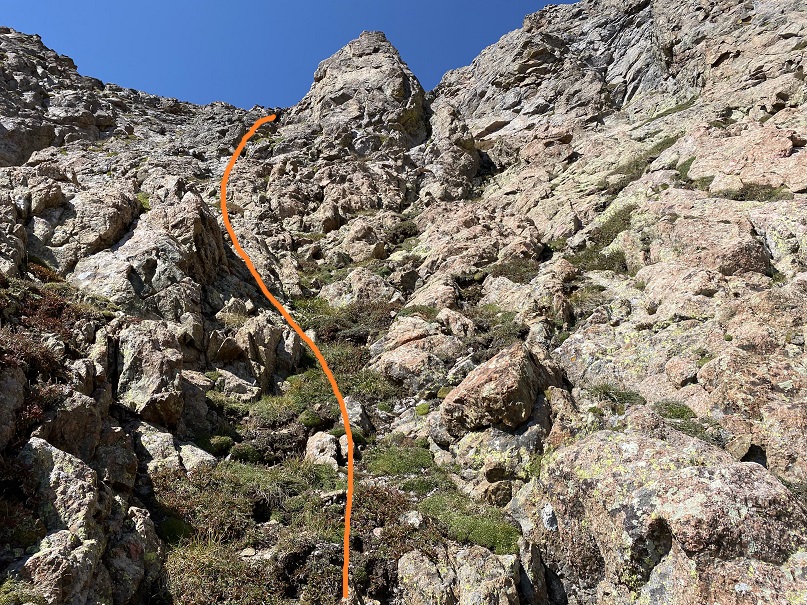
Here’s what the gully looks like

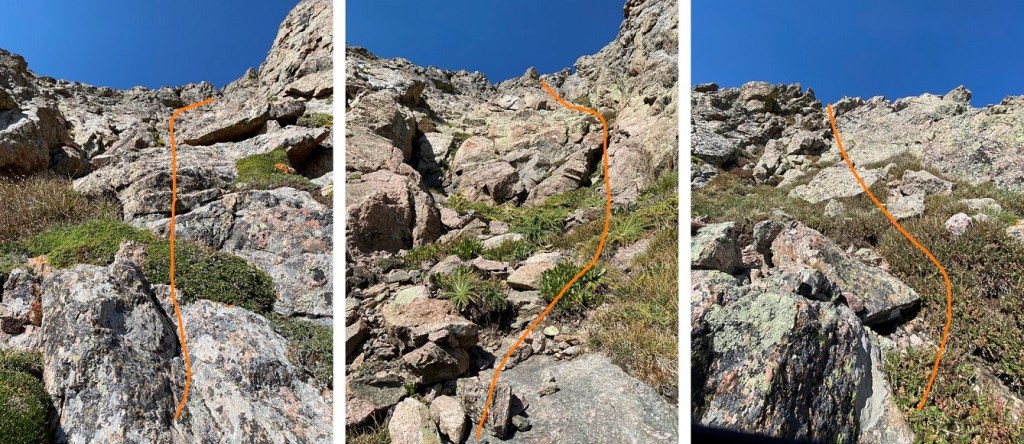
And here’s topping out of the gully

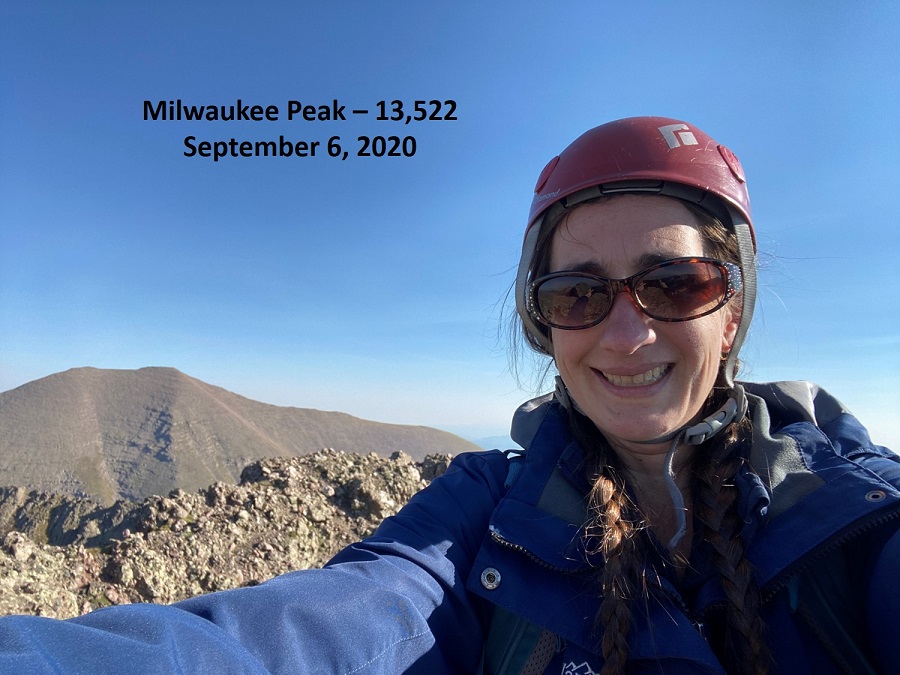
From there it’s an easy (if airy) traverse to the summit.   I summited Milwaukee Peak at 8:55am

Milwaukee Peak: 

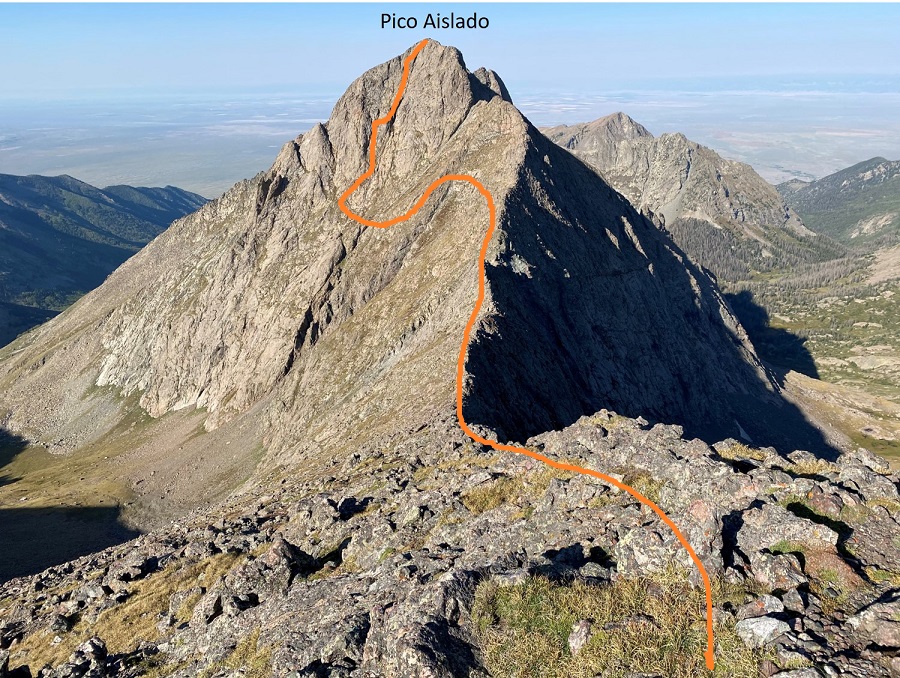
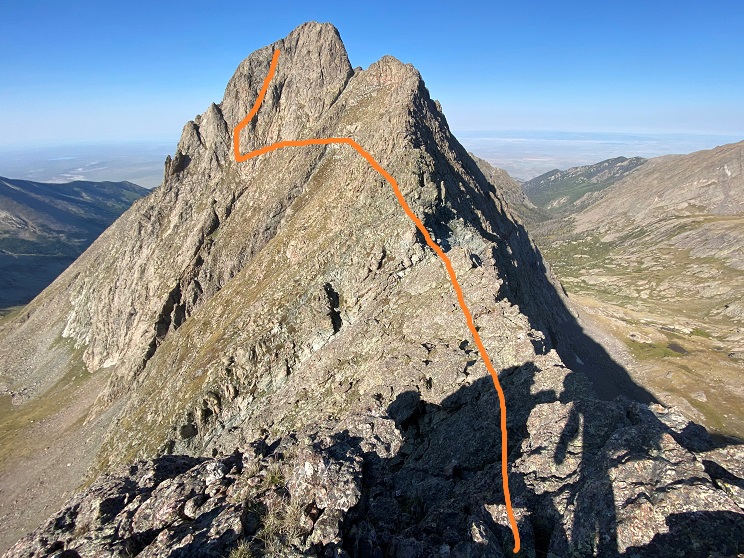
From the summit of Milwaukee here’s the route over to Pico Aislado (which means ‘Isolated Peak’ in Spanish).

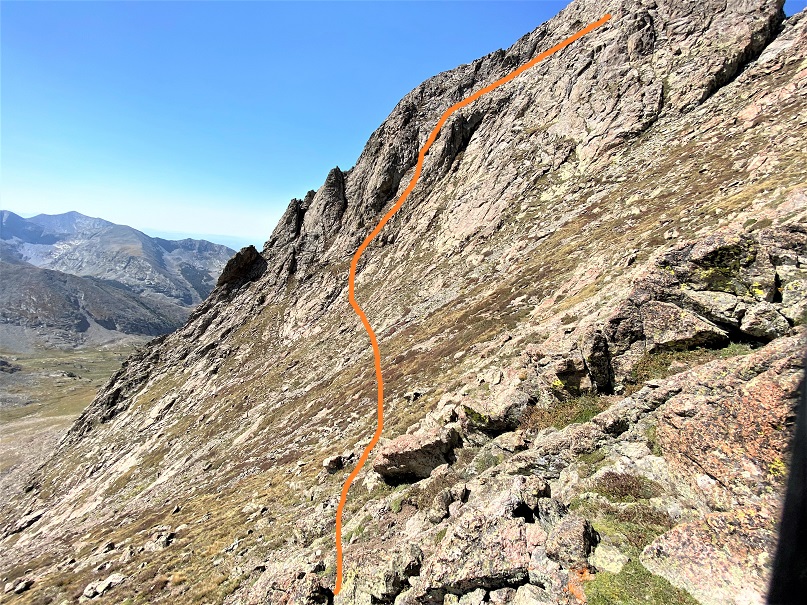
In the beginning I could just stick to the ridge (better pictures of some of the obstacles here on the description of the way back, but they all stay at class 3).  There were some ups and downs but nothing too difficult.  At the ‘saddle’ this is the path I took, staying low, keeping under the rock line.  There’s no need to stick to the ridge here, as you’ll end up losing elevation later.

Take note of the ‘cairn’ I’ve circled here.  You’ll be aiming for it later.  (It’s not actually a cairn, but it’ll look like one from below).

I came to the last gully on this side of the mountain, turned right, and kept to the left as I ascended. 

I kept aiming for where that circled ‘cairn’ was.  As soon as I found it, I turned right and followed the ridge to the summit

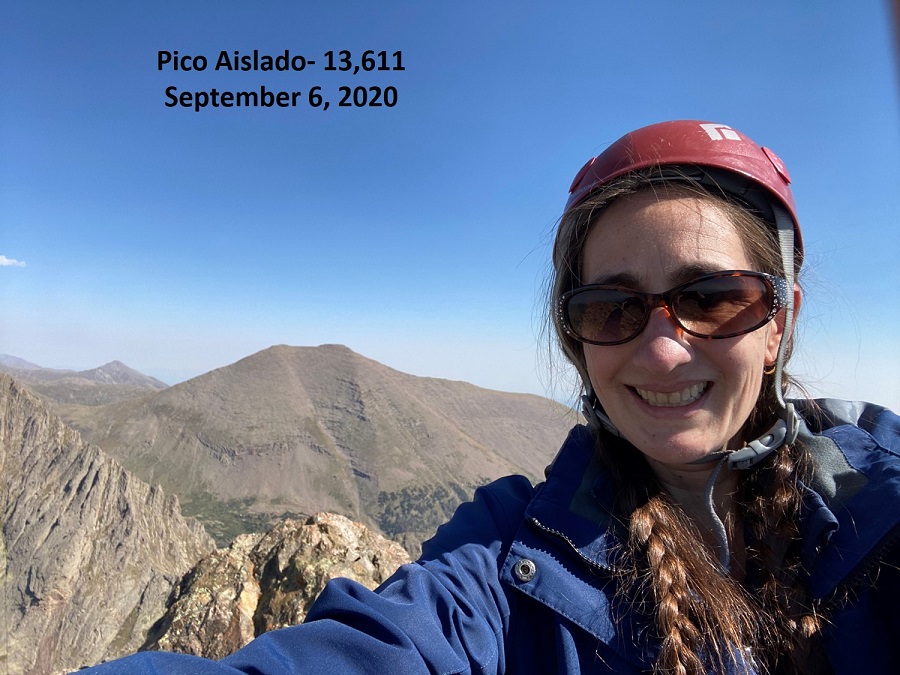
I summited Pico Aislado at 10:30am

Pico Aislado:

I headed back the way I’d come, following the ridge to the ‘cairn’ (circled in red) and then the gully back down

I felt the gully was easier to go down than up

Here’s the route I took back to Milwaukee Peak

There were two difficulties on the ridge back.  The first reminded me of the knife edge on Capitol, but with less exposure.  I probably could have descended to avoid this, but what’s the fun in that?  I went straight up and over

The next obstacle was this class 3 rock formation.  Once again, straight up and over

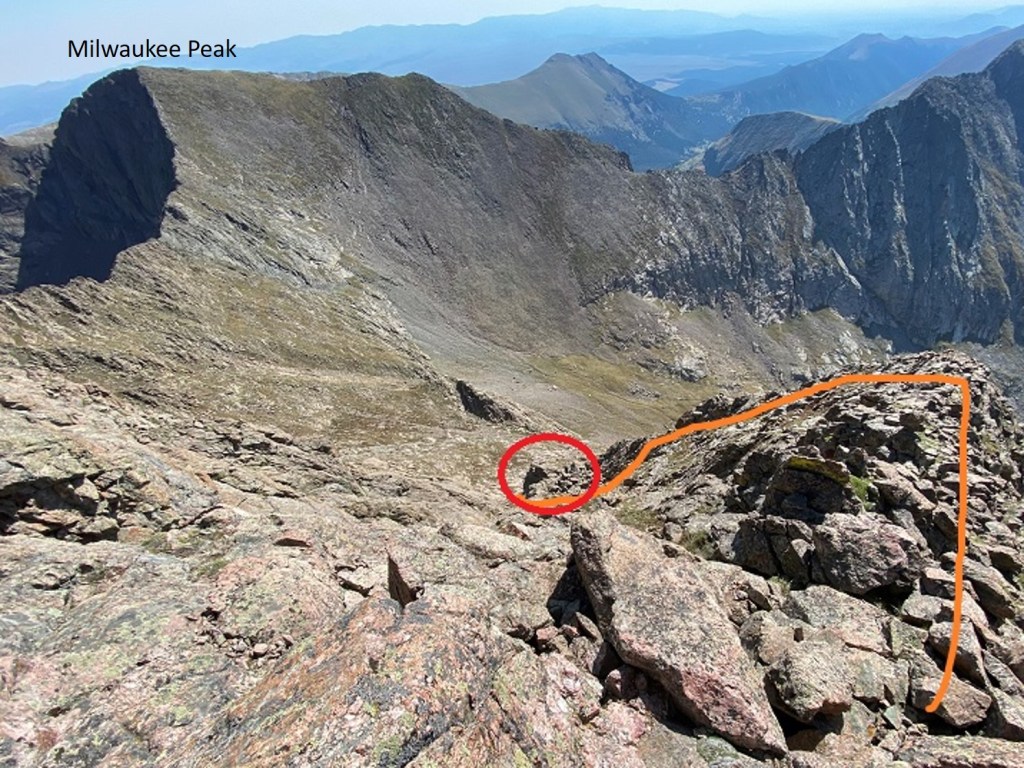
Then it was an easy ridge hike back to Milwaukee Peak.  I summited and headed left (northeast) to descend

Back down the gully

Down the mountain to the notch, which was much easier to downclimb than upclimb

And back down the ridge to the saddle, and through the upper basin

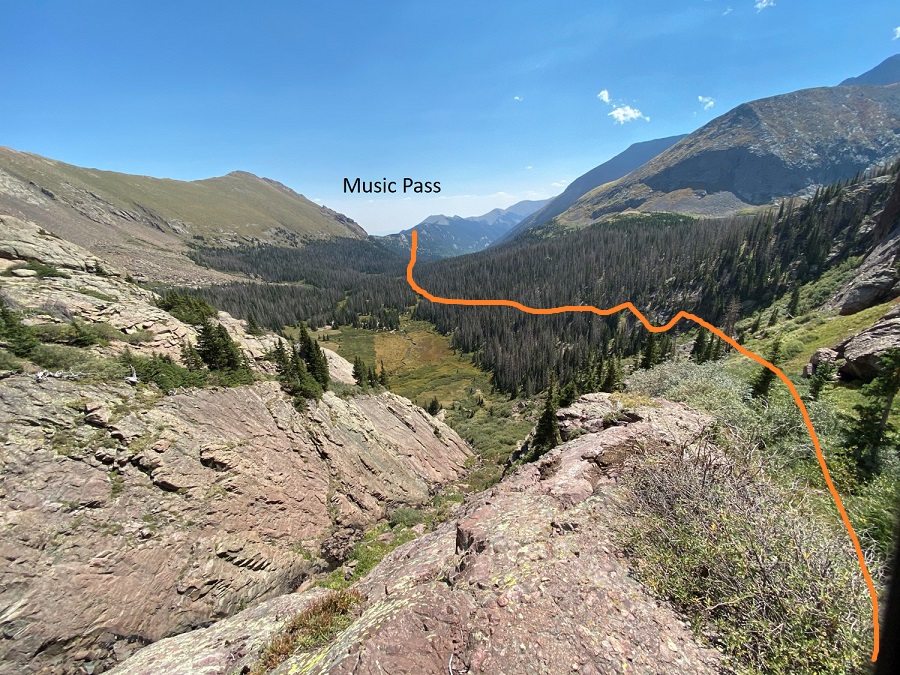
Here’s an overview of the route to Music Pass

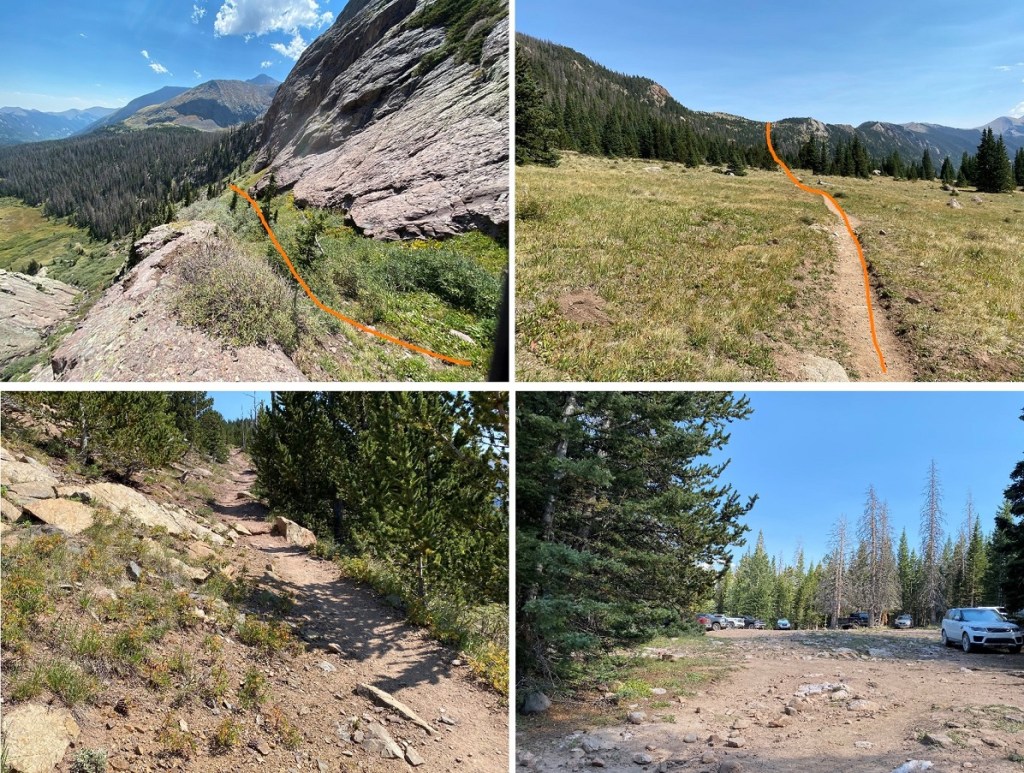
And some pictures of the class 1 trail out.  The 450’ of gain up the pass isn’t that bad.

I saw no less than a dozen hunters in the area after gaining Music Pass, all with bows and arrows.  Some were knocking on trees, others were making calls, and some stood guard with binoculars.  I’d seen bear tracks, marmots, and pikas, but besides that not another animal all day.  I made it back to my truck at 3pm, surprised to see Strava hadn’t logged my route, so sorry, no detailed topo this time.  The hike took me 10 hours to complete.  I also guestimated on the elevation gain by looking at other reports.  I took my mileage off my iPhone (which stated 13.7 miles, 195 floors, and 36,864 steps).  Time to finish my weekend of camping!  All of my girls are seniors in High School now, so this will be our last Labor Day campout.
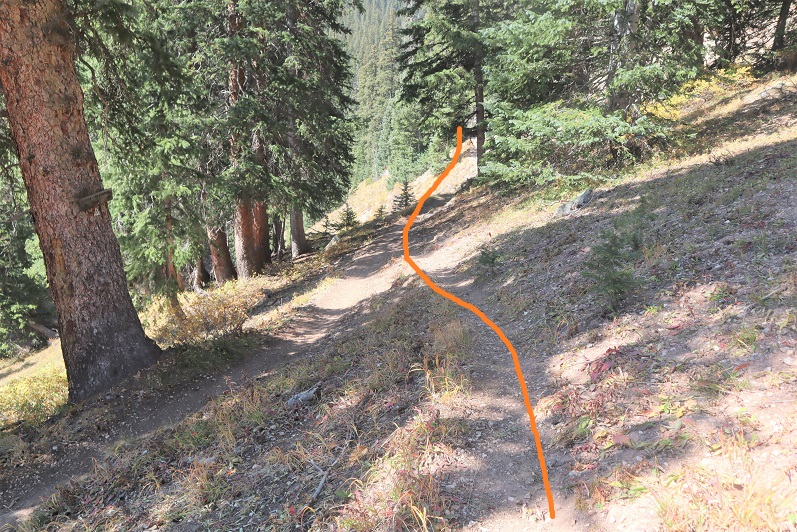
Here’s a hand-drawn map of my route

Magdalene Mountain – 13,780

RT Length: 15.32 miles

Elevation Gain: 4074’

The creek crossings to get to the Rockdale Trailhead were easier than I’d anticipated.  6-8 inches of water weren’t difficult to pass (it’s now September in a lower snow year).  In the dark the willows and water made navigation fun.  Colorado pinstriping indeed. 

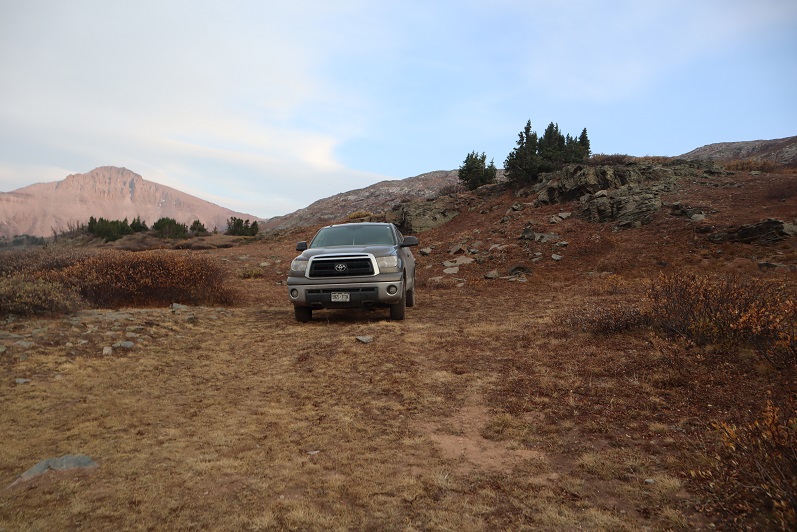
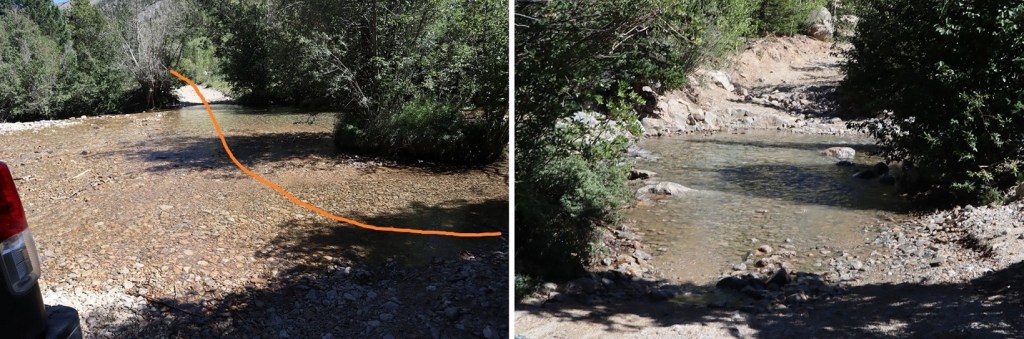
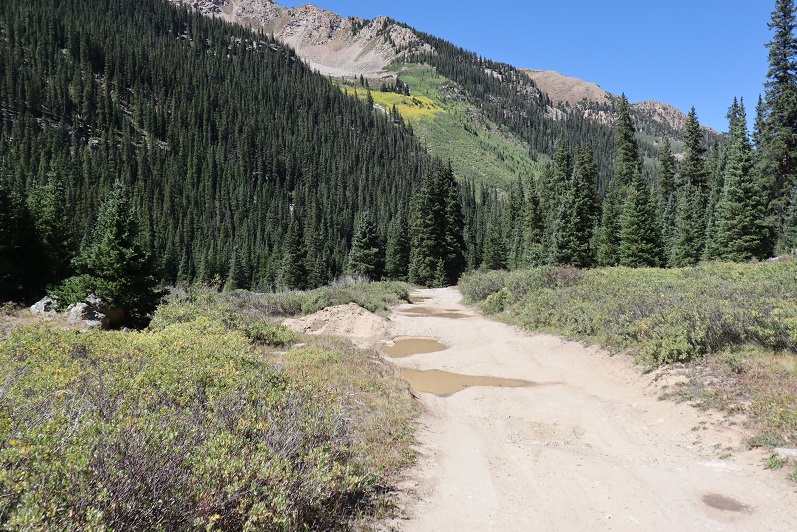
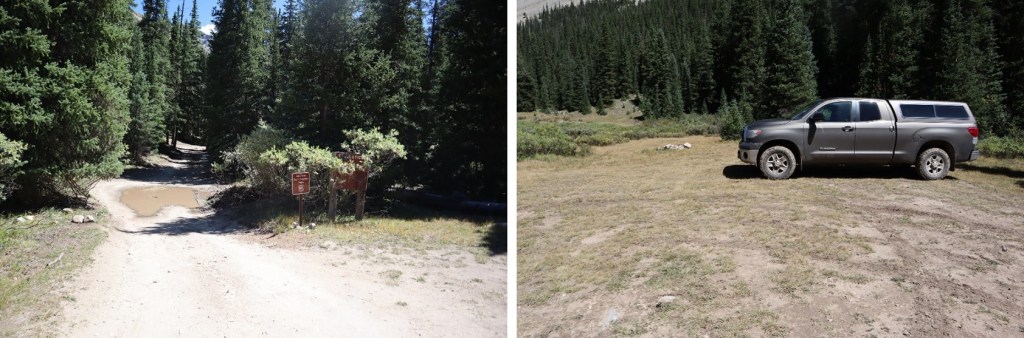
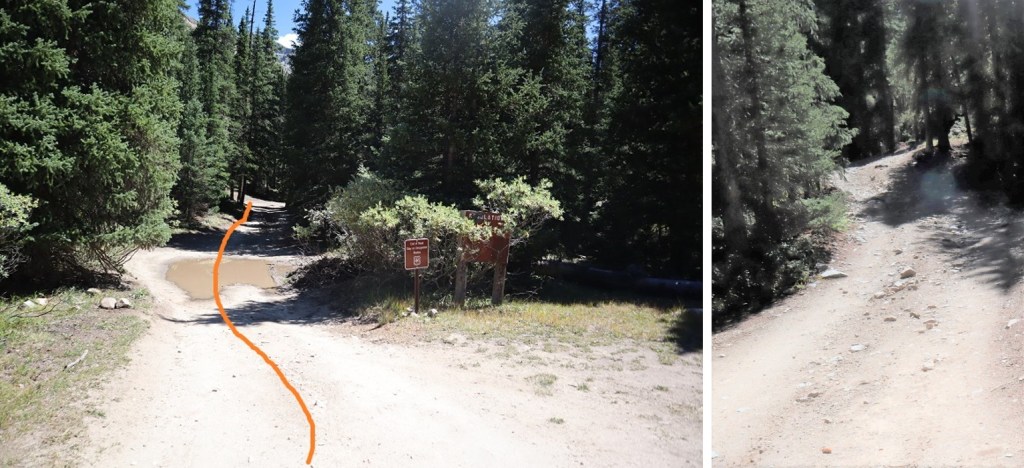
There were only two stream crossings, just at the beginning of the 4WD road, but tons of short ups and downs and puddles.  I drove slowly and I’m pretty good at navigation, but still managed to hit the underside of my truck a couple of times (I have a stock Tundra).  This picture is from one of the easier areas of the drive.  Most of the difficult areas have tree cover, making pictures difficult.
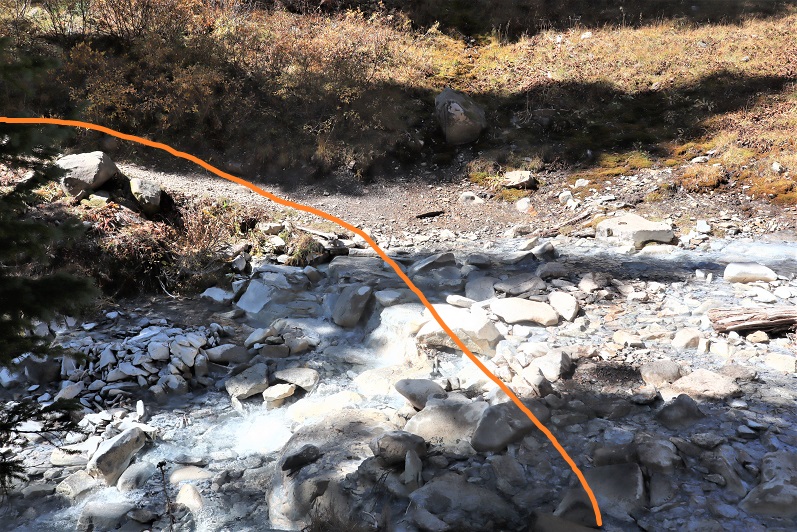
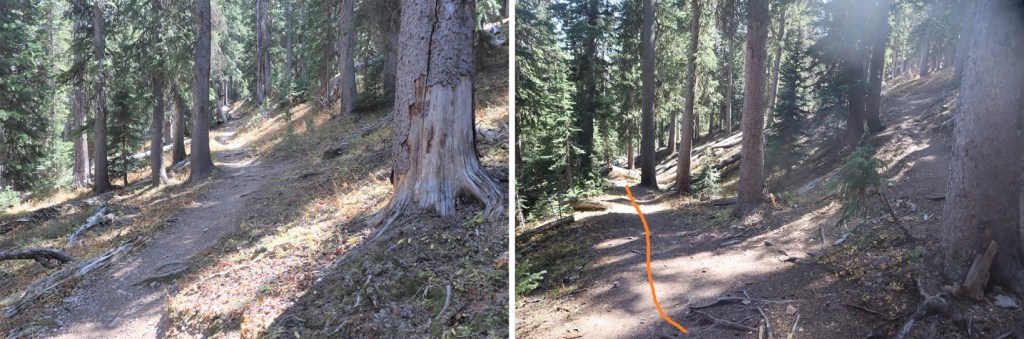
At 10880’ there’s a sign that says the road ends (even though it looks like it goes further).  There are several large camping sites here.  I parked my truck and got out my gear
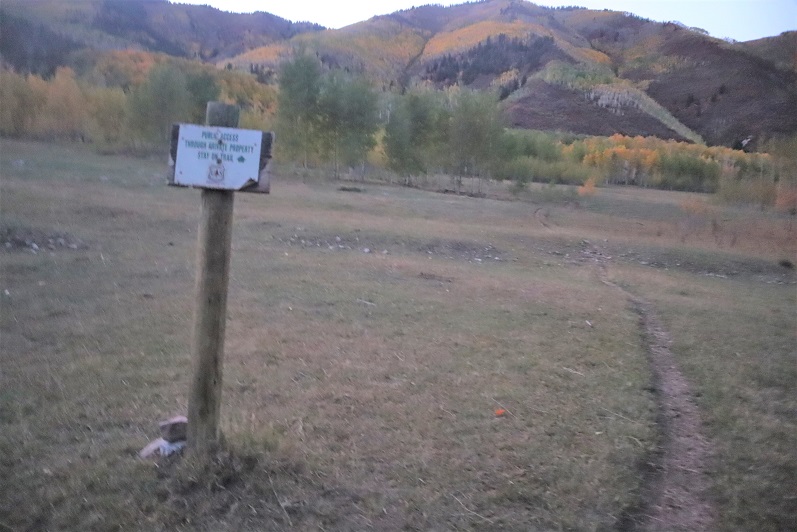
I was on the trail at 5am, following the 4WD dirt road south.
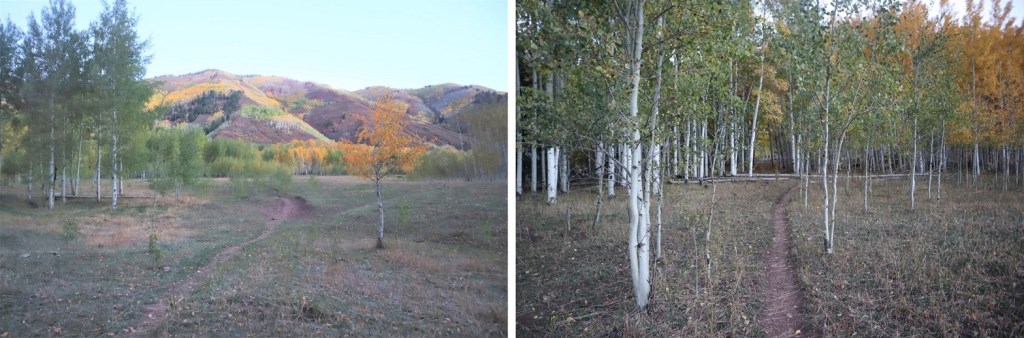
After hiking for .3 of a mile I came to the ‘old’ parking area, now covered by an avalanche.  There’s a nice trail through this if you stick to the left.

After the avalanche area the 4WD road picks up again

After hiking for .75 miles total I came to the junction of the trail and the road.  Both ways go around the lake.  I chose to go up and over the hill

Giving me a good look at Cholsey Lake

And then I followed the trail back down the hill and into the basin. 

This is a class 1 trail that heads south through pine trees, willows, and some small creek crossings

At around 3 miles of hiking the trail started turning left, curving southeast.  Here the trail became faint, but there were plenty of well-constructed cairns to guide the way up to the pass at 12,500’.  Off to my left I saw a huge bull elk, bounding away.

At this point the trail was now gone, but I had a great view of Pear Lake.  Pear Lake wasn’t where I was headed however. I turned left and followed the ridge northeast, staying as high as possible.

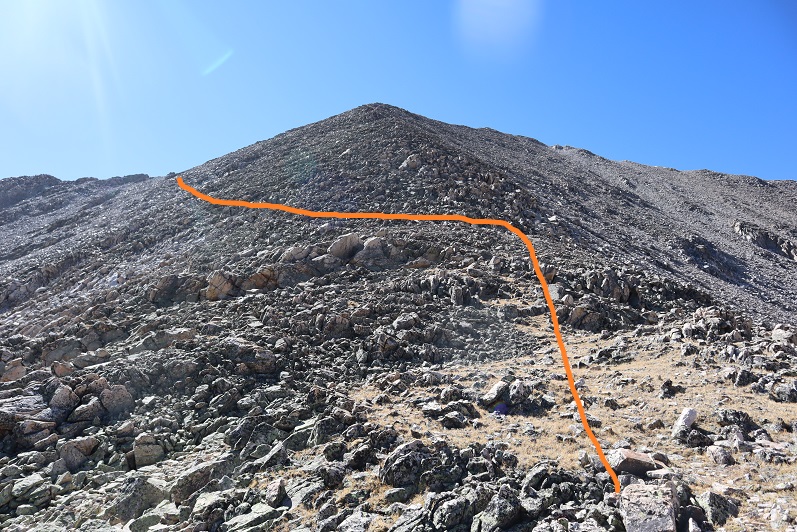
My goal was to aim for this gully.  There are a lot of ups and downs here, so I tried to stay high.

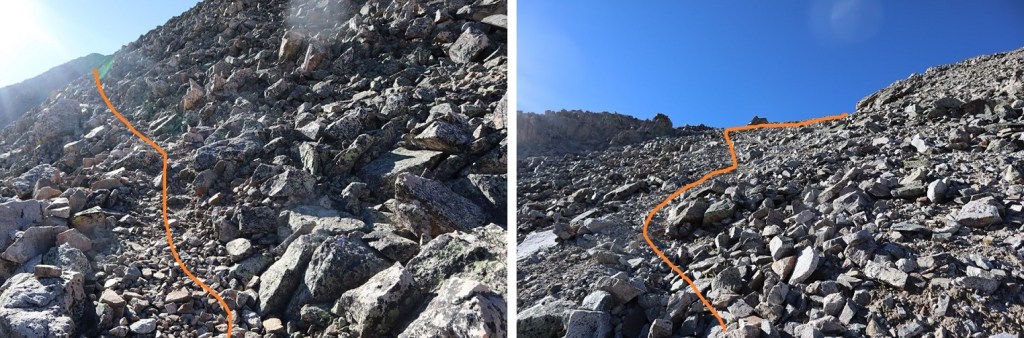
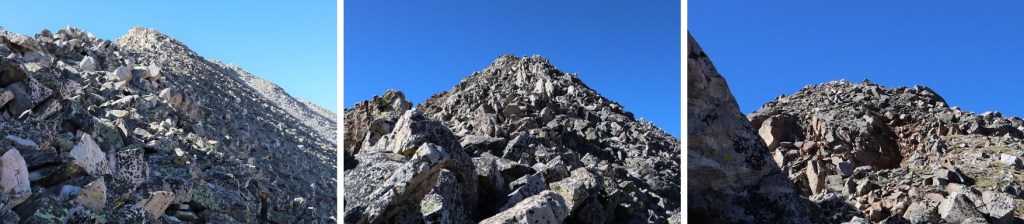
Here’s the path I took, step by step, to get to the gully

The safest way to approach this gully is to start out by going left around this boulder, and then straight up, following the scree trail

There are a lot of loose rocks here, the kind that cause rockslides, so watch your footing.

The top of the gully put me at 12,860’.  Now it was time to head back down, staying as high as possible, but still losing about 300’ of elevation as I traversed my way over to Magdalene’s ridge.  Here’s an overall of the route I took

And step by step:  First, down the gully.  The most stable area is to stick to the left, near the rock

Then I headed southeast, staying high

The rocks give way to tundra.  I kept aiming for the ridge

Keeping Silver King Lake to my right, I made it to the base of the ridge.  Here there’s a cairned trail that picks up and will lead you to the summit.  It starts by zig-zagging up and around the first ledge

Then following the well cairned trail to the saddle

It looks like the trail has been covered in rockfall in areas, but the cairns help to stay on course

Once at the saddle I turned right and followed the ridge southwest

There are several social trails up this ridge, but I was able to summit by sticking to the ridge proper, keeping this class 2

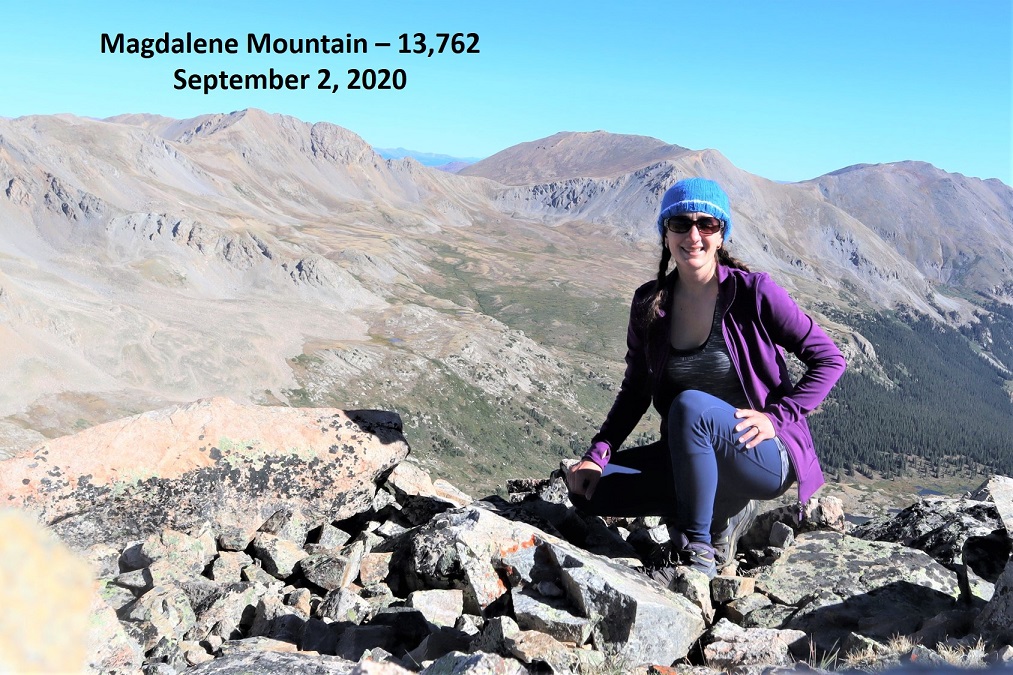
I summited Magdalene Mountain at 9:40am

Magdalene Mountain:

There are 2 summit registers here. 

Time to head back the way I came.  First, down the ridge

Once at the saddle I turned left and followed the trail back down the mountain

Here’s an overview of the route back to the pass

And step by step:

Here’s looking back up at the gully.  Once again, I stayed north to ascend

From the top of the gully, here’s the overall route back to the pass

And step by step.  Down the gully and across the rocks

Staying high

Then taking the plateau back to the pass, where the trail picks back up again

I turned right at the cairns and headed back down to the basin

I looked longingly at the ridge that connects Pear Peak with PT 13517.  I really wanted to do that ridge today.  It was an absolutely perfect day, but I was short on time, as the drive in had taken longer than expected.  I had to get back home and finish working for the day. Oh well, it will be a fun adventure in the future.   Here are some pictures of the route back down.  Spirits high, I rather enjoyed the hike out. 

Back to the lake and up the hill

Past the avalanche area

And back to my truck. I made it back to my truck at 2pm, making this a 15.32 mile hike with 4074’ of elevation gain in 9 hours