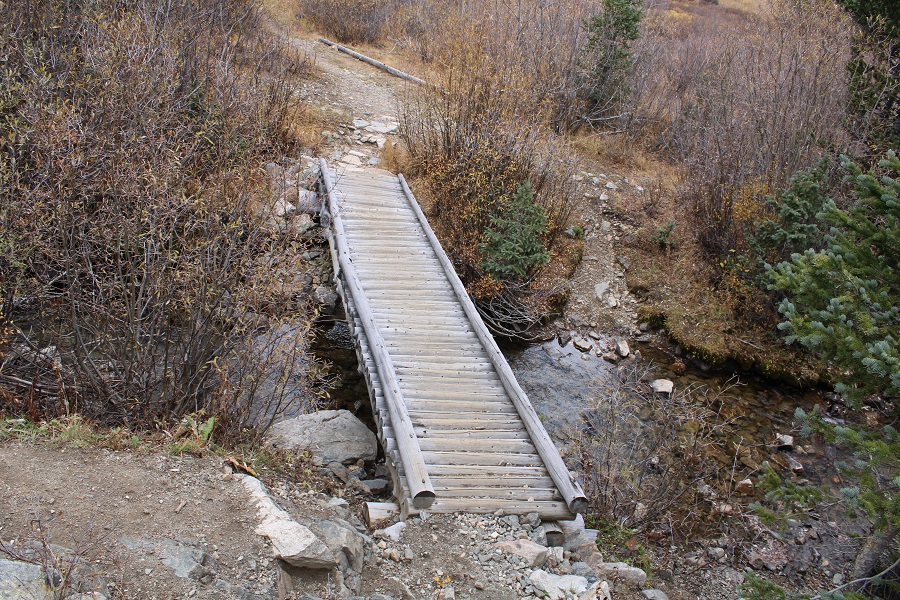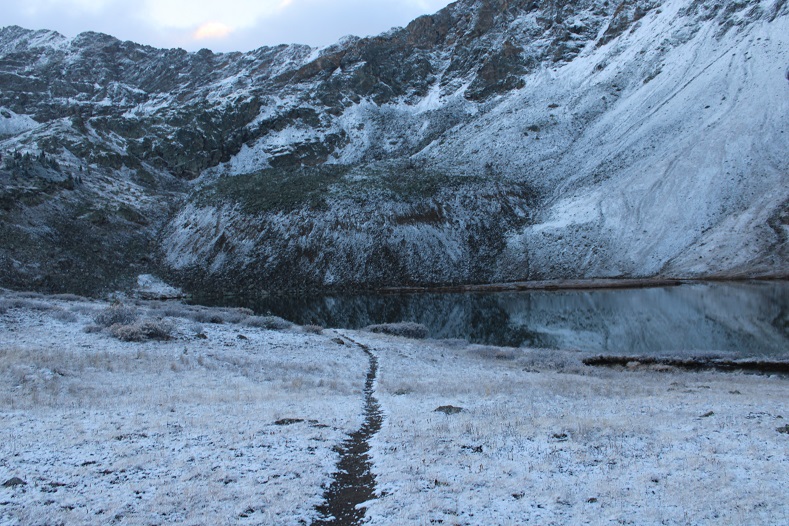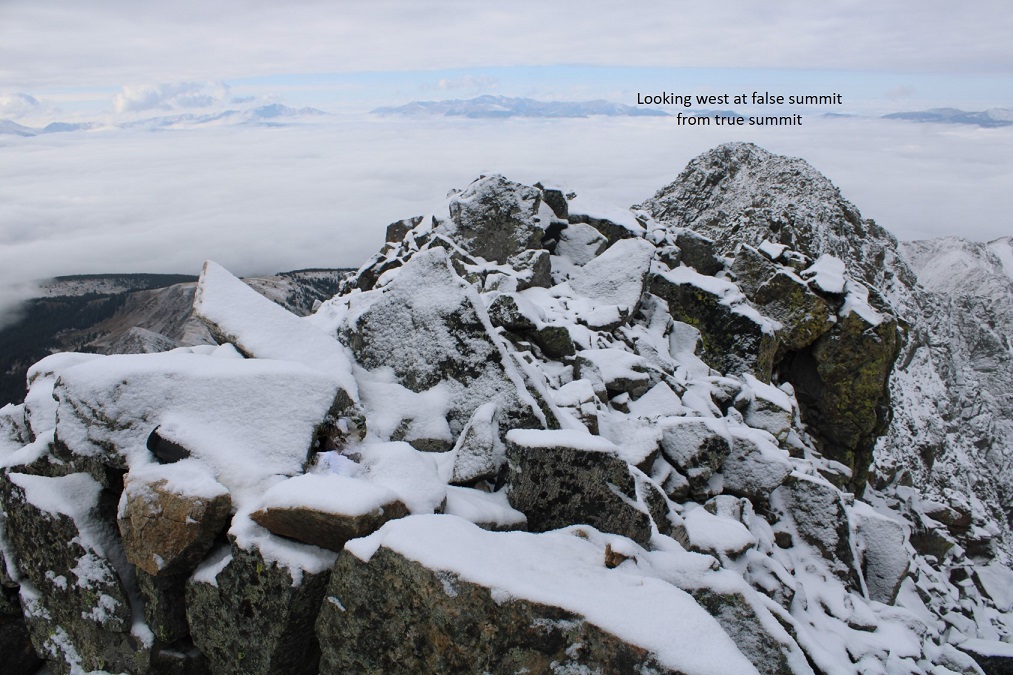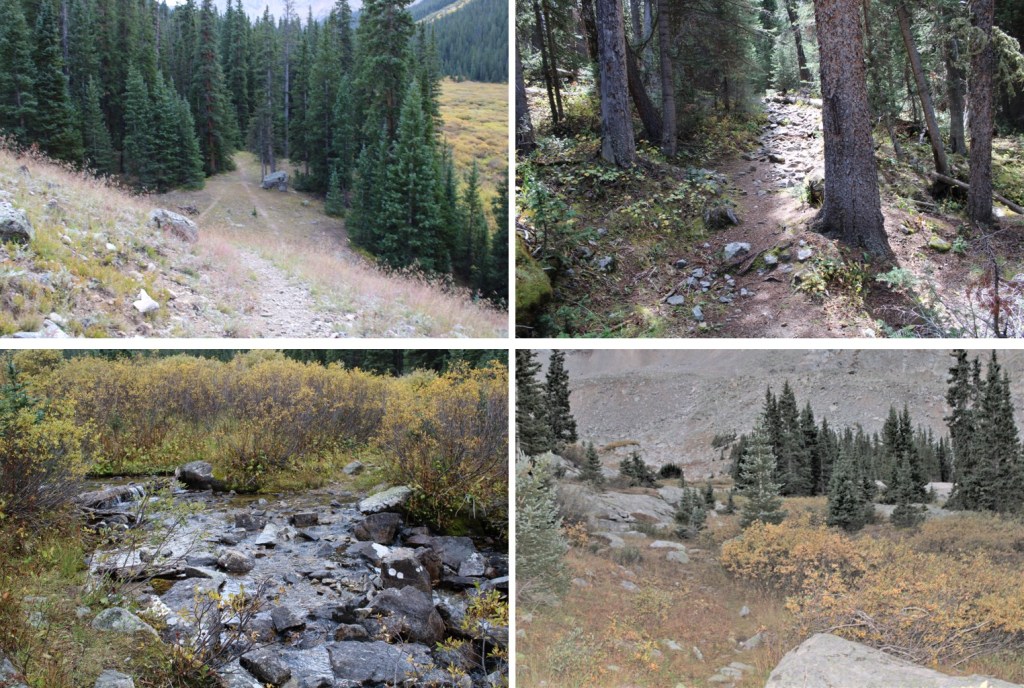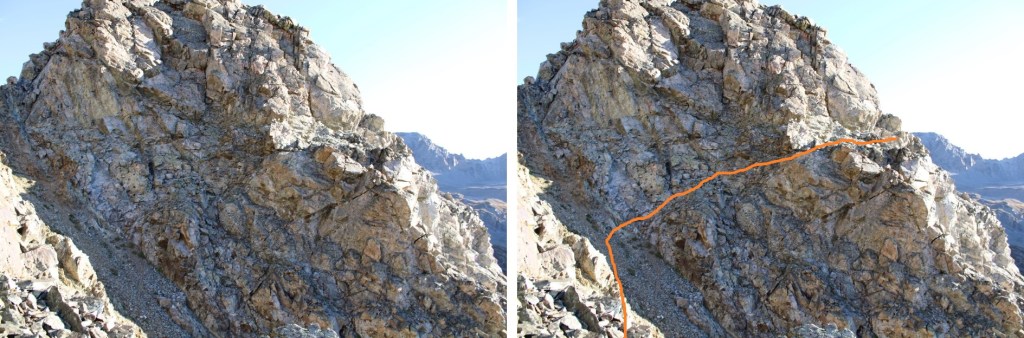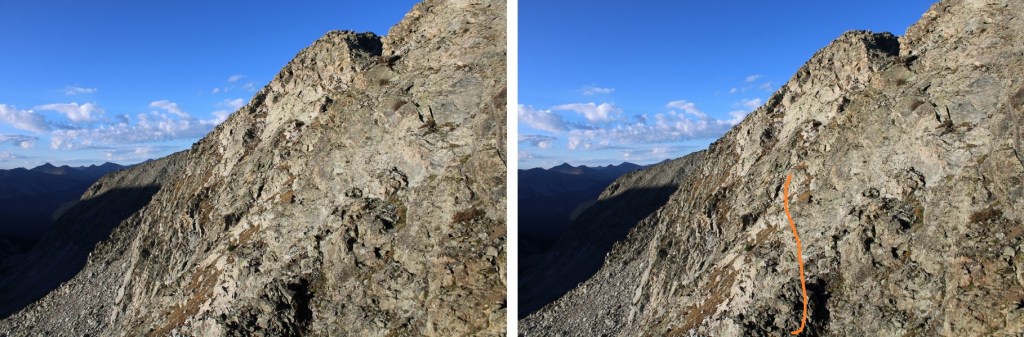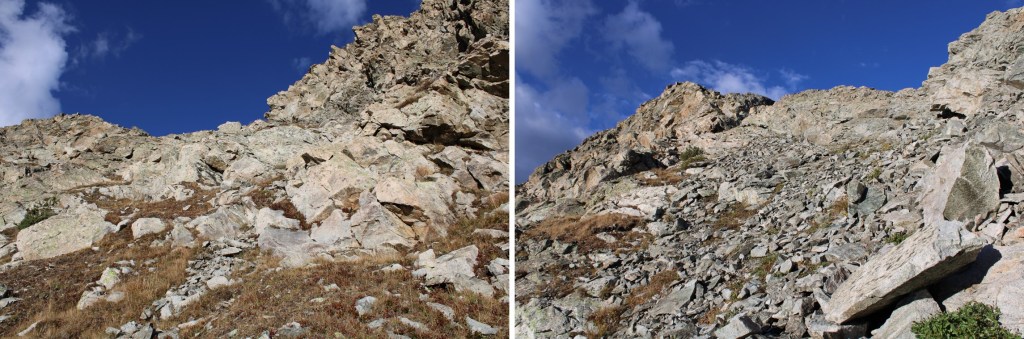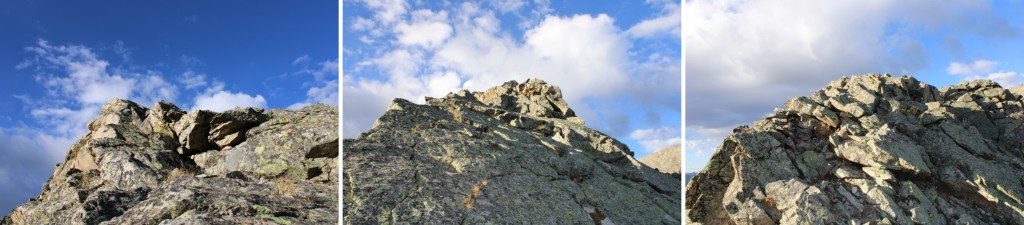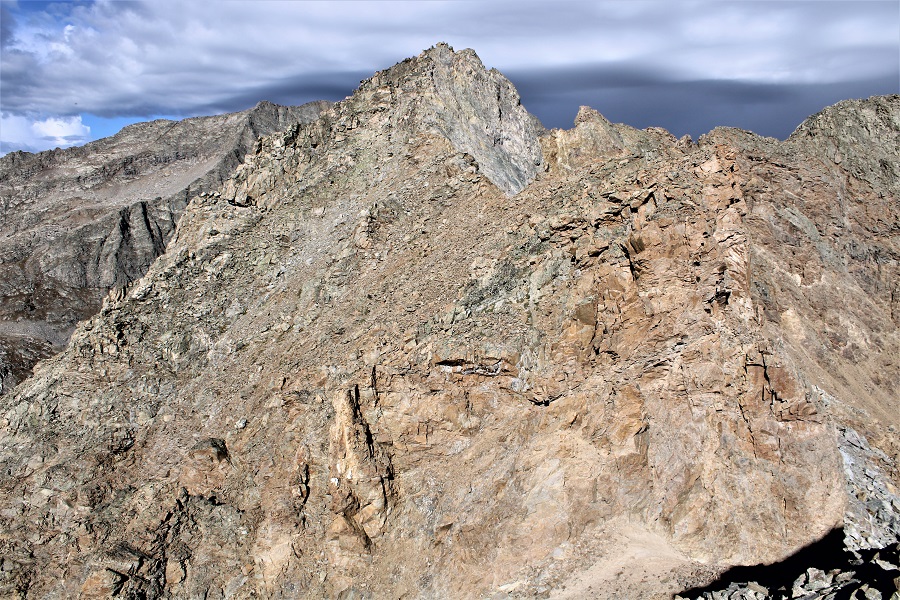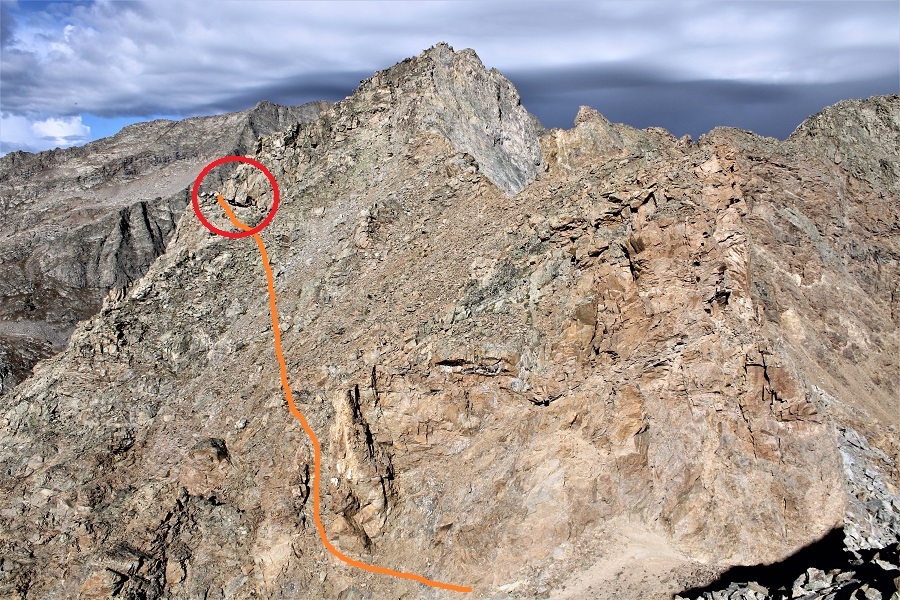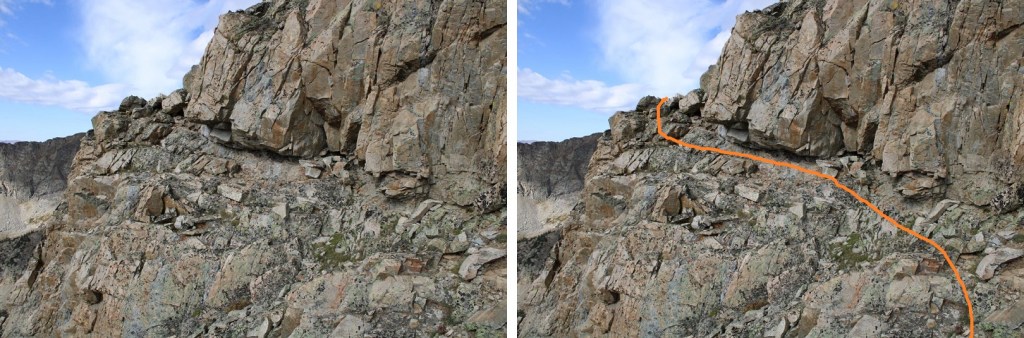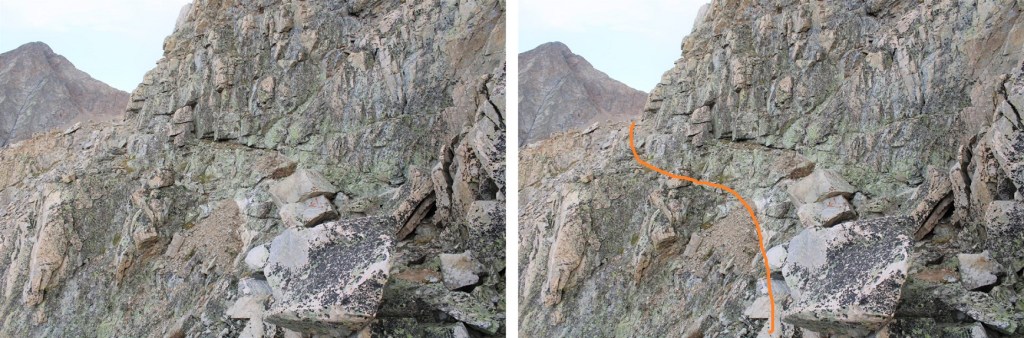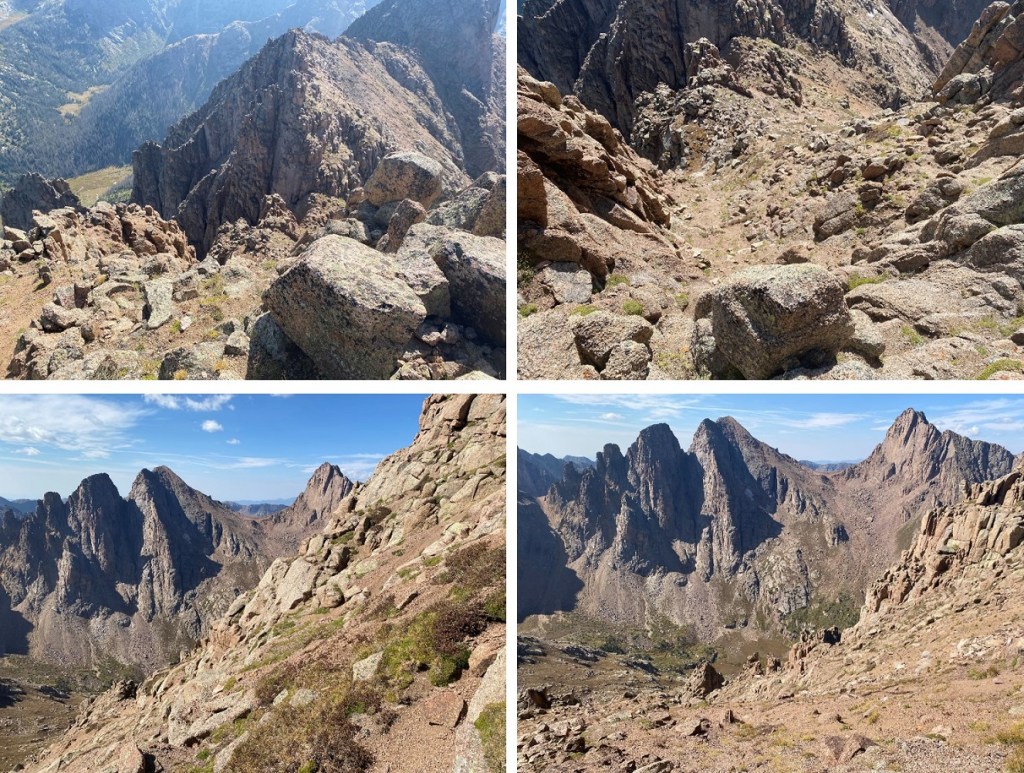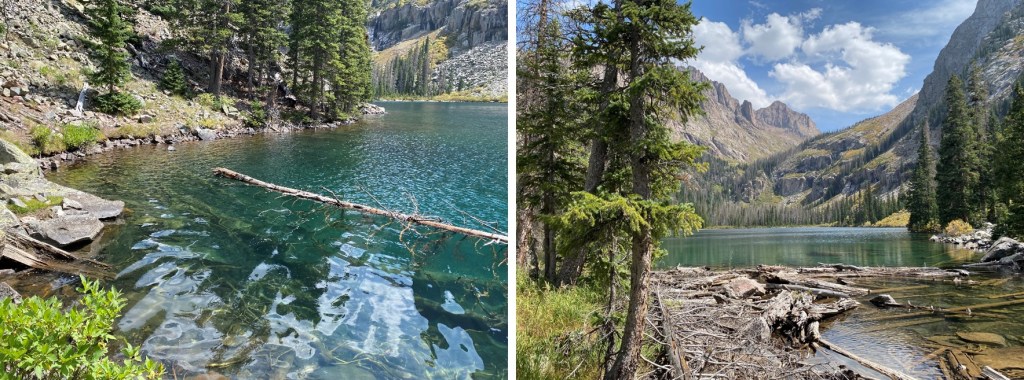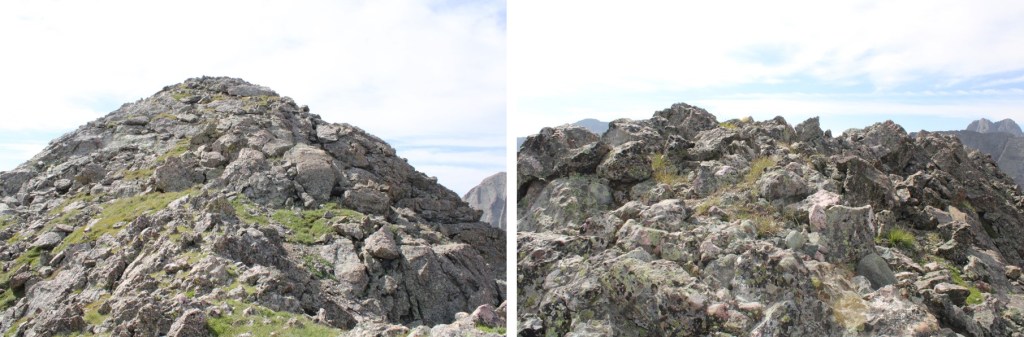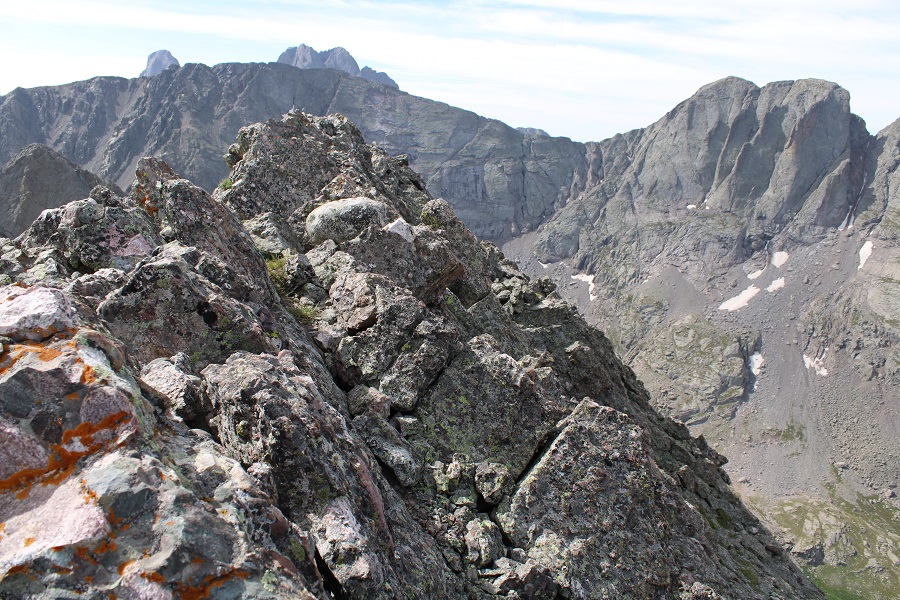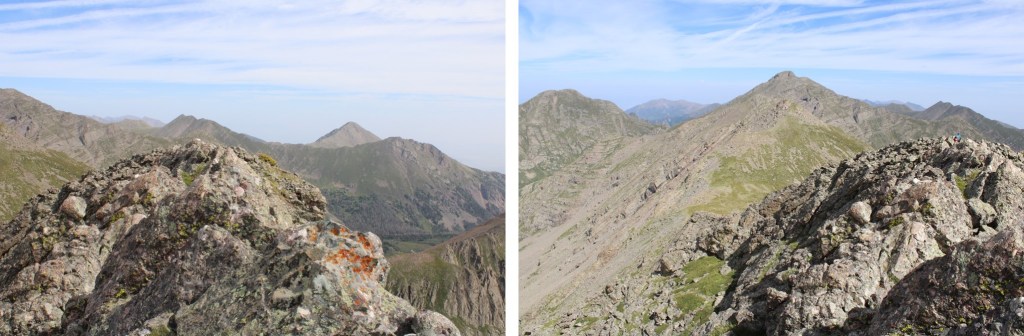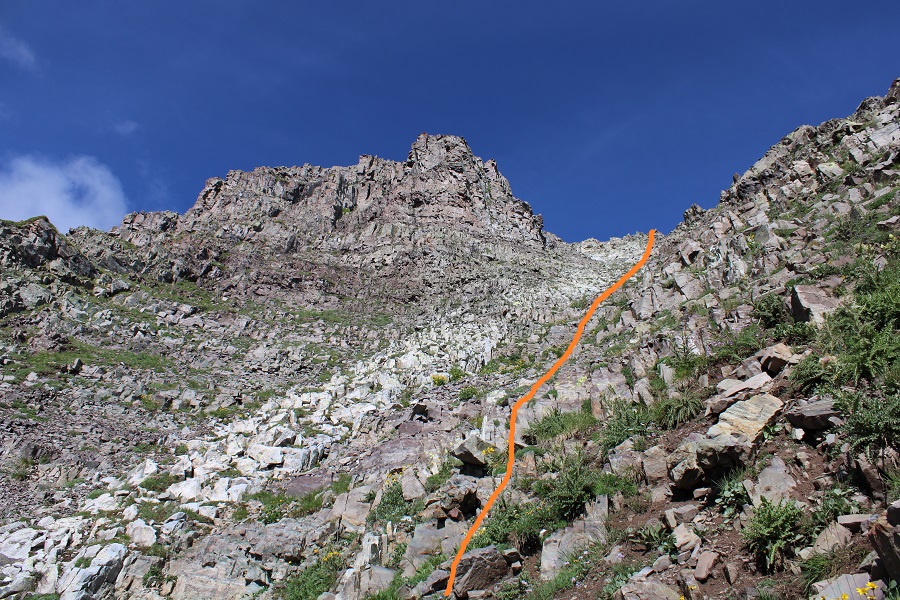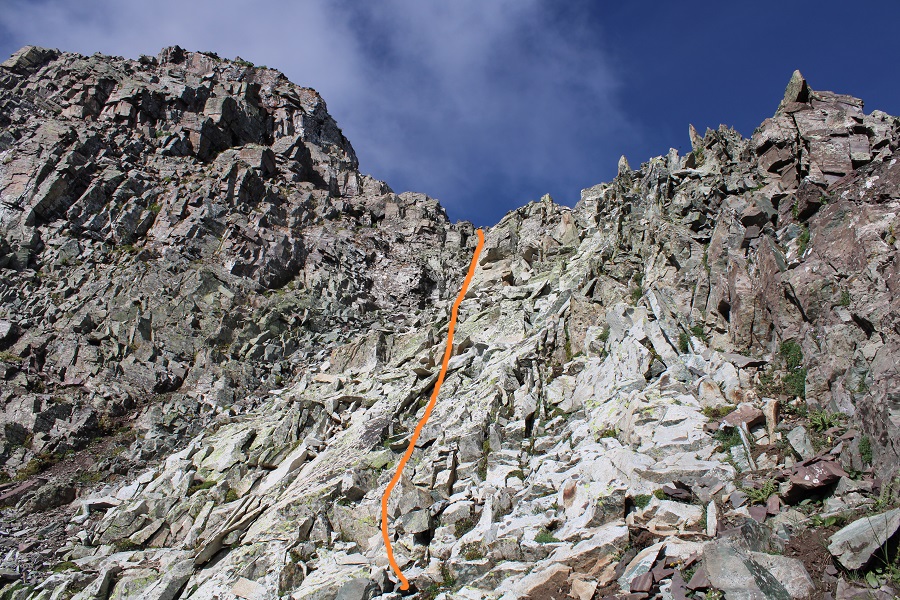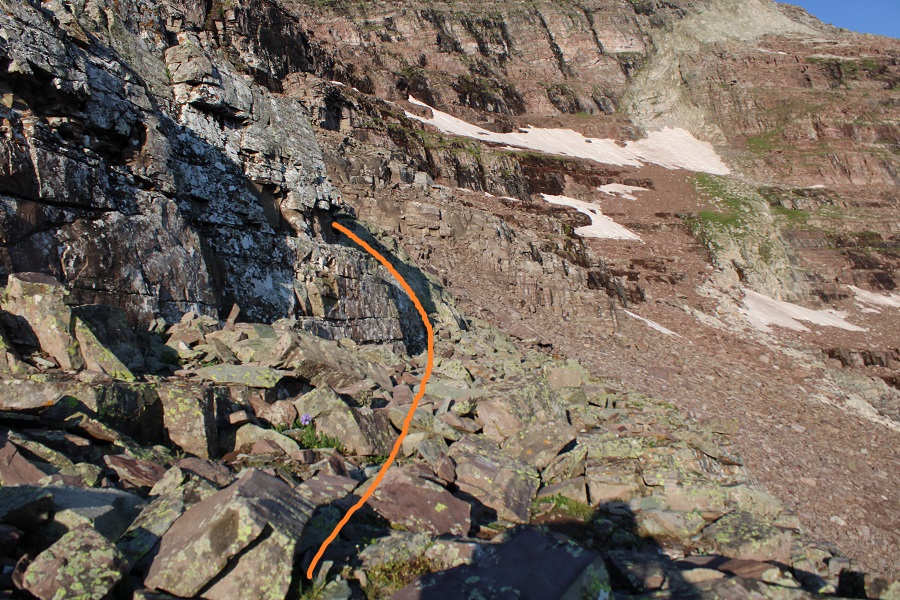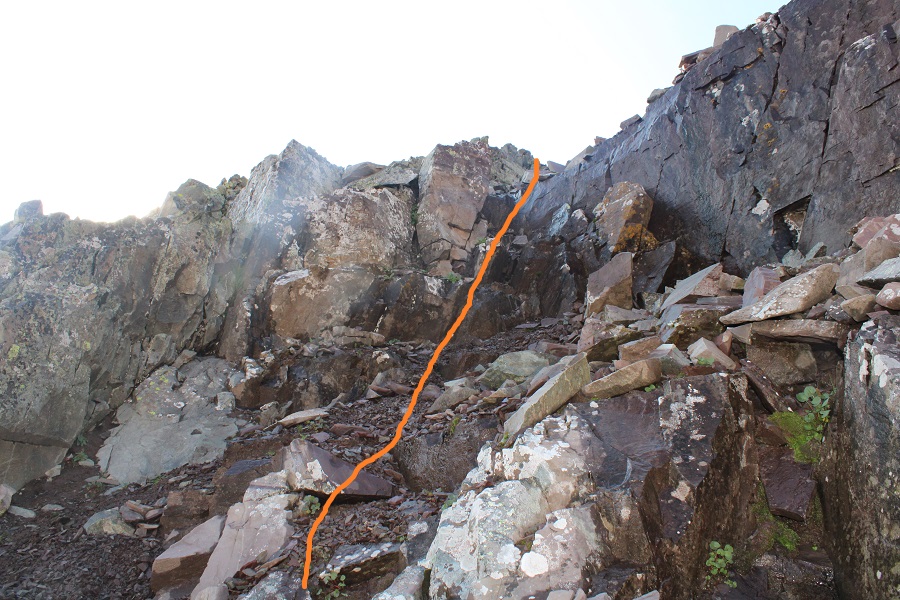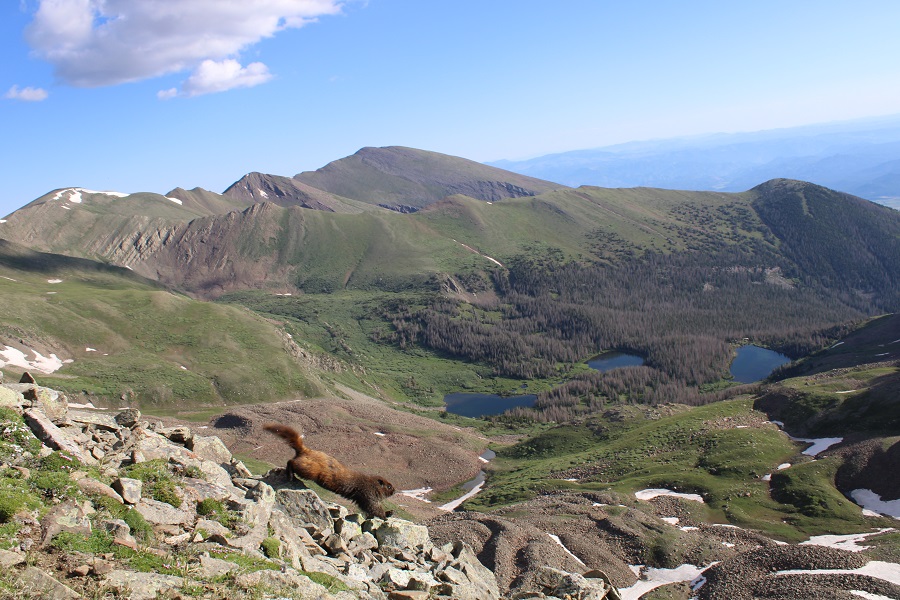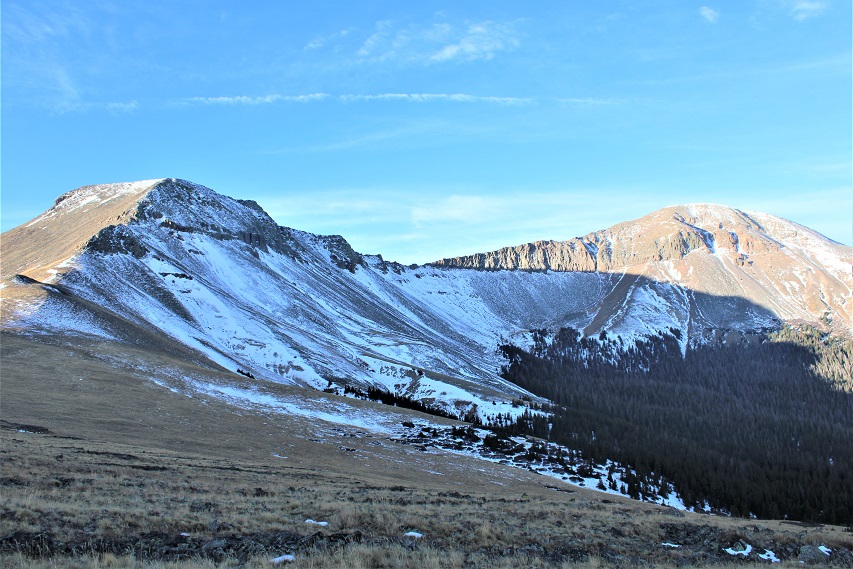
East Buffalo Peak – 13,300 & West Buffalo Peak – 13,326

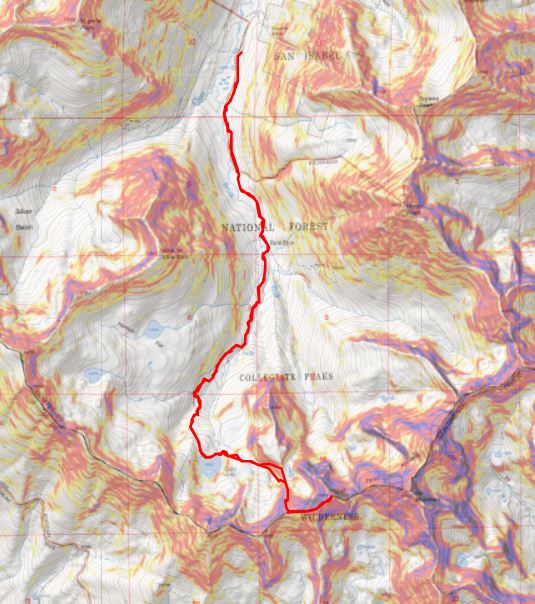
RT Length:  11.95 miles

Elevation Gain: 3489’

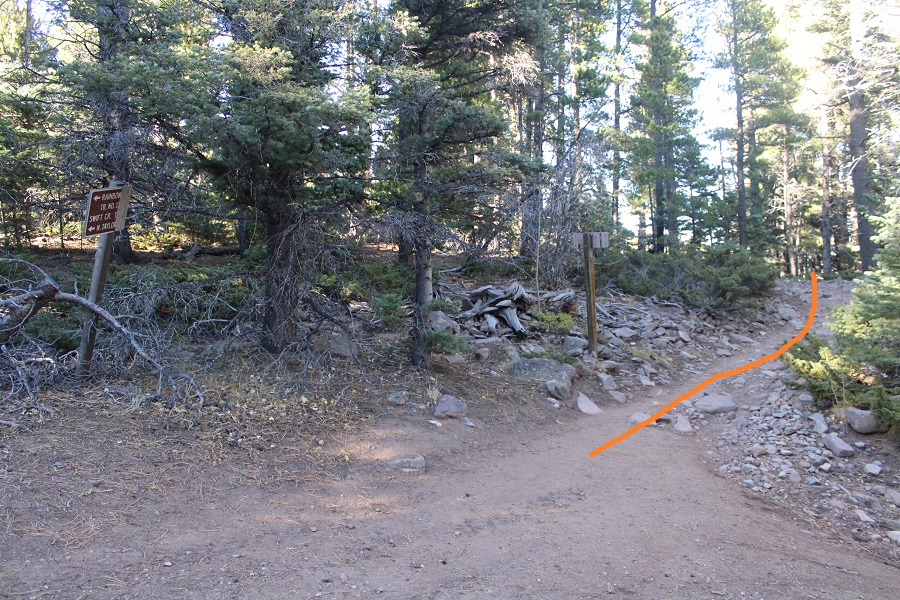
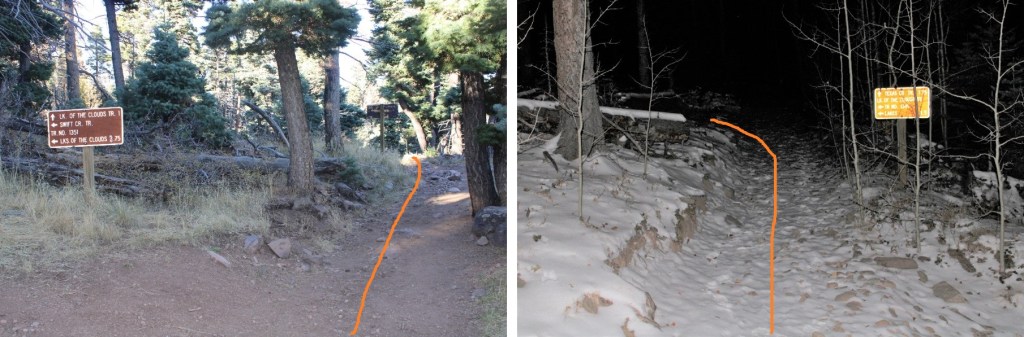
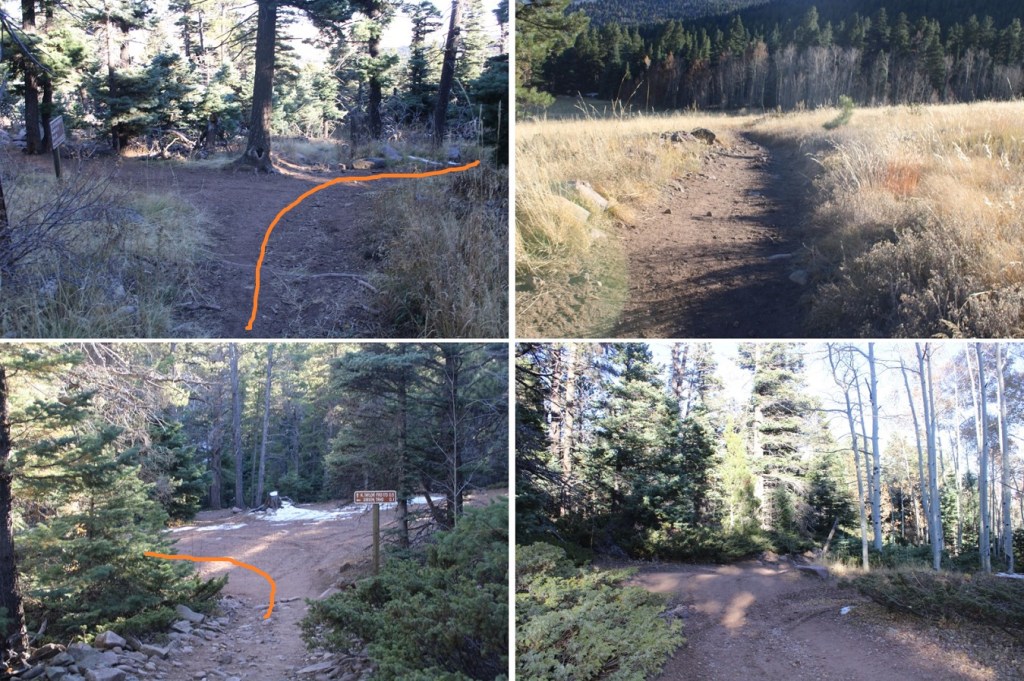
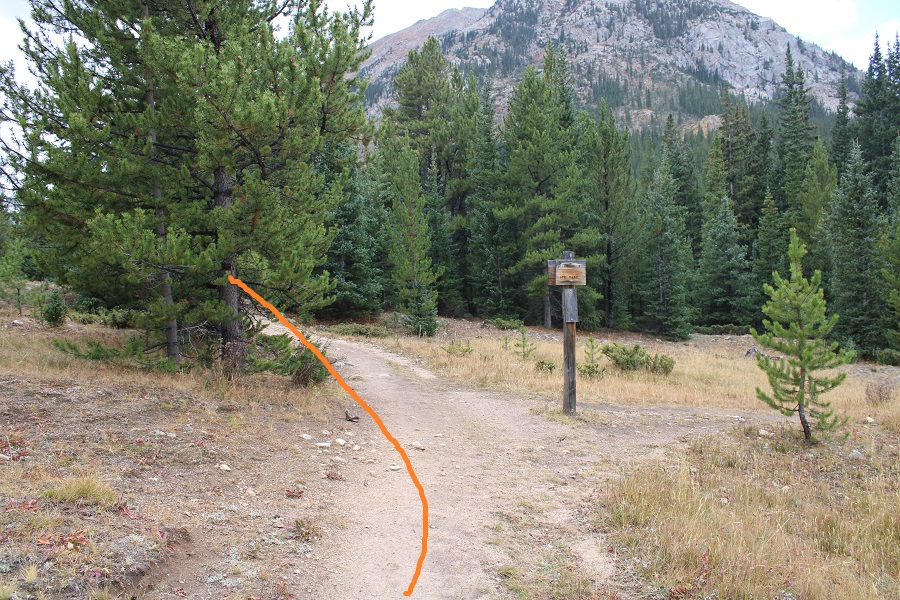
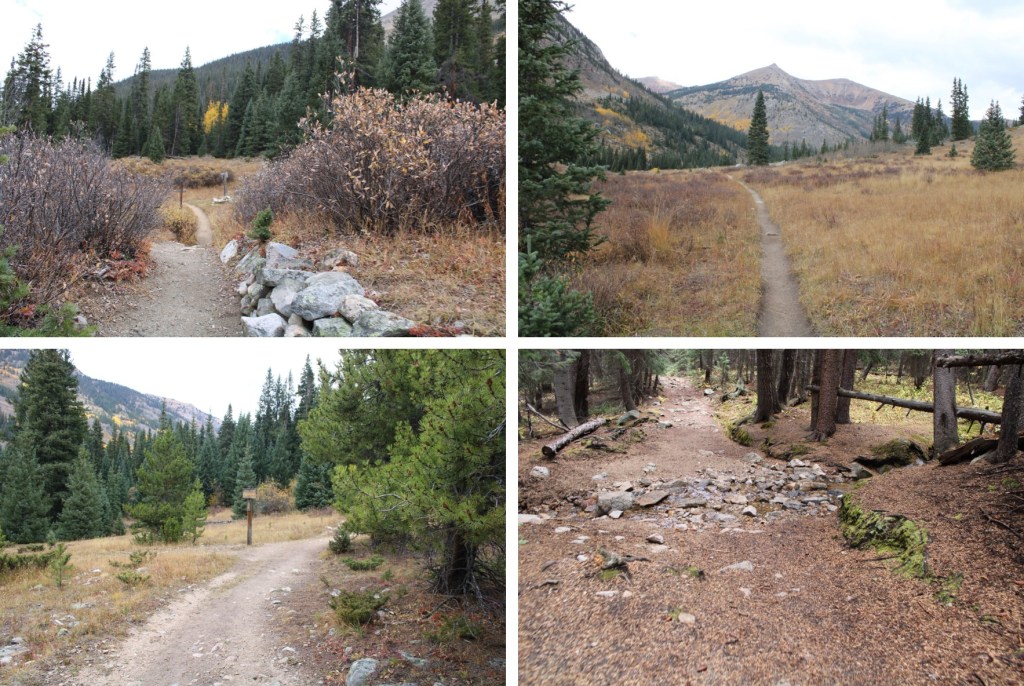
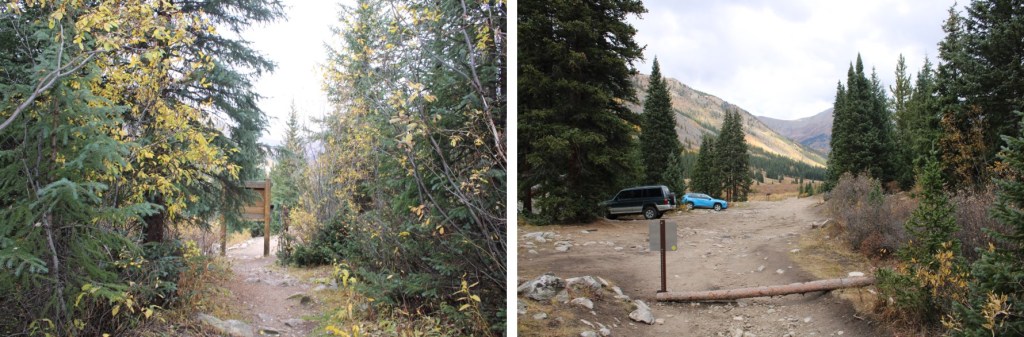
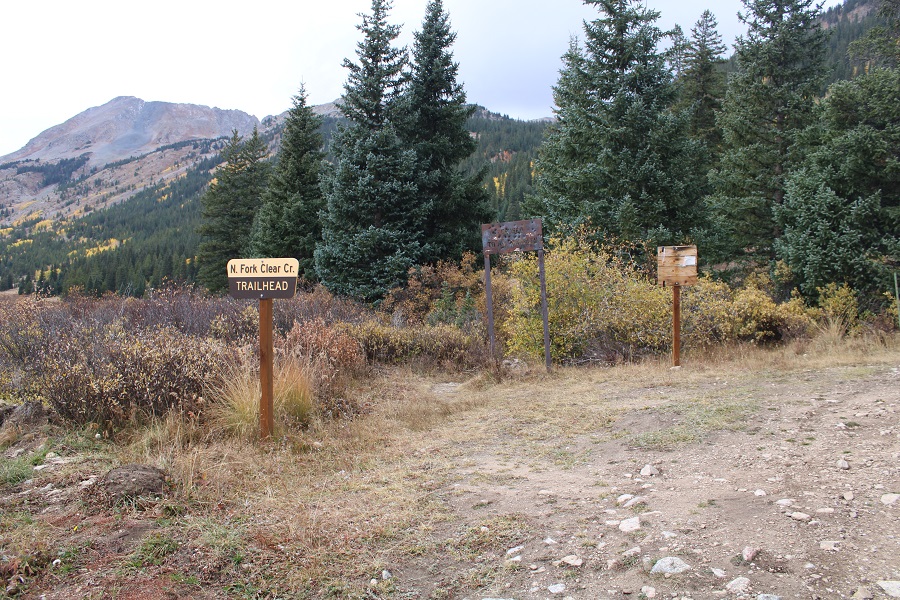
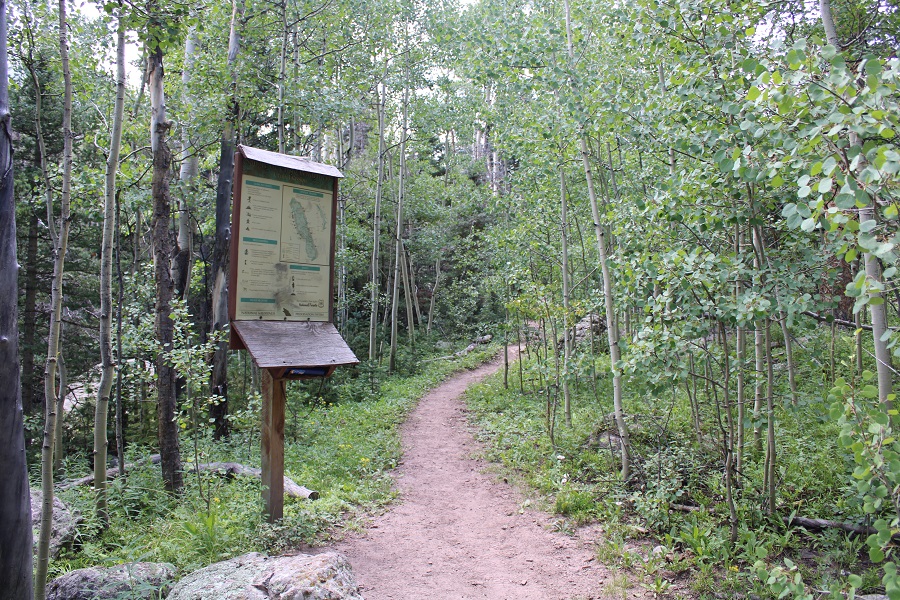
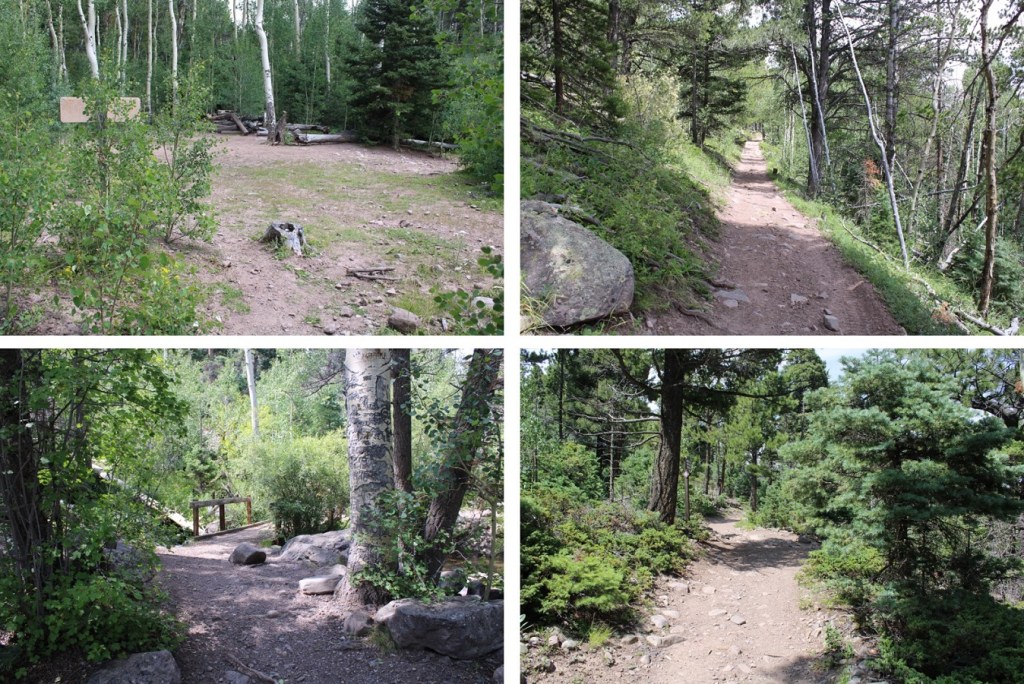
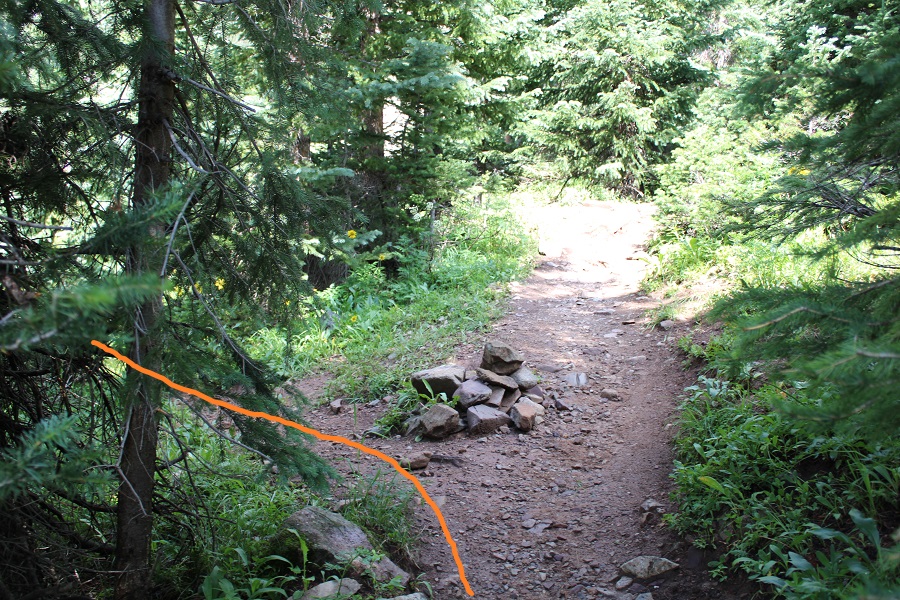
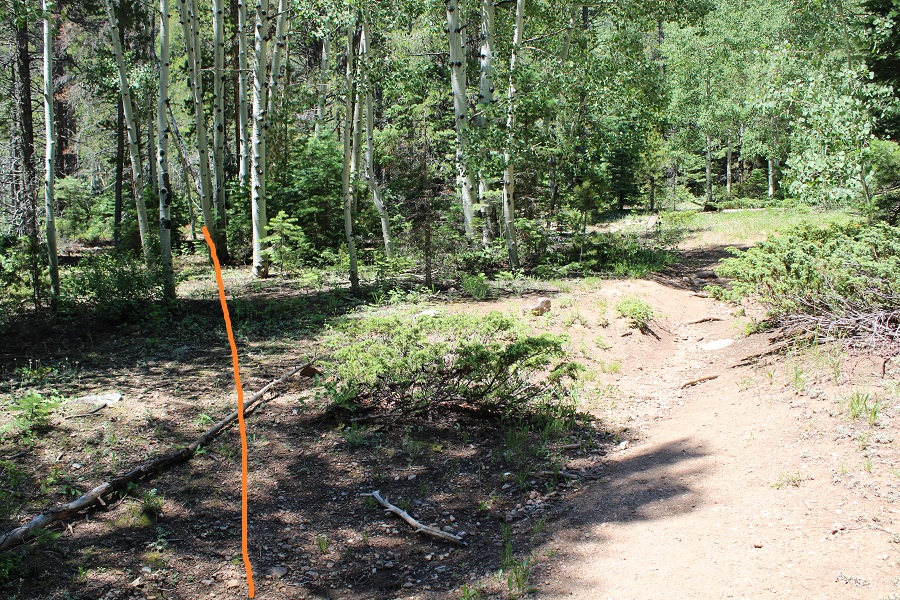
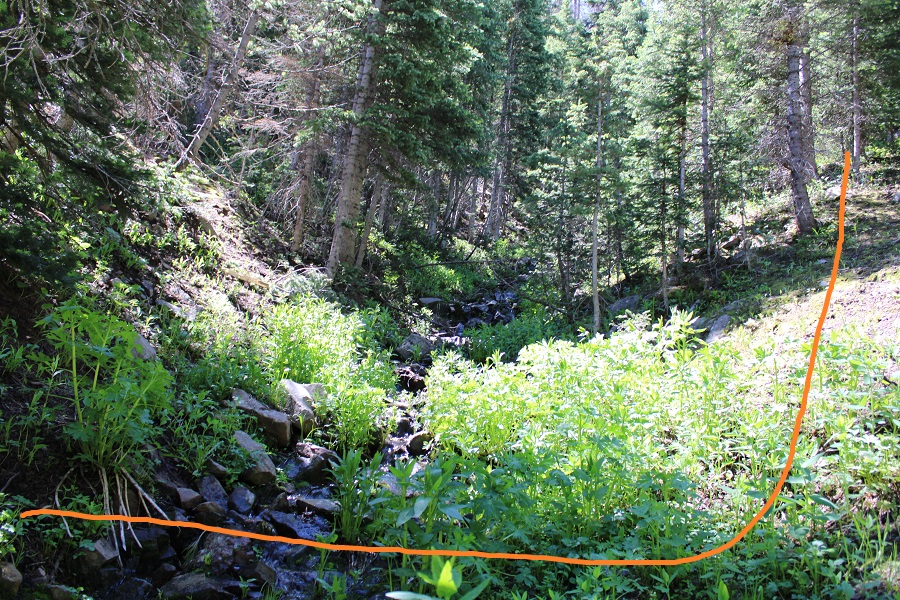
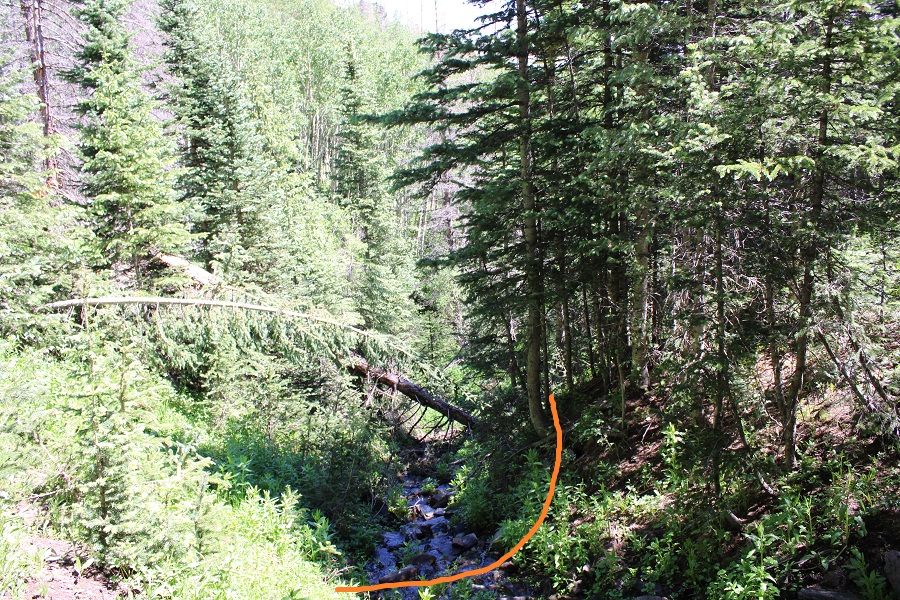
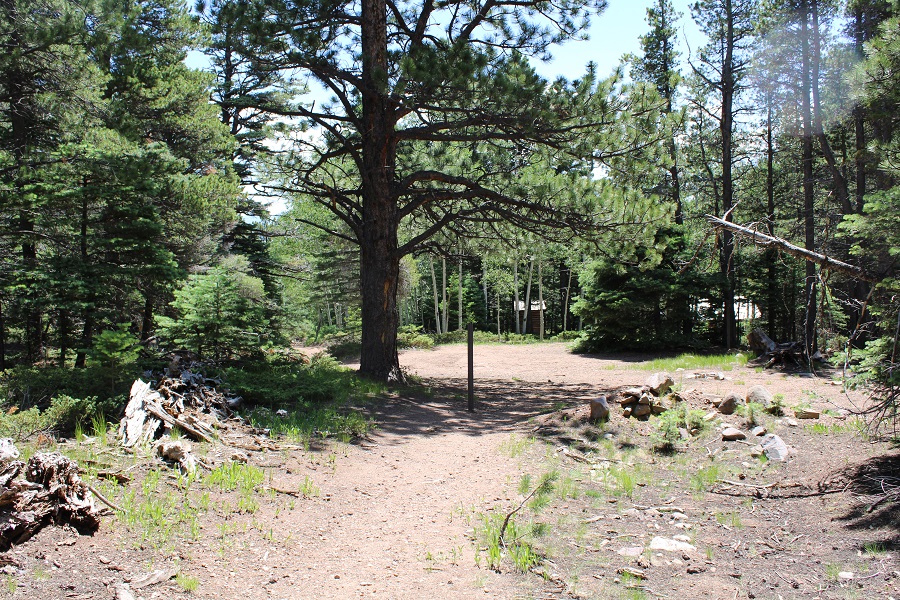
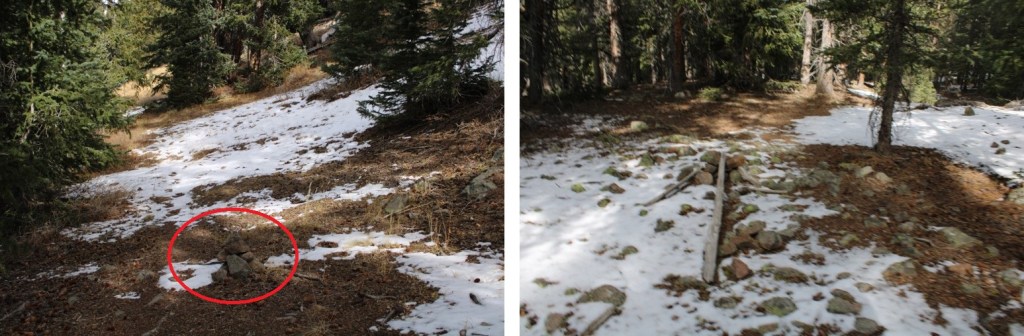
It was an easy 4WD road to the trailhead.  I was surprised I hadn’t seen a single vehicle on the long drive in.  There weren’t any cars parked at the trailhead, but the dispersed campsite was free, so I parked there, being sure to leave room in case anyone else wanted to camp. I read a bit, tried to eat (and failed), sipped whiskey, watched a curious camp robber, and once again, got to bed early.  The trailhead was just to the west of where I parked (trailhead circled in red)

I woke up hungover.  Or, at least, I felt hungover.  I hadn’t had enough to drink last night to give me a hangover, but here I was, with a pounding headache.  Probably has something to do with the fact I have a difficult time eating while I’m hiking, and I’d already hiked 7 peaks above 13K in the past 2 days.  On the positive side, I wasn’t cold this morning: that’s two mornings in a row!  It was 38 degrees.  I slowly gathered my gear, forced down a breakfast bar, and was on the trail at 6:30am, trudging slowly.  It was going to be a long day.

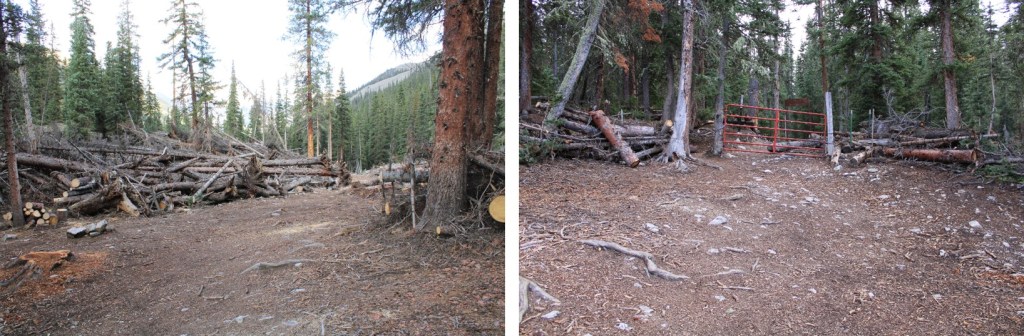
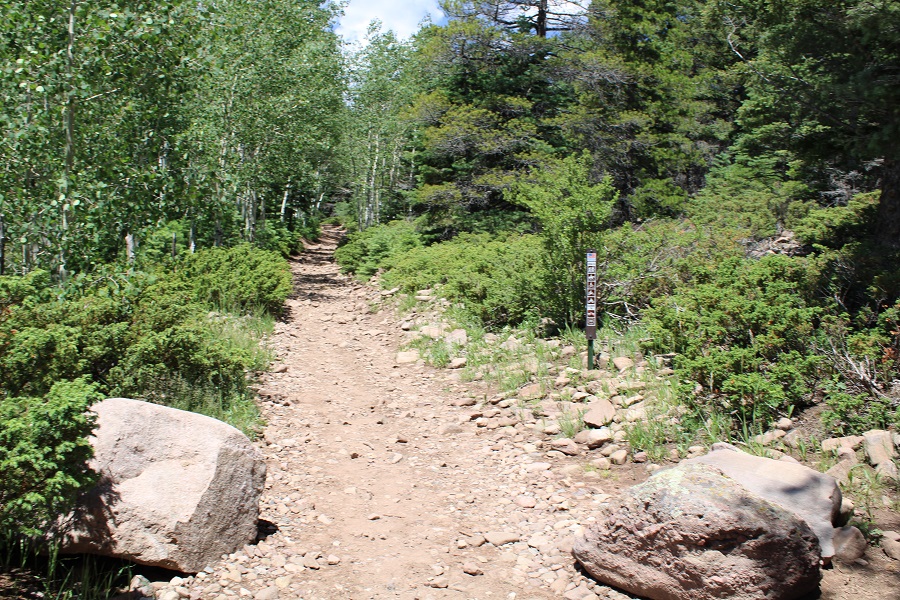
I made my way towards the trailhead (now with a vehicle parked there I hadn’t heard drive in), and followed the trail southwest to a closed 4WD trail.
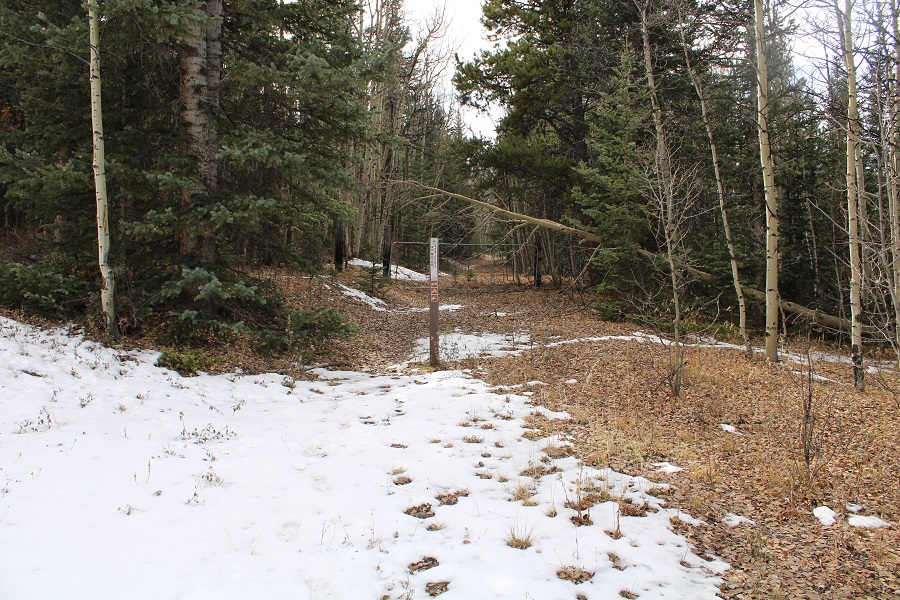
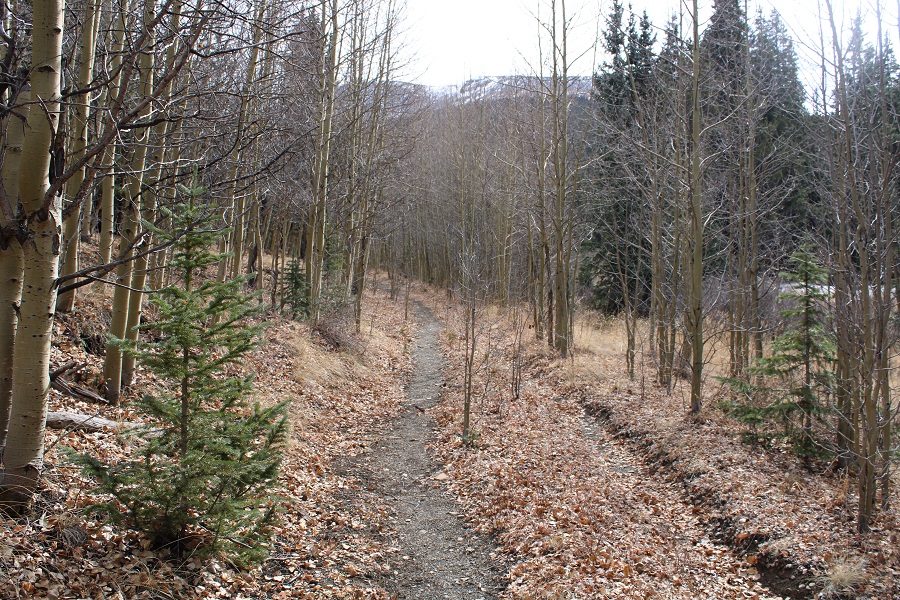
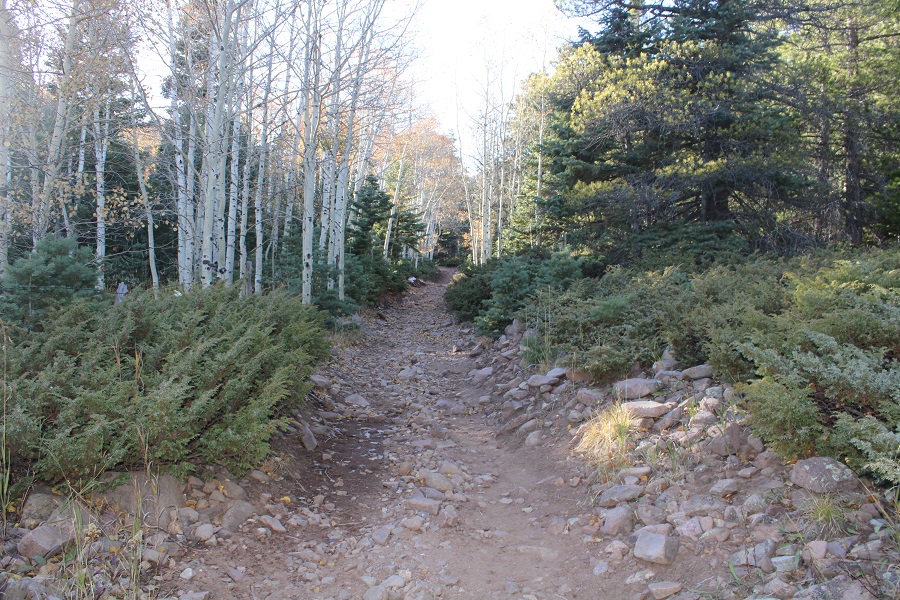
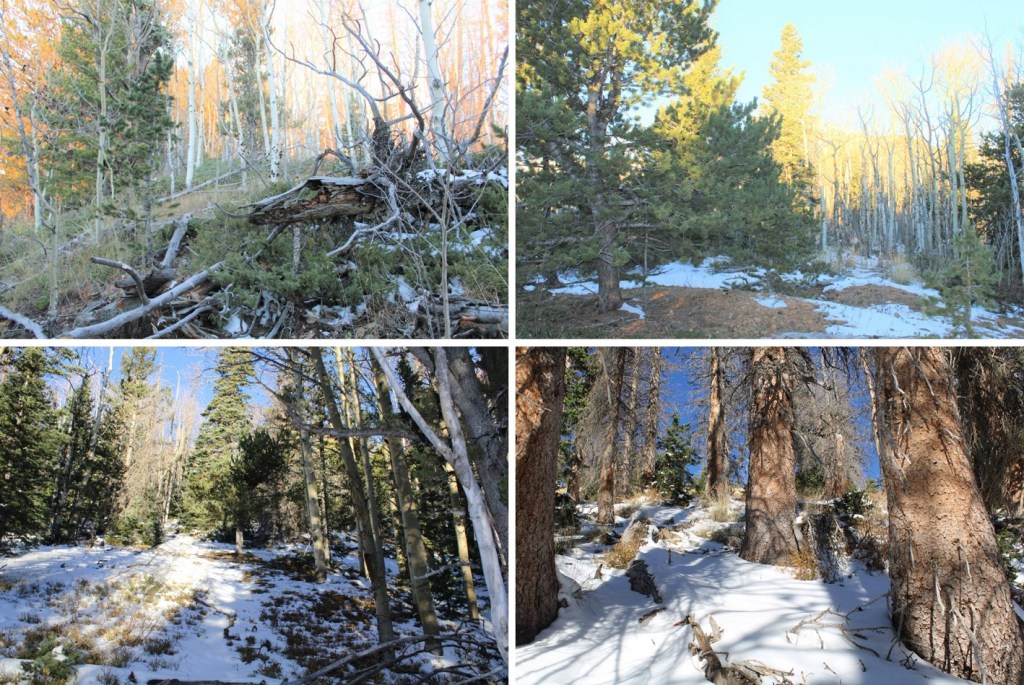
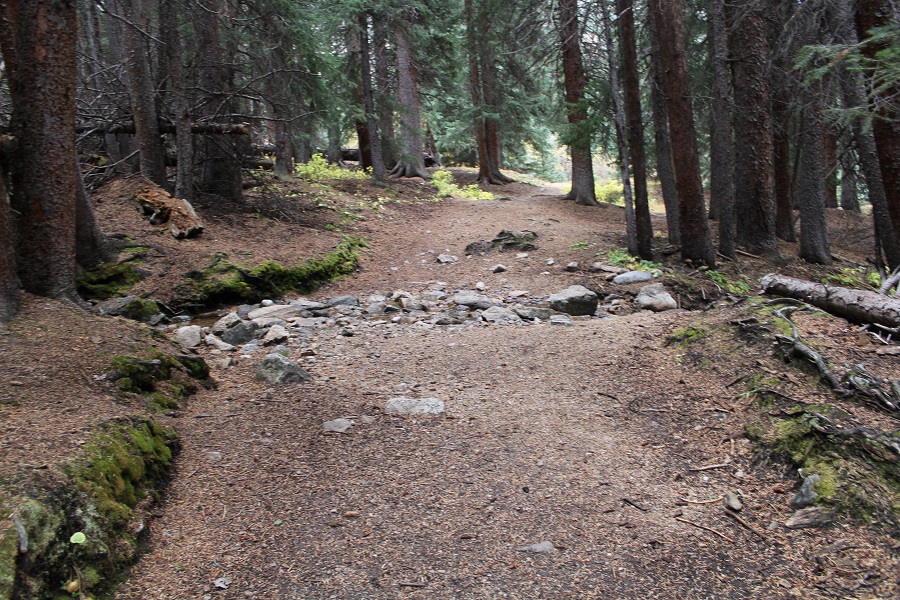
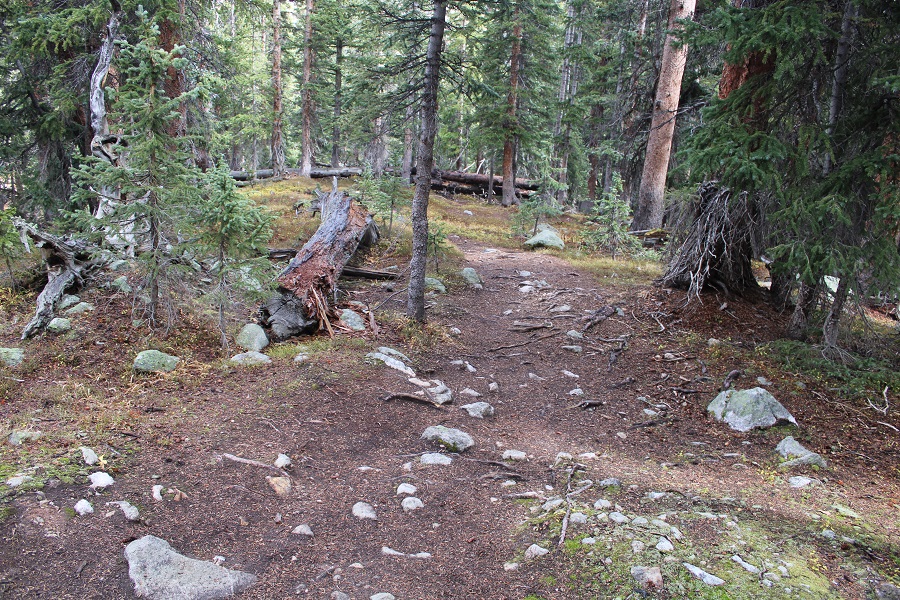
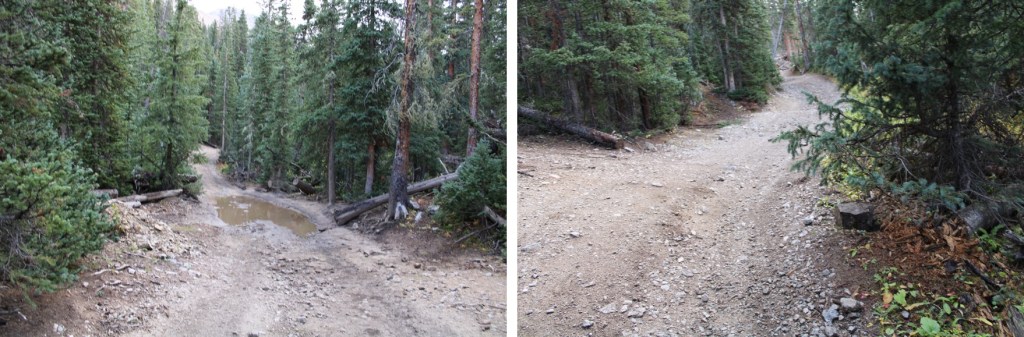
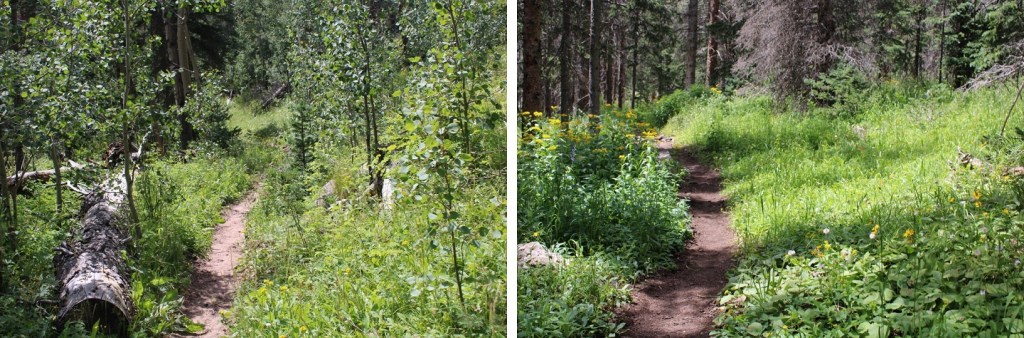
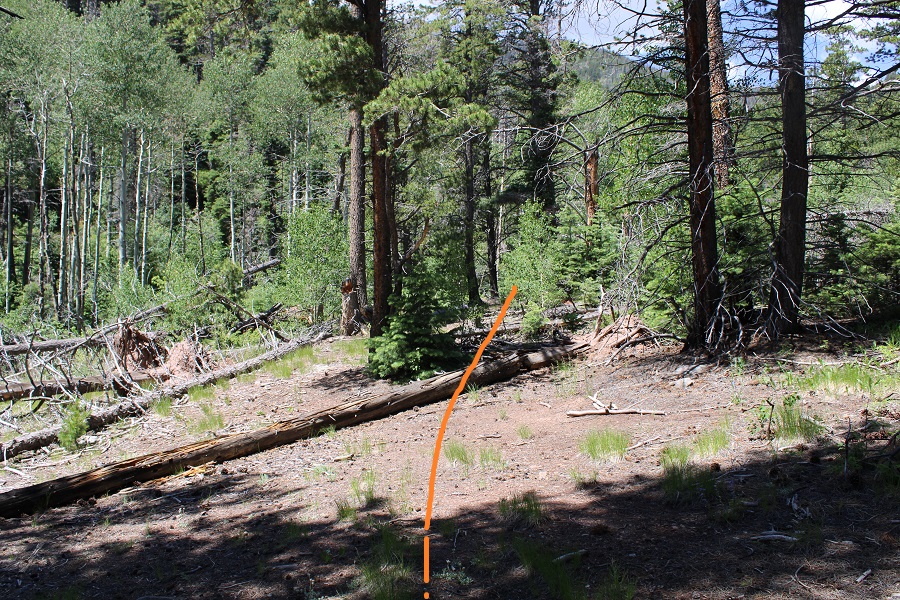
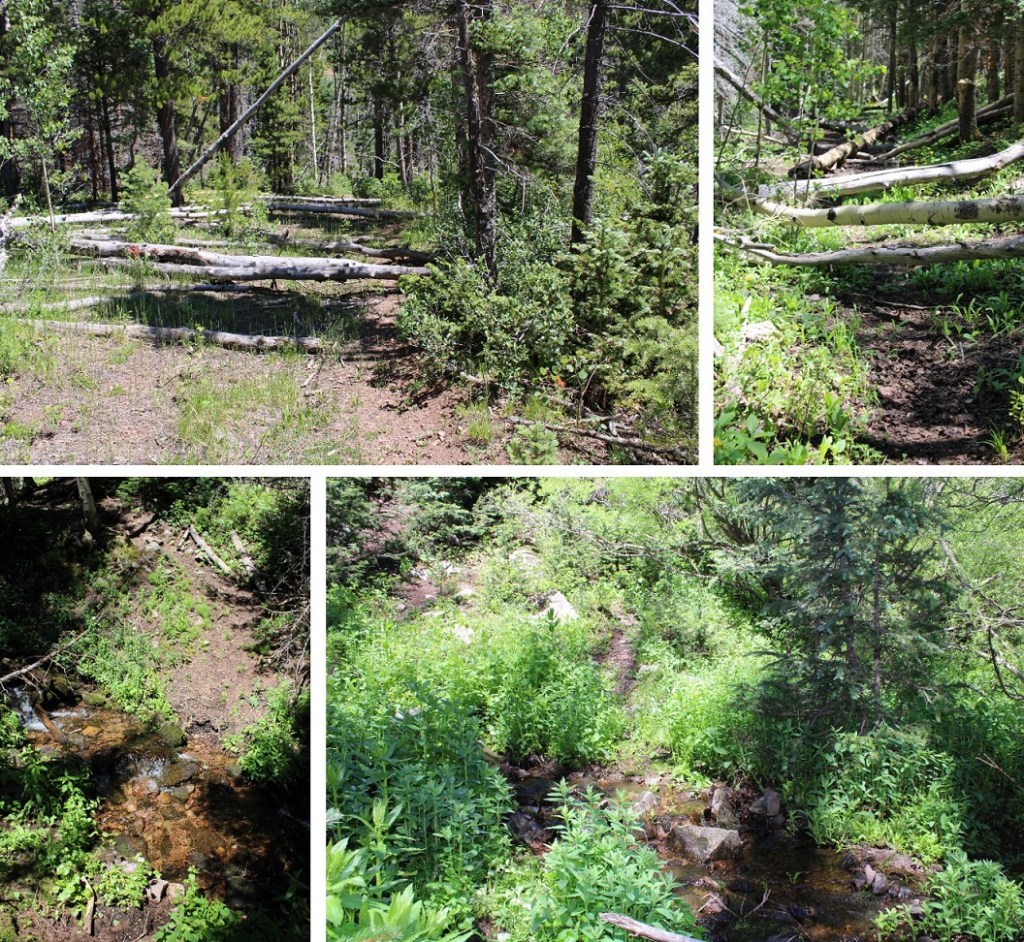
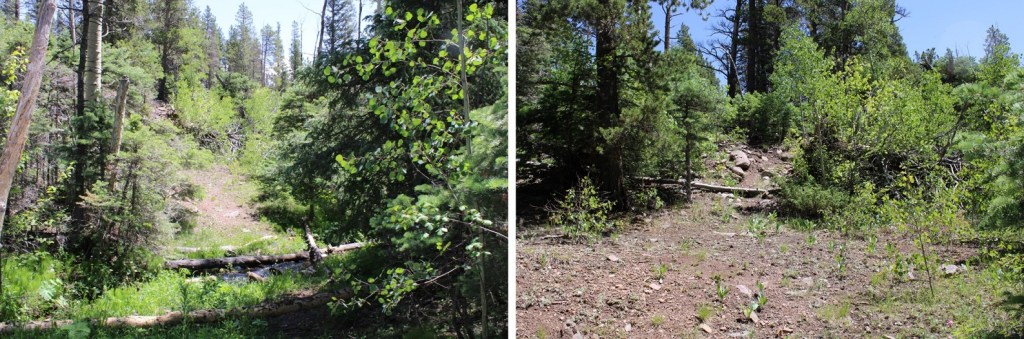
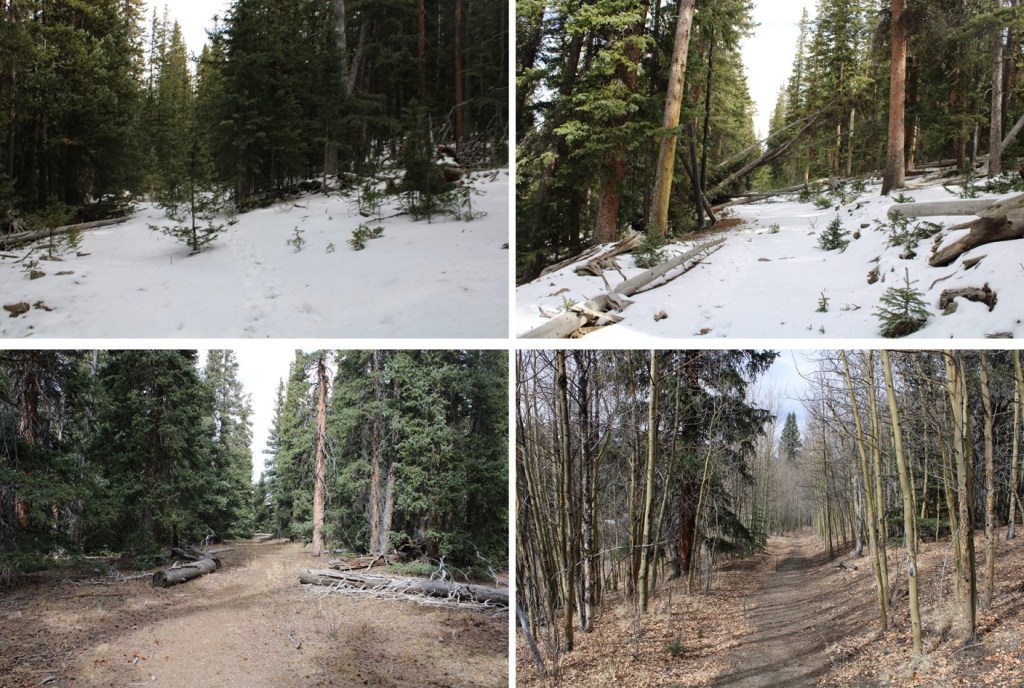
This road obviously hadn’t been in use in quite a while, as there were trees growing directly in the middle of the road, and large trees that had fallen across it years ago

I followed this 4WD road for 3 miles, almost to treeline.  As the sun came up, crows started cawing.  They must have known about my headache. Also, this is when I realized I’d forgotten my sunglasses.

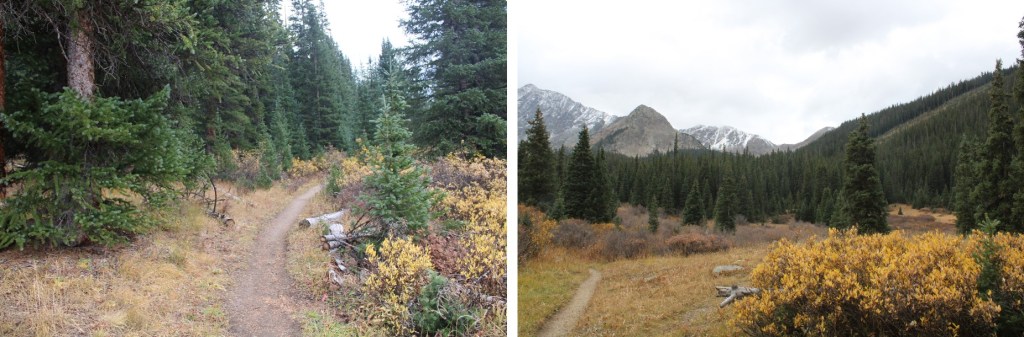
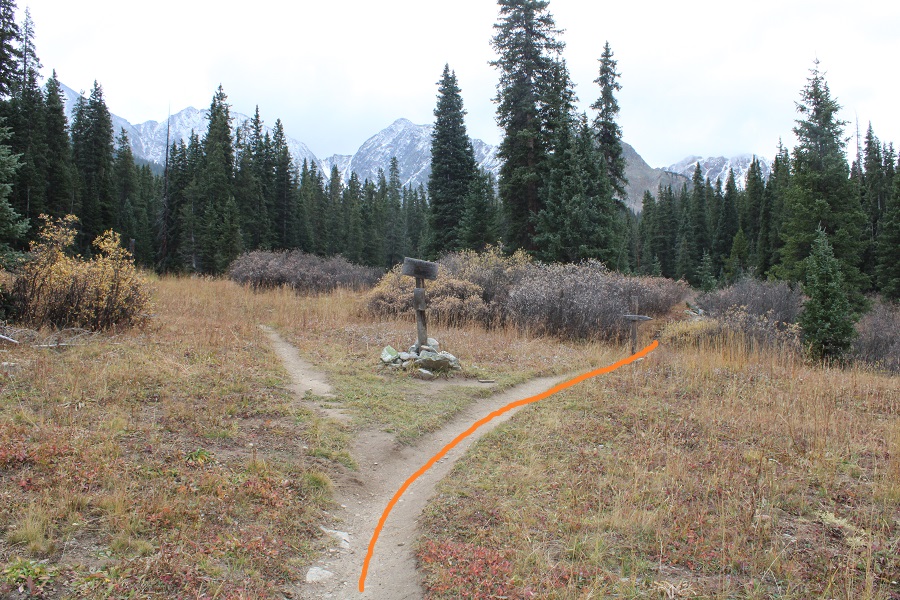
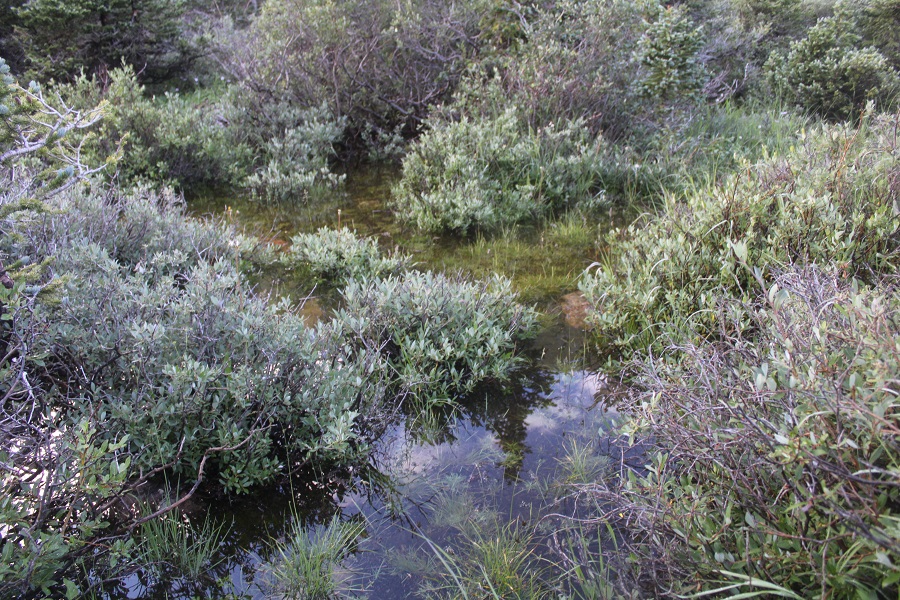
There was one set of tracks on the trail, which ended when the road ended.  When the 4WD road ended, the cairns picked up.  Initially, I’d wanted to hike West Buffalo Peak first, but I wasn’t able to find a marked route.  So, instead I took a visual of how I wanted to head back, in case there wasn’t a route, and followed the cairns south that would lead me towards East Buffalo Peak instead.  The cairns initially brought me to willows.  These willows were easy to navigate.
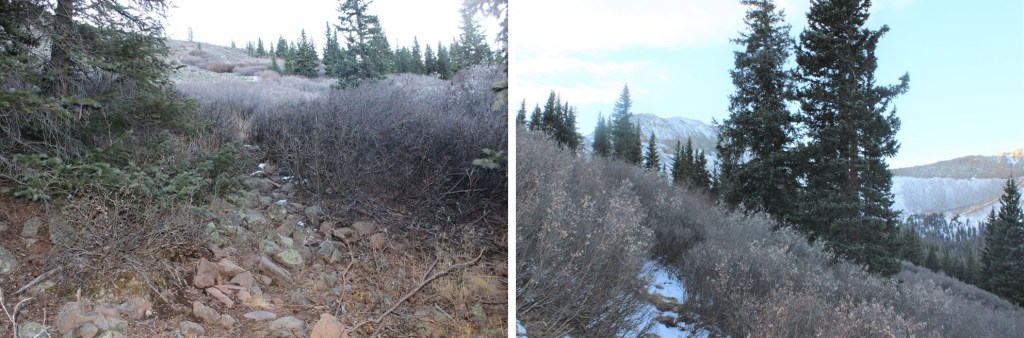
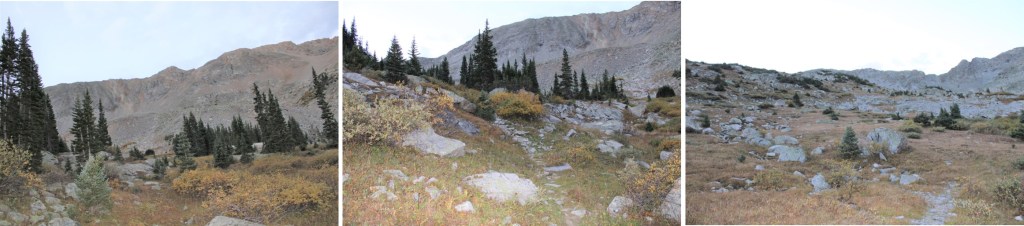
Once out of the willows, I was on tundra.  There were still cairns to guide the way.  I was heading south to the ridge. 
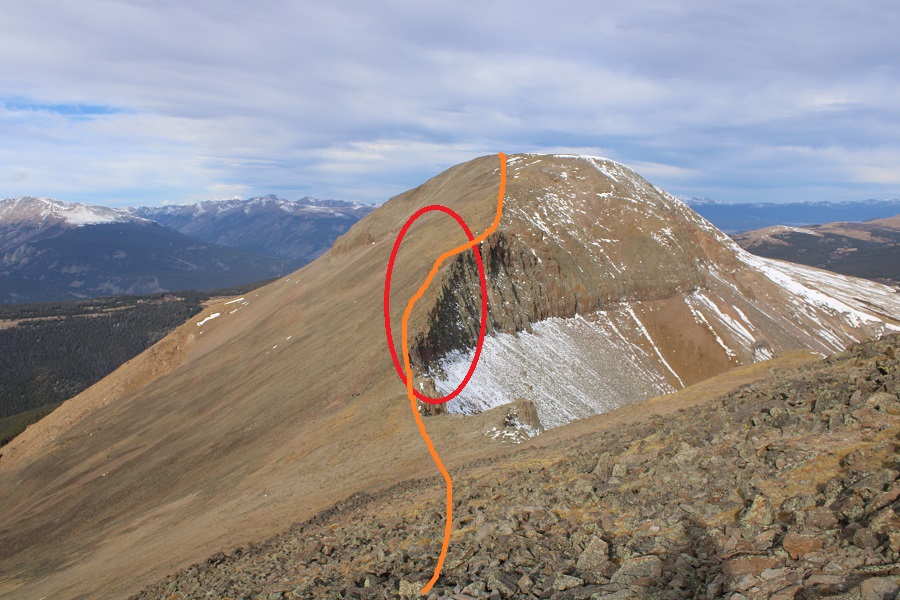
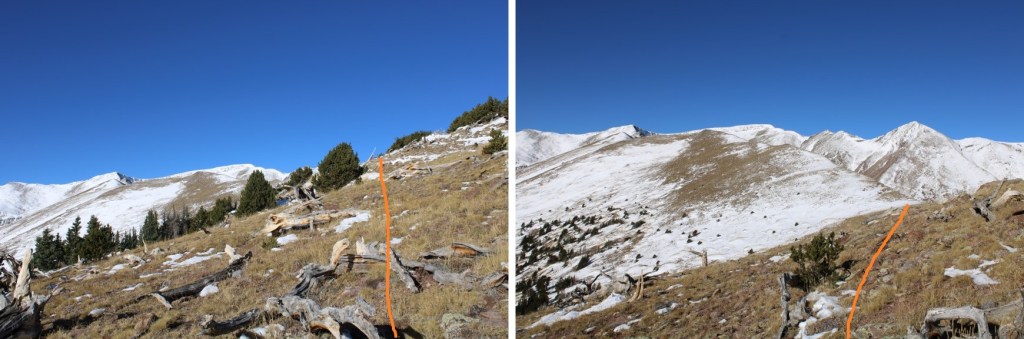
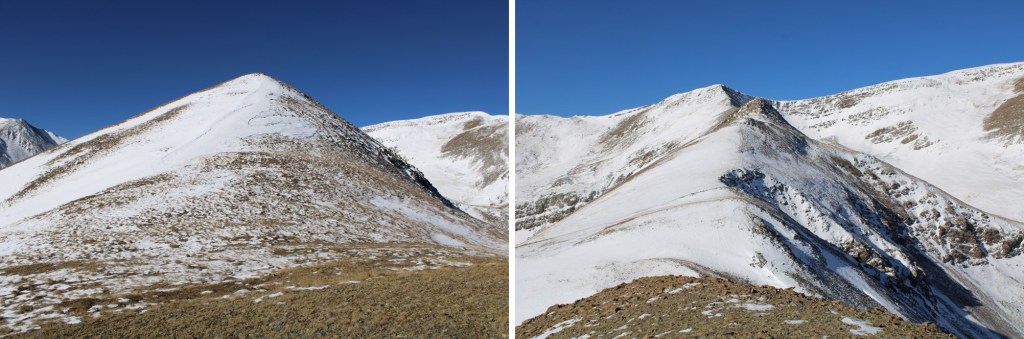
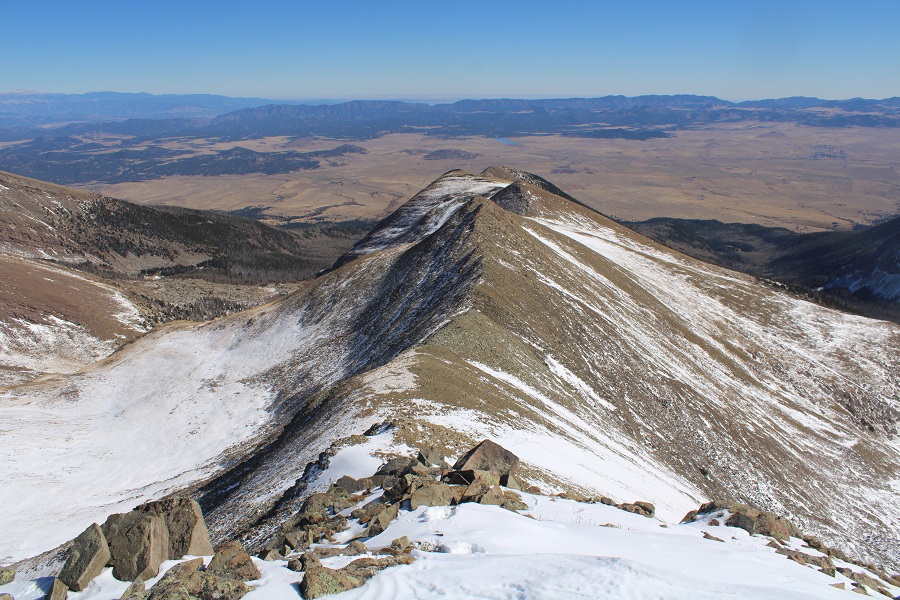
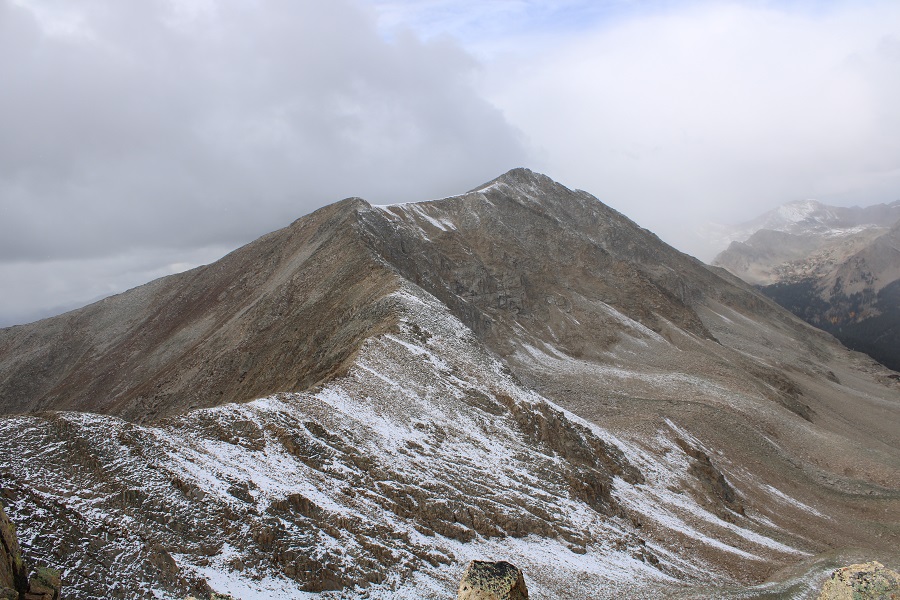
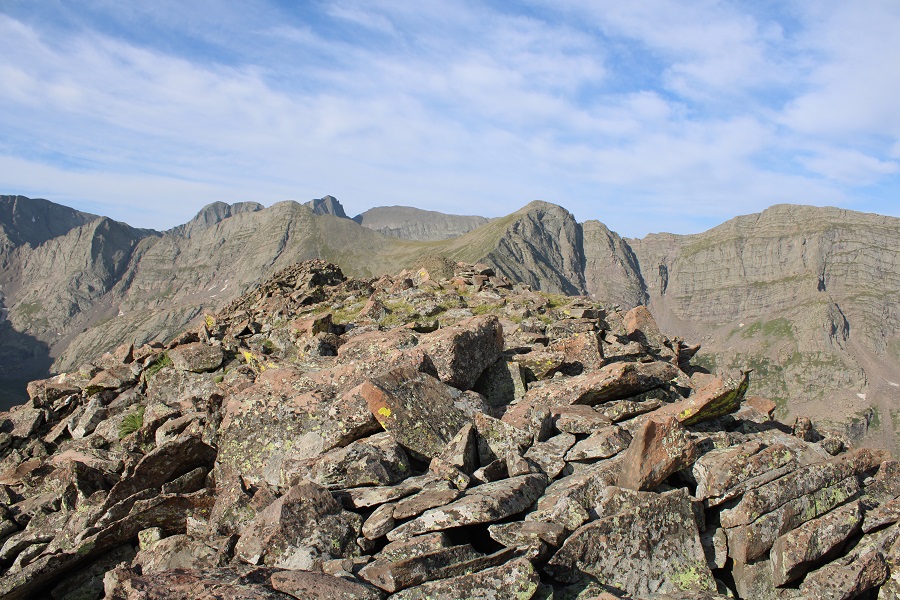
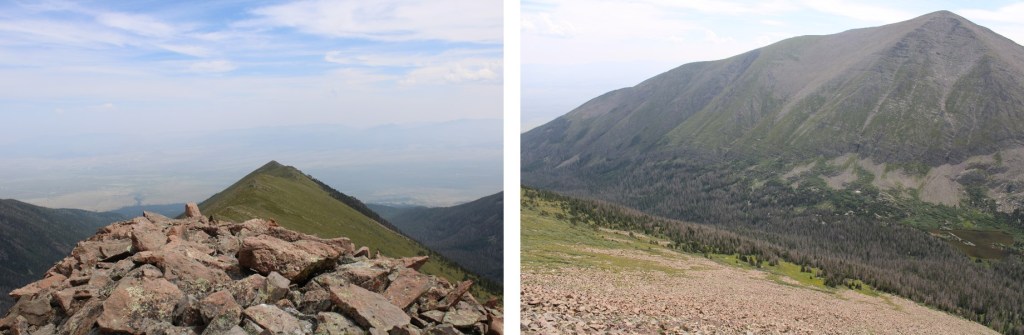
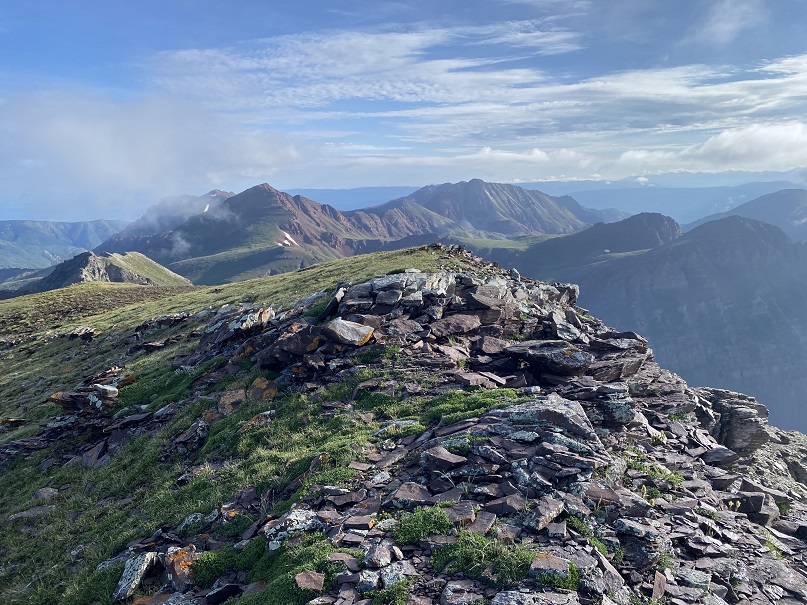
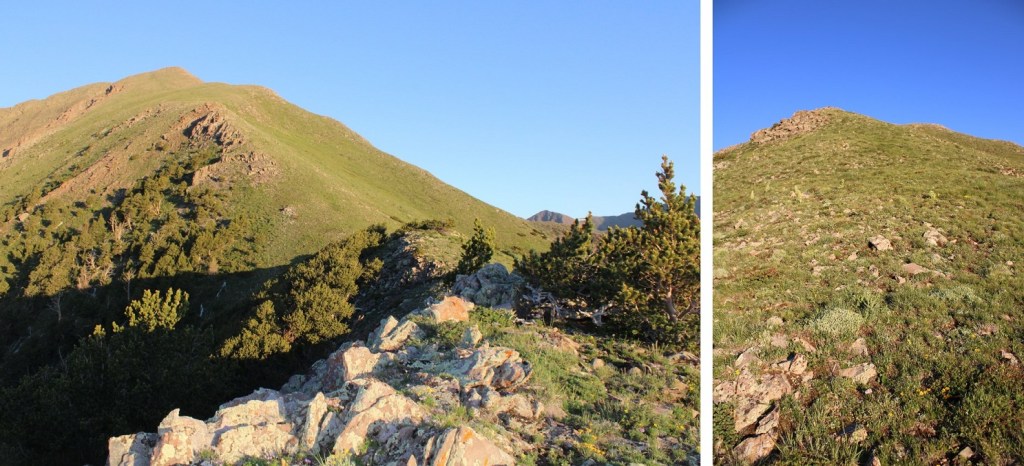
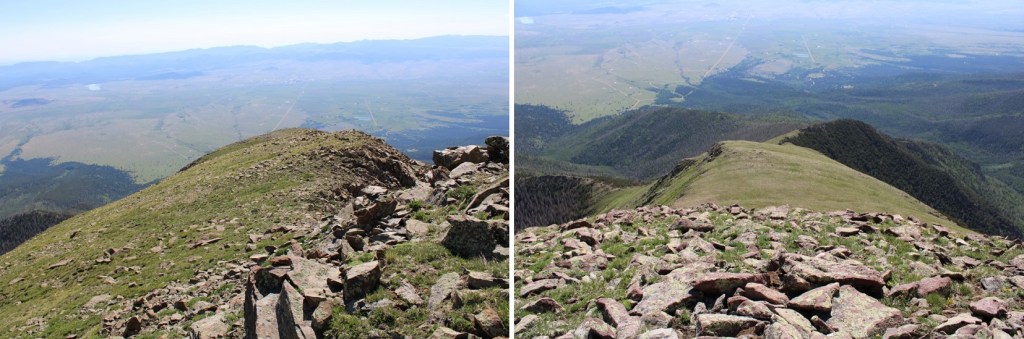
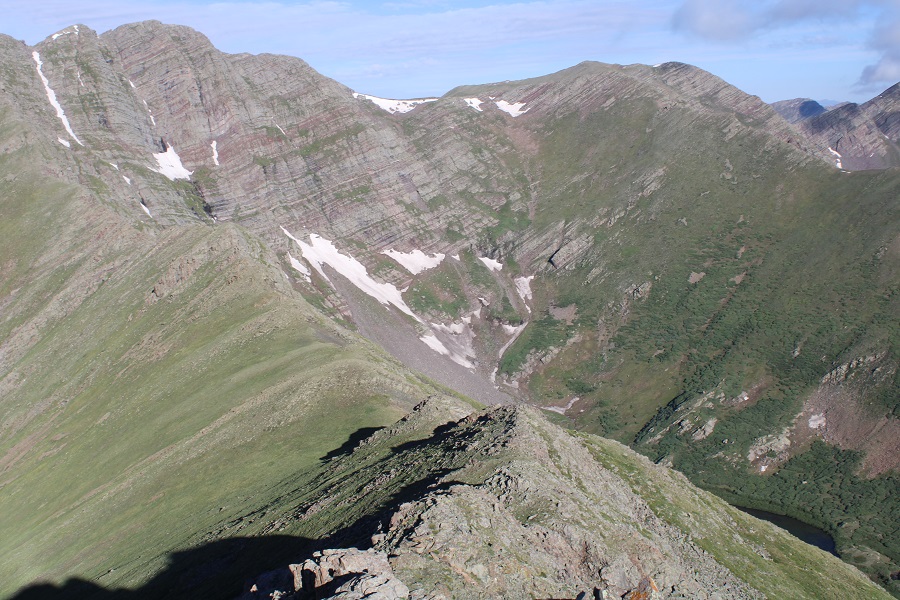
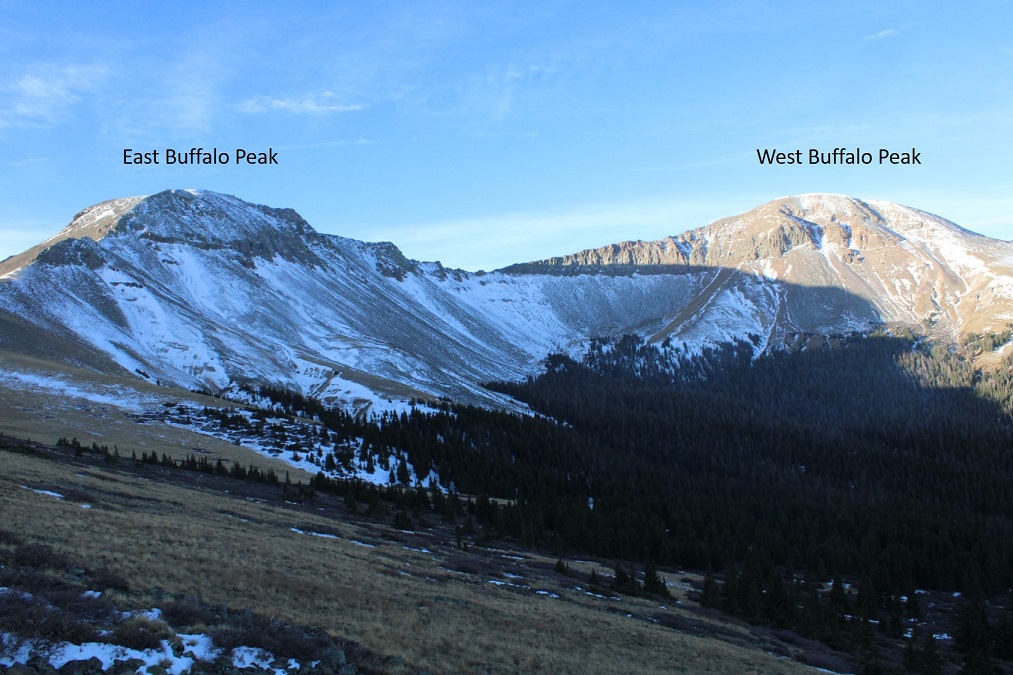
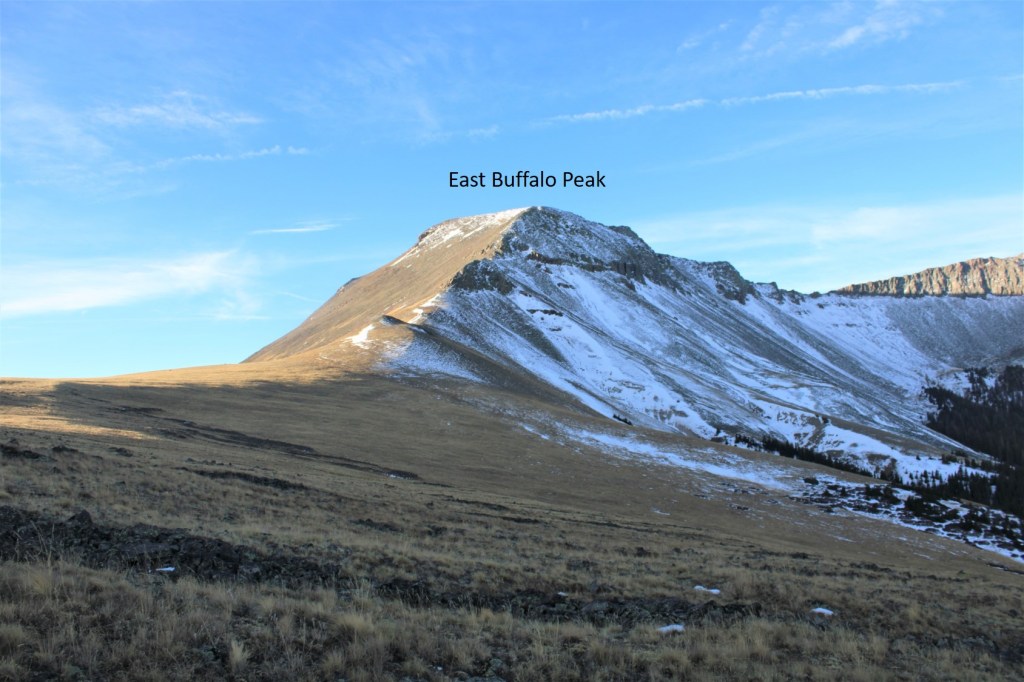
As I was ascending the ridge, I could see East and West Buffalo Peaks
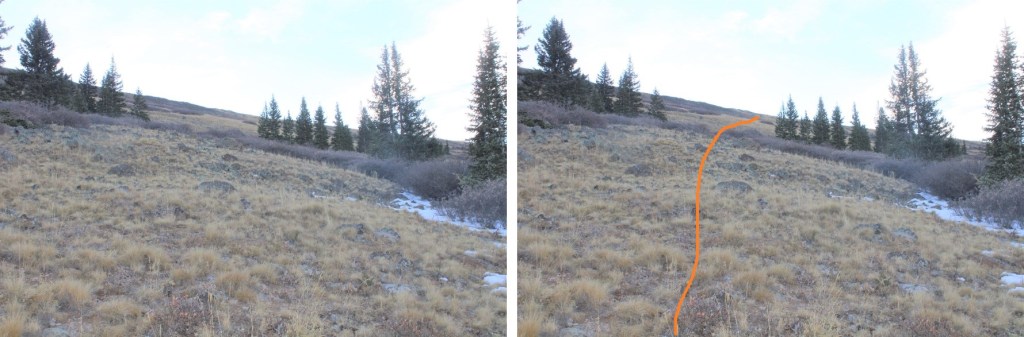
Ok, back to that tundra ridge
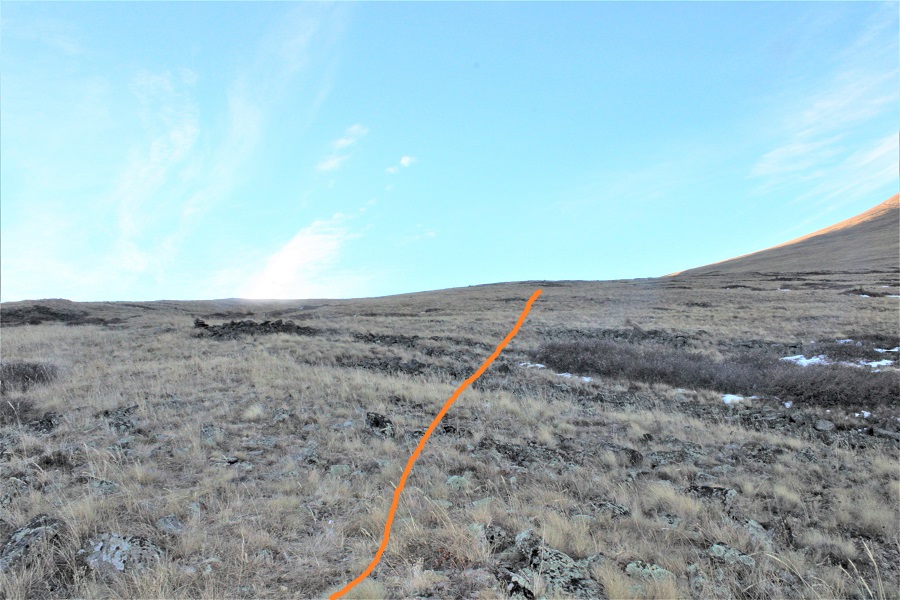
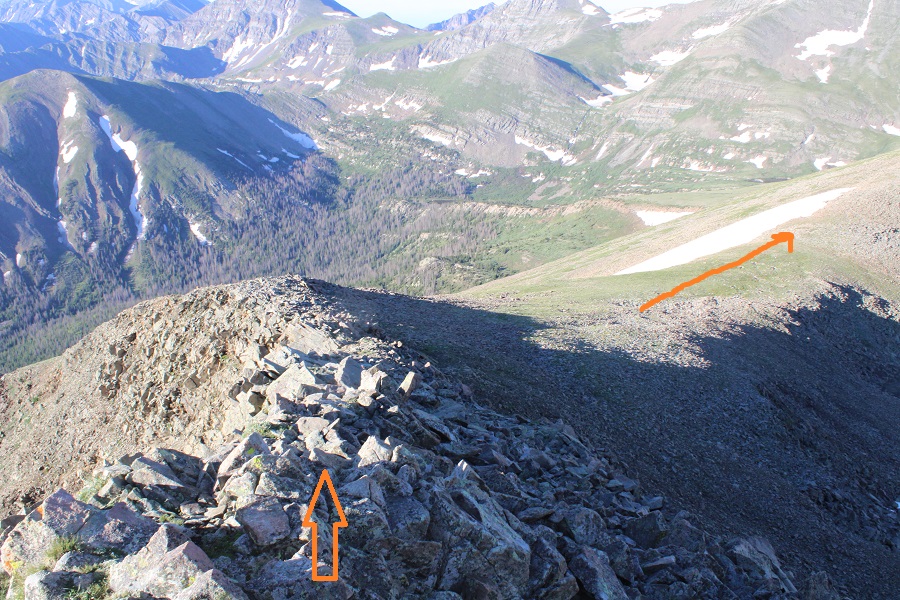
Once near the top of the ridge I turned right and headed southwest towards East Buffalo Peak
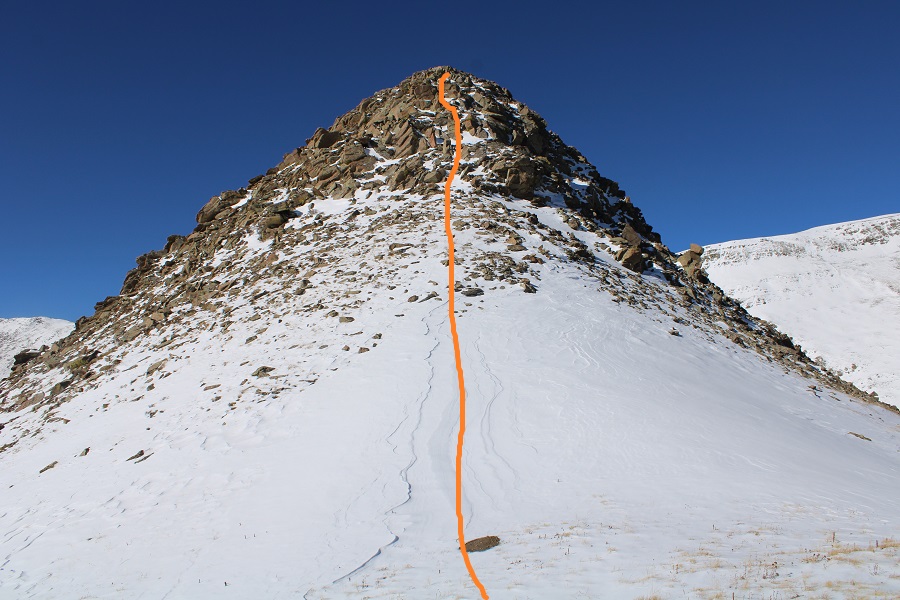
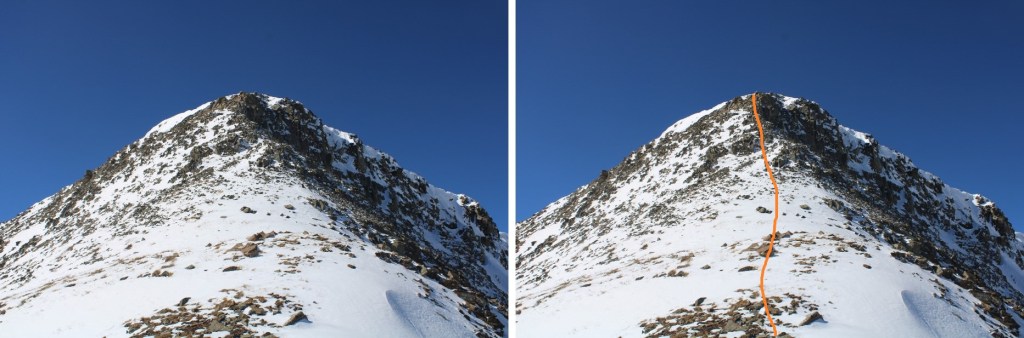
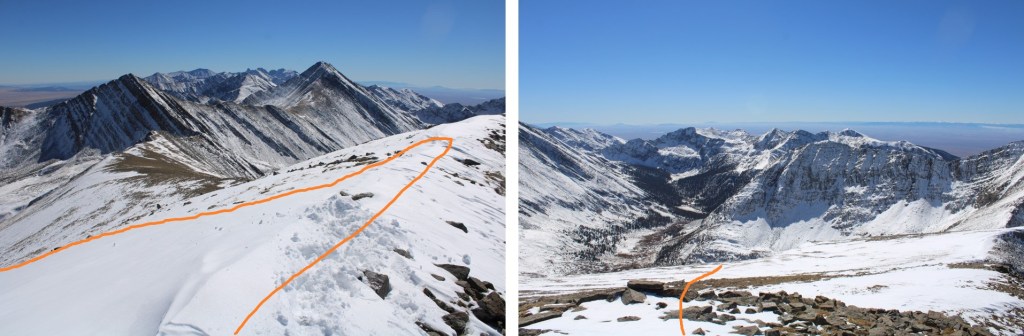
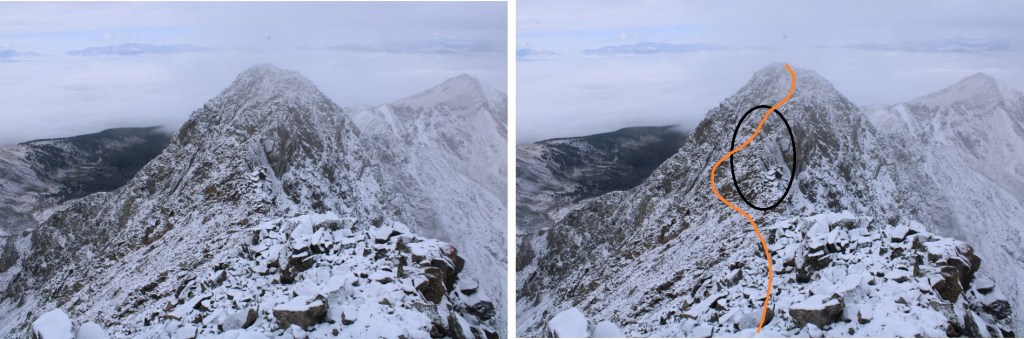
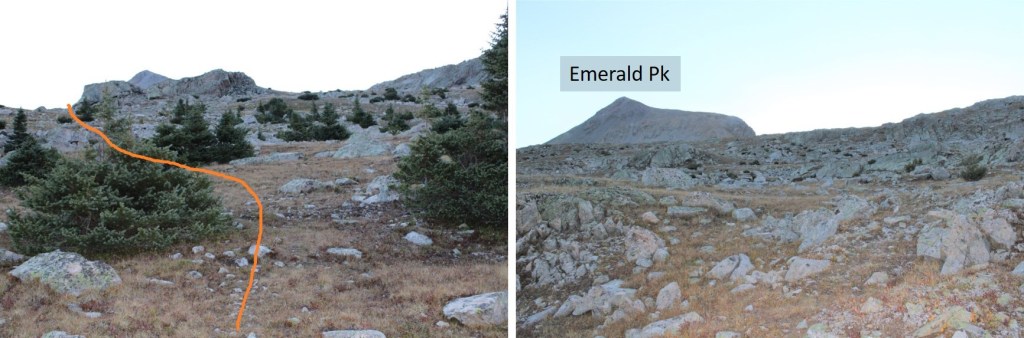
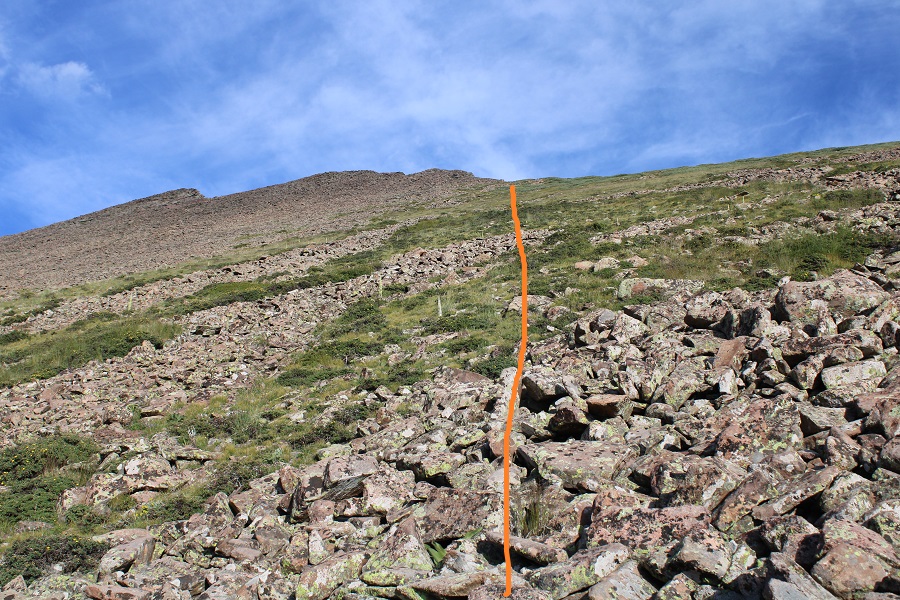
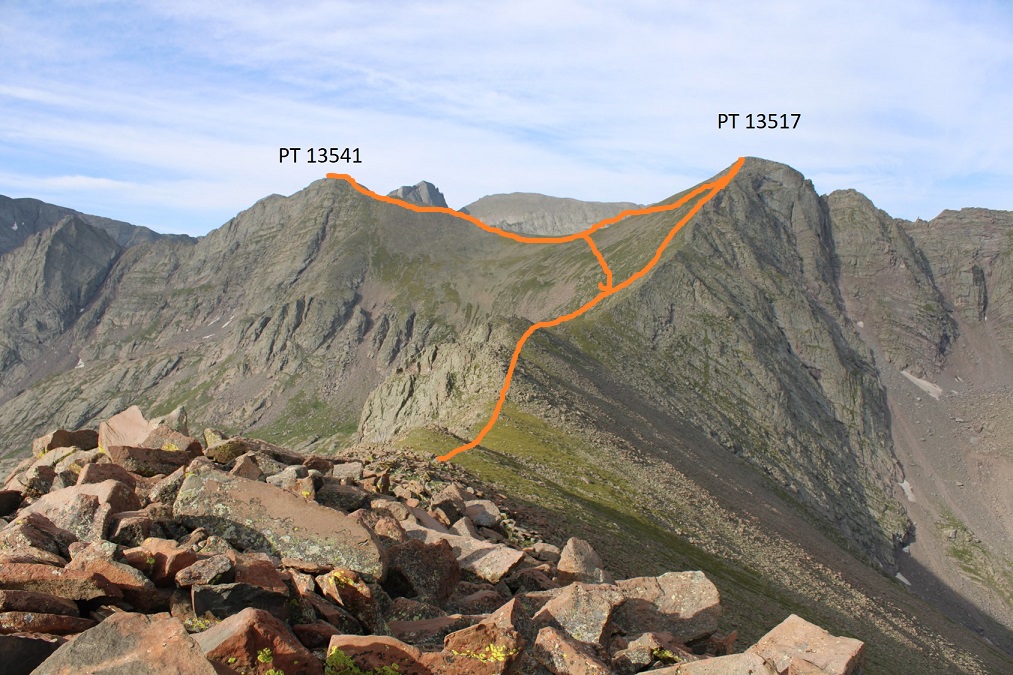
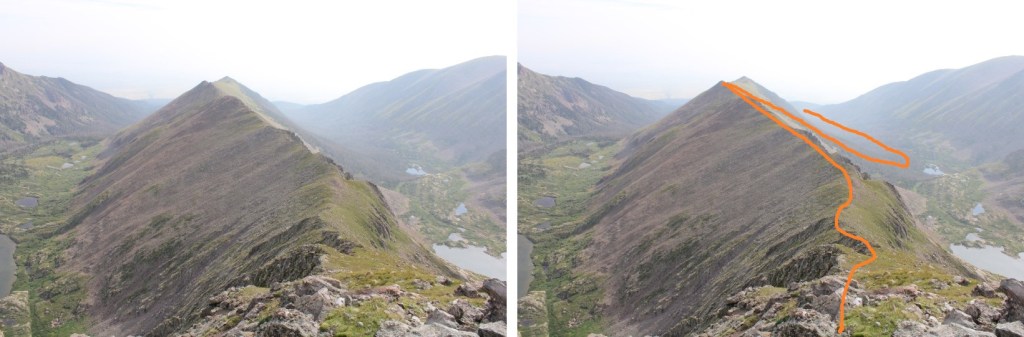
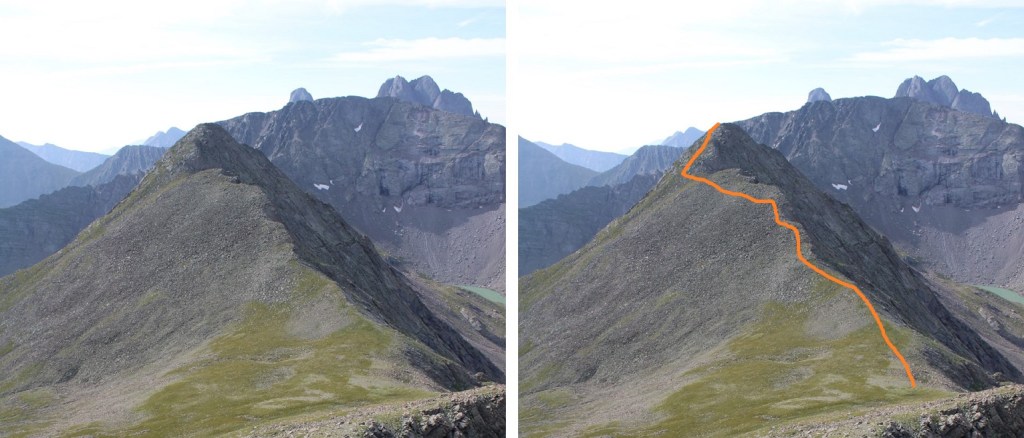
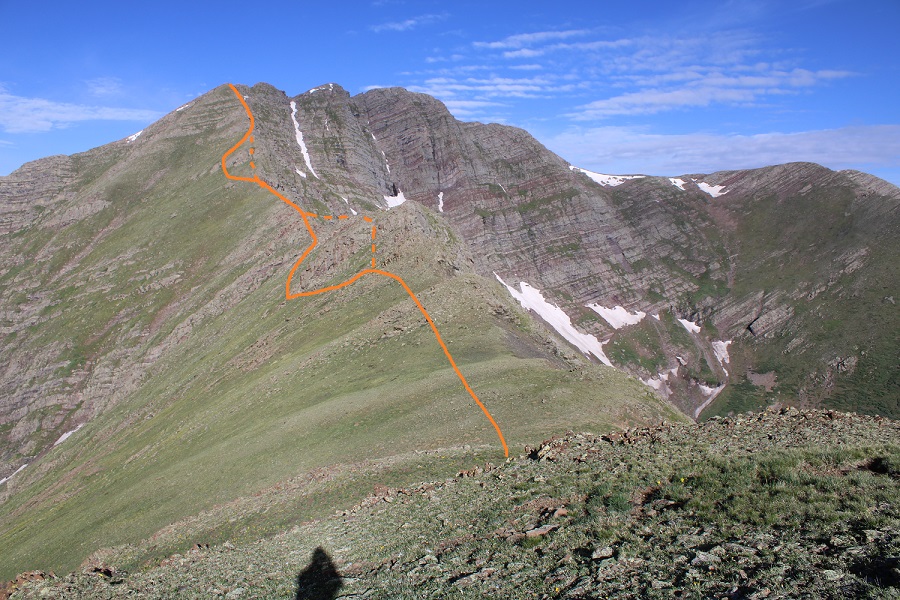
Here’s the overall route I took up the ridge

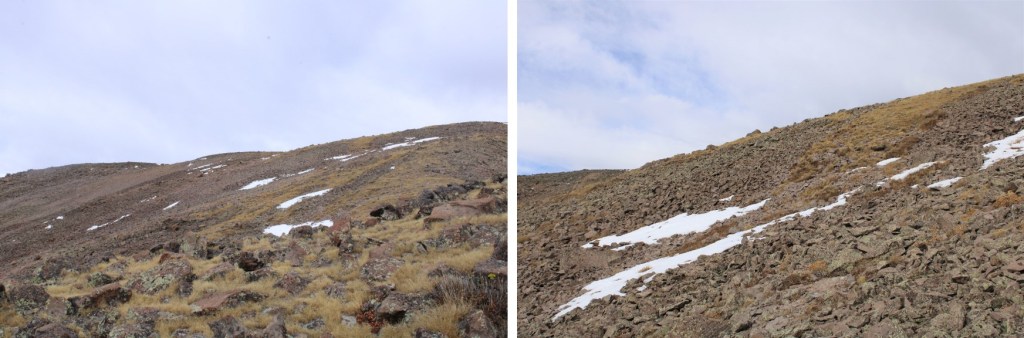
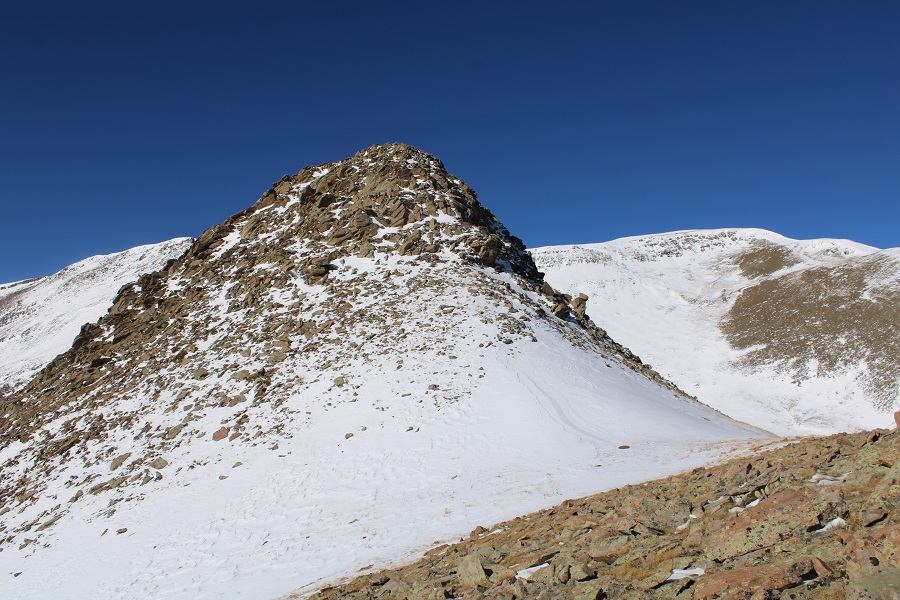
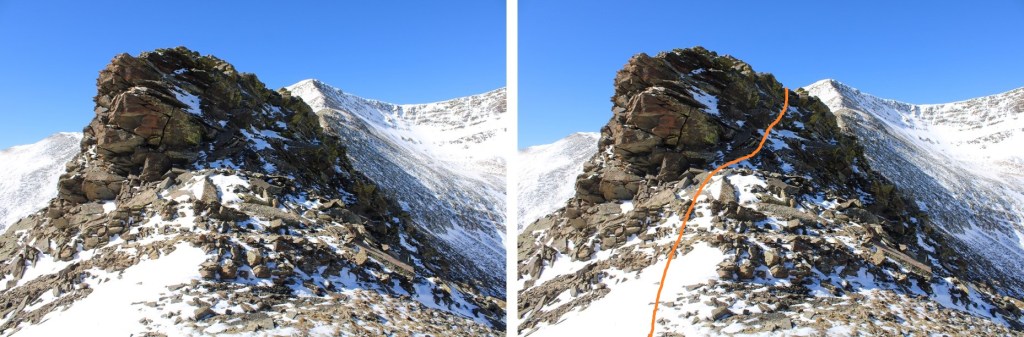
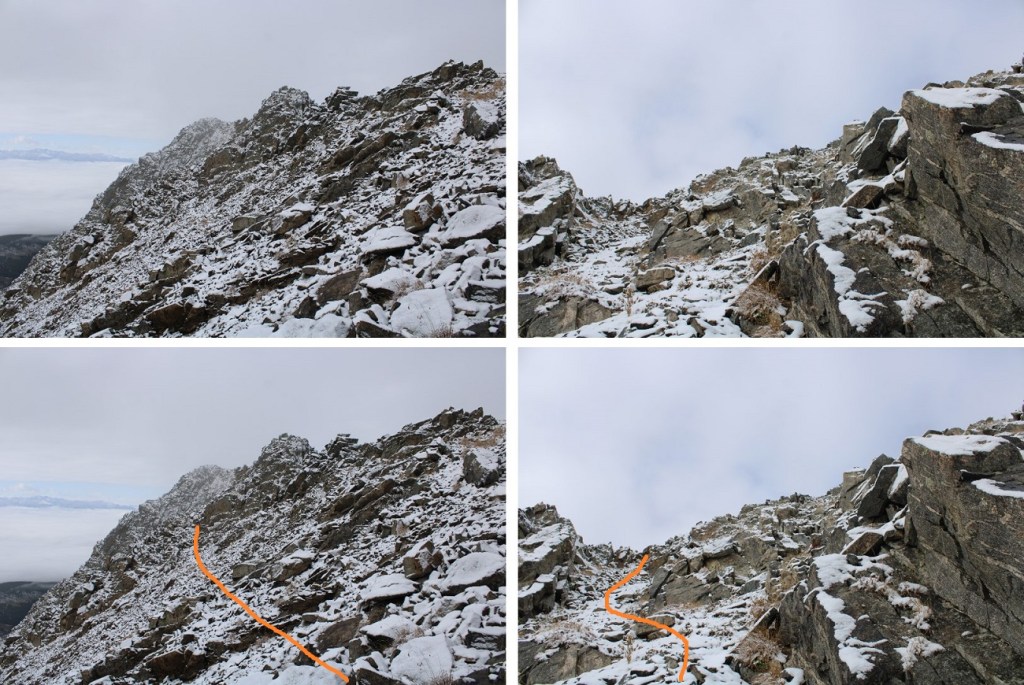
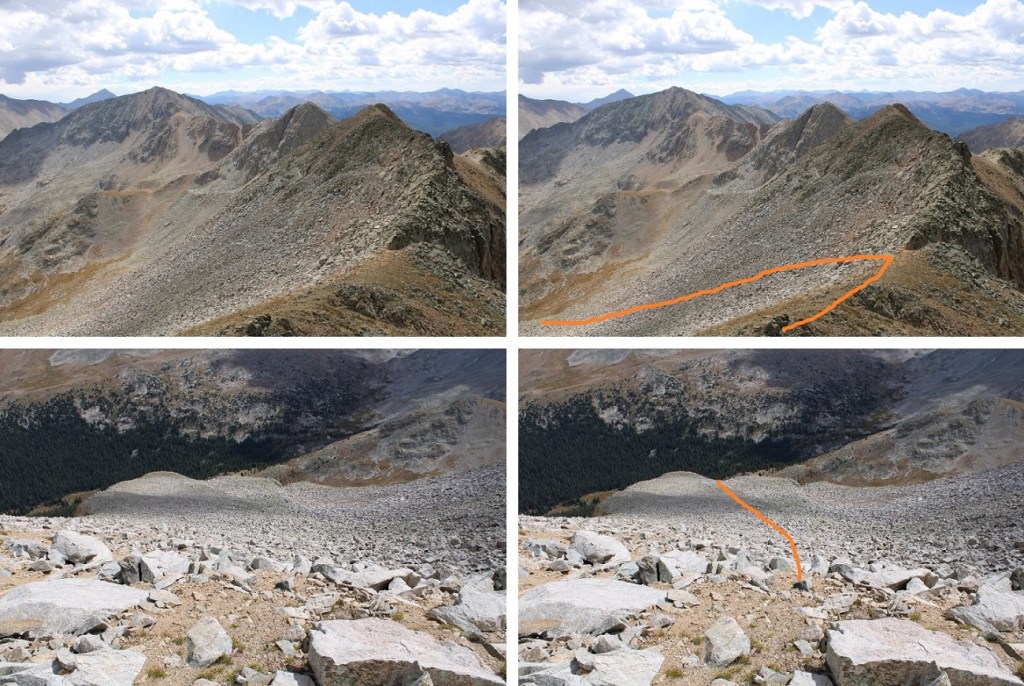
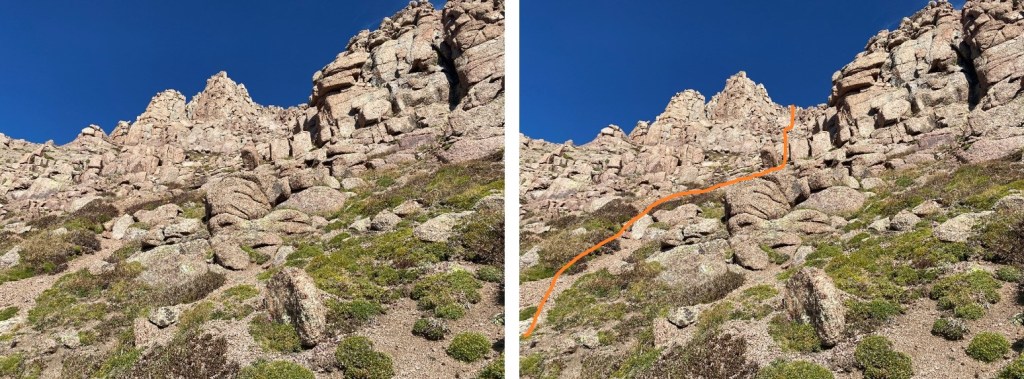
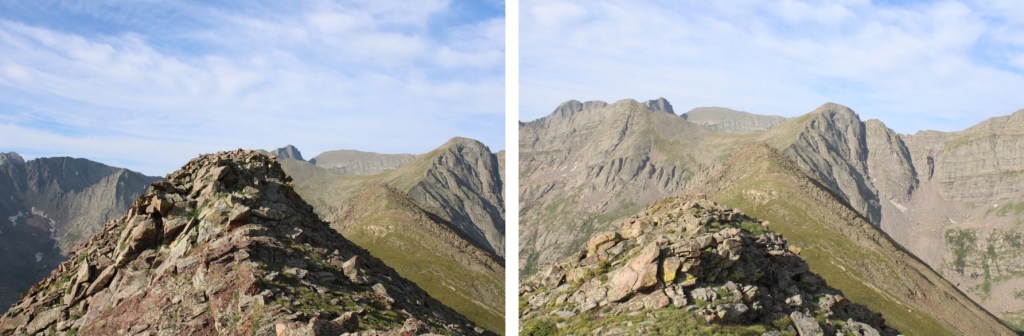
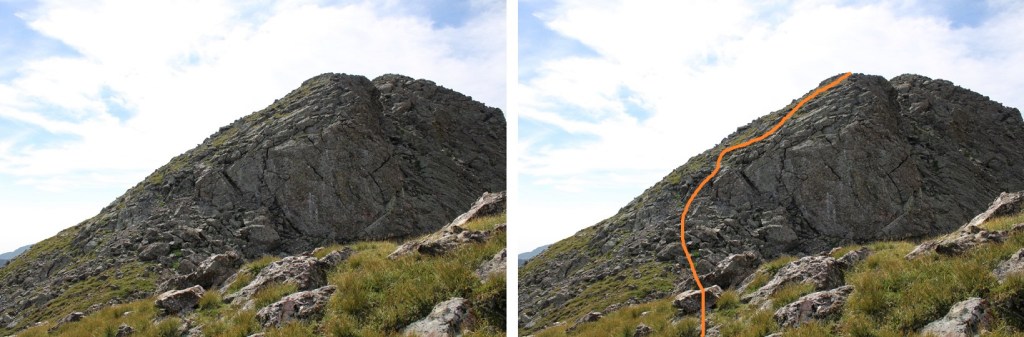
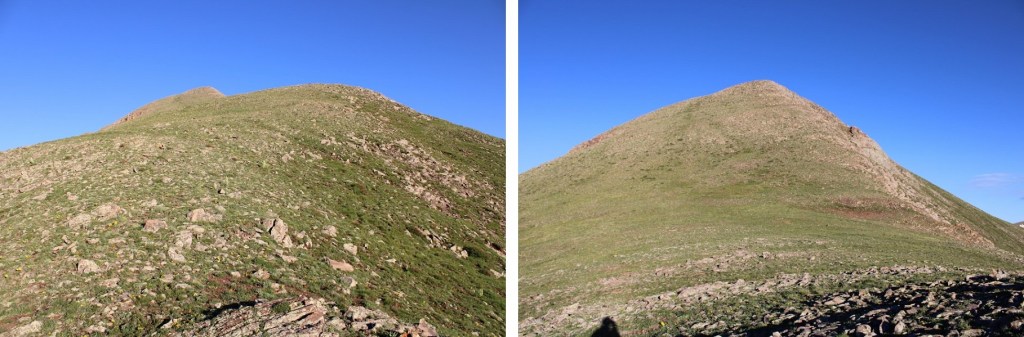
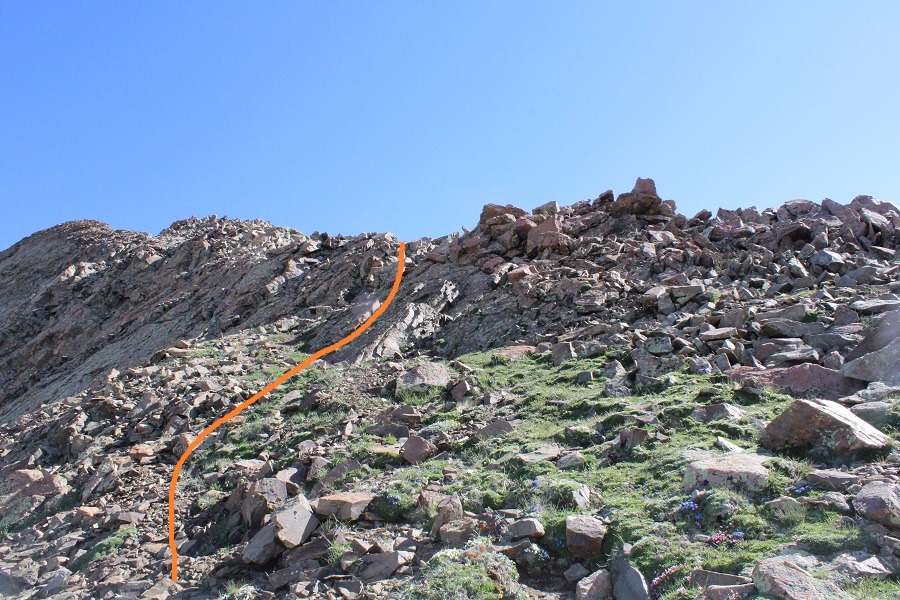
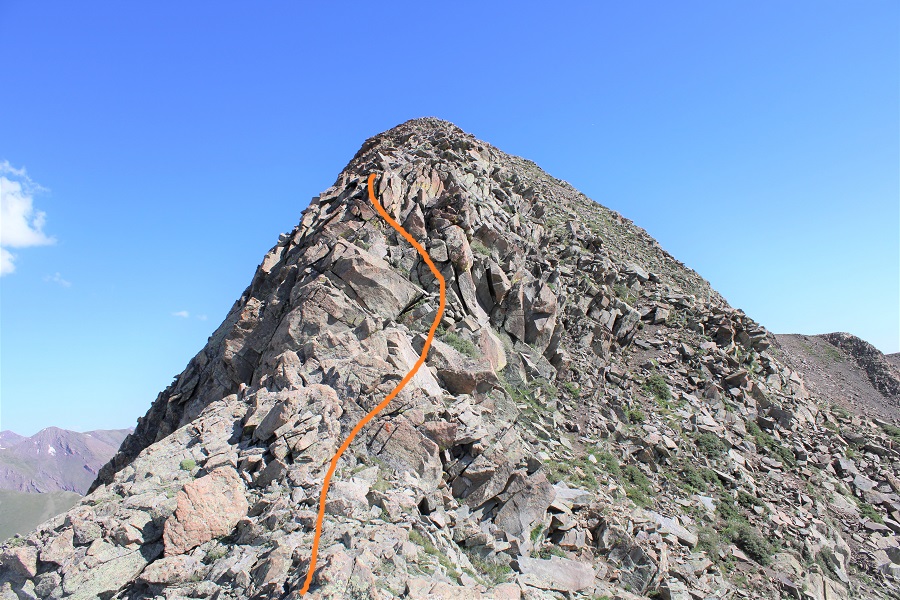
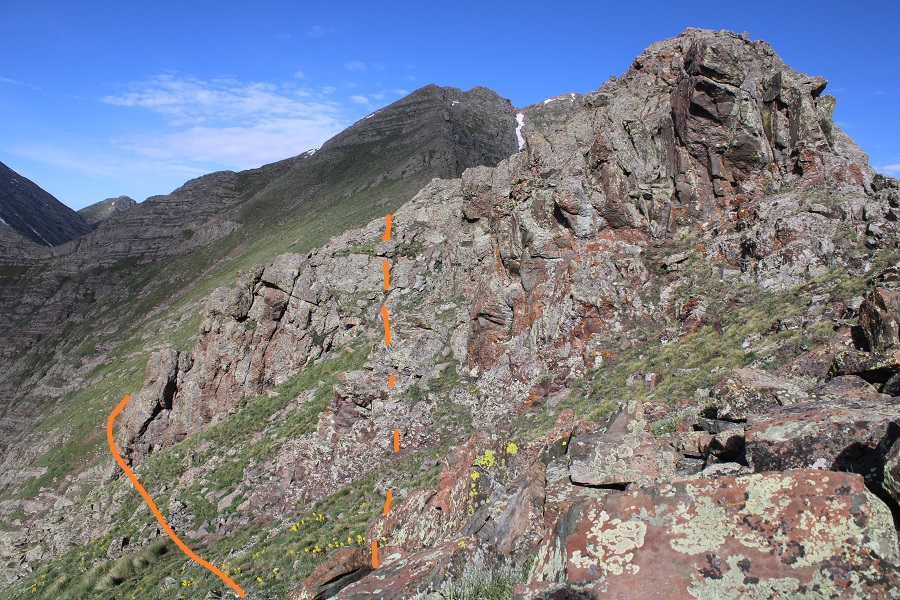
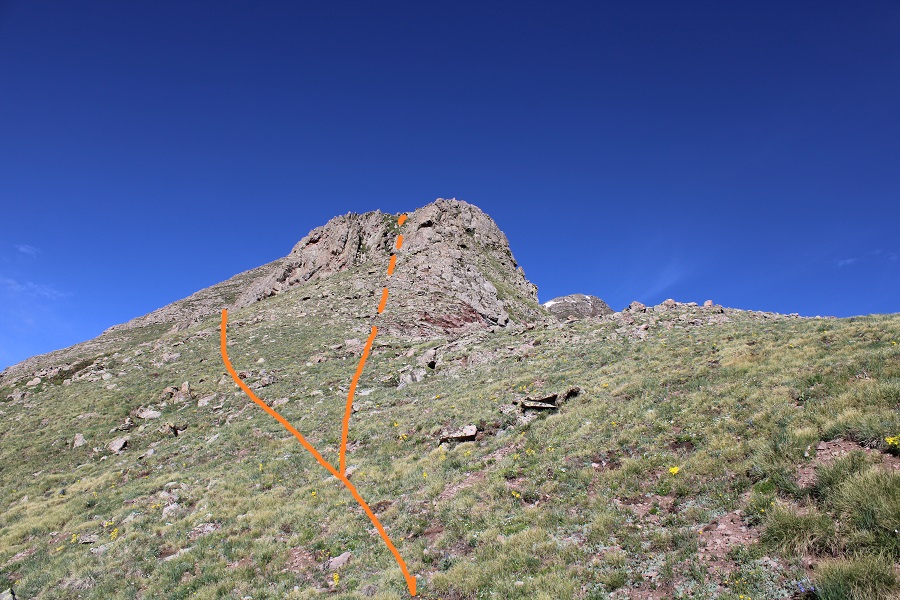
And some step-by-step pictures.  First, I skirted the initial hump to the left

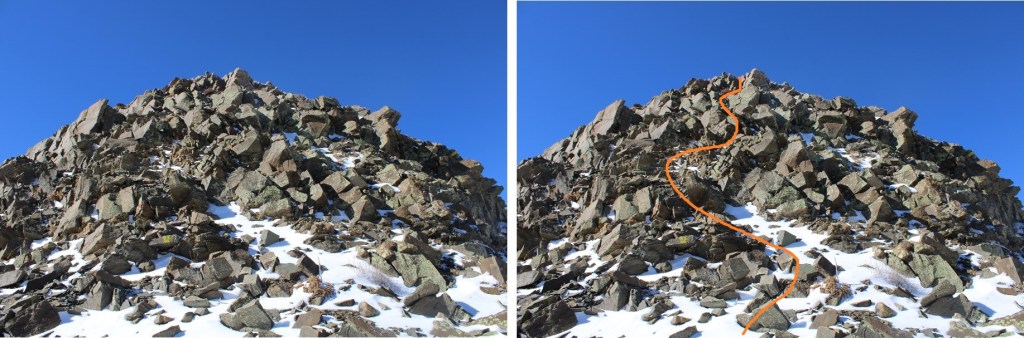
Next, I continued to stay just a bit left, rounding the south side of the ridge
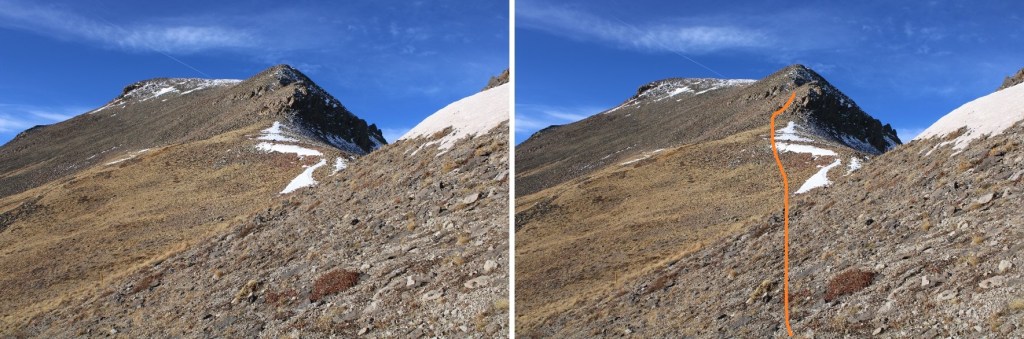
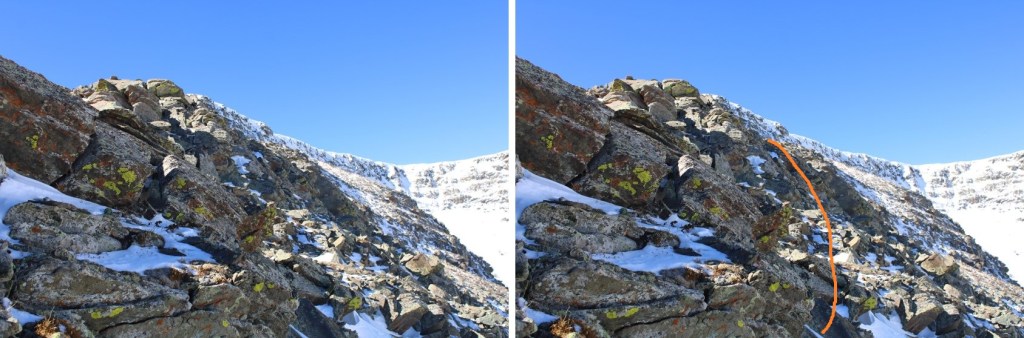
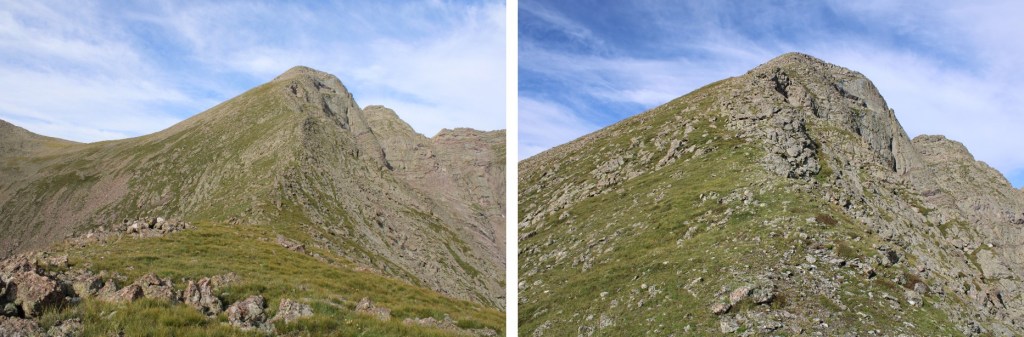
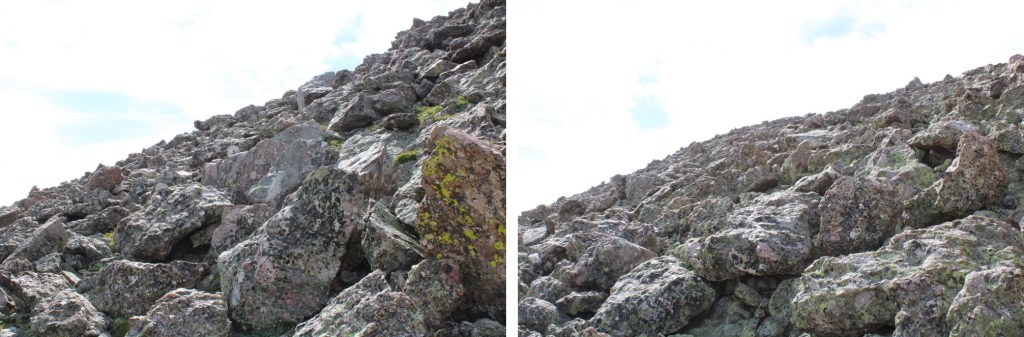
From here on out, I stayed right in the middle of the ridge.  It looked like there were game trails here, but they were half-covered in snow.  The rocks were a bit loose, but this was no more challenging than difficult class 2.  I still had a headache, so I decided to drink water, something I rarely do while hiking.  Where there was snow, I re-filled my water bottle.
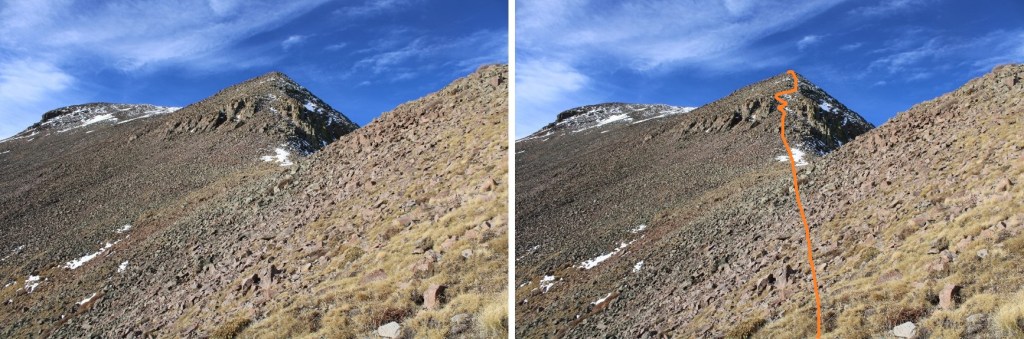
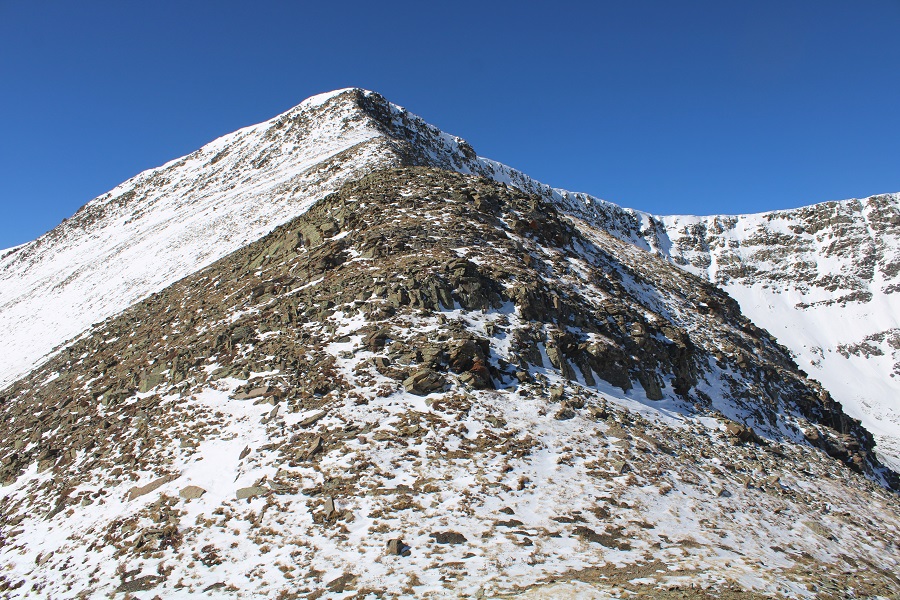
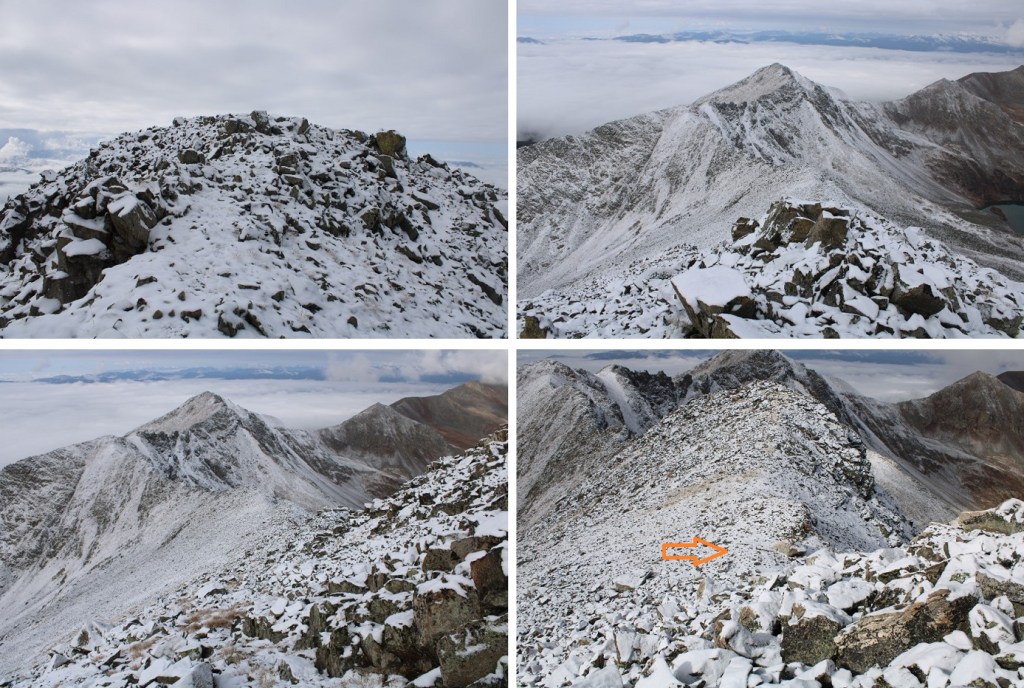
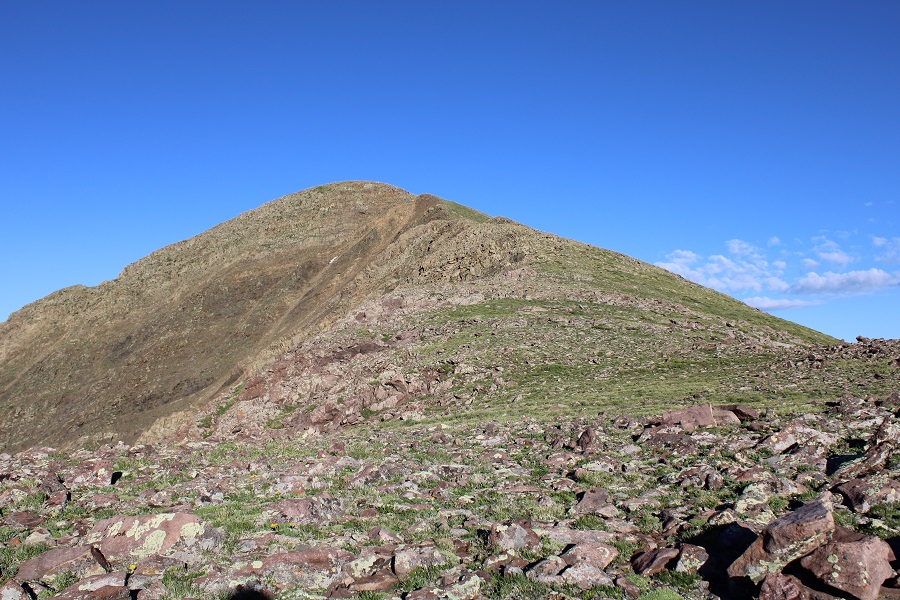
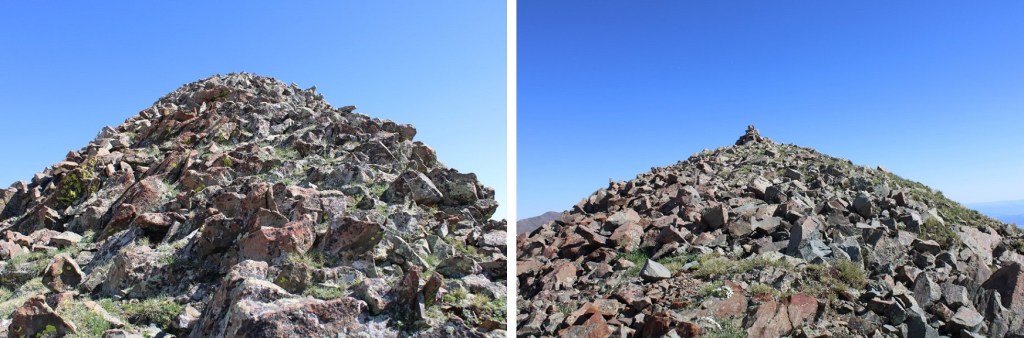
I topped out and it was an easy walk on tundra and rocks to the summit, heading southwest.

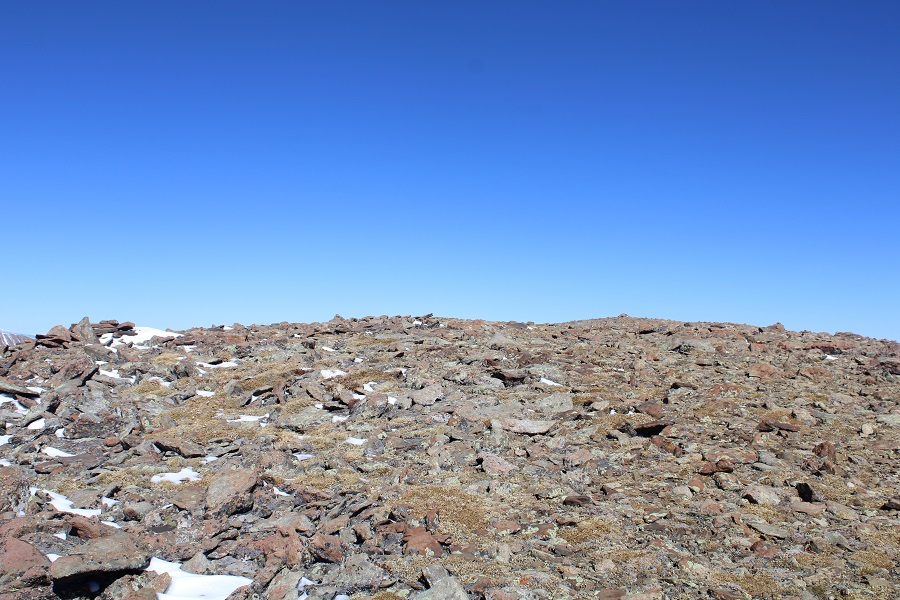
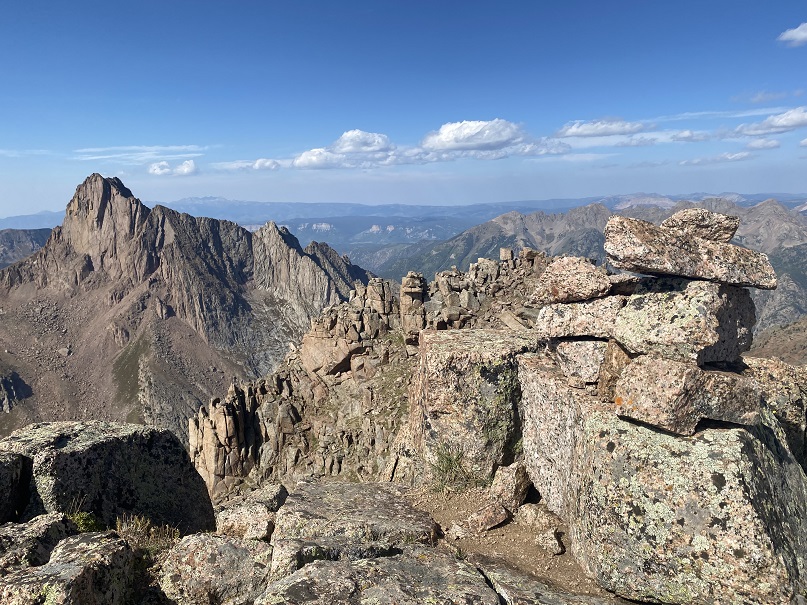
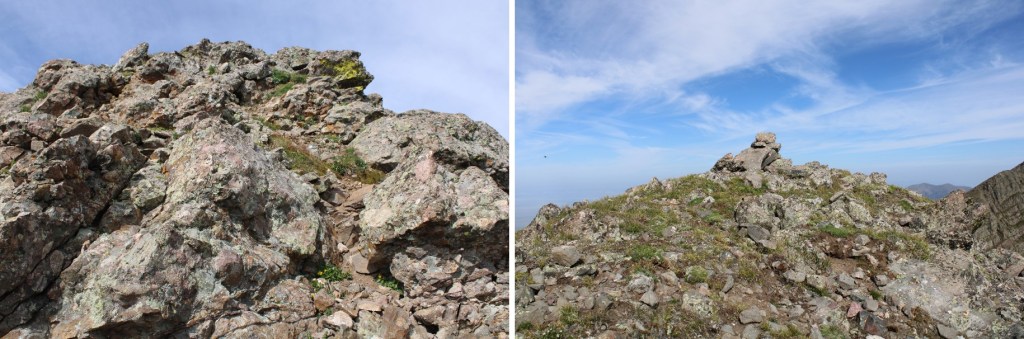
The summit was large and flat and the summit was at the far west end of the summit area, marked by a large cairn.

I summited East Buffalo Peak at 9:30am.
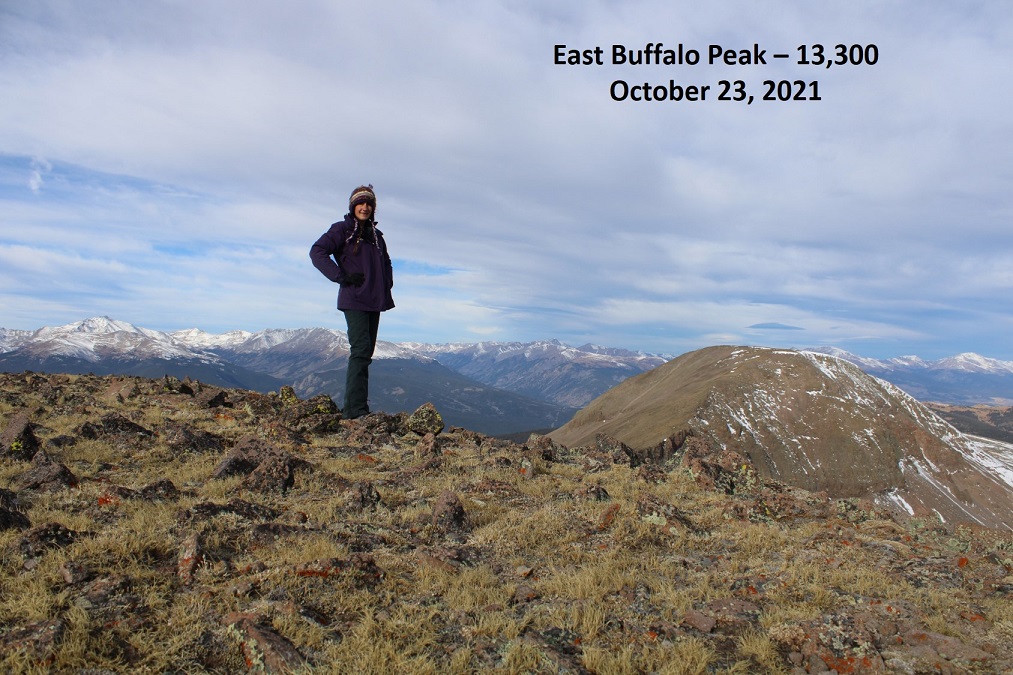
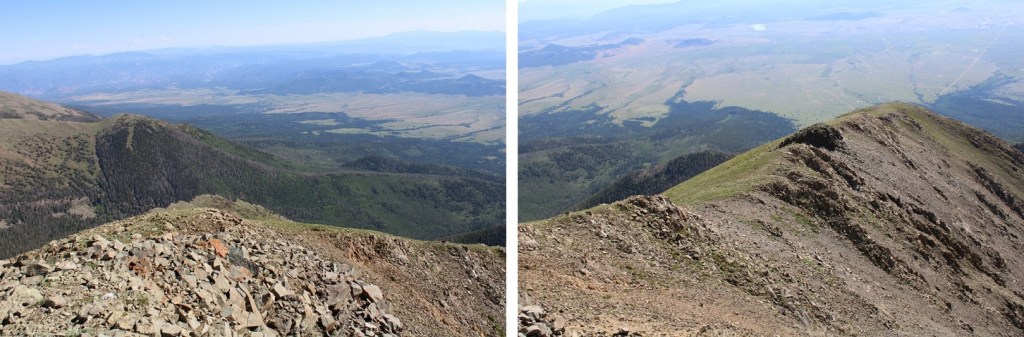
East Buffalo Peak:

From East Buffalo Peak, West Buffalo Peak looks like a straightforward ridge hike.  To be honest, it wasn’t any more difficult than class 2, but it was a little harder than it looked.
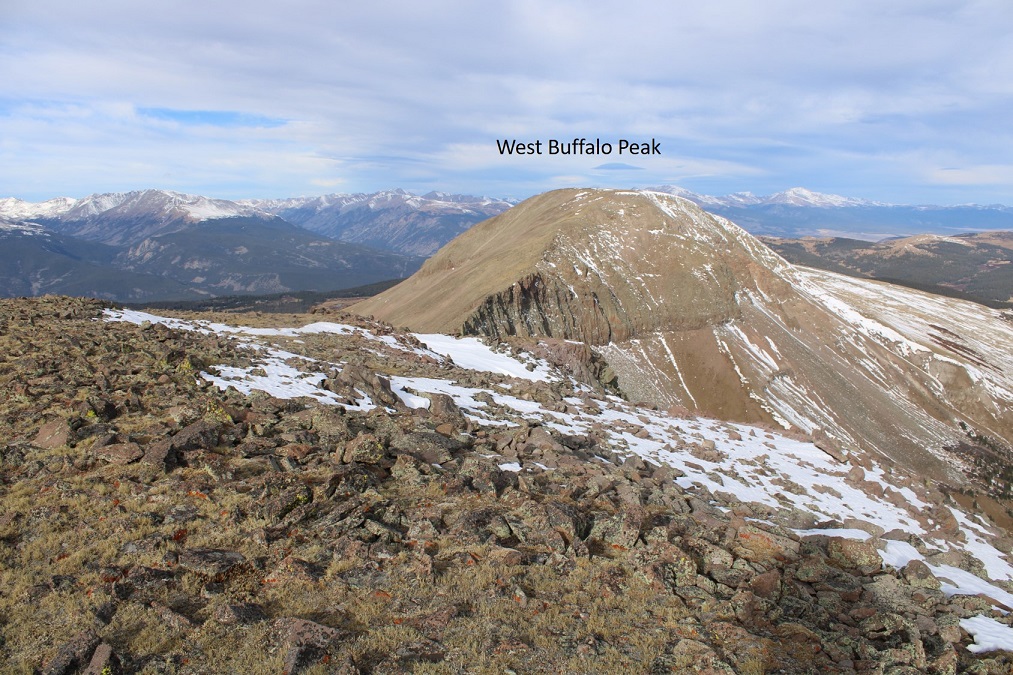
I started out by following the ridge west, and came upon some drop-offs. These were easy to navigate
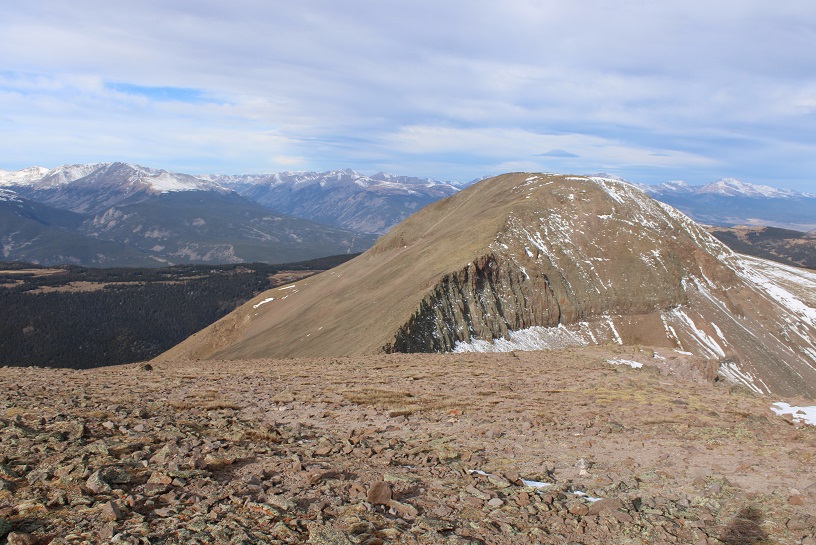
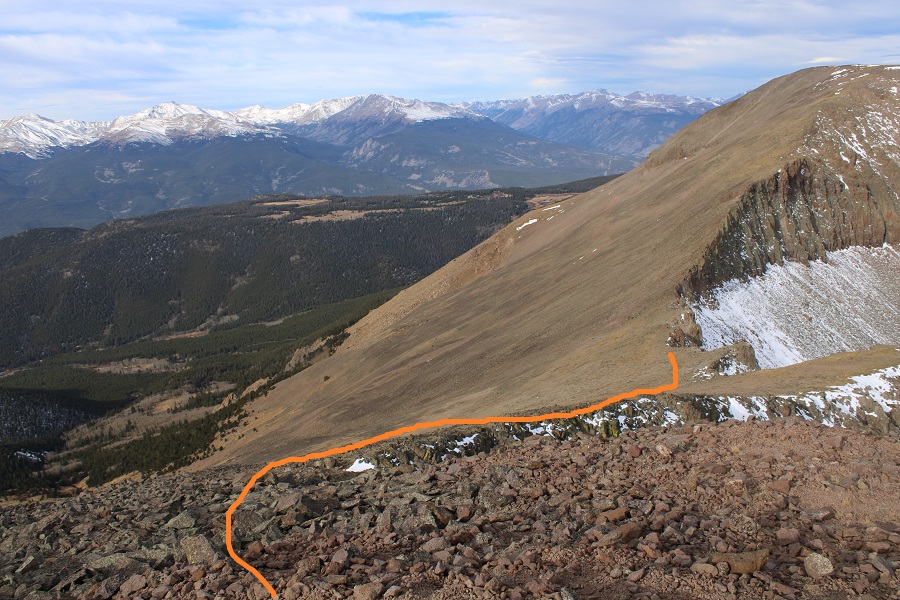
I made my way to the saddle on tundra.  What had initially looked like a rocky ridge was in fact, a very rocky ridge.  I stayed a few yards from the ridge proper to the left.
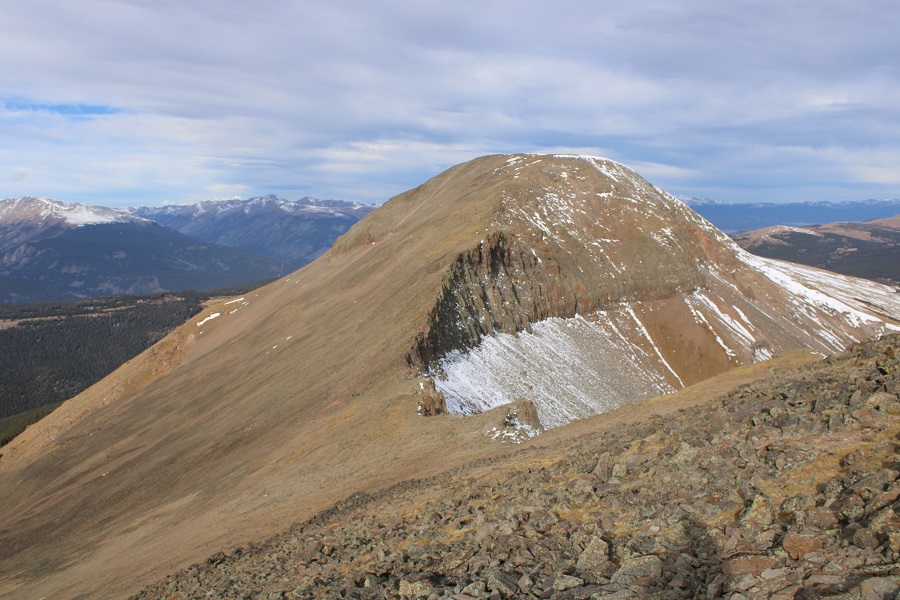
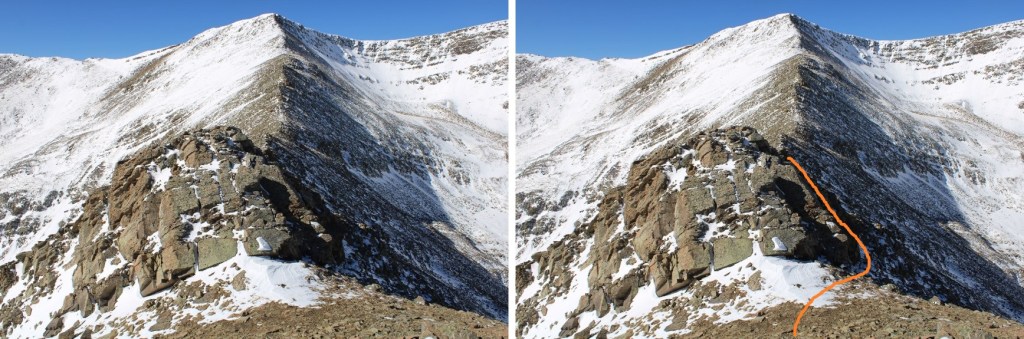
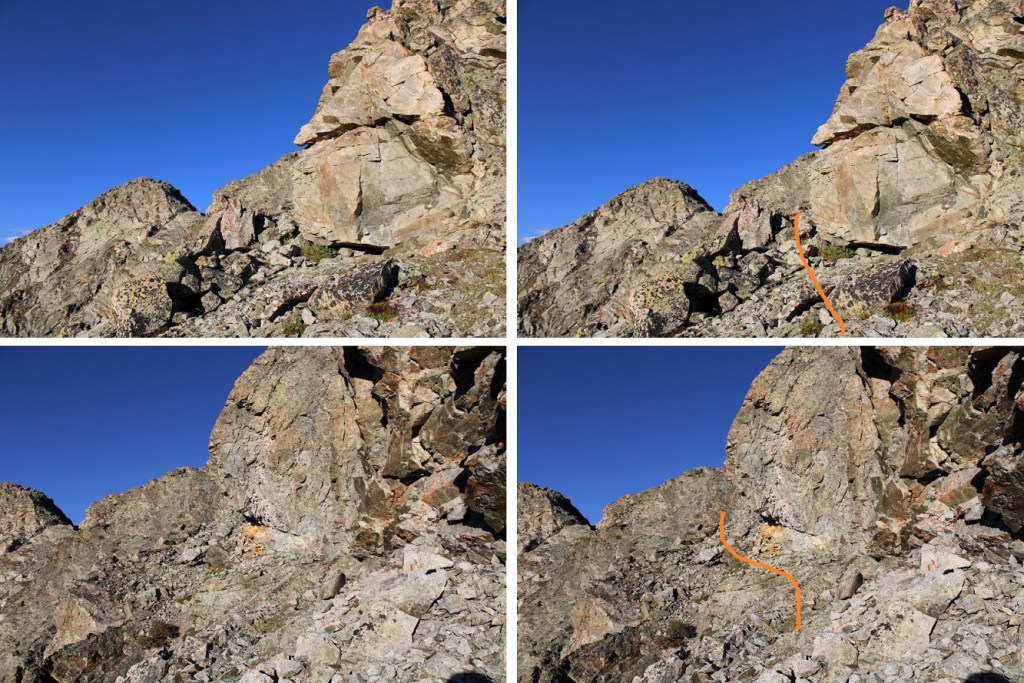
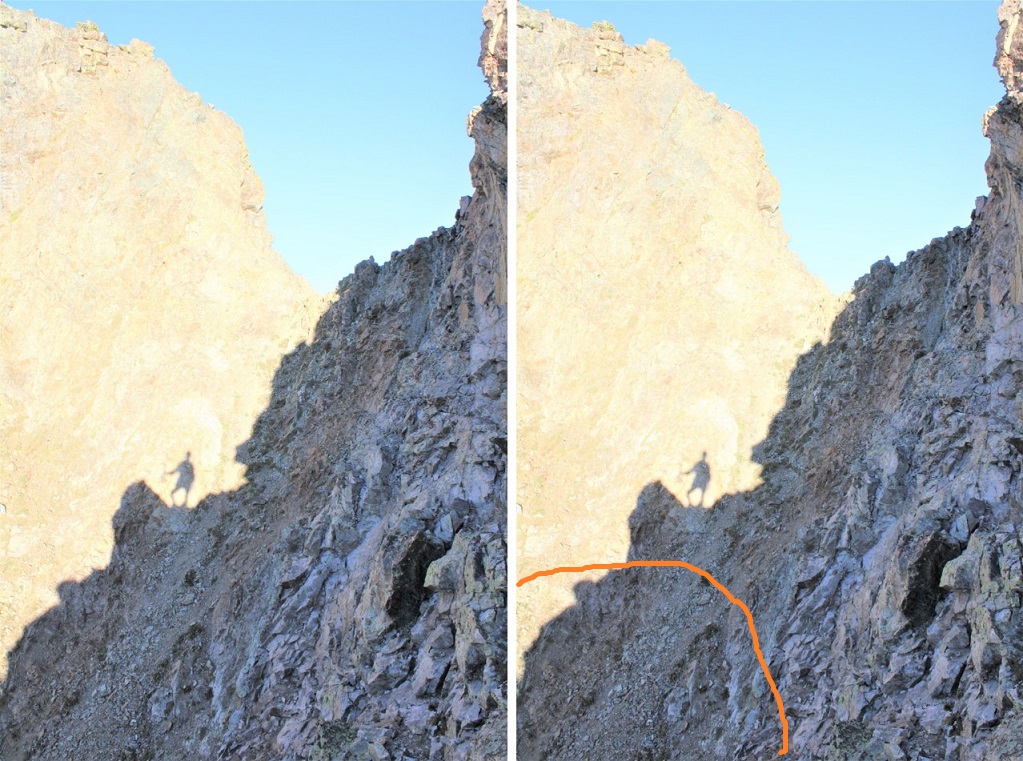
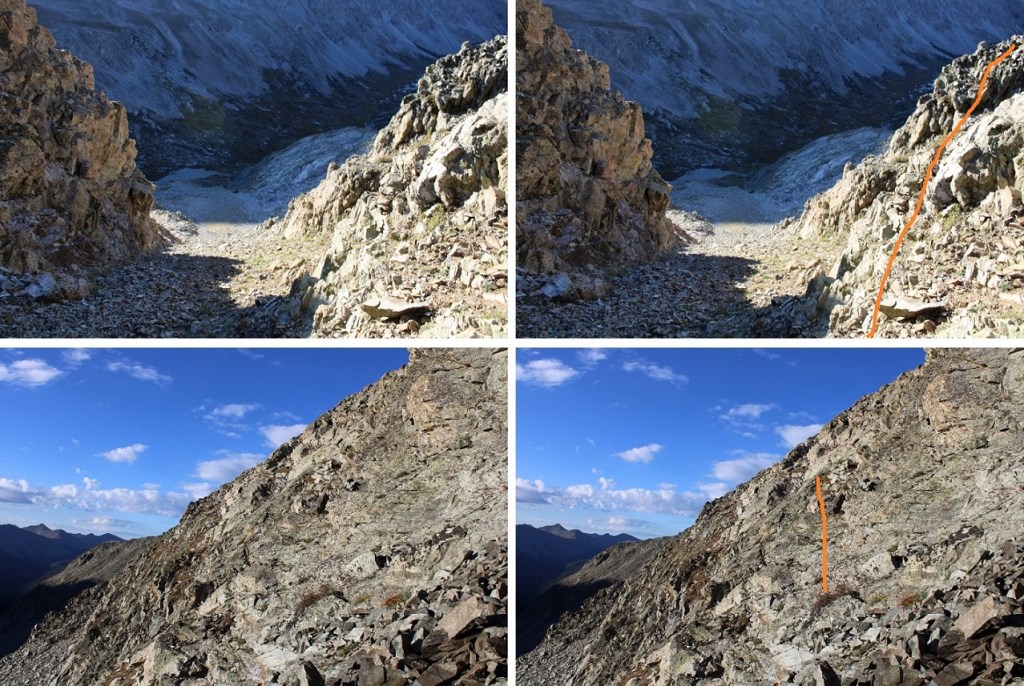
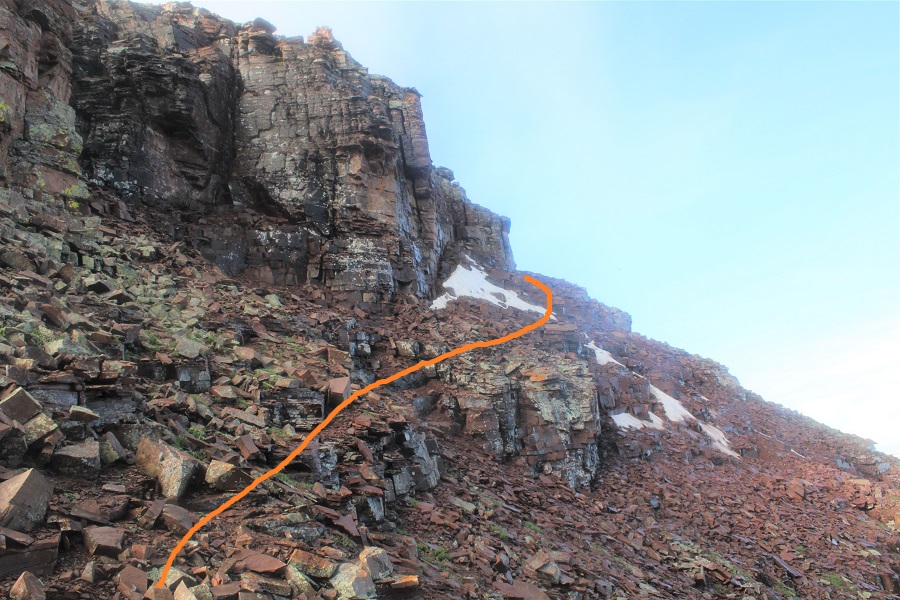
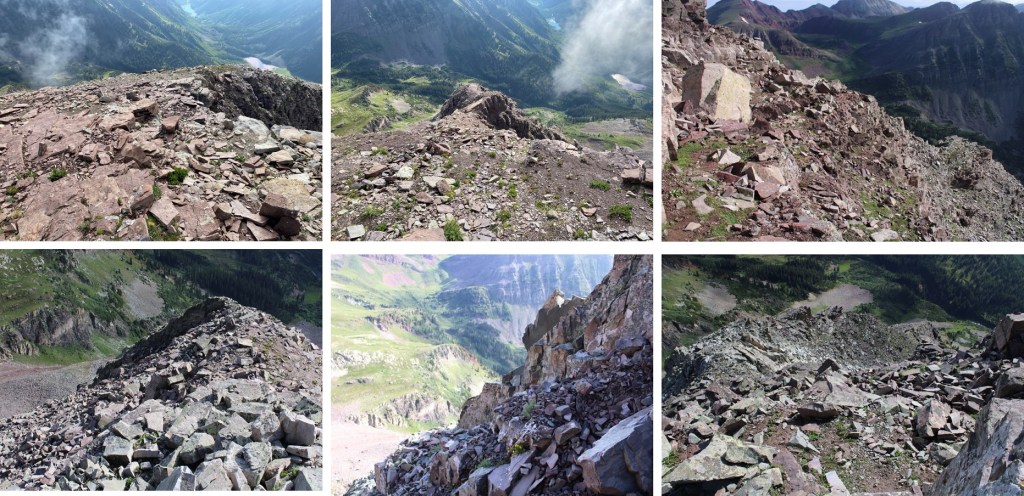
Here are some step-by-step pictures of the ridge up to West Buffalo Peak

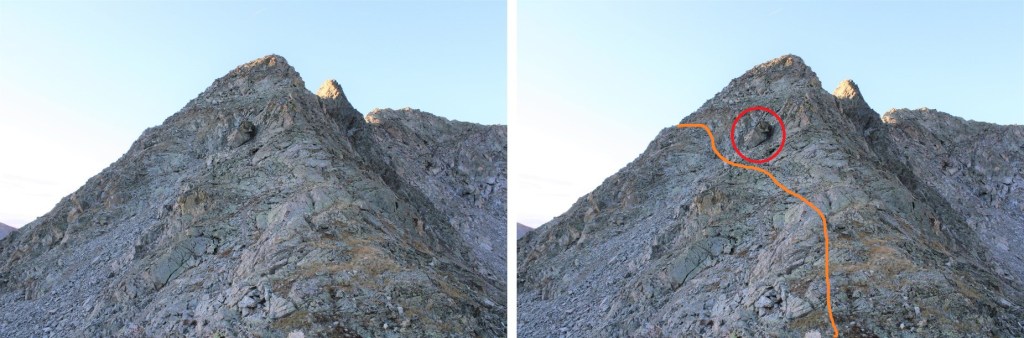
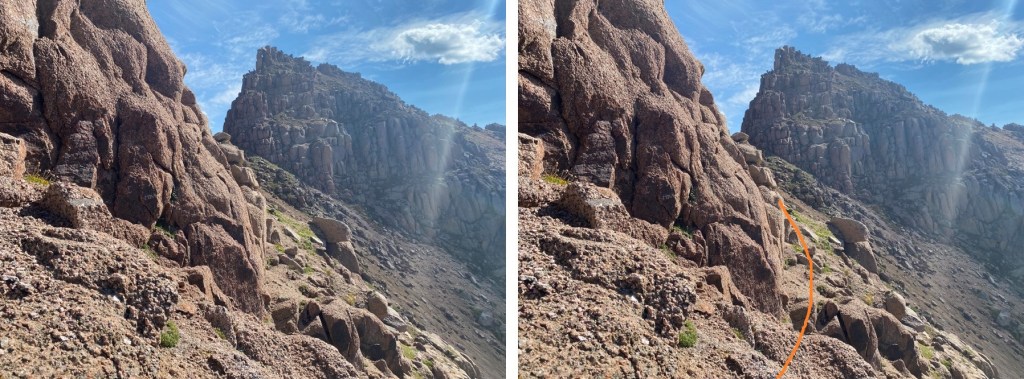
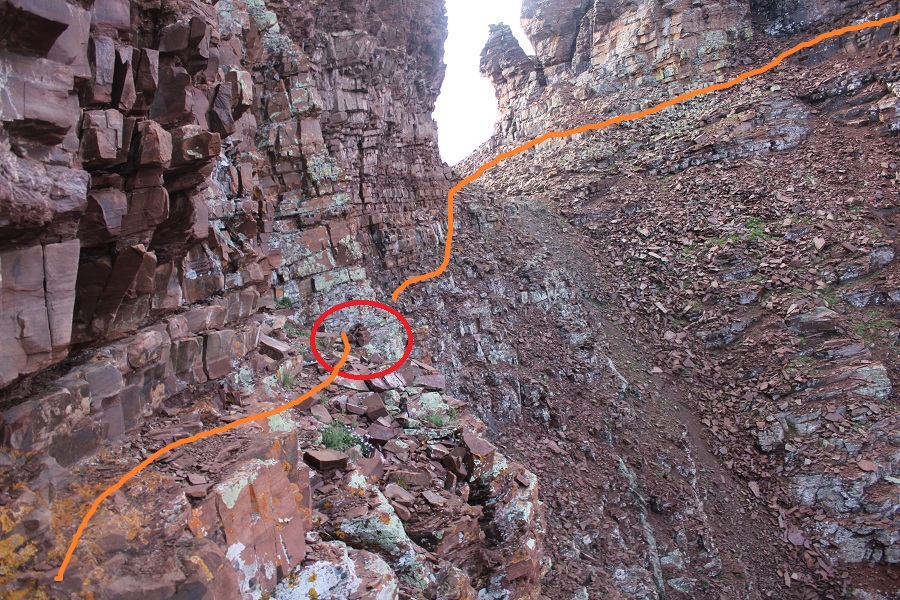
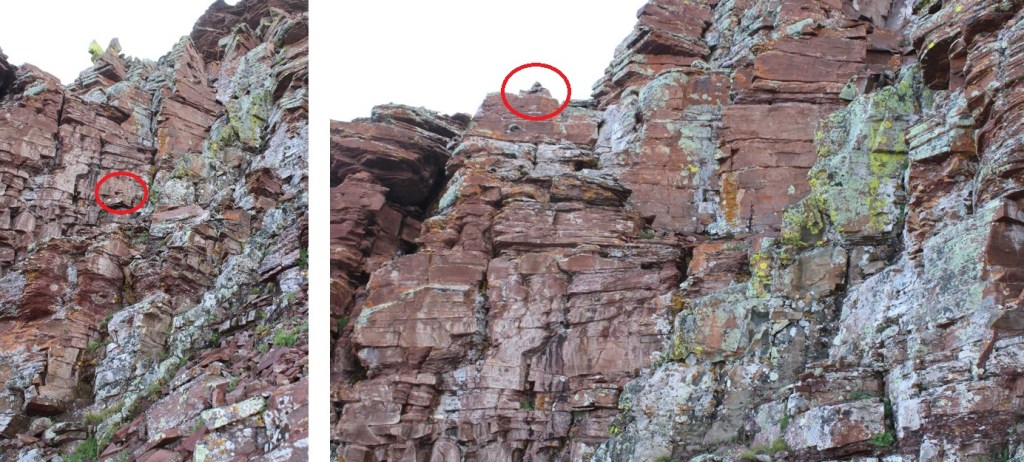
I was initially worried about this area circled in red

However, while it was loose shale, I was able to go straight up and over the top without any difficulty.
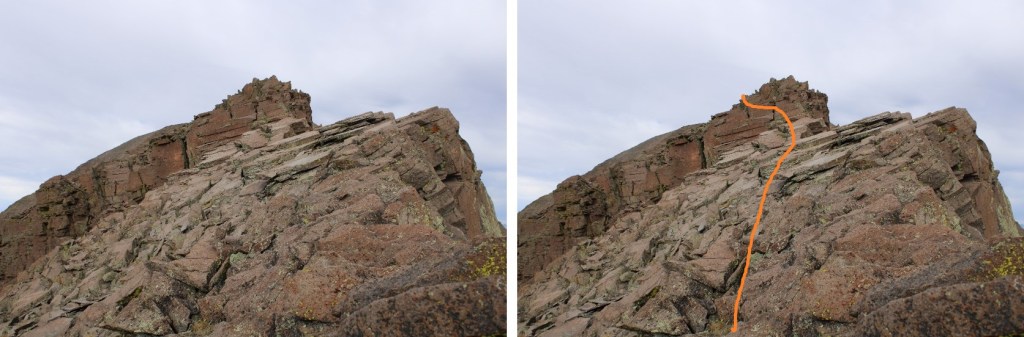
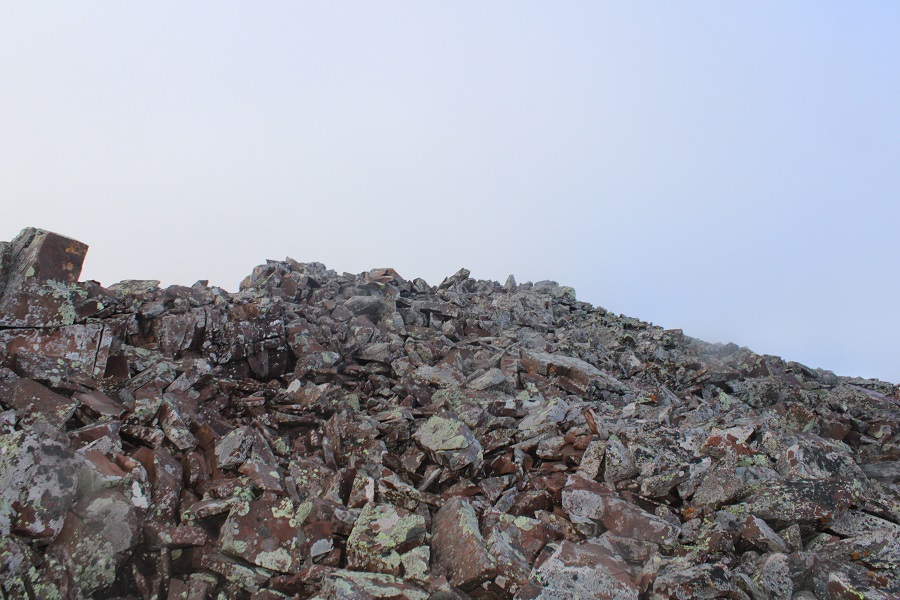
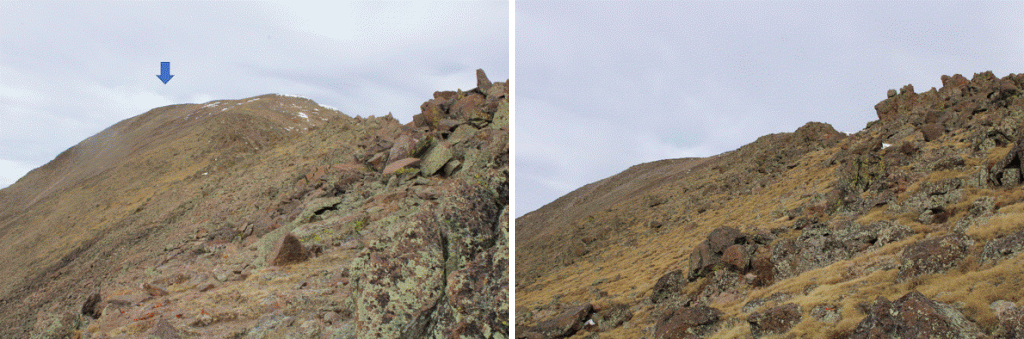
From there, it was an easy stroll to the summit of West Buffalo Peak. 
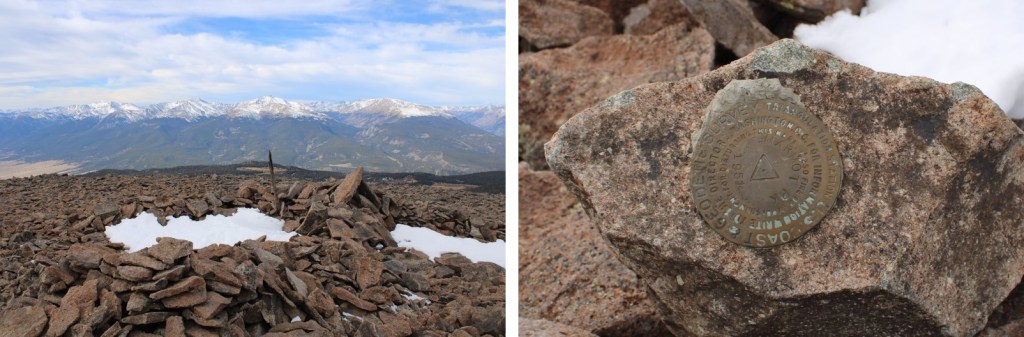
The summit is at the very west end of the peak.  There’s a wind break here, and a summit marker (which says “Marmot Peak”)
I summited West Buffalo Peak at 10:30am
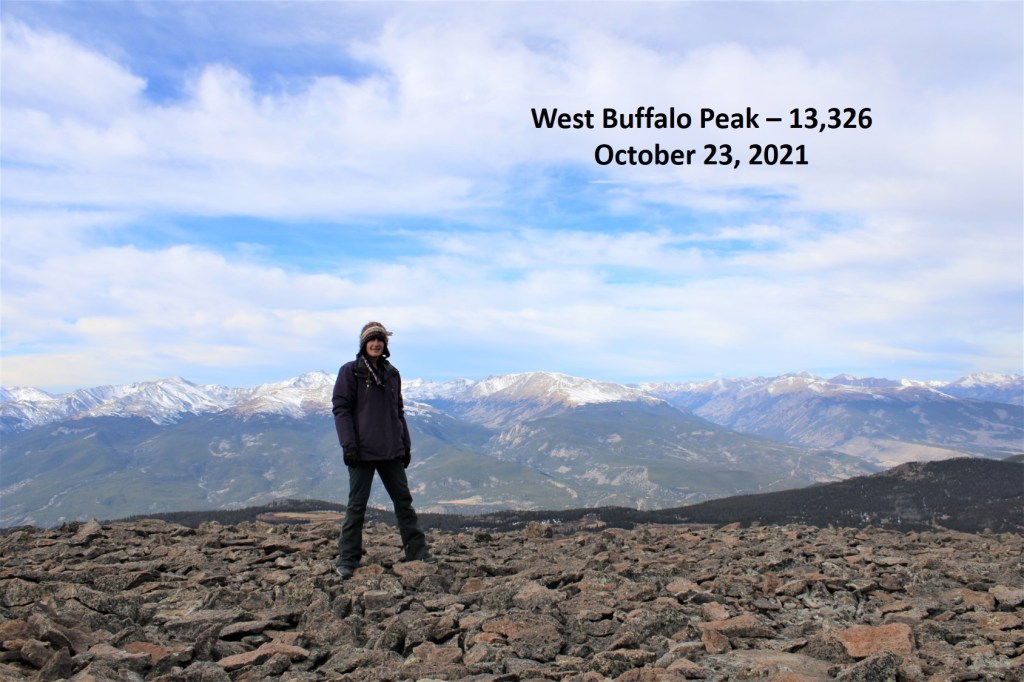
West Buffalo Peak:  

(Sorry about the orientation:  I didn’t realize it when I took the video, and now it’s a pain to fix it…)

I was making this a loop, so I turned and headed northeast, just for about .13 miles. 

Then I descended the ridge, heading northeast towards the 12917/West Buffalo Peak saddle, and then turned right and headed east.
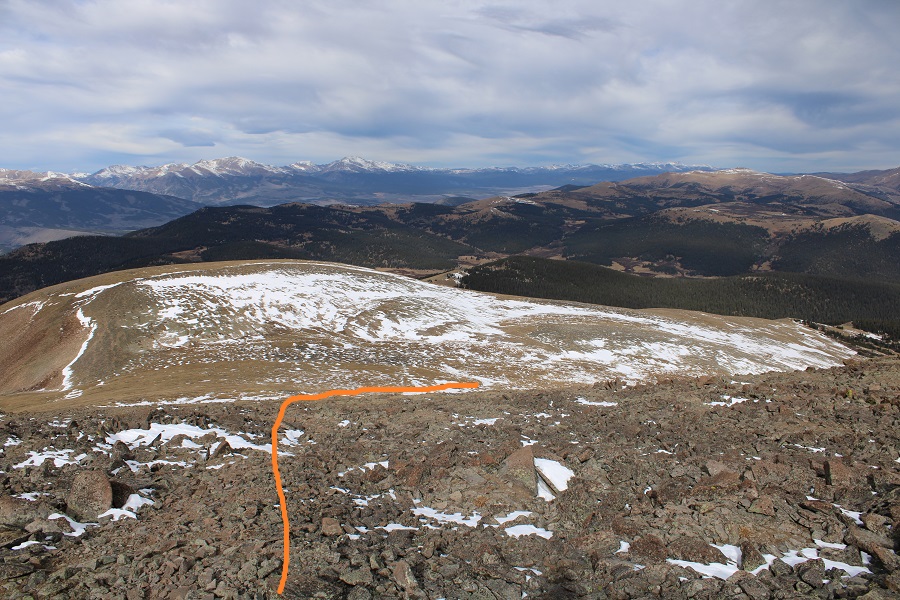
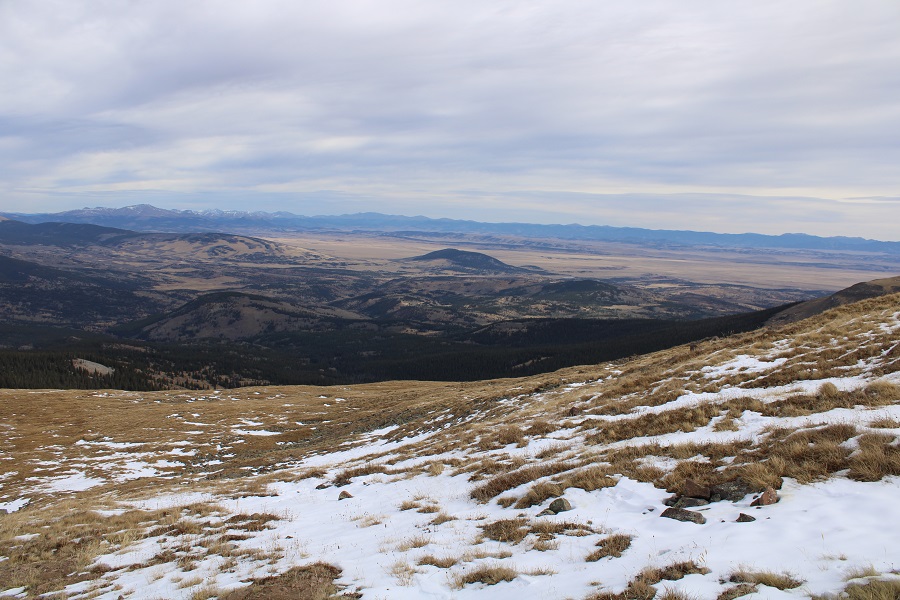
I was hoping to pick up cairns here, similar to the ones I found hiking up East Buffalo Peak, but wasn’t able to locate any.  I wanted to hook back up with the 4WD road.  Much of the route would be below treeline, and in current conditions lined with snow, so as I hiked east, I visualized where I wanted to end up and got out my compass.
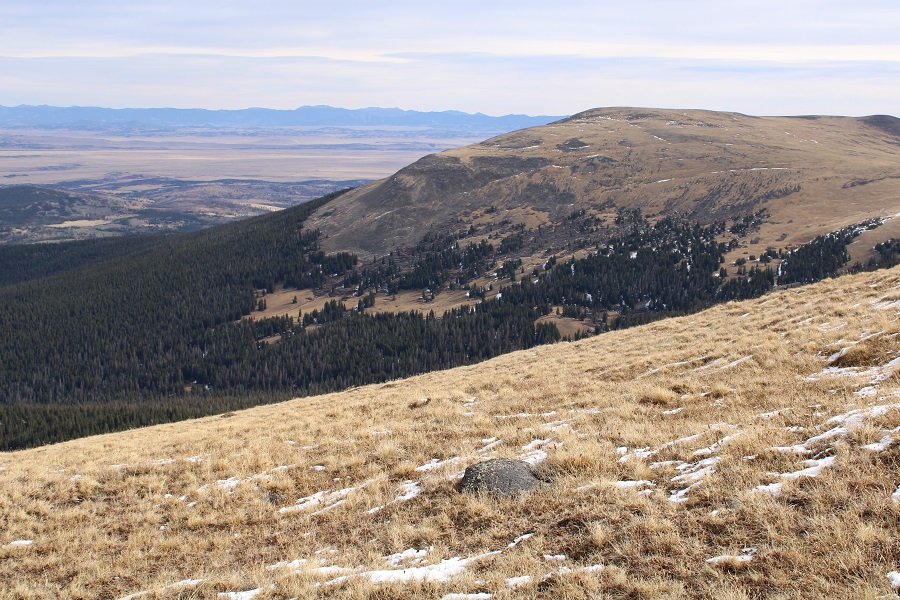
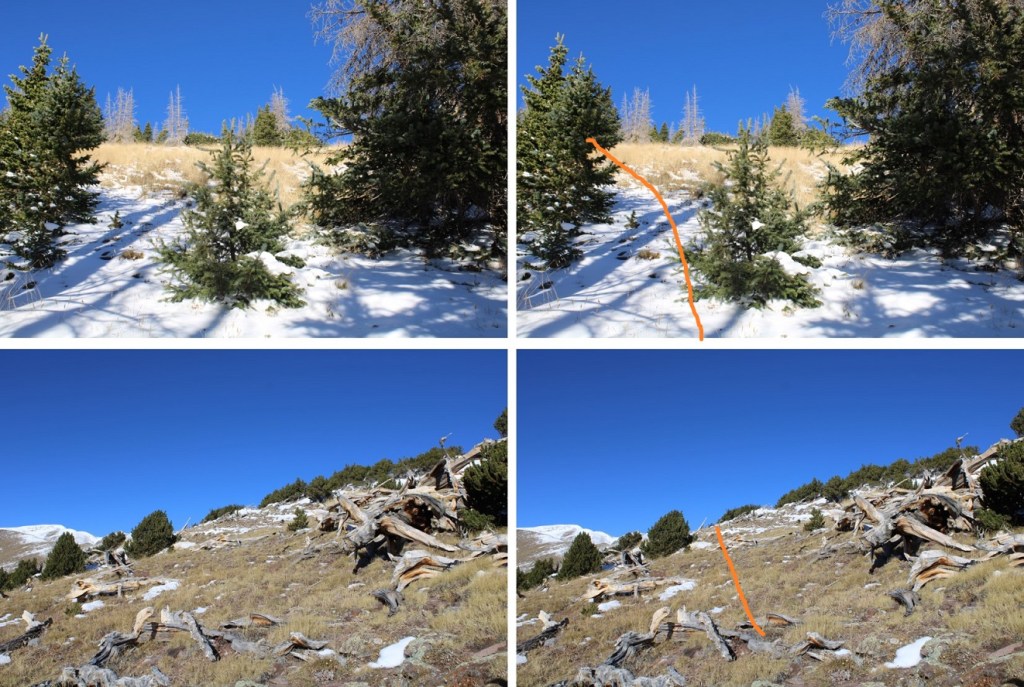
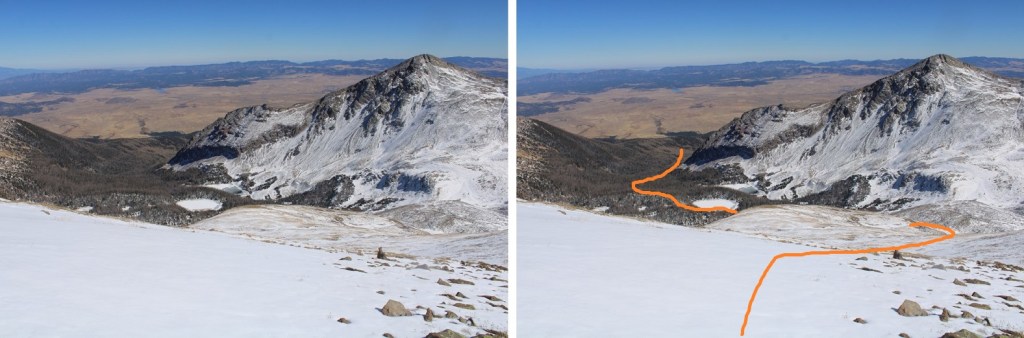
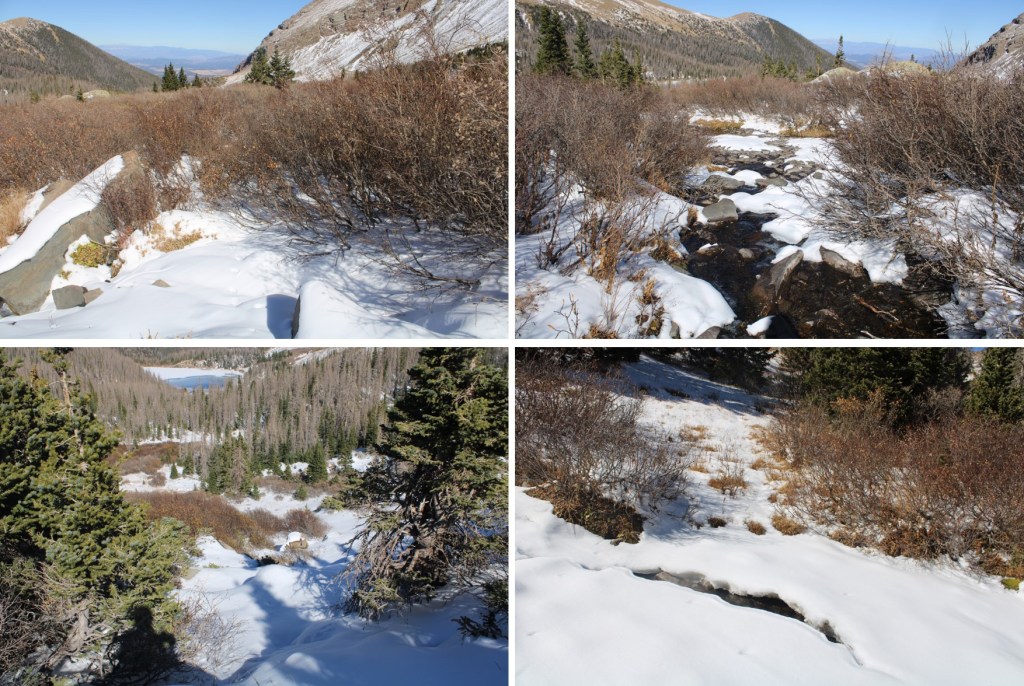
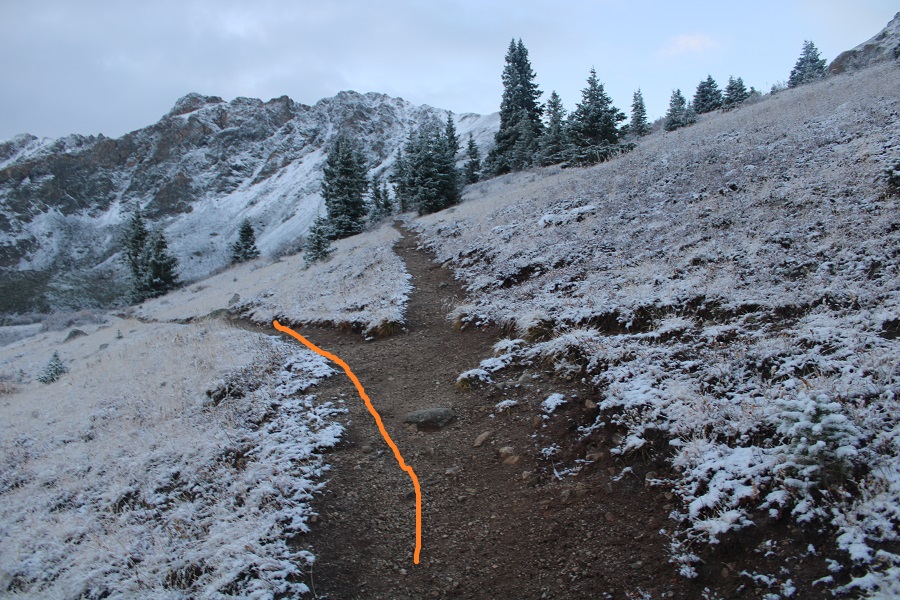
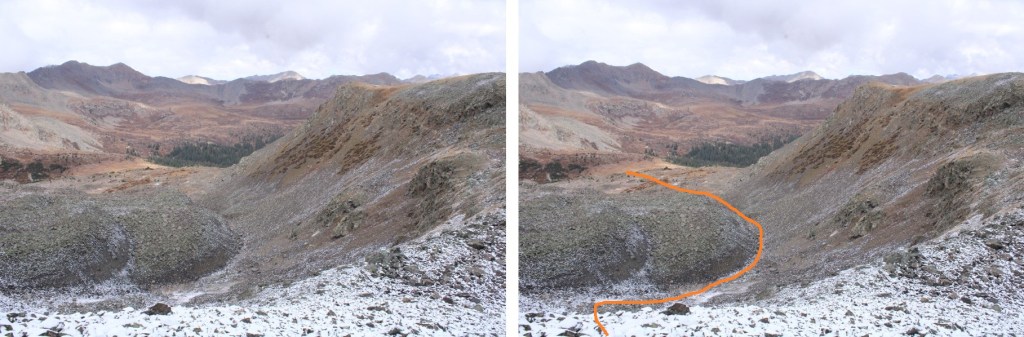
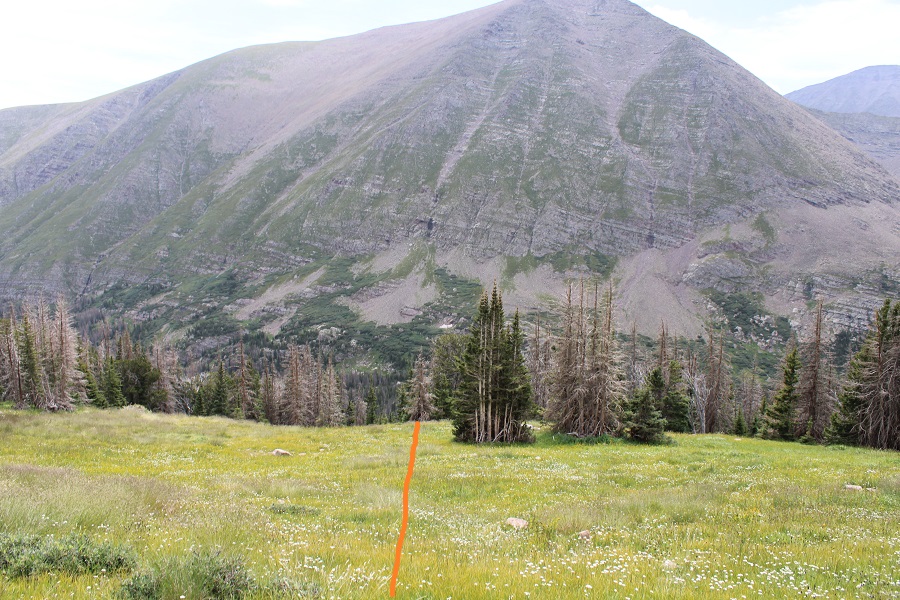
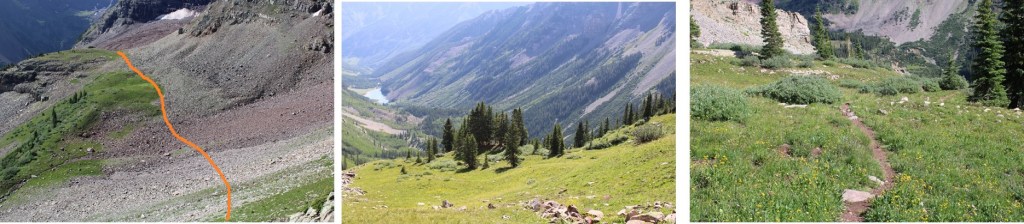
The orange line is how I ascended the ridge to East Buffalo Peak this morning.  So, from where I was at, I needed to aim towards the meadows.
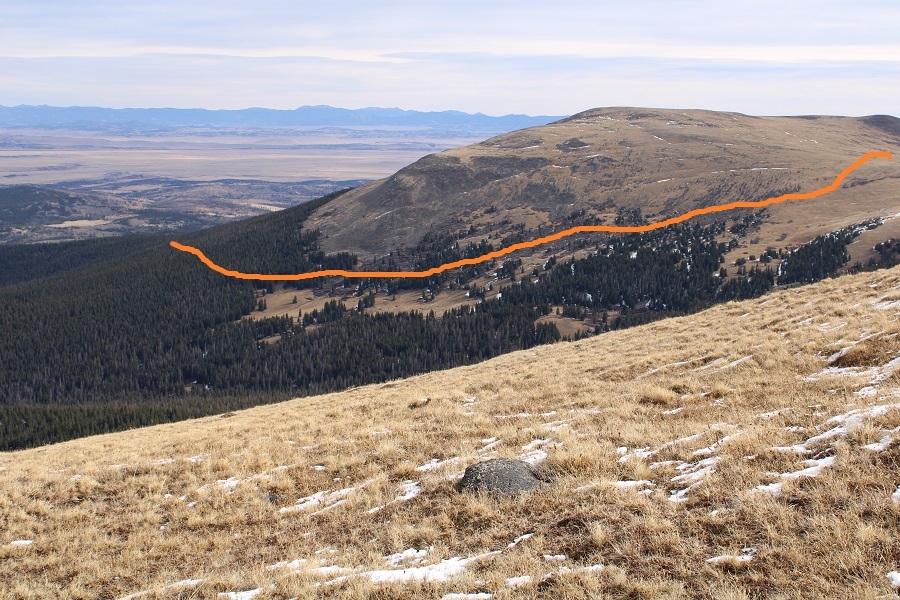
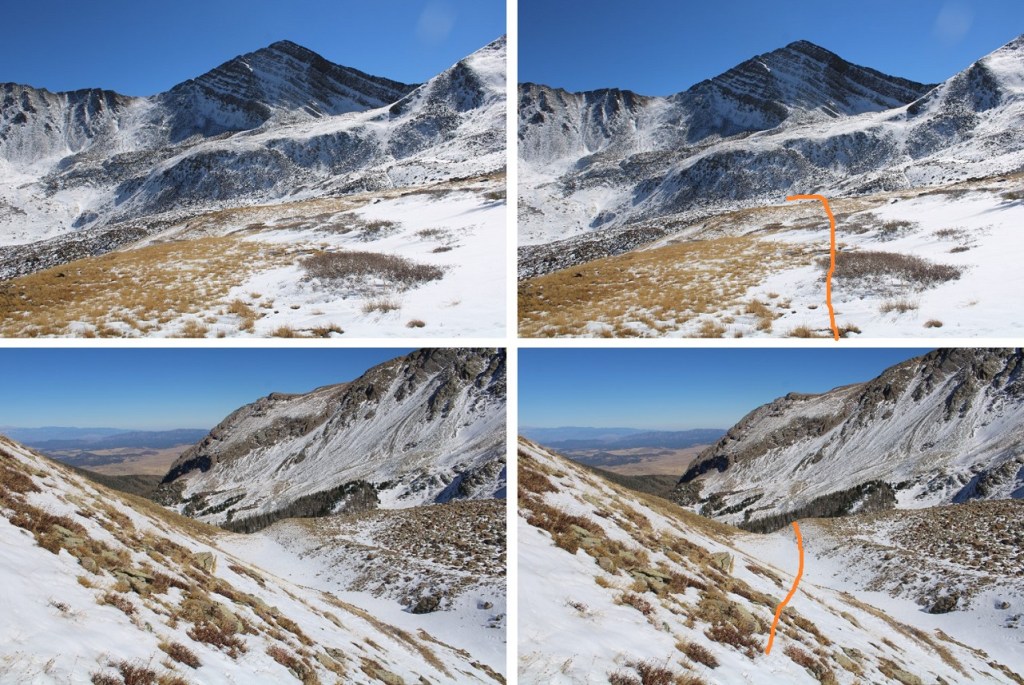
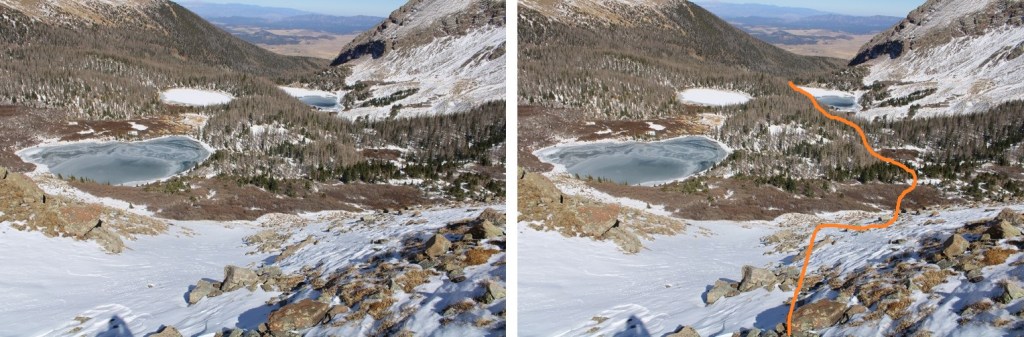
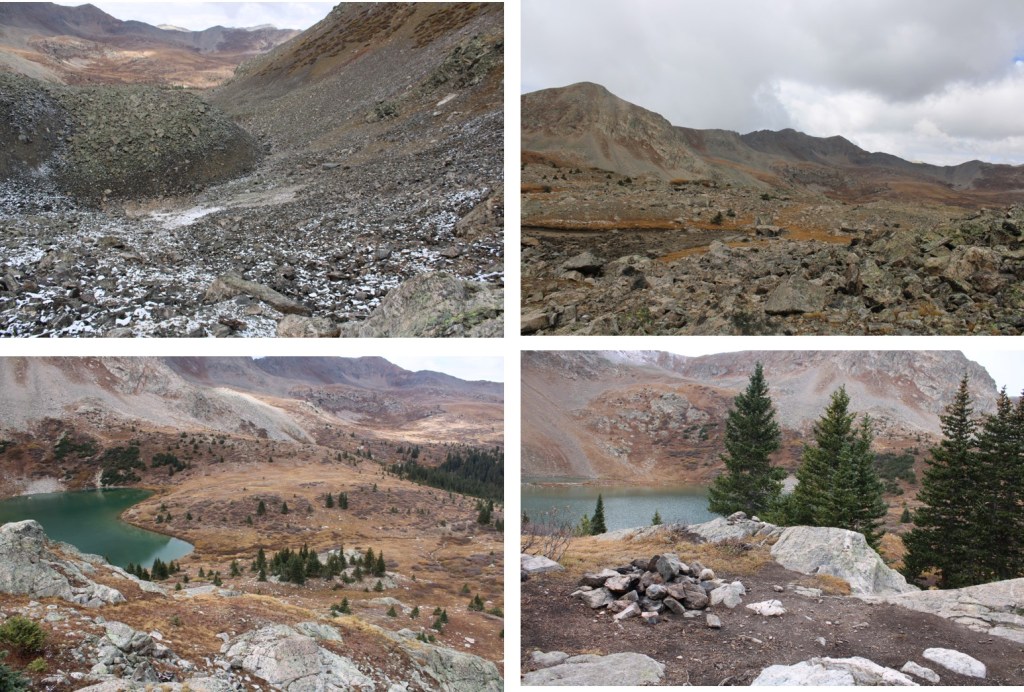
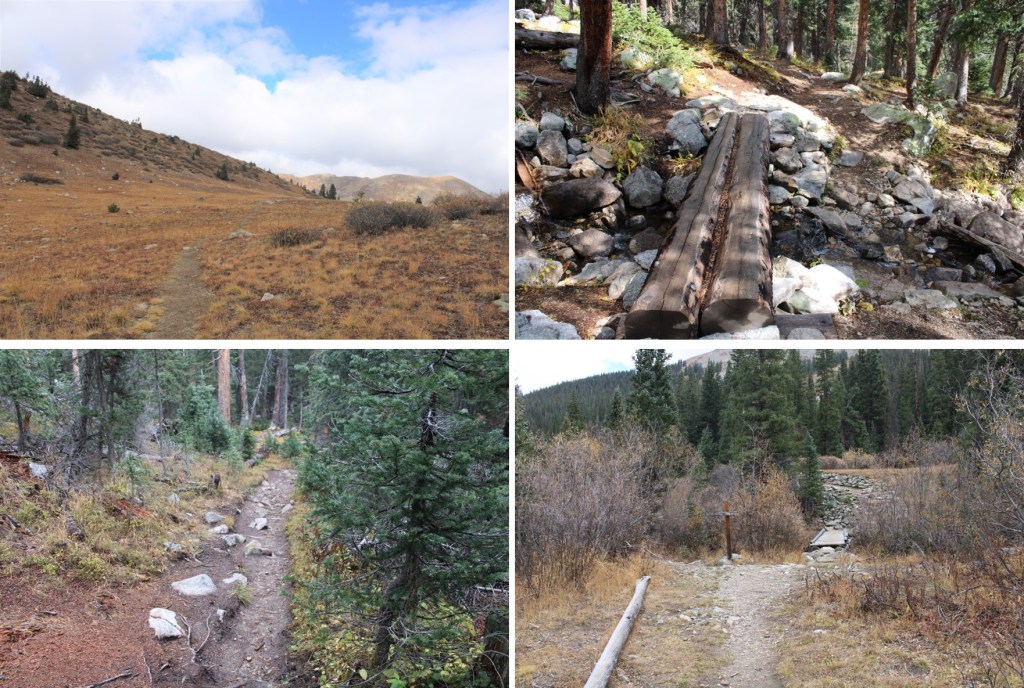
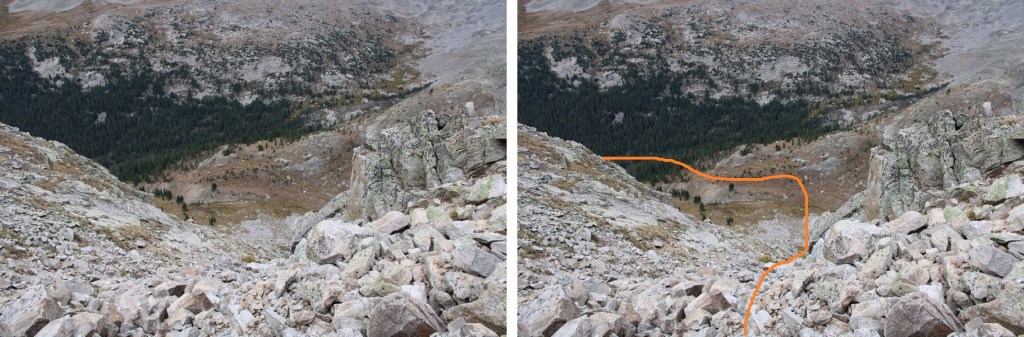
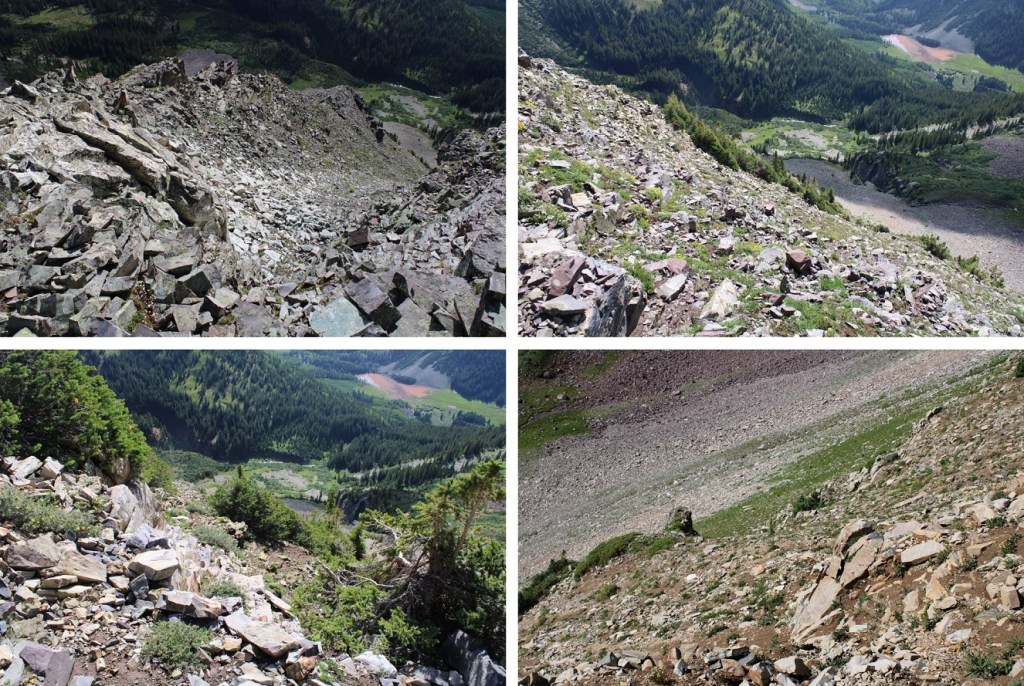
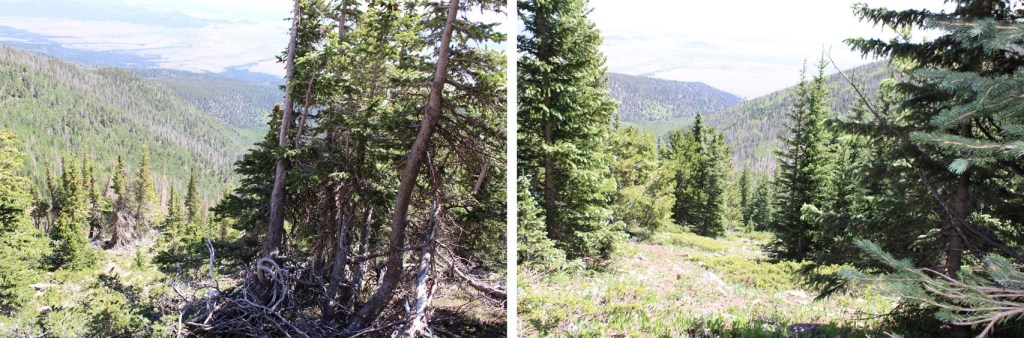
Much of this route is below treeline, so pictures won’t be that helpful.  Here’s an overview of the route I took to get to the meadows.  Once at 11650’, (and crossing a drainage) I did my best to stay at around that same elevation, skirting the mountainside, heading towards the meadows. There were some ups and downs along the way, but nothing major.

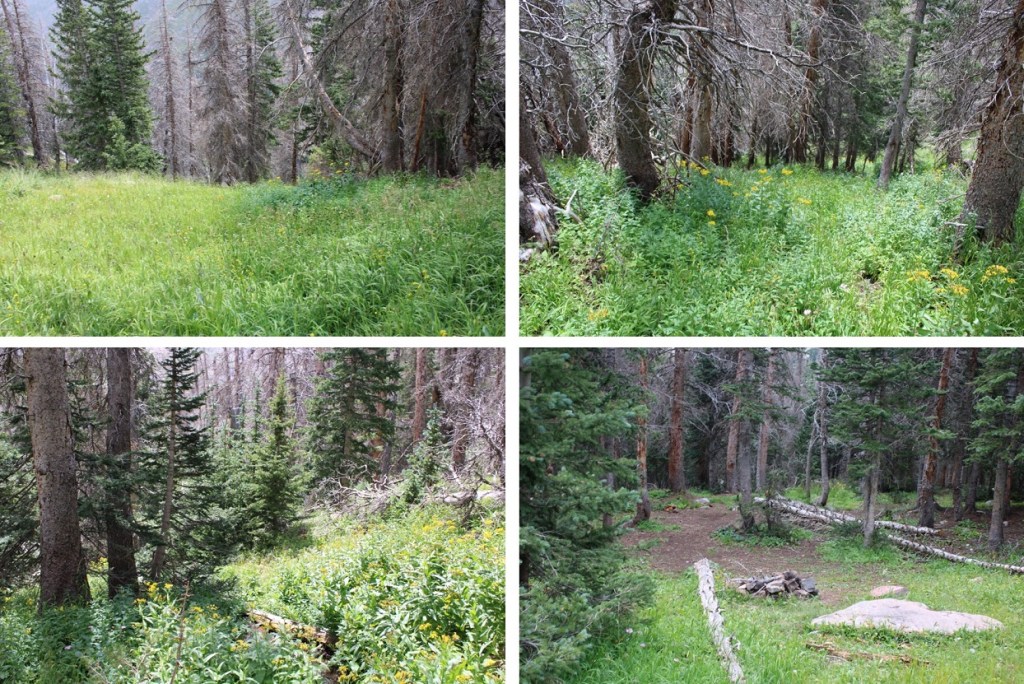
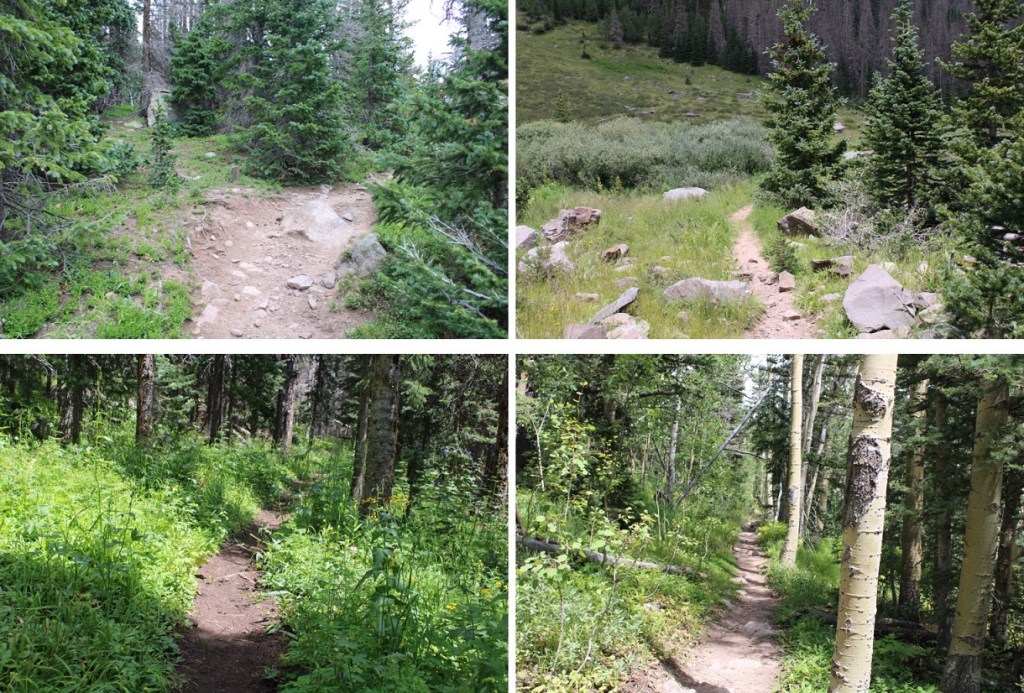
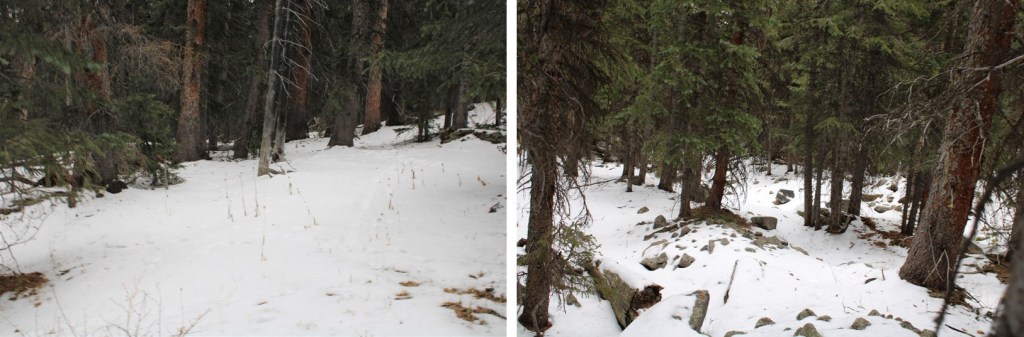
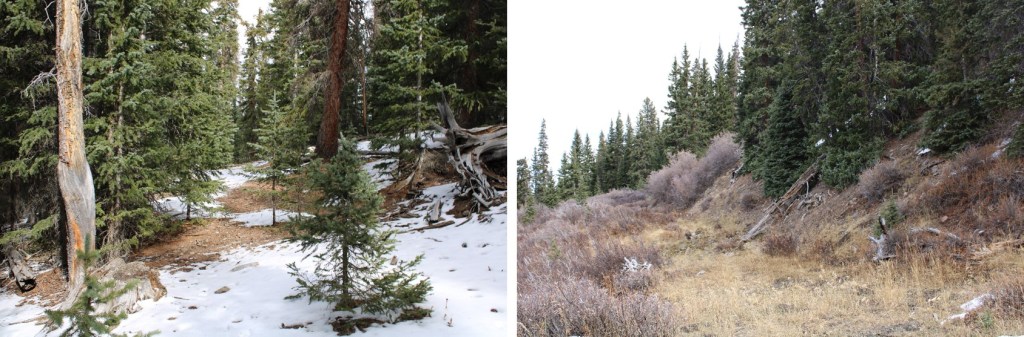
Here are some pictures of the route

Once in the trees, there were tons of elk tracks.  These were helpful in figuring out snow depth, and I frequently followed them when pertinent.  At one point, I could smell elk near, looked up, and saw a buck with rather large antlers startle about 15 feet from me and bound away.
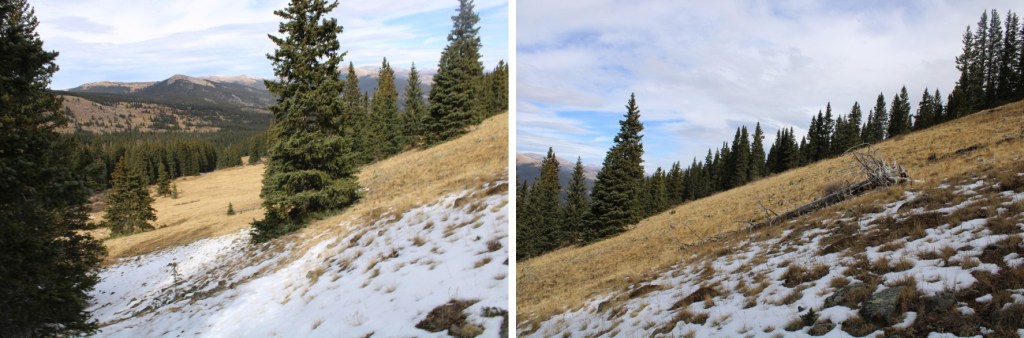
I made it to the meadows, and followed them back to the 4WD road by trying to stay above them, in the trees
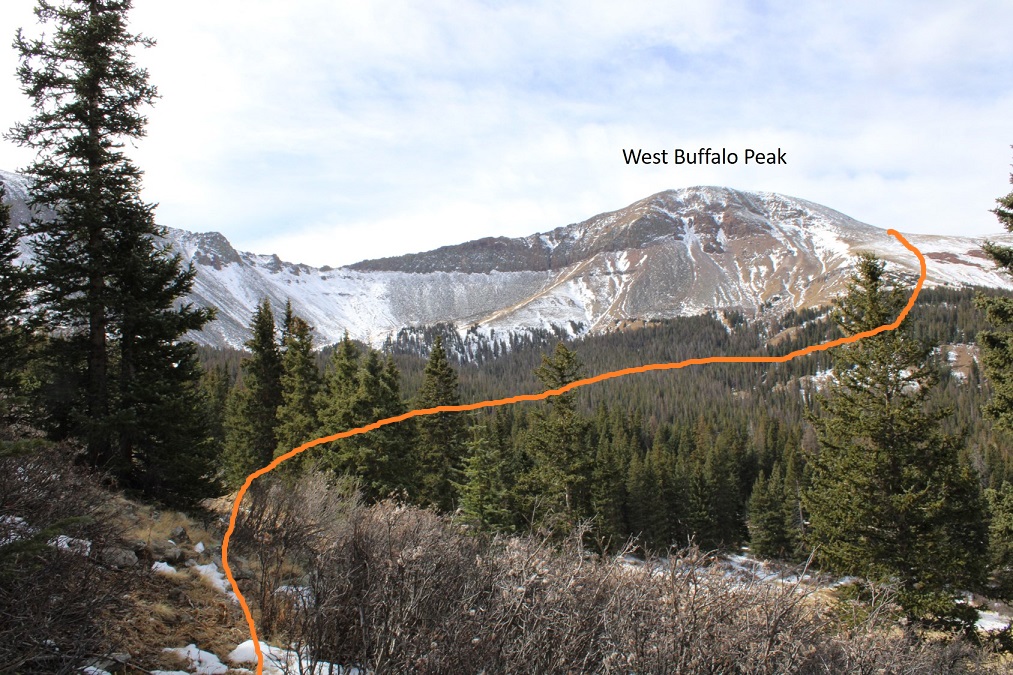
Here’s looking back at West Buffalo and my route back to the 4WD road.  If you’re planning on doing this as a loop and doing East Buffalo first, it’s a good idea to get this visual on your way in.
I was now back at the cairns that would lead me to the road (the same ones that led me to the willows earlier this morning)
I followed the 4WD road back to the trailhead (the crows were still there along the way)
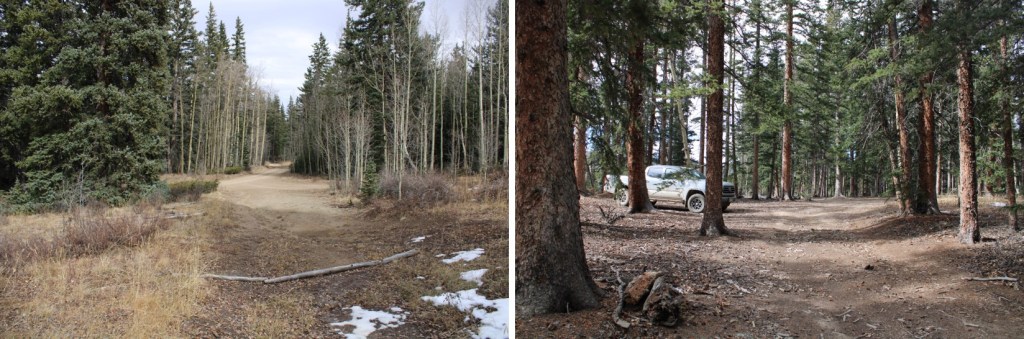
I made it back to my truck at 1pm, making this an 11.95 mile hike with 3489’ of elevation gain in 6.5 hours.

On to the next trailhead!

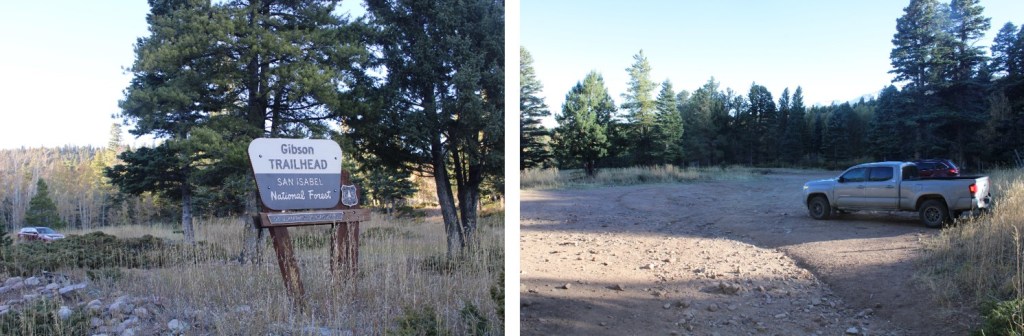
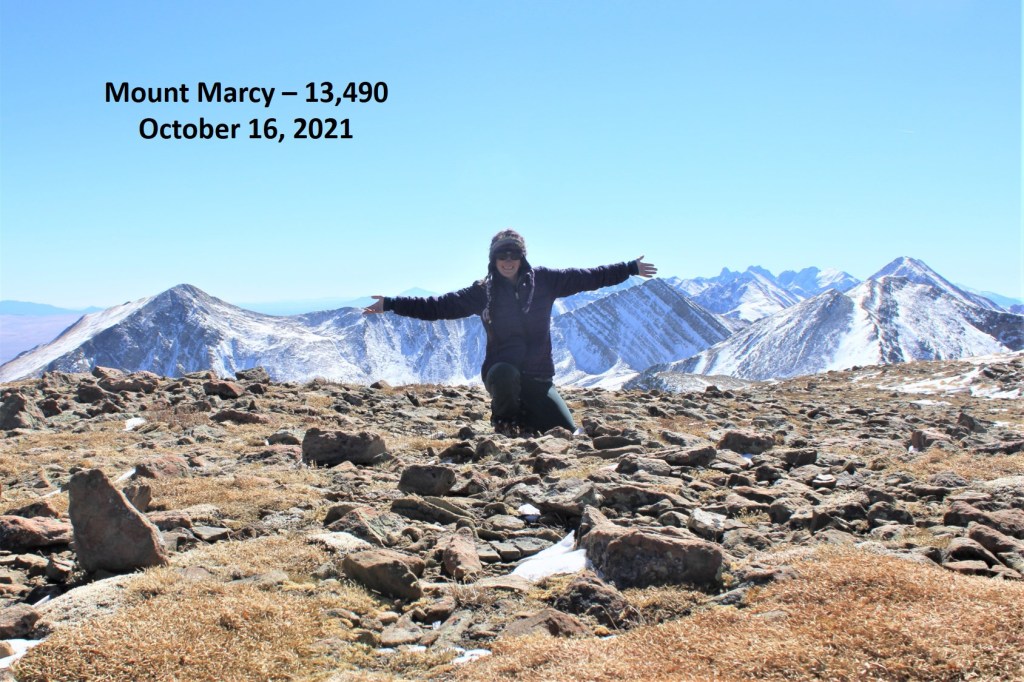
Mount Marcy – 13,490 and Silver Peak – 13,513

RT Length:  16.6 miles

Elevation Gain: 5573’

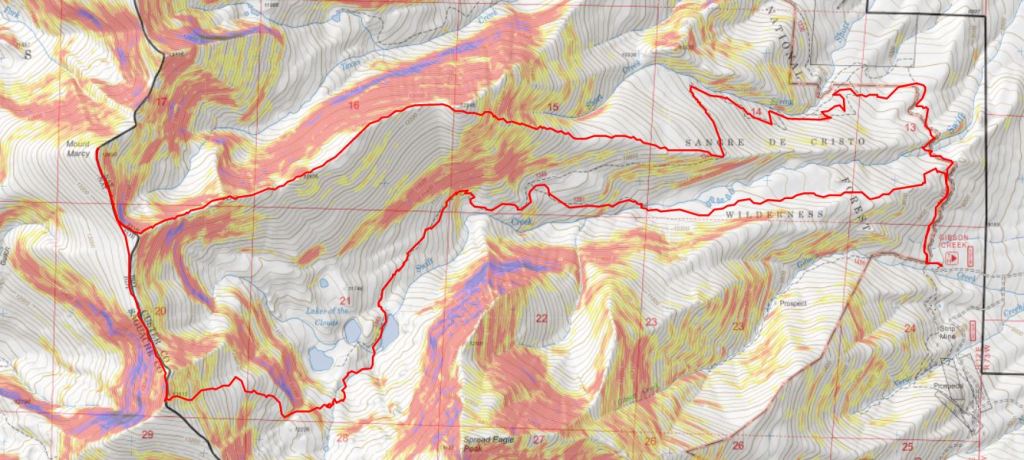
I wanted an early start for this peak, but not too early.  I knew it had snowed the past couple of days, but only a few inches:  I had no idea what to expect when it came to conditions, above or below treeline.  I got a later start than usual because I was making this a loop and wanted to get pictures on the way in of the route.  I gathered my gear and was on the trail at 5:30am.

I started following the Gibson Creek trail west, and after about .1 of a mile, turned right onto 1336 (the sign is still damaged) and followed 1336 past the first junction (this is where the loop connects) and turned left onto 1349.  I had hiked for a total of 1.3 miles at this point.

There was now snow on the trail.  It was still dark, and I could hear an owl hooting in the trees. I saw lots of rabbit tracks, and some elk tracks as well.  Mine were the first footprints. I continued following trail 1349 as it switchbacked up the mountainside.

At 10350’, and after a total of 3.4 miles of hiking, the trail will stop increasing in elevation and start heading towards trail 1351.  It was here I left the trail and headed west up the ridge.  I was worried there would be a lot of downfall here, like there is when heading up towards Gibbs Peak, but the ridgeline was surprisingly manageable below treeline.

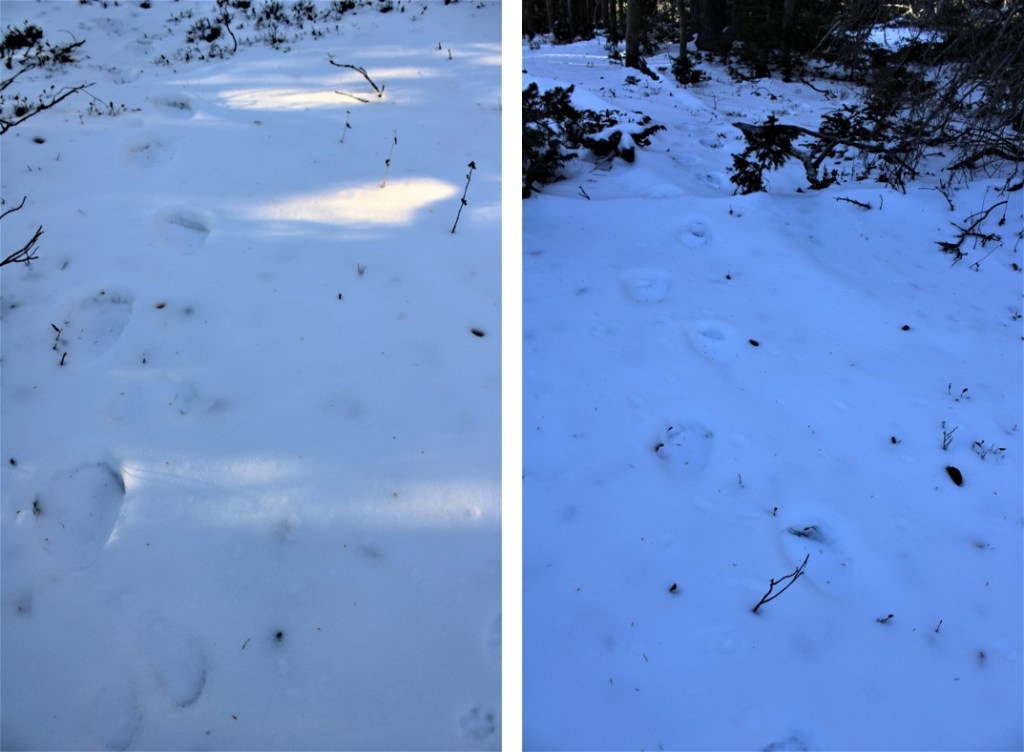
Along the ridge I came across two separate sets of bear tracks, both heading south

I kept heading west, following the ridge.  Just at treeline, and before topping out, I skirted the ridge to the left. 

There is no need to ascend to PT 12245.  Instead, I stayed just a bit south of the point, then gained the ridge by losing elevation.

Once on the ridge the conditions varied.  They started out with easy, lightly covered-in-snow tundra.  I followed the ridge southwest.

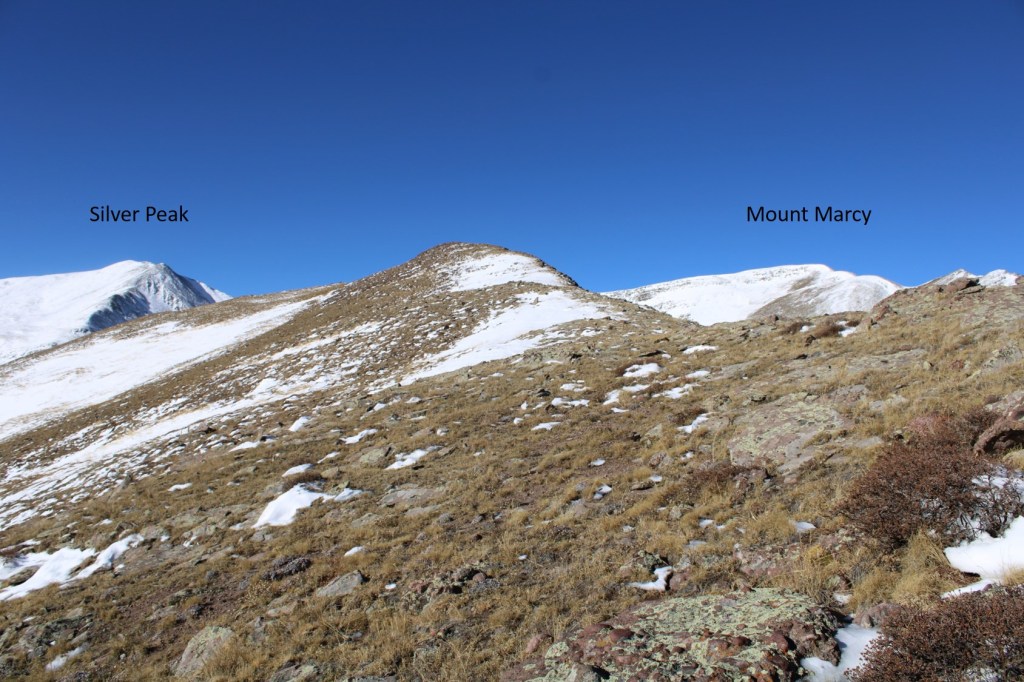
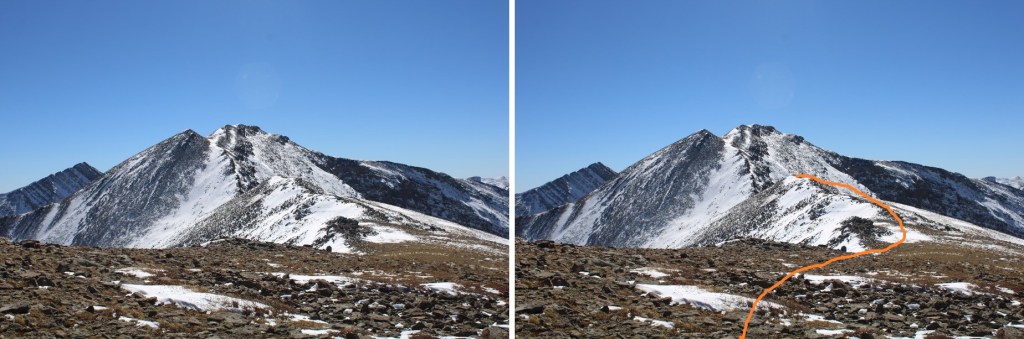
I was able to see Mount Marcy and Silver Peak clearly at this point. 

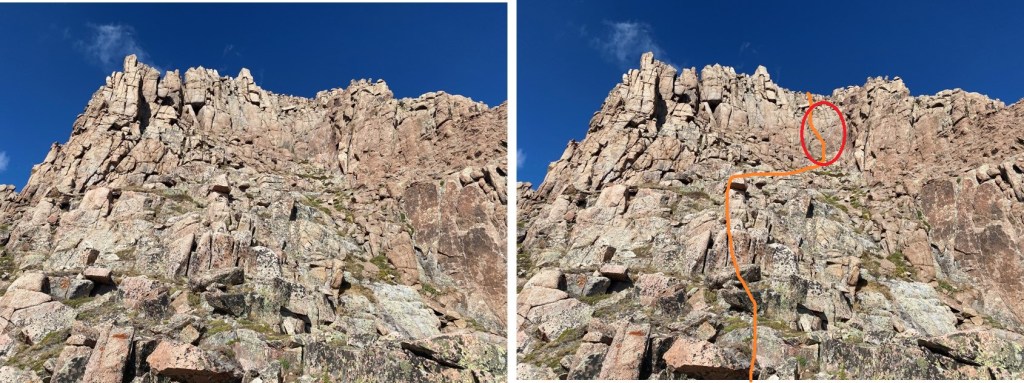
I continued following the ridge southwest, through varying conditions.  There were a lot of elevation gains and losses. I was aiming for the point in the middle. The difficult areas are circled in red (only difficult because of today’s current snow conditions). The rest of the ridge was a class 2 ridge walk. 

The snow had drifted in some areas, and snowshoes were helpful.

I went straight up and over this, using snowshoes in the beginning, and then taking them off to scramble up the rock.

Here I dipped down to the right to navigate the rocks, and then quickly re-gained the ridge

Here are the next few obstacles, and the path I took.  If I didn’t stay directly on the ridge, I dipped to the right.

I kept aiming for the highest point on the ridge

The last push was the hardest.  This was difficult class 3 climbing on the snow.  I stayed mostly in the center of the ridge

Here are some closer pictures of the class 3 scrambling to the top

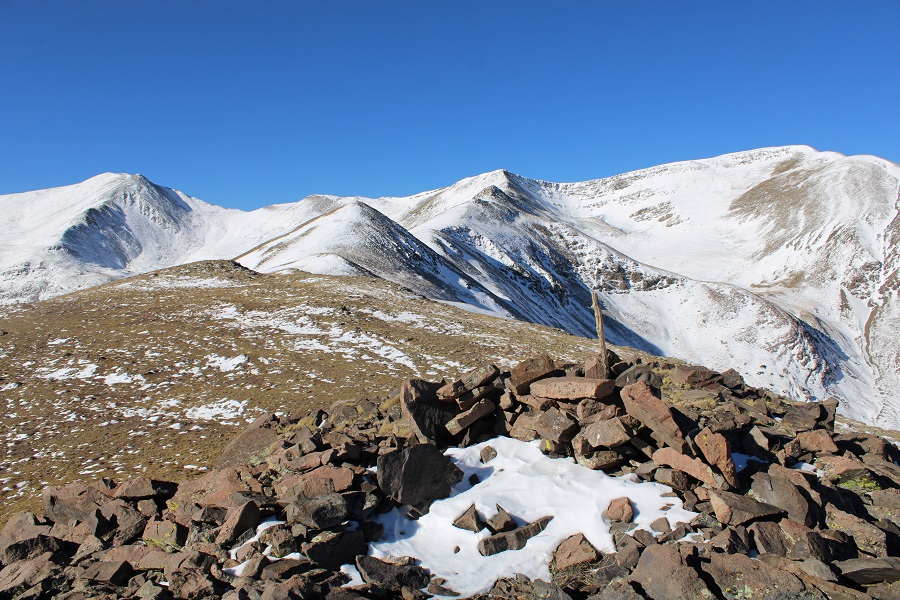
From the top, here’s looking back at the ridge

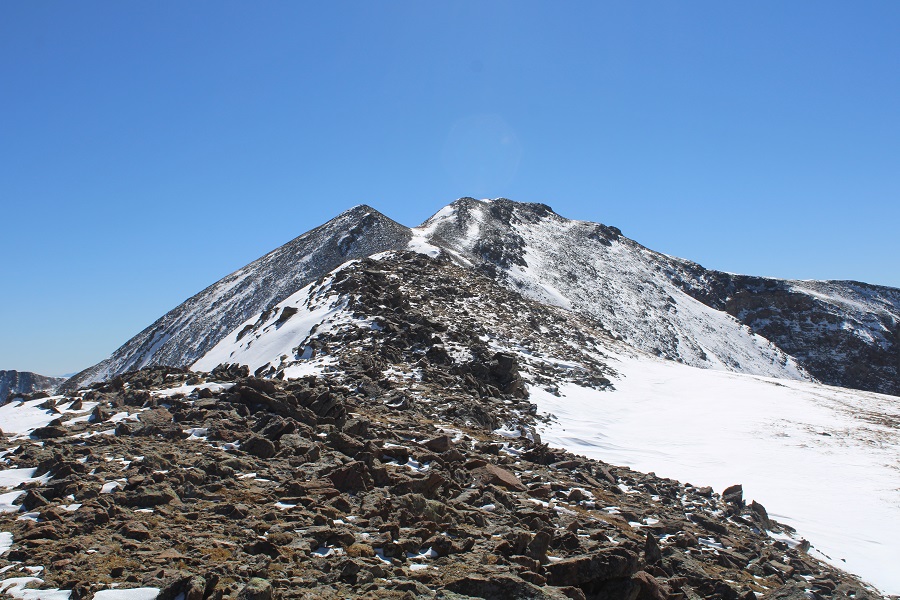
I now turned right and followed the easy ridge towards Mount Marcy

It was difficult to tell where the true summit was, and there were two cairns at the top.  I went with the one furthest north, as it had a summit register and required me to pass the first cairn, thus ensuring I’d hit the summit at some point. 

I summited Mount Marcy at 11:40am

Mount Marcy:

I headed back the way I’d come, and headed towards Silver Peak.  I didn’t re-summit the high point, but skirted it to the right on easy terrain

And then followed the ridge to the saddle

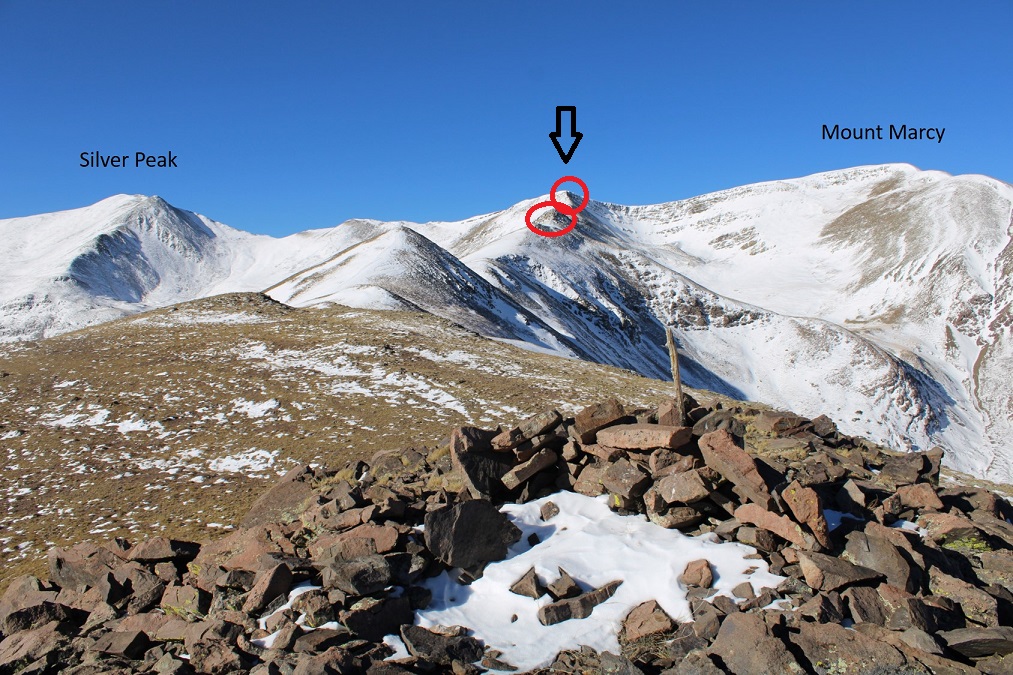
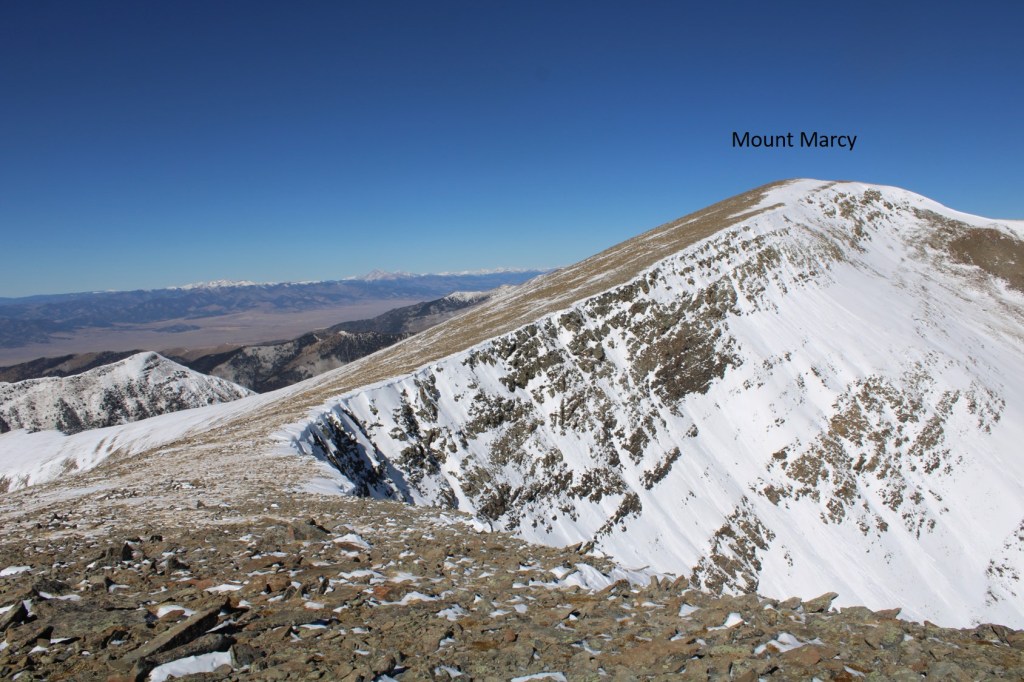
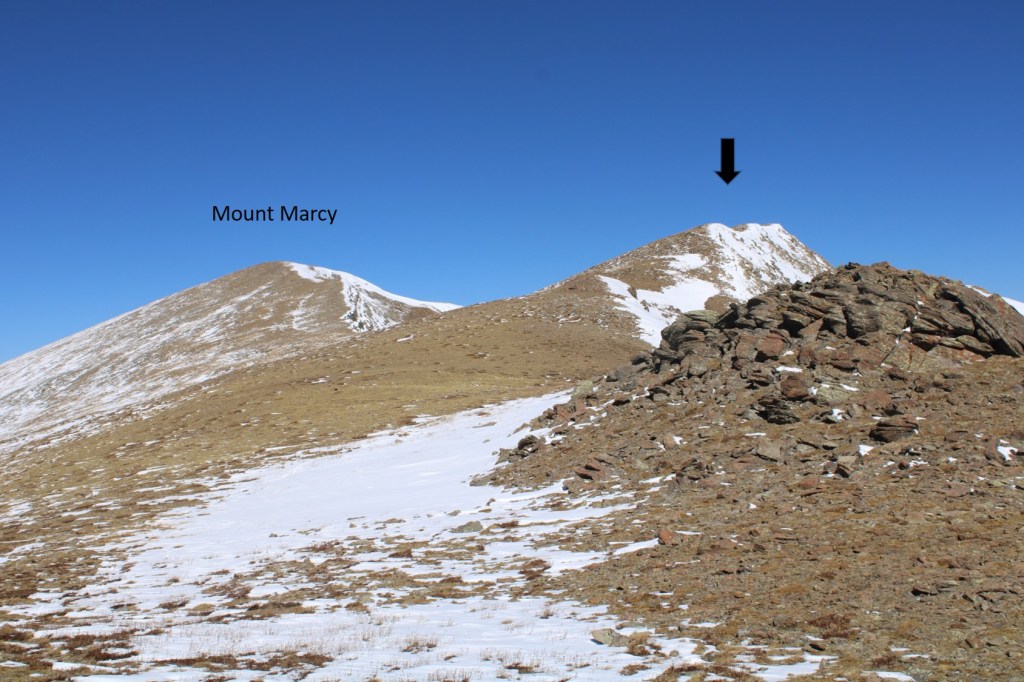
Here’s looking back at Mount Marcy.  The black arrow is how I accessed the ridge

But now, to continue towards Silver Peak

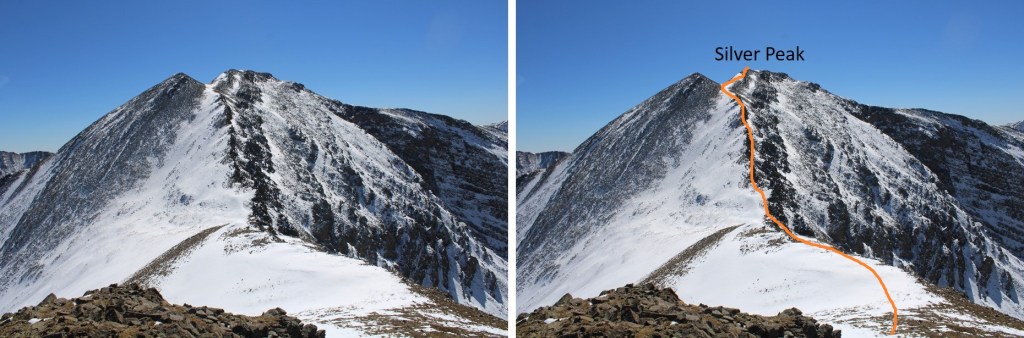
I made it to the saddle, and picked my route. By sticking to the very top of the ridge I was able to keep this class 3, although there were some tricky moves with the snow. Here’s the route I took

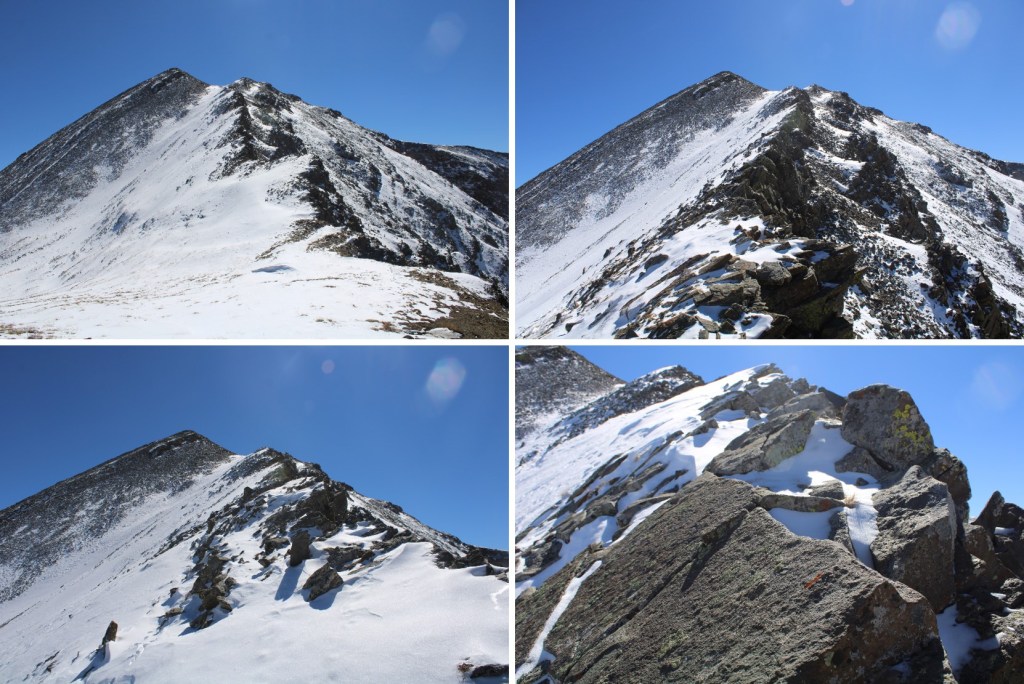
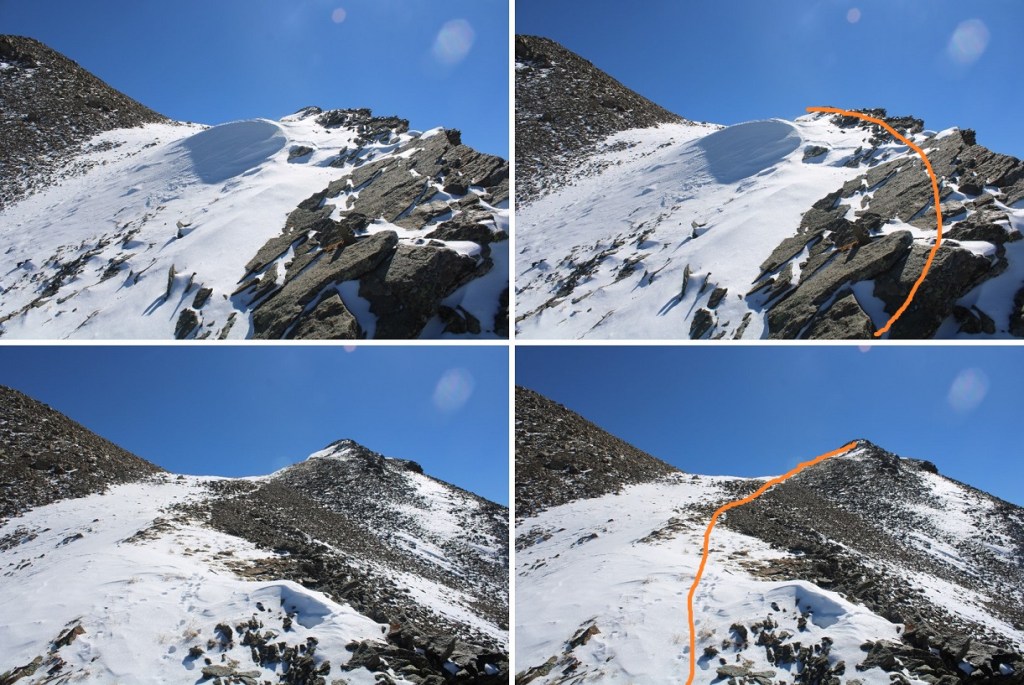
And some closer pictures of the ridge

Topping out of the ridge was class 2

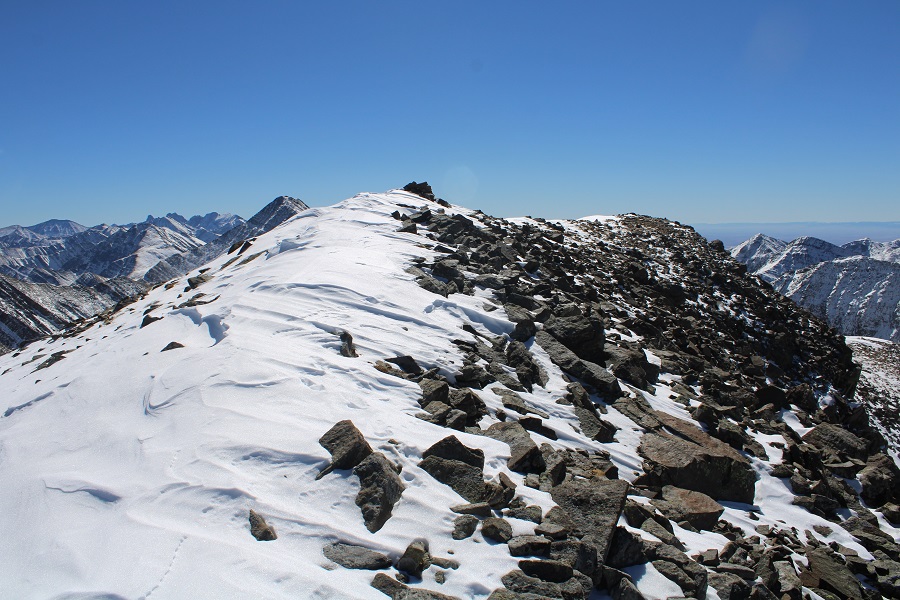
I then headed south towards the summit

I summited Silver Peak at 1pm

Silver Peak:  

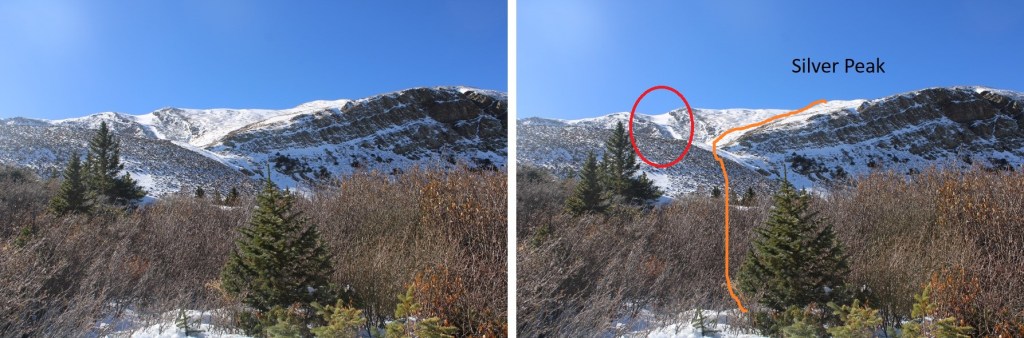
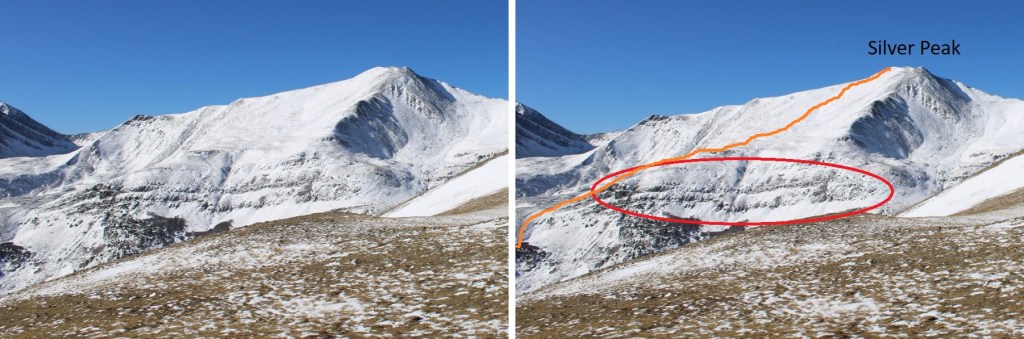
I was making this a loop, so from here I wanted to descend into the Lakes of the Clouds basin.  To do this I followed the ridge about 50 feet south, then turned left and headed east.  It’s important to follow the contour of the ridge, as it cliffs out if you go too far north.  Here’s a visual from earlier in the day.  You’re trying to avoid the cliffs I the circled area

Please note:  I’ll show you how I made it down to the Lakes of the Clouds, but I do NOT recommend this as a winter/winter conditions route, and it’s probably not ideal in summer either.  There was snow in the top of the avalanche chute, and it was mid-October.  The gullies were unstable and difficult to navigate while covered in snow, and it was hard to find a direct route down.  The only positive was the creeks were low, so I was able to walk directly in them to avoid the willows.  (Willows:  another reason to avoid this route, just go back and take the ridge down). 

I made my way into the basin, first heading south, and then east

Once I could see them, I was aiming for this lake, where a trail would pick up

The route required me to cross/use an avalanche route/drainage area.  To navigate this, I stayed as high as possible, once crossing the drainage

I stuck to the stream whenever possible, which would ultimately lead to the lake

I have to say, this part of the hike was miserable.  I had to watch every step, and took considerable time dusting snow off rocks to make sure I had secure hand/foot placement.  It was getting later in the day, so snow stuck to my microspikes.  I lost a spike somewhere along the way… probably in a stream crossing, as the snow that had built up on my foot became engorged with water, much as a snow cone would when adding syrup, became heavy, and slushed into the muck.  Long story short:  my feet were wet the entire hike back to my truck.

Here’s looking back at how I came down from Silver Peak.  The top of the avalanche area is circled in red, and flows all the way to the lakes

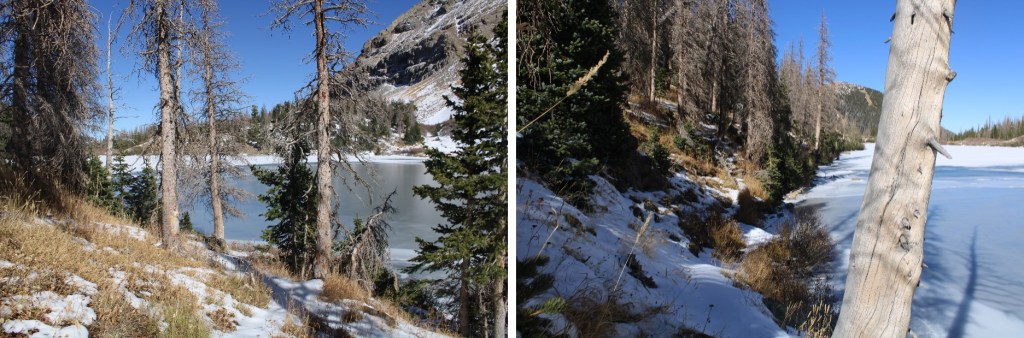
I skirted the lake to the left and at the north end of the lake came upon trail 1349, which was packed down this morning by fishermen heading to the lakes

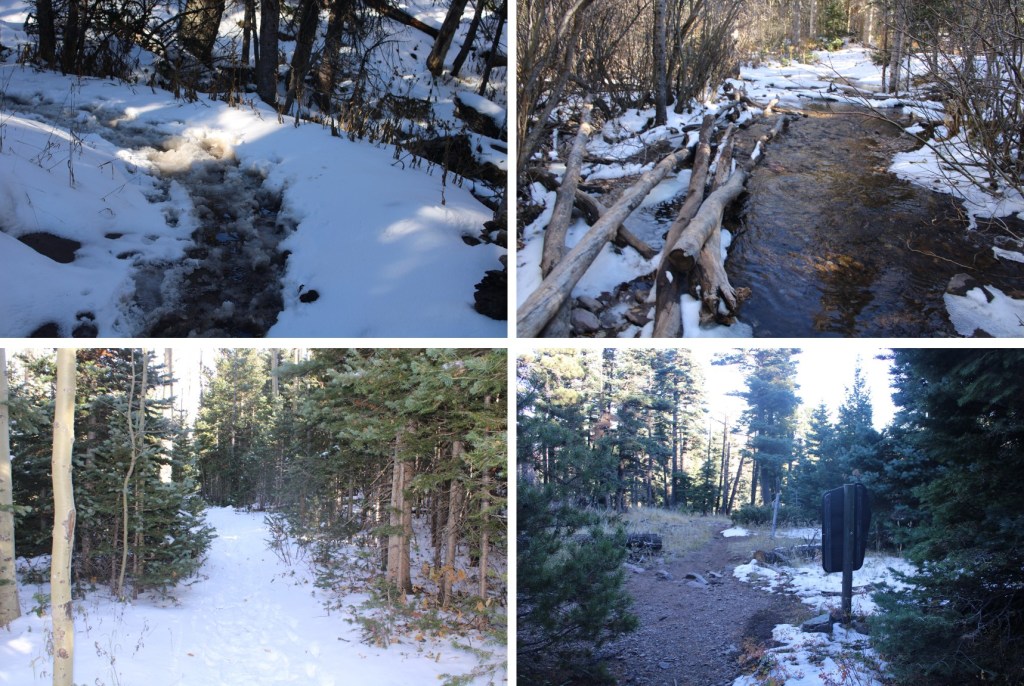
I took Trail 1349 for 3.75 miles, back to Trail 1336, and the to the Gibson Trailhead.  This is a great, class 1 trail.  The only downside are all the softball-volleyball sized rocks littering the path

I made it back to my truck at 4:30pm, making this a 16.6 mile hike with 5573’ of elevation gain in 11 hours.

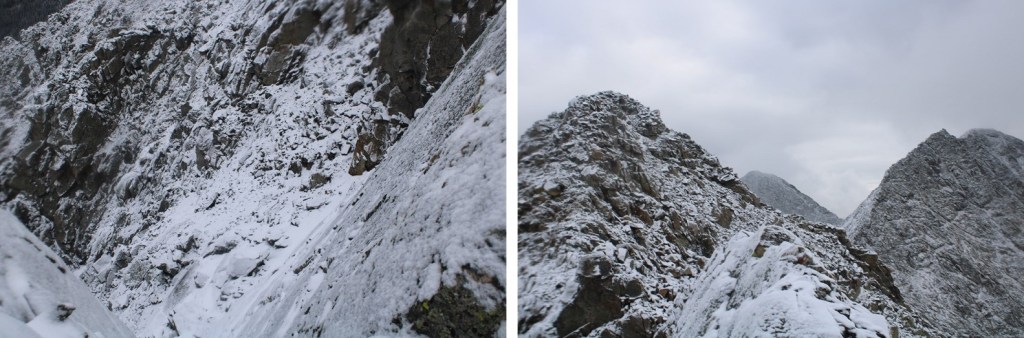
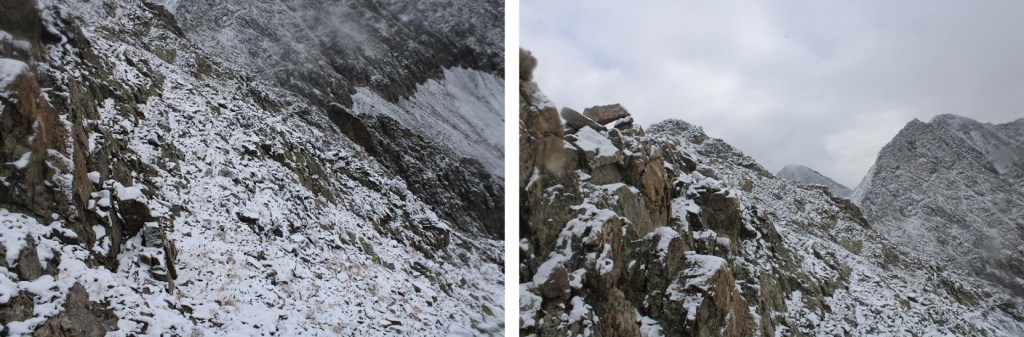
West Apostle – 13,597

RT Length: 12.04 miles 

Elevation Gain:  3575’

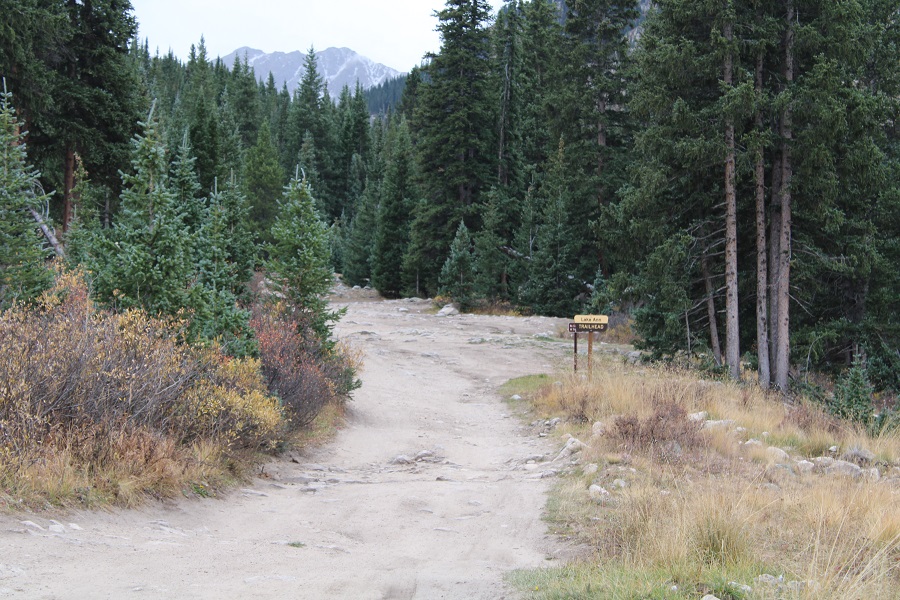
I was the only one at the Lake Ann/Huron Peak trailhead at 5pm on a Friday, and I was thrilled!  The 4WD road to the upper trailhead was a little rougher than I remembered it, but the drive had been worth it to be the only one there. I jotted down some notes from the days hike, sipped some whiskey, and looked at notes for tomorrow. It was still light out when I curled up in the back seat of my Tacoma and drifted off to sleep to the sound of pounding rain:  that meant fresh snow on the peak tomorrow!

I woke up and things seemed dry outside, which was odd for the amount of rain I’d heard last night.  I put on my winter gear anyway and was on the trail at 5:30am. The trail starts at the south end of the parking area, and continues heading south, towards Lake Ann.  Be sure to take the Lake Ann trail, NOT the Huron Peak Trail

I hiked 4 miles south along a class 1 trail to Lake Ann

Stay left at this crossing

At the second crossing I went right

And crossed a creek on a ‘pretty-solid’ bridge

Finally, I started gaining elevation as I made my way towards Lake Ann

Just after making it to treeline, go left at this junction.

And you’ll arrive at Lake Ann

The goal is to skirt the north side of the lake, and enter the upper basin

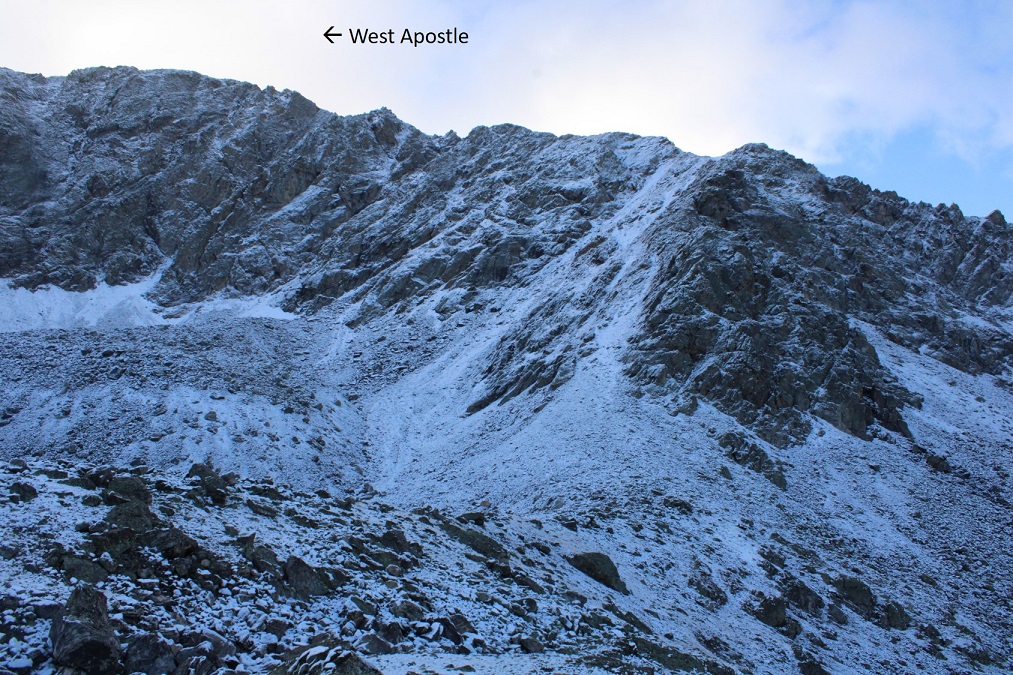
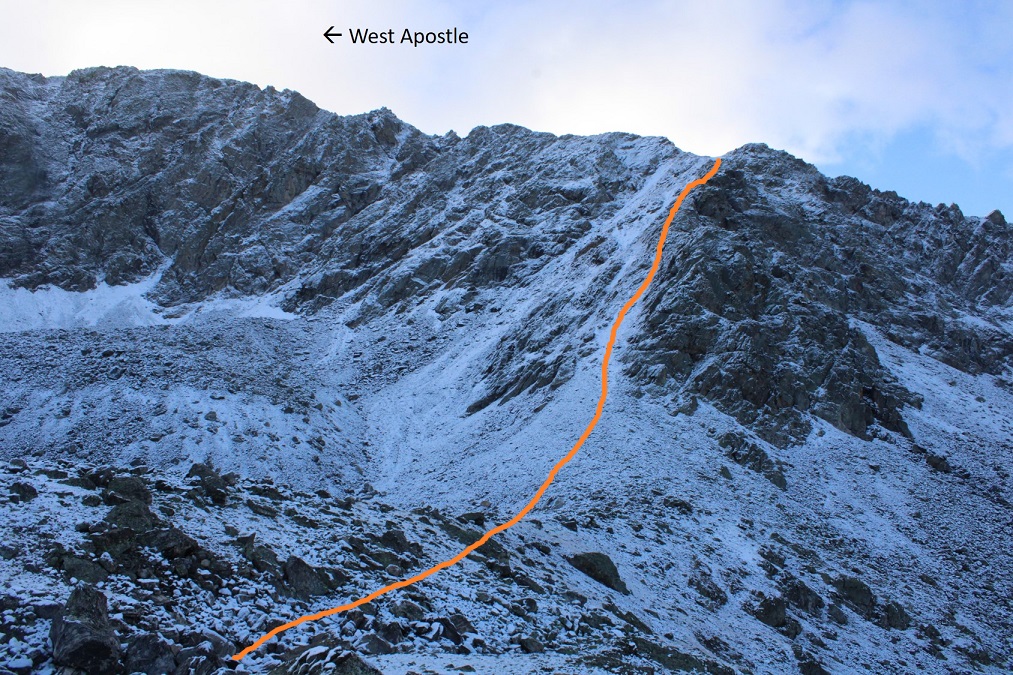
Here’s an overview of the route

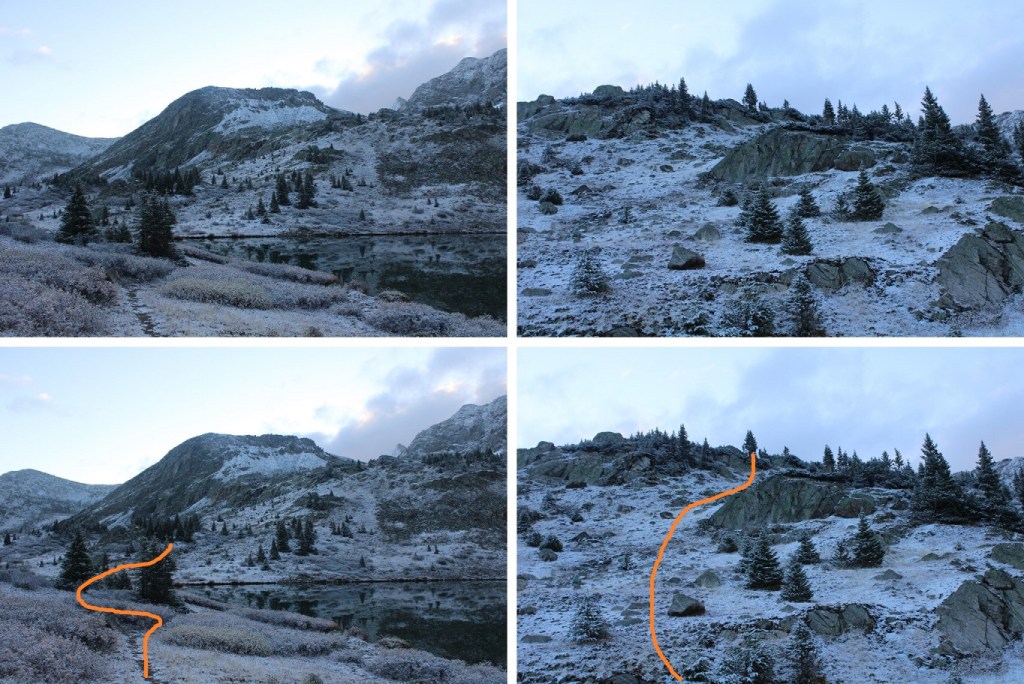
And some step-by-step pictures into the upper basin

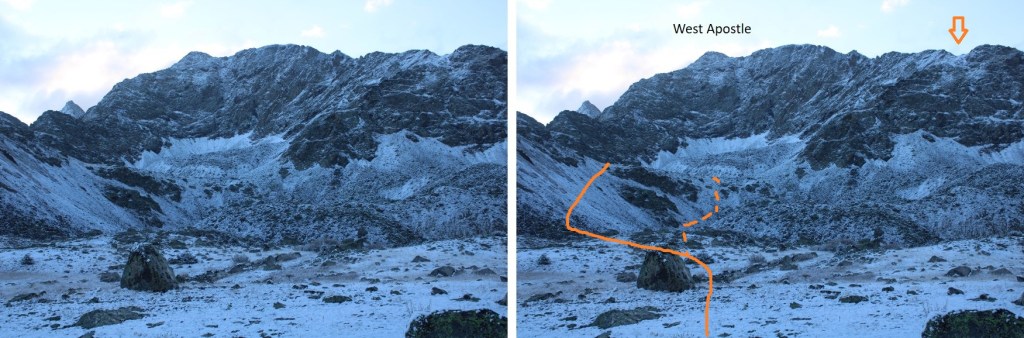
Once in the upper basin I aimed to ascend the amphitheater.  This can be done multiple ways. I decided to stay left on the way up (solid line), and follow (very faint) game trails, and I went right on the way down (dotted line).  The orange arrow is where you’ll eventually be aiming.

Here’s another picture of the amphitheater

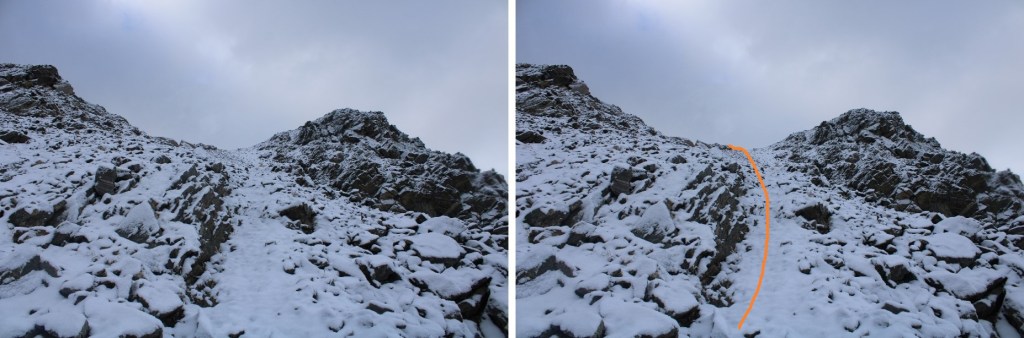
Once at the top of the amphitheater I was in another basin.  I turned right, and followed the ridge.  I’m sure the best way to ascend this gully is straight up the gully, but today there was unconsolidated snow blocking that route.  Even with microspikes I wasn’t able to get traction the gully direct, so I took the rocks to the right. 

Here are some closer pictures of the gully

At the top of the gully I went left

Which brought me to the ridge (and a cairn!)

I turned left and followed the ridge northeast.  This is a class 2 ridge, which I was able to stay on the top of the ridge to hike most of the way.

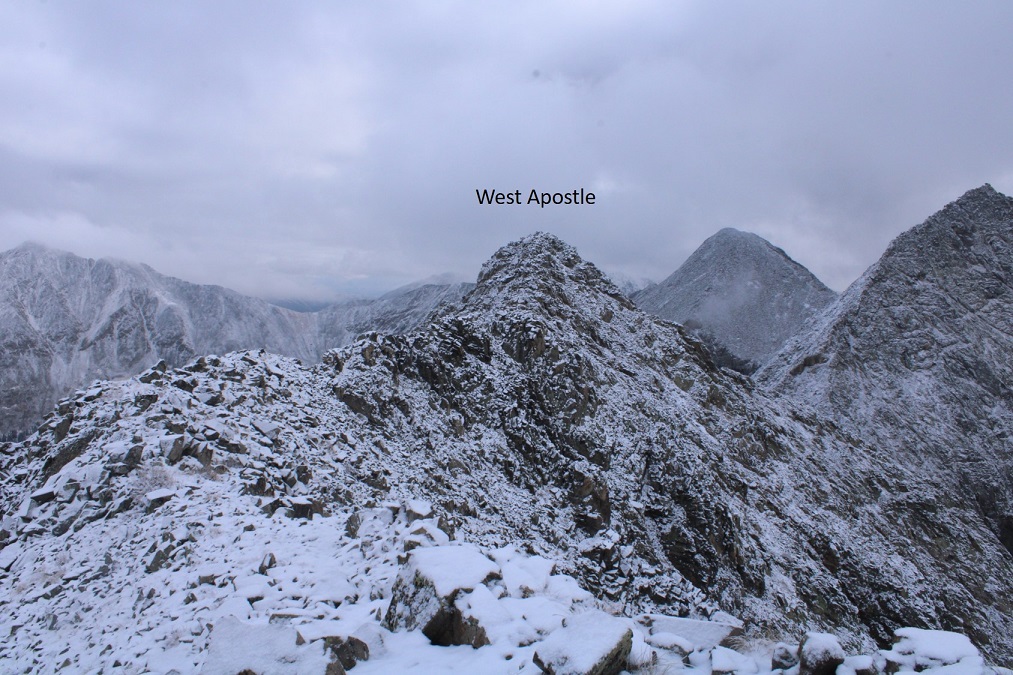
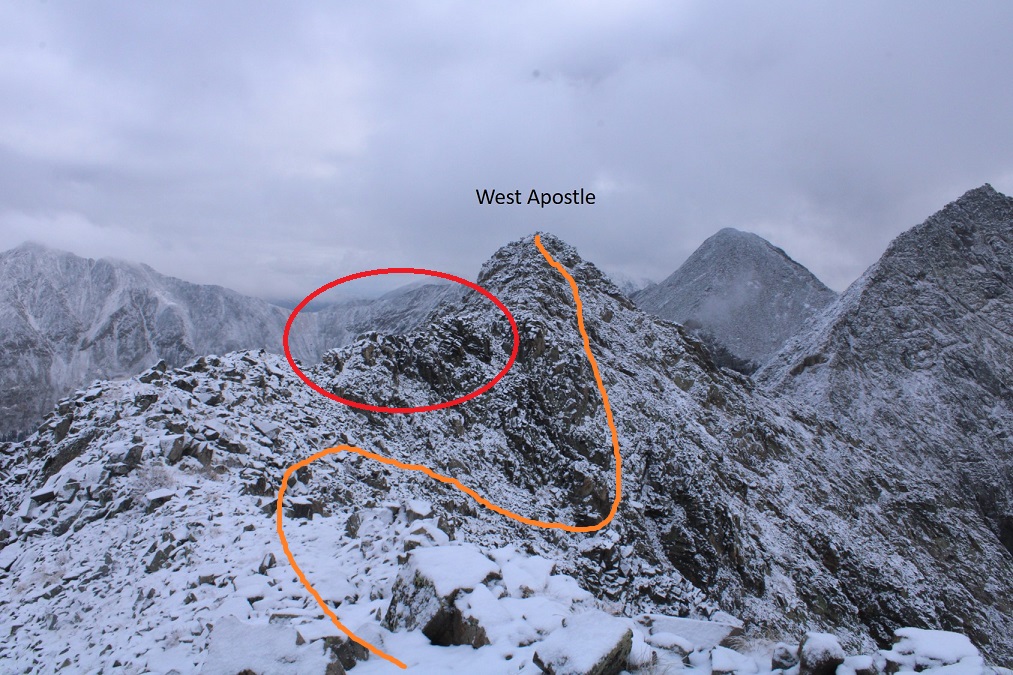
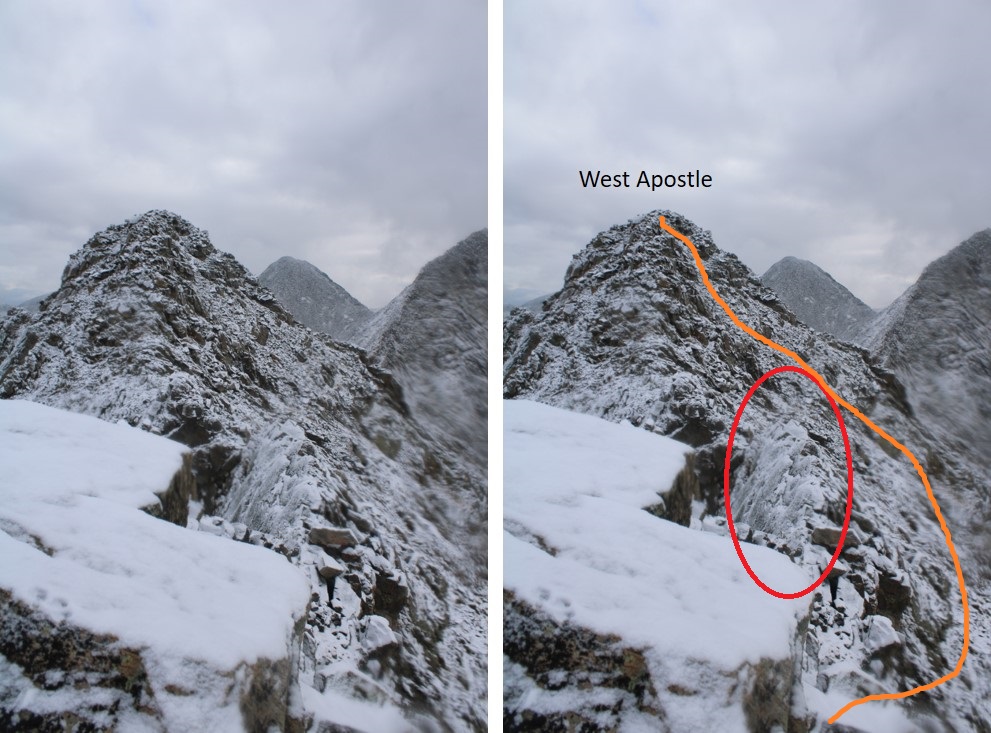
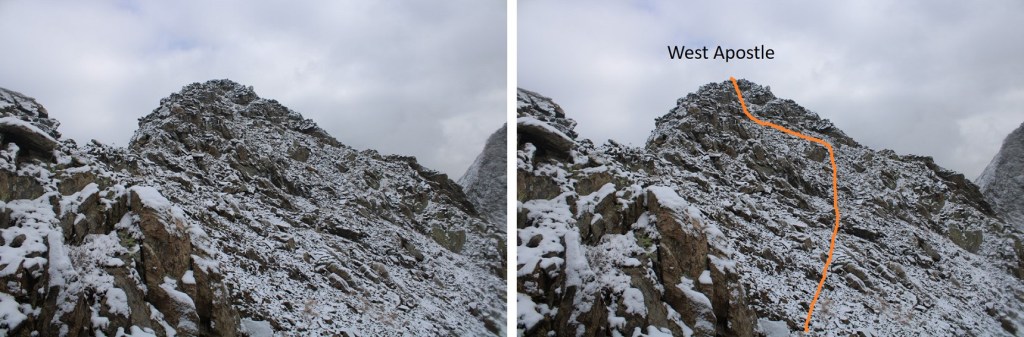
Here it gets a little dicey.  If there hadn’t been snow, I would have taken the ridge all the way to the summit.  However, with the snow and ice today things were slippery, and the exposure was real (to the left).  I decided to dip down to avoid some of the worst of the exposure.  I did this a little later than I should have, as it as getting spicy already.   The area with exposure is circled in red.  This is how I summited West Apostle

Here’s a picture of the ridge

And this is the exposure I was avoiding

So, I dipped down to the right and kept it class 2

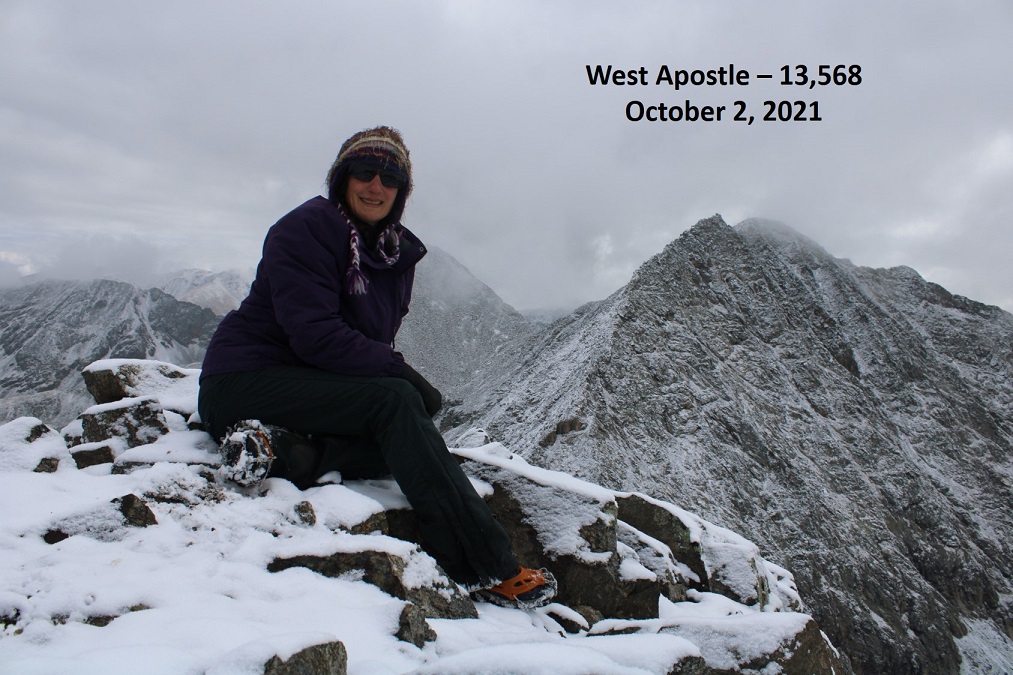
I summited West Apostle at 9:30am

West Apostle: 

There was a summit register, but it was a pipe one missing its lid, so I replaced it with a jar. Here’s looking back at the false summit

I headed back the same way I summited, heading west, avoiding the area with exposure

Here’s what that looks like after dipping down

Back on the ridge, I followed it to the saddle.

The cairn was helpful in finding the correct exit from the ridge in all this snow.

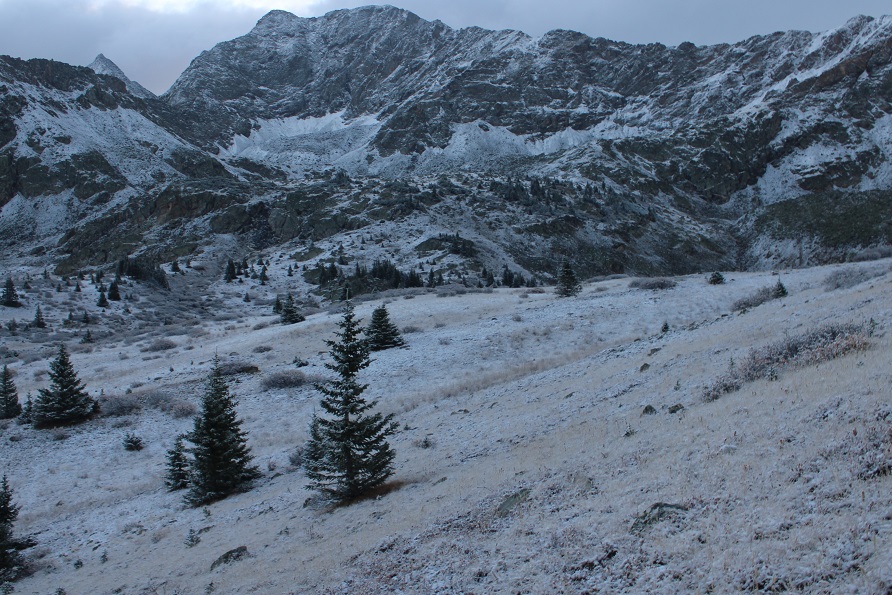
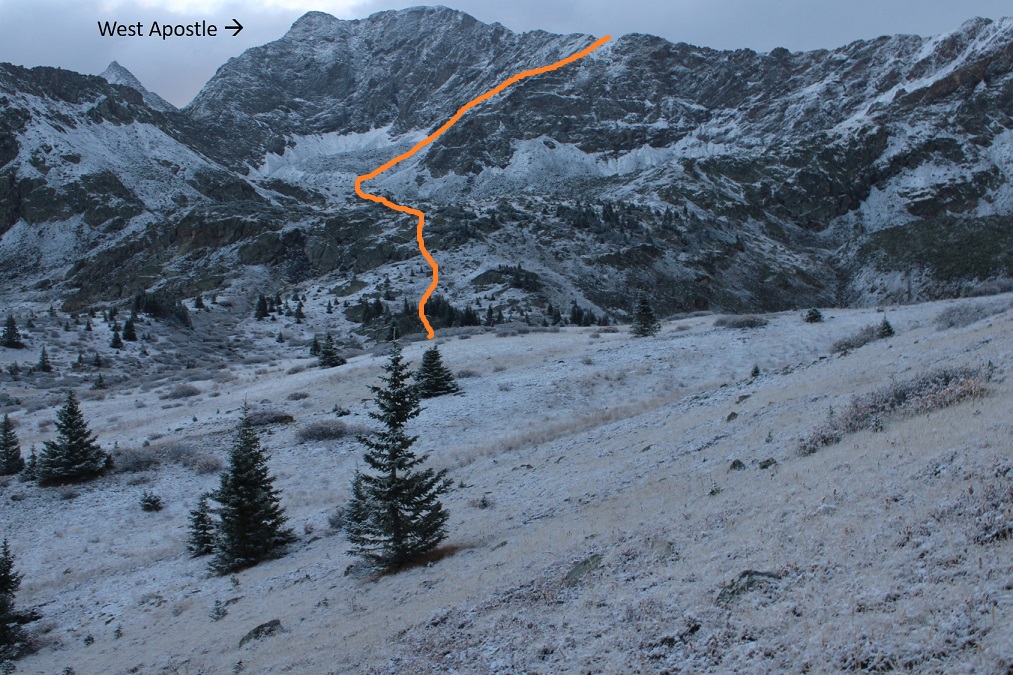
I made my way back down towards the gully, staying as much to the west as possible, avoiding the gully direct and sticking to the rocky area.

I then re-entered the basin, and headed west towards Lake Ann

Back at Lake Ann, it was easy to pick up the class 1 trail and follow it back to the trailhead.

I made it back to my truck at 12:30pm, making this a 12.04 mile hike with 3575’ of elevation gain in 7 hours.

Jenkins Mountain – 13,432, PT 13,145 & PT 13,232

RT Length:  13.75 miles

Elevation Gain:  5322’

Snow had been forecasted for today, but not until later in the afternoon. I made it to the North Fork Creek Trailhead on an easy 4WD road, and it was foggy out.  I was hoping the fog would lift as the sun came up, but it ended up snowing off and on all day. Luckily there was no wind, so the snow was actually enjoyable (if annoying because I couldn’t see very far).   I was on the trail at 5:30am.

I followed North Fork Creek Trail for 2.75 miles southwest to treeline at 11,250’, without gaining or losing much elevation. I never crossed the creek.

Here the trail stopped. I’d hoped by now the sun would have lifted the fog, but unfortunately, it started snowing instead, and visibility wasn’t great.

Here’s a view of the route I took to the ridge, from back on the trail later in the day

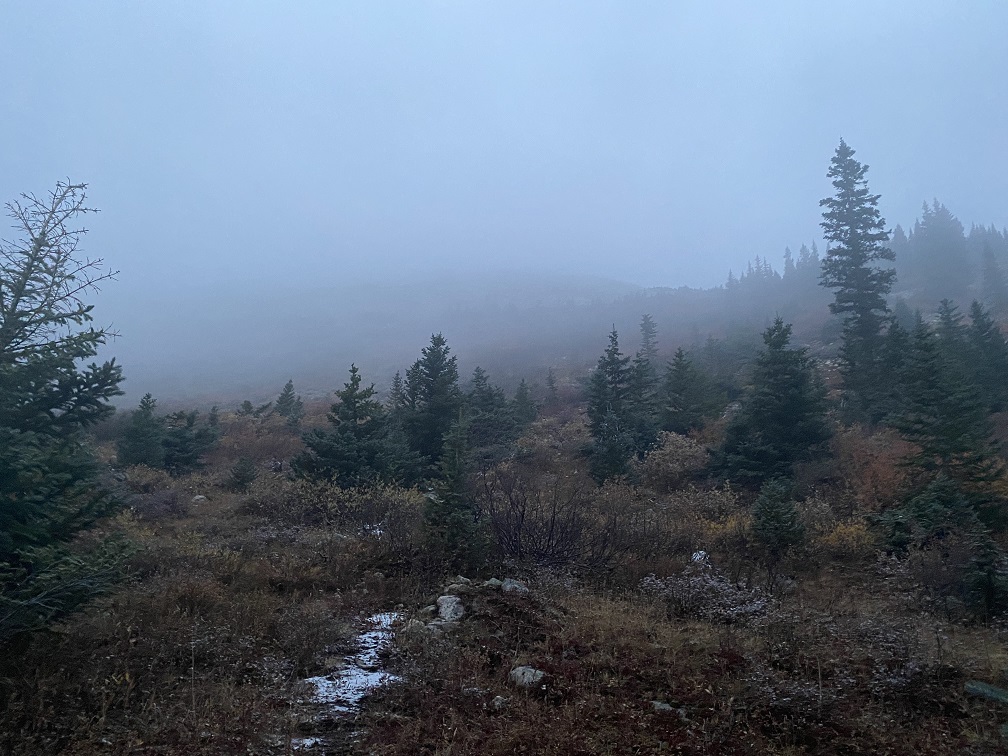
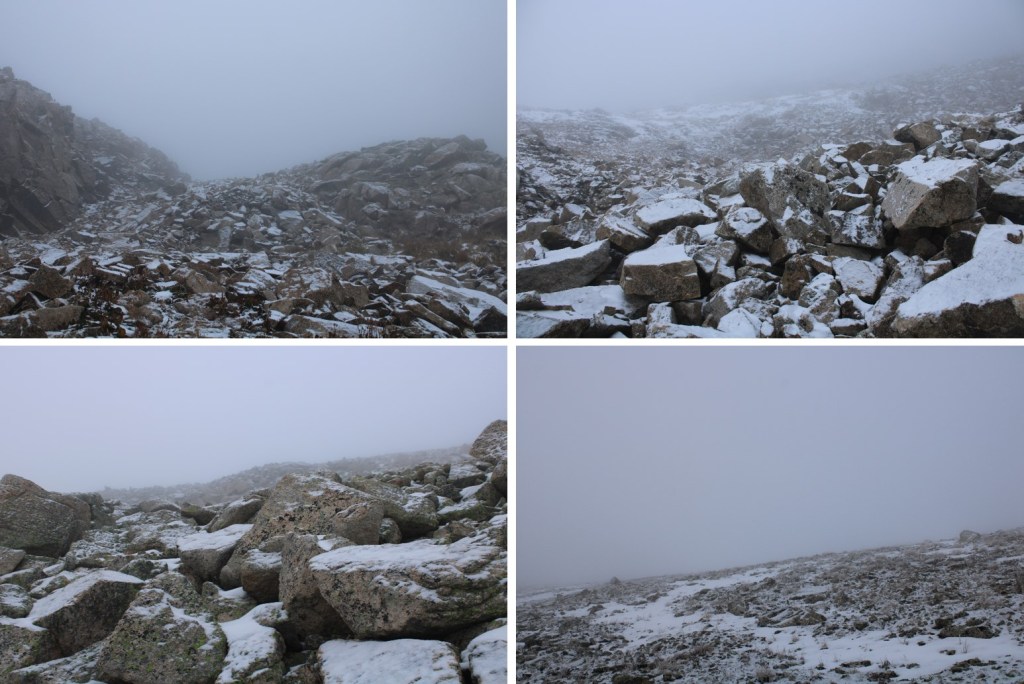
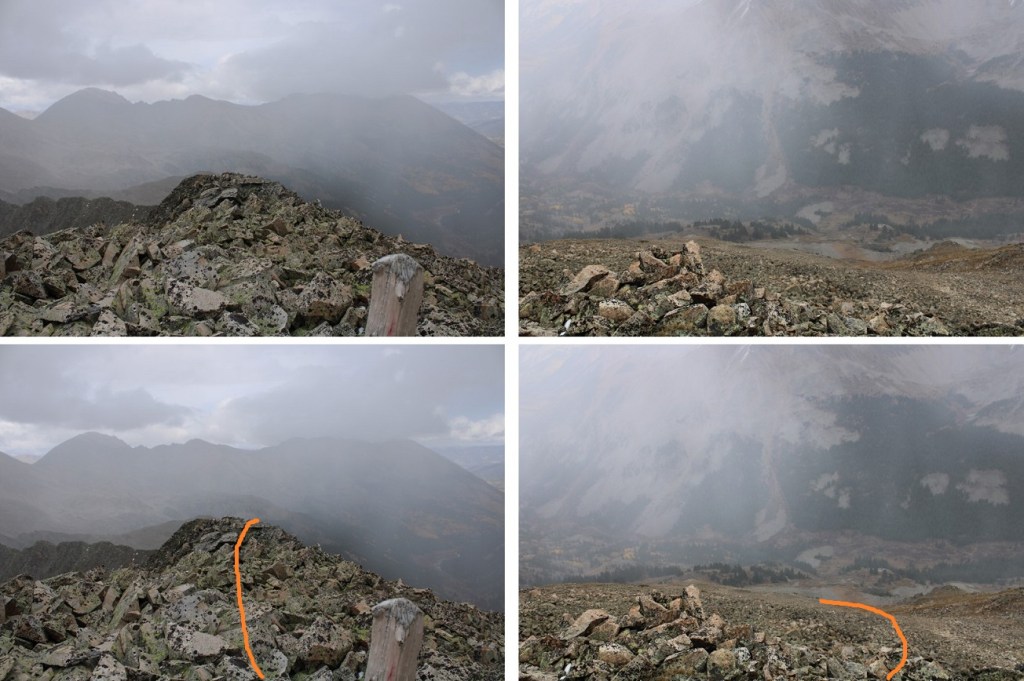
I followed the path of least resistance and headed southwest towards a rocky gully and the ridge (better pictures later).  There was a fog, so I didn’t get great photos, but here are some pictures of what I could see:

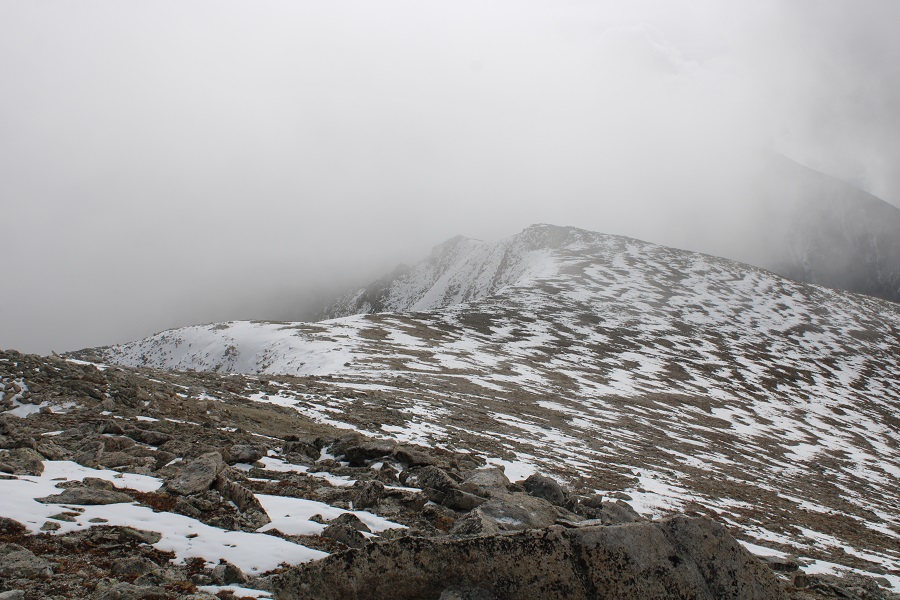
The rocky gully area brought me to the ridge between point 13050 and 13015. I couldn’t see far, which was frustrating, but I knew to continue following the ridge southwest. Luckily, I came back to this spot later I the day, so I have clear pictures of this part of the hike.  The rocks here rolled.  In the morning they were icy, so I had to be especially careful.

I followed the ridge towards 13050. This ridge was easy to follow, even when it was snowing.  I stuck to the ridge proper, only dipping down to the left one time.  This can all be kept at class 2.

Once at PT 13050 I turned right and headed northwest towards Jenkins Mountain, first losing about 230’ of elevation.

This was another ridge hike, where I briefly dipped down to the left to avoid some rocks

Here are some pictures of the ridge, up to the first “false summit”.  If you can’t stay on the ridge, dip down to the left.

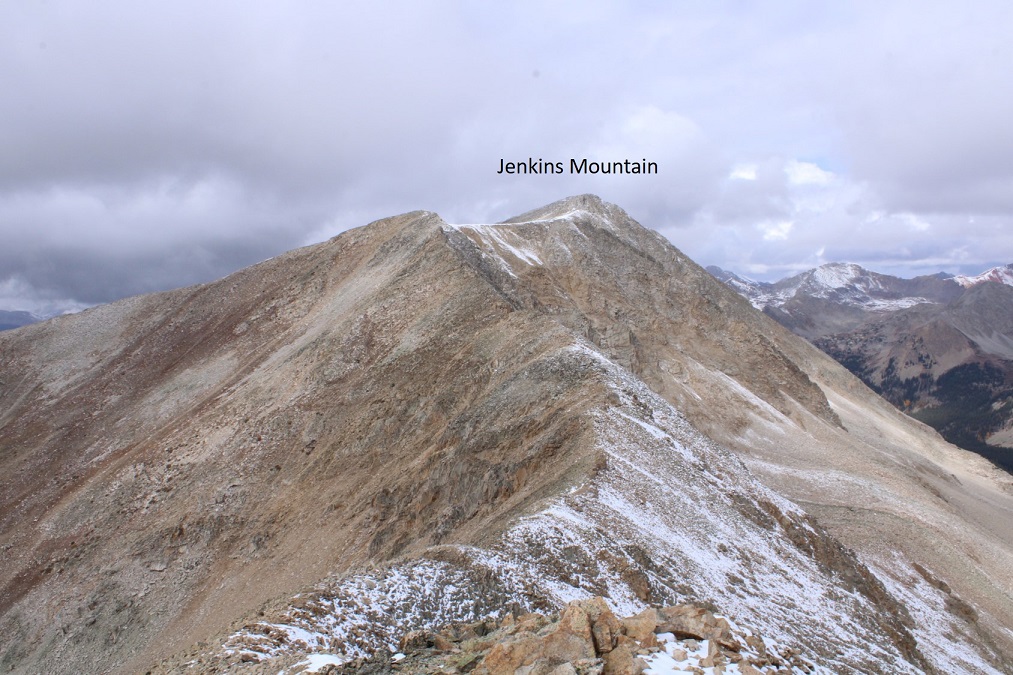
From the top of the false summit, I lost a little bit of elevation, but it was an easy ridge hike to the true summit of Jenkins Mountain.  I’m sure this would be a piece of cake on a clear day. Today however, the ridges were frustrating because I didn’t have visuals of how far they ‘went’

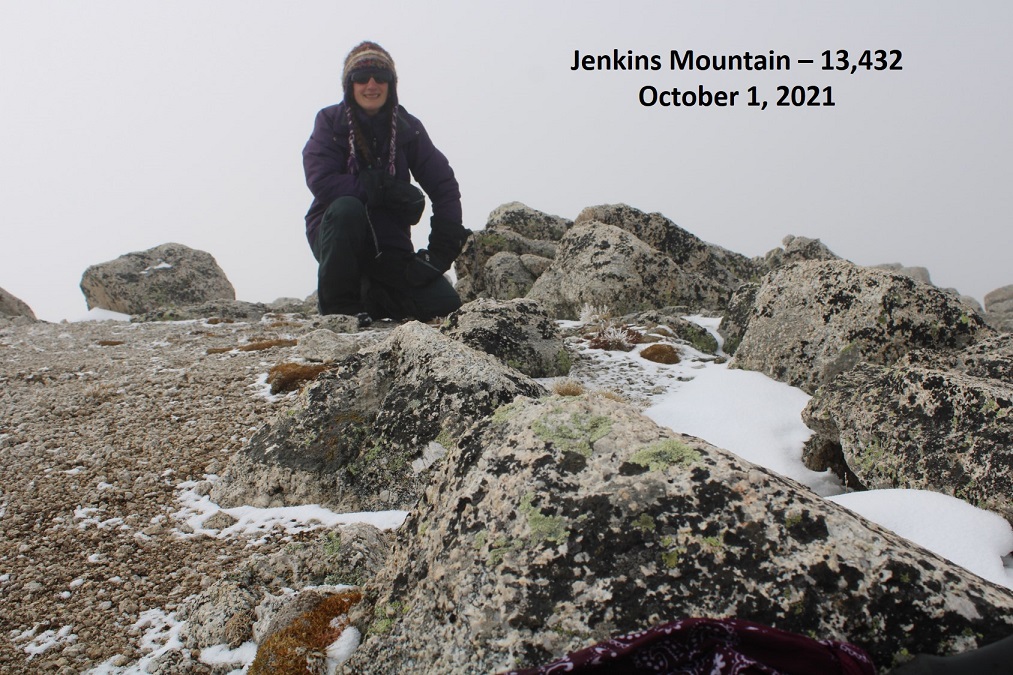
I summited Jenkins Mountain at 10am

Jenkins Mountain: 

I was happy to see it looked like the weather was starting to improve.  There was a summit register.  I turned and headed back towards PT 13050.

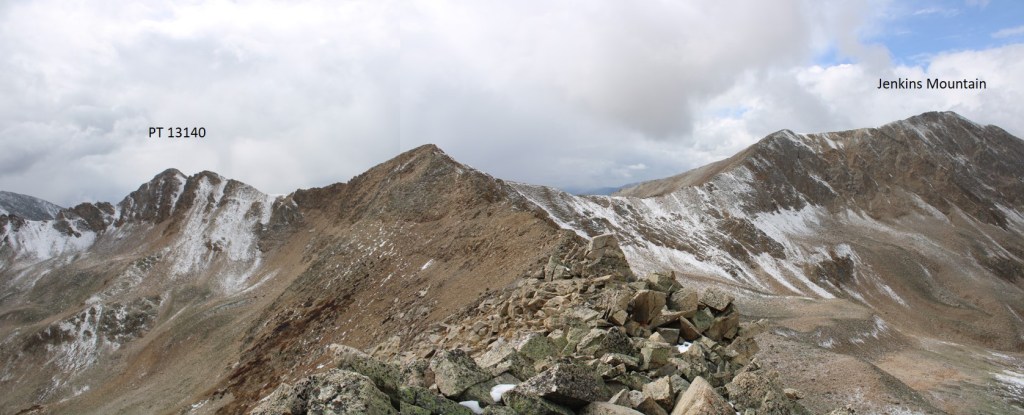
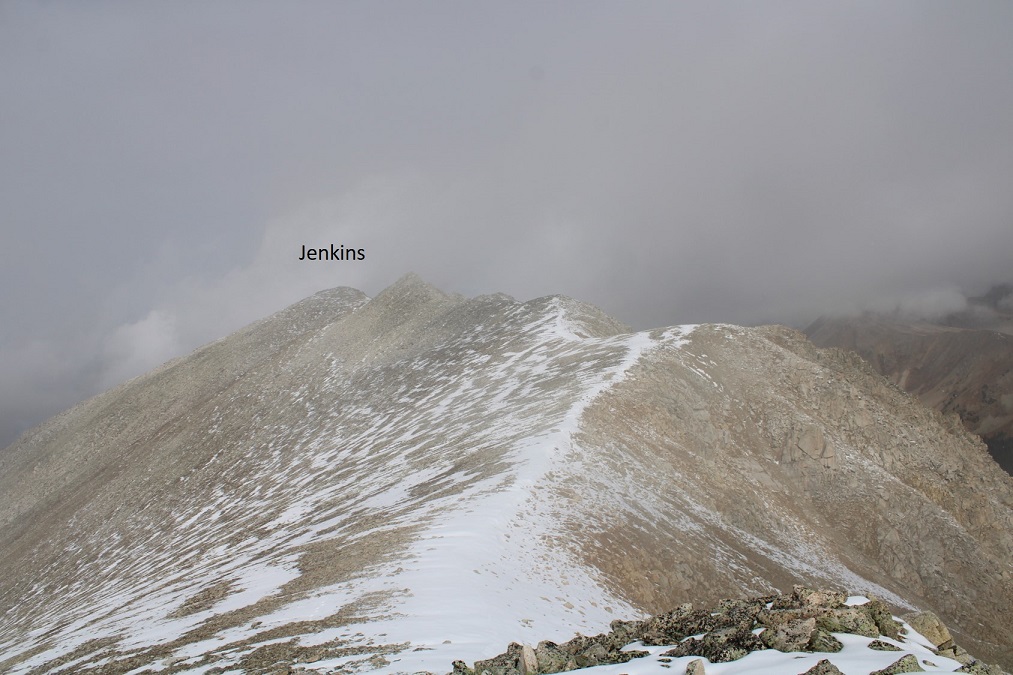
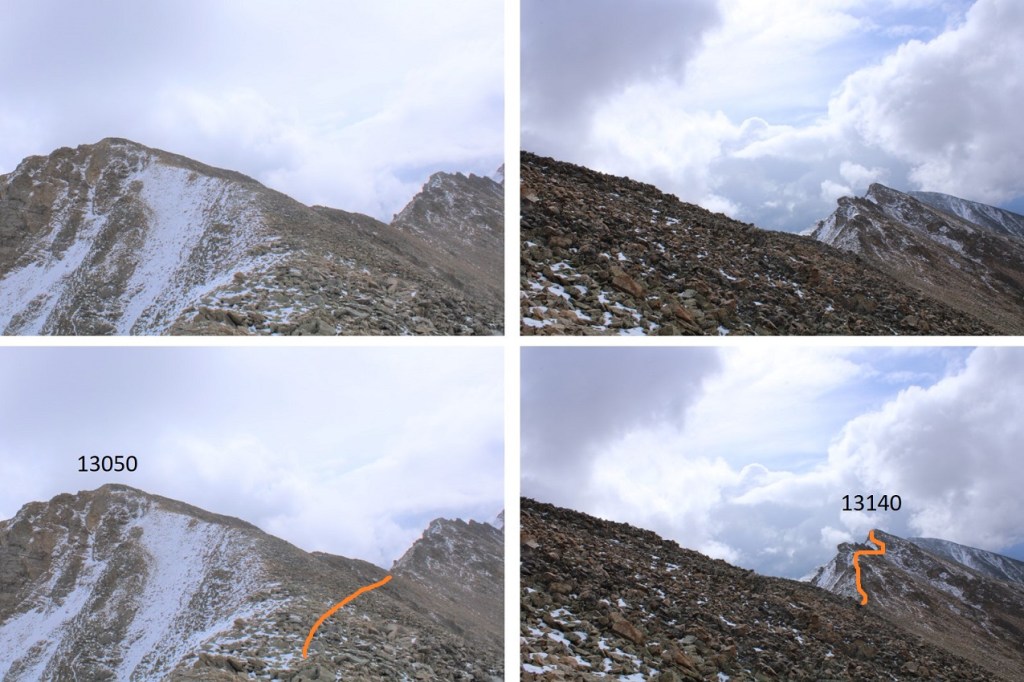
Halfway down the ridge I could see PT 13050, as well as PT 13140

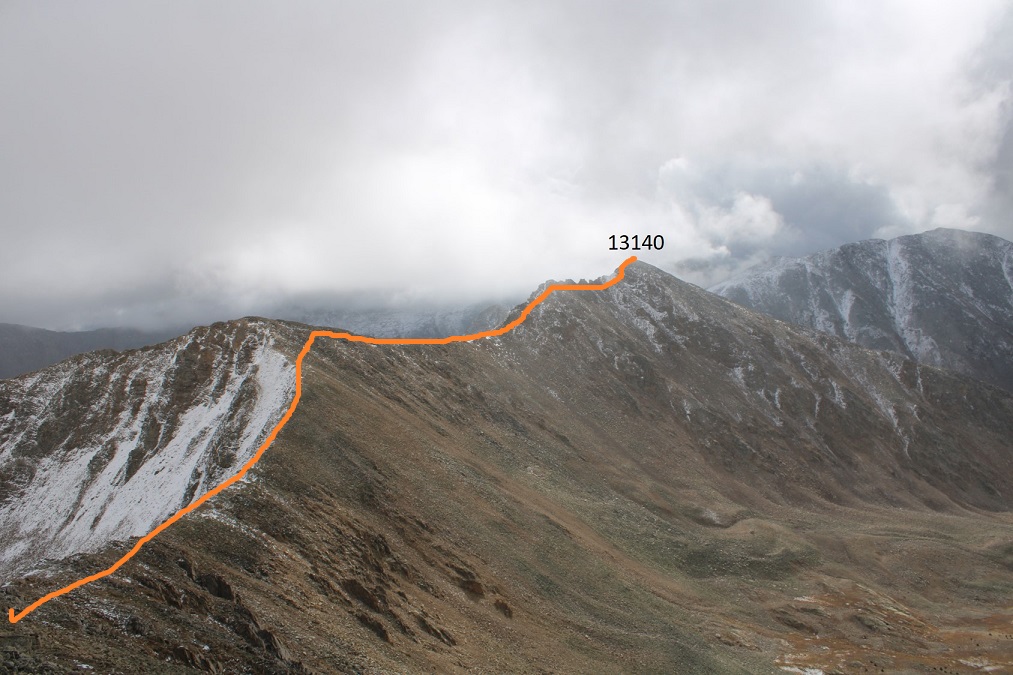
I didn’t completely re-summit PT 13050.  Here’s an overview of the route I took to PT 13140

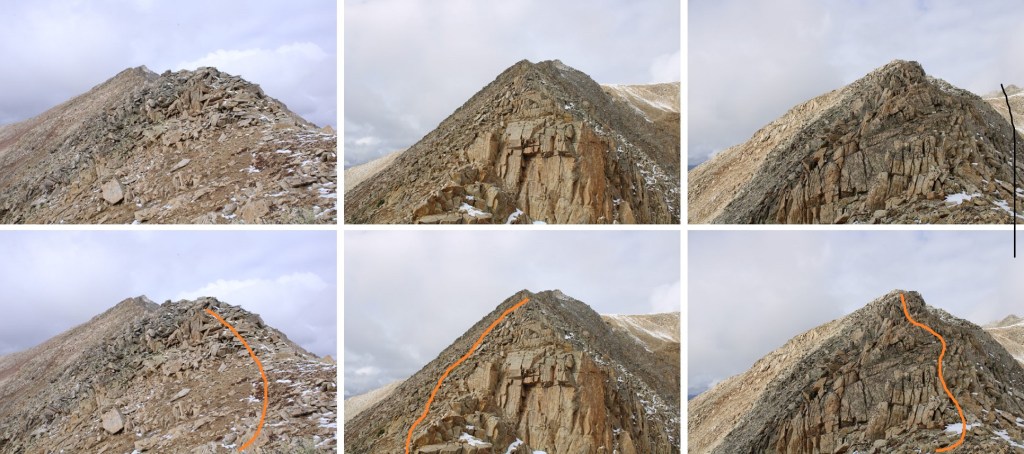
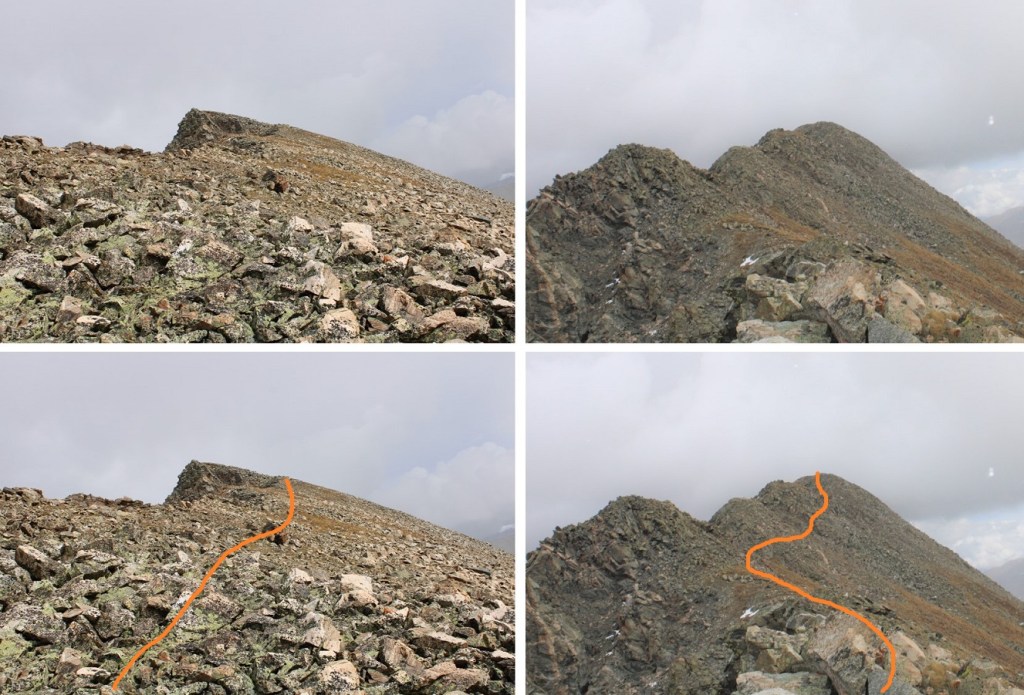
And some step-by-step pictures

I could stay on top of the ridge for most of the ridge;  it wasn’t until the end I needed to dip right.

After the false summit I needed to dip down and lose about 75’ of elevation

I regained the ridge

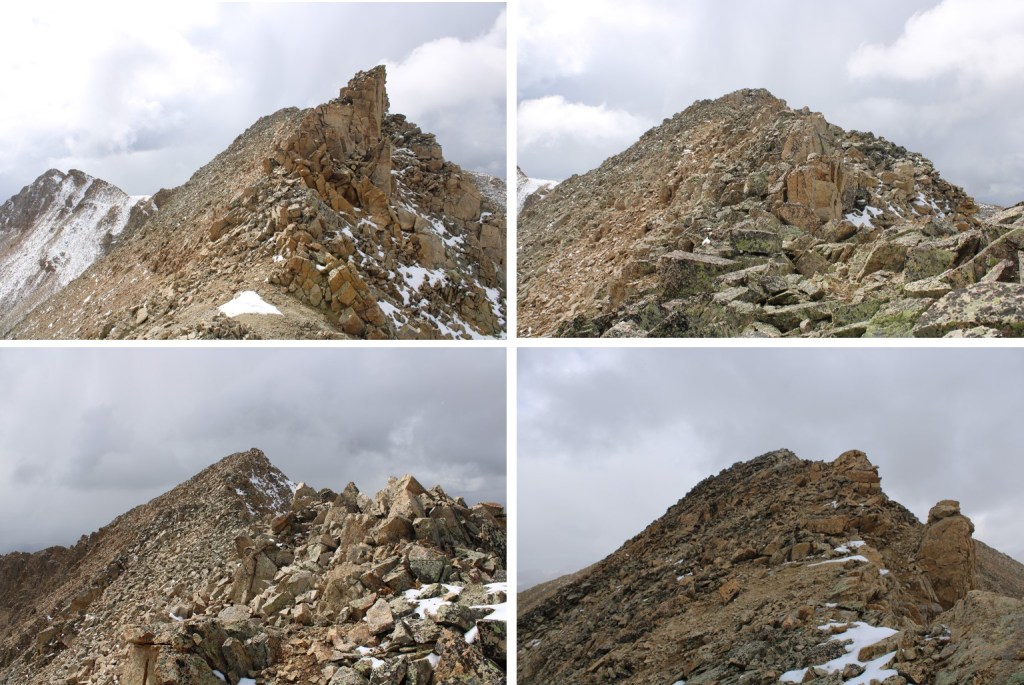
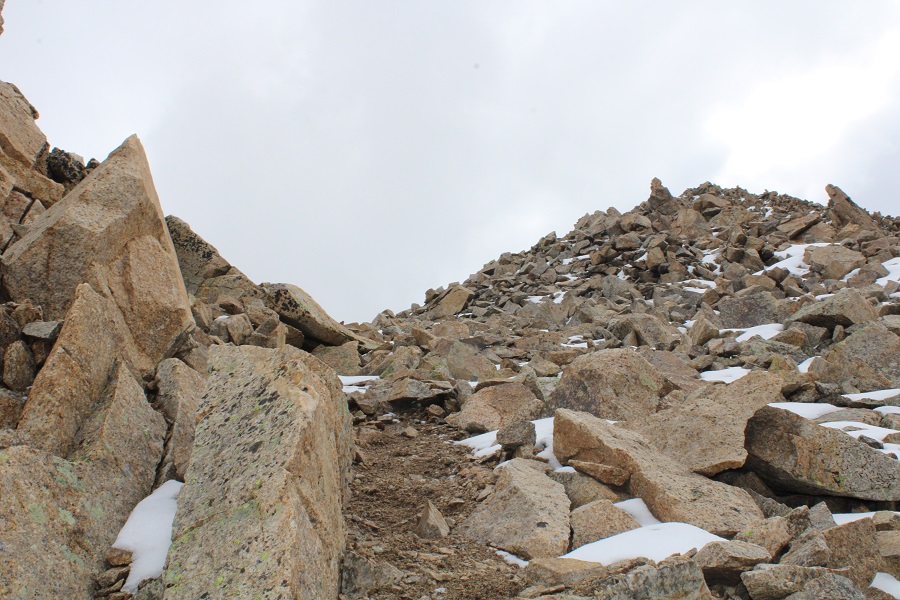
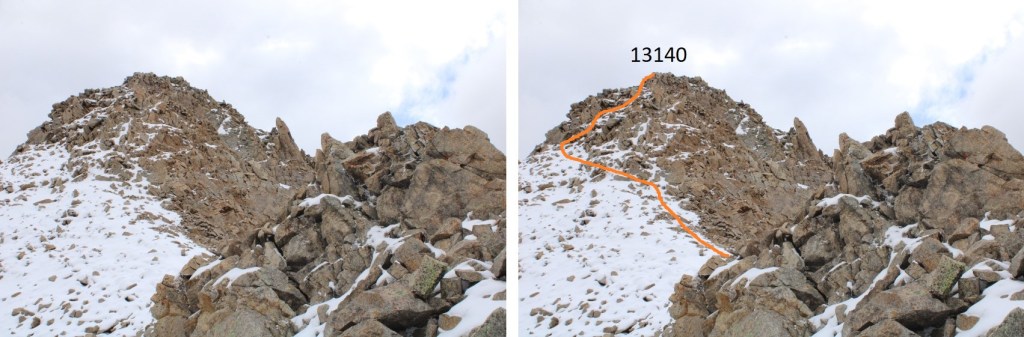
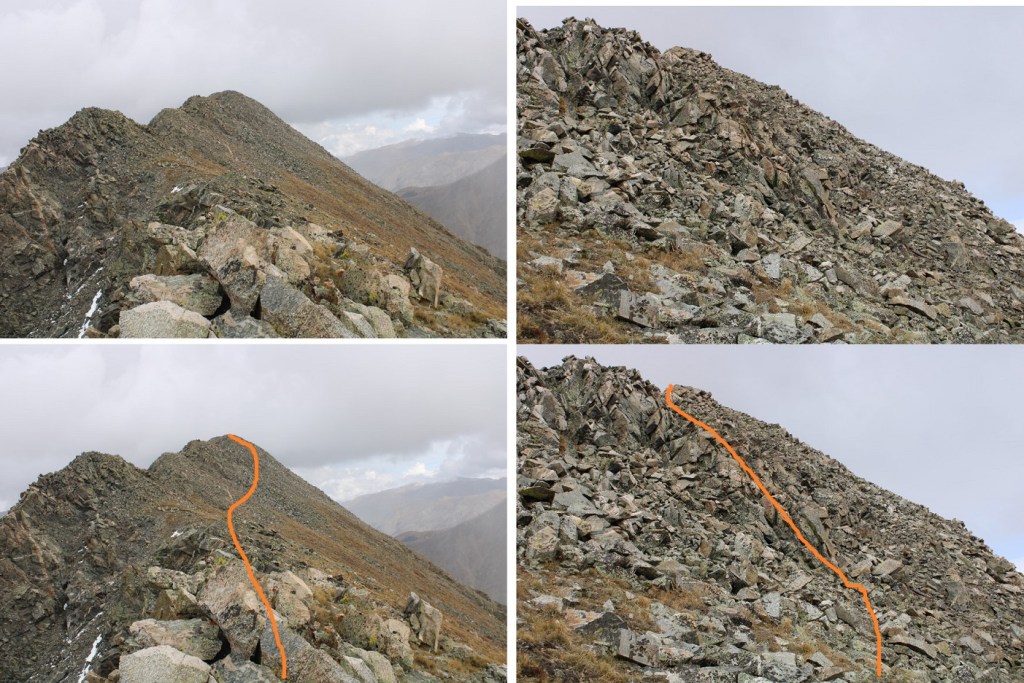
And this is how I summited PT 13140.  I’m sure there was some sort of a trail here, but it was currently covered in snow. The last few feet are ‘choose your own adventure’, all class 2.

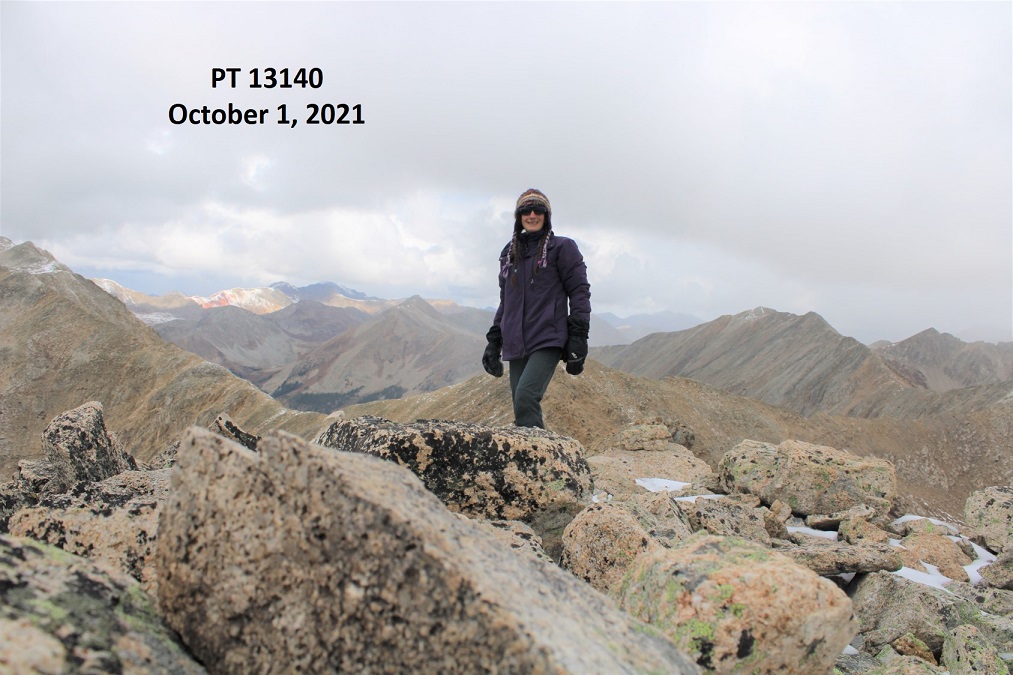
I summited PT 13140 at 11:30am

PT 13140:

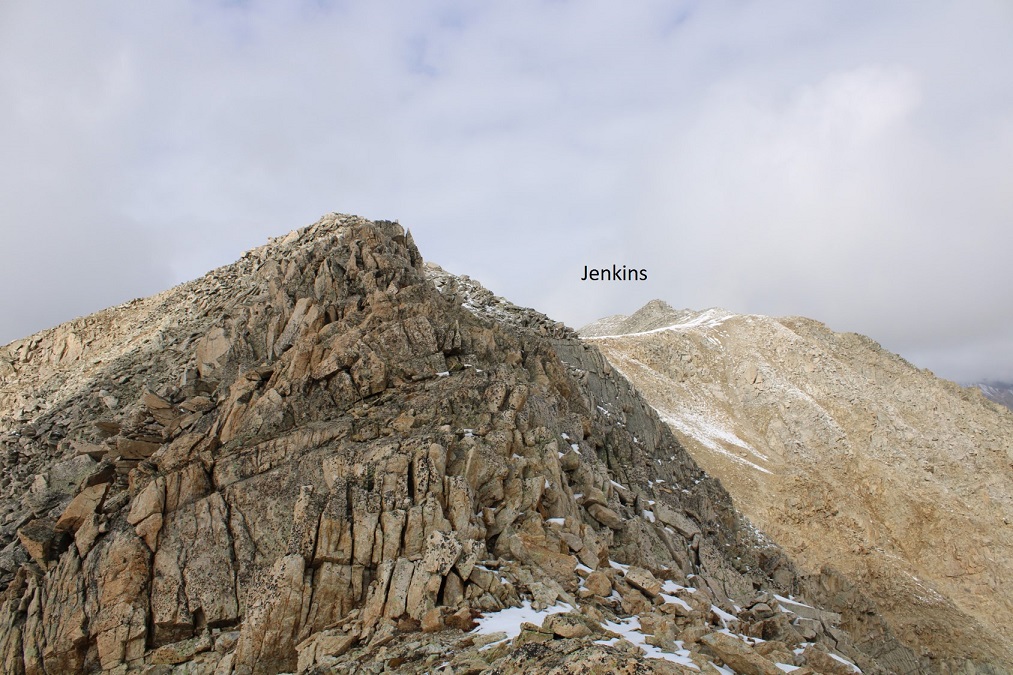
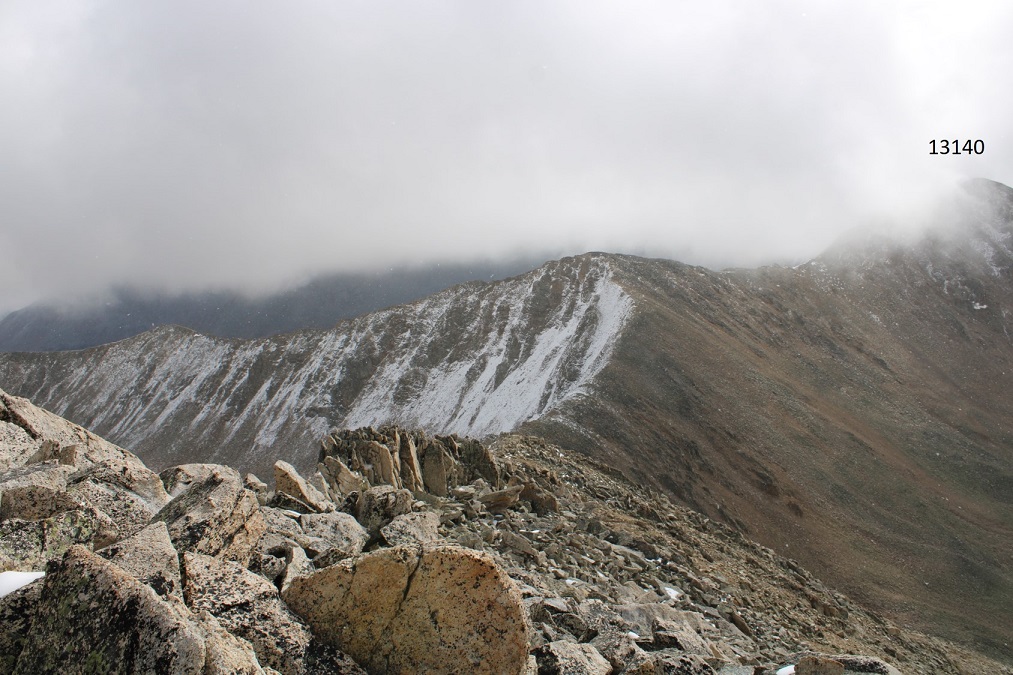
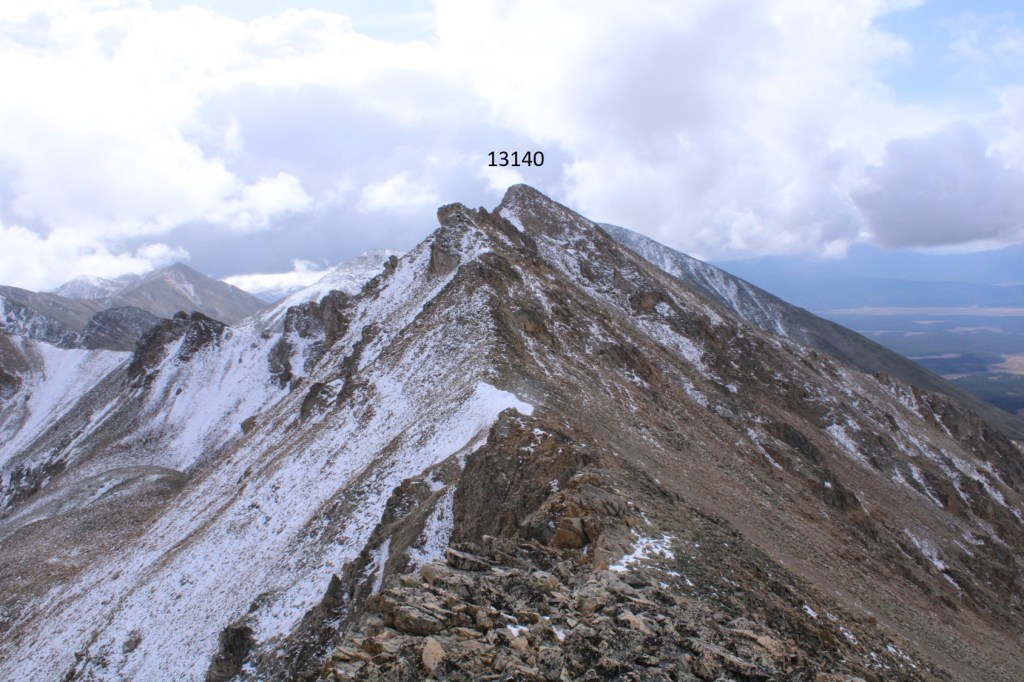
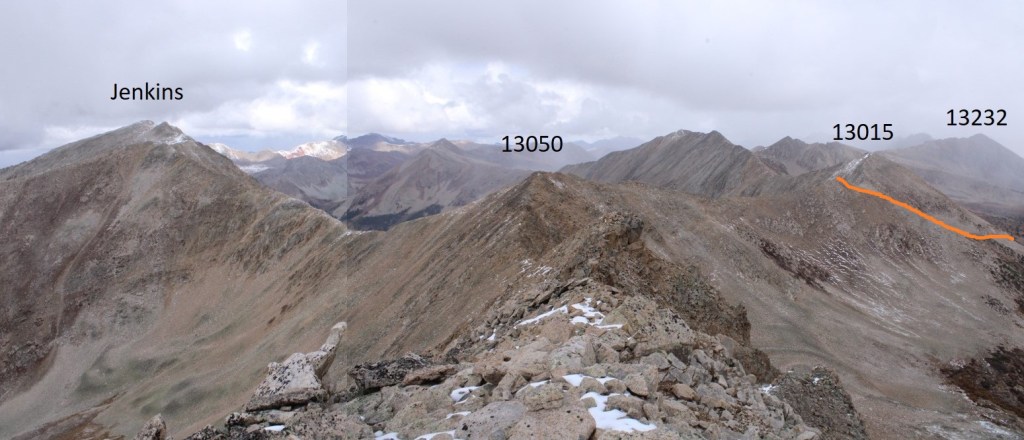
From the summit, here’s looking back at the trek from Jenkins, as well as the next few points for the day

For reference, this is how I gained the ridge to the saddle between PT 13050 and 13015.  It’s kind of a ridge itself.

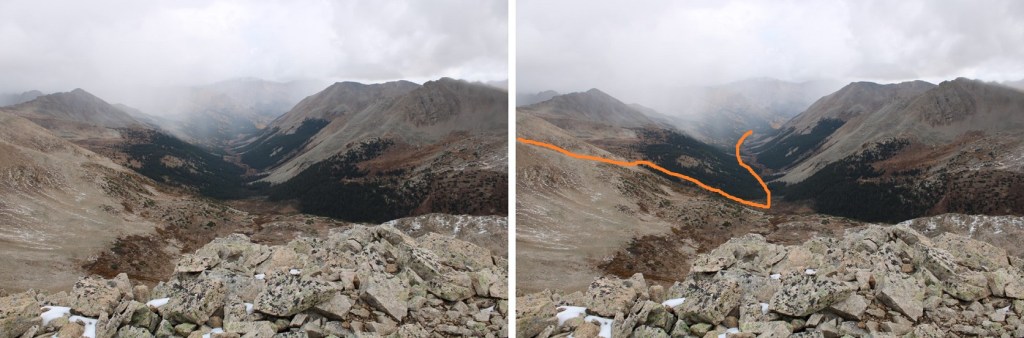
And another view, from PT 13140, looking back at how I exited the basin and gained the ridge. I headed back to PT 13050.

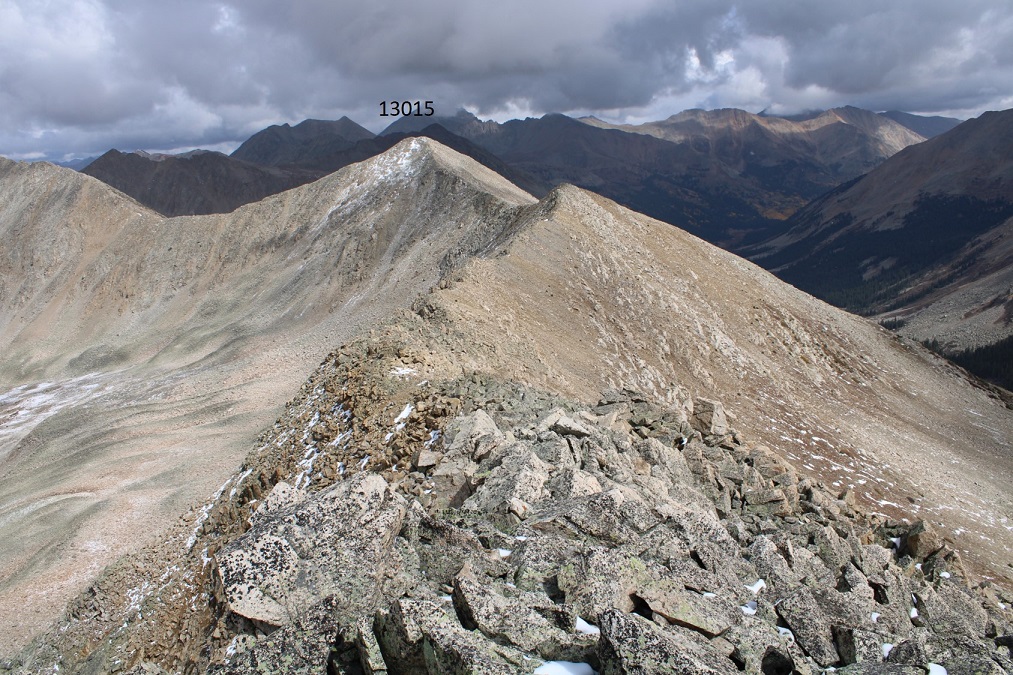
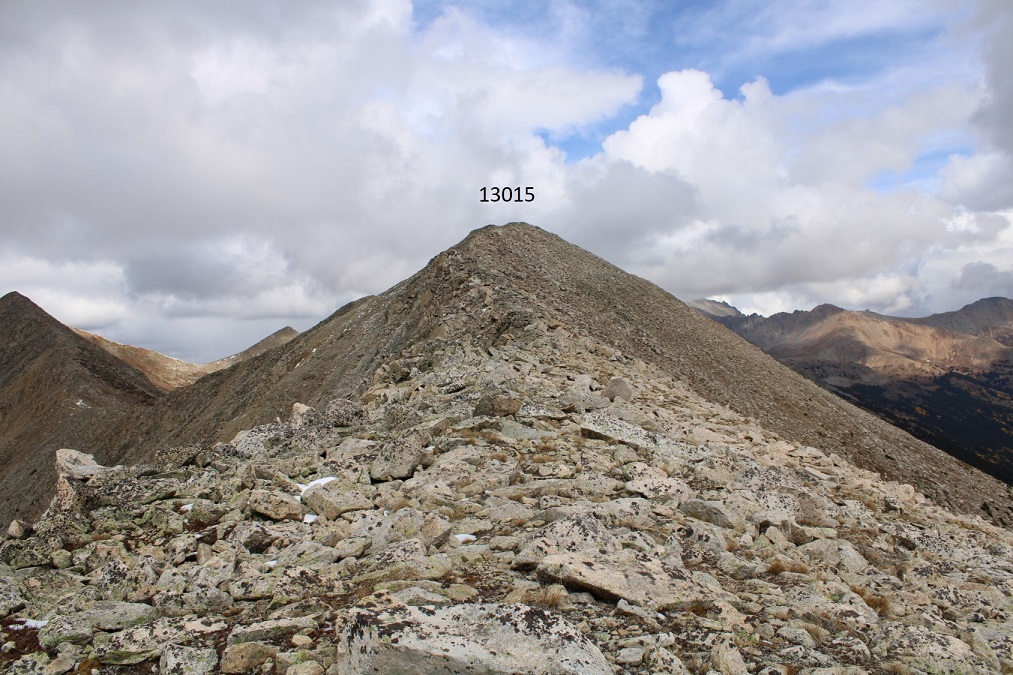
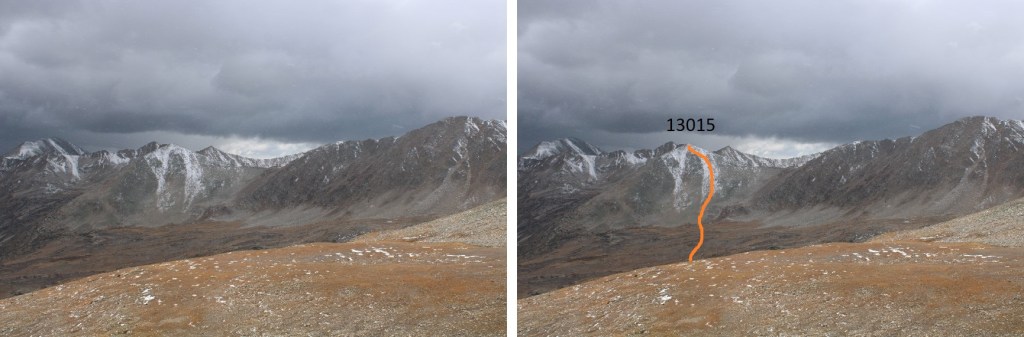
Here’s looking northeast at PT 13015 from 13050.

This was a class 2 hike all the way to PT 13015

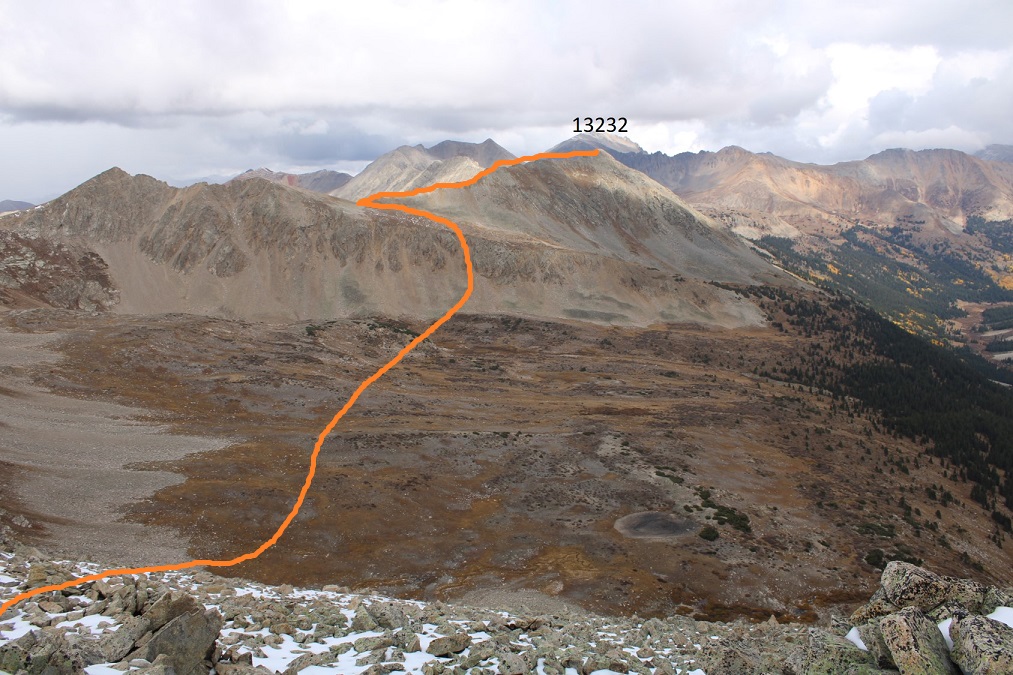
From the summit of PT 13015 I could see my next peak:  Pt 13232. 

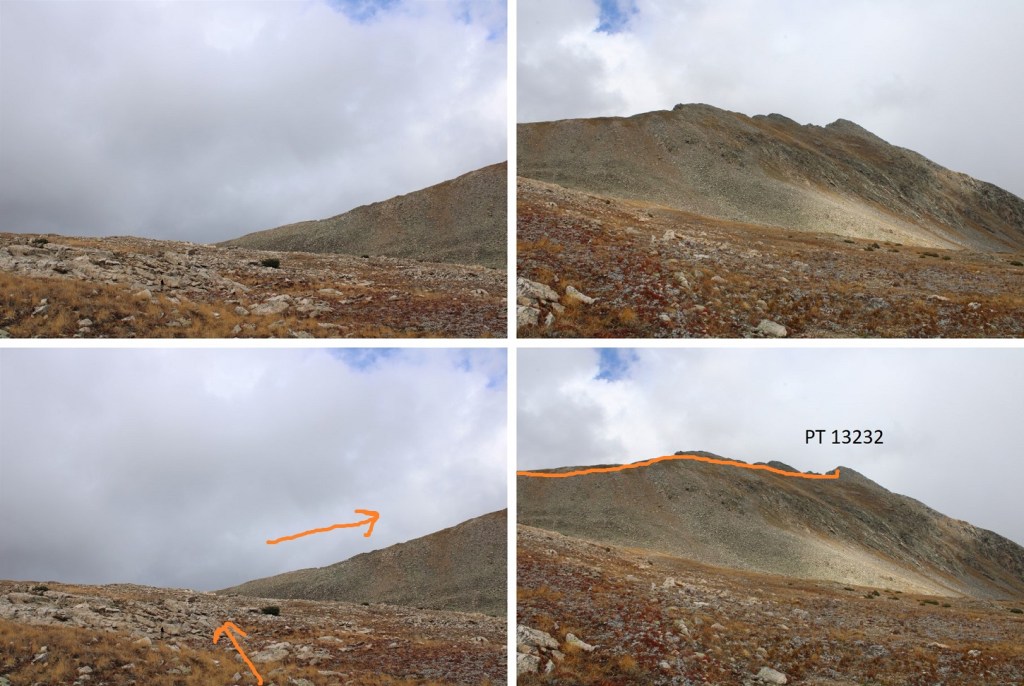
This is the route I took to get there:

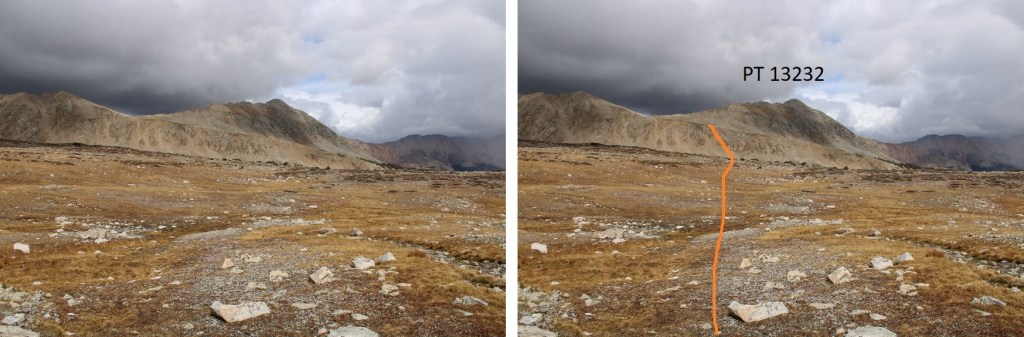
This route had me turning and following the ridge for a short distance northwest, descending a scree, rock, and snow filled gully, crossing the basin, finding another gully and ascending it to a slanting plateau/ramp, taking the plateau to the ridge, and then following the ride to the summit. Here are some step-by-step pictures:

I lost 850’ of elevation, heading int the basin

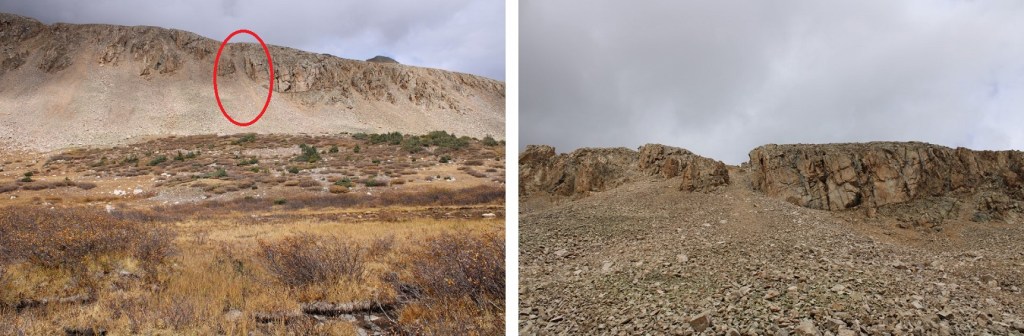
I then headed northeast and crossed the basin, heading towards an access gully (alternately, you can lose more elevation, skirt the then re-ascend the ramp, but I wanted a more direct route. 

Here’s a closer look at that gully. It was as 2+ gully, but wasn’t technical at all.

At the top of the gully I turned left and headed towards the saddle, then took the ridge to the summit (all class 2)

Here’s looking back at the way I took down and across the basin from 13015

The ridge was rocky, but easy to follow.  I tried to stay where the rocks met the tundra.

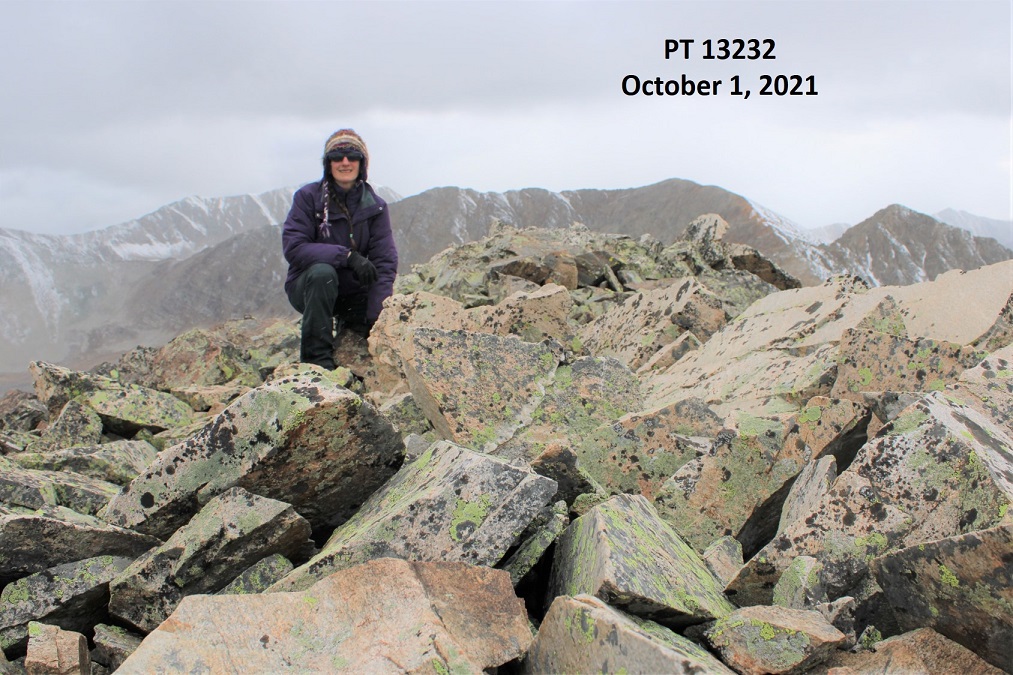
I summited PT 13232 at 2:45pm.  It was now snowing, but it was a nice, gentle snow.

PT 13232:

I could see the trailhead from the summit to the northeast: now I just needed to get there.  I descended the ridge to the northeast. Not far, just a few yards, found a scree filled gully, and took that to tundra.  I then aimed northeast towards North Fork Lake Creek, until I found the trail and followed it back to the trailhead.

Sorry for the foggy pictures here: I was in the clouds and it was snowing much of the day.  The trailhead is circled in red

I descended to the north, and round a gully to take down heading southeast, and turned left at the tundra

I then headed northeast towards North Fork Lake Creek

For reference, here’s looking up the gully I took down from PT 13232

Once on the trail I followed it back to the trailhead. 

I made it back to y truck at 4:30pm, making this a 13.75 mile hike with 5322’ of elevation gain I 11 hours. 

On to the next trailhead!
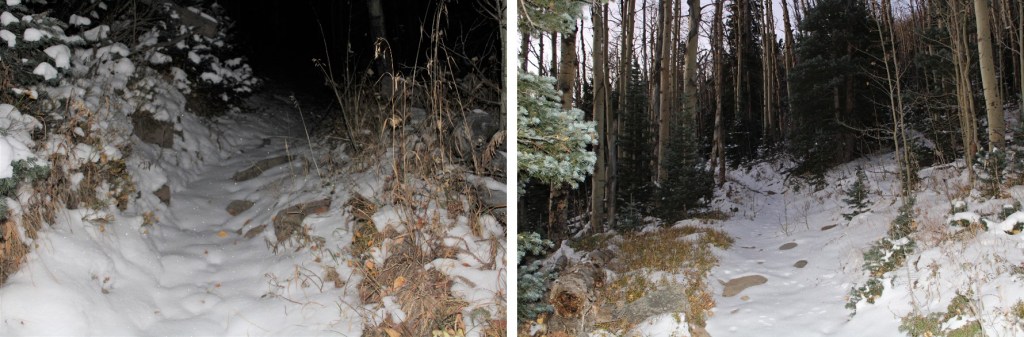
Also, it’s fall

Pear Peak – 13,462, PT 13220, PT 13513

RT Length: 11.89 miles

Elevation Gain: 3995’

I’m not a fan of the Rockdale Trailhead. It’s an adventure in itself, starting with a drive through Clear Creek

And then the road to get to the trailhead is littered with dips and rocks. I feel I’m a pretty good driver on 4WD roads, but I have a hard time avoiding some of the obstacles on this one.  If you drive to the upper trailhead be sure of your driving skills/vehicle.

I made it to the trailhead and was on the trail at 5:30am. The trail is class 1, and starts out by heading south along trail 1461.

After hiking for less than half a mile I came to the avalanche area. Last time I was here was recently after the avalanche, and it was difficult to navigate.  They did a lot of work in this area, and now you can drive a car through it (if vehicles were allowed, that is).  I passed around the gate, and continued along the trail.

Just before making it to Clohsey Lake there’s a junction in the road and it becomes a trail.  You can take this, or continue taking the road to the lake and pick up the trail on the other side. I chose to take the trail up and over the small mountain

I followed this trail south for 3 miles from where I parked, through pine trees, willows, across streams, and eventually to treeline.

After about 3 miles the trail kind of disappeared/fizzled out.  Last time I was here I found cairns to take me to the ridge, but this time I didn’t see any.  No worries though, I just kept rounding the hillside, heading northeast towards the ridge. You’ll want to just head towards the ridge, but easier terrain is to your left (northeast).

It was 3.75 miles to the ridge.  Once on the ridge I turned right and followed the ridge south.  I could mainly stay on the top of the ridge, dipping to the left a few times when necessary.  I was headed towards the black arrow.

To continue to follow the ridge I had to make it around this point. I aimed for just below the large boulder, then went left, following dirt and scree and hugging the mountainside.

This part was easy, but as I rounded the corner, I came upon gullies full of choss. This area felt class 4.  To navigate these, I hugged the gullies, dipping down to cross the first big one, and then remaining level before eventually finding what looked like a game trail to the ridge.

Here’s the view and my route from the first big gully. I stayed level to get across the chossy gullies. It’s harder/steeper than it looks.

Safely across the first gully, here’s looking back at the route I took down

Now I continued at level elevation heading south, until I found an obvious route to the ridge.  Until this time the ridge had been rock slabs, spires, and choss, but once it became rocks and tundra I headed up, then turned left to follow the ridge.

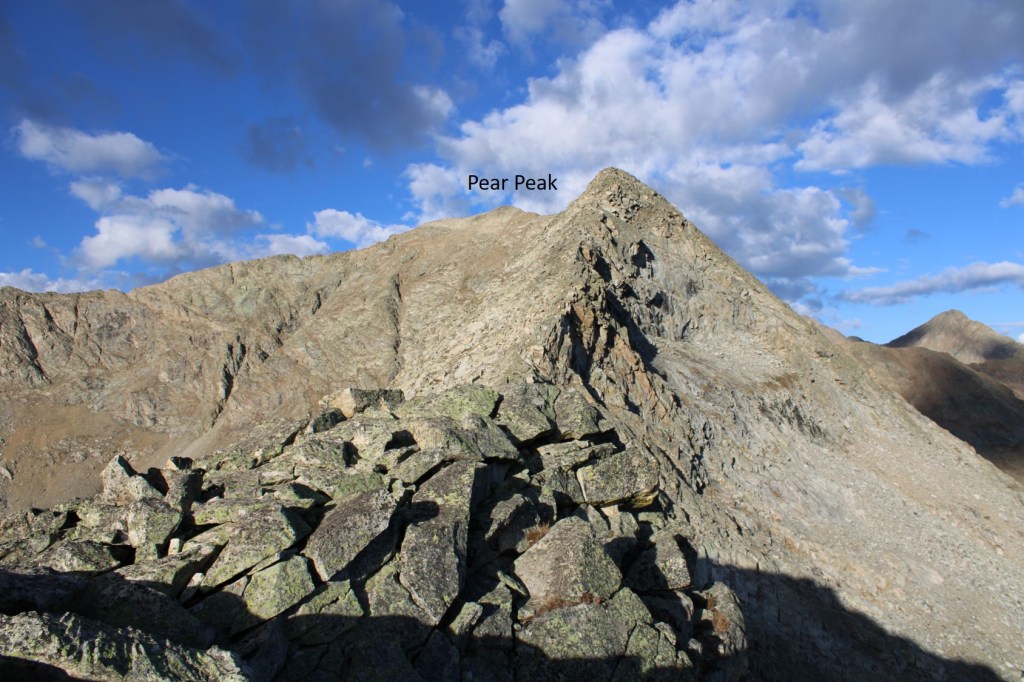
From this point on, the ridge ‘goes’.  It’s mostly on large, solid rock, but remember, these rocks can move. It’s about three quarters of a mile from here to the summit of Pear Peak.  The ridge felt consistent class 2-3. I didn’t feel there were any class 4 moves on this ridge.

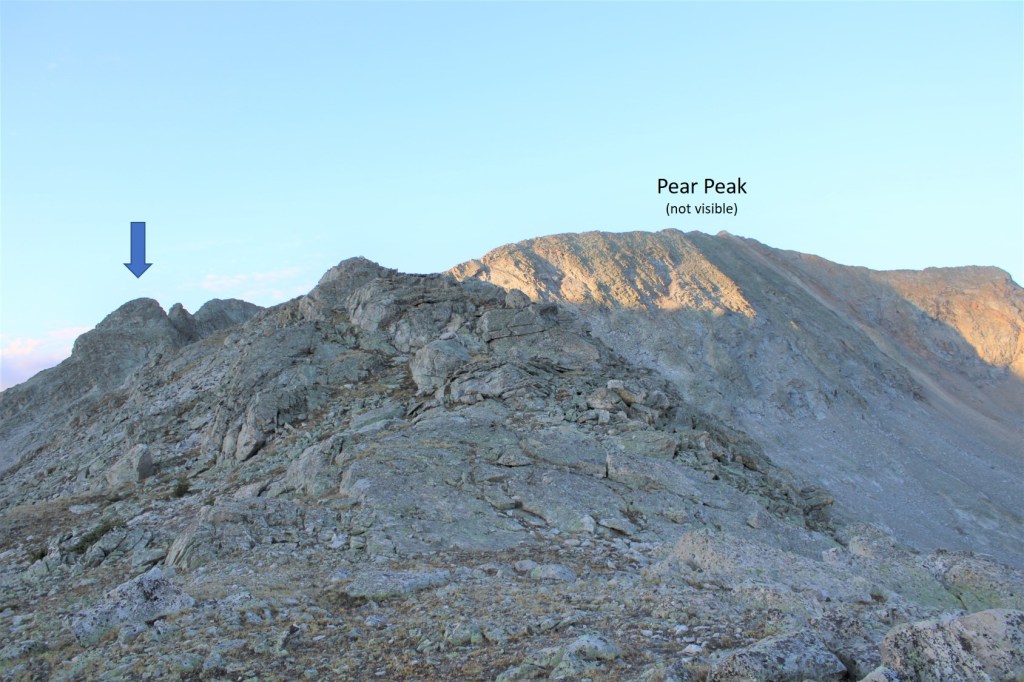
If I ever felt the need to dip off the ridge, I went left.  Pear Peak is actually to the left, past the false summit (which isn’t really a false summit because you can see the true summit most of the time)

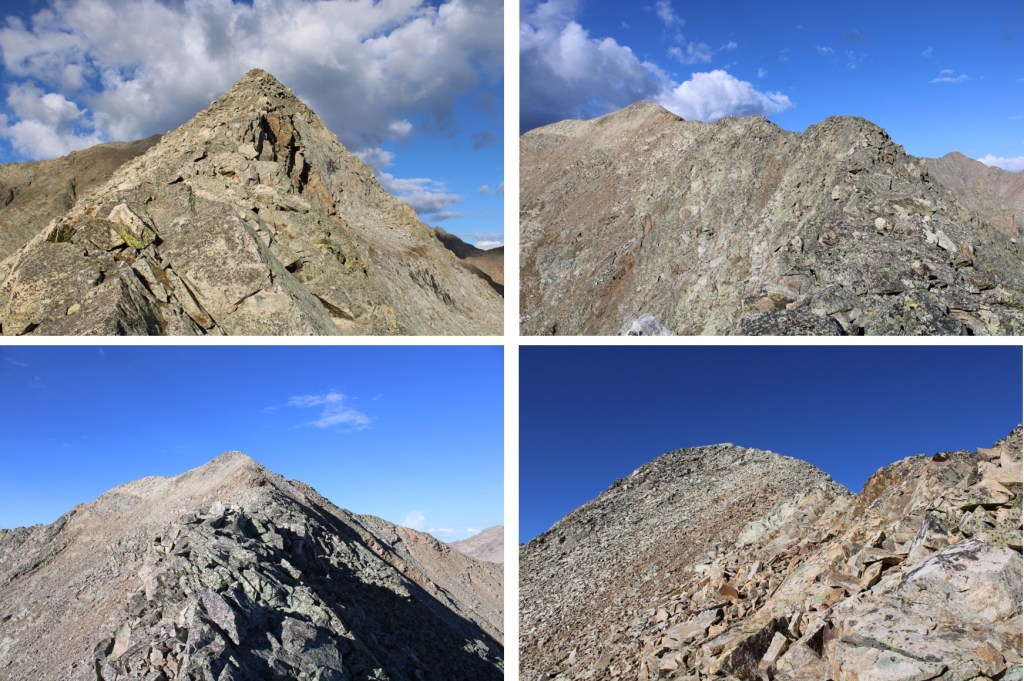
Here are some more ridge pictures

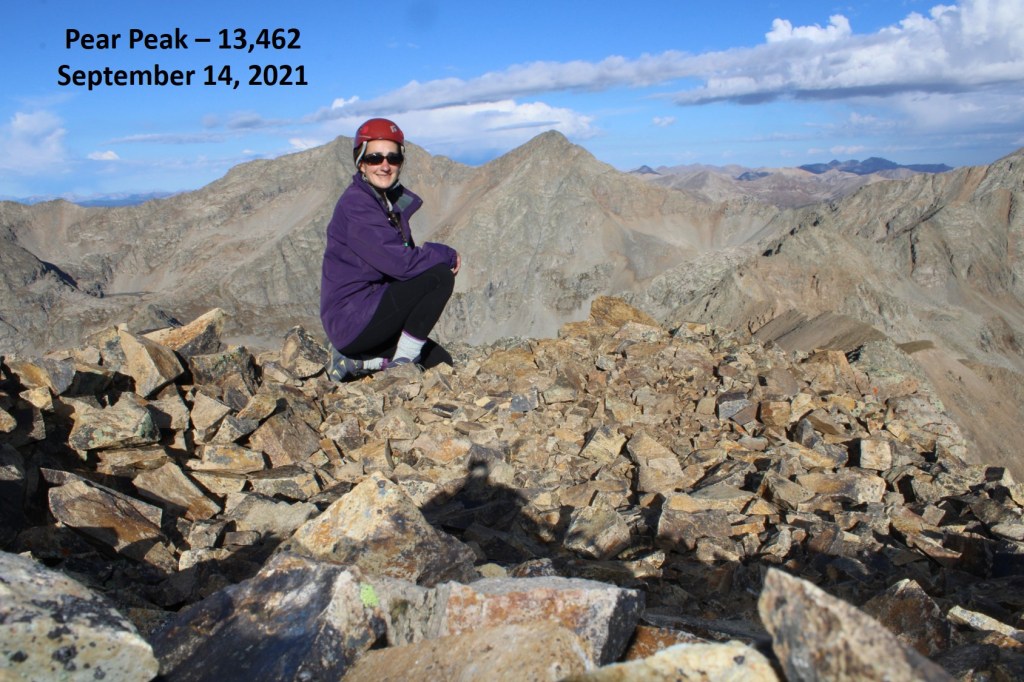
I summited Pear Peak at 8:45am

Pear Peak:

Now the easy part, as I turned northwest and descended the ridge to the Pear Peak/PT 13220 saddle.  This was class 2, once again sticking to the ridge and dipping to the left when necessary.

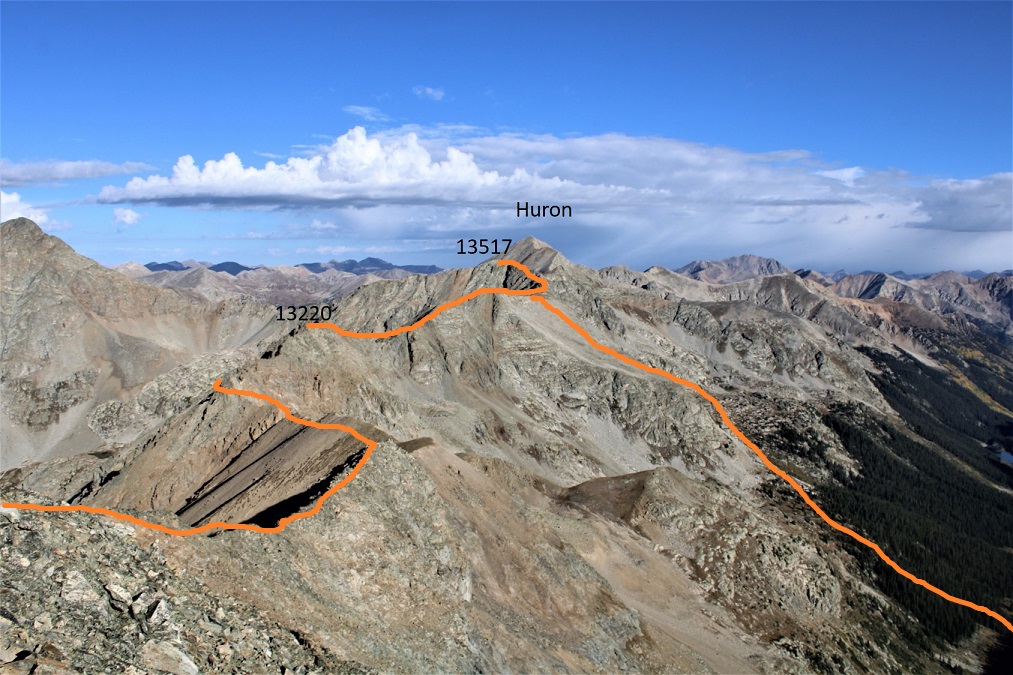
Here’s an overview of the rest of my route, mostly following the ridge, except for a short area on the way to 13220 where I stayed left (more on this later).  You also have a good view of the decent route from here. Now’s a good time to study it.

Ok, down the ridge to the Pear Peak/PT 13220 saddle.  It’s all class 2, and you’re aiming for a scree filled gully, circled in red

Once you make it to the gully, the choss and adventure begins.

I dipped down into the gully, crossed it, and then stayed level in elevation as I rounded the south side of the peak, aiming for two protruding rocks.

Once I started heading north, I followed game trails up gullies and back to the ridge.  This area seemed to go on forever.  

Once on the ridge it was class 3 to the summit

I summited PT 13220 at 10am

PT 13220: 

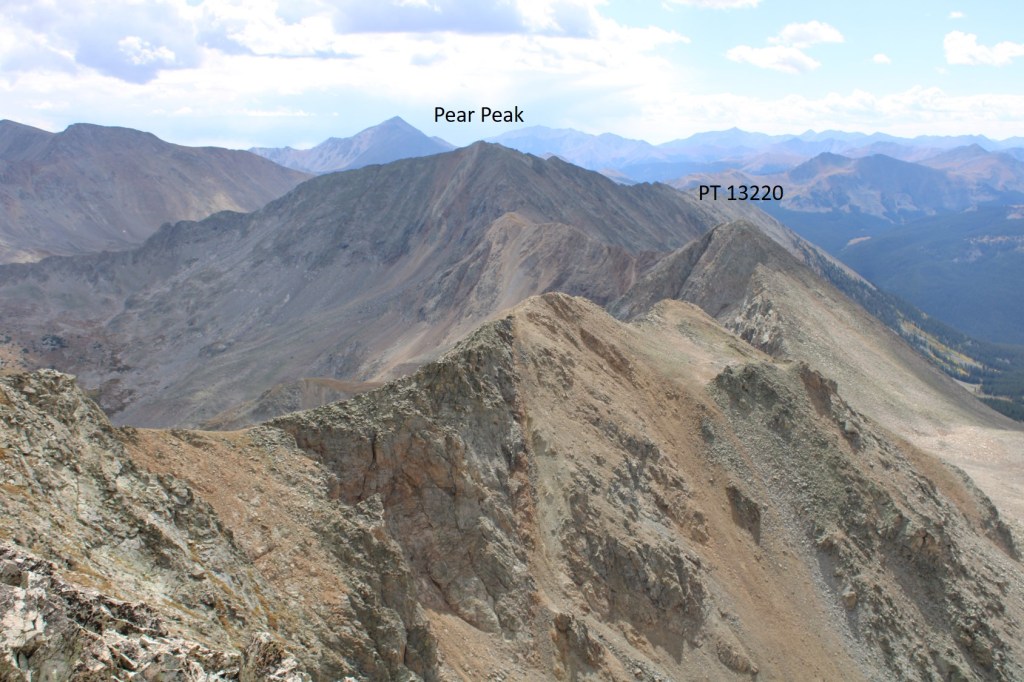
Here’s looking back at the route from Pear to PT 13220.  It was 1.5 miles from Pear to 13220.

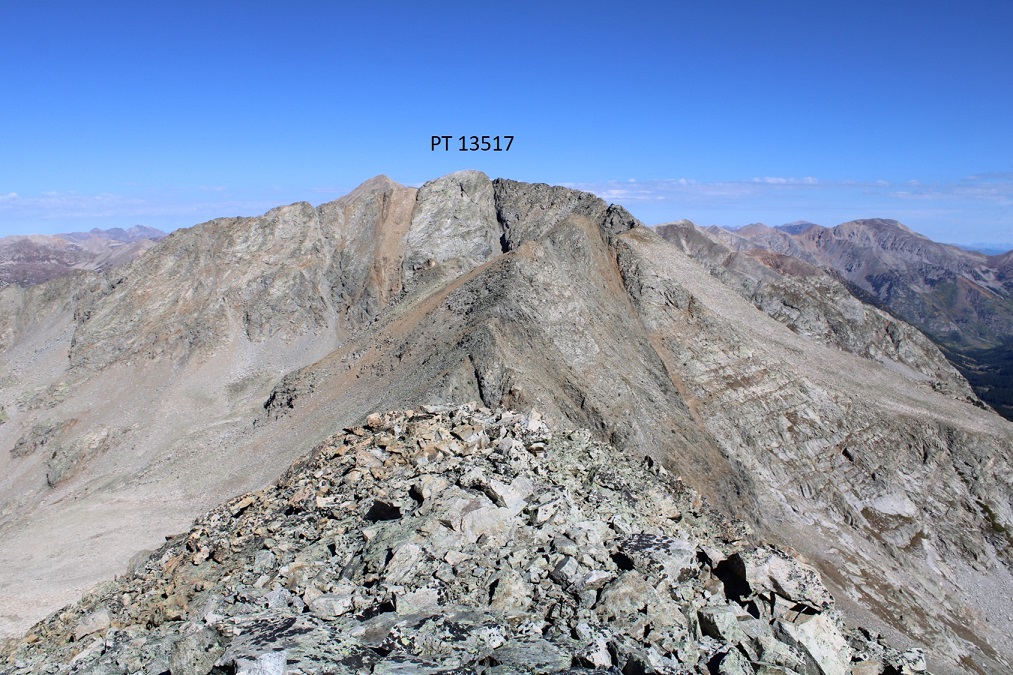
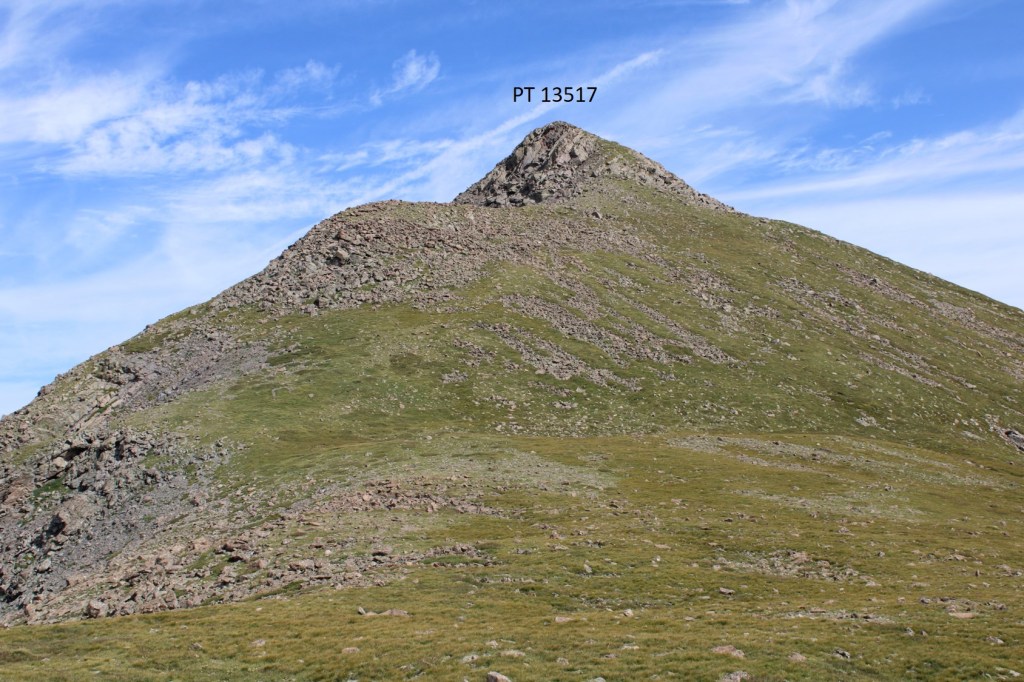
Next up, PT 13517 (more ridge work!)

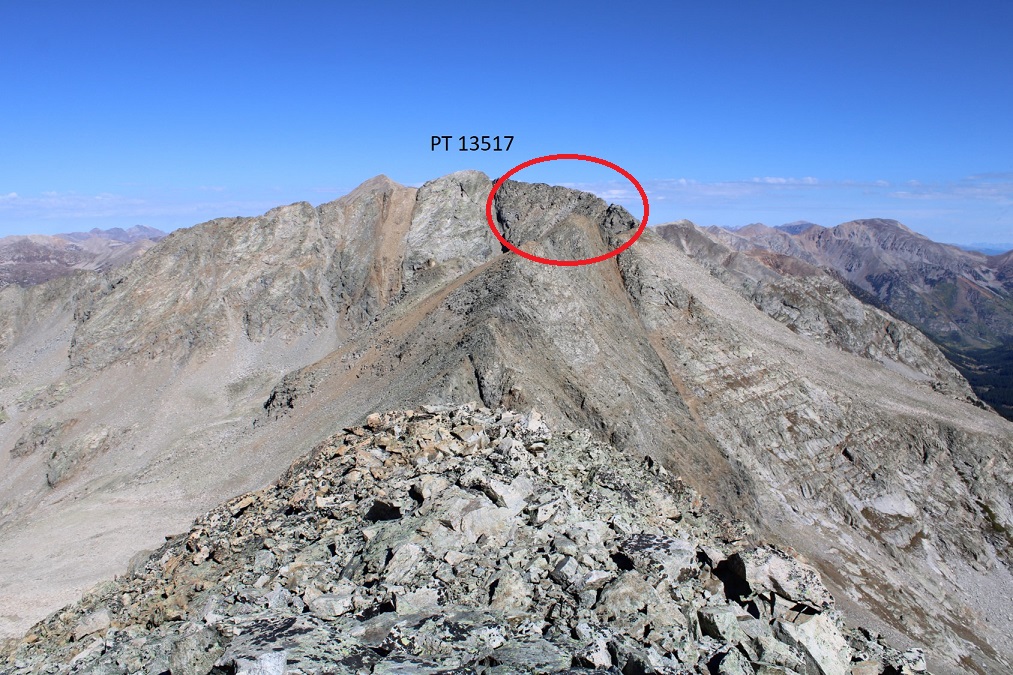
I followed the ridge the entire time.  The ridge to the saddle was class 2.  The difficult part is the ridge circled in red, which I felt was consistent class 3, with a bunch of class 4 moves thrown in.

The trek to the saddle was mostly on rocks, with a short ridge at the end (yes, you can stick to this ridge too)

I entered the final ridge by going around to the east, then ascending the ridge by heading northeast.

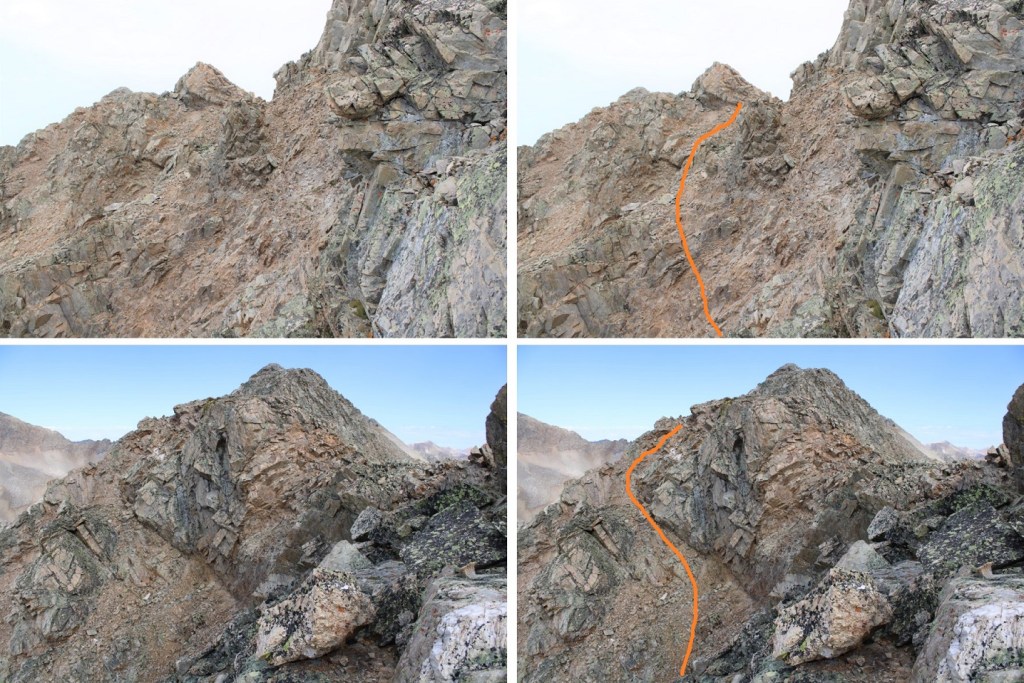
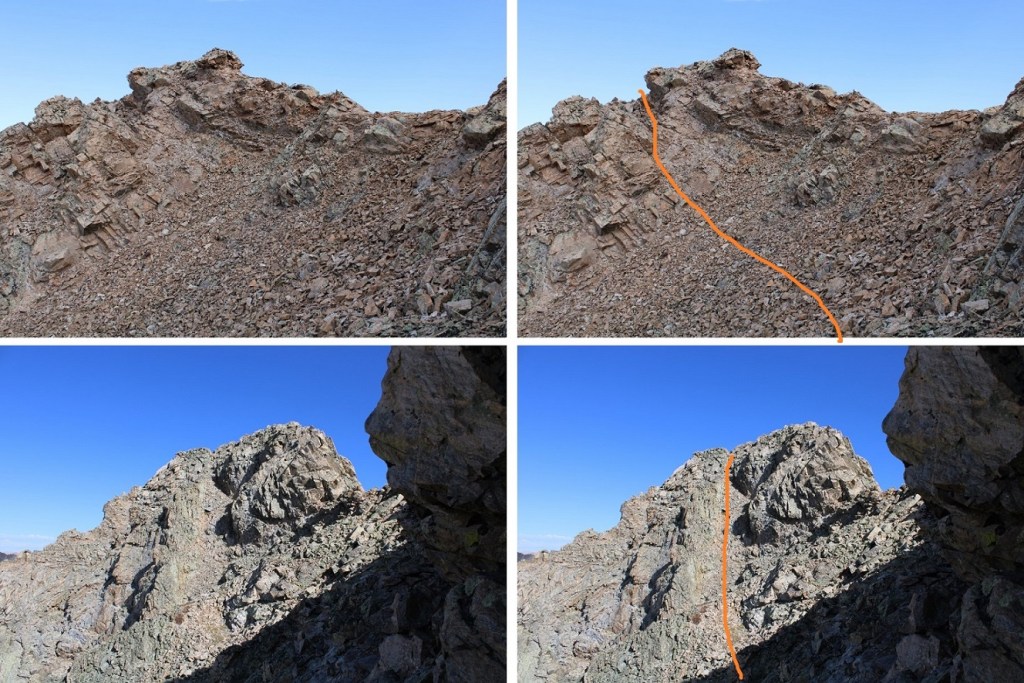
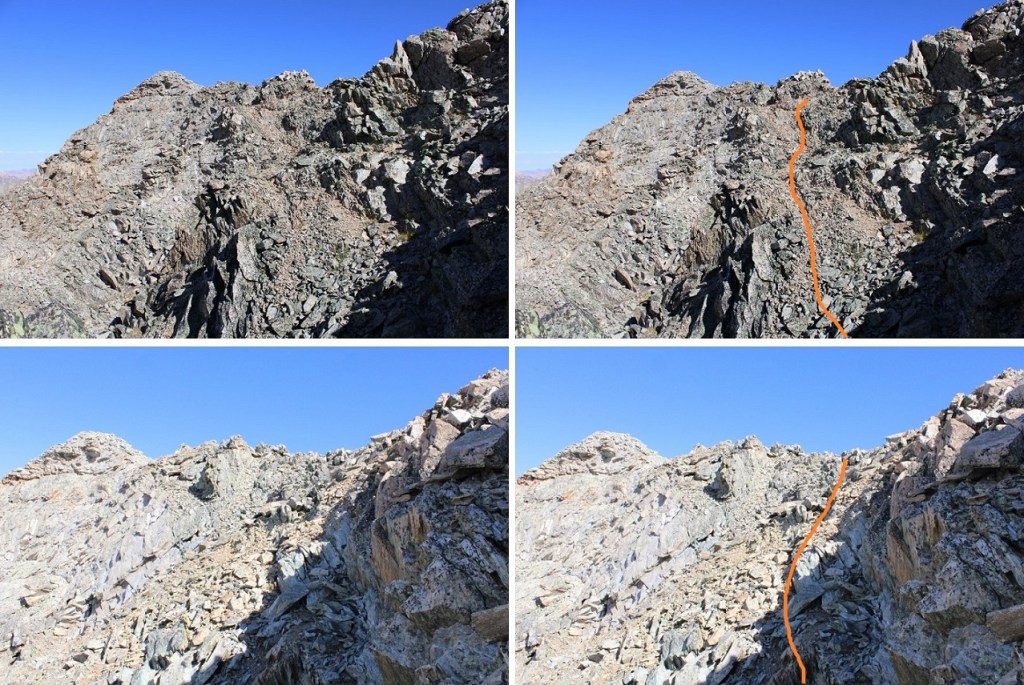
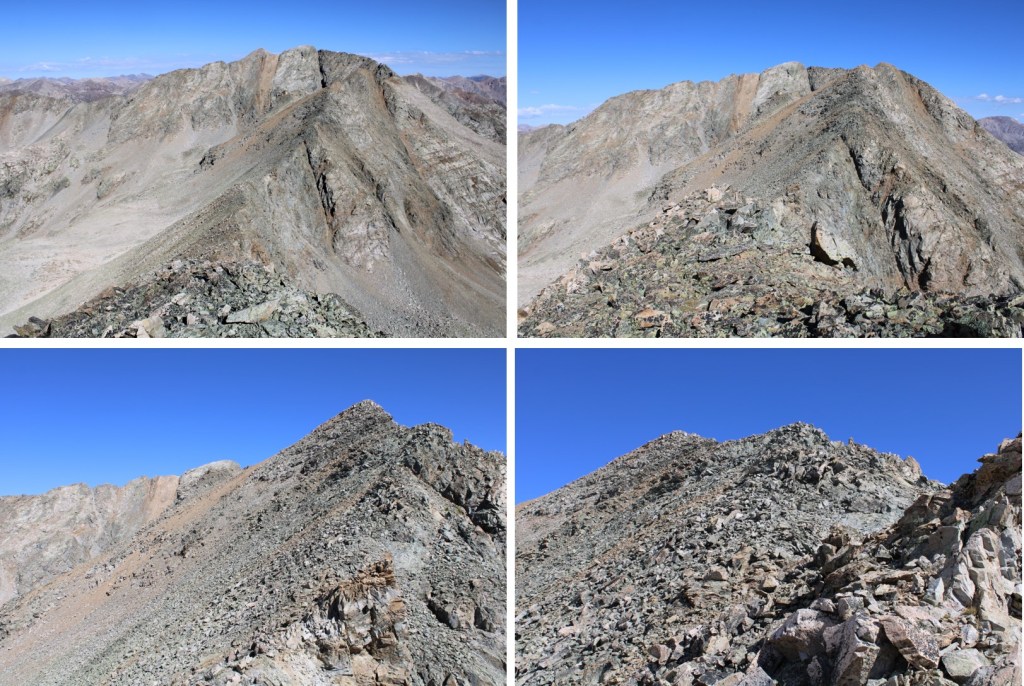
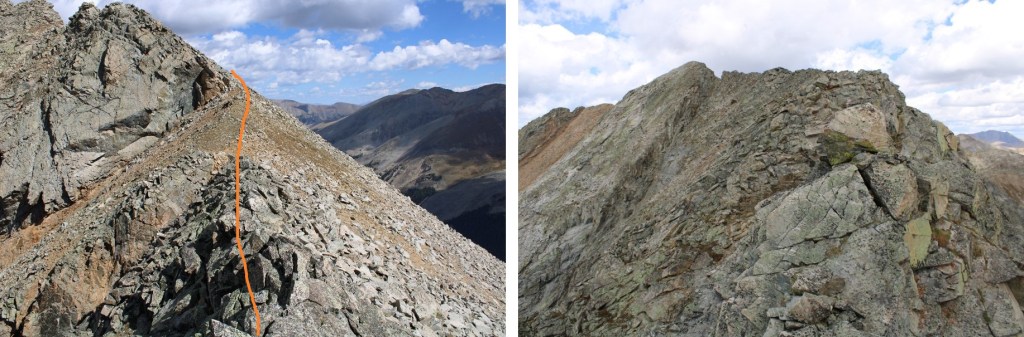
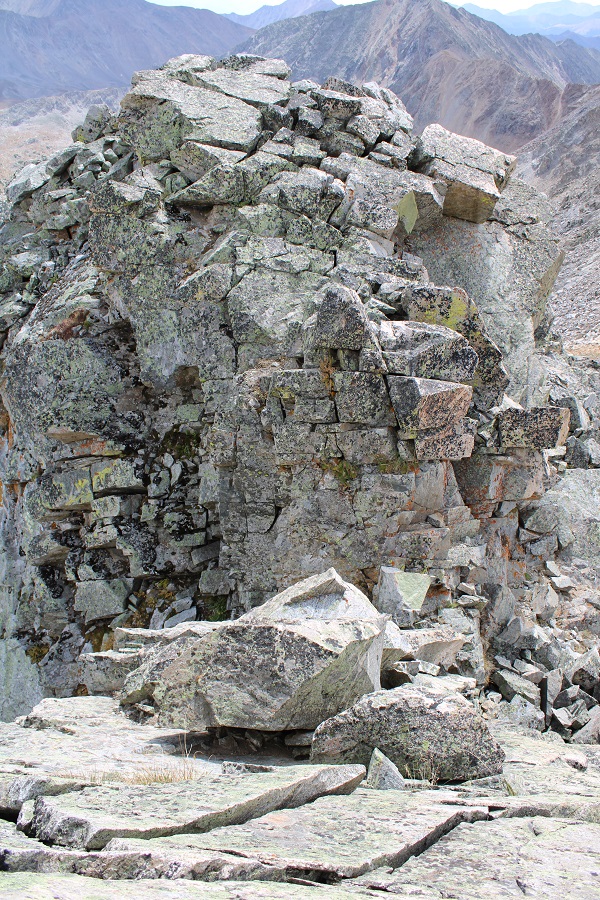
As I said before, this is a class 3 and 4 ridge.  There are too many specific moves to illustrate here, as the climbing is consistent, so I’ll just show a few of the fun ones. While the rock looks solid, and mostly is, please be careful of the ones that look solid but roll. If you can’t go straight up the rocks, look for game trails to the left.  Nothing should feel over class 4.  To put it in perspective, I consider difficult class 4 anytime I need to remove my DSLR camera from around my neck, or put my trekking pole away to climb.  I didn’t have to do either of those things on this ridge, but it was the most difficult climbing of the day.

The last little dip before the final push to the summit was class 2

I summited PT 13517 at 11:15am

PT 13517: 

PT 13517 was a little over a mile away from PT 13220. Here’s looking back at PT 13220 and Pear Peak

I turned and retraced my steps back to the saddle. 

Here’s the other side of that initial class 4 move

Back at the saddle, I headed east, and took the gully to the left down

The gully had scree, tundra, and bounders.  I was easily able to find a way down this gully, but it looked challenging to find a good way to go up. I was glad I chose to do Pear first.

Here’s my overall route down the gully, across the small basin (I stayed high here) and back down to the trail.  I followed a waterfall northeast, keeping the waterfall to my left to exit so I wouldn’t need to cross the water. This brought me to willows and the trail I’d used to hike in.

The hike out was uneventful, except it rained.  I know it looks like it was a beautiful day, but in reality, just before PT 13220 it was snowing, and it rained/hailed/graupeled a bit on my way down. There were also people fishing at Clohsey Lake who had a few dogs. I was about 100 yards from them, but their dog wouldn’t stop barking at me.  I’m sure that made for wonderful fishing.

I made it back to my truck at 1:45pm, making this a 11.89 mile hike/scramble with 3995’ of elevation gain in 8 hours, 15 minutes.  And now, for the fun drive out!

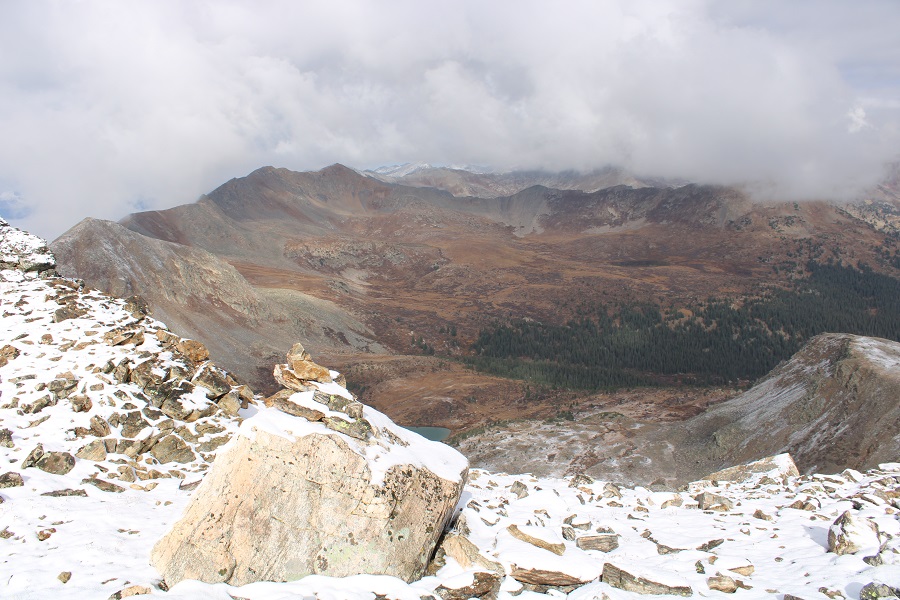
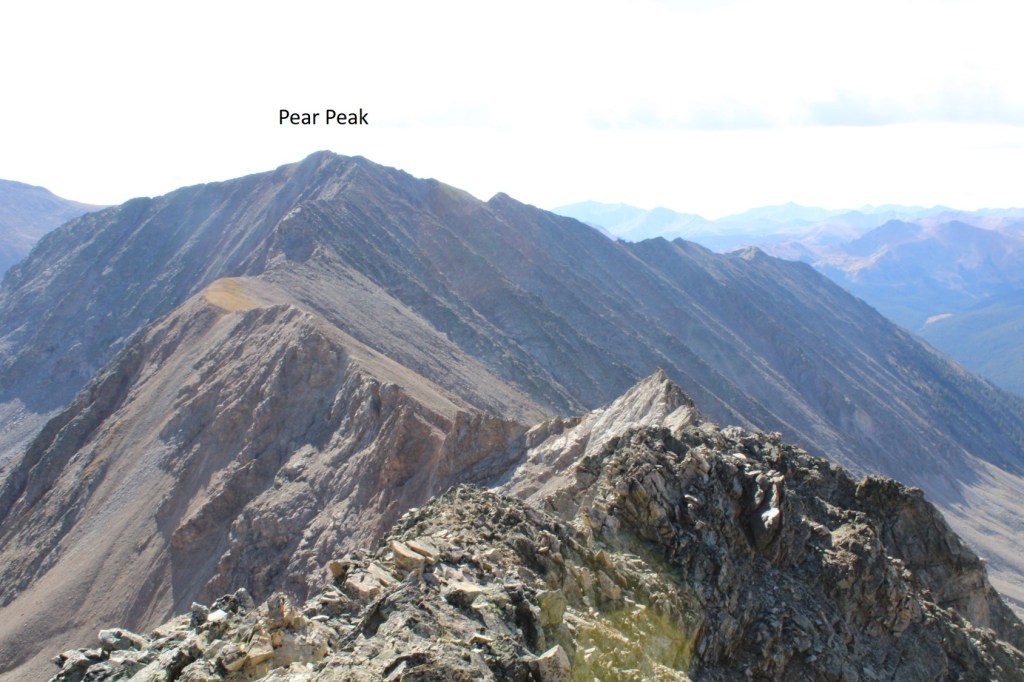
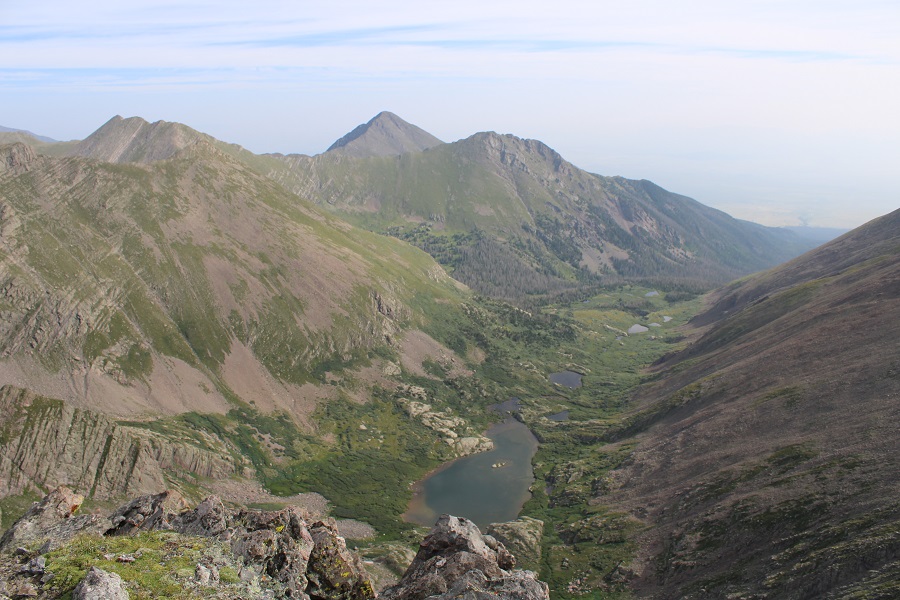
Here’s a view of Clohsey Lake and the basin from Pear Peak

Monitor Peak – 13,707 and Animas Mountain – 13,789

RT Length: 45.07 miles

Elevation Gain: 12,724’

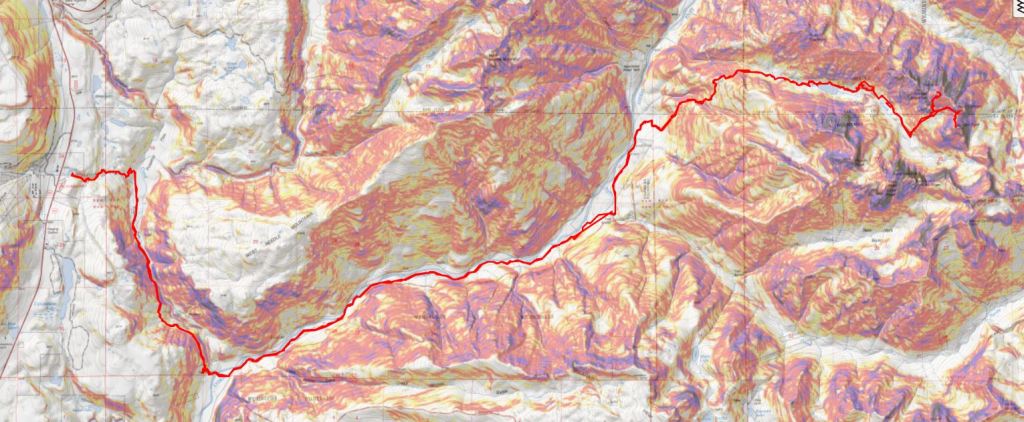
I started this hike from Purgatory Creek Trailhead.  I’ve put together a route description of the trek from Purgatory to Ruby Basin, which can be found here.

For my first day in, I decided to camp at the Ruby Basin junction. I started at 3pm and made it to my camping spot at 6:45pm.  I made it to the train tracks just as a train was approaching, to which a passenger pointed at me and said “Hey look:  Wildlife!” and everyone got out their cameras and waved at me.  I smiled and waved back.  I gathered some acorns to snack on as I hiked (just before the railroad tracks there are tons of scrub oak, and the acorns are now in season). 

I was so glad it didn’t rain!  I think this is the first time I’ve done this approach where it hasn’t rained. As I got closer to my camping spot, I came across two girls camping there already. I chatted with them for a minute: they were headed to Ruby Basin too, to hike Turret.  I wished them well and picked a spot closer to the Ruby Basin junction to set up for the night.  I dried out my clothes as best I could, ate some popcorn, and went to bed.

It was a warm but windy night.   I was up early, and spent a good half hour just stargazing.  Eventually I got up and was on the trail at 5:45am, headed to Ruby Lake.  I made it to the lake just before 9am.  Today I was taking my time, so I sat by the lake for a bit, filtered water, and watched the trout swim by the shore, every once in a while snagging a fly for breakfast.  

My only goal today was to make it to Ruby Basin.  I knew it wouldn’t take long, but I wanted to hike in the cool of the morning, instead of the heat of the day.  Here’s looking back at Ruby Lake from just before making it to the basin

I made it to Ruby Basin, in all its willow filled splendor, at 10:45am.  For those doing the math, it took me less than 5 hours to hike from the Ruby Basin cutoff to Ruby Basin, and I took my time. 

There was a tent set up in the far side of the basin (east), but I didn’t see anyone camping there. Basically, I had the basin to myself.  I strapped on my creek crossing shoes and took a walk in the creek(s).  They were running at a trickle.

I relaxed for the next few hours, drying out, enjoying the sunshine, and going over my notes for my day tomorrow. This was my second attempt at these peaks. It hurt to turn around last time, but I had bad beta (and not enough beta, as I had other goals in mind and these peaks had been secondary).  I’d been up in my head that entire weekend, and in the end turned around much sooner than I should have. I went home, got better beta, and was now back to attempt these peaks again. Around 2pm I saw the girls I’d met the night before enter the basin, and to my surprise, they headed directly up Turret.  Rock on ladies!

Also, there were bees and crickets. Crickets everywhere!  They jumped around my ankles as I walked through the basin, munched on my journal and hopped onto my gear. I ate dinner and went to bed as the sun was going down (it goes down over Turret early this time of year).

Once again, I got up before my alarm, and spent some time stargazing.  I saw several shooting stars, and a few airplanes coasting across the night sky. There was no moon, but I could see the stars clearly. I made out a few constellations, and noted the frost on the outside of my bivy. I wanted to start at first light, but ended up starting a little earlier, around 6am.  These are the peaks I was attempting today

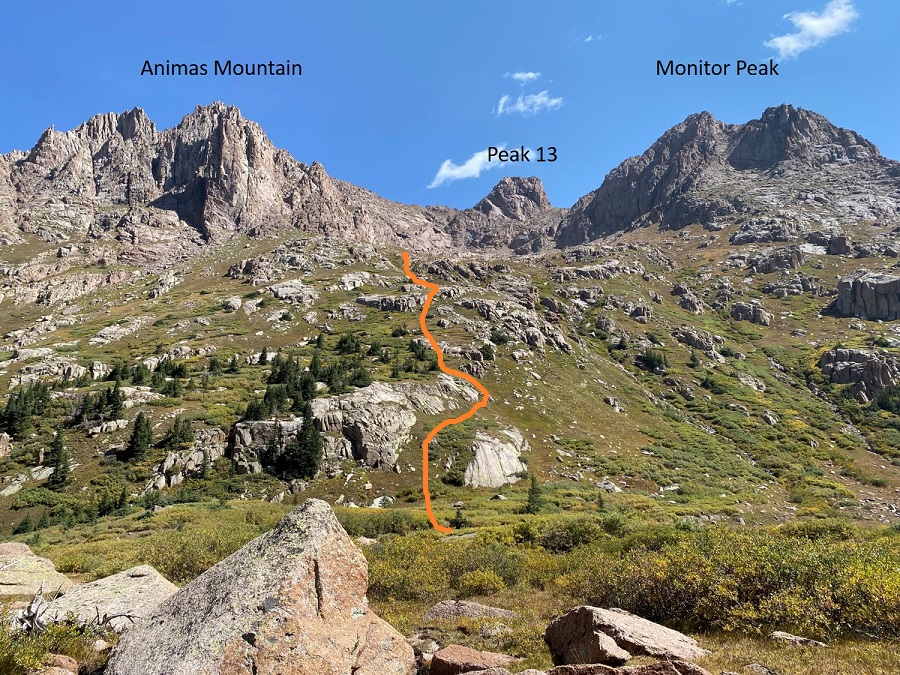
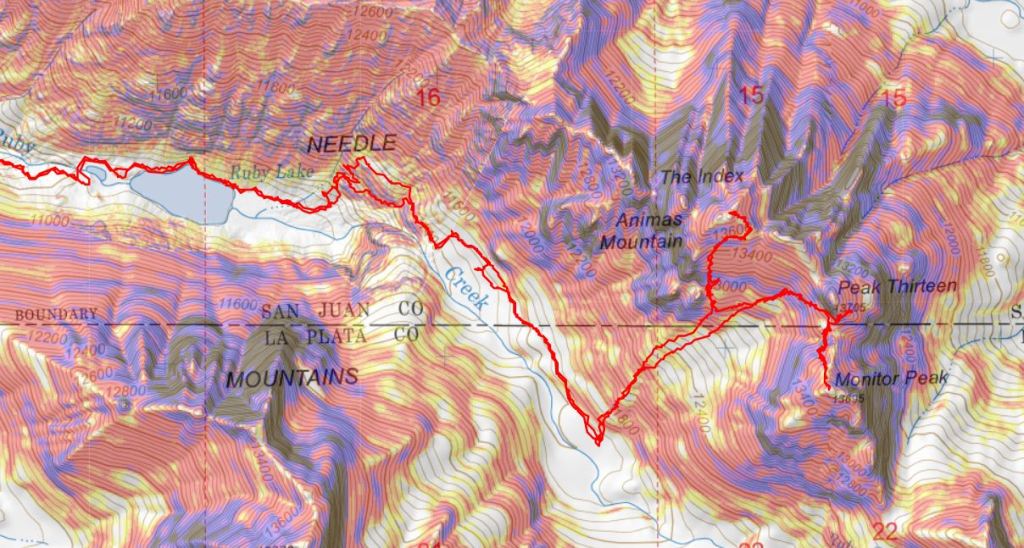
Here’s an overview of the route from Ruby Basin to the upper basin below Animas, Peak 13, and Monitor.  After about 20 feet of willows, I was able to stay on tundra the entire time. This is choose your own adventure, but it’s easy to find a class 2 route into the upper basin. I just kept aiming towards Peak 13.

Here’s a look at the upper basin.

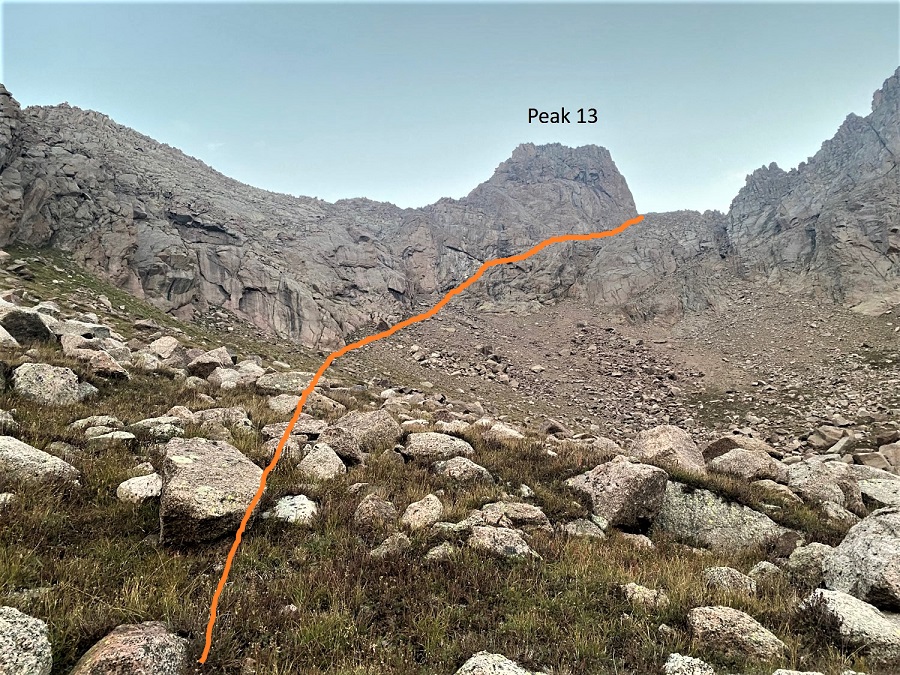
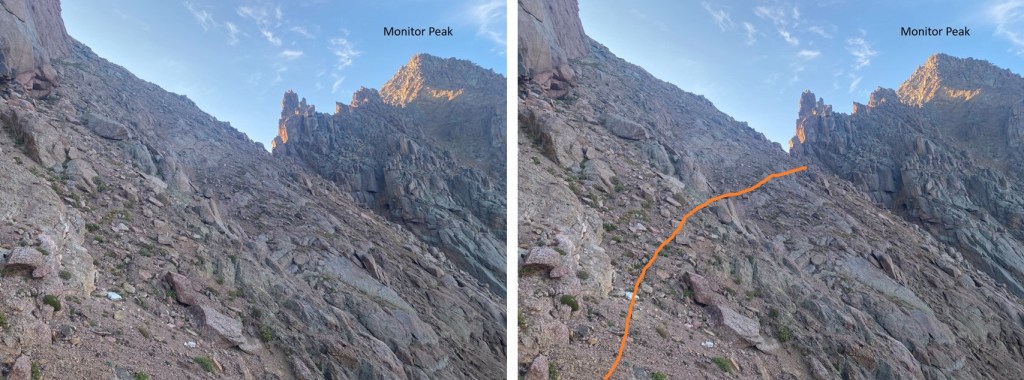
I was headed towards Monitor Peak first. There are several ways to do this.  This time I took what I consider to be the ‘easy’ approach.  Directly below Peak 13 there are two ramps you can ascend. I chose the further one, as it was less steep. I followed the basin northeast, towards an obvious ramp. It’s just below a section of a white and black streaked slab.

Here are some closer pictures. There are two ramps here, an upper ramp and a lower ramp. Both go, but the upper ramp is less steep, and all class 2 in my opinion.

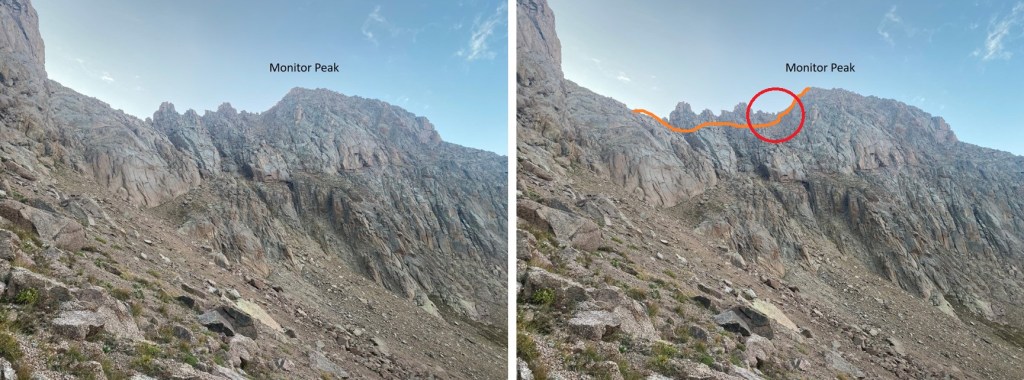
Also, while you’re here, look to your right.  Find this gully (circled in red). It’s the gully you will be aiming for when ascending the ridge (ascending to the ridge before this point is fruitless). Here’s an overall view of the climb to Monitor from the Peak 13/Monitor saddle. You’ll know you’re in the right gully because there’s a white vein of rock going through it (more on this later, but from this spot you can clearly see the white vein, so it’s a good time to get a visual of where you’re aiming).

But first, let’s get to the saddle, by going up that ramp.  As you can see, it’s wide, and easy to navigate.

The top of the ramp deposited me at the Peak 13/Monitor saddle.   Well, actually, I didn’t need to go all the way to the saddle.  I skirted the saddle and continued south across scree, following the ridge.

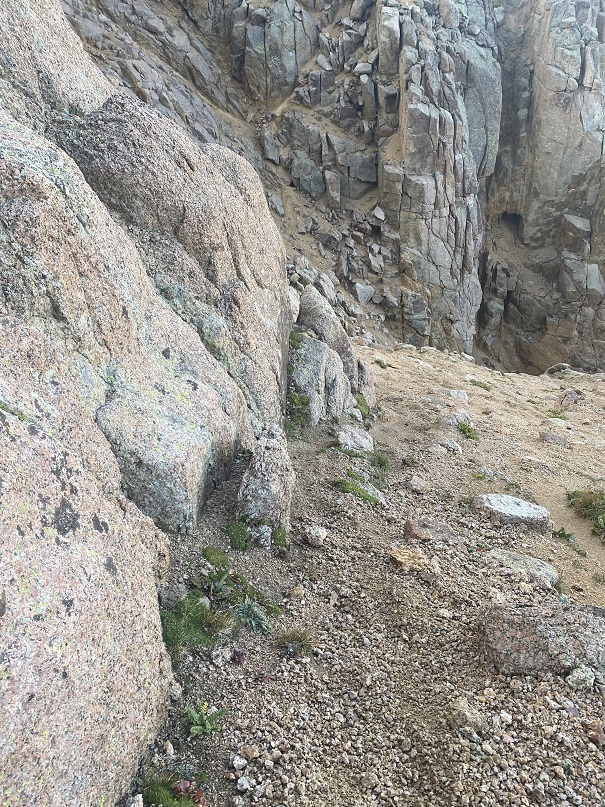
Now for the gullies. There are several of them, and in order to cross the first one I had to descend about 100 feet down, then re-ascend. Before doing that however, I got a good look at my route.  This looks harder than it is.  Here’s the route I took after re-ascending the gully.

But first, I had to descend on kitty-litter scree, and then re-ascend. 

When re-ascending there were a couple of ways I could have gone (all felt class 3). This is the way I chose. 

Get a good look at your intended route from above, as this is what it looks like from below.  Hint: aim for this rock, go behind it, turn right, and follow the areas covered I dirt.

Ok, now to find that gully. Luckily, from here there were cairns, and even a bit of a game trail.  I followed them south, staying well below the ridge

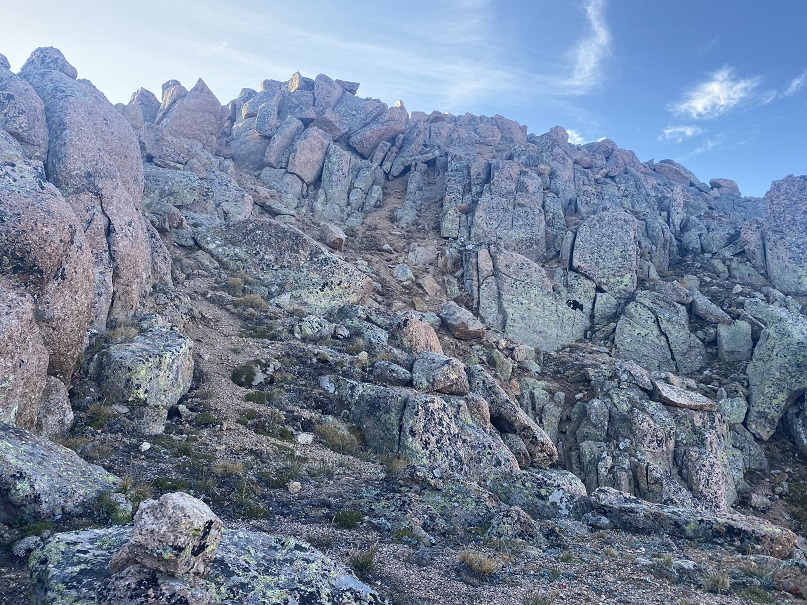
I rounded the corner, and could clearly see the correct gully.  I followed this gully to the ridge

Once on the ridge, I turned right, and followed it to the summit, dipping to the right at the end, but always following a class 2 game trail. 

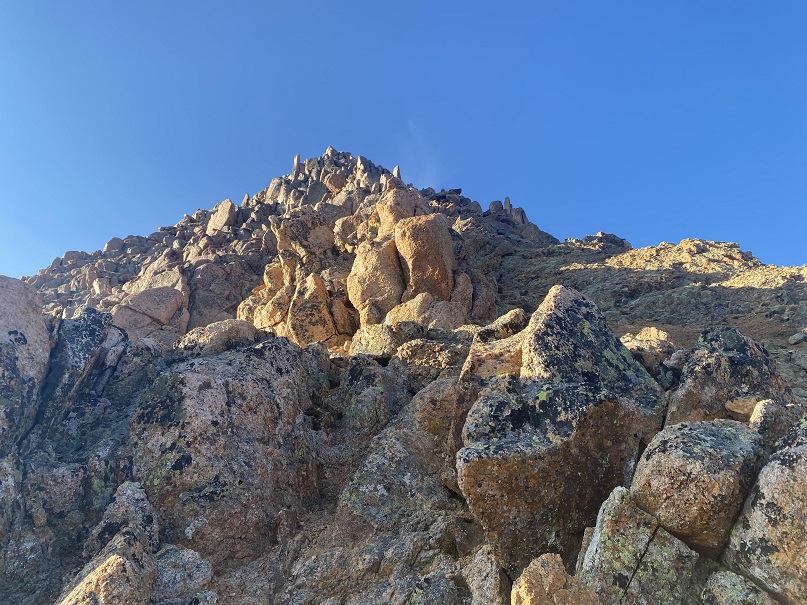
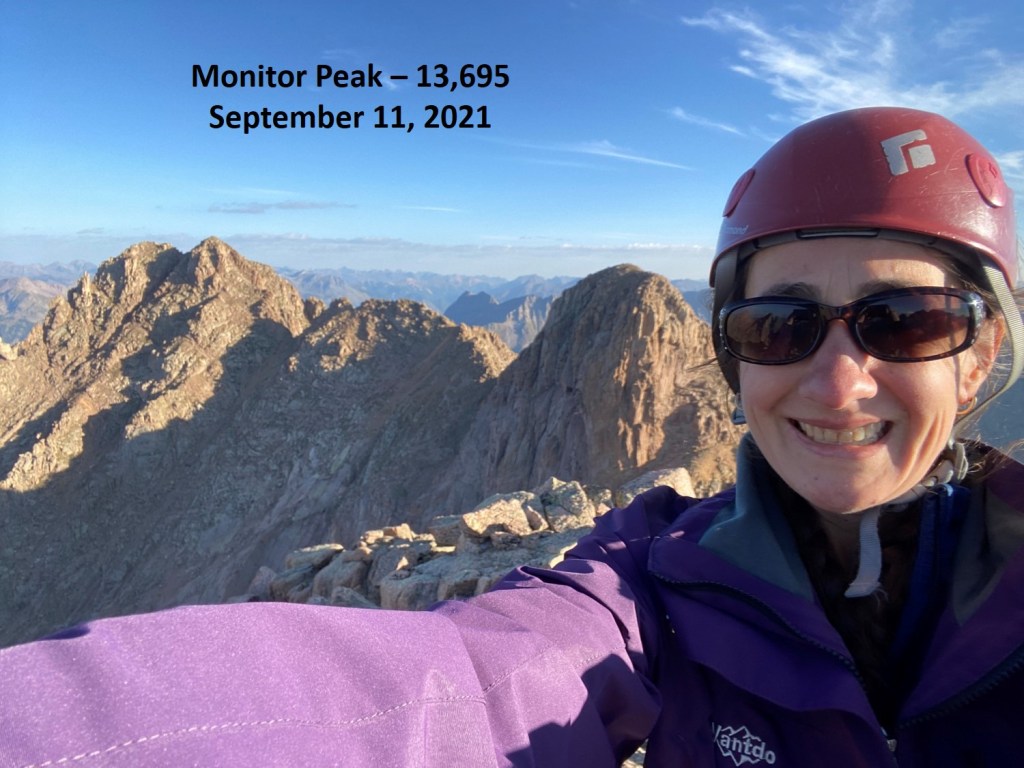
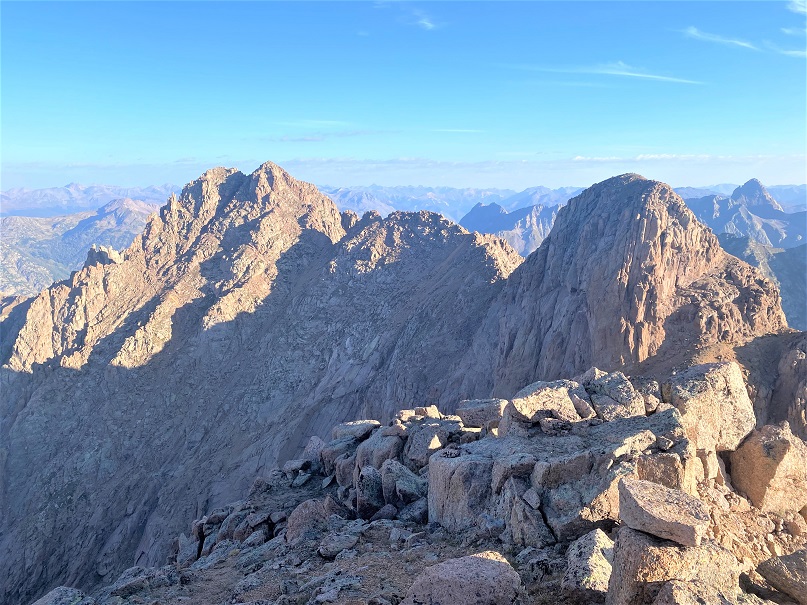
I summited Monitor Peak at 8am.

Monitor Peak:

There was a summit register in need of new paper (but with 2 pencils), and great views! 

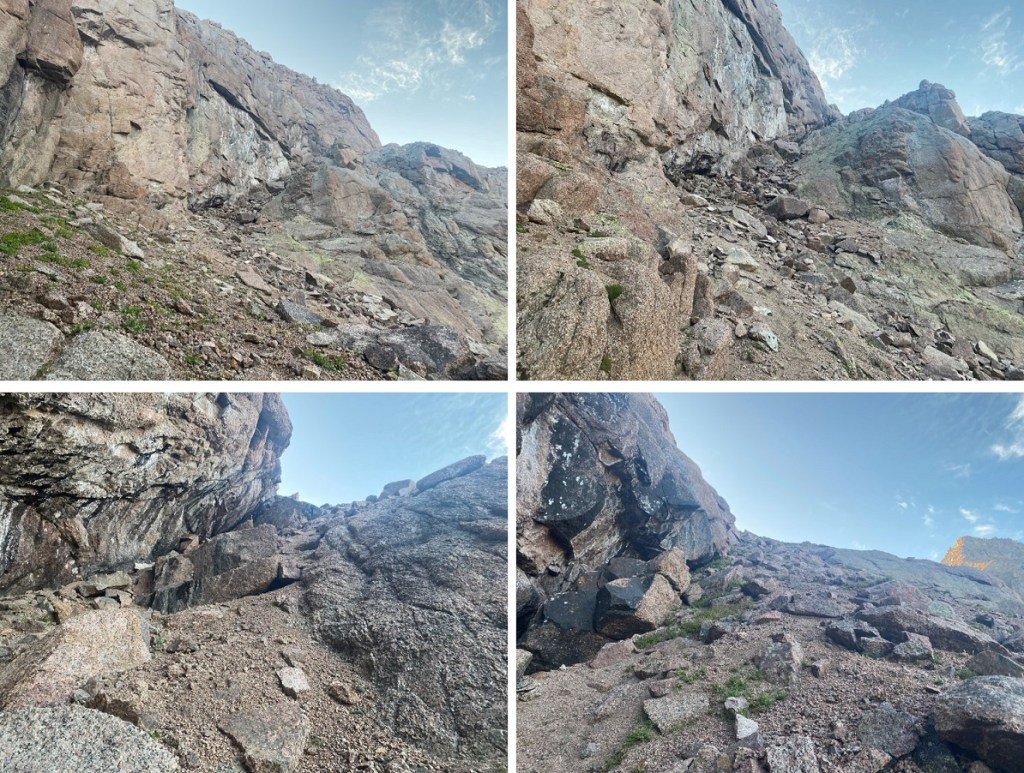
Next on the agenda was Peak 13. Spoiler alert:  I didn’t summit Peak 13. When I got to the area where I was supposed to “just go straight up” I found that while it was class 4, there were no hand/foot holds, and everything I tried to grasp turned to kitty litter in my hands.  Since I hike solo, I have a rule not to upclimb anything I don’t think I can downclimb (if I don’t have rope), and while I could probably have upclimbed this, I wouldn’t have been able to downclimb it, and a fall would be deadly (lots of exposure). In any event, I’ll describe the process of getting there.  Now is also a good time to get a visual of how I climbed Animas Mountain as well. These were my routes:

From the summit of Monitor Peak, I headed back to the Monitor/13 saddle, retracing my steps

Once at the saddle I followed it northeast, to an obvious stopping point. Here I turned to head up, and, like I said before, I deemed it unsafe, so I turned around, tried several other ‘ledges’, and in the end decided to just head back to the upper basin and summit Animas from the gully.  I was very happy with this choice.  Here are pictures of the two possible routes up to Peak 13 I decided not to take

Instead, I descended back into the upper basin by way of the upper ramp.

I followed the contour of the mountain all the way down to 12860’, and the only obvious gully that ‘went’

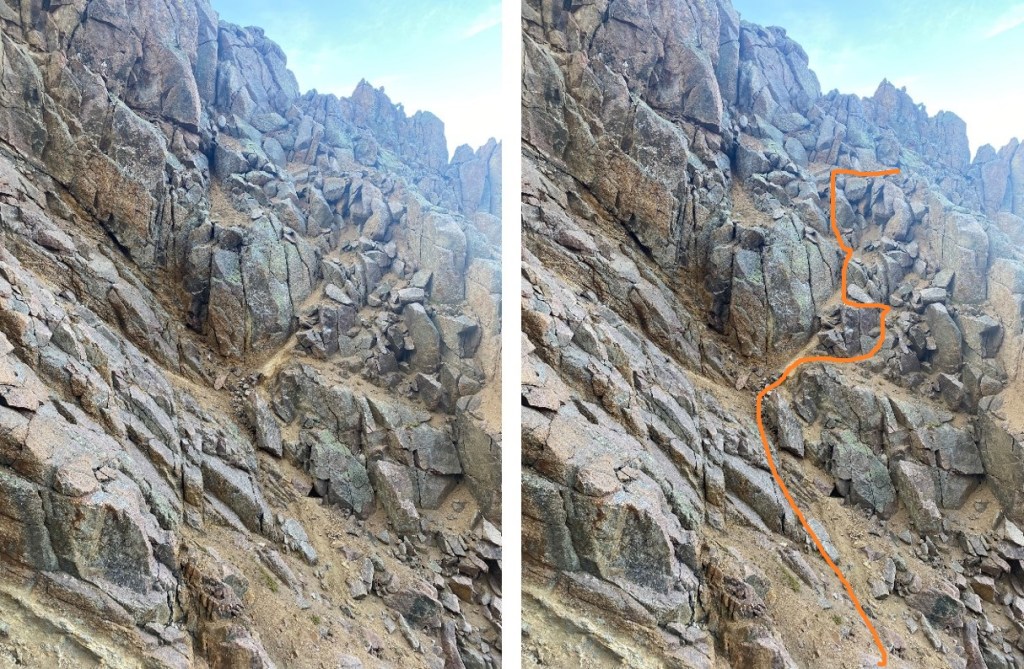
I then followed this gully north.  There are lots of divergences here, but if you keep heading north, they all seem to ‘go’. I just kept the spires to my left and followed the obvious contour of the gully. I as able to keep this all class 3.  If you’re in class 4 territory, back up and look for an easier route.

When I made it to 13580’ I headed east, towards the sandy saddle between Monitor and 13500’

I didn’t go all the way to the saddle however, because I saw cairns leading me up the ridge (class 2).

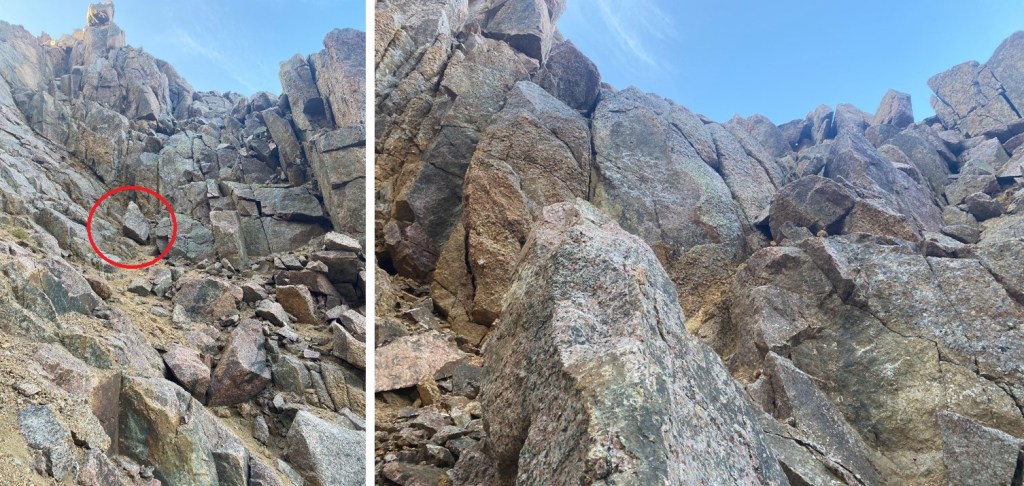
Here’s the overall route to the summit, all well cairned.  The circled area is a brief class 4 chimney section (less than 10 feet or so) that is the only obvious way out of the gully.  When you make it above the chimney you’re about 20 vertical feet from the summit on easy to navigate ledges.

To get up the chimney I jammed my arms into either side and used my forearms to lift myself up. On the way down, I faced the rock and put both hands/arms in the left crack to lower myself down.  You may be asking yourself why I was fine climbing this chimney and not the class 4 section on Peak 13?   It’s because the rock here was firm, and I didn’t have to worry about it crumbling in my hands as I was climbing.  When I made it to the top of the chimney I turned right and followed the cairns to the summit.

I summited Animas Mountain at 10:30am

Animas Mountain:

There was a trail register in dire need of paper.  With no place to sign I put it back and turned and descended the same way I ascended, back to the saddle, and then down the gully. Note, I did not descend the scree filled gully, but instead the rocky one I ascended, this time keeping the rock spires to my right.

Once in the upper basin I headed southwest on the slope, back to my campsite. It helped to stay to the right of the waterfall area, on the tundra. 

I made it back to my campsite in the Ruby Basin at 11:40am.  I ate lunch, packed up my gear, thanked the marmots for not messing with it this time, and headed back through the willows towards Ruby Lake.  It was a really hot day. I stopped at the lake to dip my bandana in the water and cool off my face.  The water felt so good!  As I was skirting the lake and looking at the clear water I couldn’t help but want to jump in.  I did some mental calculations, and before I could stop myself I set all my stuff aside and went into the lake.  I swam around for a few minutes, hopped back out, dried off in the sun (it only took about 30 seconds in the dry Colorado heat) dressed and was back on the trail within 10 minutes.
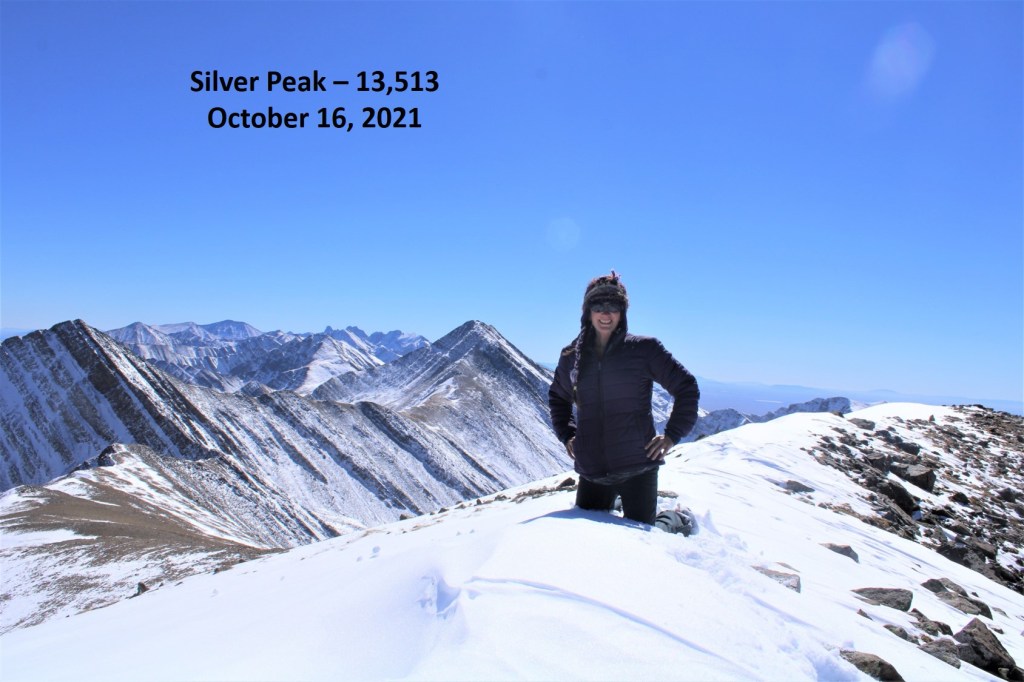
I made it to the Chicago Basin cutoff and decided to once again spend the night. There was a woman in a hammock waiting for her husband, who was running the Chicago Basin 14ers (woot!).  I couldn’t help thinking to myself how I wish I could find a partner who would support me like that (or join me?).   I set up my gear, talked with a man who’d lost his water filter and had a busted eyebrow (he got it crossing the creek?).  I told him where to find the train, and campsites, and made it an early night (again). I woke up before my alarm, and was on the trail at 4am, out and back at the Purgatory trailhead at 8am.  Side note: hiking in the Purgatory Flats area on the way out was by far the coldest part of my weekend.  By this time I’d already taken off my coat and gloves, but had to put them back on because the temperatures were so cold. I’m thinking this isn’t the best place to camp for the night.

CalTopo tells me my stats were 45.07 miles with 12724’ of elevation gain.

PT 13543, PT 13533 & Little Baldy Mountain – 12982

RT Length:  19.45 miles

Elevation Gain: 5950’

Route: Horn Creek Trailhead via Macey Trail

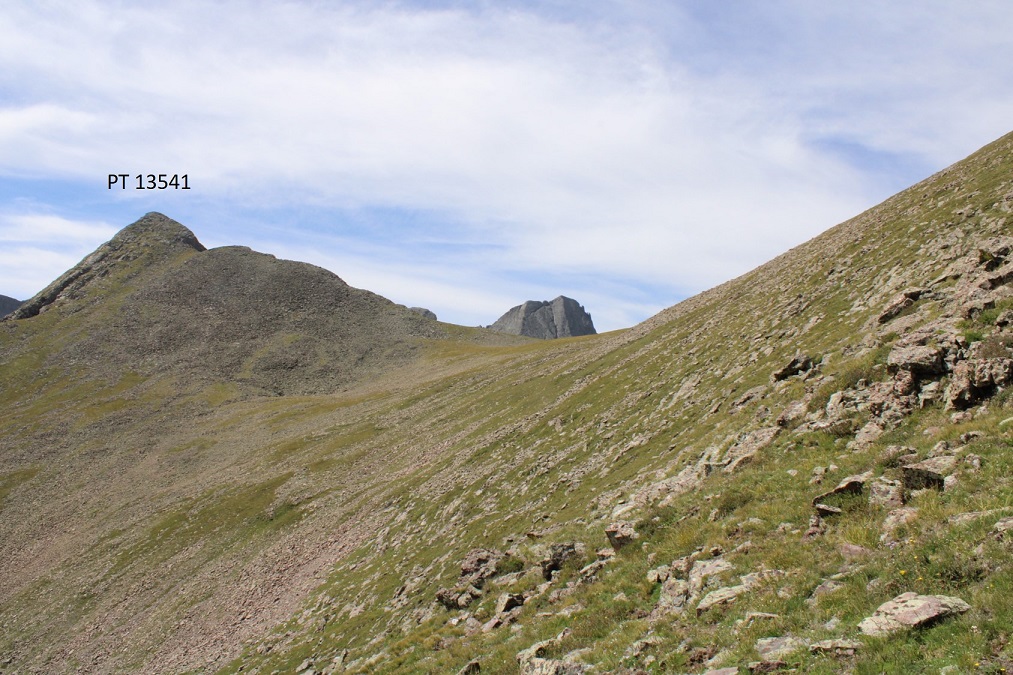
I was here last week and summited PT 13541 via Horn Lakes Trail, and to put it nicely, it was awful!  Once the trail ended at the creek crossing (Dry creek, which was flowing fast), I was met with hundreds of feet of 8-foot-tall willows to navigate, standing in about 18 inches of standing water.
There was no way I could recommend that route, so I went about trying to figure out another one. While this route is a bit longer, bonus: no willows in water!!!

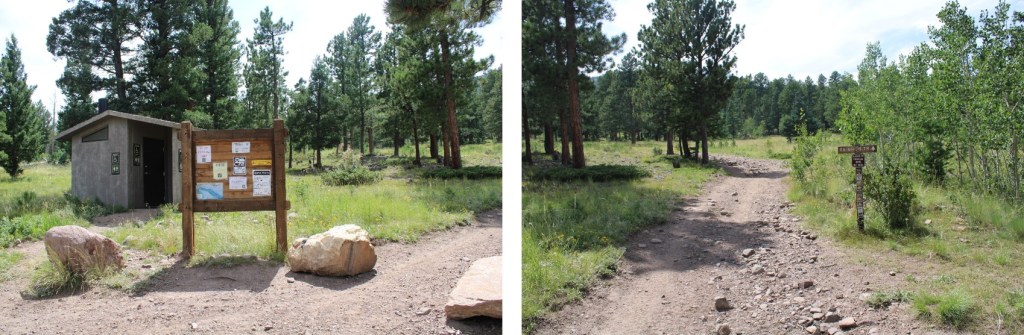
I parked at the Horn Creek Trailhead and was on the trail at 4:30am.  The trailhead was full of vehicles (last week I was the only vehicle in the lot). The trail starts at the west end of the parking area, which holds about 20 vehicles. There are information maps here and a clean restroom. Dispersed camping is allowed for 14 days, and there are horse corrals.

I followed the Rainbow Trail for just under half a mile to this junction, then turned left and continued following Rainbow Trail / Macey Trail.

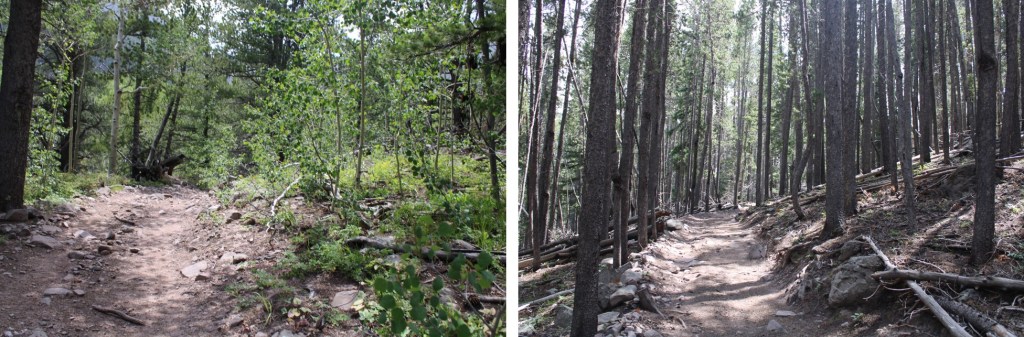
This trail is very well defined:  it’s used for OHVs.  I followed the trail as it hugged the side of the mountain, heading south

After hiking for a total of 3.3 miles I came to another junction, and took the Macey Trail west. This trail is a little more narrow, but still class 1.

There’s a trail register a ways after the junction. I signed it and continued on.

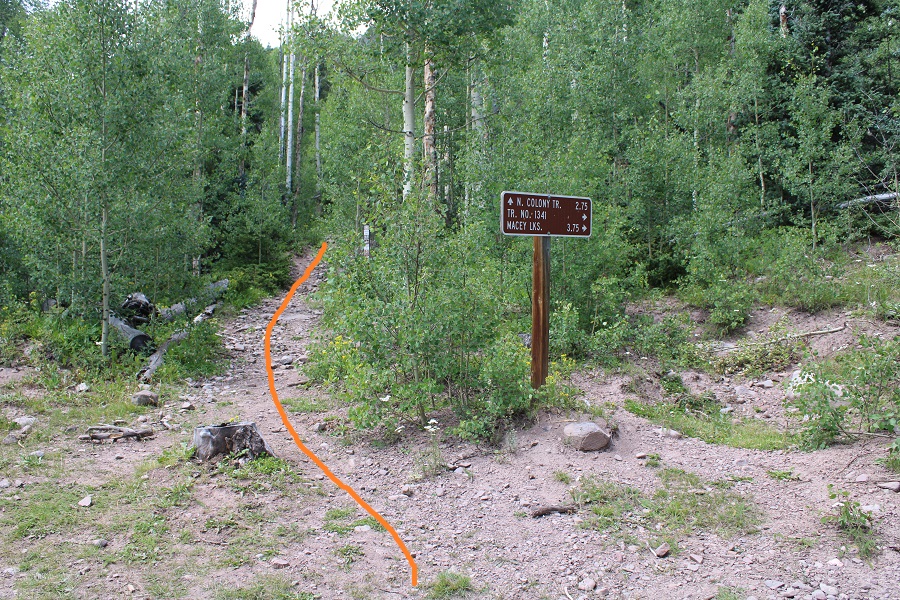
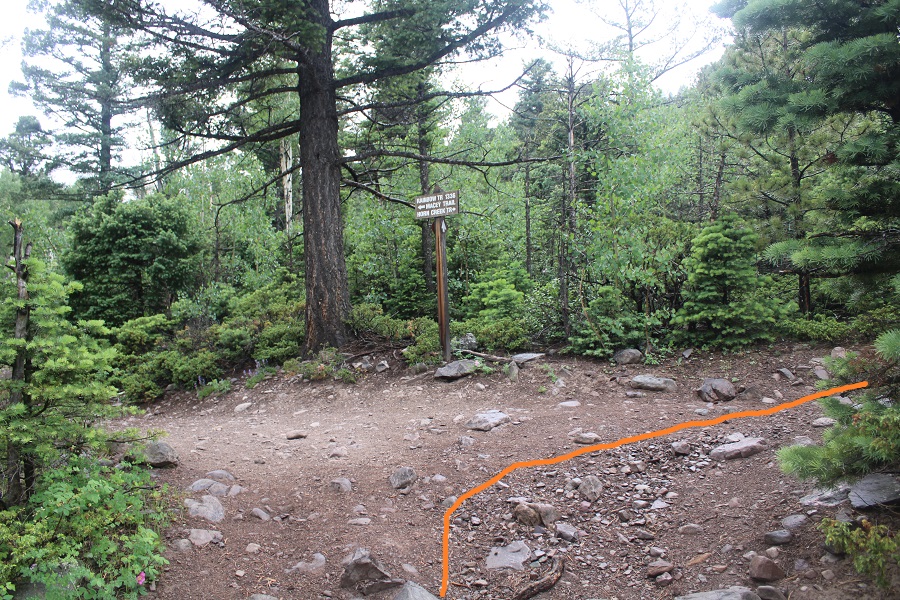
Just after Macey Falls, and just before making it to the first Macey Lake, I left the trail and headed northwest.  I’d hiked 6.5 miles total to this point. I’m guessing this is a camping area, because I left the trail at this marker (seen on the right side of the trail).

If you see this sign, you’ve gone a couple of yards too far.

I bushwhacked northeast to treeline, about half a mile. This wasn’t too bad: there were downed trees, but not too many. I was mostly pushing my way through thigh-high flowers and grasses. I started out by skirting a small pond to the right.

And then hiking up through grasses, flowers, and trees.  The elevation gain was moderate and I never came across a large obstacle (cliff, water, drainage, huge boulder, etc.)

After about half a mile I was at treeline, and could clearly see the ridge

I made my way to the ridge, staying mostly on tundra and rocks.   The willows are small and completely avoidable.

Once on the ridge I turned left, and followed it southwest

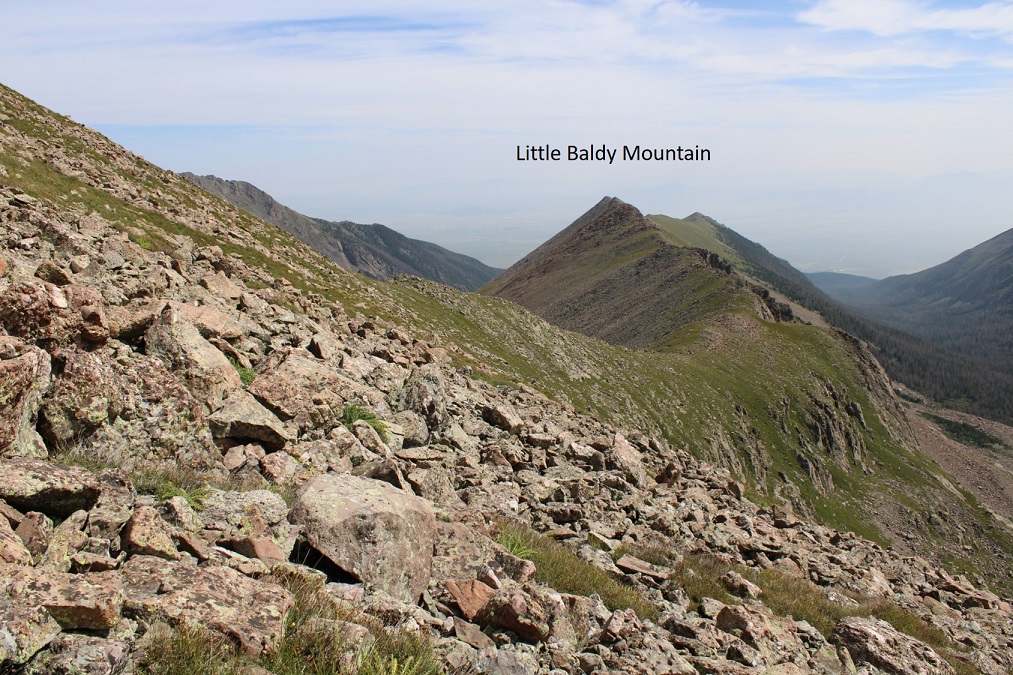
The ridge has a lot of ups and downs.  I crossed over two small bumps (kind of like ears), then lost 150’ of elevation and gained it again to the true summit of Little Baldy Mountain.  This is the best way to describe where Little Baldy Mountain is (an unranked 12er).  There is a cairn on the first hump, but it’s the second cairn you’re looking for (if it really even matters? It is unranked.  Just follow the ridge and you’ll hit it).

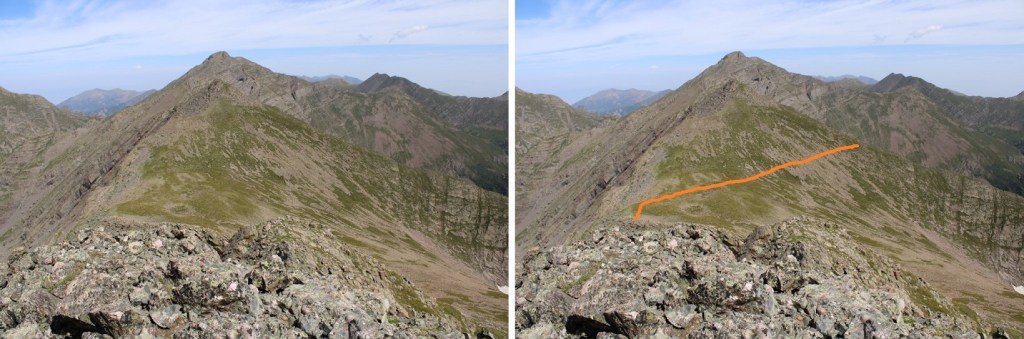
The ridge is a bit rocky, with some tundra thrown in, and all class 2. Here you can see the route to PT 13517 and 13541

Here’s an overview of the route I took.  I summited PT 13517 first, then took the ridge to PT 13541, and then went saddle to saddle. 

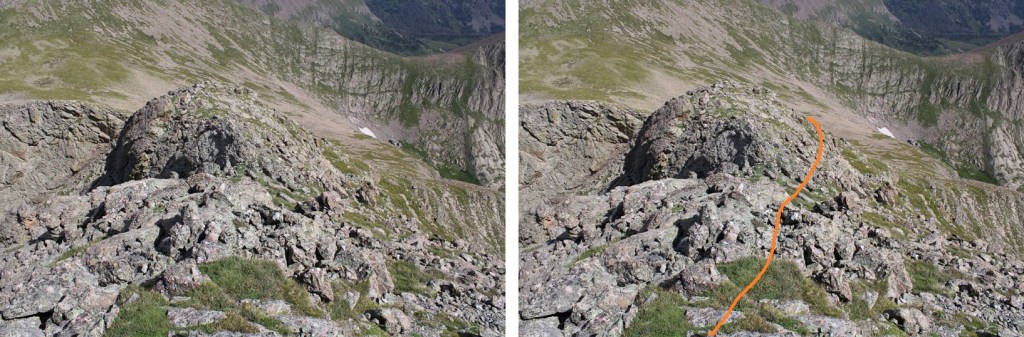
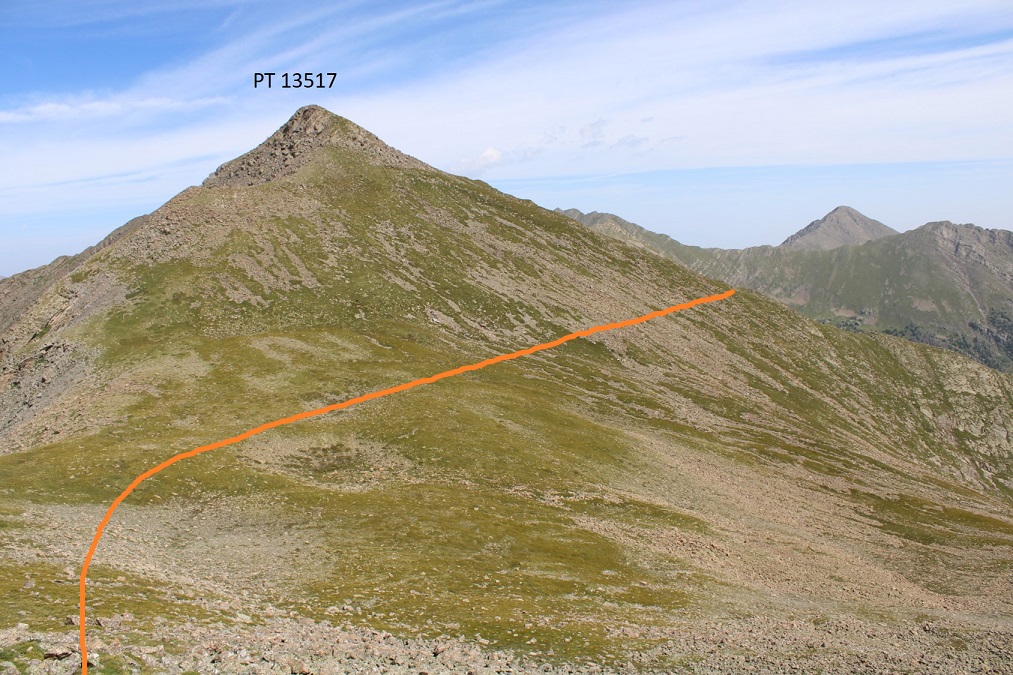
Here are some step by step photos. First, the ridge to PT 13517

The ridge was mostly tundra, but became rocky at the end.  All of the rock above treeline feels like Crestone rock:  conglomerate with lots of hand holds. The only difference is these are rocks, and not slabs. This stays class 2

I summited PT 13517 (unranked) at 9:15am

PT 13517:

Here’s looking back at the ridge and the route in

Here’s looking back at the Horn Creek approach: Look at all that water and willows!!!

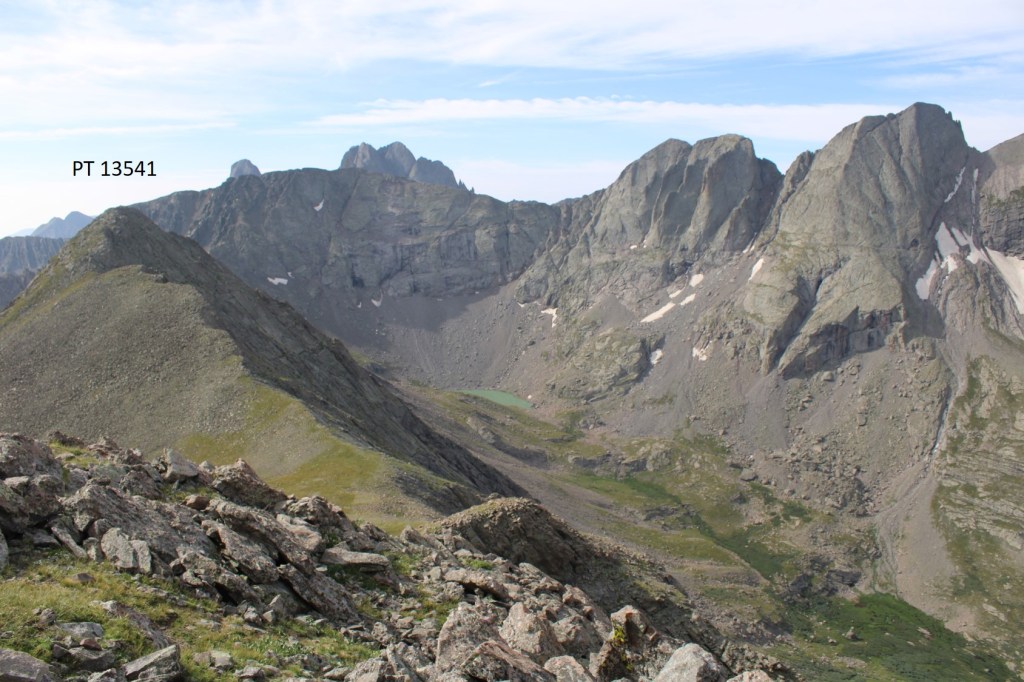
Now to head over to the ranked peak of the day: PT 13541. Check out those Crestones!

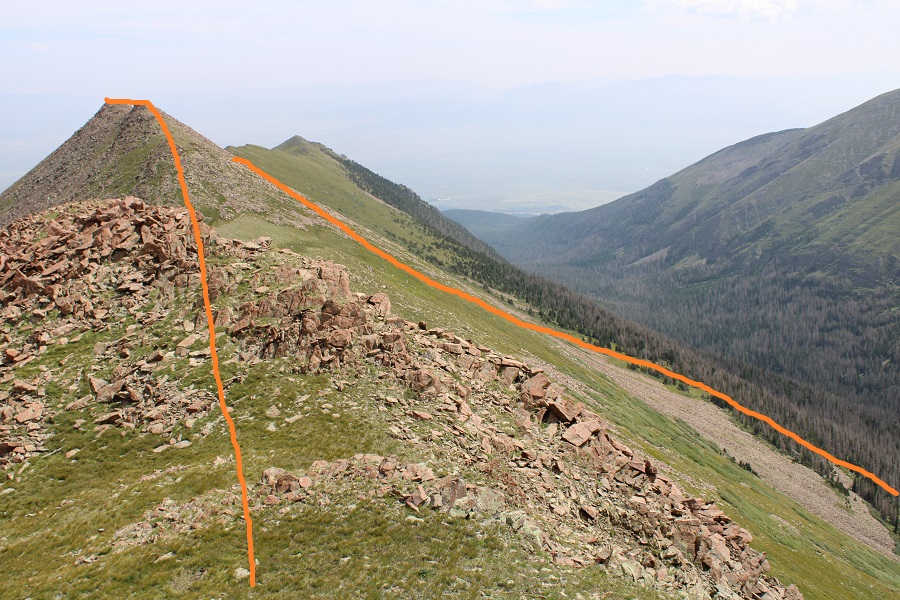
The trek over to 13541 was straightforward, and a simple ridge hike until the last bit or so (circled in red)

I hiked down to the saddle and enjoyed the views for a bit. Doesn’t Kit Carson Peak look like a cooked (or uncooked) turkey from this angle?

From the saddle, here’s looking up at 13517

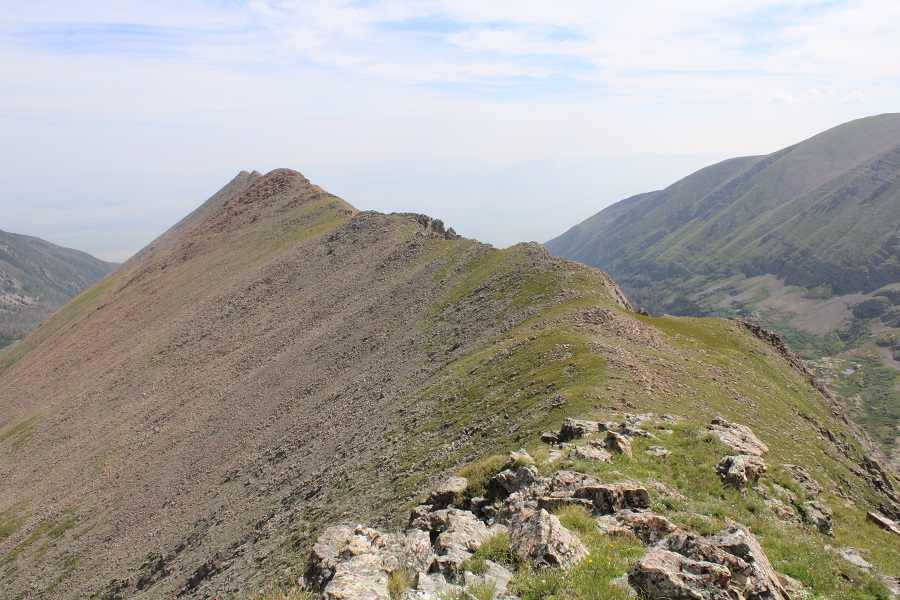
Most of this ridge to PT 13541 is just a tundra hike, until the end, where it becomes rocky and there are some steep drop offs to avoid. Here’s an overall view of the route: A little more than half way up the ridge I left the ridge and skirted the mountain to the left to head towards the summit

The ridge gets a little rocky, but this stays class 2

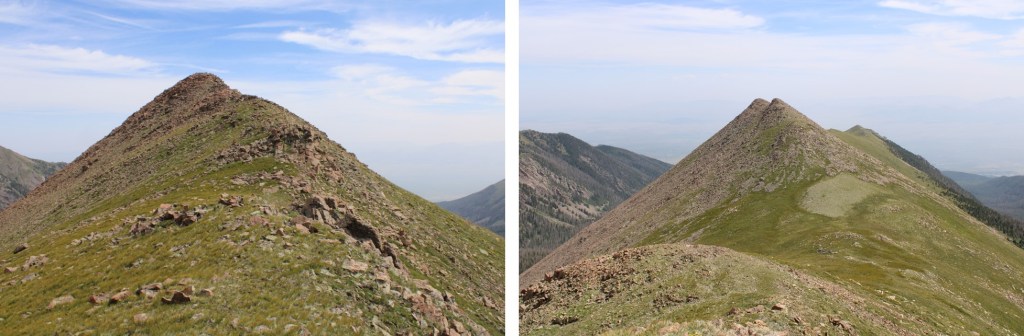
Just when you think you’re at the summit…

You’re close, but not there yet.  I had my helmet with me but decided it wasn’t really necessary. I dropped my gear and headed towards the true summit. This was easy class 3, with plenty of hand/footholds.

You can stay on top of the ridge the entire time, or dip down to the right.  The summit is in the middle of this short ridge

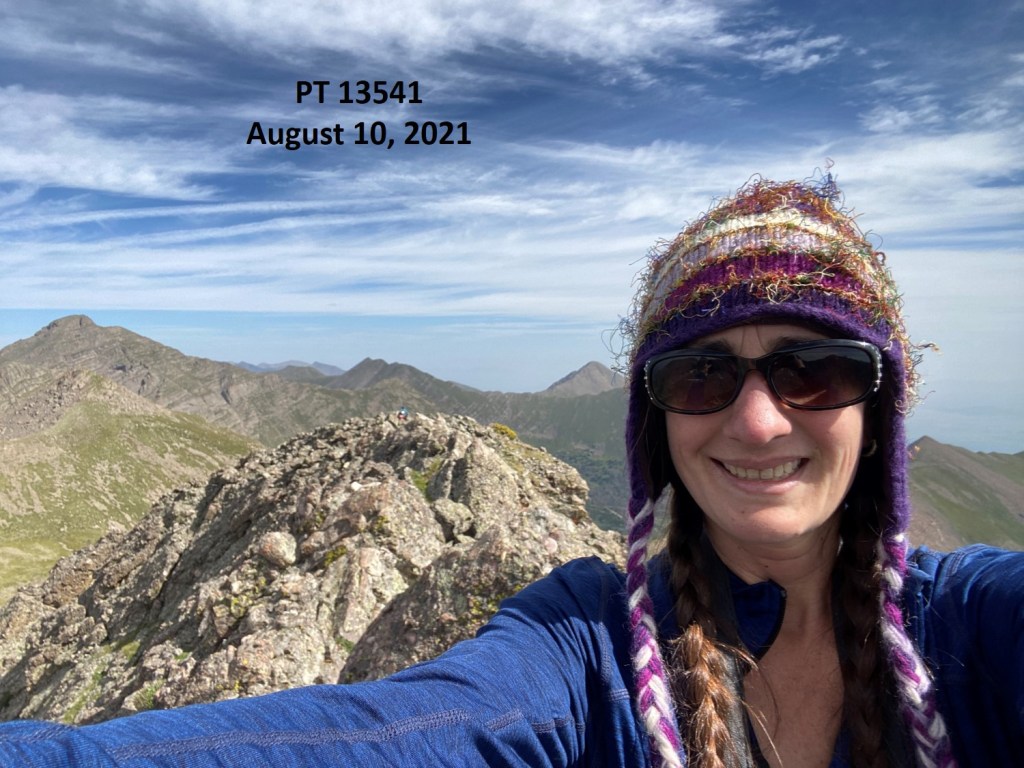
I summited PT 13541 at 9:55am I didn’t feel safe setting up my camera, so I took a selfie

PT 13541: 

I left a summit register, and then went back to get my gear.

It was a really nice day, so I enjoyed my time here for a while. I took a ton of fun photos, and did some visual research for another peak I still need to figure out how to climb in the area (next week???). When it was time to head back, I made my way back to the 13517/13541 saddle the way I’d come, then traversed over to the 13517/Little Baldy Mountain saddle.  This was all class 2 on tundra and talus

Here are some more visuals: 

From the saddle, here’s looking back at PT 13541

Once at the saddle I followed the ridge back up and over Little Baldy Mountain and the two small humps

After the second rocky hump I left the ridge and descended southeast, back towards Macey Lakes

Once in the trees I just kept aiming southeast until I made it back to the trail (Macey Trail 1341)

Now on the trail, I followed it back to the Rainbow Trail

And then followed the Rainbow Trail back to the trailhead

I made it back to my truck at 2:30pm, making this a 19.45 mile hike with 5950’ of elevation gain in 10 hours.

Sleeping Sexton – 13,460

RT Length:  12.7 miles

Elevation Gain:  5156’

This was actually my second attempt on Sleeping Sexton:  I was here last week but got turned around at the false summit due to getting ‘buzzed’.  I figured it was for the best however, because I had done some serious route finding that morning and now I could provide a clear and useful GPX file for the route, instead of one with a lot of attempts that didn’t lead anywhere.

I made it to the Maroon Bells welcome station, and this time the attendant recognized me.  We chatted for a bit, as he was interested in some of the summits I was doing.  Then he referred me to talk with someone at their offices in town, and we’re basically best friends now.

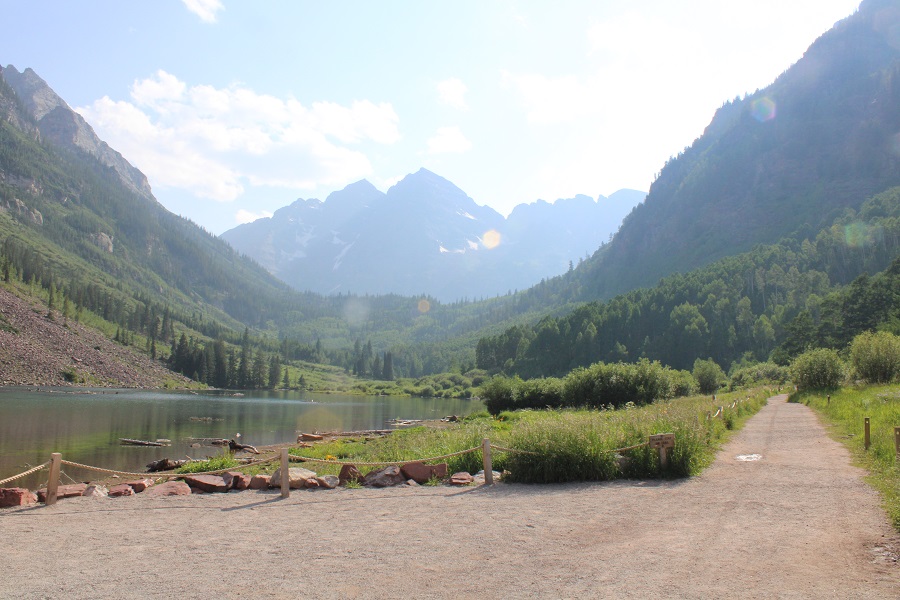
It was raining when I arrived, but people were walking around Maroon Lake anyway. 

I was on the trail at 2:15am. 

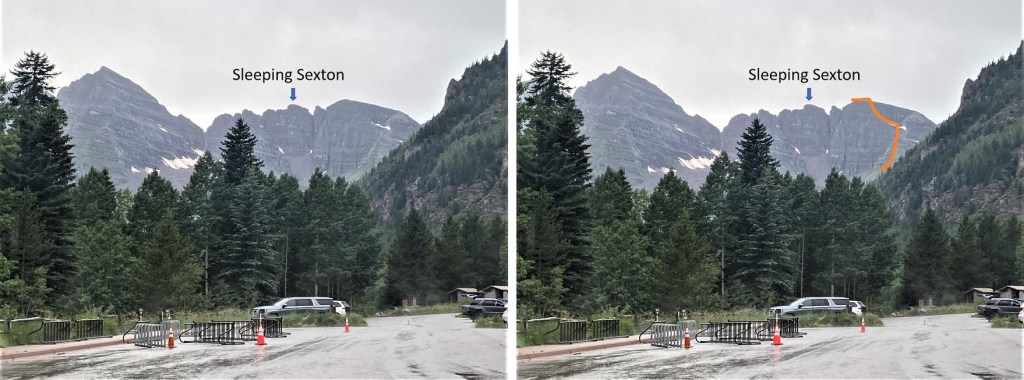
From the parking area, here’s an overview of the route above treeline to the false summit

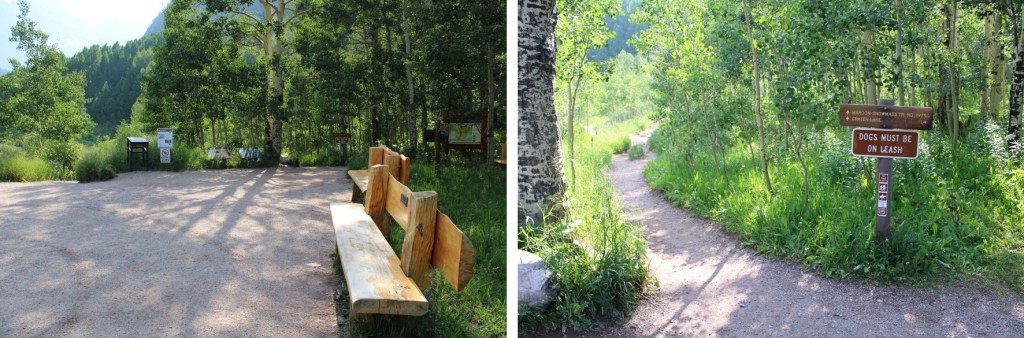
The trail starts by skirting Maroon Lake, then taking the Crater Lake trail southwest.

There was a full moon out, so I didn’t need my flashlight.

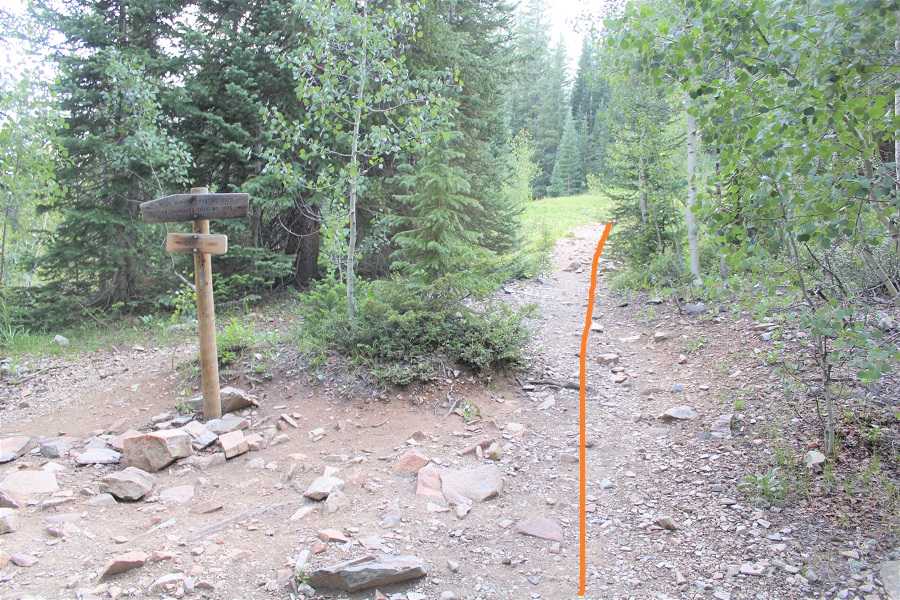
At the junction for Crater Lake I continued following trail 1975 northwest. This is the trail you take if you’re doing the Northeast route for North Maroon Peak.  There are camping spots just before the next junction.

The trail continues to be a well defined, class 1 trail.  At about 10775’ there’s another junction.  If you’ve hiked North Maroon Peak before, you’ll recognize this trail.  I turned left here and crossed the creek, following the North Maroon Peak Trail (still class 1)

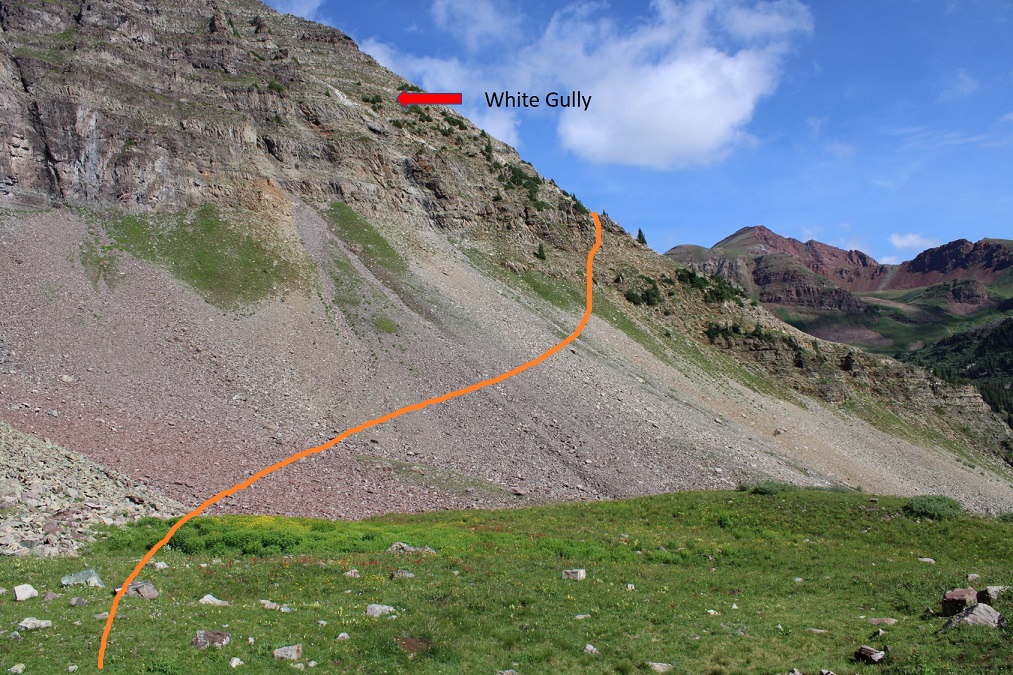
Here’s an overview of the trek to the false summit (or ‘the crown’) from the creek crossing.  I followed the North Maroon Peak’s Northeast Ridge Route until I made it to tundra, at about 11,600’.  I then left the trail and headed northwest, behind this outcropping, to the base of the white gully. I then trekked up the ridge and followed the white gully until it ended. Here’s a basic overview.

Here are some step by step photos of the way I accessed the white gully:  I followed the North Maroon Trail to treeline

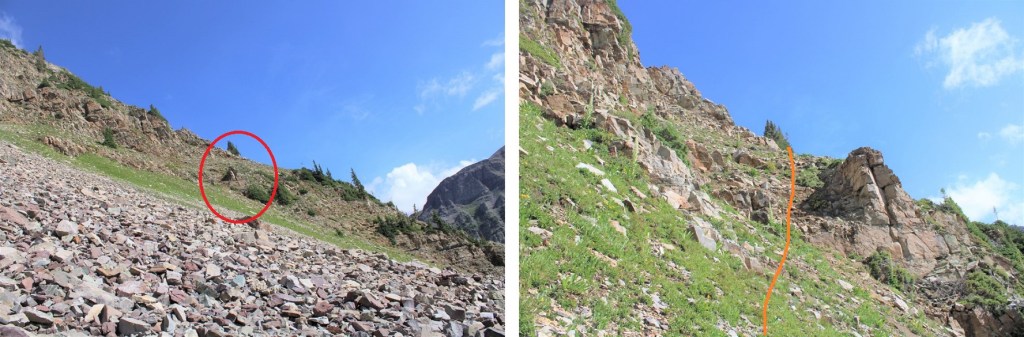
At 11,600’ I left the North Maroon Trail and headed northwest

Here you can see the base of the white gully.  I didn’t want to climb straight up the gully, as it was very steep.  Instead, I accessed the ridge, and followed the ridge to the white gully.  (I did this after spending a lot of time last week trying to see if the smaller gullies ‘went’ to access the white gully, and turned back every time because I didn’t have rope.  I believe it’s much easier to access the ridge first and then head up).

Here’s exactly where I entered and exited the ridge.  I found this to be class 2 and direct access.  Now’s a great time to put on your helmet if you haven’t already done so.

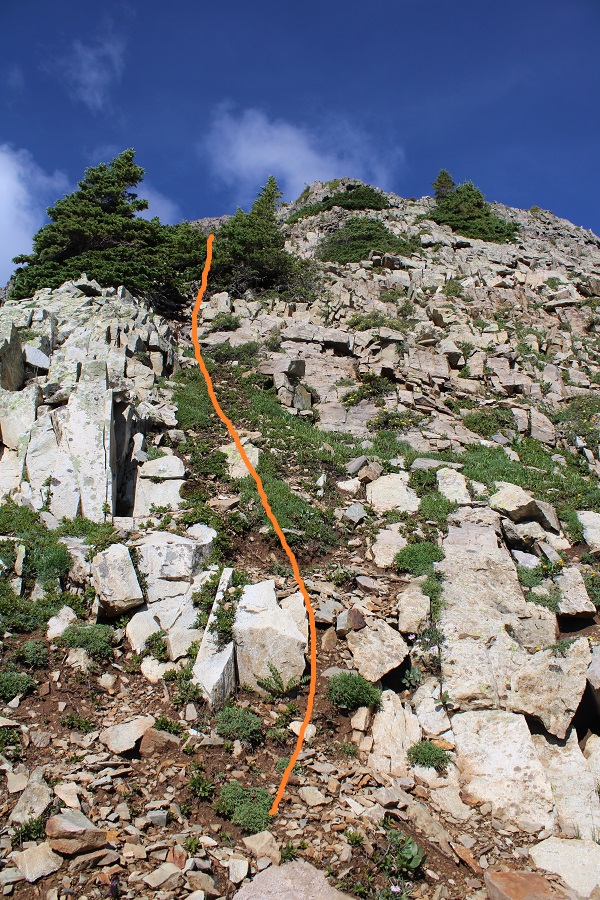
Once on the ridge I followed it west, staying in-between the ridge and the white gully (to the right of the gully, but left of the ridge).  If you look for them, you’ll find game trails here (you may have to duck under some branches to use them though).

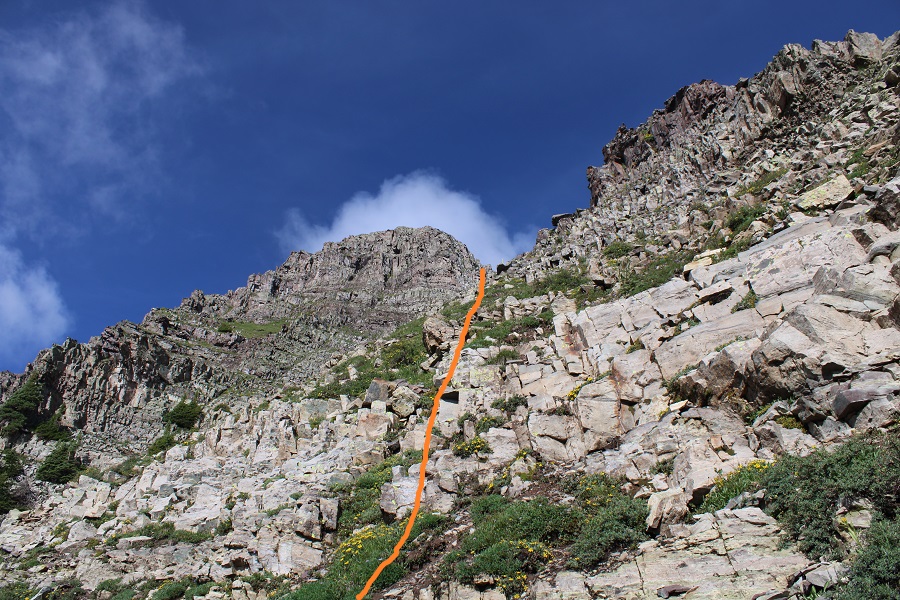
Once near the white gully, I found the terrain to the right to be more stable than the white gully itself, especially on my way down.

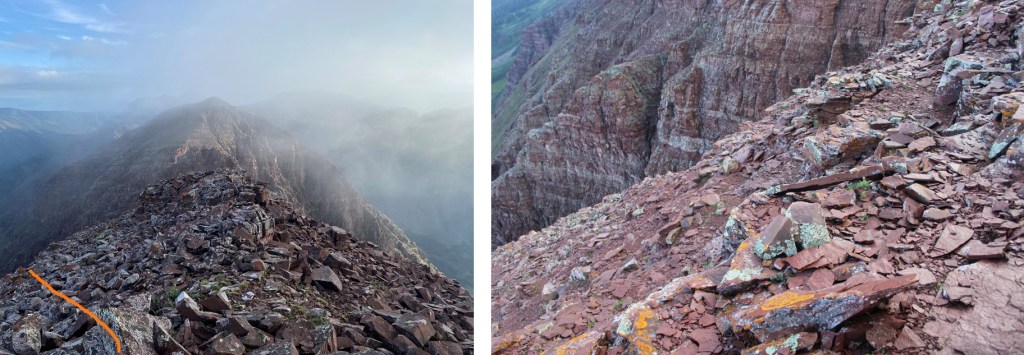
Topping out of the white gully felt class 3

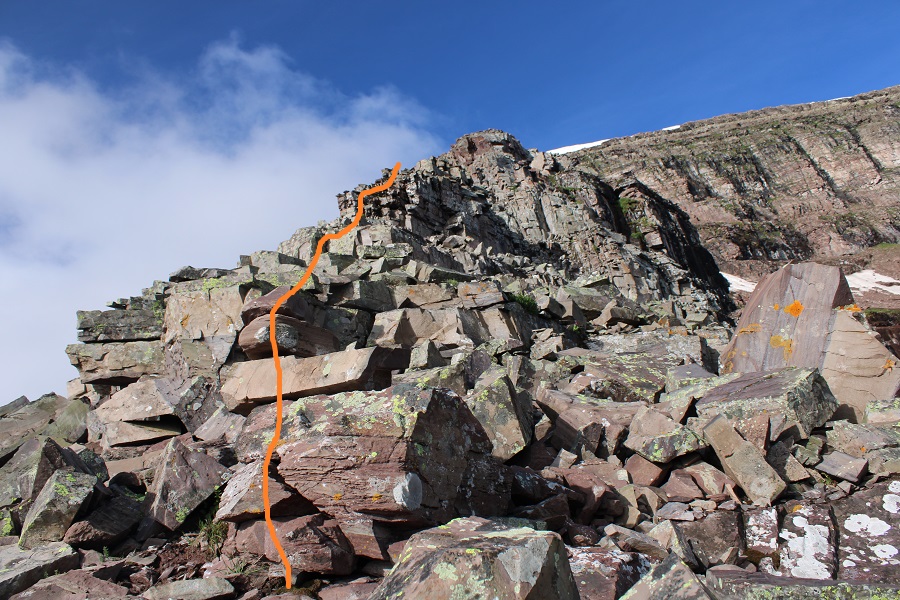
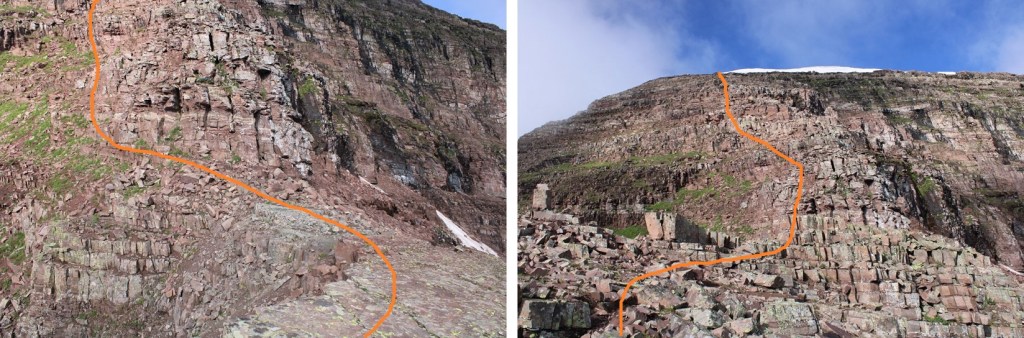
From here it became ‘choose your own adventure’ as I followed the ridge southwest. I started out rounding the ridge’s north side, and then went back and forth between north and south sides of the ridge a few times.  There are cairns here, and nothing is more difficult than class 4.  In fact, if you’re extra careful/spend a lot of time route finding, you can probably keep this at mostly class 3. Here’s the route I took:

From the top of the white gully I rounded the corner and made my way back to the ridge.  It had rained the night before, so I had to be extra careful with every foot placement (wet = slippery)

Once back on the ridge I followed it for a ways

Before hitting a bit of a shelf and crossing over to the south side of the ridge

I followed the ridge to the false summit / ‘the crown’

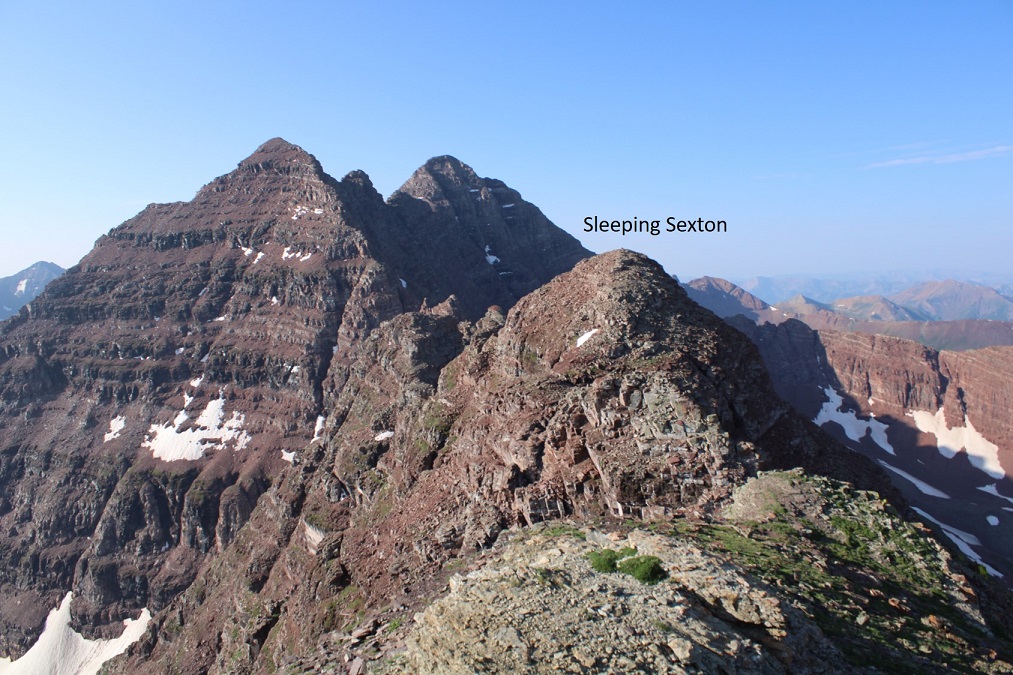
From the false summit you can see the true summit of Sleeping Sexton

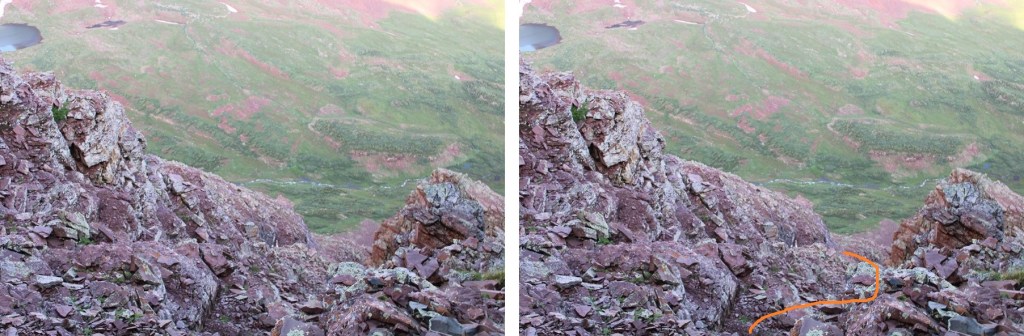
And now, the fun route finding begins!  I descended the false summit 125’ and crossed a gully.  There were cairns here to help in the crossing (circled in red). These are steep and go at class 3/4

After crossing the first gully I descended once again, another 160’

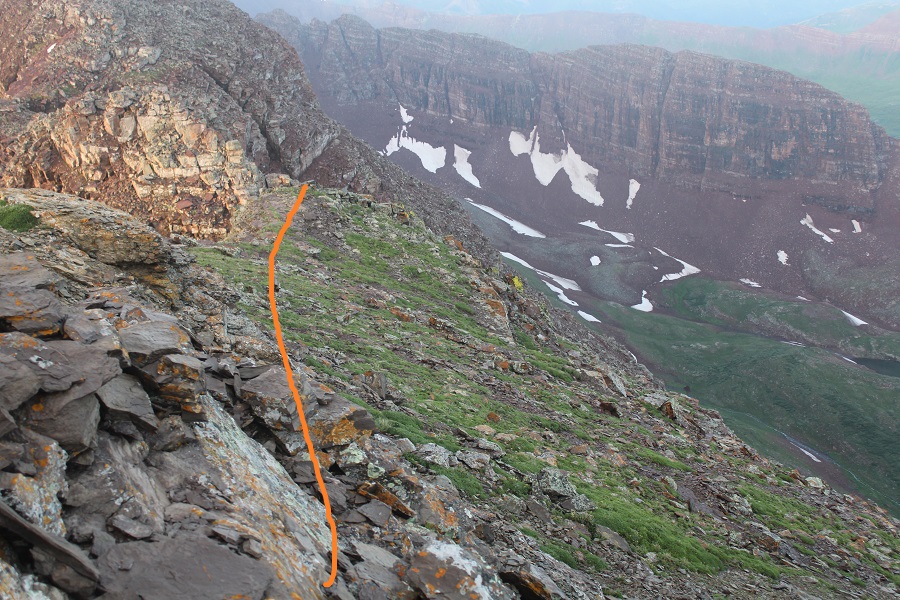
I was now at 13,130’, and parallel with the saddle between Sleeping Sexton and the false summit.  I followed the contour of the mountain to the ‘secret ledge’. Here’s what that looks like heading in

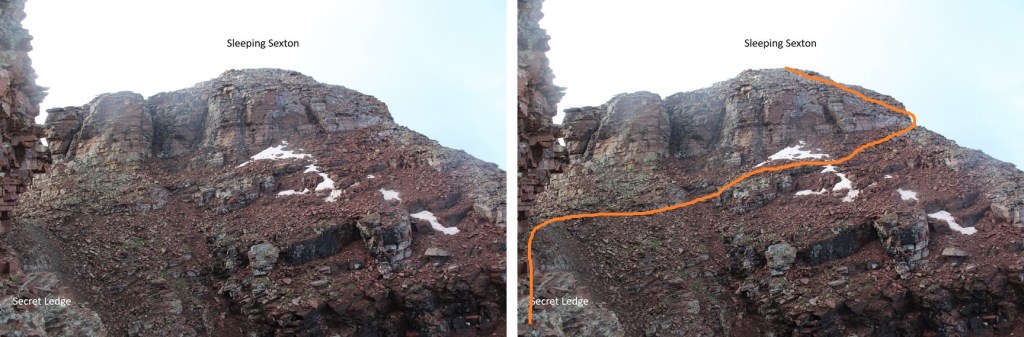
I crossed the ledge to the ‘saddle’, then skirted the side of the mountain and headed up to the summit

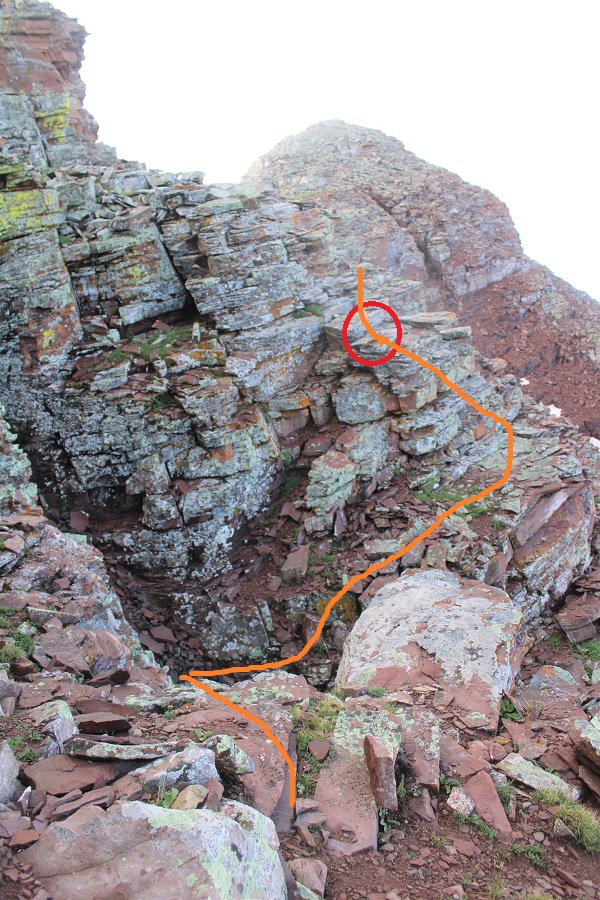
The ledge is not as bad as it looks.  There’s a cairn here (circled in red) DO NOT DESCEND HERE.  Instead, use it as a reference point and stay level with it (especially on your way back) and continue following the ledge. If you do this, it stays class 2 to the saddle.

From there it was an easy trek to the summit, first skirting the mountainside

And then ascending the ridge

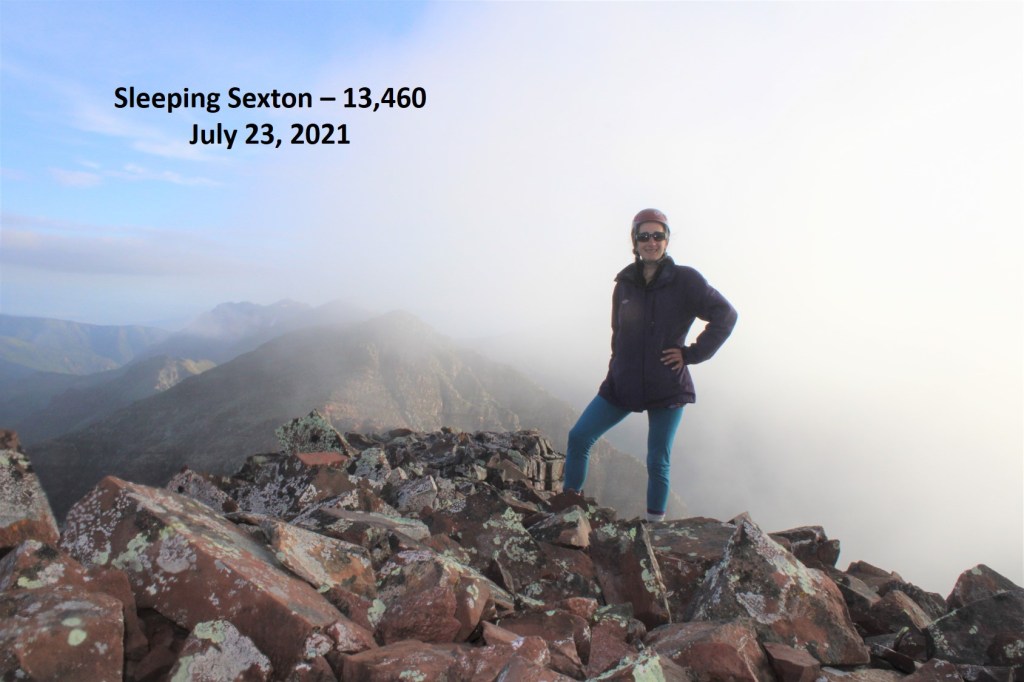
I summited Sleeping Sexton at 6:45am, just as the weather started rolling in

Sleeping Sexton: 

Since the weather wasn’t cooperating I didn’t stay long.  I turned and headed back the way I’d hiked in.  Here’s looking back at the false summit / ‘the crown’

And a view making it back to the ledge

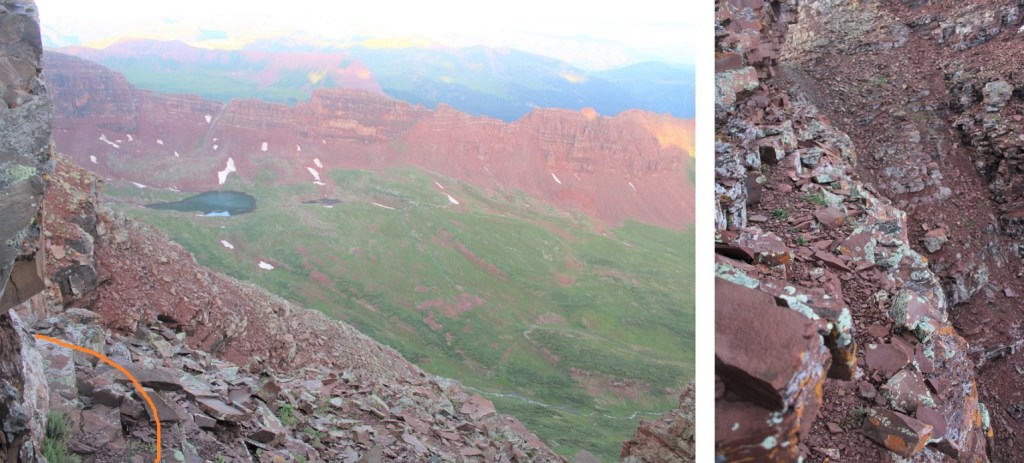
Here are some more images of that ledge, looking back.  Remember to look for the cairn, and stay level with it.

For reference, here’s the size of the route.  The route can clearly be seen over my shoulder (to the left)

I rounded the corner, and ascended the gully, aiming for the cairns

Crossed the next gully

And gained the ridge to the false summit / ‘the crown’

I actually stayed here for a bit because I had cell service.  I let my family know I was ok, and downloaded the weather forecast for the next day.  However, eventually the clouds told me to get going.

Clouds rolling in: 

Here are some pictures of my way back to the white gully

Back down the white gully to the ridge

And from the ridge back to the trail

Once back on the trail it was an easy, class 1 hike back to the parking area.

I made it back to my truck at 11:30am, making this a 12.7 mile hike with 5156’ of elevation gain in 9 hours, 15 minutes. 

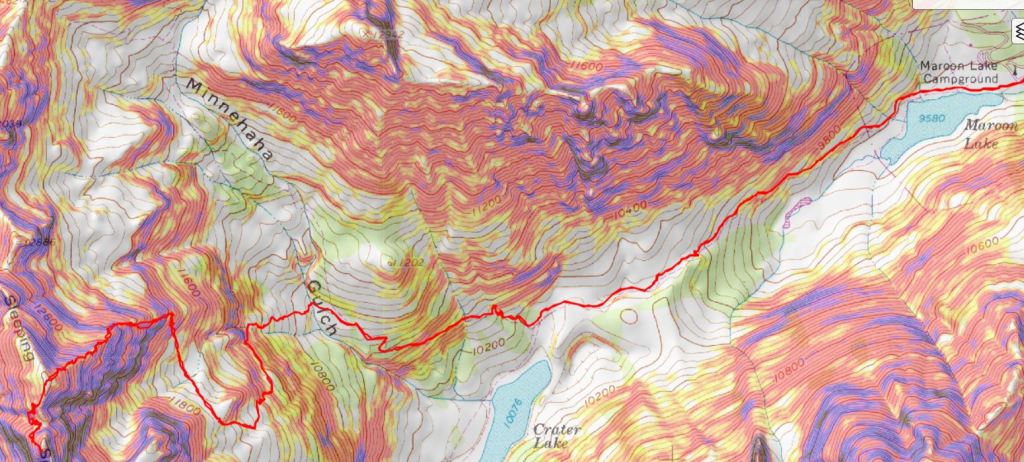
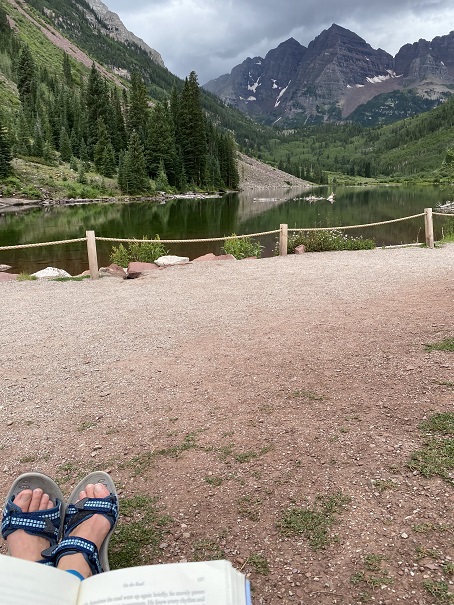
It was still early in the day, so I ate lunch by Maroon Lake, read for a bit, looked at topo maps for tomorrow, and jotted down notes in my journal before making it an early night.  Oh, I forgot to mention the goats:  They were the same two goats I saw last week, and if for no other reason than them, wear your helmet until you make it back onto the class 1 trail:  They were kicking rocks down the gullies the entire time I was there. 

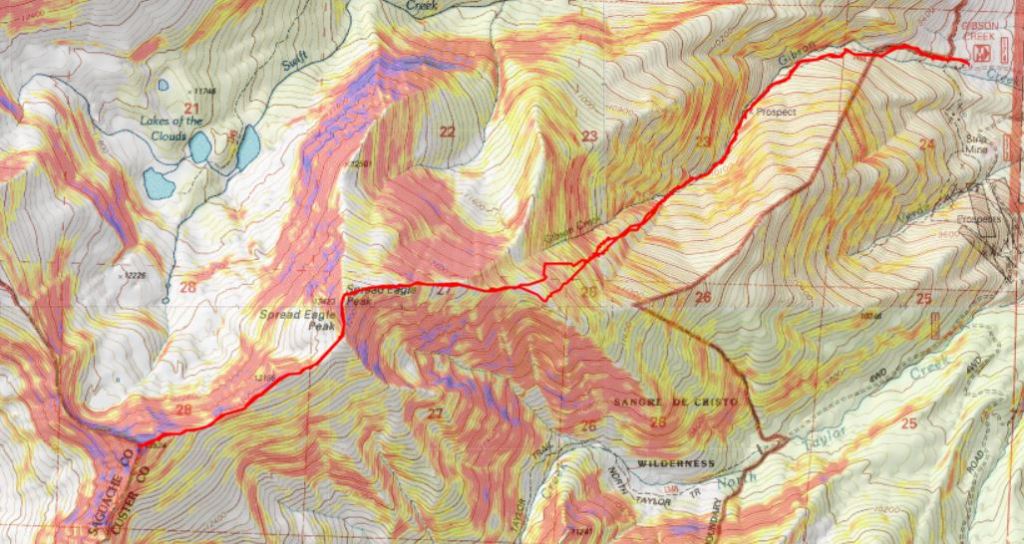
Spread Eagle Peak – 13,423 and Peak of the Clouds – 13,524

RT Length:  11.05 miles

Elevation Gain:  5461’

This was my 4th attempt at Peak of the Clouds.  Not because it’s a difficult peak, but because every time I was in the area I was thwarted by the elements; snow conditions, or a fast-moving storm coming in.  Today had a great weather forecast, so I figured today was my day.

Unlike my previous stays at the Gibson Creek trailhead, this time it was packed.  Probably because it was a Saturday over 4th of July weekend.  There were RVs set up everywhere, and every parking space in the lot was taken.  Knowing I was going to spend the night in my truck I just waited for someone to leave and then backed into their spot. 

I was sitting at the trailhead, just appreciating the sounds of the birds chirping and insects humming, and then the sun comes out and lights up each individual blade of grass and all I can think is how lucky I am this is my life.  It was a perfect night, and the last one I’d be spending in this particular vehicle, as my new truck was waiting for me at the lot and I was picking it up Monday.  I wanted to enjoy tonight.

I’d been gone for a few days, and I also wanted to get back home to see my kids, so I made it an early morning.  I was on the trail at 3:45am.  The trail starts at the north end of the parking area, and follows trail 1456 west.

The trail starts out nicely defined.  Stay straight at the Rainbow Trail Crossing.  This sign has been broken for years.  I wonder if they’ll ever replace/fix it?

Here’s where it gets tricky.  After hiking for .4 miles, and at 9400’, leave the trail and cross Gibson Creek.  It looks like there used to be a good trail here at one time, but it’s no longer well defined.  In fact, someone placed a tree trunk over the way you’re supposed to go.

After crossing Gibson Creek, the trail picks up again. 

The trail goes through various conditions, from being well-defined, to being covered with downed trees, to barely being a trail at all.  It also crosses Gibson Creek several times. 

The main thing is to just keep following Gibson Creek west/southwest

I followed the trail for about 2 miles, to when the trail abruptly ended where a tree had fallen over the trail.  Here I crossed the creek one last time, and bushwhacked southwest, up the mountain.  It’s important to note here something the topo map doesn’t show:  Apparently, somewhere Gibson Creek was to my right, but a much larger creek was to my left (this creek is not shown on the topo map, and could just be an error in CalTopo, as the creek was always to the south of me, but on the map it’s shown as being north).  Gibson Creek pretty much fizzled out here, so keep the creek you can see to your left as you ascend the hillside. 

This is a steep hillside with some bushwhacking involved.  It seemed to go on forever.  I took a different way down than I did up, and I’d recommend taking the way I went up, directly aiming southwest towards the ridge, as it avoids the large section of willows to the northwest. 

I made it to the ridge as the sun was coming up

Once on the ridge, it’s a straightforward, class 2 ridge hike to the summit.

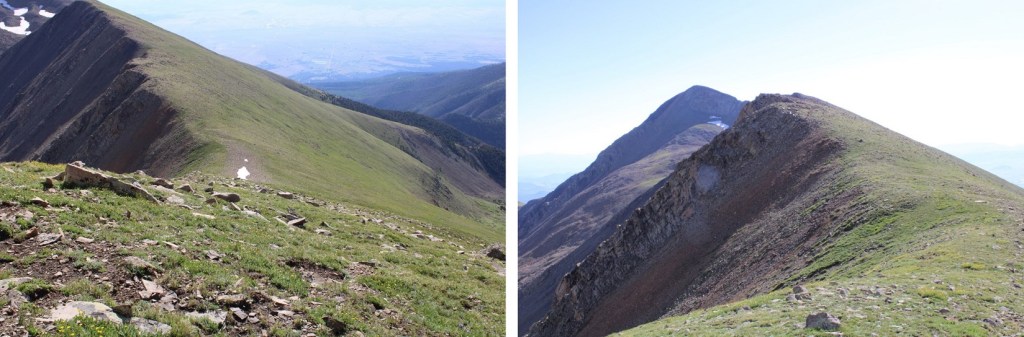
Here are some step-by-step pictures of the ridge

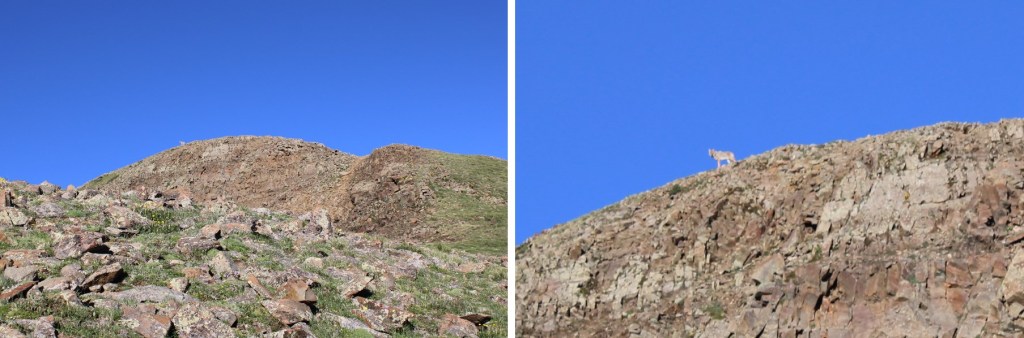
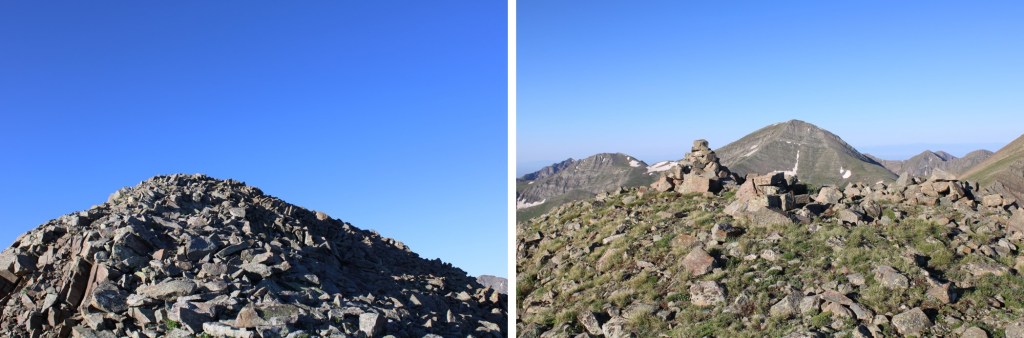
As I was nearing the summit, I looked towards the summit and thought I saw a bighorn sheep.  When I looked again I realized it was a coyote:  the biggest coyote I’ve ever seen!  He was chillin’ on the summit.

I summited Spread Eagle Peak at 7:15am.  The coyote was nowhere to be seen.

Spread Eagle Peak: 

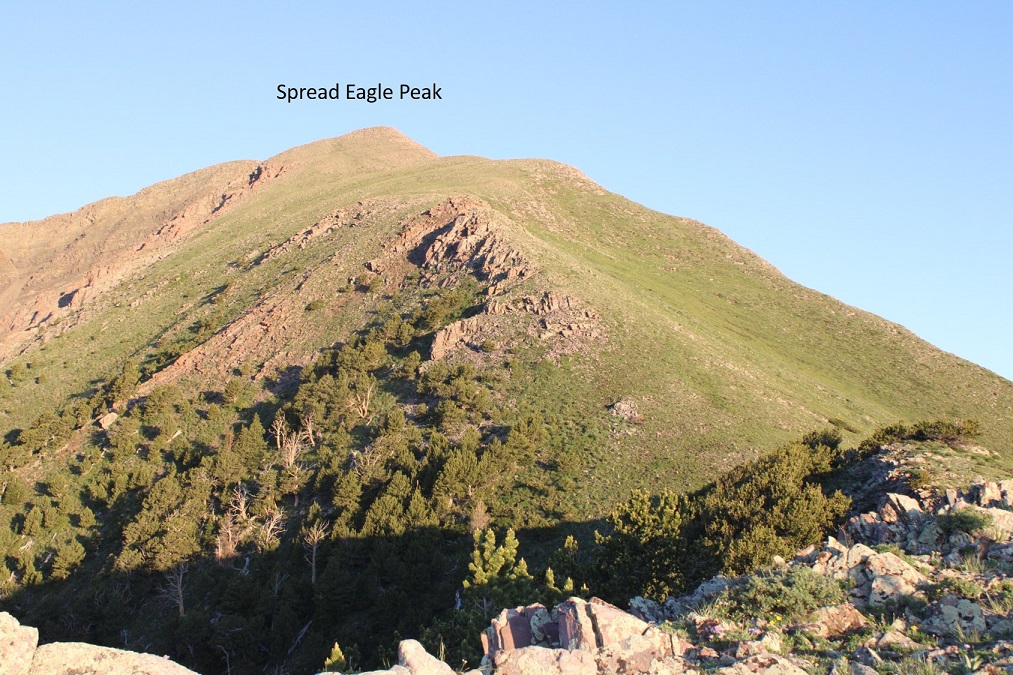
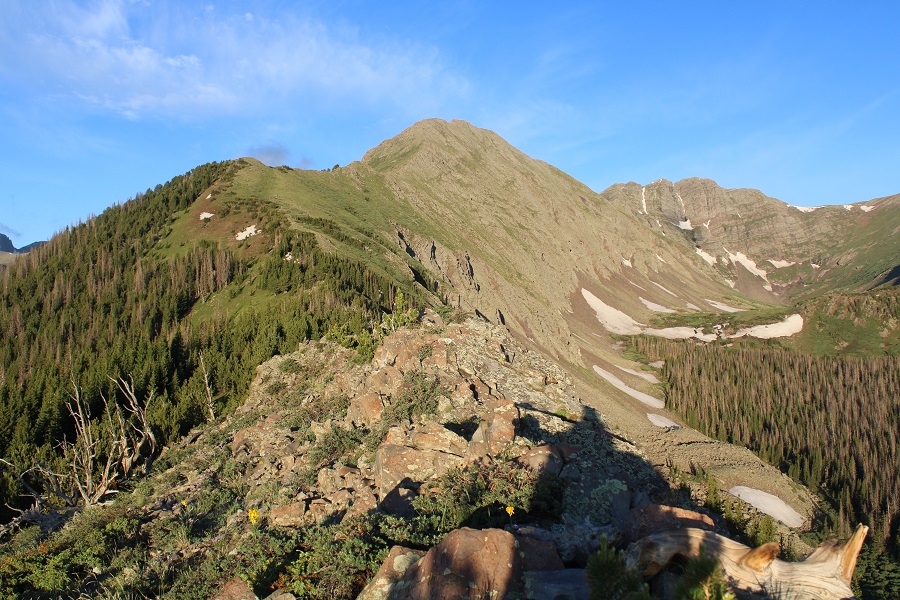
It was an absolutely beautiful day!  I headed south, down the ridge to the Spread Eagle/Peak of the Clouds saddle.

This was a straightforward trek, with just one short class 3 move.  I stayed right and downclimbed this section.

Then followed the ridge to the saddle

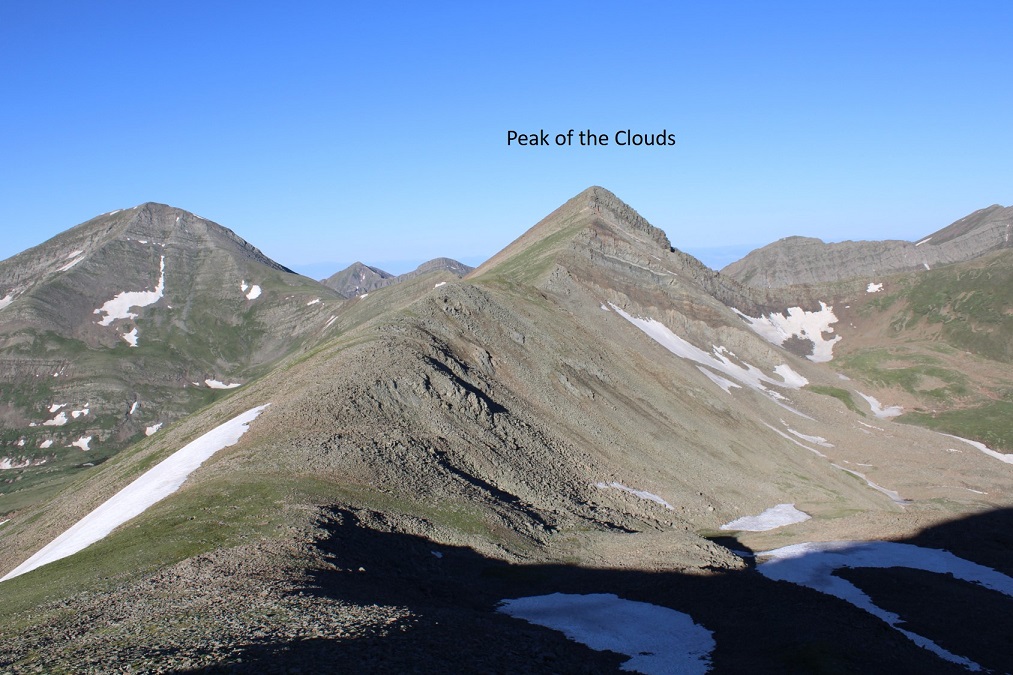
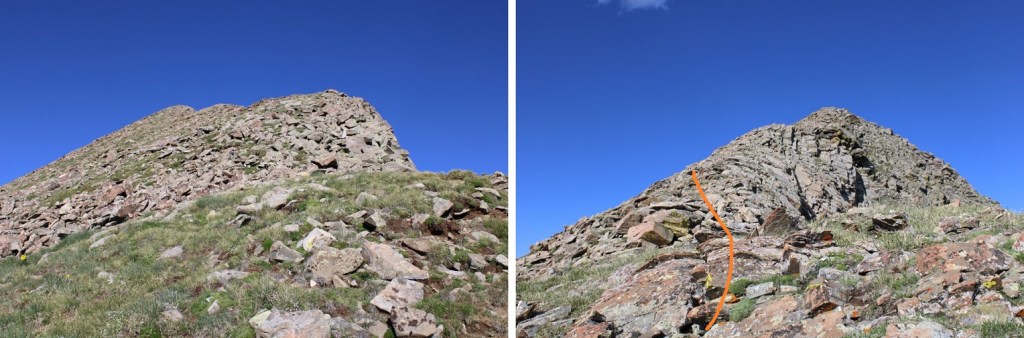
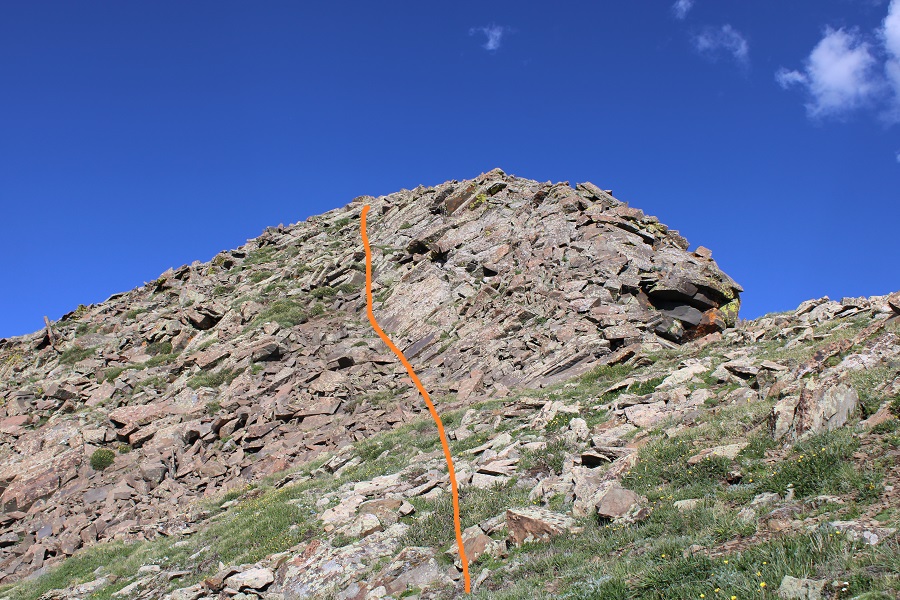
It was a simple, class 2 ridge hike to the summit of Peak of the Clouds

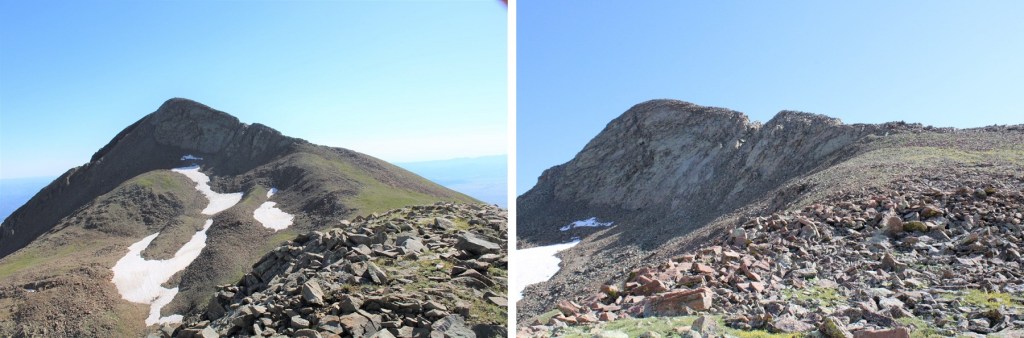
Here are some step-by-step pictures

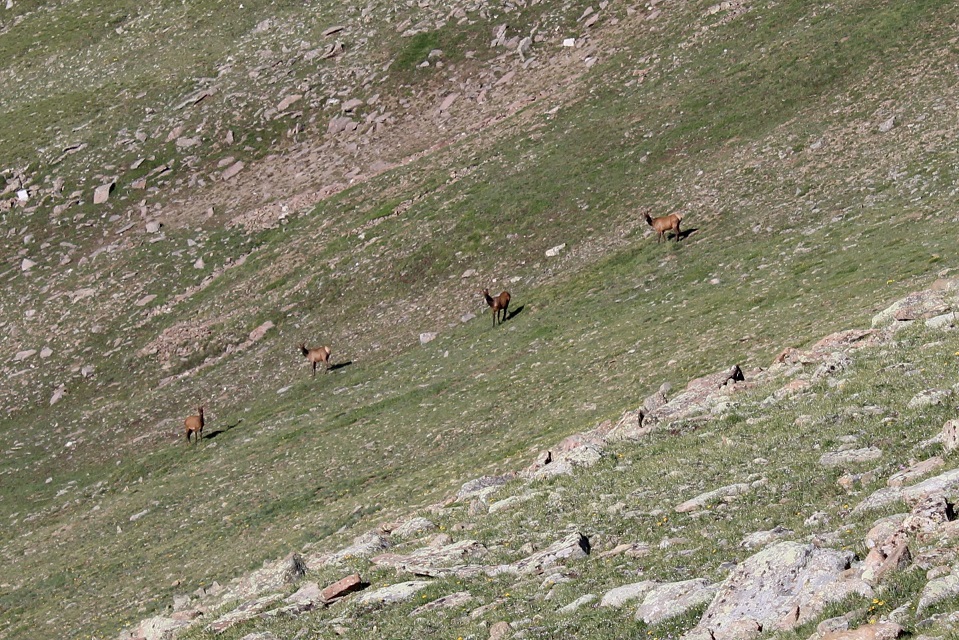
Here I saw some elk (they didn’t stay long)

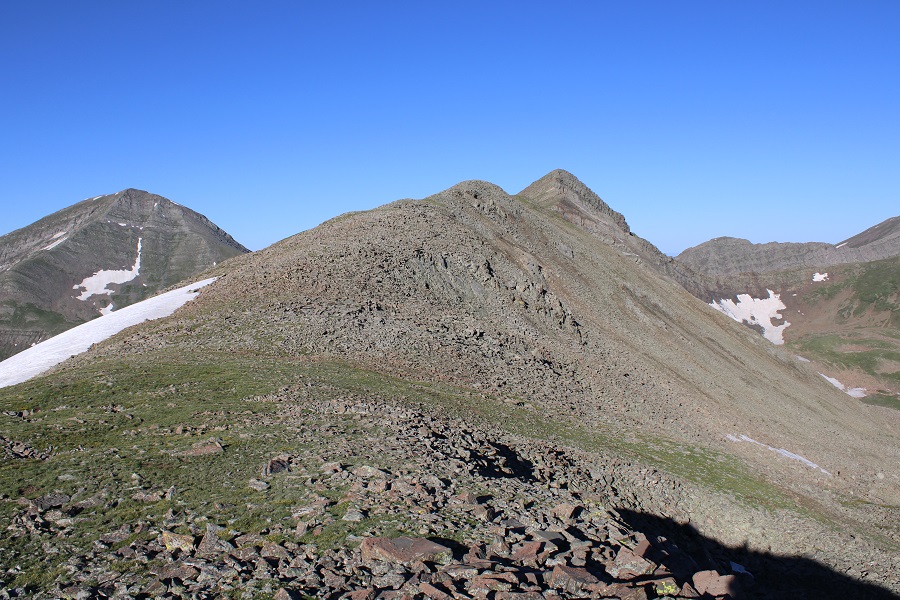
Looking up at the ridge to Peak of the Clouds

As I was hiking up, a marmot rushed down past me.  I wonder where he was going?

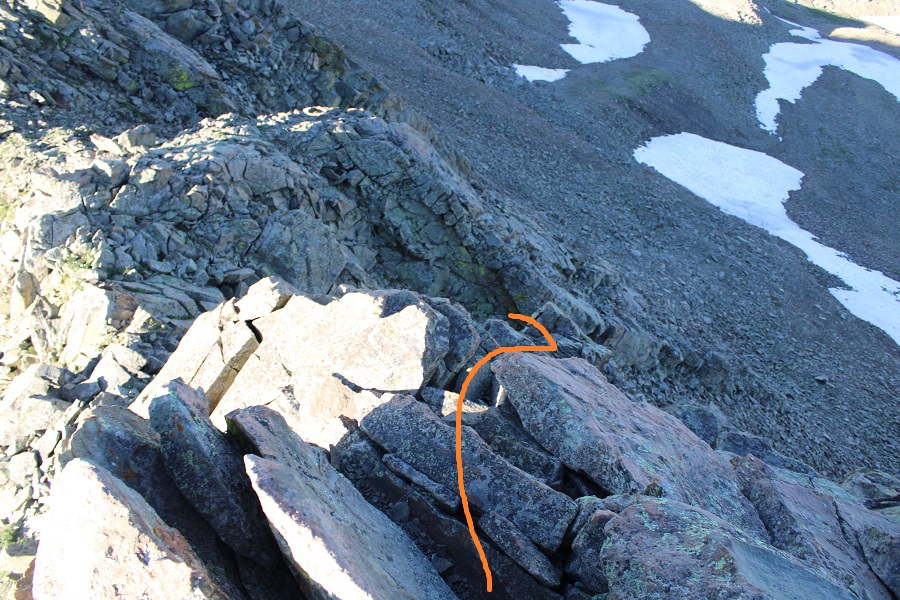
The last part of the ridge was rocky.  I stayed to the left.

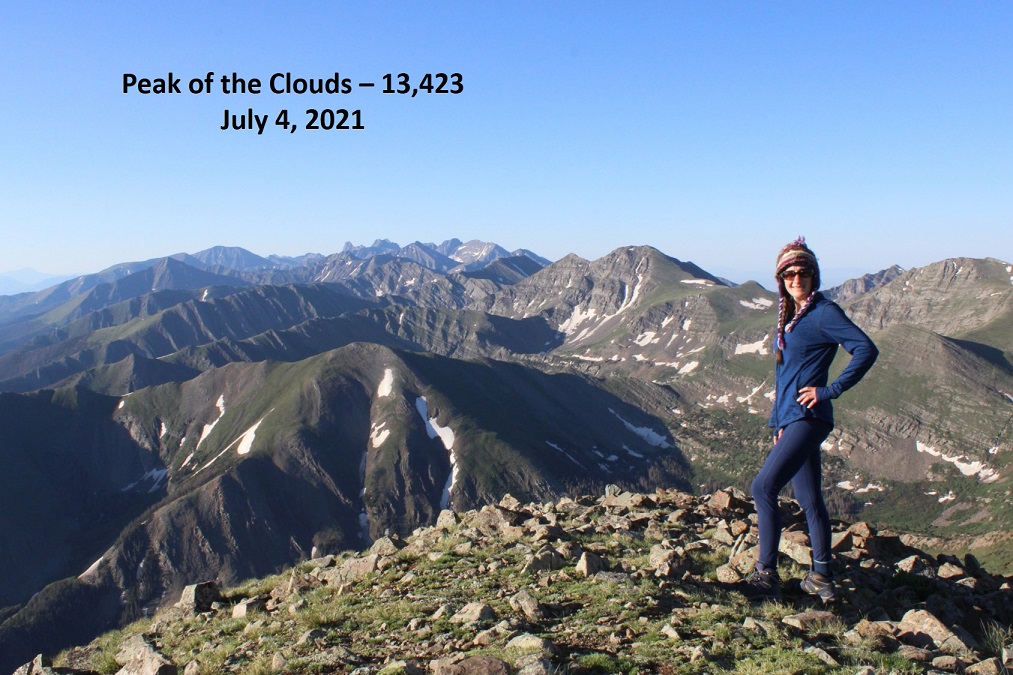
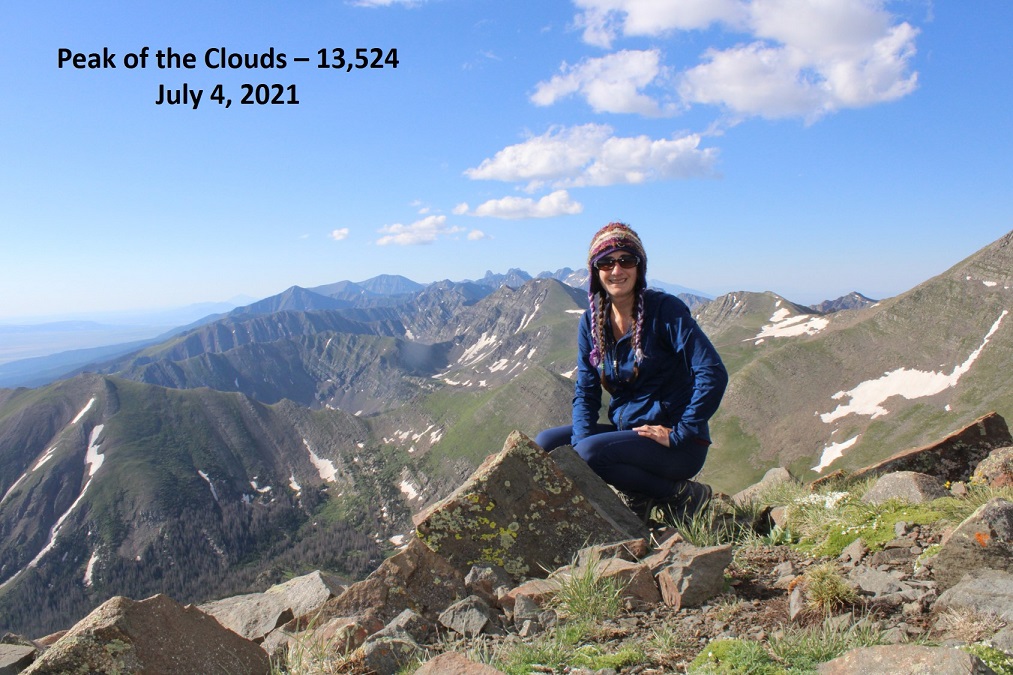
I summited Peak of the Cloud at 8:20am

Peak of the Clouds:

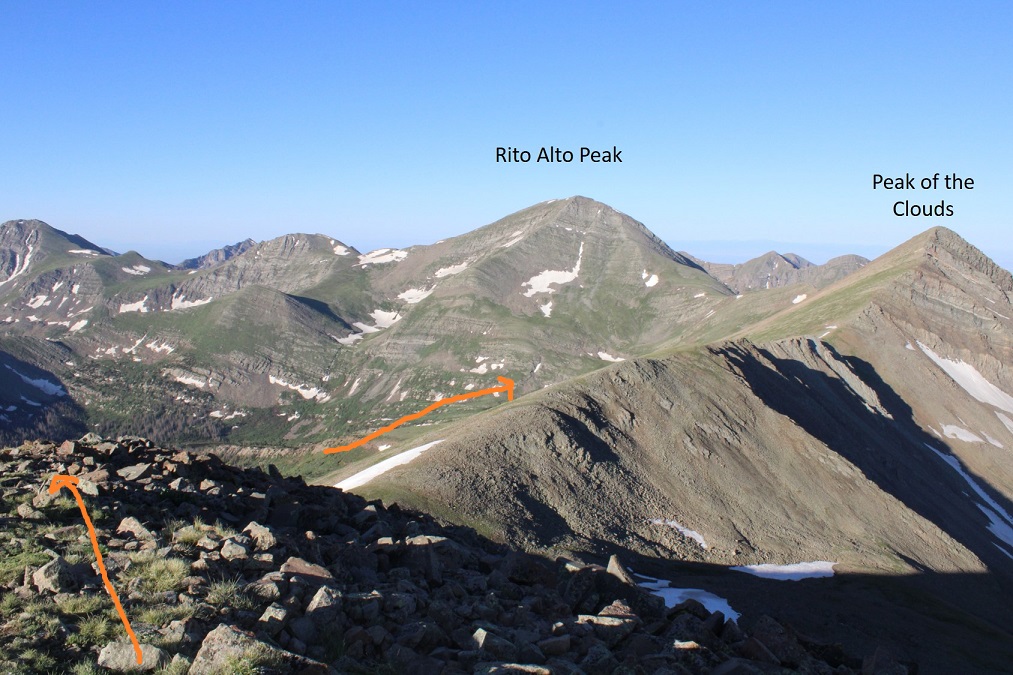
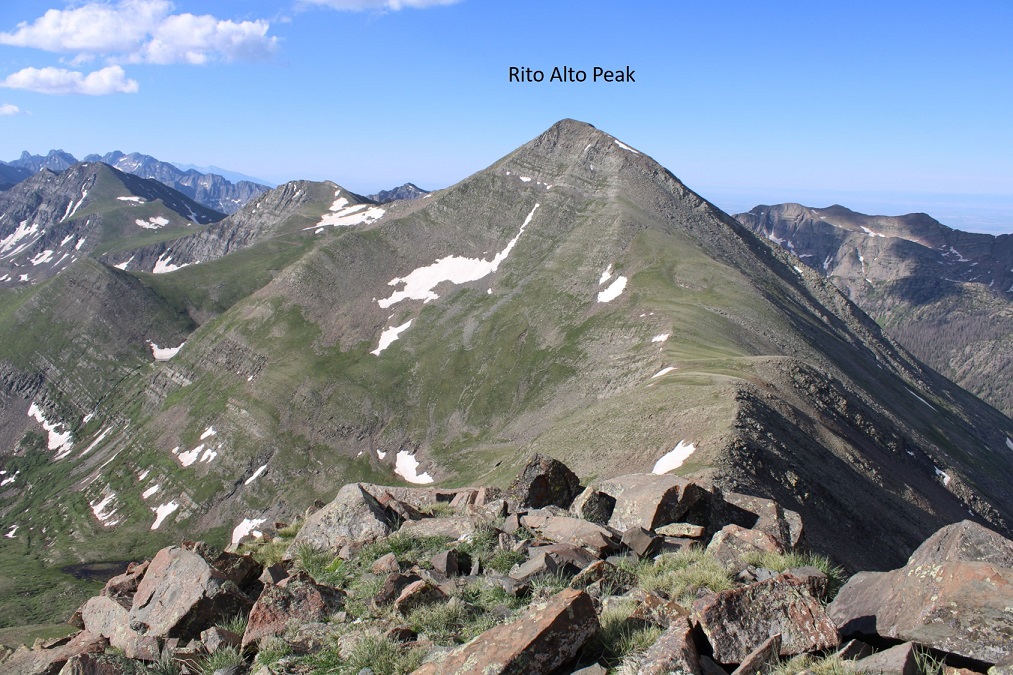
Here’s a look at the ridge to Rito Alto Peak (in case anyone is looking to do that one as well)

I sat for a minute and enjoyed my time on the summit.  It was a beautiful 4th of July in the Sangres!

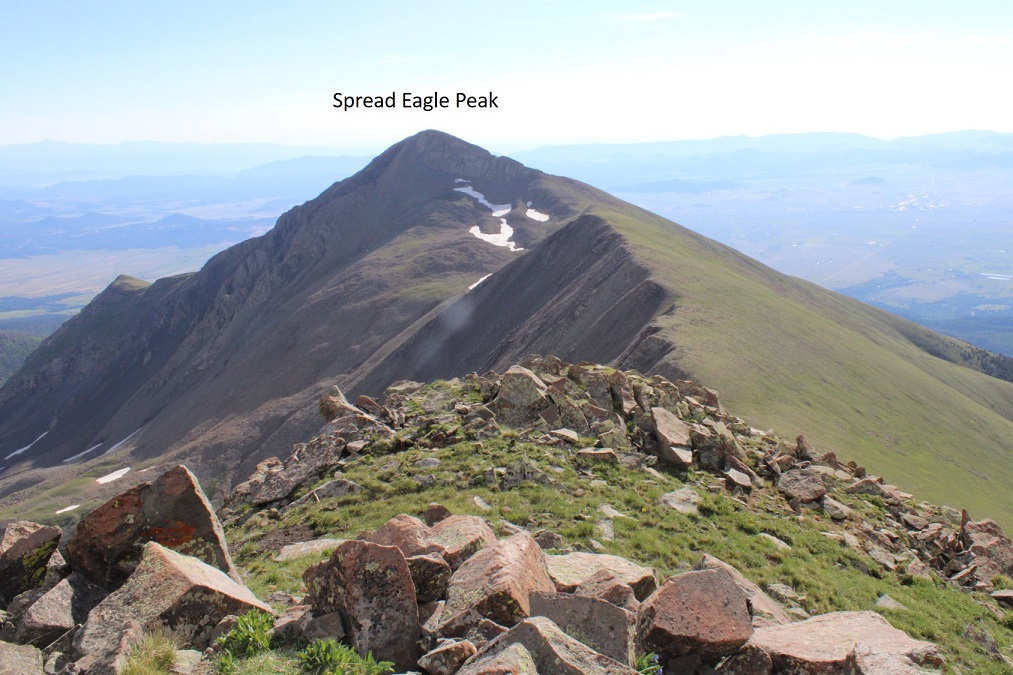
I was making this an out and back trip today, so I turned and looked back at Spread Eagle Peak

Here are some step-by-step pictures back to the saddle

This is how I accessed the ridge

And then followed the ridge north

The short class 3 section was easier to upclimb than downclimb.

Then it was an easy ridge hike to the summit

I turned and headed east down the ridge, back to treeline.  I saw elk here as well.

Once near treeline I headed back toward Gibson Creek, but as I said before, I encountered a lot of willows and it was slow going.  I’d recommend following the ridge as it slopes up a bit and becomes treed, and then heading northeast.

Yes, there’s bushwhacking and route finding involved.

I made it back to the creek, and followed the trail back as it curved northeast towards the trailhead

I crossed Gibson Creek one last time, and was back on the well-marked trail.

I made it back to my truck at 11:45am, making this an 11.05 mile hike with 5461’ of elevation gain in 8 hours.  Now, time to drive home, wake up my daughters, and grill some steak!

Little Horn Peak – 13,143 and Fluted Peak – 13,576

RT Length:  12.35 miles

Elevation Gain: 5504’

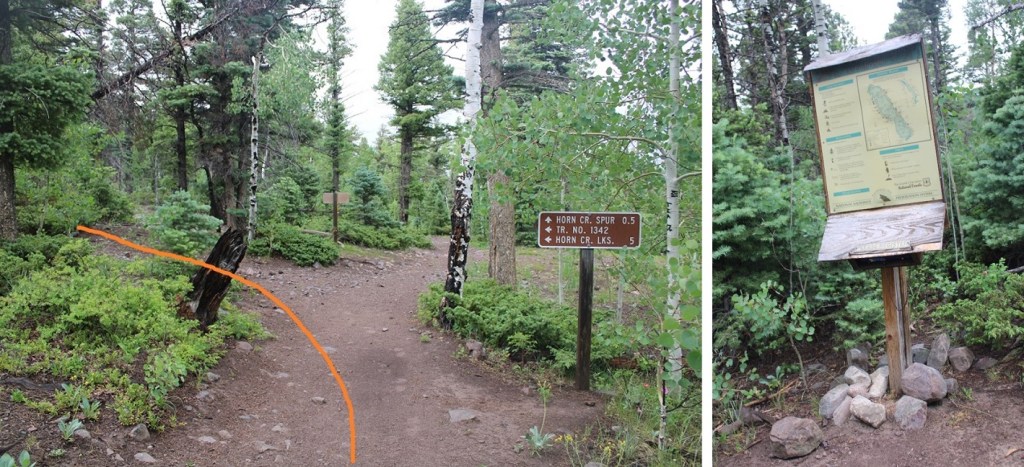
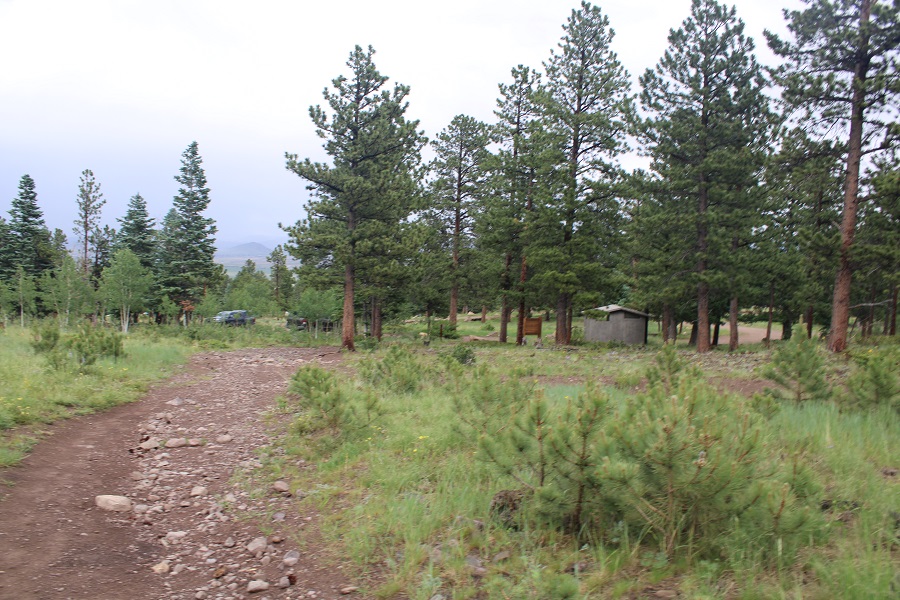
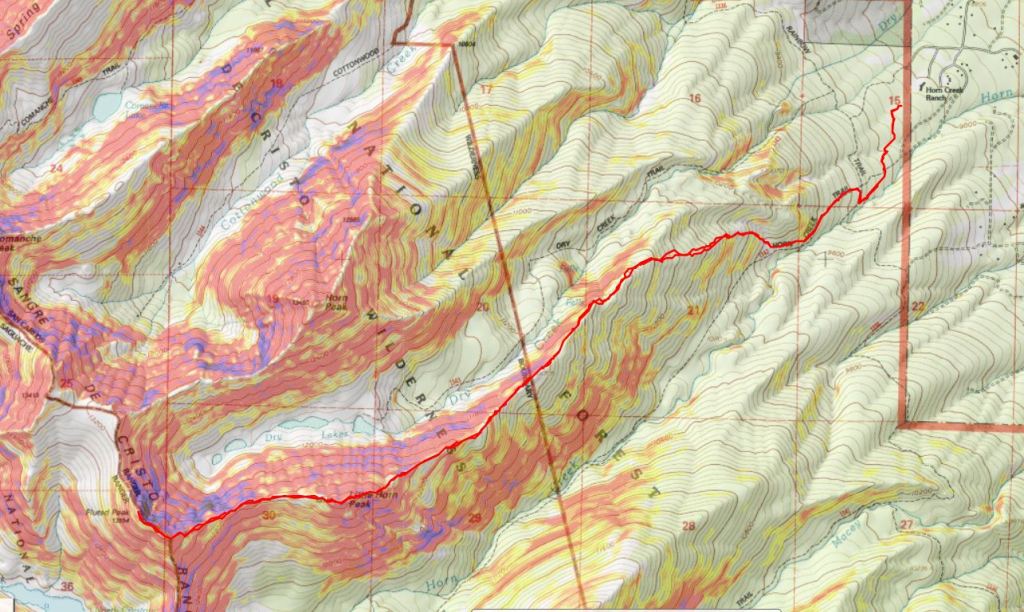
I parked at the Horn Creek Trailhead, the only vehicle in the lot.  I’m always surprised at how few people take advantage of the free dispersed camping sites we have in Colorado, especially ones like this with a bathroom.  Eager to summit and get back to treeline before the incoming storm, I gathered my gear and was on the trail at 4:30am.  The trail starts by following the Rainbow Trail southwest for just over half a mile

Then I turned right onto Horn Creek Trail

I followed Horn Creek Trail for a short distance, about a tenth of a mile, before turning left at the junction towards Horn Creek Lakes.  Here there’s a register, that looks to be kept up.

I stayed on this trail for half a mile, before leaving the trail at 9590’ and heading north and then west up the ridge.  There is no trail here.  I left a small cairn to indicate where I left the trail, but I don’t expect it to be there long, as it was small.

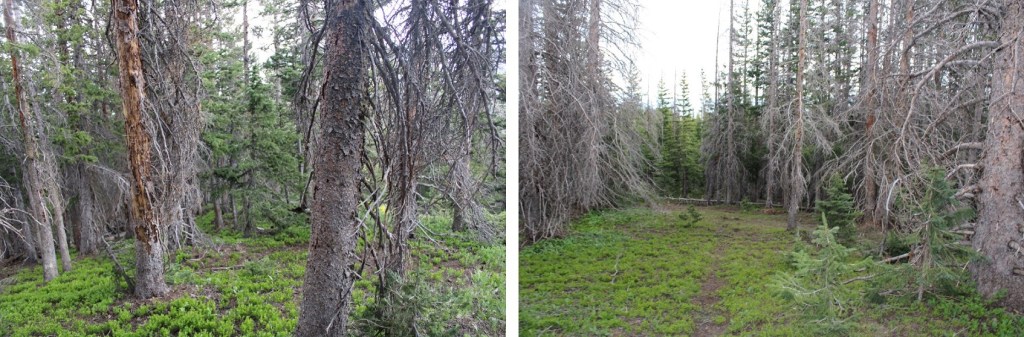
Route finding here can be a bit tricky, but the goal is to gain the ridge.  I did this by heading west, through the pine and aspen trees.  Every once in a while, I’d come across a game trail.  They all fizzled out however.  This area is easy to navigate, as there aren’t too many downed trees.  I was able to avoid most of them.

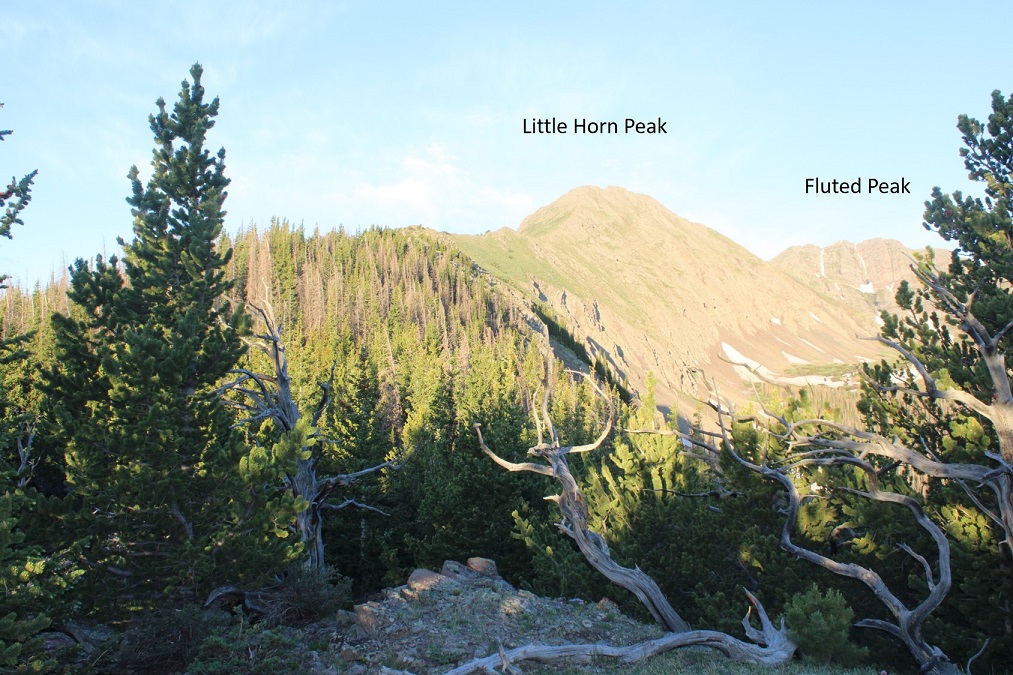
Once I was on the ridge, I followed it southwest to treeline.  This is a long ridge, and it seemed to take forever to make it to treeline.  Here’s my first glimpse of Little Horn Peak

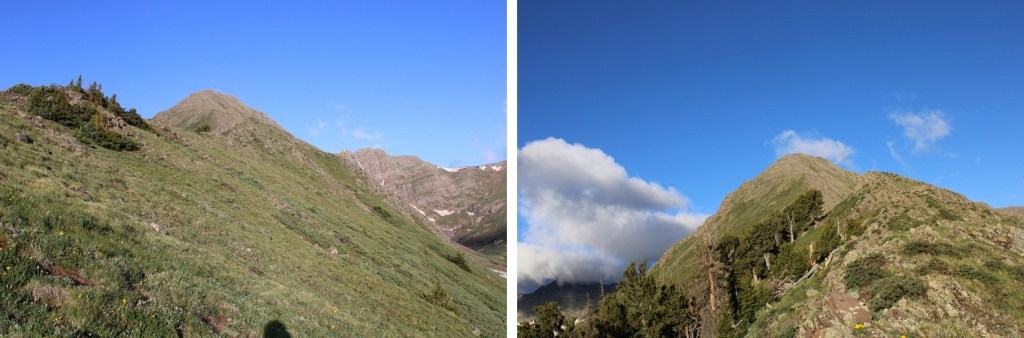
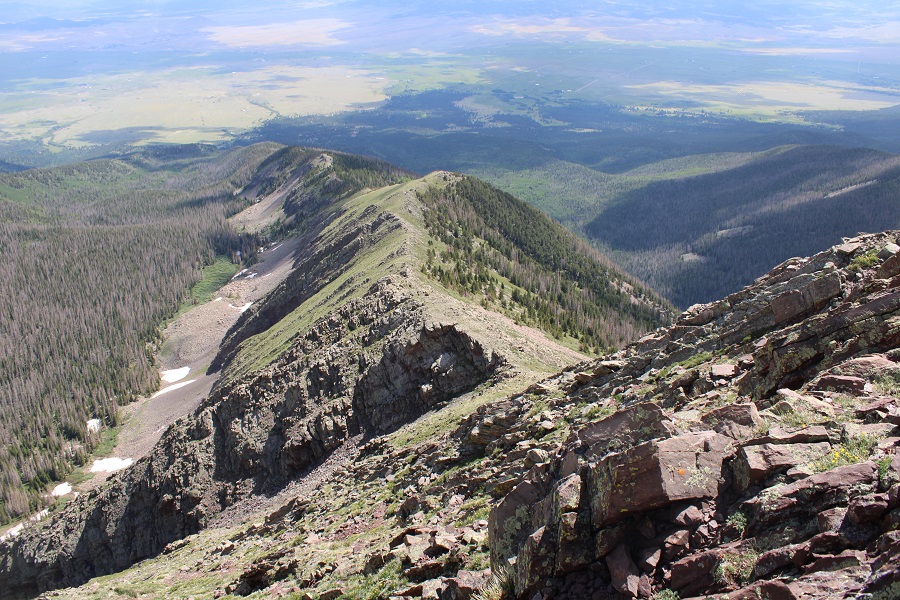
Like I said, this is a long ridge

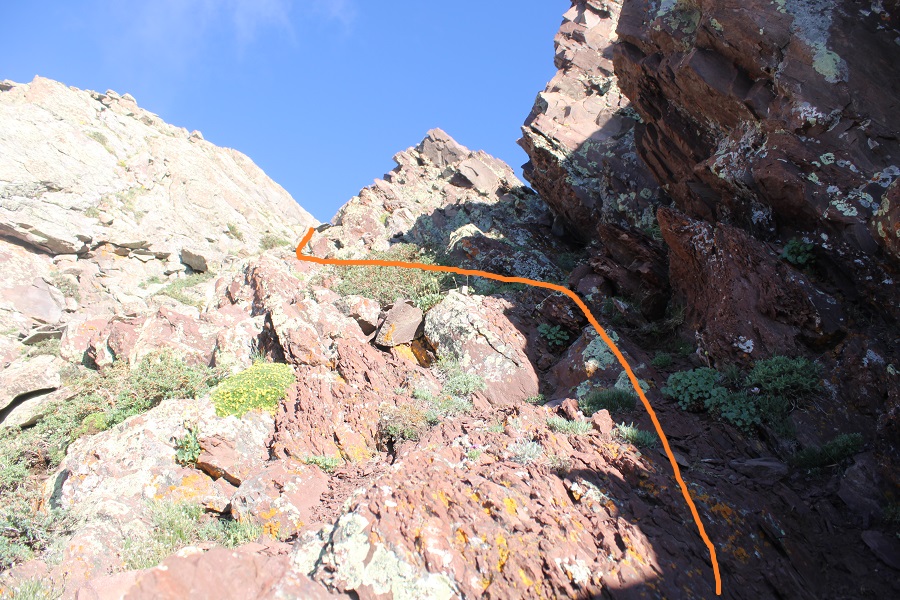
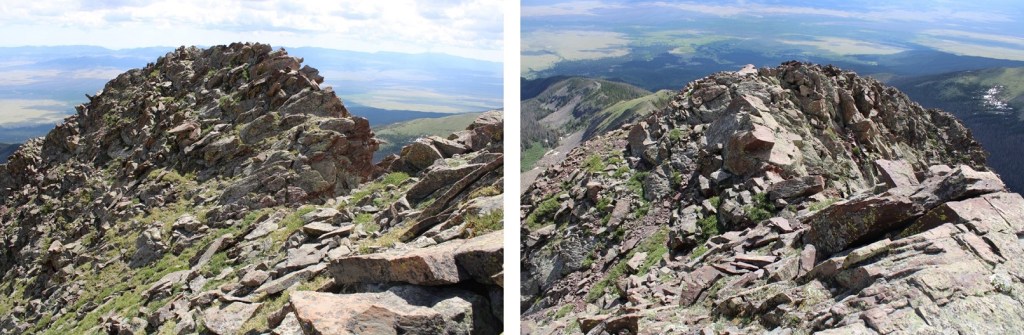
The class 3 fun starts at the top of the ridge, which is a false summit.  From here you can see Little Horn Peak’s true summit

My trekking pole isn’t collapsible, so I left it at the start of the class 3 section, put on my helmet, and started heading straight over the ridge.  The class 3 section is consistent for another half mile to the summit. 

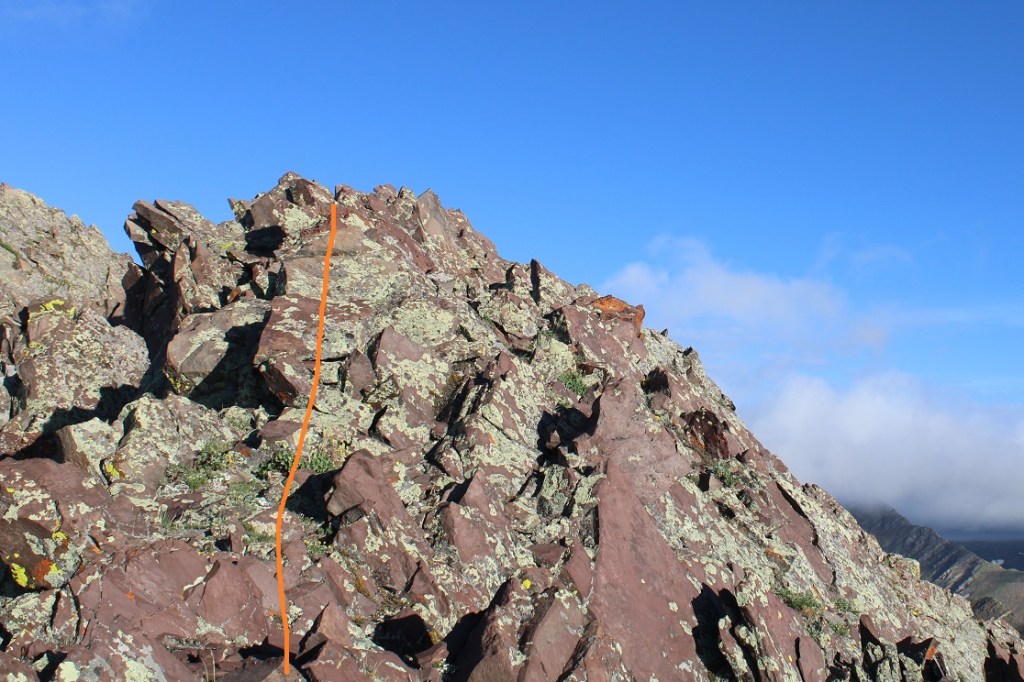
Start out by going straight over the ridge.  There is some exposure here. 

Then you’ll dip down to the right.  Look for a notch, go through it, and now you’re on the left side of the ridge. 

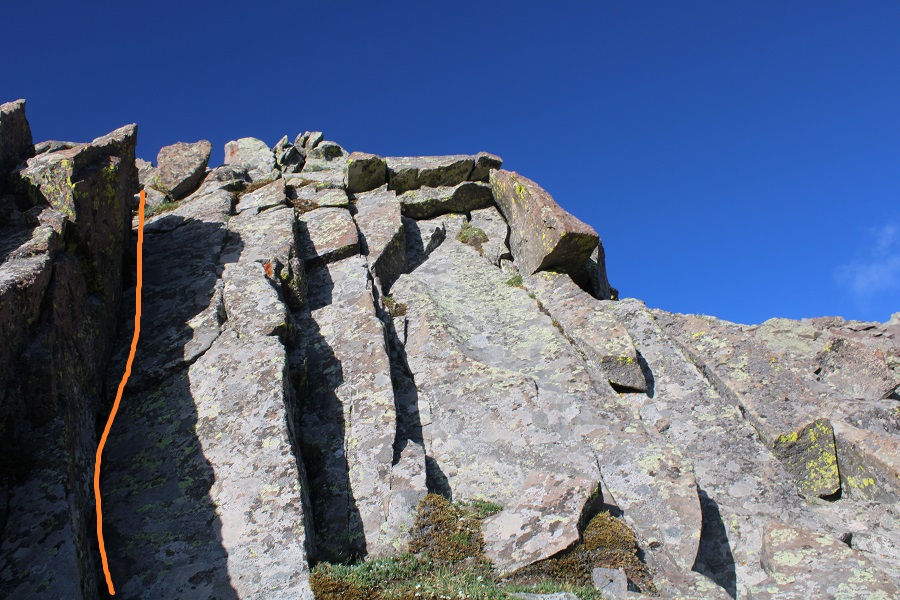
Go up the gully and cross back over to the right side of the ridge

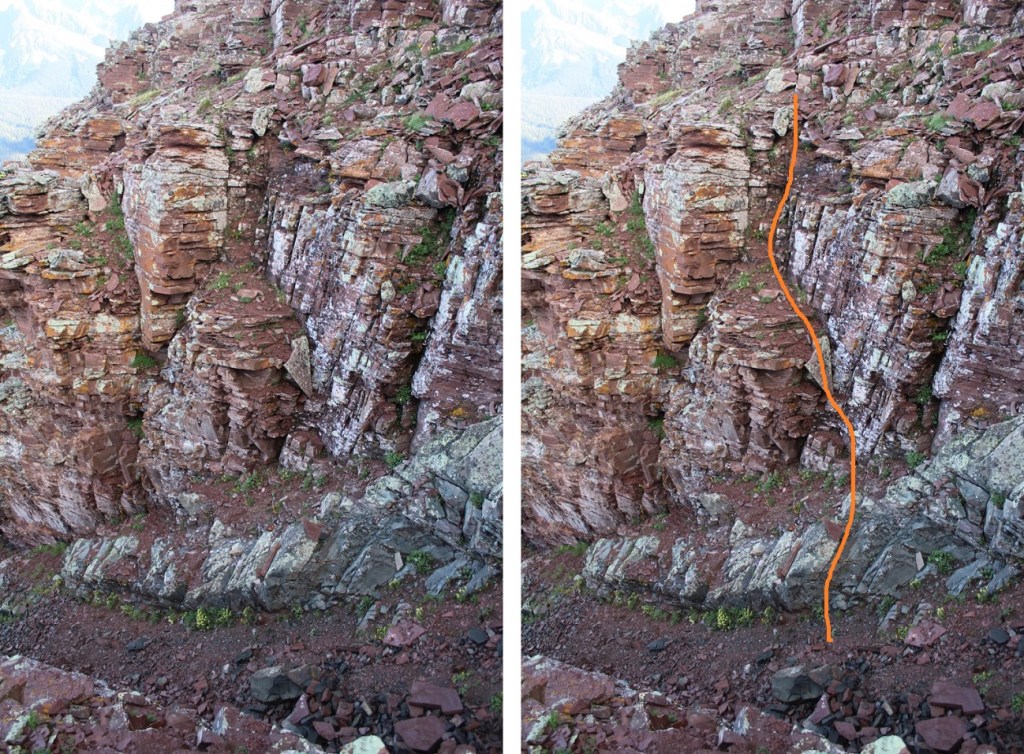
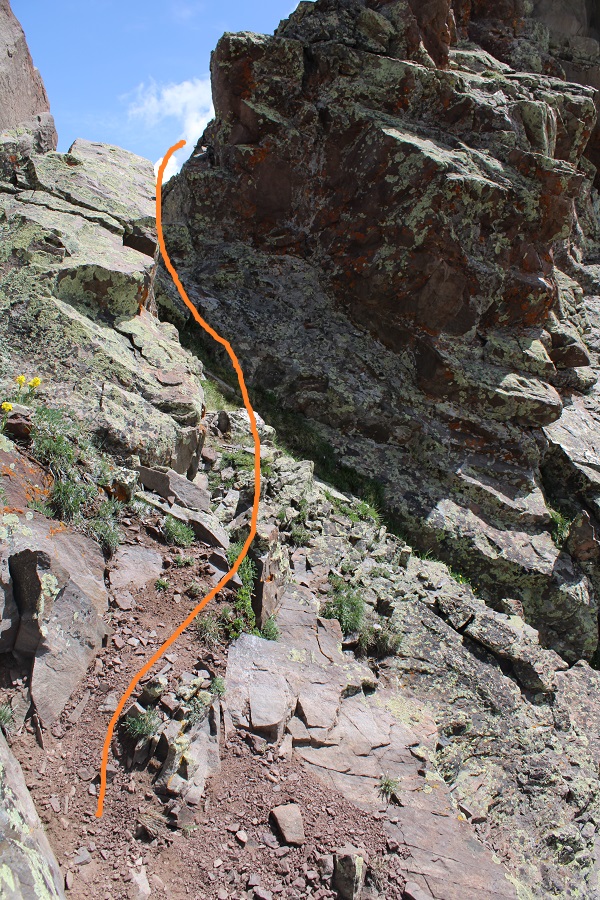
There’s a section of rock to upclimb.  This was difficult class 3 / easy class 4 (and much more difficult and committing on the way back down later in the day).  

From the top of this section I could see the summit.  I stayed on the left side of the ridge from this point on, staying on class 2 terrain.

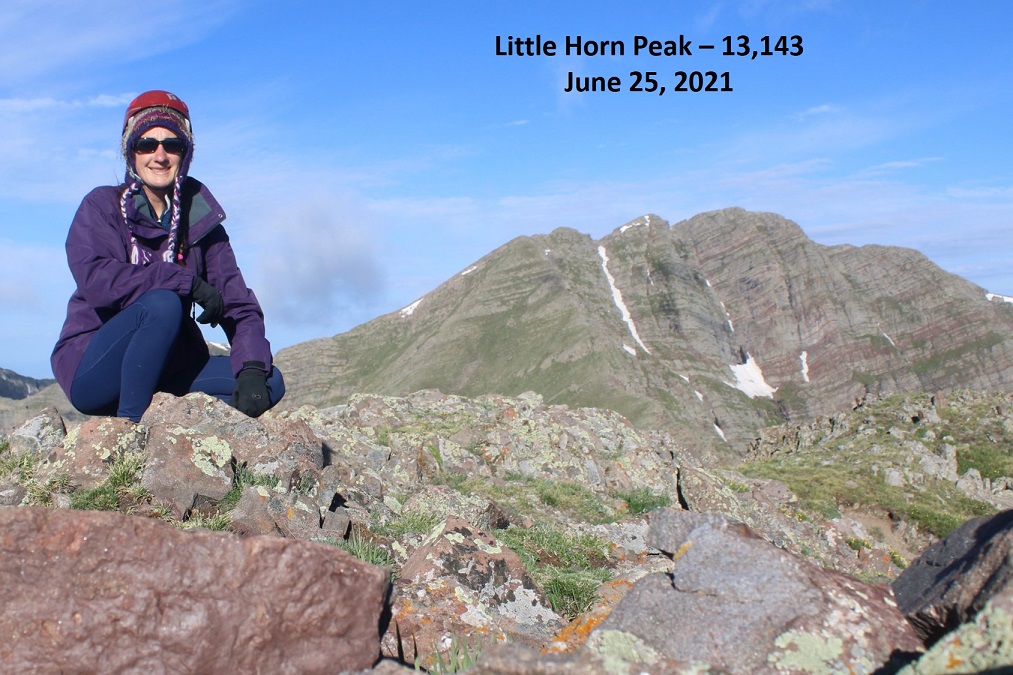
I summited Little Horn Peak at 7:45am

Little Horn Peak: 

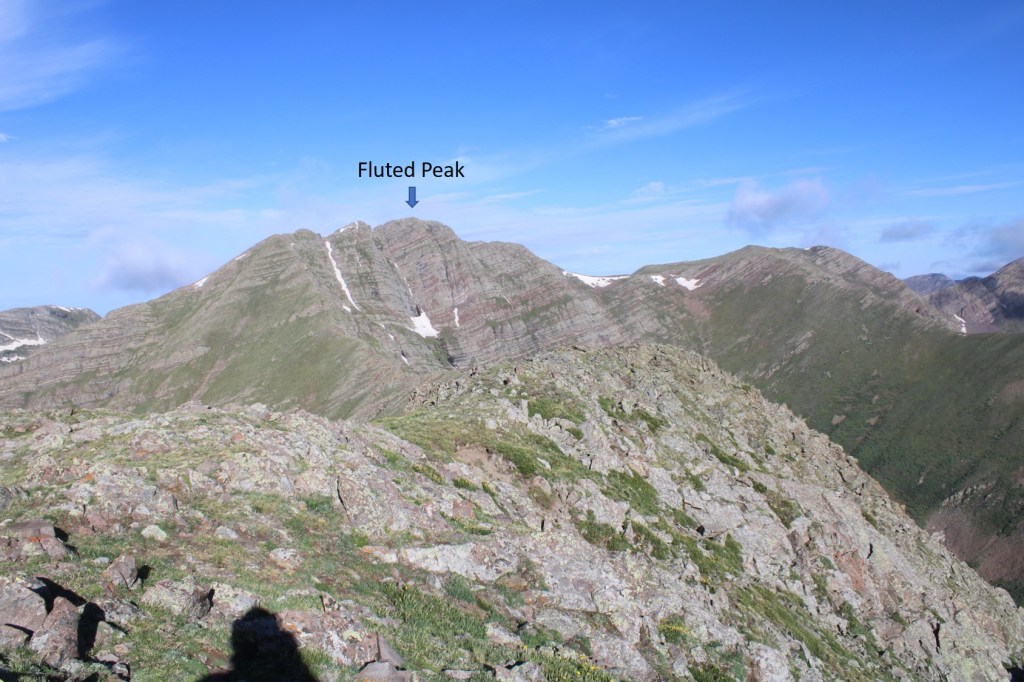
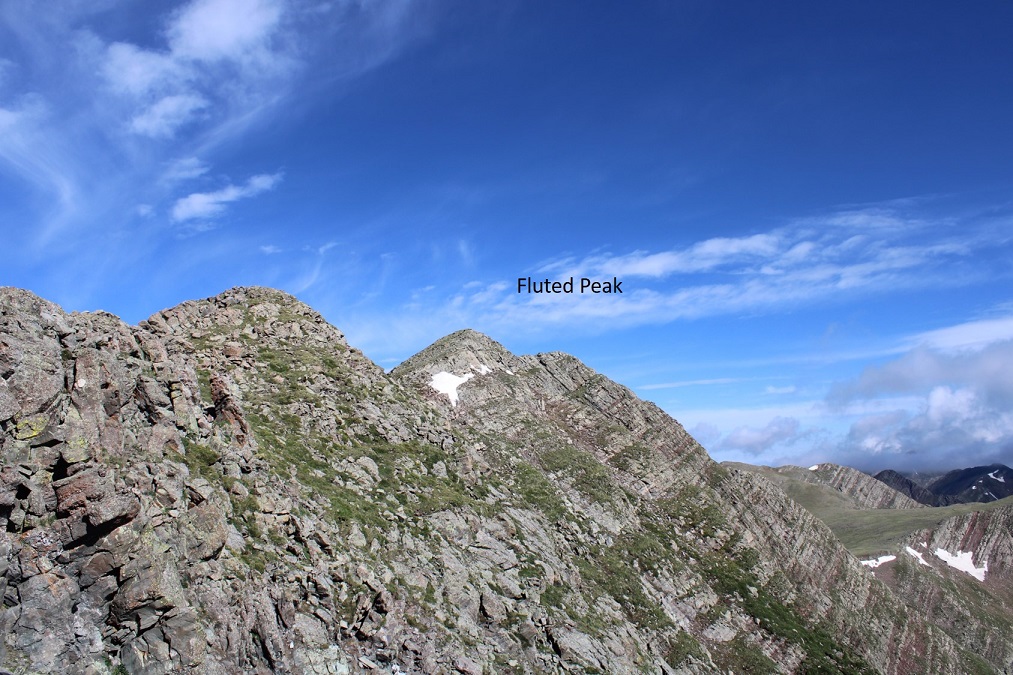
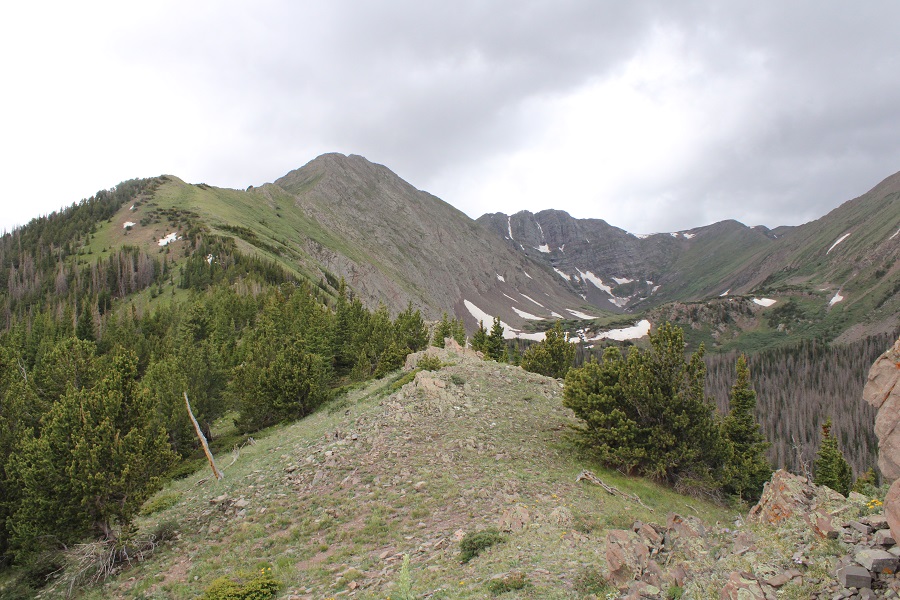
That was it for the class 3 section of the hike.  The ridge over to Fluted Peak is class 2 (with the option to go up a class 3 chimney, but it’s avoidable).  Here’s Fluted Peak to the west.

This was a simple ridge hike to the saddle.  You can’t see them very well in this photo, but there was a mama bighorn sheep with her baby walking up the ridge.  The baby couldn’t have been more than a month old.

From the saddle, here’s how you keep this a class 2 hike (dotted lines show the class 3 route)

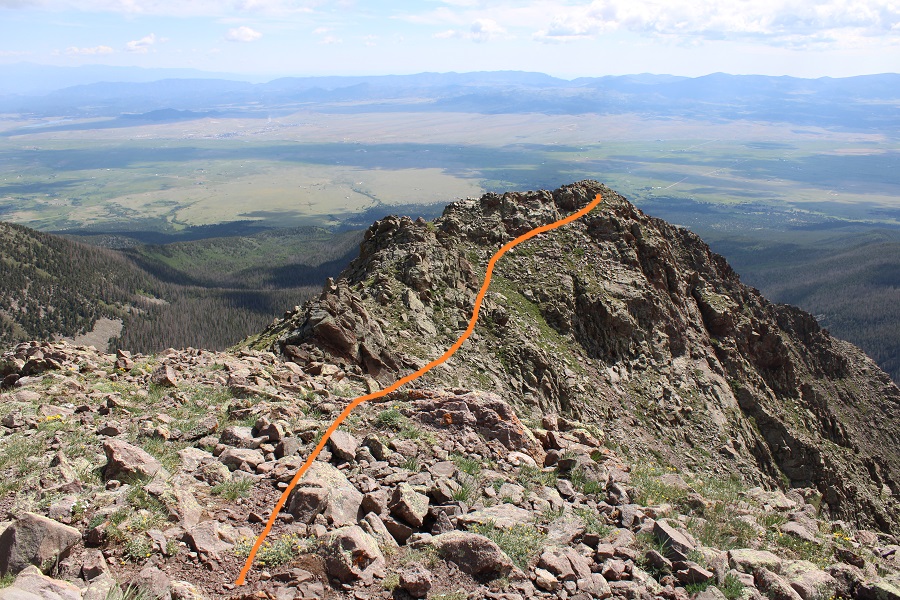
Here’s the first obstacle (class 2 solid, class 3 dotted):

And the second (class 2 solid, class 3 chimney dotted):

Here’s that chimney up close

After the chimney, it’s straightforward class 2 to the top of the ridge to the first false summit. 

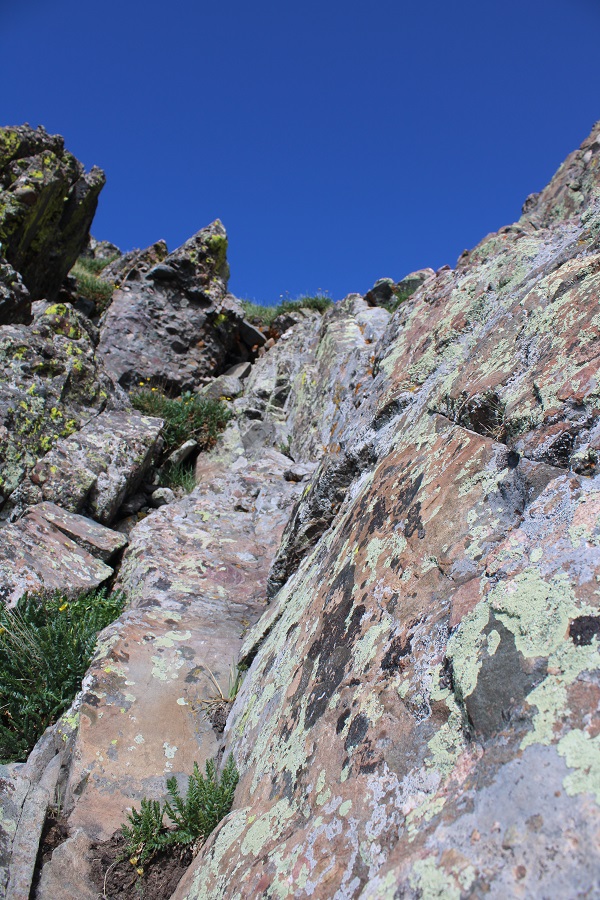
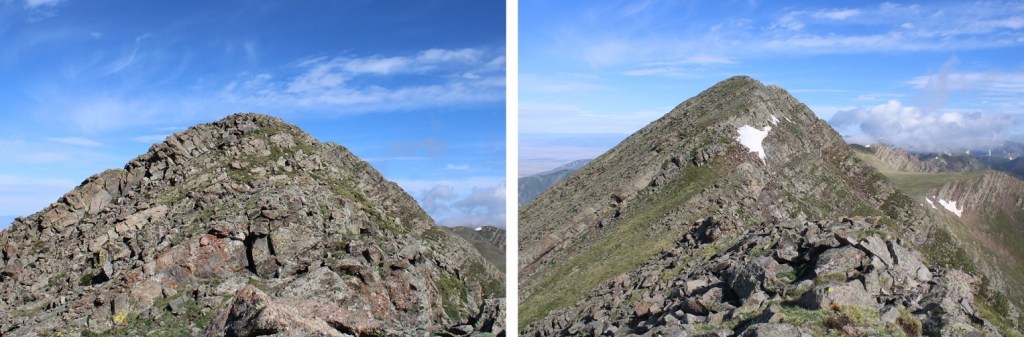
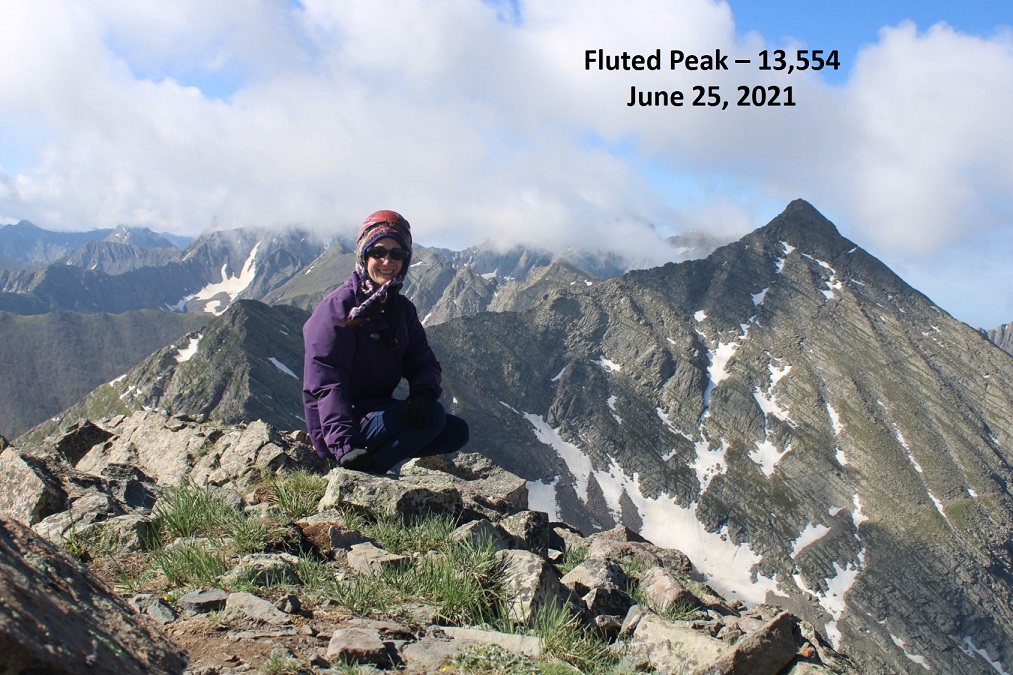
Fluted Peak is actually here

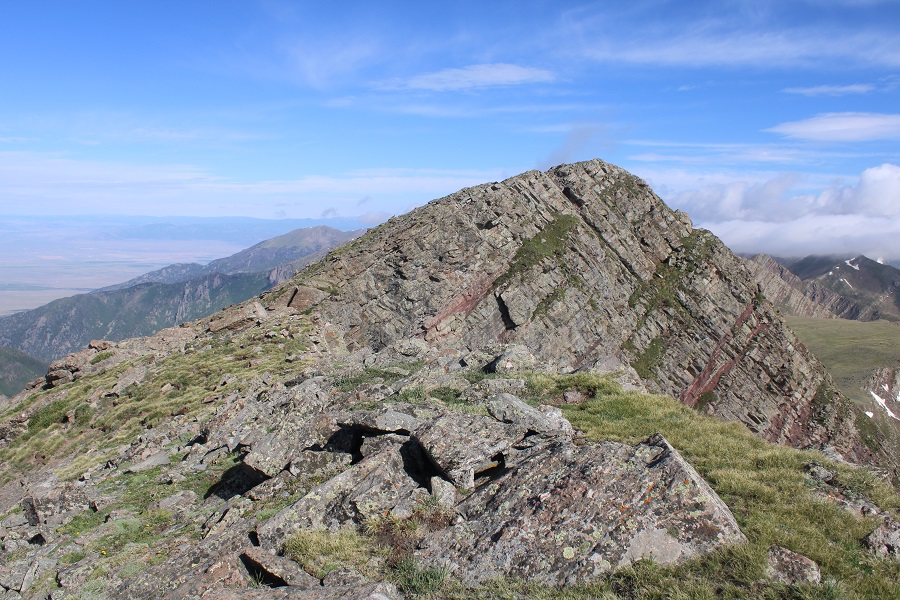
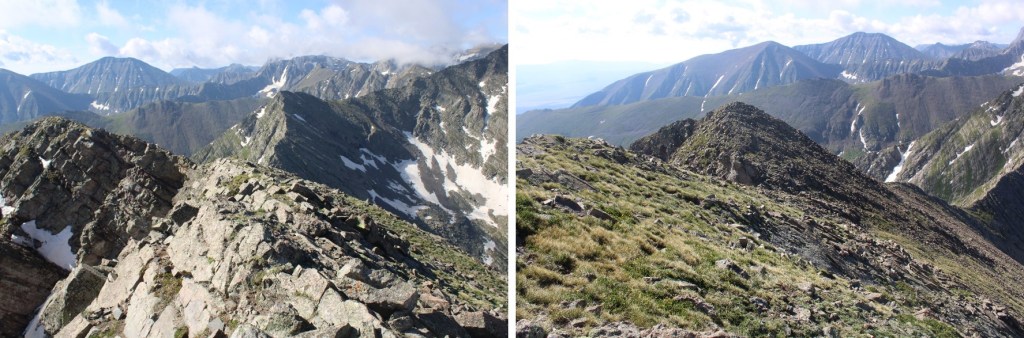
There are two quick false summits to go up and over

And then the final summit

I summited Fluted Peak at 9am

Fluted Peak: 

The clouds were coming in fast, so I decided to re-trace my steps and head back to Little Horn Peak (I’ve already summited Horn Peak, so there was no need to make this a loop today).  I headed back to the ridge

Here’s a picture of Little Horn Peak from the Fluted Peak Ridge

It all stayed class 2 until I made it to the summit of Little Horn Peak

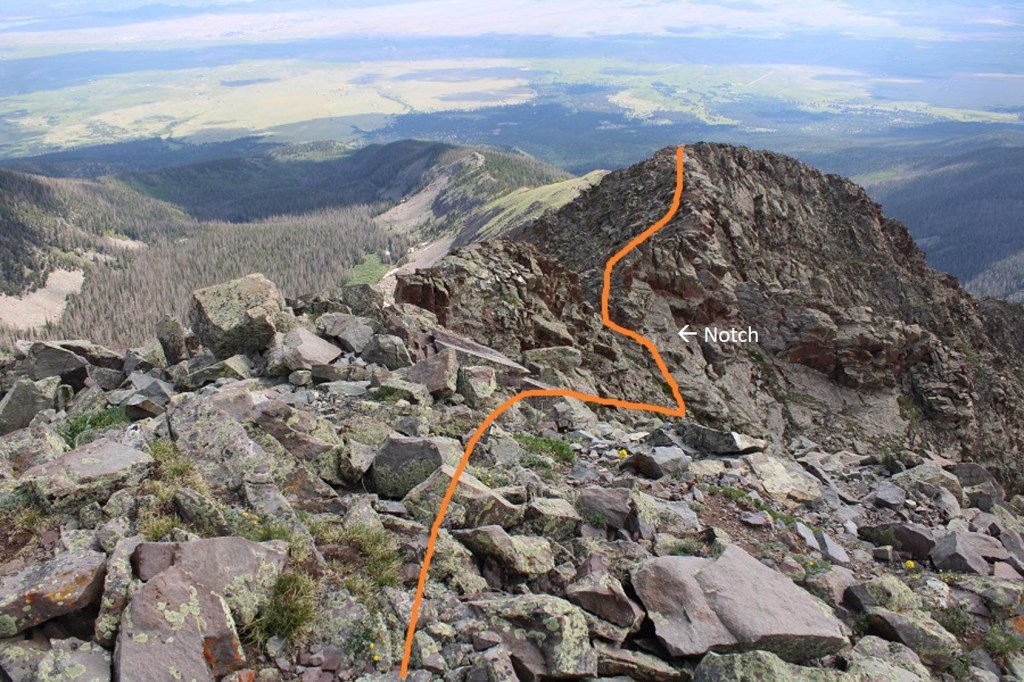
From there It was class 3 again until I made it to the ridge.

Here’s a closer look at that notch

And the last bit of scrambling to the ridge

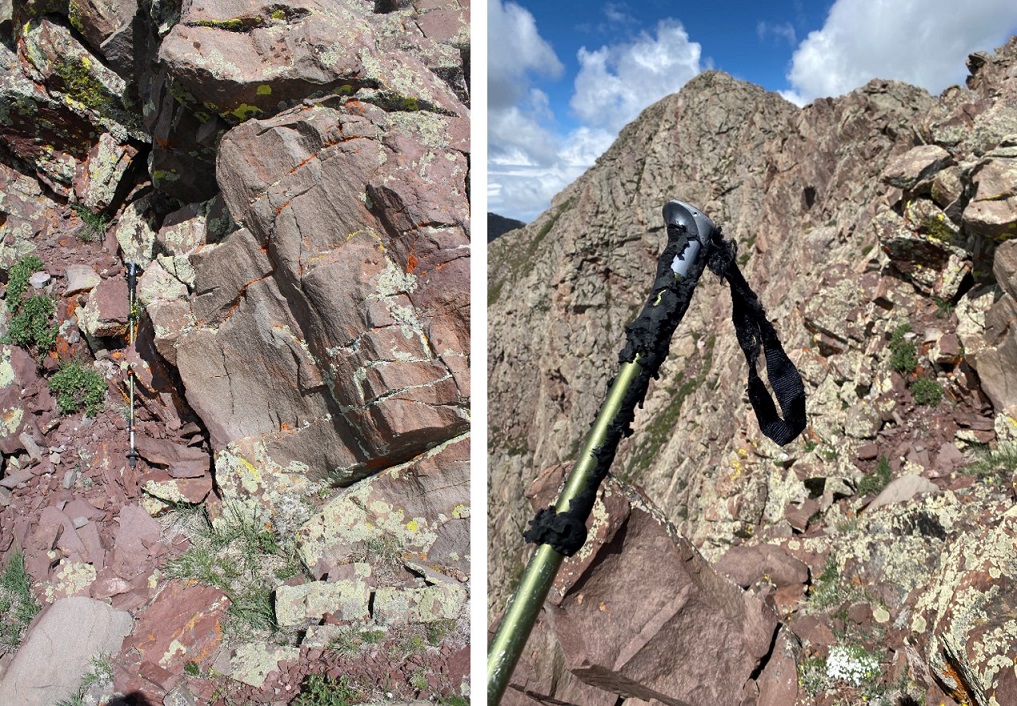
I made it to the ridge and looked around for my trekking pole.  It wasn’t where I’d left it.  Instead, it was about 15 feet away, at the entrance to a marmot burrow. I picked it up and found some marmot had turned it into a snack.  Just adding more photographic evidence to prove the case “Marmots can’t be trusted with trekking poles”.

I sighed, took off my helmet, and headed back down the ridge (yes, I brought the trekking pole down). 

Once back at treeline I turned back for a last view as it started raining. 

The rain quickly turned to hail and I had to put my camera away. Here are some pictures of below treeline, in-between bouts of rain/hail. I just kept descending northeast, and when the ridge ended I continued east towards Horn Creek Trail.  Once again, I’d pick up game trails and then lose them.   A little advice:  you should be able to hear Horn Creek flowing below you to your right if you’re going in the correct direction.

Back on the trail I followed it to the trailhead.

I made it back to the trailhead at 1pm, making this a 12.35 mile hike with 5504’ of elevation gain in 8.5 hours.  That had been a fun day of scrambling!

I dried off and headed to the next trailhead.  When I got there it was still raining, so I decided to make dinner inside the topper of my truck.  I finished, cleaned up, and was sitting down to write notes in my journal when I heard a loud “BANG!” 

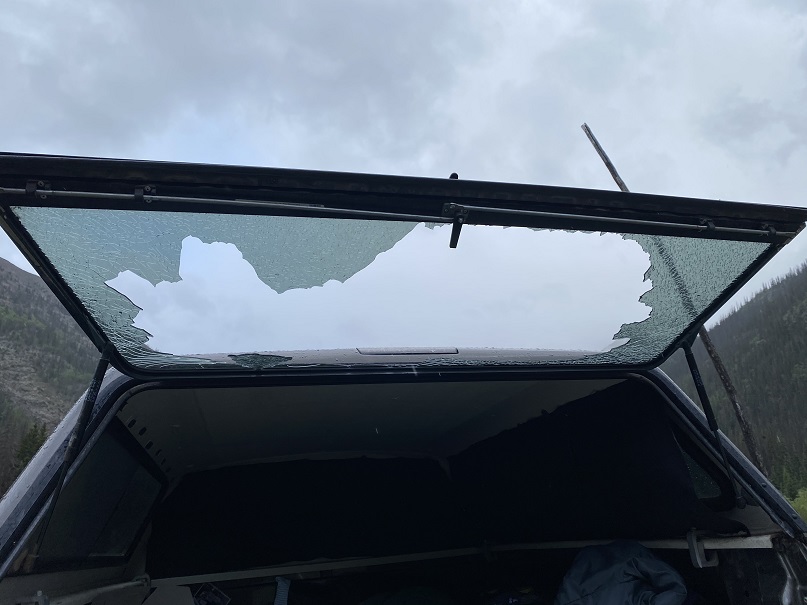
I looked up, and the back window to my topper crumpled and broke into thousands of pieces.  I honestly thought I’d been shot at, and turned around but didn’t see a bullet hole anywhere.  Next, I gingerly opened the window, crawled out of the truck and took a look around:  no one in sight (but it was still raining). 

I assessed the damage, and realized I needed to take care of this asap, so I put on gloves and cleaned up all the broken glass I could, still getting some small slivers of glass embedded in my fingers.  Next, I drove to where I could get cell reception, and found the nearest place that would be open the next day to fix the broken glass was 5 minutes from my home, and 6 hours from where I was right now.  I sighed:  It looked like I had a long night ahead of me. 

It turned out the auto glass store couldn’t help me, and told me to go to where I’d originally bought the topper.  They couldn’t help me for another 4-6 weeks (and $600), but referred me to another glass shop that didn’t open until Monday.  So, a quick trip to Walmart to pick up some duct tape and a tarp and I was able to create a makeshift door that does nothing to keep animals/intruders out, but has done a decent job keeping out the rain.  I’m still not sure why the window broke:  I was told sometimes there’s just a flaw in the glass.  That sounds bogus, but I’m getting a new one soon anyway, and I’ve learned not to get windows in my next topper (I don’t use them anyway).  I’m actually more upset I lost out on two days of hiking.